



Abstract
The Career Adapt-Abilities Scale (CAAS) is a widely used measure to assess career adaptability. The initial design covered four areas — concern, control, curiosity, and confidence. Recent research validated a 12-item version of the scale (CAAS-SF) and a five-factor version that includes the additional factor of cooperation (CAAS-5). The study reported here developed and validated a brief 15-item Chinese version of Career Adapt-Abilities Scale (CAAS-5-SF) to include five factors. Based on data obtained in Macao from a sample of 326 university graduates who had gained employment, it was found that the scale has good factor structure and internal consistency. Significant correlations between CAAS-5-SF and career success, as well as between cooperation subscale and social capital, provided evidence for convergent validity of the instrument and the cooperation subscale respectively. It was also found that CAAS-5-SF and CAAS-5 were strongly associated in their subscales and overall scale. Results suggested that CAAS-5-SF is a suitable alternative to CAAS-5 for research and practice purposes with Chinese speakers. Implications for research and practice are discussed.
Sociocultural and Economic Background of Macao
Macao, situated in the coastal area of southern China neighboring Hong Kong, was a Portuguese colony for about 400 years from the 16th century. It was returned to China in 1999 and became a Special Administrative Region of People’s Republic of China. The liberalization of its gaming industry in 2002 resulted in unprecedented economic growth. The city surpassed Las Vegas as the world’s biggest gambling center in 2006, and the GDP per capita rose to USD123,892.2 in 2018, ranking number two in the world (World Bank, 2018). The strong economy leads to a vibrant job market, with unemployment rate as low as 1.7% (Statistics and Census Service, 2019). However, over reliance on the gaming and hospitality industry has resulted in limited vocational options for young people in Macao (Education and Youth Affairs Bureau, n.d.). Macao youth also lack career planning and adaptability to navigate the vocational paths in the changing environment (Macao Federation of Trade Unions, 2013).
Career Adaptability
The world of work today offers less stability and predictability in people’s career paths, due to such influences as globalization, digitalization, technological innovation, rapid shifts in occupational structures, and changes in the labor market. The result has been an urgent need for greater flexibility and mobility in the workforce, with new paradigms required by schools, vocational colleges and universities to address career planning and development in the new era (Coutinho et al., 2008; Hall, 2002; Savickas, 2011).
Career construction theory is one of the contemporary models that addresses the needs of today’s workers who may have to negotiate a lifetime of job changes. Central to the theory is the concept of career adaptability, which can be described as an individual’s preparedness for coping with occupational transitions and changes in work practice (Savickas, 1997, 2005, 2013). Career adaptability draws on a set of psychosocial resources that shape an individual’s behaviors for adjusting to the environment, thereby achieving desired goals along a career path (Savickas, 2013; Savickas & Porfeli, 2012).
According to career construction theory, there are four dimensions of career adaptability, or 4Cs — concern, control, curiosity, and confidence. An adaptable individual, when faced with new or modified vocational tasks, occupational transitions, or work traumas, is conceptualized as a) becoming concerned about the future of their career, b) exercising control to make necessary preparations, c) displaying curiosity by exploring different potential opportunities, and d) strengthening confidence to realize one’s aspirations. A team of vocational psychologists constructed and validated an international form of the Career Adapt-Abilities Scale (CAAS) to assess career adaptability along these four dimensions (Savickas & Porfeli, 2012). The measure consists of four subscales covering concern, control, curiosity, and confidence, each with 6 items.
CAAS has been applied extensively in research, finding that career adaptability is associated positively with career identity (Porfeli & Savickas, 2012), career decision self-efficacy (Douglass & Duffy, 2015), career satisfaction and performance evaluations (Zacher, 2014), and proactive career behaviors (Taber & Blankemeyer, 2015). Career adaptability is also linked with career engagement (Nilforooshan & Salimi, 2016), higher employment quality in the school-to-work transition (Koen et al., 2012), and other dimensions in life such as meaning in life (Yuen & Yau, 2015), well-being (Maggiori et al., 2013), and quality of life (Soresi et al., 2012). Tien et al. (2014) validated CAAS in Macao and contended that career adaptability was an essential attribute for young people in Macao to achieve self-realization.
Five-Factor Model of Career Adaptability and Cooperation Dimension
In addition to the 4Cs, cooperation, which refers to one’s ability to work along with others by compromising and contributing, was originally proposed as the fifth dimension of career adaptability. This interpersonal dimension was thought to be an important adaptability resource, at least in the collective societies. In the cross-cultural validation of CAAS, however, the cooperation subscale, despite showing strong psychometric properties in and of itself, did not cohere with the other four factors in the initial analysis. The researchers thought that cooperation might be more related to adapting behaviors rather than contributing specifically to career adaptability, and thus removed it from the final measure (Einarsdóttir et al., 2015).
However, McMahon et al. (2012) identified cooperation as a critical feature of career adaptability among older women in Australia, England and South America. They noted the importance of social relationship networks during the women’s career transitions. In a separate study in Norway and UK, Brown et al. (2012) found that meaningful interactions at work and participating in work-related communities represented a platform for developing adaptability among mid-career changers. Adopting a culturally sensitive emic approach, Einarsdóttir et al. (2015) developed a version of CAAS sensitive to the collective culture in Iceland. They identified cooperation and contribution as separate dimensions of career adaptability relevant for Icelanders. Further research is necessary to examine whether cooperation does indeed contribute to career adaptability.
Nye et al. (2018) contented that the inclusion of cooperation as an adaptability resource was theoretically appropriate, citing that some theories already recognized this interpersonal element in career adaptability, but is often overlooked in research in Western predominantly individualistic cultures. They argued that a model of career adaptability that recognizes a collective dimension is more complete than one that only considers individualistic factors. Using samples from United States, Mainland China and Taiwan, Nye et al. (2018) validated a five-factor Career Adapt-Abilities Scale (CAAS-5), adding cooperation as the fifth dimension. The five-factor model fitted the data reasonably well across the three samples, providing additional support for the inclusion of cooperation in any adaptability measure. However, the researchers acknowledged that they had only examined the internal validity with the measurement model, and further research to investigate the external validity of CAAS-5 is warranted.
Given the initial evidence that suggests the inclusion of cooperation as a factor in the measurement of career adaptability (Brown et al., 2012; Einarsdóttir et al., 2015; McMahon et al., 2012; Nye et al., 2018), the aim of the current study was to validate a short form of CAAS-5 (CAAS-5-SF). The motivation to reduce the length of the original scale came from the research by Maggiori et al. (2017). They had validated a brief version of CAAS (CAAS-SF), reducing the length of scale by half, with just 3 items in each subscale and 12 items in total. The brevity makes the scale much easier to use, in both counseling and research situations. Given the good model fit of CAAS-5 (Nye et al., 2018) and the strong associations between CAAS and CAAS-SF (Maggiori et al., 2017), the following hypotheses were generated: Hypothesis 1: CAAS-5-SF will fit well to the five-factor model of career adaptability. Hypothesis 2: The total and subscale scores of CAAS-5-SF will be positively correlated with those of CAAS-5.
Differences across Gender and Education Level
There is no theoretical basis to expect gender differences in career adaptability, and research on gender differences have been inconclusive. Within Chinese societies, Tien et al. (2014) and Yuen and Yau (2015) found no significant gender difference on adaptability in Macao and Hong Kong. However, Hou et al. (2012) found that males had significantly higher scores on control, curiosity, and confidence (but not concern). It therefore seemed appropriate to also examine gender differences in adaptability in the present study.
Additionally, Savickas and Porfeli (2012) viewed adaptability resources as a form human capital, which can be accumulated through education and experience. It is reasonable to expect that people with higher education will have higher adaptability. Tien et al. (2014) also found that participants with higher educational levels had higher adaptability. Therefore, a third hypothesis was generated: Hypothesis 3: Postgraduate degree holders have higher career adaptability scores than their undergraduate counterparts.
In order to compare scores across different groups, an instrument must possess measurement invariance at the scalar level (Yu & Shek, 2014). Therefore, the measurement invariance of CAAS-5-SF would be examined in the present study. The analysis procedure is discussed later.
Career Success
Career success is typically conceptualized as the positive work-related achievements or psychological outcomes accumulated in one’s career journey, and is composed of extrinsic and intrinsic success (Seibert et al., 1999). Extrinsic career success refers to objective achievements, such as salary, status and promotions, whereas intrinsic career success is an individual’s subjective evaluations, such as sense of accomplishment, meaning and satisfaction (Seibert et al., 2001). The subjective dimension is particularly important as individuals cannot be considered successful in their careers if they are dissatisfied with their work (Judge et al., 1999). In addition, perceived internal marketability (belief that one is of value to the current employer) and perceived external marketability (belief that one is of value to other employers) are considered important indicators of subjective career success because successful individuals are those who are valuable and marketable in their current or other organizations (Eby et al., 2003). The present study focused on examining these subjective dimensions of career success.
According to career construction theory, career adaptability enables adapting behaviors that can in turn lead to the goal of adaptation. The outcome of adaptation is the implementation of self-concepts in a new work role and is indicated by success and satisfaction (Porfeli & Savickas, 2012). Existing research has shown that career adaptability predicts subjective career success (Guan et al., 2015; Zacher, 2014). On this basis, a fourth hypothesis was generated: Hypothesis 4: Career adaptability is positively associated with perceived career success.
Social Capital
Social capital is conceptualized as the valuable resource derived from an individual’s interpersonal network connections (Zhang et al., 2010). This form of resource can be divided into bonding and bridging capital. Bonding capital refers to social relationships that link people who are homogeneous, with bonding based on common lineage or interests, such as family, friends and colleagues. Bridging capital refers to network connections that link people who are heterogeneous, with connections made through social groups and organizations (Chen et al., 2008; Wang et al., 2014).
Social capital is considered a key determinant of career success as it provides access to career-related information, resources and sponsorship, which are important factors that facilitate career development (Seibert et al., 2001; Zhang et al., 2010). For young people who are transitioning from school to work, it is expected that those with more social capital are likely to have better employment outcome. In addition, social capital is characterized by trust and reciprocity (Zhang et al., 2010), so individuals with good social capital are expected to get along or cooperate well with others. In order to explore these beliefs in the present study, the following hypotheses were framed: Hypothesis 5: Social capital is positively associated with perceived career success. Hypothesis 6: Career cooperation is positively associated with social capital.
Purpose of the Current Study
The main purpose of the study was to validate CAAS-5-SF. Macao has a population of 667,400, over 92% of which are ethnic Chinese. It has the highest population density in the world, standing at 20,000 per sq. km (Statistics and Census Service, 2019). Such high population density has many implications, one of which being the closely-knit social environment where interpersonal relationship is essential for one’s career development (Sultana, 2010). Macao is also a collective society (Morrison, 2006), and the social influence on one’s vocational experience is salient (Ouyang et al., 2016). Therefore, Macao was considered to be a suitable setting for validating the social and cooperative component of career adaptability. Validation of the scale will be beneficial to personnel involved in career development services in Macao.
Method
Participants
Data were collected from 326 recent graduates from a public university in Macao (age range: 21–38 years, M = 25.05, SD = 3.44; gender: 39.6% males; ethnicity: 99.4% Chinese). These individuals had all secured employment. The top five work sectors were education (23.6%), banking and finance (10.4%), government (8.6%), hotel (7.1%), and gaming and entertainment (6.7). Within the sample, 180 (55.2%) had graduated from undergraduate programs, while 118 (36.2%) and 28 (8.6%) from Masters and Doctoral programs respectively.
Measures
Career adaptability
Career adaptability was measured using CAAS-5 (Nye et al., 2018). The Chinese version was originally translated by Tien et al. (2012). The items in the measure were equally divided into the five subscales of concern, control, curiosity, confidence, and cooperation. The total score indicates the strength of an individual’s current career adaptability. Example items include “preparing for the future” (concern); “sticking up for my beliefs” (control); “imagining what my future will be like” (curiosity); “overcoming obstacles” (confidence); and “playing my part on a team” (cooperation). Participants responded to the items using a 5-point Likert-type scale ranging from 1 (not strong) to 5 (strongest). The instrument has been found to have good psychometric properties and structural validity (Nye et al., 2018). In the present study, the reliabilities of the subscales were .91 (concern), .89 (control), .89 (curiosity), .89 (confidence), and .83 (cooperation). The reliability of the overall scale was .96.
Career success
Career success was measured with the Career Success Scale (Eby et al., 2003), which was translated into Chinese by Wang and Long (2009). The 11-item measure includes three subscales, namely perceived internal marketability (3 items), perceived external marketability (3 items) and career satisfaction (5 items). Example items include “my company views me as an asset to the organization” (perceived internal marketability); “I could easily obtain a comparable job with another employer” (perceived external marketability); and “I am satisfied with the success I have achieved in my career” (career satisfaction). Participants responded to the items using a 5-point scale ranging from 1 (totally disagree) to 5 (totally agree). The instrument has been found to have good internal consistency, test-retest reliability, and structural validity with Chinese samples (Li et al., 2014; Wang & Long, 2009). In the present study, the reliabilities of the subscales were .83 (perceived internal marketability), .84 (perceived external marketability), and .88 (career satisfaction). Reliability of the overall scale was .92.
Social capital
Social capital was measured with the Chinese version of Personal Social Capital Scale (PSCS) 8 (Wang et al., 2014), which was a brief version of the 42-item PSCS developed by Chen et al. (2008). The instrument includes two four-item subscales addressing bonding capital and bridging capital, and the total score indicates an individual’s overall social capital. In the present study, the wording of some items was slightly modified by two career development professionals to better match with the language usage in Macao. Example items of the scale include “How do you rate the number of your friends” (bonding capital), and “How many of the social groups/organizations will help you upon your request?” Participants responded to the items on 5-point scale ranging from 1 (none/a few) to 5 (all/a lot). The instrument has good reliability, construct and concurrent validity (Wang et al., 2014). In the present study, the reliabilities were .79 for bonding capital, .90 for bridging capital, and .86 for the overall scale.
Procedure
Ethical approval was obtained before the survey was conducted. Data were collected at the same time as the university’s own Graduate Employment Survey. The university’s Career Center sent the relevant questionnaires to students who had graduated within the past 6 months and had gained employment. Participation in the survey was entirely voluntary.
Data Analysis
The main purpose of the present study was to validate CAAS-5-SF. Analyses were conducted using Statistical Package for Social Sciences Version 24 and AMOS statistical package Version 24.0 (Arbuckle, 2016). First stage of the analysis involved generating descriptive statistics and scale reliabilities based on the 12 items from CAAS-SF (Maggiori et al., 2017). Using confirmatory factor analyses (CFA), a measurement model of CAAS-SF was estimated with the current sample. The establishment of the scale reliabilities and internal validity provided foundation for the next stage of analysis.
At the second stage, the six cooperation items from CAAS-5 (Nye et al., 2018) were added to CAAS-SF. To make this addition consistent with the other subscales, the six cooperation items were reduced to three, based on empirical and theoretical considerations. This process produced the CAAS-5-SF, with three cooperation items added to the original 12 items of CAAS-SF. CFA on CAAS-5-SF was then conducted, along with the descriptive statistics and internal consistencies of the scale. Based on the sample size and model complexity of the current study, the following cutoff values of goodness-of-fit indices were adopted: (a) comparative fit index (CFI) and Tucker-Lewis index (TLI) >.92, (b) root mean square error of approximation (RMSEA) <.08, and (c) the standardized root mean square residual (SRMR) <.08 (Hair et al., 2014).
At the third stage, to test the measurement invariance of the new CAAS-5-SF across gender (male vs female) and educational level (undergraduate vs postgraduate), a stepwise multigroup CFAs were conducted in accordance with the procedure proposed by Rudnev et al. (2018). Testing involved 3 levels of invariance, namely configural, metric, and scalar invariance. Configural invariance refers to the measurement of same concepts across groups and is indicated when the general factor structure is the same across groups. Metric invariance means that constructs are measured by equivalent measurement units across groups and is met when factor loadings are the same across groups. Scalar invariance means that the scales measuring the constructs have the same measurement units and same zero points across groups. It is met when factor loadings and item intercepts are the same across groups. Invariance at the scalar level is necessary for meaningful comparison of scores across groups (Rudnev et al., 2018; Yu & Shek, 2014). When measurement invariance was established, CAAS-5-SF scores across gender and educational level were compared using multivariate analysis of variance (MANOVA).
At the fourth stage, correlational analyses among CAAS-5-SF, career success, and social capital factors were conducted. Finally, to better understand the relative strength of the CAAS-5-SF and social capital factors in predicting career success, hierarchical linear regression analyses were conducted.
Results
Preliminary Analysis
The skewness of all items ranged from −.803 to .582, and kurtosis ranged from −.524 to 1.126, indicating that the data were normally distributed in this sample. Maximum likelihood estimation was suitable for assessing the goodness-of-fit in the analysis (Hair et al., 2014). There was also no missing data. 1
Psychometric Properties of CAAS-SF
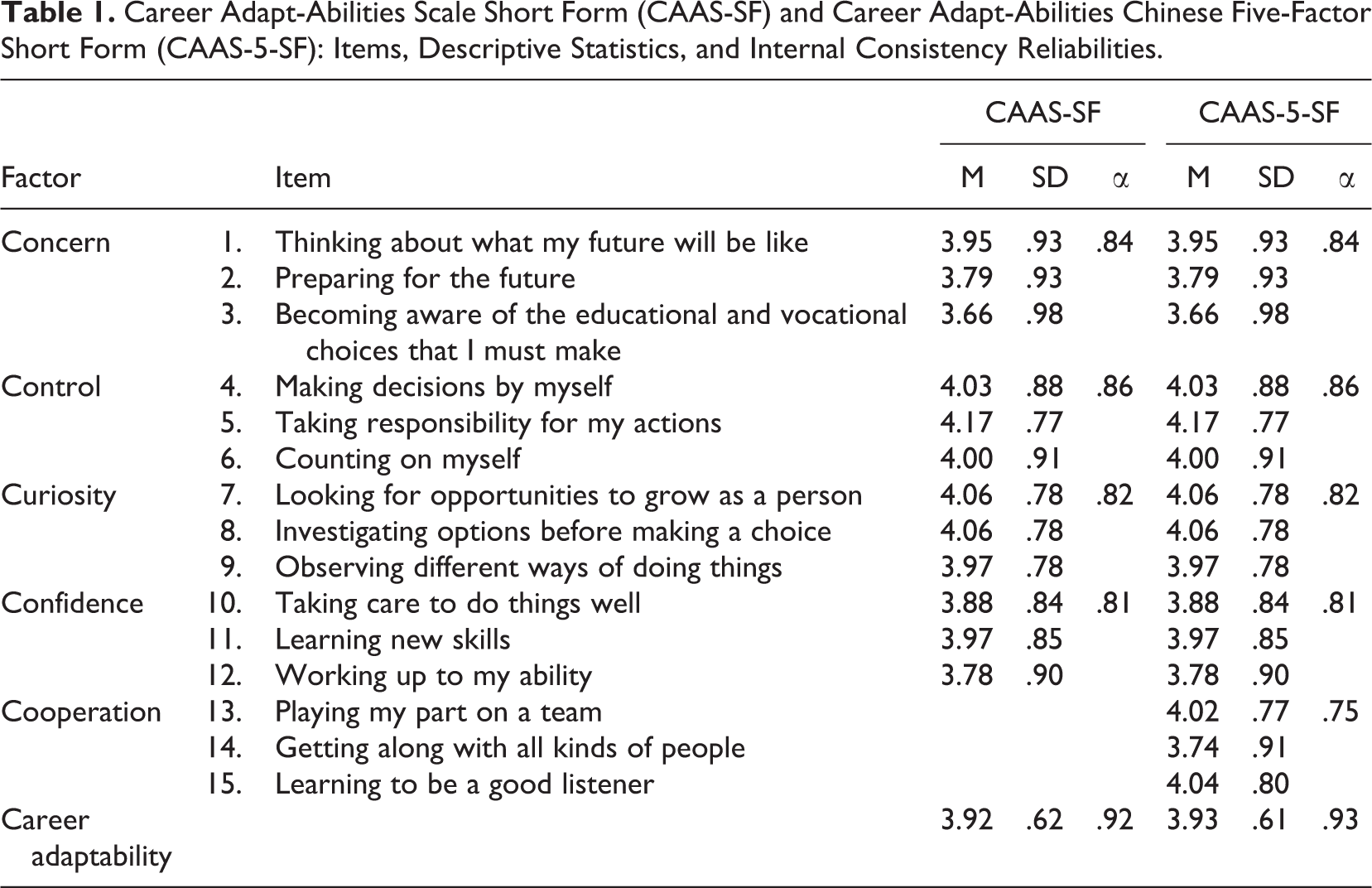
Means and standard deviations of the CAAS-SF items, as well as the Cronbach’s alphas of the dimensions are shown in Table 1 (.84 for concern, .86 for control, .82 for curiosity, .81 for confidence, and .92 for the overall scale). Results indicate that the scale has good internal consistency with the current sample.
Career Adapt-Abilities Scale Short Form (CAAS-SF) and Career Adapt-Abilities Chinese Five-Factor Short Form (CAAS-5-SF): Items, Descriptive Statistics, and Internal Consistency Reliabilities.
Second-order CFA, with concern, control, curiosity and confidence as first-order factors and career adaptability as the higher-order factor, yields the following fit indices: χ2(50) = 163.78, χ2/df = 3.28, CFI = .951, TLI = .936, RMSEA = .084, and SRMR = .047. They compare less favorably to the fit indices of CAAS-SF (Maggiori et al., 2017), which were χ2(50) = 333.01, χ2/df = 6.66, CFI = .964, TLI = .953, and RMSEA = .064, but nonetheless indicate that the data have a reasonable fit to the theoretical model. The standardized loadings from the items to the corresponding factor ranged between .62 and .91 and the coefficients from the first-order factors to the second-order adaptability varied between .78 and .98, all significant at p < .001. Figure 1 shows the factor structure and standardized loadings of CAAS-SF. Results indicate that CAAS-SF has satisfactory psychometric properties with the current sample and provide foundation for the development and validation of CAAS-5-SF at the next stage.
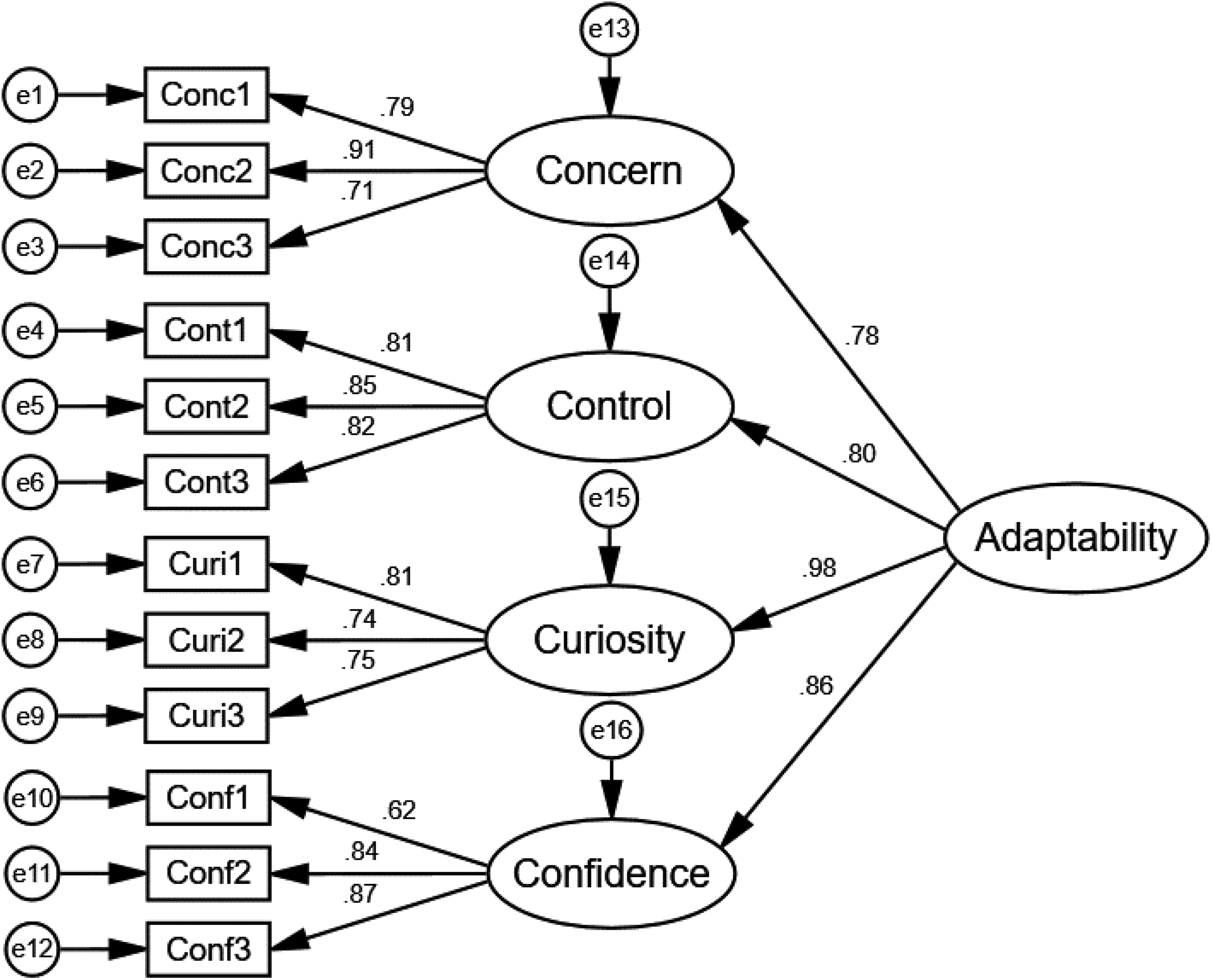
Confirmatory Factor Analysis of Career Adapt-Abilities Scale–Short Form.
Construction and Confirmatory Factor Analysis of CAAS-5-SF
The six cooperation items from CAAS-5 (Nye et al., 2018) were added to CAAS-SF. A measurement model was then estimated, yielding the following fit indices: χ2(130) = 350.30, χ2/df = 2.695, CFI = .933, TLI = .921, and RMSEA = .072, SRMR = .051. To be consistent with the length of other subscales, cooperation item with the lowest loading was removed one at a time until 3 items remained on the cooperation subscale, forming the CAAS-5-SF. The removal of these items was also conceptually appropriate. The first 2 items removed were “Hiding my true feelings for the good of the group” and “Compromising with other people.” Compared to other cooperation items which were stated in an active and straightforward manner, these 2 items appeared to connote passivity and unauthenticity. They cohered to the subscale the least and were therefore removed. The third item removed was “Sharing with others” which had a marginally lower loading than “Learning to be a good listener.” Both items were in the domain of communicating with others. As cooperation is about overcoming egocentrism (M. Savickas, personal communication, June 28, 2016), listening appears to fit better than sharing in capturing the dimension of cooperation, so the item “Sharing with others” was removed.
CFA shows that the model, after reducing the cooperation subscale to 3 items, has acceptable fit indices: χ2(85) = 261.65, χ2/df = 3.078, CFI = .938, TLI = .924, RMSEA = .08, SRMR = .049. Except for the RMSEA, they compare more favorably to the fit indices of CAAS-5 (Nye et al., 2018), which were χ2(1,204) = 3,084.16, CFI = .906, RMSEA = .063, and SRMR = .059. The standardized loadings from the items to the corresponding factors ranged between .63 and .91 and the coefficients from the first-order factors to the second-order adaptability varied between .77 and .96, all significant at p < .001. Figure 2 shows the factor structure and standardized loadings of CAAS-5-SF. Results support Hypothesis 1: CAAS-5-SF fits well to the five-factor model of career adaptability.
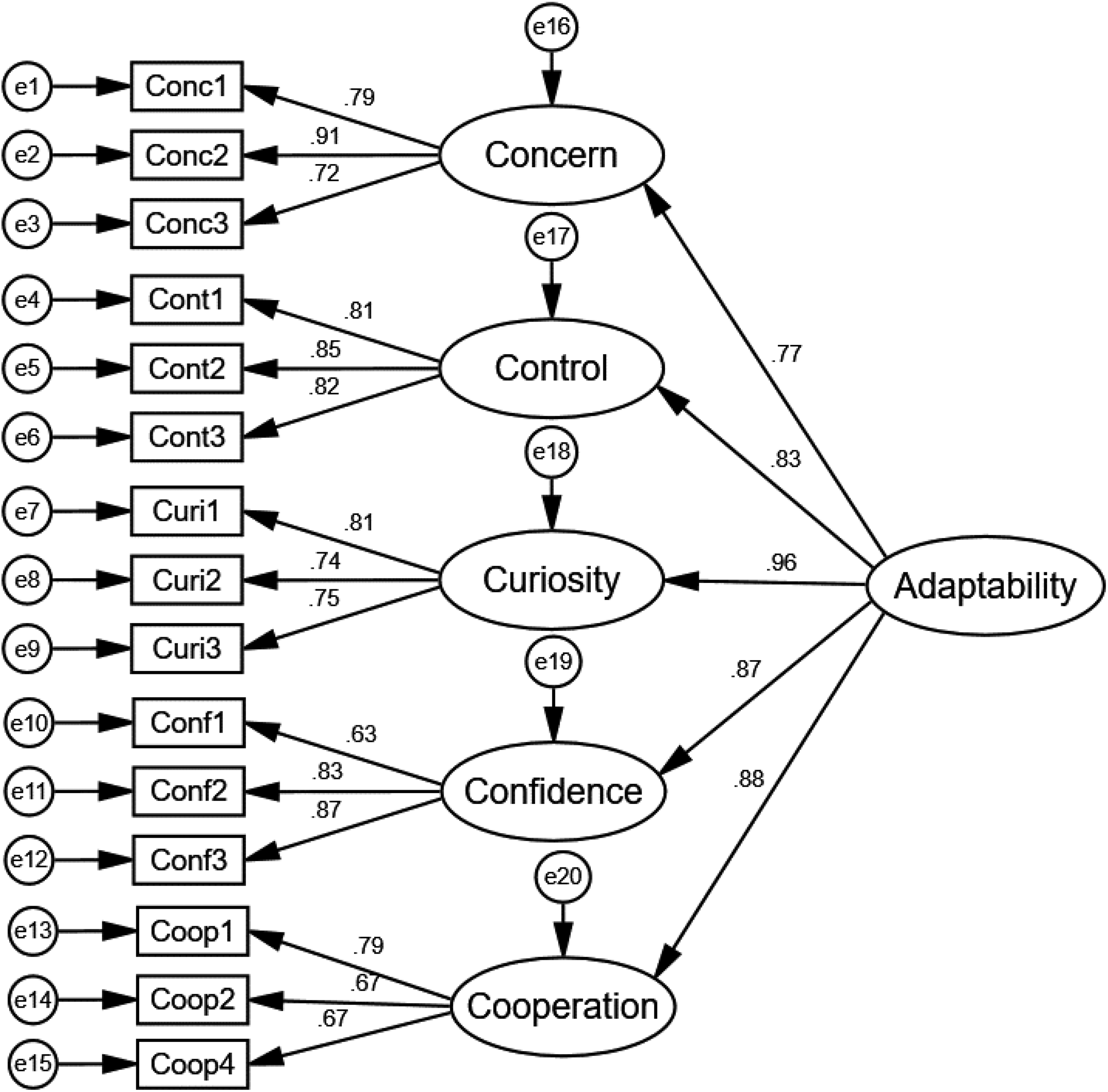
Confirmatory Factor Analysis of Career Adapt-Abilities Scale Chinese Five-Factor Short Form.
Reliability of CAAS-5-SF
CAAS-5-SF has a Cronbach’s alpha of .93 for the overall scale and .75 for the newly added dimension of cooperation. Item means, standard deviations and internal consistency reliabilities are shown on Table 1.
In addition, correlational analyses showed that the corresponding subscales in the CAAS-5 and CAAS-5-SF were strongly associated (r = .96 for concern; r = .91 for control, r = .94 for curiosity; r = .93 for confidence; r = .93 for cooperation, and r = .98 for overall adaptability, all significant at p < .001). Furthermore, a consistent pattern of significant correlations was found among factors of CAAS-5-SF, ranging from .514 to .716, all significant at p < .001. The subscales were also highly associated with the global adaptability, ranging from .805 to .865, p < .001 (See Table 2). Results support Hypothesis 2, suggesting that CAAS-5-SF is an adequate alternative to the 30-item version CAAS-5.
Descriptive Statistics and Correlation Matrix of Career Adapt-Abilities Scale Chinese Five-Factor Short Form, Career Success Scale and Personal Social Capital Scale.
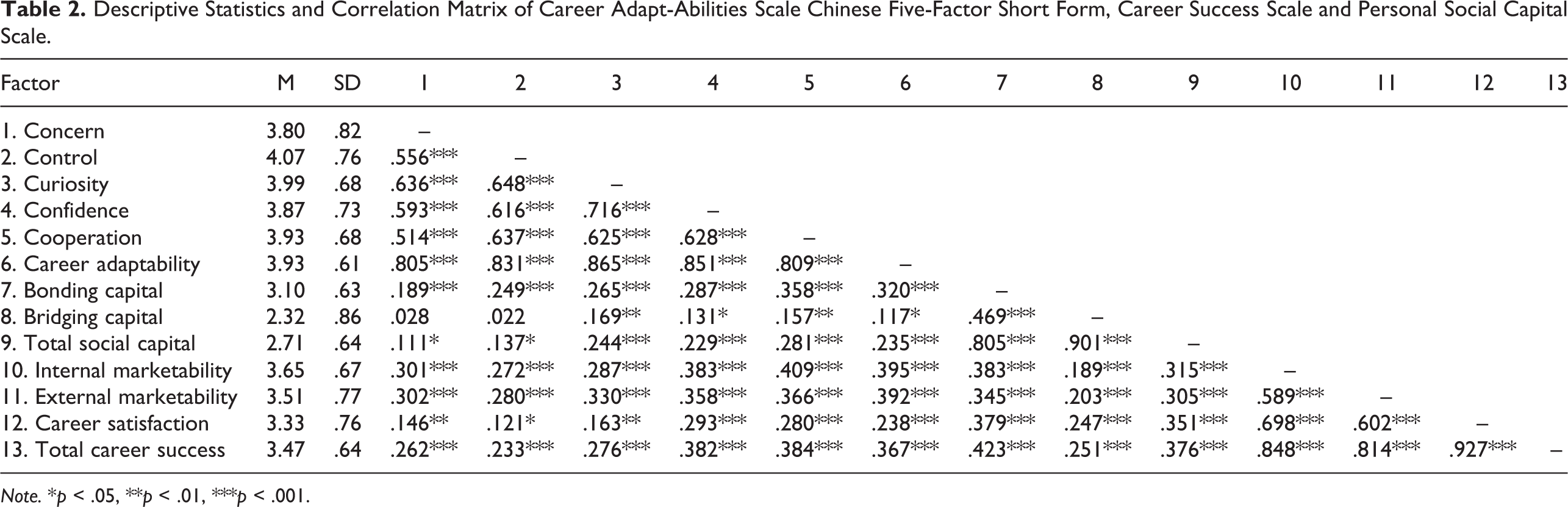
Note. *p < .05, **p < .01, ***p < .001.
Measurement Invariance for CAAS-5-SF
The measurement invariance of CAAS-5-SF across gender groups was assessed according to the stepwise procedure suggested by Rudnev et al. (2018). First, the configural model was estimated. The acceptable fit indices, χ2(170) = 416.01, χ2/df = 2.447, CFI = .915, RMSEA = .067 indicated that the factor structure was similar across groups. Next, the first-order metric, first- and second-order metric, first-order scalar, and first- and second-order scalar models were estimated and compared step-by-step. Invariance is indicated if ΔCFI and ΔRMSEA between two nested models is smaller than .005 and .01 respectively (Chen, 2007). Table 3 shows comparison of the models. The ΔCFIs (ranging from .001 to .003) and ΔRMSEAs (ranging from .000 to .002) are well within the cutoff criteria, supporting configural, metric, and scalar invariances of CAAS-5-SF across gender groups.
Fit Indices for Multigroup Confirmatory Factor Analysis of Career Adapt-Abilities Scale Chinese Five-Factor Short Form, Verifying Measurement Invariance across Gender and Educational Level.
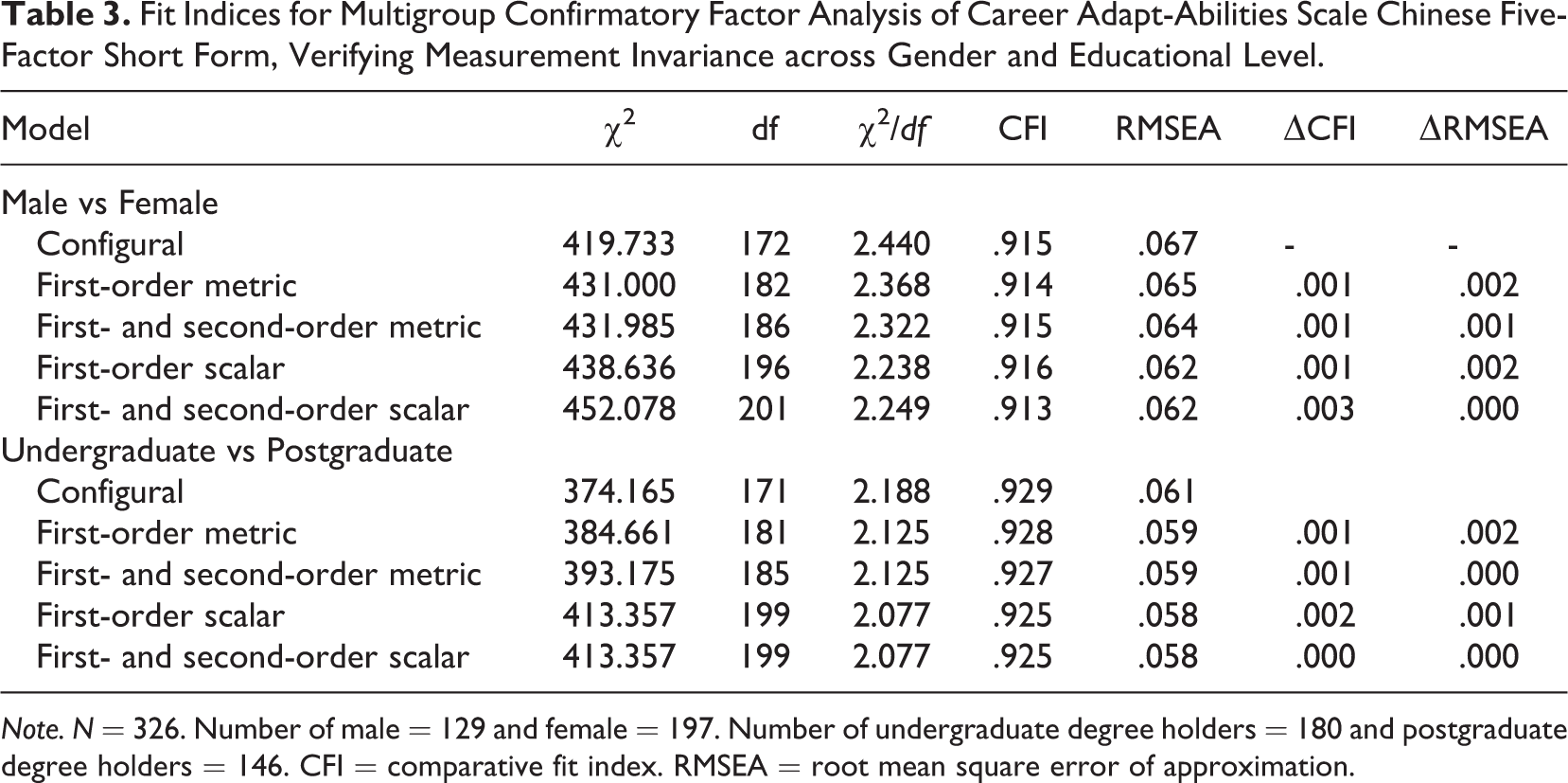
Note. N = 326. Number of male = 129 and female = 197. Number of undergraduate degree holders = 180 and postgraduate degree holders = 146. CFI = comparative fit index. RMSEA = root mean square error of approximation.
The same procedure was repeated to assess measurement invariance across educational levels, namely undergraduate (bachelor’s degree holders) versus postgraduate (master’s and doctoral degree holders). The ΔCFIs (ranging from .000 to .002) and ΔRMSEAs (ranging from .000 to .002) between the nested models indicate configural, metric, and scalar invariances across educational levels. It appears participants of different gender and educational levels responded to CAAS-5-SF in similar manner, suggesting that CAAS-5-SF scores can be meaningfully compared between male and female as well as between undergraduate and postgraduates degree holders.
Gender and Educational Level Differences on CAAS-5-SF
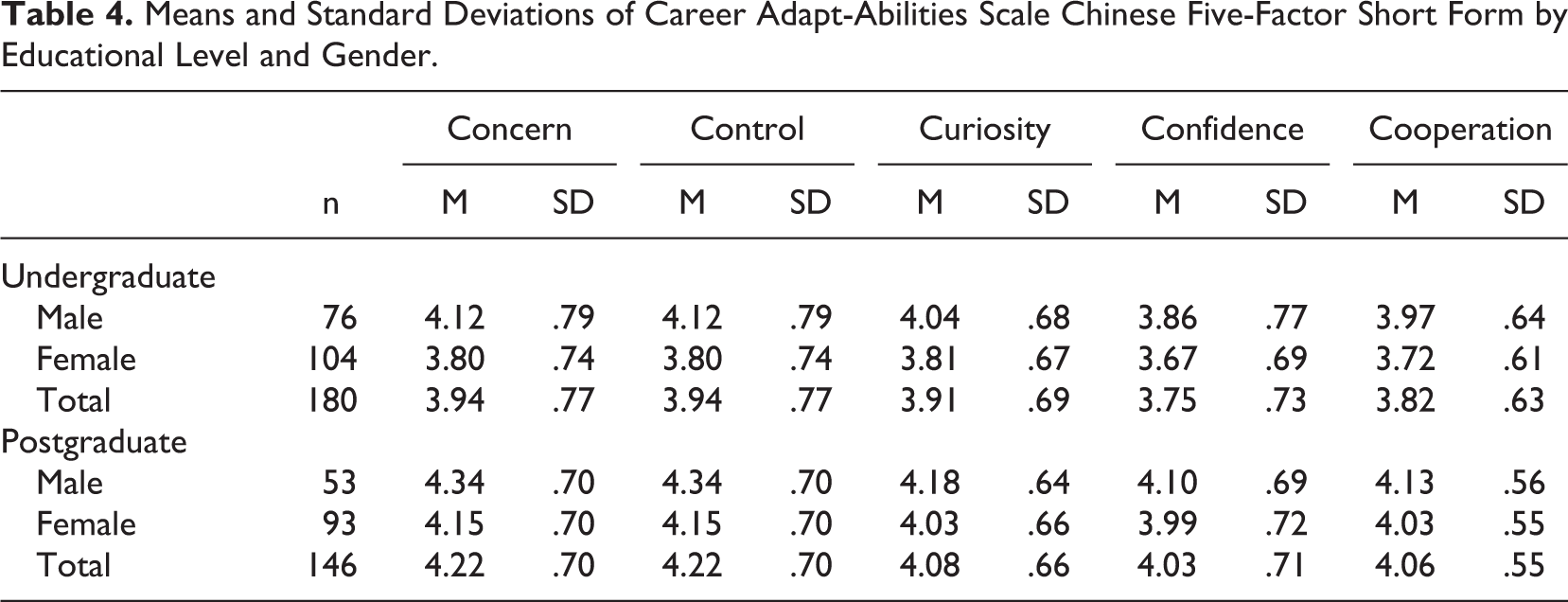
Participants’ scores on CAAS-5-SF were compared across gender and educational levels. Table 4 shows the means and standard deviations of CAAS-5-SF scores. Two-way MANOVA, with gender and educational level as independent variables, was used to compare the mean scores across groups (Table 5).
Means and Standard Deviations of Career Adapt-Abilities Scale Chinese Five-Factor Short Form by Educational Level and Gender.
Multivariate and Univariate Analysis of Variance for Career Adapt-Abilities Scale Chinese Five-Factor Short Form.
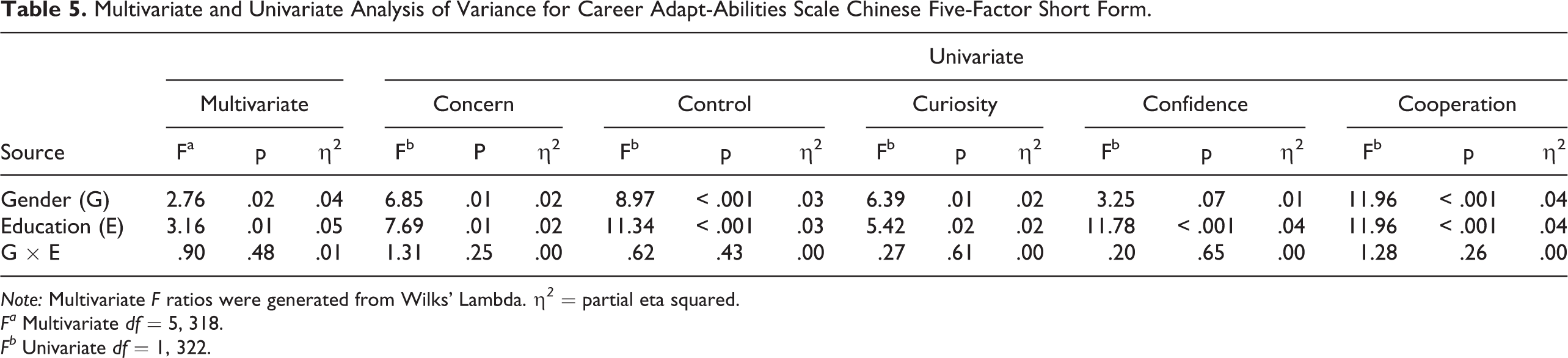
Note: Multivariate F ratios were generated from Wilks’ Lambda. η2 = partial eta squared.
Fa Multivariate df = 5, 318.
Fb Univariate df = 1, 322.
The main effect of educational level is significant, Wilk’s Λ = 0.95, F (5, 318) = 3.16, p < .01, η 2 = .05. Univariate analyses indicated that postgraduate degree holders had significantly higher scores on all five subscales of CAAS-5-SF than their undergraduate counterparts, supporting Hypothesis 3. With regard to gender, the multivariate effect is also significant, Wilk’s Λ = 0.96, F (5, 318) = 3.76, p = .02, η 2 = .04. Results from univariate analyses showed that males had significantly higher scores on concern, control, curiosity, cooperation, but not confidence, when compared to females. There is no significant interactional effect between gender and educational level on CAAS-5-SF.
Correlations among CAAS-5-SF, Career Success Scale and Personal Social Capital Scale
As shown in Table 2, the career success has a positive correlation with career adaptability (r = .367) and its dimensions (r ranging from .233 to .384), all significant at p < .001. In addition, career adaptability and its subscales also have a positive association with internal marketability, external marketability, and career satisfaction (r ranging from .121 to .409), all significant at p < .05 or beyond. Results support Hypothesis 4: Career adaptability is positively associated with career success. Meanwhile, among the correlations between the career success and adaptability dimensions, the relationship with cooperation is the strongest (r = .384, p < .001).
In addition, social capital and its subscales have a positive association with career success and its dimensions (r ranging from .189 to .423, all significant at p < .001). Results support Hypothesis 5: Social capital is positively associated with career success. Finally, career cooperation has a positive correlation with social capital (r = .281, p < .001), as well as its subscales of bonding capital (r = .358, p < .001) and bridging capital (r = .157, p < .01). Results support Hypothesis 6: Career cooperation is positively associated with social capital.
Hierarchical Linear Regression Analyses
Table 6 shows the results of hierarchical linear regression analyses predicting the career success. When entered in Step 1, none of the demographic variables individually had a significant effect on career success, but collectively they explained four percent of the variance in career success (p < .01). When entered in Step 2, career adaptability dimensions explained an additional 17% of the variance in career success (p < .001). Among the adaptability dimensions, cooperation had the strongest effect (β = .30, p < .001), followed by confidence (β = .26, p < .001), while concern (β = .04, p = .53), control (β = −.13, p = .09), and curiosity (β = −.05, p = .56) had no significant effect on career success. When entered in Step 3, social capital dimensions together explained an additional nine percent of the variance in career success (p < .001), with bonding capital (β = .28, p < .001) having a positive and significant effect but not bridging capital (β = .09, p = .12). Meanwhile, the effects of career confidence (β = .23, p < .01) and cooperation (β = .20, p < .01) became somewhat weaker after social capital factors were entered into the regression models. The Variance Inflation Factors were smaller than three, indicating that multicollinearity was within an acceptable level in these analyses (Hair et al., 2014).
Hieratical Linear Regression Analyses.
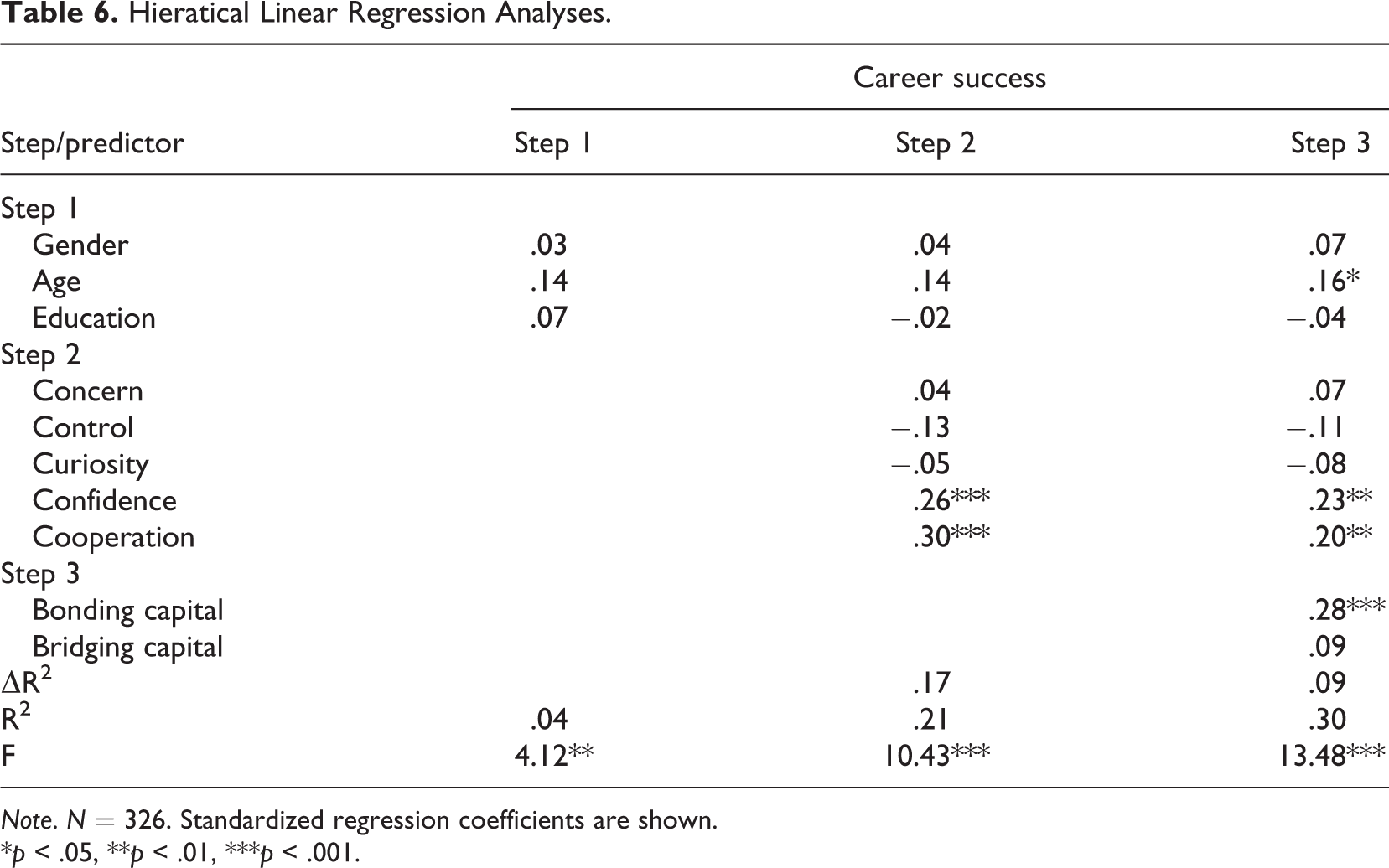
Note. N = 326. Standardized regression coefficients are shown.
*p < .05, **p < .01, ***p < .001.
Discussion
This study developed and validated CAAS-5-SF based on a sample of university graduates who were making transitions to the world of work. Results indicate that CAAS-5-SF has sound psychometric properties, including good internal consistency and reasonable model fit. With reference to the overall scale and its sub-dimensions, CAAS-5-SF has excellent correlations with CAAS-5. In addition, although the length of the scale is reduced by half, its model fit indices compare favorably to those of CAAS-5. In summary, results provide evidence for reliability and structural validity of CAAS-5-SF, suggesting the scale as an efficient alternative to CAAS-5.
Since social capital is characterized by connections built on trust and reciprocity (Zhang et al., 2010), individuals with good social capital are expected to get along and cooperate well with others. As predicted, social capital had a positive and significant correlation with career cooperation in the present study. This finding provides support for the convergent validity of the cooperation subscale. In addition, previous research has shown that CAAS is associated with career success (Guan et al., 2015; Zacher, 2014). The same relationship between career adaptability, with the additional dimension of cooperation, and career success is expected in the present study. Results show that CAAS-5-SF and its subscales are significantly correlated with career success as well as the dimensions of internal marketability, external marketability, and career satisfaction. These findings provide support for the convergent validity of the CAAS-5-SF and the inclusion of cooperation as a factor of career adaptability. Furthermore, results also indicate that career adaptability resources are essential for the attainment of subjective career success for fresh graduates in Macao.
The validation of CAAS-5-SF has several theoretical implications. First, findings from the present study add to the literature that supports the inclusion of cooperation into the construct of career adaptability (Brown et al., 2012; Einarsdóttir et al., 2015; McMahon et al., 2012; Nye et al., 2018). However, explanation is needed for why cooperation did not cohere to the other adaptability dimensions in the initial cross-cultural validation of CAAS. A possible reason is that cooperation did not load on adaptability in individualistic cultures, which made up a significant portion of the 13 countries where the validation of CAAS took place (M. Savickas, personal communication, June 28, 2016). However, this cannot explain why cooperation was identified in CAAS-5 (Nye et al., 2018) with a sample of American college students. A different explanation is needed. We reviewed the initial validation studies of CAAS and found that many of the samples from individualistic societies were teenagers — United States (Porfeli & Savickas, 2012), Portugal (Duarte et al., 2012), Italy (Soresi et al., 2012), France (Pouyaud et al., 2012), and Belgium (Dries et al., 2012). It may be possible that cooperation, which is focused on the interaction with others, develops later in life than the other four adaptability resources, which are more focused on the self. In other words, cooperation may be manifested and becomes an essential psychosocial resource in career development only among older individuals, such as college age or above. This is consistent with findings from qualitative studies that identified cooperation among mid-career changers and older women (Brown et al., 2012; McMahon et al., 2012). Future research should attempt to validate CAAS-5-SF using older samples in individualistic societies and investigate the process of development for career cooperation.
In addition, findings from the present study show the importance of cooperation in career development. Cooperation has the strongest correlation with career success among the adaptability resources. In addition, regression analyses indicate that cooperation, among the adaptability dimensions, is the strongest predictor of career success. It appears that the psychosocial competence of working well with others is a particularly important resource in a collective society like Macao. However, since the present study is cross-sectional in nature, the predictive effect of cooperation cannot be ascertained. Future research should address the predictive validity of career cooperation using longitudinal designs.
In the present study, scalar invariance of CAAS-5-SF was identified across gender and educational level, allowing meaningful comparison of adaptability scores across these groups (Rudnev et al., 2018; Yu & Shek, 2014). Consistent with previous research (Tien et al., 2014), participants with higher educational levels had higher adaptability. Graduates with a postgraduate degree had more adaptability resources than their undergraduate counterparts. This finding is in line with the view that adaptability resources can be considered a form of human capital, which can be accumulated through education and experience (Savickas & Porfeli, 2012). With regard to gender differences, results from the current study showed that males had higher scores on career adaptability and its subscales, except for confidence, than females. It is interesting to note the absence of gender difference on adaptability among secondary school students (Tien et al., 2014; Yuen & Yau, 2015) but the presence of gender difference among university students (Hou et al., 2012) and graduates in the present study. As Chinese culture places more importance on career success for males than females, it may be possible that males develop more readiness and adaptability than females at the time that transition to the world of work is imminent, such as during tertiary education. More research is needed to understand the process by which males and females develop career adaptability.
The findings of the study also have several practical implications. First, it is interesting to note that among all the dimensions of CAAS-5-SF and social capital, the effect of bonding capital is the strongest in predicting career success. It appears that while cooperation, or the competence of working along with others, is important in achieving career success, the resource embedded in one’s networks may be even more essential in the school-to-work transition in Macao as social connections provide access to career-related information, resources and sponsorship (DeFillippi & Arthur, 1994; Seibert et al., 2001). Yet contrary to prediction, bridging capital, or resource stemming from social groups and organizations, did not contribute to career success in the regression analyses. When compared to bonding capital, in addition, bridging capital had weaker associations with career adaptability resources. One possible explanation is that graduates in the current sample had not developed enough bridging capital. Their score on bridging capital was the lowest among all variables. Therefore, we encourage college students to develop bridging capital by social networking and getting involved in social organizations, which are effective ways of enhancing career success and adaptability resources (Huang & Aaltio, 2014; Tian & Fan, 2014)
Another practical implication is that the validated CAAS-5-SF can serve as an efficient assessment of career adaptability, especially in Macao where resources for career services are limited. As Hirschi (2012) argued, one of the goals in career counseling is to develop an individual’s resources, such as career adaptability. CAA5-5-SF can be used as a screening tool, allowing career service practitioners to identify clients’ specific needs and to develop a targeted career intervention. In addition, the tool can be used to evaluate the effectiveness of interventions by measuring the difference in the adaptability scores before and after the interventions.
Limitations and Directions for Future Research
The study had several limitations. First, CAAS-5-SF was developed and validated with recent university graduates in Macao who had recently gained employment. Replication is recommended with other samples, such as older workers and blue-collar employees. It is also recommended to carry out a similar validation study in other Chinese societies, such as Hong Kong, Taiwan, and Mainland China. Second, data were collected from graduates who had found employment, and excluded graduates who were moving on to postgraduate studies or were still looking for employment. These not-yet-employed individuals may have different characteristics in terms of career adaptability and should be included in future research. Third, the current study was cross-sectional in nature and only convergent validity of CAAS-5-SF was established. Future research should employ longitudinal designs to examine the predictive validity of CAAS-5-SF. Finally, Johnston (2018) suggested more research on intervention that aims at increasing adaptability, so an effective instrument for pre- and post-intervention measurement of career adaptability is needed. The brevity of CAAS-5-SF makes it a potentially useful tool for these repeated measures. However, future research should examine the test-retest reliability of CAAS-5-SF to ensure that any observed changes in career adaptability can be attributed to genuine changes in the individual, rather than instability of the scale (Aldridge et al., 2017).
Conclusion
In summary, the present study found that CAAS-5-SF, with five dimensions of concern, control, curiosity, confidence and cooperation, has sound psychometric properties and is a suitable instrument to measure career adaptability. The fact that the instrument contains only 15 items makes it quick and convenient for administration in research and practice. Furthermore, the present study supports the inclusion of cooperation in the construct of career adaptability and shows the importance of cooperation in predicting career success. Given these findings, we recommend using CAAS-5-SF in future research and practice that targets career adaptability.
Footnotes
Acknowledgments
The authors wish to thank Mark L. Savickas and Hsiu-Lan Shelley Tien for sharing the Career Adapt-Abilities Scale and its Chinese version for use in the present study.This article is based on the doctoral dissertation of the first author under the supervision of the second and third authors.
Declaration of Conflicting Interests
The author(s) declared no potential conflicts of interest with respect to the research, authorship, and/or publication of this article.
Funding
The author(s) received no financial support for the research, authorship, and/or publication of this article.
