



Abstract
In this study we investigated whether regulatory emotional self-efficacy beliefs (RESE) indirectly predict turnover intentions (TI) through organizational socialization (OS) and organizational identification (OI). Three waves of data (1-year lag) were collected on a representative sample of 890 military newcomers belonging to two different cohorts. We tested our hypotheses using a multigroup autoregressive cross-lagged panel model (MG-ACLP) and results fully confirmed the posited theoretical model. Regulatory emotional self-efficacy beliefs reduced intentions to quit indirectly, via organizational socialization and identification. The present study contributes to fill several literature gaps by offering a complete picture of the socialization process. Moreover, it offers insights about how to support the military newcomers’ work adjustment and retention by fostering and developing their regulatory emotional self-efficacy beliefs. Limitations as well as directions for future research are discussed.
Keywords
Organizational socialization processes occur when individuals deal with work-related transitions, such as moving from school to work, from a certain organization to another one, or with role transitions within the same organization (Ellis et al., 2014). During this phase, individuals transit “from being organizational outsiders to being insiders” (Bauer et al., 2007, p. 707). This change requires the acquisition and internalization of values, rules, expected social behavior, attitudes, skills, and competences necessary to perform their new work roles (Wanberg, 2012). The degree to which individuals successfully socialize to their new job/role has several proximal (i.e., short term) and distal (i.e., long term) implications, such as the ability to identify with the organizational roles and values, and the development of turnover intentions (Ashforth & Saks, 1996; Bauer & Erdogan, 2012; Saks & Ashforth, 1997; Saks et al., 2007).
Empirical studies have indeed shown that organizational identification develops after newcomers acquire the knowledge of the new work environment, develop the competences needed to perform duties effectively, and start to feel accepted by colleagues. These three core aspects of organizational socialization (Bauer et al., 2007; Chao et al., 1994; Ellis et al., 2014) are linked to the development of the identification with one’s organization (e.g., Ashforth & Saks, 1996; Franke, 2000). On the contrary, there are evidences suggesting that individuals with lower levels of socialization are unable to cope with the experience of the uncertainty regarding what others expect from them (Jackson et al., 1987; Wanous et al., 1992), and with the perceived disparity between one’s own expectations and what it turned out to be a member of the organization (i.e., “reality shock”; see Nelson, 1987). If this experience becomes chronic, turnover intentions may emerge as the long turn by-product of organizational socialization failure (Saks & Ashforth, 2000; Vandenberghe et al., 2011).
In sum, organizational socialization helps newcomers in reducing the stressful uncertainty experienced “so they may feel confident and able to successfully contribute to their new organization” (Ellis et al., 2015, p. 204). Organizational identification is then the landmark of a successful organizational socialization process, and it implies the internalization of the prototypical organizational aspects in the self, thus reducing uncertainty (Pratt, 2000). In this regard both meta-analyses (Riketta, 2005) and narrative literature reviews (Ashforth et al., 2007b, 2008) highlighted a negative relationship between organizational identification and quit intentions.
Among antecedents, socialization research has mostly looked at which practices organizations can employ to socialize their new hires (e.g., socialization tactics; Van Maanen & Schein, 1979), and the proactive behavior acted by the latter (e.g., information seeking; Ellis et al., 2017). Socialization research has also repeatedly pointed to self-efficacy beliefs among the personal resources positively related with organizational socialization (for a review, see Saks & Gruman, 2018).
However, in spite of the context-specific nature of self-efficacy beliefs (Bandura, 1997), organizational socialization research is permeated by the use of general work-related self-efficacy scales (Saks & Ashforth, 1997; for an exception, see Gruman et al., 2006). Instead, empirical longitudinal studies on the role of specific self-efficacy beliefs as antecedents of organizational socialization are scarce. In this study we investigated the role of self-efficacy beliefs related to the management of negative affect, namely regulatory emotional self-efficacy beliefs (or emotional self-efficacy; Alessandri et al., 2018; see Alessandri et al., 2015, for a review). Formally, they are defined as a set of “beliefs regarding one’s capability to ameliorate negative emotional states once they are aroused in response to adversity or frustrating events” (Caprara et al., 2008, p. 228). Confidence in one’s own ability to manage stress and negative feelings is likely to foster individuals in coping with socialization costs by counteracting frustration and preventing discouragement, and by promoting perseverance in the socialization process (Alessandri et al., 2015; Bandura, 1997).
The aim of the present study is to introduce and to empirically validate an overarching theoretical model in which newcomers’ regulatory emotional self-efficacy beliefs indirectly predict turnover intentions, by fostering their levels of organizational socialization and identification with their job/role (see Figure 1). Accordingly, the relationship between regulatory emotional self-efficacy beliefs and turnover intentions is hypothesized to be indirect, being mediated by organizational socialization and identification. This model is rooted in previous studies linking turnover intentions with self-efficacy beliefs (e.g., Saks, 1995), organizational socialization (see Ashforth et al., 2007a), and organizational identification (e.g., van Dick et al., 2004).

The hypothesized conceptual model.
The present study was conducted on newcomers enrolling and attending a military academy, a prototypical applied example in which the socialization process plays a pivotal role (Bowles & Bartone, 2017; Caforio, 2018). Military organizations are usually represented as “greedy institutions” (Segal, 1986), asking their members since their first entrance to respect a rigid hierarchy, to accept a high work–life imbalance, and to undergo a harsh (both physically and psychologically) training (Hall, 2011; Soeters, 2018). A such demanding context seriously and perpetually put to test newcomers’ adaptability requiring them a significant investment of one’s personal resources and strong self-regulatory abilities. Below, we present in detail the theoretical reasoning underlying the above hypothesized theoretical model.
From Regulatory Emotional Self-Efficacy Beliefs to Organizational Socialization
Socializing to a new job/role is challenging due to the fatigue, the uncertainty, and the anxiety that transitioning into the new job roles brings about (Ellis et al., 2015). Arguably, the higher the individuals’ belief to be able to cope with these disphoric states, the higher their availability to invest and to persist in the socialization process. Regulatory emotional self-efficacy beliefs capture the core of this capacity (Caprara et al., 2008). High self-efficacy helps individuals to properly cope with threats and to perform well their activities despite anxiety arousal (Bandura et al., 2003). Moreover, previous research has shown that self-efficacy beliefs in managing negative emotions are negatively related with negative affect, anxiety, and depression (Alessandri et al., 2015), and positively with the capacity of flexibly adapting to negative experiences across time and circumstances (see Milioni et al., 2015). On the contrary, individuals who do not believe that they can control emotions associated with negative experiences are unlikely to adjust to new and unfamiliar situations (e.g., a new work environment or a new work role), as well as to respond flexibly to stressful and challenging circumstances (Consiglio et al., 2013). A previous prospective study showed the mediational role played by the military cadets’ self-efficacy beliefs in managing negative emotions at work over the longitudinal relationship between neuroticism and burnout (Alessandri et al., 2018). Relying on these results, one may argue that regulatory emotional self-efficacy beliefs may help newcomers to properly cope with uncertainty, negative emotions, and distress characterizing the socialization process. Therefore, we hypothesized the following: H1: Regulatory emotional self-efficacy beliefs positively predict organizational socialization over time.
From Organizational Socialization to Turnover Intentions through Organizational Identification
Organizational identification is defined as “a specific form of social identification in which people define themselves in terms of their membership in a particular organization” (Mael & Ashforth, 1995, p. 311). According with applications of the Social Identity Theory to work contexts (for a review, see Haslam & Ellemers, 2005), identified workers are expected to perceive themselves as psychologically intertwined with and belonging to the organization.
There are several reasons for which organizational identification and organizational socialization are two strictly connected processes. From a theoretical standpoint, both processes imply the internalization of unique and prototypical aspects of one’s organization (e.g., van Dick et al., 2004; Wanberg, 2012). Furthermore, they require to the individuals to progressively adapt to the surrounding organizational environment, thus reducing the sense of foreignness and increasing their ability to deal with new and unexpected organizational events (Ellis et al., 2015; Pratt, 2000; van Dick et al., 2004). Moreover, Ashforth and Saks (1996) argued that one of the basic aims of organizational socialization is “to transform newcomers into exemplars of their organizations” (p. 155), and identification would increase as a result of a successful transformation (see Bullis & Bach, 1989). When newcomers enter a new organization, socialization process helps them to become effective insiders by increasing the salience of their membership and the likely of accepting it (Chao et al., 1994; Crocetti et al., 2014).
Accordingly, measures of organizational socialization and organizational identification are positively related both in cross-sectional (e.g., Ge et al., 2010; Lee, 2013), and prospective studies (e.g., Ashforth & Saks, 1996; Smith et al., 2017). Overall, available evidences suggest that organizational socialization may predict organizational identification (Ashforth et al., 2007b; Chao et al., 1994; Saks & Ashforth, 1997). Therefore, we hypothesized the following: H2: Organizational socialization positively predicts organizational identification over time.
Counteracting turnover intentions is a prerogative for organizations that invest a lot of resources in the recruitment and onboarding process, such as military ones (Caforio, 2018; Holt et al., 2007; Kammeyer-Mueller & Wanberg, 2003). One reason is that early turnover intentions are likely to end up in turnover behaviors as attested by meta-analytic weighted average correlations ranging from .32 to .52 (see Dalton et al., 1999) between turnover intentions and turnover behavior, with peaks of .70 and .80 when years of experience and age are taken into account, respectively (Cho & Lewis, 2012; see also Harrison et al., 2006). Moreover, turnover intentions are often highest amongst newly hired employees (Ashforth & Saks, 1996; Cho & Lewis, 2012) that could start harboring intentions to leave because of a repeated experience of unmet expectations. In this case, subsequent turnover behaviors acquire the status of escape strategies from a stressful and unsupportive work environment (Avanzi et al., 2014, 2015; Ellis et al., 2015; Haslam & van Dick, 2011).
According to Social Identity Theory, the early development of a solid organizational identification may ward off the desire to quit the organization. The assumption is that the more the people feel identified with their own organization, the lower they want to leave (Turner & Haslam, 2001). Indeed, organizational identification represents an indicator of loyalty to one’s own organization, in terms of psychological attachment, and thus of a successful establishment of the relationship between a member and his/her organization (Mael & Ashforth, 1995). Workers identified with their own organization result more involved (Van Knippenberg & Van Schie, 2000), more satisfied with their job (van Dick et al., 2004), experience less stress (Haslam & van Dick, 2011), and report greater well-being (for a meta-analysis, see Steffens et al., 2017).
Still, a strong identification makes easier the cooperation and collaboration among members (Haslam et al., 2003; van Dick & Haslam, 2012), increasing the likelihood to give and receive social support and to involve in collective actions (Avanzi et al., 2015; Edwards & Peccei, 2010; Haslam et al., 2005; Levine et al., 2005). In sum, highly identified individuals tend to perceive their organization as part of their self, and thus withdrawing from it would have noxious consequences compared with their lowly identified counterparts, because this decision would require losing important “organizational-based” parts of their self-concept.
Consistently, organizational identification has shown to be an antecedent of withdrawal attitudes such as turnover intentions (see meta-analysis by Riketta, 2005, and review by Haslam & Ellemers, 2005). More in detail, a negative relationship both in civilian (e.g., van Dick et al., 2004) and in military settings (e.g., Wan-Huggins et al., 1998) was found. Drawing on the aforementioned evidence on the relationships between organizational socialization, organizational identification, and turnover intentions, one may argue that individuals showing higher levels of organizational socialization are those who experience a deep sense of identification with one’s organization that in turn prevents the development of thoughts of leaving. Thus, we hypothesized the following: H3: Organizational identification mediates the relationship between organizational socialization and turnover intentions.
Reducing cadets’ turnover is crucial for military organization, because of the direct and high costs associated with cadets’ turnover (i.e., the military wastes about $35,000–$60,000 for each cadet who abandons his/her military organization; see Strickland, 2005), as well as for the indirect costs associated with low motivation (see Dupré & Day, 2007; Young et al., 2010).
The Present Study
Relying on the aforementioned theoretical considerations and empirical evidence underlying and supporting H1, H2, and H3, in this study we aimed to test an integrative model in which the relationship between regulatory emotional self-efficacy beliefs and turnover intentions was expected to be mediated by organizational socialization and organizational identification. Thus, this model postulated the additional hypotheses reported below: H4: Regulatory emotional self-efficacy beliefs indirectly negatively predict turnover intentions through the serial mediation of organizational socialization and organizational identification.
In performing all the analyses, we adjusted for gender and age. From a general standpoint, the investigation of the associations between socio-demographic characteristics and other study variables in a representative population-based sample represents a unique chance to achieve reliable results on their associations. More in detail, these control variables were included in the model as they have shown to be related with regulatory emotional self-efficacy beliefs, organizational socialization, organizational identification, and turnover intentions in previous studies. For instance, turnover intentions are higher amongst younger and newly hired employees compared with older ones (e.g., Pitts et al., 2011). Instead, gender differences are inconsistent (for a review, see Cho & Lewis, 2012), and often due to the gender wage gap (Royalty, 1998). Importantly, in order to take into account the potential effect of different levels of prior socialization among newcomers coming from other military organizations, and thus already having a previous military knowledge and experience (Caforio, 2018; Soeters, 2018), we controlled for years’ service spent in another different military organization.
This study may advance organizational literature in several ways. First, this is the first attempt to clarify and explain the theoretical relationships among regulatory emotional self-efficacy, organizational socialization, organizational identification, and turnover intentions under an overarching theoretical framework. Second, we expand previous results by using longitudinal data that are useful to attest (not to prove) likely direction of causality. Third, we use a representative population-based sample of workers belonging to a single organization followed during their entire training period. Finally, the expected results offer important insights for building interventions aimed to improve work adjustment and retention by relying on regulatory emotional self-efficacy training.
Method
Participants
Two complete cohorts (henceforth, “C1” and “C2”, respectively) of military cadets who applied and were selected for enrolment in the first year of one of the most prestigious Italian military academies took part in this study. As such, the present sample is naturally representative of the military cadets entering this academy every year. C1 started in 2016 and ended in 2018, whereas C2 started in 2017 and ended in 2019. The overall sample consists of 890 military cadets. Participants belonging to C1 were 334 (33% female; Mage = 23, SDage = 2.2). 22% of them had at least 1 year of previous experience at a different military organization. This variable ranged from 0 to 8 years (M = 0.52, SD = 1.3). With regard to C2, participants were 556 (39% female; Mage = 22.6, SDage = 2.4). 21% of them had at least 1 year of previous experience at a different military organization. This variable ranged from 0 to 7 years (M = 0.48, SD = 1.2).
Procedure
Military cadets provided their responses after logging into computers at the academy under direct supervision of a specifically trained psychologist not belonging to the organization (i.e., a researcher). The psychologist did not interfere in any way with participants, nor interacted with them, but only introduced them to the procedure and showed them how to interact with the electronic version of the test battery. Military cadets were randomly assigned by human resource managers to one of four groups of individuals (each composed of about 104 members) who completed the battery at different times during the same day. The study was approved by a Sapienza University of Rome Internal Review Board (“p.n. 0000576”). All the military cadets were informed that participation was voluntary, and that data would have been treated confidentially. No incentive was offered. Informed consent was asked at the beginning of the survey.
Attrition Analysis and Missing Data
Loss of participants is a common situation in longitudinal studies. C1 consisted of 310 cadets at W1 (92.81% of the whole cohort 1 subsample), 310 cadets at W2 (92.81%), and 259 cadets at W3 (77.54%), whereas C2 consisted of 511 cadets at W1 (91.91% of the whole cohort 2 subsample), 498 cadets at W2 (89.57%), and 500 cadets at W3 (89.93%). In regards of retention rate: For W1-W2 it was 92.26% (n = 286) for C1 and 88.65% (n = 453) for C2; for W1-W3 it was 75.81% (n = 235) for C1 and 89.04% (n = 455) for C2; for W2-W3 it was 75.81% (n = 235) for C1 and 88.76% (n = 442) for C2. Thus, overall, retention rate is substantially high (> 75% for each pair of waves). Attrition was mostly due to participants’ unavailability at a specific wave (e.g., illness, or some kind of authorized absence such as an organizational permission to be absent at work that specific day).
For C1, participants with completed data from W1 to W3 differed from participants who were not retained in terms of gender [χ2(1) = 4.735, p = .03], specifically, females dropped out more than males; whereas for C2 there were not significant differences [χ2(1) = 0.112, p = .738]. Instead, for both cohorts, no significant difference due to attrition was found for regulatory emotional self-efficacy beliefs, organizational socialization, organizational identification, and turnover intentions [C1: F(7, 302) = 0.710, p = .710; C2: F(7, 503) = 0.513, p = .825). Thus, given the negligible effect of study variables on attrition and the high retention rate (in both cohorts), we treated missing data by using Full Information Maximum Likelihood (FIML) estimation procedure in all models (Enders, 2010).
Measures
Measures included in the present study are part of a larger battery aimed to investigate the psychological determinants of newcomer adjustment to the military academy.
Regulatory emotional self-efficacy beliefs (RESE)
Self-efficacy beliefs in managing negative emotions were measured with six items drawn from the original RESE scale (Caprara et al., 2008), adapted for the military context (Alessandri et al., 2018). The validity of this scale has been largely attested in civil (Alessandri et al., 2015; Caprara et al., 2008) and in the military settings (Alessandri et al., 2018) with respect to measures of psychological adjustment, emotional wellbeing and job-related stress. These items measure the degree to which military cadets evaluate their own abilities to manage negative feelings (e.g., frustration, anger) in front of negative and stressful situations at work. Responses were given on a 5-point scale, ranging from 1 (not well at all) to 5 (very well). Sample item: “At work, how well can you get over irritation quickly after the experience of a failure?” For C1, Cronbach’s alphas were .88 (W1), .86 (W2) and .89 (W3). Likewise, for C2, they were .86 (W1), .87 (W2), and .88 (W3). In this study we investigated the longitudinal invariance of the scale across the three study waves and found support for weak factorial invariance (i.e., stability of the factor structure and of the loading size across time; see Table 1).
Model Fit Indices for Longitudinal Tests of Factorial Invariance of Scales.

Note. df = degrees of freedom; CFI = Comparative Fit Index; TLI = Tucker-Lewis Index; RMSEA = root mean square error of approximation; SRMR = standardized root mean square residual.
***p < .01. nsp > .05.
Organizational socialization (OS)
Organizational socialization was measured with four items drawn by the Organizational Socialization Questionnaire (OSQ; Livi et al., 2018). This self-reported scale has shown high convergent validity, as attested by significant and positive correlations with other self-report socialization questionnaires (Livi et al., 2016), with measures of OCB-I, and by a negative and significant correlation with a measure of interpersonal strain (Livi et al., 2018). The estimated Cronbach’s alpha for this scale is .81. The OSQ measures the newcomers’ level of socialization in terms of competence, acceptance by co-workers, and identification with the organization. However, items assessing identification with the organization were removed because their content overlapped with those included in the Mael and Ashforth’s (1992) organizational identification scale. Responses were given on a 5-point scale ranging from 1 (strongly disagree) to 5 (strongly agree). Sample items: “I have learned how to carry out my work-related activities and duties well,” “I feel completely accepted by my colleagues.” For C1, Cronbach’s alphas were .74 (W1), .78 (W2), and .78 (W3). Likewise, for C2, they were .68, (W1), .75 (W2), and .82 (W3). In this study we found evidence for weak factorial invariance of the instrument (see Table 1).
Organizational identification (OI)
Organizational identification was measured with the six-item Mael and Ashforth’s scale (1992). Such measure was also used in previous military studies (e.g., Mael & Alderks, 1993; Mael & Ashforth, 1995) and has shown convergent validity with measures of job involvement, task motivation, career intent, and perceptions of unit effectiveness. Responses were given on a 7-point scale, ranging from 1 (totally disagree) to 7 (totally agree). Sample item: “When I talk about [name of the organization], I usually say ‘we’ rather than ‘they’.” For C1, Cronbach’s alphas were .77 (W1), .88 (W2), and .88 (W3). Likewise, for C2, they were .79 (W1), .84 (W2), and .87 (W3). The weak factorial invariance was supported as the factor loadings were fully invariant across time (see Table 1).
Turnover intentions (TI)
Turnover intentions were measured with a single item that consisted of asking participants to indicate the likelihood of leaving the academy within 1 year: “How likely is that you will leave this academy in the next 12 months?” Responses ranged from 1 (very unlikely) to 5 (very likely). We used a single-item scale to measure turnover intentions, the validity of which has been already established both in civilian (e.g., Janssen et al., 1999; Smith et al., 2013) and military settings (e.g., Langkamer & Ervin, 2008; Wan-Huggins et al., 1998).
Covariates
Age (expressed in years), gender (0 = male, 1 = female), and previous experience at a different military organization (expressed in years) were all measured at W1.
Data Analytic Strategy
In order to investigate the cross-lagged longitudinal analysis needed to test our theoretical model, we employed a three-wave multigroup autoregressive cross-lagged panel model (MG-ACLP). 1 Given that our sample consisted of two cohorts of military cadets that started academy in two separate years (i.e., samples are independent), we decided to use a multigroup SEM approach. This approach allows a close inspection of similarity and differences in both parameters estimates and model fit across cohorts (through Likelihood-Ratio test). Thus, it is a better procedure for attesting robustness of generalizability of our hypothesized model, if compared to (a) preliminary analyze differences in focal variables (e.g., through a MANOVA or through a Box’s M test) and (b) run separate models (for each cohort) and then analyze differences without a specific statistical test.
We started with a multigroup structural equation model consisting of four constructs measured at three time points and three control variables for both cohorts. This model, called the unconstrained cohort*time multigroup model, included all autoregressive paths for each construct across time (e.g., from regulatory emotional self-efficacy at W1 to regulatory emotional self-efficacy at W2), all cross-lagged paths described above (e.g., from regulatory emotional self-efficacy at W1 to organizational socialization at W2), and all concurrent correlations among constructs at each time point. Furthermore, at each time point, all constructs were regressed on all control variables.
Then, we moved to test the time-constrained multigroup model, by imposing, separately in each cohort, a set of across-time equality constraints on: (1) all included cross-lagged paths, (2) all autoregressive paths, (3) all covariances among residual variances, and all residual variances (from W2 to W3). These longitudinal constraints are related to the assumption of stationarity (e.g., Orth et al., 2021) and were imposed for pursuing model parsimony and for inspecting the across-time relationships among constructs, given that we did not expect a significant change in their magnitude (Little, 2013; Orth et al., 2021; Usami et al., 2019).
Finally, we specified the time-and-cohort-constrained multigroup model, by maintaining all above longitudinal constraints on parameters, while further generalizing them as to be invariant not only across time but also across cohorts. Moreover, we specified the variances of all variables at W1 to be equal across cohorts. Thus, this model resulted highly more parsimonious than the preceding ones. As a practical example, in C1 the coefficient associated with the path from regulatory emotional self-efficacy at W1 to organizational socialization at W2 was specified to be equal to the same path from W2 to W3, as well as to the same paths in C2. Thus, out of four different paths, this model resulted on only one common estimated coefficient.
Model Evaluation
All models were estimated by using Mplus 8.30 statistical software (Muthén & Muthén, 1998-2017) with the Yuan and Bentler (2000) Robust Maximum-Likelihood estimator for parameter estimates and for handling missing data through the Full Information Maximum Likelihood (FIML; Enders, 2010). The goodness fit of each model was evaluated with the following fit indices: YBχ2 statistics, the Comparative Fit Index (CFI), and the Root-Mean-Square Error of Approximation (RMSEA) with associated 90% confidence intervals (CIs). CFI values above .90, and RMSEA values lower than .08 would suggest an adequate fit of the model to data (Kline, 2016). Nested models were compared by using the scaled difference chi-square devised by Satorra and Bentler (2001; SBΔχ2) and difference in CFI (ΔCFI). When the comparison resulted in a non-significant SBΔχ2 and a ΔCFI < .01 (Cheung & Rensvold, 2002), the more parsimonious model was chosen. Indirect effects were statistically significant if the 95% bias corrected confidence interval (BC-CI; computed through 5,000 resamples) does not include the value of 0 (MacKinnon et al., 2004).
Results
Zero-Order Correlations Among Variables
Table 2 presents a summary of intercorrelations, means, and standard deviations for scores on regulatory emotional self-efficacy beliefs (RESE), organizational socialization (OS), organizational identification (OI), and turnover intentions (TI) within and across waves, in both cohorts.
Descriptive Statistics and Correlations for Study Variables Disaggregated by Cohort.
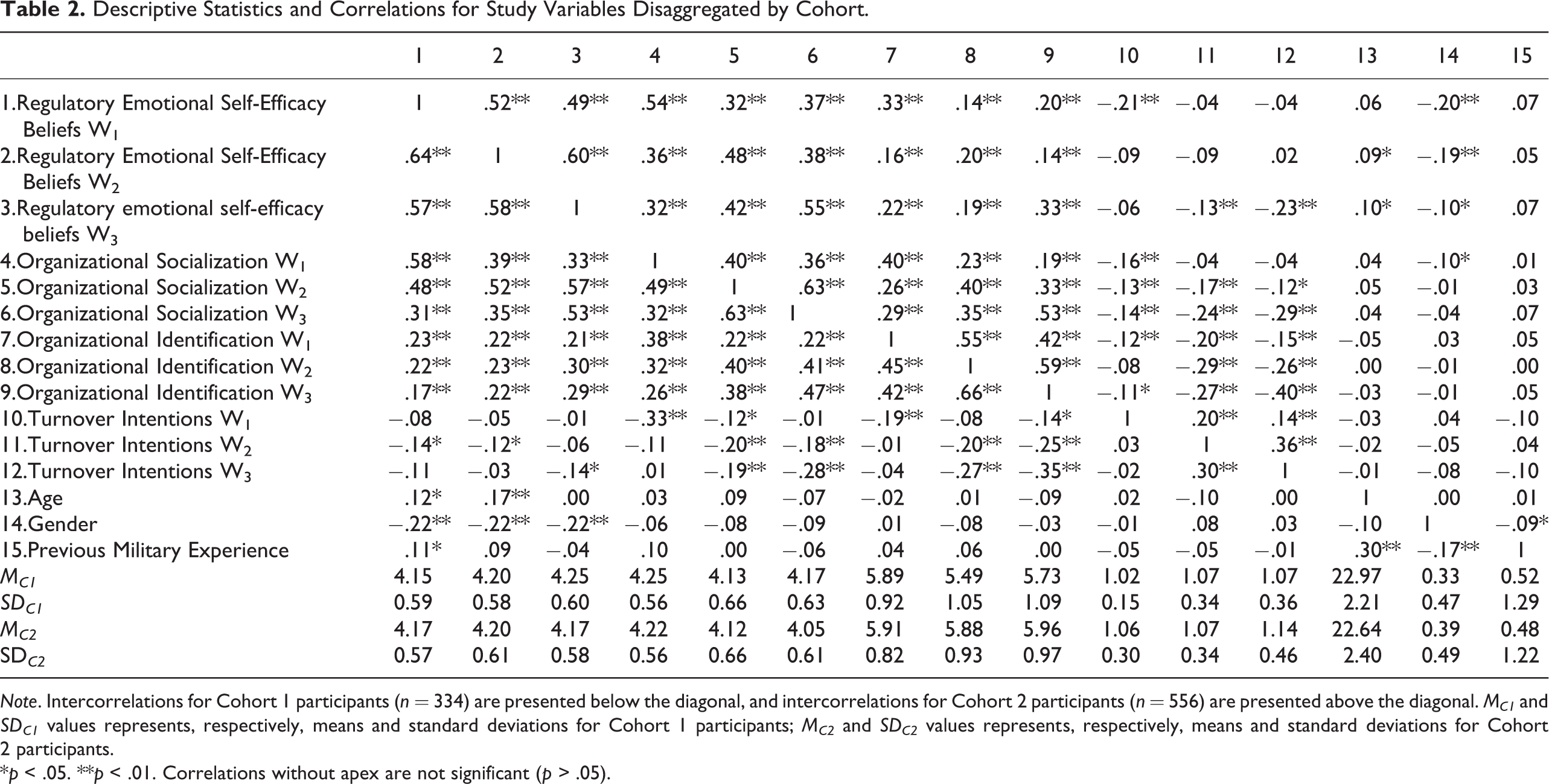
Note. Intercorrelations for Cohort 1 participants (n = 334) are presented below the diagonal, and intercorrelations for Cohort 2 participants (n = 556) are presented above the diagonal. MC1 and SDC1 values represents, respectively, means and standard deviations for Cohort 1 participants; MC2 and SDC2 values represents, respectively, means and standard deviations for Cohort 2 participants.
*p < .05. **p < .01. Correlations without apex are not significant (p > .05).
Regulatory emotional self-efficacy beliefs, organizational socialization, and organizational identification were positively associated among them. Turnover intentions were negatively associated with all other variables. On average, the highest within time correlation was between RESE and OS, whereas the lowest correlation was between RESE and TI, in both cohorts. Moreover, the highest cross-lagged correlation was between RESE and OS in both time intervals. Finally, the lowest cross-lagged correlation was between TI and OI in the first time interval, whereas it was between RESE and TI in the second time interval.
Multigroup Autoregressive Cross-Lagged Panel Model
After fixing non-significant covariates to zero, the unconstrained cohort*time multigroup model fitted the data well: YBχ 2 (120) = 181.032, p < .001; CFI = .976; RMSEA = .034 (90%C.I. = .023, .044). Note that, although not hypothesized, the cross-lagged reciprocal relations (1) between regulatory emotional self-efficacy beliefs and organizational socialization, and (2) between organizational socialization and organizational identification, were added, because they were necessary for achieving a good model fit. Using this model as the baseline, we then examined the invariance of estimated parameters across time (not by cohort), by estimating the time constrained multigroup model that fitted the data adequately: YBχ 2 (152) = 235.533, p < .001; CFI = .967; RMSEA = .035 (90%C.I. = .026, .044). The time constrained multigroup was not significantly different from the unconstrained cohort*time multigroup: SBΔχ 2 (32) = 51.581, p = .02, ΔCFI = .009. Thus, we subsequently estimated the time-and-cohort constrained multigroup model. After releasing the across-cohorts equality constraint on the variance of turnover intentions at W1, this model fitted the data well YBχ 2 (193) = 280.631, p < .001; CFI = .966; RMSEA = .032 (90%C.I. = .023, .040). The time-and-cohort constrained multigroup model was not significantly different from the time constrained multigroup: SBΔχ2(41) = 49.510, p = .17, ΔCFI = .001.
Autoregressive paths
As it can be seen in Figure 2, in terms of Cohen’s (1992) effect size interpretation (a) turnover intentions stability across the three time points resulted low from T1 to T2 and medium from T2 to T3; (b) organizational socialization stability resulted medium across both intervals; (c) stability of regulatory emotional self-efficacy beliefs and organizational identification were both high.
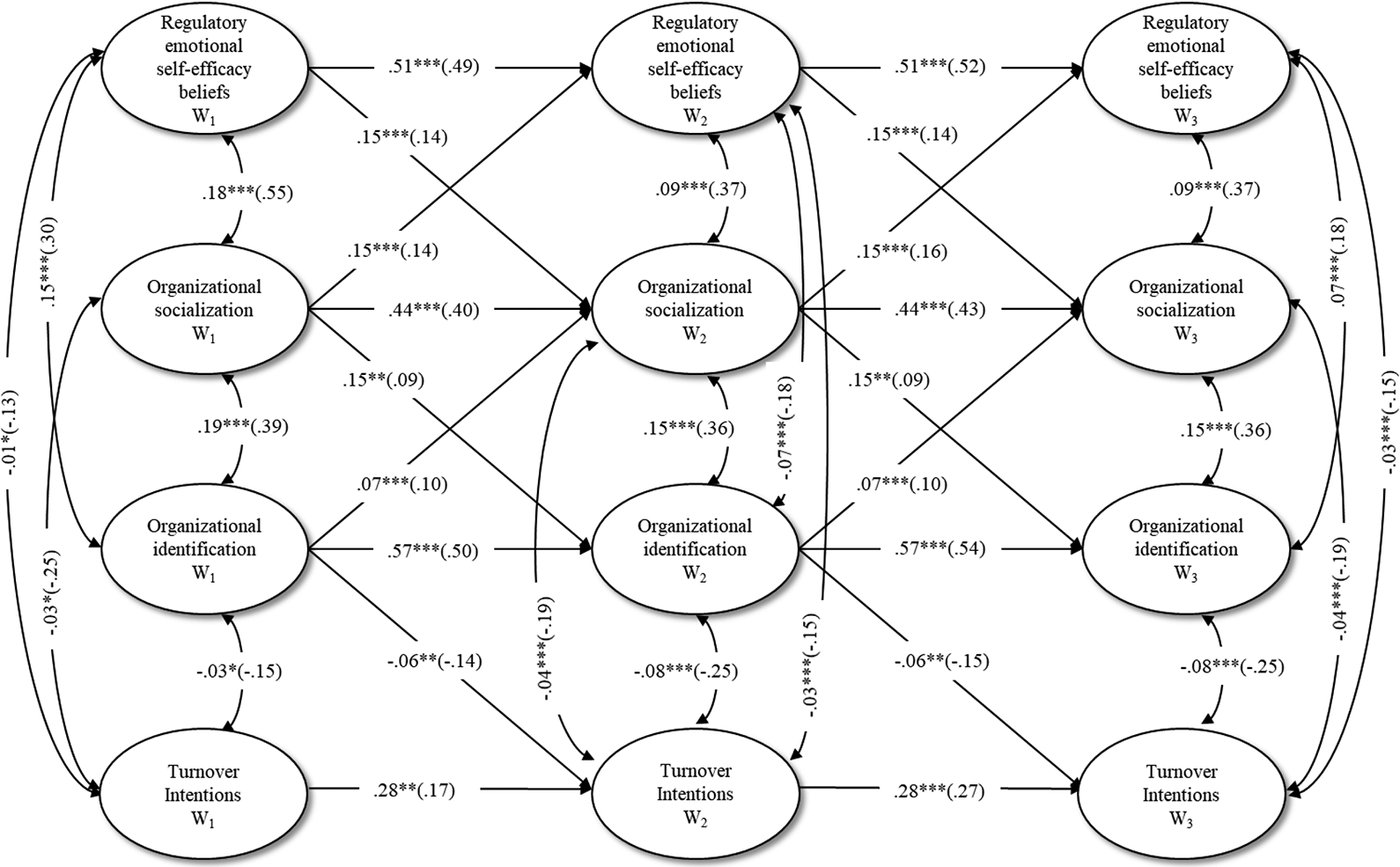
The estimated multigroup structural equation model (“time-and-cohort constrained multigroup model” in the main text). Note. Covariates and non-significant paths are omitted for sake of clarity and presented in the main text. Unstandardized parameters are reported with their associated significance level (*p < .05; **p < .01; ***p < .001). Averaged standardized parameters across cohorts are presented in brackets.
Cross-lagged and mediated paths
The hypothesized cross-lagged paths were significant. As shown in Figure 2, regulatory emotional self-efficacy beliefs positively predicted organizational socialization across time (H1). In turn, organizational socialization longitudinally positively predicted organizational identification (H2), and turnover intentions was indirectly and negatively predicted by organizational socialization through the mediation of organizational identification (H3; B = −.009, 95% BC-C.I.: −.019, −.004). Most importantly, a negative unstandardized indirect effect of regulatory emotional self-efficacy beliefs on turnover intentions through organizational socialization and organizational identification (H4) was found (B = −0.001, 95% BC-C.I.: −0.003, −0.001), thus attesting the hypothesized serial mediation (i.e., three-path mediation).
Control variables
Gender significantly predicted regulatory emotional self-efficacy beliefs both at W1 (B = −.24; p < 001) and W2 (B = −.13; p < .001), and organizational socialization at W1 (B = −.10; p < 01), with males scoring higher. Age significantly predicted regulatory emotional self-efficacy beliefs both at W1 (B = .01, p < .05) and W2 (B = .02; p < .01), with older individuals reporting higher levels of perceived emotional self-regulatory skills. Finally, having a previous military experience revealed no significant association with any of the major variable in the model.
Observed effect sizes
Overall, in the final time-and-cohort constrained multigroup model coefficients for the longitudinal paths were moderate in size (see Figure 2), according to common standards (Cohen, 1992). Finally, the model accounted for a large proportion of variability for all variables. R-squared coefficients were (a) .39 (W2) and .38 (W3) for regulatory emotional self-efficacy beliefs, (b) .29 (W2) and .33 (W3) for organizational socialization, (c) .29. (W2) and .33 (W3) for organizational identification. In accordance with the modeling strategy discussed in the “Multigroup Autoregressive Cross-Lagged Panel Model” section, R-Squared coefficients for turnover intentions varied from C1 to C2: they were .04 (W2) and .12 (W3) for C1, and .08 (W2) and .12 (W3) for C2.
Alternative pathways
Seven alternative paths were tested and compared with the estimated time-and-cohort constrained multigroup model by using the scaled difference chi-square devised by Satorra and Bentler (2001; SBΔχ2) and difference in CFI (ΔCFI). More specifically, we tested whether (1) regulatory emotional self-efficacy beliefs were predicted by turnover intentions (SBΔχ2(4) = 2.343, p = .67; ΔCFI = .001), (2) regulatory emotional self-efficacy beliefs were predicted by organizational identification (SBΔχ2(4) = 3.993, p = .41; ΔCFI = .000), (3) organizational identification was predicted by turnover intentions SBΔχ2(4) = 2.123, p = .71; ΔCFI = .002), (4) organizational identification was predicted by regulatory emotional self-efficacy beliefs (SBΔχ2(4) = 2.452, p = .65; ΔCFI = .001), (5) turnover intentions were predicted by regulatory emotional self-efficacy beliefs (SBΔχ2(4) = 2.837, p = .59; ΔCFI = .001), (6) turnover intentions were predicted by organizational socialization (SBΔχ2(4) = 2.204, p = .70; ΔCFI = .000), (7) and organizational socialization was predicted by turnover intentions (SBΔχ2(4) = 3.569, p = .47; ΔCFI = .001). Results of model comparison indicated that the time-and-cohort constrained multigroup model was (a) the best fitting model and (b) the most parsimonious model in terms of number of estimated parameters. Accordingly, whenever a direct path was added to this model (e.g., from turnover intentions to regulatory emotional self-efficacy beliefs) it turned out to be non-significant (i.e., p > .05).
Discussion
We presented a theoretical model in which regulatory emotional self-efficacy beliefs indirectly decreased intentions to quit by directly fostering organizational socialization and indirectly promoting organizational identification. Our results supported our expectations. Indeed, we found evidence that individuals reporting higher levels of regulatory emotional self-efficacy beliefs resulted more socialized and identified and harbored less intentions to quit. Moreover, our results suggest that individuals higher in organizational socialization reported a strong sense of identification with their organization. This latter, in turn, counteracted the development of thoughts of leaving. All in all, our findings suggested that, especially in a new and demanding work environment, one’s abilities to handle negative emotions along with organizational socialization and identification are pivotal ingredients for counteracting turnover intentions, and thus preventing significant costs for both the individual and his/her organization.
The present study contributes to expand the theoretical understanding of organizational socialization process by filling several gaps in the literature. Whilst organizational socialization scholars have traditionally restricted their attention on organizational practices and newcomers’ proactive behavior in explaining organizational socialization (Kammeyer-Mueller et al., 2013; Smith et al., 2017), we offer a full picture of the psychological processes that, starting from perceived self-regulatory abilities, lead newcomers to (a) socialize with the other members of their organization as well as acquire new work-related competences needed to perform well their duties, (b) identify with culture, values, and rules of their organization, and finally (c) desire to stay and invest in their organization. Our model is particularly relevant because, to our knowledge, it provides a unique explanation of the temporal sequence leading individuals to develop quit intentions.
In sum, the present study answers the call for taking into account the dynamic nature of the socialization process (Ashforth, 2012; Kammeyer-Mueller et al., 2013), by using two large cohorts assessed at three time points for three consecutive years (i.e., from the enrolment to the end of the training). Indeed, while organizational socialization is particularly relevant for newcomers when joining a new organization, it is also empirically attested that it continues to be important over the whole career span (Caforio, 2018; e.g., role transitions; Ellis et al., 2014), making organizational socialization (with rules, roles, and work demands) a goal that has to be constantly achieved (Moreland & Levine, 2006).
Of importance, our model suggests a temporal sequence, leading from perceived self-regulatory abilities to the decision to remain (and thus not to quit) in the academy. According to the model, then, organizational identification follows the more general organizational socialization process, and is the closer determinant of the intention to remain. On the other end, organizational identification depends upon the socialization level achieved by a particular worker, that is mostly a function of his/her perceived self-regulatory abilities. In sum, whereas the model assigns to regulatory emotional self-efficacy beliefs a pivotal role in sustaining the decision to remain in the academy, this role is played at the outmost distance.
These results have also several practical implications. For example, our findings suggest the value of training aimed to improve individuals’ regulatory emotional self-efficacy beliefs in the military academy, for example by using approaches such as reflective learning (Pool & Qualter, 2012), or mentoring. In this latter regard, a recent longitudinal study conducted on a sample of military pilot-trainees who were experiencing difficulties in their training course, McCrory and colleagues (2013) found that the Psychological Skills Training (i.e., a formal one-to-one mentoring intervention based on both social-cognitive and self-regulation models) was associated with a heightened efficacy. Furthermore, mentoring is among the organizational practices aimed at socializing newcomers (for a recent review of the literature on socialization and mentoring, see Allen et al., 2017).
Limitations and Future Research
This study has several limitations. First, we have exclusively relied on self-report measures, and using the same source of information may lead to biased results due to the common method variance (Conway & Lance, 2010). Thus, future studies are encouraged to use multi-source of information (e.g., peer and/or supervisor assessment, objective data on turnover) to corroborate our results. However, it should be noted that “when individual perceptions and attitudes are determining employees’ responses to work, self-reports should be a valid and useful source of data” (Bauer & Green, 1994, p. 22).
Second, notwithstanding the overall high retention rate, the higher drop out of females compared with males may represent a limit of the present study. However, as already discussed, we point out that cadets may randomly missing data collection (e.g., because illned or because military duties during the day of data collection); hence, missingness may be due to chance, rather than to substantive reasons that may impact on subsequent data analyses. Third, if on the one hand the representativity of the sample is a strength, on the other hand military organizations greatly differ from civilian ones (e.g., Griffeth et al., 2000) and thus cautions should be used in generalizing our findings to other organizational settings (Simons et al., 2017). Therefore, scholars are encouraged to replicate our study involving other samples (i.e., individuals belonging to non-military organizations). Fourth, organizational constraints prevent us from predicting turnover behavior as well as the use of a more comprehensive measure of turnover intentions. However, it should be noted that previous research has consistently attested that behavioral intentions to quit are positively and strongly related with actual turnover (e.g., Dupré & Day, 2007; for a meta-analysis, see Hom et al., 2017).
Finally, we did not include measures of job stressors, nor contextual variables (e.g., formal organizational practices, climate, and socialization agents) that may influence newcomers’ socialization. Although it was beyond the scope of the present study, socialization research would benefit from testing the role of emotional self-efficacy beliefs within integrative conceptual models such as those recently proposed. For instance, according to Ellis and colleagues’ model of socialization (Ellis et al., 2015, Fig. 1), emotional self-efficacy would expected to be among those individual differences related with proactive personality that influence the socialization process and its outcomes, by affecting organizational and individual tactics, cognitive appraisal processes, and the stress experience.
Conclusion
Our results contribute to support an overarching theoretical model of organizational socialization wherein regulatory emotional self-efficacy beliefs represent relevant individual differences able to trigger work adjustment especially for newcomers, both directly and indirectly. Overall, the present study represents a step forward toward the understanding of the mechanisms leading newcomers to fully adjust to their role and preventing the emergence of thoughts of leaving, an even more costly issue for those organizations (such as military organizations) that invest a lot of resources in recruiting, selecting, and training people.
Footnotes
Declaration of Conflicting Interests
The author(s) declared no potential conflicts of interest with respect to the research, authorship, and/or publication of this article.
Funding
The author(s) disclosed receipt of the following financial support for the research and/or authorship of this article: Guido Alessandri was supported by two grants named Progetto Ateneo Grande (S.A. Number: 50/19) and Progetto Ateneo Medio (D.R. Number: 2936/2017) funded by Sapienza University of Rome (Rome, Italy). Enrico Perinelli was supported by a research fellowship titled WeBeWo LAB: Quality of Social Relationships in Workplace (Number: 40103205) granted by the Autonomous Province of Trento and the Department of Psychology and Cognitive Science of University of Trento, and by a grant titled Ricerca per la Ripartenza [research for restarting] funded by Fondazione Caritro (Trento, Italy).
