



Abstract
This research introduces career crafting to describe a set of lifelong career behaviors that individuals engage in when developing their meaningful career paths. The Career Crafting Assessment (CCA), based on the defined criteria of career crafting, was developed to measure the construct and its validity was tested across two studies. Exploratory factor analysis in Study 1 revealed that the CCA is multidimensional, composed of four factors. Confirmatory factor analysis in Study 2 further specified that the CCA is hierarchical, demonstrating a good model fit of a four-factor model with a higher-order factor. Correlational tests indicated that career crafting is positively related to existing career constructs, demonstrating convergent validity. Furthermore, the CCA predicted meaningful work, work engagement, and subjective career success, providing concurrent validity. Finally, a series of hierarchical regression tests revealed that career crafting accounts for more of the variance in meaningful work and work engagement than job crafting but not in subjective career success, partially providing incremental evidence. Overall, study findings suggest that (a) career crafting is a distinct construct, and (b) the CCA is a valid measure for assessing career crafting that can be used to better understand lifelong career behaviors to make one’s career more meaningful and engaging.
Careers involve a range of transitions that include movement between jobs, employers, occupations, and industries across a lifetime (Sullivan & Baruch, 2009). According to the U.S. Bureau of Labor Statistics (2018), individuals report changing their jobs an average of 11.9 times by the age of 50. A job that satisfies an individual at a certain point may not be an ideal job at another point in time due to the changing nature of an individual’s needs, values, and strengths (Hall, 1976, 2002; Sullivan, 1999; Sullivan & Baruch, 2009). On the other hand, the required abilities, skills, and knowledge for a job can change over time. Therefore, it is important to understand individuals’ career behaviors in this dynamic career context.
We propose the construct of career crafting to better understand successful lifelong career behaviors in the changing nature of career contexts. We define career crafting as a set of proactive and congruence-seeking behaviors that (a) broadens career-relevant resources in response to the evolving nature of jobs and (b) explores career options more congruent to one’s changing needs, values, and interests. Previous research has focused on improving meaning in people’s current job (Wrzesniewski & Dutton, 2001) or by seeking new jobs. We argue that both—to make a better fit for a job and explore a new job in response to their changing needs, values, and interests—should not be separated because both are critical to maintaining and improving meaning in work. Therefore, career crafting addresses a set of career behaviors that helps improve meaning in peoples’ current job and potential future jobs.
Career crafting emphasizes the integration of proactivity and congruence in a career context. Proactivity is an individual’s ability to optimize resources in achieving desired work and personal outcomes (Berlyne, 1960; Kossek et al., 1998; Stumpf et al., 1983; Tims & Bakker, 2010; Wrzesniewski & Dutton, 2001). Congruence is a concept that reflects the alignment of one’s career with their interests, strengths, values, and needs (Edwards, 1991; Edwards & Shipp, 2007; Hall, 1976; Kristoff & Guay, 2011; Mainiero & Gibson, 2018; Verquer et al., 2003). Career crafting posits that individuals rarely achieve the best possible career fit across their lifetime without a combination of both proactivity and congruence in one’s career. To further elaborate, proactivity acts as an external compass that leads an individual to resources outside the self, such as one’s relationships and organizational career opportunities, while congruence acts as an internal compass that guides an individual to resources within the self, such as their values, interests, and needs. As such, proactivity and congruence together would optimally facilitate the achievement of satisfying careers across the lifetime. However, the current body of career literature has rarely defined a construct that uses both. Instead, it emphasizes constructs that are defined by the use of either the external (e.g., job crafting, career exploration, and career self-management) or the internal (e.g., protean career and the kaleidoscope career model) compass. Career crafting addresses this gap and offers an integrated use of proactivity and congruence to help individuals improve meaningfulness in their careers.
The Present Study
The present study’s primary purpose is to develop a validated measure for career crafting, the Career Crafting Assessment (CCA). We generated items by reviewing a range of the items from career constructs that potentially capture key facets of career crafting. In Study 1, the items were tested using exploratory factor analysis (EFA), a method that reduces and refines items, in a sample of full-time employees collected from Amazon’s Mechanical Turk (MTurk). In Study 2, the identified items were evaluated and cross-validated using confirmatory factor analysis in another MTurk sample of full-time employees. Furthermore, to establish convergent validity of the developed items, we assessed correlations between the developed measure and a range of related variables. Finally, to establish concurrent and incremental validity of the developed items, we assessed linear and hierarchical regression analyses predicting criterion variables.
Defining Career Crafting
In articulating career crafting, we first laid out the essential dimensions of proactivity using existing domains of job crafting. These domains include task, relationship, and cognitive crafting, solidified by research that includes Wrzesniewski and Dutton (2001), Slemp and Vella-Brodick (2013), and Tims et al. (2012). Job-level task crafting describes the practice of changing the type, scope, and number of job tasks to better suit an individual’s strengths and values. Job-level relational crafting refers to changing the amount and quality of interactions with other people encountered on the job. Job-level cognitive crafting involves altering the individual’s perception of their work, such as interpreting their job as a part of fulfilling their life story instead of viewing work as a means of living (Wrzesniewski & Dutton, 2001). These three domains were chosen as the scaffolding to frame proactive behaviors of career crafting because they are considered to represent key areas of proactivity in the context of work.
Furthermore, to identify the congruence-seeking behaviors of career crafting, behaviors that help better alignment with one’s evolving self were drawn mainly from the protean career orientation (Hall, 1976) and the kaleidoscope career model (Mainiero & Sullivan, 2006). These concepts highlight self-directed, value-driven, and need-based approaches to careers, emphasizing the critical factors that change in a career over time, and their role in career satisfaction. Whereas research on congruence places emphasis on perceptions and orientations towards work rather than presenting specific behaviors, we determined a behavioral level integration for both proactivity and congruence to help guide one’s actions explicitly. Therefore, these concepts were translated into behaviors to describe people’s tendency to take action with the intention of aligning individuals’ careers with their evolving needs, interests, and values.
By synthesizing the aforementioned literature, career crafting is characterized as a set of proactive behaviors that create or expand task, relational, and cognitive resources with the goal of supporting individuals’ efforts toward achieving congruence between their career and their needs, values, and interests. Career-level task crafting is defined as the extent to which individuals develop skills and abilities that lead to the realization of their best self within their career. Career-level relational crafting is defined as the extent to which individuals proactively search for and connect with a group of people with whom they can share their authentic interests and values. Finally, career-level cognitive crafting is defined as the extent to which individuals proactively reflect career meaning and frame their career as an essential part of their meaningful life. In addition, the subdimensions are thought to be synergized to one’s career. For instance, having relational resources (e.g., a career mentor) may influence one’s task accomplishment, and thus one’s job fit evaluation (Tims et al., 2016). Research suggests that positive relationships, positive meaning, and task accomplishment are related and serve as part of the building blocks of subjective well-being (Donaldson et al., 2020; Seligman, 2018). Moreover, proactivity and congruence should be exhibited across subdimensions and collectively shape career crafting. Thus, we speculate that career crafting is composed of task, relationship, and cognition dimensions, with the subdimensions of career crafting being closely related.
Related Constructs
It is essential to demonstrate that career crafting and its dimensions converge with related measures to validate the construct and its measurement. We reviewed relations between career crafting and theoretically relevant constructs that include protean career orientation, job crafting, career exploration, career self-management, and organizational career management, hypothesizing that the pattern of correlations would support the establishment of convergence validity.
Career crafting and protean career
It is speculated that the protean career is relevant to career crafting. The protean career orientation is a career decision-making style that is both self-directed and values-driven (Briscoe & Hall, 2002). Those with a protean career orientation prefer to chart their own careers rather than follow a career path set forth by their organization (Hall, 1976). Instead of merely accepting when an organization gives them raises, promotions, or role changes, a person with a protean orientation may seek these conditions proactively at their own pace. Similar to protean individuals, career crafters also use self-direction and a values-driven attitude as their internal compass when navigating their career path. The difference, however, is that career crafters proactively utilize their relational and task resources to expand their career opportunities, which is not included in the protean career construct. Together, we posit that career crafting is positively, moderately related to the protean career orientation, and cognitive crafting is more strongly related to the protean career than task and relational crafting.
Career crafting and job crafting
Wrzesniewski and Dutton (2001) originally introduced job crafting as a concept that describes employees’ need to control tasks, work relations, and cognition to improves meaningfulness in work. Tim et al. (2012) further operationalized job crafting based on the job demands-resources model (Bakker & Demerouti, 2007), emphasizing the role of increasing job resources and decreasing hindering job demands in improving work engagement and performance. Career crafters, like job crafters, utilize the three dimensions of job crafting and develop job resources. For example, career crafters would perform task crafting by taking extra challenges to explore their overarching career interests. However, whereas job crafting is an effort to improve person-job fit and work motivation in their current job (Tims et al., 2012; Wrzesniewski & Dutton, 2001), career crafting encompasses broader career behaviors to improve vocational fit and meaning in work. Thus, we speculate that career crafting is positively, moderately related to job crafting.
Career crafting and career exploration
Career exploration involves purposefully seeking out career or organization-related information previously unknown to an individual (Berlyne, 1960). Information from this exploration subsequently affects future career behaviors; when individuals modify their behavior using information they sought out, they are being proactive in shaping their career (Stumpf et al., 1983). Career crafters seek out career-related information as the career exploration construct suggests. However, career crafters also utilize their current tasks as information for their future career, which is not included in the career exploration construct. Therefore, we hypothesize that career crafting is positively, moderately related to career exploration.
Career crafting and career self-management
Career self-management is an individually motivated behavior in which one gathers resources and information to contribute to their career decision-making and problem-solving (Kossek et al., 1998). Career crafters are likely to exhibit self-controlled behaviors similar to those in career self-management during the process of career decision making. However, career crafting involves more than self-controlled behavior. Career crafters cognitively reframe their career to align with their values and to create meaning. Therefore, we hypothesize that career crafting is positively, moderately related to career self-management.
Career crafting and organizational career management
Whereas career self-management is driven by the self, organizational career management is driven by one’s organization (Sturges et al., 2002). This type of career management can come in the form of training programs, mentoring from a supervisor, and career advice. Career crafters not only proactively seek opportunities initiated by themselves, but also utilize the opportunities provided by organizations. However, considering that career crafters use self-directedness, they may be less influenced by their organization’s plan for their career development. Therefore, we career crafting is related to organizational career management.
Criterion-Related Constructs
It is necessary to investigate the relations between career crafting and criterion variables to establish the concurrent and incremental validity of career crafting. We hypothesize that career crafting accounts for incremental variance in meaningful work, work engagement, and subjective career success, beyond that accounted for by job crafting, a known predictor of these criterion variables.
Career crafting and meaningful work
Meaningful work refers to the work that is perceived as worthwhile, consequential, or valuable to oneself or others and fosters personal growth (Pratt & Ashforth, 2003; Steger et al., 2012). Research suggests that job crafting improves meaningful work by expanding or reducing task and relational resources. A time-lagged study by Tims et al. (2016) reported that individuals who crafted their job perceived more autonomy and support, which improved the perceived fit between the individual and the job the next week. This, in turn, enhanced meaningfulness in work during the final week of the study. We postulate that career crafters may perceive their work more meaningfully than job crafters because they seek out congruence between their interests and their work. Thus, career crafters are more likely to stay or find a job that allows them to experience more meaning. This congruence between one’s changing needs, values, and interests and career is not reflected in current job crafting studies. Therefore, we hypothesize that career crafting improves meaningful work above and beyond job crafting.
Career crafting and work engagement
Work engagement refers to a positive, fulfilling, work-related state of mind characterized by vigor, dedication, and absorption (Schaufeli et al., 2002). When employees craft their jobs, they can create a personally engaging environment at work. Harju et al. (2016) reported that when individuals increased challenges at work via a new project, they also increased their engagement at work. A longitudinal study reported that having lower unnecessary job demands led to decreased burnout, and higher job resources led to increased work engagement (Hakanen et al., 2008). While Hakanen et al.’s (2008) research was limited to the context of a single job, we propose that individuals may receive greater benefits from engaging in similar behaviors in the career domain. Although they may seek more job-related resources, career crafters also seek resources beyond those inherent to their job and outside of their organization. Therefore, we posit that career crafting improves work engagement above and beyond job crafting.
Career crafting and subjective career success
Subjective career success refers to accumulated positive psychological accomplishment from work experiences (Seibert et al., 1999). Seibert et al. found that proactivity was predictive of subjective career success. Furthermore, another study with a sample of mid-level managers in a large service organization found that job crafting is positively linked to subjective career success (Cenciotti et al., 2017). We speculate that even when career crafters may feel dissatisfied with their current position, they may view that remaining in the position is a necessary endeavor to strengthen their path to their desired career. Therefore, we hypothesize that career crafting will capture more variance in subjective career success than job crafting.
Study 1. with Item Generation and Exploratory Factor Analysis
Method
Scale Development
The Career Crafting Assessment (CCA) was constructed to operationalize career crafters’ behaviors using a deductive method that is commonly suggested for scale development in organizational studies (Hinkin, 1998). We identified existing career scales contributing to career crafting behavior as defined in this study. Seven different scales were finally considered in the development of the career crafting scale: the Job Crafting Scale (Slemp & Vella-Brodrick, 2013), the Job Crafting Scale based on the Job Demands-Resources model (Tims et al., 2012), the Career Planning Scale (Gould, 1979), the Career Salience Scale (Greenhaus et al., 1990), Career Self-Management (Sturges et al., 2002), the Authenticity, Balance, and Challenge Scales (KCM; Sullivan et al., 2009), and the Protean Career Attitude Scale (Briscoe et al., 2006). From these scales, 96 initial items were generated. After two review processes with several organizational psychology researchers and following discussions with two individuals identified as exemplary career crafters, 50 items were chosen based on how appropriately they fit with our conceptualization of career crafting. Out of the 50 items, 12 items remained in their original form, and the other 38 items were revised to better capture career crafting. For example, the word “job” was changed to “career,” and questions related to attitudes or orientations were rewritten to capture specific behaviors. Finally, 23 items were created to reflect the task crafting dimension, 13 items to reflect the cognitive crafting dimension, and 14 items to reflect the relational crafting dimension. The response set is a 7-point Likert-type scale ranging from Does not describe me at all (1) to Completely describes me (7).
Participants
A total of 318 participants in the United States and Canada were recruited via Amazon’s Mechanical Turk (MTurk), an online crowdsourcing service. MTurk was chosen because of the diversity of participants (Behrend et al., 2011; Buhrmester et al., 2011) and greater attention by the participants (Hauser & Schwarz, 2016). Those who did not satisfy the criteria of 1) being a currently full-time employee and 2) having a minimum of one year full-time work experience were excluded from participating because of a potential lack of career crafting experiences. Of the sample (N = 318), 53% were male (n = 168) and 47% were female (n = 149). The participants’ ages ranged from 20 to 67 years, with the average age being 42.8 (SD = 9.49) years. The majority of respondents (94%, n = 299) reported having more than two years of full-time work experience, and 3% reported their position being at the manager level (n = 123). In terms of education, 63% of the participants possessed a bachelor’s degree or higher (i.e., master’s degree or PhD; n = 200). Regarding race/ethnicity, the majority self-identified as White/Caucasian (78%, n = 247), followed by African American/Black (8%, n = 25), and Asian (8%, n = 25), while 3% self-identified as Hispanic/Latino (n = 10) and 2% (n = 6) as Multiracial.
Procedure
First, we conducted a screener survey comprised of three questions (employment status, work experience, and career status) with $0.10 compensation. The main survey was administered only to those who passed the screener survey and satisfied the criteria (i.e., having a minimum of one year of full-time work experience and being currently full-time employees) and consented to participate. These participants were asked to complete an open-ended question about their career journey and were given the 50-item Career Crafting Assessment (CCA). Demographic information was collected at the end of the survey, including age, gender, marital status, whether they have children or dependents, ethnicity, education level, industry, occupation, job level, and income. Participants who completed the main survey were paid an additional $0.70 for a total compensation of $0.80.
Results
R (version 3.5.1) was utilized in analyzing the collected data. The final dataset included 318 cases after removing cases in which the vast majority of items were unanswered (n = 65), failed the attention check (n = 4), appeared as univariate outliers (n = 4), or straight-lining responses (n = 16). The data passed Bartlett’s test of sphericity (p < .001) and the Kaiser-Meyer-Olkin measure (KMO = .96), confirming that the items were sampled adequately to proceed with factor analysis (Hair et al., 1995; Tabachnick & Fidell, 2007). Factors were extracted using the principal axis factoring (PAF) method and rotated obliquely using oblimin rotation, taking into account the theoretically expected relations among the dimensions (Fabrigar et al., 1999). We conducted Horn’s (1965) parallel analysis to determine the number of factors that should be retained. Then, items that had cross-loadings higher than .30 onto multiple factors, weak factor loadings (less than .50), or weak communality scores (less than .50) were removed (see Costello & Osborne, 2005). With these criteria, we retained 23 of the initial 50 items. We then performed a series of EFA on the remaining items, resulting in four factors with 15 items that satisfy all criteria specified above. The relational dimension hypothesized to be one factor emerged as two separate factors—Changing Relational Boundaries and Utilizing Relational Resources. As hypothesized, the cognitive crafting related items formed another factor—Reflecting Positive Career Meaning. Finally, the task crafting related items established the fourth factor—Expanding Task Boundaries. Table 1 illustrates the items, item means, standard deviations, and factor loadings. The internal consistency of the entire CCA was high, with Cronbach’s α = .93 and McDonald’s ω = .95. Each of the four dimensions demonstrated good internal consistency, with a range of α = .83 to .93 and ω = .84 to .93 (see Table 2). Factor correlations were also adequate, ranging from .45 to .73. The four factors explained 67% of the total variance observed in the CCA, indicating the retained items’ strength. Overall, these results provide initial evidence of construct validity.
Exploratory Factor Analysis: Items, Means, Standard Deviations, and Factor Loadings of the CCA.
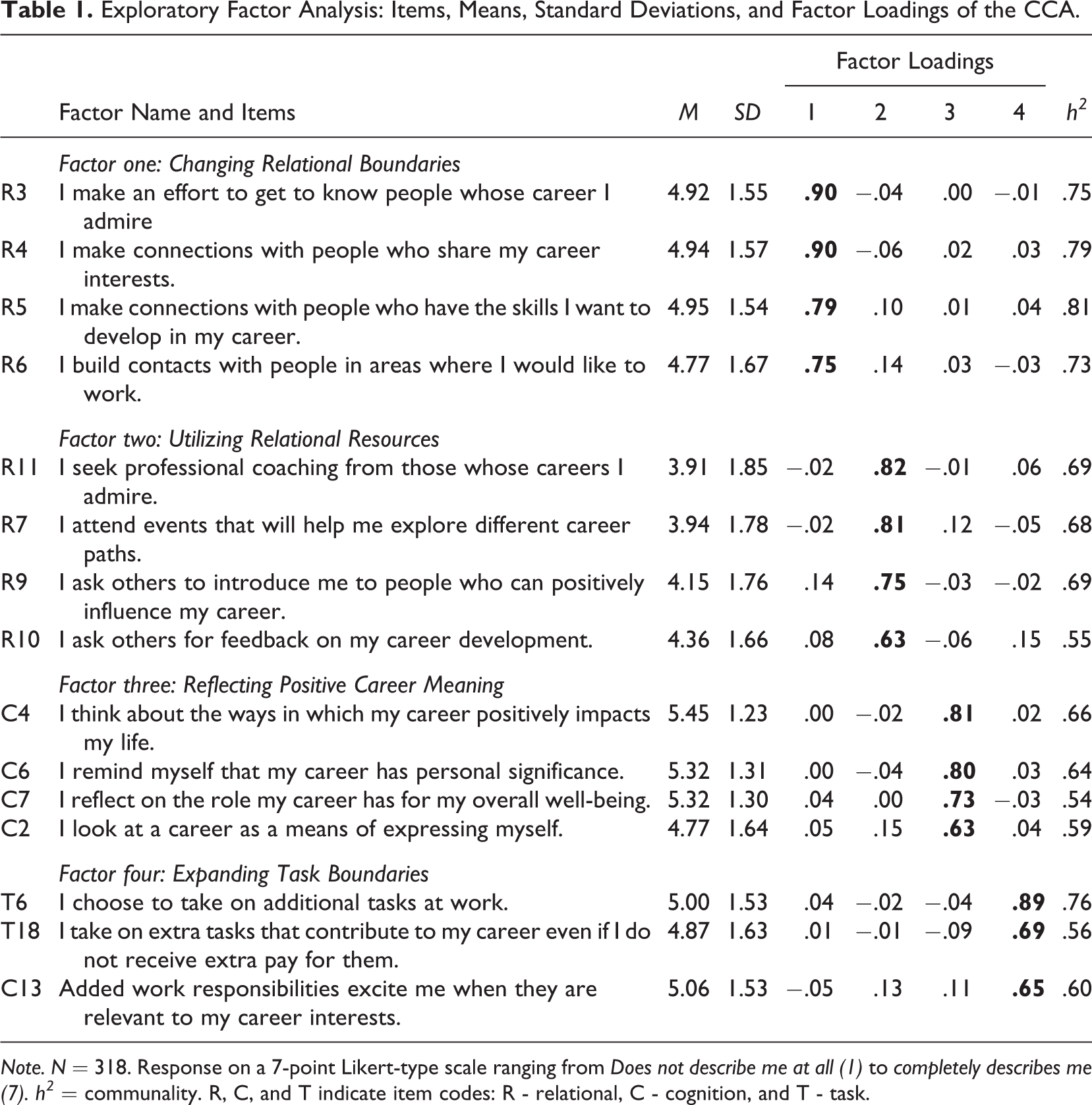
Note. N = 318. Response on a 7-point Likert-type scale ranging from Does not describe me at all (1) to completely describes me (7). h2 = communality. R, C, and T indicate item codes: R - relational, C - cognition, and T - task.
Exploratory Factor Analysis: Matrix of Factor Correlations of the CCA.
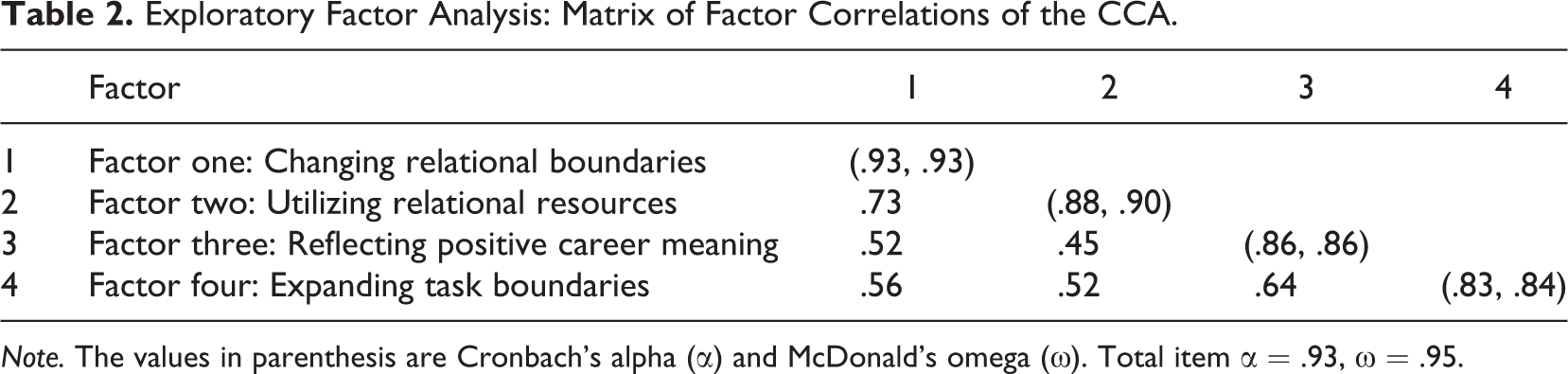
Note. The values in parenthesis are Cronbach’s alpha (α) and McDonald’s omega (ω). Total item α = .93, ω = .95.
Study 2. Confirmatory Factor Analysis and Validity Tests
Method
Participants
A total of 304 participants were recruited using MTurk. Because the same method was used as in Study 1, those who had taken part in Study 1 were excluded from participating in Study 2 via the MTurk ID screening process. Using the same criteria of Study 1, the survey was administered to participants who satisfied 1) being currently a full-time employee and 2) and having a minimum of one year of full-time work experience. Of the sample (N = 304), 42% were male (n = 128) and 58% were female (n = 176). The ages of the participants ranged from 22 to 69 years, with an average age of 38.4 (SD = 10.30) years. The majority of participants (94%, n = 286) reported having more than two years of full-time work experience. In terms of education, 58% of the participants possessed a bachelor’s degree or higher (i.e., master’s or PhD degree; n = 176). Regarding race/ethnicity, the majority self-identified as White/Caucasian (75%, n = 229), followed by African American/Black (70%, n = 22), Asian (6%, n = 1), Hispanic/Latino (5%, n = 15), multiracial (5%, n = 16), American Indian or Alaskan Native (n = 2), and not specified (n = 1).
Procedure
Participants who completed the screener survey (three questions to identify employee status and year of work experience) were compensated $0.10. Those who qualified for and completed the full survey were paid an additional $1.40, for a total compensation of $1.50. The amount paid to participants was decided based on MTurk compensation and participation rates (e.g., Buhrmester et al., 2011) and the average amount of time needed to complete the survey based on our pilot data.
Measure
Career crafting
We used the revised version of the CCA, comprised of 15 items, as determined by Study 1. The response set is a 7-point Likert scale ranging from Does not describe me at all (1) to Completely describes me (7). Sample items from each dimension include: “I make connections with people who share my career interests” (changing relational boundaries), “I seek professional coaching from those whose careers I admire” (utilizing relational resources), “I think about the ways in which my career positively impacts my life” (reflecting positive career meaning), and “I choose to take on additional tasks at work” (expanding task boundaries). Internal consistency for each dimension was α = .93, .86, .91, and .90, respectively.
Job crafting
We used the Job Crafting Scale (JCS), developed by Tims and colleagues (2012). The JCS is a 21-item measure that has four dimensions: increasing job resources (5 items, α = .85), decreasing hindering job demands (6 items, α = .87), increasing social job resources (5 items, α = .87), and increasing challenging job demands (5 items, α = .88). The response set is a 5-point Likert-type scale ranging from Never (1) to Often (5). A sample item in each dimension is “I try to develop my capabilities” (increasing job resources ), “I make sure that my work is mentally less intense” (decreasing hindering job demands), “I ask my supervisor to coach me” (increasing social job resources), and “When an interesting project comes along, I offer myself proactively as project co-worker” (increasing challenging job demands). Prior research has supported reliability and criterion and convergent validity of this measure (Tims et al., 2012, 2016).
Protean career orientation
We used the Protean Career Attitudes scale (PCA) developed by Briscoe and colleagues (2005; 2006). The PCA scale is composed of 14 items with two latent factors; self-directedness (8 items, α = .84) and value-driven (6 items, α = .78). Sample items include “I am in charge of my own career” (self-directed) and “I’ll follow my own guidance if my company asks me to do something that goes against my values” (value-driven). The response set was a 5-point Likert-type scale ranging from Little or no extent (1) to A great extent (5). Prior research has supported the reliability and validity of the measure (Briscoe et al., 2006; Herrmann et al., 2015).
Career exploration behavior
We used three subscales from the Career Exploration Survey (Stumpf et al., 1983) that are comprised of 14 items: self-exploration (SE, 5 items, α = .88), environmental exploration (EE, 6 items, α = .87), and intended-systematic exploration (ISE, 3 items, α = .83). The response set is a 5-point Likert-type scale of frequency ranging from Little (1) to A great deal (5). Sample items include “[I] contemplated my past” (SE), “[I] sought information on specific areas of career interest” (EE), and “[I] sought opportunities to demonstrate skills” (ISE). Prior research has supported the reliability and validity of the measure reflected in a positive correlation with career choice (Stumpf et al., 1983).
Career self-management
We used the Individual Career Management Scale (ICMS; Sturges et al., 2002) to assess career self-management behaviors. The ICMS is comprised of four factors: networking (7 items, α = .62), mobility-oriented behavior ( 2 items, α = .62), practical behaviors (5 items, α = .54), and drawing attention (2 items, α = .41). We excluded the latter two subscales because of poor internal consistency. Sample items include “I have got myself introduced to people who can influence my career” (networking) and “I have made plans to leave this organization once I have the skills and experience to move on” (mobility oriented behavior). This scale uses a 5-point Likert-type scale with anchors at Strongly disagree (1) and Strongly agree (5). Prior research has supported this measure’s reliability and validity along with evidence for positive correlations with career success, career satisfaction, organizational support, and organizational commitment (De Vos & Soens, 2008; Verbruggen et al., 2007).
Organizational career management
We used the organizational career management scale developed by Sturges and colleagues (2002). This scale has two factors: informal help (4 items, α = .86) and formal help (6 items, α = .88). Sample items include “I have been given impartial career advice when I needed it” (informal help) and “My boss has made sure I get the training I need for my career” (formal help). This scale uses a 5-point Likert-type scale from Strongly disagree (1) to Strongly agree (5). Research has supported score reliability (Sturges et al., 2002).
Meaningful work
To measure meaning at work, we used the Work and Meaning Inventory (WAMI) developed by Steger and colleagues (2012). The WAMI is composed of a higher order factor with three lower order factors (positive meaning, meaning-making, and greater good motivations) comprised of 10 items in total. We used the total score of 10 items, which has been suggested as adequate for analysis (Steger et al., 2012). A sample item includes: “I view my work as contributing to my personal growth.” This scale uses on a 5-point scale from Absolutely untrue (1) to Absolutely true (5). Research has supported reliability and validity reflected in positive relations to calling orientation, job satisfaction, career commitment, organizational commitment, and intrinsic work motivation (Fouché et al., 2017; Jung & Yoon, 2016; Steger et al., 2012). Internal consistency in our study was α = .91.
Work engagement
We used the 9-item Utrecht Work Engagement Scale (UWES-9; Schaufeli et al., 2006). UWES-9 is comprised of nine items that represent vigor, absorption, and dedication. We used the total score of nine items suggested as adequate for analysis (Schaufeli et al., 2006). A sample item includes “At my work, I feel bursting with energy.” The measure uses a 7-point Likert scale ranging from Never (1) to Always (7). Research has supported the scale validity and reliability (Schaufeli et al., 2006). Internal consistency in our data was α = .95.
Subjective career success
We used the Career Satisfaction Scale (CSS) developed by Greenhaus and colleagues (1990) to measure satisfaction with one’s career. The CSS is comprised of five items and is rated on a 5-point Likert-type scale from Strongly disagree (1) to Strongly agree (5). A sample item is “I am satisfied with the success I have achieved in my career.” Research has reported positive correlations with job performance, and negative correlations with burnout (Keeton et al., 2007; Shanafelt et al., 2010). Internal consistency in our data was α = .80
Results
Confirmatory Factor Analysis (CFA)
The collected data were analyzed using R (version 3.5.1). The final dataset included N = 304 after removing missing data (n = 1), attention check failure (n = 15), flattened responses (n = 19), univariate (n = 5; the cut off +/−3 SD, Cohen et al., 2003), and multivariate outliers (n = 8, the cut off +/−3 SD from Mahalanobis’ distance). The data set showed adequate skewness and kurtosis, and histograms confirmed normal distributions. Scatterplots between the CCA and criterion variables were linear, with no specific patterns, ensuring homoscedasticity. The Bartlett’s Test of Sphericity was significant, and KMO (=.94) was adequate, confirming data appropriateness (Hair et al., 1995; Tabachnick & Fidell, 2007). Cronbach’s α and McDonald’s ω for the entire item set was .93 and .96, respectively, showing strong internal consistency. Each subscale also exhibited high internal consistency. Cronbach’s α was .93, .86, .91, and .90, and McDonald’s ω was .93, .88, .91, and .90 for Factor 1 (Changing relational boundaries), Factor 2 (Utilizing relational resources), Factor 3 (Reflecting positive career meaning), and Factor 4 (Expanding task boundaries), respectively. CFA was performed using the maximum likelihood estimation procedure. First, we established a four-factor model with correlated factors based on the result of the exploratory factor analysis in Study 1. Subsequently, we compared its model fit with a four-factor model with a higher-order factor and a three-factor model with correlated factors as originally hypothesized. The four-factor model demonstrated good fit indices (χ2 = 178.39, df = 84, CFI = .97, TLI = .965, SRMR = .04, RMSEA = .06; RMSEA 90% CI = [.05, .07]); CFI exceeded the .95 cutoff; SRMR was less than suggested .06 cutoff, RMSEA was less than .08 for adequate fit (Hu & Bentler, 1999; Kline, 2015; MacCallum & Austin, 2000). All items loaded significantly on the latent variables, with coefficients ranging from .67 to .91. The subscales were highly intercorrelated, ranging from .49 to .76. We then assessed the four-factor model with a higher-order factor. The subscales loaded strongly onto the higher-order factor, ranging from .64 to .89. (see Figure 1). The fit indices demonstrated a good model fit (χ2 = 194.74, df = 86, CFI = .97, TLI = .961, SRMR = .05, RMSEA = .07; RMSEA 90% CI = [.05, .08]). A three-factor model was then assessed after combining Changing Relational Boundaries and Utilizing Relational Resources into one factor. The three-factor model exhibited poor fit indices and thus was no longer considered. Table 3 summarizes the model fit indices for all three models.
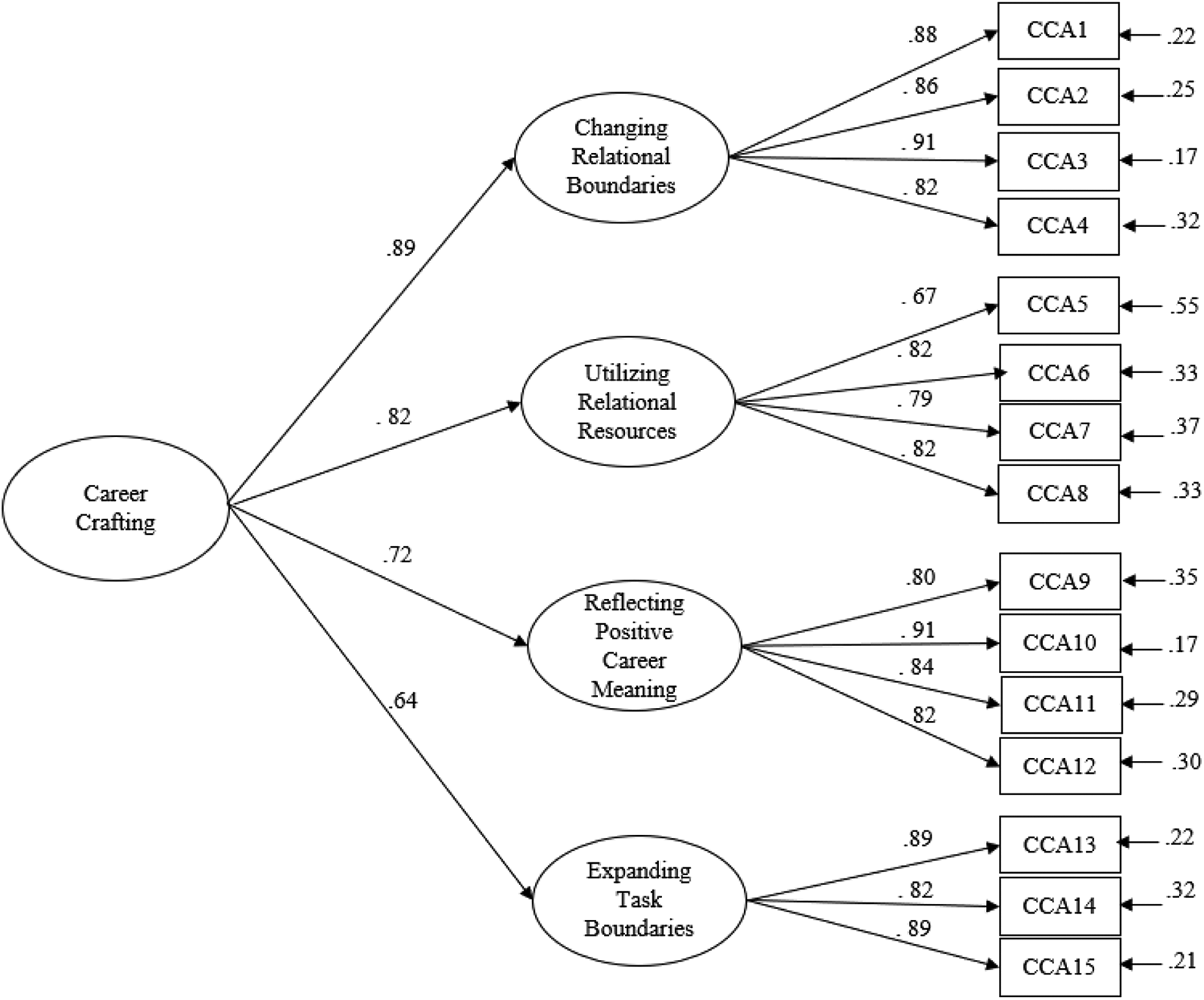
Graphical representation of a four-factor model with a higher-order factor. Circles represent latent factors, and squares represent manifested variables. Single-headed arrows index factor loading and numbers appearing next to each manifest variable represent error variance associated with each item.
Confirmatory Factor Analysis of the CCA.

Note. N = 304. Relative indexes: CFI = comparative fit index. SRMR = standardized root mean square residual. TLI = the Tucker–Lewis Index. RMSEA = root-mean-square error of approximation. AIC = the Akaike Information Criteria.
Because both the four-factor model and the four-factor model with a higher-order factor demonstrated good model fit, the two models were further examined. AIC score (13,938 vs. 13,951) and model comparison (Δ χ2 = 16.35, p < .001) showed that data fit better on the four-factor model. However, the TLI difference was insignificant (<.01), indicating that the model difference is negligible (Gignac, 2007). In this case, we favored the four-factor model with a higher order factor because of the better fit with the theoretical perspective of career crafting in that proactivity and congruence exhibited across the four factors should collectively contribute to career crafting outcomes. Thus, we concluded that a four-factor model with a higher-order factor best supports the concept of career crafting in light of both statistical and theoretical considerations.
Convergent Validity Tests
We hypothesized that career crafting is positively related to the protean career orientation, career exploration, career self-management, job crafting, and organizational career management. We examined the Pearson correlation coefficient to test these hypotheses. Correlations among the CCA and the related constructs were positive and significant with the exceptions of mobility (one of the subscales of career self-management) and decreasing job demand (one of the subscales of job crafting, see Table 4). As hypothesized, Reflecting positive career meaning, the third dimension of career crafting, had a more substantial relationship with protean career among subdimensions of the CCA.
Intercorrelations between Career Crafting and Related Constructs.

Note. N = 304. The values in the parenthesis are Cronbach’s alpha. *p < .05. **p < .01. ***p < .001.
Criterion and Incremental Validity Tests
We conducted linear regressions to test our hypotheses that career crafting predicts meaningful work, work engagement, and subjective career success. The scales’ internal consistencies were adequate: α = .91, .95, and .80 for meaningful work, work engagement, and subjective career success, respectively. We used mean scores of each of these criterion constructs based on previous studies (e.g., Greenhaus et al., 1990; Schaufeli et al., 2006; Steger et al., 2012). The results of the linear regressions supported our hypotheses and demonstrated that the CCA was a significant predictive variable for meaningful work (β = .65, 95% CI [.57, .74], p < .001), work engagement (β = .67, 95% CI [.59, .76], p < .001), and subjective career success (β = .27, 95% CI [.16, .3], p < .001).
After finding evidence of concurrent validity, we conducted a series of hierarchical regressions to test whether the CCA explains variance above and beyond job crafting. In the first step, based on prior research (e.g., Tims et al., 2012; Van Wingerden et al., 2017), we entered three subscales of job crafting as predictors for meaningful work, work engagement, and subjective career success. In the second step, we added the mean score of the CCA as a predictor. R2 was significantly changed when the CCA was added to the second step, capturing more of the variance in meaningful work and work engagement, providing evidence of incremental validity of the CCA. However, R2 change was insignificant when the CCA was added as a predictor for subjective career success, failing to support career crafting’s unique contribution above and beyond job crafting in predicting subjective career success. Table 5 illustrates the results of hierarchical regression analyses predicting meaningful work, work engagement, and subjective career success.
Hierarchical Regression Analysis Predicting Meaningful Work, Work Engagement, and Subjective Career Success.
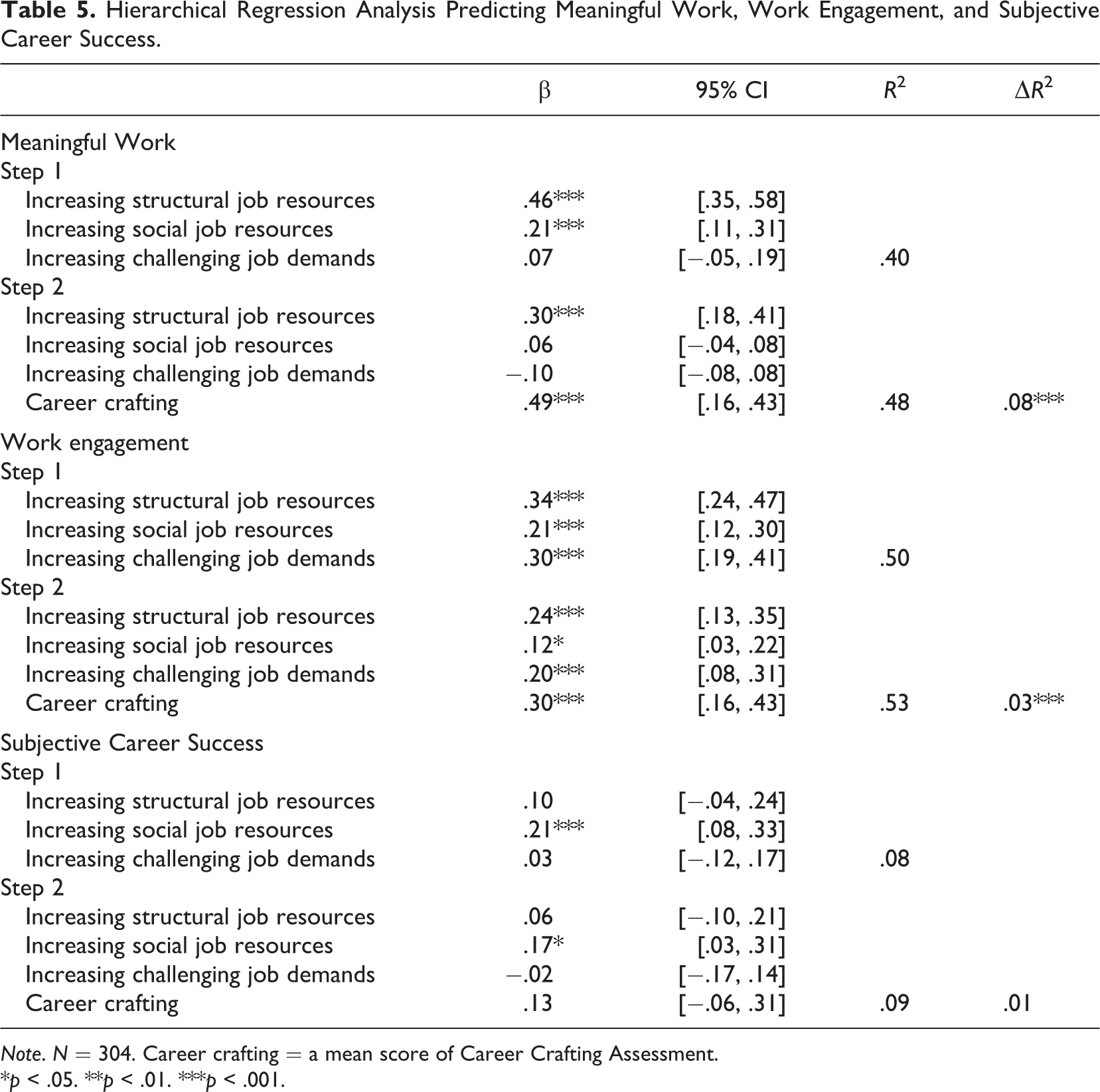
Note. N = 304. Career crafting = a mean score of Career Crafting Assessment.
*p < .05. **p < .01. ***p < .001.
General Discussion
Careers are comprised of a continuum of a person’s current job and potential future jobs. Career crafting describes successful lifelong career behaviors by incorporating proactive crafting efforts both in one’s current job and across the movement between jobs, employers, occupations, and industries. In addition, career crafting addresses the phenomenon in which one’s career becomes more meaningful when proactive crafting is motivated by the process of seeking congruence to one’s changing needs, interests, and values. We developed the Career Crafting Assessment (CCA) and tested the validity of the measure to operationalize career crafting. Exploratory factor analysis in Study 1 led to the initially hypothesized three dimensions of career crafting (relational, cognitive, and task crafting) being further articulated into four dimensions, allowing for a more comprehensive understanding of successful career behaviors. The relational dimension that we hypothesized to be one factor emerged as two separate factors, Changing relational boundaries and Utilizing relational resources, suggesting the vital role of proactive relational crafting in producing positive career outcomes, consistent with previous studies (e.g., Fagenson, 1989; Parker et al., 2008). The third factor, Reflecting positive career meaning, emerged from the cognitive crafting items, indicating that career crafters view their careers as a significant part of their life, suggesting that meaningful careers are important for career crafters. Finally, the fourth factor, Expanding task boundaries, indicates that task crafting is another essential part of career crafting, suggesting that career crafters are willing to take on extra tasks to experience new career-related responsibilities in their organization. This four-factor structure was reevaluated in Study 2 via confirmatory factor analysis. The data was a good fit for a higher order factor model, supporting the theoretical perspective of career crafting which emphasizes the integration of proactivity and congruence across the subdimensions of career crafting. Exploratory and confirmatory factor analyses together provided evidene of construct validity for the CCA.
Subsequently, convergent validity of the CCA was established by obtaining positive correlations between career crafting and protean career orientation, career self-management, career exploration, organizational career management, and job crafting with exceptions of mobility (one of the subscales of career self-management) and decreasing hindering job demand (one of the subscales of job crafting). The lack of a significant relation between career crafting and mobility implies that when an organization limits one’s career path, career crafters may not immediately consider leaving the company but instead to find a way to develop their career inside the organization. The strong positive correlation between career crafting and organizational career management supports this notion, suggesting that organizations which provide opportunities to pursue alternative pathways within the organizations may have more success in retaining their career crafting employees. The subscales of the career crafting having non-significant or weak correlations with decreasing job demand indicate that career crafters utilize promotion-focused strategies motivated by the need to enhance the meaningfulness of one’s career (i.e., increasing job resources), rather than prevention-focused strategies motivated by the need to enhance the meaningfulness of one’s career (i.e., reducing hindering job resources, Lichtenthaler & Fischbach, 2019). This outcome is consistent with Tims et al.’s (2012) finding that decreasing job demands is unrelated and independent of other job crafting dimensions. Future research that looks into the relations between career crafting and negative criterion variables such as burnout and turnover intention would provide a better understanding of career crafting and help inform an appropriate strategy for organizations to retain career crafters.
Finally, criterion validity of career crafting was established. Concurrent validity of career crafting was supported by linear regressions which indicate career crafting predicted meaningful work, work engagement, and subjective career success significantly. The strong relation between career crafting and work engagement is practically insightful for organizations because work engagement predicts higher job performance (Bakker et al., 2010; Kim et al., 2012). In terms of incremental validity, a series of hierarchical regression tests revealed that career crafting explains a unique variance of meaningful work and work engagement above and beyond job crafting. However, career crafting did not account for significantly more variance in subjective career success than job crafting. These results indicate that even though career crafters are satisfied with their current jobs, they may still desire more engaging and meaningful work in their career. It would be interesting to examine whether career crafting is related to calling, particularly seeking a calling (see Dik et al., 2012) that has not yet been found. Overall, our findings across two studies support career crafting and the CCA’s reliability and validity.
Limitations and Future Research
There are several limitations in our study, as well as suggestions for future research. First, the present study is a cross-sectional design. While cross-sectional designs are largely used for scale validations, longitudinal research should be conducted to explore the impact of career crafting on desired career outcomes over time and enable assessment of predictive validity. Second, the CCA is based on self-report and thus suspectable to self-report bias (e.g., participants over- or underestimating their career behaviors, Donaldson & Grant-Vallon, 2002). Future research using dyadic or 360 degree data collection methodology which compares self-reports with close colleagues’ observations would address this concern. Third, the present study utilized an online sample from Amazon’s Mechanical Turk (MTurk). Although MTurk samples have been shown to provide high-quality data (Behrend et al., 2011; Buhrmester et al., 2011; Hauser & Schwarz, 2016), future studies that test the replicability of these results on targeted populations (e.g., employees from one organization, blue-collar workers, or specific age groups) would further broaden the field’s understanding of career crafting. Finally, the CCA has only been validated on American and Canadian participants who have been employed full-time for a minimum of one year. It is possible that career crafting presents itself differently or not at all in other regions or populations in different points of their career progression. For example, unemployed individuals who are experiencing significant career transitions may be more likely to report actively exhibiting career crafting behaviors and applying specific dimensions of career crafting in order to develop themselves professionally. Future research should thus examine if the CCA has relevance in specific industries, other countries, or among those who are part-time or unemployed.
Practical Implications and Conclusion
Given that an average person’s career can last a previously unimaginable 60+ years of their life, with job and/or employer transitions occurring every 4.5 years (Gratton et al., 2015; Walsh & Volini, 2017), an understanding of the full range of successful career behaviors is more critical than ever before. Our research findings suggest that the concept of career crafting and the CCA can be a useful framework to help people monitor and refine progress in building meaningful career experiences throughout their lifetimes. Even when choosing to remain committed to an organization throughout their working lives, employees increasingly expect employers to help them continually grow and provide opportunities (Walsh & Volini, 2017). If an employer is unable to meet these expectations, competitive employees are not hesitant to move along to another employer that can help them craft their careers. This trend is especially true among millennials, who tend to pursue purpose and personal development over job satisfaction (Gallup, 2016). The CCA may prove to be a valuable tool for organizations to provide developmental resources to support their employees’ career crafting. Furthermore, career crafting predicts work engagement, a construct that is significantly related to job performance (Bakker et al., 2010; Kim et al., 2012). Therefore, understanding career crafters and providing interventions that support their career need are vital in the constant battle to retain top organizational talent.
Footnotes
Declaration of Conflicting Interests
The author(s) declared no potential conflicts of interest with respect to the research, authorship, and/or publication of this article.
Funding
The author(s) received no financial support for the research, authorship, and/or publication of this article.
