



Abstract
Vocational research using the psychology of working theory (PWT) is increasing. Still, empirical studies testing the hypothesized relationships among this theory’s intended target group (e.g., working class or blue-collar workers) are scant. Given the context of South Africa, and drawing on the PWT, this study adds to career literature by illustrating the indirect effect of job satisfaction on the relationship between decent work and two work-related outcomes (i.e., subjective career success and turnover intention) among a sample of South African blue-collar workers. Our results confirmed the bifactor five-factor structure for decent work among a sample of blue-collar workers in South Africa. Specifically, we contribute to existing knowledge about the outcome portion of the PWT model within non-western contexts, by illustrating the direct relationship of decent work with two outcomes i.e., subjective career success and turnover intention and provide evidence for the indirect effect of job satisfaction in these relationships.
Keywords
Introduction
The psychology of working theory (PWT) views career development from a psychological perspective to explain the work experiences of all individuals, particularly those who live in poverty or near poverty and who face marginalization and discrimination (Duffy et al., 2016). As marginalized groups (e.g., lower-status people) struggle to obtain and retain work in difficult economic times (Duffy et al., 2016), the concept of decent work has attracted considerable attention from the International Labour Organization (ILO) and various vocational researchers (Blustein, 2006; 2008; Duffy et al., 2017). With the pressure of globalisation, a rapid demand for skills is visible through the increased rate of technological advancement (Nizami & Prasad, 2013). Such demands for skills are heightened by the rise in restructuring, downsizing, and outsourcing, as organisations attempt to remain competitive (Blustein, 2006; 2008; Ribeiro et al., 2016). As many developing economies globally lack the educational infrastructure and resources to provide the skills required (Cohen & Zaidi, 2002), an acute sense of insecurity among the working class is evident (Standing, 2002). This, in turn, also contributes to the occurrence of precarious work, which captures work that is temporary, offers low wages, provides no benefits or social protection, often occurs during anti-social hours, offers no long-term career trajectory, and provides limited opportunity for personal development (Blustein et al., 2020; Duffy et al., 2016), all of which stand in contrast to the ILO’s intention with decent work.
At the heart of the PWT, decent work allows all people to engage in “productive work in conditions of freedom, equity, security, and human dignity” (ILO, 1999, p. 3). In line with the ILO guidelines, the PWT conceptualizes decent work as work that offers safe working conditions, allows for leisure time and rest, supports social and family values, offers adequate compensation, and provides access to healthcare (Duffy et al., 2017). Occupational researchers regard decent work as an essential component of well-being and work fulfillment and, as such, as an integral part of the empirically testable PWT model. In essence, the PWT outlines how certain predictors (e.g., marginalization, economic constraints, work volition, career adaptability) affect an individual’s ability to secure decent work and that, if they do secure decent work, it will lead to the fulfillment of outcomes (e.g., survival needs, self-determination needs, social connection needs, well-being) in their life (Duffy et al., 2016). Moreover, the PWT emphasizes theoretical inclusiveness, social justice, and individual-level practical applications, with the core notion and intention to give a voice to and a perspective on the working class (Blustein et al., 2008; Duffy et al., 2016).
The PWT (and, by implication, decent work) was developed to describe the work experiences of potentially uneducated workers living in poverty or lower-class conditions in developing economies (Duffy et al., 2016). However, literature shows that decent work (measured on an individual level) has been mainly studied among samples of educated, skilled employees from developing countries (e.g., professional people and middle-to upper-class individuals) (Buyukgoze-Kavas & Autin, 2019; Di Fabio & Kenny, 2019; Dodd et al., 2019). In this regard, research that captures the work experiences of those individuals for whom contextual elements are primary determinants of how they experience their work is limited (Duffy et al., 2016; Koekemoer et al., 2019). One such group of the workforce is blue-collar workers, as they choose work out of necessity, based on whatever opportunity presents itself at the time (Ribeiro et al., 2016), and their access to work is restricted mainly due to the experience of some form of marginalization or economic constraints (Duffy et al., 2016), making it very difficult to attain decent work.
In this regard, research studies that extend the PWT to the experiences of blue-collar workers are rare (Agars & French, 2016; Koekemoer et al., 2019). A blue-collar worker has been defined as workers whose work mainly involves some form of manual labor and is also referred to as the “unseen worker” (Agars & French, 2016; Blustein, 2006; Koekemoer et al., 2018; Lee & Mohamed, 2006; Ribeiro et al., 2016). To bear merit in the current world of work and for the continuous development of the PWT, research must include this previously excluded group of the workforce (Agars & French, 2016), as they have a pivotal role to play in the economy globally and are considered an invaluable workforce in developing countries (Herr, 2008). For example, research on blue-collar workers employed in South Africa would be valued, as the country provides an extreme example of how an employee’s choice of work is influenced by external factors.
Relating the PWT to the South African Context
Within the history of South Africa, examples of marginalization are very evident as Apartheid and racism directly restricted access to opportunities for non-white and female citizens - also labeled as previously disadvantaged individuals (Ozler, 2007). Due to decades of oppression and limited access to resources (such as work opportunities and education), a large part of the South African population lives in poverty (Ngepah et al., 2023; Statistics SA, 2022), and South Africa is one of the most economically inequitable countries globally, with race playing a determining factor (when considering the Gini coefficient, that measures the distribution of income across a population, and is illustrative of the inequality in a country). Although the overall Gini per capita income (including salaries, wages, and social grants) for the South African population decreased slightly during the last decade, no changes among the Black African population were detected (meaning inequality remains high for black employees in South Africa). Also, South Africa has the world’s highest Gini index in income distribution, with a current Gini Coefficient score of 63 (Statista, 2022). According to Nel (2022), the current disparities are primarily a consequence of an Apartheid history marked by prejudice, inequality, and the inability to reverse the structural consequences. Thus, in this sense, almost three decades after the end of apartheid, race remains a key driver of high inequality due to its impact on education and labor market (Nel, 2022).
Moreover, South Africa has the second-highest unemployment rate in Africa at 32.9% (Trading Economics, 2022) and the third-highest in the world (Naidoo, 2022). With a labor force participation rate of 58% (STATS SA, 2022), almost 11 million individuals in South Africa fall within the workgroup of “unskilled and semi-skilled employees” 1 (STATS SA, 2022). The crippling poverty, high Gini Coefficient, and high unemployment rates are the triple challenge South African workers face. Given this pressurized economic context of South Africa, job creation and the promotion of productive employment and decent work are compromised, and blue-collar workers, in particular, are those most adversely affected as they encounter poverty, severe inequality, and the burden of unemployment.
Against the backdrop of the PWT, as the crippling socio-economic challenges remain in South Africa, blue-collar employees' productivity, motivation, work engagement, and well-being can be hampered (Nel, 2022). Given the strong emphasis on the contextual nature of the PWT, testing its relationships among blue-collar workers in South Africa can be crucial for theory development and the predictability of the model to its intended target group (working class). According to Duffy et al. (2020), the PWT provides a new, empirically testable model that focuses on the attainment and outcomes of decent work, particularly in respect of populations with a marginalized status or populations that are underrepresented, such as blue-collar workers. While the PWT comprises both antecedents (e.g., work volition, career adaptability) and consequences (e.g., work fulfillment) related to decent work, far more studies have focused on the predictors than on the outcomes (Blustein et al., 2020; Duffy et al., 2019). Moreover, very few studies have focused on new or additional outcomes not mentioned in the original PWT (Duffy et al., 2019; Wang et al., 2019), as several studies mainly indicate job satisfaction as an outcome of decent work (Atitsogbe et al., 2021; Kim & Kim, 2022; Nam & Kim, 2019).
The Present Study
In light of the background mentioned above, our research was primarily motivated by the lack of empirical studies testing the hypothesized relationships of the PWT among its intended target sample (i.e., working class) and the shortage of decent work studies stemming from non-western countries such as South Africa. Furthermore, the study builds on the recent work of Wan and Duffy (2022a), as their findings have opened the door for future studies to explore outcomes of decent work and the role of job satisfaction within the PWT more closely. The aim of our study was two-folded: 1) to provide empirical evidence for the hypothesized PWT relationships among blue-collar workers within a non-Western context such as South Africa, and 2) to expand our knowledge on the outcome portion of the PWT by incorporating subjective career success and exploring the mediating role of job satisfaction in this regard.
The Measurement of Decent Work: Implications for Future Studies
In 2017, Duffy et al. developed the Decent Work Scale (DWS) in line with the goals and conceptualization of the ILO’s definition and defined the concept as follows: work that provides a physically and psychologically safe working environment, hours that provide adequate time away from work that enables a person to recuperate and enjoy leisure time, organizational values that are aligned with and supportive of family and social values, adequate compensation, and access to healthcare. (Duffy et al., 2017, p. 206)
The DWS aims to assess an overall score in respect of decent work as well as five specific dimensions or aspects, which include safe working conditions, access to healthcare, adequate compensation, free time and rest, and complementary values. Since its development, scholarly work has focused on understanding how the construct of decent work functions cross-culturally in an attempt to promote decent work studies globally (Duffy et al., 2020). As such, several validation studies have been published as part of the 2020 special issue of the Journal of Vocational Behaviour on the cross-cultural exploration of decent work (Duffy et al., 2020). Through confirmatory factor analyses (CFA), most of these studies evaluated the decent work factor structure by testing three separate models for the DWS: a correlational model, a higher-order model, and a bifactor model. In many instances, the comparison of these models according to the CFI difference criteria of .01 revealed that the three models of decent work were not practically different (Cheung & Rensvold, 2002), where all the tested models fitted the data in their respective settings well (Buyukgoze-Kavas & Autin, 2019; Di Fabio & Kenny, 2019; Dodd et al., 2019; Ferreira et al., 2019).
Thus, as a practical matter, researchers differed in their preferred parsimonious CFA models, and as such, the analyses across these studies vary with regards to the use of a correlation (Buyukgoze-Kavas & Autin, 2019), a higher-order (Masdonati et al., 2019) or a bifactor model (Di Fabio & Kenny, 2019; Dodd et al., 2019; Ferreira et al., 2019) for decent work. Irrespective, except for the study of Vignoli et al. (2020) confirming a three-factor structure among French employees, the majority of studies confirmed the five-factor structure for decent work in their respective contexts (Buyukgoze-Kavas & Autin, 2019; Dodd et al., 2019; Ferreira et al., 2019; Masdonati et al., 2019; Ribeiro et al., 2019). However, according to Ferreira et al. (2019), a slightly deeper look into the characteristics of a bifactor model is needed to understand just how much such a model might add to our understanding of the construct of decent work. In the DWS development study, Duffy et al. (2017) confirmed that the items measuring decent work share a common, underlying factor while loading onto their respective subfactors (i.e., a bifactor model). Enabling future researchers to assess the relative contribution of general versus subscales to the DSW total score.
Fundamentally, a bifactor model enables researchers to identify the variance common in a subscale that is not explained by a general factor (Dunn & McCray, 2020); is particularly valuable for evaluating the plausibility of the subscales and can lead to greater conceptual clarity (Dunn & McCray, 2020) of decent work, as Duffy et al. (2020) suggested some potential nuances in measuring decent work in various countries, especially in non-western contexts. Unfortunately, only a few decent work studies have employed samples from sub-Saharan Africa (Atitsogbe et al., 2021; Sanhokwe & Takawira, 2022). Yet, decent work is highly relevant to the African continent, particularly in South Africa, where the problem of unemployment constitutes an ongoing difficulty (Nel, 2022). Although Malan (2019) is one of the only SA studies confirming a four-factor structure for decent work, this was done amongst a white educated female sample. Hence our interest in exploring decent work among a South African sample of blue-collar workers.
The PWT as a Theoretical Framework to Explain Outcomes of Decent Work
The PWT aims to be all-encompassing (i.e., to include all workers) and focus on the primary contextual and secondary psychological variables that impact workers’ capability to secure decent work and the related outcomes (Blustein, 2008). Vocational scholars consider work as the central position in most individuals’ lives, and as such, being employed can lead to meeting survival needs (capacity to sustain one’s existence), social connection (capacity for work to provide relational support and social contribution), and self-determination (capacity for work to facilitate autonomous and motivating experiences) needs (Blustein, 2008). Similarly, and central to the PWT, decent work attainment predicts fulfillment in work and life, including an increased sense of meaningfulness in the workplace (Duffy et al., 2016).
One of the fundamental notions of the PWT is that the primary function of decent work is to satisfy basic needs, yet, Blustein et al. (2023) recently postulated that the experience of decent work is less about meaningfulness and satisfaction but rather about meeting a threshold consisting of basic workplace components that should be expected for all workplace adults. In this sense, Blustein and colleagues suggest that decent work reflects basic workplace conditions to which all employees are entitled, while meaningful work is aspirational, reflecting the significance of work. Moreover, drawing on the PWT, they argue that need satisfaction is the primary connector, and that decent work allows for basic need satisfaction that sets the stage for work to be experienced as meaningful. According to Saari et al., (2022), satisfying psychological needs can be source of meaningfulness for blue-collar workers.
In similar vein, ample research has demonstrated work as primary vessel to meet needs and thereby boosting well-being (Deci et al., 2017). Against the backdrop of the PWT, decent work has been related to job satisfaction, withdrawal intention, and life satisfaction, all of which are often described as well-being or work fulfillment outcomes (Buyukgoze-Kavas & Autin, 2019; Di Fabio & Kenny, 2019; Dodd et al., 2019). More recent studies have also shown that decent work positively influences overall well-being, commitment, and work engagement (Kim et al., 2022; McIlveen et al., 2021) and negatively influences turnover intention (Wan & Duffy, 2022a; 2022b) and physical and mental health (Duffy et al., 2019).
Our study expands on these empirical studies by similarly using the PWT as the theoretical framework to explain the relationships between decent work and two specific work-related outcomes, namely, subjective career success and turnover intention, and to investigate the role of job satisfaction in this regard.
Decent Work, Subjective Career Success, and Turnover Intention (Among Blue-Collar Workers)
Many career theories emphasize the role of individual agency and choice. Yet, its relevance for underprivileged groups worldwide has been questioned, specifically when considering career success and decent work. According to McMahon and Watson (2020), decent work may well be aspirational in a context such as South Africa due to its high unemployment and the continuous challenge of job creation. Likewise, Baranik et al. (2022) confirmed (with their research across 37 countries) that socio-economic factors significantly influence employees’ careers and that pursuing intrinsically motivating careers is much more difficult in contexts and countries with lower human development indexes (which include the Gini index), as is the case in South Africa.
In the literature, subjective career success has been referred to as one’s understanding of a career as the “evolving sequence of work experience over time” (Arthur et al., 1989), which involves an evaluation/judgment that is more subjective (Abele & Spurk, 2008). In this regard, subjective career success portrays elements that are more intrinsic to one’s career, such as self-enhancement, work-life balance, and work orientation (Heslin, 2005). Although blue-collar workers are often considered to pursue jobs instead of careers, specific intrinsic elements related to this group of workers’ subjective career success experiences are evident in the literature. For example, Koekemoer et al. (2018) identified elements such as recognition, skills, competence, meaningful work, and adding value. Furthermore, Hennequin (2007) confirmed that the experiences of career success for blue-collar workers are not primarily dependent on financial factors. Such findings are accentuated in the views of Baranik et al. (2022) and Baruch et al. (2016) that work situations for this group of the population (underprivileged, marginalized groups) are far more complex than thought before and that their career behaviors are best understood when looked at in the context of a larger picture of workers' health and personal circumstances. Besides, literature provides evidence of career success contributing factors such as work experience, level of education, and organizational aspects (Ballout, 2007), which all resonate with the underlying notions of the PWT.
In the context of the PWT, decent work and subjective career success share the element of meaningfulness, which can refer to engaging in work of personal, social, and significant value (Pratt & Ashforth, 2003). In this regard, Nam and Kim (2019) found that decent work positively relates to work meaning. Moreover, Kekana et al. (2022) found that blue-collar workers experience their work as decent if their company’s organizational culture is characterized by fairness and justice exemplified by equal treatment and interpersonal fairness practices. Additionally, these employees’ survival and power needs are met through having decent work, as it enables them to provide for themselves and their families, which results in them enjoying a raised personal status because they are employed.
Likewise, Shockley et al. (2016) argue that employees who are engaged in work that they value socially or personally tend to feel that the direction of their careers aligns with their personal preferences and needs. This also resonates strongly with the view of Blustein et al. (2023) that decent work promotes feelings of meaningfulness because it offers a space to connect with others and contribute to society. Using the self-determination theory and given the context of the PWT, it can be argued that with decent work (which results in need satisfaction) an increased feeling of meaningfulness is felt which can manifest in one’s perception of subjective career success.
Despite several positive outcomes reported in relation to the work of blue-collar workers, in the context of decent work, relationships with turnover intention have been found (Buyukgoze-Kavas & Autin, 2019; Dodd et al., 2019; Ribeiro et al., 2019; Dodd et al., 2019, 2019), but very little empirical evidence for this relationship among samples of blue-collar workers are found. Yet, Koekemoer et al. (2019) suggest that turnover intention is quite common among blue-collar workers since health and safety (which also relate to decent work) play a significant role in their work environment experiences. Furthermore, although the work experiences of blue-collar workers might not align with those of white-collar employees, these workers still enjoy meaningful work and accumulate various skills over time (Koekemoer et al., 2019). As such, decent work can potentially offer the opportunity to build social connections and a sense of social belonging and articulate self-determination with meaningful activities (Duffy et al., 2016; Kekane et al., 2023). Given that decent work’s primary function is to satisfy basic needs (as per the PWT), Wan and Duffy (2022) recently explained that having decent work allows employees to be satisfied with their work and, as a result, exhibit low levels of turnover intention. Such findings suggest that if an individual’s work does not meet or fulfill their specific needs (for instance, not providing enough money to provide for one’s family), they are more likely to consider leaving or resigning. Koekemoer et al. (2019) supported this, where blue-collar workers indicated their strong sense of being a provider as a key motivator for working.
Job Satisfaction Among Blue-Collar Workers
Numerous empirical studies confirmed job satisfaction as an outcome of decent work (Kim & Kim, 2022; Mcllveen et al., 2020). In this regard, scholars have argued that job satisfaction is experienced when certain needs (e.g., survival and social needs) are met (Duffy et al., 2016). For example, Koekemoer et al. (2018) have found that blue-collar employees value aspects such as support from their organization in enabling them to satisfy their aspirations to progress in their work and to provide for their families; in other words, they have a desire to have particular needs fulfilled by their work or career. However, according to Hu et al. (2010), blue-collar workers’ view of job satisfaction entails facets that are very different from those of white-collar workers. In their opinion, the differences lie in judgments that contribute to or represent job satisfaction, especially concerning aspects such as opportunities for promotion and physical aspects of the work environment (all of which can relate to aspects of decent work). Most studies on job satisfaction among blue-collar workers focus on the facets of job satisfaction itself and describe how these differ from white-collar workers’ experiences (Hu et al., 2010). Nevertheless, Santhanam and Srinivas (2019) have found that happiness significantly alters the strength of the relationship between engagement and turnover intention among blue-collar workers. In this regard, Judge et al. (1995) state that job satisfaction is the most important element of subjective career success and that individuals dissatisfied with various aspects relating to their jobs tend to perceive their careers as unsuccessful. Many researchers use the terms job satisfaction and subjective career success interchangeably as they consider these concepts similar (Spurk, et al., 2019). However, career scholars advocate the difference between job satisfaction and subjective career success (Ng et al., 2005; Spurk et al., 2019) even though strong relationships have been found between the two concepts (Koekemoer et al., 2020).
Considering the Role of Job Satisfaction in the PWT for Blue-Collar Workers
According to the findings of Santhanam and Srinivas (2019), it is very important to create a happy workplace for blue-collar workers as it will enhance their physical and mental well-being, which will, subsequently, result in better individual and organizational performance. Furthermore, specifically for blue-collar workers, recent studies underlined the importance of organizational and occupational contextual factors for the experiences of job satisfaction and decreased turnover intention (Gottschalck et al., 2020; Reig-Botella et al., 2022). Besides, in recent literature, the influence of job satisfaction on the turnover intentions of employees has been confirmed (Wan & Duffy, 2022a; Xu et al., 2021), showing that individuals who are unhappy or dissatisfied with their jobs are more likely to seek alternative employment or resignation (Wan & Duffy, 2022a; Xu et al., 2021). In this regard, the PWT postulates that job satisfaction is an indicator of work fulfilment; therefore, if employees experience their work as decent, it means that they feel their needs are met, resulting in a sense of job satisfaction (Duffy et al., 2016).
We expand this line of reasoning beyond work fulfilment with the inclusion of subjective career success as an outcome in the PWT. According to Ballout (2007), subjective career success reflects the natural flow of an individual’s perceptions of satisfaction and success in their work activities or career roles. Since the sense of being able to accomplish tasks – to create and contribute—is integral in many aspects of work and careers (Blustein, 2001), it is no surprize that individuals strive to engage in activities that are experienced as authentic, self-regulating, and motivating (Ryan & Deci, 2000). In this sense, for many employees, the relational interactions that exist in their working context or their careers offer important psychological resources (e.g., social support, a sense of shared purpose and community) which provide the foundation for the fulfilment of needs that gives employees a sense of purpose, meaning and joy in their lives (Ballout, 2007; Blustein et al., 2023). In this sense, job satisfaction has been well-documented as an important element of subjective career success, and that individuals dissatisfied with various aspects relating to their jobs tend to perceive their careers as unsuccessful (Ballout, 2007). Particularly the findings of Koekemoer et al. (2018) show that blue-collar workers experienced increased feelings of subjective career success if their careers met particular needs (e.g., aspirations for progressions, responsibility toward others, and ability to provide). The PWT proposes that decent work leads to well-being through self-determination needs or the need for one’s behaviors to be congruent with authentic and meaningful goals (Ryan & Deci, 2000), which we argue can also refer to one’s need for meaningful career experiences and career goals.
Thus, against the backdrop of the PWT (grounded in the self-determination theory), we aim to extend our current understanding of outcomes related to decent work, as we argue that with decent work (leading to needs satisfaction), increased meaningfulness in one’s work is experienced (resulting in job satisfaction) which in turn can either result in feelings of subjective career success or decreased turnover intention among blue-collar workers. In this regard, decent work offers blue-collar workers the opportunity to build social connections (and a sense of social belonging), provide opportunities to engage in meaningful activities at work (and in their careers) which as a result of the fulfilment of needs satisfaction (feelings of job satisfaction) can increase their perceptions of subjective career success. Thus, in line with the PWT and previous literature, the following two hypotheses were proposed for the present study:
(H1a): In respect of blue-collar workers in South Africa, job satisfaction will mediate the relationship between decent work and subjective career success.
(H1b): In respect of blue-collar workers in South Africa, job satisfaction will mediate the relationship between decent work and turnover intention.
Method
Participants and Procedure
The study followed a quantitative cross-sectional survey design. A combination of purposive and convenience sampling was utilised to recruit South African blue-collar workers (N = 229) in a mining and manufacturing company. A gatekeeper (registered industrial psychologist), who worked within the organisations, assisted the researcher to recruit participants. Individuals who were temporarily or permanently employed, who could read and understand English, were at least 18 years old (purposive sampling), and were considered blue-collar workers were approached to participate. However, participation was voluntary, and employees interested in the study could partake depending on their availability during the data collection period (convenience sampling). The definition of blue-collar workers adopted for the purpose of this study was in line with that of Lee and Mohamed (2006), which refers to workers who primarily perform labour that is of a manual nature. Given the latest workforce development and the call for more precise language surrounding that by the National Fund for Workforce Solutions (https://nationalfund.org/no-such-thing-as-low-skill-worker), for the purpose of this study we refrained from using the term semi-skilled. According to the National Fund for Workforce solutions, all jobs require a unique set of skills and knowledges, and as such the use of terms such as low-skill or semi-skilled workers is not appropriate (https://nationalfund.org/no-such-thing-as-low-skill-worker). Instead, we focused on the manual nature of blue-collar work as within the mining and manufacturing environment, work often requires physically building, maintaining, operating, or cleaning something. In this regard, our participants’ work did require some sort of skill, and the sample included boilermakers, truck operators, diesel mechanics, security guards, cleaners, store controllers, disinfectors, and fitters. Incidentally, the definition and explanation of essential workers seem more fitting, as these employees conduct a range of operations and services in industries that are thought of as essential to the functioning of society, and are employed in industries such as food and agricultural and Industrial commercial (Words of the workforce, 2021). The majority of the sample included Black (91%) male employees (62%) in the age range of between 26 and 35 (45%). The highest qualification of most of the participants (55%) was matric/Grade 12, and 3% had a 3-year degree. More than half of the sample had between three and 10 years of work experience, and almost 70% were permanently employed. Data was collected using hard-copy questionnaires as most of the blue-collar workers did not have access to computers. Ethical approval and permission to conduct the study were obtained before data collection commenced. Participants were ensured of their rights relating to their participation, which included being informed about voluntary participation, informed consent, confidentiality, and anonymity.
Instruments
The DWS of Duffy et al. (2017) was used to measure decent work. This instrument measures the five dimensions of decent work (comprising 15 items): safe working conditions, complementary values, free time and rest, adequate compensation, and access to healthcare. Sample items include the following: safe working conditions (“I feel physically safe interacting with people at work.”); complementary values (“My organisation’s values align with my family values.”); free time and rest (“I have free time during the work week.”); adequate compensation (“I am rewarded adequately for my work.”); and access to healthcare (“I have a good healthcare plan at work.”). Items are measured on a 7-point scale ranging from 1 (“strongly disagree”) to 7 (“strongly agree”), where a higher score indicates that participants are more likely to perceive their work as being decent. Evidence of the instrument’s reliability is evident in previous studies (see validation studies in Duffy et al., 2020). For example, in a recent survey conducted in South Africa by Malan (2019), reliability coefficients ranged from .81 to .92 for all the dimensions except for that of adequate healthcare, which did not emerge as a dimension of decent work.
The Job Satisfaction Scale (JSS), as set out by Hellgren et al. (1997), was used to measure job satisfaction. Sample items include: “I enjoy being at my job.” and “I am satisfied with my job.” The scale measures job satisfaction with four items on a 5-point scale ranging from 1 (“strongly disagree”) to 5 (“strongly agree”). Evidence of the reliability of the JSS has been well-established in the South African context (De Klerk et al., 2015).
The Turnover Intention Scale (TIS) of Sjöberg and Sverke (2000) was used to measure turnover intention. The scale consists of three items (e.g., “I feel that I could leave this job.”) that are measured on a 5-point scale ranging from 1 (“strongly disagree”) to 5 (“strongly agree”). Reliability of the instrument within a South African context has been confirmed in various studies (De Villiers & Stander, 2011).
Subjective career success was measured with the Subjective Career Success Inventory (SCSI) of Shockley et al. (2016). The instrument’s 24 items measure subjective career success and comprise eight dimensions, namely, authenticity, meaningful work, influence, quality work, personal life, growth and development, satisfaction, and recognition, and each dimension consists of three items. Sample items include “I have been recognized for my contributions.” (recognition) and “I have chosen my own career path.” (authenticity). Items are measured on a 5-point scale ranging from 1 (“not at all”) to 5 (“a great deal”). Valid and reliable psychometric properties within the South African context have recently been reported (Olckers & Koekemoer, 2022).
Data Analysis
The descriptive analyses, Zskewness and Zkurtosis, and correlation analysis were conducted using IBM SPSS Statistics 28.0.1. For testing the measurement model (Confirmatory factor analyses) and the mediation model we used the lavaan package version .6.15 in R software (Yves, 2012). The maximum likelihood robust (MLR) estimator was used, and the standard errors were estimated using the sandwich method. The Full information maximum likelihood (FIML) method was used to handle the missing values. The assumption of univariate and multivariate normality was performed using the transformed z scores of skewness and kurtosis and the Shapiro-Wilk test of multivariate normality. In line with Duffy et al. (2017), we considered three-factor structure models for decent work: a correlational model (consisting of five factors that were allowed to correlate), a higher-order model (where latent variables are regressed onto a high-order decent work factor) and a bifactor model (where items for each scale load onto respective subscale and a general decent work factor). For SCSI we tested similar models in line with previous studies (Haenggli & Hirschi, 2020; Shockley et al., 2016). In assessing the models, we used the following model fit indices: the composite leading indicator (CLI), Tucker-Lewis index (TLI), root mean square error of approximation (RMSEA), and standardized root mean square residual (SRMR). According to Hu and Bentler (1999), good model fit is defined as having a chi-square (X2)/degrees of freedom (df) with a parameter below three and RMSEA and SRMR values less than .08.
To confirm if the sample size of 229 is sufficient to conduct the mediation analysis within the latent framework using SEM, the study adopted the method proposed by MacCallum et al. (1996), the RMSEA (ɛ) value of .08 was used as the cut-off value to evaluate the model.
Results
To first, sense the possibility of common method bias (as self-reported measures were used), we conducted the Harman single-factor test to detect common method variance (Podsakoff et al., 2012). The results showed that the variance explained by a single factor was 33.2% for SCS, and 34.8% for the DWS. This was lower than the critical value of 50% in both instances, suggesting that common method bias is not a concern.
Measurement Model Testing
A competing measurement modelling strategy was employed to determine the factor structures of the DWS and SCSI. The factorial structure of both instruments was estimated by testing various competing measurement models using a confirmatory factor analyses process (guided by the literature). The results are summarized in Table 1. • Model 1: A single factor confirmatory factor model, where all items loaded onto a single factor. As illustrated in Table 1 poor fit was obtained for DWS and the SCSI. • Model 2: A correlation model as per the original factor structure of the DWS (Duffy et al., 2017) and the SCSI (Shockley et al., 2016). In these models all items were allowed to load onto their respective a priori factors (i.e., five-factor DWS; eight-factor SCSI). As illustrated in Table 1, poor fit was obtained for DWS and for the SCSI the model did not converge. • Model 3: Based on literature we proceeded and tested higher-order models for the DWS and the SCSI (Duffy et al., 2017; Haenggli & Herschi, 2020), where items were loading on the respective subscales (i.e., five factors for DWS, and eight factors for SCSI), and the subscales were loading onto the overall scale. Again poor fit was obtained for both DWS and SCSI (as illustrated in Table 1). • Model 4: Based on previous studies suggesting bifactor models for the DWS (Di Fabio & Kenny, 2019) and the SCSI (Olckers & Koekemoer, 2022), we then continued to test bifactor models. In model 4, items loaded onto their respective priori factors but were also allowed to load onto a general factor. In bifactor models, the latent factors are uncorrelated from each other. In this model although good fit was found for DWS, the SCSI failed to converge due to high correlation between the latent variables. Measurement Model Testing. Note. χ2 = chi-square statistic; df = degrees of freedom; CFI = comparative fit index; TLI = Tucker-Lewis index; RMSEA = root mean square error of approximation; SRMSR = standardized root mean square residual.
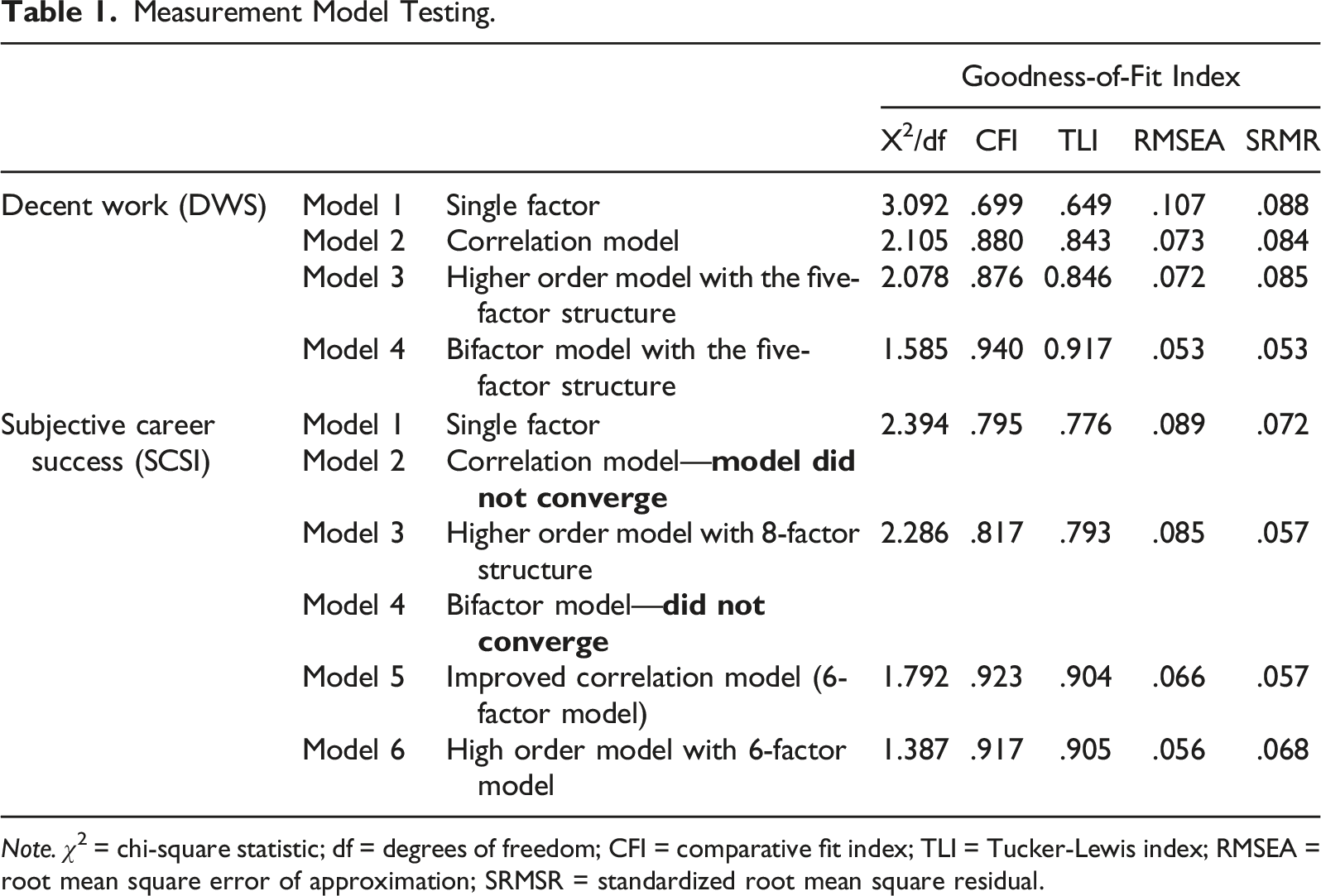
Several methods have been proposed in the literature (Hooper et al., 2008) to improve the fit indices, including, excluding items with loadings of <.5, non-significant path loadings, and using modification indices. Peugh and Feldon (2020) refer to such methods as specification search. In the case of the correlation model of the SCSI (model 2), the model did not converge due to some of the latent factors (Quality work vs. Growth development) and (Authenticity vs. Personal life) that were highly correlated r > 1. Such a problem is defined as Heywood cases (Farooq, 2022). In line with the underlying original explanations of the dimensions and when considering the wording of the items, it made sense to combine the highly correlated latent factors. As a result, an improved model was tested for SCSI (Model 5—six-factor model). Improved fit was found as illustrated in Table 1. A six-factor high-order model with six dimensions was tested (Model 6) in order to bring the various dimensions under a common high factor level SCSI.
Based on the outputs of the different models (in Table 1) and taking into account the literature, the bifactor model (model 4) for DWS is the most preferred model with good fit. With regard to the SCSI, model six demonstrated the best fit, which is a higher order model with six factors.
Reliability and Convergent Validity.

Note. CR = composite reliability; AVE = average variance extracted.
Correlation Coefficient Matrix and Discriminant Validity.
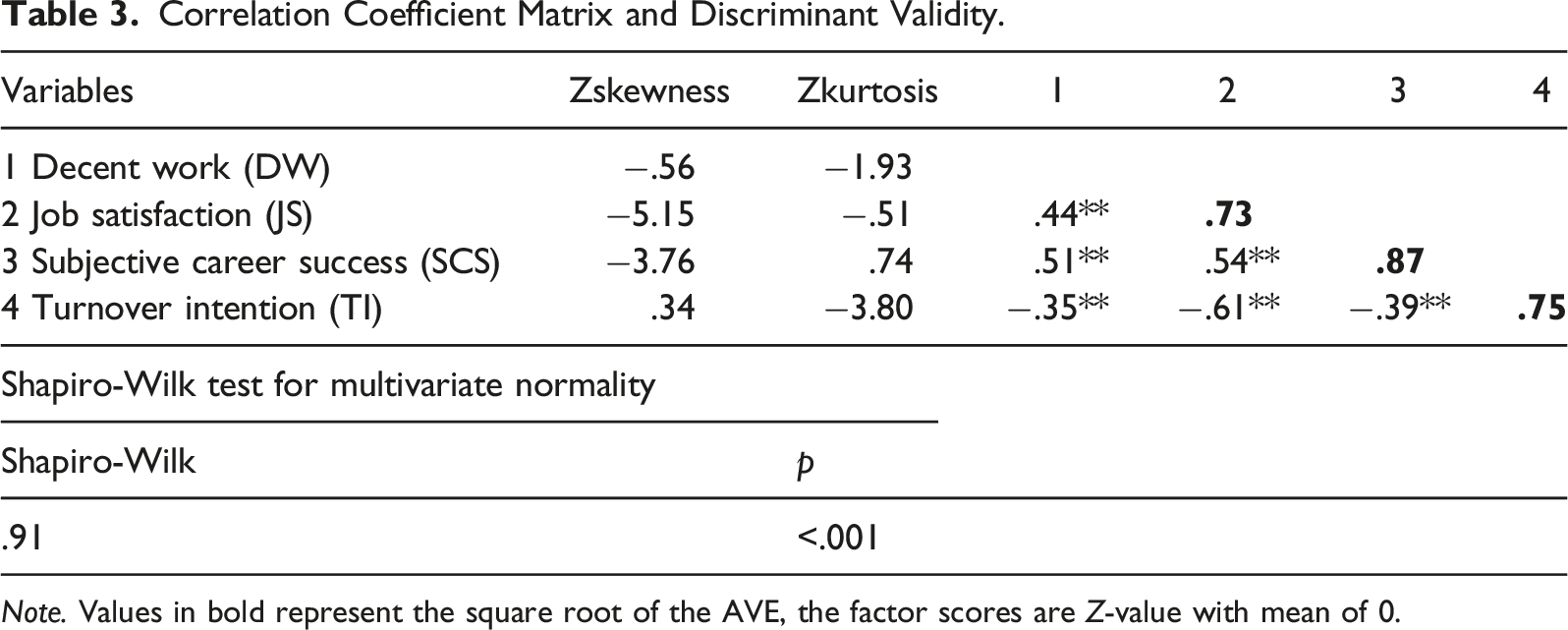
Note. Values in bold represent the square root of the AVE, the factor scores are Z-value with mean of 0.
The descriptive analysis, skewness, and kurtosis z-values are presented in Table 3. The most of the z values are within the critical values (−1.96 and 1.96) determined at .05 significance level, with exception of Job satisfaction with Zskewness value of −.5.15, SCS with Zskewness of 3.76 and Turnover intention Kurtosis value = −3.80 values outside the critical range the assumption of normal distribution. The Shapiro-Wilk Test of Multivariate Normality was also performed with p < .001, which indicates non-normal data.
Indirect Effect of Decent Work on Subjective Career Success and Turnover Intention Via Job.

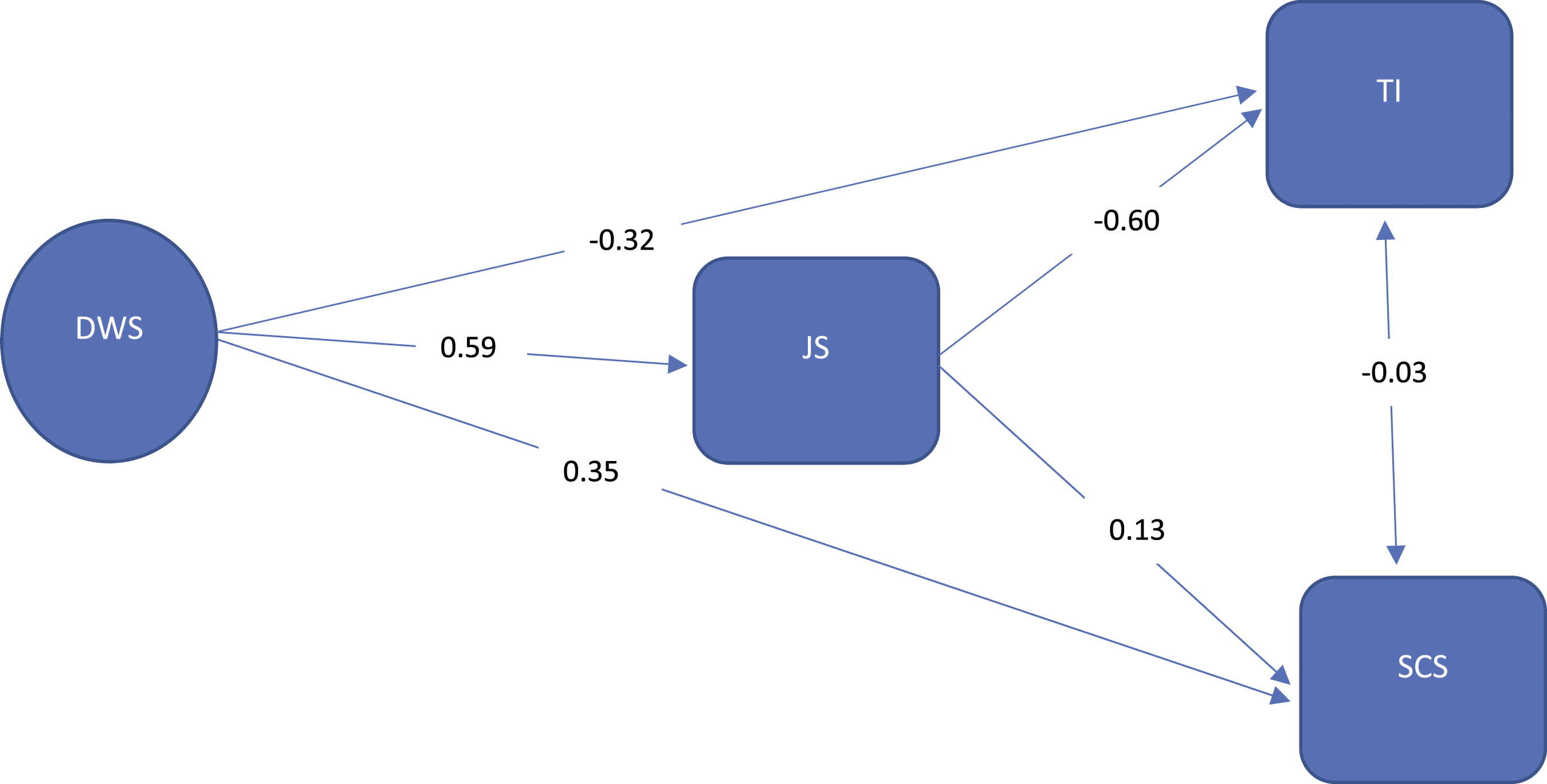
Hypothesized mediation: decent work to subjective career success via job satisfaction. Decent work to turnover intention via job satisfaction.
As illustrated in Figure 1 above and Table 4 below, decent work also had a direct relationship with subjective career success (
Discussion
In line with its original intention, we utilized the PWT as a theoretical framework to contribute to research on blue-collar workers in non-western contexts, particularly the experience of decent work, subjective career success, and turnover intention for South African employees. Recently, there has been a significant increase in the number of empirical studies that use the PWT framework (reflected in the special issue of the Journal of Vocational Behaviour, Duffy et al., 2020), with a strong focus on validating the DWS in different contexts (e.g., Portugal, Brazil, Italy, South Korea). These studies, generally, indicate that decent work is measured as a five-factor concept (i.e., safe working conditions, complementary values, free time and rest, adequate compensation, and access to healthcare). Given the context of South Africa (the crippling poverty and high unemployment), exploring decent work among blue-collar workers is highly meaningful and central to the PWT discourse. In line with the majority of previous studies (which stems from Western countries), our results also confirmed the five-factor structure using the bifactor model for DW as the best-fitting model, suggesting that the DWS items share a common underlying factor while also loading onto their respective subfactors (Di Fabio & Kenny, 2019; Dodd et al., 2019; Duffy et al., 2017).
This result can be understood from two strands. The first is that, from a psychological point of view, the concept of decent work pervades and is broader than the specific aspects of the five dimensions of the instrument. However, there is some specificity in each dimension. It seems that blue-collar workers in this sample perceive decent work as a complete picture, although constituted by different facets. Such findings are complex as they suggest that each subscale has independent variance and variance belonging to an underlying decent work factor. With the bifactor indices, we could assess the relative contribution of the general versus subscales to the DWS total score. In our study, we found that 40% of the common variance is explained by the general factor and 60% is explained by the five decent work subscales, as opposed to the 31% common variance and 69% variance of the subscales in the original validation study of the DWS (Duffy et al., 2017). Such bifactor model findings suggest that each component of DW is unique and that the DWS can be used to capture not only an overall perception of DW but also how and to what degree subcomponents contribute to that perception. In this regard, scholars have suggested representing decent work as a bi-factor model within a latent framework. However, according to Duffy et al. (2017), any relation between a given decent work subscale and a criterion variable is difficult to interpret and have suggested various ways to address such concern. As such, we were interested in how well decent work in general relate to work-outcomes. The decent work was model as bifactor in the mediation analysis. In this regard, our study is the first to confirm the five-factor structure of DWS in the African context and to test a general decent work factor with specific hypothesized variables from the PWT among a non-western, blue-collar worker sample. Confirming the importance of decent work aspects such as adequate compensation (a dimension of DWS) is quite interesting, given the high unemployment rate (34.4% in 2021) in South Africa (Statistics South Africa, 2021). Past studies conducted in South Africa have suggested that blue-collar workers would rather have any kind of work than no work (Kekana, 2021; Koekemoer et al., 2018), suggesting that being employed is all-important, regardless of the pay they receive or their perception of DW.
In regard to the outcomes of decent work, in the literature, positive relationships have been established with well-being concepts such as commitment and work engagement (Huang et al., 2022; Kim et al., 2022; McIlveen et al., 2021), whereas negative relationships have been reported, albeit to a lesser extent, with turnover intention (Wan & Duffy, 2022), physical and mental health (Duffy et al., 2019). Therefore, a finding such as ours that decent work is directly related to subjective career success contributes significantly to career literature and specifically to what is currently known about the outcome portion of the PWT model. Our findings suggest that blue-collar workers who experience decent work are more likely to experience job satisfaction and subjective career success. Our study also enhances our understanding of the internal mechanism between decent work and subjective career success in respect of blue-collar workers, by providing evidence for the indirect effect of job satisfaction. Within the context of the PWT, our findings suggest that for blue-collar workers decent work can not only provide the opportunity to build social connections (and a sense of social belonging) in their work, but also may provide opportunities to engage in meaningful activities related to their careers which as a result of the fulfilment of needs satisfaction (e.g., job satisfaction) can manifest in their perceptions of subjective career success.
Recently, the indirect effect of job satisfaction between decent work and turnover intention has been reported among new-generation workers (Wan & Duffy, 2022) and was also confirmed among the sample of blue-collar workers in our study. Nevertheless, our replication of such a finding among employees in a non-western country is noteworthy, given the context of South Africa. Establishing job satisfaction as an explanatory variable (mediator) in the PWT (as opposed to needs fulfilment as a mediator and job satisfaction as an outcome variable) may open various other avenues within the sphere of the PWT and the well-being literature, especially because links with job satisfaction have been well-established.
Practical Implications and Future Research
Our findings emphasize that decent work and job satisfaction each play a role in the experience of subjective career success and of turnover intention for blue-collar workers. In line with the PWT and the view of Blustein et al. (2023) decent work needs to be about meeting a threshold consisting of basic workplace components and that such conditions should be expected for all workplace adults. In this regard, managers should recognize that subjective career success and turnover intention are relevant not only to white-collar employees but also to essential workers or blue-collar workers. As such, organizations or industries that employ mainly blue-collar workers should focus on decent work aspects as a way to satisfy their needs in order to increase feelings of job satisfaction and subjective career success. For example, providing employees with access to healthcare and with safe working conditions (dimensions of decent work) would be valuable, as Koekemoer et al., (2019) also found that health and safety plays a significant role in the work environment of South African blue-collar workers and that high turnover is quite common in the work environment of these workers. Given that the multidimensionality of subjective career success could not be confirmed in this study, it would be useful to consider testing the mediation model among white-collar workers (with the inclusion of the subdimensions of subjective career success as outcomes), as literature has indicated that work experiences and indicators of success may vary for such employees. Future research could also as suggested by Duffy et al. (2017) test such relationships within a latent framework and may include other work-related outcomes of importance for blue-collar workers.
Limitations
One potential limitation worth mentioning is the use of mediation analyses in cross-sectional studies, and as such should be given some due caution. Although this does not vitiate the findings of the present analysis, it is suggested that future research might very well separate the measurements by different time periods. Furthermore, given the small sample size we conducted a priori sample size analysis to confirm the sample size in conducting mediation using SEM as suggested by MacCallum et al.
Conclusion
Empirical studies testing the hypothesized relationships of the PWT among its intended target group (e.g., working class or blue-collar workers) are scant, even more so decent work studies stemming from non-western contexts. Given the context of South Africa and drawing on the PWT, our study contributes to career literature by illustrating the indirect effect of job satisfaction on the relationship between decent work and two work-related outcomes (i.e., subjective career success and turnover intention) among a sample of South African blue-collar workers. Using the PWT as framework, our findings suggests that for our sample of blue-collar workers, decent work provide opportunities to build social connections and engage in meaningful activities in their careers which as a result of the fulfilment of needs satisfaction (e.g., job satisfaction) may manifest in perceptions of subjective career success.
Footnotes
Declaration of Conflicting Interests
The author(s) declared no potential conflicts of interest with respect to the research, authorship, and/or publication of this article.
Funding
The author(s) received no financial support for the research, authorship, and/or publication of this article.
