




Abstract
This study builds on the social cognitive career theory model of career self-management (SCCT-CSM) to examine the effects of faculty-based supervisor informational support, parental instrumental support and classmate emotional support on student career certainty during work placement learning. It also examined the mediating effects of self-esteem and career decision self-efficacy in the relationships. Using data collected at three-time points from undergraduate students undertaking work placement learning in 109 Nigerian organizations, we test an SCCT-CSM-driven model of contextual factors (i.e. supports), core SCCT variable (self-efficacy), personality-related variable (i.e. self-esteem) and career-related action (i.e. student career certainty) in work placement learning context. The results suggest that perceiving higher informational and instrumental support from faculty-based supervisors and parents stimulated students’ career decision self-efficacy and self-esteem in learning career-related skills, consequently leading to higher student career certainty. The findings have important implications for faculty-based placement learning supervisors, parents, students and placements host organizations to acknowledge the role of support in enhancing student career certainty. Thus, support should be highly considered during work placement learning to improve student career certainty.
Introduction
Work placement learning (WPL) provides university students with opportunities to spend some time in the industry to gain work experience and preparation for future work (Ocampo et al., 2020; Nwosu et al., 2022; Okolie et al., 2022). However, there is a need for further empirical research to learn how and whether the type of support that students perceive from faculty-based supervisors, parents and classmates may enhance their career certainty during WPL. Okolie, Ochinanwata, et al. (2021) defined WPL as a skills development programme of higher education institutions that aims to expose students to a real-world work experience within a specific period during their penultimate year in the undergraduate programme in a host organization, under the supervision of faculty (sending or home institution) and industry-based (recipient or host institution) supervisors, after which they return to the campus to complete their academic programmes. The literature reports that universities around the world place a high emphasis on WPL with the belief that it can facilitate student academic performance, integration of theory into practice, career development and development of employability skills (e.g. Okolie et al., 2021b; Silva et al., 2016). Despite the potential benefits of WPL as reported in previous studies (e.g. Clayton & Thessin, 2016; Okolie et al., 2020), a pertinent issue remains noticeably absent: how the type of support that students perceived during WPL from faculty (teacher)-based supervisors, parents and classmates may influence their career certainty.
Career certainty results in career decision-making which may influence students’ approach to perceiving their future careers (Jordaan et al., 2009). Students may likely face difficulties making career decisions, and this may occur at any time they engage in work-related activities that may affect their career decisions (Patton & Creed, 2001) such as WPL. However, students’ ability to make career decisions may be influenced by many contextual factors (Osipow, 1999), which may include appropriate informational, instrumental and emotional support from their teachers (i.e. faculty-based supervisors), parents and classmates. On the other hand, support from faculty-based supervisors, parents and classmates for students’ general, academic and career development has been well researched (e.g. Hombrados-Mendieta et al., 2012; Metheny et al., 2008; Turner et al., 2003; Zhang et al., 2021), but empirical findings on the types of support that may influence student career certainty during WPL has been sparse. Against this backdrop, we build on Hombrados-Mendieta et al.’s (2012) findings to identify important types of support that students require during learning (i.e. faculty-based supervisor informational, parental instrumental and classmate emotional), influence student career certainty during WPL. Although Hombrados-Mendieta et al. (2012) measured these forms of support in school, they encouraged further research in other contexts to understand their effects. Previous research (e.g. Okolie et al., 2021, 2021b) has called for more research to learn the exact types of support that students perceive from their supervisors, parents and colleagues during placements. This is an important empirical gap that the present study intends to fill.
Evidence shows that many education institutions encourage faculties to be involved in providing quality support for students’ career development and path planning (Zhang et al., 2019). To learn more about the effectiveness of the types of support provided for students by faculty-based supervisors, parents and classmates during WPL, we build on Hombrados-Mendieta et al.’s (2012) findings to study the effects of these specific types of support (i.e. informational, instrumental and emotional) from faculty-based supervisors, parents and classmates on student career certainty. This may contribute much to research, policy and practices in the WPL field, and offer new insights into ways to strengthen these specific types of support in placements.
Drawing upon the social cognitive career theory model of career self-management (SCCT-CSM) (Lent & Brown, 2013), varying cognitive, personality and contextual factors may influence individuals’ career development and career decision-making. The SCCT-CSM model includes the core social cognitive variables of self-efficacy, outcome expectations, and goals; certain personality-related variables; contextual supports and barriers (Lent & Brown, 2013). The SCCT-CSM model recognized that contextual factors (e.g. faculty, parental or classmate support), a core variable of SCCT (e.g. self-efficacy – operationalized as career decision self-efficacy) and personality-related variable (conceptualized as self-esteem) can, directly and indirectly, influence students’ career-related interests, goals and actions (e.g. career certainty) (Lent et al., 2016; Lent & Brown, 2013). SCCT-CSM model offers a broad, flexible template for the study of career-related behaviours and encourages full exploration of the contextual and personality-related factors to gain more knowledge of career development among students (Lent et al., 2016). Thus, building on the SCCT-CSM framework, we examine the effects of contextual factors (support) on career-related action (career certainty) through the mediating effects of the core SCCT variable (self-efficacy) and personality-related variable (self-esteem) among higher education students in WPL. This study contributes significantly to the scant empirical studies on the relationships between these variables building on SCCT-CSM assumptions in the study context.
Theoretical and Hypotheses Development
Social cognitive career theory model of career self-management postulates that individuals can be interested in, choose to pursue and perform better in activities in which they have strong self-efficacy beliefs as long as they have the required skills and support to pursue the activities (Lent et al., 2016). According to Lent and Fouad (2011), certain concepts such as self-efficacy and self-esteem thrive, and majority of career development theories acknowledge the importance of these mechanisms within the causal flow of variables responsible for vocational behaviour. Therefore, we build on SCCT-CSM as a guiding framework to examine the mediating effects of core SCCT (career decision self-efficacy) and personality-related variable (self-esteem) in the relationship between support (faculty-based supervisor informational, parental instrumental and classmates emotional) and career-related actions (student career certainty). At the core of SCCT lies the assumption that individuals with high self-efficacy beliefs may be more likely to successfully engage in tasks associated with making career decisions (Taylor & Betz, 1983). Previous studies have found that important factors such as career decision self-efficacy and self-esteem play significant roles in developing individuals’ work or career-related actions, (e.g. Alliman-Brissett et al., 2004; Lent et al., 2002; Molero et al., 2018; Rosenberg, 1965), but none examined the mediating role of career decision self-efficacy and self-esteem in the context of this study. Social cognitive career theory model of career self-management postulates that individuals’ contextual factors may facilitate their development of career-related actions via a core SCCT variable and personality-related variable (Lent et al., 2016; Lent & Brown, 2013; Lent & Fouad, 2011). Building upon the SCCT-CSM framework, we propose the following conceptual model (Figure 1). Conceptual model.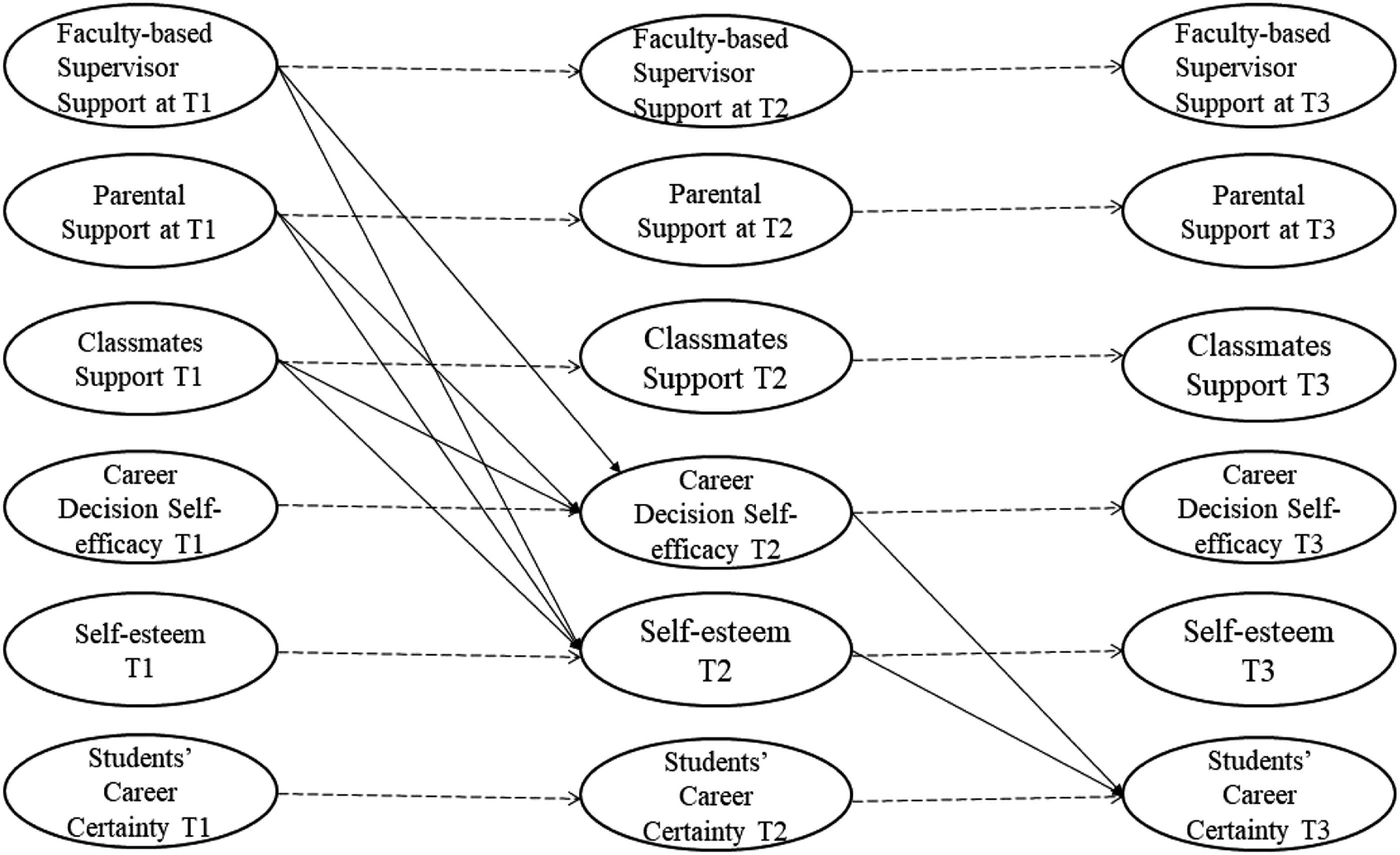
Support and Student Career Certainty
We draw upon Hartung’s (1995, p. 1) definition of career certainty as ‘the degree to which individuals feel confident, or decided, about their occupational plans’. Going by this definition, ‘career certain’ students could be seen as those who have developed a higher degree of confidence, or decidedness about their future career decision-making (Pesch, 2014; Osipow, 1999), and may have been influenced by faculty-based supervisors, parents and classmates during WPL. As Buyukgoze-Kavas (2013) has explained, making a career decision is an inevitable task of life, therefore, the career decisions that students make during WPL are important in setting the foundation for their future careers. However, we acknowledge that selecting a career may be difficult for many undergraduate students given that they need to balance their interests, learning abilities and learning tasks available at placements and the employers’ skills need (e.g. Patton & Creed, 2001). Despite the potential difficulty in making career decisions, we argue that quality support from faculty-based supervisors, parents and classmates may positively influence student career certainty during WPL.
As the literature reports, there are many forms of faculty support for students including emotional, instrumental, informational, feedback and validation and support for autonomy faculty-based supervisor informational support (Deci & Ryan, 1987; Zhang et al., 2021). However, in the context of this study, the focus is on faculty informational support, and we draw upon Zhang et al.’s (2021) conceptualizations of teacher career-related support to define faculty-based supervisor informational support during WPL as the supervisors’ willingness to provide relevant knowledge and career-related information that help learn WPL tasks that may enhance students’ development of skills required for entry into their chosen future careers. Such informational support requires the faculty-based supervisors to show genuine interest in students’ career aspirations and be available to assist students to form career decision self-efficacy and self-esteem toward career certainty. Faculty-based supervisors may provide informational support during placements by establishing effective communication channels between students and placement organizations, providing an informational guide to students to learn work-related knowledge and skills based on demands of the labour market to enhance student career certainty. Previous studies (e.g. Brooks & Youngson, 2016; Nwosu et al., 2022; Okolie et al., 2022) found that quality support is essential in ensuring a successful placement and helping students to understand the industry they wish to work in having received information regarding the competitive nature of recruitment processes in the organizations.
On the other hand, there are many forms of career-related support that students may receive from parents. For example, in their career-related parental support scale, Turner et al. (2003) identified instrumental, career-related modelling, verbal encouragement and emotional support as important forms of support to students from parents. However, in the context of this study, the focus is on instrumental support given the findings of Hombrados-Mendieta et al. (2012) that among other important forms of parental support, instrumental support is highly required by students during learning. Parental instrumental support is defined as parents’ material and financial support towards their career-related skill development. It plays a significant role at almost every point in a student’s career trajectory in contributing to the successful development and decision-making in that students tend to draw much on parents to enable them to cope with financial challenges they may face when schooling and developing their career paths (Alliman-Brissett et al., 2004; Zhang et al., 2019). This form of social support may not likely be offered to students by their classmates who may likely offer higher emotional support (Hombrados-Mendieta et al., 2012). Classmate emotional support has been viewed as an important form of support that students perceive from their colleagues, which may be in form of a feeling of acceptance and motivation (Danielsen et al., 2010; Hombrados-Mendieta et al., 2012). For example, Danielsen et al. (2010, p. 249) reported that ‘in the classrooms where students perceived that they are accepted by their colleagues, they are more likely to view the motivational climate of the classroom as supporting’. Thus, we focus on these three important types of support to learn their effects on student career certainty because these forms of support have received relatively limited attention in student career certainty research (Danielsen et al., 2010; Hombrados-Mendieta et al., 2012; Zhang et al., 2019).
Drawing upon SCCT-CSM, we argue that students who perceived higher faculty-based supervisor informational, parental instrumental and classmate emotional support may be able to form higher career decision self-efficacy and self-esteem, which may, in turn, increase their career certainty. Therefore, we might expect positive relationships between these types of support and student career certainty. Thus, we hypothesize that:
Support, Career Decision Self-efficacy and Self-esteem
Drawing upon previous studies (Hombrados-Mendieta et al., 2012; Turner et al., 2003; Zhang et al., 2021) we argue that students who perceive these forms of support during WPL may likely form self-esteem and career decision self-efficacy, which may, in turn, enhance their career certainty. Drawing upon SCCT-CSM (Lent & Brown, 2013), self-efficacy and personality-related variable such as self-esteem can be seen as important factors that may influence student career certainty during WPL. According to Betz et al. (1996) carer decision self-efficacy is defined as the extent to which individuals believe in their ability to perform certain career-related tasks in an experienced matter. Ozer and Bandura (1990) explained that when self-efficacy is high, students may likely experience increased motivation, perseverance and likelihood of rejecting negative thoughts about their capabilities leading to career certainty.
On the other hand, self-esteem is an evaluative constituent of self-knowledge, which is defined as how much individuals feel about themselves as worthy (Baumeister et al., 2003). Self-esteem can be viewed as the degree to which individuals like or dislike themselves (Lent & Fouad, 2011). Self-esteem ‘refers to a person’s belief about whether he or she is intelligent and attractive, for example, and it does not necessarily say anything about whether the person is intelligent and attractive’ (Baumeister et al., 2003, p. 2). Linked to the present study, it is important to learn whether students who have higher personal beliefs about whether they are decided about their future careers can, in turn, increase their career certainty. Drawing upon (Baumeister et al., 2003), we argue that there could be some benefits that may be derived from individuals’ beliefs that they could decide on certain careers in the future, regardless of whether they are certain.
Linked to SCCT-CSM, self-esteem and self-efficacy are two important variables that can facilitate student career actions. These two variables are highly correlated (Lent & Fouad, 2011), in that despite the level of individuals’ self-efficacy and other personality-related characteristics, individuals with low self-esteem may likely feel unfriendly about themselves, whereas those with high self-esteem may not (Chen et al., 2004). Thus, students with high self-esteem and career decision self-efficacy resulting from perceived higher informational, instrumental and emotional support from faculty-based supervisors, parents and classmates may likely be more certain about their future careers given that they may be more proactive (Betz et al., 1996). Going by Taylor and Betz’s (1983) conceptualization of career decision self-efficacy, SCCT-CSM personality-related variable and SCCT-CSM framework (Lent & Brown, 2013), we may expect a positive relationship between the types of support and student career decision self-efficacy and self-esteem. Thus, we hypothesize that;
Mediating Effects of Career Decision Self-efficacy and Self-esteem
Career decision self-efficacy and self-esteem are relevant in understanding important factors that could enhance individuals’ career interests and goals because of their perceived positive roles in regulating human functioning and emotional well-being through cognitive, motivational, affective and selective processes (e.g. Baumeister et al., 2003; Hamill, 2003). Previous studies have reported links between career decision self-efficacy, self-esteem and career-related actions, for example, Kim et al. (2015) found that individuals with low career decision self-efficacy were more likely to experience negative career thoughts which may contribute to anxiety and limit their career actions. Gushue et al. (2006, p. 25) found that career decision self-efficacy ‘was related to vocational identity and the extent of reported career exploration activities’. Also, Park et al. (2018) found that self-esteem had a significant effect on career choice, confirming the assumptions of SCCT-CSM that personality-related variable (e.g. self-esteem) and career decision self-efficacy are distinct constructs that may help to learn student career certainty. From the SCCT-CSM perspective, we argue that higher informational, instrumental and emotional support from parents, faculty-based supervisors and classmates during WPL, may likely form higher career decision self-efficacy and self-esteem, which may, in turn, contribute to increasing confidence in their career certainty (Taylor & Betz, 1983). Building upon SCCT-CSM and previous findings, we hypothesize that;
Method
Sample and Procedure
The undergraduate students in this study were recruited during the first 2 weeks of reporting to the industries or organizations that accepted them for WPL. Thus, they spend 6 months learning on the job with periodic visits by their faculty-based supervisors to offer helpful career or work-related informational support, monitor the progress of the placement learning activities, and sign their weekly WPL log books – an important requirement for graduation in the Nigerian higher education system. With the consent and approval of the managers of the organizations that accepted students for placement, and students we recruited, a total of 381 students in 109 organizations within an industrialized city in Nigeria. Students were informed that participation was voluntary, and assured of anonymity and confidentiality. Upon recruitment, and completion of consent forms, students were informed about the aim of the study. Data were collected at threetime points, and participants responded to the same questionnaire containing faculty-based supervisor informational support, parental instrumental support, classmate emotional support, career decision self-efficacy, self-esteem and career certainty throughout the three-time points.
At Time 1 (T1) and 2 months into the WPL programme, the structured questionnaire was shared with the 381 students face-to-face, and they were allowed to stay up to 1 week with the questionnaire to enable them to complete the surveys carefully and then return to the researcher. At T2 (a fourth month into the placement programme), the same 381 participants responded to the same questionnaire face-to-face and then, returned to the lead researcher within 7 days. At T3 (6th month and the completion of the WPL programme), we followed the same procedures at T1 and T2 and the same participants who responded at both T1 and T2 responded. We received a total of 377 responses (98% response rate) and 4 (2% drop rate). The four students who dropped out from the data collection at T3 was not due to refusal but because they returned to their campuses before the copies of the questionnaire got to them. The rationale for collecting data using the adopted approach is to evade the problem of common method bias associated with self-report measures (Podsakoff et al., 2003). The participants comprised 229 (60.74%) males and 148 (39.26%) females between the age range of 19 to 25 years old.
Measures
The validity and reliability of the scales in the present study were estimated using confirmatory factor analysis (CFA) with T1 data, and the criteria for the estimation were based on some parameters for acceptable data fit including CFI and TLI = > 0.90; x2/df = < 0.3; SRMR < 0.08, RMSEA < 0.06 (Hu & Bentler, 1999; Bryn, 2012). Also, the convergent and discriminant validity, as well as the composite and Cronbach alpha validity were calculated and reported with T1, T2 and T3 data (e.g. Chukwuedo et al., 2021).
Faculty-based Supervisor Support. This was measured by adapting the 5-item informational support sub-scale of the Career-related Teacher Support Scale (Zhang et al., 2021). The responses ranged from 1 = never to 5 = always. A sample item was, ‘my faculty-based work placement learning supervisor explain to me the prospects of my profession’. The original scale showed a Cronbach’s alpha = 0.92. In the present study, the one-factor CFA for T1 indicated a good fit to the data: χ2 = 8.90; df = 5; χ2/df = 1.78; CFI = 0.95; TLI = 0.93; SRMR = 0.03, RMSEA = 0.06 with the following validity and reliability values; at T1 composite reliability (CR) = 0.93; Average variance extracted (AVE) = 0.78, discriminant validity (DV) = 0.88, and the Cronbach alpha = 0.94. At T2; CR = 0.92; AVE = 0.79; DV = 0.89 and α = 0.93, and at T3; CR = 0.93; AVE = 0.77; DV = 0.88 and Cronbach’s α = 0.93, respectively.
Parental Instrumental Support. We adapted the 7-item Instrumental Assistance sub-scale of the Career-related Parental Support scale (Turner et al., 2003). We made few rewordings of the items to suit the context of the present study. Responses were on a five-point scale of strongly agree (5) to strongly disagree (1). A sample item included: ‘My parents support me financially to buy the necessary items for my study’. The original scale showed item correlations ranged from 0.45 to .67. In the present study, the one-factor CFA for T1 indicated a good fit to the data: χ2 = 14.42; df = 14; χ2/df = 1.03; CFI = 0.96; TLI = 0.94; SRMR = 0.04, RMSEA = 0.06 with the following validity and reliability values; CR = 0.94; AVE = 0.80, DV = 0.89, and Cronbach’s alpha = 0.94. At T2; CR = 0.93; AVE = 0.79; DV = 0.89 and Cronbach’s alpha = 0.94, and at T3; CR = 0.0.94; AVE = 0.80; DV = 0.90 and Cronbach’s α = 0.95, respectively.
Career-Related Classmate Support. This was measured by reformulating the adapted 7-item emotional support sub-scale of the career-related parent support scale (Turner et al., 2003). Items were rated on a 5-point scale of 5 (Strongly agree) to 1 (Strongly disagree). A sample item includes; ‘My classmates say things that make me happy when I learn something I might use in a job sometime’. The original scale showed item correlations ranged from 0.51 to 0.71. In the present study, the one-factor CFA for T1 indicated a good fit to the data: χ2 = 18.76; df = 14; χ2/df = 1.34; CFI = 0.97; TLI = 0.95; SRMR = 0.05, RMSEA = 0.07 with the following validity and reliability values; CR = 0.91; AVE = 0.71, DV = 0.84, and Cronbach’s alpha = 0.92. At T2; CR = 0.92; AVE = 0.73; DV = 0.86 and Cronbach’s alpha = 0.92, and at T3; CR = 0.93; AVE = 0.77; DV = 0.98 and Cronbach’s α = 0.94, respectively.
Career Decision Self-efficacy. This was measured using the 25-item Career Decision Self-Efficacy Scale (Betz et al., 1996). The scale has five dimensions including; self-appraisal (5 items); occupational information (5-items); goal selection (5-items); planning (5-items) and problem-solving (5-items). A sample item includes; ‘I can figure out which job is suitable for me’. Responses ranged from (1 = No confidence to 7 = Complete confidence). The scale reported an alpha value of 0.94 for the 25 items, and previous researchers (e.g. Hampton, 2006) have reported the internal consistencies ranging from 0.91 to 0.97. In the present study, the five sub-scales were used as one-factor CFA model with a good data fit at T1: χ2 = 916.90; df = 265; χ2/df = 3.46; CFI = 0.92; TLI = 0.91; SRMR = 0.05, RMSEA = 0.07. The scale showed the following acceptable validity and reliability at T1: CR = 0.87; AVE = 0.62; DV = 0.79 and Cronbach’s alpha = 0.89; at T2; CR = 0.88; AVE = 0.65; DV = 0.81, Cronbach’s alpha = 0.89; and at CR = 0.93; AVE = 0.77; DV = 0.88 and Cronbach’s alpha = 0.88.
Self-esteem. This was measured using the 10-item Self-Esteem Scale (Rosenberg, 1965). Responses ranged from (1 = strongly disagree to 7 = strongly agree). A sample item includes: ‘I feel that I’m a person of worth, at least on an equal plane with others’ and previous studies (Judge et al., 2003) have reported a Cronbach’s alpha of 0.88 for the self-esteem scale. In the present study, the one-factor model for Time one yielded an acceptable data fit: χ2 = 59.85; df = 35; χ2/df = 1.71; CFI = 0.96; TLI = 0.95; SRMR = 0.05, RMSEA = 0.07, with the following reliability and validity values at T1: CR = 0.82; AVE = 0.54, DV = 0.73, and the Cronbach alpha = 0.83. At T2: CR = 0.85; AVE = 0.58, DV = 0.76, Cronbach alpha = 0.85, and T3: CR = 0.91; AVE = 0.72, DV = 0.85, and the Cronbach alpha = 0.91, respectively.
Student Career Certainty. This was measured using the career certainty scales (Osipow et al., 1976; Pesch, 2014). A 2-item career certainty sub-scale (Osipow et al., 1976), which has been widely used in career decision-making research was used. A sample item includes ‘I have decided on a career and feel comfortable with it. I also know how to go about implementing my choice’. Also, a 3-item career certainty scale (Pesch, 2014) was adapted. Responses ranged from (1 = strongly disagree to 6 = strongly agree). A sample item includes ‘I have decided on a career I am most interested in pursuing’. The Cronbach reliability value for the scale was 0.92. In the present study, the one-factor model for T1 yielded a good data fit: χ2 = 6.65; df = 5; χ2/df = 1.46; CFI = 0.96; TLI = 0.95; SRMR = 0.03, RMSEA = 0.06, with the following reliability and validity values at T1: CR = 0.93; AVE = 0.81, DV = 0.90, and the Cronbach alpha = 0.92. At T2: CR = 0.93; AVE = 0.76, DV = 0.87, and the Cronbach alpha = 0.93, and T3: CR = 0.94; AVE = 0.82, DV = 0.91, and the Cronbach alpha = 0.95, respectively.
Results
Preliminary Analysis
Mean, Standard Deviation and Bivariate Correlations of the Study Variables.
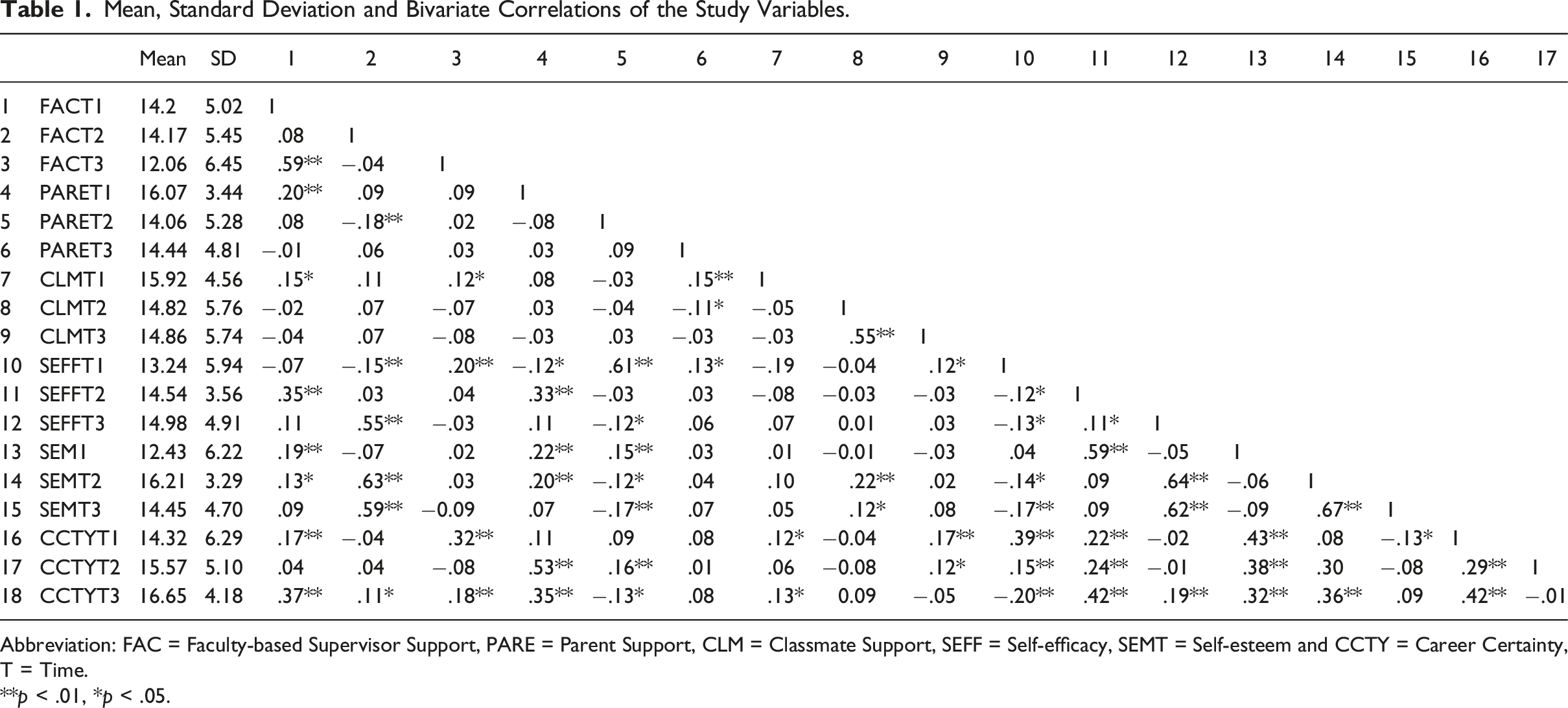
Abbreviation: FAC = Faculty-based Supervisor Support, PARE = Parent Support, CLM = Classmate Support, SEFF = Self-efficacy, SEMT = Self-esteem and CCTY = Career Certainty, T = Time.
**p < .01, *p < .05.
Testing the Hypotheses
Structural equation modelling (SEM-AMOS 24) was employed to test all hypotheses with bootstrapping (5000 and 95% bias-corrected confidence interval (CI95%) including the covariates (Bryn, 2012; Shrout & Bolger, 2002; Zhao et al., 2010). The structural model fit was acceptable: χ2 = 13.55; df = 6, χ2/df = 2.26, CFI = 0.97, TLI = 0.90, RMSEA = 0.06 and PClose = 0.26 (Hu & Bentler, 1999). The model included faculty-based supervisor informational support at T1, parental instrumental support at T1, classmate emotional support, at T1, career decision self-efficacy at T2, self-esteem at T2 and student career certainty at T3. The analysis showed that treating student career certainty at T1 as a control variable, faculty-based supervisor informational support at T1 (β = 0.19, p < .001) and parental instrumental support at T1 (β = 0.15, p < .001) associated positively with student career certainty at T3, whereas we found no statistically significant effect of classmate emotional support at T1 (β = 0.08, p = .11) on student career certainty at T3. Hence, hypotheses 1a and 1b were accepted, whereas hypotheses 1c was rejected.
The SEM analysis for hypothesis two showed that treating career decision self-efficacy at T1 as a control variable, faculty-based supervisor informational support at T1 (β = 0.31, p < .001) and parental instrumental support at T1 (β = 0.28, p < .001) associated positively with student career decision self-efficacy at T2. Classmate emotional support at T1 was associated negatively with career decision self-efficacy at T2 (β = −0.15, p < .05), indicating that hypotheses 2ai and 2bi were accepted while hypothesis 2ci was partially accepted given that the result was statistically significant but negative. Also, treating self-esteem at T1 as a control variable, only parental instrumental support at T1 associated positively with self-esteem at T2 (β = 0.18, p < .001), whereas faculty-based supervisor informational support at T1 (β = 0.09, p = .11), and classmate emotional support at T1 (β = 0.07, p = .23), showed no evidence of positive effects on self-esteem at T2. Hence, hypothesis 2bii was accepted, whereas hypotheses 2aii and 2cii were rejected. The analysis of hypothesis three revealed that treating student career certainty at T2 as a control variable, career decision self-efficacy at T2 (β = 0.28, p < .001) and self-esteem at T2 (β = 0.27, p < .001) were associated positively with student career certainty at T3. Hence, hypotheses 3a and 3b were accepted.
Direct and Indirect Effects.
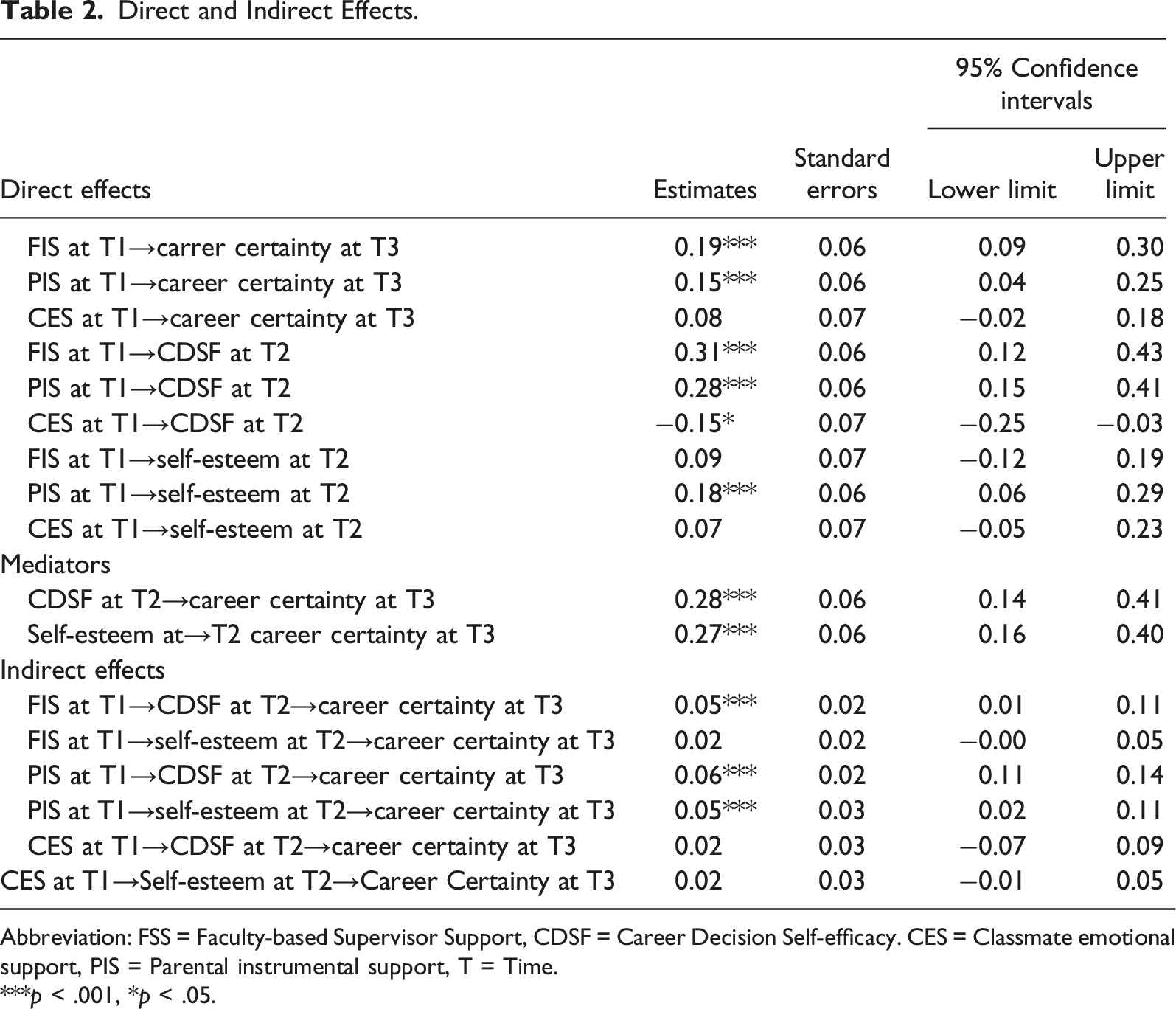
Abbreviation: FSS = Faculty-based Supervisor Support, CDSF = Career Decision Self-efficacy. CES = Classmate emotional support, PIS = Parental instrumental support, T = Time.
***p < .001, *p < .05.
Discussion
This study tested a theory-driven model of faculty-based supervisor support, parental support, classmate support, career decision self-efficacy, self-esteem and student career certainty during WPL based on the core assumptions of SCCT-CSM (Lent & Brown, 2013). No previous studies have tested a multiple mediation model of SCCT-CSM contextual variables, personality-related variable, core SCCT variable and individual career-related action among university students undertaking WPL in organizations. Our model tested the effects of faculty-based supervisor informational support at T1, parental instrumental support at T1 and classmate emotional support at T1 on student career certainty at T3 through multiple mediating effects of career decision self-efficacy at T2 and self-esteem at T2. We, therefore, discuss the most important contributions of the present study.
The study found that faculty-based supervisor informational support and parental instrumental support positively and significantly associated with student career certainty (hypothesis 1a and 1b). This result implies that students who perceived higher informational support from their faculty-based supervisors and instrumental support from parents during WPL may be more likely to develop a higher degree of certainty about their future careers. A possible explanation of this result could be the contextualization process of parental and faculty-based supervisor informational and instrumental supports which may enable students to be more certain about their future careers. Linked to SCCT-CSM, parents and faculty-based work placement supervisors may encourage students by providing instrumental and informational support that may help them to understand possible future career prospects, learn new skills for meeting the demands of the employers, read successes stories of individuals in such careers, which may increasingly influence their career certainty. Although these results may be anticipated given the previous positive reports of career-related teacher and parental support on student career-related behaviours (Turner et al., 2003; Zhang et al., 2019, 2021), these findings serve as baseline hypotheses, and the confirmation in the present study is important. Also, classmate emotional support was not significantly related to student career certainty in this population (hypothesis 1c). A possible interpretation of this result could mean that the type of emotional support students perceived from their classmates during the WPL may not be adequate to influence their certain certainty.
We found that faculty-based supervisor informational support and parental instrumental support were positively related to student career decision self-efficacy (hypotheses 2ai and 2bi). The positive relationships imply that students who perceived increasing informational and instrumental support from their faculty-based supervisors and parents during WPL experienced an increasing career decision self-efficacy toward their future career certainty. Linked to SCCT-CSM, students undertaking WPL may develop higher career decision self-efficacy when they perceive quality support (Lent et al., 2016; Taylor & Betz, 1983). Surprisingly, classmate emotional support was negatively associated with career decision self-efficacy (hypothesis 2ci). This implies a decreasing effect of classmate emotional support on student career decision self-efficacy. Although previous research (Hombrados-Mendieta et al., 2012) has found an increasing effect of classmate emotional support during adolescence, our finding shows that such support did not increase career decision self-efficacy in this population. An explanation for this is the contextualization process of classmate emotional support that may not allow students to form higher career decision self-efficacy leading to career certainty. For example, students whose close classmates have low career decision self-efficacy may be affected negatively given the bias to their thought processes about pursuing certain careers in the future.
Only parental instrumental support was associated positively with students’ self-esteem (hypothesis 3bii). A possible interpretation of this result could mean that students whose parents provide quality support such as funds and talk about how WPL activities may someday help them get their dream jobs, may be more likely to develop higher self-esteem leading to an increasing career certainty. This result could be interpreted that students who perceived higher instrumental support from their parents may form more positive thoughts about themselves which may increase their career certainty. We found no evidence of the positive effect of informational support from faculty-based supervisors and emotional support from classmates on students’ self-esteem in this population (hypotheses 2aii and 2cii), which may be as a result of students' perception of support on their self-esteem.
The study revealed that career decision self-efficacy and self-esteem were positively related to student career certainty (hypotheses 3a and 3b). These findings imply that students who have formed greater career decision self-efficacy and self-esteem may be likely to become more certain about their future careers. Such students may be able to accurately evaluate their capabilities to make helpful decisions about their future careers. Students with higher career decision self-efficacy and self-esteem may actively take part in various career exploratory activities to discover more career options. The finding is consistent with previous research (e.g. Vertsberger & Gati, 2016) that students need higher self-efficacy and self-esteem for effective career decisions.
Our study found that career decision self-efficacy mediated the relationship between faculty-based supervisor informational support and parental instrumental support and student career certainty in this population. These results imply that the indirect effects of informational and instrumental supports from faculty-based supervisors and parents on student career certainty were through students’ higher career decision self-efficacy. Also, self-esteem mediated the effect of parental instrumental support on student career certainty, thereby explaining why there is a relation between the two variables in this population. These findings also indicate that these types of support from parents and faculty-based supervisors during WPL may not wholly be the reasons for the increased student career certainty in this population, rather, the increased career decision self-efficacy and self-esteem which students may have developed from these types of support.
Surprisingly, both career decision self-efficacy and self-esteem did not mediate the effects of classmates support on student career certainty in this population. Given that classmates spend much time with each other and can provide emotional support that may motivate their peers to work as a team to accomplish difficult learning tasks, we would have expected classmates support to have salient effects on students’ career certainty and self-esteem. Although support from classmates was found to be highly relevant toward students’ motivation to succeed (Danielsen et al., 2010; Hombrados-Mendieta et al., 2012), it did not have a significant impact on students’ career certainty in this population. This inconsistency with previous studies regarding support from classmates may come from the various ways this form of support has been measured. Consistent with SCCT-CSM (Lent & Brown, 2013) our study has provided a theoretical justification for students' need for a higher career decision self-efficacy and self-esteem during WPL to enhance their career certainty (e.g. Buyukgoze-Kavas, 2013; Hampton, 2006; Taylor & Betz, 1983).
Conclusion and Implications
The present study built on the SCCT-CSM (Lent & Brown, 2013) framework, which helped to explain the importance of contextual variables, core SCCT variable and personality-related variable in enhancing student career action during WPL. It examined whether the types of support that students require from parents, faculty-based supervisors and classmates during WPL such as informational, instrumental and emotional support positively influence their career certainty. By examining the faculty-based supervisor informational support, parental instrumental support, classmates emotional support, career decision self-efficacy, self-esteem and student career certainty, and highlighting their significance for higher education students during WPL, the study provides a more understanding of SCCT-CSM principles in this study context. The present study thus extends the key tenets of SCCT-CSM beyond the psychology fields where it is highly examined. Our findings have practical implications for parents whose adult children are sent to organizations for WPL, and faculty-based supervisors whose supportive actions may enhance student career certainty. Quality informational and instrumental supports can inspire students to form higher career decision self-efficacy and self-esteem towards their future careers.
Our findings have implications for career support services and guidance during WPL. Faculty-based supervisors can work collaboratively with professionally trained career counsellors to offer more informational support to students by helping them to identify possible career development-related obstacles they may likely face in achieving their future careers to find possible strategies for overcoming the possible obstacles. The faculty-based supervisors may employ more effective support techniques such as active listening to students’ narrative approaches toward building their career decision self-efficacy and self-esteem to enhance their career certainty (Okolie et al., 2022). Also, parents can increase their instrumental support for students such as increasing funding budgets for the students’ studies during WPL to help them build higher self-esteem to enhance their career certainty. This may help students to develop higher self-esteem, be able to speak up in groups and evaluate their efforts toward pursuing their future careers. While this study was conducted in Nigeria, the results may apply to other countries where WPL is part of higher education programmes.
Limitations and Future Research Directions
The first limitation of this study is about the homogeneity of the participants – university students who completed the WPL and then returned to their various campuses. This may limit the generalization of the findings to other higher education students such as polytechnics and higher colleges who may be currently undertaking placements in the industry. We suggest that future studies should replicate this study with other students of higher learning to learn the effect on their career certainty. Second, participants are Nigerian undergraduate students. Therefore, there may be relative country constraints to the generalization of the findings. We recommend that future studies should replicate this study in other countries or conduct multiple country studies to compare the results. Another important limitation is that this study failed to test the association between self-efficacy and the three forms of support (Lent et al., 2010). Future studies may consider testing this as an alternative model in their SCCT-CSM research to learn the effects. Despite these limitations, the present study has provided valuable evidence on the relationship between faculty-based supervisor informational support, parental instrumental support and classmate emotional support and student career certainty at three-time points through the principles of SCCT-CSM.
Footnotes
Declaration of Conflicting Interests
The author(s) declared no potential conflicts of interest with respect to the research, authorship, and/or publication of this article.
Funding
The author(s) received no financial support for the research, authorship, and/or publication of this article.
