



Abstract
The dual-process theory of career decision-making (DTC) adds to the conversation about understanding and facilitating career decision-making from a more realistic and inclusive perspective and highlights the joint operation of decision ambiguity and ambiguity management strategies in career decision-making. However, a psychometrically sound measure of decision ambiguity is lacking. Thus, the current study used two samples of U.S. college students to develop and initially validate a measure of decision ambiguity (CDMA). Study 1 (n = 195) developed the CDMA and found initial evidence for a unidimensional structure. Study 2 (n = 271) cross-validated the unidimensional structure of the CDMA and supported the convergent, discriminant, concurrent, and incremental validities of the CDMA. Specifically, the results supported (1) the differential associations of the CDMA with need for information and with neuroticism/negative affectivity, lack of readiness, and interpersonal conflicts, (2) the positive association between the CDMA and choice/commitment anxiety, and (3) the incremental predictions of the CDMA for career decidedness, career certainty, and major satisfaction over and beyond need for information. Therefore, the current study offers a psychometrically sound measure of decision ambiguity, which has potential to facilitate the scientific inquiry and social justice application of the DTC.
Career decision-making, which denotes a process of deciding on one’s educational or occupational area, is an important but challenging developmental task (Kulcsar et al., 2020; Xu & Bhang, 2019). Because career decision-making represents one of the most common presenting concerns in career counseling/education, extensive research has explored the facilitative/inhibitive factors in the career decision-making process (Kulcsar et al., 2020; Xu, 2021a). However, the guiding framework of this research agenda, namely, Parsons’s (1909) three-step model, encounter increasing challenges in the contemporary context of career decision-making, with inevitable decision ambiguity as a key challenge (Krieshok et al., 2009; Savickas et al., 2009). Such inevitable ambiguity refers to inherent uncertainty regarding which career direction should be chosen and plausibly results from a confluence of psychological limits, sociocultural oppression, and socioeconomic uncertainty in contemporary career decision-making (Blustein, 2013; Krieshok et al., 2009; Savickas, 2013). Other than being an intellectual gap in the Parsonian framework of career decision-making, inevitable decision ambiguity could disproportionally affect marginalized populations because they tend to be granted less privilege and power in accessing career-related information and pursing personal aspirations despite of normative expectations and systemic discrimination (Duffy et al., 2016) and these contextual constrains likely create difficulty in figuring out a clear optimal choice. Importantly, to cope with ambiguity-induced stress (Kahneman, 2003; Thaler, 2016), marginalized populations might be tempted to turn to strategies (e.g., submitting to stereotyped vocational roles; (Park et al., 2020) that could instill a sense of certainty (as a decision-making heuristic; (Gigerenzer & Gaissmaier, 2011) at the cost of long-term well-being and career advancement (Wong et al., 2017).
To address the underrecognized issue of managing inevitable decision ambiguity, the dual-process theory of career decision-making (DTC; (Xu, 2021a; 2021b) argues that while matching person-environment information to evaluate the goodness of career options represents an important decision-making process, managing inevitable ambiguity to reduce its psychological threat represents another important process. Based on this tenet, the DTC further highlights the extent of decision ambiguity and the appropriateness of ambiguity management strategies as two primary constructs in shaping the career decision-making progress. However, while research has developed a scale for measuring responses to ambiguity (Xu & Tracey, 2015; 2017a) and has examined the role of ambiguity aversion (e.g., Storme et al., 2019; Xu, 2020; Xu & Tracey, 2017b), no measure of decision ambiguity exists, which creates difficulty in understanding the direct effect of decision ambiguity and the interactive effect of decision ambiguity and ambiguity management strategies on career decision-making. Thus, to enhance research and practice related to the DTC and career compromise of marginalized populations, the focus of the present study was to develop and initially validate the Career Decision-Making Ambiguity Scale (CDMA).
Decision Ambiguity and the Dual-Process Theory of Career Decision-Making
The DTC (Xu, 2021a; 2021b) advances the literature of career decision-making by proposing a more realistic and inclusive assumption that despite effortful information collection and matching, ambiguity cannot be eliminated during a given window of career decision-making. Thus, the DTC proposes that managing ambiguity, which essentially concerns reducing the threat of ambiguity (or containing ambiguity in the DTC terminology) as opposed to eliminating ambiguity, is an important decision-making process that complements Parsons’s (1909) person-environment fit framework (see Figure 1). Furthermore, the DTC argues that ambiguity management is crucial for commitment-and-persistence-related career behaviors because commitment and persistence entails a high level of exclusivity (or loyalty) in the decision and such exclusivity directly conflicts with decision ambiguity. Dual-Process Theory of Career Decision-Making Process. Note. NA= Neuroticism/negative affectivity; CCA = Choice/commitment anxiety; NI = Need for Information; LR = Lack of Readiness; IC = Interpersonal conflicts. Adapted from Xu, H. (2021). Career decision-making from a dual-process perspective: Looking back, looking forward. Journal of Vocational Behavior, 126, 103,556. https://doi.org/10.1016/j.jvb.2021.103556.
Research has shed light on the role of ambiguity management in career decision-making, and perhaps the most direct evidence for the DTC’s proposition about ambiguity management stems from research on ambiguity aversion/tolerance (Xu, 2021a). Ambiguity aversion denotes a tendency to find ambiguity anxiety-provoking and avoid it (Xu & Tracey, 2017a). Research has consistently shown that ambiguity aversion negatively predicted the process and outcome markers of career decision-making, including career decision-making self-efficacy, career indecision, career satisfaction, and perceived fit (e.g., (Storme et al., 2019; Xu, 2020; Xu & Tracey, 2017b). Such results were found not only in individualistic cultural contexts (e.g., the U.S. and France; (Park et al., 2020; Storme et al., 2019; Xu & Tracey, 2014) but also in collectivistic cultural contexts (e.g., China and South Korea; (Park et al., 2019; Xiao et al., 2017; Xu et al., 2016).
Notably, while the DTC highlights decision ambiguity and containing strategies as two key constructs in ambiguity management, research has predominantly focused on containing strategies (e.g., avoidance and calling) and shed little light on decision ambiguity. This research gap renders at least two theoretical questions about the DTC unclear. First, could decision ambiguity directly inhibit career decision-making? Second, would decision ambiguity interact with containing strategies in affecting career decision-making outcomes (from a stress regulation perspective)? Additionally, although the DTC suggests that individuals from marginalized backgrounds tend to experience heightened ambiguity (Xu, 2021a; 2021b), research on the antecedents of decision ambiguity barely exists, which rends the development of ambiguity unclear and limits the utility of this construct in conceptualizing career struggles of marginalized populations.
The development and consequence of decision ambiguity not only matter to the validity of the DTC but also could have important practical implications for combating social issues such as sustained gender and racial/ethnical gaps in the entry and retention of science, technology, engineering, and mathematics (STEM) areas and persistent/generational poverty. After decades of research and intervention on STEM pipeline leakage and poverty, it is striking that these issues persist even in most developed countries (Blustein et al., 2019). While this disconcerting status undoubtedly calls for further systemic changes in institutions and society, we argue that ambiguity management of the DTC might be able to provide a supplementary perspective on the difficulty in uprooting these social issues. That is, even though norm-conforming career choices (e.g., low-end jobs for people with disadvantaged backgrounds) could have an inferior quality in terms of well-being and financial rewards, they could be (ironically) psychologically appealing as they relieve marginalized populations of handling ambiguity and related stress.
Our conjecture about the important decision dilemma of marginalized populations rests upon prospect theory and the psychology of heuristics (Gigerenzer & Gaissmaier, 2011; Kahneman, 2003; Thaler, 2016). Prospect theory and related research has documented the role of uncertainty in causing distress and consequently directing decisions (Kahneman, 2003; Thaler, 2016). This body of research advances the decision-making literature by showing that individuals consider not only the expected outcomes of options but also the uncertainty in obtaining outcomes (Kahneman, 2003; Thaler, 2016). Furthermore, uncertainty was found to be an unfavorable factor in decision-making scenarios where rewards are anticipated (such as career decision-making; (Kahneman, 2003; Thaler, 2016). To handle such uncertainty, individuals often rely on heuristics, which denote mental shortcuts that essentially capitalize on certain aspects of information in decision making, to frugally and quickly make a decision (Gigerenzer & Gaissmaier, 2011). However, common heuristics, such as path dependence (Hastie & Dawes, 2010) and social proof (Rao et al., 2001), tend to prioritize immediately available or normative information and consequently could embody social oppression and perpetuate the status quo.
In other words, the DTC accounts for work volition and experiences with marginalization/oppression by focusing on the role of systematic factors not only in causing distressful ambiguity but also in perpetuating the status quo through ambiguity management strategies. Park et al. (2020) found initiative evidence for the decision dilemma facing marginalized populations in that Asian men who more strongly feared ambiguity showed stronger adherence to traditional masculine norms. In this case, adherence to traditional masculine norms likely serves as a heuristic that can install a sense of direction and consequently help Asian mean cope with ambiguity-induced distress. However, adherence to traditional masculine norms, particularly when it is rigid, could limit career options of Asian mean and unfavorably affect their mental health (Wong et al., 2017). Given the initial evidence, more direct evidence on the interplay of decision ambiguity and containing strategies is needed.
Obviously, all these research and practical opportunities need a psychometrically sound measure of decision ambiguity; however, such a measure has yet to be developed. Thus, the purpose of the present study was to develop the Career Decision-Making Ambiguity Scale (CDMA).
The Dimensionality and Nomological Network of Decision Ambiguity
Following the DTC and related research’s definition of ambiguity (Xu, 2021a; Xu & Tracey, 2017a), we define decision ambiguity as inherent uncertainty in career decision-making that manifests in four areas: informational inaccessibility, complexity, insolubility, and unpredictability. Among the four areas of ambiguity, inaccessibility denotes the state of being unable to understand new information and access information beyond one’s social circle (e.g., too much to learn). Complexity denotes the state of being unable to synthesize various aspects of information (e.g., multifaceted interests and values). Insolubility denotes the state of being unable to reconcile conflictual information (e.g., personal vs. environmental voices). Unpredictability denotes the state of being unable to predict the future regarding the self and the vocational world (e.g., an unpredictable economy). The first three ambiguity areas (i.e., inaccessibility, complexity, and insolubility) were selected based on Budner’s (1962) tripartite model of ambiguity, while unpredictability taps into the future-oriented nature of career decision-making (Xu & Yin, 2020). Although the magnitude of the four ambiguity areas could vary by personal and environmental contexts, the four areas represent inherent challenges in contemporary career decision-making that cannot be eliminated (but could ironically be elevated) through enhanced information collection. Research on ambiguity responses has shown that individuals grouped responses to the four ambiguity areas based on the nature of responses (e.g., accept vs. avoid) as opposed to the type of ambiguity sources (Xu & Tracey, 2015; 2017a). This result suggests that the four areas are highly interconnected with one another and collectively reflect a unitary perception of decision ambiguity. Therefore, research on the role of ambiguity aversion/tolerance did not differentiate the four ambiguity areas and focused on the differential roles of different ambiguity responses (Xu & Tracey, 2015; 2017a). Similarly, although we developed items for all four ambiguity areas, we anticipated the newly developed CDMA to exhibit a unidimensional structure.
The predictive model of the DTC (see Figure 1) delineates the conceptual links of decision ambiguity to other important constructs of career decision-making. We focused on a key process construct, career decision-making difficulty. Career decision-making difficulty technically embraces any difficulty that impedes the career decision-making process, including decision ambiguity. However, the latest integrative model of career decision-making difficulty, Xu and Bhang’s (2019) integrative five-factor model, resonates with previous taxonomies of decision difficulty (e.g., Gati et al., 1996; Saka et al., 2008) and mainly addresses challenges other than decision ambiguity. Specifically, Xu and Bhang’s (2019) integrative five-factor model was derived from Brown et al.’s (2012) meta-analytic Career Indecision Profile model and encompasses neuroticism/negative affectivity (i.e., general anxiety), need for information (i.e., information deficits), choice/commitment anxiety (i.e., difficulty in committing to a single choice), lack of readiness (i.e., difficulty in engaging in the process), and interpersonal conflicts (i.e., conflicting perspectives). Mapping the five difficulties on the DTC predictive model, one could argue that neuroticism/negative affectivity, lack of readiness, and interpersonal conflicts tap into general psychosocial barriers, while need for information and choice/commitment anxiety addresses the information foundation for matching the proximal outcome of ambiguity management, respectively (see Figure 1; Xu & He, 2022). Because decision ambiguity specifically addresses ambiguity perception in ambiguity management, it is subject to but differs from general psychosocial challenges, namely, neuroticism/negative affectivity, lack of readiness, and interpersonal conflicts. Compared to the general psychosocial challenges, need for information is likely more closely related to decision ambiguity because (1) theoretically, the information foundation facilitates ambiguity management according to the DTC, and (2) empirically, it is not always easy for individuals to recognize differences between a lack of information and the presence of inevitable ambiguity (Roche et al., 2017; Xu & He, 2022).
In addition to the discriminant and convergent relational patterns of decision ambiguity with decision difficulty, we anticipated that decision ambiguity positively predicts choice/commitment anxiety because commitment entails a high level of loyalty to a single career choice but ambiguity regarding the “right” choice increases the opportunity cost of committing to a particular choice (fear of missing out). It is based on this reasoning that the DTC (Xu, 2021a) conceptualizes choice/commitment anxiety as the proximal outcome of ambiguity management. In addition to the prediction of decision ambiguity for a proximal decision outcome, we propose that decision ambiguity could supplement need for information in shaping distal career decision-making outcomes. Although decision ambiguity and need for information are related, they differ and supplement each other according to two arguments of the DTC (Xu, 2021a; 2021b). First, ambiguity is an inherent feature of contemporary career decision-making and does not necessarily result from informational deficits. Second, while informational deficits could create difficulty in evaluating and narrowing down career options, ambiguity regarding the “right” choice likely presents a barrier to narrowing down options to a single one. Thus, both informational deficits and decision ambiguity could hinder career commitment, which has a ripple effect on decidedness, persistence/performance, and ultimately satisfaction (Lent & Brown, 2013). Therefore, we anticipated that decision ambiguity positively predicts distal decision outcomes over and beyond need for information. We focused on three distal decision outcomes in this study, including career decidedness, career certainty, and academic major satisfaction, because they address three important aspects of career development for students. Specifically, it is plausible to argue that decidedness offers a direction for career preparation, certainty forecasts investment in the chosen career, and major satisfaction denotes subjective well-being within the chosen career.
Summary of the Present Study
To enhance research and practice of the DTC, we developed and initially validated the Career Decision-Making Ambiguity Scale (CDMA). Drawing on the DTC and related research, we hypothesized that the CDMA exhibits a unidimensional structure (Hypothesis 1: structural validity), the CDMA is more strongly correlated with need for information than with neuroticism/negative affectivity, lack of readiness, and interpersonal conflicts (Hypothesis 2: convergent and discriminant validities), the CDMA positively predicts choice/commitment anxiety (Hypothesis 3: concurrent validity), and the CDMA positively predicts career decidedness, career certainty, and major satisfaction over and beyond need for information (Hypothesis 4: incremental validity).
Study 1. Development of the CDMA
Study 1 developed the CDMA in a college population, in which career decision-making is one of the most important developmental concerns. Although we anticipated a unidimensional structure of the CDMA, we conducted exploratory factor analysis (EFA) to examine if alternative structural models could empirically outperform the unidimensional model.
Methods
Participants
The current sample consisted of 195 college students from a Midwestern university in the United States (mean age = 19.00, SD = 1.17). Of the participants, 11.8% (n = 23) identified as man, 86.7% (n = 169) identified as woman, and 1.5% (n = 3) identified as transgender. In terms of race/ethnicity, 54.9% (n = 107) identified as White/European American/Caucasian, 4.6% (n = 9) identified as African/African American/Black, 12.3% (n = 24) identified as Hispanic/Latinx American, 16.9% (n = 33) identified as Asian/Asian American, 3.6% (n = 7) identified as Arab American/Middle Eastern/North African, and 7.2% (n = 14) identified as Multiracial. In terms of social economic status (SES), 1.5% (n = 3) identified as living in poverty, 12.3% (n = 24) identified as working class, 52.8% (n = 103) identified as middle class, 27.7% (n = 54) identified as upper-middle class, and 4.6% (n = 9) identified as upper class. The participants reported a variety of majors, including psychology, biology, nursing, and economics.
Measure
Career Decision-Making Ambiguity
In general, we followed Worthington and Whittaker’s (2006) guideline to develop the initial items of the CDMA. Because the Career Decision Ambiguity Response Scale-Revised (CDAR-R; (Xu & Tracey, 2015; 2017a) has shown its validity in measuring responses to ambiguity, we borrowed 12 descriptions of ambiguity from the CDAR-R. This strategy took advantage of existing evidence for the CDAR-R and could help enhance the content validity of the CDAM. Additionally, we developed four items based on our review of the career decision-making literature. The final item pool consisted of 16 items in total and four items each for the four ambiguity areas. We deemed this scale length appropriate given the expected unidimensional structure of the scale. Example items include “I need to sort out complex aspects of multiple careers” and “There is a good deal of unfamiliar information for me to make sense of.” Using a 7-point Likert scale ranging from 1 (Strongly disagree) to 7 (Strongly agree), the CDMA asked participants to indicate the extent to which they agree with descriptions of their career decision-making. Higher scores indicated greater decision ambiguity.
Procedures
Following the approval from the institutional review board, we recruited participants from students who were taking a psychology introduction class. Students first reviewed the introduction of this study and decided if they wanted to participate in this study for an extra credit opportunity. Once they consented to participate, they were directed to an online survey where they answered questions about demographic information and research questionnaires. Participants’ responses were kept confidential throughout the research process.
Analysis
Following the conventional guidelines of scale development (Kahn, 2006; Worthington & Whittaker, 2006), we first conducted a parallel analysis (with 1000 replicated random datasets and 95% as the cutoff) and EFA (with principal-axis factoring and direct oblimin rotation) to determine the best factor structure. Then, based on the factor structure, we retained the best six to eight items of each potential dimension, which were defined as items that exhibited maximum primary loadings (at least .50), minimum cross loading (at most .32), and maximum content representativeness (all four ambiguity areas). The dataset revealed a small missing rate across all variables (about 5%). We conducted Little’s (1988) test to examine the missingness pattern and found that χ2 = 211.86, p = .84, indicating a pattern of missing completely at random (MCAR). Thus, we used pairwise deletion of SPSS to handle missing data in EFA (Schlomer et al., 2010).
Results
To ensure data adequacy for EFA, we first examined the Kaiser-Meyer-Olkin (KMO) and Bartlett's test of sphericity. The results revealed a KMO of .92 and a significant Bartlett's test (p < .05), warranting subsequent EFA (Kahn, 2006; Worthington & Whittaker, 2006). Given the anticipated unidimensional structure and the averagely medium item communality (around .50), we deemed the current sample size adequate for EFA (MacCallum et al., 1999).
In EFA, parallel analysis (Horn, 1965) suggested a unidimensional structure. Although principal-axis factoring suggested a three-factor structure (with eigenvalues >1 as the criterion), the three factors did not exhibit clear conceptual differences and in fact only one factor was above the elbow of the scree plot. Based on these conceptual and empirical grounds, we selected a unidimensional structure as the best factor model and found that this model explained 45.42% of the total variance. The structural result supported the theoretically anticipated unidimensional structure.
Factor Loading for Exploratory Factor Analysis.
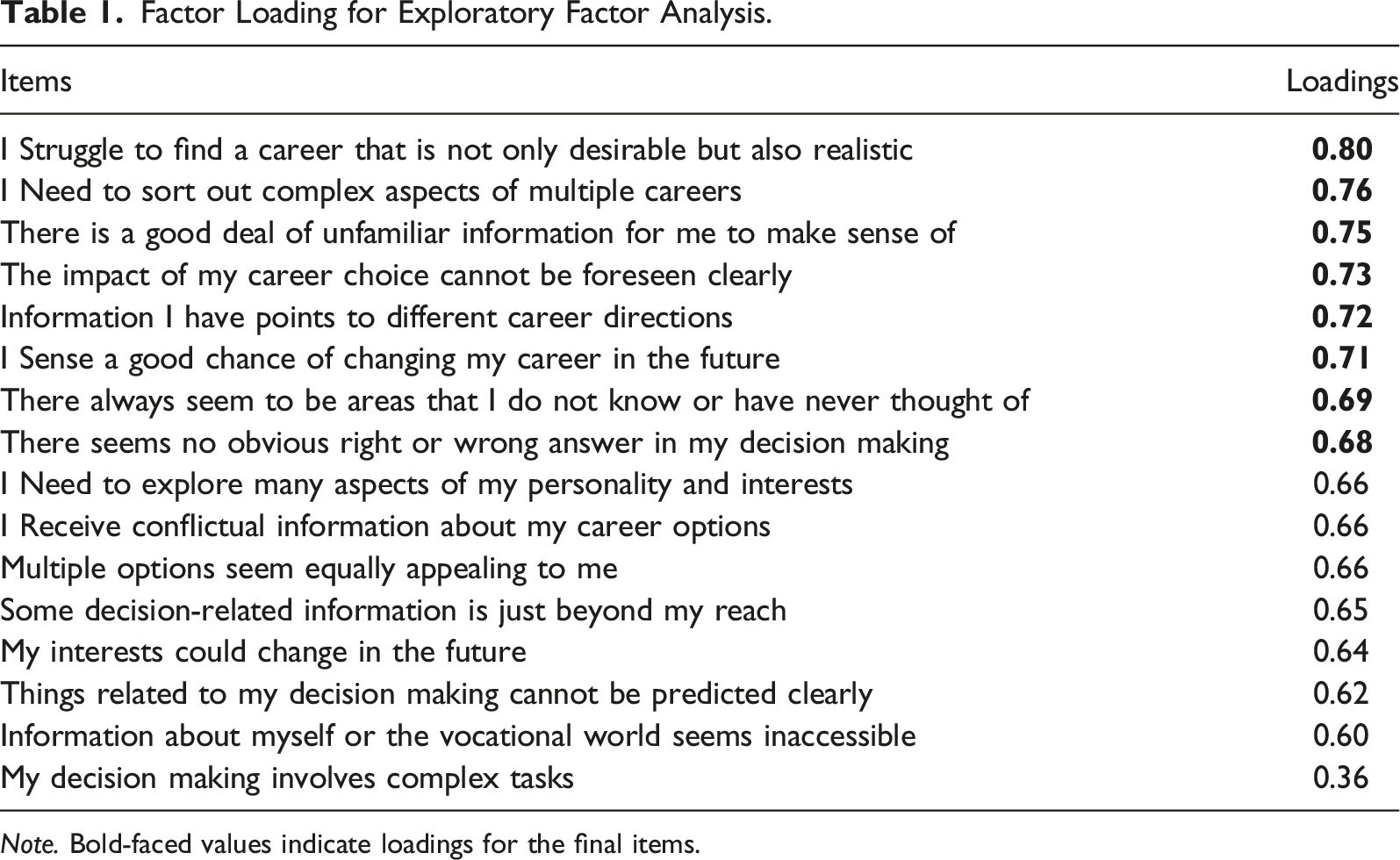
Note. Bold-faced values indicate loadings for the final items.
Study 2. Validation of the CDMA
Study 2 examined the structural, convergent, discriminant, concurrent, and incremental validities of the newly developed CDMA in another sample of college students. To shed light on the development of decision ambiguity in sociocultural contexts, we additionally explored the variations of the CDMA by gender, race/ethnicity, sexual orientation, and social class. We anticipated that individual with marginalized identities and lower SES tend to experience greater decision ambiguity because their power and privilege backgrounds could elevate the four ambiguity areas. Specifically, their disadvantaged resource background (e.g., disadvantaged social and financial capital), elevated person-environment conflicts (e.g., personal aspiration vs. family affordance/expectations; (Whiston & Keller, 2004), and compromised volition (e.g., pressure to satisfy basic needs over psychological needs; (Duffy et al., 2016) could create difficulty in accessing information of norm-nonconforming careers, synthesizing multiple perspectives/priorities (e.g., desirability vs. feasibility), combating oppressive career decision-making norms (e.g., stereotypical gender roles), and allocating energy to long-term career planning (Xu & Yin, 2020).
Methods
Participants
The study participants consisted of 271 college students from the United States with a mean age of 22.63 years (SD = 1.91). Of the participants, 42.4% (n = 115) identified as man, 53.9% (n = 146) identified as woman, 1.8% (n = 5) identified as transgender, and 1.8% (n = 5) identified as gender nonbinary. In terms of race/ethnicity, 64.9% (n = 176) identified as White/European American/Caucasian, 14.4% (n = 39) identified as African/African American/Black, 6.3% (n = 17) identified as Hispanic/Latinx American, 9.6% (n = 26) identified as Asian/Asian American, and 4.8% (n = 13) identified as Multiracial. In terms of social economic status (SES), 8.1% (n = 22) identified as living in poverty, 36.2% (n = 98) identified as working class, 43.2% (n = 117) identified as middle class, 11.1% (n = 30) identified as upper-middle class, and 1.1% (n = 3) identified as upper class. They reported a variety of majors, including biology, accounting, computer science, and psychology.
Measures
Decision Ambiguity
We used the CDMA developed in the first study to measure decision ambiguity. Participants rated each item on a 7-point Liker scale ranging from 1 (Strongly disagree) to 7 (Strongly agree). High scores indicated greater decision ambiguity. The current study revealed an alpha coefficient of .88 for the CDMA.
Career Decision-Making Difficulty
We used the Career Indecision Profile-Short-5 factors (CIP-Short-5; Xu & He, 2022) to measure the five primary career decision-making difficulties documented in Xu and Bhang’s (2019) integrative model. The CIP-Short-5 consists of 25 items in total and five items each for neuroticism/negative affectivity (NNA), need for information (NI), choice/commitment anxiety (CCA), lack of readiness (LR), and interpersonal conflicts (IC). Two sample items were “Often feel fearful and anxious” and “Need to learn more about my interests”. Participants rated each item on a 9-point Likert scale ranging from 1 (does not describe me) to 9 (describes me well). Higher scores indicated greater difficulty in the corresponding area. Xu and He (2022) reported alpha coefficients of .94, .93, .91, .91, and .87 for NNA, CCA, NI, LR, and IC, respectively. They also found support for the validity of the CIP-Short-5 in its associations with the CIP-65 (Hacker et al., 2013), the Career Decision-Making Difficulties Questionnaire (CDDQ; Gati et al., 1996), and the Emotional and Personality Career Difficulties Scale (EPCD; Saka et al., 2008). The current study found alpha coefficients of .88, .82, .88, .83, and .90 for NNA, CCA, NI, LR, and IC, respectively.
Career Decidedness
We used a scale of career decidedness that has been used in previous research involving decidedness (e.g., Lent et al., 2019). The scale contains three items from previous career research. Two sample items were “How decided about your overall career direction are you at this point in time” (ranging from completely undecided to very decided) and “I have decided on a specific occupation or job title that I plan to pursue, for example, computer engineer, writer, or psychologist” (ranging from strongly disagree to strongly agree). Participants responded to each item on a 6-point Likert scale. Higher scores indicated greater career decidedness. Lent et al.’s (2019) study revealed an alpha coefficient of .81 for the scale and support the validity of the scale in its positive association with career decision-making self-efficacy. The current study reported an alpha coefficient of .79.
Career Certainty
We used three items from previous research about career certainty (Osipow et al., 1976; Pesch et al., 2017; Tracey, 2010) to measure participants’ certainty about their career choice. Two sample items were “I am very certain of the occupational choice I made” and “I definitely want to pursue my current career of choice”. Participants rated each item on a 4-point Likert scale ranging from 1 (not at all like me) to 9 (exactly like me). Higher scores indicated greater career certainty. Research has supported the validity of the current items in their positive associations with self-perceived occupational knowledge and interest-major congruence (Pesch et al., 2017; Tracey, 2010). The current study reported an alpha coefficient of .88.
Academic Major Satisfaction
We used the six-item Academic Major Satisfaction Scale (AMSS; (Nauta, 2007) to measure academic major satisfaction. A sample item was “Overall, I am happy with the major I’ve chosen.” Participants rated each item of the AMSS on a 5-point Likert scale ranging from 1 (strongly disagree) to 5 (strongly agree). Higher scores indicated greater academic major satisfaction. Nauta (2007) found an alpha coefficient of .90 for the AMSS. She also found support for the validity of the AMSS in its associations with career decision self-efficacy and career choice anxiety. The current study revealed an alpha coefficient of .90.
Procedures
With institutional review board approval, we recruited participants from a crowdsourcing platform, Amazon Mechanical Turk (MTurk). MTurk offers affordable access to diverse populations and has been increasingly popular in social science (Buhrmester et al., 2011; Paolacci & Chandler, 2014; Ramsey et al., 2016). While Study 1 used a traditional four-year-college sample, the use of MTurk in Study 2 helped strengthen the generalizability of the results to a broader college population. On MTurk, we invited voluntary participants to answer an online survey, which included demographic questions and research questionnaires. They were monetarily compensated for their time and effort. All participants’ responses were anonymous and confidential. To further enhance data quality, we adopted several mechanisms, including inviting only participants who passed the attention check on the platform and had a history of approval rate >95%. Additionally, we used three validity items (e.g., “please choose ‘Moderately agree’”) throughout the entire survey to identify low-quality data entries. Out of 279 total responses, we retained 271 as valid responses because they correctly answered the validity items.
Analysis
We first conducted confirmatory factor analysis (CFA) to cross-validate the unidimensional structure of the CDMA. In this effort, we compared three competing models, consisting of a one-factor model, a four-factor oblique model (four ambiguity areas as four separate but related factors), a four-factor (S-1) bifactor model (inaccessibility, complexity, and unpredictability as specific factors and all items loaded on a general factor; (Eid et al., 2017), and a five-factor hierarchical model (four ambiguity areas as four first-order factors indicating one second-order factor of decision ambiguity). We used the CDMA items as the indicators of latent factors. Additionally, to ensure the distinctiveness of decision ambiguity and the five career decision-making difficulties, we compared three competing models, consisting of a six-factor model (five difficulties and decision ambiguity as separate factors according to the DTC), a four-factor model (need for information, decision ambiguity, and choice/commitment combined as an undifferentiated factor addressing information management and other decision difficulties as separate background factors), and a one-factor model (the five decision difficulties and decision ambiguity combined as a general factor of decision difficulty). The three models represent three levels of distinctiveness among the five decision difficulties and decision ambiguity. We used the items of the CDMA and CIP-Short-5 as indicators of the corresponding latent constructs. We followed the suggestions of Hu and Bentler (1999) and Kline (2015) and used several criteria to holistically evaluate the model-data fit: the robust Chi-square, comparative fit index (CFI; > .90, adequate; > .95, good), root mean square error of approximation (RMSEA; <.08, adequate; < .06, good) and standardized root mean square residual (SRMR; < .08, adequate; < .06, good). To enhance the robustness of the current results to potential non-normality, we employed the robust maximum likelihood parameter estimation in Mplus 8.
Following the examination of the structural validity of the CDMA, we examined the correlations of the CDMA total score with the five difficulty scores of the CIP-Short-5 for convergent, discriminant, and concurrent validities. Regarding convergent and discriminant validities, we used Fisher’s z test to precisely compare the correlations of the CDMA with need for information and with neuroticism/negative affectivity, lack of readiness, and interpersonal conflicts. We examined the correlation of the CDMA with choice/commitment anxiety to shed light on the concurrent validity of the CDMA. Then, we conducted hierarchical multiple regression to examine the incremental predictions of the CDMA for career decidedness, career certainty, and academic major satisfaction over and beyond need for information. Last, we examined the correlation of the CDMA with gender, race/ethnicity, sexual orientation, and subjective SES. For the categorical variables of gender, race/ethnicity, and sexual orientation, we coded the privileged status (i.e., man, White, and heterosexual) as 1 and all marginalized identities as 2. Notably, we did not separate marginalized gender, race/ethnicity, and sexual identities because our focus was on the general level of marginalization, and the current sample size created difficulty in meaningfully capturing marginalized subgroups (also see (Duffy et al., 2017). Thus, this approach represents a proxy of privilege/immunity from oppression and might not capture heterogeneity among marginalized subgroups.
The dataset revealed negligible missingness (<1%). We conducted Little’s (1988) test to examine the missingness pattern and found that χ2 (22, n = 271) = 27.40, p = .16, indicating a pattern of missing completely at random (MCAR). Thus, we used the full information maximum likelihood estimation (FIML) and pairwise deletion of SPSS to handle missing data in CFA and regression, respectively (Schlomer et al., 2010).
Results
Structural Validity of the CDMA
Summary of Model Fit Indices for CFA Models.
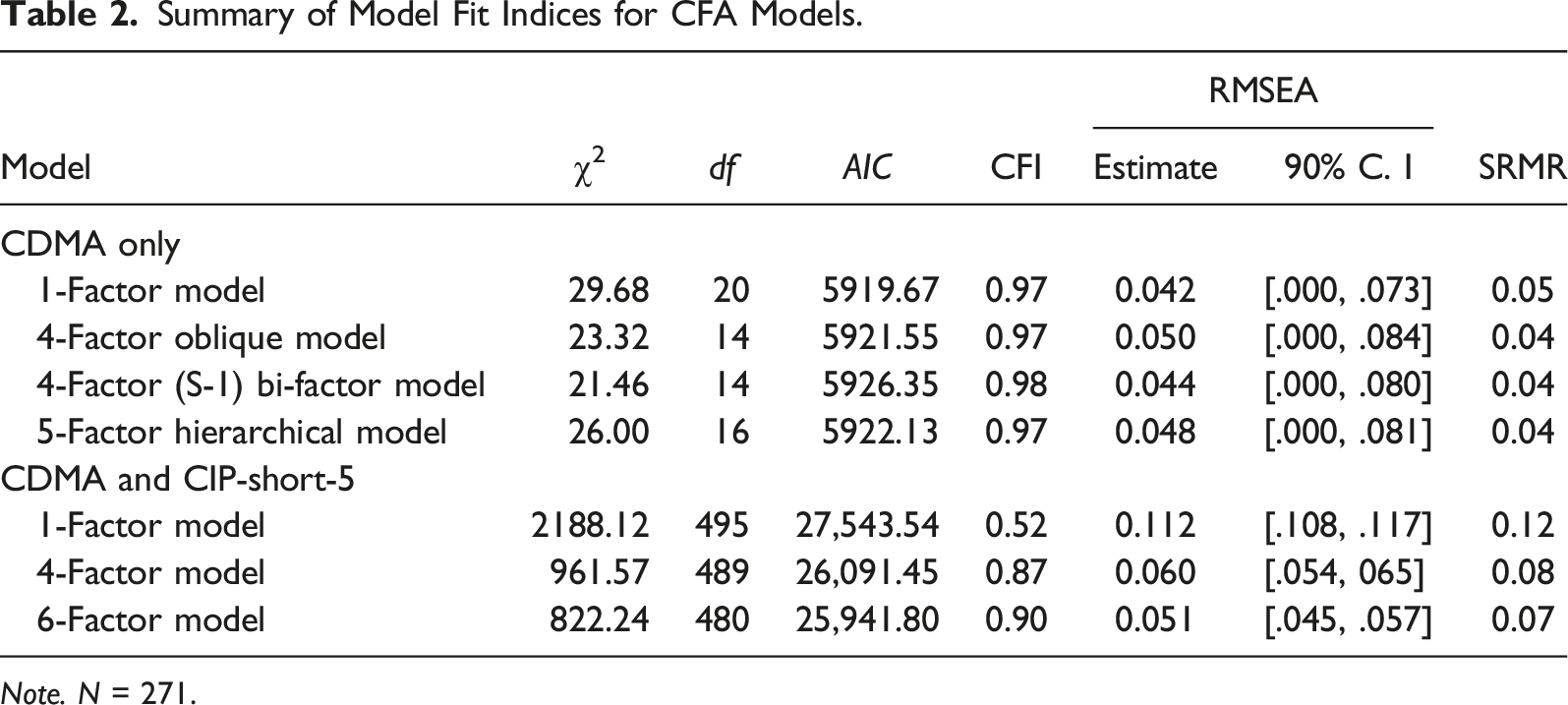
Note. N = 271.
We then examined the fit indices of the three competing models regarding the distinctiveness of the CDMA and the CIP-Short-5. As shown by the values of χ2/df (2188.12/495), RMSEA (.112), SRMR (.12), AIC (27,543.54), and CFI (.52), the one-factor model fit the data poorly. Similarly, the values of χ2/df (961.57/489), RMSEA (.060), SRMR (.08), AIC (26,091.45), and CFI (.87) for the four-factor model did not support (or marginally supported) the adequacy of this model. Last, as shown by the values of χ2/df (822.24/480), RMSEA (.051), SRMR (.07), AIC (25,941.80), and CFI (.90), the six-factor model was an adequate representation of the data. Additionally, the six-factor model exhibited the best model-data fit indices among the three competing models. Thus, the results aligned with the DTC and showed that decision ambiguity and the five decision difficulties addressed distinct constructs of career decision-making.
Convergent, Discriminant, Concurrent, and Incremental Validities of the CDMA
Means, Standard Deviations, and Correlations of Variables in Study 2.
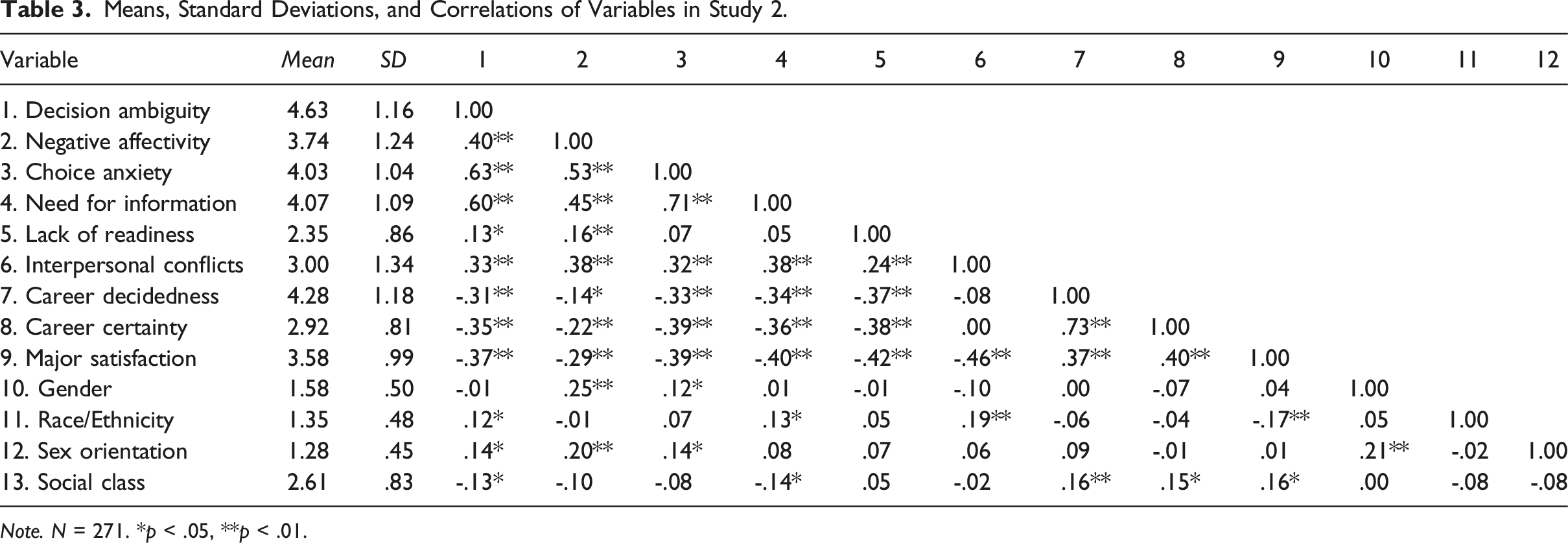
Note. N = 271. *p < .05, **p < .01.
Results supported the convergent validity of the CDMA in its positive association with need for information (r = .60, p < .001). The CDMA was also positively associated with neuroticism/negative affectivity (r = .40, p < .001), lack of readiness (r = .13, p = .038), and interpersonal conflicts (r = .33, p < .001), which was expected given the influence of general psychosocial challenges on ambiguity management. However, Fisher’s tests revealed that zs = 3.82, 6.36, and 4.77 (ps < .001) for pairwise comparisons of the correlations of the CDMA with need for information and with neuroticism/negative affectivity, lack of readiness, and interpersonal conflicts, respectively. This result indicated that the CDMA was more strongly associated with need for information than with neuroticism/negative affectivity, lack of readiness, and interpersonal conflicts. The results supported the hypothesized discriminant pattern of the CDMA in relation to decision difficulties.
Hierarchical Multiple Regression on Career Decision-Making Outcomes in Study 2.
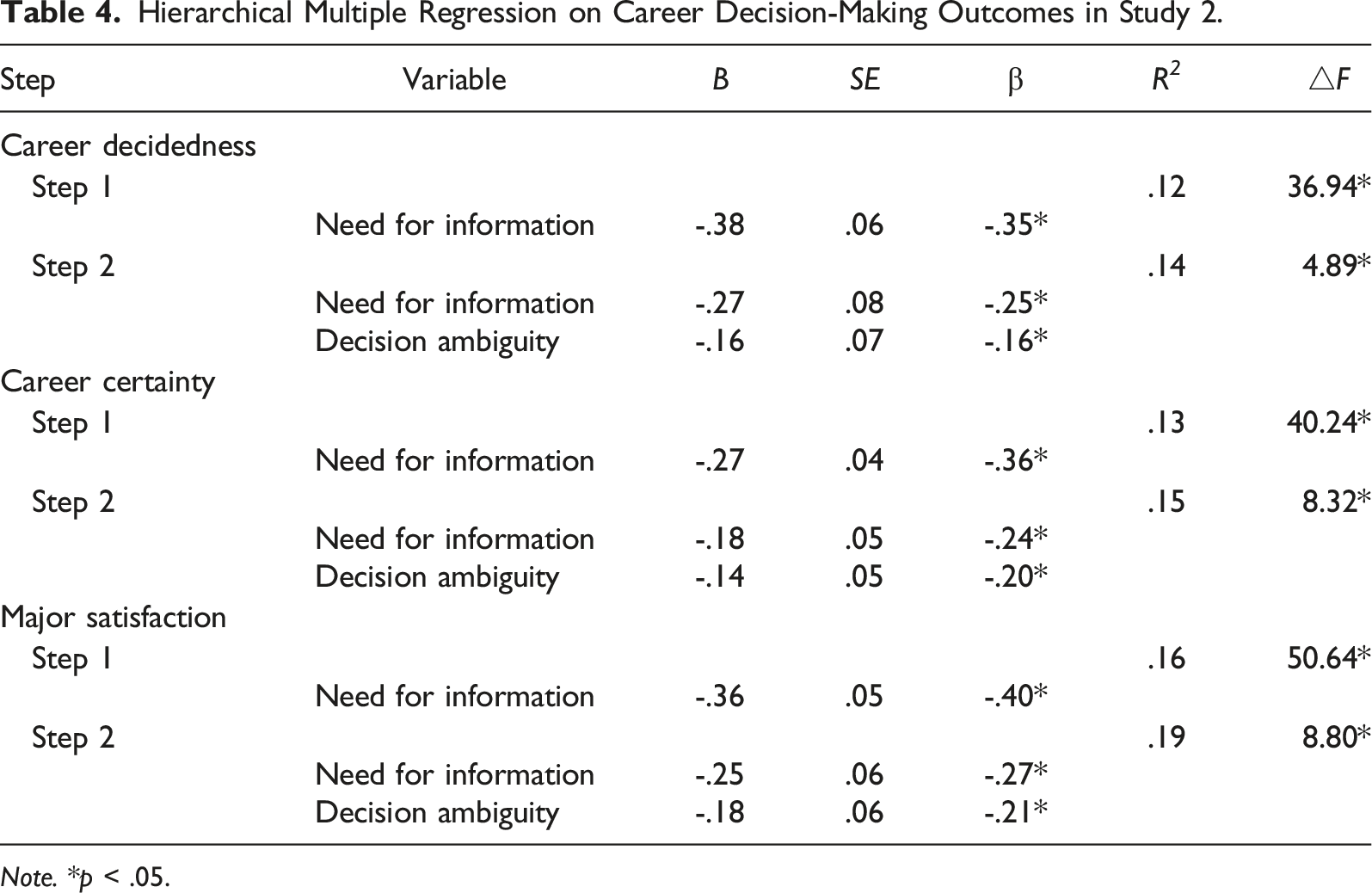
Note. *p < .05.
Variations of the CDMA by Gender, Race/Ethnicity, Sexual Orientation, and Social Class
Results showed that the CDMA was not correlated with gender (r = -.01, p = .91) but was positively associated with race/ethnicity (r = .12, p = .042), sexual orientation (r = .14, p < .05), and social class (r = -.13, p = .025). These results indicated that individuals with marginalized backgrounds in terms of race/ethnicity, sexual orientation, and social class (but not gender in this study) tended to experience greater decision ambiguity in career decision-making.
Discussion
Given the lack of a scale of decision ambiguity in the field, we developed and validated the CDMA using two college samples. The results supported the unidimensional structure of the CDMA (Hypothesis 1) through EFA and CFA, supported the convergent and discriminant validities of the CDMA in its associations with neuroticism/negative affectivity, lack of readiness, interpersonal conflicts, and need for information (Hypothesis 2), supported the concurrent validity of the CDMA in its positive association with choice/commitment anxiety (Hypothesis 3), and supported the incremental validity of the CDMA in predicting career decidedness, career certainty, and major satisfaction over and beyond need for information (Hypothesis 4). Together, while the results supported the psychometric soundness of the newly developed CDMA, they offer rich implications for extending the scientific inquiry and social justice application of the ducal-process theory of career decision-making (DTC).
Psychometric Performance and Utility of the CDMA
The CDMA, to our best knowledge, is the first measure in the literature that aims to assess a key construct of the DTC, decision ambiguity. The solid theoretical underpinnings of the CDMA coupled with its satisfying psychometric soundness suggests the scale as the first choice for measuring decision ambiguity in the current literature. Based on its conceptual novelty, theoretical underpinnings, and empirical performance, the CDMA offers a decent solution to an important measurement hurdle in the emerging research body of the DTC and opens a door for future DTC-oriented research and practice.
Specifically, with the CDMA, researchers can examine the development and consequence of decision ambiguity in career development. First, while the current study offers initial evidence for the associations between marginalization and socioeconomic constraints with decision ambiguity, future research can further investigate the development of decision ambiguity by using an intersectionality perspective (Cole, 2009) and/or focusing on context-specific oppression. Obviously, individuals hardly experience only one form of socially imposed disadvantages, and the intersection of multiple forms of marginalization likely creates more conflicts and greater resource deprivation and thus could amplify decision ambiguity, which deserves more research. Relatedly, individuals might experience decision ambiguity due to their unique family-cultural backgrounds or unique features of considered careers. For example, a hierarchical power orientation in family and society (e.g., hierarchical collectivism) and a career of an unpredictable prospect (e.g., art-related) could elevate ambiguity in navigating different decision perspectives and priorities.
Second, the CDMA enables future research to examine the standalone effect of decision ambiguity. The standalone effect of decision ambiguity sheds light on a psychological mechanism of how marginalization and economic constraints could interfere with career decision-making. While extensive research has suggested that individuals from disadvantaged backgrounds tend to struggle in career development (Blustein et al., 2019), it appeared to us that past research might underrecognize an inherent condition of real-life career decision-making: individuals face inevitable dilemmas/trade-offs in weighing competing information and voices. As a result of such inherent ambiguity, a clean answer to the optimal choice probably never exists even when individuals are provided with necessary resources. Thus, while changing oppressive environments and encouraging personal agency address important barriers of career development, it would be idealistic to assume that empowering individuals with enhanced support, volition, and resources can eradicate ambiguity in figuring out a sensible career direction, in developing career commitment, and in obtaining desirable career outcomes. Therefore, the DTC (Xu, 2021a; 2021b) calls for more attention to decision ambiguity, which likely affects most people’s (particularly marginalized populations’) career decision-making process and outcomes. Using the CDMA, future research can directly examine the role of decision ambiguity.
Last, the CDMA enables future research to examine the interplay of decision ambiguity and containing strategies in career decision-making. The interactive model of ambiguity management has great potential to explain seemingly unreasonable career choices, particularly career compromise of marginalized populations. As argued in the introduction and literature review, calculating the goodness of career options represents only one driving force in decision making, and managing ambiguity represents another motivational force in decision making (Hastie & Dawes, 2010; Thaler, 2016). While ambiguity cannot be practically eliminated in career decision-making, it is reasonable to expect that individuals would need to seek a mechanism to convince themselves of the rightness of their choice (which we call enhancing subjective certainty). Unfortunately for marginalized populations, while such mechanisms (or containing strategies in the DTC terminology) could present a clearer career direction (e.g., gender-, race-, or class-based socialization), they often serve to reinforce the status quo and the societal power structure. Using the CDMA, we encourage future research to examine this perspective, based on which practitioners can consider designing and advocating alternative containing strategies to help marginalized populations avoid the aforementioned “pitfall” in their career development.
In addition to the scientific utility of the CDMA, the CDMA has notable utility in practice. For example, practitioners can use the CDMA to assess the severity of decision ambiguity in a client’s career decision-making. This application might be particularly useful when practitioners comparatively examine the scores of decision ambiguity and informational deficits, which helps determine the intervention focus. Because people tend to underrecognize the distinction between informational deficits and ambiguity (Roche et al., 2017; Xu & He, 2022), showing clients the score discrepancy of informational deficits and ambiguity (particularly the differential longitudinal trajectories of the two aspects) might help clients better understand their career struggle. Additionally, practitioners can use the CDMA as a screening tool to identify at-risk students/clients, which helps prevent at-risk students/client from employing maladaptive strategies to reduce the threat of ambiguity. This application certainly requires researchers to first establish norms of the CDMA in different populations.
Limitations and Suggestions for Future Research
Several limitations should be noted when interpreting the current study. First, while the DTC conceptualizes decision ambiguity as an inherent feature that likely persists during a given window of career decision-making, the current study did not explicitly examine the stability of the CDMA score. Thus, it would be interesting for future research to examine the test-retest reliability of the CDMA, which helps enhance the psychometric evidence of the CDMA. Second, while we developed ambiguity items to capture the four general ambiguity areas, the current items do not emphasize ambiguity clues that are specific to certain decision-making scenarios and populations, which might render the CDMA less sensitive in those scenarios. For example, decision ambiguity might be a particularly salient phenomenon when certain gender groups (e.g., women) encounter certain careers (e.g., STEM). This might explain why gender was not associated with decision ambiguity in the present study. Considering that the CDMA is the first in the field to measure decision ambiguity, we encourage future research to explore whether developing context-specific decision ambiguity scales is scientifically and practically useful. Last, the current study used two college samples to develop and validate the CDMA. Although career decision-making is a central developmental task for college students, it is not a one-time mission that occurs only in college. Thus, examining the validity of the CDMA in other developmental contexts, such as working environments, would be necessary. Additionally, it would be interesting for future research to validate the CDMA in younger populations (e.g., high school students) so that prevention/intervention programs could target the management of decision ambiguity early in secondary educational settings. It is also important to note that Study 1’s sample largely self-identified as woman, which might limit the generalizability of the results to individuals with different gender identities. Although Study 2’s college sample was more gender balanced, it was recruited through MTurk and might deviate from typical college students in terms of SES and age.
Conclusions
To enhance the science and social justice application of the dual-process theory of career decision-making, the current study developed and initially validated a measure of decision ambiguity. The newly developed CDMA exhibited satisfying internal consistency and satisfying structural, convergent, discriminant, concurrent, and incremental validities. Therefore, the current study offers a psychometrically sound measure of decision ambiguity and contributes to the scientific and social agenda of understanding and facilitating career decision-making under a more realistic and inclusive assumption.
Footnotes
Declaration of Conflicting Interests
The author(s) declared no potential conflicts of interest with respect to the research, authorship, and/or publication of this article.
Funding
The author(s) received no financial support for the research, authorship, and/or publication of this article.
