



Abstract
The dual-process theory of career decision-making (DTC; Xu, 2021a; 2021b) resulted from a synthesized and critical reflection of career decision-making and related models in the contemporary psychosocial context of career development. The DTC features persistent decision uncertainty as a salient condition of contemporary career decision-making, and its theoretical framework and predictive model establish DTC’s conceptual and empirical foundation, respectively. However, the DTC and the career decision-making literature in general still lack a process-oriented prescriptive model that foregrounds decision uncertainty. Consequently, the extant literature fails to prescribe key decision-making components and procedures under decision uncertainty. Thus, drawing on the DTC, decision-making science, and existing models of career decision-making, we propose a four-stage process model, which involves four interlinked macro stages and micro steps within each stage. The model also involves five propositions to explain and predict the effects of important personal and environmental factors on the process and outcomes of each stage. We describe the DTC process model and use a case example to illustrate how the model can be applied in practice. Together, the DTC’s theoretical framework, predictive model, and process-oriented prescriptive model constitute a comprehensive theory regarding dynamic career decision-making and adaption in an uncertain world and offer diverse research and practical implications.
Keywords
Introduction
Career decision-making, which entails choosing educational and occupational directions, has been a central topic for career development research and practice over the past century (Gati & Kulcsár, 2021; Xu & Bhang, 2019). Although prior career decision-making models (e.g., Gati, 2013; Lent & Brown, 2020; Parsons, 1909) do not deny uncertainty regarding the “right” educational or occupational direction, they fall short of incorporating uncertainty in their formulation of the career decision-making process and treat uncertainty merely as a background. However, the current psychological, socioeconomic, and sociocultural contexts of career decision-making feature insolubility, instability, non-linearity, and uncertainty in career development (Lent & Brown, 2020; Savickas, 2013). This heightened level of decision uncertainty renders existing decision models insufficient and calls for a model that foregrounds uncertainty (Krieshok et al., 2009). The economic and public health crisis caused by the COVID-19 pandemic represents a classic example of career decision-making in uncertain conditions.
Accordingly, Xu (2021b) synthesized developments in the career decision-making literature and proposed a dual-process theory of career decision-making (DTC), which uniquely highlights reducing decision uncertainty and reducing the threat of decision uncertainty as two related but distinct processes. Discussions on the DTC have focused on its position in the theoretical landscape of career decision-making (Xu, 2021b) and empirical evidence for its predictive model (Xu, 2021a). However, the DTC and the career decision-making literature in general still lack a process-oriented prescriptive model that incorporates persistent decision uncertainty as a key premise and prescribes components and procedures for dynamic career decision-making under uncertain conditions. Such a model has important implications for guiding contemporary career decision-making because accelerated technology advancement, precarious employment arrangement, and evolving occupational profiles create the conditions for considerable decision uncertainty (Blustein et al., 2019; Lent & Brown, 2020). Thus, in this article, we draw on existing career decision-making models and the core propositions of the DTC and develop a process model within the DTC that prescribes how to make a career decision under uncertainty and what affects this process.
The DTC process model elaborates on three areas that are important for career decision-making but have been inadequately addressed by current decision-making models (including the DTC). First, the DTC advocates a satisfactory interim choice as a goal for career decision-making in uncertain conditions (Xu, 2021b); this strategy essentially proposes a minimum standard of career choice but does not specify stopping rules for individuals aspiring to the “best possible” choice. Consequently, how to pursue the best possible decision while simultaneously acknowledging decision uncertainty remains unclear. Second, while the DTC proposes reducing the threat of uncertainty as a goal for managing persistent uncertainty, it falls short of specifying mechanisms for achieving this goal. This hinders formulating adaptive management approaches and understanding decision behaviors from the lens of uncertainty management. Last, reevaluating and adapting the initial choice have been acknowledged by existing decision models (e.g., Sampson et al., 1999; Super, 1990) and the DTC; however, the field has not adequately acknowledged and accounted for uncertainty in the reevaluation process. As a result, little guidance exists regarding how to reevaluate and adapt the initial choice in the presence of uncertainty. All three areas are given more attention in the current model.
It should be noted that while we use terms such as choice and decision in the article, we acknowledge that most people do not enjoy unlimited freedom in career decision making and are subject to social and economic constraints (Duffy et al., 2016). For example, systemic issues, such as opportunity/resource disparity and discrimination, clearly impact what career is deemed acceptable or accessible. Thus, we position our process-oriented prescriptive model as an effort to help people make career decisions under contextual constraints, which supplements conversations about directly eradicating systemic barriers (Ali et al., 2022). This premise manifests itself in at least two areas of the process model which we detail later. First, the key construct of the process model, uncertainty regarding the “right” choice, results from not only personal issues but also contextual constraints. Second, contextual factors are expected to affect several key steps/components of the process model.
Development and Status of the DTC
Initial Models and Core Propositions of the DTC
The DTC emerged from a synthesized and critical reflection of career decision-making and related models in contemporary career development. Joining other scholars’ analysis (Blustein et al., 2019; Krieshok et al., 2009; Lent & Brown, 2020; Savickas, 2015), Xu (2021a) outlined psychosocial challenges and socioeconomic transitions that individuals are facing the 21st century. First, individuals rarely have complete access to decision-related information and rarely have the full psychological capacity to exhaust options and compute a clear optimal choice. Second, individual and systemic oppression remain in force throughout the career development process, and oppression affects individual agency and volition, creating lingering dilemmas. Last, the changing occupational profiles and employment arrangement in the fourth wave of the industrial revolution, combined with unpredictable economic and public health crises, increase future unpredictability.
Given these structural challenges, contemporary career decision-making models emerged to supplement, strengthen, or renovate Parsons (1909) seminal framework. Career construction theory (Savickas, 2013) and happenstance learning theory (Krumboltz, 2009) represent post-modern models and supplement the Parsonian framework by highlighting constructivist authoring in career designing and dynamic adaption to planned and unplanned events. Gati and colleagues’ prescreening, in-depth exploration, choice model (PIC; Gati, 2013) enhanced Parson’s framework by introducing a prescreening stage to reduce cognitive load in collecting and matching information (Kahneman, 2003; Krieshok et al., 2009; Simon, 1972). Lastly, Lent and Browns (2020) content-process-context (CPC) model of career intervention renovates Parson’s framework by placing the dynamic P-E interaction in individuals’ career and life contexts (Blustein et al., 2019; Hartung et al., 2010).
The DTC differs from these models by foregrounding decision uncertainty in its theoretical building and centering on the differential management of state and persistent uncertainty (termed confusion and ambiguity, respectively, by the DTC) in career decision-making. While uncertainty in the DTC denotes generic uncertainty in calculating the “right” choice, state uncertainty/confusion refers to uncertainty that can be clarified through enhanced information collection and processing (e.g., unknown interests); by contrast, persistent uncertainty/ambiguity refers to uncertainty that cannot be eliminated during a given decision time-frame despite problem-solving efforts (e.g., unclear industry outlook). Although confusion and ambiguity could manifest differently across individuals, the DTC highlights information inaccessibility, inconsistency, complexity, and unpredictability as four interrelated issues contributing to ambiguity about career outcomes and highlights unclear decision parameters as the general manifestation of confusion (Xu, 2021a). Given the differential solvability of confusion and ambiguity, the DTC also proposes that people handle confusion and ambiguity differently in that reducing uncertainty itself and reducing the threat of uncertainty are the goals for confusion and ambiguity management, respectively. Thus, the DTC differentiates between two decision-making processes in terms of uncertainty subtypes and uncertainty management strategies. Notably, although the presence of uncertainty subtypes in theory justifies the use of different uncertainty management approaches, the DTC acknowledges that individuals in practice often have difficulty in differentiating between confusion and ambiguity and coordinating the two uncertainty management approaches.
The uncertainty-oriented focus of the DTC responds to heightened uncertainty in contemporary career decision-making and theoretically resonates with a core finding in general decision-making science and behavioral economics that reducing uncertainty is a fundamental human desire (Hastie & Dawes, 2010; Kahneman, 2003). Furthermore, DTC offers a unified platform to integrate the aforementioned discussions. As Xu (2021b) argued, while the P-E fit framework (e.g., Gati, 2013; Parsons, 1909) offers clear tactics for reducing uncertainty, post-modern models (e.g., Krumboltz, 2009; Savickas, 2013) highlight accepting and adapting to uncertainty. However, these prior models do not differentiate confusion and ambiguity, and consequently, their opposing strategies (reduce vs. accept uncertainty) may compete with each other and limit career counseling and educational practice.
The development of the DTC represents a timely effort to synthesize the strengths and limitations of Parson’s framework in the current world of work (Xu, 2021b). It should be noted that the DTC differs from the dual-system model described by Lent and Brown (2020) and Krieshok et al. (2009), which focus on rational and intuitive thinking systems. The DTC instead focuses on confusion and ambiguity because rational and intuitive thinking do not appear to have the distinct functionalities that their titles suggest (De Neys & Pennycook, 2019) and they could be useful for both confusion and ambiguity management (Xu, 2021b). Following the establishment of the dual-process framework, the predictive model of the DTC draws on the major developments in career decision-making research and conceptualizes matching information and containing ambiguity as two prototypical strategies for confusion and ambiguity management, respectively (Xu, 2021a). While matching information closely aligns with the practice of person-environment-context (P-E-C) correspondence (Lent & Brown, 2020), containing ambiguity entails strategies and efforts to mitigate the threat of ambiguity (e.g., submit to social norms and avoid decision making). Using confusion and ambiguity management as two separate, but interactive processual mechanisms, the predictive model of the DTC delineates how the psychosocial context of career decision-making may influence the content, process, and outcomes of career decision-making.
Together, the theoretical framework and the predictive model of the DTC involve nine core tenets. First, managing uncertainty is a key motive in career decision-making (motive). Second, confusion and ambiguity are two distinct types of uncertainty (differentiation of confusion and ambiguity). Third, the content of decision information and the orientation of matching information influence the area of match (content of confusion management). Fourth, the adequacy of decision information and the adaptiveness of matching orientation influence the progress of matching (process of confusion management). Fifth, the content of decision ambiguity and the orientation of containing ambiguity influence the area of commitment (content of ambiguity management). Sixth, the extent of decision ambiguity and the adaptiveness of containing orientation influence reactions toward commitment (process of ambiguity management). Seventh, confusion and ambiguity management influence each other (dynamic interaction). Eighth, the abilities to dialectically manage both confusion and ambiguity represent a key metacompetence area (dialectical decision competence). Last, decision-making outcomes form a new background influencing subsequent career decision-making (a cyclic process). Xu (2021a) summarized five decades’ of career decision-making research and showed that although evidence for different portions of the predictive model varies in strength, prior research generally supports the unique utility of both confusion and ambiguity management and their interactive nature.
Updating the Status of the DTC: Calling for a Process Model
Although the theoretical framework and the predictive model of the DTC help establish the conceptual foundation and the empirical evidence, respectively, the DTC lacks a process-oriented model that aligns with the core propositions of the DTC and arranges key decision-making components in a developmental fashion. To be fair, the DTC framework proposes strategic anchoring and adjustment as a new approach to career decision-making, which emphasizes (1) identifying an anchor choice (i.e., a satisfactory working choice) to initiate career preparation and construction, (2) implementing the choice to advance career and accumulate resources, and (3) monitoring the anchor choice in the event that adjustment is needed. Although strategic anchoring and adjustment address key principles of the career decision-making process, it falls short of articulating exact components and processes that individuals need to address to achieve adaptive career (decision-making) outcomes. Such a model is crucial for advancing career educational and counseling practices based on the DTC.
In addition, a process-oriented model within the DTC may supplement existing intervention models of career decision-making by introducing a dynamic iterative model with handling ambiguity as a key task. Although existing models acknowledge ambiguity, they rarely incorporate ambiguity into their formal conceptualization of the career decision-making process and provide actionable strategies for decision making under ambiguity. For example, in Gati and colleagues’ (2013) PIC model and six prescriptive career models they identified (Gati & Kulcsár, 2021), ambiguity is described as a background factor that people need to accept. This acknowledgement is helpful for increasing the readiness of ambiguity management; however, how to make a career decision given inevitable ambiguity remains unclear. Relatedly, choice implementation and adaptation has been acknowledged as integral to career decision-making in contemporary models (e.g., Lent & Brown, 2020; Sampson et al., 1999). Supers (1990) life-span, life-space model acknowledges career decision-making as a recycling process as opposed to a static one-time event and emphasizes adaptability across developmental stages. However, these models fall short of delineating how ambiguity manifests in adaptation and how iteration should occur under ambiguity. As the DTC (Xu, 2021a; 2021b) argues, ambiguity is an increasingly important challenge in contemporary career decision-making and consequently requires a model that features it in the foreground as opposed to the background. Thus, a major contribution of the current process model to the broader career decision-making literature is that it prescriptively answers how to make dynamic career decisions and adaptation in conditions of ambiguity.
The Process Model of the DTC
We followed four interrelated principles in developing the process model. First, we drew on existing career decision-making models and incorporated components in these models that are compatible to the DTC into our process model. Second, we adopted a broader, developmental conceptualization of career decision-making (Savickas, 2013; Super, 1990; Xu, 2020a) to cover not only the initial career-related choice but also subsequent adaptations. The current process model extends to career decisions across the life-span. Third, we used adaptiveness to define decision quality, which denotes the extent to which career choices can meet individuals’ career and life goals given their psychosocial context. This conceptual choice stems from decision science’s traditional emphasis on maximized expected returns (Hastie & Dawes, 2010) and emerging discussions on ecological rationality (Goldstein & Gigerenzer, 2002) and contextual affordances (Lent & Brown, 2020). Last, the process model was designed to align with the core propositions of the DTC.
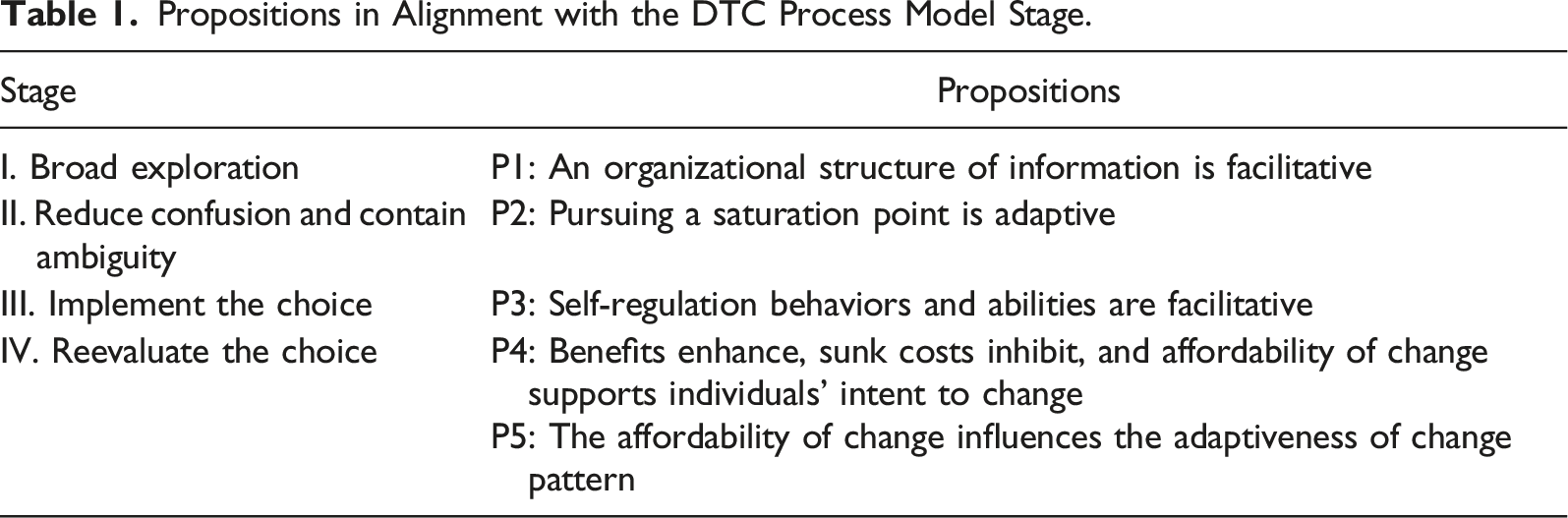
Based on the DTC’s anchoring and adjustment approach and existing process models on career exploration and decision-making (Gati, 2013; Lent & Brown, 2020; Xu, 2021b), we propose four macro stages as recommended steps in the cycle of career decision-making and adaptation (see Figure 1). These four stages consist of broad exploration (Stage I), reduce confusion and contain ambiguity (Stage II), implement the choice (Stage III), and reevaluate the choice (Stage IV). They are functionally interlinked in that while the products of each stage (i.e., information, choice, or assessment) generally serve as the foundation for subsequent stages, assessment results at two particular stages (i.e., Stages II and IV) could redirect the flow to previous stages. While modeling the four stages, we focused on their main goals and functions, micro components and processes, and personal and environmental influences. These three areas were carefully chosen as they each address unique scientific and practical questions and together could offer a rich model description and applicable research and practical implications. Specifically, the main goals and functions address the functional role of each stage and could guide intention development and progress assessment in career counseling practice. Micro components and processes within each stage address technical pathways that individuals can follow to achieve stage goals, which offer a fine-grained conceptualization of the decision-making process. Personal and environmental influences address process and outcome variations, which help explain decision-making difficulty and suggest coping mechanisms. We focus on influences that are particularly important for the DTC process model or have not been adequately explained by existing decision models (see Table 1 for all propositions). The process model. Propositions in Alignment with the DTC Process Model Stage.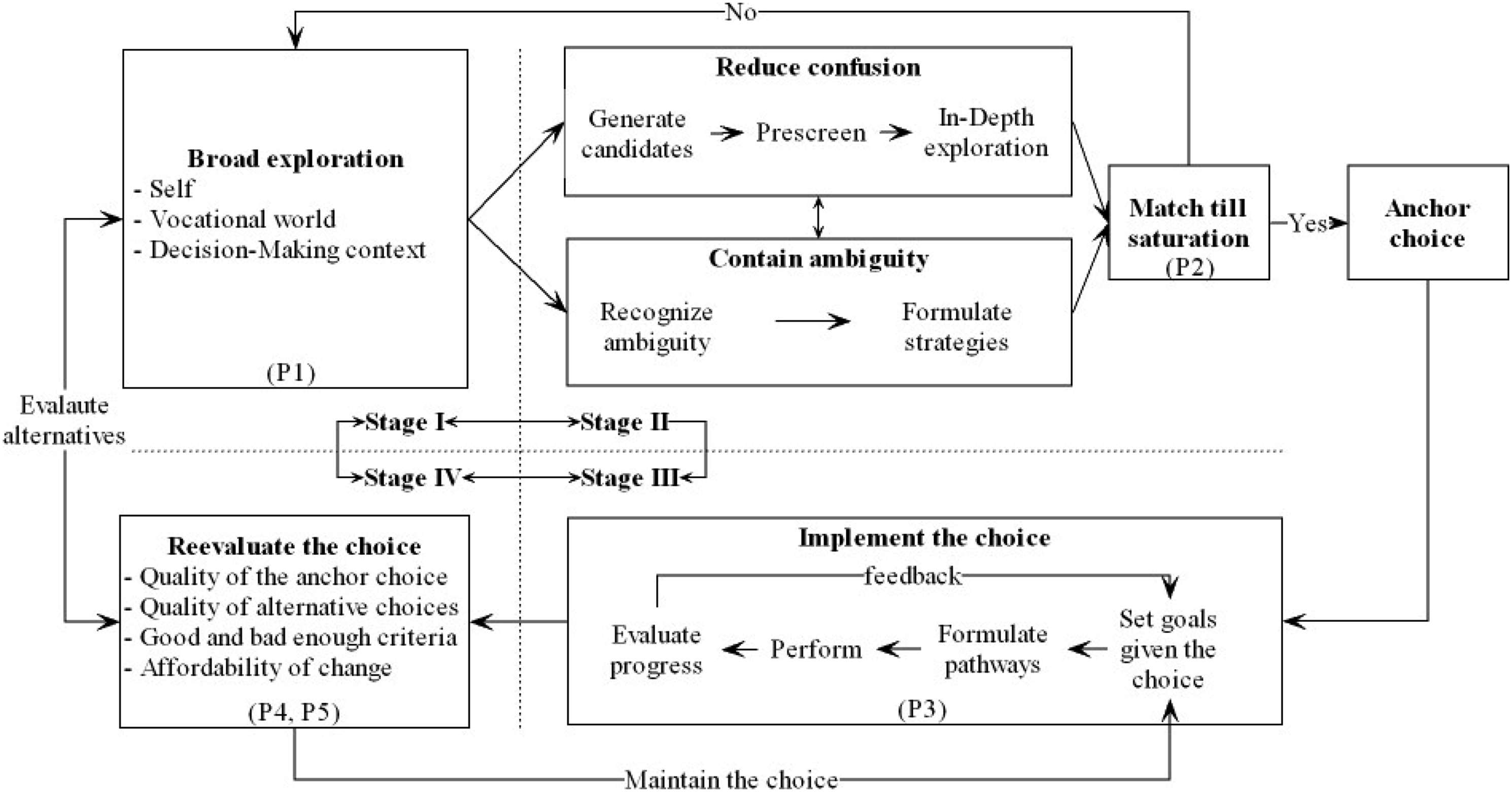
We would like to acknowledge upfront that the four stages advance the conversation about career decision-making to different degrees due to different scholarly accumulation in the four areas. However, we believe that including all four stages is necessary for depicting the entire career decision-making loop. In our design, Stage I largely builds on existing narratives about key decision-making parameters (e.g.,(Gati, 2013; Super, 1990) but holds a goal that is more compatible with the reality of ambiguity. Stage II incorporates the traditional P-E matching paradigm but adapts and expands it to accommodate ambiguity management. Stage III draws on the literature about self-regulatory/proactive/adjustment career behaviors (e.g., Dawis, 2005; Lord et al., 2010) but emphasizes advancing career in the chosen major/occupation and cultivating readiness for adaptation. Stage IV offers the first account in the field (to our knowledge) of reevaluating educational/occupational choices under ambiguity. We introduce each stage in the following sections and primarily focus on Stages II and IV due to their theoretical innovation. In addition, we use a case study to illustrate how practitioners can assist individuals through each stage of the DTC process model.
Stage I: Broad Exploration
In Stage I, individuals need to widely explore areas related to career decision-making to form a broad informational foundation. The goal of this stage is not necessarily to know everything because uncertainty is inevitable; rather, it focuses on broadening information sources to prevent bias and areas outside of one’s awareness. It is no surprise that individuals might be tempted to adopt information shortcuts to circumvent the daunting demands and responsibility in the decision-making process (Lent & Brown, 2020; Xu & Bhang, 2019). Although information shortcuts (e.g., capitalizing on intuition and available information) might not be necessarily wrong in real-life decision making (Kahneman, 2003; Kahneman & Tversky, 1979), a systematic approach that highlights specifying personalized criteria and calculating expected rewards is valuable for maximizing choice quality (Hastie & Dawes, 2010; Von Neumann & Morgenstern, 2007). This information-processing strategy underlines Parsons’s model and was further elaborated in other models (i.e.,(Dawis, 2005; Holland, 1997).
To establish a broad informational foundation, individuals need to collect information in at least three areas, based on P-E-C correspondence (Lent & Brown, 2020; Xu, 2021b): personal characteristics, vocational attributes, and contextual parameters. First, personal characteristics and vocational attributes constitute the foundational pair of information that shapes need-supply and demand-ability fit (Dawis, 2005). Important personal characteristics include but are not limited to vocational interests, values and needs, and abilities (Dawis, 2005; Holland, 1997). Correspondingly, important vocational attributes may include the nature of occupational activities, work cultures and offering, and job demands. Although P-E fit likely signal ideal career directions, individuals do not live in socioeconomic vacuum (Blustein et al., 2019; Lent & Brown, 2020). Contextual parameters, such as affordances, time framework, and supports and barriers, influence whether carrying out P-E fit at a given moment of decision making is feasible and affordable. Thus, although individuals do not have to comply with contextual parameters, understanding them can facilitate a broader and more ecological perspective of career development and inform subsequent choice implementation.
We highlighted a personal factor (i.e., organizational structures of information) that could influence the informational foundation formed through Stage I. Organizational structures of information address the extent to which individuals adopt psychological structures to make sense of the interrelationship among personal and environmental characteristics. The structural issues of information were probably introduced by Hollands (1997) model of vocational interests. Holland’s model proposes six interest (and occupational) types and arranges them on a hexagonal structure. Tracey and colleagues (Tracey, 2008; Xu & Tracey, 2017a) argued that while Holland’s hexagonal structure can function as a normative model describing the interest structure at the population level, individuals adhere to this model differently. Such individual differences would reflect the extent to which individuals use Holland’s model to conceptualize interest and vocational information, and the adoption of this model is expected to help individuals make sense of and integrate information and consequently facilitate their career exploration and decision-making. While research has supported the benefit of using the organizational structure of interests for decision making (Tracey, 2008; Xu & Tracey, 2017a), it is plausible that other personal and environmental parameters can also benefit from such structures. In summary, we propose that in Stage I, individuals using an organizational structure to make sense of information are more likely to engage in exploration, broaden the scope of exploration, and accumulate accurate information (Proposition 1).
The following case illustrates the application of the DTC process model. Gabby, an African American woman in high school, hopes to find the “right” occupation and identify a major that can prepare herself for that occupation. Gabby aspires to be an electronic engineer but debates whether an electronic engineer would be a good career choice given the underrepresentation of women of color in this profession. During Stage I, Gabby’s counselor encourages Gabby to broadly collect information about herself, occupations, and contexts, such as interests, values, abilities, occupational profiles, and personal support systems as opposed to just focusing on the original career option. The goal is to help Gabby understand the motive(s) of her aspiration, to expand the list of career options, and to be mindful of rewards and challenges associated with each career option. To help Gabby make sense of information and formulate potential alternative options, Gabby’s counselor educates Gabby about Holland’s hexagonal structure and encourages her to use the hexagonal structure in career exploration. For instance, Gabby might realize that she has competing investigative, social, and conventional interests (explaining her passion for a career as an electronic engineer) and can alternatively consider pharmacist, computer science teacher, library science teacher, and registered nurse (recommended by the O*NET) as viable career options.
Stage II: Reduce confusion and Contain Ambiguity
During Stage II, individuals match the collected decision-related information to reduce confusion around the “right” choice and develop strategies to reduce the threat of ambiguity (i.e., contain ambiguity). The essential goal of Stage II is to manage both confusion and ambiguity to achieve an interim choice (or an anchor choice in the DTC). This interim choice serves to help individuals establish a certainty foundation (i.e., knowing that their choice would not be terribly wrong), initiate career preparation (e.g., formal education and training or transition planning), and acknowledge space for improvement and adaptation. In other words, this interim choice embraces both foundational certainty (which supports goal-oriented actions) and manageable uncertainty (which allows for adaptation). This interim choice cannot be established without satisfactory reduction of confusion and adequate acceptance of ambiguity and represents a product of dialectical management of confusion and ambiguity (Xu, 2021a; 2021b). If individuals are unable to establish a foundational sense of certainty through confusion and ambiguity management, they will need to reengage in Stages I and II and further explore and process information.
The process of reducing confusion involves four steps. The first three steps, namely, generating candidates based on broad exploration, screening out options that lack good fit, and in-depth exploration of promising options, resonate with the first two stages of the PIC model (Gati, 2013) and Porfeli and Skorikovs (2010) account of broad and specific exploration. This information processing flow serves to help individuals manage their cognitive resources and potential biases (Kahneman, 2003; Lent & Brown, 2020) so that they can strike a balance between the breadth and depth of the information foundation. However, the choice stage of the PIC model (or “true” reasoning in Parson’s framework) is substituted with a component that aligns better with the DTC: match information till saturation. As described by the DTC framework (Xu, 2021b), because of psychosocial challenges, an optimal occupational/major choice that matches all aspects of decision-making information, if it even exists, is inaccessible during a given window of career decision-making. Therefore, a “perfect” match is an idealistic and unreasonable goal for career decision-making as it is not compatible with contextual limits in real-life career decision-making; pursuing such a career choice could ironically lead to procrastination in career preparation and missing optimal decision and execution timing.
Alternatively, pursing a saturation point, where individuals have raised the decision quality to a “good enough” level (Gottfredson, 2005; Simon, 1972) but do not exhaust efforts to search for the best option, is probably more reasonable in managing psychosocial resources, work-nonwork balance, and timing for necessary preparation (Goldstein & Gigerenzer, 2002). This saturation point can be further operationalized through consideration of both decision-making effort and the benefits of such effort. Specifically, based on the presence of both confusion and ambiguity (Xu, 2021b), we depict a relation between decision-making effort and perceived certainty regarding the final choice (see Figure 2). This relation features a diminishing return of decision-making effort in that greater effort helps reduce confusion regarding the goodness of a choice. However, individuals cannot afford unlimited effort and cannot practically eliminate uncertainty regarding whether a choice is optimal. On the effort-certainty chart, we define saturation as a point where decision-making effort ceases to generate appreciable increase in decision certainty. Notably, the saturation point reaches a reasonable balance of decision quality and effort and does not impose a “good enough” choice, often perceived as a passive and less desirable goal (Xu, 2020a), as the end product. Thus, we envision that matching till saturation provides an operational, proactive definition of an anchor choice and could help put the DTC’s original idea of anchoring into practice. Conceptualizing the pursuit of a saturation point and a clear optimal choice as two contrasted decision-making goals/orientations, we propose that pursuing a saturation point facilitates career decision-making such that individuals are more likely to achieve career decidedness and commitment readiness (Proposition 2). The anchoring process.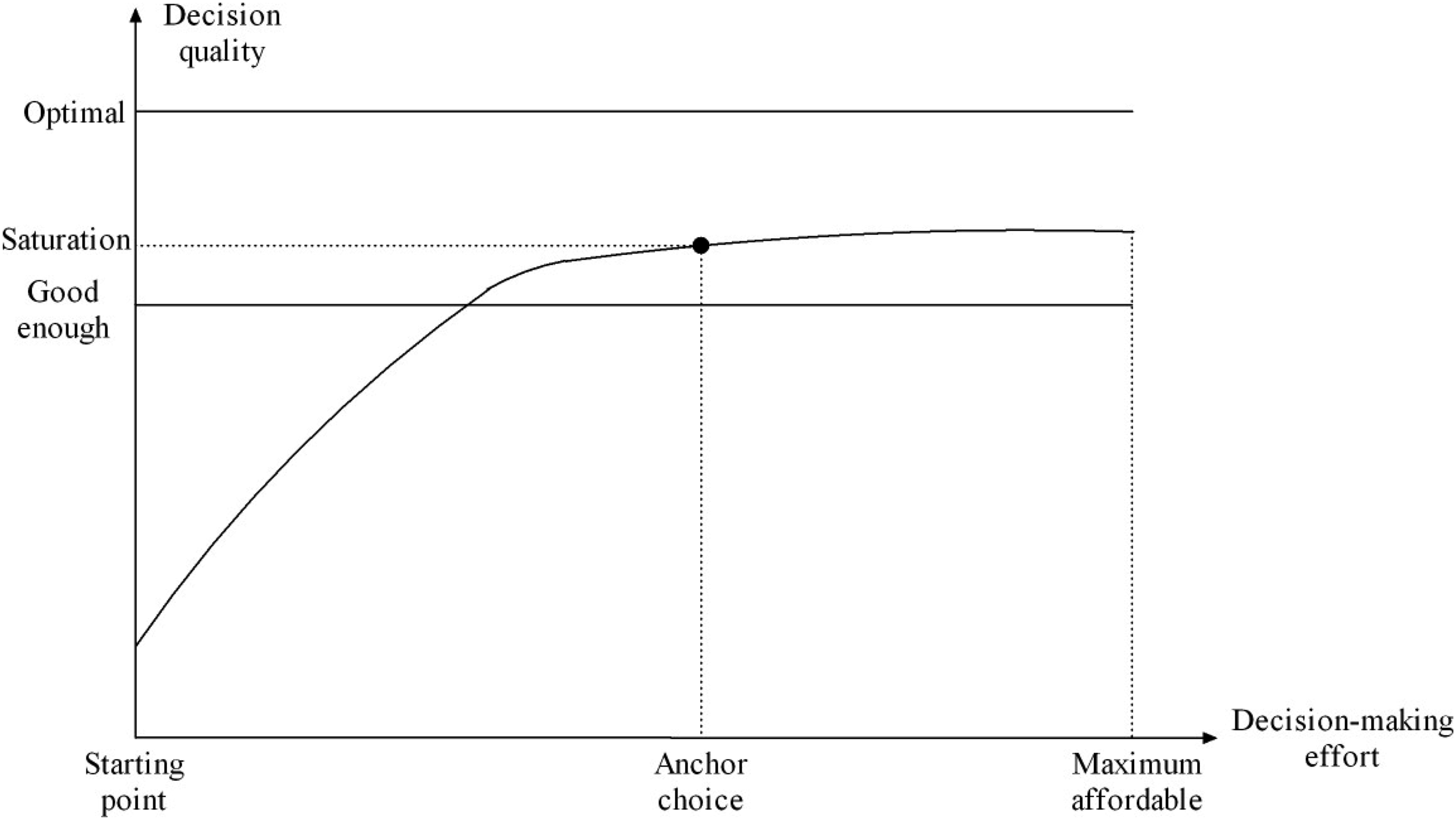
Using saturation to signal the timing for an anchor choice is likely more feasible when individuals can acknowledge and properly handle ambiguity because otherwise looking for an anchor choice instead of an optimal choice could seem unreasonable and cause distress. It is plausible that the first step to manage ambiguity is to recognize ambiguity in career decision-making. Without the awareness of ambiguity, it is difficult for people to pinpoint ambiguous areas in their career decision-making, let alone developing appropriate strategies to contain ambiguity. When ambiguity is recognized, the next step is to develop strategies to reduce the threat of ambiguity (i.e., contain ambiguity). As notedly earlier, the DTC has not explicitly addressed technical solutions to achieving this goal. While confusion management features collecting and matching information, we propose that ignoring some information that in theory helps calculate P-E-C fit is likely a key procedure that helps people arrive at a decision in the presence of ambiguity. This information reduction tactic might be counterintuitive because according to uncertainty reduction theory, individuals collect information to reduce uncertainty (Kramer, 1999). However, a key feature of career decision-making concerns the presence of inevitable ambiguity, which cannot be eliminated during a given window of career decision making. Under this condition, collecting information might ironically heighten the awareness and perceived threat of ambiguity as opposed to reducing ambiguity. Yoon et al. (2021) study provides evidence for this phenomenon in that they investigated information collection during the COVID-19 crisis, a period of high uncertainty. More specifically, Yoon et al. (2021) found that individuals who consumed more news about COVID-19 reported more uncertainty, which challenges uncertainty reduction theory and speaks to the limited (if not detrimental) role of information collection in highly uncertain scenarios.
In contrast to collecting information, ignoring some information may help reduce the threat of ambiguity because it could simplify and accelerate the decision process and consequently relieve individuals of computing ambiguity. In fact, decision science has acknowledged that ignoring some information is not only a common decision strategy (see heuristics for an example) but also could be an adaptive decision strategy when decision scenarios involve considerable uncertainty (Gigerenzer & Gaissmaier, 2011; Hastie & Dawes, 2010). However, ignoring information is not always adaptive because avoiding decision making due to fear of ambiguity could lead to maladaptive decision outcomes (Xu, 2020b; Xu & Tracey, 2017b). Thus, to safeguard the adaptiveness of ambiguity management, a psychosocial justification (e.g., some information is practically inaccessible or relatively unimportant to evolutionary fitness) is probably needed when determining which area of information to ignore, when, and to which extent. A psychosocial justification is important also because collecting information makes intuitive sense and cannot be withheld without a powerful reason. Notably, seeking a saturation point represents a joint process of collecting and ignoring information in that it not only collects information to elevate decision quality to “good enough” but also ignores information that is practically difficult, if not impossible, to access. By doing so, this strategy could help mitigate the concern for potential decision “mistakes” and facilitate decision-making. We would like to highlight that ignoring information that is practically inaccessible is just one adaptive approach to ignoring information and that other approaches might also function adaptively depending on specific decision contexts.
There are two additional considerations regarding the product of Stage II, the anchor choice. First, although saturation regarding P-E-C fit is generally recommended as the end point of anchoring, it is possible that contextual affordances for some individuals might not support them in reaching the saturation point. If so, these individuals would have to make a tough compromise on decision quality at the time of career decision-making. However, they can and should strategically make such a compromise in that the chosen educational or occupational direction should help to increase affordance in subsequent adaptation without creating dependence on a single path. Second, several comparable options might be present at the saturation point, but individuals have to select a single one of the available options. The dilemma often concerns a trade-off between short-term, small rewards and long-term, large rewards. Because gratification delay theory and research support the positive role of gratification delay in human endeavors in general and career decision-making in particular (Hoerger et al., 2011; Watts et al., 2018; Xu & Yin, 2020), we recommend that individuals select choices with more growth potential over choices with more immediate rewards when permitted.
In Stage II, since Gabby has enhanced awareness of personal and social factors in her career decision-making, Gabby’s counselor encourages Gabby to rule out unacceptable options (e.g., library science teacher) and gather more information about the remaining options (e.g., electronic engineer, pharmacist, registered nurse, computer science teacher, and physics teacher) that satisfy at least some of her important needs. With deeper information about each option, Gabby ranks and narrows down the remaining options until identifying the top option. At this step, what fundamentally differentiates the DTC process model from conventional P-E-C fit is that Gabby’s counselor does not view maximum decision quality (in terms of P-E-C fit) as the goal. Relatedly, following the DTC process model, Gabby’s counselor does not use maximized P-E-C fit or maximum affordable effort to define the stopping point and does not construe a choice with suboptimal P-E-C fit as an necessarily inferior choice. Instead, Gabby’s counselor would use the minimum standard (i.e., good enough) and a saturation point (see Figure 2) to identify the stopping point, which helps Gabby avoid obsession with an optimal choice and strike a balance between decision quality and effort.
Specifically, to help Gabby find the saturation point, Gabby’s counselor invites Gabby to document how much effort she needs to eliminate each option when narrowing down the option pool. To quantify effort, Gabby can use the effort (e.g., objective time or subjective energy) that has been taken to eliminate the first option as the calculating unit. For example, she might first eliminate registered nurse 1 week after working with her counselor but needs 2 weeks before she eliminates pharmacist. The remaining options, computer science teacher, electronic engineer, and physics teacher, could be all good enough, but Gabby’s counselor encourages Gabby to continue exploration. Eventually, it might take 4 weeks of careful exploration and consideration before Gabby decides to eliminate the third option, computer science teacher. Assuming Gabby’s exploration has been consistent and effective across the 7 weeks, Gabby’s counselor at this point helps Gabby reflect on the effort-benefit relation and notes that the marginal benefit of Gabby’s effort has significantly decreased and the remaining two options might represent a trade-off.
Electronic engineer versus physics teacher is likely a difficult trade-off for Gabby because while the career as an electronic engineer might better fulfill Gabby’s investigative interests and achievement value, the career as a physics teacher might better fulfill Gabby’s social interests and desire for avoiding social barriers. Although Gabby could experimentally continue exploring the two options (which are above good enough), she might experience that knowing more about the two options does little to reveal a better option. According to the DTC process model, this saturation point signals the time for making an anchor choice. At this point, Gabby’s counselor helps Gabby acknowledge that decision ambiguity might persist during her decision-making window despite her efforts. This ambiguity is present for at least two reasons. First, she is interested in different activities, which lead to different career directions. Second, it is hard to predict the progress of systemic changes in the opportunity structures and occupational/organizational cultures. Acknowledging ambiguity can also be conducted in parallel or prior to exploration, which could help Gabby reduce stress during the exploration process and prepare her for making an anchor choice. In Gabby’s case, she might choose high school physics teacher as the anchor choice because she is unsure that her interests, talents, and support system can offset the oppressive societal barriers in the other career path. Accordingly, she could choose education as her college major and physics as her minor.
Stage III: Choice Implementation
With the anchor choice identified in Stage II, individuals in Stage III proactively and strategically implement the choice and advance their career in the chosen educational/occupational area. The goal of this stage is twofold: (1) to pursue career success, broadly defined, based on the anchor choice and (2) to cultivate readiness (including psychological, social, and financial resources) for potential adjustments to the anchor choice. Like Stage II, Stage III involves two seemingly contradictory processes with the first goal assuming stability and the second goal anticipating change. The first goal of Stage III is straightforward; however, the second goal is not always intuitive. It is not uncommon that individuals tend to disengage from certain career activities because they have not developed a clear commitment to that career, or more colloquially, they still feel unsure about the career choice. This ingrained mentality makes evolutionary and economic sense in that investment of resources should align with anticipated rewards (Green & Myerson, 2004). However, this mentality could perpetuate a dysfunctional career cycle where poor performance in a poorly fitting choice undermines employability for a better fitting choice and consequently leads to a chronic sense of being stuck and hopeless. Alternatively and perhaps counterintuitively, individuals need to manage their frustration and pursue success as much as allowed by the P-E-C fit. This strategy takes into account ambiguity in the anchor choice and helps cultivate readiness for potential changes, which is highly anticipated in this fluid and complex world of work (Lent & Brown, 2020; Savickas, 2013) and crucial for a boundaryless career (Briscoe et al., 2006).
To achieve the goals of Stage III, individuals engage in effective self-regulation. We chose the self-regulation framework as a meta-cognitive framework for choice implementation because of its comprehensive theoretical account of goal pursuit and considerable empirical foundation (Lord et al., 2010). The complete negative feedback loop of self-regulation involves four interlocking elements: set goals, formulate pathways, perform, and evaluate progress. In the first step, individuals set specific career development short- and long-term goals based on their anchor career choice. Based on these goals, they then formulate specific pathways through which they can achieve their goals. In the third step, individuals act on planned strategies and pathways. Last, they evaluate their progress in achieving their career goals and decide if and how to adjust their goals and pathways. It should be noted that adjustment in Stage III focuses on adjusting work environment or personal attitudes/behaviors to achieve career success allowed by the macro educational/career choice; thus, the theory of work adjustment (TWA; (Dawis, 2005), which focuses on adjustment in a specific work environment, also provides valuable insights into this stage. We discuss adjustment to the macro career choice in Stage IV. The self-regulation framework of choice implementation resonates with constructs related to agentic career development, such as protean career orientation (Briscoe et al., 2006), career adaptability (Savickas & Porfeli, 2012), and constructivist beliefs of career decision-making (Xu, 2020a). We propose that individuals’ self-regulation behaviors and abilities help individuals to obtain success allowed for by P-E-C fit (Proposition 3).
In Stage III, Gabby formulates academic and career goals based on the chosen occupation and strives to obtain career success. Since Gabby chooses to study education and physics in college and become a physics teacher after graduation, her counselor helps Gabby formulate and execute a study plan with respect to education and physics courses and internship, which helps strengthen Gabby’s qualification and competitiveness for a physics teacher job (self-regulation in academic study). Although Gabby chooses to focus on teaching physics, her counselor, according to the DTC process model, reminds Gabby of her passion for the career as an electronic engineer and the necessity of exploring and investing in electronics courses. This strategy helps enhance Gabby’s understanding of electronic engineering and keeps the door to a related career open. When Gabby approaches graduation, Gabby’s counselor helps Gabby navigate job application until she finds a physics teacher job (self-regulation in in job searching). During her employment as a physics teacher, Gabby might generally enjoy her career but needs to adapt to her school/students to improve her job performance (self-regulation in workplace). Alternatively, she might realize that she is not fully satisfied as a physics teacher and wonder if she should pursue her original passion for electronic engineering. Although the questions and concerns about this initial option might resemble the one Gabby initially encountered in high school, she now has a better understanding of herself (or a different life goal) and greater financial and social resources.
Stage IV: Reevaluate the Choice
Through Stage III, individuals develop psychological, social, and financial resources and enhance their understandings of P-E correspondence in their unique psychosocial context. Both resources and understanding of P-E fit provide the basis on which one can reevaluate the anchor choice in Stage IV to determine if a change in career choice is needed. Thus, the goal of Stage IV is to reevaluate the anchor choice within the new psychosocial context and decide whether and when to adjust the anchor choice. Notably, Stage IV could be triggered in a planned or unplanned manner in that individuals could strategically plan reevaluation when identifying the anchor choice or be forced to reevaluate the anchor choice when facing unplanned events (e.g., layoff), as suggested by happenstance learning theory (Krumboltz, 2009). The reevaluation strategy speaks to a dynamic iterative conceptualization of career decision-making shared by the DTC, Sampson et al. (1999) cognitive information processing theory, and Super (1990) idea of “recycling”. Essentially, because ambiguity is inevitable in career decision-making, there is no guarantee that the anchor choice will remain adaptive throughout subsequent career development. Additionally, given the paramount role of P-E-C correspondence in career decision-making, it makes sense that personal development and environmental changes may warrant a reconsideration of the anchor choice. Certainly, individuals might decide not to change their career and alternatively focus on adjusting themselves or their work environment due to psychological, economic, or time considerations (Dawis, 2005; Verbruggen & De Vos, 2020). If so, they will reengage with their anchor choice and strive to develop their career within that framework. By contrast, they might decide to change their career choice and reinitiate Stage I or evaluate career alternatives through Stages I and II and then decide on change.
Before presenting the recommended approaches in Stage IV, we first describe the major elements that individuals likely consider in their reevaluation process. These elements consist of adaptiveness of the anchor choice, investment of the anchor choice, adaptiveness of an alternative choice, “bad enough” and “good enough” criteria, and affordability of change. Figure 3 presents the interrelationships of the first three elements and their variation by time. Adaptiveness of the anchor choice is probably the first element that individuals consider in reevaluation. This denotes the extent to which the anchor choice can satisfy an individual’s career and life goals given their psychosocial context. Note that Figure 3 presents a situation where the anchor choice becomes less adaptive over time, which is a justifiable rationale for reevaluation. If the anchor choice remains good enough or becomes increasingly adaptive in career development, there is no need to engage in reevaluation unless a compellingly better alternative appears. When the anchor choice becomes less adaptive, it is likely triggered by disruption to P-E-C correspondence, such as a change in environment (e.g., digital editing becomes a crucial skill for photography) or new insights about the self (e.g., the chosen career is a poor fit one’s personality). However, the decreasing adaptiveness may eventually land at a baseline because human beings have an impressive capacity to adapt to adversity (Diener et al., 2009). The reevaluation process.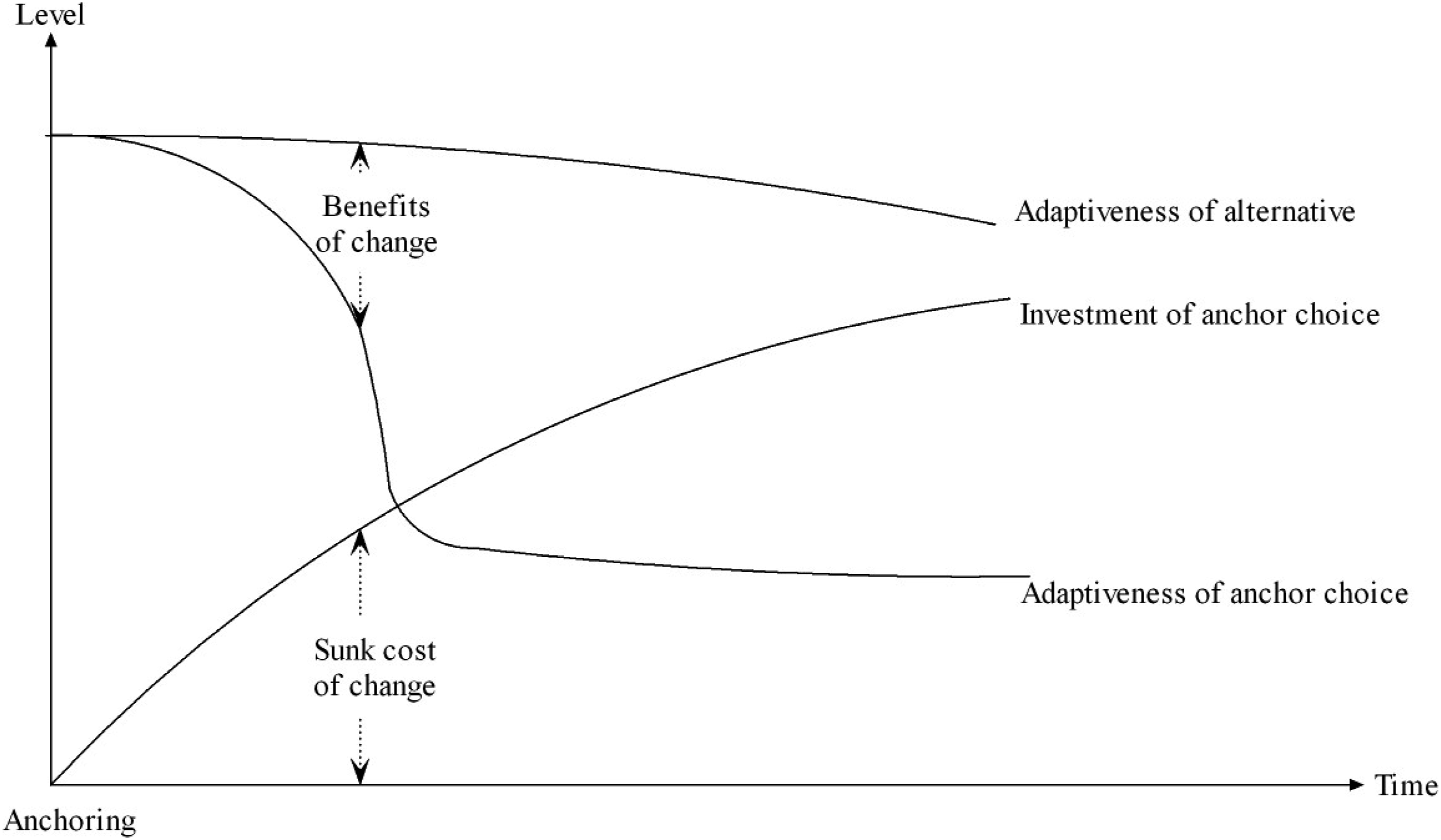
In contrast to the adaptiveness of the anchor choice, the investment of the anchor choice likely increases over time because individuals not only need to invest psychosocial and financial resources to advance their career but also spend considerable time in the process. The third element, the adaptiveness of an alternative choice, could appear anywhere in Figure 3 depending on the nature of the alternative. However, to keep Figure 3 parsimonious and readable, we present a common situation in which the alternative is comparably adaptive to the anchor choice. The alternative choice also likely becomes less adaptive over time mainly because resources and time that could have been spent on the alternative choice are consumed as individuals continue to engage in the anchor choice. The fourth and fifth elements, “good enough” and “bad enough” criteria, denote the minimal level of choice goodness individuals hope to achieve and the maximum level of choice badness individuals can tolerate, respectively. Lastly, the affordability of change denotes psychological, social, and financial resources that can be used to fuel change and absorb the ramifications of change.
The six elements together could explain change behaviors and shed light on reasonable change decisions. First, we define benefits of change as the gap between the adaptiveness of the alternative and the anchor choice, and sunk cost of change as the investments put into the anchor choice. These two parameters, together with the affordability of change, may explain individuals’ intent to change. The benefits of change represent a driving force for change, while the sunk cost of change represents a resistance for change, as shown by decision-making science (Hastie & Dawes, 2010; Verbruggen & De Vos, 2020). When the benefits of change outweigh the sunk cost of change, individuals tend to develop an intent to change, provided that such a change is affordable. However, as demonstrated by Figure 3, the benefits of change and the sunk cost of change often covary with each other, resulting in ambiguity in discerning their relative levels. This dilemma is further compounded by the fact that alternatives often involve inevitable uncertainty regarding how adaptive they are, particularly in comparison to the anchor choice. These mechanisms potentially explain a common challenge in practice, an ambivalent motivation for change.
Second, we propose three patterns of change that could explain individual variation on the timing of change during Stage IV: proactive change, reactive change, and inactive change. Proactive change occurs when the adaptiveness of the anchor choice decreases but remains above the “good enough” level. In other words, individual practicing proactive change motivate themselves to change because the anchor choice is not as good as it used to be but still good enough. Reactive change occurs when the adaptiveness of the anchor choice falls below the “good enough” level but remains above the “bad enough” level. In other words, individuals practicing reactive change motivate themselves to change because the anchor choice is no longer good enough but still tolerable. By contrast, inactive change is present when the adaptiveness of the anchor choice falls below the “bad enough” line. In other words, individuals with inactive change procrastinate in their change actions despite the fact that the anchor choice has become unacceptably bad.
Last, we advocate correspondence between change pattern and the affordability of change. We argue that proactive and reactive change may both be preferable, depending on individual affordability of change. If individuals possess greater affordability, they can more strongly consider proactive change because it can help maximize post-change outcomes (see the declining adaptiveness of alternatives) and its relatively small incremental benefits can be justified by strong affordability. By contrast, when individuals possess limited affordability, they may consider reactive change because it still leads to positive post-change outcomes and its relatively large incremental benefits can justify the use of limited affordability. Relatedly, we recommend against inactive change because the growing sunk cost could trap individuals in the maladaptive status, which in turn could undermine the affordability of change and perpetuate inactive change. In summary, we propose that the benefits, sunk cost, and affordability of change enhances, inhibits, and supports individuals’ intent to change, respectively (Proposition 4). We also propose that the affordability of change influences the adaptiveness of change pattern such that the greater the affordability of change, the more likely proactive change will lead to positive short- and long-term outcomes, such as satisfaction with the change decision and career success (Proposition 5).
Notably, DTC’s change pattern is related to but differs from TWA’s construct of flexibility (Dawis, 2005). Both change pattern and flexibility reflect the level of dissatisfaction individuals can tolerate before initiating change. However, flexibility is employed by the TWA to predict adjustment behaviors, whereas change pattern is employed by DTC to prescribe appropriate timing for change. To put it simply, flexibility functions as a linear concept, while change pattern functions as a discrete concept denoting that different levels of flexibility could be adaptive for different resource conditions. It is also worth mentioning that good and bad enough criteria in Stage IV differ from Gottfredson (2005) concept of circumscription because circumscription focuses on (1) initial decisions (as opposed to adaptation) and (2) bad enough criteria only (as opposed to both good and bad enough criteria).
In Stage IV, based on Gabby’s enhanced resources and accumulated knowledge about herself and the current and potential careers (physics teacher vs. electronic engineering), Gabby’s counselor helps Gabby reevaluate the anchor choice and decide if it makes sense for Gabby to transition to the career as an electronic engineer. The DTC process model recommends three unique practical strategies. First, it is crucial to help Gabby clarify her good and bad enough criteria. This step could entail identifying psychological, social, behavioral, and economic markers for each criterion (e.g., joy vs. depression and increasing vs. decreasing income). Note that the use of both good and bad enough criteria is a distinctive feature of the DTC process model because existing models tend to dichotomize decision quality (not good = bad), which fails to recognize the gray area between clearly good and clearly bad choices. Second, Gabby’s counselor educates Gabby about her dilemma in her reevaluation and adaption. We recommend that Gabby’s counselor use Figure 3 to illustrate why Gabby might experience ambivalence for change, which could help explain to Gabby why it is important to identify good and bad enough criteria. Last, Gabby’s counselor helps Gabby consider her resource background and decide which change pattern is suitable to her. If Gabby has an adequate safety net (e.g., financial and support support), she can transition to pursue the career as an electronic engineer when teaching physics becomes less appealing than electronic engineering or is no longer satisfying. If she has concerns about the potential risks of change, she can decide to make a career transition when teaching physics becomes unacceptable.
Discussion
Drawing on the DTC, decision-making science, and existing models of career decision-making (Gati & Kulcsár, 2021; Hastie & Dawes, 2010; Xu, 2021a; 2021b), we propose a process model of career decision-making and adaptation (see Figure 1) to prescribe processes and components that are conducive to career decision-making in contemporary psychosocial contexts. The process model consists of four stages, broad exploration (Stage I), reduce confusion and contain ambiguity (Stage II), choice implementation (Stage III), and reevaluation (Stage IV). Each stage involves unique goals, steps, and personal and environmental influences of its process and outcomes. Although individuals generally should follow through these stages sequentially, they may also reengage in previous stages when necessary. The dynamic iterative process of career decision-making and adaptation offers rich implications for theory, research, and practice, which we outline below.
Theoretical Implications
Perhaps one of the most important theoretical contributions of our process model is that it expands the DTC and is the first in the field to theorize both confusion and ambiguity management in a developmental and prescriptive manner. Based on existing intervention models of career decision-making and the core principals of the DTC, the process model highlights reaching saturation regarding P-E-C correspondence as opposed to reasoning out a clear “optimal” educational or occupational choice as the decision-making goal. This strategy is adaptive for two reasons. First, it builds on the incremental utility of decision-making effort, which can be relatively easily assessed. For example, individuals can obtain process feedback from experienced practitioners or rely on technology to monitor their progress (Teyber & Teyber, 2010). By contrast, an optimal choice is hard to identify because it requires an individual to exhaust relevant information (including information about the future) and synthesize a complex array of potentially conflicting parameters. Second, because pursuing saturation and a related anchor choice considers both decision quality and effort, it is more cost-effective or ecologically friendly than pursing a clear optimal choice which focuses on decision quality and involves considerable effort. This time and resource-related benefit is meaningful because career decision-making is a time-sensitive process and most individuals cannot afford unlimited effort. Additionally, exerting effort to identify an optimal choice does not necessarily pay off because career development is not mechanically determined by the choice itself (see the constructivist perspective regarding the decision quality; (Xu, 2020a). Notably, by specifying dual-process pathways to saturation and related anchor choice, our process model incorporates and integrates insights from both the P-E fit framework (e.g., Gati, 2013; Parsons, 1909) and postmodern models (e.g., Krumboltz, 2009; Savickas, 2013) and offers coherent decision-making tactics for the whole spectrum of uncertainty management, which is overdue in the field.
In addition, our process model is the first to formally theorize the adaptation process under uncertain conditions. By introducing six key parameters in reevaluation (i.e., adaptiveness of the anchor choice, investment of the anchor choice, adaptiveness of an alternative choice, “bad enough” and “good enough” criteria, and affordability of change), our process model offers theoretically justifiable explanations for individual variation in the choice about change. For example, it is well-known in counseling practice that clients are ambivalent to change (e.g., Miller & Rollnick, 2004). Our process model is the first to analyze ambivalent motivation based on a comparison of benefits and sunk costs of change. By taking into account developmental trends of the two motivational forces, the process model is promising in explaining inactive change, which often traps people and perpetuates a maladaptive career status. More importantly, the process model continues to recommend strategies based on a strategy-in-context perspective in that the choice about change needs to align with the affordability of change. More specifically, while greater affordability of change can justify and power more proactive change, reactive change is reasonable for individuals who can not afford to make changes. However, a bottom line (i.e., bad enough) should be calculated and enforced to avoid perpetuating the poor career choice, even if it entails uncertainty regarding alternatives.
Research Implications
The current process model offers fruitful implications for future research. First, future research is needed to examine the five propositions of the process model, which focus on personal and environmental factors that affect the process and outcomes of each stage. These five propositions represent a joint product of broad psychological principles and a dual-process conceptualization of career decision-making tasks. Thus, by examining these propositions, research could offer evidence for the validity of the process model and suggest potential areas to revise. Additionally, research on the five propositions could shed light on individual variations in each stage, offer a more nuanced understanding of the process, and suggest potential intervention strategies. Second, future research can design intervention programs based on the current process model and examine their efficacy. As noted in our aims for this model, intervention is one of the main application scenarios of this process-oriented model. Thus, examining interventions based on prescribed strategies could offer insights on the practical utility of the process model and further speak to its validity.
In addition to research opportunities directly created by the five propositions, the current process model also suggests research directions indirectly associated with the propositions. For example, future research can use the process model as a conceptual framework to examine how various decision-making difficulties and intervention strategies work together in a process flow. While research has revealed five major decision-making difficulties (Xu & Bhang, 2019) and five critical intervention components (Brown et al., 2003), little research has explored how different decision difficulties and intervention components interact with one other in a coherent process framework. The current model could provide such information, based on which decision-making difficulties can be systematically addressed. Additionally, future research can develop new measures that align better with the renovated conceptualization of the process of decision-making difficulties. In fact, a theoretical framework regarding the five major decision difficulties and five critical intervention components is overdue because the current models of difficulties and intervention components were derived mainly using an empirical approach (Brown et al., 2003; Xu & Bhang, 2019).
Practical Implications
The current model also presents important practical implications. First, the delineated four stages are particularly useful for directing progressive intervention programs, such as group career counseling and career education at the school and classroom levels. Practitioners can arrange the four stages according to their clients’ or students’ needs and the timeframe of intervention and use the recommended strategies to facilitate progress to the goals of each stage. Additionally, practitioners can readily use the end goals for each stage to assess clients’ progress. Although individual career counseling typically has more flexibility than structured group intervention and may not conform to the prescribed stage sequence, practitioners can consider evaluating clients’ key needs and issues and mapping them on the process model to locate appropriate intervention strategies. Second, the model highlights several clinically meaningful constructs, such as ambiguity management, saturation, anchor choice, change pattern, and parameters in reevaluation. All these constructs shed light on important assessment or exploration areas that likely require collaborative practitioner-client work. Notably, the current model implies the reality of emotional, relational, and nonlinear processes particularly in Stages II and IV, which echoes the concern about a robotic or rigid problem-solving style of career intervention (Lent & Brown, 2020) and encourages the use of emotion-relationship-oriented counseling skills in career interventions.
Last, the model fits the increasing effort to facilitate career development of marginalized populations and offers a career development perspective on mobilizing social hierarchy and combating suppressive stereotypes. More specifically, the current process model not only acknowledges contextual affordances but also offers a more balanced and actionable approach between complying with and defying contextual affordance. That is, the model situates career developing in one’s psychosocial context and recommends making ecologically adaptive choices based on clear bottom lines (i.e., “good enough” and “bad enough”). Then, adaptive career choices could help form improved new psychosocial backgrounds (e.g., enhanced affordances) for subsequent decisions. Through this iterative process of career striving accompanied by societal transformation to more fair and liberated work structures, individuals living with poverty or other marginalized backgrounds could steadily build psychosocial resources and eventually obtain a flourishing sustainable career. To clarify, when discussing this personal mechanism, we do not hold that individuals assume all responsibility for their career and life status; rather, we focus on proposing a personal pathway to help people balance realities with individual aspirations and short-term aims with long-term goals.
Conclusions
To expand the DTC to address career decision-making processes, we propose a four-stage process model, which involves four interlocking macro stages and micro steps within each stage. We outlined five propositions to explain and predict the influence of key personal and environmental factors on the decision process and outcomes of each stage. With this process model, the DTC now consists of a theoretical framework, a predictive model, and a prescriptive process model. Together, we believe that they constitute a fuller theory about the dynamic career decision-making process and adaption in an uncertain world and offers a range of theoretical, research, and practical utility.
Footnotes
Declaration of conflicting interests
The author(s) declared no potential conflicts of interest with respect to the research, authorship, and/or publication of this article.
Funding
The author(s) received no financial support for the research, authorship, and/or publication of this article.
