



Abstract
This study examined the profiles taken by global and specific facets of work engagement and burnout among a sample of novice (M tenure = 3.77 years) nurses (n = 570; 88.4% females; M age = 29.3 years). This study also investigated the role of psychological need satisfaction in the prediction of profile membership, and the implications of these profiles for attitudinal (job satisfaction), behavioral (in-role and extra-role performance, absenteeism, and presenteeism) and health (perceived health difficulties) outcomes. Latent profile analyses revealed six profiles: High Global Engagement and Low Global Burnout, Moderately High Global Engagement and Moderately Low Global Burnout, Low Dedication and Efficacy and Highly Cynical, Dedicated but Exhausted Burned-Out, Low Efficacy Burned-Out, and Very Low Global Engagement and Very High Global Burnout. Although these profiles were replicated over a 1-year period, profile membership was only weakly stable. The most beneficial outcomes were observed in the High Global Engagement and Low Global Burnout profile, and the most detrimental in the Very Low Global Engagement and Very High Global Burnout profile. Need satisfaction was also associated with profile membership, although associations were stronger for global levels of need satisfaction than for specific levels of autonomy, competence, and relatedness need satisfaction.
Keywords
Introduction
Work engagement, defined as “a positive, fulfilling, work-related state of mind” (Schaufeli et al., 2002, p. 74), entails high levels of energy (vigor) and enthusiasm (dedication) at work, and being happily involved and absorbed in one’s work-related tasks (absorption). Work engagement is a known precursor of many desirable outcomes for organizations (e.g., in-role and extra-role performance; Neuber et al., 2022) and employees (e.g., job satisfaction; Goering et al., 2017). In contrast, burnout represents a psychological state of resource depletion encompassing emotional exhaustion (i.e., low physical energy and fatigue), cynicism (i.e., excessively detached responses to others), and a reduced sense of professional efficacy (i.e., feelings of low productivity and achievement) (Schaufeli et al., 2009). Burnout is known to hinder individual (e.g., impaired psychological functioning and health; Goering et al., 2017) and organizational (e.g., absenteeism; Jourdain & Chênevert, 2015) functioning.
Little, however, is known about the combined impact of work engagement and burnout (Salmela-Aro et al., 2019). By identifying profiles of workers characterized by distinct configurations of work engagement and burnout, person-centered analyses provide a way to address this limitation (Morin et al., 2018). Emerging person-centered research has started to look at how work engagement and burnout components combine within specific profiles of employees (Abós et al., 2019; Mäkikangas et al., 2014; 2017; Moeller et al., 2018). However, no research has done so by jointly considering the global (work engagement or burnout) and specific (vigor, dedication and absorption, or emotional exhaustion, cynicism, and reduced professional efficacy, left unexplained by the global levels) components of work engagement (e.g., Gillet et al., 2019a) and burnout (e.g., Sandrin et al., 2022). Information is thus lacking regarding the nature of employees’ work engagement and burnout configurations based on a complete theoretical coverage of the multidimensionality of these complementary constructs (Salmela-Aro et al., 2019). Furthermore, research still has to address how these distinct profiles of work engagement and burnout develop and evolve over time.
The present study identifies the work engagement and burnout profiles present in a sample of novice nurses while accounting for the global/specific nature of these constructs. We also investigate the extent to which the nature of these profiles, their prevalence, and nurses’ profile membership change across a 1-year time interval. Investigating stability and change in the nature of these profiles and in nurses’ profile membership addresses an important theoretical concern given that work engagement and burnout are both conceptualized as dynamic processes fluctuating over time (Goering et al., 2017). Furthermore, we document the construct validity (Meyer & Morin, 2016) of these profiles by considering their associations with psychological need satisfaction and various outcomes (i.e., performance, job satisfaction, perceived health difficulties, absenteeism, and presenteeism).
This study was designed to investigate work engagement and burnout among novice nurses. The career entry period represents a particularly challenging period likely to exert a lasting impact on nurses’ job attitudes and behaviors (Fernet et al., 2020b). Turnover rates are particularly high during the early years of employment among novice nurses (e.g., Blegen et al., 2017: 17%), and higher than those observed among tenured nurses (Hayes et al., 2012) or other healthcare workers (Statistics Canada, 2022). Beyond its direct costs in terms of recruitment, selection, and training, turnover also creates instability at the organizational level likely to compromise the quality of care delivered to the patients (Tomietto et al., 2015). When novice nurses enter their new working environment, they often face an inconsistency between their expectations and the reality of clinical practice (Kodama & Fukahori, 2017), leading them to feel inadequate in their ability to quickly achieved the necessary level of efficiency in their work (Sönmez & Yildirim, 2016), which in turn can impact patient care quality (Boamah et al., 2017).
Beyond the specific nature of our sample, this study was also designed to help us achieve a more in-depth understanding of the longitudinal dynamic of burnout and work engagement among any occupational groups during the early years of their career, when burnout and work engagement first start to emerge. Furthermore, as the person-centered approach is better aligned with managers’ natural tendency to think in terms of categories rather than complex variable relations (Hofmans et al., 2021), our results are likely to have practical implications in helping managers to more easily identify the types of employees most likely to benefit from intervention and in suggesting actionable levers of intervention.
Co-Existing Global and Specific (G/S) Work Engagement and Burnout Components
Burnout and work engagement are explicitly defined as multidimensional constructs encompassing distinct interrelated facets (burnout: Emotional exhaustion, cynicism, and reduced professional efficacy; work engagement: Vigor, dedication, and absorption) known to share differentiated covariate associations (e.g., Gillet et al., 2019a; 2022). However, it has also been proposed that employees might experience work engagement and burnout holistically, as global entities, rather than as diverse psychological manifestations (Goering et al., 2017; Moeller et al., 2018). Acknowledging this dual multidimensional and global nature suggest that both constructs should be conceptualized as global entities reflecting commonalities among specific dimensions, themselves including specificity unexplained by these global entities. Research has supported a bifactor representation of both constructs, resulting in the estimation of global (G-) work engagement (Gillet et al., 2019a; Huyghebaert-Zouaghi et al., 2022a) or burnout (Gillet et al., 2022; Sandrin et al., 2022) factors together with specific (S-) vigor, dedication, absorption, emotional exhaustion, cynicism, and reduced professional efficacy factors reflecting their unique nature beyond their commonalities. Moreover, these studies have all have supported the presence of differential associations between participants’ global and specific levels of work engagement and burnout and a variety of attitudinal (e.g., job satisfaction), behavioral (e.g., work performance) and health (e.g., health problems) outcomes. More precisely, this bifactor representation results in the estimation of independent (i.e., orthogonal, uncorrelated) G- and S- factors, making it possible to jointly consider the role played by participants global levels of work engagement and burnout while also making it possible to consider the role uniquely played by each S-factors beyond that of the G-factors in a way that is untainted by multicollinearity (Morin et al., 2016a; 2017). From this perspective, the S-factors should not be interpreted to reflect the same thing as the subscales (e.g., vigor, dedication, and absorption) from which they are estimated, but rather the degree of imbalance in participants’ specific levels on these subscales beyond their common nature (e.g., Gillet et al., 2019a).
A Person-Centered Perspective on the Complementary Role of Work Engagement and Burnout
Table S1, reported in the online supplements [https://smslabstats.weebly.com/publications.html], summarizes the results from previous person-centered research seeking to identify profiles of burnout and/or work engagement among diverse samples of workers. Although we did our best to identify all studies available at the time of writing this manuscript, we cannot guarantee exhaustiveness. When considering these results, despite some variations possibly related to methodological differences (e.g., type of employees, specific measures), a high level of similarity is apparent across studies. However, very few studies have adopted a comprehensive approach incorporating multiple facets of work engagement and burnout, and none of them while considering the dual global/specific nature of work engagement and burnout. Importantly, when indicators present a known bifactor structure, ignoring this structure is likely to erroneously result in profiles differing from one another only in relation to employees’ global levels of burnout or work engagement shared across dimensions (Morin et al., 2016a; 2017), making it harder to detect variations involving specific components of both constructs. This limitation is thus likely to explain why previous studies have identified profiles differing only quantitatively (i.e., profiles characterized by matching patterns of work engagement or burnout across all subdimensions, such as a profile characterized by high levels of vigor, dedication, and absorption), but not qualitatively (i.e., profiles characterized by patterns of work engagement or burnout differing across subdimensions, such as a profile presenting high low emotional exhaustion, low cynicism, and moderate reduced professional efficacy).
Lacking prior guidance from research relying on a disaggregation of global versus specific ratings of work engagement and burnout, we leave as an open question the nature of the profiles to be identified in this study. However, in line with the quantitative differences reported in the literature, we expect at least one large Normative 1 profile displaying average levels of work engagement and burnout across dimensions, a High Engagement/Low Burnout profile displaying low levels of burnout and high levels of work engagement across dimensions, and a Low Engagement/High Burnout profile characterized by high levels of burnout and low levels of work engagement across dimensions. These expectations are consistent with the conservation of resources (COR) theory (Hobfoll, 1989), which conceptualizes stress as emerging from the actual or perceived loss of material or psychological resources. From this perspective, the energizing nature of work engagement stands in stark contrast with the resource depletion nature of burnout.
However, and in accordance with the previously identified subset of profiles differing qualitatively (e.g., Abós et al., 2019) and with previous studies relying on a similar operationalization of work engagement (Gillet et al., 2019a), we expect profiles characterized by distinctive configurations across components. For instance, we expect a Moderately High Engagement/High Burnout profile displaying high global levels of burnout, and moderate to high global levels of work engagement and specific levels of vigor, dedication, and absorption, matching the highly engaged and highly frenetic (Abós et al., 2019) and highly engaged-exhausted (Moeller et al., 2018) profiles identified previously. From a theoretical perspective burned-out workers tend to be driven by internal and external pressures, whereas engaged workers tend to be driven by pleasure and volition. However, motivation often involves a combination of both for a subset of employees (e.g., Fernet et al., 2020a), matching this expected Moderately High Engagement/High Burnout profile.
What is the nature of the work engagement and burnout profiles that will be identified among the present sample of novice nurses, and will these profiles differ from one another quantitatively (in level) and qualitatively (in shape)?
A Longitudinal Person-Centered Perspective
Meyer and Morin (2016) noted the importance of assessing the stability of person-centered solutions to support their use as guides for the development of interventions tailored at distinct profiles of employees. The ability to devise such interventions is conditioned on evidence that the profiles reflect neither ephemeral phenomena, nor rigid conditions unlikely to respond to interventions. To address this issue, we consider the stability of the work engagement and burnout profiles identified in this study over the course of 1 year. This time interval was selected based on prior research (Grødal et al., 2019), because it goes beyond daily fluctuations (Klasmeier & Rowold, 2022) while remaining short enough to capture changes that may not be apparent over longer time spans (Mäkikangas et al., 2017). Our focus on early career nurses made it especially important to consider a time frame long enough to allow nurses to navigate through at least 1 year of employment (Fernet et al., 2020b).
From a person-centered perspective, two types of stability should be considered (Huyghebaert-Zouaghi et al., 2022b; Sandrin et al., 2020). Within-sample stability is related to the nature of the profiles themselves, which can change over time. Drastic changes in the number or nature of the profiles in the absence of external change would suggest that the profiles have only limited practical utility and reflect mainly transient phenomena. Alternatively, profile members might become more or less similar to one another over time, and some profiles might become more or less prevalent over time. These two types of changes do not preclude the reliance on person-centered solutions as intervention guides, but simply suggest the profiles possess some degree of malleability. In contrast, within-person stability refers to changes in nurses’ profile membership over time (Huyghebaert-Zouaghi et al., 2022b; Sandrin et al., 2020) and can occur in the absence of within-sample changes.
Various sources of evidence help us better grasp the longitudinal dynamics of work engagement and burnout. Estimates of rank-order stability indicate that ratings of work engagement (r = .61 to .64; Grødal et al., 2019; Heinrichs et al., 2020) and burnout (r = .58 to .72; Frögéli et al., 2019; Kinnunen et al., 2019) are quite stable over one to 3 years, although similar estimates have been reported over only 3 months (r = .78; Madigan et al., 2015). A recent person-centered study supported the within-sample and within-person stability (92.6%–100% across profiles) of work engagement profiles over a 4-month interval (Gillet et al., 2019a), while Mäkikangas et al. (2014, 2017) also supported the idea that levels of work engagement and burnout evolve differentially from one another over time. Other studies examining the longitudinal trajectories of work engagement (van den Heuvel et al., 2020) and burnout (May et al., 2020) also reported stable trajectories, although some of them found that work engagement increased slightly as a function of age (Kim & Kang, 2017). Yet, average trajectories may mask substantial inter-individual heterogeneity, which can be uncovered through person-centered analyses. Turning our attention to person-centered studies of burnout trajectories, evidence supports both inter-individual heterogeneity in the shape of these trajectories, as well as their stability over periods of one to 2 years (Mäkikangas et al., 2012; Rudman & Gustavsson, 2011).
Despite their interest, none of these studies has considered profiles jointly defined by burnout and work engagement components, or relied on a global-specific disaggregation of these components. Moreover, none of these studies has considered novice employees, knowing that the period during which one is socialized into, and learns the ropes of, a new occupation is likely to entail more fluctuations over time (Zhou et al., 2022). Thus, although prior evidence allows us to formulate some hypotheses, these hypotheses remain tentative. Furthermore, in light of these limitations, it is also impossible to anticipate the nature of the dominant within-person transitions in profile membership.
The profiles identified in the present study will present a high level of within-sample stability over a 1-year interval (i.e., the same number of profiles, with the same structure, the same within-profile dispersion, and the same size will be identified).
Moderate (50%) to high (75% or more) levels of within-person stability in profile membership will be observed over a 1-year interval.
Will the profiles display upward (toward a High Engagement/Low Burnout profile), downward (toward a Low Engagement/High Burnout profile), or lateral (toward profiles with similar levels but different configurations of work engagement and burnout) transitions?
A Construct Validation Perspective
To document the theoretical and practical implications of a person-centered solution, it is critical to assess its construct validity via the examination of associations between the profiles and theoretically relevant covariates (Meyer & Morin, 2016). Without information related to the key determinants of the profiles or their consequences, simple knowledge regarding their nature will be of very limited utility.
Predictors of Profile Membership
Self-determination theory (SDT; Ryan & Deci, 2017) positions the satisfaction of employees’ psychological needs for autonomy (i.e., a sense of volition of ownership), competence (i.e., a sense of mastery), and relatedness (i.e., a sense of belongingness) as a core driver of their well-being. SDT further assumes that the satisfaction of all three needs is needed for employees to experience optimal functioning. Considerable evidence exists to support this assumption (Van den Broeck et al., 2016), revealing strong associations between these needs and job attitudes (e.g., satisfaction, commitment), behaviors (e.g., performance, lower absenteeism), and well-being (e.g., engagement, lower burnout).
Within SDT, research has recently converged on the superiority of a bifactor operationalization of need satisfaction, making it possible to obtain a direct indicator of employees' global levels of satisfaction across all three needs with a non-redundant indicator of the extent to which each specific need is in a state of imbalance relative to this global level (e.g., Gillet et al., 2019b; 2020). Gillet et al. (2020) showed that higher global levels of need satisfaction were associated with higher levels of work engagement and with lower levels of burnout. Moreover, imbalance in autonomy satisfaction (i.e., when the satisfaction of this need is higher than that of the others) was also related to lower levels of burnout and higher levels of work engagement, whereas imbalance in competence or relatedness satisfaction was associated with lower levels of burnout. These considerations suggest that global and specific levels of need satisfaction should be associated with a higher probability of membership into the High Engagement/Low Burnout profile, and with a lower probability of membership into the Low Engagement/High Burnout profile, leading us to expect that:
Global and specific levels of need satisfaction will increase membership in profiles displaying higher global work engagement and lower global burnout, and decrease membership in profiles displaying lower global work engagement and higher global burnout.
Outcomes of Profile Membership
We consider a combination of well-documented attitudinal (job satisfaction), behavioral (in-role and extra-role performance, absenteeism, and presenteeism), and health-related (perceived health difficulties) outcomes of work engagement and burnout (Goering et al., 2017). Previous person-centered research (see Table S1; e.g., Abós et al., 2019) indicate that profiles with high work engagement and low burnout tend to display more adaptive outcomes (e.g., higher job satisfaction, lower absenteeism) than profiles with low work engagement and high burnout. From the perspective of COR theory (Hobfoll, 1989), burned-out employees can be seen as lacking the resources required to accomplish their work-related tasks, leading them to higher levels of dissatisfaction, perceptions of ineffectiveness, and impaired functioning. In contrast, engaged employees are seen as positively disposed toward their work, thus increasing their willingness to allocate extra time and resources to their organization, which may ultimately foster adaptive functioning (Gillet et al., 2019a). Additional results (see Table S1; e.g., Moeller et al., 2018) indicate that work engagement may protect employees against the negative effects of burnout, suggesting that more positive outcomes should be observed in profiles displaying high engagement and burnout relative to a profile displaying low work engagement and high burnout. We thus formulate the following hypotheses:
Profiles displaying higher global work engagement and lower global burnout will be associated with more positive outcomes than profiles displaying lower global work engagement and higher global burnout.
Profiles displaying higher global levels of work engagement and burnout will be associated with more positive outcomes than profiles displaying lower global levels of work engagement and higher global levels of burnout.
Method
Participants and Procedures
Participants were recruited from all novice registered French-Canadian nurses (with 5 years or less of tenure in the nursing occupation) working in the public health care system in the province of Québec, Canada, before the start of the COVID-19 pandemic across two time points, 12 months apart. Potential participants were contacted via a letter explaining the study and providing a link to an online questionnaire. Participants were re-invited by email to respond to the same questionnaire 12 months later. At both time points, it was emphasized that responses were anonymous, that participation was voluntary, and that participants were free to withdraw at any time. All communications and measures were in French (the official language in Quebec). No compensation was offered to participants. Approval was obtained from the research ethics committee of the second author’s institution.
The sample included 570 nurses (88.4% women) with an average age of 29.3 years (SD = 8.7) and occupational tenure of 3.8 years (SD = 6.7). Most (78.9%) held a permanent position, and a majority (57.3%) worked full time. A total of 570 nurses participated at Time 1 (T1) and 233 at Time 2 (T2; 40.8% retention). This sample was fairly representative of novice nurses registered in Québec’s professional nursing association (47.0% full time; 86.0% women; Mage = 28.3; Fernet et al., 2017).
Measures
All measures were administered at both time points and had been previously validated in French. Validity and reliability of the French-Canadian version of these measures are similar to those of the original version and have been supported in prior studies (i.e., burnout: α = .71 to .90; Sandrin et al., 2022; work engagement: α = .77 to .82; Gillet et al., 2018; need satisfaction: α = .83 to .88; Trépanier et al., 2013; performance: α = .92 to .94; Fernet al., 2020a; job satisfaction: α = .89; Gillet et al., 2013).
Analyses
Preliminary Analyses
The psychometric properties of all multi-item measures were verified through preliminary analyses reported in the online supplements (factor structure, longitudinal invariance, composite reliability, and factor correlations; see Tables S2 to S8). These analyses supported: (a) a bifactor-confirmatory factor analysis (CFA) representation of work engagement including one G-factor (engagement) and three S-factors (specific vigor, dedication, and absorption); (b) an alternative bifactor-CFA representation of burnout including one G-factor (burnout), two S-factors (specific emotional exhaustion and cynicism), and a separate correlated factor reflecting reduced professional efficacy; (c) a bifactor-CFA representation of need satisfaction including one G-factor (global levels of need satisfaction) and three S-factors (specific levels of autonomy, competence, and relatedness need satisfaction); and (d) a three-factor CFA model underpinning participants’ ratings of job satisfaction, and in-role and extra-role performance. The main analyses relied on factor scores saved in standardized units (SD = 1; M = 0; Morin et al., 2016b) from preliminary models specified as invariant over time to ensure comparability (Millsap, 2011). Factor scores provide a partial control for unreliability (Skrondal & Laake, 2001) and preserve the structure of the measurement model (e.g., invariance, bifactor; Morin et al., 2016a). This approach was important given the low reliability of the psychological need satisfaction measure.
Model Estimation
Analyses relied on the maximum likelihood robust (MLR) estimator, Mplus 8.6 (Muthén & Muthén, 2021), and full information maximum likelihood procedures (FIML) to handle missing data. FIML made it possible to rely on all participants who responded to one time point (n = 570), without losing the 337 participants who completed a single time point (Enders, 2010), and is recognized to be robust to similar rates of missing data (e.g., Newman, 2003). Time-specific models were estimated using 5000 random start values, 1000 iterations, and 200 final optimizations, whereas these numbers were increased to 10,000, 1000, and 500 for the longitudinal analyses (Morin & Litalien, 2019).
Latent Profile Analyses (LPA)
Time-specific LPA including one to eight profiles were estimated allowing the means and variances of all burnout and work engagement components to be freely estimated (Morin & Litalien, 2019). The optimal solution was selected while considering the meaningfulness, theoretical-relevance, and statistical adequacy of the profiles, as well as statistical indicators (Morin & Litalien, 2019). A lower value on the Akaïke Information Criterion (AIC), Consistent AIC (CAIC), Bayesian Information Criterion (BIC), and sample-size Adjusted BIC (ABIC) indicate a better model. Statistical research has shown that the BIC, CAIC, and ABIC, but not the AIC, were efficient guides of the optimal number of profiles (Diallo et al., 2016; 2017). However, these indicators are sample-size dependent (Marsh et al., 2009), and thus often fail to converge on a specific solution. It is thus suggested to rely on a graphical display (i.e., elbow plot) to help identify the optimal solution (Morin et al., 2011). Finally, the classification accuracy (0–1) is summarized by the entropy.
Longitudinal Tests of Profile Similarity and Latent Transition Analyses (LTA)
Assuming that the same number of profiles would be selected at both time points, the two time-specific LPA solutions will be combined into a longitudinal LPA for longitudinal tests of within-sample profile similarity (Morin et al., 2016b; Morin & Litalien, 2017). Starting from a model of configural similarity (same number of profiles), equality constraints were sequentially imposed on the within-profile means (structural similarity), variances (dispersion similarity), and size (distributional similarity). Similarity is supported when at least two, out of the CAIC, BIC, and ABIC, decrease relative to the previous model (Morin et al., 2016b). The most similar solution was then re-expressed as a LTA to investigate within-person stability and transitions in profile membership, using the manual three-step approach advocated by Morin and Litalien (2017) to ensure the replicability of the solution.
Predictors and Outcomes of Profile Membership
We then examined the relations between the profiles, the predictors (predictive similarity), and the outcomes (explanatory similarity), and the similarity of these associations over time. Demographics (sex, age, tenure, contract type, weekly work hours, and marital status) were first considered in a series of four models. First, a null effects model assumed no relations between these variables and the profiles. Second, the effects of these variables were freely estimated, and allowed to vary over time and as a function of T1 profile membership (effects on profile transitions). Third, relations differed over time only. Finally, relations were set to be equal over time (predictive similarity). Relations between the predictors and the profiles were then assessed in the same sequence.
Time-specific outcomes were directly included to the final LTA and allowed to vary as a function of profile membership at the same time point. Explanatory similarity was assessed by constraining these associations to be equal over time. The multivariate delta method was used to test the significance of between-profile differences in outcome levels (Raykov & Marcoulides, 2004).
Results
Latent Profile Analyses (LPA)
Results from the Time-Specific and Longitudinal Models.
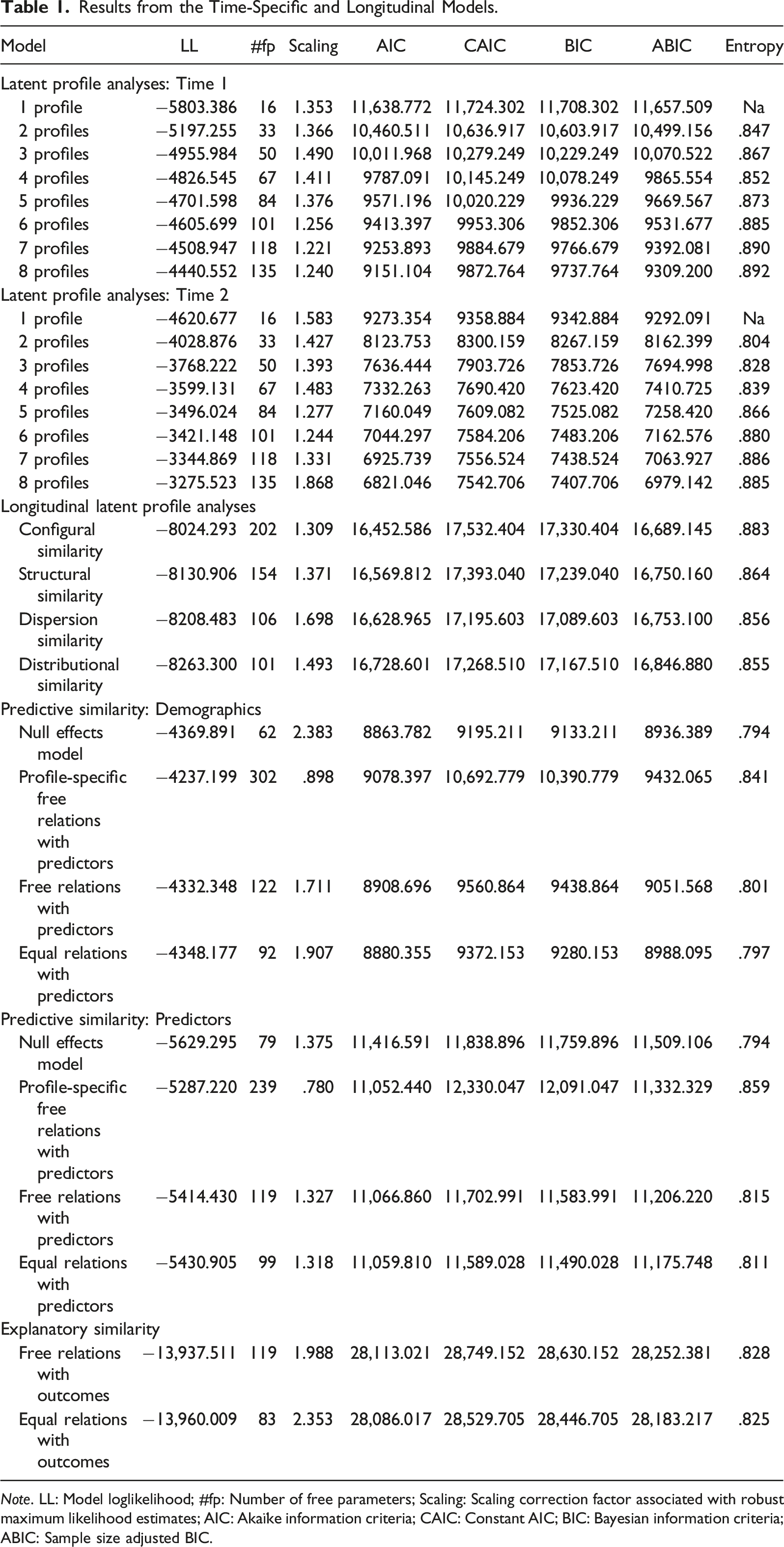
Note. LL: Model loglikelihood; #fp: Number of free parameters; Scaling: Scaling correction factor associated with robust maximum likelihood estimates; AIC: Akaïke information criteria; CAIC: Constant AIC; BIC: Bayesian information criteria; ABIC: Sample size adjusted BIC.
The results from the longitudinal models are reported in Table 1. Starting with a model of configural similarity including six profiles per time point, the models of structural and dispersion similarity were supported by the data, but not the model of distributional similarity. The model of dispersion similarity was retained for interpretation (Research Question 1). These results partially support Hypothesis 1, revealing that the final six profiles present the same structure and within-profile variability over time, although their size differs. The results from this model of dispersion similarity are presented in Figure 1, and parameter estimates are reported in Table S9 of the online supplements. As shown in Table 2, this solution had a high level of classification accuracy, ranging from 77.4% to 93.1% across profiles at T1 and from 88.3% to 93.0% at T2, as summarized in a high entropy of .856. Final six-profile solution from the model of dispersion similarity (number of profiles and within-profile means and variances equal over time) Note. S-factor/G-factor: Specific and global factors from a bifactor model; all indicators are factor scores estimated in standardized units (M = 0; SD = 1). Classification Accuracy: Average Probability of Membership into Each Latent Profile (Column) as a Function of the Most Likely Profile Membership (Row). Note. Profile 1: High Global Engagement and Low Global Burnout; Profile 2: Moderately High Global Engagement and Moderately Low Global Burnout; Profile 3: Low Dedication and Efficacy and Highly Cynical; Profile 4: Dedicated but Exhausted Burned-Out; Profile 5: Low Efficacy Burned-Out; and Profile 6: Very Low Global Engagement and Very High Global Burnout.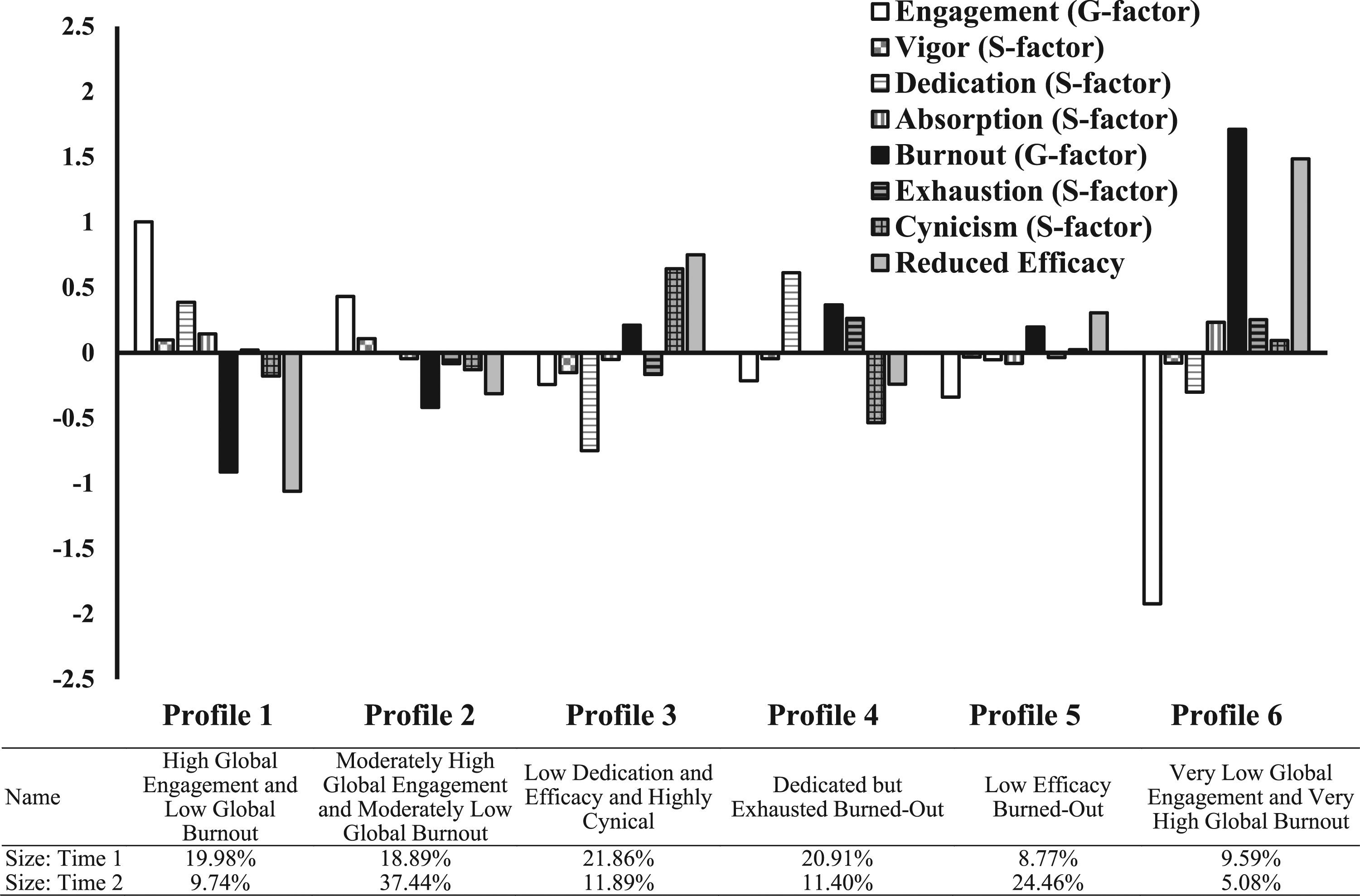

The first two profiles displayed a combination of low burnout and high engagement, although the first profile was more extreme. This High Global Engagement and Low Global Burnout profile characterized 19.98% of the participants at T1 and 9.74% at T2. In contrast, the Moderately High Global Engagement and Moderately Low Global Burnout profile characterized 18.89% of the participants at T1 and 37.44% at T2. In contrast, the sixth profile presented an opposite configuration dominated by burnout. This Very Low Global Engagement and Very High Global Burnout profile characterized 9.59% of the participants at T1 and 5.08% at T2.
Three other profiles displayed moderately high global levels of burnout, but were also substantially defined by participants’ scores on some of the specific factors. Thus, the fourth profile was also characterized by moderately high specific levels of emotional exhaustion and high specific levels of dedication. This Dedicated but Exhausted Burned-Out profile characterized 20.91% of the participants at T1 and 11.40% at T2. The fifth profile also displayed moderately high levels of reduced professional efficacy and of global levels of burnout. This Low Efficacy Burned-Out profile characterized 8.77% of the participants at T1 and 24.46% at T2. Finally, the third profile also displayed low specific levels of dedication, and high specific levels of cynicism and of reduced professional efficacy. This Low Dedication and Efficacy and Highly Cynical profile characterized 21.86% of the participants at T1 and 11.89% at T2.
Latent Transitions Analyses (LTA)
Transitions Probabilities.

Note. Profile 1: High Global Engagement and Low Global Burnout; Profile 2: Moderately High Global Engagement and Moderately Low Global Burnout; Profile 3: Low Dedication and Efficacy and Highly Cynical; Profile 4: Dedicated but Exhausted Burned-Out; Profile 5: Low Efficacy Burned-Out; and Profile 6: Very Low Global Engagement and Very High Global Burnout.
Other profiles transitioned toward more than one profile. For members of the Low Dedication and Efficacy and Highly Cynical profile at T1, typical transitions involved the Moderately High Global Engagement and Moderately Low Global Burnout (24.7%; upward) or Low Efficacy Burned-Out (40.9%; lateral) profiles at T2. Likewise, for members of the Low Efficacy Burned-Out profile at T1, the main transitions involved the Moderately High Global Engagement and Moderately Low Global Burnout (11.3%; upward) and Low Dedication and Efficacy and Highly Cynical (22.8%; lateral) profiles at T2. Finally, T1 membership in some profiles was linked to transitions toward many profiles at T2. For members of the Dedicated but Exhausted Burned-Out profile at T1, transitions involved the High Global Engagement and Low Global Burnout (7.0%: upward), Moderately High Global Engagement and Moderately Low Global Burnout (14.9%; upward), Low Dedication and Efficacy and Highly Cynical (11.3%; lateral), Low Efficacy Burned-Out (36.0%; lateral), and Very Low Global Engagement and Very High Global Burnout (3.7%; downward) profiles at T2. For members of the Very Low Global Engagement and Very High Global Burnout profile at T1, transitions involved the Low Dedication and Efficacy and Highly Cynical (19.6%; upward), Dedicated but Exhausted Burned-Out (28.2%; upward), and Low Efficacy Burned-Out (20.3%; upward) profiles at T2.
Predictors of Profile Membership
Results from the Predictive Analyses.

Note. *p < .05; **p < .01; SE: Standard error of the coefficient; OR: Odds ratio; S-REL: Specific relatedness need satisfaction; S-COM: Specific competence need satisfaction; S-AUT: Specific autonomy need satisfaction; G-NEED: Global need satisfaction; the coefficients and OR reflect the effects of the predictors on the likelihood of membership into the first listed profile relative to the second listed profile; specific relatedness, competence, and autonomy need satisfaction as well as global need satisfaction are estimated from factor scores with a standard deviation of 1 and a mean of 0; Profile 1: High Global Engagement and Low Global Burnout; Profile 2: Moderately High Global Engagement and Moderately Low Global Burnout; Profile 3: Low Dedication and Efficacy and Highly Cynical; Profile 4: Dedicated but Exhausted Burned-Out; Profile 5: Low Efficacy Burned-Out; and Profile 6: Very Low Global Engagement and Very High Global Burnout.
Similarly, specific levels of autonomy satisfaction predicted membership into the High Global Engagement and Low Global Burnout profile relative to the Low Efficacy Burned-Out profile. Specific levels of competence satisfaction predicted membership into the High Global Engagement and Low Global Burnout and Dedicated but Exhausted Burned-Out profiles relative to the Low Efficacy Burned-Out and Very Low Global Engagement and Very High Global Burnout profiles, as well as into the High Global Engagement and Low Global Burnout, Moderately High Global Engagement and Moderately Low Global Burnout, Dedicated but Exhausted Burned-Out, and Low Efficacy Burned-Out profiles relative to the Low Dedication and Efficacy and Highly Cynical profile. In addition, specific levels of competence satisfaction also predicted membership into the Dedicated but Exhausted Burned-Out profile relative to the Moderately High Global Engagement and Moderately Low Global Burnout profile. Finally, specific levels of relatedness satisfaction only predicted membership into the High Global Engagement and Low Global Burnout and Moderately High Global Engagement and Moderately Low Global Burnout profiles relative to the Low Dedication and Efficacy and Highly Cynical profile.
Outcomes of Profile Membership
Associations between Profile Membership and the Outcomes Taken from the Model of Explanatory Similarity (Equal across Time Points).

Note. M: Mean; CI: 95% confidence interval; in-role performance, extra-role performance, and job satisfaction are estimated from factor scores with a mean of 0 and a standard deviation of 1; Profile 1: High Global Engagement and Low Global Burnout; Profile 2: Moderately High Global Engagement and Moderately Low Global Burnout; Profile 3: Low Dedication and Efficacy and Highly Cynical; Profile 4: Dedicated but Exhausted Burned-Out; Profile 5: Low Efficacy Burned-Out; and Profile 6: Very Low Global Engagement and Very High Global Burnout.
The highest levels of job satisfaction were observed in the High Global Engagement and Low Global Burnout profile, followed by the Moderately High Global Engagement and Moderately Low Global Burnout profile, then equally by the Dedicated but Exhausted Burned-Out and Low Efficacy Burned-Out profiles, and finally by the Low Dedication and Efficacy and Highly Cynical and Very Low Global Engagement and Very High Global Burnout profiles. Levels of perceived health difficulties, absenteeism, and presenteeism were higher in the Very Low Global Engagement and Very High Global Burnout profile than in all other profiles, which showed fewer differences. For instance, perceived health difficulties were higher in the Low Dedication and Efficacy and Highly Cynical and Dedicated but Exhausted Burned-Out profiles than in the High Global Engagement and Low Global Burnout profile. In contrast, absenteeism was higher in the High Global Engagement and Low Global Burnout and Dedicated but Exhausted Burned-Out profiles relative to the Low Dedication and Efficacy and Highly Cynical profile. Finally, presenteeism was higher in the High Global Engagement and Low Global Burnout profile than in the Low Dedication and Efficacy and Highly Cynical profile.
Discussion
We relied on preliminary variable-centered analyses in combination with person-centered analyses to investigate the value of jointly considering global and specific dimensions of work engagement (Gillet et al., 2019) and burnout (Sandrin et al., 2022). This approach resulted in an improved representation of the measurement of both constructs, and of the nature of the profiles of work engagement and burnout observed among the current sample of novice nurses. Our longitudinal design also allowed us to test the within-person and within-sample stability of these profiles over a 12-month interval, thus expanding upon previous studies based on shorter intervals of three to 4 months (Huyghebaert-Zouaghi et al., 2022b; Sandrin et al., 2020). Given the importance of the early years of employment for integration and retention in the nursing occupation (Fernet et al., 2020b), it was important to capitalize on a longer time interval (1 year of work) to realistically inform intervention. Finally, we documented the criterion-related validity of these profiles by examining their associations with theoretically relevant predictors (psychological need satisfaction) and outcomes (job satisfaction, in-role and extra-role performance, absenteeism, presenteeism, and health difficulties).
Work Engagement and Burnout as Multidimensional Constructs
Recent studies have highlighted the need to account for the multidimensional nature of burnout (Gillet et al., 2022; Sandrin et al., 2022) and work engagement (Gillet et al., 2019a; Huyghebaert-Zouaghi et al., 2022a) as global entities (the G-factors) measured from distinct dimensions retaining some specificity (the S-factors). Our preliminary analyses lent further support to these conclusions. In the bifactor solution retained for both constructs, although the S-factors were more weakly defined that the G-factor, they still retained specificity, supporting the idea that ratings of emotional exhaustion, cynicism, vigor, dedication, and absorption retained something unique beyond their role in the assessment of global work engagement and burnout levels. However, reduced professional efficacy was best reflected as an independent factor, rather than as a burnout component. This observation is consistent with accumulating evidence showcasing emotional exhaustion and cynicism as core manifestations of burnout, and positioning reduced professional efficacy as conceptually distinct from burnout (Nadon et al., 2022; Sandrin et al., 2022). This conclusion is also consistent with the original definition of burnout and with the observation that efficacy remains unaffected for many burned-out employees (e.g., Schaufeli et al., 1996). For instance, some have suggested that professional efficacy may rather act as a protective resource against burnout (Skaalvik & Skaalvik, 2010), whereas others have positioned it as an outcome of burnout (Kim & Burić, 2020). Clearly, future studies will be needed to better unpack these different possibilities.
Work Engagement and Burnout Profiles
Our results revealed six profiles of work engagement and burnout among novice nurses: (1) High Global Engagement and Low Global Burnout, (2) Moderately High Global Engagement and Moderately Low Global Burnout, (3) Low Dedication and Efficacy and Highly Cynical, (4) Dedicated but Exhausted Burned-Out, (5) Low Efficacy Burned-Out, and (6) Very Low Global Engagement and Very High Global Burnout. These profiles matched our expectations, anchored in results from prior person-centered studies summarized in Table S1 of the online supplements. Our results also supported the generalizability of these profiles across time points, although their size evolved over time. These observations suggest that these profiles may reflect central psychological mechanisms involved in the experience of work engagement and burnout, irrespective of the specific facets, measures, and models used to operationalize these constructs. Importantly, these profiles were identified in a sample of novice nurses undergoing a period of integration into their new occupational roles (Fernet et al., 2017). Although the challenges generally faced by early career employees, coupled with those more generally associated with the nursing occupation are numerous, the similarity between our results and those obtained in prior research suggest that the nature of these profiles might be relatively independent from these specific occupational characteristics. Therefore, profile-based generic interventions could possibly be devised in a way that is likely to be relevant to any groups of employees.
Adding to the evidence obtained as part of our preliminary measurement analyses, our person-centered results also reinforced the value of disaggregating the global and specific components of burnout (Sandrin et al., 2022) and work engagement (Gillet et al., 2019a). Indeed, none of our profiles displayed matching levels across all components of burnout or work engagement. Consequently, despite the complementary nature of these interrelated components (Schaufeli et al., 2002), our findings demonstrate the value accounting for their overlap via the estimation of a G-factor to obtain a clearer view of the role uniquely played by each facet. In this regard, although global levels of work engagement and burnout played a central role in the definition of all profiles, specific levels on a subset of their components also played a critical role in the definition of four out of six profiles.
Membership into the Moderately High Global Engagement and Moderately Low Global Burnout (73.8%) and Low Efficacy Burned-Out (59.1%) profiles was moderately to highly stable over time, whereas membership into the Low Dedication and Efficacy and Highly Cynical (23.4%), High Global Engagement and Low Global Burnout (26.6%), Dedicated but Exhausted Burned-Out (27.2%), and Very Low Global Engagement and Very High Global Burnout (30.9%) profiles was far less stable, which could be related to our reliance on a sample of early career nurses. These results are particularly informative in showing that the two profiles characterized by the most balanced configuration (i.e., where the S-factors showed the smallest deviations from the sample mean, thus reflecting alignment with the G-factors) were also the most stable over a period of 1 year. From a practical perspective, this result suggests that membership into these two profiles is unlikely to change in the absence of a systematic exposure to external changes or interventions, and that interventions seeking to change these profiles are likely to require some effort. The moderately high rates of stability observed for these two profiles are generally aligned with previous results on burnout (Frögéli et al., 2019; Kinnunen et al., 2019) and work engagement (Grødal et al., 2019; Heinrichs et al., 2020), and suggest that during the early stages of nurses’ careers, more balanced configurations reflect a more strongly integrated mode of functioning.
For the remaining profiles, the lower rates of within-person levels of stability, albeit unexpected, are nonetheless encouraging in supporting the possible fruitfulness of less intensive interventions designed to nurture more desirable profiles and limit the occurrence of less desirable ones, at least if implemented early in the career. These results also suggest that it might be harder for novice nurses to maintain a profile characterized by a more imbalanced configuration or, alternatively, that such an imbalanced configuration could indicate a lack of crystallization. Additional research is needed to unpack the relevance of these interpretations, to verify whether these results extend to sample of more established employees, and to test the true efficacy of differential interventions strategies.
Psychological Need Satisfaction and Profile Membership
Our results showed that nurses’ global and specific levels of need satisfaction were associated with their membership into profiles characterized by higher levels of work engagement and lower levels of burnout (e.g., High Global Engagement and Low Global Burnout; Moderately High Global Engagement and Moderately Low Global Burnout), and with a lower likelihood of membership into profiles characterized by lower levels of work engagement and higher levels of burnout (e.g., Very Low Global Engagement and Very High Global Burnout). These results contribute to research supporting the positive impact of psychological need satisfaction on work engagement and its negative effect on burnout (Gillet et al., 2020; Van den Broeck et al., 2016), thus supporting SDT’s (Ryan & Deci, 2017) positioning of these needs as core drivers of optimal functioning.
Beyond these generic effects, global levels of need satisfaction and specific levels of competence satisfaction predicted membership into the Dedicated but Exhausted Burned-Out (4) profile relative to the Low Efficacy Burned-Out (5) and Low Dedication and Efficacy and Highly Cynical (3) profiles. Moreover, specific levels of competence satisfaction predicted their membership into the Low Efficacy Burned-Out profile (5) relative to the Low Dedication and Efficacy and Highly Cynical (3) one. These three profiles displayed moderately low global levels of work engagement and moderately high global levels of burnout, mainly differing in their specific levels of dedication (Profile 4 > 5 > 3; as shown by their non-overlapping confidence intervals in Table S9 of the online supplements) and cynicism (Profile 4 < 5 < 3), which both vary in a way that match these associations. These results suggest that global levels of need satisfaction and specific levels of competence satisfaction may be particularly relevant for the prediction of nurses’ dedication (increasing them) and cynicism (decreasing them) in a way that matches the results from previous variable-centered analyses (e.g., Gillet et al., 2020). These results are also consistent with the idea that feelings of competence help employees dedicate themselves to their work and reinterpret obstacles as challenges to be met, thereby decreasing their likelihood of withdrawing from their work, and thus their risk of burnout (Huyghebaert et al., 2022b).
Finally, our results showed that specific levels of competence satisfaction were associated with nurses’ membership into the Dedicated but Exhausted Burned-Out profile relative to the Moderately High Global Engagement and Moderately Low Global Burnout one. To understand this unexpected result, we have to consider that the need for competence tends to be less contingent on external circumstances than the other needs, so that employees’ scoring high on competence should be confident in their abilities in a way that is relatively independent from external contingencies (Chiniara & Bentein, 2016). This freedom from contingencies might make them less likely to reciprocate through work engagement. However, because competence satisfaction is based on the exercise of agency, highly competent nurses may still be inclined to invest energy at work (i.e., dedication), especially when facing work difficulties, which could in turn deplete their emotional resources, thereby increasing their risk of burnout (Hobfoll, 1989). Alternatively, from a developmental perspective, the benefits of competence satisfaction may also take longer to manifest, being largely influenced by experiences of mastery (Schiefele & Schaffner, 2015), which tend to increase in frequency over the course of the career. Future research will be needed to achieve a more precise understanding of the development of nurses’ burnout, including the moderating role of emotional investment and exposure to stressful situations as challenges or hindrances to feelings of competence.
Outcomes of Profile Membership
The profiles shared well-differentiated associations with the outcomes. As expected, we found that the High Global Engagement and Low Global Burnout profile displayed the most positive outcomes (i.e., in-role and extra-role performance; job satisfaction), whereas the Very Low Global Engagement and Very High Global Burnout profile displayed the worst outcomes (i.e., the lowest job satisfaction and the highest health difficulties, absenteeism, and presenteeism). These findings confirm the adaptive role of work engagement and the detrimental effects of burnout (e.g., Goering et al., 2017).
From an outcome perspective, our results also suggest that it is not sufficient to consider global levels of work engagement and burnout without also considering their specific facets. For instance, Dedicated but Exhausted Burned-Out nurses displayed higher in-role performance, similar extra-role performance, health difficulties, absenteeism, and presenteeism, and lower job satisfaction than Moderately High Global Engagement and Moderately Low Global Burnout nurses. Thus, although the former displayed lower global levels of work engagement and higher global levels of burnout than the latter, the higher specific levels of dedication and lower specific levels of cynicism observed in the latter profile seemed to carry benefits, especially for in-role performance (Neuber et al., 2022). However, these benefits came at a cost in terms of job satisfaction, an indicator of affective well-being (Ryan & Deci, 2017). Thus, whereas dedication and a sense of connection to one’s work (i.e., low cynicism) might maximize in-role performance despite globally high burnout and globally low work engagement, the negative emotions associated with this globally less desirable profile (Chiaburu et al., 2013) still seem to take a toll on employees’ affective well-being.
The High Global Engagement and Low Global Burnout profile also displayed higher absenteeism and presenteeism than the Low Dedication and Efficacy and Highly Cynical one. Although these results seem to contradict the negative relations reported between work engagement and absenteeism or presenteeism (Neuber et al., 2022; Rivkin et al., 2022) and the positive effects of burnout on these behaviors (Demerouti et al., 2009; Jourdain & Chênevert, 2015), these results suggest that there might be limits to the benefits of high work engagement and low burnout. This interpretation is aligned with the possible “dark side” of work engagement noted by Sonnentag (2011) and supported in prior research (e.g., Gillet et al., 2019a). Research suggests that when employees are highly engaged, they may lack opportunities to recover and restore their resources (Sonnentag, 2011). This interpretation is also aligned with research on the concept of over-commitment (e.g., Sperlich et al., 2013), showing that whereas commitment is associated with a variety of positive outcomes (e.g., Perreira et al., 2018), extreme levels may be harmful (Gillet et al., 2021). These unexpected findings could also be explained by the fact that nurses with low dedication might stop thinking about work and thus have an easier time recovering from it (Gillet et al., 2021).
More consistent with our expectations, the High Global Engagement and Low Global Burnout profile presented one of the highest levels of extra-role performance and job satisfaction, while displaying lower health difficulties, absenteeism, and presenteeism than the Very Low Global Engagement and Very High Global Burnout profile. These results may be explained by COR theory (Hobfoll, 1989), which suggests that burned-out employees lack the resources required to accomplish their work tasks, leading them to become dissatisfied and to feel ineffective (Schaufeli et al., 2009). In contrast, engaged employees are more positively disposed toward their work, and thus experience more positive work-related emotions (Schaufeli et al., 2002), in turn increasing their identification with, and willingness to allocate extra time and resources to, their organization (Goering et al., 2017).
Finally, job satisfaction and performance (in-role and extra-role) were higher in the Low Efficacy Burned-Out profile than in the Low Dedication and Efficacy and Highly Cynical one. Thus, the combination of low cynicism and high absorption (both suggesting a strong work connection) might protect nurses with a profile displaying moderately low global work engagement and moderately high global burnout against undesirable outcomes. Although this result is consistent with research on the benefits of work connection (e.g., Perreira et al., 2018), future research is needed to validate this interpretation.
Limitations and Future Directions
First, our sole reliance on self-report measures increases the risk of social desirability and self-report biases. To alleviate these concerns, it would be useful for future studies to consider objective measures (e.g., organizational data on work performance and absenteeism) and informant ratings (e.g., colleagues, supervisors). Second, we used single-item measures to assess health difficulties, absenteeism, and presenteeism. These measures tend to be less reliable than multi-item measures, and not as good at providing a complete content coverage of the construct under study. It would be interesting for future research to replicate our results using more robust measures. Third, although the present study was conducted among novice French-Canadian nurses, our results should be replicated among more experienced nurses, as well as among more diversified occupational groups in different work settings, countries, languages, and cultures. Recent evidence even indicates that nurses working throughout Canada seem to experience higher levels of exhaustion (but lower levels of disengagement) than those working in other countries (RNAO, 2022), highlighting the need for more research in this area. Fourth, we assessed the stability of work engagement and burnout profiles over a period of 12-month which did not involve any systematic change or transition for most participants. It is thus likely that our estimates of stability would be reduced if longer time intervals, transitions (e.g., promotion), or interventions (e.g., professional training) were considered. Moreover, although our data was collected prior the COVID-19 pandemic, this pandemic is likely to have added to the already high levels of ill-being that healthcare workers typically experience (Amanullah & Ramesh Shankar, 2020) due to the unpredictability of this pandemic, to the work overload resulting from the increased intake in patients, and to the various changes imposed to handle this pandemic (e.g., Parandeh et al., 2022). Future studies should thus examine the extent to which our findings would generalize to longer periods of time, social changes, and pandemic context.
Practical Implications
Our findings suggest that managers should be particularly attentive to employees experiencing low levels of need satisfaction, who were more likely to display a Very Low Global Engagement and Very High Global Burnout profile and less likely to display a High Global Engagement and Low Global Burnout profile. Therefore, changes designed to increase employees’ psychological need satisfaction seemed to represent a fruitful way to support more desirable profiles. By doing so, the current trend of overcommitment could be limited and the great resignation could be curbed (Gillet et al., 2018). For instance, workload could be limited at the organizational level by stating clear segmentation norms and encouraging balanced and healthier lifestyles (Kreiner et al., 2006). Workload could be reduced at the individual level through coaching or counseling (e.g., developing new habits and replacing malfunctioning behaviors; Van Gordon et al., 2017). More generally, public authorities may require organizations to create a written policy on disconnecting from work (e.g., not engaging in work-related communications) for all employees. At the start of the career, it might be particularly important to encourage more efficient work recovery processes to protect nurses’ professional well-being and to facilitate positive spillover between their work and personal roles (Demsky et al., 2014). Efficient work recovery can be trained. For instance, participants involved in a recovery training program (e.g., time management, self-reflection) displayed better relaxation and sleep quality after the training than those not involved (Hahn et al., 2011). To nurture need satisfaction, organizations could also allocate resources to enactive mastery experiences, promote self-directed decision-making, create opportunities for personal growth, and promote a supportive culture via a variety of validated methods (e.g., Eisenberger & Stinglhamber, 2011). Programs seeking to sensitize managers to the benefits of adopting an autonomy-supportive approach, and to provide them with tools to implement this approach, might also be helpful (Gillet et al., 2013).
Supplemental Material
Supplemental Material - On the Combined Role of Work Engagement and Burnout Among Novice Nurses: A Longitudinal Person-Centered Analysis
Supplemental Material for On the Combined Role of Work Engagement and Burnout Among Novice Nurses: A Longitudinal Person-Centered Analysis by Nicolas Gillet, Claude Fernet, Yael Blechman, and Alexandre J. S. Morin in Journal of Career Assessment
Footnotes
Declaration of Conflicting Interests
The author(s) declared no potential conflicts of interest with respect to the research, authorship, and/or publication of this article.
Funding
The author(s) disclosed receipt of the following financial support for the research, authorship, and/or publication of this article: Preparation of this paper was supported by grants from the Fonds de Recherche du Québec – Société et Culture (2019-SE1-252542) and the Social Science and Humanity Research Council of Canada (435-2018-0368).

Supplemental Material
Supplemental material for this article is available online.
Notes
References
Supplementary Material
Please find the following supplemental material available below.
For Open Access articles published under a Creative Commons License, all supplemental material carries the same license as the article it is associated with.
For non-Open Access articles published, all supplemental material carries a non-exclusive license, and permission requests for re-use of supplemental material or any part of supplemental material shall be sent directly to the copyright owner as specified in the copyright notice associated with the article.
