



Abstract
The collective changes resulting from the COVID-19 pandemic impacting both individual workers and their environment suggest that changes occurred in workers’ person-environment fit. Drawing from the Theory of Work Adjustment and job crafting theory to examine how the pandemic may have shifted workers’ needs and the environmental reinforcers that lead to satisfaction, the purpose of this study was to explore how members of the U.S. workforce have adapted to the personal and environmental changes resulting from the COVID-19 pandemic. A total of 439 participants were recruited through Prolific to participate in the study. Regression analyses were conducted to predict workers’ changes in values, occupational reinforcers, P-E fit, and adjustment styles. Results indicated (a) that participants who changed jobs during the pandemic reported greater job satisfaction with their new position, (b) that some work values changed for participants, and (c) that workers engaged in job crafting and distinct types of adjustment to increase satisfaction during the pandemic. Implications for future research and applications for career development professionals are discussed.
Introduction
The COVID-19 pandemic fueled an interest in workers’ experiences with their jobs. A PsychInfo search for articles published since 2020 in peer-reviewed academic journals using the keywords “COVID-19” and “work” or “career” yielded more than 63,000 results. Despite this remarkable influx in research on career, many articles have focused on work/life balance and family caregiving responsibilities. Some researchers established research agendas related to other topics, such as the impacts of COVID-19 as a career shock (e.g., Akkermans et al., 2020) and emotional regulation during the pandemic (e.g., Restubog et al., 2020). However, there was a dearth of studies exploring how the changes in work requirements, including working from home or continuing to work in-person as an essential worker, fundamentally shifted the nature of work-related reinforcers, or the rewards that are provided by the workplace (such as compensation or the opportunity to achieve). Some of the experiences of individuals’ responses to changes in work-related rewards and expectations have been captured in popular press articles (e.g., Olen, 2022). For example, based on their individual needs for work/life balance, some workers decided to work from home permanently while others decided to return to the office. Still others decided to retire early. Furthermore, the press coined the term “quiet quitting,” whereby some workers became less invested in their work and only completed the tasks required of them in their role (Klotz & Bolino, 2022). Yet other workers were not satisfied with their work and became a part of the “great resignation” by leaving their jobs for opportunities that better aligned with their values, needs, and goals (Klotz, 2021; Parker & Horowitz, 2022). However, there remains limited research examining the impact of these changes on workers’ experiences.
Notwithstanding the absence of empirical studies, the COVID-19 pandemic has left lasting impacts on the global workforce and has changed the ways individuals engage with their work. Shortly after the World Health Organization (WHO) declared COVID-19 a pandemic on March 11, 2020, U.S. businesses and organizations closed to accommodate government lockdown orders and social distancing policies (Kantamneni, 2020; Moreland et al., 2020; WHO, 2020). These closures resulted in rapid and drastic changes in employment status for millions of people, with 49 million workers, or 14.7% of the employed labor force in the United States, filing for unemployment in April 2020 (BLS, 2020b; Sharma et al., 2020). Some workers pivoted to working from home, while still others continued to go to work in-person under “essential worker” status. As the pandemic progressed, more than 25% of U.S. adults received at least some unemployment benefits (Stettner & Pancotti, 2021). Another 50% left or planned to change their jobs (Ellerbeck, 2022). These changes may suggest that some individuals left their positions because the nature of the job itself changed, with specific regard to the types of rewards or patterns of work reinforcement that they experienced in their workplace. For example, some jobs that previously rewarded a worker’s need for collaborative interactions may have suddenly transitioned to remote work because of pandemic-related changes, resulting in few to no interactions among workers. Conversely, essential workers who were mandated to continue reporting to work in-person may have felt their personal safety was violated.
Despite emerging evidence that some workers became less psychologically invested in their jobs through “quiet quitting” (Harter, 2022; Klotz & Bolino, 2022) and others changed their jobs since the start of the COVID-19 pandemic as part of “the great resignation,” (Casselman, 2023; Klotz, 2021) little is known about specific factors – such as one’s work values – that may have influenced how workers made intentional decisions about their career to adapt to the impacts of the COVID-19 pandemic. The time away from work may have led some individuals to reflect on their values and how satisfied they were at work. For some, the time saved on not commuting to work could instead be spent with family. Working from home also offered many the opportunity to perform work tasks differently. In turn, this may have led some workers to realize they were dissatisfied with their jobs, either because what was rewarding in the job had changed or because their own needs had changed, contributing to a change in work values.
The current study aims to investigate how changes in work-related factors affected U.S. workers’ perceptions of their reinforcers, satisfaction, and adjustment style by focusing on workers’ person-environment (P-E) fit. Drawing from the Theory of Work Adjustment (Dawis, 2005), as well as job crafting research (Wrzesniewski & Dutton, 2001), we propose that during the pandemic, many workers realized they were dissatisfied with their jobs, either because what was rewarding in the job had changed or because their own needs changed. Moreover, we suggest that some workers engaged in adjustment to bring their needs more in line with their work-related reinforcers, while others realized that their values changed during the pandemic.
Theoretical Framework
The Theory of Work Adjustment
The Theory of Work Adjustment (TWA) describes the vocational outcomes resulting from the reciprocal interactions between individuals and their work environments (Dawis, 2005; Weiss et al., 1966). At the core of TWA is the assumption that both the individual and the environment have requirements or needs that can be fulfilled by the other. The theory proposes that an individual’s needs and values correspond to the organization’s reinforcers to predict an individual’s job satisfaction and that the individual’s abilities meet the workplace’s ability requirements (Dawis et al., 1968; Hesketh & Griffin, 2005). Satisfaction occurs when the organizational rewards meet the individual’s needs. Likewise, satisfactoriness occurs when the individual’s skills and abilities match the organization’s requirements. An individual’s level of satisfaction positively correlates with their tenure at a job. Finally, an individual will be retained, and not terminated, by the organization so long as the individual meets the organization’s ability requirements.
When an individual’s needs are met by environmental reinforcers or the environmental requirements are met by the individual, the individual and the environment are in correspondence (Dawis et al., 1968). Correspondence is thought to be dynamic, fluctuating from day to day, but individuals have a threshold of discorrespondence where they initiate adjustment behaviors to regain correspondence. When the individual’s needs are not met by the environmental rewards or the individual is unable to fulfill the environment’s requirements, the individual and the environment are discorrespondent. Discorrespondence can take different forms: the individual may be satisfied but unsatisfactory, dissatisfied but satisfactory, and dissatisfied and unsatisfactory (Swanson & Schneider, 2013). In the latter case, the individual is likely to be terminated. As discorrespondence creates dissonance between the individual and the environment, it serves as a motivation for change. Thus, “satisfaction motivates ‘maintenance’ behavior; dissatisfaction motivates adjustment behavior” (Dawis, 1996, p. 87). The form of adjustment behaviors to initiate change will depend on individual and environmental characteristics (Dawis, 1996). When individuals are dissatisfied, they may focus on changing themselves (reactive behaviors) or changing their environment (active behaviors). The pandemic may have provided workers with an opportunity for reflection about how their needs and values changed, or it may have altered the reinforcers in the workplace, thus realizing that they were in discorrespondence and they may have reprioritized their values or worked to change the reinforcers in the workplace (e.g., ask for more money or more time off). We also consider our study from the lens of job crafting theory as an alternate theory of how workers act on their work environment to meet their needs.
Job Crafting
Job crafting theory suggests that employees may make changes to balance their job demands and job resources for positive outcomes, but from a different theoretical perspective (Job-Demands-Resource Theory; Wrzesniewski & Dutton, 2001). Through job crafting, employees modify aspects of their work to increase the fit between the job’s demands and the employee’s needs, skills, and values (Berg et al., 2008). Individuals can craft their jobs in four ways. First, individuals may increase their structural job resources by engaging in proactive behaviors to attain greater autonomy and variety at their job and by increasing their knowledge about their job by creating opportunities to develop themselves (Plomp et al., 2016; Tims et al., 2012, 2016). Second, individuals may increase their social job resources, such as asking for feedback and improving their social support within the workplace. Third, individuals may increase challenging job demands. For example, an employee may take on more responsibility to increase their motivation in a situation where the job is understimulating and leads to boredom. Fourth, individuals may decrease hindering job demands by lowering the cognitive demands of their job to prevent burnout. They may further redefine the meaning of their job – that is, they may reconsider the way they think about the job (Berg et al., 2013; Wrzesniewski & Dutton, 2001). Research by Tims et al. (2013) found that job crafting is linked to increase in job resources, job satisfaction, and overall wellbeing, and decrease in burnout. Considering the role of job crafting during the COVID-19 pandemic, Ingusci et al. (2021) found that job crafting served as a protective factor against stress related to work overload among a diverse group of remote workers. Although the authors did not explore gender differences in their study, similar research among female nurses found that seeking resources was positively associated with better performance, while reducing job demands was negatively associated with task performance (Munir et al., 2021). In comparing gender differences in job crafting and its effect on work performance, Lyu and Fan (2020) found that while job crafting was an antecedent that reduced the influence of family on their work for females, job crafting was the antecedent that reduced the influence of work on the family for males.
Literature Review
Gender
Gender-based differences have rarely been studied within the TWA paradigm. However, despite this lack of robust empirical evidence, vocational psychology literature has largely assumed gender as a binary construct and has demonstrated differences in the men’s and women’s work values and experiences (Fouad et al., 2023). Konrad et al.’s (2000) meta-analysis of work values analyzed 242 samples collected from 321,672 men and boys and 316,842 women and girls in the United States between 1970 and 1998. Their results showed small but statistically significant effects for many gender differences in work values, except for communal values. Women, in comparison to men, reported stronger work attributes for helping others and working with other people. These effect sizes for women’s versus men’s altruism were in the medium effect range (d = −.36 to −.45). Furthermore, in comparison to men, women showed the strongest differences in work values when they were employed in female dominated careers. Women in traditionally female dominated careers typically eschewed traditionally masculine values like autonomy, pay, and status more than women in careers with a more gender balanced workforce. Konrad et al. (2000) also found that women in non-traditional careers showed a more pronounced affinity for traditionally masculine work values than the men themselves. The authors speculated that women entered traditionally masculine disciplines only if they had “strong preferences for masculine-typed job attributes” (Konrad et al., 2000, p. 600).
Despite the paucity of studies published on gender-related work values since the year 2000, gender related differences in choices and experiences are well documented in vocational psychology literature (Ellinas et al., 2018; Fouad et al., 2016, 2017, 2023; Singh et al., 2013) and scholars have demonstrated that women’s career development and work-related experiences differ from men’s (Fouad et al., 2023). For example, despite the steady increase of women entering the STEM fields, there are myriad barriers to their entry and tenure (Fouad et al., 2017). This was especially evident during the COVID-19 pandemic when women experienced higher rates of unemployment (15.5%) than men (13.0%; BLS, 2020b). Women’s higher rate of unemployment was due, in part, to their overrepresentation in the industries most detrimentally impacted during the pandemic, including food service and hospitality (McKinsey, 2021). Thus, when these industries decreased or temporarily ceased operations, women were more likely to be laid-off or furloughed (Karageorge, 2020; McKinsey, 2021).
We are cognizant of the limitations of examining gender as a binary construct, and recognize the limited but growing amount of research on transgender and nonbinary individuals’ career development experiences that has emerged in the past decade. Notable research has focused on discrimination (Goldberg et al., 2021), self-efficacy pre- and post-transition for transgender individuals (dickey et al., 2016), and affirming workplace practices (Cancela et al., 2020). However, it should be acknowledged that existing research has scarcely considered the values and work choices of these populations.
Caregiving
Caregiving responsibilities and household tasks increased during the pandemic for both women and men (McKinsey, 2021). However, labor statistics, research, and reviews conducted during the pandemic have shown that women were impacted more than men (Collins et al., 2021; Karageorge, 2020; McKinsey, 2021). Women became responsible for increased caregiving and childcare tasks, such as homeschooling children, when childcare and school operations closed (Kantamneni, 2020). While some women were able to work from home, their regular work tasks were conflated with their caregiving tasks, and many needed to decrease their working hours to be able to support additional caregiving tasks (Collins et al., 2021). Likewise, those women who were deemed essential workers and had to continue working outside the home were forced to find alternative options for childcare and other caregiving responsibilities.
Consistent with traditional societal gender norms in the U.S. that have typically placed caregiving responsibilities on women (Ciciolla & Luthar, 2019), research conducted during the pandemic found that women’s work productivity decreased during government-ordered lockdowns and that caregiving and household tasks increased (Feng & Savani, 2020). While women have experienced several negative effects of the COVID-19 pandemic on their work, other women may have had more positive experiences. The increase in caregiving responsibilities may have resulted in women reprioritizing their work and family needs and values. They may have modified their job tasks or changed jobs to allow for more flexibility. Likewise, working from home may have allowed women to identify aspects of their work they valued more or less highly than others, leading to work and career development-related decisions.
Essential Workers
In August 2020, the U.S Center for Disease Control (CDC, 2021) defined essential workers as “those who conduct a range of operations and services in industries that are essential to ensure the continuity of critical functions in the United States.” In broad terms, this included two kinds of essential workers: healthcare workers, such as firefighters, nurses, and doctors; and non-healthcare workers, like truckers, teachers, and grocery store workers. Minoritized racial and ethnic groups were disproportionately represented in essential work settings (BLS, 2020a; Parker et al., 2020; Waltenburg et al., 2020). Individuals who worked in these fields were more likely to be exposed to COVID-19 because they often had close contact with the public or coworkers, were unable to work from home, and were not afforded sick days (McNicholas & Poydock, 2020). Therefore, this group of workers may have had very little agency to bring values and reinforcers together in alignment in their workplaces during the pandemic.
Hypotheses
Considering the existing research on the impact of the COVID-19 pandemic on workers’ experiences, as well as the foundational components of the Theory of Work Adjustment (Dawis et al., 1968) and job crafting theory (Tims et al., 2012; Wrzesniewski & Dutton, 2001), we propose the following five hypotheses: 1. H1: Perceptions of job satisfaction have changed since the COVID-19 pandemic began. 2. H2: The importance of some work values – namely relationships, support/safety, working conditions, achievement, independence/autonomy, and recognition/status – changed for workers during the pandemic. 3. H3: Workers engaged in distinct types of adjustment during the pandemic to increase satisfaction – as measured by job crafting and adjustment style – and these differed by: (a) gender, (b) caregiving requirements, and (c) essential worker categorization. 4. H4: Workers quit and/or changed their jobs due to poor P-E fit during the pandemic. 5. H5: Those spending additional time on caregiving responsibilities during the pandemic were less satisfied with their work and this differed by gender and essential worker status.
Methods
Participants
A total of 500 participants were recruited using Prolific, an online research platform that prioritizes reasonable wages for participants and that has shown to produce higher quality data than other comparable platforms (e.g., Amazon Mechanical Turk, CrowdFlower; Peer et al., 2017, 2022). All participants were 18 years or older, were working when COVID-19 was declared a pandemic on March 11, 2020, and self-identified as a U.S. worker participating in the U.S. workforce when they consented for our research. Consistent with Prolific’s minimum pay rate of $8.00/hour (Prolific, 2023), each participant was compensated $3.20 to take the survey that required an average of 17 minutes and 51 seconds to complete.
To assure the validity of our sample, we screened participants’ submissions for improbable response patterns. For example, we checked participants' attention and earnest participation by embedding questions that called for a specified response, such as “please select disagree for this question.” In addition, we analyzed participants’ responses for straight-lined selections and unrealistic completion times. Any participant submissions that demonstrated such behaviors were omitted from our study. Because of the nature of our study, we also required participants to complete the WIP-C, described in greater detail in the measures section, to be compensated for their participation. Of the 500 responses, 61 participants’ data were omitted for not completing the WIP-C, missing data on other measures, failing attention check questions, having unnaturally fast response times, and/or not being employed at the time COVID-19 was declared a global pandemic on March 11, 2020 per our consent form, yielding a final participant pool of 439.
Participant Demographics
The age range of the participants was 20–84 (
Measures
WIP-C
The WIP-C is an online work values assessment tool based on the Minnesota Importance Questionnaire (MIQ), which was developed to help workers identify the needs and values that are most important to them within the workplace (McCloy et al., 1999). Grounded in TWA (Dawis & Lofquist, 1984), the WIPC measures 21 work-related needs that are grouped into six values: relationships, support/safety, working conditions, achievement, independence/autonomy, and recognition/status. Participants complete a series of 21 questions, each containing five need statements that were presented with the stem, “In my ideal job it is important that...” and asked to rank each statement in order of personal importance (McCloy et al., 1999). Example items include, “I could be busy all the time,” “I could do things for other people,” “I could try out my own ideas,” “my pay would compare well with that of other workers,” and, “the job would provide an opportunity for advancement.” Responses to each of the 21 needs are then grouped into six categories representing the aforementioned values. Results of the WIP-C were calculated using the procedure outlined by McCloy et al. (1999) and detailed in the procedure section below. Median test-retest reliability correlations over 1–2 months were .63 in the development samples of over 500 people (McCloy, et al., 1999). Cronbach alpha levels ranged from .48 (Altruism) to .84 (Autonomy) in the development samples, with most of the values over .70. McCloy, et al. (1999) provide evidence of validity in the high relationship between Work Profiler values and values on the Minnesota Importance Questionnaire.
Adjustment Style
The Theory of Work Adjustment (TWA) postulates that individuals actively or reactively adjust to reach correspondence with their work environment (Dawis & Lofquist, 1984; Rounds, et al., 1978). The present study examined participants’ adjustment styles in two ways. First, adjustment styles were measured using Shtivelband’s (2014). Participants are presented with two options, one reflecting active adjustment (scored 1) and the other reflecting reactive adjustment (scored 2). A sample item asks participants, “what would you do if you were unhappy because you couldn’t take pride in the work that you do.” Participants are then asked to select either the active response, “I would talk with my boss about doing things that would give me a greater sense of pride about my work,” or the reactive response, “I would lower my expectations of the job.” Participants’ mean score was then calculated. Second, the authors consensually analyzed participants’ open responses explaining how they adjusted during the pandemic and coded their statements as an active or reactive adjustment style.
To categorize participants’ adjustment styles, our team employed a form of consensual qualitative research (CQR) methodology developed by Hill et al. (1997, 2005). As recommended by Hill et al. (1997, 2005), our research team met to bracket our assumptions regarding our potential biases about the data before moving into the analytic process. Each author attested before the team that they did not have preconceived notions regarding our sampled participants' overall work adjustment styles during the pandemic, but anticipated some factors – such as a gender, caregiving requirements, and essential worker categorization – would show distinctive patterns of reactive or active adjustment styles. Then the research team democratically nominated two coders, the principal investigator and a fifth-year counseling psychology doctoral student. Individually, these two coders reviewed every open-ended response to the question, “Since March 11, 2020, what have you done to increase satisfaction in your work?”.
Next, the two coders separately labeled the participants’ responses as either active or reactive. For example, the participant response, “I moved to a job that was a much better fit for me where I felt like I could learn and grow,” was coded as active. In contrast, the participant response, “My work now offers a hybrid model with two days working from home and three days working in the office,” was labeled as reactive. Later, the two coders reunited to compare their individual results. When there was a disagreement in their coding, the discrepancy was brought by the two coders to the rest of the research team for discussion and a final decision was made by the group, collectively.
Job Crafting Scale
Job crafting was measured using the 21-item Job Crafting Scale (Tims et al., 2012). The Job Crafting Scale has four subscales, three of which represent active adjustment and one that represents reactive adjustment: Increasing structural job resources (active adjustment), increasing social job resources (active adjustment), increasing challenging job demands (active adjustment), and decreasing the level of hindering job demands (reactive adjustment), and uses a five-point Likert scale ranging from 1 (never) to 5 (often). Sample items for this scale include: “I make sure that my work is mentally less intense” and “When there is not much to do at work, I see it as a chance to start new projects.” Cronbach’s alpha coefficients where above .70 for all factors (Tims et al., 2012). In the current study, Cronbach’s alpha for the increasing structural job resources scale was .81, increasing social job resources scale was .85, increasing job demands scale was .80 and decreasing job demands scale was .83.
Job Satisfaction
A five-item version of the Brayfield and Rothe (1951) Index of Job Satisfaction was used to measure job satisfaction (Judge et al., 1998). Participants were asked to respond on a five-point Likert scale ranging from strongly disagree (1) to strongly agree (5). Sample items included: “I feel fairly well satisfied with my present job,” and “Most days, I am satisfied with my work.” Several studies have used this measure and reported adequate reliability coefficients ranging from .82 to .95 (Ilies & Judge, 2003; Judge et al., 2002). In this study, Cronbach’s alpha was .92.
Satisfaction Questionnaire Open Response
All participants were invited to respond to an open-ended question asking if they felt more or less satisfied with their work since the COVID-19 pandemic was declared. Of note, 228 participants reported that their satisfaction with their work had remained about the same since the pandemic began. Eighty-six participants described how and/or why their satisfaction decreased, while 125 participants described how and/or why their satisfaction increased. Examples of the open responses of those less satisfied included “I’m doing work that covers my bills but it’s not what I want to be doing or what I enjoy” and “I do not find much meaning or significance in my job.” Examples of increased satisfaction included “I left a job that was draining for something that was more fulfilling” and “I have more responsibilities.” Responses were coded by the first author, audited by the third author, and discussed by the entire team. Specifically, the first author coded the response for whether they were more satisfied or less satisfied, and whether the participant indicated they had engaged in active or reactive adjustment, and what type of job crafting was used (decreasing demands, increasing resources, increasing social resources, or increasing demands). Differences in coding between the first and third authors were discussed by all four authors and consensus was reached.
Degrees of Freedom
The Degrees of Freedom scale (Wright, 2022) is comprised of two subscales: the external pressers scale and the work demand scale. The external pressers scale consists of ten items, including, “my family depends too much on my income for me to risk not agreeing with my boss at work” and “because of my financial situation, I’m not able to do everything I would like at work.” The work demand scale consists of four items including, “My job skills are in enough demand that I don’t have to put up with poor working conditions” and “I have enough work experience to get any job I want in my field.” Responses are coded on a five-point Likert scale from strongly disagree (1) to strongly agree (5). All items on the work demand scale are reverse coded as is one item, “I can put up with unfavorable work conditions because I can move jobs whenever I want,” on the external pressers scale. Responses are summed; the higher the score, the more degrees of freedom an individual has endorsed. In the current study, the external pressers scale had an alpha value of .83, while the work demand scale had an alpha value of .75.
Work Values Changes
Work values changes were measured with a single question asking participants if their values of relationships, support/safety, working conditions, achievement, independence/autonomy, and recognition/status had changed since the pandemic. Participants were prompted to answer “... The extent to which the following values have become more or less important to you during the pandemic.” Changes in work values were measured on a −3 (less important) to +3 (more important) sliding scale.
Demographic Questionnaire
Demographic information was collected regarding participants’ age, race, ethnicity, gender identity, social class, sexual orientation, marital status, essential worker status, and caregiving responsibilities prior to and after the pandemic was declared. Participants were also asked about their occupation at the time COVID-19 was declared a pandemic; their occupation at the time they took the survey; and whether they had experienced voluntary or involuntary turnover since the pandemic was declared.
Procedure
Coding Participants’ Occupations
To calculate P-E fit before and after the pandemic was declared on March 11, 2020, participants were asked to indicate their occupations before and after that date. The authors, comprised of a professor in Counseling Psychology, and three advanced doctoral students in Counseling Psychology with training in vocational psychology, consensually coded approximately 20% of participants’ occupation responses together to establish coding practices using the O*NET-SOC 2020 (National Center for O*NET Development, 2021). Each author then coded the remainder of the participants’ reported occupations individually. Any challenges with coding were brought back to the research group for consultation and to reach team consensus.
Calculating WIP-C Results
To calculate participants’ WIP-C results, we employed the calculation instructions outlined in McCloy et al. (1999). The calculations can be summarized into the following steps, but the authors strongly recommend future researchers consult McCloy et al. (1999) and Rounds et al. (1978) for additional detail. 1. The sum of ranks for each of the 21 WIP-C items was computed before being converted to votes by subtracting the sum of ranks from 25. 2. An absolute scale was established for each participant by setting a zero-point. The number of votes obtained for each of the zero-point item was computed and adjusted. 3. The number of votes rated as “important” by the participant were added to one and the z-score value for each item was obtained from the “Votes-to-z-Score Table” provided in McCloy et al. (1999). 4. The z-score of the zero-point item was then subtracted from the item’s z-score yielding final scores for the items. 5. Subscale scores for the six values (relationships, support/safety, working conditions, achievement, independence/autonomy, and recognition/status) were then computed by calculating the mean of each subscale’s items. 6. Circular triads, or the consistency with which participants responded, were calculated using the formula 7. Based on the circular triads, the coefficient of consistence was computed using the equation
Results
Hypothesis 1
Hypothesis one proposed that workers’ perceptions of job satisfaction have changed since the COVID-19 pandemic began and was assessed in two ways. First, changes in participants’ perceptions of job satisfaction since the COVID-19 pandemic began were assessed on a scale from 1 (less satisfied), 2 (about the same), or 3 (more satisfied). Overall, the mean for 439 participants was 2.09, indicating that they had about the same level of job satisfaction pre and post pandemic.
Second, participants who changed jobs (N = 87) were asked how satisfied they were with their job before March 11, 2020 and then how satisfied they were with their current job. For participants who changed jobs, the average change in job satisfaction between participants' job before the pandemic and their current job was significantly different (t (85) = −3.267, p < .001), indicating they were considerably more satisfied with the new job or position. For people who changed their jobs, job satisfaction did change, as they perceived more job satisfaction, providing partial support for Hypothesis 1. Overall, though, job satisfaction perceptions did not change for participants who stayed in the same job.
Hypothesis 2
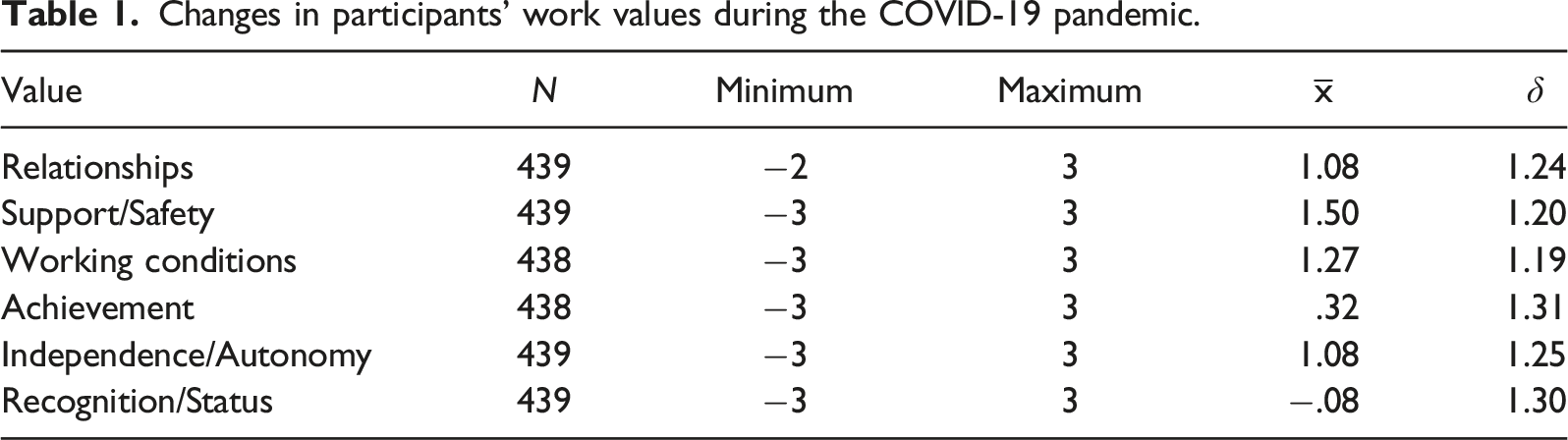
Changes in participants’ work values during the COVID-19 pandemic.
Hypothesis 3
Descriptive statistics and correlations for satisfaction, adjustment style, and degrees of freedom variables.
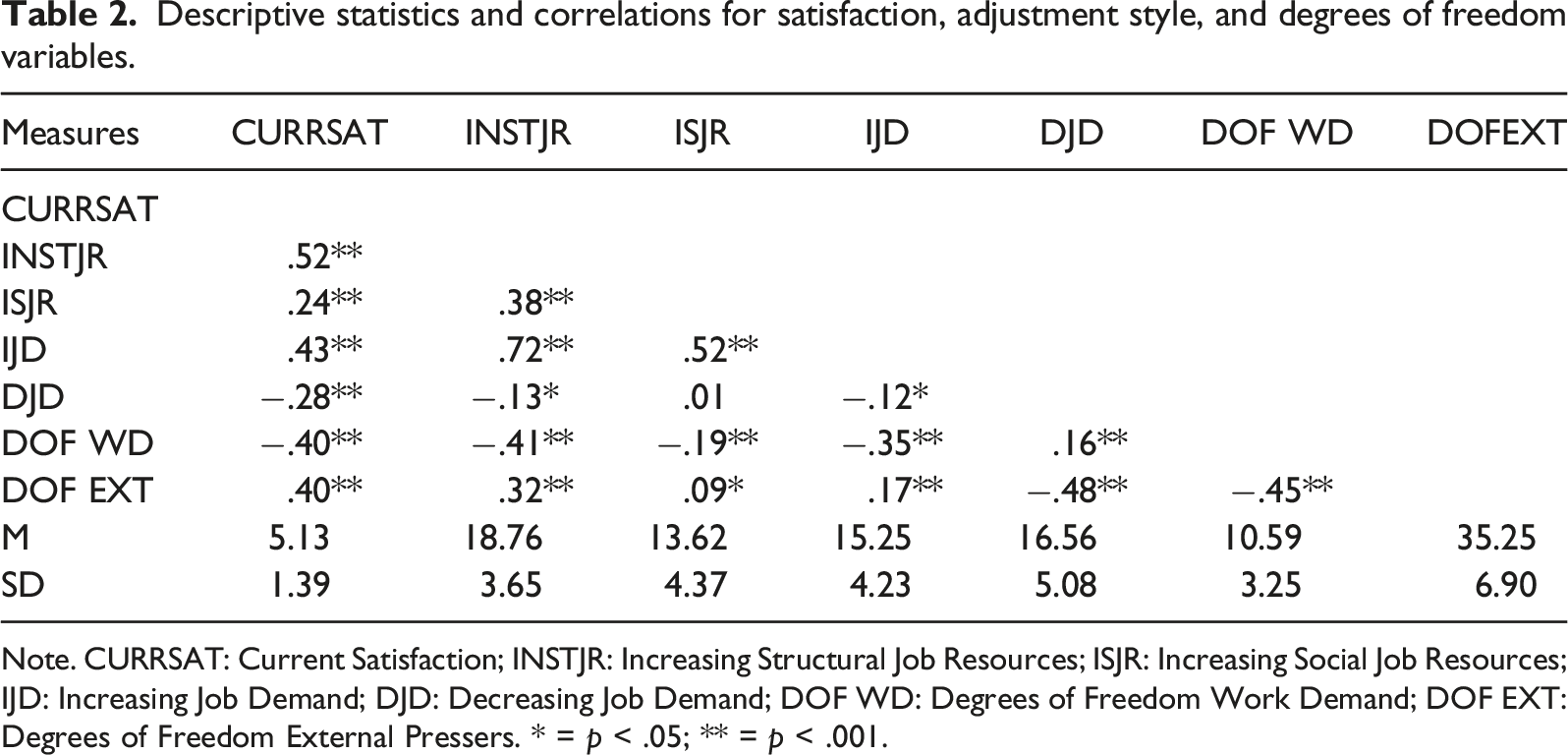
Note. CURRSAT: Current Satisfaction; INSTJR: Increasing Structural Job Resources; ISJR: Increasing Social Job Resources; IJD: Increasing Job Demand; DJD: Decreasing Job Demand; DOF WD: Degrees of Freedom Work Demand; DOF EXT: Degrees of Freedom External Pressers. * = p < .05; ** = p < .001.
Multiple regression analyses for job crafting and degrees of freedom variables.

To test the hypotheses that workers’ engagement in distinct types of adjustment during the pandemic to increase satisfaction differed by gender, caregiving requirements, and essential worker categorization, we created interaction terms between the moderating variables (gender, caregiving requirements, essential worker categorization) and the predictors (increasing structural job resources, decreasing job demands and external pressers). Since increasing social job resources and increasing job demands did not predict satisfaction, we did not create interaction terms between these two variables and the moderating variables. Thus, we created interaction terms between increasing structural job resources and care giving differences, increasing structural job resources and gender, increasing structural job resources and essential worker categorization, decreasing job demands and essential workers categorization, decreasing job demands and gender, decreasing job demands and caregiving differences, degrees of freedom external pressers and caregiving differences, degrees of freedom external pressers and gender, degrees of freedom external pressers and essential worker categorization.
The interaction terms between increasing structural job resources and care giving differences was added to the regression model predicting satisfaction from these two variables (increasing structural job resources and care giving differences). The interaction term did not account for any significant variance in worker’s satisfaction (∆R2 = .005, ∆F (1, 435) = 3.03, p = .08, (b = −.0035, 95%CI [−.007, .005], p = .08)). The interaction term did not also account for any significance variance in worker’s satisfaction for the following: increasing structural job resources and gender (∆R2 = .0038, ∆F (1, 435) = 2.3, p = .13, (b = −.05, 95%CI [−.11, .01], p = .13)), increasing structural job resources and essential worker status (∆R2 = .001, ∆F (1, 435) = .77, p = .38, (b = .03, 95%CI [−.37, .10], p = .38)), decreasing job demands and essential worker status (∆R2 = .001, ∆F (1, 435) = .63, p = .43, (b = .02, 95% CI [−.08, .03], p = .43)), decreasing job demands and gender (∆R2 = <.001, ∆F (1, 435) = .003, p = .96, (b = −.001, 95% CI [−.05, .05], p = .96)), decreasing job demands and caregiving differences (∆R2 = .001, ∆F (1, 435) = .76, p = .38, (b = −.001, 95% CI [−.005, .002], p = .38)), degrees of freedom external pressers and caregiving differences (∆R2 = .003, ∆F (1, 435) = 1.54, p = .22, (b = .001, 95% CI [−.0007, .003], p = .22)), degrees of freedom, external pressers, and gender (∆R2 = .0006, ∆F (1, 435) = .29, p = .59, (b = −.009, 95% CI [−.043, .024], p = .59)), degrees of freedom, external pressers, and essential worker categorization (∆R2 = .001, ∆F (1, 435) = .63, p = .43, (b = −.015, 95% CI [−.02, .05], p = .43)). Thus, we found partial support for Hypothesis 3.
Hypothesis 4
Our fourth hypothesis was that workers quit and/or changed their jobs due to poor P-E fit during the pandemic. We assessed P-E fit for individuals who changed jobs by assessing the correspondence between the two jobs to see if they differed. Specifically, we compared two WIP-Cs for qualifying participants: (1) the WIP-C results for the participant’s pre
Although hypothesis 4 was not supported, we asked participants whether their job satisfaction had increased or decreased since the pandemic began, and if so, how. Eighty-six individuals indicated that their job satisfaction decreased, while 125 indicated that their job satisfaction had increased. Examples of reasons for decreased job satisfaction included: “It has become boring and I’ve realized I could do more than what I am doing now”, or “I don’t make as much as I used to because we all had to take a pay cut due to COVID”, suggesting less satisfaction was due to poor P-E fit. Examples of reasons for increased job satisfaction included “My job was extremely difficult during the early days of the pandemic because it is so people oriented. Now that I am able to work with people directly it has improved,” or “I am more satisfied I’ve created better healthy boundaries and established a good work life balance that I didn’t have before the pandemic” or “I work more efficiently from home because I’m able to make my working environment meet my needs better”. We coded the examples of satisfaction in terms of adjustment style (reactive or active) or type of job crafting (increased job demands, increased social or structural resources, or decreased job demands). We were specifically interested in what workers did to increase their satisfaction, and therefore coded the examples of increased satisfaction as a research team, reaching consensus among the four members of the team on adjustment style or job crafting type. Eighty-nine participants gave examples of reactive adjustment (“I work remotely”) while 47 participants gave examples of active adjustment (“I received a raise and promotion”). In coding for job crafting, 37 participants increased job resources (asked for a raise), 11 participants increased social resources (more supportive supervisors), 61 decreased job demands (working from home and not tied to a desk), and 23 increased job demands (took a more challenging position).
Hypothesis 5
For Hypothesis 5, we hypothesized that those spending additional time on caregiving responsibilities during the pandemic were less satisfied with their work and this differed by gender and essential worker categorization. The majority of participants (68.1%) did not report an increase in caregiving responsibilities during the pandemic. For the 23.5% who reported increased caregiving responsibilities, the average number of increased hours of increase was 11. There were no differences in satisfaction between those whose caregiving responsibilities increased versus those whose caregiving responsibilities decreased (F (2,436) = .927, p = .396), and it did not differ by gender (F (3, 435) = 1.982), p = .116 or by essential worker categorization (F (1,465) = .046, p = .830).
Discussion
The aim of the current study was to examine how changes to work-related reinforcers impacted U.S. workers’ perception of satisfaction since the COVID-19 pandemic. Using the Theory of Work Adjustment and job crafting theory, we explored the effects of the pandemic on workers’ reports of person-environment fit, adjustment style, degrees of freedom, and job satisfaction. Our results yielded mixed findings for our hypotheses.
We found partial support for Hypothesis 1, that workers’ perceptions of their job satisfaction have changed since the COVID-19 pandemic began. While workers who remained in their same job during the pandemic did not report significant differences in their levels of satisfaction prior to and after the pandemic’s start, workers who changed jobs reported being statistically significantly more satisfied in their new job or position. These findings align with TWA (Dawis, 2005), suggesting that workers may have become discorrespondent with their work environment during the pandemic to a level they deemed unmanageable and subsequently left the environment (i.e., left their job). Moreover, our results parallel popular press articles that indicate that some workers who changed jobs during the pandemic are more satisfied with their work (Parker & Horowitz, 2022).
Our second hypothesis, that the importance of participants’ work values of relationships, support/safety, working conditions, achievement, independence/autonomy, and recognition/status will have changed for workers during the pandemic, was fully supported. Workers reported that the values of support/safety, working conditions, independence/autonomy, and relationships all became more important to them during the pandemic. Furthermore, achievement was reported as being more important but only slightly. These findings align with those of the MacLellan (2022) which indicated that women and men value pay, work-life balance, job security and the ability to use their skills in their work. Moreover, our result that workers’ value of support/safety and working conditions increased during the pandemic may reflect workers’ desire for COVID-19 policies that protect their health and their work. This parallels additional findings by MacLellan (2022) that men valued COVID-19 policies that aligned with their beliefs. Likewise, the opportunity to work from home may have prompted the realization for some workers that independence and autonomy were more important to them as they completed their work-related tasks. In that same vein, working remotely may have instilled the importance of relationships for other workers as they were no longer readily able to collaborate and socialize with colleagues. We also found that recognition/status was slightly less important which may reflect changes in workers’ work/life priorities stemming from additional responsibilities at home, or active/reactive adjustment of their jobs.
Hypothesis 3, that people engaged in distinct types of adjustment during the pandemic to increase satisfaction, was supported, but the finding was not moderated by gender, caregiving requirements or essential worker categorization. Although these results seemingly contradict the findings in existing literature and popular press articles that women were disproportionately impacted by the pandemic because of the increase in caregiving requirements they experienced
At the heart of the current study was the fundamental premise, informed by TWA, that if organizational reinforcers changed, so too would workers’ values, suggesting that P-E fit has changed. However, our data did not support our fourth hypothesis that P-E fit has changed. We believe this may have occurred for two reasons: (1) our sample of workers who changed jobs during the pandemic (n = 87) may not have been large enough to glean this information, and (2) the workers who changed jobs during the pandemic may have transitioned to work with similar reinforcers. Of note, the workers who did change jobs in this sample were less likely to be highly educated than those who remained in their jobs. Although the majority of our sample did not leave their jobs and thus did not increase P-E fit, some workers reported taking steps to increase their job satisfaction, such as decreasing their commutes, working from home, or seeking additional job resources, even if they did not change jobs during the pandemic.
Our final hypothesis, stating that those who were responsible for caregiving during the pandemic would be less satisfied by their work, was unsupported. We also did not find differences in this finding by gender or essential worker status. As with our findings with hypothesis 3, these findings differ from those in the literature and popular press (e.g., Kantamneni, 2020; McKinsey, 2021).
Limitations
There were several limitations to the current study. Important to note is that our data were collected during the spring of 2022, two years after COVID-19 was declared a pandemic. At that time, vaccinations for COVID-19 were available and accessible to many people in the U.S., mask requirements were lifted in multiple settings, and social distancing restrictions had been greatly reduced (CDC, 2023). As such, participants’ experiences with and reflections on their work may have been different than they would have at earlier points in the pandemic. Extending this further, we did not ask about whether participants received federal benefits at any point during the pandemic. We speculate that government sponsored programs—such as distributing immediate child tax credits, offering special business loans, pausing student loan payments, and implementing more generous unemployment benefits—could have affected workers’ perceived work reinforcers and satisfaction.
We also used retrospective recall in the current study to assess how participants adjusted to environmental and personal changes during the pandemic. We identify the use of retrospective recall as a limitation in our study as memory research reveals that human memory is imperfect and may lead to recall bias – a systematic error that occurs due to the inability of research participants to remember the events accurately or leave out details of the events in their report (Colombo et al., 2020; Hipp et al., 2020).
Additionally, the data for the current study were collected using Prolific. While Prolific has been shown to yield higher quality data than other research platforms (Peer et al., 2017, 2022), there remain limitations to recruiting participants through online platforms, such as increasing participant non-naivety (Peer et al., 2017), the possibility of responses from “bots” (Webb & Tangney, 2022), and a disproportionate number of participants under age 50 (Difallah et al., 2018). While bot detections features were activated for our survey and data were reviewed for inconsistencies, we cannot be certain that our data are free from bot responses. Likewise, we recognize that a large number of our participants were under age 50 (n = 319) and that this is a limitation of our study.
Notably, the number of participants in our study who had changed jobs was small. This may have limited some of our findings regarding changes in values and satisfaction. Additionally, we did not code the occupational level of each participant. While O*NET Online provides a “specific vocational preparation” (SVP) code that allows occupations to be clustered by the amount of time typically required for a worker to develop the skills needed for the specific occupation, the code is listed as a range. For example, the SVP code for clinical and counseling psychologists indicates that over four years to more than ten years of training is needed (O*NET Online, 2023). The significant variation in this range, and in those of other occupations, limited our ability to effectively and accurately code the occupations provided by participants.
The limitations with the occupational codes being expressed as a range can be illustrated using the Bureau of Labor Statistics (2022) information on registered nurses (RNs). To be an RN in the US, nurses must graduate from an approved nursing program and pass the National Council Licensure Examination (NCLEX-RN). RNs may have a basic RN diploma from a professional nursing school, typically taking 2–3 years to complete, or may have an associate’s degree in nursing (ADN), an associate of science in nursing (ASN), or a Bachelor of Science degree in nursing (BSN; BLS, 2022), which all take about 4 years to complete. A number of RNs may also have a master’s degree in nursing but technically work in the capacity as an RN, either full-time, or part-time while holding positions in administration, research, consulting, and teaching (BLS, 2022). According to O*NET-SOC 2020, administrators, researchers, consultants, and secondary and post-secondary teachers are separate occupations from nursing (National Center for O*NET Development, 2021). In turn, this wide range of education levels and job descriptions for workers who identify as RNs could have confounded our results. Pay, educational attainment, achievement, and leadership opportunities can influence a worker’s perception of occupational reinforcers and satisfaction due to those work attributes being inextricably linked to work values, per the tenets of TWA.
Methodologically, the calculations for the WIP-C collapse the 21 reinforcers described in TWA into six values. This process of collapsing reinforcers into a limited number of values may not have effectively captured the nuance of each reinforcer, leading to our finding that P-E fit did not change as a result of the COVID-19 pandemic. Furthermore, the measure used to assess adjustment style (Shtivelband, 2014) is scored with a binary scoring system and has not been previously normed on the population described in this article. This is important to note because it is well understood that measures used in research should be valid for the population being studied. However, the measure of adjustment style used was the only one found after careful review of the literature and thus was incorporated into the current study.
Another limitation of our study is that we did not capture workers who resigned from their positions and did not seek other work. We specifically set out to examine the experiences of those who were working at the time the COVID-19 pandemic began and were working at the time they completed the survey. Therefore, we acknowledge that there is a large group of workers whose values may have changed during the pandemic but have been applied to other, non-work-related settings, or who resigned from their positions because of their dissatisfaction.
Criticisms of P-E Fit
Guan et al. (2021) note that criticisms of P-E fit include challenges in its application to the changing economy and current careers. Perhaps one of the greatest and most recent impacts to the economy and careers is the COVID-19 pandemic. After shelter-in-place orders were declared to prevent transmission of the virus, many workers began teleworking from home, while essential employees were required to continue working in-person. This resulted in changes in the quantity and strain of responsibilities at home for these workers (Kantamneni, 2020; Kashen et al., 2020). For workers with children and/or dependent or elderly adults for whom they needed to care for, this may have necessitated increased caretaking responsibilities. In examining work-to-family conflict prior to the pandemic, Golden et al. (2006) and Lapierre et al. (2016) found that teleworking led to greater work-to-family conflict because of the blurring between work and non-work responsibilities. Considering the impact of COVID-19 on work, De Cooman et al. (2021) posited that changes in work-to-family conflict may have a subsequent effect on workers’ person-environment fit.
Another criticism of P-E fit is the lack of understanding of the construct’s change across the lifespan (Guan et al., 2021). There is limited literature on age as a moderator of the relationship between P-E fit and outcomes such as job satisfaction and turnover intentions. However, in examining the role of age on P-E fit types, Rauvola et al. (2020) found that person-organization fit was more important for older participants’ work satisfaction. Although the researchers hypothesized that person-group fit would be predictive of younger participants’ work satisfaction, there were insignificant and mixed results of person-job and person-group fits predicting work satisfaction.
Future Research
The Theory of Work Adjustment is a beneficial theory in which to ground research considering changes in workers experiences and is appropriate in conceptualizing career decisions, such as turnover intentions (Dahling & Librizzi, 2015; Fouad et al., 2017). Given the substantial impact of the COVID-19 pandemic on employees' experiences with their work, there is limited research that has employed TWA to examine changes in P-E fit as a result of the pandemic. This dearth in scholarship may be partially due to challenges related to measuring TWA’s constructs, as well as related constructs. For example, future research may pay particular attention to measuring adjustment style. There are presently few validated measures of adjustment style in the literature, including the one used in the current study. As such, the opportunity to measure adjustment style within the full TWA model, as well as differences in adjustment style across gender, racial/ethnic background, essential worker status, and other identities and contextual factors is limited. There is also little to no research on how reinforcers may differ across gender, racial/ethnic background, sexual orientation or social class, or the intersections among these identities.
Furthermore, additional research is warranted in examining degrees of freedom as a construct influencing P-E fit. Conceptually, degrees of freedom influence workers’ adjustment styles and therefore play a crucial role in determining workers’ satisfaction. The scale used in the present study to measure degrees of freedom is the only one known by the authors to consider the construct through a P-E fit lens. Future research would provide additional validation of the measure and a greater understanding of its applicability with additional populations.
An initial consideration of this study was to examine whether a relationship existed between adjustment style and job crafting, in that active adjustment was simply an example of workers proactively modifying elements of their work to better align with their needs. Our findings indicate that adjustment styles and job crafting techniques are separate constructs. Active adjustment reflected employees’ intentional efforts to change their environment to increase P-E fit; job crafting reflected how employees reshaped their jobs to cultivate meaningfulness in their work. We would say that while adjustment styles are top-down, that is, the employee adjusting self and the environment to meet the employer’s needs, job crafting is bottom-up as the employee initiates and creates meaningfulness in their work through job crafting techniques. As our findings indicate that workers engaged in different adjustment styles and job-crafting techniques to improve satisfaction during the pandemic, future research should further explore how these constructs relate and differ.
Implications for Career Development Professionals
Career development professionals may find the results of the current study to be useful in their work with clients. Broadly, the current study advances the literature on how workers explore their work options and operate in their environments based on their values to increase their satisfaction. Therefore, career development professionals may employ these results as they work with clients who are looking to increase their job satisfaction, who are in the midst of job and career changes, or whose work has been impacted by significant individual, community, or global events. Being mindful of the potential shifts in workers’ values as a result of changes in work responsibilities and settings, especially in light of sociopolitical and economic challenges, would allow career development professionals to aid clients in developing insight about their values and work-related needs, as well as exploring career opportunities and transitions to other positions that better align with their values. Career development professionals can also apply our findings to their work with women, caregivers, and “essential workers,” who may be disproportionately impacted by workplace responses to change and who may balance work and personal responsibilities. Supporting these clients in identifying factors within their control both in their workplaces and in personal settings, such as how their adjustment style can be leveraged to increase their P-E fit could increase job satisfaction and work/life balance.
Footnotes
Declaration of conflicting interests
The author(s) declared no potential conflicts of interest with respect to the research, authorship, and/or publication of this article.
Funding
The author(s) received no financial support for the research, authorship, and/or publication of this article.
