




Abstract
Hofstede’s value dimensions offer a measure of one component of culture (cultural values) and are a means of gaining greater understanding of the role culture plays in national innovation success. Hofstede’s (1980) cultural measures of individualism, uncertainty avoidance, and power distance, for example, have been shown to be correlated to the number (per capita) of trademarks (Shane, 1993). Via multivariate multiple linear regression, we assess the link between Hofstede’s measures of cultural values and innovation as measured by the Global Innovation Index (GII). Our analyses show a strong negative relationship between Hofstede’s dimensions of power distance and GII innovation scores as well as a strong positive relationship between individualism and GII innovation scores. No relationship was found for Hofstede’s measure of uncertainty avoidance.
In a world that has moved swiftly to global trade, innovation rates have become one of the tools by which nations and businesses achieve success in the world. For example, Wind et al. (1990) show that new products, typically derived from innovation, explain one quarter to one third of financial growth in businesses. In many cases, businesses and organizations have an “innovation imperative” in which innovation is deemed necessary for both growth and survival. With the recognition of the importance of innovation for success at both the business and national levels, scholars have become interested in investigating what factors help and hinder innovation.
In this article, we look at the role culture plays in influencing national levels of innovation. Culture is hard to conceptualize and definitions abound. At its broadest, culture is defined as “. . . that complex whole which includes knowledge, belief, art, morals, law, custom, and any other capabilities and habits acquired by man as a member of society” (Tylor,1958, p. 1). A more narrow and cognitively oriented definition is that of Geertz (1973, p. 89), who defined culture as “. . . an historically transmitted pattern of meanings embodied in symbols, a system of inherited conceptions expressed in symbolic forms by means of which men communicate, perpetuate, and develop their knowledge about and attitudes towards life.”
Scholars have long contended that culture influences economic behavior (Smith, 1776; Weber, 1905), government policies (Fukuyama, 1995; Jin, 2001), and national institutions and business systems (Fukuyama, 1995; Geertz, 1973; Hall, 1990; Hampden-Turner & Trompenaars, 1993; Hofstede, 1980; Jin, 2001; Lipset, 1990). Thus, it is not difficult to argue that culture plays a key role in influencing national innovation success. Hofstede’s (1980) cultural measures of individualism and power distance, for example, have been shown to be correlated to the number (per capita) of patents for inventions (Shane, 1992) while individualism, power distance, and uncertainty avoidance have been shown to be correlated to number of trademarks (Shane, 1993).
The value dimensions defined by Hofstede (1980, 2001) offer a measure of one component of culture (cultural values) and are a means of gaining greater understanding of the role culture plays in national innovation success. However, the work to date is limited by the use of patent and trademark data as a proxy for innovation. The intention of this article is to deepen our understanding of Hofstede’s measures of cultural values and their link to innovation by looking at more comprehensive measures of innovation than trademarks and patents. We examine the relationship between Hofstede’s cultural value dimensions and country scores on the Global Innovation Index (GII).
We start the article by providing an overview of the GII and its component measures. We then look at Hofstede’s value dimensions and their relationships to innovation followed by a discussion of the research methods. The subsequent sections examine the relationships found between Hofstede’s measures of cultural values and differences in national innovation scores on the GII. Our multivariate multiple linear regression analyses show a strong negative relationship between Hofstede’s dimensions of power distance and GII innovation scores and a strong positive relationship between individualism and GII innovation scores. These results suggest a link between cultural dimensions and innovation indicating that it occurs for more sophisticated measures of innovation than trademarks and patents.
The GII
The GII (INSEAD, 2009) consists of five input measures (termed pillars) for innovation and two output measures (pillars). The inputs are those things that enable an economy to be innovative. In other words, those things that help provide a conducive environment for innovation. Outputs are the results of a nation’s innovative activities.
The five input pillars are institutions and policies, human capacity, general and ICT infrastructure, market sophistication, and business sophistication (see Figure 1). The Institutions and Policies pillar attempts to “capture the macroeconomic stability and the institutional framework of a country” (INSEAD, 2009, p. 21). A regulatory framework which helps to attract businesses through incentives and protection is deemed essential for all nations wishing to achieve in innovation. The Human Capacity pillar refers to education standards and research activity within a nation as these are believed to be important determinants of innovation capacity. The General and ICT Infrastructure pillar is considered an important measure because appropriate infrastructure is needed to feed the national innovation system. Infrastructure fosters growth in businesses, raises the standard of living, and increases productivity and efficiency levels. Infrastructure is considered the backbone of any economy. The Market Sophistication pillar tries to capture “the state of credit availability and the condition of creditors and investors in an economy” (INSEAD, 2009, p. 23). The financial is important to assess as it is considered an important measure of economic well-being and is a focus of significant government policies. Finally, the business sophistication pillar tries to capture “the nature of the business environment and its conduciveness to innovation activity in the economy” (INSEAD, 2009, p. 24).
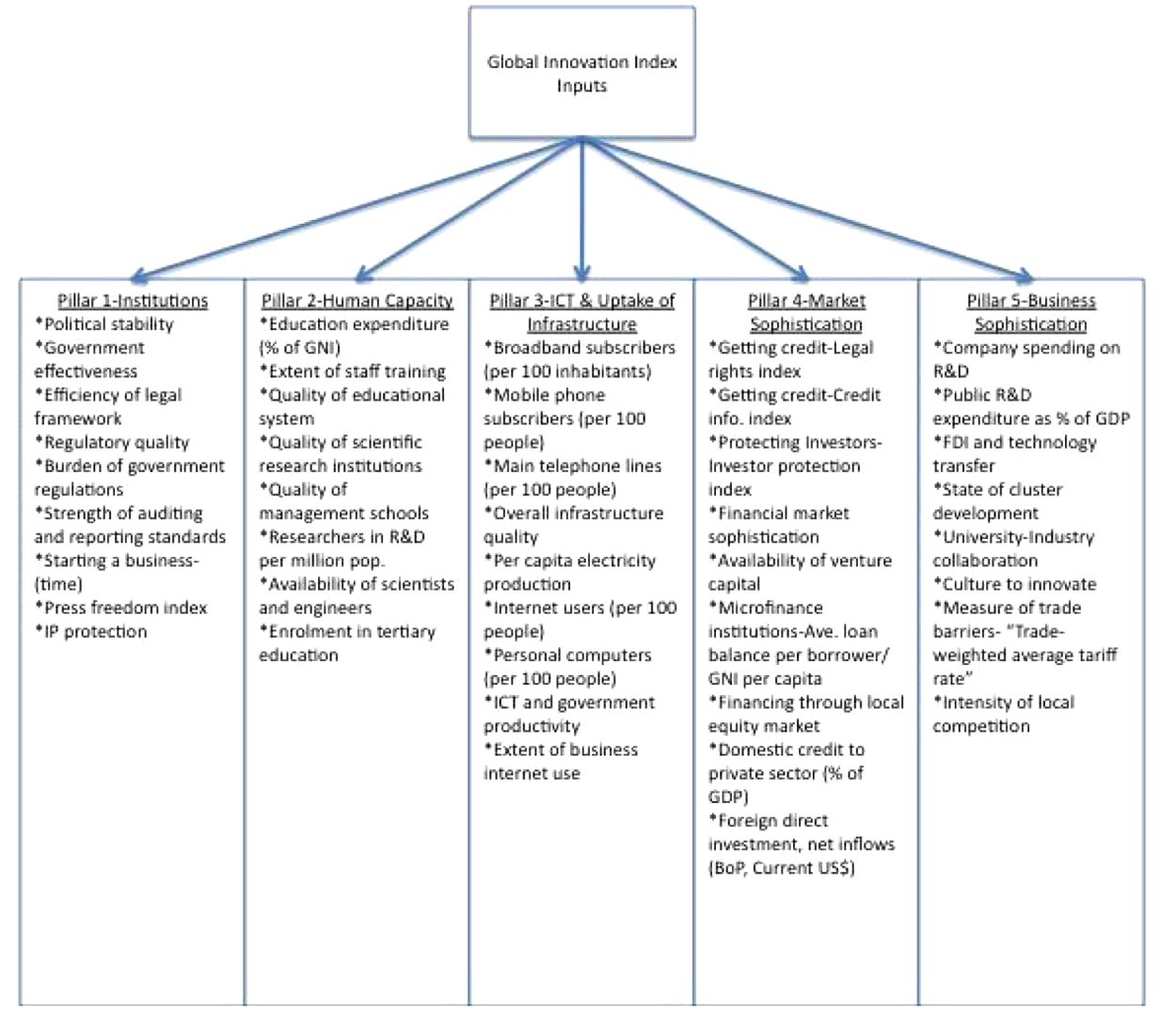
Global Innovation Index—inputs
The two GII output measures included scientific outputs and creative outputs and well-being (see Figure 2). The first pillar of the outputs encompasses factors like patent numbers and number of scientific publications. It is meant to represent a composite measure of “those variables which are traditionally thought to be fruits of innovation” (INSEAD, 2009, p.25). The second output pillar assesses how innovation has influenced the creative industry as well as living standards.

Global Innovation Index—outputs
As can be seen by Figures 1 and 2, each of the input and output measures are based on several variables. The data for the input and output measures were obtained from such reputable sources as World Economic Forum and the World Bank. It should be noted, the no information is currently available regarding the internal consistency of the GII measures. This is an area for future research.
Hofstede’s Dimensions of Culture
Hofstede defines culture as “The collective mental programming . . . part of our conditioning that we share with other members of our nation, region or group but not with members of other nations, regions, or groups” (Hofstede, 1983, p. 76). From 1967 to 1978, using systematically collected data from a large number of national cultures, Hofstede sought to develop empirically based terminologies to describe different cultures. Working as a psychologist for IBM, Hofstede collected data on employee attitudes and values in multiple cultures via standardized paper questionnaires. Values were defined as desires and assessed via questions ascertaining preferences. More than 116,000 questionnaires were collected for 40 countries. Questionnaires at IBM were administered twice, once between 1967 and 1971 and again between 1971 and 1973. Hofstede published his groundbreaking findings in the 1980 book Culture’s Consequences: Comparing Values, Behaviors, Institutions and Organizations Across Nations. The book is currently in its second edition (see Hofstede, 2001).
Hofstede initially identified four criteria that reliably differentiate between cultural values in diverse nations. The first cultural dimension was individualism versus collectivism. Individualistic societies have loose ties among their members and everyone looks after their own interests. The United States, Canada, and Australia score high on Hofstede’s individualism dimension. Collectivist nations, in contrast, tend to have stronger ties between group members, and will place a higher value on communal interests than individual interests. Examples of collectivist societies include Taiwan, Japan, and Colombia.
Hofstede’s second cultural dimension was large versus small power distance. Power distance refers to the “. . . extent to which less powerful members of organizations and institutions (like the family) accept and expect that power is distributed unequally” (Hofstede & Bond, 1988, p. 10). High power distance nations are more autocratic and individuals are more willing to accept differences in power and wealth. High power distance nations include India, France, and Mexico. Low power distance nations value equality among their members and encourage democratic forms of participation. Such nations include the United States, Australia, and Israel.
Strong versus weak uncertainty avoidance is Hofstede’s third cultural value dimension. This dimension is concerned with the manner in which cultures deal with an unpredictable future. Societies like Singapore, the United States, and Canada, which are low on this factor, tend to be tolerant of uncertainty and feel relatively secure. Countries high on this factor such as France, Belgium, and Greece actively avoid uncertainty and work to create a sense of control.
The fourth cultural value dimension identified by Hofstede was that of masculine versus feminine values. Masculine cultures like Venezuela, Italy, and Germany place great value “. . . on achievement, tasks, money, performance, and purposefulness, whereas more feminine cultures emphasize people, the quality of life, helping others, preserving the environment, and not drawing attention to oneself” (Nakata & Sivakumar, 1996, p. 64).
A fifth cultural dimension, long-term versus short-term orientation, and a sixth cultural dimension, indulgence versus restraint, have since been added to Hofstede’s list of cultural dimensions (Hofstede, Hofstede, & Minkov, 2010). Thrift and perseverance are associated with a long-term orientations, whereas respect for tradition and fulfillment of social obligations are associated with a short-term orientations. Indulgence refers to a tendency toward the free gratification of human desires. On the opposite pole, restraint refers to the belief that gratifying one’s desires needs to be curbed and social norms regulated.
Hofstede’s work has been shown to have high validity and reliability, as indicated by robust factor analyses results (Shane, 1992). Regarding reliability, Hofstede administered his questionnaire twice and used only those questions showing high correlation to derive his cultural value scales (Hofstede, 1980; Kogut & Singh, 1988; Shane, 1992). Furthermore, Hofstede’s indices have shown strong correlations with similar indices devised by other researchers (see, for example, Gordon, 1976 and Schwartz, 1994).
Since the initial studies by Hofstede, there have been six major replications of the survey for non-IBM employees (e.g., airline pilots, European consumers, municipal civil servants, and so on), each covering 14 or more nations originally studied by Hofstede (see de Mooij, 2004; Hoppe, 1990; Merritt, 2000; Mouritzen, 2002; Shane, 1995; van Nimwegen, 2002). These replications, conducted decades after Hofstede’s original work, support Hofstede’s original findings and suggest that the findings are still relevant today. Although the countries’ cultures may have changed since Hofstede’s original study, the replications indicate that if they changed, they did so together, such that their relative positions remained intact (Hofstede, 2010).
Innovation and Hofstede’s Measures
Shane (1992) found several connections between innovation and Hofstede’s cultural dimensions. Specifically, his research found a positive relationship between national individualism scores and numbers of patents issued in a nation. Furthermore, a negative relationship between power distance scores and numbers of patents issued was identified. These relationships remained significant when the data on innovation were adjusted for wealth. In a 1993 study, using trademarks instead of patents as a proxy for innovation, and controlling for income and industrial structure, Shane (1993) found similar results regarding power distance and individualism but also found that high uncertainty avoidance was negatively correlated with the number of trademarks produced.
Shane (1993) utilized institutional theory as an explanatory framework to understand why differences in cultural dimensions and rates of innovation are linked. According to this theory, the societies in which businesses operate influence their manner of operation. Shane (1993, p. 70) contends: “As organizational characteristics reflect societal values, managers might find that the organizational behaviours that promote innovation are easiest to develop in uncertainty accepting, individualistic, non-power distant societies, and these behaviours, in turn, might help to increase national rates of innovation.” Innovations carry with them a threat to the social hierarchy by redistributing power; lower status members can become more highly valued for their potential to do more, or do it better. Thus, high power distance nations may find it hard to innovate according to Shane (1992, 1993). The positive relationship between individualism and innovation suggests that autonomy, independence, and freedom, beliefs associated with individualism, are needed for a nation to be innovative. Finally, the positive relationship between uncertainty acceptance and innovation rates suggests that risk tolerance and acceptance of change are helpful when engaging in innovation, as innovation necessarily brings about change.
Although theoretically plausible, Shane’s (1992, 1993) empirical findings need to be interpreted with some caution, inasmuch as individualism and power distance accounted for approximately 17% and 14% of the variance in number of patents issued across nations, respectively (Shane, 1992). Using number of patents issued as a proxy for inventiveness is problematic, as well, in that nations differ in their requirements for issuance of such patents. A strong argument can be made that collectivist nations simply do not officially recognize individual inventiveness (or inventions) as readily as individualist nations and therefore may be innovative but have low numbers of patents. Use of trademarks as a proxy for innovation also has its problems. First, trademarks are given only to products that are to be marketed while process innovations are not trademarked. Second, the relationship between innovations and trademarks is not one-to-one as many innovations might fall under the umbrella of one trademark. Finally, as was the case with the use of patents as a proxy for innovation, nations differ in their requirements for trademarking and the protection offered by trademarks. These problems indicate a need for better measures of innovation and suggest that there may be other factors involved in the link between Hofstede’s cultural dimensions and innovation.
Research Hypotheses
We tested three hypotheses regarding the relationship between Hofstede’s measures of cultural values and country scores on the GII. These hypotheses are based on Shane’s findings described earlier regarding the links between cultural values and innovation.
Hypothesis 1: Power Distance will be negatively related to innovation index scores on the GII.
Hypothesis 2: Individualism will be positively related to innovation index scores on the GII.
Hypothesis 3: Uncertainty Avoidance will be negatively related to innovation index scores on the GII.
Method
One set of research variables were taken from Hofstede et al. (2010) work on cultural values—power distance, individualism, and uncertainty avoidance. Hofstede’s measures of time orientation and masculinity were not used in this research as they have not been previously linked to innovation, and we could think of no strong theoretical argument for such a connection. The other set of research variables was taken from the GII. By using the GII, we draw the boundary of our measure of innovation at the national level. Although businesses have globalized and many companies have corporations in multiple countries, we believe it best to draw our boundary at the national level as multinational corporations must abide by the laws and policies of the country in which they operate and, in most cases, the majority of their employees will be members of the national culture.
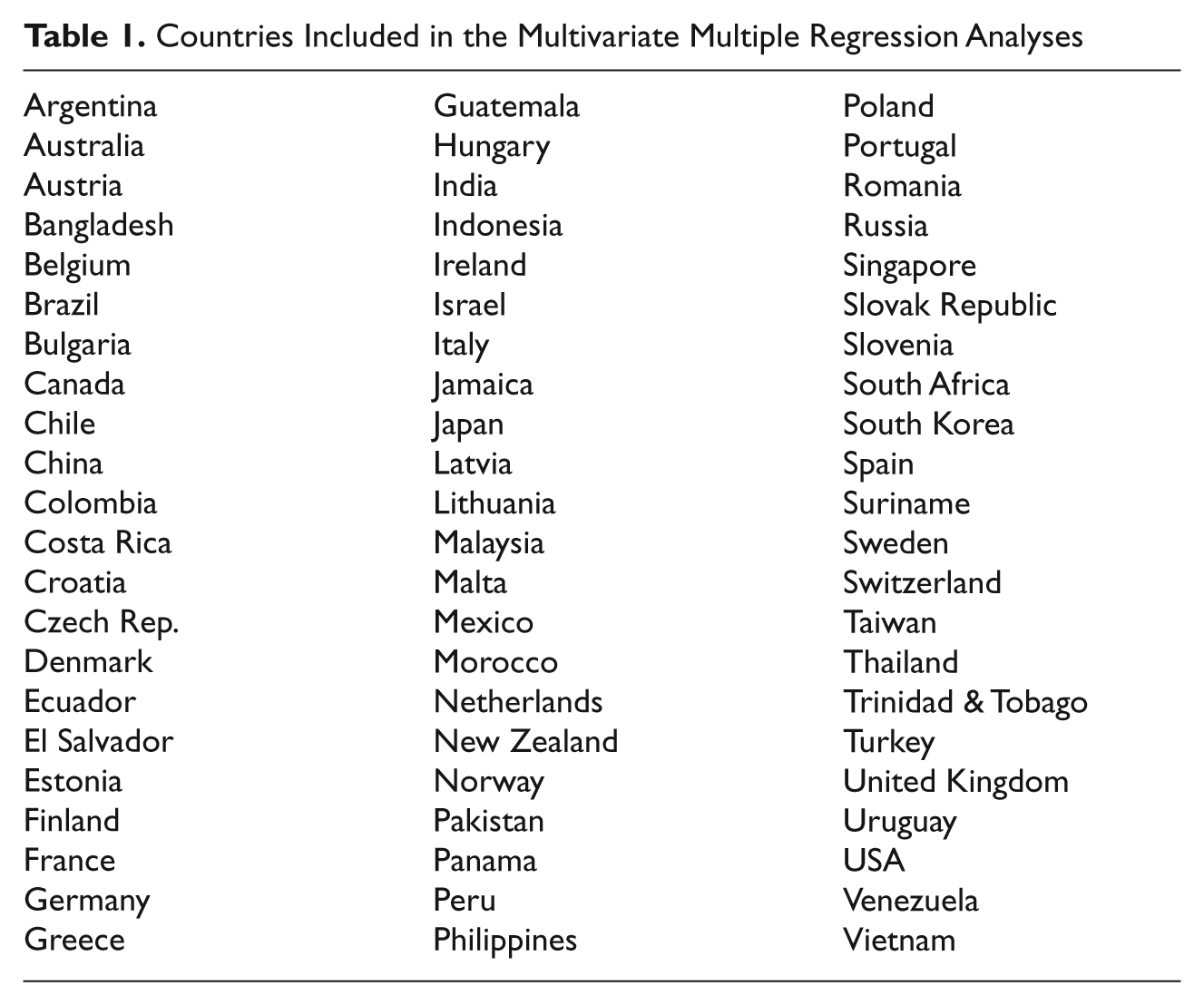
The aim of the statistical analysis was to uncover the relationships between selected cultural dimensions (power distance, individualism, and uncertainty avoidance), and the GII innovation scores (five input measures and two output measures). The two data sets were merged, which yielded 66 countries that had scores for the Hofstede dimensions and the GII Inputs and Outputs (see Table 1). These data were analyzed using a multivariate multiple linear regression. The three cultural variables (Power Distance, Individualism, and Uncertainty Avoidance) were used as predictors; the innovation scores became the criteria variables. Bivariate correlations were then calculated to test the strength and direction of the relationships of the Hofstede dimensions and the GII scores. All raw data used in our analyses can be found in appendix.
Countries Included in the Multivariate Multiple Regression Analyses
Results
The result of the multivariate multiple linear regression analysis indicated that Power Distance and Individualism were reliably related to innovation scores. Uncertainty Avoidance was not. The complete set of statistical results for this analysis can be found in Table 2.
Results of Multivariate Multiple Regression; Hofstede Dimensions as Predictors and GII Input and Output as Criteria
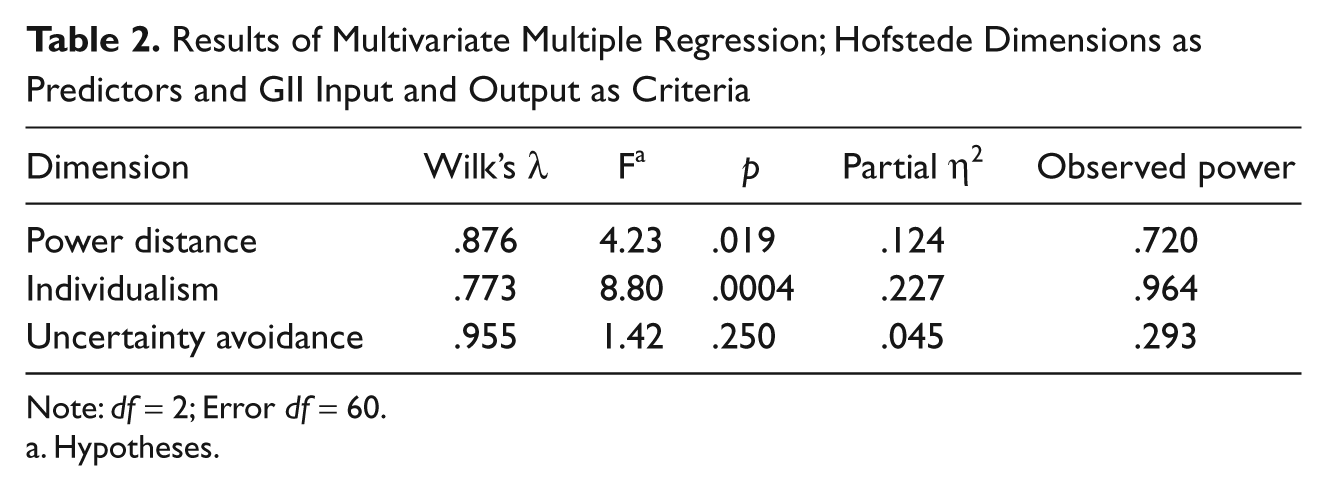
Note: df = 2; Error df = 60.
Hypotheses.
The bivariate correlations used to assess strength and direction of relationship showed that both GII Input and Output scores were individually related to Power Distance and Individualism, albeit in different directions for each of the cultural variables. Power Distance was negatively associated with both GII Input and Output (r =-.64 and r = -.58, respectively; both p < .001). In contrast, Individualism was positively related to GII Input and Output (r = .66 for both, p < .001).
Discussion
This study explored the links among cultural values and national-level innovation ratings. Previous research has linked Hofstede’s cultural values with innovation outcomes—specifically trademarks and patents. This study extends the relationship between Hofstede’s cultural values and innovation by looking at the relationship between Hofstede’s dimensions and a more comprehensive measure of national innovation—the GII. Our research offers mixed support for Shane’s (1992, 1993) findings.
The results of our analysis indicate that the cultural dimension of power distance is strongly and negatively related to innovation in line with Shane’s (1992, 1993) findings. High power distance nations may find it hard to encourage their citizens to innovate as inequalities among people are not only expected but desired and communication is limited between those of different strata (Hofstede, 2010). In high power distance nations subordinates in a workplace expect to be told what to do, thus, opportunities to think for oneself and to use imagination are limited. By contrast, subordinates in low power distance nations expect to be consulted and having imagination is prized (Hofstede, 2010). In low power distance nations, it is believed that all people should have equal rights and equal opportunities to succeed (Hofstede, 2010). In high power distance nations, it is believed that the powerful should have special privileges and it is expected that not everyone will have an equal opportunity to reach the highest level of advancement (Hofstede, 2010). With limited opportunities for advancement, people in high power distance nations in the lower strata may feel little motivation to be innovative as it is unlikely they will be able to reap the rewards directly or even get their idea noticed by those higher up in the social hierarchy.
It appears that the degree to which a culture reduces the barriers between status levels—that is, places a high value on egalitarianism—is, in some manner, connected to levels of innovation. This means that as a person in a country feels able to approach, make suggestions to, and debate with someone in a higher status position, so does that country’s innovation score increase. Thus, the increased amount of communication between the levels of society and within business could allow for the easier flow and acceptability of innovation ideas. It should also be noted that egalitarian societies emphasize meritocracy which can, in turn, put an emphasis on education (Lipset, 1990). A society in which people rise and fall based on merit is a society in which competitiveness is more likely to occur. In such a society, innovation provides an edge to those who are competitively inclined.
Also, in support of Shane’s (1992, 1993) findings, our analysis indicates that individualism is strongly and positively related to innovation. The positive relationship between individualism and innovation suggests that autonomy, independence, and freedom—beliefs associated with individualism—are needed for a nation to be innovative. In individualist societies, speaking one’s mind is highly valued whereas in collectivist societies direct confrontation is avoided to maintain harmony (Hofstede, 2010). Innovation thrives on ideas and in collectivist societies the avoidance of confrontation may serve to limit the number of ideas that get expressed and heard. Furthermore, research within the field of psychology suggests that students within individualist society have more creative potential than students within collectivist societies (Jaquish & Ripple, 1984; Jellen & Urban, 1989; Zha et al., 2006). In individualist societies, the purpose of getting an education is to learn how to learn (Hofstede, 2010). According to Amabile (1983), this type of learning environment fosters creativity. By contrast, in collectivist societies, the purpose of education is to learn how to do (Hofstede, 2010). This type of learning environment may stifle creativity as children are not allowed sufficient opportunity to pursue personal interests and initiatives. In a world in which technology is rapidly changing, the emphasis in individualist societies on learning how to learn, may put such nations in a better position as far as innovation with members being better able to adapt to a world in which they will be constantly needing new skills.
Our analysis indicates that uncertainty avoidance is unrelated to innovation as measured by the GII. This is not an entirely surprising finding. Shane found mixed results with respect to uncertainty avoidance. In his 1992 study, Shane found no relationship between uncertainty avoidance and patents. However, in his 1993 study, a relationship between uncertainty avoidance and trademarks was identified (low uncertainty avoidance was associated with a higher number of trademarks) and Shane concluded that uncertainty avoiding cultures were slower regarding innovation. Our findings support Shane’s original findings showing no clear relationship between uncertainty avoidance and innovation. The principal driver behind Hofstede’s uncertainty avoidance dimension appears to be a desire for control, such that outcomes can be reasonably accurately predicted. A need for control can both help and hinder innovation.
Research comparing self-employment levels with a nation’s Uncertainty Avoidance score found that self-employment was actually higher in uncertainty avoiding cultures (Hofstede et al., 2010). Researchers found that low subjective well-being was associated with uncertainty avoiding cultures and this in turn was the likely motivator for people to choose self-employment as self-employment provided people with greater perceived control over their lives. According to Schumpeter (1983), entrepreneurs, such as those who start their own business, are a significant source of innovation. In this instance, the need for control may actually be spurring innovation. Similarly, uncertainty avoiding countries may be better at developing innovative ideas into new products and services as implementation requires attention to detail and punctuality. Uncertainty accepting countries, however, may be better at coming up with innovative ideas and with basic innovations. In either case, uncertainty avoiding and accepting, innovation does take place. It is the form of innovation that changes.
It is important to note that although cultural characteristics may limit innovation, nations do have the potential to overcome cultural deficits to innovation once they become aware of the situation. Fukuyama (1995), for example, writes of those cultures predisposed to high trust and those predisposed to low trust among their people. High trust societies have a strong sense of communal solidarity which enables the formation of large scale business enterprises. Low trust societies, however, limit their trust to family members or an ethnic group and businesses are kept small, often within a family. The result of different levels of trust has led to different roles of the state. In low trust societies, such as Italy and China, the government has intervened to help create large-scale business. The same can be done for cultural deficits to innovation. The key is in identifying the deficit. Our results indicate that power distance is strongly and negatively related to national measures of innovation whereas individualism is strongly and positively related to measures of innovation. Government and business policies designed to overcome or work around issues of power distance and a collectivist orientation may prove helpful for national-level innovation.
Although 66 nations from across the world were utilized in this study, further research is needed as the Middle East and Africa were underrepresented in the sample (Hofstede measures were unavailable). Future research should also look into the role institutional frameworks, such as laws and innovation policies; play in complicating or mitigating cultural values in so far as they influence innovation. As previously mentioned, government policies and initiatives can work to overcome cultural deficits to innovation. Exploring ways in which governments and businesses have successfully “worked around” culture to be innovative would be of great interest academically as well as practically.
Footnotes
Appendix
The author(s) declared no potential conflicts of interest with respect to the research, authorship, and/or publication of this article.
The author(s) disclosed receipt of the following financial support for the research, authorship, and/or publication of this article: Funding for this research was provided by the New Zealand Foundation for Research, Science and Technology under contract number LINX0801.