



Abstract
This article focuses on the changes in attitudes about sexuality, gender equality, and intimate partner violence within the context of modernization. Revised modernization theory predicts that increasing development leads to greater levels of egalitarian gender values and liberal sexual mores as part of a larger change in society. Our analysis leads to the conclusion that although both these sets of attitudes are a part of the movement towards postmaterialist values, in the context of intimate partner violence, different dynamics prevail at different levels of development. Using regression analysis and data from the fifth wave of the World Values Survey, we find a significant relationship between attitudes towards intimate partner violence, egalitarian gender values and liberal sexual mores. In general, liberal attitudes towards sexuality do not necessarily mean a lower tolerance for intimate partner violence. Crucially, the relationship between these three sets of values depends on the level of development. We find that in agrarian and industrial societies, higher levels of liberal sexual mores with lower levels of egalitarian gender values lead to a higher level of support for intimate partner violence against women.
Introduction
This article explains how the broad process of modernization impacts egalitarian gender values, liberal sexual mores, and attitudes about intimate partner violence. We focus our attention on the version of modernization theory which was first proposed by Ronald Inglehart in the early seventies. This theory was formulated in order to explain changes taking place in post-industrial societies at that time. These were changes in the attitudes and values held by people, including attitudes about the role of women and men in society. The theory makes strong claims about how modernization leads to changes in attitudes about gender, though this change is itself not independent of the cultural traditions of a society. We look into this relationship and focus our analysis on attitudes concerning intimate partner violence against women (IPVAW) in forty-four countries which participated in the fifth wave of the World Values Survey / European Values Survey (WVS/EVS 2005–08). Though the WVS/EVS is not focused on attitudes concerning IPVAW, the fifth wave of the survey has one question on this topic that asks if it is “justifiable for a man to beat his wife.” We believe that an analysis centered on this question can help us understand the values and attitudes that correlate with and explain why people from different countries justify IPVAW. Hence, this article will explore the relationship between egalitarian gender values, liberal sexual mores, and attitudes about IPVAW at the macro level.
Theories regarding Physical IPVAW
As Carlson and Jones (2010) point out, there are two sets of influential theories that explain physical IPVAW described in the sentence “a man beat his wife”. These theories are the family violence theory and feminist theory and both can be conceptualized on a continuum of conflict and control (Carlson & Jones, 2010). The family violence theory states that conflict is inherent in social relationships. Since men and women have different interests, this could lead to conflict and the use of violence (Straus, 1976, 1978, 1979, 1990; Steinmetz, 1978). In this theory, violence is not only due to the existence of conflict, but it is a method by which people resolve conflicts. Hence, this theory leads us to the conclusion that the justification for physical IPVAW would be no different than the justification for the use of violence amongst all social groups. It also follows that the justification for ‘a man beat his wife’ should be similar to the justification for ‘a woman beat her husband’.
In contrast to this, most feminist theories will assume that in the continuum from conflict to control, physical IPVAW, “‘domestic violence’ or ‘battering’, as it is generally understood by professionals and by the public, is primarily a problem of heterosexual male control of women partners”(Johnson & Ferraro, 2000, p. 949). In fact, the specific violence used by men when they beat their wives—which is the main concern of this article—has long been regarded as one of the most important issues in feminist scholarship (Yllo, 1988, p. 28). But even if most influential feminists have developed theories of gender violence and identified many programs, interventions, advocacy efforts, and legislative agendas to address the issue, there has been a general reluctance in acknowledging social factors besides patriarchy among the causes of abuse. 1 Since the seventies, one of the main arguments proposed in hegemonic feminist writings concerning gender violence is that violence is a method of control that men use in order to maintain their domination (Rodriguez, 2011). In this tradition, as Michele Bograd notes, a feminist analysis springs from this question: ‘Why do men beat their wives?’ The analysis of this specific question directs attention towards the violence in heterosexual relationships—marriage or partnership—within the structure of patriarchy (Bograd, 1988, p. 13). Or, as Saunders pointed out, a “key element of feminist theories of woman abuse is that men use physical violence to maintain male dominance in the family. Women as individuals and as a class are regarded as the primary victims” (Saunders, 1988, p. 90). Hence the hegemonic explanation for this kind of violence is that at a macro level, IPVAW is the result and expression of the oppression of women, by men, within a patriarchal system (Dobash & Dobash, 1979; Walker, 1979; Sugarman & Frankel, 1996). One of the results of this view, in an international arena, is well expressed in the currently accepted institutional definition of violence against women as stated in the declaration of the fourth United Nations Conference on Women in Beijing in 1995. 2
Another vein of academic literature on the subject also maintains that IPVAW has its root cause in the fact that we live in sexist societies (Heise, 1998; Flood & Pease, 2009). In addition to this, these theories also take into account a wide range of risk factors related to intimate partner physical abuse perpetration and victimization that demonstrate the complexity of the causes and correlates of domestic violence (Stith, et al., 2003). The multifactor framework suggests that IPVAW results from the interaction between various characteristic of the individual and their environment. Hence, we can identify multiple levels of factors related to IPVAW: the macrosystem (general cultural values and beliefs), the exosystem (the offender’s individual formal and informal social structures such as their friendship, work place, support groups, and legal institution), the microsystem (characteristics of the immediate setting in which abuse takes place), and the ontogentic level (the abuser’s developmental history). In their meta-analytic review, Stith et al. (2003) don’t include any factor related to the macrosystem level, maybe because they didn’t have enough data to check hypotheses concerning IPVAW in different societies and cultures.
From our point of view, general cultural values and beliefs about inequality between men and women—the gender gap—operates at a macrosystem level, and seems to be the variable that explains the general acceptance of norms and attitudes supportive of IPVAW. These social norms also explain, in a broad sense, why women continue in an abusive relationship and how aggressive men justify their behavior. Hence, “the more that people maintain egalitarian gender attitudes, the better are their attitudes toward violence against women” (Flood & Pease, 2009, p. 128). IPVAW does not occur in a societal vacuum. Rather, there needs be a general acceptance of traditional gender norms which support inequality between men and women and social norms supportive of violence (Heise, 1998).
Recent studies have taken more nuanced approaches to this subject, emphasizing that we need to take into account factors such as the cultural context in which the violence occurs (Sorenson, 1996; Johnson & Ferraro 2000; Raj & Silverman, 2002; Mason, et al., 2008; Bent-Goodley, 2005; Klevens, 2007). Many empirical studies have given support to socialist feminist views that emphasize socioeconomic status as the main variable which explains domestic violence (DeKeseredy & Schwartz, 2002). Other studies also agree that explanations for intimate partner violence have less to do with race and ethnicity than with socioeconomic status (Jonhson & Ferraro, 2000, p. 953; Rennison & Planty, 2003; West, 2004; Sokoloff & Dupont, 2005; Hallyday & Lucas, 2010). At the cross national level, a study by Kaya and Cook (2010) analyzes physical IPVAW data from forty developed and developing countries. They find that physical IPVAW decreases with an increase in female labor force participation in non-agricultural sectors and an increase in women’s secondary school enrollment. They also note that increasing total fertility rate signals more physical IPVAW while at the same time, the size of Muslim and Catholic populations do not have a significant effect on physical IPVAW (Kaya & Cook, 2010).
Boy and Kulczycki (2008) reach much the same conclusions when analyzing various studies conducted in Middle East and North Africa. Intimate partner violence mostly affects rural women, women who are not financially independent, and women with a lower education level. Focusing on the attitudes of men and women regarding intimate partner violence, the study finds that 87% of the total population in Jordan, 86.4% in Egypt, and 40.2% in Turkey agree that intimate partner violence is justified in at least one instance. The main reason given in order to justify this violence is infidelity or refusal to have sex. In the case of Jordan, the authors emphasize that “almost no one cited a woman’s violation of religion or disrespect for her husband’s family as reasons for wife beating” (Boy & Kulczycki, 2008, p. 62).
Hence these studies show that there are good reasons to investigate the link between attitudes about physical IPVAW and the modernization process. This process itself includes, but is not limited to, access of women to the non-agricultural labor market, access to education, urbanization, and a decrease in fertility rates. All of these changes affect the prevalence of physical IPVAW and the attitudes surrounding it.
As researchers have alerted us, physical IPVAW is more prevalent among people who support the role of the traditional family and hold traditional norms related to gender and sexuality. Our paper looks to take these findings forward. Since we look at a broad spectrum of countries, our aim is to shed light on how attitudes towards gender and sexuality affect attitudes towards physical IPVAW. As all of these connections take place within the broad process of modernization, we will first look at how attitudes towards gender and sexuality change. After that, looking at a broad spectrum of countries, we will investigate how modernization impacts attitudes towards physical IPVAW.
Gender and Modernization
The revised theory of modernization proposed by Ronald Inglehart states that economic development is linked with a broad syndrome of distinctive value orientations. It also claims that changes in the processes of economic production and cultural processes are reciprocal (Inglehart & Norris, 2003, p. 15). Even though this revised version does not view modernization as a linear process, it does define it as the socioeconomic dimension of advancing human development that permits the broadening of human choice and autonomy leading to an increasingly humanistic society (Inglehart & Welzel, 2005, pp. 1–5). The theory was proposed in order to explain the change in attitudes and basic value priorities seen in advanced industrial countries (Inglehart, 1971). While Daniel Bell (1976) stressed an increase in the service industry and the changing nature of work, Inglehart emphasized the consequences of economic security. In this vein, Inglehart describes the process as a silent revolution, one in which “the values of Western societies have [shifted] from an overwhelming emphasis on material well-being and physical security toward greater emphasis on the quality of life” (Inglehart, 1977, p. 3).
This revised modernization theory is based on two key hypotheses: the scarcity hypothesis and the socialization hypothesis. The first says that under conditions of scarcity, people tend to emphasize materialist values which are necessary for ensuring survival. This changes under conditions of prosperity where people tend to emphasize postmaterialist values which are more concerned with quality of life. The second hypothesis concerns itself with how people tend to form attitudes and values. These values are mainly a reflection of the prevalent conditions during one’s pre-adult years. This is not to say that one’s cultural heritage does not play a role as it is noted that older generations transmit values to their children. However, the claim is that if one’s cultural heritage proves inconsistent with experience, the latter will prove more influential in value formation (Inglehart, 1971; Inglehart & Welzel, 2005, pp. 97–8).
The theory posits that the process of value change is not linear. As industrialization brings with it rationalization, secularization and bureaucratization, the move towards a knowledge society puts emphasis on values of autonomy and self-expression. This can be inferred from the scarcity hypothesis as rising levels of existential security along with economic growth and higher levels of education can be shown to lead towards this value change. Thus, the processes of modernization and value change contribute towards human development and lead to an increasingly humanistic society (Inglehart & Welzel, 2005, pp. 1–3). However, the scarcity hypothesis also implies that during times of crisis, when standards of living decline and material scarcity is prevalent, we ought to see a move towards materialist values.
Following the theory, both industrialization and post-industrialization lead to two major dimensions of cross-cultural value orientations. In the first stage, there is a move from traditional-religious authority toward rational-bureaucratic authority and the rise of the modern state. This leads to a decline in attitudes supporting the traditional family. In the second stage, post-industrialization will bring a shift away from materialist values and state authority towards self-expression values and greater personal autonomy. The rise of gender equality is linked to increasing of self-expression values (Norris & Inglehart, 2002, pp. 240–1) which “give priority to tolerance over conformity, autonomy over authority, gender equality over patriarchy, and participation over security” (Welzel & Inglehart, 2008, p. 130) along with support for the women’s movement (Abramson & Inglehart, 1995, p. 10).
Inglehart and Norris carefully explain the changes in attitudes towards gender equality in Rising Tide (2003). Considering the first phase of modernization, the move from agrarian to industrial society, there are some important changes in family and sex roles. As the family is crucial for survival in preindustrial societies, traditional values about gender roles will predominate. The decrease in fertility, decrease in family size (from extended to nuclear) and the entry of women into the labor market lead to significant changes in attitudes about family. People will show greater tolerance for, for example, divorce and abortion. It is also expected that, “Women are enfranchised and begin to participate in representative government, but still have far less power than men” (Norris & Inglehart, 2002, p. 240). At this point is important to note that the theory looks at changes in social structures and attitudes about gender as a part of a broad movement that leads from traditional values to secular-rational values, as seen in the definition of both sets of values: “By traditional values we refer to orientations that are relatively authoritarian, place strong emphasis on religion, and emphasize male dominance in social life, respect for authority, and relatively low levels of tolerance for abortion and divorce and that have relatively high levels of national pride. Societies with secular-rational values emphasize the opposite characteristics” (Inglehart & Norris, 2005, p. 484).
The transition from industrial to postindustrial society also affects family and sex roles. Concerning family structures, we expect to see the erosion of the nuclear family, the growth of nontraditional households, and changing patterns of marriage and divorce. We also expect to see growing equality of sex roles in the home, family, and workplace and the rise of married women into the labor force. The broad movement in values is one from survival values to self-expression values, from materialist to postmaterialist values. In this context, “Women are less restricted to attaining status and fulfillment through the traditional route of family, marriage, and children, as alternative opportunities for self-expression and financial autonomy have become available. These changing norms have given rise to political demands, fuelling support for the second-wave feminist movement, and legal reforms associated with securing equal opportunities and women’s rights. In short, the rising tide of support for gender equality in postindustrial societies is part of a broad and coherent cultural shift that is transforming economically developed societies” (Inglehart & Norris, 2003, pp. 17–8).
Changing attitudes about Gender and Sexuality
Attitudes about gender equality and the position of women in society do not necessarily coincide (Shuman & Johnson, 1976). Analyzing the social position of women, a good definition of gender equality/inequality can be found in Norris’ Politics and Sexual Equality (1987). She states that “equality means a 50:50 distribution of men and women in all areas so both sexes are equally represented in different roles and equally rewarded materially, socially and psychologically for their performance in these roles” (Norris, 1987, p. 36). In fact, in this book we can find a useful set of indicators to compare the social position of women and men in different societies taking into account economic, social and political data. Norris thinks that while this data informs us about the actual position of women, it is also important to explore how attitudes affect this situation in order to have a complete picture (Norris, 1987, p. 38). She suggests exploring attitudes about equal roles in work, politics and child-care, and comparing those with material conditions (economic, social, and cultural) in order to understand sexual stratification and social change. 3
The revised modernization theory, however, is not focused on comparing the discrepancies between attitudes and actual sexual stratification. In order to grasp the argument presented in Rising Tide, one has to read it noting that Inglehart and Norris are not talking about the actual social changes in the position of women that have been produced in postmodern societies. For these they accept the measures contained in the Human Development Report by the UNDP. They are, however, speaking about the attitudes that people in these societies hold about gender equality. 4 For this purpose they develop an instrument, the gender equality scale, that “should not be regarded as reflecting the conditions of equality experienced in women’s and men lives; rather, it reflects cultural attitudes towards gender equality” (Inglehart & Norris, 2003, p. 177). Using this scale, they try to document “how the modernization process has transformed values by generating a rising tide of support for equality between women and men in post-industrial societies, and greater approval in these societies of a more permissive and liberal sexuality, including tolerance of divorce, abortion and homosexuality” (Norris & Inglehart, 2002, p. 240).
Inglehart and Norris show that attitudes towards gender equality remain consistent and form predictable patterns in societies with different levels of modernization (agricultural, industrial, and postindustrial). Higher levels of modernization correspond with more egalitarian attitudes, so that “the most important finding is that the gap that has emerged between traditional agrarian societies and egalitarian postindustrial societies is far greater than the gap that exists between women and men within each type of society” (Inglehart & Norris, 2003, p. 47). Cohort analysis is used to show that younger generations (especially in post-industrial societies) are more egalitarian than older generations, so it is expected that in the future the tendency is towards more egalitarianism. And while differences between societies are greater than those within societies, individual-level predictors of egalitarian attitudes—including age, sex, educational level, employment status, marital status, number of children, and family savings—remain significant.
Since modernization also involves a process of secularization, it is also logical to hypothesize that we will see a simultaneous move towards liberal sexual mores, exemplified in the attitudes towards divorce, abortion, homosexuality, and prostitution (Inglehart & Norris, 2003, p. 59). The analysis shows that in postindustrial societies there has been a dramatic shift toward greater tolerance, especially on issues related to abortion, divorce and homosexuality (with women being somewhat more tolerant than men regarding abortion and homosexuality ). Industrial societies show a lower tolerance, but here the differences are not very pronounced. Finally, agrarian societies are characterized by a low tolerance and, moreover, show no major differences between generations. So the trend is that as “societies become wealthier, threats to survival become less pressing, and people become more tolerant of gender equality and social diversity and give higher priority to self-expression” (Inglehart, et al., 2008, p. 271).
But freedom and equality, even if they belong to the same postmaterialist syndrome, represent two different dimensions of attitude. The former is related to liberal individual rights while the latter is related to the disadvantages that women as a group face as compared to men. As Eileen McDonagh suggests, in postindustrial societies such as the USA, it is the combination of both that has increased women’s political citizenship (McDonagh, 2002). From our point of view, even if some feminists argue for freedom—for example, when they claim that women have the right to make decisions regarding their own body—this is also a liberal claim, not only a feminist one. It is not necessary to be a feminist to defend freedom of choice in matters relating to sexuality. Conversely, not all feminists will support the right of abortion or prostitution. The defense of divorce, abortion, prostitution, and homosexuality connects strongly with liberal feminism and also with liberal thought which claims that individuals have the right to choose and decide what they want to do concerning their sexuality. Hence, these ideas do not represent feminist thought in its entirety, but only a liberal strand of feminism. While issues surrounding liberal sexual values might not have the support of all feminisms, issues surrounding domestic violence do; no feminist will claim that it is justifiable for a man to beat his wife. And this issue of domestic violence is related to equality, not freedom. In other words, a claim about intimate partner violence against women involves a social diagnosis that requires a change in the social rules between men and women—it involves social justice.
Postmaterialism—as suggested by Inglehart—is related to egalitarianism in a broad sense (not only between men and women). It is also related to individual freedom, freedom of speech, and individualism. In fact, one of the characteristic of critical citizens in postindustrial societies is that they are not strongly engaged with formal political organizations (Inglehart, 1999). While they will support egalitarian gender attitudes in general, they might not agree what social justice is and how to achieve it. This is why Hayes, McAllister, and Studlar, examining data from the second wave of the World Values Survey reach the conclusion that “men are more postmaterialist, women are more feminist, but neither postmaterialist men nor postmaterialist women are more supportive of feminism” (Hayes, et al., 2000, p. 436). Similarly, Frank and McEneaney determine that “individualism had a stronger effect on the formation of lesbian and gay social movement, while gender equality had a stronger effect on the liberalization of state policies. The latter is particularly true regarding policies on sex between women” (Frank & McEneaney, 1999, p. 935). The extension and combination of individualism and gender equality, as has happened in postmaterialist societies, seems to provide a ‘cultural opportunity structure’ that gives rise to active social movements and liberalized state policies.
Method
In the present study we try to understand how the broad process of modernization impacts egalitarian gender values and liberal sexual mores. We also are interested in understanding the impact of the configuration of these values in determining attitudes about IPVAW. So, in our analysis we first ask if egalitarian gender values and liberal sexual mores are determined by the same factors and try to explain the differences, if any, that we find between these two sets of attitudes. The revised modernization theory says that both these sets of attitudes go hand to hand in the postindustrial societies where the postmodern syndrome occurs. However, what is the configuration of these attitudes in agrarian and industrial societies? Also, what, if any, interaction exists between these attitudes in relation to attitudes towards IPVAW?
Data and Preliminary Analysis
Here, we first look into the factors affecting egalitarian gender values and liberal sexual mores, and then check if these two sets of attitudes can help explain attitudes towards IPVAW. To do so, we analyze data from the fifth wave of the World Values Survey / European Values Survey (WVS/EVS). The team behind the World Values Survey (WVS) is a worldwide network of researchers in a non-profit association studying changing values and their impact on social and political life. In collaboration with the EVS (European Values Study), they have executed five waves of surveys (1981–2007) in 97 societies containing almost 90 percent of the world’s population including very poor countries and very rich ones. Representative national samples of each society’s public are interviewed using a standardized questionnaire translated into the local language. All interviews are conducted face to face by local field organization and are supervised by academic researchers. Internal consistency checks are made between the sampling design and the outcome and rigorous data-cleaning procedures are followed at the WVS data archive. Since all datasets are downloadable via the Internet, social scientists can easily replicate the analysis of others.
Because the questionnaire used has evolved over the years, only the fifth wave contains all the items we need to carry out the present study. And in this wave, the questionnaire of forty-four of the fifty-seven countries included all the questions used in our analysis. Appendix C lists all the countries included in our analysis along with developmental and political indicators.
Moving on to some preliminary analysis of the data, one of our initial findings from the fifth wave of the WVS/EVS is that acceptance of IPVAW is not very widespread. The percentage of respondents who state that it is never justified is very high—across all the countries for which we have data, 76% of respondents say that IPVAW is never justified. In Appendix A, we present data on physical IPVAW suffered by women in the past twelve months from twenty-two countries alongside data about attitudes towards IPVAW in these countries. The correlation between attitudes towards physical IPVAW and its prevalence is 0.724. Thus, we find a high correlation between attitude and conduct.
In Appendix B, we provide the mean values of a slew of socio-demographic indicators for respondents who either justified physical IPVAW or not. Those who did not justify this kind of violence had higher levels of egalitarian gender values and lower levels of liberal sexual mores; for post-industrial societies this difference was small but for industrial and agrarian societies, it was large. Amongst the other socio-demographic, those who did justify IPVAW were, on average, male and younger that those who did not. They were not as likely to be married or living as married and were more likely to be employed. Across all societies, those who justified intimate partner violence had less confidence in the women’s movement than those who did not. The differences observed in the other variables were not the same across agrarian, industrial, and post-industrial societies. Curiously, in agrarian societies, those who did justify IPVAW had a higher score on the postmaterialist index than those who didn’t. This was not the case in industrial and postindustrial societies.
Research Design and Hypotheses
To analyze support for gender equality, we extend a regression model by Inglehart and Norris in Rising Tide which looks into individual-level factors explaining the gender equality scale. 5 On the basis of this model, and other analyses, they conclude that while individual-level factors and societal modernization may partly explain support for gender equality, cultural differences play a large role as well. We extend their model to include the three-item media-use index which gives us an individual’s frequency of accessing news media. 6 In short, we expect that young people, women, those with higher educational levels, infrequent attendees of religious services, those with paid work, and a higher media-use index to higher levels of egalitarian gender values. Differences between societies are expected to be significant and will partly be explained by the human development index and the level of democratization of the country: people in developed countries and democracies are expected to have greater levels of egalitarian gender values. We extend this model to a multilevel model because of the cross-sectional nature of the data. Conducting the same analysis for liberal sexual mores as the dependent variable, we expect to find similar results since the revised modernization theory claims that an increase in both sexual tolerance and gender equality occurs simultaneously and both are instances of growing self-expression.
Hypothesis 1: The Human Development Index and the level of democratization (Gastil Index) are significant predictors of both egalitarian gender values and liberal sexual mores with greater development and democratization corresponding to higher levels of both sets of values. Hypothesis 2: Individual-level predictors in the model (age, sex, educational level, work status, frequency of attendance of religious services, and the use of media) have similar effects across both dependent variables—egalitarian gender values and liberal sexual mores (that is, the significance and sign of the individual-level predictors should be the same in both the models).
Turning our attention to physical IPVAW, we find that amongst much of the literature we have reviewed in this article, there exists a broad agreement that individuals who are more egalitarian in their conduct and attitudes will not support IPVAW. Similarly, across all societies we expect that those who espouse lower levels of egalitarian gender values will, with high probability, justify IPVAW.
Revised modernization theory states that because the transition from agrarian to industrial and postindustrial society affects families and sex roles, attitudes about gender equality and sexual mores will also change. It also claims that attitudes remain consistent and form predictable patterns at different levels of modernization (agrarian, industrial, and postindustrial). As societies develop and become richer, people become more tolerant of gender equality and social diversity and give a higher priority to self-expression. Hence, we hypothesize that the modernization process plays an important role in determining support for IPVAW. Specifically, we expect to see a smaller percentage of the population justifying IPVAW in postindustrial societies than in agrarian societies. And while the combination of egalitarian gender values and liberal sexual mores play an important role in determining support for IPVAW, we do not expect the interaction between them to be the same in societies at different levels development. In postindustrial societies, both egalitarian gender values and liberal sexual mores are a part of the same postmaterialist syndrome; both are the result of rising levels of self-expression. Hence, we expect that in these societies, individuals with higher levels of both sets of values will not support IPVAW. However, because the liberal sexual mores depend on self-expression to a much great extent than egalitarian gender values (the latter coming with secular-rational values), the interaction between egalitarian gender values, liberal sexual mores, and justification of IPVAW is not very clear in agrarian and industrial societies.
Hypothesis 3: Across all societies, individuals with low levels of egalitarian gender values will, with higher probability, justify IPVAW than individuals with high levels of egalitarian gender values. Hypothesis 4: The level of support for IPVAW varies between societies with postindustrial societies showing lower levels of support than industrial or agrarian societies. Hypothesis 5: In postindustrial societies, individuals with higher levels of egalitarian gender values and liberal sexual mores will show low support for IPVAW.
Instruments
For the analyses, we constructed two indices—one for egalitarian gender values and the other for liberal sexual mores. The index for egalitarian gender attitudes is based on the gender equality scale used by Ingelhart and Norris in Rising Tide (2003). This scale was constructed using five questions related to gender equality from the pooled 1995-2001 WVS/EVS. 7 It needed to be updated for the fifth wave of the WVS/EVS because one of the five questions doesn’t appear in this wave of the survey. However, a new question about gender equality in the workplace has been introduced and this has been included in the index. Hence, our index measuring egalitarian gender values is composed of Likert-style, four-point agree-disagree responses to the following three items: (1) men make better business executives than women do, (2) men make better political leaders than women do, and (3) university is more important for a boy than a girl. For all these questions, ‘agree’ is coded low. The responses to these three questions were added and the scale itself was standardized to 100.
Factor Analysis of Attitudes toward Gender Relationships in the WVS/EVS, 2005–7.
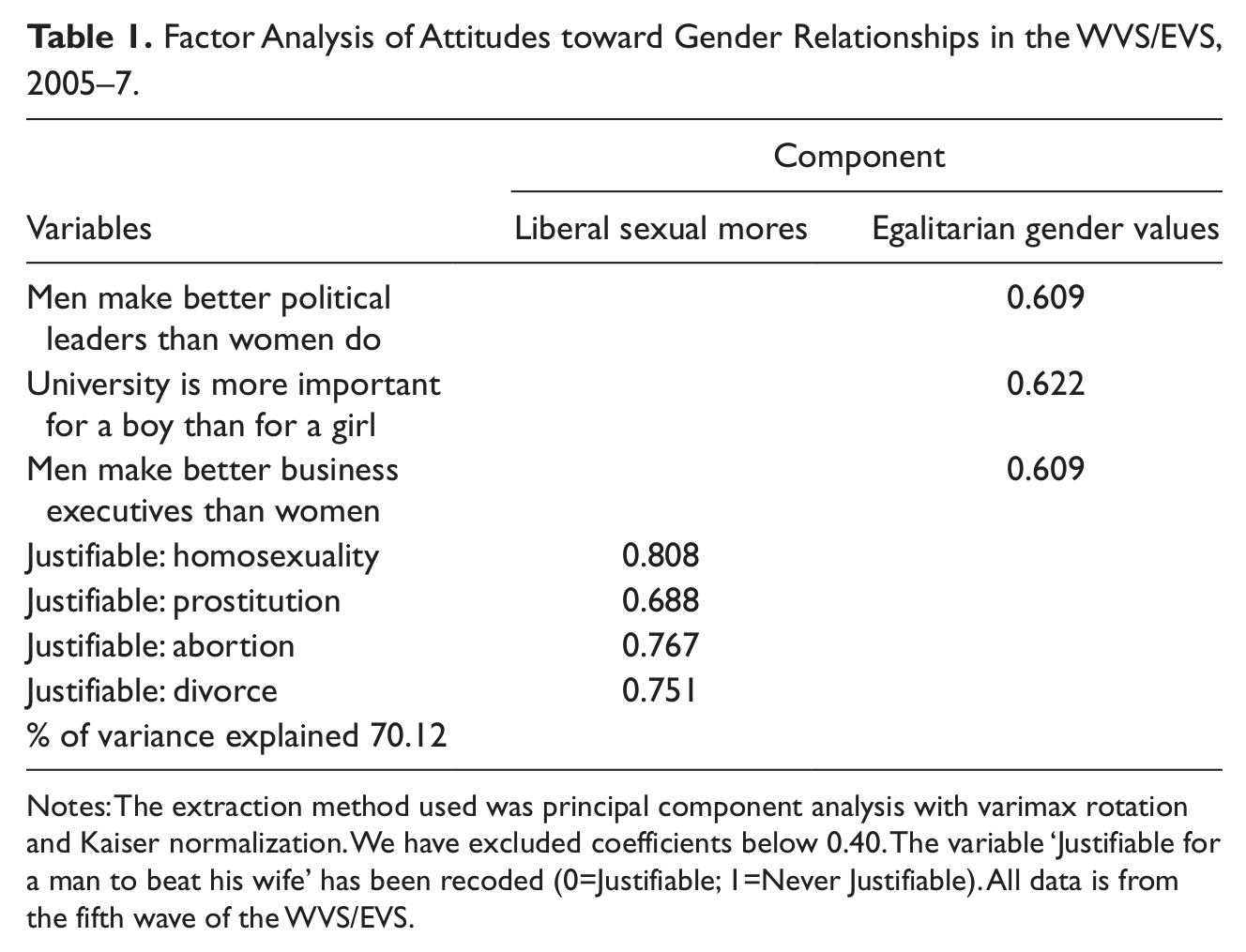
Notes: The extraction method used was principal component analysis with varimax rotation and Kaiser normalization. We have excluded coefficients below 0.40. The variable ‘Justifiable for a man to beat his wife’ has been recoded (0=Justifiable; 1=Never Justifiable). All data is from the fifth wave of the WVS/EVS.
In order to measure liberal sexual values, we devised a scale using four questions related to the justifiability of abortion, divorce, homosexuality, and prostitution. This is similar to the scale found in Inglehart and Norris (2009). Responses to these questions were on a 10-point scale with a low value signifying less support for liberal sexual mores. Similar to the scale for egalitarian gender values, the responses to these four questions were added and standardized to a scale of 100.
That these items tap into two distinct value dimensions was confirmed using confirmatory principal component factor analysis as shown in table 1. Here we see that the two dimensions captured 70.12% of the variation. Furthermore, a reliability analysis conducted using the variables related to liberal sexual values gave a Cronbach’s alpha of 0.84 which means that these variables are measuring the same thing. A corresponding reliability analysis conducted for the variables related to egalitarian gender values gave a Cronbach’s alpha of 0.78.
Analysis and Results
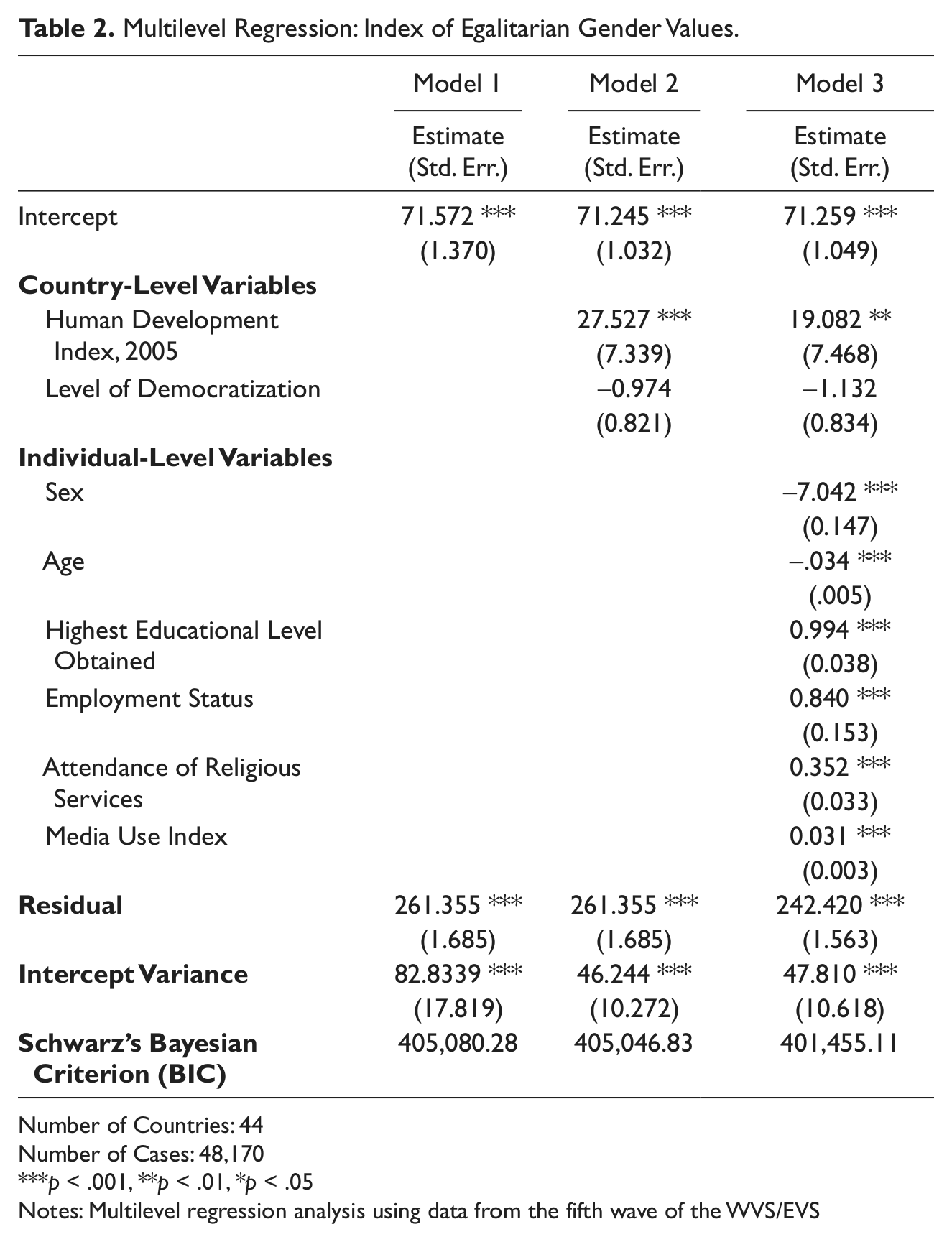
In this section we will test our hypotheses with data from the fifth wave of the WVS/EVS and present the results. In order to test the first two hypotheses, we conducted multilevel regressions with these two indices as dependent variables. The cross-sectional nature of the data meant that multilevel regressions provided the best method for testing the hypotheses. We conducted two sets of analyses, one with index of egalitarian gender values and the other with the index of liberal sexual mores as the dependent variables. The independent variables were the same for both the analyses and fall into the two categories of country-level and individual-level variables. The former includes the Human Development Index and the Level of Democratization for 2005. 8 The individual-level variables, taken from the WVS/EVS, are age, sex (male = 1, female = 0), highest educational level obtained, employment status (1 = paid work, 0 = unpaid work), frequency of attendance of religious services (1 = more than once a week, 8 = practically never), and the individual’s media use index. The last variable was calculated using responses to the use of newspapers, radio / television, and the internet to access news media and is the same index constructed by Inglehart and Norris (2009). As is usual in multilevel analysis, the independent variables were grand mean-centered for ease of interpretation. All the independent variables were entered as fixed components, while the intercept was treated as a random component, capturing the variability across groups—in this case nations.
Multilevel Regression: Index of Egalitarian Gender Values.
Number of Countries: 44
Number of Cases: 48,170
p < .001, **p < .01, *p < .05
Notes: Multilevel regression analysis using data from the fifth wave of the WVS/EVS
Multilevel Regression: Index of Liberal Sexual Mores.

Number of Countries: 44
Number of cases: 48,170
p < .001, **p < .01, *p < .05
Notes: Multilevel regression analysis using data from the fifth wave of the WVS/EVS.
The results of the multilevel regression analyses are shown in tables 2 and 3. With both dependent variables, Model 1 is a simple Analysis of Variance (ANOVA) where we can see that the intercept variance is significant. This means that significant differences exist between countries and provides support for the multilevel regression model. Model 2 shows the multilevel model with only the country-level variables while Model 3 includes the individual-level independent variables as well. The beta estimates provided in the tables can be interpreted as showing the level of increase in the dependent variable for a unit increase in the independent variable. For both dependent variables, the individual-level predictors were significant and with the expected sign which was the same for both dependent variables. The regression analysis tells us that those who would have greater liberal sexual mores and egalitarian gender values are: women, the younger generation, better educated, with paid employment, less attendance of religious services, and greater media use. The difference in values between men and women was much larger with respect to egalitarian gender values than it was for liberal sexual mores. For the country-level variables, we see that the HDI is not a significant predictor of liberal sexual values while the level of democratization is. Here, we see that a greater level of democracy in a country gives us a higher index of liberal sexual mores. In the case of egalitarian gender values, we can see that highly developed countries have higher levels of gender equality but that the level of democratization is not significant predictor.
While the results show support for our second hypothesis, this is not the case for the first. Our first hypothesis was that both the level of development and democratization should be significant in predicting liberal sexual mores and egalitarian gender values. Our results, using data from the fifth wave of the WVS/EVS, show that this is not the case. Both these sets of attitudes, even if they belong to the postmodern syndrome, are not quite explained by the same societal variables. Our results show that in the full model with country-level and individual-level predictors, development is a significant predictor for egalitarian gender values whereas level of democracy is not. The situation is reversed for liberal sexual mores where level of democracy is significant and development is not. However, the picture is a little more nuanced than that and suggests an interaction which is not captured in the models presented here. For the index of liberal sexual mores as the dependent variable, Model 2 (the one with only country-level variables) shows us that both the HDI and level of democratization are significant. However, with the addition of the individual-level variables, the HDI ceases to be significant. This suggests some significant cross-level interactions between the HDI and individual-level variables. 9
Turning our attention to attitudes regarding IPVAW, we find that across all societies, 76% of the population doesn’t support intimate partner violence in any form. There are, however, marked differences between agrarian, industrial, post-industrial societies. 10 As shown in figure 1, 87% of the population of post-industrial societies does not justify IPVAW while the corresponding figure is 83% for industrial and 62% for agrarian societies. We infer from this that the level of development plays an important role in determining attitudes towards physical IPVAW, thus lending support to our fourth hypothesis.
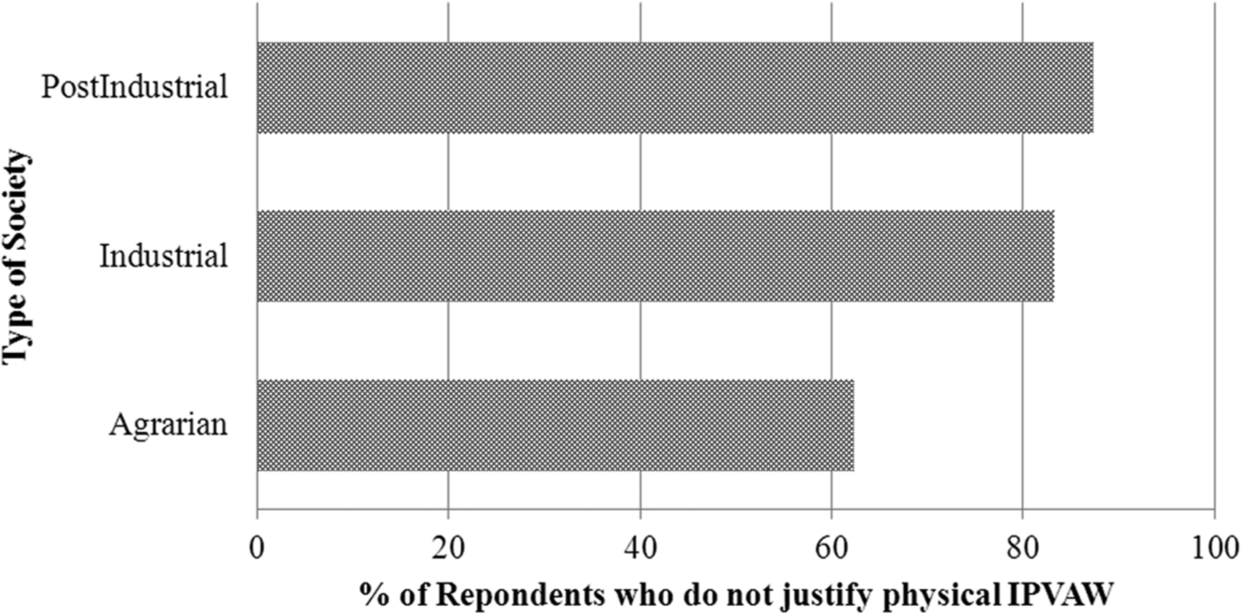
Percentage of respondents who never justify intimate partner violence by type of society.
In order to test our third and fifth hypotheses, we need to look at the relationship between egalitarian gender values, liberal sexual mores, and attitudes towards gender violence. Since there is a marked difference in the percentage of people justifying IPVAW in different types of societies, it makes sense to take a separate look at agrarian, industrial, and postindustrial societies.
Figures 2, 3, and 4 show the average level of the indices of egalitarian gender values and liberal sexual mores for individuals with a given attitude on IPVAW. Here, we present three separate graphs for agrarian, industrial, and post-industrial societies. In post-industrial societies we see that while individuals who justify IPVAW have a lower score on the index of egalitarian gender values, the trend for the index of liberal sexual mores is not as clear. Industrial and agrarian societies show clear trends where those who justify IPVAW have higher scores on the index of liberal sexual mores. In addition, agrarian societies show a clear trend where those who justify IPVAW have lower egalitarian gender values. Thus, we find some preliminary support for our third hypothesis (namely that across all societies, individuals with higher levels of egalitarian gender values will not justify IPVAW).
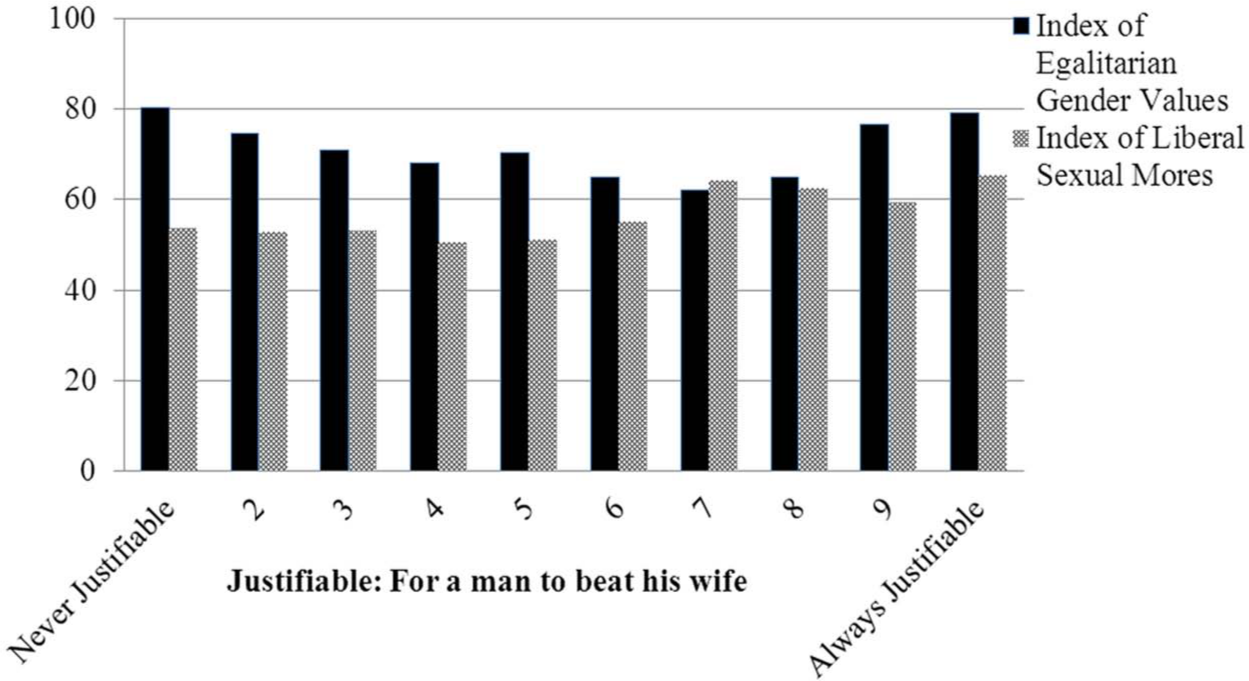
Postindustrial Societies: Mean values of the Index of Egalitarian Gender Values and Liberal Sexual Mores by Justification of Intimate Partner Violence.
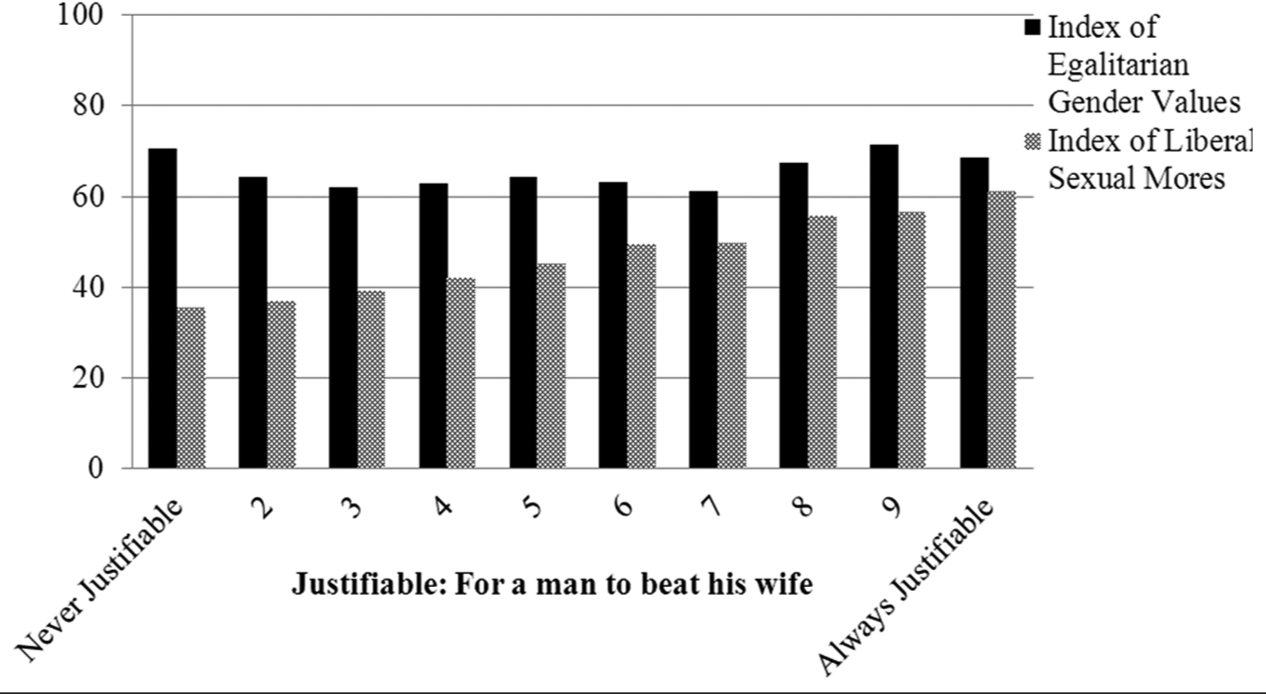
Industrial Societies: Mean values of the Index of Egalitarian Gender Values and Liberal Sexual Mores by Justification of Intimate Partner Violence.
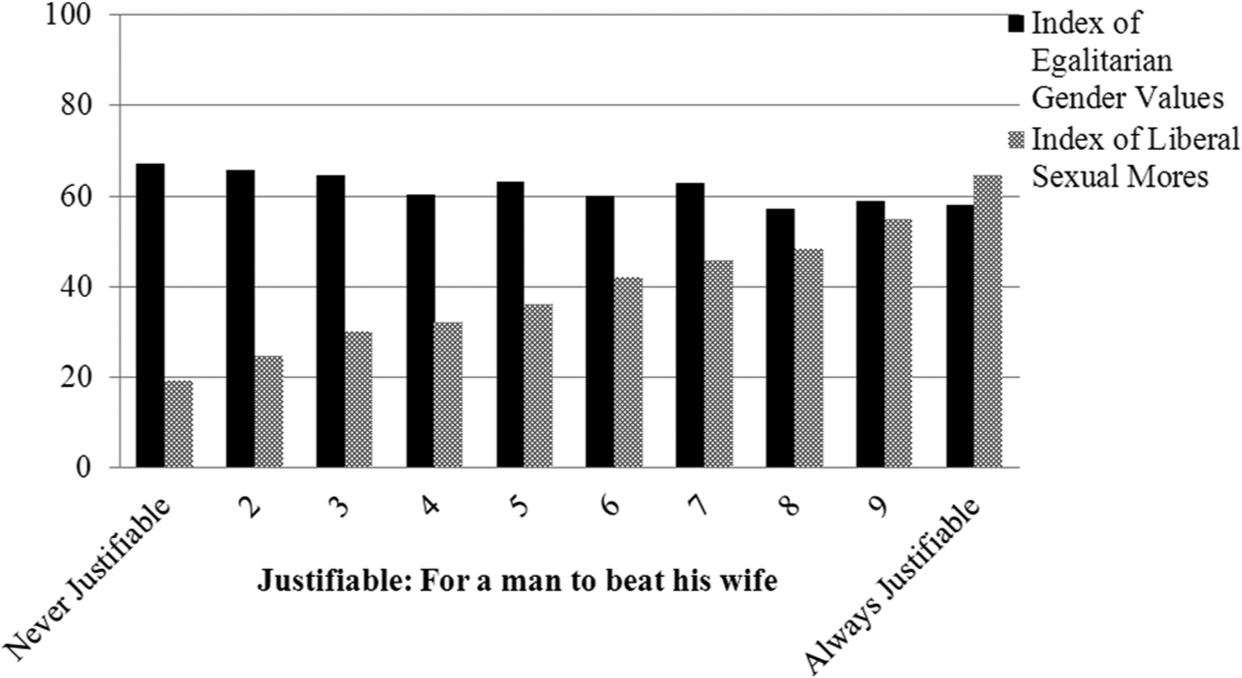
Agrarian Societies: Mean values of the Index of Egalitarian Gender Values and Liberal Sexual Mores by Justification of Intimate Partner Violence.
Looking closely at egalitarian gender values and the justification of IPVAW, we see in figure 5 that across all three types of societies, individuals who say that IPVAW is never justifiable have, on average, higher levels of egalitarian gender values than those who justify IPVAW. We used an independent, two-sample means test to confirm that this difference in mean values was indeed statistically significant. In this analysis, equal variances were not assumed between the two samples. We present the results in table 4. Across all three kinds of societies, we find the difference in means to be statistically significant, hence lending support to our third hypothesis. One interesting result is that the difference in the means of egalitarian gender values decreases from postindustrial to agrarian societies.
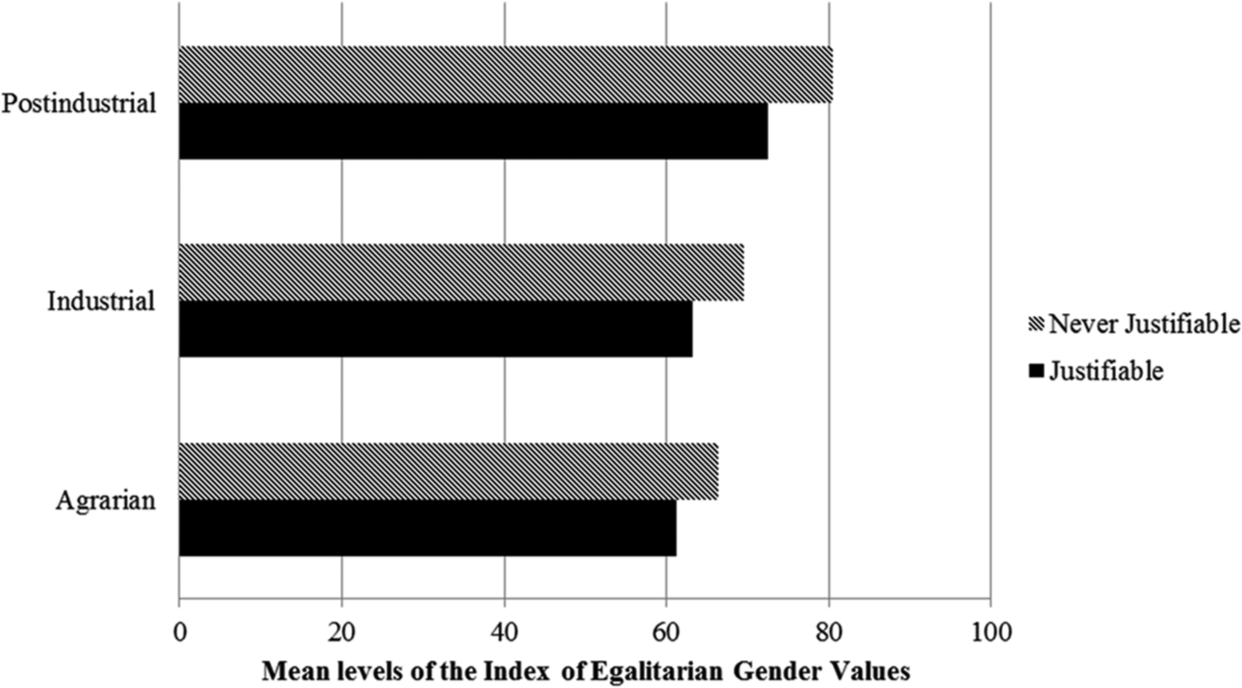
Average values of the Index of Egalitarian Gender Values for individuals who do and do not justify IPVAW.
Independent two-sample means test between the Index of Egalitarian Gender Values for those who do and do not justify IPVAW.
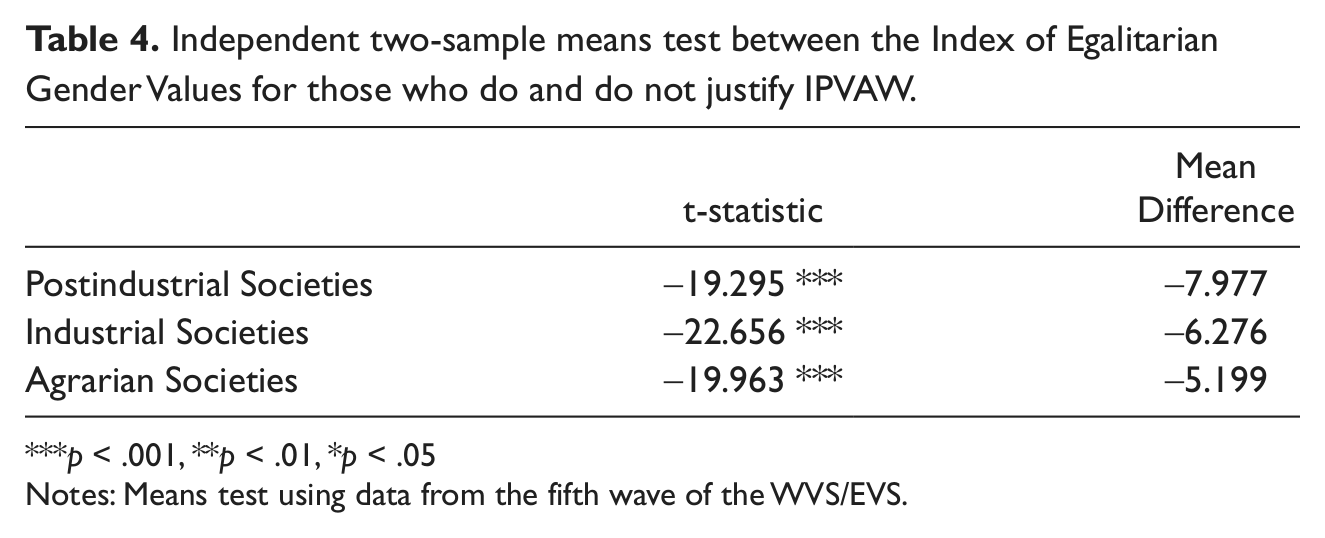
p < .001, **p < .01, *p < .05
Notes: Means test using data from the fifth wave of the WVS/EVS.
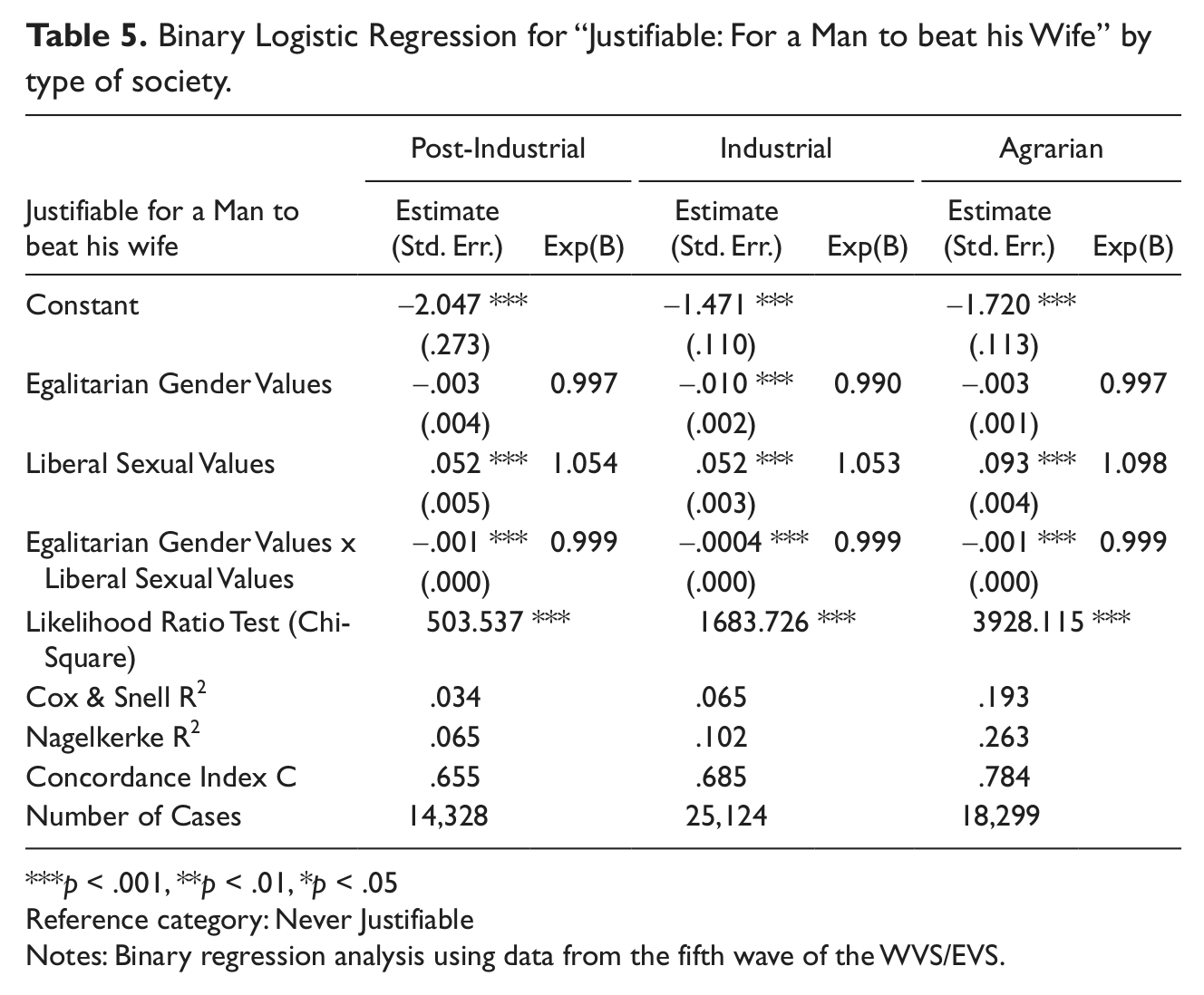
The analysis thus far does not tell us much about the combination of egalitarian gender values and liberal sexual mores and any interaction between them. As the theory behind our fifth hypothesis suggests, both these sets of values are part of rising self-expression. Hence, higher levels of both should lead to a decrease in support for IPVAW among individuals in postindustrial societies. But how do these sets of values affect the justification of IPVAW in industrial and agrarian societies? In order to find out, we conducted regression analysis. However, a linear regression was deemed unfit because the dependent variable (“Justifiable: For a man to beat his wife”) is not normally distributed—the vast majority of all responses are at ‘never justifiable’ on the ten point scale. The ten point scale is itself unnecessary as we are mostly interested in understanding under which value orientations IPVAW is justifiable (or not). Furthermore, collapsing the ten point scale into a binary of justifiable / not justifiable allows us to conduct binary regression analysis giving us the probability that a person will / will not justify IPVAW for a particular value orientation. Hence, all the responses from two to ten on the scale were recoded as zero, while one remained ‘never justifiable’. For the binary logistic regression, this recoded variable was the dependent while the indices of egalitarian gender values and liberal sexual mores, along with the interaction between the two, were the independent variables. The regression analysis does not include any demographic control variable as we are here only interested in the relationship between justification of IPVAW and value orientations. The one variable which we do control for is the type of society (agrarian, industrial or post-industrial) of the respondent. Conducting three separate regressions for these three types of societies allows us to understand the different value orientations behind the justification of IPVAW in these societies.
The results of the regressions are shown in table 5. The model was an improvement over the intercept-only model, as evidenced by the likelihood ratio test, for data from all three types of societies. From the table, we see that the model was a much better fit for agrarian societies than it was for industrial and postindustrial societies. This can be seen from the pseudo-R2 and the c-statistic. For postindustrial societies, the model has c-statistic of 0.655. This means that for a pair of individuals—one who justifies IPVAW and the other does not—the model correctly assigns a higher probability in 65.5% of the cases. Hence, for this statistic, a higher value means that the model is a better fit for the data and so we see that the data for agrarian societies, with a c-statistic of 78.4%, fits the model much better than industrial or postindustrial societies.
Binary Logistic Regression for “Justifiable: For a Man to beat his Wife” by type of society.
p < .001, **p < .01, *p < .05
Reference category: Never Justifiable
Notes: Binary regression analysis using data from the fifth wave of the WVS/EVS.
Due to the presence of the interaction term, the binary regression cannot be interpreted easily by looking at the odds ratios of the variables. In order to aid with the interpretation, we present three graphs which show the probability that an individual will justify intimate partner violence at given levels of egalitarian gender values and liberal sexual mores. There is one graph each for agrarian, industrial, and post-industrial society.
From figure 6, we see that in postindustrial societies, higher levels of egalitarian gender values and liberal sexual mores indicate that an individual will, in all likelihood, not justify IPVAW. Indeed, in postindustrial societies, it is only at very low levels of egalitarian gender values that the probability that an individual justifies IPVAW is high. From figures 6, 7, and, 8, we see that at low levels of liberal sexual values, the probability that an individual will support IPVAW is low (below 20% in all societies). The graphs also show us that at low levels of egalitarian gender values, increases in liberal sexual mores leads to increases in the probability that an individual will justify IPVAW. While this effect is present across agrarian, industrial and postindustrial societies, we find that in agrarian and industrial societies, increasing levels of liberal sexual mores lead to higher probabilities that IPVAW will be justified for even moderately high levels of egalitarian gender values. Only at very high levels of egalitarian gender values does the effect of rising liberal sexual mores not lead to an increase in the probability that IPVAW will be justified. In postindustrial societies, even for moderate levels of egalitarian gender values, we see the increasing levels of liberal sexual values do not lead to an increase in the probability that IPVAW will be justified.
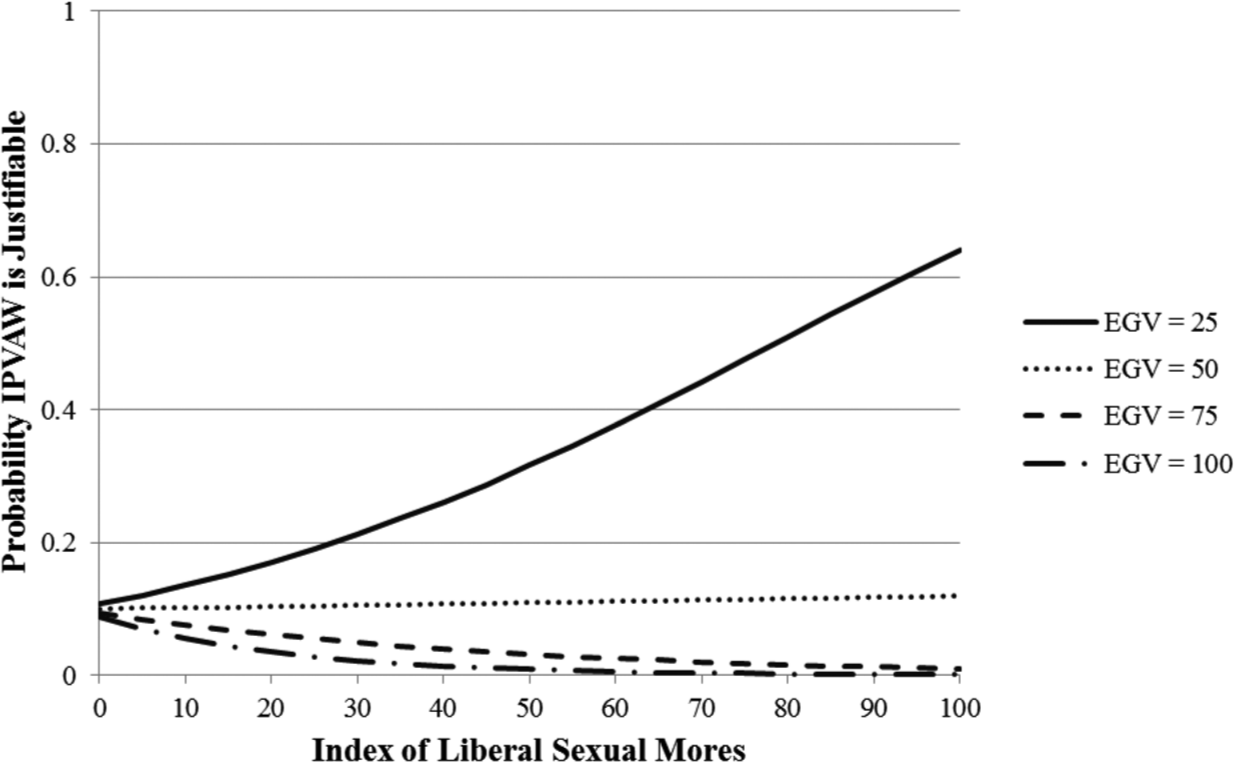
Postindustrial Societies: Probability that IPVAW is Justifiable for given values of the Index of Egalitarian Gender Values (EGV) and Liberal Sexual Mores.

Industrial Societies: Probability that IPVAW is Justifiable for given values of the Index of Egalitarian Gender Values (EGV) and Liberal Sexual Mores.
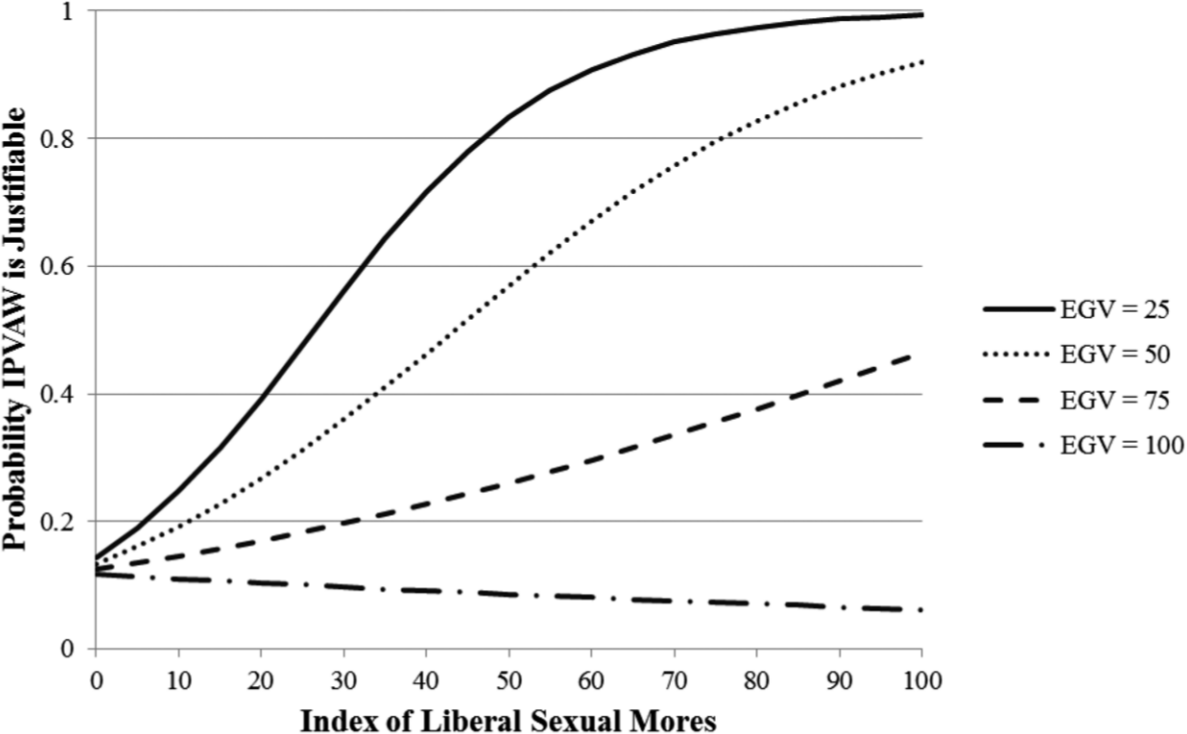
Agrarian Societies: Probability that IPVAW is Justifiable for given values of the Index of Egalitarian Gender Values (EGV) and Liberal Sexual Mores.
Conclusions
In this paper, we have seen how the revised theory of modernization helps us explain egalitarian gender values, liberal sexual mores, and attitudes towards IPVAW. Interestingly, the inter-play between these three sets of attitudes is different in societies at different stages in the modernization process. Looking back at our first hypothesis and the results we obtained, we find that development is positively associated with higher levels of gender egalitarianism and liberal sexual mores. However, it is a little surprising that in our model, the level of democratization is not a significant predictor of egalitarian gender attitudes. And as far as liberal sexual attitudes are concerned, the level of development is not a significant predictor in the full model with all individual-level variables, though there is strong evidence of cross-level interactions. Why might this be? Gender equality, as mentioned before, is concerned with equality and liberal sexual values are concerned with liberal individual rights. Hence, one way of interpreting the results would be to note that development is crucial for social justice whereas democracy is necessary for liberal individual rights. For postindustrial societies, both these attitudes are components of the broader postmaterialist syndrome. In these societies, where development and democracy coincide and survival is not a concern, there is no inconsistency in supporting both equality and liberal individual rights; one does not come at the expense of the other.
As far as the individual level predictors—sex, age, educational level, employment status, frequency of attendance of religious services, and media use—are concerned, we find them to be significant with the same sign for both egalitarian gender attitudes and liberal sexual mores. People with the following characteristics score higher with both sets of values: women, the younger generation, better educated, with paid employment, less attendance of religious services, and greater media use. Looking at the coefficients, we see that the difference between men and women is greater with respect to gender equality than it is with liberal sexual mores. Because gender equality is connected with social justice, women support it as it permits them participate in society as the same way as men. Similarly, as liberal sexual mores are connected with the views about how to organize sexuality in society the difference between men and women is not as large. For all countries women are a little more liberal than men because we are talking about issues that directly affect their personal right to choose concerning the sexuality and family.
Moving onto attitudes about IPVAW, the preliminary analysis that we carried out shows that the support for the IPVAW is not extensive; 76% of all respondents do not justify IPVAW at all. However, our result contradicts the idea of those who maintain that IPVAW exists because the public supports it. Only a minority of all respondent—and a small minority in postmodern societies—justify the IPVAW. As feminists maintain, our results show that inegalitarian gender attitudes increase the probability that an individual will support IPVAW. However, this is not the complete picture. If we take into account the interaction between egalitarian gender values and liberal sexual mores, we see that individuals with low levels of both sets of values—namely, those within the fold of the traditional family—will, with very low probability (less that 20% across all societies) justify IPVAW. Hence, we can conclude that those who do justify IPVAW have inegalitarian gender attitudes but that not everyone with inegalitarian gender attitudes will justify IPVAW.
But why might this be? After all, most feminist theories predict that it is exactly those within the structure of the traditional patriarchal family who support IPVAW. However, as we have shown in our analysis, this is not the case. To us, it looks like our results shed light on a paradox observed by Kate Millett (1971, p. 46). Drawing on Hannah Arendt’s (1969) work on power and violence in the political realm, Millett noted that while violence is an instrument by which men maintain power over women, it is not the most important one. As a system of power, patriarchy needs legitimacy. And violence, in the long run, destroys legitimacy and hence is a threat to power. So, following this line of reasoning, we speculate that in a patriarchal system where everyone respects the status quo, violence has no place. We would expect—and indeed do see—greater justification of IPVAW when the traditional family system breaks down. This case is best exemplified by individuals in agrarian and industrial societies who hold inegalitarian attitudes towards gender while at the same time are quite liberal in their attitudes towards sexuality. These individuals are not within the traditional family as they have higher levels of support for abortion, divorce, homosexuality, and prostitution and yet are not egalitarian in their attitudes about gender. It is exactly these individuals who, with high probability, justify IPVAW. Hence in agrarian and industrial societies, increasing justification of IPVAW goes hand in hand with increasingly liberal views towards sexuality, except for individuals with highly egalitarian gender values. This helps explain why some feminist movements in these societies do not make any strong claims regarding homosexuality, abortion, divorce, and prostitution as these are regarded as individualist western influences. Instead they choose to focus on reducing disparities between men and women in access to education, employment, and welfare while defending the sanctity of the family.
Discussion and limitations of the study
The originality of our study is derived from the idea that levels of development interact with social attitudes on various issues to encourage or discourage attitudes that justify IPVAW using the WVS/EVS. We have been able to detect some of the factors that influence attitudes toward IPVAW at the macrosystem level, and specifically the relationship between egalitarian gender values and liberal sexual mores. As some studies have shown, IPVAW is not normatively acceptable for any ethnic group (Fanslow, et al., 2010) and, since our analysis is significant, the definition of violence contained in the sentence ‘justifiable for a man to beat his wife’ is not culturally specific, as some author have found trying to develop cross-cultural research (Mason, et al., 2008). Corroborating the work of other authors, the results of our analyses show that higher levels of egalitarian gender attitudes are positively related to better attitudes toward violence against women (Sugarman & Frankel, 1996; Flood & Pease, 2009). Also, our results are coherent with the idea that at a macrosystem level, the attitudes about gender equality as pertaining to IPVAW are clearly related to socioeconomic modernization of a given society—a result which supports the general hypothesis of socialist feminists. Because there are no studies that try to connect gender equality and sexual liberal mores in the broad configuration of attitudes about IPVAW, we cannot compare our results. In this case, we think that this study is a new way to explore attitudes about IPVAW at a macrosystem level. In any case, our results suggest that attitudes about IPVAW are also connected to attitudes about liberal sexual mores, not only gender equality.
Of course, there are a number of limitations in our present study. First, the single measure of attitudes toward IPVAW can be considered problematic, particularly for cross-national data. We are aware that it is possible to find multiple context specific meanings of ‘beating one’s wife’, depending on the culturally approved bonds (Counts, et al., 1999). However, this objection would remove the scope of much cross-cultural research, at least in this field. We suggest that our result should be tested with other sources of data—quantitative and qualitative—in order to confirm the consistency of relationships between the variables. Second, there are limits derived from our data source. One of them is that we have complete available data for only 44 countries and it would be better to have more countries. Also, we are focused on only one way to express the acceptability of one type of partner violence and we cannot be sure that this kind of violence has “an international language”, as Mason, et al. (2008) put it. Finally, it would be interesting to compare this result with a similar analysis of later waves of the World Value Survey. In this way we could explore these attitudes in a longitudinal perspective.
Footnotes
Appendix A
Appendix B
Appendix C
Acknowledgements
The authors thank Ronald Inglehart for his support and advice. Finally, much of this article was written at the Institute for Social Research at the University of Michigan, MI, USA, which remains, as always, a great place to work.
Declaration of Conflicting Interests
The author(s) declared no potential conflicts of interest with respect to the research, authorship, and/or publication of this article.
Funding
The author(s) disclosed receipt of the following financial support for the research, authorship, and/or publication of this article: Pilar Rodríguez received funding for this research from the Ministerio de Educación (Spain), under a scholarship (PR2010-0595) for research at the University of Michigan (Institute for Social Research) from March to August 2010.