



Abstract
It was hypothesized that societies that put greater emphasis on men being rigidly committed to culturally accepted models of masculinity (nations with high Hofstede MASculinity scores) would report higher mean national levels of masculine gender role stress (MGRS) than societies that emphasize such to a clearly lesser extent (low national MAS scores). Supporting this expectation, a large country-level correlation of +.64 (p = .01) was found across 13 countries (n = 6,420) between national MAS scores and national MGRS scores. In line with previous findings, Hofstede’s MAS measure was found to be conceptually distinct from Bem’s measure of instrumentality. Implications for intervention and further studies are briefly pinpointed.
Masculine gender role stress is a theoretical construct that describes the stress created in men when they feel they are not meeting society’s expectations for masculine behavior, or when the situation forces men to act in feminine-typed ways. The stress produced by these feelings or actions are thought to be related to negative psychological and behavioral outcomes.
Copenhaver and Eisler (1996) developed a set of propositions that could help explain the development of masculine gender role stress in men. These propositions could also help explain how masculine gender role stress may lead to mental and physical health problems in men. In developing these, the authors based themselves on three theories. These are (a) the theory of Bem (1981a) that gender role schema predispose men to view the world through masculine-tinted cognitive lenses, (b) the view of Pleck (1995) that culturally imposed masculinity predisposes men to masculine gender role strain, and (c) the work of Lazarus and Folkman (1984) on the crucial role of cognitive appraisal in responding to stress.
Copenhaven and Eisler (1996) argued as follows. There are significant gender differences in the specific situations that men and women appraise as stressful. The sociocultural contingencies that reward masculine attitudes and behaviors, while punishing nonmasculine attitudes and behaviors, result in the development of masculine cognitive schemata in the vast majority of men. These schemata, reinforced by peers and adult role models, eventually operate through a self-evaluation process to provide the basis for what men see as proper personal characteristics and behavioral displays. The masculine cognitive schemata are then used by men in varying degrees to appraise potential threats and challenges from the environment as well as to evaluate and guide their choice of coping responses.
However, strong commitment to masculine cognitive schemata is hypothesized to restrict the types of coping strategies available to men in particular situations. By implication, masculine gender role stress may result from excessive reliance on culturally approved masculine schemata that hamper the individual man in his objective appraisal of threatening situations and permit him a limited range of gender-linked approved coping strategies to deal with stress (Lazarus & Folkman, 1984). This, in turn, may predispose men to behavioral patterns (e.g., excessive alcohol consumption, aggression) that are unhealthy or dysfunctional (Copenhaver & Eisler, 1996; Eisler, 1990a; Eisler & Skidmore, 1987; Eisler & Blalock, 1991).
Thus, the concept of masculine gender role stress is based on the paradigm that gender related differences in the way men appraise environmental, behavioral, and perceptual events are directly related to their experience of stress, which may increase vulnerability to physical and psychological disorders (e.g., Selye, 1976).
In order to explore some of the relationships between masculine gender role stress and dysfunctional behavior patterns in men, Eisler and Skidmore (1987; Eisler, Skidmore, & Ward, 1988) developed the Masculine Gender Role Stress (MGRS) Scale. Its items support the conceptualization that men are most prone to psychological stress in situations that are appraised as feminine (e.g., emotional expressiveness), and/or threatening to male control (e.g., subordination to women) or competence (e.g., performance failure). Higher scores on the MGRS scale point to stronger appraisal of stress.
Among other things, Eisler et al. (1988) found in U.S. undergraduates that in spite of the MGRS Scale being highly correlated with anger in men, but less so in women, it was more strongly related to cognitive and somatic anxiety in women than in men. The MGRS Scale was also inversely correlated with good health practices. MGRS scores have also been shown in U.S. samples to be associated with male intimate abusiveness (Copenhaver, Lash, & Eisler, 2000; Eisler, Franchina, Moore, Honeycutt, & Rhatigan, 2000; Franchina, Eisler, & Moore, 2001; Jakupcak, Lisak, & Roemer, 2002), with men’s fear of emotions (Jakupcak, Salters, Gratz, & Roemer, 2003), with Type A behavior, hostility, personal loss, life dissatisfaction, and elevated systolic and diastolic blood pressure in both men and women (Watkins, Eisler, Carpenter, Schechtman, & Fisher, 1991), in Dutch clinical and nonclinical samples with phobic and obsessive-compulsive behavior (Arrindell, Kolk, Pickersgill, & Hageman, 1993; Arrindell, Kolk, Martín, Kwee, & Booms, 2003), and in Chinese human service professionals with symptoms of burnout such as emotional exhaustion and depersonalization (Tang & Lau, 1996). Thus, investigators are beginning to address the concept of masculine gender role stress in different national settings. Studies testing specific hypotheses about cross-national differences in masculine gender role stress, however, have not yet appeared in the literature. The present study attempts to fill this void.
Linking National Culture With National Differences in MGRS
Copenhaver and Eisler (1996) have pointed out that becoming masculine with respect to one’s thoughts, expression of one’s feelings, and behavioral repertoires requires extensive sociocultural education. The development of masculinity is promoted by the developing man’s interaction with adult role models, his peers, and major societal institutions. In their view, many masculine beliefs and behaviors have cultural roots.
Hofstede (1998, p. 5) defines “culture” (or “mental software”) as broad, collective patterns of thinking, feeling, and acting that have important consequences for the functioning of societies, of groups within those societies, and of individual members of such groups. Thus, Hofstede (2001, p. 9) treats culture as the collective programming of the mind that distinguishes the members of one group or category of people from another. This programming entails that a country’s norms are transferred to the young child in the family, are further developed and confirmed in schools, at universities, in the workplace, in political life, and even in the prevailing religious, philosophical, and scientific ideas (Hofstede, 1998, pp. 17-18).
Hofstede (1980) distinguished between masculine and feminine societies. At the national level, Masculinity and Femininity refer to the dominant gender role patterns in the vast majority of both traditional and modern societies: the patterns of male assertiveness and female nurturance (Hofstede, 1980, p. 277; Hofstede, 2001, p. 284). In Hofstede’s terms (2001, p. 297), Masculinity stands for a society in which gender roles are clearly distinct: Men are supposed to be assertive, tough, and focused on material success, whereas women are supposed to be more modest, tender, and concerned with the quality of life. Femininity stands for a society in which gender roles overlap: Both men and women are supposed to be modest, tender, and concerned with the quality of life.
Empirical data with country-level indices have shown in relation to gender roles that in feminine countries men are allowed to be gentle, feminine, and weak, whereas in masculine ones women should be gentle and feminine and nobody should be weak. In feminine countries, macho behavior (i.e., ostentatious manliness) is ridiculed, whereas in masculine ones machismo in men, and marianismo (i.e., a combination of near saintliness, submissiveness, and frigidity) or hembrismo (i.e., extreme femininity, passivity, and self-abnegation) in women are propagated (Hofstede, 2001, p. 312).
Thus, in masculine (“tough”) societies, men are socialized and mentally programmed to be more skilful, performance-oriented (in all areas of life), competitive, successful, assertive, aggressive, macho and sex-typed, yet, perhaps by implication, also more fearful of expressing soft emotions than men in feminine (“tender”) societies. This leads to the first hypothesis, namely that masculine countries would, on average, report more masculine gender role stress since noncompliance to sex-typed behavior would induce greater threat, fear or distress due to the relevant gender roles being cognitively more strongly linked with the need for achievement, for excelling, for winning and for other positive reinforcements, and hence with the fear of failure and of punishment, than would be the case in feminine countries.
Accordingly, the first aim of the present study was to test the prediction that scores on Hofstede’s MAS dimension would correlate positively with national MGRS scores. In testing this hypothesis, the level of stress already present in a society was also taken into account. This was done by using the scores on a second dimension also derived by Hofstede termed uncertainty avoidance. Hofstede (2001, p. 161) described his uncertainty avoidance index (UAI), which is positively associated with neuroticism-anxiety, as a measure of the extent to which members of a society feel threatened by uncertain or unknown situations.
National Instrumentality and National Differences in MGRS
A second aim of the present study was to determine the differential capabilities of Hofstede’s MAS dimension and the gender role-related personality trait of masculinity to predict MGRS. Masculinity is oftentimes also referred to as instrumentality (e.g., Hermann & Betz, 2004) and was measured with the Bem Sex Role Inventory (BSRI; Bem, 1981b). The BSRI is based on a conceptualization of the traditionally sex-typed person as someone who is highly attuned to cultural definitions of sex-appropriate behaviors and who uses such definitions as the ideal standard against which her or his own behavior is to be evaluated. In this view (Bem, 1974, 1981b), the traditionally sex-typed person is motivated to keep her or his behavior consistent with an idealized image of masculinity or femininity, a goal that (s)he presumably accomplishes both by selecting behaviors and attributes that enhance that image and by avoiding those that violate it. Thus, the BSRI contains items that were chosen on the basis of cultural definitions of sex-typed social desirability. However, the BSRI is not a measure of gender role-related stress. At the individual level, MGRS has been shown, in line with prediction, to be distinct from, that is, uncorrelated or only very lowly associated with, masculinity (Arrindell et al., 1993; Eisler & Skidmore, 1987; van Well, Kolk, & Arrindell, 2005). Moreover, at the country level, MAS has been demonstrated to be unrelated to the masculine gender role (Best & Williams, 1998). Thus, the joint and independent contributions of Hofstede’s MAS and country-level masculine gender role scores in predicting country-level MGRS scores were also assessed. Several theories relating gender role orientation to mental and physical health have been summarized in the literature (see Davidson-Katz, 1991). The theory that has accumulated the most empirical support is the “masculinity hypothesis.” It proposes that the more masculine one is, the healthier one will be. Paralleling the significantly negative associations that have been reported at the individual level between the masculine gender role and measures of negative affect (e.g., Whitley, 1984), it was anticipated that, at the country level, high masculine gender role scores as assessed with the BSRI would predict significantly lower levels of MGRS. To avoid semantic and conceptual confusions between Hofstede’s MASculinity and Bem’s masculinity dimensions, the latter will henceforth be referred to as instrumentality.
To counteract the potential tendency of respondents to overreport good or underreport bad behavior, which could interfere with the interpretation of average tendencies on MGRS and BSRI, the part played by cross-national differences in Lie-Social Desirability responses on the outcome of hypothesis testing was also addressed.
Method
Participants
A dataset comprising 13 national students samples served as the basis for the study.
Data were collected from a total of 6,543 volunteer undergraduate students. Specifically, the following countries were involved: Australia (n = 701; 253 males, 448 females), Croatia (n = 647; 190 males, 457 females), Germany (n = 357, 74 males, 283 females), Great Britain (n = 249; 98 males, 151 females), Greece (n = 446; 169 males, 276 females), Guatemala (n = 469; 208 males, 261 females), Hungary (n = 401; 143 males, 258 females), Italy (n = 1,057; 475 males, 581 females), Japan (n = 275; 115 males, 160 females), the Netherlands (n = 405; 140 males, 265 females), Spain (n = 689; 303 males, 386 females), Sweden (n = 385; 184 males, 200 females), and Venezuela (n = 462; 164 males, 298 females). Variable ns are due to missing data on gender. The average age of the students across the different national samples ranged from 20-25 years (SD = 2-8 years). Foreign born and visa students (n = 123 or 1.9%) were excluded from the original national samples, leaving a total of 6,420 participants.
Materials
For ensuring translation equivalence and comparability of measures and findings across national samples, the questionnaire set was translated into each of the different native and dominant languages following standard procedures described in the cross-cultural methodological literature (e.g., Brislin, 1986), and standardized response formats and scoring systems used across research centers. For the purposes of the present study, the following measures were used, with higher endorsement rates pointing to higher scores on the variable as named. As part of a larger test battery, measures were administered in each country in the same order, with state measures being preceded by trait measures.
Masculine Gender Role Stress (MGRS) Scale (Eisler & Skidmore, 1987; Eisler, 1990a)
An MGRS scale comprising 15 items was used. Each item was rated on a scale ranging from not at all stressful (1) to extremely stressful (5). The MGRS scale contained three items from each of five domains, namely Physical inadequacy (“Feeling that you are not in good physical condition,” “Not being able to find a sexual partner,” “Having your lover say that (s)he is not satisfied”), Emotional inexpressiveness (“Telling your partner/spouse that you love him/her,” “Telling someone that you feel hurt by what (s)he said,” “Admitting that you are afraid of something”), Subordination to women (“Being outperformed at work by a woman,” “Having a female boss,” “Being with a woman who is more successful than you”), Intellectual inferiority (“Working with people who seem more ambitious than you,” “Having people say that you are indecisive,” “Working with people who are brighter than yourself”), and Performance failure (“Finding that you lack the occupational skills to succeed,” “Getting passed over for a promotion,” “Being unable to perform sexually”). The theoretical score range on this measure was 15-75.
Short-Bem sex role inventory (s-BSRI)
Ten items with the highest item-remainder correlations with their keyed scale were selected from the original BSRI (Bem, 1981b, p. 13) for measuring instrumentality. The relevant items were “Defend my own beliefs,” “Independent,” “Assertive,” “Strong personality,” “Forceful,” “Have leadership abilities,” “Willing to take risks,” “Dominant,” “Willing to take a stand,” and “Aggressive.” Data supporting reliability and validity of the BSRI were reported by Bem (1981b). The theoretical score range was 10-70.
Eysenck Personality Questionnaire-Revised-Abbreviated (EPQR-A) Lie Subscale
The EPQR-A is a 24-item version of the 48-item short-EPQ-Revised (Eysenck & Eysenck, 1991). The EPQR-A was developed by Francis, Brown, and Philipchalk (1992). For the purpose of the present study, only national scores on the Lie-Social Desirability scale were employed. Data on the structural equivalence of the EPQ for a large number of countries were reported by Barrett, Petrides, Eysenck, and Eysenck (1998). The theoretical score range was 0-6.
Hofstede’s masculinity/femininity (MAS)
Hofstede (1980) collected empirical evidence of differences in culture among paper-and-pencil responses on 14 work-related value items from large samples of employees of subsidiaries of the same multinational business corporation (IBM) in 40 countries (more than 116,000 participants). The 14 work goals were: challenge, living in a desirable area, earnings, cooperation with colleagues, training, (fringe) benefits, recognition, physical working conditions, freedom, job security, career advancement, use of skills, relationship with manager, and personal time for personal or family life. A country-level factor analysis with orthogonal rotation revealed as one of the dimensions a bipolar factor that opposes goals that emphasize a concern for people, inside or outside the organization (femininity), to goals that enhance the person’s ego but which do not imply a concern for others (masculinity).
Extensive validity data are available for this dimension (Hofstede, 1998, 2001).
Hofstede’s uncertainty avoidance index (UAI)
UAI for each of the IBM countries was computed on the basis of the country mean scores on three items that formed one common societal “uncertainty avoidance” syndrome: Rule orientation, employment stability, and job stress. Hofstede (2001, p. 150) notes that the conceptual link between the stress question and the other two items is the mean level of anxiety in a country. When this is higher, people feel more stressed, but at the same time they try to cope with their anxiety by searching for security, which is visible in both rule orientation and employment stability. At the country level, the UAI index is very strongly correlated with neuroticism-anxiety (Hofstede, 2001, p. 156).
Procedure
Students were, where possible, recruited from universities located in different geographical regions of each country and among students who were enrolled in any of the four major areas of science (natural sciences, humanities, life sciences, and social sciences). In the majority of the countries, questionnaires were group-administered.
Anonymity was ensured to maximize candid responses. Financial incentives to participate were not given.
Results
Initial Analyses
There were systematic (overall) differences between the national samples on gender (χ 2 [12] = 127.97, p < .001) and age (F [12, 6407] = 38.50, p < .001). By using the approach of statistical control, these variables were treated as covariates in separate analyses of covariance (ANCOVAs) and controlled for in order to obtain corrected mean MGRS, Instrumentality and Lie scores for each national sample (e.g., Tatsuoka, 1971). In doing so, “country” served as the independent variable and the MGRS, Instrumentality and Lie dimensions as dependent variables in separate ANCOVAs. For each ANCOVA, the joint effects of the covariates were statistically significant (p < .01). However, corresponding observed and adjusted scores were deemed interchangeable as they were very closely to unity associated with one another, r’s (12) = .99, p’s < .01. Yet, for counteracting the influence of the oversampling of women in several countries, it was deemed more appropriate to use the corrected rather than the observed national scores when conducting the main analyses.
Table 1 gives the Hofstede MAS and UAI scores, by nation. It also shows the means for the observed MGRS, Bem’s Instrumentality and Lie scores, by nation. (A survey of the corrected means is available upon request.) Internal consistency reliabilities (Cronbach’s αs) were calculated for each of the individual scales for each national sample. These are also reported in Table 1 (between parentheses) where it will be seen that both the MGRS and Bem’s Instrumentality subscale showed very acceptable levels of internal consistency (.70-.80s) that could be given the qualification fair to good (Cicchetti, 1994). The Lie scale, however, obtained lower levels of internal consistency, in spite of the observation that the mean inter-item correlations (not shown in the Table) across all scales indicated (range: .15-.27) that we are dealing with fairly homogeneous sets of items. Briggs and Cheek (1986) have pointed out that values of the mean interitem r smaller than .10 would indicate that we would be dealing with a heterogeneous set of items.
Survey of National Scores on Hofstede’s Masculinity (MAS) and Uncertainty Avoidance Index (UAI), and Masculine Gender Role Stress (MGRS), Bem’s Instrumentality and Lie Scales (Cronbach’s αs for MGRS, Bem’s Instrumentality and Lie Scales Appear Between Parentheses).
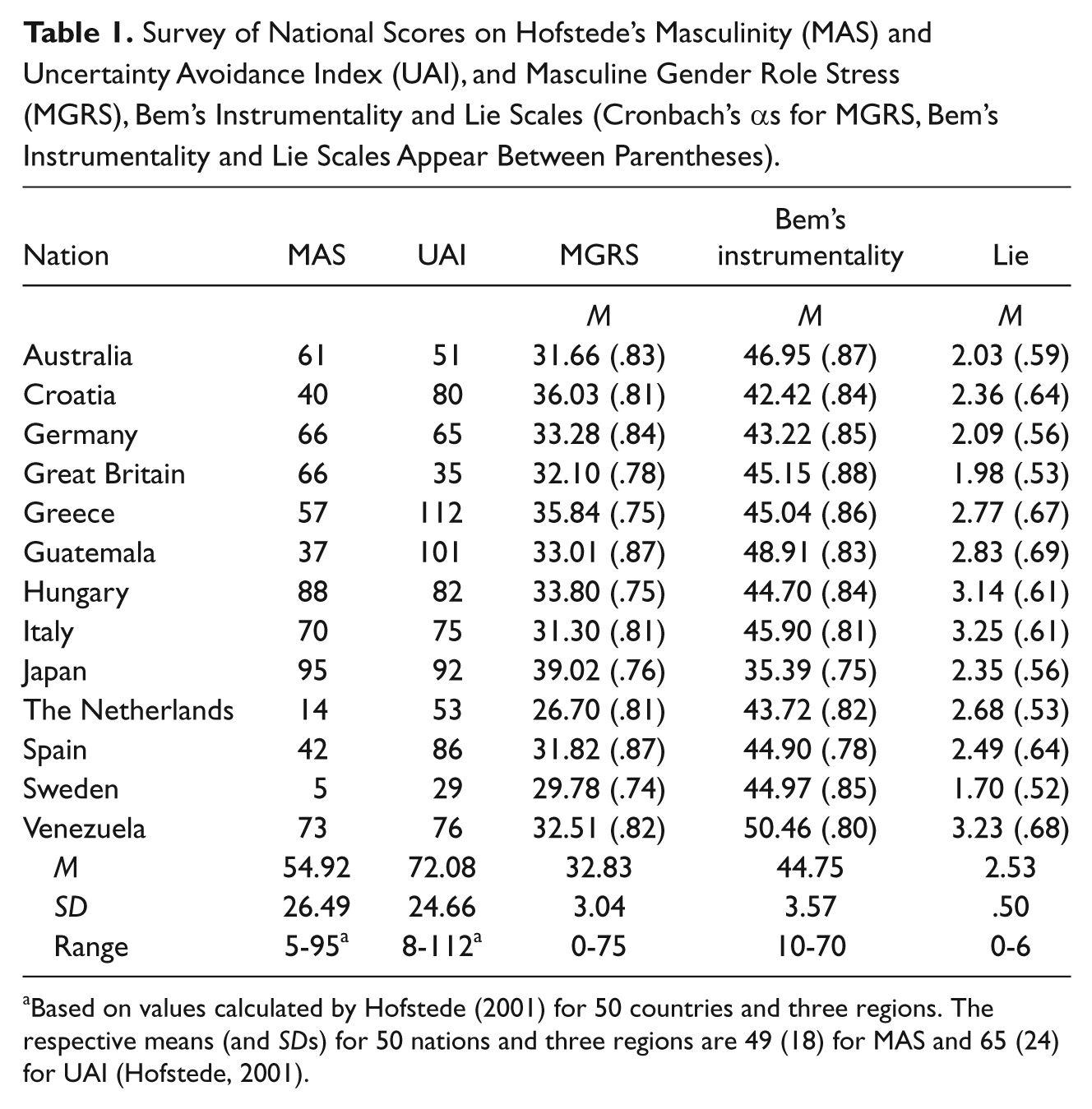
Based on values calculated by Hofstede (2001) for 50 countries and three regions. The respective means (and SDs) for 50 nations and three regions are 49 (18) for MAS and 65 (24) for UAI (Hofstede, 2001).
Main Analyses
Table 2 gives the intercorrelations between the Hofstede MAS and UAI dimensions and the corrected (i.e., adjusted for the eventual influences of cross-national differences in the distributions of gender and age) country-level scores on the MGRS, Bem’s Instrumentality and Lie scales.
Intercorrelations Between the Hofstede Dimensions (MAS and UAI) and Adjusted Masculine Gender Role Stress (MGRS), Bem’s Instrumentality and Lie Scale Scores.
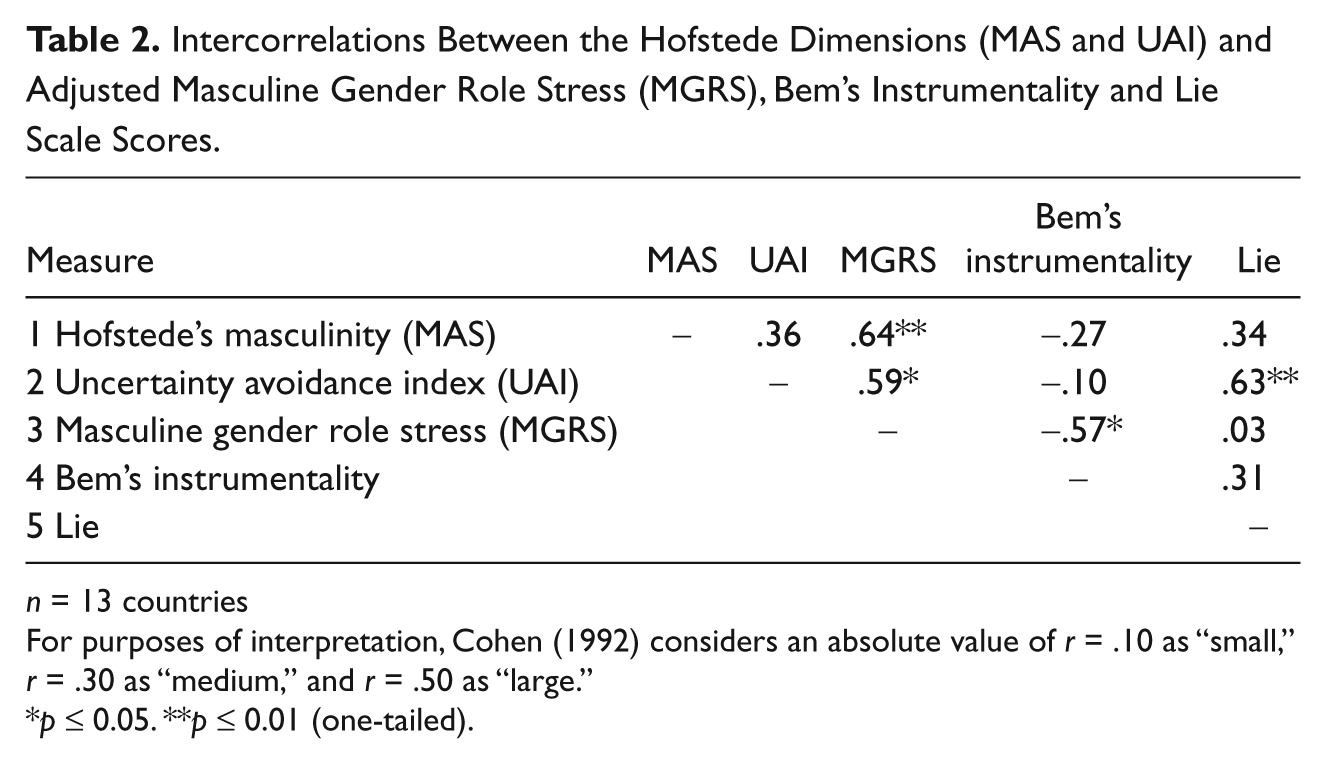
n = 13 countries
For purposes of interpretation, Cohen (1992) considers an absolute value of r = .10 as “small,” r = .30 as “medium,” and r = .50 as “large.”
p ≤ 0.05. **p ≤ 0.01 (one-tailed).
It will be seen that, in line with prediction, Hofstede’s MAS index correlated positively with MGRS, meaning that the more masculine countries had higher MGRS scores. Hofstede’s UAI was also positively associated with MGRS, even after holding constant Lie scores which were significantly positively associated with MGRS scores, pr (10) = .73, p < .01 (partial correlations are not shown in the Table). Thus, countries with high scores on anxiety-emotionality were also the countries with high MGRS scores. When MAS was correlated with MGRS, taking into account the amount of stress already present in society, that is, partialling out UAI scores, the relevant association dropped only slightly, maintained its positive sign and remained statistically significant, pr (10) = .56, p < .05. In line with Best and Williams (1998), Hofstede’s MAS was uncorrelated with country-level scores on Bem’s Instrumentality scale. At the country level, Hofstede’s MAS, Bem’s Instrumentality and MGRS scores were all uncorrelated with Lie scores.
Table 3 gives a summary of the results of a hierarchical regression analysis at the country level of Bem’s Instrumentality and Hofstede’s MAS scores entered at step 1 and 2, respectively, on MGRS scores. It will be seen that, in line with prediction, both country-level Instrumentality and Hofstede’s MAS scores were shown to independently predict country-level MGRS scores. The standardized regression coefficients had opposite signs. Thus, lower country-level scores on Bem’s Instrumentality scale and higher ones on Hofstede’s MAS were predictive of higher country-level MGRS scores. Hofstede’s MAS, which was included at step 2, succeeded in contributing a significant increment to the proportion of variance beyond what had already been accounted for by Bem’s Instrumentality score higher up in the hierarchy (step 1), multiple R = .76, adjusted R2 = .49 at step 2. Expressed in terms of f 2 (Cohen, 1992), this set of two predictors provided findings reflecting a large effect size, .96.
Summary of Hierarchical Regression Analysis of Masculine Gender Role Stress (MGRS) Scores on Bem’s Instrumentality and Hofstede’s Masculinity (MAS) Scores (n = 13 Countries).

Note: *p < .05. Multiple R = .76, R2 = .57; adjusted R2 = .49 at step 2; R2 = .25 for step 2 (p < .05); pr = .61 at step 2.
Discussion
This is the first study on MGRS carried out at the country level. In agreement with predictions, it was found that societies that put strong emphasis on men being committed to culturally accepted models of masculinity (i.e., nations with high Hofstede MASculinity scores) had higher mean national levels of MGRS than those that put less emphasis on such commitment (i.e., nations with low national MAS scores). Thus, “tough” (high MAS) societies reported higher levels of MGRS than “soft” (low MAS) societies. In addition, in line with the individual level masculinity hypothesis, higher levels of country-level instrumentality (as measured with Bem’s BSRI) predicted, independent of MAS scores, lower country levels of MGRS.
In view of the empirical findings at the individual level that link MGRS with poor mental and physical health and detrimental health habits (for a survey, see Eisler, 1995) and those at the country level showing that the incidence and morbidity rates for a number of disease processes (e.g., cardiovascular diseases, respiratory and immune system unwellness) differ considerably across different countries (see Matsumoto & Fletcher, 1996), one may wonder if, or even speculate that, country-level MGRS may be among the many predictors (diet, lifestyle, and the pace of life may be other contributing factors, that incidentally may also be related to MGRS) that could contribute to cross-national differences in physical health and disease.
At the individual level, the MGRS scale has been shown to be distinct from instrumentality (Eisler, 1995, p. 215), yet at the country level, we found a negative, large effect-sized r between both measures (see Table 2). However, a closer look at Table 2 clearly indicates that, at the country level, we are still dealing with separable constructs as they evidenced distinct patterns of associations with other measures (MAS, UAI, and Lie), in magnitude, in sign, or in statistical significance.
One important limitation of the present study is that its analyses were based on only 13 national samples. This number is smaller than 10% of the worlds’ total sample of nations. In addition, the national samples used were not randomly drawn from the total sample of nations in the world. Thus, further studies with a far more larger number of randomly drawn national samples are needed to establish the stability of the present findings.
In conclusion, without wanting to imply any causality, the present findings provide support at the country level for the stance that societies with a dominant cultural requirement that men adhere to several aspects of culturally approved masculine ideology and role behavior (i.e., tough societies as defined by Hofstede) may have dysfunctional health consequences. The argument for this is that tough societies would run the risk of inducing high levels of MGRS with adverse mental and physical health consequences in their average inhabitants (e.g., Eisler, 1990a, 1995; Eisler & Blalock, 1991), more so than would be the case in soft societies. Furthermore, it was demonstrated that tough societies (i.e., those with high Hofstede MAS scores) are not necessarily also the ones with high country scores on Bem’s Instrumentality scale which was uncorrelated with Hofstede’s MAS —— a replication of Best and Williams (1998), although both measures, independently from one another, predicted country-level MGRS scores with opposing signs.
Some of the health-related intervention strategies for men that are described in Eisler (1990b) and Copenhaver and Eisler (1996), that is, consciousness raising, modeling self-disclosure, and assignments in “un-masculinity”, may need to be implemented on a large scale in societies with (very) high scores on Hofstede’s MAS dimension in order to bring down or prevent MGRS and to ameliorate some of the male gender role related obstacles that seem to prevent men from fully utilizing health-related services. Eisler (1990b) notes that such therapeutic procedures might better help men engage in counseling, better than traditional psychological services that have been conceptualized without adequate consideration of socialized masculine attitudes, values, and behavior proscriptions which prohibit men from seeking counseling when in need.
In Eisler’s view, masculine values also discourage men from playing the traditional client role should they find themselves in psychological treatment; men are stressed by the very nature of traditional counseling, such as having to express feelings or to reveal doubts about their ability to manage their personal affairs, or to compete successfully at work. The present findings show that the tougher the society, the greater the likelihood that the average man will experience difficulties with situations that are appraised as feminine (e.g., the expression of tender emotions, help-seeking behavior), and/or as threatening to male control (e.g., subordination to women), or competence (e.g., physical, work or sexual performance). Living in tough societies coincides with high levels of MGRS in their average inhabitants.
Footnotes
Acknowledgements
Dr. Oei was a visiting Professor at James Cook University in Singapore when this paper was completed.
Authors’ Note
The Cultural Clinical Psychology Study Group comprised the following members: G. Aguilar, W.A. Arrindell, N. Bagés, D.P.H. Barelds, R. Bentall, M. Bouvard, K.R. Bridges, A. Buchanan, V.E. Caballo, M.G. Calvo, G. Canalda, J. Castro, W.R. Crozier, M. Davis, M. Eisemann, R.J. Farrer, L. Feldman, W. Frindte, T. Gärling, P. Gaszner, R. Gillholm, R. Glavak, M. Gustafsson, S.B. Hansson, P. Harris, C. Hatzichristou, B.L. Hudson, S. Iwawaki, M. Johnston, J. Kállai, E. Kasielke, J. Kenardy, A.M.M. Kolk, P.Y. Lau, C.C. Leong, I. Montgomery, T.P.S. Oei, D.L. Palenzuela, D. Pennington, M. Peter, M.J. Pickersgill, L.A. Recinos, J.C. Richards, J. Richter, O. Rydén, E. Sanavio, C. Sica, M.A. Simón, M. Surman, B. Torres, S. van Well, and F. Zaldívar.
This article was written while the first author was affiliated with the University of Groningen, Heymans Institute, Groningen, The Netherlands. The author can be reached at
Declaration of Conflicting Interests
The author(s) declared no potential conflicts of interest with respect to the research, authorship, and/or publication of this article.
Funding
The first author received financial support for the research from the Royal Netherlands Academy of Arts and Sciences. The authors received no financial support for authorship or publication of this article.