




Abstract
This article examines the connection between leadership and citizenship behaviors in a comparative study of Brazilian and U.S. employees. The influence of country and power distance orientation on the relationship between perceived charismatic leadership and follower organizational citizenship behaviors is analyzed statistically, while controlling for demographic factors. Given the ambivalent frameworks and findings in the literature, we also proposed and tested a quadratic effect of power distance orientation on citizenship behaviors, and analyzed the adequacy of the model to explain two dimensions of citizenship: altruism and generalized compliance. We found that charismatic leadership was positively associated with citizenship behaviors in the U.S. group, but not in the Brazilian group. Although the groups differed regarding power distance orientations, that cultural factor did not significantly moderate the relationship between charismatic leadership and citizenship behaviors, only country of origin did. However, we confirmed that both very high and low power distance orientation were associated with citizenship behaviors across the samples. While the tested hypotheses were confirmed when altruism was the criteria, the same was not observed regarding generalized compliance. We discuss the implications of these findings for theory, research, and practice.
Introduction
Since attention to cultural diversity is considered a strategic asset for companies that operate abroad, issues regarding the cross-cultural management of organizations have become important themes in business administration (Johnson, Lenartowicz & Apud, 2006; Mintzberg & Gosling, 2002). As global markets have expanded, so has the field of cross-cultural leadership (Dickson, Hartog & Mitchelson, 2003)—while leadership is considered to be a universal social phenomenon (Bass, 1997), the connections between specific leadership styles and associated follower behaviors is argued to vary as a function of cultural factors (Yan & Hunt, 2005). In this article, we focus on the implications of culture for the relationship between charismatic leadership and cooperative behaviors of followers in the organizational context.
Scholars have acknowledged that cooperative behaviors are conceived in different ways by people from different cultures and seem to be influenced by distinct situational conditions across countries (e.g., Gelfand, Erez, & Aycan, 2007; Podsakoff, Mackenzie, Paine, & Bachrach, 2000). In particular, the reputed influence of charismatic leaders on work behaviors of followers is yet to be verified in different parts of the world (Tsui, Nifadkar & Ou, 2007). In this study, we empirically investigate the connections between charismatic leadership (CL) and follower organizational citizenship behaviors (OCB) throughout a comparative study of employees in the United States and Brazil. Nowadays Brazil and the United States are the two most populous and economically strong nations in the Americas. Brazil has lately become an important developing country regionally and globally, attracting foreign direct investments of US$660.5 billion, or equivalent to 30.8% of the GDP (BACEN, 2012). However, while most leadership frameworks in the contemporary literature have been developed and tested in the United States and Europe, studies investigating such theories in the Brazilian context are rarely seen in international journals. We aim to contribute to the current cross-cultural literature by studying these issues in such a unique cultural milieu, thereby expanding that debate beyond the U.S.–EU frontier, and by conducting a comparative analysis.
Furthermore, we also focus on power distance, since it seems to be a relevant cultural factor for leadership and citizenship in organizations (Kirkman, Chen, Chen, & Lowe, 2009), although less often investigated in behavioral studies (Gelfand, Erez, & Aycan, 2007). Given the ambivalent rationales and findings in cross-cultural studies that support both low power distance (e.g., Hofstede, 2001; Kirkman et al., 2009) and high power distance (Javidan, Dorfman, De Luque & House, 2006; Lam, Hui & Law, 1999) as triggers of OCBs, in this article we propose and test a curvilinear relationship for the effects of power distance orientation on citizenship behaviors. We also compare the efficacy of that model to predict both impersonal and personal helpful behaviors at work, considering two subdimensions of citizenship as criteria: behaviors directed at individuals (altruism) and behaviors directed at an organization (generalized compliance).
Charismatic Leadership
Theories of transformational and charismatic leadership have been widely examined and emphasized in the U.S. management literature since they were introduced (Bass, 1990; Burns, 1978; House, 1977; Shamir, House & Arthur, 1993; Yukl, 1998). In these theories, charismatic leaders are described as having a well-articulated vision and a special way to communicate that vision to others. In so doing, charismatic leaders are seen as able to spur followers into internalizing and prioritizing a collective cause over their individual interests (Kark & Shamir, 2002; Pillai, Schriesheim & Williams, 1999; Podsakoff, MacKenzie, Moorman & Fetter, 1990).
Organizations face strong and continuous influence from their external environment, requiring constant adaptation, and change. Since it is fundamental that organizations be prepared for such a task, effective leaders need to have the ability to convince their followers to be proactive to maintain high organizational performance. Charismatic leaders would be able to exert this type of influence on their followers who then internalize their leaders’ vision and commit to the leaders’ goals and values, becoming motivated to exert greater effort and to think innovatively about problems (Bass, 1985). Therefore, charismatic leaders are said to be capable of transforming employees’ behaviors to respond to change, assuring high performance particularly in the face of continuous external pressures.
Charismatic appeal is a key factor in CL theory. Considering that charisma is assumed to be a rare trait found in some human beings who are gifted with extreme communicability and persuasiveness and who are often described as possessing “magnetic” charm, it is expected that charisma will generally lead to effective leadership (see Antonakis, Fenley & Liechti, 2011; 2012). As a result of this key characteristic, charismatic leaders are seen as particularly capable of interpersonal acumen that is more than just getting along well with others, but also results in influencing them and getting them to happily accept more responsibilities.
In addition, through relationships grounded on strong personal identification, charismatic leaders would be more likely to enhance their followers’ sense of self-worth, and insofar as the leaders’ values and beliefs are internalized by followers, behavioral change should be expected. These ideas rest on the assumption that charismatic leadership involves a higher order effect, that is, leaders reflect their expectations onto followers, who in turn reflect theirs onto their leaders in a two-way process, establishing a reciprocal exchange of mutual trust and obligations (Goodwin, Wofford, & Whittington, 2001).
Charisma and Organizational Citizenship Behaviors
Citizenship behaviors have been studied in depth since the 1980s (Organ, Podsakoff & MacKenzie, 2006; Podsakoff et al., 2000). While seen as discretionary, extra-role behaviors of employees “not directly or explicitly recognized by the formal reward system” (Organ, 1988, p. 4), organizational citizenship seems to contribute to organizational outcomes (Funderburg & Levy, 1997; Randall, Cropanzano, Bormann & Birjulin, 1999). In the work context, citizenship may encompass personal helping behaviors directed to specific individuals, such as altruism (e.g., assisting a coworker with a task), and also impersonal helpful behaviors directed to an organization, such as generalized compliance (e.g., arriving at work on time) (Smith, Organ & Near, 1983; Williams & Anderson, 1994). In general, the charismatic appeal of leaders is seen as an antecedent of such behaviors. Scholars suggest that, through emotional and moral connections, followers internalize leaders’ values and goals and are more prone to transcend self-interests for a collective goal (Bass, 1985; House & Shamir, 1993; House, Spangler & Woycke, 1991).
Several reviews summarizing studies done mainly with U.S. and European groups (e.g., Fuller et al. 1996; Judge & Piccolo, 2004; Lowe et al., 1996; Organ, et al., 2006; Podsakoff et al., 2000) have suggested that charismatic leadership could have strong effects on both the in-role performance and extra-role citizenship behaviors of followers. Based on such findings, in general one should expect charismatic leaders to be able to stimulate their followers to engage in citizenship behaviors. It follows from these arguments that
Hypothesis 1(H1): The stronger the charismatic traits of leaders, the higher the organizational citizenship behaviors of their followers.
Leadership and Organizational Citizenship: Cultural Constraints
Hofstede (1991) discussed culture as a collective phenomenon, as the shared values of those who live or lived within the same social environment, a common programming of the mind that distinguishes those who are members of one group or category from others (p. 5). Cultural differences could forge distinct patterns of behavior in the workplace across nations. Although charismatic leadership might entail some elements that are common through a range of societies (Bass, 1997; House & Aditya, 1997), country-specific and cross-cultural investigations have also suggested that the recognition and effectiveness of charismatic leadership might be conditioned by the cultural and economic features present in a country (e.g., Javidan & Carl, 2004; Javidan, Dorfman, Deluque & House, 2006; Shamir & Howell, 1999). In other words, while some contexts could facilitate the emergence and effectiveness of CL, others could inhibit it. For instance, leaders’ traits that attenuate leader-follower power distance, such as stimulating participation in decision-making processes, were considered more important for effective leadership in Australia than in more collectivistic cultures with greater power distance such as China (Casimir & Waldman, 2007).
Similarly, scholars have asserted that perceptions of OCBs as well as the likelihood of engaging in such behaviors can be constrained or stimulated by cultural factors (Farh, Earley & Lin, 1997; Javidan, Dorfman, Deluque & House, 2006; Paine & Organ, 2000). While in individualistic environments, weak social frameworks may foster responsibility only for oneself and one’s nuclear family as a general response; under the strong ties of collectivism, altruistic behaviors might extend to a larger social group. Since OCBs are a more natural behavior in collectivist cultures and a more exceptional behavior in individualistic cultures, people living in the former would be more likely to engage in such behaviors (Moorman & Blakely, 1995 Paine & Organ, 2000; Van Dyne, Vandewalle, Kostova, Latham, & Cummings, 2000). Euwema, Wendt, and Van Emmerik (2007) directly tested the moderating effects of individualism/collectivism on the relationship between leadership styles and group organizational citizenship behaviors. Looking at data from 33 countries, they observed that in more individualistic cultures directive leadership was more negatively related to group OCBs and supportive behavior less positively related to group OCBs.
With the purpose of further considering cross-cultural constraints for the relationship between charismatic leadership and citizenship behaviors, in this study we compare U.S. and Brazilian employees.
Brazil: Economic and Cultural Aspects
In order to allow a more comprehensive and in-depth understanding of the issues discussed in the context of the two countries, we begin by offering a description of the Brazilian economic and cultural environment, since knowledge regarding Brazil is less diffused in other parts of the world than similar knowledge regarding the United States.
Brazil was colonized by the Portuguese in a basically exploitative agrarian model, where slaves constituted the main labor force. After Napoleon invaded Portugal, Brazil became home to the Portuguese Crown when the capital of the Portuguese Kingdom was transferred from Lisbon to Rio de Janeiro. The Empire of Brazil was proclaimed independent by the king’s heir in 1822, but the country only became a republic in 1889. The roots of power distance likely germinated from a societal model that was top-down, based on the model of the mother country, with little or no ideal of democracy or participation by common citizens in running collective affairs. Colonization is thus one of many factors which contributed to the development and consolidation of Brazilian culture. In addition, during the 1900s Brazil went through several dictatorships, the last one being a military regime that lasted from 1964 to 1985. Since the country can be still considered a young democracy, Brazilians beliefs regarding power distance might still reflect the experiences during such regimes of exception.
Today with approximately 191 million inhabitants (IBGE, 2010), Brazil occupies nearly half (47%) of South America. It is ranked as the fifth largest country in population (IMF, 2010) and as the sixth largest economy in the world (CEBR, 2011) accounting for 60% of the South American industrial production (World Bank, 2008). The country has approximately 95 million workers (IPEA, 2011), which equals 50% of the total population. Brazil has been showing a positive trend toward more formal jobs (IBGE, 2008), and along with a thriving economy, the country has lately experienced reduced unemployment rates and even positive social mobility: the middle class in Brazil is now equivalent in numbers to the middle class in the United States (though not at equivalent income levels). As a consequence, it has attracted considerable direct international investments, with a number of multinational companies establishing new businesses in the country. In such a context, cultural differences and their implications for attitudes and behavior in the workplace become even more relevant, as substantial complexity is added to daily operations of companies from abroad.
Prominent social anthropologists have devoted their lives to the study of culture and society in Brazil (e.g., DaMatta, 1983, 1985, 1986; Freyre, 1963, 1966; Holanda, 1984). In their comprehensive analyses, some traits are considered key characteristics of Brazilian culture (see, DaMatta, 1986, 1991; Freitas, 1997; Freyre, 1966, 1987; Holanda, 1984). Their work reveal several aspects that seem particularly relevant to understand behavior in the work context, and which would be left disregarded if we restrict our review to the limits of conceptualizations of culture discussed in U.S.–EU frameworks (e.g., Hofstede, 1991; House et al., 2004). In this article, we highlight only the main elements that are discussed in these works in order to provide a broader basis to understand social and work relationships relevant to our research question. These characteristics are: (a) hierarchy, (b) personalism, (c) sensualism, (d) adventureness, (e) “jeitinho brasileiro” (the Brazilian way of overcoming problems), (f) “malandragem” (roughly “slyness”), and (g) “estrangeirismo” (“foreignism”).
Hierarchy is discussed as the tendency to centralize power inside social groups, to accept relationship gaps between different social strata and to show passivity to the existence of underprivileged classes (e.g., Freitas, 1997; Freyre, 1966). Personalism reflects a society strongly based on social relationships, search for proximity and affect in relationships, as well as paternalism combined with moral and economic dominance (e.g.: DaMatta, 1985, 1986; Freitas, 1997; Freyre, 1966; Holanda, 1984). Sensualism can be understood as the use of personal charm in social relationships, to facilitate progress in social navigation and the attainment of personal goals (e.g., Freitas, 1997; Freyre, 1966). Adventureness reflects the tendency to be less disciplined and to loathe manual or methodic work (e.g., DaMatta, 1986; Freitas, 1997; Freyre, 1966; Holanda, 1984).
“Jeitinho brasileiro” is described as a singularity of the Brazilian culture, and is associated with a tendency to find a way to fulfill personal needs and interests no matter the obstacles imposed (constraints and shortages, as well as laws or orders), particularly when the solution to overcome these obstacles requires influencing others to make exceptions. This trait can have extremely functional manifestations such as resiliency, creativity, and inventiveness in the face of scarcity and adversity, but also can have dysfunctional manifestations such as the tendency to disregard formal norms. “Malandragem” is the ability to use such jeitinho in social interactions. It works as a flexible personal style, one that shows great adaptability to the circumstances, which could also be employed to obtain personal benefits (e.g., DaMatta, 1983; 1986).
The concept “estrangeirismo,” which contrasts with U.S. nationalism, also deserves to be highlighted. This trait of Brazilian culture is described as the valorization of outsiders’ cultures over one’s own—the assumption that goods, trends, or knowledge from foreign countries, in particular from developed ones, are also suitable for Brazilians. Odd as it may seem, some authors suggest that foreignism might foster segregation in social relationships, particularly in the organizational environment. This is argued because in Brazil having knowledge or information from abroad or acquired abroad is seen as a key element in the identity of the social elites, and is thus an important ingredient in social categorization (e.g. Holanda, 1984; Motta, Alcadipani, & Bresler, 2001).
The CL–OCB Relationship: The Implications of Cultural Constraints
Quite clearly, Brazil is a country where power, social, and work relationships seem to be highly intertwined. As observed by Brazilian social anthropologists, personalism (the value of personal relationships for social mobility and benefit), “the Brazilian way” (rule stretching in social exchanges) and hierarchy (limited power, highly centralized in small social groups and leveraged through social relationships), conjugated with lack of work opportunities, creates motives for OCBs in employees even when leaders are far from charismatic. In contexts marked by job insecurity coupled with trends such as personalism and hierarchy, helping behaviors, and generalized compliance are likely to be informal and not declared norms of conduct (Paine & Organ, 2000). So, given the characteristics of Brazilian culture and the above mentioned findings, it is expected that individuals in Brazil would mostly tend to abide by informal rules of corporate citizenship behavior even if their managers are not as appealing as charismatic leaders often are.
Furthermore, due to hierarchy and its association with power centralization and tolerance to inequality, the behaviors of less charismatic leaders in Brazil might not necessarily be seen as divergent from the prototypical leadership behaviors expected in most organizational contexts (Yan & Hunt, 2005). In the United States in contrast, employees would more likely see directive behaviors as not inspiring and departing from the cultural norm, and therefore would tend to reduce effort under such conditions (House et al., 2004). Thus, behaviors characterized as OCBs in the United States, and which seem to be quite susceptible to the influence of charismatic leaders there, could be observed among Brazilians employees even when they are working under less appealing leaders who do not have strong charismatic traits.
In addition, the general focus on relationships characterized by personalism and jeitinho is likely to foster an emphasis on favor exchange as a widespread way to navigate in the social arena. In this scenario, helping behaviors are an important element in someone’s portfolio of responses, which is also driven by an inflated need to appear as likeable and socially accepted, and thus suited to be kept as a member in an organizational system. In this environment, engaging in OCBs could serve as an alternative to indirectly achieve self-actualization through the fulfillment of affiliation needs (Prates & Barros, 1997). Therefore, we predict that:
Hypothesis 2 (H2): The effects of charismatic leadership on follower’s OCBs will be moderated by nationality: effects will be stronger in the U.S. sample than in the Brazilian sample.
The Role of Power Distance
Gelfand, Erez, and Aycan (2007) have suggested that the current cross-cultural research is too focused on the individualism and collectivism dimensions of societal culture. In order to expand knowledge in the field, we explore power distance in this study as a cultural factor that seems particularly relevant to both leadership and OCB (Kirkman et al., 2009). According to Hofstede (1991), power distance refers to the extent to which members of a society expect and allow power to be unequally distributed. In cultures characterized by high power distance, centralization tends to be a common feature of organizations, and individuals would be expected to be subservient and less encouraged to take initiative; while in cultures with lower power distance, individuals’ initiative and participation in decision making are not only expected but often urged (Carl et al., 2004).
The concept hierarchy, discussed by Brazilian anthropologists and presented in the previous section, seems analogous to the concept of power distance. Given the discussion regarding such distinctive characteristics of the Brazilian context and culture, particularly as it compares to the United States, even though the country has experienced many progressive developments in society and business, group-level societal differences on power distance are likely to remain. Therefore, in this study we tested the following hypothesis:
Hypothesis 3(H3): Power distance will be higher for Brazilians than for U.S. employees.
Power Distance Orientation and OCB: Reconciling Conflicting Views
Societal characteristics such as power distance should have a strong influence on individual-level values, attitudes, and behaviors as a consequence of continuous interactions in a specific social context. Nevertheless, it has been pointed out that societal culture has often limited power to explain the values that different people individually endorse in a society (Peterson & Wood, 2008). On the other hand, cultural value orientations, that is, individually held cultural values seem to have more direct effects on the ways employees react to work events, particular to their leaders (Kirkman, Lowe & Gibson, 2006; Kirkman et al. 2009). In other words, although societal-level culture is likely to influence individual level values, ultimately it is an individual’s beliefs regarding power and authority that will more proximally affect his/her attitudes and behaviors in the workplace. Since within-country variations in cultural values at the individual level can be larger than country-level differences, such individual differences would be even more relevant to leadership than societal level differences on cultural values (cf. Kirkman et al., 2009). Thus, besides exploring interactive effects of being a U.S. or Brazilian national on the relationship between CL and OCB, this study also investigates main effects of power distance orientation on OCBs.
Interestingly, the literature is quite ambivalent regarding the implications of power distance for OCBs. Because obedience and dependence tend to be norms in societies with high power distance (Javidan et al., 2006), researchers have asserted that employees with high power distance beliefs would be inclined to believe that bypassing their bosses would be a form of insubordination and to behave submissively around managers in order to avoid disagreements. Employees with low power distance beliefs would feel more comfortable voicing their opinions and performing other discretionary behaviors (Hofstede, 2001). Based on such assumptions, some scholars argue that power distance orientation should negatively predict employee discretionary behaviors (Kirkman et al., 2009)—as beliefs regarding power distance become stronger, employees would engage less frequently in OCBs since they would be less likely to work outside of their formally prescribed job roles. Low power distance would, on the other hand, create more opportunity, liberty, and willingness to engage in discretionary behaviors such as OCBs.
Other scholars have argued that nationals of high power distance countries could be more inclined to perceive some OCBs as an implied requirement of their jobs when compared to those working in low power distance nations (Javidan et al., 2006; Lam, Hui & Law, 1999; Paine & Organ, 2000). Such rationale regarding power distance was applied by Coyne and Ong (2007) in their study to explain why Malaysians were more likely to engage in OCBs than Germans. OCBs in those contexts could be menial tasks performed by a subservient employee to elicit favors from superiors and/or to conform to organizational expectations. Therefore, individuals with high power distance beliefs would tend to engage more frequently in OCBs.
Summing up the aforementioned literature, while greater independence coinciding with low power distance orientations could create motives to work outside formally prescribed jobs, lasting experiences with inequality and power base scarcity inherent to high power orientation could also favor the engagement in certain OCBs such as working late and taking on tasks beyond one’s formal obligations. Although these two trends seem conflicting, particularly assuming that the relationship between power distance and OCBs is linear, arguments in the literature seem to allow us to predict that both very low and very high power distance beliefs could favor OCBs, although for distinct reasons.
Such divergent views and apparently contradictory effects could be reconciled by considering that stronger beliefs regarding power distance, high and low, could actually endow individuals with clearer frameworks to define and construe their roles in a social system as one that comprises OCBs. Individuals largely define what constitutes their role as employees based on their subjective beliefs—they input meaning to their position in the organizational hierarchy and enact their roles accordingly (Graen, 1976; Salancik & Pfeffer, 1978). Strong beliefs regarding power distribution in a society, both as highly equal and unequal, could lead to the construction of a repertoire of work roles that include OCBs, thus promoting such behaviors (cf. Morrison, 1994). For individuals with very high power distance orientations, the employee role is likely to comprise OCBs as a requirement, since in a social system where power is unequally distributed serving is often an obligation and helping can promote benefits such as those derived from cohesion. For individuals with very low power distance orientations, on the other hand, the employee role is likely to include OCBs as an entitlement, since the individual is empowered to take part in a system where power should be equally distributed, thus having the prerogative to participate and share responsibilities.
As power distance beliefs become more ambivalent, individual role definitions could also become fuzzier, and weakly defined frameworks would not strongly require the enactment of certain citizenship behaviors. Therefore, a nonlinear (U-shaped) relationship might be preferable over a linear one to describe how power distance orientation and OCBs are associated. Hence, we present the following hypothesis:
Hypothesis 4(H4): Power distance orientation has a positive quadratic effect on OCBs.
Method
Setting, Participants, and Procedures
This study was based on a sample of 90 Brazilian and 109 U.S. participants, all of them students enrolled in graduate management programs in a Brazilian and an U.S. university. In the Brazilian sample most respondents are from Southeastern Brazilian states, while in the U.S. sample most respondents are from states in the Midwest and East Coast. The participants were given an electronic address to access and answer to a web-based questionnaire. To increase student collaboration in the project, most participants were given a grade-based incentive by their institutions to join in the research project. The only requirement to participate was to be working under the same boss for at least 1 year. As they accessed the site, the U.S. participants answered an English version of the questionnaire, while the Brazilian participants answered a Portuguese version. Without declaring any personally identifiable information, the participants responded to questions designed to gather demographic information, their perceptions about their leaders’ charismatic traits and the frequency in which they engaged in OCBs.
A total of 105 Brazilian students were invited to answer to the Portuguese-Brazilian version of the questionnaire. From those, 90 completed the survey, resulting in an 86% response rate. In the Brazilian sample, 55% of the participants were men; 64% were subordinated to a male leader; 87% were working at private, for-profit companies, and mostly large organizations. The average age was 30.1 years (min. 20; max. 55), with a standard deviation of 9.02 years. The average time working with the leader was 2.3 years, with a standard deviation of 2.62 years.
A total of 120 U.S. students were invited to answer to the English version of the questionnaire. From those, 109 completed the survey, resulting in a 90% response rate. In the U.S. sample, 51% of the participants were men; 55% were subordinated to a male leader; 89% were working at private, for-profit companies, and mostly medium-sized organizations. The average age of participants was 25.2 years (min. 20; max. 53), with a standard deviation of 6.34 years. The average time working with the leaders was 2.1 years, with a standard deviation of 1.95 years.
The average age of Brazilian graduate students in business programs is 34 years old (c.f. Lucht, 2010), thus higher than the average observed in the United States. Therefore, the 5-year difference between the two samples is likely to reflect demographic trends also found in the student populations. Nevertheless, since age is a known predictor of OCB, in all analyses age and hierarchical level were used as control variables in this study.
Measures
Charismatic Leadership (CL)
Charismatic leadership was measured using the scale developed by Bass (1989), a six-item, 7-point Likert-type scale, with a reported .93 reliability index (α). The questionnaire asked respondents to indicate the extent to which the charismatic features probed by the scale accurately described their bosses, ranging from 1 “completely disagree” to 5 “completely agree.” In our study, the reliability observed in the U.S. and Brazilian samples were both .95.
Power Distance (PD)
Power distance was measured with six items taken from Earley and Erez (1997) following previous research on power distance as it relates to individual value orientations (e.g., Brockner, et al., 2001; Kirkman et al., 2009). Sample measures include “In work-related matters managers have the right to expect obedience from their subordinates” and “Employees should not express disagreements with their managers.” The alpha reported for the original scale was 0.71. The reliability observed in our study was .70 for the U.S. and .73 for the Brazilian sample.
Charismatic Leadership Interactions With Country and With Power Distance
These variables were calculated as the product of average charismatic leadership scores respectively by country and by power distance. Country codes were 0 = “Brazilian” and 1 = “United States.” We standardized and centered all variables used to construct interaction terms, prior to creating the moderators (Cohen, Cohen, West, & Aiken, 2003).
Quadratic Power Distance (Quadratic PD)
The quadratic term was obtained by squaring the values of the original power distance variable.
Organizational Citizenship Behavior (OCB)
OCB was measured using the scale developed by Smith, Organ, and Near (1983), which is a 16-item, 7-point Likert-type scale, with a reported 0.86 reliability index (α). The questionnaire asked respondents to indicate how often they engaged in OCBs. This scale measures two subdimensions of citizenship behaviors, altruism (OCB-A) and generalized compliance (OCB-GC). In this study, a 5-point scale ranging from 1 “Never” to 5 “Always” was used.
The reliability index observed for the subscale altruism in the U.S. and Brazilian samples were .70 and .73, respectively. For the subscale compliance, the reliability was .68 in the U.S. sample, but lower than .60 in the Brazilian sample. Because initially one item, “attend work above the norm,” had low loadings on both factors, we excluded the item and retested the reliability of the subscale for that group. The reliability of the 8-item generalized compliance measure was improved to .70 in the Brazilian sample, therefore we dropped the item for that group before calculating overall scores and conducting subsequent analyses. Since the item was not disturbing the subscale in the U.S. sample, it was included when overall scores were calculated for that group.
Analyses
Hypotheses Testing
Table 1 provides descriptive statistics based on nationality to allow comparisons of values obtained for the entire sample with values for the Brazil and U.S. subgroups. For Brazilian and U.S. participants the mean difference was not statistically significant for aggregated OCB or charismatic leadership traits. T-Tests for mean differences did confirm that the average score for power distance was significantly higher in the Brazilian than in the U.S. sample (MeanBrazil = 2.98; MeanUnited States = 2.71; T (197) = 2.72; p < .01), thus supporting H3. It is worth noting that this result is similar to what was observed in previous studies that included power distance measures of the two countries (e.g., Carl, Gupta, & Javidan, 2004; Hofstede, 2001), which also suggested higher levels for Brazilians when compared to U.S. nationals.
Descriptive Statistics a .
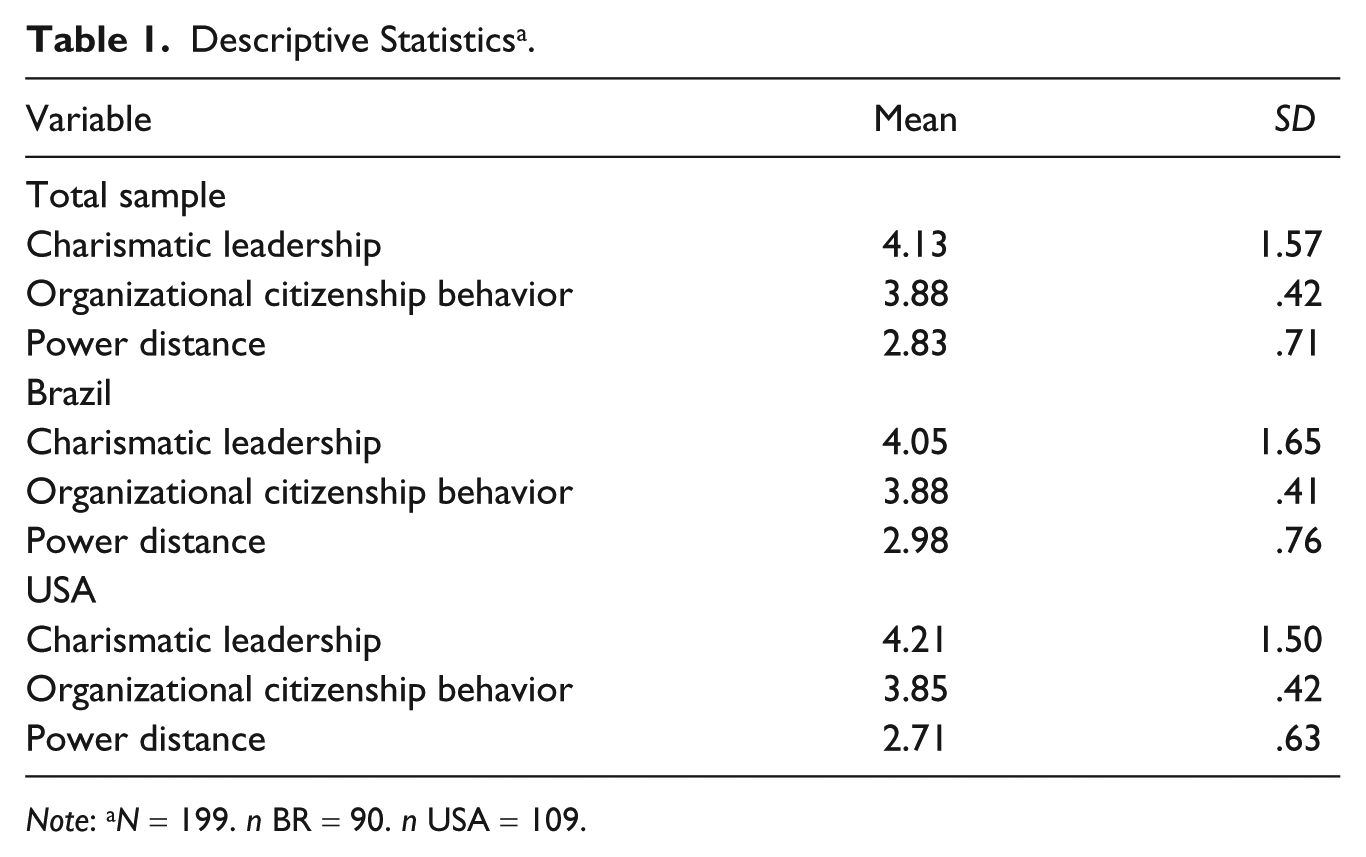
Note: aN = 199. n BR = 90. n USA = 109.
Table 2 shows Pearson correlations between the variables and reliability indices based on Cronbach’s α for the scales in this study. In the table, correlations of country of origin and overall power distance orientation with other variables can be observed. As verified in the previous analysis, in this sample the country of origin has a significant correlation with power distance orientation (r = – .19; p < .01). The sign of the coefficient indicates that Brazilians tended to report higher power distance values as compared to U.S. individuals. In addition, there is a significant correlation (r = .21; p < .01) between OCB and charismatic leadership, indicating that higher charismatic leadership values were associated with higher OCB values.
Pearson Correlations a .

Note: aN = 199. n BR = 90. n USA = 109 *p < .05. **p < .01.
Reliability indexes for measurement scales (Chronbach’s α).
Coding was 0 = “Brazilian,” 1 = “USA”.
Table 3 shows the different patterns of association between the substantive variables of interest in the two separate samples. While there is a significant correlation between OCB and charismatic leadership in the U.S. sample (r = .31; p < .01), the effect between charismatic leadership and OCB values was much smaller and not significant for the Brazilian group (r = .11; p = n.s.). Since the quadratic power distance term is the product of the original power distance measure times itself, these two variables should be highly correlated in all analyses.
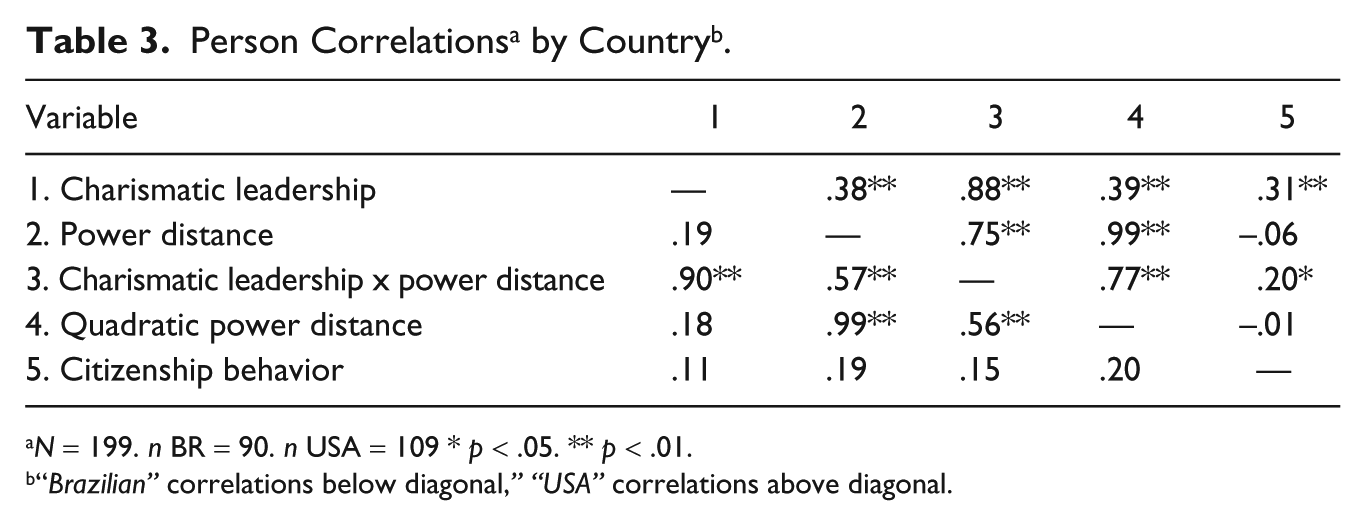
N = 199. n BR = 90. n USA = 109 * p < .05. ** p < .01.
“Brazilian” correlations below diagonal,” “USA” correlations above diagonal.
To further test the hypotheses in the study, we analyzed direct and interaction effects through hierarchical regressions. Table 4 shows standardized regression coefficients (β), R2 and ΔR2, at each step of that analyses. In the first step, three demographic variables were included in the model: nationality, age, and hierarchical level. Only hierarchical level had a significant effect on OCB (β = .36; p < .001), with no direct effects of country of origin on OCB reports. In the second step of the hierarchical regression analysis, the variable charismatic leadership was added to predict OCB. This model provided an ΔR2 significantly different from zero (FChange (1, 185) = 5, 73, p < .02), thus confirming H1. The results for the regression coefficients in that model show that both hierarchical level and charismatic leadership have significant effects on OCB in the overall sample (β = .30; p < .01 and β =. 17; p < .02, respectively). In the next step, power distance was entered as a predictor of OCB in the model; however, no increment in R2 was observed and the power distance parameter was not significant.
Regression Analyses of Direct, Moderated, and Higher Order Effects on OCB a .
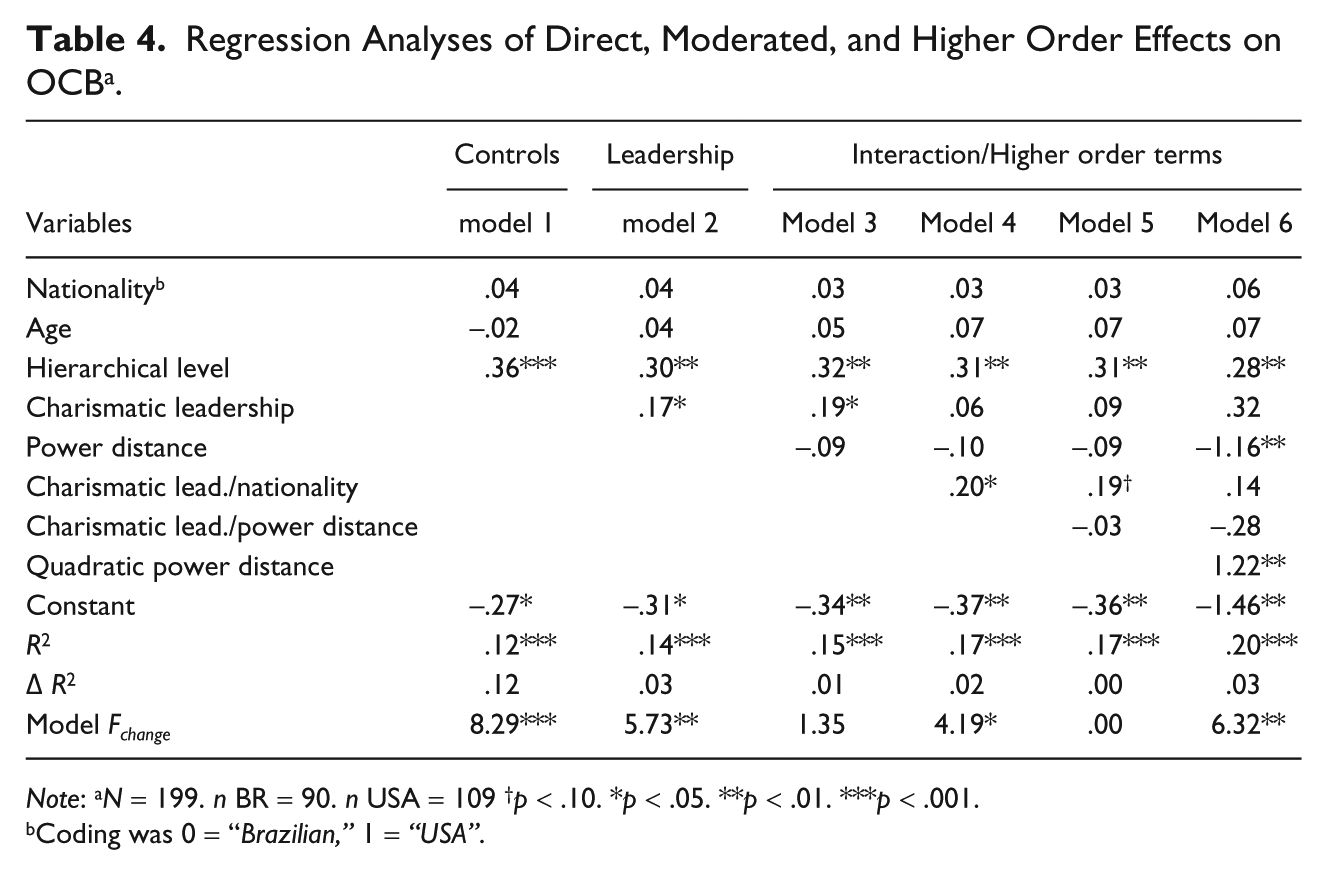
Note: aN = 199. n BR = 90. n USA = 109 †p < .10. *p < .05. **p < .01. ***p < .001.
Coding was 0 = “Brazilian,” 1 = “USA”.
In the next step, an interaction term for nationality and charismatic leadership was entered in the model. There was a significant ΔR2, (FChange (1, 183) = 4.19, p < .05). This result suggests that country of origin moderates the effects of charismatic leadership on OCB, thus supporting H4. Next, an interaction term for power distance and charismatic leadership was included in the model, but no increment in R2 was observed. Finally, a quadratic term for power distance was entered in the model, which yielded a significant increment in R2 (FChange (1, 181) = 6.32, p < .02), thus supporting H4.
As we plot the regression lines for the effects of charismatic leadership on OCB in both samples, we observed that in the U.S. group the line’s slope indicates that high OCB values are associated with high charismatic leadership values. Low OCB values, in this sample, occurred when charismatic leadership values were also low (see Figure 1). Brazilian workers show OCB scores, similar to the U.S. sample, when charismatic leadership values were low, but lower OCB scores than the U.S. sample when charismatic leadership values are high.
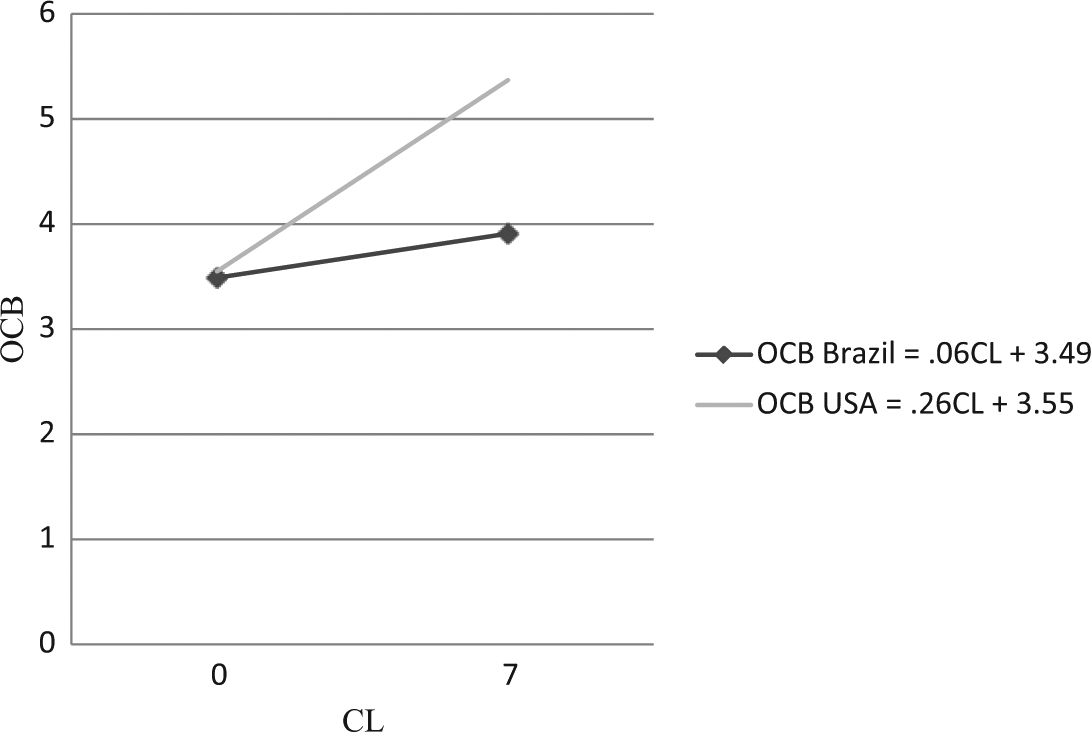
Effect of charismatic leadership on OCB by country.
In order to obtain further insight on our research topic, we also plotted the effect of the quadratic term of power distance on OCB. As shown in Figure 2, there seems to be a positive relationship between power distance and OCB when power distance values are very low, however as power distance values increase from low to medium, reported frequency of OCBs also decreased. When power distance values increase from medium to high levels, values of OCB start to increase again. It should be noted that, in this sample, country of origin per se does not moderate the relationship between power distance and OCB (β = −.03 ns), thus ruling out the possibility that the U-shaped relationship is a result of opposite trends (positive vs. negative) for effects of power distance on OCBs in the two samples.

Quadratic effect of power distance on OCB.
Post Hoc Analyses
Although the literature offers evidence of a general OCB factor (LePine et al., 2002), researchers frequently divide OCB into dimensional models to classify citizenship behaviors (e.g., Organ, 1997; Podsakoff, MacKenzie, Paine, & Bachrach, 2000). Thus, in addition to assessing hierarchical regression models with overall OCB as the dependent variable, we also tested models where OCB’s dimension of altruism and generalized compliance are considered as separate dependent variables, as it has been done by other researchers in the OCB literature (e.g., Jiao, Richards & Zhang, 2011).
Initially, we conducted a principal component, confirmatory factor analyses with data from the U.S. and Brazilian pool of respondents, in order to assess if there were grounds to separate the OCB dimensions of altruism and generalized compliance. These analyses revealed that the two-factor model containing altruism and generalized compliance fit the data better than a single factor model of OCB. The Brazilian two-factor model fitted the data well (comparative fit index [CFI] = .85, [RMSEA]=.05), whereas a single factor model did not (CFI = .66, RMSEA = .11, Delta Chi Squared = 80.2 df = 1, p < .001). The U.S. two-factor model fitted the data well (CFI = .82, RMSEA = .09), whereas a single factor model did not (CFI = .82, RMSEA = .09, Delta χ2 = 63.21 df = 1, p < .001). Therefore, we calculated scores based on the means obtained for each subscale. Factor correlations were .40 for the U.S. sample and .02 for the Brazilian sample. In the Brazilian sample, item loadings (lambdas) ranged from .47 to .82 for altruism (Factor 1) and from .54 to .75 for generalized compliance (Factor 2). In the U.S. sample, item loadings (lambdas) ranged from .23 to .70 for altruism (Factor 1) and .15 to .78 for generalized compliance (Factor 2).
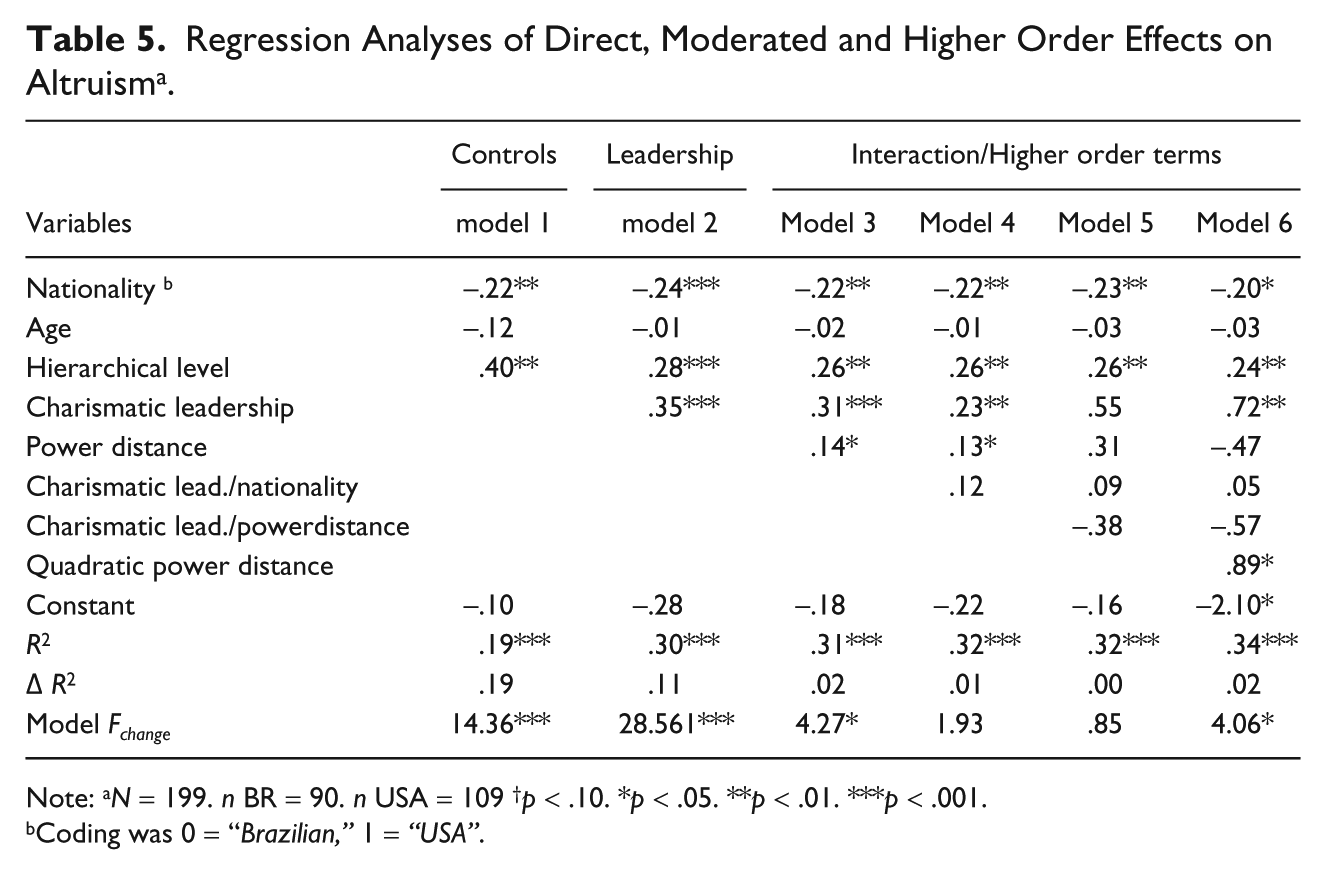
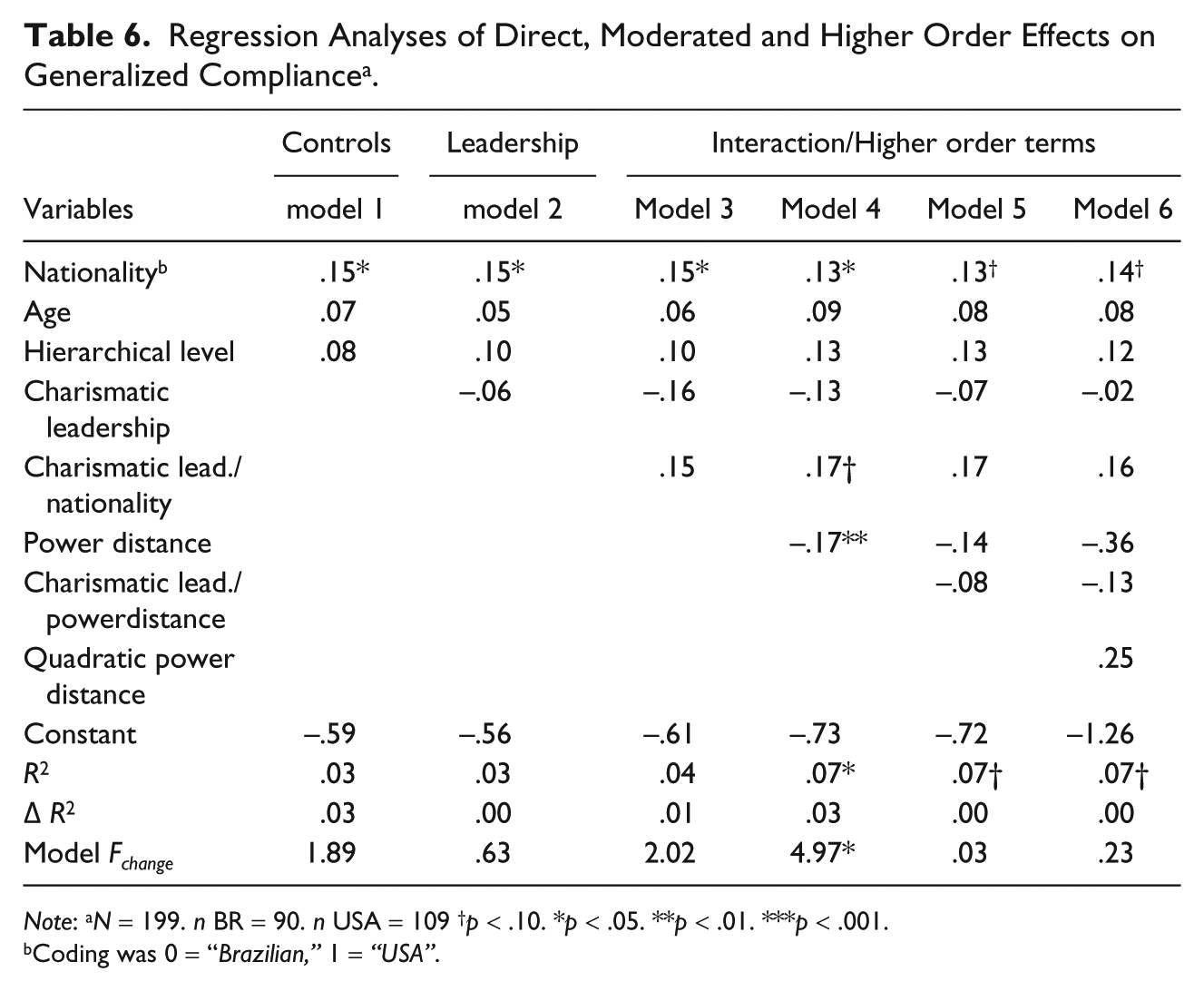
Based on the results above, we performed a post hoc analysis for the two OCB dimensions of OCB-A (Table 5) and OCB-GC (Table 6). As far as OCB-A, the results indicated that altruism was negatively associated with nationality (higher for Brazilians), negatively associated with hierarchical level (less altruism at higher levels), positively associated with charismatic leadership, and also affected by the quadratic term for power distance orientation across the samples. As far as OCB-GC, the only effects confirmed were a positive association with nationality (higher for U.S. employees) and a negative association with power distance orientation (less compliance as power distance orientation increases) across the samples.
Regression Analyses of Direct, Moderated and Higher Order Effects on Altruism a .
Note: aN = 199. n BR = 90. n USA = 109 †p < .10. *p < .05. **p < .01. ***p < .001.
Coding was 0 = “Brazilian,” 1 = “USA”.
Regression Analyses of Direct, Moderated and Higher Order Effects on Generalized Compliance a .
Note: aN = 199. n BR = 90. n USA = 109 †p < .10. *p < .05. **p < .01. ***p < .001.
Coding was 0 = “Brazilian,” 1 = “USA”.
It is worth noting that although the effect size of the quadratic term was somewhat smaller when OCB-A was the criteria rather than overall OCB, thus yielding a larger p-value, it was significant, and the unique variance it explained of altruism (2%) was very similar to the unique variance it explained of overall OCB (3%). Nevertheless, since compliance is negatively associated with power distance in the samples, when we combine altruism and compliance the resulting criteria (overall OCB) was even more clearly predicted by extreme PD beliefs.
Discussion and Conclusion
The role played by cultural factors on perceptions of and responses to leaders, on the meaning and likelihood of engaging in cooperative behaviors, and on the reputed effects of leadership on citizenship behaviors of followers are underexplored areas of research. This investigation is the first of which we are aware to examine those issues by comparing Brazilian and U.S. workers also discussing the effects of power distance orientation. According to our observations, having superiors that are perceived as more charismatic leaders is associated with greater engagement in OCBs among U.S. employees. However, the same was not observed among Brazilians—in the Brazilian group, employees would still report high frequencies of OCBs even when they did not see their leaders as particularly charismatic, and not necessarily report high engagement in OCBs when they considered their leaders to be highly charismatic. This observation reinforces the general impression that cultural factors can constrain the generalizability of leadership theories as they stand at present, as suggested by several scholars (Dickson, Hanges & Lord, 2001; Tsui, Nifadkar & Ou, 2007).
Although differences in power distance orientation were observed between the groups studied, in our analysis power distance did not moderate the CL–OCB relationship, and the single moderating factor driving that difference was country of origin. It should be noted, however, that propositions and findings from other studies allowed us to expect that the relationship between power distance and OCBs would not show a linear pattern, but rather follow a U-shaped function. Indeed, we found evidence that individuals with more extreme, both high and low power distance orientations reported more frequent engagement in OCBs at different hierarchical levels than those with intermediate, ambiguous power distance orientations. Post hoc analyses also confirmed that individuals with higher and lower power distance orientation were more likely to engage in person oriented OCBs, that is, altruism.
In addition, we also observed in our post hoc tests that the significant predictors of dimensions of OCB where quite distinct. Besides the higher order effect of power distance, altruism also tended to be higher among Brazilians, positively related to hierarchical level and perceived charismatic leadership, and also associated with higher power distance orientation. On the other hand, generalized compliance was higher among U.S. employees, significantly associated with low power distance orientation, and not significantly related to the other predictors. These observations give support to the assertion that research on citizenship behaviors could profit from theoretical frameworks that attempt to analyze different behaviors subsumed under the OCB spectrum, such as individual-oriented and organization-oriented behaviors, given that their roots might lay on quite distinct grounds (cf. Karriker & Williams, 2009; LePine, Erez & Johnson; 2002).
Despite the support for the hypotheses tested in this study, our research has limitations that should be acknowledged. This study relied on scales previously developed in the U.S. culture. Although translation and back-translation prescriptions were followed, and the scales in their final form were shown to have good psychometric properties in the Brazilian sample, the questionnaires reflect U.S. conceptualizations of charismatic leadership and OCBs. Although participation was anonymous and with data collection conducted electronically outside the work environment, measures of OCB were self-reported, thus increasing the risk of social desirability in the participants’ responses. Our findings are based on a small sample, jeopardizing our ability to confirm small but significant effects. It is important to replicate our analysis with a larger number of workers in the Brazilian business environment. We also used a less than ideal measure of culture: country of origin, or nationality. Although we proposed a theoretical argument for why a combination of several cultural traits would drive the differences we observed in the CL–OCB relationship across the countries, the effect of specific cultural variables as moderators of that relationship still remains to be verified empirically.
Even though there was a 5-year difference in the mean age between the two samples, and age is a known predictor of OCBs, we did not observe significant effects of age on OCBs (neither overall OCB, nor altruism or compliance). In addition, we did not observe any significant differences between the two groups on the overall OCB level of participants. Therefore, the age difference between our samples should not be a concern.
As far as the measurement issues observed, with one item disturbing the compliance scale for the Brazilian sample, although the item was “attend work above the norm”, which is a quite objective behaviour, problems of interpretation might have arisen. It is possible that the notion of attending work beyond what is formally required by a company’s norm did not seem right to Brazilians—perhaps thinking in terms of low absenteeism or working late would be more readily understood as compliance. However, that was not how the item was originally conceived in OCB scale. At this point we can only recommend that researchers delve deeper into meanings of OCBs in the country, to further investigate and fine-tune multidimensional conceptualizations of OCBs, as well as the measures used to assess these constructs.
Although we did not observe any connection between charismatic leadership and follower citizenship behaviors in the Brazilian sample, other characteristics and actions of leaders could still promote follower performance and foster citizenship behaviors in the Brazilian workplace—perhaps not charismatic behaviors per se, but a combinations of other behaviors displayed by leaders that are discussed in contemporary theories and models, such as transformational, empowering and authentic leadership theories. Therefore, the impact of those leader behaviors on subordinate conduct and performance should continue to be investigated by future empirical research in Brazil.
Future theoretical efforts and empirical analysis are still needed to clarify the mechanisms through which power distance, both as a cultural factor and as an individual difference, promotes OCBs. More research is thus necessary to better explain how power distance as a value orientation affects specific employee beliefs and attitudes. In addition, only the use of multilevel approaches will be able to further clarify the contribution of cultural and personal value orientations on leadership and employee attitudes and behaviors. Such research efforts should strive to analyze the predictive power of value orientations when other individual differences in personality traits and demographic factors are considered as well.
In addition, the younger segment of Brazil’s population may be developing new sets of values relative to the country’s political context and globalization of media and economy. Research suggests an evolution in general for power distance, showing that it moves over time toward lower levels (Dickson et al., 2001). Therefore, additional research efforts should be taken in order to further investigate and monitor power distance orientation in the country.
It is worth highlighting that the meanings individuals attribute to different behaviors within the OCB range might be distinct as a result of cultural factors (cf. Kwantes, Karan, Kuo & Towson, 2008). Although this may change as the country’s economy matures and as sharp inequality is reduced, in light of the singularities of Brazilian culture, we can speculate that some Brazilians may not even conceive some behaviors depicted as OCBs as discretionary, but rather take them as normative behaviors in organizational settings. Therefore, future research should as well delve into the meaning of organizational citizenship in Brazil, and attempt to clarify if and which OCBs are perceived as norms of conduct rather than discretionary behaviors.
Awareness regarding distinctive traits of a country’s culture and their implications to organizational behavior and leadership should guide managers and their decisions in such settings. Nevertheless, our results suggest that while some traits might be used as a general standard to compare distinct national groups, we still know little about culture’s consequences regarding behavior in the workplace. Diversity might exist within national groups, and while some people would fit more closely to their indigenous traditions, others could display different values. Our findings imply that both the differences that relate to macro-cultural dimensions and those that relate to micro-value orientations should be considered when dealing with those issues. As frequently advised, managers acting abroad should get acquainted with country-level differences to better understand the values of people in a particular nation and the drivers of their behaviors and performance. However, they should also expect variation when dealing with foreign groups, and instead of assuming stereotypical profiles, get to know these groups and adjust their styles and managerial policies to the different beliefs and expectations of specific individuals.
Finally, it is worth highlighting that theories about leadership taught in business schools and diffused in best selling management readings tend to be readily imported and taken as appropriate and valid locally in many parts of the world, in spite of the lack of evidence to support such conclusions. This constraint should prompt leaders and other audiences in Brazil or in other parts of the world to have a stake in theory, research and management education in their nations, and to call for and strongly support serious research programs. Such efforts are necessary to test and expand and fine-tune existing models and theories. Only then organizational leaders, both native and expatriate citizens working abroad, will have a sound base to guide them. Up until now we can only be sure that considerable research on established theories about leadership is still needed to better examine when North meets South, and when East is far distant from West.
Footnotes
Declaration of Conflicting Interests
The authors declared no potential conflicts of interest with respect to the research, authorship, and/or publication of this article.
Funding
The authors received no financial support for the research, authorship, and/or publication of this article.