



Abstract
Theoretical explanations for fertility transformations, such as the demographic transition, have primarily emphasized one of three influences: (a) decreasing mortality rates, (b) economic development, and (c) the transmission of female empowerment norms. Empirical tests suggest that the relative contribution of these factors on predicting fertility varies across populations and time periods. Identification of the factors underlying this variation will ultimately be aided by the pooling of cross-national and time-series data. To this end, the current study combines data from 167 countries across a 40-year time period (i.e., 1970-2010). A fixed effects model is specified to examine how the three factors predict within-country variability in adolescent and total fertility rates. Results indicate that all three variables are associated with fertility patterns in theoretically consistent ways, although the association is often non-linear. In addition, the level of association between economic development and female empowerment with fertility varies across levels of mortality. Results highlight that a “unified” theory of demography will develop through understanding how levels of the three factors may interact to transform global fertility patterns.
Introduction
Theoretical explanations for the fertility patterns associated with the demographic transition have attributed primary causal influence to one of three factors: (a) economic development (Caldwell, 1976; Harris & Ross, 1987), (b) decreases in population mortality rates (Chisholm et al., 1993; Coale, 1984), and (c) transmission of norms associated with female empowerment (Cleland & Wilson, 1987). Studies examining these factors, considered collectively, indicate the relative contribution of each in explaining how fertility transformations vary across time periods and both within and across scales of analysis (i.e., local, regional, and national levels; Mason, 1997; Matthiessen & McCann, 1978; Sanderson & Dubrow, 2000; Shenk, Towner, Kress, & Alam, 2013; Van de Walle, 1986). Identification of the factors (e.g., sociocultural, economic, political) ultimately responsible for these spatiotemporal variations will be aided through models incorporating pooled cross-cultural and time-series data. Analysis of such data facilitates the development of a “unified” theory of demography by determining the relationship between fertility and the three factors across differing levels (e.g., non-linear at high mortality levels) as well as the interactions across these levels.
To examine the interplay of economics, population mortality, and female empowerment in transforming global fertility patterns, the current article incorporates data from 167 countries across a 40-year time period (1970-2010). A fixed effects approach is used to model the within-country contributions of each factor on reproductive onset (adolescent fertility) and output (total fertility). The model tests for the presence of non-linear effects and interactions between the three factors. In general, results indicate each variable displays a non-linear association with fertility, while the effect of economics and female empowerment varies across levels of population mortality.
The Three Influences
Economics
Arguments that place primary importance on economics in fertility changes have traditionally focused upon the role of child labor (Caldwell, 1976; Harris & Ross, 1987). In societies where child labor represents a large contribution to the household economy (e.g., small-scale agriculture), the flow of wealth is argued to be from child to parent, thereby favoring high fertility rates. In contrast, industrial societies favor lower fertility rates as shifts in the occupation structure increasingly emphasize adult labor (e.g., highly skilled labor). Economic arguments have been incorporated within a life history theory framework (see below) to emphasize the benefits of investing in one’s self (e.g., education) when such benefits, while delaying reproduction, ultimately enhance offspring fitness (Becker, 1992; Kaplan, Hill, Lancaster, & Hurtado, 2000).
Support for the influence of economics on fertility, especially regarding a primary role of child labor, has been mixed. Ethnographic accounts of subsistence-oriented societies demonstrate that while children do produce economic benefits and may increase fertility through cooperative breeding (e.g., aiding in child care; Kramer, 2005), their labor is usually not sufficient to result in an overall economic gain (Kaplan, 1994; Turke, 1989). More general support for the role of economics has come from cross-national studies documenting a negative relationship between fertility rates and increases in economic indicators (e.g., GDP per capita) and education levels (indications of a shift toward more highly skilled labor; Bulled & Sosis, 2010; Caudell & Quinlan, 2012; Low, Hazel, Parker, & Welch, 2008) although similar studies find no relationship, especially between economic indicators and fertility (Sanderson & Dubrow, 2000). However, a recent regional analysis by Shenk et al. (2013), comparing the three main factors on fertility, found that fertility declines in Bangladesh were best accounted for by economic models.
Population Mortality
Theories emphasizing the influence of population mortality rates, such as the classic demographic transition theory (DTT), view fertility declines as a product of increased infant survivorship rates, which result from advancements associated with industrialization and urbanization (Notestein, 1953; Thompson, 1930). 1 DTT has been placed on an explicit evolutionary footing within life history theory, which argues that optimal reproductive strategies are the consequence of extrinsic risk levels (Roff, 2002; Stearns, 1989). In environments with high extrinsic risk (e.g., high mortality), the most fitness-enhancing strategy is to reproduce early and often to “beat the odds,” given the likelihood that some offspring will die. When extrinsic risk is low, differential reproductive success is more contingent upon an individual’s ability to provide parental investment, thereby selecting for greater investment in one’s self (e.g., education) and subsequent delays in reproduction (Quinlan, 2007).
A majority of cross-national studies within a life history framework find that indicators of risk (e.g., infant mortality, life expectancy at birth) display the strongest association with fertility changes controlling for economic and educational factors (Bulled & Sosis, 2010; Caudell & Quinlan, 2012; Low et al., 2008). Analysis of historical data, mostly from European countries, provides modest to strong support (correlation from .10-.70) between infant mortality and fertility although several countries displayed a negative or non-significant relationship between mortality and fertility at one point in time (Cantrelle, Ferry, & Mondot, 1978; Mason, 1997; Matthiessen & McCann, 1978; Van de Walle, 1986). In addition, several studies have found that the correlation between mortality and fertility does not hold in high risk countries, such as countries low on the Human Development Index (Low et al., 2008) and across 12 sub-Saharan countries (Cantrelle et al., 1978).
Cultural Transmission
Ideational theories of fertility changes emphasize the transmission of norms of low fertility and female empowerment (e.g., perceptions of modern contraception and acceptance of female education) and usually place greater weight on historical and cultural aspects that may either facilitate or inhibit the transmission of these norms (Basu, 1993; Cleland & Wilson, 1987). Transmission processes have been modeled using cultural transmission and social network theories (Kohler, Behrman, & Watkins, 2001; Newson et al., 2007). Cultural transmission studies have modeled the effect of who a person learns from (e.g., parent, peer) on the transmission of norms. Horizontal transmission (i.e., peer to peer) is argued to result in higher rates of norm change in contrast with the more conservative vertical transmission (i.e., parent to child; Cavalli-Sforza & Feldman, 1981). Social networking studies have examined how network typology or the properties of network actors facilitate or restrict the transmission of new norms. For example, sparsely connected networks (i.e., low density of network ties) are argued to result in lower rates of transmission relative to more densely connected networks (Haythornthwaite, 1996; Kohler et al., 2001).
Given the paucity of measures on female empowerment/fertility norms on a cross-cultural scale, direct tests of ideational hypothesis have largely been confined to local and regional scales (Basu, 1993; Kohler et al., 2001; Munshi & Myaux, 2006). Basu (1993) argued that cultural differences between northern and southern India in the acceptable timing at first marriage account for fertility differences across the two regions. In Kenya, Kohler et al. (2001) found that network density is associated with a woman’s propensity to use modern contraception but this association is the strongest in areas of low market activity. Regional studies using data from multiple transmission scales (e.g., personal network, media) reported finding evidence that transmission is weak across broader scales, such as across the media, compared with more individualized forms of transmission, such as contraceptive interventions (Shenk et al., 2013). Cross-national examinations have provided indirect support for ideational theories by documenting negative associations between fertility rates and proxies of fertility norms, such as contraception prevalence rate and female participation in education and labor (Bulled & Sosis, 2010; Caudell & Quinlan, 2012; Low et al., 2008). These results, in terms of female education and labor, could also be interpreted as support for economic theories of demographic change. However, as many utilized proxies are ratios, for example, the ratio of female to male enrollment in secondary education, they reflect increases (or decreases) in female empowerment beyond purely economic factors.
Summary
Considered collectively, cross-cultural research on human fertility patterns, while providing support for the influences of economics, population mortality, and female empowerment, has demonstrated how the relative contribution of each differs across time period and scale of analysis. Beyond highlighting the multi-causal nature of fertility transformations, these findings suggest factors may precede, follow, and/or interact with one another. For example, using a path analytic approach on 191 countries, Caudell and Quinlan (2012) demonstrated that past economic indicators affect later fertility rates directly, as well as indirectly through prior impacts on population mortality rates. In addition, as the study by Kohler et al. (2001) demonstrated, local economies affect the transmission of fertility norms by affecting social network structure. In short, levels of the three factors affect the relative contribution of other factors on fertility. To determine the interplay between the proposed influences on fertility, a cross-cultural and longitudinal analysis, in which different levels of within-country population mortality, economic development, and female empowerment are observed, is warranted.
Method
Data
Data were collected from 167 counties from the World Bank (http://data.worldbank.org/), representing decadal time spans from 1970 to 2010 (see the appendix for summary statistics and correlation matrix). Dependent variables were adolescent fertility and total fertility rates. Total fertility rate (tfr) is the expected reproductive output, given current age-specific fertility rates. Adolescent fertility (asf) is the birth rate for females aged 15 to 19 years per 1,000 individuals. Population mortality was represented by the rate of infant mortality (infmort), that is, the number of deaths per 1,000 births. Given the presence of significant skew and kurtosis, infant mortality rates were square-root transformed. Economics was represented by changes in a nation’s GDP per capita (gdp) and was log transformed. Norms of fertility and female empowerment were represented by the gender parity measures of female-to-male ratio in secondary (fmsecond) and tertiary enrollment (fmtert). Different education levels were used as secondary enrollment is representative of female empowerment changes in developing countries, while tertiary enrollment is a better indicator in more developed countries, especially historically. If data were missing for a particular time period (e.g., 1970), the point was filled in with data spanning a ±3-year time period (i.e., 1967-1973). Table 1 provides summary statistics across the five time periods. Table 2 provides a correlation matrix.
Mean and Observations Across Five Time Periods.
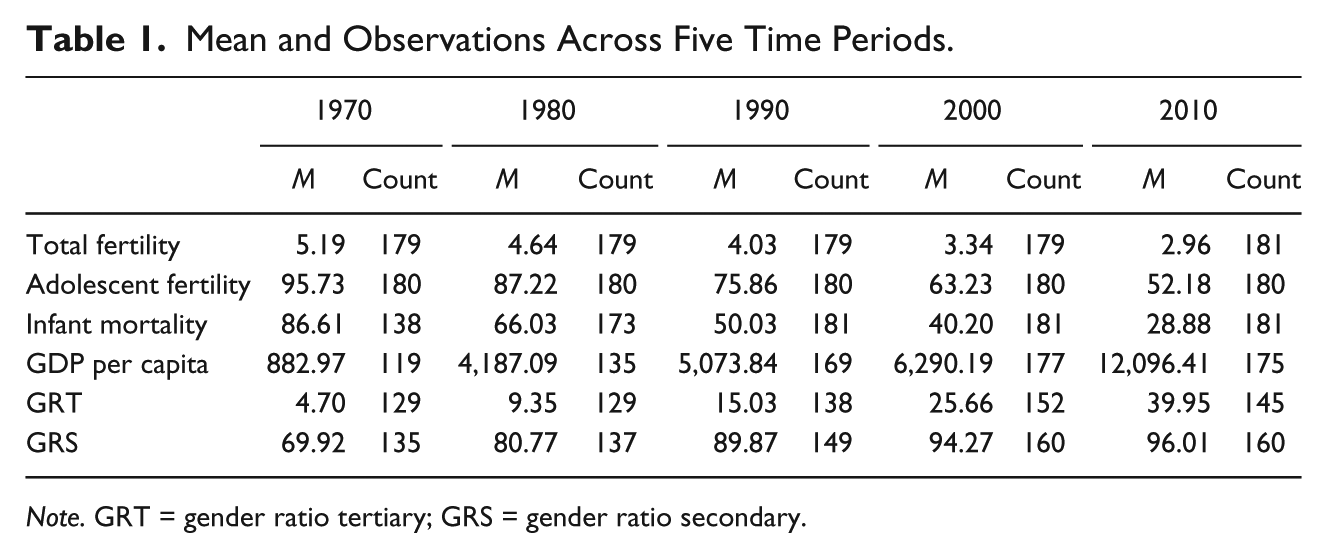
Note. GRT = gender ratio tertiary; GRS = gender ratio secondary.
Correlation Matrix.
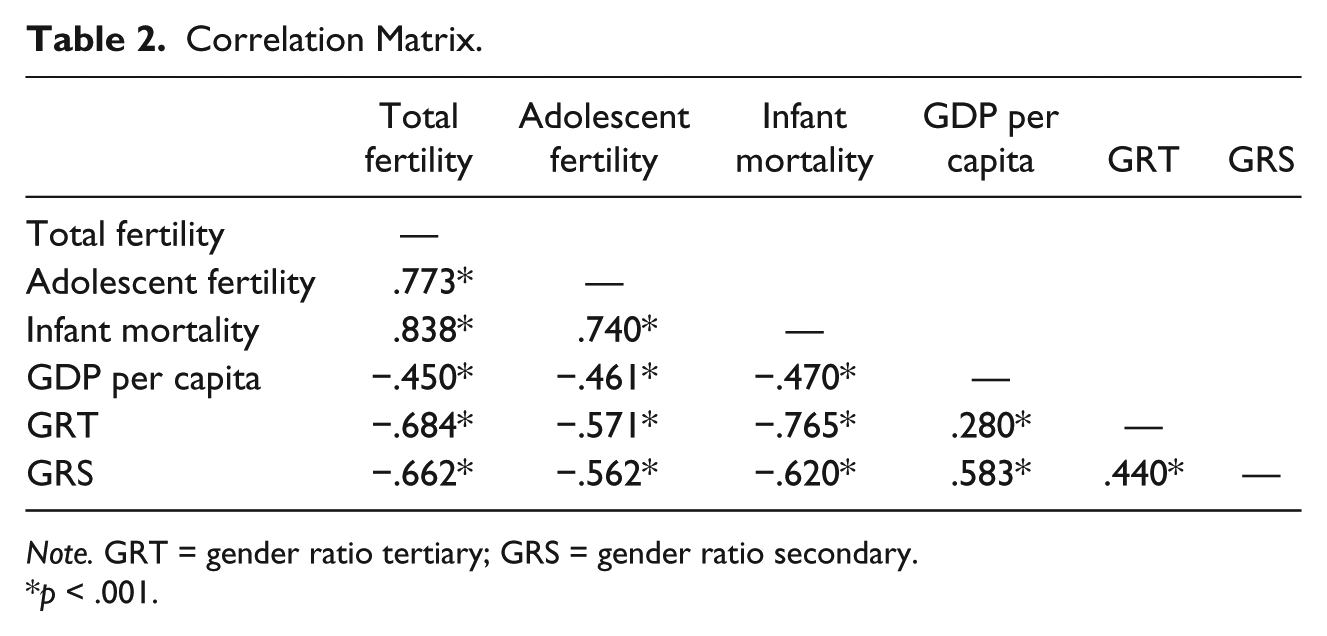
Note. GRT = gender ratio tertiary; GRS = gender ratio secondary.
p < .001.
Analysis
A fixed effects approach was used to model the relationship between the three main factors and reproductive onset and output. Fixed effects exhibits several benefits compared with the more commonly applied ordinary least squares (OLS) regression in cross-national analysis (see Bulled & Sosis, 2010; Low et al., 2008). In cross-national analysis, fixed effects control for all relatively stable characteristics of countries (e.g., climate, culture) by ignoring between-country differences (unlike OLS) and focusing purely on within-country variation. Controlling for these differences, a fixed effects model can provide unbiased estimates of how changes in mortality, economics, and female empowerment within-country are associated with within-country fertility changes (Allison, 2009). Examining within-country changes in the three proposed influences and fertility, as pointed out by Potter, Schmertmann, and Cavenaghi (2002), is the most appropriate way to test predictions of demographic theories as these theories are logically founded upon within-country changes. Importantly, fixed effects and OLS methods can produce substantially different results when applied to the same data set, and thus affect whether predictions derived from demographic theories are supported (see Potter et al., 2002, p. 751). Finally, while fixed effects models do not account for heterogeneity between countries, this heterogeneity can be parsed out in the analysis to demonstrate how between-country variation may affect within-country relationships. In the current study, between-country variation was grouped into high, low, and medium mortality levels to graph the interactions between mortality, economic development, and female empowerment on fertility patterns.
Model specification proceeded by generating models that included all main independent variables, testing for significant non-linear relationships, and then entering interaction effects between all variables. Survey years were included as dummy variables to control for temporal variations in fertility not accounted for by the three independent variables. Stata v12 xtreg command was used for all analysis (StataCorp, 2012). Hausman tests were used to determine whether a fixed or random effects approach was more appropriate (Hausman, 1978). Test results supported the use of a fixed effects approach (p < .0001).
Results
Final model results are provided in Table 3. Regression coefficients are interpreted as within-country changes in the parameter are associated with within-country changes in fertility. Models 1 and 3 (main and quadratic effects) indicate that infant mortality was positively associated with adolescent and total fertility although this association decreased at higher levels of mortality. Confidence intervals associated with this relationship (see Figure 1), however, indicate that precision substantially decreases at both high and low mortality rates. GDP per capita was negatively associated with both fertility rates although this effect decreased at higher capita levels. Gender parity in tertiary education was negatively associated with total fertility but not significantly related to adolescent fertility. In contrast, gender parity in secondary education was significantly related to decreases in adolescent fertility but not total fertility.
Model Results.

Note. See “Method” section for description of variables. GRT = gender ratio tertiary; GRS = gender ratio secondary.

Within-country impacts of infant mortality on total fertility and adolescent fertility.
The addition of interaction effects (see Models 2 and 4) rendered several quadratic effects non-significant and these quadratic effects were removed. Interaction effects were graphed using three different levels of the modifier variables (i.e., mean & ± 1 standard deviation; see Figure 2). In general, the effects of economic and gender parity on fertility varied across mortality levels. Gender parity in secondary education was negatively associated with total and adolescent fertility but only in countries with medium and high levels of mortality. Likewise, total fertility was only effected by gender parity in tertiary education in medium and high mortality levels. For adolescent fertility, however, the negative relationship with gender parity in tertiary education was only significant within low mortality countries. GDP exhibited a positive relationship with total fertility rates within low and medium but not high mortality countries. For adolescent fertility, GDP has a negative relationship at high mortality levels, a positive relationship at low mortality levels, and a non-significant relationship within medium mortality levels. A significant interaction between GDP and gender parity in secondary education (not pictured) indicated that wealth and secondary education display a synergistic effect on fertility, although only at medium and high wealth countries.
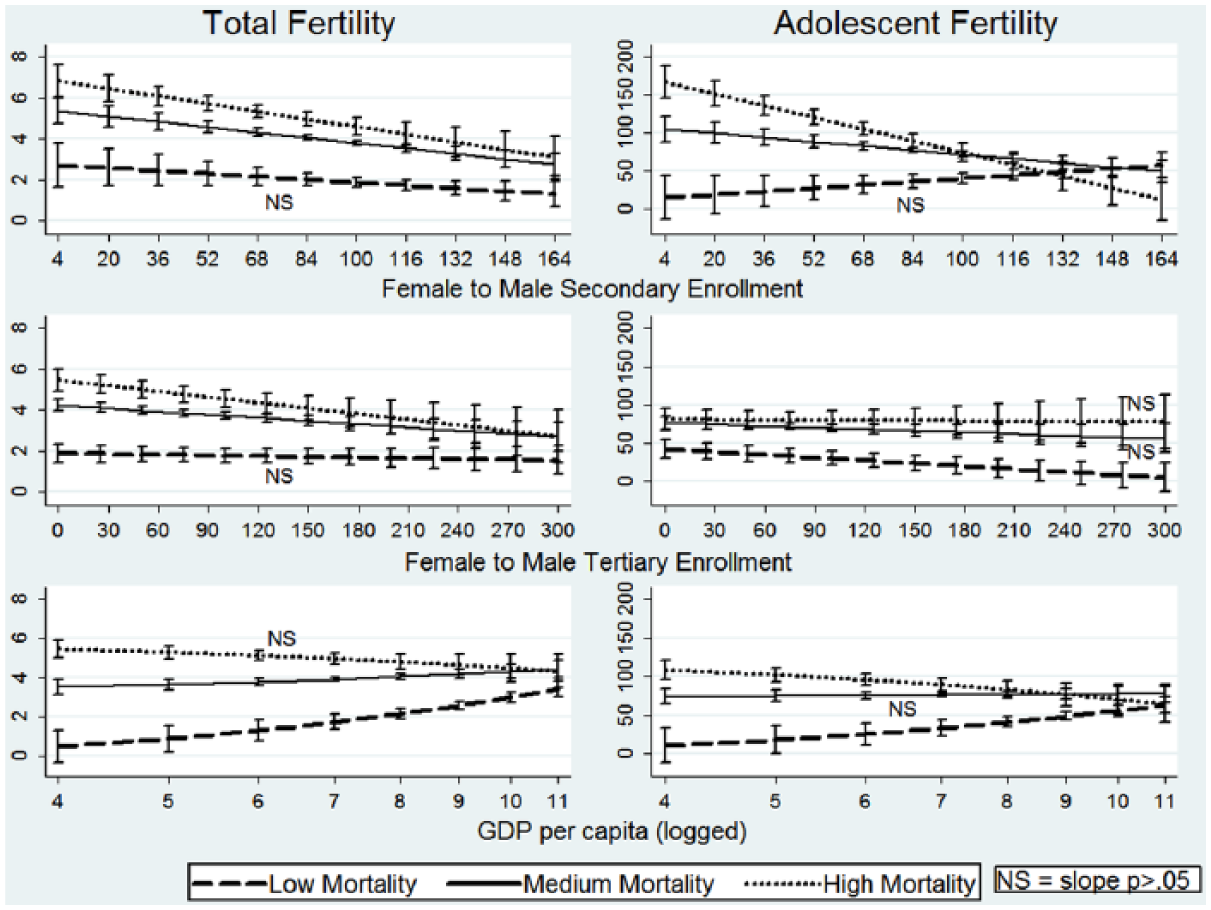
Effect of gender parity and GDP on within-country total fertility and adolescent fertility rates at low, medium and high mortality.
Discussion
Using a fixed effects approach, the current study examined the association between within-country changes in economics, mortality, and female empowerment and the onset and output of female reproduction within 167 countries across a 40-year period (i.e., 1970-2010). In general, fertility rates were positively associated with mortality rates and negatively associated with economic development and advances in female empowerment. However, this relationship was not linear across all levels of the three factors. Higher levels of population mortality and economic development were associated with decreasing impacts on fertility rates. These results suggest the presence of threshold effects. For example, it may be that mortality must decline to a certain level before resulting in statistically noticeable changes in reproductive behavior. Indeed, the fertility decreases observed in countries with extremely high mortality environments (see Figure 1), beyond issues of small sample size, may not reflect optimal life history strategies but instead very low infant survivorship. This interpretation would be consistent with previous studies finding a negative or no relationship between mortality and reproduction in sub-Saharan Africa and countries low on the Human Development Index (Cantrelle et al., 1978; Low et al., 2008)
The association between the three factors and within-country fertility rates across the 40-year period also varied across levels of the other factors. Decreasing rates of gender parity in secondary and tertiary education were associated with the largest decrease in total fertility rates in medium and high mortality countries. In contrast, gender parity decreases in low mortality countries did not result in significantly different total fertility rates. Thus, female empowerment norms, at least those related to female education, have the greatest impact on fertility in high mortality environments. These results seem to contradict suggestions that education and economic factors begin to take precedence in fertility decisions only when mortality rates fall (Kaplan, 1994; Shenk et al., 2013). Alternatively, a non-significant relationship in low mortality countries may occur as gender disparities in education within these countries have exhibited relatively smaller changes over the last 40-year period (i.e., no variability). Indeed, the threshold may be shifting so that higher levels of female empowerment (e.g., women as the “breadwinners” of the household) need to be attained before resulting in statistically noticeable impacts on reproduction. This interpretation would be consistent with Model 3 showing that as gender parity in secondary education increases the negative association adolescent fertility decreases. Future studies should incorporate indicators that better represent female empowerment in developing countries, such as the relative economic contribution of a woman to the household controlling for other female empowerment indicators.
An unexpected finding, in light of theoretical expectations and previous empirical work, was the synergistic interaction between economic growth and fertility rates (see Figure 2). GDP increases resulted in the largest total fertility increases within low mortality countries. These findings are even in contradiction with Model 1 in the current study that documented a negative relationship between GDP and total fertility. 2 The trend is likely a product of nations that have experienced large growth in GDP over the last 40 years but remain within Stage 3 of the demographic transition, where mortality rates have decreased but fertility rates remain high, including several Arab states. This trend may provide support for ideational theories if the relatively lower rates of gender-equality observed in Arab societies pressurize women toward earlier and more frequent reproduction (Norris & Inglehart, 2001). Combined with economic growth that allows for increases in parental investment, such pressures may lead to dramatic increases in fertility. This possible synergistic interaction between economic growth and cultural norms in some low mortality countries demonstrates why fertility models should consider all three proposed influences in concert to provide a more nuanced account of global fertility patterns.
The current study has several limitations. First, lacking direct measures of female empowerment/fertility norms, the current models cannot directly test ideational theories. If indirect indicators, (e.g., gender parity indices) are not correlated with these norms, then model results should not be considered a proper gauge of association. In fact, a study of nine Latin American countries found that while female education was negatively related to total fertility, most females shared the desire for a small family size regardless of education level. However, better educated women had a greater breadth of knowledge (e.g., contraception methods) and higher socioeconomic status (Martin & Juarez, 1995). Thus, while low fertility norms are necessary, they do not seem sufficient when lacking access to key resources, such as education. Gender disparity in education then, although not a direct indicator, is likely a reliable indicator of the propensity of norms to affect fertility. Again, such dependencies highlight the importance of including all factors, as well as interactions, in models of fertility behavior. A further limitation of the current study is that effects were modeled as contemporaneous over the 40-year period and so must be interpreted as associations. A stronger case for causation could have been made through the specification of lagged effects (Mason, 1997). However, current data availability ensures that the specification of lagged effects produced a substantial decrease in sample size. 3 A further complication is that some influences may exhibit shorter/longer lagged effects than others (e.g., economic versus mortality changes; Mason, 1997). Future studies should examine such temporal differences as they likely vary across nations with differences in cultural, economic, and political contexts.
Conclusion
The current study applied a fixed effects approach to examine how the onset and output of female reproduction was affected by economics, population mortality, and female empowerment within 167 countries across a 40-year period (1970-2010). In general, results indicate that the three factors affected fertility in theoretically consistent ways. However, impacts of the influences were not linear and interacted with levels of the other influences, especially mortality, in the transformation of fertility patterns. These deviations provide a point of departure for examining how cultural differences across and within nations (e.g., short-term vs. long-term orientation) affect the relationship between the three proposed influences and fertility patterns. The development of a “unified” theory of demographic transitions will be supported by cross-cultural examinations that can establish whether the fine-grained results of local and regional analyses reflect global patterns and, if not, begin to identify the local/regional influences (e.g., cultural, political, historical) that give rise to these variations.
Footnotes
Appendix
Models With Decadal Time Lag.

| Total fertility |
Adolescent fertility |
|||
|---|---|---|---|---|
| M1 | M2 | M3 | M4 | |
| Infant mortality | 0.33** | 0.38** | 4.75** | 6.51** |
| Infant mortality2 | −0.01 | 0.013** | 0.11** | 0.22** |
| GDP per capita | 0.02 | 0.11 | −1.74 | −1.29 |
| GDP per capita2 | 0.03* | 0.41* | ||
| GRS | −0.01** | −0.01** | −0.31** | −0.27** |
| GRS2 | −0.000 | 0.0001 | ||
| GRT | −0.000 | −0.002 | −0.09* | 0.06 |
| GRT2 | 0.000 | −0.0001 | ||
| Infant mortality × GDP | −0.21 | −0.37 | ||
| Infant mortality × GRS | −0.000 | −0.03* | ||
| Infant mortality × GRT2 | −0.000 | 0.02 | ||
| GDP × GRS | −0.000 | −0.01* | ||
| 1990 | −0.20 | −0.19 | −5.01 | −4.67 |
| 2000 | −0.41 | −0.31 | −9.07 | −8.16 |
| 2010 | −0.59* | −0.17 | −18.01* | −13.11* |
| Constant | 0.54 | −1.92 | 45.52* | 68.27** |
| R 2 | .72 | .71 | .65 | .66 |
| N | 371 | 371 | 371 | 371 |
| Countries | 167 | 167 | 167 | 167 |
Note. GRT = gender ratio tertiary; GRS = gender ratio secondary.
Declaration of Conflicting Interests
The author(s) declared no potential conflicts of interest with respect to the research, authorship, and/or publication of this article.
Funding
The author(s) received no financial support for the research, authorship, and/or publication of this article.