



Abstract
Values attributed to children provide insights into the place of the child in family and society. The place of the child, in turn, is the key to understanding intergenerational dynamics. In this article, a key construct, “value of children,” and several studies using it are examined from the perspective of a theory of family change. This theoretical perspective and the studies shed light on the links between the values attributed to children/expectations from them, and the care of the elderly—two key aspects of the family not commonly studied in intersection. This intersection is analyzed in this article. Research shows that where the values attributed to children define the role of the offspring as the provider for the parents, family care of the elderly becomes the norm. With systematic changes in the socio-cultural-economic context and in the family, this norm undergoes change, also. What changes, what is maintained, and to what degree are empirical questions of significance for the care of the elderly.
Keywords
The type of value attributed to the child, and accepted by others, has significant implications for intergenerational relations in the family and for the care of the elderly. This is the basic premise and the point of departure of this article; the research and theory examined here derive from this rather simple premise and promise to shed light on some complex human phenomena. Thus, in this article, we attempt to understand individual–family–society links by examining changes and continuities in family dynamics and family culture in the face of socio-economic development. The main theoretical point that can be made from the start is that as the value of the child for the family changes, the state of the elderly changes, as well. These two phenomena are rarely studied together, but we propose that they intersect, and it is important to study this intersection. This key point provides the backbone of the analyses and the discussions in this article. A global perspective is taken to reveal systematic patterns of change, which have been evidenced in research and which can be used for in-depth understanding and prediction.
The Value of Children (VOC) Studies
Early on research showed that in socio-economic contexts where children provide material benefits to parents, both when they are young and when they grow up, material/economic values tend to be attributed to them, particularly “old-age security” value. However, in socio-economic contexts where children do not constitute economic assets but rather entail economic costs for parents, they are attributed psychological values, such as fun, pride, and so on (e.g., Fawcett, 1983; Kagitcibasi, 1982, 2007; Trommsdorff & Nauck, 2005).
The original research paving the way for the developments in our thinking on these issues in question is the nine-country VOC Study conducted in the 1970s (Bulatao, 1979; Fawcett, 1983; Hoffman & Hoffman, 1973; Kagitcibasi, 1982). That study was replicated partially some three decades later in a few of the original countries and has spread over 14 countries in the 2000s (Trommsdorff & Nauck, 2005). We will designate the two studies “VOC1” and “VOC2” and use some comparisons between them from Turkey, which is a country where both studies were conducted.
VOC1 examined parental motivations underlying childbearing and the values attributed to children. More than 20,000 married respondents from nine countries were interviewed, using nationally representative samples in Indonesia (Sundanese and Javanese samples), Korea, the Philippines, Singapore, Taiwan, Thailand, Turkey, and the United States, and a women’s sample from Munich, Germany (Bulatao, 1979; Darroch, Meyer, & Singarimbun, 1981; Fawcett, 1983; Hoffman, 1987; Kagitcibasi, 1982).
These studies were carried out following and in line with the promising theoretical work in population economics aiming to understand the processes underlying global population shifts (e.g., Becker, 1960). Economists construing the VOC mainly in economic terms pointed to its reduction with increased economic development, resulting in declining fertility, that is, demographic transition. The theoretical perspective used in the VOC studies, however, focused on different types of values attributed to children by parents. They also showed that these values were affected differentially by economic development and differentially related to desired number of children. This was a significant contribution with major implications for understanding fertility behavior as well as parenting, family ties, and family dynamics in general (Kagitcibasi, 1982, 2007).
Three basic types of values emerged, namely, economic/utilitarian, psychological, and social/traditional. The economic/utilitarian VOC for parents entails children’s material contribution to the family both when they are young (as child labor or help with household chores) and also in adulthood in terms of their old-age security value for their elderly parents. This value reflects the dependence of the family on offspring for its livelihood through its life cycle and the strong family loyalty of the children, a collectivistic pattern. Psychological VOC, however, is a value attributed to children by parents reflecting the joy, pride, fun, companionship, and love derived from having children. Social or social/traditional VOC entails mainly the social acceptance having children brings to parents and son preference (continuation of the family name). This value is especially important in traditional societies. There may be other reasons for having children such as evolutionary/reproductive ones, enabling the human population to grow, which evolutionary biologists discuss. In the VOC studies, we focused on the values that were “salient” for people, but not on such other possible underlying causes. The responses provided by the participants clustered empirically in these three main factors/values.
A main finding of VOC1 was the greater salience of the economic/utilitarian VOC and especially of the old-age security VOC for parents in less developed countries. In the United States and Germany, the material VOC, including old-age security value, was of minimal importance, whereas in Turkey and other collectivistic less developed countries such as Indonesia, the Philippines, Thailand, and Taiwan, it was of high salience for parents (Bulatao, 1979; Darroch et al., 1981; Fawcett, 1983; Kagitcibasi, 1982). Within-country variations also reflected similar patterns in terms of socio-economic development. For example, in Turkey as the socio-economic development level of the area of residence rose, the salience of the old-age security VOC decreased (100% in the less developed rural regions, 73% in medium developed small towns, 61% in more developed cities, and 40% in metropolitan centers; Kagitcibasi, 1982).
What is the significance of such diversity in VOCs? Indeed, why do people want children? This simple question is profoundly important, as it points to the very place of the child in family and society. The value attributed to children is a key to understanding parenting goals and expectations from children, intergenerational relations, and the modifications in these in changing socio-cultural-economic environments. The implications of VOC for family dynamics, parenting behaviors, and the well-being and care of the elderly are far reaching. It is therefore an important conceptual tool that has potential for an in-depth analysis into family, society, and culture. In socio-cultural-economic contexts where both parents and children/adolescents expect that the elderly are to be cared for by their adult offspring, this type of care becomes the norm. Or to put it differently, where socio-cultural norms define the role of the offspring as the carer of their elderly parents, this becomes what is normal and acceptable.
Clearly, there are also other factors that affect the condition and care of the elderly. In particular, general affluence levels and the existence and availability of institutional support and care are important for the care of the elderly. Thus, it may be claimed that objective conditions make all the difference; however, the situation is more complex. Observations from VOC1 provide us with some insights. A number of specific questions were asked regarding expectations of prospective help from adult offspring such as contributing to the family financially. After the pilot, these questions could not be asked in Germany because they were offensive for the respondents who rejected such expectations. In the United States, the questions were kept in the interview but similarly annoyed parents who kept saying that “they don’t want anything from their children and would be glad if their children could take care of themselves!” The same set of questions were also found somewhat offensive in Turkey but for the opposite reason. Many respondents from traditional rural areas responded saying, “Of course, if our child (especially son) is worthy of his family, he is going to take care of us and not leave us on the street!” (Kagitcibasi, 1982). Thus, it is not only objective conditions that make a difference but also family values, even family honor. Often objective conditions and social norms are congruent, although at times, mismatches may come about, especially due to environmental constraints emerging in social change and immigration.
The marked global urbanization presents a challenge here. The traditional rural lifestyles where family care of the elderly is congruent with objective conditions, are giving way to urban lifestyles. In the urban context, family members, including women, tend to be employed outside the home. New family arrangements and dynamics such as female employment, increasing needs and demands of the offspring, and less extended family and communal support render family care more problematic.
Change in Family Values
How stable are these family values? There is diversity and change, together with continuity. What changes and what is maintained are empirical issues. As already discussed, the main finding of VOC1 was that with socio-economic development, the economic/material VOC decreases in importance. Does this mean that the overall value of the child decreases with economic development, as assumed by economists to explain fertility decline with economic development, that is, “demographic transition?” In fact, this is not the case. VOC1 findings showed that with economic progress, although economic VOC decreases in importance, psychological VOC either remains the same or even increases (Fawcett, 1983; Kagitcibasi, 1982, 2007). So, it is not the overall value of the child that changes but rather the type of value attributed to the child shifts from economic/utilitarian to psychological.
A similar pattern is seen when findings are compared over time (Ataca, Kagitcibasi, & Diri, 2005; Kagitcibasi & Ataca, 2005). Turkey is the only country where national studies were conducted within both VOC1 and VOC2 projects. Thus, we have the possibility of comparative analyses over a period of three decades. Figure 1 presents comparative findings from VOC1 and VOC2. In response to a question inquiring into reasons for wanting a child (or another child), responses ranged from economic/utilitarian VOCs such as “Children can help when you get old” or “To help your family economically” to “Pleasure watching children grow” or “To have someone to love and care for” (psychological VOC) to “To have a/another son” (social/traditional VOC).
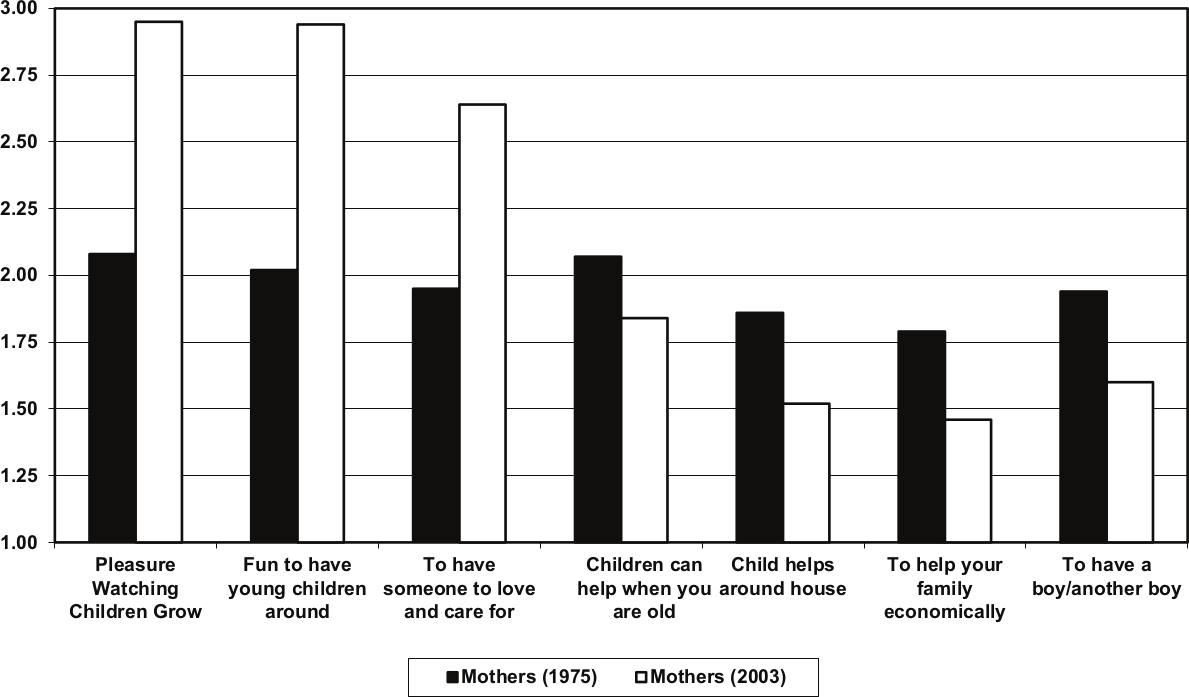
Comparative findings from the 1975 and 2003 Turkish VOC studies: Reasons for wanting a child.
The figure shows that although in 1975 all the VOCs were rather similar in importance, three decades later, the significance of psychological VOCs (the first three reasons) far exceeded economic VOCs (the next three) and traditional son preference. Thus, cross-sectional and panel comparisons show that with socio-economic development (i.e., increased urbanization, education, and affluence), economic/utilitarian role, or value of the child decreases, but its psychological value gains in salience.
Theory of Family Change
Based on the VOC1 study and other relevant research, a Theory of Family Change was proposed by Kagitcibasi (1990, 2005, 2007, 2013). A distinction was made between intergenerational material and psychological interdependencies in the family. Economic/utilitarian VOC was considered to reflect material intergenerational dependencies, and psychological VOC reflected psychological/emotional dependencies. Based on this understanding, three prototypical family models were distinguished. The first, the “family model of (total) interdependence,” is common in less developed, rural, agrarian contexts with closely knit human ties, that is “cultures of relatedness” or collectivism, and is characterized by familial interdependencies in both psychological and material realms. The contrasting model of “independence” is more common in Western industrial urban settings with an individualistic culture. A third model, the psychological interdependence model, is a synthesis of the first two patterns.
Here, a note of caution is in order. Psychological interdependence does not mean more love and affection. Therefore, “psychological” is used here, rather than “emotional,” which tends to be understood as love. Psychological independence/interdependence has to do with boundaries of self with regard to close others. With more diffuse self boundaries, somewhat “overlapping” selves are seen that reflect very little or no interpersonal distance among closely knit selves in the family (psychological interdependence). With more clearly defined boundaries, more separate selves are seen (psychological independence). The concept of “privacy” is more relevant here than the concept of love. There is more individual privacy in the family model of independence than in the family model of psychological interdependence. Thus, the degree of connectedness of family members is the main factor (Kagitcibasi, 2007).
Psychological interdependence model is posited to characterize especially the urban and more developed socio-economic contexts within cultures of relatedness. In such contexts, there are significant changes in lifestyles accompanying urbanization and socio-economic development; however, there tends to be continuity in culture—close-knit human ties of “the culture of relatedness” (collectivism). Increased affluence brings about less material dependence on the offspring, but continuing family culture of relatedness maintains psychological dependence. Therefore, this change does not imply a shift toward the Western family model of separation and independence as predicted by a general modernization perspective. Instead, a different pattern of family relations emerges that combines interdependence in the psychological realm with independence in the material realm (Kagitcibasi, 1990, 2007). This psychological interdependence family model differs from the traditional (rural/low socio-economic status [SES]) family model of (total) interdependence, given the former’s decreased intergenerational material interdependence, as well as decreased social/traditional VOC, including son preference. It also differs from the prototypical Western (middle-class) individualistic family model because it involves intergenerational psychological interdependence.
Research Evidence
Research provides evidence for the psychological interdependence family model. For example, in Hong Kong, Stewart, Bond, Deeds, and Chung (1999) found persistence of family interdependencies together with some individualistic values in “modern” families. Kwak (2003) in a review of research with ethnic minorities in the United States noted the common preference of adolescents for both autonomy and family relatedness. Koutrelakos (2004) found decreasing material but continuing emotional interdependencies in Greek Americans with acculturation. Georgas, Berry, van de Vijver, Kagitcibasi, and Poortinga (2006) in a 27-country study of the family found evidence for autonomy and relatedness to coexist in the psychologically interdependent family. Other recent research corroborates these findings (e.g., Dekovic, Pels, & Model, 2006; Jose, Huntsinger, Huntsinger, & Liaw, 2000; Kim, Park, Kwon, & Koo, 2005; Lubiewska, 2008; Mayer, Trommsdorff, Kagitcibasi, & Mishra, 2012; Phalet & Schonpflug, 2001).
Other studies with samples from countries not frequently studied concur. For example, McShane, Hastings, Smylie, Prince, and Tungasuvvingat Inuit Family Resource Centre (2009) studying parenting values of urbanizing Inuit in Canada pointed to the increasing prevalence of the psychologically interdependent family, evidenced by both autonomy and relatedness in their child-rearing orientations. Similarly, Tulviste, Mizera, and De Geer (2012) comparing Estonian and Swedish mothers’ socialization values found that through social change in Estonia, systematic changes in the family occurred in line with family change theory, and Seidl-de-Moura et al. (2008) comparing mothers’ socialization goals in seven cities in Brazil found similar patterns.
Finally, a large-scale comparative study on family values and relations using university student samples in 26 countries (Georgas et al., 2006) showed that with socio-economic development, hierarchy in family relations decreased. In particular, with increased affluence, urbanization, and education, intergenerational hierarchy in the family lessened and autonomy increased. These findings supported Kagitcibasi’s family change theory and provided insights into global trends in family dynamics as well as the changing roles of children.
Intergenerational Relations: VOC2 Studies
Recent comparative analyses using VOC2 data provide more direct supportive evidence. In this set of studies, three generations were studied: grandmothers, mothers, and adolescents; thus, intergenerational relations could be addressed. Several country investigators using these data found expected SES and/or generational variations in the VOC. The Indian VOC2 study (Mishra, Mayer, Trommsdorff, Albert, & Schwarz, 2005) found a shift toward increased psychological VOC with urbanization. The VOC2 Study in Indonesia (Albert, Trommsdorff, Mayer, & Schwarz, 2005) also pointed to changes from traditional utilitarian to psychological VOC in rural–urban and generational comparisons. In China (Zheng, Shi, & Tang, 2005) in both the rural and the low-SES “floating” people’s samples, and among grandmothers’ samples, economic/utilitarian VOC was found to be higher than that of the urban, higher SES samples and the younger generation, for whom psychological VOC was more important.
With a cross-cultural comparative approach, Mayer et al. (2012) examined patterns of family-related value orientations of mothers and their adolescent children in Germany, Turkey, and India using VOC2 data. Adolescents preferred more independent and less interdependent orientations than their mothers across the three cultures. With a higher level of economic development came the preference for a more independent family model. For example, comparisons across social strata and regional groups in Turkey showed that independent and psychologically interdependent orientations were salient in urban groups. In particular, more than twice as many adolescents displayed the independent pattern as that of their mothers, whereas more than twice as many mothers displayed the psychologically interdependent pattern compared with that of their children.
Further comparative studies by Mayer (2013) and Trommsdorff and Mayer (2012) analyzing VOC2 data from 2,566 adolescents in 10 countries identified three patterns of cultural and family-related value orientations that represented the family models of interdependence, independence, and psychological interdependence (see Figure 2). The pattern that represented psychological interdependence was similar to the pattern representing (total) interdependence in terms of high family interdependence, which reflects the tightly knit relationships among family members. However, psychological interdependence pattern is also similar to independence pattern with respect to a low utilitarian/normative VOC.
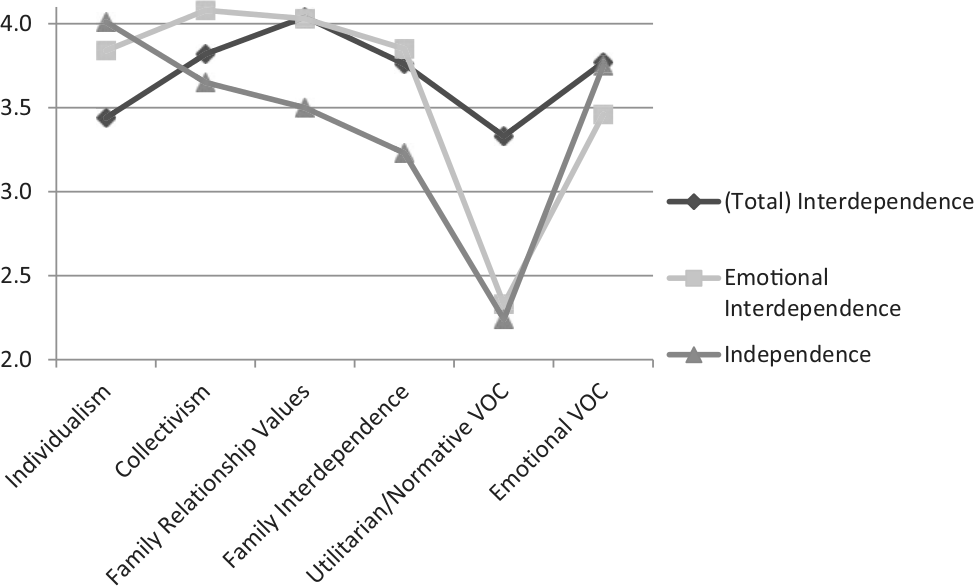
Family value profiles across 10 cultures (cluster profiles resulting from the K-means cluster).
Adolescents’ readiness to support parents was found to be strongly related to the three patterns with higher frequencies of helping parents with household chores in the family model of interdependence followed by psychological interdependence and, last, independence. Clearly, these findings point to different intergenerational relationships with important implications for the care of the elderly. In addition, as expected, it was found that as the countries’ socio-economic development and affluence increased, interdependence values decreased, and psychological interdependence and independence values increased.
Thus, the VOC2 findings have far-reaching implications for the care of the elderly. Considering the material versus psychological interdependencies in the family, it is understandable why the former should decrease with increased affluence, urbanization, and economic development. With these lifestyle changes, organized social support systems such as old-age pensions, social security benefits, health insurance, and the like become more readily available to the elderly, so that they do not have to depend on their adult offspring for their livelihood, thus decreasing intergenerational material dependencies in the family. However, there is no reason why psychological connectedness or interdependencies should decrease with socio-economic development, particularly in collectivistic cultures where family relatedness values are cherished. These are not incompatible with socio-economic development and urban lifestyles. That is why in the Turkish VOC2 Study, while economic VOC decreased with socio-economic development, psychological VOC increased (Ataca et al., 2005; Kagitcibasi, 1982; Kagitcibasi & Ataca, 2005).
The Changing Aged Populations
The world is aging. “In 2006, almost 500 million people worldwide were 65 and older. By 2030, that total is projected to increase to 1 billion—1 in every 8 of the earth’s inhabitants” (U.S. Department of Health and Human Services, 2007, p. 2). The number of older people shows a rapid increase from 202 million in 1950 to 841 million in 2013 (United Nations, Department of Economic and Social Affairs, Population Division, 2013). It is predicted that the speed of aging will accelerate in the next 40 years, and the proportion of the population aged 60 or above will reach 21% in 2050 (United Nations, Department of Economic and Social Affairs, Population Division, 2013. “Significantly, the most rapid increases in the 65-and-older population are occurring in developing countries, which will see a jump of 140 percent by 2030” (U.S. Department of Health and Human Services, 2007, p. 2). For example, between 1990 and 2025, the 60+ age population in Africa is expected to quadruple to 100 million, with 75 million in Sub-Saharan Africa (Cattell, 1993).
Life expectancy as well as healthy life expectancy at age 60 shows a great degree of variability around the world. On average, a person of 60 can expect to live 16 more years (9.2 years in good health) in Afghanistan, 21 more years (15.6 years in good health) in Turkey, and 26 more years in Japan (20.3 years in good health; Global Age Watch Index, 2014).
Aging shows marked differences between the more and the less developed regions. Although aging has been an issue in the more developed regions since the middle of the 20th century, it is only starting off in the less developed areas with an expectation of high acceleration in the next few decades(United Nations, Department of Economic and Social Affairs, Population Division, 2013; see Figure 3).

Proportion of the population aged 60 years or above: World and development regions 1950-2050.
In Turkey, the proportion of population 65 years and above was 7.5% in 2012. This proportion is expected to increase to 10.2% in 2023, 20.8% in 2050, and 27.7% in 2075. In the 1960-2002 period, 60+ age group increased by 57% and 80+ age group increased by 266% (Turkish Statistics Institute, 2012, www.turkstat.gov.tr). Thus, in Turkey, we see a dramatic example of the “demographic transition.” A key phenomenon here is the so-called “Societal aging,” referring to the proportion of the rates of fertility and mortality (Tufan, 2014). If fertility is high, a society does not “age,” even if the number of the aged increases. In Turkey, fertility rates have decreased significantly in the last decades.
Care of the Elderly
Given the high-scale acceleration of older populations globally, there will be a major future demand for long-term care. The numbers that indicate the need for old-age care are striking. According to the European Commission’s (EC) 2009 Ageing Report, by 2060, those above 65 with at least one disability in activities of daily living will reach 44.4 million, which is more than double the figure in 2007. Dependent older people who receive care in institutions would triple, formal care at home would more than double, and informal or no care would reach 22.3 million by 2060 (Bettio & Verashchagina, 2010). The EC Ageing Report documents that informal caregivers, that is, family and friends, make up the most important group. Less than half of the 20.7 million dependent elderly in the European Union in 2007 are estimated to have benefited from formal care, while 12.3 million received informal or no care (Bettio & Verashchagina, 2010).
Especially in the economically developed countries, given higher affluence and better public health measures, the care of the aged population has become a major issue, socially and economically. Institutional provisions and various benefits provided to the elderly are becoming more costly, and the policies involved are discussed in detail in the public sphere (Bettio & Verashchagina, 2010).
The state of the elderly and their care have long been topics of study in the social sciences, ranging from demography to gerontology, from economics to anthropology. Early on, anthropological studies, especially those carried out in preindustrial societies pointed to wide variation in the treatment of the aged. Some practices appear extreme, such as the voluntary self-exclusion or the abandonment of the elderly, although there has also been debate about the prevalence of some of these practices such as abandonment (e.g., Aboderin, 2004). In contrast are traditions of reverence of the aged and ancestor worship. In general, treatment of the elderly has been studied without relating it specifically to child socialization, these two aspects of family and society being considered separate spheres of human phenomena. The gist of the present article is to provide such a link that has not been recognized sufficiently but is empirically evidenced.
In a study using the VOC constructs with university student samples from Turkey and the United States, Aycicegi-Dinn and Kagitcibasi (2010) compared the attitudes and values of the university students with their perceptions of the attitudes and values of their parents. Both generational and SES/development differences were found in most values. The social/traditional VOC was less important for the students compared with their parents. Students as well as their parents endorsed this type of VOC less in urban and higher SES contexts than rural contexts. Students also perceived their parents to have higher economic/utilitarian expectations from children than they themselves did from future offspring. The Turkish rural students perceived their parents to have higher economic expectations from them than did Turkish urban students.
Gender and Care of the Elderly
Gender can make a difference in the expectations of future help and care from the offspring. In the above study (Aycicegi-Dinn & Kagitcibasi, 2010) unexpectedly, American students had as high expectations as the rural Turkish students because of generally higher expectations of economic support from daughters in the United States than in Turkey, where patrilineal family ties still hold to some extent, and men are the main “bread earners.” Although expectations of economic support from sons showed no difference between urban Turkish and American students, expectations from daughters were higher in Americans than both Turkish groups. It was also the case that Turkish rural students perceived their parents to expect economic support from their sons much more than from their daughters. In a similar vein, the Turkish VOC2 findings showed that urban high SES mothers’ material expectations of help from sons and daughters varied only slightly, with the difference in expectations from sons and daughters increasing in the urban low-SES and the rural groups (Ataca et al., 2005). The latter groups adhere to more traditional patriarchal worldviews.
It appears that the meaning of old-age security varies with cultural context. Whereas in the low-SES Turkish family it refers to the economic/utilitarian help that is provided mostly by sons, in the American middle-class family, it refers to care and support that is provided mostly by daughters. Interestingly, a study with urban middle-class mothers in Turkey found a similar trend to that of the American family (Ataca & Sunar, 1999). Mothers preferred daughters as companions for themselves and as helpers both when they are young and when they grow up. Moreover, they indicated old-age security as a reason for girl preference rather than boy preference. Again, changes in gender-related worldviews, and specifically, weakening of patriarchal values with socio-economic development are relevant here.
The Turkish VOC study findings also provide insights into SES and generational differences in parents’ sex preference in children (Ataca et al., 2005). With increasing SES, material/utilitarian expectations both in terms of household help and financial assistance in old age decreased. Traditionally, in a patriarchal context, such benefits are expected more from sons; hence, this decreasing pattern has consequences for parents’ sex preference in children. Compared with the national sample of VOC1 in 1975, sons were preferred much less in the urban sample of VOC2 in 2003, with the exception of the low-SES grandmothers. A clear girl preference among mothers from high and low urban SES groups alike, together with even a greater preference on the part of the high SES grandmothers, may reflect their own experiences of being closer to their daughters than to their sons. Indeed, recent statistics from Turkey show that 37.2% of adult daughters compared with 33.4% of adult sons visit their parents (Turkish Statistics Institute, 2012, TUIK–Turkish Statistics Institute).
VOC2 study in Turkey showed that psychological needs and values have become very important. This reflects emotional closeness between generations, which tends to be fulfilled more by daughters. In fact, VOC2 findings showed that expectations of living close and providing emotional support were expected more from daughters than from sons. These are non-material expectations.
Using VOC2 data from Germany, Israel, Palestine, and Turkey, Kagitcibasi, Ataca, and Diri (2010) studied intergenerational relationships between mothers and adolescents. Maternal expectation of support from grown-up children and emotional support provided to mothers by adolescents were at higher levels in the Turkish and Palestinian groups, whereas German mothers had the lowest level of expectations. Intergenerational intimacy both for mother–adolescent and also for mother–own mother was also greater in Middle Eastern families than in German families. Similarly, greater emotional support to grandmothers was provided by Middle Eastern mothers than by German mothers. Intimacy and support are characteristics of the interdependent family and psychologically interdependent family with close-knit family ties. Intimacy in the mother–adolescent relationship affected the adolescent’s emotional support to the mother. The study also provided some insight into the mother’s expectations of future support from her children based on her relations with her own mother. Greater intimacy with own mother and greater support provided to her led to higher expectations from offspring in the future. In contrast, the perceived burden of the support given to own parent had a negative impact on expectations of future support from children.
Conclusion and Future Prospects
In conclusion, we can say that this article presented theory and research focusing on family roles and values, and in particular, the VOC for parents as important factors with implications for the care of the elderly. In addition to and alongside objective indicators such as affluence, the availability of institutional support, and the like, family variables are a key to a better understanding of the care for the elderly. In particular, where family values in line with social norms define the role of the offspring as the carer of the elderly parents, family care becomes the norm. With systematic changes in the family, this norm undergoes change, also. What changes and what is maintained, and to what degree, are questions of great significance for the care of the elderly. This care is influenced by both socio-economic development and culture which both shape families and need to be taken into consideration to develop a better understanding of the complex phenomena involved. Thus, further research is needed to delve into the intergenerational dynamics that reflect both culture and the economic context.
Commonly, topics such as care of the elderly have been studied by economists, demographers, and sociologists, but psychological work, particularly from a comparative cross-cultural perspective, is rather rare. Yet, cross-cultural psychological research can contribute greatly to a better understanding of the issues involved. This is because accumulated psychological knowledge on parent–child relations and family dynamics can help reveal human phenomena beyond those studied by other social sciences. For example, family change theory has been supported by research, as discussed above; however, there is a need to study whether the theoretical predictions hold in new socio-cultural contexts and to what degree.
The implications of the theory of family change for the care of the elderly point to the important role of socio-economic factors on one hand, and cultural factors on the other. These factors are distinct and make distinct impacts on the family. Specifically, with regard to the two contrasting family models of independence and (total) interdependence, both socio-economic conditions (affluence, availability of institutional care, etc.) and also culture (culture of separateness–relatedness or individualism–collectivism) imply mainly institutional or extra-familial care in the Western middle-class contexts and family care in the less developed socio-economic contexts. However, when it comes to the synthesis family model of psychological interdependence, there are opposite implications of the socio-economic and cultural factors. From an affluence (socio-economic) perspective, institutional or extra-familial care is implicated for the elderly; but from a cultural perspective (close-knit family values), family care is implicated.
This makes the picture rather complex and often problematic for all involved. It may generate interesting hypotheses to be tested in future research, for example, concerning the conditions under which socio-economic factors such as affluence would dominate the decisions about the care of the elderly and conditions under which cultural factors would dominate. There is also a need to better understand what types of modifications, syntheses, or fusions may emerge when culture and socio-cultural context have contrasting implications for the change of family values, such as in immigration contexts.
Finally, further research is needed to inform applications and practice. As seen in the example of immigration, when there are conflicting orientations, research can shed light on more adaptive courses of action. With increasing life expectancies across the globe, care of the elderly is becoming a major human issue. Psychological research can make a difference in dealing with it. Indeed, the greater the depth of understanding we develop about family dynamics, intergenerational relations, values attributed to children, and expectations from them in the contexts of socio-economic change and development, the greater contribution we can make to the well-being of the elderly.
Footnotes
Declaration of Conflicting Interests
The author(s) declared no potential conflicts of interest with respect to the research, authorship, and/or publication of this article.
Funding
The author(s) disclosed receipt of the following financial support for the research, authorship, and/or publication of this article: The 1975 VOC Study was supported by the International Development Research Center of Canada; the 2003 Study was supported by the German Research Council.