



Abstract
In the present research, we examined cross-cultural generalizability of the roles of anxiety and intergenerational contact in age-based stereotype threat (ABST). To this end, we conducted studies in France (individualistic culture) and Indonesia (collectivistic culture). In the main study, elderly participants in France and in Indonesia completed the Digit Span task that was presented as memory (high-threat) or cognitive strategy task (low-threat). Using the bootstrapping method, we found that, in both countries, stereotype threat led to lowered performance among the elderly who had little or no contact with the young. Those with positive contacts, on the other hand, showed no performance decrement under high (vs. low) threat. Highlighting the importance of culture, performance anxiety mediates the effects of threat on the performance of the French elderly, versus intergroup anxiety for the Indonesians. Self-construal (independent vs. interdependent) associated with cultural orientation (individualistic vs. collectivistic) was proposed to explain the cultural difference in the type of anxiety as a mediator. This not only leads to suggestions for future research but also for possible real-life intervention strategies.
Stereotype threat theory posits that individuals show real performance decrement when they fear that their performance or behavior may be seen or interpreted as confirming the negative stereotypes of their group (Steele & Aronson, 1995). Studies on the effects of stereotype threat on performance among the elderly (Age-Based Stereotype Threat or ABST) have consistently shown performance decrement in memory domains, central to the stereotypes of the elderly in many societies (i.e., that they are forgetful, see Brubaker & Naveh-Benjamin, 2018; Chasteen et al., 2005; Hess et al., 2003; Mazerolle et al., 2017).
Previous research has shown that the elderly performed significantly worse than young people on memory tasks when the task instruction mentioned (vs. did not mention) memory ability (Desrichard & Köpetz, 2005; Lamont et al., 2015; Rahhal et al., 2001). Using a different experimental paradigm, the elderly also performed worse when told that the purpose of the study was to investigate age differences in memory tasks, compared to when told that the purpose was to reveal individual differences (Abrams et al., 2006; Hess, Emery, et al., 2009; Hess, Hinson, et al., 2009). These results converge in suggesting that although aging may bring about cognitive declines (Harada et al., 2013), stereotype threats can compound the observed declines in the performance of the elderly.
In the context of global aging, it is important to generalize the above findings to countries other than “western” (such as the US or the UK) where most of the studies have been conducted, with few exceptions (e.g., among Korean elderly, see Lee & Lee, 2019; Chinese elderly, see Tan & Barber, 2020). To this end, we studied stereotype threat effects on memory performance of the elderly in Indonesia and in France. Both countries are predicted to be in the top 10 countries with the highest percentage of the population over the age of 80 by year 2050 (United Nations-Department of Economic and Social Affairs, 2015). Furthermore, as research on stereotype threat has interventions (to overcome its negative effects) as ultimate goals, it is important to identify and test the cross-cultural generalizability of underlying factors that can explain observed performance decrement and factors that can serve as buffers against the effects of stereotype threats. In the present research, we focused on anxiety as the mediating variable in the link between threat and performance, and contact with the young as a factor that may attenuate/eliminate the effects of stereotype threats on the performance of the elderly (Abrams et al., 2006, 2008).
Abrams et al. (2006, 2008) have identified intergenerational contact as moderator of stereotype threat effects among the elderly. They found that the elderly who have more positive intergenerational contact have better performance (than those with less positive contact) on cognitive tests, under stereotype threat. Their studies thus established that positive contact with young people could prevent performance decrements of the elderly, on domains on which they are negatively stereotyped. Importantly, these studies revealed that under stereotype threat, the elderly with positive intergenerational contact were less anxious compared to those with no or negative contact. Specifically, the effects of threat and contact on the performance of the elderly are mediated by performance anxiety or the (feeling of) apprehension of being negatively evaluated (see Crisp & Abrams, 2008).
Performance anxiety is associated mostly with the concern about one’s positive self-image, in one’s own eyes or others’. Stereotype threat situations, however, may incite other types of anxieties. Given that stereotype threat generally implies intergroup situations or even requires an intergroup context for its manifestation (see Shapiro & Neuberg, 2007; Wout et al., 2008), the integration of intergroup literature is indeed promising (see Crisp & Abrams, 2008). This literature has revealed the existence of another type of anxiety, namely intergroup anxiety or the feeling of discomfort when anticipating or experiencing interactions with outgroup members (Pettigrew & Tropp, 2006; Stephan & Stephan, 1985). Intergroup research has also revealed that positive intergenerational contact can lead to the reduction of intergroup anxiety among the elderly (Chua et al., 2013).
Intergroup anxiety may potentially play a more significant role among individuals from more collectivistic Asian cultures than those from Western individualistic cultures, in modulating their performance under stereotype threat. Asians tend to have more interdependent self-construal that includes others or the groups they belong to, in their self-definition (vs. independent among Westerners, see Markus & Kitayama, 1991). In short, the groups to which one belongs are likely to be more salient among Asians than Westerners who think of themselves as separate and unique individuals. Consequently, it is likely that the intergroup nature of stereotype threat situations will induce intergroup anxiety to relatively higher degrees among Asians than among Westerners. We propose thus that both types of anxiety may mediate the link between stereotype threat and performance decrements, but to different degrees as a function of culture and the associated self-construal.
In this research, we expected to find a pattern of mediated moderation such that the moderating effect of intergenerational contact on stereotype threat would be mediated by anxiety. We proposed that culture should play a role in the type of anxiety that is likely to mediate the effects of stereotype threat on the performance of the elderly on stereotyped tasks, given differences in the self-construal of individuals from different cultures. Among those who belong to collectivistic cultures and thus are more likely to have an interdependent self-construal, in our case the Indonesian elderly, intergroup anxiety should play a relatively more important role compared to their French counterparts who are likely to have more independent self-construal (or compared to performance anxiety). Among the French elderly, on the other hand, we expected their level of performance anxiety to be higher (compared to Indonesians or to intergroup anxiety).
We expected contact with young people outside the family to play a similar role, that is, reducing stereotype threat effects, among both French and Indonesian elderly. However, differences may be expected on contact with the young within the family, notably grandchildren, given the dominant family structures in each country. As most of the elderly in Indonesia live with or near their families, the quantity and quality of contact with grandchildren tend to be quite high and positive (Niehof, 1995). In contrast, French elderly tend to live separately from their children or grandchildren (Organisation for Economic Cooperation and Development Family Database, 2016). This led us to expect that frequency and quality of contact with young people outside the family would play a similar role (in reducing stereotype threat effects) in both countries, but that contact with grandchildren may vary (thus, of greater or lesser importance) as a function of the family structure in the two target countries.
We first conducted a preliminary study to determine the content of the stereotype of the elderly among Indonesians, in particular among the target population, that is, Javanese that represents the largest ethnic group in Indonesia (40.22%; Badan Pusat Statistik, 2010), which is still lacking in the current empirical literature. We expected that the content, in particular related to memory domain (i.e., being forgetful), to be comparable to that in the west. Next, we conducted parallel experiments in both France and Indonesia using the same procedure, to test our hypotheses related to the modulating roles of intergenerational contact and anxiety in the link between threat and performance. We expected performance anxiety to play a more important role among the French, versus intergroup anxiety that should play a more important role among Indonesian elderly.
Method
Preliminary Study
This preliminary study aimed to ascertain the content of the elderly stereotype among our target population, Javanese Indonesians.
Participants
Participants were 103 adolescents (aged 15–18, M = 16.3 years; 39 males and 64 females), 107 adults (aged 22–59, M = 41.82, 43 males and 64 females), and 92 elderly (aged 60–85, M = 66.92, 38 males and 54 females). Adolescent participants were High School students, whereas adult participants were employees in diverse professions (government or private). The elderly participants were recruited from elderly care groups (Posyandu Lansia). All participants were in relatively good health. The different age groups were included to ensure that both the elderly and the young hold similar stereotypes concerning the elderly.
Procedure
Participants were run individually in classrooms, workplaces, or homes (for the elderly). They were told that they would take part in a study allegedly on “social perception.” An open-ended task was used: Participants were asked to write words or phrases that come to mind spontaneously when they think about, hear, or read the word “the elderly.” They responded in writing on the provided sheet, except for elderly participants who could respond verbally if they wished (and all responses written verbatim by the researcher). There was no limit on the number of responses that participants could give, as long as they were spontaneously generated. Participants received a small thank you gift at the end of the individual session.
Results and Discussion
In total, participants generated 992 responses to the word “the elderly” (M = 3.34, SD = 2.07). Responses for the most part were adjective words (e.g., frail, experienced). Unlike some previous studies that removed physical traits (e.g., white hair, wrinkled face, see Hummert et al., 1994) and responses that did not refer to traits (e.g., young people should respect the elderly, Zhang et al., 2002) from the analyses, all responses given by the participants were included in our analyses. Each of the responses was coded by two independent coders according to valence (positive, negative, and neutral, Cohen’s Kappa inter-rater reliability for each group: adolescents = .95, adults = .91, and the elderly = .97) guided secondarily by past literature (Hummert et al., 1994; Schmidt & Boland, 1986).
Most Frequent Descriptions about the Elderly
We ranked the most frequent descriptions or statements for the elderly listed by participants in the three age groups. The top three descriptions about the elderly for each of the groups were: Needing care (12.8%), Forgetful (7.5%), and Respected (7.5%) for adolescent sample; Forgetful (9.6%), Sick (5.5%), and Needing care (5.5%), for adults; and Religious (15.7%), Frail (8.6%), and Forgetful (8.2%) for the elderly sample.
Valence of the Elderly Stereotype
Next, we conducted a 3x3 ANOVA with age group (adolescent vs. adult vs. elderly) as between-group variable, and valence (positive vs. negative vs. neutral) as within-participant variable. Results yielded a significant main effect of age, F(2,299) = 33.79, p < .001 and valence, F(2,598) = 120.68, p < .001. Participants on the whole generated significantly more negative statements (M = 1.84, SD = 1.68) than positive (M = 1.38, SD = 1.54) and neutral (M = .12, SD = .45), p < .001. Results also yielded a significant interaction between group and valence, F(4,598) = 5.10, p < .001. The elderly generated an equivalent proportion of positive and negative statements (Ms = 1.36 and 1.37, for positive and negative statements respectively, p = .97), whereas the other groups generated significantly more negative than positive statements (Ms = 1.61 & .89, p < .001 for adolescents; Ms = 2.46 and 1.88, p < .05 for adults). Thus, stereotypes of the elderly held by the young/adults appear to be negative, comparable to findings in western countries.
This preliminary study allowed us to ascertain that the elderly stereotype in Indonesia (among Javanese, specifically) is similar to that found in western societies. Of particular interest to us is the elderly stereotype related to the memory domain among Indonesians, that is revealed to be compatible with results obtained from western participants (see Armstrong et al., 2017). This allows us to ascertain that memory decline is also associated with the stereotype of aging among Indonesians, and that memory tasks, used in our main studies below, could also be potentially threatening to this group of elderly. In other words, we expected ABST to be present among Indonesian elderly. ABST has indeed been observed from the few studies conducted among the elderly from collectivistic cultures (Korea, Lee & Lee, 2019; Hongkong, Chan et al., 2020). The present study, aside from contributing to the current evidence of the existence of ABST in the elderly from collectivistic cultures, examined factors that modulate its effects which, as argued above, could differ as a function of individualistic-collectivistic cultural orientation.
Main studies
Two studies were conducted in parallel in France and in Indonesia. The main objective was to examine intergroup anxiety as a modulating factor in the link between stereotype-threat and performance of Indonesian elderly (versus performance anxiety for the French elderly), given the importance of groups in the self-definition or self-construal of individuals from collectivistic cultures. In view of their potential application to overcome stereotype threat effects, the role of intergenerational contact in reducing anxiety, be it performance or intergroup, was also examined.
Participants
For the study conducted in France, a total of 40 participants, 13 male and 27 female elderly (Mage = 69.85, range = 61–79, SD = 5.31), recruited from various social groups and organizations for elderly people in the Paris region participated. The average years of education was 13.45 years (SD = 1.58). Thirty-seven participants (92.5%) were retired and the remainder still worked or had returned to work after retirement. Twenty-one participants (52.5%) lived alone and 19 (47.5%) lived with their spouse. None lived with their children and/or grandchildren. The number of grandchildren they had ranged from 0 to 9 (M = 1.60, SD = 2.02). Eighteen participants (45%) had no grandchildren.
The study in Indonesia also included 40 participants comprising 15 males and 25 females, Mage = 69.30, range 61–79, SD = 5.31, recruited through the local regents and elderly groups in the city of Yogyakarta. The average years of education was 11.98 years (SD = 3.76). Twenty-four participants (60%) were retired, 6 (15%) still worked, and 10 (25%) never worked previously (e.g., were housewives). Six participants (15%) lived alone and 34 participants (85%) lived with family (i.e., their spouse and children-grandchildren). The number of grandchildren they had ranged from 0 to 28 (M = 6.18, SD = 6.24). Only one participant had no grandchildren (2.5%).
Procedure and materials
The same procedure was followed for the studies in both France and Indonesia.
Prior to the start of the experiment, participants were informed orally and in writing that they would participate in a study conducted by a university in their city and would be asked to complete diverse tasks during the study. Consent was obtained from all participants who were well aware that they could discontinue their participation at any time if they wished.
Participants were randomly assigned to one of two conditions: high stereotype threat (n = 20) versus low stereotype threat (n = 20). Participants in high-threat condition were told that the task was “a memory task that measures whether the elderly perform more poorly compared to young people.” Participants in low-threat condition were told that the purpose of the task was “to understand how people differ in their strategies on cognitive tasks.” Participants then completed a digit span task from the Wechsler Adult Intelligence Scale-Fourth Revised edition: They were asked to listen to a sequence of digits and to repeat them in forward, backward, and ascending order. There were 48 sequences in increasing difficulty, from 2 to 9 digits each. A score of 0 to 48 was given based on the number of correct responses.
Next, participants completed questionnaires related to performance anxiety, intergroup anxiety, and contacts with young people, in that order. All questionnaires were translated from English to French or to Indonesian and back translated to English.
Performance anxiety was measured using nine items from Osborne (2001). Participants rated how they felt while taking the test on items such as uneasy and calm, using a 7-point rating scale (1 = not at all, 7 = very much). The intergroup anxiety measure was adapted from Stephan and Stephan (1985). Participants had to indicate how they felt when interacting with young people compared to occasions when interacting with people from their own age group. Ratings were made on a 7-point scale (1 = not at all, 7 = very much) on items such as awkward and confident.
To measure contact with young people outside the family, we used items adapted from Abrams et al. (2006). The items measured the quality and quantity of contact with people aged 35 years or younger. We asked participants to indicate how many pleasant and unpleasant contacts with young people they had in the previous week. An index of relative pleasantness was obtained by subtracting the number of unpleasant contact from the number of pleasant contact. Participants also indicated how many close young friends they have and how many friends of their age group have younger friends (i.e., extended contact). This measure thus comprised three items, that is, recent quality of contact, friends, and extended contact. Factor analysis revealed that all loaded on a single factor that accounted for 63.92% of the variance for the French elderly, and for 60.04% of the variance for Indonesian elderly. These factor scores were used as an index of contact quality with young people outside the family (relatively less to more positive), for each participant.
For contacts within the family, we measured contacts with grandchildren (Abrams et al., 2008). Participants were asked to indicate the frequency of meeting their grandchildren within the past week, from never (1) to every day (8), and to rate the quality of the relationship with the grandchildren, from very negative (1) to very positive (7). For the elderly without grandchildren, we assigned a score of 1 to ensure that they had a low score of contact quality with grandchildren. Excluding these participants, the frequency of contact score among French and Indonesian elderly averaged 2.00 (SD = 1.02) and 6.15 (SD = 2.93), respectively, representing once for the French and five times per week for the Indonesians. To obtain a weighted index of contact, frequency scores were multiplied by positivity scores, and divided by 7 to scale the variable onto the same 1 to 7 range. All contact scores (within and outside the family) were then transformed to z-scores and used in the analyses.
A measure of collective self-esteem (CSE; Luhtanen & Crocker, 1992) was also given as past studies on stereotype threat have included mostly personal self-esteem (Carels et al., 2013; Rydell & Boucher, 2010). We aimed to fill this gap and explore the possibility that CSE may play a relatively important role among our Indonesian elderly (i.e., participants with more interdependent self). The 16-item questionnaire was adapted to the group “elderly,” such as “I frequently regret being an elderly person.” Participants responded to each item using a 7-point scale ranging from 1 (strongly disagree) to 7 (strongly agree). Due to time restriction, no personal self-esteem measure was administered.
Lastly, participants were asked to rate their own health on a single question, “In general, would you say your health is ______?” ranging from 1 (poor) to 5 (excellent). This was followed by a demographic questionnaire assessing age, sex, living status, marital status, total years of education, and occupation (retired or working).
At the end of the session, participants were debriefed thoroughly regarding the purpose of the study, and all questions were answered fully.
Results
Data from each country were analyzed and presented separately. Tables 1 and 2 present the correlations between the main variables, for France and for Indonesia respectively. Prior to running the analyses, the health condition and demographic variables were checked to determine if they were related to threat conditions and performance. We found that health status among participants in both countries correlated significantly with performance. However, its inclusion in the analyses did not influence the effects of threat and contact on performance and was thus omitted from the analyses that follow.
Correlations between Main Variables, Means, and Standard Deviations (French Elderly).
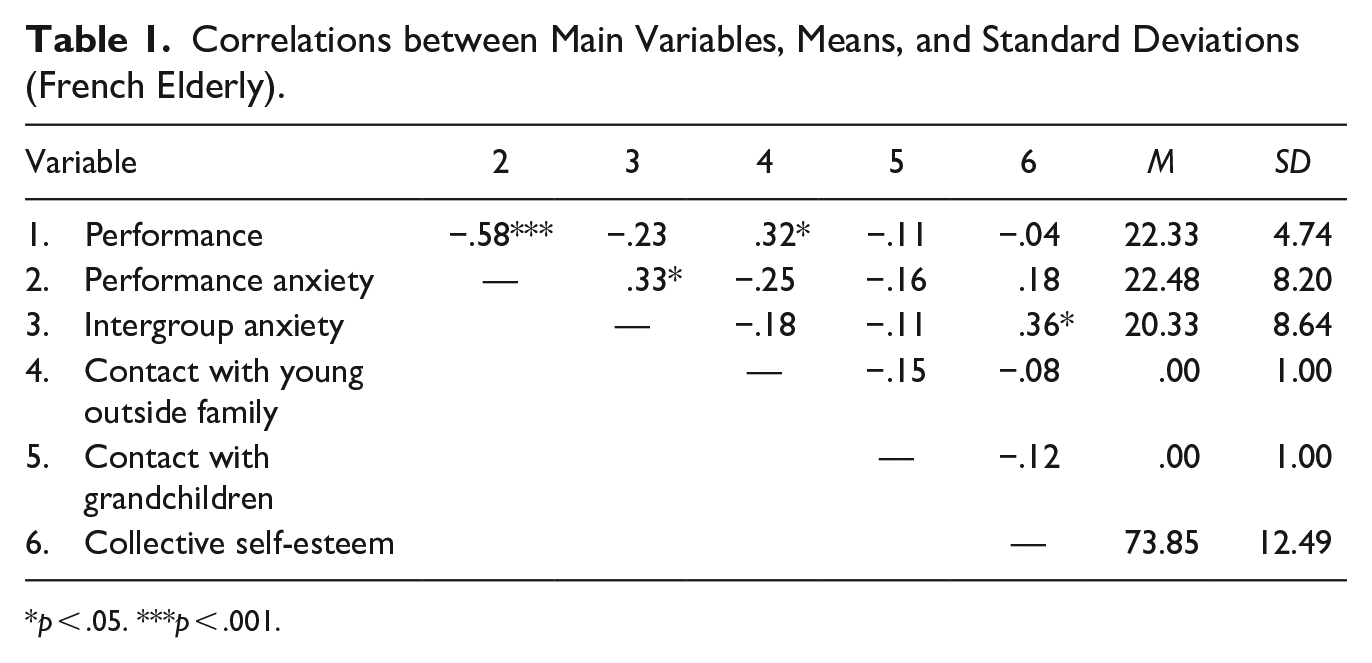
p < .05. ***p < .001.
Correlations between Main Variables, Means, and Standard Deviations (Indonesians Elderly).

p < .05. **p < .01. ***p < .001.
The first analysis examined differences in the performance of the elderly across threat conditions. As expected, in both countries, participants in high-threat condition had lower performance than those in low-threat condition. French participants in high threat performed significantly worse (M = 20.75, SD = 4.76) than those in low threat condition (M = 23.90, SD = 4.27), F(1,38) = 4.86, p < .05, d = .69. The same pattern was found for Indonesian elderly: Participants in high threat condition performed worse (M = 18.20, SD = 3.58) than those in low threat condition (M = 21.25, SD = 3.65), F(1,38) = 7.11, p < .05, d = .84.
An ANOVA that included the variables country and threat condition was also conducted to examine their effects on participants’ performance on the Digit span task. This analysis revealed that there was no statistically significant interaction between the effects of threat and country/culture on the performance of the elderly, F (1,76) = 0.03, p = 0.957. The absence of the effects of threat and country/culture (i.e., no difference in the performance of Indonesian and French elderly) confirms that the results presented above cannot be attributed to differences in baseline performance between the French and the Indonesian elderly.
Moderation by Intergenerational Contact
To determine whether intergenerational contact moderates the relationship between stereotype threat and performance, we used “Model 1” in PROCESS (Hayes, 2013). Effects were estimated from 10,000 bias-corrected bootstrap samples. Bootstrapping method is recommended for small sample size. We then conducted separate analyses for contact with young people outside the family and within (i.e., contact with grandchildren). There was no correlation between contacts with the young outside and within the family, for the French (r = −.15) and for the Indonesian elderly (r = −.05)
Among French participants, there was a significant interaction between threat and contact with young people outside the family, b = 3.18, SE = 1.46, t(36) = 2.18, p < .05, but no significant interaction between threat and contact with grandchildren, b = .73, SE = 1.58, t(36) = .46, p = .64. The significant interaction indicated that contact with young people outside the family moderated the effect of threat on performance (see Figure 1a). Among the elderly with less positive contact, the conditional effect showed that threat had a significant effect on performance, effect = −5.67, SE = 1.91, t(36) = −2.97, p < .01, and the confidence interval (CI) did not include zero = −9.554 to −1.795, indicating statistically definitive indirect effect. Among those with more positive contact, however, there was no significant effect of threat, effect = .67, SE = 2.05, t(36) = .32, p = .75, and the CI for indirect effect included zero = −3.495 to 4.833.

Test performance as a function of threat and amount of positive contact with young people outside the family among French participants (a) and Indonesian participants (b).
Among Indonesian participants, the same pattern emerged: only the interaction between threat and contact with young people outside family was significant, b = 2.44, SE = 1.02, t(36) = 2.40, p < .05. There was no significant interaction between threat and contact with grandchildren, b = .62, SE = 1.16, t(36) = .53, p = .60. Thus, only contact with young people outside the family moderated the effect of threat on performance. The conditional effect indicated that threat had a significant effect on the performance of the elderly with less positive contact, effect = −.68, SE = 1.41, t(36) = −3.93, p < .001 CI = −8.421 to −2.685, but not among those with more positive contact, effect = −5.55, SE = 1.41, t(36) = −.48, p = .64, CI = −3.556 to 2.204 (see Figure 1b).
To rule out the possibility that baseline differences between the two countries account for the observed results, we also checked for the effects of threat condition, intergenerational contact, and culture on the performance of the elderly by using PROCESS “Model 3.” We did separate analyses for contact with young people outside and within the family. For contact with young people outside the family, there was no significant two-way interactions of Threat × Culture, Contact × Culture, as well as three way interactions of Threat × Contact × Culture. Only the main effect of threat (b = −2.51, t(72) = −2.11, p < .05), two-way Threat × Contact interaction (b = 3.18, t(72) = 2.47, p < .05, and culture (b = −2.60, t(72) = −2.22, p < .05) were significant. The conditional effect indicated that contact with young people outside the family moderated the link between threat and performance both in France and in Indonesia (effect = 3.18, t(72) = 2.47, p < .05, CI = .617 to 5.748 and effect = 2.43, t(72) = 2.03, p < .05, CI = .042 to 4.835, respectively). The effect of threat on performance was significant for the elderly with less positive contact with young people outside the family, but not for the elderly with more positive contact.
For contact with young people within the family, the result showed no significant effect of threat, contact, and culture and of all two-way and three way interactions (all ps > .05). Thus, contact with the young within the family did not moderate the link between stereotype threat and performance of the elderly both in France and in Indonesia.
Mediated Moderation Analyses
Given the above, we next tested a mediated moderation model of stereotype threat on performance. We examined if performance anxiety and intergroup anxiety mediate the relationship between threat, contact with young people outside the family, and performance. Thus, in these analyses, we included intergenerational contact as the moderator, and performance anxiety and intergroup anxiety as the mediator variables (using PROCESS “Model 7”; Hayes 2013).
For the French elderly, the interaction between stereotype threat and contact was significant for performance anxiety (b = −5.34, SE = 2.52, t(36) = −2.12, p < .05 CI = −10.452 to −.232), but not for intergroup anxiety (b = −3.51, SE = 3.01, t(36) = −1.17, p = .25, CI = −9.626 to 2.596; see Table 3). The conditional indirect effects indicate that mediation of performance anxiety was observed among elderly people with less positive contact (effect = −3.28, SE = 1.44, CI = −6.531 to −.954), but not among those with more positive contact (effect = −.08, SE = 1.35, CI = −2.251 to 2.772).
Mediated Moderation Results for French Participants.
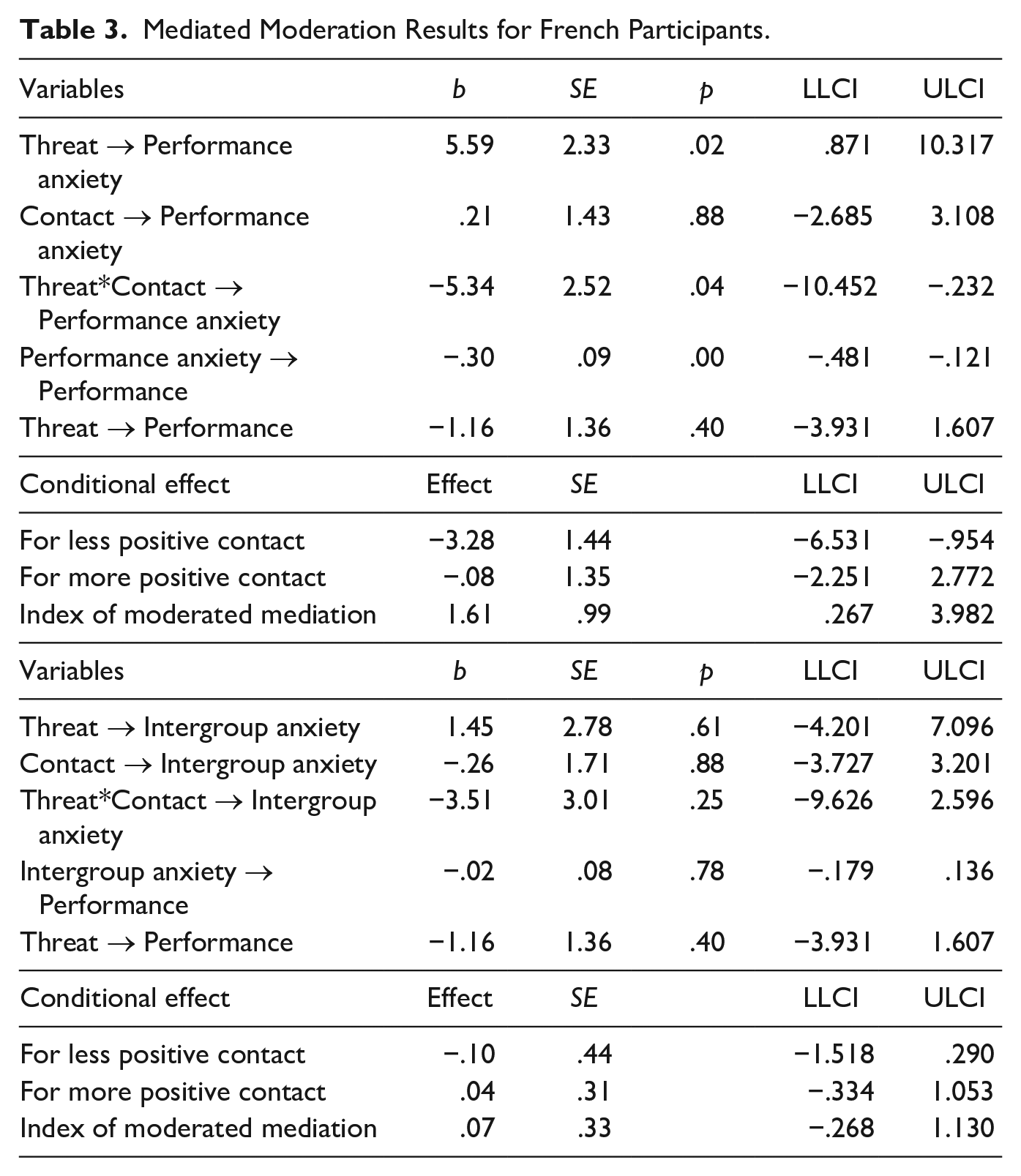
For Indonesian elderly, the analysis revealed a different pattern: The interaction between stereotype threat and contact was significant for intergroup anxiety (b = −5.36, SE = 2.60, t(36) = −2.07, p < .05, CI = −10.612 to −.108), but not for performance anxiety (b = −2.08, SE = 1.73, t(36) = −1.20, p = .24, CI = −5.586 to 1.429; see Table 4). The conditional indirect effects indicate that mediation of intergroup anxiety was observed among elderly people with less positive contact (effect = −2.24, SE = 1.14, CI = −4.928 to −.439), but not among those with more positive contact (effect = −.18, SE = .75, CI = −1.736 to 1.348).
Mediated Moderation Results for Indonesian Participants.

Note. Thus, the proposed mediated moderation—that anxiety mediates the effect of threat and contact on performance—was supported in both countries. Importantly, the two countries differed in the type of anxiety: performance anxiety for the French participants and intergroup anxiety for the Indonesians.
Additional Measures/Analyses
Additional analyses test whether CSE modulates the effect of threat on performance (PROCESS “Model 1”; Hayes, 2013). For Indonesian participants, the analysis yielded a significant interaction between threat and CSE, b = .27, SE = .09, t(36) = 2.74, p < .01. Threat had a significant effect on the performance of participants with low CSE (effect = −5.75, SE = 1.46, t(36) = −3.92, p < .001, CI = −8.714 to −2.777), but no effect on the performance of those with high CSE (effect = −.021, SE = 1.44, t(36) = −.01, p = .98, CI = −2.938 to 2.895). Collective self-esteem thus moderates the effects of threat on performance. For the French, CSE did not moderate the relationship between threat and performance.
Discussion
Our findings showed that, similar to the elderly in the west, that is, France, Indonesian elderly are also susceptible to underperform on memory tasks under stereotype threat. As our pre-test showed, France and Indonesia share similar stereotypes of the elderly at least concerning their memory capacity decline. Stating that a task measures memory performance was sufficient to activate stereotype threat and to impair performance among the elderly in both countries. These findings contribute to the generalization of the effects of stereotype threat to other cultures, specifically to collectivistic cultures such as Indonesia.
Furthermore, as was found in studies in individualistic cultures such as the UK, intergenerational contact appears to buffer the negative effects of stereotype threat on the performance of the Indonesian elderly (see Abrams et al., 2006, 2008). Our findings revealed that it is contact with young people outside of (vs. within) one’s family that counteracts the deleterious effects of stereotype threat, for both French and Indonesian elderly. This contradicted our expectations for the French elderly and is inconsistent with Abrams et al.’s (2006, 2008) findings with the elderly in the UK where contact with grandchildren did matter. An explanation may be that contact was measured differently here: we assessed actual contacts with grandchildren during the previous week, whereas Abrams et al. (2008) assessed contacts during the past year. Consequently, we had low scores (and variability) on the frequency of contact reported by the French elderly who do not tend to live with or near their children/grandchildren. In contrast, among the Indonesian elderly who generally live with or near their own children (and grandchildren) due to traditional family structures and cultural values (Suardiman, 2011), we indeed expected that only contact with young people outside of one’s own family to play the buffering role. This was confirmed. We measured contacts in the past week (vs. the past year) as we thought this might lead to more sensitive and accurate estimations given by participants, and would be better adapted for the Indonesian elderly (for whom the number of contacts in the past year might be very high and potentially creating a ceiling effect). A better compromise for future studies may be to measure the number of positive contacts with the young in the past month or the past few months.
The most important finding concerns the specific type of anxiety that the elderly from different cultures may experience under stereotype threat. Thus, though anxiety mediates performance decrement in participants of both countries, different types of anxiety seem to predominate as a function of culture. As expected, performance anxiety mediates the threat-performance link among our French elderly. This may indicate a concern that their low performance may negatively reflect on their self-image (in their own eyes or others’). This is consistent with the idea that possessing valued attributes are important for individuals with independent self-construal, contributing to their self-esteem and well-being (Rosenberg, 1979). Among our Indonesian elderly, intergroup anxiety mediates the effects of threat on their performance. As discussed above, individuals with interdependent self-construal tend to consider group membership as important in their self-definition, and this may make salient the intergroup nature of stereotype threat situations and/or the stereotype associated with their group (Wout et al., 2008).
Thus, despite apparent similarity of the effects of stereotype threat on the performance of the elderly, culture appears to hold a key role in the “why” of the decrease in the performance. Culture influences among others how individuals construe their self, in particular related to the importance of others or groups in one’s self-definition. Self-construal may impact not only the perception of the threat, but also the experience of the threat itself including the type of anxiety that one feels. As Shapiro and Neuberg (2007) and Wout et al. (2008) proposed, stereotype threats may be perceived as targeting the individual (self stereotype-threat) or the group (group stereotype-threat). People from collectivistic cultures who have more interdependent self-construal may perceive the threat as a group-threat, in contrast to those from more individualistic or western cultures who perceive the threat as self-threat. That is, Indonesian elderly may be anxious of being a bad ambassador for their group, and not that their personal self-image could be tarnished as the case may be for the French elderly. This results in a different type of anxiety that predominates. Experimental studies would be necessary to test further the causal link between self-construal and the type of anxiety that may mediate stereotype threat-performance link. To this end, we could induce independent or interdependent self-construal in participants from the same culture, and submit them to stereotype threat situations. We could expect those induced with interdependent self-construal to experience relatively higher intergroup anxiety compared to those induced with independent self-construal, who should experience more performance anxiety.
Future studies should also vary the moment when measures of anxiety are administered (i.e., after the induction of stereotype threat but before the task, during the completion of the task or after completing the task). We measured anxiety after the performance task, though participants were instructed explicitly to indicate what they were feeling while completing the task. We cannot, however, rule out the possibility that these emotions are a reaction to the participants’ (perceived) performance (Indeed, no feedback on the performance was ever given to participants during or after the task). Nonetheless, we would still expect the cultural difference in anxiety to hold, as we think that it reflects the predominant and likely stable motivation (maintaining a positive self-image vs. a positive group image or at least a good member of one’s group) and thus susceptibility to a specific type of anxiety of participants as a function of their cultural groups. This still suggests that different intervention strategies would be better adapted to certain cultural groups. Re-categorization (of young and of old into a single group or category), for instance, may reduce anxiety and improve the performance of the Indonesian elderly but may not do so for the French elderly.
Another observation worth noting from our study is “respect” for the elderly, which a number of young Indonesian participants spontaneously cited when they thought of the elderly. A recent study by Nicolas et al. (2020) invoked the traditional cultural values of respect for the elderly to explain the relatively more (or less pronounced) stereotype threat effects among their elderly Indian, compared to the French participants. Increasing awareness of respect may represent another strategy to overcome stereotype threat effects among elderly Indonesians—none of whom, interestingly, spontaneously mentioned respect in association with the word “Elderly” in our preliminary study (using spontaneous generation task). Furthermore, perceived respect from outgroups has been found to facilitate re-categorization to a common group (Simon et al., 2015), which may decrease intergroup anxiety among the Indonesian elderly, but may also facilitate performance of the French elderly if accompanied by the blurring of the elderly stereotype.
Finally, related to our exploratory measure related to collective self-esteem, we found that CSE moderates the effect of threat on performance among Indonesian but not among the French elderly. The elderly showed poorer memory performance under high (vs. low) threat, but only if they had low(er) CSE. The elderly who felt positive about their group performed as well under high stereotype threat as those in low threat condition. This suggests again that the group plays a more important role in the self of Indonesian elderly, and that increasing CSE could lead to better performance among this population. However, we cannot rule out that personal self-esteem still plays an important role, as we did not obtain this measure, due to time restriction.
Future studies should also examine whether the buffering function of contact generalizes to contacts via social media such as Facebook, Whatsapp, etc. Indeed, many elderly increasingly use these social media to maintain contacts with others, including the young (Jung & Sundar, 2016). The present sanitary situation (in the year 2020) and the necessary restrictions related to physical contacts often render social media as the only means of contacts. Studies should examine the role of social media as a complementary or the only means of contact with the young for the elderly, related to stereotype threat effects.
Footnotes
Declaration of Conflicting Interests
The author(s) declared no potential conflicts of interest with respect to the research, authorship, and/or publication of this article.
Funding
The author(s) disclosed receipt of the following financial support for the research, authorship, and/or publication of this article: This work was funded by the Dikti Doctoral Scholarship from the Directorate General of Resources for Research, Technology, and Higher Education of Indonesia to the first author.