



Abstract
This study compares self-construals in Belgium and Turkey in two different relationship contexts: mother and teacher. Following Kağıtçıbaşı’s model, we measured self-construal along the dimensions of autonomy and relatedness. Belgian (n = 276) and Turkish (n = 153) students completed Self Scales for either the mother or the teacher context. Consistent with previous cross-cultural research, Belgian students were more autonomous and less related than Turkish students, when aggregating across relationship contexts. However, in each culture, reported self-construals differed by relationship context. Moreover, the differences were entirely driven by the teacher context; no cultural differences were found with regard to self-construals in the mother context. One implication is that cultural self-construals are better seen as combined instances of socially situated selves than as stable traits.
Self-construals are ways in which individuals define themselves and make meaning of previous and new experiences (Baumeister, 1998; Markus, 1977). Self-construals vary across cultures, because cultural contexts provide different opportunities for engagement, and thus different opportunities to experience the self (Kitayama, Duffy, & Uchida, 2007; Markus & Hamedani, 2007; Markus & Kitayama, 2003; Markus, Mullally, & Kitayama, 1997). In North American contexts, individuals come to see themselves as separate from others and unique because the cultural practices in which they engage (sleeping separately, being praised by others) cast them as unique and separate; in Japanese contexts, individuals come to see themselves as connected, because they engage in practices calling for connection and adjustment (co-sleeping, self-criticism, and acceptance by others). The idea is very close to early symbolic interactionist notions of self (Cooley, 1922; Mead, 1934): We are who we are, because our social environment makes us so. The difference is that early symbolic interactionist theories proposed that our selves mirror the evaluations and judgments of others, whereas contemporary sociocultural theories emphasize how individuals’ engagement in social interactions and collective practices affords and constrains our self-construal.
An individual’s engagement in interactions is facilitated not only by his or her cultural environment at large but also by the particular relationship contexts. Given that each type of relationship is associated with different experiences, we propose that individuals may construe themselves differently depending on the particular relational context of engagement. Moreover, there are cultural differences in habitual interactions and relationships, so that the ways to experience the self in a particular relationship (e.g., with the mother) may differ cross-culturally. This has an important and so far unexplored implication for cross-cultural research on self-construal: It may be more productive to cross-culturally compare the self-construals associated with particular relationship contexts than to assume that self-construal is a monolithic concept or trait within each culture.
In the current study, we map cultural variation in the self-construals of Belgian and Turkish young adults in two relational contexts; namely, in relationship with the mother and the teacher, respectively. We expect that mapping variations in self-construal by relational context will paint a more nuanced picture of cultural differences than can be obtained by only looking at the aggregated differences in self-construal.
Autonomy and Relatedness
Initial cross-cultural approaches to self described cultures in terms of either independent or interdependent selves (e.g., Markus & Kitayama, 1991). However, it is probably more accurate to conceptualize the cultural differences in self-construals in terms of the relative focus on autonomy and relatedness, respectively (Kağıtçıbaşı, 2005). The latter conceptualization acknowledges that people across the world define themselves in terms of both autonomy and relatedness (see also Ryan & Deci, 2000), and allows for more nuanced cultural differences in self-construal, as described on both dimensions. A number of studies have shown that self-construals in different cultures vary with respect to the relative levels of both autonomy and relatedness (Georgas, Berry, van de Vijver, Kağıtçıbaşı, & Poortinga, 2006; Tamis-LeMonda et al., 2008).
In the current study, we focused on Belgian and Turkish cultural contexts, because these cultures differ with respect to prevalent self-construals: Belgian student samples have been found to be more autonomous and less related than their Turkish counterparts (Güngör & Phalet, 2011). These findings converge with research comparing preferred family models in German and Turkish cultural contexts; Germany is a country neighboring to Belgium. Whereas German mother–child dyads preferred autonomy in the family, urban Turkish mother–child dyads preferred family models that focus equally on autonomy and relatedness—the so-called “emotional interdependent family model” (Mayer, Trommsdorff, Kağıtçıbaşı, & Mishra, 2012). Autonomy and relatedness findings also converge with characterizations of Belgian contexts as individualist and Turkish contexts as collectivist (Güngör & Bornstein, 2010; Kitayama, Park, Sevincer, Karasawa, & Üskül, 2009; Phalet & Claeys, 1993).
Situated Self-Construals
Evidence for situated self-construals comes from several studies showing that people in fact construe the self differently depending on the relationship or activity concerned (Andersen & Chen, 2002; Chen, Boucher, & Tapias, 2006; McConnell, 2011; Neff & Harter, 2003). For instance, in one study, U.S. college students were asked to rate themselves in terms of autonomy and connectedness. Self-ratings differed for their relationship with their mother, their father, their best friends, and their romantic partners (Neff & Harter, 2003): Students rated themselves as more autonomous than related in their relationship with their parents, but this was not the case for their relationships with either friends or romantic partners; in romantic relationships, students described themselves even as more related than autonomous. This and other studies suggest that individuals’ self-construals differ in ways that fit the specific relational contexts, even within U.S. cultural contexts (Markus & Cross, 1990).
Cross-cultural research on self-construals has found self-construals in East Asian contexts to be even more context-bound than self-construals in North American contexts. Although none of these studies measure self-construal in terms of autonomy and relatedness, they converge on the conclusion that East Asians need the context to be able to describe themselves in trait-like terms, whereas North Americans less require such contexts (Cousins, 1989; English & Chen, 2007; Kanagawa, Cross, & Markus, 2001; Suh, 2002). The notion that self-construal may be contextualized thus appears cross-culturally valid.
Self-Construals in Relationship With Mother and Teacher
In the current research, we compare Belgian and Turkish self-construals in two relationship contexts: the relationship with the mother and that with the teacher. These relationship contexts were chosen, because they are universally significant, and they represent major socializing contexts for self (Kağıtçıbaşı, 2007; Keller, 2003). Judging from the scarce literature available on these contexts, we expected cultural differences in self-construals to be more pronounced in the teacher than in the mother context.
Mother context
Self-report studies of Belgian and Turkish adolescents and young adults suggest that self-construals in the mother context might be both autonomous and related. Belgian adolescents rated their relationships with their parents as even more connected than agentic (Beyers, Goossens, Vansant, & Moors, 2003). Similarly, in another study, Belgian college students indicated that they wished to stay in close connection with their parents even though they wanted/needed to become independent (Kins, De Mol, & Beyers, 2014). Relative to their peers from other individualist cultures, Belgian adolescents and young adults may be more related with the mother. For instance, in a cross-cultural study, Belgian adolescents rated themselves as closer to their mothers than their Canadian counterparts (Claes, 1998).
Just like their Belgian counterparts, Turkish adolescents in urbanized settings described their relationship with their mother in terms of both autonomy and relatedness (Imamoğlu & Karakitapoğlu-Aygün, 2004; Kağıtçıbaşı & Ataca, 2005). A general observation is that young family members in Turkish urbanized settings strive for autonomy while they also preserve warm and supportive family ties (Kağıtçıbaşı, 2007). Drawing from all these different studies, we argue the following:
Across Belgian and Turkish urbanized settings, both autonomy and relatedness are important aspects of the self in the relationship with the mother.
Despite characterizations of Belgian culture as individualist and Turkish culture as collectivist, we did not predict any differences for the mother context.
Teacher context
Much less is known about self-construals in teacher contexts. It seems likely that, across cultures, teachers will expect that student learning comes with some degree of autonomy; students should be task oriented, in addition to relationship oriented (e.g., Pianta, Nimetz, & Bennett, 1997). Thus, we would expect that the relationship with the teacher affords higher levels of autonomy than with the mother and this would be true both in the Belgian and the Turkish context. Autonomy, as well as teachers’ autonomy support, benefits Belgian students’ test performance (Vansteenkiste, Simons, Lens, Sheldon, & Deci, 2004). In addition, some degree of relatedness (warmth) is known to be beneficial to Belgian teacher–student relationships (Verschueren & Koomen, 2012).
However, several findings suggest that relatedness with teachers is particularly important in the Turkish context. Turkish teachers emphasize their relationship with their students more than teachers in some individualist cultures: In a cross-cultural study, they reported less conflict and more closeness to their pupils than their U.S. counterparts (Beyazkürk & Kesner, 2005). Moreover, Turkish students’ school belonging was more affected by perceived relationship quality with teachers than by the perceived quality of other aspects of the school environment, such as control (the opposite of autonomy; Cemalcılar, 2010). This too suggests that relatedness is an important defining dimension of Turkish students’ self-concept in the relationship with the teacher.
Taking these findings together, we expected Belgian youth to report higher levels of autonomy in relationship to their teachers than their Turkish counterparts, and we expected Turkish youth to report high levels of relatedness than their Belgian peers.
The Current Study
In sum, we examined the levels of autonomy and relatedness in two cultural contexts, a Belgian and Turkish one, across two relationship contexts, the mother and the teacher contexts. We explored whether the degree of cultural difference was variable across relationship contexts.
The current study contributes a situated approach to the research on cross-cultural differences in self-construals. It also offers insights into two relationship contexts—the mother and the teacher contexts—across two different cultural contexts. Finally, we contribute to cross-cultural research generally by including two cultures not typically studied, and thus extending our knowledge base beyond the traditional East–West comparisons.
Method
Participants
Participants were 276 Belgian psychology undergraduate students (University of Leuven) and 153 Turkish social sciences students (İzmir University, Marmara University, and Middle East Technical University). Belgian students (M = 18.12 years, SD = 2.05) were slightly younger than Turkish students (M = 19.64, SD = 2.21), F(1, 435) = 52.013, p < .001, but gender distributions were similar (80% and 73% female, respectively). Students also reported their income situation and the level of education of their mothers. The majority of Belgian and Turkish students were still financially dependent on their families, χ2(2, N = 438) = 2.125, p = .346. Belgian and Turkish mothers differed with respect to their educational levels, χ2(2, N = 438) = 133.626, p < .001; more than half of the Belgian mothers finished a tertiary education whereas almost half of the Turkish mothers had no/primary education.
Procedure
Participants received either the mother or the teacher version of the questionnaire; in each session, the questionnaires were taken from a randomly mixed stack of mother and teacher questionnaires. In the teacher version of the questionnaire, students were asked to describe themselves in relation with their main teacher from the previous year. All participants answered some demographic questions. Questionnaires were developed in Turkish; they were translated from Turkish to Dutch, and back-translated to Turkish using the successive development method (van de Vijver & Poortinga, 1997). Belgian and Turkish participants completed Dutch and Turkish questionnaires, respectively.
Both Belgian and Turkish students completed the questionnaires during class time; the Belgian students received course credit. In both countries, a research team was present to inform the participants about the general purpose of the study and to answer questions. Confidentiality and anonymity was ensured. Completion of the questionnaire took approximately 20 min.
Measures
Autonomy and relatedness
Autonomy was measured by three items that were adopted from a scale developed by Güngör and Phalet (2011) and validated for both Belgian and Turkish samples (e.g., “I can plan my future without my mother/teacher’s guidance”) and three other items adopted from a scale of autonomy in pupil–teacher relationships that was developed in the Belgian context (e.g., “I usually find it comforting if my mother/teacher chooses in my place what is good for me” [reversed item]; Koomen, Verschueren, & Thijs, 2006).
Relatedness was measured by six items derived from the relatedness scale developed by Güngör and Phalet (2011; for example, “My relationship with my mother/teacher was an important part of who I am”). Both autonomy and relatedness items were rated on a 7-point Likert-type scales (1 = totally disagree, 7 = totally agree). For the current research, all original items were rewritten to pertain specifically to the relationship with the mother/teacher (for a full list of items, see Table 1).
Items of the Autonomy and Relatedness Scales and Unstandardized Parameter Estimates.
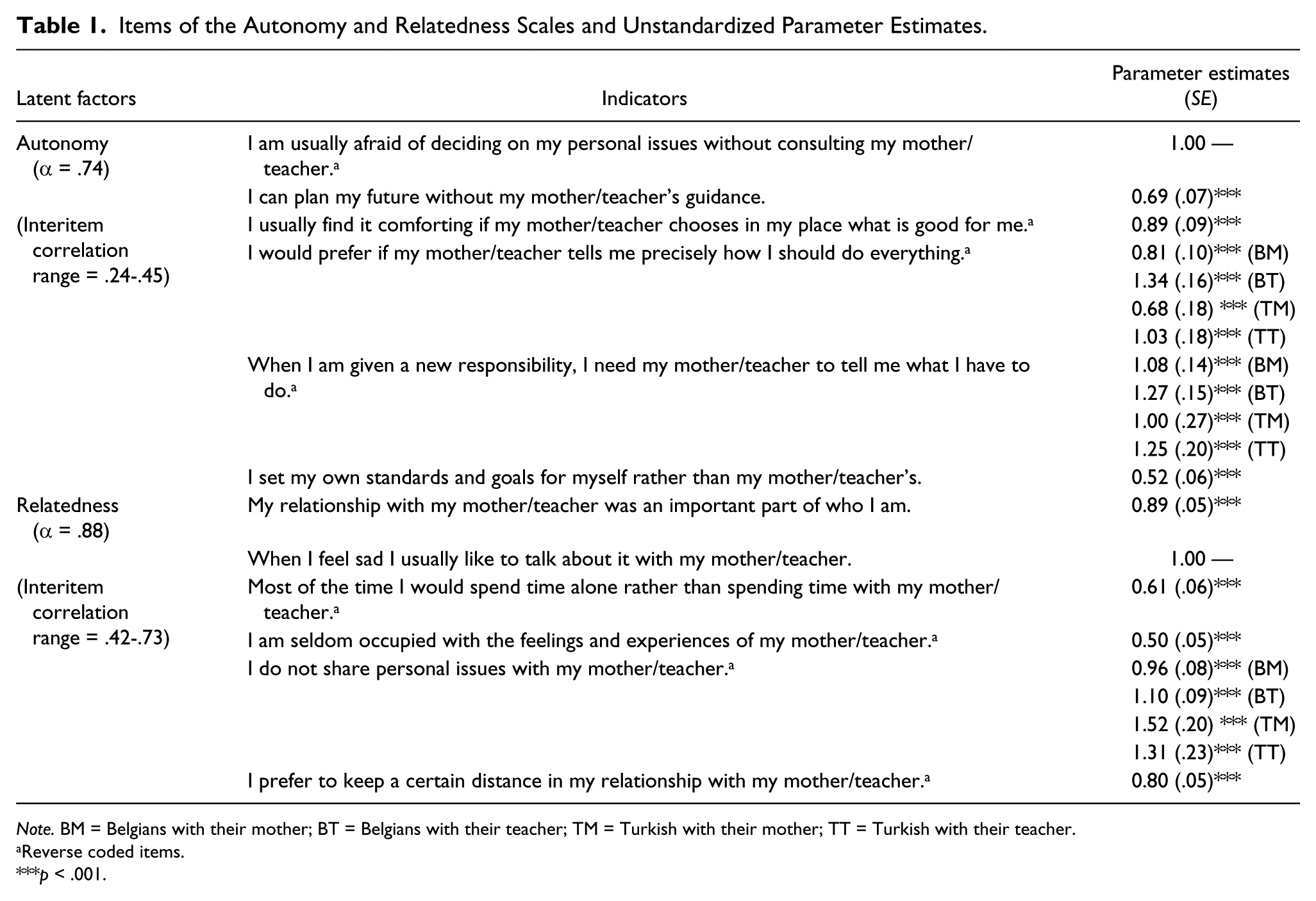
Note. BM = Belgians with their mother; BT = Belgians with their teacher; TM = Turkish with their mother; TT = Turkish with their teacher.
Reverse coded items.
p < .001.
To establish the equivalence of the autonomy and relatedness scales across cultures and relationship contexts, we used multigroup confirmatory factor analysis (MCFA; Byrne & van de Vijver, 2010). In a first step, we found configural equivalence: χ2(212) = 445.806, p < .001, comparative fit index (CFI) = .87, root mean square error approximation (RMSEA) = .05, and standardized root mean square residual (SRMR) = .06. This means that the six autonomy items loaded for both cultures and relationship contexts on an autonomy factor; and that the six relatedness items loaded on a relatedness factor. Next, we imposed equality constraints on all factor loadings to test metric equivalence. While full metric equivalence was rejected, χ2(242) = 496.366, p < .001, CFI = .86, RMSEA = .05, SRMR = .07; Δχ2(30) = 50.561, p = .01, a partially equivalent model showed acceptable fit according to the criteria suggested by Hu and Bentler (1999), χ2(233) = 475.201, p < .001, CFI = .87, RMSEA = .05, SRMR = .07; Δχ2(21) = 29.395, p = .11. Based on this model, we constructed autonomy and relatedness scales (see Table A1 in the appendix for more details); the correlations between autonomy and relatedness were −.35 (p < .001), −.37 (p < .001), −.35 (p = .001), and −.27 (p = .01), respectively, for Belgians in relation with their mother and their teacher groups, and Turks in relation with their mother and their teacher groups (see Table 1).
Results
Cultural Differences in Self-Construals
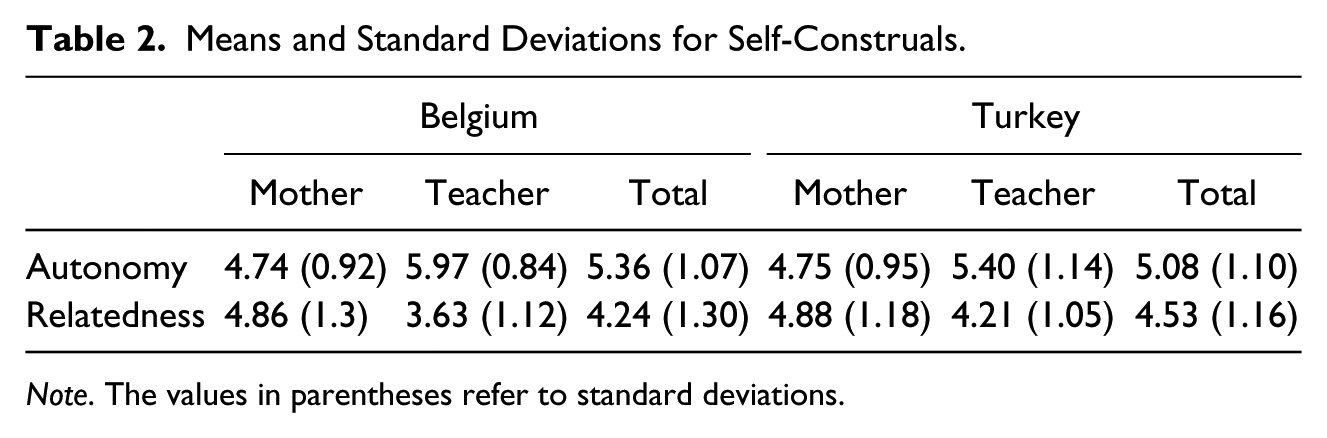
To test the cultural differences in the levels of autonomy and relatedness, we conducted MANOVA on self-orientations (autonomy, relatedness) with cultures (Belgian, Turkish) and relationship contexts (mother, teacher) as between-subjects factors (see Table 2). We controlled for gender and age because in some cases they associated with autonomy or relatedness (see Table A2 in the appendix for correlations between study variables). There were differences in the use of response scales across cultural groups and relationship contexts, F(3, 442) = 44.81, p < .001. This response tendency, combined with the failure to find full scalar equivalence, led us to group mean center autonomy and relatedness scores by culture before conducting group comparisons (Fischer, 2004; Meuleman & Billiet, 2011). As hypothesized, Belgians rated themselves as more autonomous than Turks (MBelgians = 5.37, SDBelgians = 1.07 vs. MTurkish = 5.08, SDTurkish = 1.10), F(1, 421) = 9.40, p = .002, η2 = .02, and less related (MBelgians = 4.24, SDBelgians = 1.36 vs. MTurkish = 4.53, SDTurkish = 1.16), F(1, 421) = 13.01, p < .001, η2 = .03 (see Figure 1). This finding replicates other research on cultural differences in self-construals.
Means and Standard Deviations for Self-Construals.
Note. The values in parentheses refer to standard deviations.
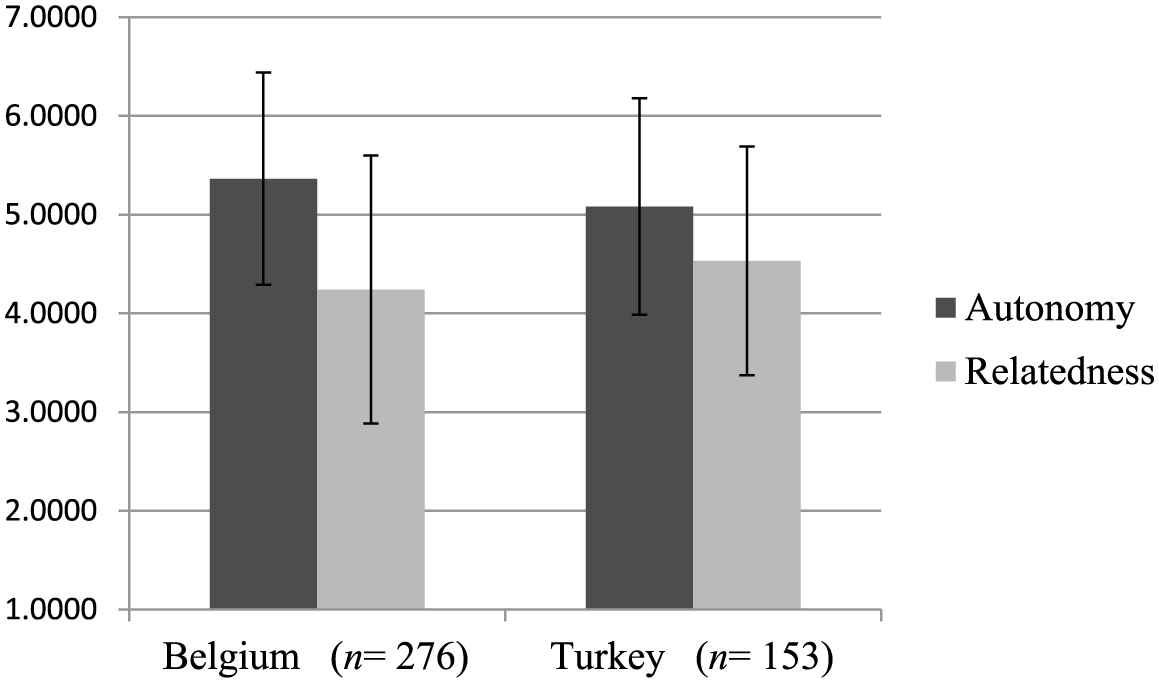
Levels of autonomy and relatedness across cultures.
These differences were qualified by a significant interaction between culture and relationship context, F(2, 420) = 6.08, p = .002, η2 = .03. To explore this interaction further, we contrasted autonomy and relatedness scores within each relationship context, using univariate ANOVAs. Consistent with our hypothesis, there were no cultural differences for the self in relationship with the mother (see Figure 2): Neither autonomy—MBelgians = 4.74, SDBelgians = .92 versus MTurkish = 4.75, SDTurkish = .95), F(1, 421) = 0.02, ns—nor relatedness levels—MBelgians = 4.86, SDBelgians = 1.30 versus MTurkish = 4.88, SDTurkish = 1.18), F(1, 421) = 0.72, ns—differed between Belgian and Turkish youth. Yet, for relationship with the teacher, we found significant cultural differences in both autonomy and relatedness (see Figure 3): Belgian students were significantly more autonomous (MBelgians = 5.97, SDBelgians = .84 vs. MTurkish = 5.40, SDTurkish = 1.14), F(1, 442) = 17.99, p < .001, η2 = .04, and significantly less related (MBelgians = 3.63, SDBelgians = 1.12 vs. MTurkish = 4.21, SDTurkish = 1.05), F(1, 442) = 11.608, p = .001, η2 = .03, than Turkish students.
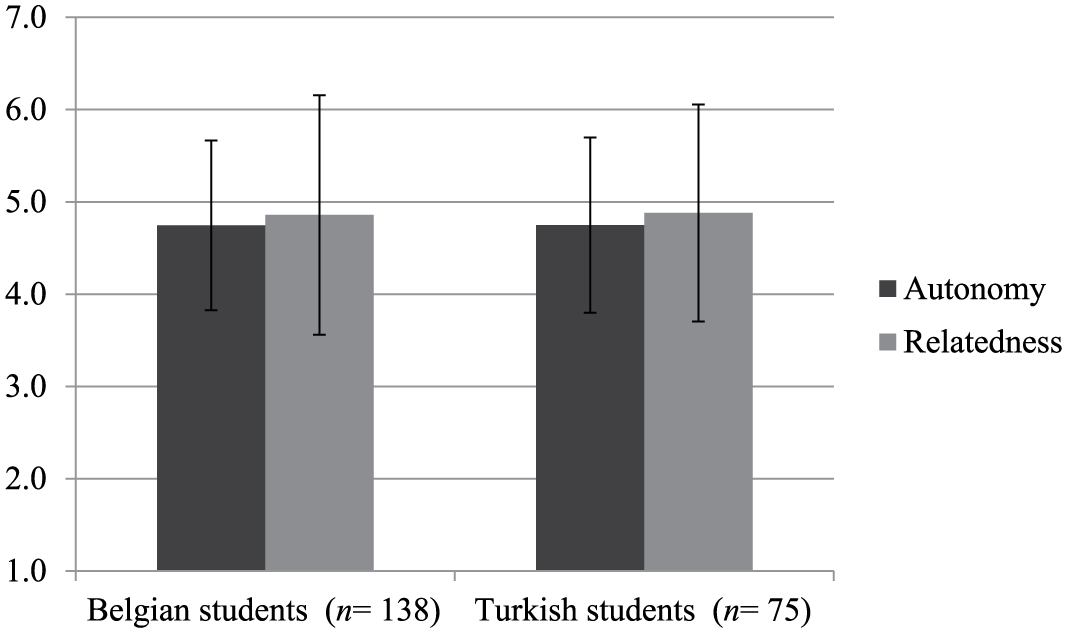
Levels of autonomy and relatedness in relation to mother.
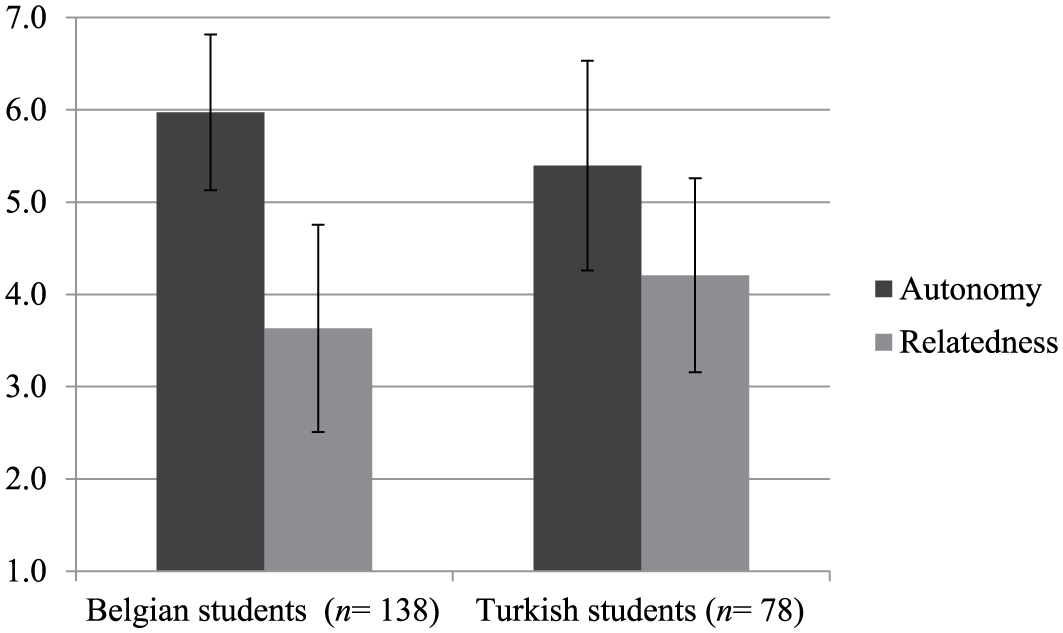
Levels of autonomy and relatedness in relation to teacher.
Contextual Differences in Autonomy and Relatedness Within Each Culture
We also followed up on the significant interaction between culture and relationship context by exploring, within each culture, the differences across relationship contexts. To this end, we contrasted the mother to the teacher contexts: In both cultures, students rated themselves as more autonomous in relation to teachers than to the mothers, F(1, 421) = 115.748, p < .001, η2 = .22, for Belgian students and, F(1, 421) = 17.244, p < .001, η2 = .04, for Turkish students. Conversely, students in both cultures rated themselves as less related to teachers than to mothers, F(1, 421) = 80.884, p < .001, η2 = .16, for Belgian students, and F(1, 421) = 11.90, p < .001, η2 = .03, for Turkish students. The differences between relationship contexts seem more pronounced for the Belgian than for the Turkish context.
Discussion
There is a large literature showing cultural differences in the relative importance of autonomy and relatedness. However, few studies have addressed the role of relationship contexts. In the current study, we investigated whether cultural differences in self-construals replicated across different relationship contexts. We compared self-construals of Belgian and Turkish samples in relationship with mothers and teachers, respectively.
We adopted a measure of autonomy and relatedness that yielded similar factors of autonomy and relatedness across cultures and relationship contexts, allowing us to create reliable scales including all the items. Although we established only partial equivalence of the scale, the results did not change when only including the items for which we found full equivalence (see Table A1, A2 and A3 in the appendix). Therefore, our findings with these scales inspire confidence.
Consistent with previous studies, aggregated autonomy ratings in the Belgian group were higher than those in the Turkish group, whereas aggregated relatedness ratings were lower. This finding is consistent with other research comparing Western European and Turkish self-construals (e.g., Mayer et al., 2012). However, these aggregated differences did not replicate to both relationship contexts. Belgians did not rate themselves as any more autonomous or any less related in relationship to the mother. Only in the relationship with the teacher did we find cultural differences in self-construals, and these seemed more pronounced than for the aggregated self-construals. Therefore, one conclusion from this research is that overall patterns of self-construals at the cultural level may hide context-specific differences in self-construals.
Another conclusion is that specifically examining self-construals within given relationship contexts may also yield cross-cultural similarities that would have been hidden by the overall patterns of self-construal. In the current study, we found that both Belgian and Turkish students rated themselves as less autonomous and more related in the mother than in the teacher context. This suggests that the relationship with the mother affords different ways of being than the relationship with the teacher, and that the direction of these differences is similar across cultures.
Our research also speaks to research showing cultural differences in context dependency of self-construals. Several studies have found such context dependency in Eastern, but not in Western cultures (e.g., Cousins, 1989; English & Chen, 2007, but also see English & Chen, 2011), suggesting that context dependency is typical of collectivist cultures. Our research does not support this conclusion. We find context dependency in both our individualist and our collectivist sample, and if anything, the contextual differences in self-construal are larger in the Belgian sample. Although this finding may be linked to the particular selection of cultures, this need not be the case: Other studies including North American samples have also found that self-construals differed, depending on the role or relationship context involved (Boucher, 2011; Chen et al., 2006; Church et al., 2012; Church et al., 2008; Church et al., 2013; McConnell, 2011). Based on our own finding, combined with this other evidence, we recommend a more fine-grained analysis of cultural differences in self-construals, in which relationship contexts are taken into account.
Similarity in self-construals in the mother context can be understood from the respective characteristics of the Belgian and Turkish cultures. On one hand, Belgium (just like its neighboring countries) is characterized by a softer variant of individualism than can be found in North American cultures (Boiger, De Deyne, & Mesquita, 2013). This variant simultaneously emphasizes individuals’ self-expression, and the importance of relationships (also called egalitarian self-expression, Schwartz & Ros, 1995), and is manifest in the relationships between Belgian parents and their adolescent children (Beyers, Goossens, Vansant, & Moors, 2003). The finding that Belgian adolescents in our study describe themselves both as autonomous and as related in the mother context fits within the characterization yielded by a number of other studies in this cultural context.
On the other hand, Turkey (especially modern Turkey) combines autonomy and relatedness. Central to Turkish culture is the emphasis on closely knit ties; however, mid-to-high Socio-economic status groups in modern Turkish culture are characterized by psychological interdependence, which is relatedness combined with autonomy (see Kağıtçıbaşı, 2005, 2007, for a review). For instance, Turkish, Greek, and Algerian university students are found to value closeness with family and friends more, but autonomy no less, than do European American, German, or Dutch students (Georgas et al., 2006; Imamoğlu & Karakitapoğlu-Aygün, 2004; Phalet & Hagendoorn, 1996; Pouliasi & Verkuyten, 2011; Üskül, Hynie, & Lalonde, 2004). The findings of a self-construal that is both autonomous and related in the mother context are thus consistent with other findings on self-construals in educated groups of Mediterranean countries.
Cultural differences in self-construals were much more pronounced for the teacher context. This means that self-construals as needed in the relationship with the teacher appear to be “cultured”: Belgian self-construals emphasize autonomy more at the expense of relatedness than Turkish self-construals. The finding resonates with Bourdieu’s view that schools are sources of cultural reproduction (Bourdieu & Passeron, 1977; Sullivan, 2002). In the Belgian culture, the relationship with the teacher requires relatively more autonomy, whereas in the Turkish culture, the relationship with the teacher is one of more relatedness. Similar conclusions were reached by research on Belgian and Turkish teachers, respectively, as described in the introduction (Cemalcılar, 2010; Vansteenkiste et al., 2004).
In both relationship contexts, and across contexts, the correlation between autonomy and relatedness was moderately negative. This finding is consistent with previous research (Tamis-LeMonda et al., 2008) and suggests that autonomy and relatedness are somewhat conflicting self-construals at the level of the individual. At the same time, at the cultural level, autonomous and related self-construals co-occur, and this is true in both cultures and for both relationship contexts.
Future research should address the consequences of fit with relationship contexts in different cultures. If cultural differences in self-construals are functional within certain relationship contexts and cultures, we would expect that self-construals lead to personal and social well-being when they fit the requirements of the relationship within a particular culture. This would go beyond literature showing that cultural fit generally predicts subjective well-being (Kitayama, Karasawa, Curhan, Ryff, & Markus, 2010; Kitayama, Mesquita, & Karasawa, 2006), suggesting that it is the fit within a particular relationship within that culture that counts.
Footnotes
Appendix
Declaration of Conflicting Interests
The author(s) declared no potential conflicts of interest with respect to the research, authorship, and/or publication of this article.
Funding
The author(s) disclosed receipt of the following financial support for the research, authorship, and/or publication of this article: This research was supported by a research fund of the University of Leuven to the last author.