



Abstract
This study examined the relations between core psychological self-schemas and the subjective well-being (SWB) of Turkish and California (United States) adolescents. The participants were 2,242 high school students (1,123 from Turkey and 1,119 from California). Core psychological self-schemas were measured with the Social and Emotional Health Survey–Secondary (SEHS-S) and SWB was measured by the combination of the Students’ Life Satisfaction Scale (SLSS; cognitive component) and the Positive and Negative Affect Schedule for Children (PANAS-C; affective component). Significant, small effect size differences were found for self-awareness, persistence, family coherence, and behavioral self-control, favoring the Turkish adolescents, and for school support, empathy, and SWB, favoring the California adolescents. Positive associations were found between the social and emotional health self-schemas and SWB for adolescents in both cultures. Multiple regression analyses indicated that self-efficacy, self-awareness, family coherence, and zest were significant predictors of SWB for both the Turkish and California samples. For the California sample only, peer support, gratitude, and optimism were significant predictors. The findings are discussed in the context of individualist and collectivist cultures.
Keywords
When parents are asked to express their greatest hopes for their children, they often reply they want them to be happy and successful (Making Caring Common Project, 2014). Research supports this parental aspiration because happy people, including adolescents, are more socially involved and productive (Diener, 2000). Happiness is an omnibus indicator of a meaningfully engaged youth who is enjoying adolescence, learning, and transitioning toward a positive adult life. From the psychological science lens, adolescents’ subjective experience of happiness is called subjective well-being (SWB; Diener, 2000). SWB is the global self-appraisal of the quality of an individual’s life at any given point in time (Diener, 1984). SWB includes a cognitive component (global judgment of satisfaction with life) and an affective component (recent pleasant and unpleasant emotional experiences; Diener & Diener, 1996). Life satisfaction is operationalized as the quality or positivity of an individual’s life (Haranin, Huebner, & Suldo, 2007). Negative emotions include personal experiences such as fear, anger, sadness, guilt, humiliation, and hatred. Positive emotions include joy, interest, confidence, and alertness (Watson, 2002). The balance of positive and negative emotions evoked by events comprises the affective aspect of SWB (Diener, Scollon, & Lucas, 2004). Various models (e.g., Biswas-Diener, Diener, & Tamir, 2004; Kern, Waters, Adler, & White, 2015; Keyes, 2006) affirm that full SWB is represented by endorsement of prototypic statements such as My life is enjoyable (positive emotions), My life is going well (satisfaction), and My life has meaning (purpose).
Although there are universal characteristics of adolescents’ SWB, there are cross-cultural considerations that require further scrutiny. The objective of this study was to contribute to the SWB literature by examining the relations between components of social emotional health (core psychological self-schemas) and SWB in students from collectivist (Turkey) individualistic (California) cultural contexts.
Understanding Adolescent SWB
For adolescents, the SWB mind-set forms incrementally during childhood and into adolescence, and, when life conditions favor the development of positive self-appraisals, this evokes positive upward developmental spirals. As conceptualized by Fredrickson’s (2001) Broaden and Build model, positive emotional experiences open a person to seek out and engage in new experiences. This openness increases the odds that a person will have new positive emotional experiences and is associated with new learning and adaptation. Under these circumstances, an adolescent is more likely to conclude—make the self-judgment—that “my life is going well.” As SWB is enhanced at each developmental stage, a youth is then more likely to experience positive future outcomes (Suldo & Huebner, 2004), such as positive mental health (Mahon & Yarcheski, 2002). Considered from this lens, a critical reason to examine SWB correlates, such as social emotional self-schemas, is that SWB serves as a global indicator that an adolescent is on a desirable developmental trajectory. From educational and clinical lenses, it is equally critical to recognize that efforts to enhance SWB simultaneously increase an adolescent’s capacity to adapt to and cope with current and future life challenges (Sun & Shek, 2010). During the adolescent years, therefore, SWB has both state- and trait-like characteristics—early positive life experiences foster positive SWB, which in turn fortifies future SWB. Over time, these psychologically nascent SWB schemas become more trait-like and consequently SWB becomes less vulnerable to succumbing to less positive life experiences and takes on the homeostatic nature of SWB in adults (Cummins, Gullone, & Lau, 2002). This is, of course, a key aspect of developmental resilience (Sagone & De Caroli, 2014). Further, Eryılmaz (2010) argues that positive SWB helps adolescents to manage life challenges and protects them from pathology that might arise in moments of episodic distress or trauma experienced later in adulthood (Park, 2004). Encouraging the formation of robust SWB has other, nonmental health benefits because it enhances students’ academic and interpersonal skills (Bird & Markle, 2012; Suldo & Huebner, 2004).
SWB Through Cultural Lenses
Although SWB has a rich, comparative cross-national research tradition, some cultural differences are noted (e.g., Kjell, Nima, Sikström, Archer, & Garcia, 2013; Tian, Chen, & Huebner, 2014; Tomyn, Tamir, Stokes, & Dias, 2016). European American cultures tend to emphasize SWB emerging from personal success (as in the Accomplishment component of Seligman’s [2011] PERM
Studies of adults in different countries and cultures have found SWB differences (Diener & Diener, 1995; Lu & Gilmour, 2004; Pflug, 2009; Suh, Diener, Oishi, & Triandis, 1998; Tuzgöl-Dost, 2010) with well-being predictors reflecting culture-specific needs and values (Oishi, Diener, Suh, & Lucas, 1999). While personal success and self-esteem are important for the SWB in individualist cultures (Diener & Diener, 1995; Oishi et al., 1999), interpersonal attachment and social relations are more important in collectivist cultures (Kang, Shaver, Sue, Min, & Jing, 2003; Uchida et al., 2004; Uchida & Ogihara, 2012). Emotions, which constitute an important aspect of SWB, vary by individualist and collectivist societies (Mesquita, 2001). Emotions are ego-focused in individualist cultures, whereas they are other-focused in collectivist cultures (Markus & Kitayama, 1991). People living in philosophically eastern societies report experiencing more complex emotions than people in philosophically Western societies (Schimmack, Oishi, & Diener, 2002). It was observed that the perception of emotional support in Asian cultures was more important for well-being than in American European cultures (Uchida, Kitayama, Mesquita, Reyes, & Morling, 2008).
Cross-Cultural SWB Investigations
In recent years, researchers have examined more nuanced aspects of cross-cultural SWB. For example, Brannan, Biswas-Diener, Mohr, Mortazavi, and Stein (2013), using samples of university students from the United States, Iran, and Jordan, observed that (a) family support had an important effect on SWB in all three countries, and (b) peer support was important for United States and Jordanian students, but not substantially for Iranian students. Similarly, in the Şimşek and Demir (2014) study of United States and Turkish university students, it was reported that family support had an important effect on SWB. In another cross-cultural study aimed at determining the sources of SWB of university students from Korea and Canada, family, relations with important people, and skills were important sources of SWB in both cultures (Lee, Park, Uhlemann, & Patsula, 1999). A study by Demir, Jaafar, Bilyk, and Ariff (2012) of United States and Malaysian students found that social relations and the quality of friendships were related with SWB. Tuzgöl-Dost (2010) found that perceived maternal democratic attitudes was important to the SWB of South African students, whereas perceived paternal democratic attitudes was more strongly associated with Turkish university students’ SWB.
Although only recently receiving broad research attention, emerging research with children and adolescents has examined cross-cultural aspects of SWB. In one study, adolescents living in individualist cultures reported higher SWB than those living in collectivist cultures (Rees & Main, 2015). Other studies have reported that life satisfaction was higher for United States than Korean adolescents (Park & Huebner, 2005), SWB was higher for Swedish than Iranian adolescents (Kjell et al., 2013), and life satisfaction was higher for Danish than Korean adolescents (Ferguson, Kasser, & Jahng, 2010).
Social and Emotional Health Model and SWB
Despite recent attention given to the examination of adolescent SWB, there is a need for additional research, particularly identifying factors associated with high levels of SWB. From applied psychology and education viewpoints, surveillance research that only monitors SWB is incomplete because it does not provide sufficient information to inform strategies that foster adolescents’ SWB. One cannot just tell an adolescent with low SWB to increase it. High satisfaction with life emerges from objective (e.g., physical resources and public policies) and subjective (e.g., success in school, forming a friendship) experiences that are associated with positive self-schemas like optimism, gratitude, and empathy (Lenzi, Dougherty, Furlong, Dowdy, & Sharkey, 2015). A better understanding of the associations between adolescents’ positive self-schemas and SWB might offer avenues through which to help an adolescent to conclude (accurately, of course) that their life is generally going well. For example, helping an adolescent to consider and appreciate the ways in which people care for them could foster higher gratitude, which could increase SWB (Furlong, Froh, Muller, & Gonzalez, 2014). The present study sought to contribute to the adolescent cross-cultural SWB literature by examining the relations between aspects of adolescents’ positive social emotional self-schemas and SWB.
To address this research objective, we draw upon a positive social emotional health model composed of core psychological self-schemas hypothesized to be associated with adolescents’ complete mental health and positive psychological development (Furlong, You, Renshaw, Smith, & O’Malley, 2014; Furlong, Dowdy, Carnazzo, Bovery, & Kim, 2014; Lenzi et al., 2015). The components of this model are measured using the Social and Emotional Health Survey–Secondary (SEHS-S), which was designed to measures the four core psychological self-schemas (Furlong, You, Renshaw, Smith, & O’Malley, 2014, see the Measures section of this article for more information about the SEHS-S). The first schema, belief-in-self, is comprised of three constructs investigated in the social emotional learning literature: self-efficacy, self-awareness, and persistence. The second schema is belief-in-others and it consists of three structures studied in childhood resilience literature: school support, peer support, and family support. The third schema is emotional competence and it consists of three structures studied in social emotional learning literature: emotional regulation, empathy, and behavioral regulation. The last schema is engaged living and consists of three structures of the positive psychology literature that have been associated with adolescent happiness (Niemiec, 2013): gratitude, zest, and optimism. The combinatorial influence of these four psychological schemas is measured as the latent trait labeled covitality (Renshaw et al., 2014).
Studies employing the SEHS-S model have found a strong relation between the structures forming social and emotional health and mental health of the students (Renshaw et al., 2014). It was found that covitality was positively related to personal adaptation and was negatively related to psychological symptoms (Jones, You, & Furlong, 2013). It was indicated that the synergy consisting of social and emotional health explained SWB of the adolescents better than psychological distress symptoms (Furlong et al., 2014; Kim, Furlong, Dowdy, & Felix, 2014). It was identified that the effect of social and emotional health on SWB is more than the separate effects of these structures (Pennell, Boman, & Mergler, 2015). In the cross-cultural context, an understudied question about adolescents is, which psychological and personal characteristics are associated with adolescents’ positive SWB? To address this question, there is a need to expand understanding of how other aspects of adolescent personality development are associated with the formation of facilitative levels of SWB.
Purpose of the Study
There are numerous cross-cultural studies regarding the factors affecting adults’ SWB with fewer studies carried out with adolescents. Furthermore, extant studies were carried out in individualist cultures and there are not as many studies about the SWB correlates of adolescents from cultures with other value cultural orientations (Park & Huebner, 2005). Social and emotional factors may affect adolescents’ SWB from different cultures in different ways. Research exploring which positive psychological and personality structures relate to adolescents’ SWB in different cultures is necessary to better understand how cultural values and experiences influence the developmental formation and stability of SWB (Khan, 2013) and to better inform universal and targeted efforts to foster positive SWB. To contribute to literature, this study investigated relations among core aspects of the social and emotional self-schemas and the SWB of Turkish and California adolescents. The following research questions (RQ) were examined:
Method
Participants
This study included samples of high school students from Turkey and California. The Turkish sample consists of 1,123 adolescents in Grades 9 to 12 attending six public high schools in three provincial centers in western Turkey. Sixty-one percent of the Turkish students were female and 39% were male. The students were distributed across grade levels: 19% ninth graders, 26% 10th graders, 28% 11th graders, and 27% 12th graders. The ages of the participants varied between 14 and 19 years (M = 16.2, SD = 1.2). The California sample included 1,119 adolescents studying in Grades 10 or 12 in a California comprehensive high school. This sample was evenly split by gender (48% females and 52% males) and grade (47% in Grade 10 and 53% in Grade 12). The ages of the California students were between 15 and 18 years (M = 16.3, SD = 1.1). Reflecting the multicultural context of the California school system, which is not representative of the larger United States school age population, 71% of the students identified as being of Hispanic/Latino(a) origin. Other individual information about the California sample was unavailable; however, school district information indicated that students’ families predominately experienced lower to middle strata economic circumstances.
Measures
For the present study, SWB was operationalized as having a cognitive component (the overall satisfaction that an adolescent has of her or his life) and an affective component (the evaluation of recent moods and feelings in an adolescent’s life; (Huebner, Hills, & Jiang, 2013). This approach to measuring SWB has been used in the International Survey of Children’s Well-Being (Rees, Andresen, & Bradshaw, 2016; Rees & Main, 2015), with samples of United States adolescents (Huebner & Dew, 1996; Huebner, Hills, & Jiang, 2013; Long, Huebner, Wedell, & Hills, 2012), and with Turkish high school students (Eryılmaz, 2012). Following these lines of inquiry, we administered the Students’ Life Satisfaction Scale (SLSS) to measure the cognitive component and the Positive and Negative Affect Schedule for Children (PANAS-C) to measure the affective component.
SLSS
This seven-item scale, developed by Huebner (1991, 1995) as a self-report of general life satisfaction, uses 6-point Likert-type response format (1 = I do not agree at all, 6 = I totally agree). In a reliability study carried out by Huebner (1991) with primary school students, the Cronbach’s alpha coefficient of the scale was found to be .80 and .88 for high school students (Dew & Huebner, 1994; Huebner, 1995). The SLSS was adapted into Turkish by Kaya (2011). An exploratory factor analysis identified a single factor that explained 58% of the variance. A Cronbach’s alpha coefficient of .88, and a 3-week test–retest coefficient of .83 have been reported (Kaya, 2011). In the present study, the Cronbach’s alpha coefficient was .78 for the Turkish sample, and .81 for the California sample.
PANAS-C
This measure was developed by Watson, Clark, and Tellegen (1988) to assess recent positive and negative emotional experiences. Each question is scored between 0 = not at all and 4 = extremely. Watson et al. (1988) reported an internal consistency coefficient of .88 for positive emotions and .87 for negative emotions. A reliability and validity study of the scale was carried out by Gençöz (2000) with internal consistencies of .83 and .86, respectively, found for positive and negative emotions. Other studies with children showed that the measure exhibited acceptable reliability (Hughes & Kendall, 2009, α = .87; Laurent et al., 1999, α = .92). The five PANAS items with the highest loading on the Positive and Negative factors in a study by Villodas, Villodas, and Roesch (2011) were used in the present study. The internal consistency coefficient of this scale was calculated as .75 for the positive emotion and .71 for the negative emotion in Turkish sample, and .88 for the positive emotion and .85 for the negative emotion in the California sample.
SEHS-S
The SEHS-S was developed by Furlong et al. (2014) to measure core positive psychological self-schemas associated with adolescents’ positive mental health. The instrument has 36 items and 12 subscales (three items per subscale). It has an a priori structural model that includes four first-order social emotional health latent traits. The belief-in-self first-order latent variable consists of the Self-Efficacy subscale (e.g., I can work out my problems), the Self-Awareness subscale (e.g., There is a purpose to my life), and the Persistence subscale (e.g., I try to answer all the questions asked in class). The belief-in-others first-order latent variable consists of the School Support subscale (e.g., At my school there is a teacher or some other adult who believes that I will be a success), the Peer Support subscale (e.g., I have a friend my age who really cares about me), and the Family Support subscale (e.g., There is a feeling of togetherness in my family). The emotional competence first-order latent variable consists of the Emotional Regulation subscale (e.g., I can deal with being told no), the Behavioral Regulation subscale (e.g., I can wait for what I want), and the Empathy subscale (e.g., I feel bad when someone gets their feelings hurt). The engaged living first-order latent variable consists of the Gratitude subscale (e.g., frequency of feeling thankful), the Zest subscale (e.g., frequency of feeling energetic), and the Optimism subscale (e.g., I usually expect to have a good). The participants answered 10 of the 12 subscales (except for Gratitude and Zest) using a 4-point Likert-type scale (1 = not at all like me, 2 = a bit like me, 3 = somewhat like me, 4 = very much like me). A 5-point Likert-type scale (1 = not at all, 2 = a bit, 3 = moderately, 4 = a lot, 5 = very much) was used for the Gratitude and Zest subscales. The aforementioned first-order latent variables were hypothesized to load on to a structural model that includes a second-order latent variable called covitality. Support for the hypothesized SEHS-S higher-order measurement model has been replicated in several studies employing confirmatory factor analysis (CFA). In the first structural validity analysis by Furlong et al. (2014) determined that the item factor loadings were between .61 and .94 with no cross-loadings and that had acceptable fit indices applying Hu and Bentler’s (1999) two-index criterion (standardized root mean square residual [SRMR] = .04, root mean square error approximation [RMSEA] = .07, N = 4,189). CFA replication studies using independent samples supported the measures’ higher-order structural model with full invariance for gender (You et al., 2014; RMSEA = .07, SRMR = .05, N = 2,240) and five California sociocultural groups (You, Furlong, Felix, & O’Malley, 2015; RMSEA = .07, SRMR = .04, N = 14,171). Further evidence supporting the SEHS-S higher-order measurement model was reported for samples of Japanese (Ito, Smith, You, Shimoda, & Furlong, 2015; RMSEA = .07, SRMR = .05, N = 975) and South Korean adolescents (Lee, You, & Furlong, 2016; RMSEA = .03, SRMR = .06, N = 686). Previous internal consistency coefficients of the SEHS-S total covitality score across the five just-described samples ranged from .91 to .95.
Of central importance for the present study, the SEHS-S was adapted into Turkish (Telef & Furlong, 2016) with a CFA replicating the original higher-order latent structure with four dimensions, and 12 subscales. The fit indices of the model were as follows: RMSEA = .04, SRMR = .06, CFI = .96, which is evidence of adequate model fit based on the two-index strategy suggested by Hu and Bentler (1999). Concurrent validity analyses showed that SEHS-S was positively correlated with resilience and prosocial behaviors, and negatively correlated with externalized and internalized behavior problems. The internal consistency coefficient were acceptable: belief-in-self (α = .76), belief-in-others (α = .77), emotional competence (α = .74), for engaged living (α = .80), and the total covitality score (α = .89). In the present study, the Cronbach’s alpha coefficient of the total score (based on all 36 items) was .90 for the Turkish sample and .93 for the California sample.
Procedure
The necessary permissions were taken from Çanakkale Onsekiz Mart University Social and Educational Sciences Research Ethics Board and Directorates of National Education for the 2013-2014 academic years for the application of the measurement tools in the Turkish sample. The prepared measurement tools were implemented in the high schools in three provincial centers in the west of Turkey with paper-and-pencil method. Prior information was given to the students about the study and they were informed that the participation was voluntary before completing the measurement tools. Data collection for the Turkish sample was carried out in classes of 30 to 35 students proctored by psychological counselors and teachers during regular course hours.
Necessary permissions were taken from the university ethics committee and school areas for the California sample. Data were collected as part of universal mental health screening carried out at one comprehensive high school. Consent forms were sent to the parents or guardians of all enrolled students in the annual enrollment packet distributed prior to the start of a school year. Following the university’s research review committee approval, passive parental consent and student assent were attained prior to survey administration. Students with parental consent and individual assent completed a universal screening survey via an online format in the school computer lab. Surveys were collected over a 2-week period. For students who were absent from class at the time that their class completed the screening, five additional follow-up attempts were made to allow these students the opportunity to complete the survey.
Data Analysis
SWB was conceptually handled as a multidimensional construct following Diener’s (1984) widely used procedure. Specifically, SWB was operationalized by summing the raw SLSS and PANAS-C scores in the following manner: SLSS + PANAS-C positive + PANAS-C negative (reversed scored), which has been shown to apply to adolescents as well as the adults (Dew & Huebner, 1994) and was previously used in research involving the SEHS-S (Lee et al., 2016).
The data were analyzed using t test, Pearson product moment correlations, and multiple regression. First, means for Turkish and California adolescents on SWB, self-efficacy, self-awareness, and persistence; school support, peer support, family support, emotional regulation, behavioral regulation, empathy, gratitude, zest, and optimism; belief-in-self, belief-in-others, emotional efficacy, engaged living, and covitality were compared using the t test (RQ1). The relations between the SWB and social and emotional factors were tested using Pearson product moment correlations (RQ2). Multiple regression analyses were used to evaluate how the SEHS-S social and emotional factors predicted the SWB (RQ3). Data were analyzed using the SPSS 16.0.
Results
First, whether there is a difference between the two samples in terms of the social and emotional health and SWB was examined (RQ1). The means and standard deviations for the social and emotional components and SWB variables are shown in Table 1. To provide control for multiple parametric tests, we set the study wide p level to .0027 (.05 / .18). Significant differences were observed on six of the 12 SEHS-S subscales: Self-Awareness (d = 0.90), Persistence (d = 0.26), School Support (d = 0.29), Family Coherence (d = 0.43), Empathy (d = 0.37), and Behavioral Regulation (d = 0.34). At the first-order domain level, significant means differences were found only for Belief-in-Self (d = 0.16). The Turkish students reported lower SWB (d = 0.18) than the California adolescents. Except for self-awareness, the magnitude of these effect sizes were all small using Cohen’s (1992) formulation.
Means, Standard Deviations, and Effect Sizes (d) for Comparisons of Social and Emotional Health Indicators and Subjective Well-Being (SWB) Among Turkish (n = 1,123) and California (n = 1,119) High School Students.

Note. Name of sample with significantly higher means bolded.
p < .001.
The relations between SEHS-S and SWB for Turkish and California samples are shown in Table 2 (RQ2). The results of the correlation analyses showed that there were positive relations between the SWB of the Turkish and California adolescents on all 12 SEHS-S subscales. As denoted with gray shading and bold type in Table 2, the magnitude of the correlations of SWB with the SEHS components were in the same direction but stronger for the California sample than the Turkish sample. We used Fisher r-to-z transformation to compare differences in the magnitude of the correlations between SWB and each of the 12 SEHS-S subscales. The magnitude of the correlation differences was not significant for Self-Awareness (z = 1.87), Persistence (z = −1.28), Peer Support (z = −1.85), and Emotional Regulation (z = −1.02). There was only one SEHS-S correlation significantly larger for the Turkish students (Empathy, z = 2.73). The remaining seven SEHS-S correlations were significantly lower for the Turkish sample: Self-Efficacy (z = −4.17), Family Coherence (z = −3.29), Behavioral Self-Control (−1.98), Gratitude (z = −5.56), Zest (z = −5.67), and Optimism (z = −13.54). Given the common pattern of significant correlations between the SEHS-S components and SWB, we then examined their relative contributions to the prediction of student SWB. As shown in Table 3, the results of a multiple regression analysis identified Self-Efficacy, Self-Awareness, Family Coherence, Peer Support, Zest, and Optimism as significant SWB predictors. These social and emotional factors account for 29% of the SWB of Turkish adolescents. The same analysis for the California adolescents are also shown in Table 3. The results of a multiple regression analysis showed that Self-Efficacy, Self-Awareness, Family Coherence, Peer Support, Empathy, Gratitude, Zest, and Optimism were significant predictors of the SWB of California adolescents with these social and emotional factors accounting for 59% of variance in SWB for California adolescents.
Correlations Between Social and Emotional Health (Covitality) and Subjective Well-Being (SWB) in the Turkish (Below Diagonal) and California (Above Biagonal) Samples.
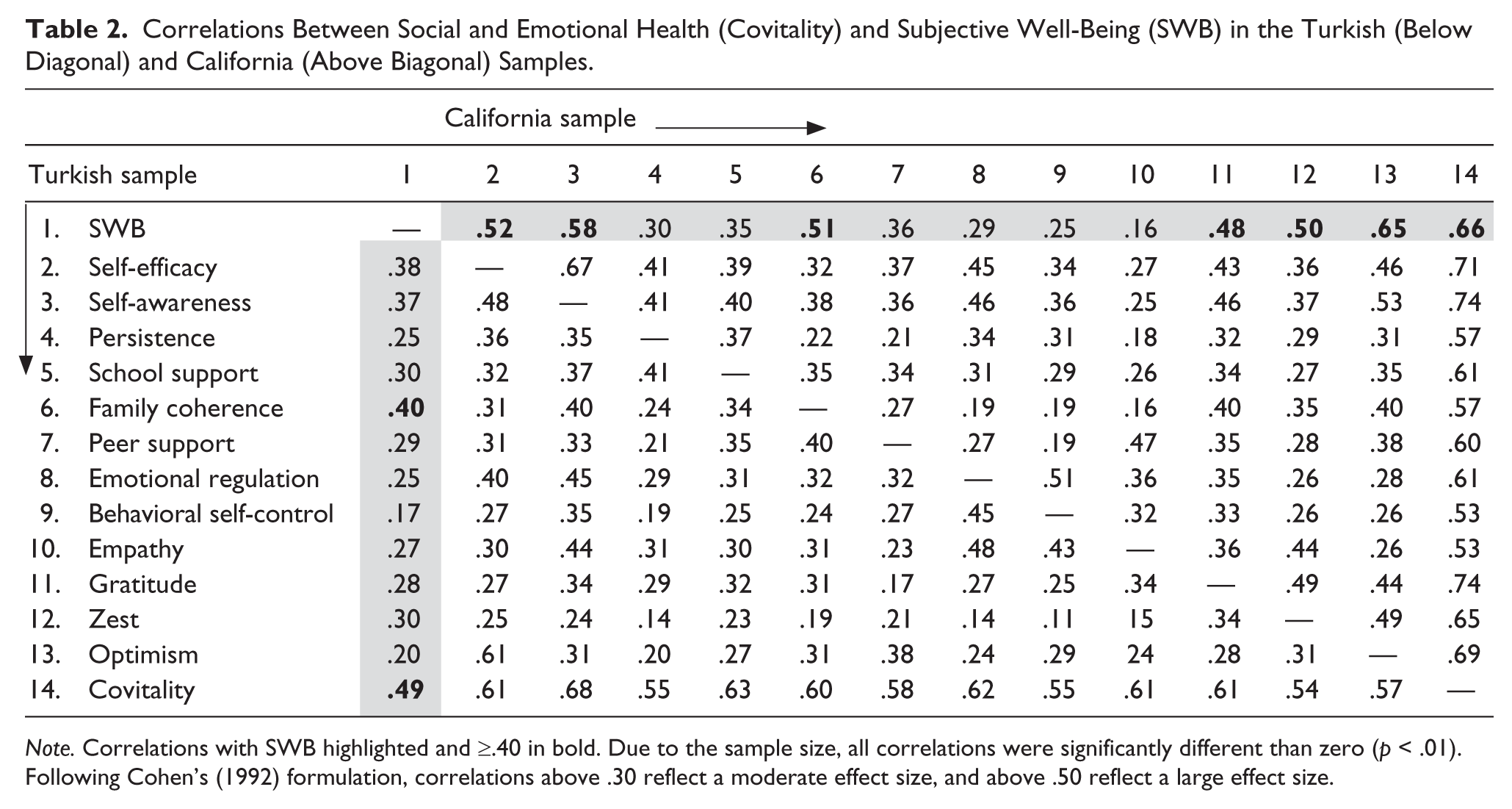

Note. Correlations with SWB highlighted and ≥.40 in bold. Due to the sample size, all correlations were significantly different than zero (p < .01). Following Cohen’s (1992) formulation, correlations above .30 reflect a moderate effect size, and above .50 reflect a large effect size.
Multiple Regressions Predicting Subjective Well-Being for Turkish and California Samples.
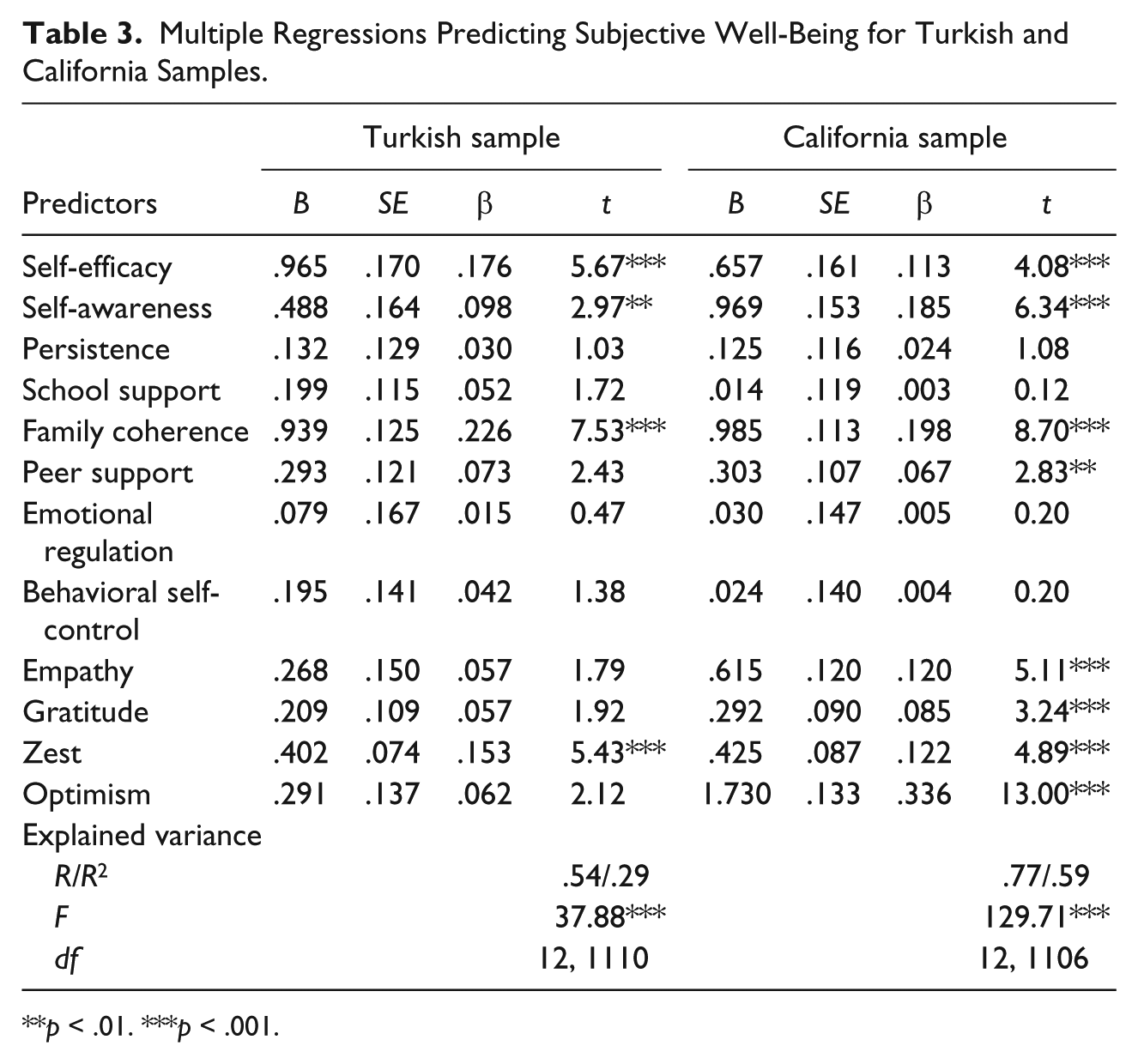
p < .01. ***p < .001.
Discussion
The results of the study showed that there was an association between SWB and core aspects of the social and emotional health of Turkish and that of California adolescents with commonly held associations for family coherence, self-efficacy, zest, self-awareness, peer support, and optimism as important predictors of SWB. For the California sample, in addition, optimism, empathy, and gratitude were important SWB predictors. Furthermore, some differences in the social and emotional health and SWB of Turkish and California adolescents were observed. While Turkish adolescents expressed a higher persistence, family coherence, behavioral self-control, and belief-in-self, the California adolescents expressed higher school support, empathy, and SWB. However, all differences found in the present study represented small effects size differences, suggesting nuances rather than extreme differences between Turkish and California high school students.
That family coherence, persistence, and behavioral self-control were higher in Turkish adolescents than in California adolescents may have emerged from the fact that Turkish adolescents live in a more collectivist society compared with California adolescents. Family values, relationships with others, and harmony in collectivist societies are more important when compared with individualist societies (Lu & Gilmour, 2004). It was found that the California adolescents had a higher SWB than Turkish adolescents. This finding can be explained from individualist and collectivist cultural points-of-view. It was reported that collectivism is the predictor of low SWB and individualism is the predictor of high SWB (Triandis, 2000; Yetim, 2003).
Previous studies have determined that, on average, people living in individualist societies report higher happiness than people in collectivist societies (Diener & Diener, 1995; Diener, Oishi, & Lucas, 2003; Ferguson et al., 2010; Gilman et al., 2008; Grob, Little, Wanner, & Wearing, 1996; Kim, Kasser, & Lee, 2003; Kim, Schimmack, Cheng, Webster, & Spectre, 2016; Kjell et al., 2013; Koydemir & Schütz, 2012; Koydemir, Şimşek, Schütz, & Tipandjan, 2013; Oishi & Sullivan, 2005; Park & Huebner, 2005; Wirtz, Chiu, Diener, & Oishi, 2009). Grob et al. (1996) indicated that the adolescents in Western cultures exhibit a higher self-respect and positive attitudes toward life when compared with those in Eastern cultures. In collectivist cultures, people can be more relation-focused and may use their skills to get more social support and enrich their social network. However, people are expected to use their emotional skills to achieve the emotional balance in individualist cultures. This may allow them get more pleasure from life (Koydemir et al., 2013).
Wirtz et al. (2009) indicated that the finding that SWB is higher in Western societies than Eastern societies may be the result from a tendency for individuals in Western societies to emphasize the positive aspects of their past experiences, whereas individuals in Eastern societies tend to emphasize the negative elements of an otherwise good life more. While integration with the group is emphasized in collectivist values, experiencing pleasure is more central in individualist values (Oishi, 2002; Triandis, McCusker, & Hui, 1990). Another factor is that SWB is more highly valued in certain cultures and people in these cultures think more about SWB as a personal value and goal. In contrast, individual SWB may not be a central aim and value in other cultures and people in such cultures do not dwell on their personal SWB as much as in other cultures. That some people focus on SWB may affect the reactions they give to research measures (Diener, Suh, Smith, & Shao, 1995). Individuals in collectivist cultures may indicate lower SWB due to the emphasis on cultural values such as modesty and responses might be influenced by measurement conventions such as the use of Likert-type response scales that do not translate clearly (Ahuvia, 2002). Another factor associated with the higher SWB of the California sample is the lower socioeconomic circumstances of the Turkish adolescents. While socioeconomic circumstances are not a primary determinant of adult SWB, it has been observed that individuals in countries with higher economic development and stability report being happier than individuals from countries with low economic indicators (see Diener & Oishi, 2000; Inglehart & Klingemann, 2000; Schyns, 1998; Veenhoven, 1995). Another factor related to the small effect size difference for SWB found in the present study is that in Turkey entrance into the university is quite difficult when compared with California students and consequently Turkish students often experience a high level of academic anxiety. That Turkish adolescent’s experience with educational-related anxiety might be a factor in their slightly lower levels of reported SWB.
The present study found that core aspects of social and emotional health were associated with the SWB of the adolescents in both samples. This finding is consistent with the research results that put forth that covitality created by social and emotional factors is strongly related to the SWB of the adolescents (Furlong et al., 2014; Ito et al., 2015; Khan, 2013; Khan & Husain, 2010; Lee et al., 2016). Social and emotional health self-schemas predicted the SWB of California adolescents at a higher level than Turkish adolescents. While social and emotional factors accounted for 29% of the SWB of Turkish adolescents, it accounted for 59% of the SWB of California adolescents. Family coherence, optimism, self-efficacy, self-awareness, peer support, and zest are the most important predictors of the SWB of the adolescents in both cultures.
Family coherence is among the important factors predicting the SWB of California adolescents in addition to being the most important factor predicting the SWB of Turkish adolescents. Family relations play a more critical role in the social networks of people in Asian societies when compared with Western societies. Thus, family relations contribute more to SWB (Li & Cheng, 2015). It was observed that in the previous cross-cultural studies carried out in both cultures, emotional closeness to the family (Imamoğlu & Karakitapoğlu-Aygün, 2007) and the social support of the family (Şimşek & Demir, 2014) had significant effects on SWB. The findings of the present study are consistent with the results of studies carried out in different individualist and collectivist cultures (see Ben-Zur, 2003; Brannan et al., 2013; Lee et al., 1999; McGrath, Brennan, Dolan, & Barnett, 2009; Park & Huebner, 2005; Uusitalo-Malmivaara, 2011).
In a study that included 11 different countries including Turkey and the United States, Schwarz et al. (2012) found that family admiration was positively correlated with the life satisfaction of the adolescents. Although there are cross-cultural differences in family structures, traditions, and rituals, the importance of the family in an individual’s life is universal (Park & Huebner, 2005). It was indicated that a peaceful home, a loving atmosphere, open communication, interest of the family, external relations, and personal importance in the family are factors related to the family that contribute to the SWB of adolescents (Joronen & Åstedt-Kurki, 2005). A warm and open communication with the family develops both the internal sources and SWB of the adolescent (Ben-Zur, 2003). The social connectedness in the family, and especially that family members frequently talk to each other, is strongly related to adolescent SWB (Konu, Lintonen, & Rimpela, 2002). The levels of SWB of the adolescents feeling the family unity-togetherness in the family environment are higher (Eryılmaz, 2011).
It was also found that support received from friends, which is another aspect of the belief-in-others, was related to SWB in both cultures. Previous research supports this finding (Danielsen, Samdal, Hetland, & Wold, 2009; Liu, Mei, Tian, & Huebner, 2015; Natvig, Albrektsen, & Qvarnstrøm, 2003; Oberle, Schonert-Reichl, & Zumbo, 2011). It was observed that the support received from friends has a direct effect on the SWB of the student (Danielsen et al., 2009). Peer acceptance in the intercultural context is an effective factor in the life satisfaction of the adolescents (Schwarz et al., 2012). In a cross-cultural study carried out by McGrath et al. (2009) on adolescents from Florida and Ireland, it was seen that emotional support received from friends provided an important hint in understanding the SWB of the adolescent in both cultures. In another cross-cultural study, Diener and Diener (1995) found a relation between friend satisfaction and life satisfaction in individualist cultures, which is contrary to the expectations. This pattern was replicated in the present study.
Optimism is another factor predicting the SWB of Turkish adolescents in addition to being the most important factor that predicts the SWB of California adolescents. In previous studies, it was found that optimism is an important predictor of SWB (Ben-Zur, 2003; Eryılmaz & Atak, 2011; Karademas, Kafetsios, & Sideridis, 2007; Mahon & Yarcheski, 2002; O’Rourke & Cooper, 2010; Vacek, Coyle, & Vera, 2010; Wong & Lim, 2009). People tend to have higher optimism in individualist societies and this may lead to high SWB (Triandis, 2000). High optimism is associated with lower depressive symptoms and hopelessness (Chang & Sanna, 2003). Optimism forms a buffer against stress during adolescence (Lai, 2009). Ho, Cheung, and Cheung (2010) suggest that it is possible that adolescents with positive expectations toward the future have a higher life satisfaction and fewer psychological problems.
It was observed that self-efficacy was associated with the SWB of both Turkish and California adolescents. This finding is consistent with the results of other self-efficacy research (Bradley & Corwyn, 2004; Cicognani, Albanesi, & Zani, 2008; Tamannaeifar & Motaghedifard, 2014; Telef & Ergün, 2013; Yap & Baharudin, 2016). The need for competence may not only ensure the SWB of adolescents at school but also contribute to results related to positive coherence such as obtaining need satisfaction (Tian et al., 2014). Strobel, Tumasjan, and Sporrle (2011) advised practitioners who aimed to increase students’ SWB to focus more on self-efficacy. Self-efficacy beliefs of the adolescents contribute to experiencing more positive emotions, a feeling of satisfaction for life, maintaining high self-esteem and developing positive expectations toward the future (Caprara & Steca, 2005). It has been observed that adolescents with a high competence of managing interpersonal relations and academic activities exhibit a high life satisfaction (Vecchio, Gerbino, Pastorelli, Bove, & Caprara, 2007). People who are optimistic and have a high expectation of self-efficacy are more engaged with the stimuli of being good, consider themselves and the world more positively, and focus on positive aspects rather than stressful situations. Thus, these people are motivated toward achieving higher goals, and they are more likely to use appropriate coping strategies to overcome developmental challenges situations (Karademas et al., 2007).
It was determined that self-awareness included in belief-in-self is negatively correlated with negative situations such as being sad, afraid, and hostile and positively correlated with all aspects of well-being (Ciarrochi, Kashdan, Leeson, Heaven, & Jordan, 2011). It has been suggested that self-awareness may have beneficial effects on health and SWB via emotional regulation (Mandal, Arya, & Pandey, 2011). Per Drake, Duncan, Sutherland, Abernethy, and Henry (2008), happy people exhibit more positive attitudes toward the past, live more spontaneously, and live the moment. It was determined that zest, which is another factor that contributes to the SWB of adolescents, is an important character trait that predicts SWB in many studies (Kabakçı, 2013; Park, Peterson, & Seligman, 2004; Peterson, Ruch, Beermann, Park, & Seligman, 2007).
Limitations and Conclusion
There are certain limitations of the research. First, data in the Turkish sample were collected from high schools in three (Çanakkale, Aydın, and Isparta) provincial centers in Turkey. As for the California sample, they were collected from a California high school. Thus, the results of the research cannot be generalized to all Turkish and California high school students. When it comes to future research, broader cross-cultural comparative research is needed to determine the social and emotional factors constructing the SWB of the adolescents by purposefully sampling from different countries with individualist and collectivist cultures apart from these two countries included in the present study. Another limitation is that the data collected were obtained based only on the self-report method. In the future, mixed-methods studies using both qualitative and quantitative methods should be carried out.
Despite these limitations of the present study, the findings contribute to the understanding of social and emotional factors constructing the SWB of the adolescents in both cultures. Culture-sensitive intervention studies that can be used by various cultures are needed around the world (Diener & Ryan, 2009). Participating in positive activities consisting of the cultures supporting well-being can be successful in increasing SWB (Boehm, Lyubomirsky, & Sheldon, 2011). Results obtained from research can be used while preparing intervention programs aimed at increasing culture-sensitive SWB, which is at once an indicator that youth are on positive developmental pathways and are building their capacity to be active, strong participants in their own development.
Footnotes
Acknowledgements
The first author thanks TUBITAK for its research support.
Authors’ Note
An earlier version of this paper was presented at the 13th National Psychological Counseling and Guidance Congress as oral presentation, Mersin, Turkey.
Declaration of Conflicting Interests
The author(s) declared no potential conflicts of interest with respect to the research, authorship, and/or publication of this article.
Funding
The author(s) disclosed receipt of the following financial support for the research, authorship, and/or publication of this article: This study is part of the research supported by TUBITAK within the scope of 2219-Foreign Postdoctoral Research Fellowship Program.