



Abstract
Kinship is a most significant organizing principle of human grouping, the basic matter of social categories in archaeological and ethnographic societies, and an important concept universally. However, its significance has rarely been adequately incorporated within archaeology’s theoretical and interpretative practice. This article aims to not only show the potential of bringing kinship into social archaeology, but also argue that archaeology can make important contributions to wider social research. Grounded on prehistoric data, spanning from the 8th to the 4th millennium
Kinship is about much more than just blood ties. It is a domain of social relations; a framework of action, rules, and rights; a powerful means to stretch identities across space and time; and a mode of structuring time, history, and memory. Indeed, kinship is closely intertwined with the entire history of humankind, and may also have been a prime mover of it (Gamble, 2008; Trautmann, Feeley-Harnik, & Mitani, 2011). Kinship is fundamental in social analysis and theoretical discourse across a range of disciplines.
In archaeology, with the exception of a few archaeologists, mainly of the New World (e.g., Ensor, 2013; Keegan, 2009; McAnany, 1995; Peregrine, 2001a, 2001b), kinship has been largely neglected. This is surprising, given the growing interest in the social analysis of action and everyday life, informed by concepts of agency, practice, and other social theories, as well as the fact that kinship has clear spatial and material dimensions. Social archaeologies have focused on “sociological” or “social” houses, gender, personhood, and identity, often without considering the important relationships through which these social categories are constructed. Kinship has continued largely to be viewed through traditional assumptions, abstract references to different concepts (e.g., “household,” “family,” “lineage,” “kin group,” “kindred,” etc.), or earlier functionalist equations of house typologies with family typologies. At the same time, a recent archaeological trend that enthusiastically embraces Lévi-Strauss’s (1983, 1987) House Societies model argues against the significance of kinship in social or economic organization (e.g., Gillespie, 2000; González-Ruibal, 2006; Joyce & Gillespie, 2000). Although this school has provided useful insights into the house as structuring social relations, by dismissing kinship, it clearly goes too far (cf. critiques in Ensor, 2011). The House Societies model is ethnographically overspecific and therefore not of such wide applicability and cross-cultural utility as is assumed. A single focus on the house risks losing sight of a basic fact: houses in village settlements intentionally chose to be part of a larger community, and a larger community’s members belong to a variety of social organizations, including lineages, clans, and sodalities. Nor were Lévi-Strauss’s House Societies organized independently of kinship. Finally, structuralism, despite its modern elaborations and versions, was not devised to account for social dynamics.
In my own work, I have focused on the household as a much more flexible and socioculturally wide analytical concept (see next section) than the more bounded notion of house and have examined it as a social process and as an analytical means through which we can interpret prehistoric social organization from the bottom up (Souvatzi, 2008a, 2008b, 2013a). This work led me to realize that the household cannot be fully understood without considering the active role of kinship in the construction of social relationships. Although not disputing a central role for the household, I have encountered many examples that suggest that individual households were interconnected into larger socioeconomic groupings and depended on wider social institutions. This article investigates the ways in which kinship provides a dynamic potential for connections and continuous transformations at a larger context as well through everyday acts, drawing primarily on archaeological data from Neolithic Greece (6800-3300
The Neolithic period worldwide is characterized by complex and rapid transformations, including the emergence of agriculture, settling down and creating permanent homes and communities, an attachment to specific places in the landscape, and a massive increase of materiality, all of which created new worlds, bound people together, and brought great changes in social structure and cultural practice of human history. In Neolithic Greece, as in all contemporary cultures from central Europe to Southwest Asia and Anatolia, the most characteristic feature is the centrality of the domestic space and the village community. Substantial architectural remains, a rich range of material culture, a variety of animal and plant remains, and generally an abundance of facilities and finds, often found in place, are derived almost in their entirety from dwellings and settlements.
In examining kinship from an archaeological perspective, the article discusses topical themes in social archaeology and anthropology, including social reproduction, economy, identity, memory, individual and collective agency, and history. Thus, it aspires not only to contribute toward the study of kinship in archaeology, but also to show how archaeology, with the materiality and historical depth of its data, can effectively inform the wider study of kinship and social organization.
A Note on Concepts, Theories, and Methods
Setting conceptual boundaries around social units is essential to avoid abstraction and confusion. I have employed “household” as a social group constructed on cooperation on a nexus of social, economic, and ritual everyday practices and relationships (Souvatzi, 2007a, 2008b, 2012, pp. 18-19). My definition combines various approaches in the social sciences (e.g., Netting, Wilk, & Arnould, 1984; Roberts, 1991; Wilk, 1991) with a practice-based methodology grounded on material and spatial archaeological data. Briefly, the household is defined primarily by the shared performance of a sphere of practices consisting minimally of production, distribution, consumption, transmission, and social reproduction. Household activities represent analytical mechanisms that result in existing or changing boundaries rather than cross-cultural homogeneity of households themselves. This concept of “household” moves away from formalism and toward a focus on the interactions of people. It is broader than a group of relatives or of people living together, whereas physical boundaries around the household are fluid rather than stable. A household may pervade, transcend, or encompass other social forms such as families or coresidential groups. As a strong indication of a household, I considered the evidence for parallel occurrence of the aforementioned main activities in a certain space. Qualitative and quantitative analysis of a combination of intrasite evidence (architecture, material distributions, spatial associations, patterns of movement, specific clusterings of items or features such as burials or specialized facilities) suggested that (a) co-occurrence of different activities was not universal at a site, and (b) social entities were not necessarily circumscribed by the architectural boundaries of buildings.
“Home,” increasingly employed in archaeology, is more cultural and emotive than social, mostly pertinent to Western ideals, and often derived from an intuitive sense of the “domestic.” Equally, the universality of the nuclear family, a concept still widely used in archaeology, has been contested in anthropology since Morgan and further criticized by Marxist and feminist scholarship as not only masking the real-life practices inside the family, but also promoting treatment of other forms as “pathological” (e.g., Bourdieu, 1996; Folbre, 1987; Knight, 2008; Levin, 1993). The “domestic labour debate” in anthropology and sociology also questioned the “natural” basis of the family and revealed its cultural character and wider social and political significance (e.g., Hart, 1992; Hartmann, 1981; Morgan, 1996, pp. 6-10, 15-21). I therefore prefer the term “conjugal” family that involves relationships among one or more individuals and their biological or social child(ren) (Fox, 1967; cf. Ensor, 2013, p. 21, 40). A household may or may not contain a family, and families may spread over two or more households. “Community,” and its relationship with “village” and “settlement,” also requires further attention. Not all community members necessarily reside within a village (or the same settlement) at any given time, and a community can exist through multiple networks and spatial scales of interaction (e.g., Means, 2007). After a long use of Murdock’s (1949) definition of “community” in archaeology (p. 79), Yaeger and Canuto (2000) offer an archaeological relational definition of community as an “ever-emergent social institution that generates and is generated by interactions that are structured and synchronised by a set of places and within a particular span of time” (p. 5). Thus, the spatial component of the community retains its significance and can be actively incorporated within the analysis, probably as “specialized” or “localized” (according to the ethnographic term) community, if referring to a settlement.
To understand social group organization, one must examine spatio-social patterning evident at the level of an entire village. It is also essential to consider the interplay of multiple scales of space and time in the creation and maintenance of social organization. Equally, as with any interpretation, the correlation of data with social practices depends on a contextual understanding of the way space, activity, and what constitutes kin are structured. I have also been particularly concerned with the issue of variability (Souvatzi, 2008a, 2013a) and the distinction between the ideal and the real (Souvatzi, 2008b). What follows is based principally on the spatial patterning of the remains of practices and relationships from a number of sufficiently exposed settlements. Finally, I use “household” to refer to spatially defined social groups identified as outlined above, whereas “house” refers to a domestic building or dwelling, and not to a household or to Lévi-Strauss’s House.
The Built Environment and Kinship Identification
In Neolithic Greece, as in all contemporary cultures from central Europe to Southwest Asia and Anatolia, the most characteristic feature is the centrality of the household and the village community. Thousands of settlements have been identified to date, containing substantial architectural remains and a rich range of material culture and facilities, often found in place, as well as of domesticated animal and plant remains. The deposition of most of this material and the setting of many craft activities within and near dwellings attests to the social and economic significance of the household.
The settlements utilize a variety of locations in the landscape and create different spatial and social arrangements. They range from long-term restricted earth mounds (or “tells”), resulting from the vertical superimposition of closely spaced houses and the accumulation of successive layers of habitation over hundreds or thousands of years to comparatively shorter term, flat and horizontally shifting sites with widespread buildings and extensive open spaces.
Ensor (2013, in press) has synthesized earlier cross-cultural associations between descent, residence, and material culture and has taken them further to construct a holistic methodology for archaeological identification of kin groups. I will loosely draw on this framework, keeping in mind that the relationship between household, family, and (co)residence is fluctuating and complex rather than fixed and straightforward. Briefly, large dwellings (more than 80 m2), often with interior room partitions, indicate matrilocality (Ember, 1973), whereas small dwellings (less than 43 m2) are associated with nonmatrilocal, conjugal families. Conjugal family dwellings arranged around a courtyard correspond to patrilocal households, whereas if they are informally clustered, they indicate cognatic or bilocal households. Widely dispersed, nonclustered conjugal family dwellings indicate neolocality. At the settlement scale, formally planned or preconceived settlement layouts with households surrounding a focal open space or a communal or ceremonial structure correspond to unilineal descent groups, whereas informal and unplanned settlement layouts with scattered households indicate bilateral descent (Chang, 1958).
Several Greek Neolithic settlements, particularly the “tells,” with their ordered layouts, spatial continuity, central focal spaces, and abundance of agricultural surplus seem to meet the cross-cultural criteria for unilineal descent groups, although spatial segmentation in some of them may just as well be based on affinity. For example, the large village at the mound of Makri (5th millennium
At the tell of Dikili Tash (Phillipoi; 6500-4200
The Middle Neolithic phase of Sesklo (5800-5300
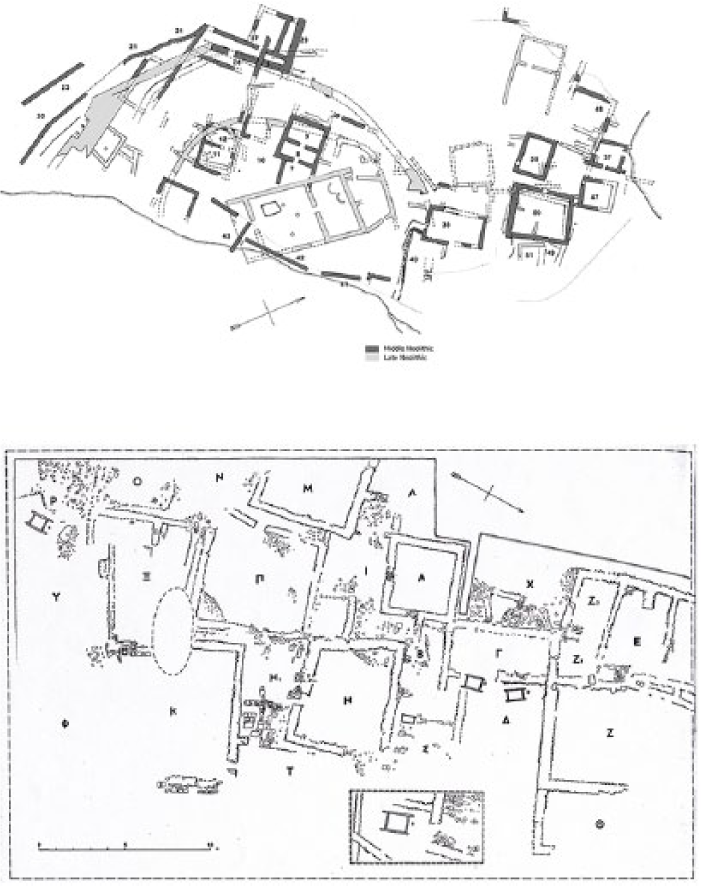
The settlement of Sesklo: Top: View of Sesklo A (not to scale). Bottom: View of Sesklo B (after Theocharis, 1973).
One interesting common characteristic of the Greek Neolithic settlements, regardless of their different types, is that of circular boundaries, such as stone enclosures and perimetric ditches, although its social significance might have varied among different communities. Circular, concentric, or what is more generally termed “ring-shaped” settlements, often based on varying underlying geometric models, occur around the world and throughout time, have attracted the attention of ethnographers since the 19th century, and have been shown to spatially configure a wide range of social groups (see Means, 2007, for an overview and analysis).
The mound of Dimini (4800-4500
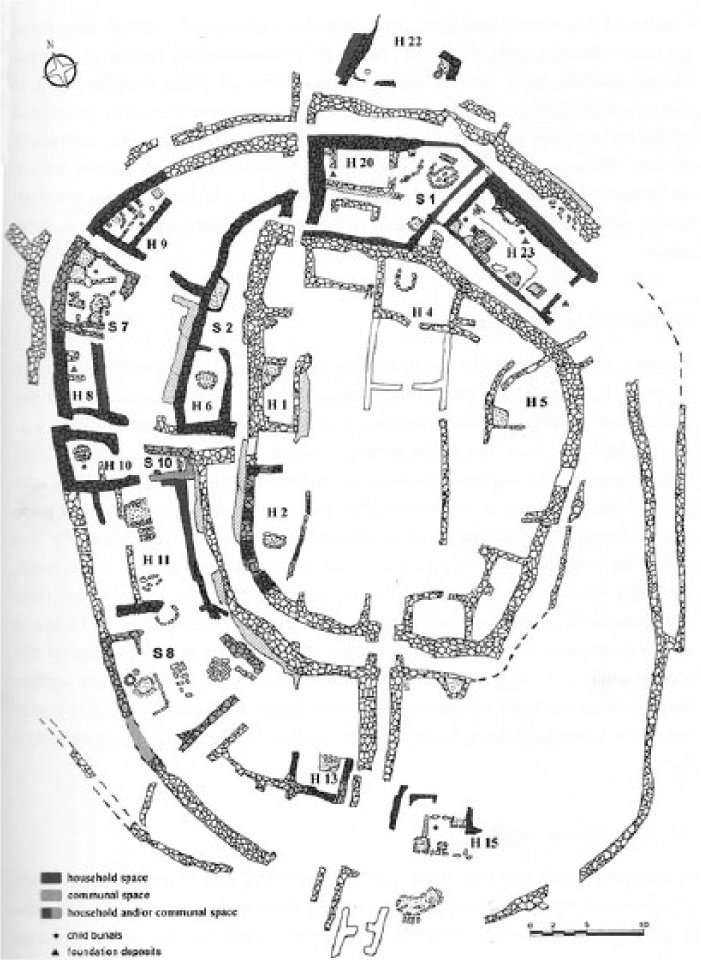
The settlement of Dimini: Households and work/communal spaces, as identified by the author, and distribution of child burials and foundation offerings.
Another variation of the concentric pattern is provided by Palioskala (5th millennium
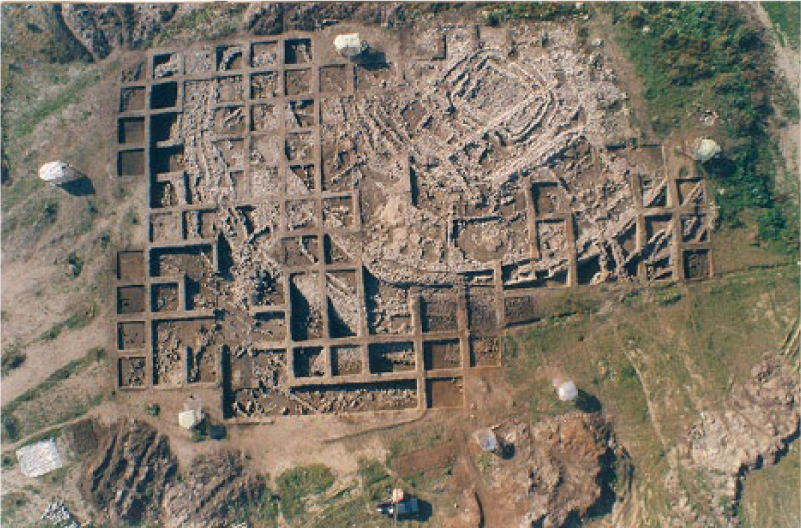
The settlement of Palioskala, aerial photograph.
In Neolithic Turkey, Hacılar 2, Aktopraklık, and Ilıpınar (7th-6th millennium
Still in Turkey, the earlier tells of Aşikli Höyük (8400-7400
In Greece, in contrast to the tell settlements with their compact layouts and vertical expansion over time, flat and extended settlements such as Makriyalos, Promachonas-Topolniča, and Galene (Figure 4) of a rather short temporal duration and a large size (up to 50 ha), resulting from the horizontal replacement of dwellings or of the entire settlement over time, raise the possibility of a different organizational ideal. At Makriyalos, the two main phases of habitation were established on opposite slopes of a low hill and had little spatial overlap (Pappa, 2007). At Promachonas-Topolniča, scattered habitation spread over two adjacent hilltops (Koukouli-Chryssanthaki, Todorova, Aslanis, Vaisov, & Valla, 2007).
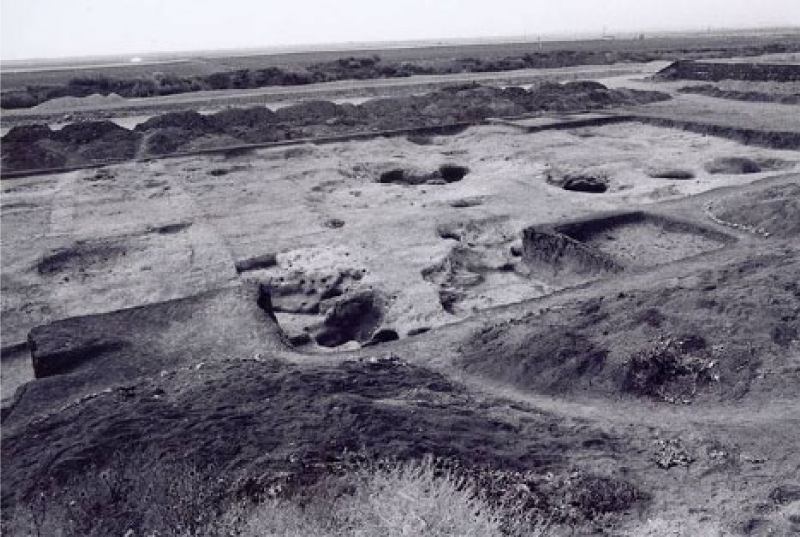
The flat settlement of Galene with widely spaced elliptical wattle-and-daub pit buildings and extensive open areas (after Toufexis, 2005).
These settlements are characterized by informal clusters of small elliptical and semisubterranean postframed dwellings (up to 5m in diameter) surrounded by various subsidiary pits, and by extensive open spaces between the clusters. They suggest bilocal and, in some cases, neolocal practices. Galene (Figure 4) is such an inconspicuous site, situated, interestingly, among numerous contemporary tells (Toufexis, 2005). The excavated area (ca. 0.17 ha) is characterized by numerous pits of varying size, shape, distribution, and function (e.g., dwellings, refuse pits, and storage pits). Makriyalos I (5200-4900
Socialization and Identity
The wide range of activities within and outside households, including cooking, storage, ceramic-, ornament-, stone tool- and textile-production, created more or less public kinds of interactions and brought people into a variety of social relations with each other. Within communities, the physical proximity, the day-to-day interaction, the daily repetition of activities, and generally the shared experience of lived space over hundreds of years would have not only strengthened ties of kinship, but they would have actually created social and ritual ties.
Shared meals in particular or the exchange of food and substances are very important processes in the creation of kinship and of social space cross-culturally and diachronically (e.g., Carsten, 1995; Hutchinson, 2000; Nuttall, 2000; Pollock, 2012). In Neolithic Greece, the high proportions of richly decorated serving pottery, thus the elaboration of the means of food consumption, the carefully made and maintained cooking facilities, and the variety of cooking implements (e.g., domed ovens, clay platforms, large clay plates, querns and grindstones, tripod cooking pots, etc.) further highlight the importance of sharing food in creating and enduring social bonds, both at a domestic and a wider level. In addition, these processes were often associated with symbolism and rituals, including foundation offerings and child burials under or near hearths.
The treatment of the deceased and the place of dead in society can also provide a clue to kinship patterns, social identities, and degrees of social incorporation. In general, the scarcity of cemeteries in Neolithic Greece (around 15), contrasted with the abundance of settlements (over 1,000), suggests that mortuary practices outside the settlement were not a particularly vital means of ancestor veneration or of social identification or differentiation. Beyond that, the frequent presence of human burials within settlements raises the question of who was selected to remain after death within the world of the living and why. There are two main, and contrasting, intrasettlement burial patterns.
The first one concerns child burials and an overall “visibility” of children. They are usually single and take place inside dwellings—in floors, under hearths, in pots or in pits—and were often found laid on or covered with rocks, smashed painted pottery, ash, or even animal bones. The symbolic retention of children after death within the world of the household derives perhaps from their importance in household’s physical and social reproduction, including the socialization of young members. At the same time, their separation from the rest of the kin group may suggest that children and infants may have not achieved membership or identity in the collective (cf. Carr, 1995). Occasional examples of multiple burials of children and infants, and one of a female holding two children might present a clue for fundamental kin bonds such as mother–child or siblingship, rested on biological or social ties.
Child burials are contrasted with most other intrasettlement burials. These often belong to adults, take place at the edges of settlements or in perimetric ditches, tend to be disarticulated and/or collective, and usually lack grave goods. For example, at Makriyalos I, the fragmented remains of at least 50 to 60 individuals, most of whom were adults, were found mainly inside one of the large perimetric ditches that surrounded the settlement, together with layers of settlement refuse and mud (Triantaphyllou, 2008). There was no obvious preference in sex, body part representation, or degree of disarticulation, and grave goods were virtually absent. The deliberate fragmentation and collective character of such deposits imply that neither the body nor the individual was treated as a bounded entity, but was instead incorporated into some sort of integrated collectivity (see Bloch, 1971, for an ethnographic example).
At Çatalhöyük in Turkey, the uneven distribution between houses of the nearly 400 Neolithic skeletons from the new excavations indicates that certain buildings served as burial locations of multiple individuals (Boz & Hager, 2013; Düring, 2011; Hodder, 2013). In addition, the frequent dismemberment of the human body and the movement and manipulation of body parts around the site suggests that the burials constituted a process of constant shaping and reshaping of identities (Nakamura & Meskell, 2013).
Another means to create social identities is through the dialectics of space and the scale at which spatial patterns are principally manifested (e.g., household or community). In many Greek Neolithic settlements, differences in household interior arrangements, spatial configuration, activities, and social reproduction indicate distinct household identities. Nevertheless, the dominant manifestations of social identity still point to the community, as attested by the common orientation of buildings within each settlement, the material homogeneity and generalized distribution of all types of goods, and the continuing emphasis on collective architectural works, communal spaces, cooperative activities, and joint rituals (Souvatzi, 2012). At Sesklo, the distinction between the tell and the flat sector suggests the cofunctioning of two levels of identity, one with patrilineal descent group and patrilocal households and another with more emphasis on cognatic households and bilateral descent, respectively. At Dimini, the highly structured and symmetrical spatial organization reflects horizontal links between household, subclan lineage, and community (clan?) interests, and suggests the use of architecture for the mediation of communally accepted principles of identity and order. At Çatalhöyük, people would also have to negotiate between household and lineage interests. In other settlements, based on the interpreted variability, the horizontal links were between variable households and community (lineages or bilateral networks). Overall, there was considerable variation in kinship practices and sociospatial organization. Descent and affinity, and patrilineal descent groups, matrilineal descent groups, and bilateral descent were all interpreted for Greek and Turkish Neolithic settlements.
The Political Economy, the Moral Economy, and Social Networks
Craft production systems in Neolithic Greece range from household production to household consumption to activities carried out by specialists. Part-time craft-specialization and long-distance exchange, developed at least from the beginnings of the Neolithic, and in several material classes, including decorated pottery, chipped stone tools, and shell and stone ornaments. Other important activities such as large-scale architectural works, agriculture, and rituals would have also involved different degrees of specialized knowledge and suprahousehold social organization. For example, the planning, decision making, labor, and resources for the construction of stone enclosures, ditches, and ordered settlement layouts would have required a network of relationships, exchanges, and obligations at the wider corporate group level. In addition, all over Greece and throughout the Neolithic, there was a constant flow of material and symbolic goods and a connection between people, things, places, and ideas in overlapping exchange systems and diverse cultural routes over wide geographical areas—for example, of obsidian from the Aegean island of Melos, which involved seafaring, and of Spondylus shell ornaments from the Aegean Sea, which reached as far as central Europe.
Significantly, although all this complexity provided a great potential for economic and social tensions—for example, through the potentially varied interests of the various producing or exchanging groups—there is no consistent evidence of hierarchy, centralization, or differentiation either within or between communities (Souvatzi, 2007b). How were individuals, households, and communities held together? How did they succeed to solve tensions, achieve cohesion, and remain in coexistence for such remarkably long periods? Who was given the authority to mobilize and allocate labor, and to exert a degree of communal over solely household rights to production, distribution, and storage? On a larger scale, to what level of social organization can the access to long-distance resources be related?
The most plausible answer to all these questions is kinship, in both its political and moral dimension. In essentially egalitarian and nonstate societies, kinship provides the potential and the motives for craft-specialization and multiple modes of production and (re)distribution, and for networks of alliance, ceremonial or ritual exchange, and marriage strategies (e.g., Han, 2004; Mader & Gippelhauser, 2000; Peregrine, 2001b; Schweizer & White, 1998). The role of kinship in cooperation and delayed-return must also account for the social integration and cohesion evidenced in Neolithic communities. In the long term, the presence of kinship bonds would have further reinforced heterarchical social ties within and between communities.
This is not to return to some normative or idealized notion of kinship as a frame of stability and equality. But kinship is a cornerstone of the moral economy over a broad range of historical and ethnographic contexts, and the moral economy is dialectically interwoven with the political economy in that it can be developed exactly to augment viability and security of individual households (e.g., Anderson, Bechhofer, & Gershuny, 1994; Cheal, 1989; Hann, 2001; Wilk, 1993). As Bloch (1973) pointed out, “the crucial effect of morality is long term reciprocity and the long term effect is achieved because it is not reciprocity which is the motive but morality” (p. 76). The growth of long-term dependencies and the production and pooling of subsistence surplus necessary for delayed-return economic systems relies more on the creation of a social obligation than on immediate return or reward.
The role of kinship in the Greek Neolithic can be situated in terms of the coordination of social and economic relationships, facilitated by intensive interaction and encouraging cohesion and equality. The social relations of production and distribution correspond to a multicentric economy and the existence of crosscutting social networks rather than bounded hierarchies. They also correspond to the indicators for exogamy, compelling competition for production for social and exchange connections with other villages to attract marriages (Ensor, 2013). Spouse mobility and postmarital relocation may more fully explain certain socioeconomic patterns, for example, the long and stable preference of many settlements for importing distant and exogenous materials such as obsidian from the island of Melos or the presence of distinctive ceramic wares in distant settlements, for example, the Dimini pottery from central Greece at Makriyalos in northern Greece (Pappa, 2007). Similarly, exchange through or for marriage alliances can explain the increase in ceramic stylistic diversification over the course of the Neolithic so that it seemed that almost each village produced a distinctive ceramic type (e.g., Perlès & Vitelli, 1999). If each village belonged to an exogamous descent group and had its distinctive pottery styles, then we could assume that each exogamous descent group had its own distinctive pottery style. This, in turn, can shed light on the relation between kinship, identity, and material culture.
In the long-term tells, the greatest concern would be to perpetuate the corporate kin groups through reproduction and competition. In the shorter term flat villages, some of which may have been bilateral, a primary concern might be to achieve and maintain social integration. Incidentally, although these sites were also involved in intensive craft production and exchange, the evidence for communal rituals, including large-scale feasting, is stronger than in the tells. For example, at Makriyalos, inside an exceptionally large pit (preserved to an area of 30 × 15 m) were deposited the remains of several hundreds of domestic animals (cattle, pigs, sheep, and goats) together with a large volume of serving pottery, grinding stones, grain crops, and cooking facilities (Halstead, 2012). At Promachonas-Topolniča I, a large subterranean nondomestic building (ca. 15 m in diameter and 2-2.5 m in depth) contained a great amount of cattle and other animal skulls, decorated pottery, house models, figurines, tools, and ornaments—most of which were found burnt (Koukouli-Chryssanthaki et al., 2007). Periodical ritualized large-scale feasting, offerings, or deliberate discard or destruction by fire (“ritual killing”?) of material possessions would serve as mechanisms for strengthening socioeconomic relationships at these sites, where the spatial patterning implies less stress on lineage.
The kinship-based economy may have also extended to corporate ownership of productive resources. Skepticism should be aimed at the idea of land ownership at the household level and the overemphasis on house space continuity. Even in the case of tells, while these can be seen as territorially based communities, and while the rebuilding on the same spot may suggest a form of ownership of domestic space, this does not necessarily mean that individual households can exclude others from the use of natural resources or of community land, or that they acted as autonomous units. As I have argued elsewhere (Souvatzi, 2013b), wider social dependencies and a possible distinction between producing and redistributive units might in fact shape the relationship between people and land. In noncapitalist societies, individual social units rarely have authority over the totality of common land, which is instead shared with other such units or is regulated through the manipulation of kinship relationships, whereas the incentive for increased production can be greatly facilitated by communal ownership of land and resources (e.g., Gough, 1961; Segalen, 1986; White & Schweizer, 1998; Wilk, 1983). Collective land-use would involve collective descent group lands and resources, at least in the case of the tell sites.
Memory, Time, History, Change
Conceptualizing and addressing time and history constitute one of the greater strengths of archaeology. Although the grand models of social evolution have continued to influence archaeological thought, there is now a growing appreciation of different scales and rhythms of time (see Hadji & Souvatzi, 2014, for a recent review). And, unlike what normative models assume, kinship does not just exist outside history.
One major way of making history is through making memory. The dwelling structures time and memory through the daily repetition of practices, the repeated reconstructions of structural elements, the burial of ancestors or of descendants, the transmission of knowledge, and finally the replacement or transmission of the buildings themselves and of the objects kept in them. These actions generated memory and histories, and turned the dwellings into historical referents that spanned generations (see also Hendon, 2010, for house as a “semiotic memory machine” in pre-Hispanic Mesoamerica [pp. 91-121], and Hodder & Pels, 2010, for “history houses” in Çatalhöyük).
Settlement space and architecture also incorporate historical, temporal, and transitional processes. A settlement’s layout does not passively reflect social organization, but is both the medium for and the outcome of histories of action that fused group genealogies, images of the past, and social relations. For instance, the process of large-scale construction of enclosures and ditches can be understood as a record of social relations and the spatial mapping of group genealogies, thus, as a social history.
The recursive relationship of architecture with unilineal descent organization, identity, and ideology maybe the reason of the maintenance of a specific and fixed settlement plan that formed over the years the prominent and permanent landmarks that are now known as “tells.” The emphasis on more durable construction materials and the effort to reconstruct basically the same form of ordered settlement layout over long periods of time monumentalized the history of the communities and can be seen as the material representation of stable lineages. Through successive generations of largely unchanged occupation, a settlement history and genealogy were created and transferred from one generation to another. Through kin groups, households were linked to each other and to those preceding and those succeeding, were committed to certain forms of behavior, and enjoyed particular relationships, rights, and duties. In concentric settlements, social changes must have been generated in part by attempts to impose and maintain a geometric layout, which would be continually balanced against the reality of living in a dynamic community.
Flat villages, however, might be viewed as having a more fluid social organization, involving more limited use of spatial practices. However, the successive interventions and short-distance relocations of buildings, in conjunction with the constant digging of pits and ditches and their infilling with various types of material, may well reflect different ways to “appropriate” and demonstrate ancestral values and spatial relations (Skourtopoulou, 2006).
Changes in entire village layouts reflect the development of new or the modification of extant social institutions. At some sites, the initial camps of small elliptical sparsely arranged huts were replaced in the subsequent phases by more solid, surface rectangular buildings. This suggests a growing commitment to space, sociality, and consensus-dominated community control. Some villages must have resulted from a small number of families that left their village and founded a new one, while others may have been founded by a relocation of an older village. Incidentally, the former case can explain the inhabitation of new areas over the course of the Neolithic with smaller hamlets or camps. These new settlements would require exogamous marital networks to maintain viability. Both cases can also be seen as deliberate fissioning to remain within the limits of cooperative social order. For example, analysis of settlement patterns in Thessaly, the region of hundreds of tells, reveals a long history of widely accepted constraints on site size, number, and territory (Johnson & Perlès, 2004): From the Early to Late Neolithic (ca. 6500-4500
Nor did overall site size and structural complexity in Neolithic Greece exhibit a stepwise progression from smaller to larger or less complex to more complex settlements. Greek Neolithic communities as a whole had a long and successful history of resistance to changes defined as linear, cumulative processes toward hierarchization, contrary to the expectations of neo-evolutionary models (Souvatzi, 2007b).
Conclusion
This article has attempted to explore what a social analysis of prehistoric societies might look like if we bring kinship into it. The theoretical arguments and the archaeological evidence discussed here indicate that houses, households, and community are extremely important themes in social analysis, but they cannot be fully understood if they are separated from the kinds of social institutions and the set of social issues included under the label of “kinship.” For example, kinship is a key site for observing how concepts of relatedness are formed and realized, for studying economic systems, and for addressing historical process. Ultimately, kinship is a way in which people integrate and differentiate themselves socially. It provides an opportunity to see individual relationships reflecting larger social relationships and therefore to bridge the gap between institutions and actions.
A concern with conceptual definitions and a concerted effort to identify kin groups in more specific ways instead of resorting to the traditional reliance on architectural typology or of dismissing kinship entirely are examples of what needs further attention in social archaeology. Otherwise, the layouts of settlements will continue to represent the collective result of a variety of social organizations present at varying scales and it will not be possible to ascertain how social relations were structured and operated except in the most general terms.
Anthropology can provide important insights into the different uses and meanings of kinship in contemporary societies and has already prompted archaeologists to rethink certain theories concerning past social groups. Another lesson to be learnt from anthropology is the cross-cultural significance of kinship in the creation of larger social relationships and identities that may contribute to the reproduction or change of smaller social units. But there is at least as much for anthropology to learn from archaeology. Anthropology still requires accounts that are historically informed and diachronically validated, and it should also focus more, I would argue, on the analytical potential of materiality as intimately bound with the human existence and kinship practices. Archaeology can expand considerably the knowledge of the diversity of kin groups, provide insights into social configurations and ideals that may no longer exist, and add a diachronic perspective to social transformations. Even though prehistorians may not be able to define the finer points of kin groups, the materiality, spatiality, and historical specificity of kin groups connect them to key social phenomena and make the archaeological contribution essential to the wider cross-cultural research of social organization (cf. Ember & Ember, 1995; Peregrine, 2001a).
Footnotes
Acknowledgements
I thank Patrick Heady and Mikołaj Szołtysek for inviting me to “the Murdock and Goody Revisited: (pre)history and evolution of family systems” workshop at the Max Planck Institute for Social Anthropology, Halle/Saale, Germany, and all the participants who made it such a fruitful meeting. Thanks also to Brad Ensor for his books and his comments on an earlier draft. Research in Turkey was conducted while I held a Scientific and Technological Research Council of Turkey (TUBITAK) Visiting Assistant Professorship at the University of (East) Thrace (2014-2015) and a British Institute at Ankara–Koç University Research Centre for Anatolian Civilizations Senior Fellowship at Istanbul (2013-2014).
Declaration of Conflicting Interests
The author(s) declared no potential conflicts of interest with respect to the research, authorship, and/or publication of this article.
Funding
The author(s) received no financial support for the research, authorship, and/or publication of this article.