




Abstract
Although not a new topic, there is a growing trend in ethnology to interpret changing kinship terminology, social organization, and marriage practices deep into prehistory. These efforts are largely guided by phylogenetic, neoevolutionary, and historical particularist theoretical models using 19th to 20th century ethnographically recorded kin terminology. However, the “high-level” theoretical models and their assumptions are untestable without data dating to prehistory. Archeological kinship analysis based on cross-cultural “mid-level” factual correspondence between social organization and patterns in material culture, which is not biased by any given “high-level” theory, can empirically test the ethnological models and assumptions. Archeological case studies on the Chontal Maya and Hohokam illustrate problems in phylogenetic, neoevolutionary, and historical particularist theoretical assumptions. Instead, the results are consistent with contemporary anthropological theory emphasizing practice and agency within historically contingent political economic social contexts.
Introduction
There is no “kinship theory.” Instead, kinship research (a topic) is guided by changing high-level theoretical trends influencing questions asked, methods used, and interpretations made. The 19th-century unilinear evolutionist belief that cultures evolve along the same path toward Western European societies relied on the comparative method to categorize cultures into preconceived stages, each with a type of kinship (e.g., Morgan, 1871). Historical particularism explained kinship as the product of diffusion or migration (e.g., Boas, 1966). Functionalism assumed that material circumstances could explain kinship practices, requiring cross-cultural comparison facilitated by the development of the Human Relations Area Files (HRAF; for example, Murdock, 1949). With neoevolutionism, abstract types were once again placed in preconceived simple-to-complex sequences (e.g., Pasternak, 1976). After the 1970s, kinship was diluted into other topical areas (Sousa, 2003) when political economy and feminism dominated anthropological theory, whereby historically contingent social relations of production structure kinship practices and ideologies (e.g., Collier & Yanagisako, 1987; Dube, 1997; Friedman, 1984; Godelier, 1984; Modjeska, 1982; Moore, 1988; Peletz, 1995; Tsing & Yanagisako, 1983). Schneider’s (1968, 1984) treatment of kinship as idiosyncratic symbol, divorced from practice, resonated with postmodernism and influenced critiques of “kinship theory” near the turn of the millennium (e.g., Carsten, 2000; Carsten & Hugh Jones, 1995; Franklin & McKinnon, 2001; Joyce & Gillespie, 2000). The critiques faded, and now contemporary anthropological perspectives on practice (after Bourdieu, 1977, 1990) or structuration (after Giddens, 1984)—to illustrate how people reproduce, manipulate, and negotiate their historically contingent social contexts—are the most prevalent theories on kinship in ethnography (e.g., Ellison, 2009; McKnight, 2004), sociolinguistics (e.g., Coehlo de Souza, 2012; Dousset, 2012; Mahalem de Lima, 2014; Turner, 2012), archeology (e.g., Ensor, 2013a, 2013b, 2013c), and bioarcheology (e.g., Johnson & Paul, 2014). Although less common, the contemporary theoretical landscape also includes behavioral ecology (e.g., Fortunato, 2017; Pashos, 2017; Porqueres & Wilgaux, 2009), economic anthropology (e.g., Keegan, 2010, 2016), and postmodernism’s selective use of narratives to support theses on ideology (e.g., Sahlins, 2013). As with all research topics, theoretical genres guide our assumptions about kinship, our questions about kinship, our methods for researching kinship, and therefore our results and knowledge about kinship.
Contemporary theory on prehistoric kinship varies but exhibits a significant divide between ethnology 1 and archeology. Radically departing from contemporary anthropological theories, ethnological kin terminology research to interpret prehistoric kinship emphasizes 19th-century phylogenetic evolutionism (e.g., Ehret, 2012; Jones & Milicik, 2011; Wheeler, Whiteley, & Powers, 2012) and 1960s neoevolutionism (e.g., Allen, 2012; Allen et al., 2008; Godelier et al., 1998). Other ethnologists advocate a form of historical particularism for interpreting prehistoric kinship (e.g., McConvell, 2012, 2013). In contrast, recent archeological treatments of prehistoric kinship tend to apply the contemporary agency perspectives (practice and structuration) developed in social anthropology and also applied in sociolinguistics (e.g., Ensor, 2013a, 2013b, 2013c; Morsink, 2013; Souvatzi, 2008, 2017).
This article calls for an evaluation of these four theoretical trends in prehistoric kinship research. But unlike ethnological research, which applies theoretical models and methods to modern data (ethnographic observations from the 19th-20th century) to interpret prehistoric kinship, the theories are evaluated using archeological data that actually date to the prehistoric periods in question. Levels of theory need consideration for understanding how archeology can evaluate ethnological ideas. Low-level theory involves generalizations on patterns in empirical observation. Mid-level theory involves factual correspondence in associations between low-level generalizations. High-level theories are abstract models for how things are or how they change, which determine the methods used, and which guide interpretation through logical coherence with the models themselves (Trigger, 2006). In archeology, low- and mid-level theories provide independent means of testing high-level theories. For example, suppose a high-level theory using 20th-century kinship terminology for data leads to the interpretation that a particular region’s prehistoric populations had bilateral descent (an interpretation of the modern data guided by the high-level theory’s assumptions and methods). If archeologists observe that dwellings surround plazas at prehistoric sites in the region (a low-level generalization on material culture), and if cross-cultural research strongly correlates that specific settlement layout exclusively with unilineal descent groups (a mid-level generalization linking a material culture pattern to a specific form of social organization), then the mid-level theory on the observations from actual prehistoric material culture falsifies the interpretation of bilateral descent, and hence falsifies one or more of the high-level theory’s assumptions.
A brief review of the assumptions behind evolutionary, historical particularist, and political economic agency-based high-level theories is first presented. Methods for empirical, prehistorical, archeological kinship analysis are described. Two of the author’s prior case studies using those methods—on the pre-Hispanic Maya and the prehistoric Hohokam—are presented. The results suggest problems with evolutionist and historical particularist assumptions.
High-Level Theories on Prehistoric Kinship
Major high-level theories guiding ethnological prehistoric kinship research are phylogenetics, neoevolutionism, and historical particularism. Due to the historical linguistic inspiration, along with adoptions from biological sciences, a 19th-century phylogenetic model is routinely assumed. Cultures’ normative kin-term models are presumed to have branched from common prehistoric ancestral kin-term models. As such, analytical techniques tailored to phylogenetic assumptions are applied to interpret “protokinship” and branching at regional scales (e.g., Ehret, 2012; Fortunato & Jordan, 2010; Jones & Milicik, 2011; Wheeler et al., 2012). Only with this theoretical model can we believe in the idea of “protokinship.” The comparative method inevitably creates cultural groupings based on similarities and differences. However, to interpret the groupings as evolutionary nodes requires faith that cultures evolve phylogenetically. Yet, prehistoric branching can never be tested with ethnographic data (because these are never prehistoric). Nevertheless, the assumption that similarities and differences among modern cultures represent clades is logically consistent with phylogenetic theory. Despite that logical coherence, the phylogenetic model’s major “language = genes = culture” foundational assumption and the belief that nodes, genetic demes, ethnicities, and now kinship maintain homogeneity over thousands of years—with daughter populations splitting and evolving homogeneously—is intensely criticized across anthropological subfields (Armelagos & Van Gerven, 2003; Bateman et al., 1990; Campbell & Poser, 2008; Clendon, 2006; Mendoza, 2004; Moore, 1994; Steele & Kandler, 2010).
Neoevolutionists, in turn, believe in lineal sequences in abstract kin-term models, paying much attention to defining types (e.g., Kronenfeld, 2004). The abstract types are placed in preconceived “simple” to “complex” sequences. These are unidirectional, but scholars vary in their sequences and entertain reversibility (e.g., Ehret, 2012; Ives, 1998; Trautmann, 2012; Trautmann & Whiteley, 2012). Only with neoevolutionism would Allen’s (2008, 2012) fictitious “Tetradic” model have a purpose—to speculate on the origins and sequence of human kinship. A generic scheme might suggest Dravidian (with exogamous moieties and classificatory cross-cousin marriage), to Iroquois (with lineage/clan exogamy), to Crow-Omaha (with lineage/clan-based prohibitions for individuals), and end there, or continue on to Hawaiian (with consanguineally based individual prohibitions). Synchronic ethnographic normative models are analyzed for clues to interpret a community’s transformations from one abstract type to another. Additional lines of evidence are commonly included. For example, if a society with lineage exogamy and Iroquois kin terminology also had moieties only for ceremonial purposes, then it is assumed that the moieties previously regulated marriages (cross-cousin marriage), and that Dravidian was the earlier kin terminology (Trautmann & Whiteley, 2012). Although moieties rarely regulate marriage, they do in the simplest marriage systems making such an interpretation logically consistent with simple to complex neoevolutionism. Abstract types represent preconceived stages, and synchronic ethnographic data are interpreted in a logically consistent fashion. Despite that coherence, neoevolutionist types and speculative sequences were generally discarded in the 1980s (e.g., Peregrine, 1996, 2001a) when theory shifted toward explaining kinship in ethnographic communities as variably shaped by historically contingent social contexts (Peletz, 1995).
Dissatisfied with these speculative models, others believe that “only” up to the past 10,000 years of kinship can be “reconstructed” using kin terminology. For example, in McConvell’s (2012, 2013) approach, cultures’ specific kin nomenclature semantics are viewed as the products of diffusion (“horizontal transmission”) through borrowing or migration (McConvell, 2012). Although referring to change as “evolution,” this is actually historical particularism. The comparative method is used, inevitably resulting in groupings of cultures based on similarities and differences. Rather than placing these in a phylogenetic framework, the historical particularist high-level perspective provides an alternative logically coherent explanation for kin-term semantic similarities and differences.
Whereas phylogenetics, neoevolutionism, and historical particularist theoretical perspectives assume normative characterizations of bounded cultures (i.e., one set of practices for each defined cultural group), contemporary political economic and agency theories view people as actively manipulating their practices to achieve social, political, and economic ends structured by, or as reactions to, historically contingent social contexts. In kinship research, this perspective implies different practices among communities (e.g., Moore, 1988), age cohorts (McKnight, 2004), or social classes having different historically created contexts (e.g., Gailey, 1985; Remy, 1975; Terray, 1984); that kin-based identities are manipulated in response to changing political economic contexts (e.g., Coehlo de Souza, 2012; Dousset, 2012; Ellison, 2009; Mahalem de Lima, 2014; Peletz, 1995; Turner, 2012); and that gender relationships are manipulated through kinship (e.g., Collier & Yanagisako, 1987; Dube, 1997; Stone, 2010; Tsing & Yanagisako, 1983). Kinship is thus viewed as variable, malleable, and negotiable strategy. For example, Moore (1988) historically contextualized divergent Southern Cheyenne kinship practices: Communities wherein women’s labor was important for trade maintained matrilocality and matrilineal descent, men in communities where raiding granted them status manipulated relationships toward patrilocality, and when individual allotments were imposed communities manipulated relationships toward ambilocality and bilateral descent to cope with resource insecurity. Whereas other theoretical trends seek to obscure variation with normative models, political economic and agency theories centralize the contexts for variation. Loose understandings of agency have permeated general archeological thought (see Hegmon, 2003), which have also informed archeological interpretation on kinship (e.g., Curet & Oliver, 1998; Ensor, 2013a, 2013b, 2013c; Morsink, 2013; Souvatzi, 2008; see Souvatzi, 2017 for elaboration on this theoretical genre).
Mid-Level Theory: Material Culture, Residence, and Descent
Unlike ethnographic analogy, cross-cultural ethnology produces generalizable mid-level theory for empirical archeological inference. Ethnographic analogy assumes, problematically, that similarities in some phenomenon entail similarities in others (Peregrine, 1996). Direct historical analogy (Steward, 1942) is problematic for assuming continuity, which instead should be a hypothesis to test (Ensor, 2011, 2013a, 2013b, 2013c, 2016). Murdock’s ethnological approach differs, in that strong cross-cultural correlations between behaviors and material culture produce generalizing mid-level theory allowing archeologists to infer human behavior empirically (Ember & Ember, 1995; Peregrine, 1996) without high-level theoretical influences on interpretation (Peregrine, 1996).
As described in the introduction, mid-level theory allows archeologists to infer social practices through cross-culturally demonstrated factual correspondence with material culture patterns. The material culture emphasized here for inferring kinship practices involves dwelling sizes and spatial arrangements. Where sizes or spatial arrangements of dwellings are cross-culturally exclusively associated with one postmarital residence strategy, or one form of descent, archeologists observing those patterns at prehistoric settlements can infer that practice. The stronger the cross-cultural correlation, the more plausible the inference. But unlike ethnological treatments of prehistoric kinship, the data with which to make inferences actually date to the prehistoric periods in question. Inferences based on empirical analyses of prehistoric material culture can thus be used to test high-level theoretical assumptions on prehistoric kinship.
Dwelling floor area provides a well-tested means for inferring matrilocal residential groups. Ember (1973) identified strong cross-cultural distinctions in matrilocal versus patrilocal dwelling floor sizes among nonindustrial societies. Matrilocal dwellings, including all internal living spaces (Ember, 1973; Peregrine & Ember, 2002), were larger than 550 to 600 ft2. Dwellings for patrilocal groups were less than 550 to 600 ft2. Divale (1977) replicated these results. Brown (1987) scrutinized methodological considerations for HRAF codings, community versus culture data, community floor area variation and uses of means, yet further supported these size distinctions. Peregrine (2001b) adjusted figures to more than 100 m2 for matrilocal dwellings and less than 60 m2 for patrilocal dwellings. Porčić (2010) combined cases in Ember’s, Divale’s and Brown’s studies using logistic regression analysis finding some misclassifications of matrilocality in mobile foraging societies (but not for patrilocality) but with no misclassifications when applied to sedentary societies. Ensor (2013a) removed cases of nobility (having palaces) and mobile foragers (having ephemeral huts), resulting in cutoffs of more than 80 m2 for matrilocal and less than 43 m2 for nonmatrilocal.
Ember, Divale, Brown, and Porčić selected only matrilocal and patrilocal societies for comparison. Although floor areas greater than 80 m2 are repeatedly demonstrated to indicate matrilocal residence, Ensor (2013a, 2013b) specified that the smaller floor areas (less than 43 m2) do not indicate patrilocality per se; but rather, individual conjugal family 2 dwellings. Conjugal family dwellings occur with patrilocality, bilocality, virilocality, avunculocality, and neolocality. Thus, small dwellings—on their own—do not indicate which of these practices were used. Importantly, however, Ensor did find generalizable associations among these practices and the spatial arrangements of conjugal family dwellings. Conjugal family dwellings for patrilocal residential groups tend to be formally arranged around, with entries facing, a small plaza space. In contrast, conjugal family dwellings for ambilocal/bilocal residential groups (cognatic residential groups) are irregularly clustered with no focal space or other planned arrangements (Ensor, 2013a).
Settlement layouts correlate with unilineal descent groups (lineages or clans) or bilateral descent. In an early use of HRAF codings, Chang (1958) discovered that (a) settlements for individual descent groups were always planned (with residences surrounding a central plaza and/or ceremonial features), (b) 82% of societies having settlements for multiple unilineal descent groups were planned and segmented (distinct descent group locations), and (c) settlements in societies with nonunilineal descent never had planned layouts, instead having widely dispersed residential groups (a ranchería settlement pattern), aggregated haphazard arrangements of residential groups, or rarely segmented villages. Ensor (2003a, 2013a) generally corroborated these findings: Comparing settlement layouts in 62 North American cultures, he found that 100% of those with exogamous unilineal descent groups had formally planned settlements (residential areas surrounding a plaza), and that 97% with bilateral descent had informal settlement layouts (haphazard arrangements of residential groups or ranchería settlement patterns). Ensor (2013a) then used Pasternak’s (1976) correlations on descent and residence to determine whether unilineal descent groups were matrilineal or patrilineal. If patrilocal residential groups occur at planned settlements, the descent groups were patrilineal. If matrilocal residential groups occur at planned settlements, the descent groups were matrilineal. Although less common, bilocal residential groups at planned settlements also indicate matrilineal descent groups. If virilocality and avunculocality are defined as residing at husband’s descent group’s location, then we should expect formally planned settlement layouts (indicating a matrilineal or patrilineal descent group) but with conjugal family residences—not extended matrilocal, patrilocal, or cognatic residential groups—surrounding the descent group’s plaza (Ensor, 2013a).
Bilateral descent can be combined with matrilocality, patrilocality, bilocality, and neolocality. Thus, any residential group patterns may occur with the informal community patterns associated with bilateral descent. With neolocality, there are no extended residential groups—only conjugal family residences. Because neolocality is always associated with bilateral descent, conjugal family dwellings are informally arranged at settlements or dispersed in ranchería settlement patterns. This differs from virilocality or avunculocality with descent groups.
These mid-level generalizations can be used to empirically infer prehistoric kinship. The author has applied this technique to address problems in the Caribbean (Ensor, 2013c), the U.S. Southeast (Ensor, 2003a, in press), the Maya region (Ensor, 2013b), and the U.S. Southwest (Ensor, 2013a). Two cases are summarized here to illustrate archeological tests of the high-level theories described above. Operationally, if phylogenetic evolution occurred, then there should be one homogeneous set of kinship practices (evidenced by only one residential and community pattern in material culture) among communities that branched into different homogeneous subsets of community practices. If neoevolutionary stages occurred, then there should be one homogeneous set of kinship practices among all communities replaced by another homogeneous set of kinship practices among all communities. If historical particularist horizontal transmission occurred, then a new practice or a set of practices should be introduced and gradually adopted among communities. However, when empirical analyses reveal that kinship varies by social contexts within or among communities, then the results would conform with political economic structuration and practice theories.
Ancient Maya Kinship
For the past century, ethnologists attempted to identify a singular ancient Maya kinship system leading to competing interpretations with reoccurring problematic assumptions. The ethnological interpretations on pre-Colombian Maya kinship used 16th- to 18th-century fragmentary post-Colombian records of kin terms and names, structural-functionalist analogies, modern ethnographic and direct historical analogy, and epigraphic data on royal successions (Ensor, 2013b). One tradition claims patrilineal descent (Beals, 1932; Haviland, 1977; Tozzer, 1907); patrilineal descent groups (Haviland, 1970, 1973; McAnany, 1995; Nutini, 1961); patrilineal descent with cross-cousin marriage (Eggan, 1934); Omaha descent, marriage, and kin terminology (Hopkins, 1988); patrilocality (Haviland, 1963, 1968); or patrilineal segmentary social organization (Carmack, 1973, 1981). Others claim nonpatrilineal models: double descent (Roys, 1940; Thompson, 1982); Kariera kinship (Coe, 1965; Hage, 2003; Lounsbury, n.d.; Thompson, 1982); Dravidian or Tetradic terminology (Borodatora & Kozhanovskaya, 1999); and the allegedly “non-kin-based,” “house society” model (Gillespie, 2000; see critiques by Ensor, 2011, 2013b). There are repeating problematic assumptions across these interpretations: a belief in pan-Maya kinship despite significant ethnographic and archeological variation; faulty structural-functionalist leaps from terminology to social organization and marriage; a belief in one system for disparate social classes; direct historical analogy despite depopulations and numerous dramatic historically imposed social reorganizations; and inappropriate ethnographic analogies (Ensor, 2013b). With so many contradicting interpretations and problematic assumptions, archeological kinship analyses are needed to identify what practices were actually used among the diverse and stratified pre-Hispanic Maya.
Islas de Los Cerros (ILC) is a pre-Hispanic site complex at five adjacent mangrove islands and a peninsula at the mouth of the Mecoacán Lagoon, Tabasco, México. Although ILC was first occupied in the formative periods, all extant features date to the Late Classic period (ca.
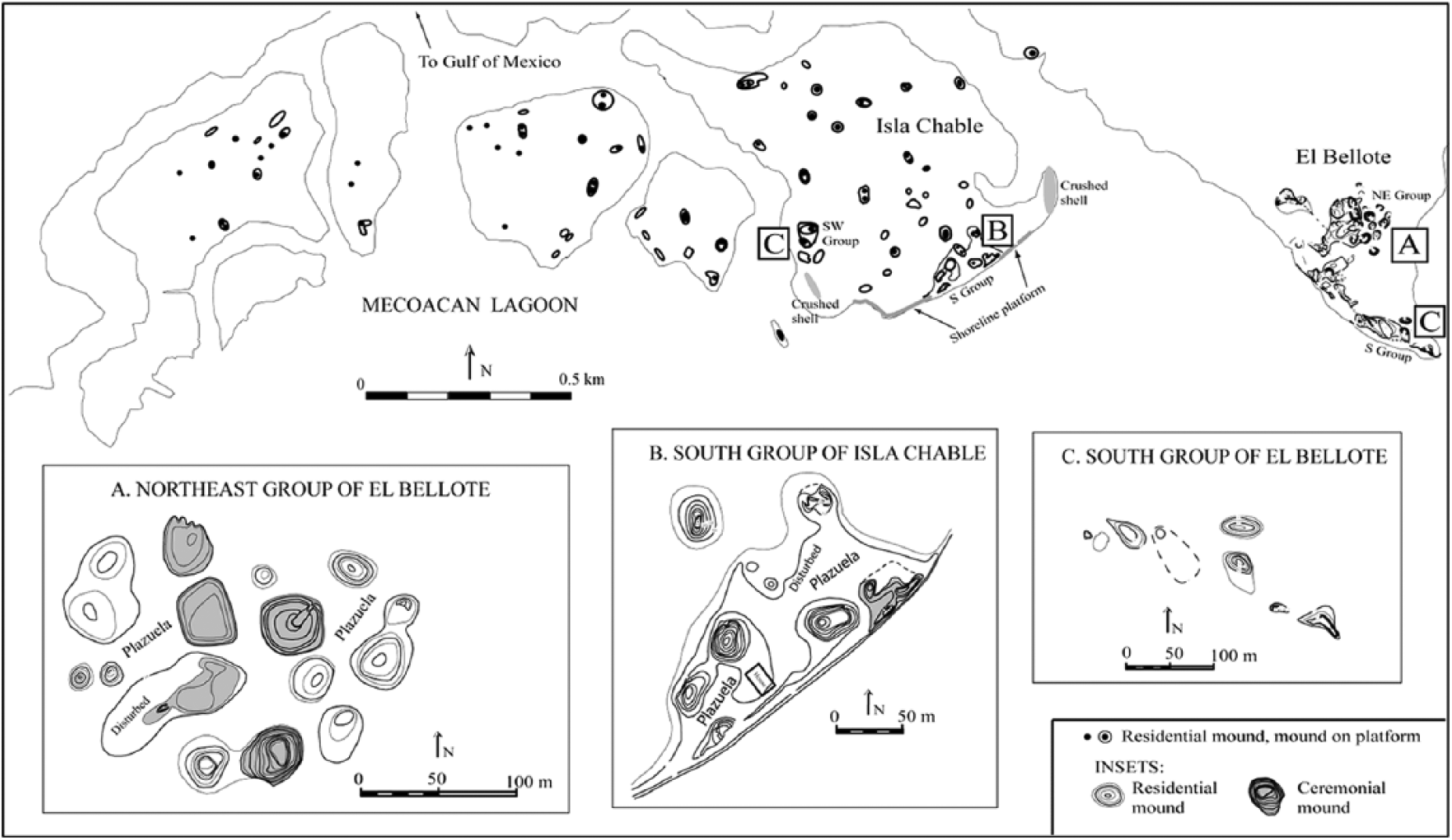
Islas de Los Cerros.
Four identifiable classes were defined by their contexts within the tributary social relations of production (Ensor, 2013b). The ceremonial elite class had no direct role in tributary production but presumably ensured the flow of tribute to Comalcalco. Their residential mounds occurred in plazuelas (conjugal family dwellings encircling small plazas indicating patrilocality) incorporating ceremonial mounds with tombs indicating patrilineal affiliations with ancestors. In the Northeast Group of El Bellote, multiple patrilocal residences were aggregated, forming a segment—the cross-cultural pattern for a lineage (Figure 1a). Members directly controlled the ceremonial reproduction of the social order, and members’ power was legitimated by patrilineal descent from ancestors. A class of resource-controlling elites was identified. The Southern Group at Isla Chable was connected to the shoreline fishing platform and the large crushed shell deposit. The group had one to two plazuelas, suggesting a patrilineage (Figure 1b) and one ceremonial mound. Members directly controlled collective surplus production for tribute, and members’ power was legitimated through patrilineal descent from ancestors. A class of resource-owning commoners was indicated by two residential groups associated with tools and production features of their own. The Southwest Group of Isla Chable is adjacent to a small crushed shell deposit. The South Group at El Bellote has an abundance of faunal remains and cutting tools in domestic areas and at a fish-processing platform. This class had informal residential groups exhibiting the cross-cultural pattern for cognatic residence (Figure 1c). For this class, rights to local resources were presumably through bilateral and affinal membership. Finally, a class of resource-deprived commoners was defined by the absence of tools and faunal remains at the vast majority of residential mounds. The only domestic activities in evidence were for food storage, cooking, and serving. Unlike the other classes, the members of this class did not have rights to local resources. Considering the large-scale collective production facilities, however, a dependence on community corvée tributary labor in exchange for food to process at residences is reasonably interpreted. The individual residential mounds of this class were informally scattered across the islands, indicating bilateral descent and neolocality (Figure 1), which is common to populations that lack resources and depend on nonkin-based relations of production (such as serfs and proletarians). 3 In sum, the disparate class contexts within the tributary social relations of production variably structured kinship practices (Ensor, 2013b).
These results contradict the ethnological interpretations of ancient Maya kinship. Patrilineal, patrilocal interpretations were only accurate for elites. The “house society” model only fits the bilocality of resource-owning commoners. No ethnological interpretations predict the neolocality and bilateral descent among the majority of the population. There was no dual or Kariera kinship.
The results also challenge assumptions for phylogenetic, neoevolutionary, and historical particularist theoretical genres. Phylogenetic evolutionism assumes that kinship practices are homogeneous over large spans of time, and that daughter populations split and evolve homogeneously, which does not account for class-distinct variation. Neoevolutionary models assume homogeneous practices for cultures that shift from one type to another. However, classes in the same local community cannot be viewed as having different rates of evolution. Historical particularism also assumes homogeneous practices, but the ILC class-based variation cannot be explained as the diffusion of practices into some classes but not others. All at ILC were integrated into one regional tributary political economy structuring disparate class-based contexts and resulting kinship practices. The results best conform with contemporary anthropological theory emphasizing practice by historically contingent political economic social contexts.
Hohokam Kinship
The second case study demonstrates 1,450 years of diachronic variation and change in kinship among the prehistoric Hohokam: a major U.S. Southwest culture occupying the Sonoran Desert region from central Arizona to northern Sonora, México. Hohokam settlements were located along river floodplains where they built extensive agricultural irrigation networks while also making use of a wide range of wild plants and animals (e.g., Bohrer, 1991; Fish & Nabhan, 1991; Szuter, 1991). The Akimel O’odham and Tohono O’odham (Pima and Papago) are direct descendants whose language is Uto-Aztecan (Fontana, 1983).
Normative models from early 20th-century data emphasize individual kindreds, bilateral inheritance and bilocality with patrilineal/patrilocal biases, and a preference for local group exogamy (with endogamy variably practiced; Bahr, 1983). “Patriclans” are indicated by terms for father, which were grouped into the Buzzard and Coyote moieties. These were not corporate groups—clans and moieties had no functions beyond a basis for teasing (Bahr, 1983). Marriage involved individual-based prohibitions against close consanguines. Normative kin-term descriptions emphasize genderless distinctions in ego’s generation for near (second cousins and closer, ideally in the same local group) versus far (beyond second cousins, ideally in other local groups; Bahr, 1983; Parsons, 1928); equating younger siblings with children of parents’ younger siblings or older siblings with children of parents’ older siblings; and bifurcate collateral distinctions for parents’ generation (undergoing replacement by lineal distinctions; Dunnigan, 1983; Parsons, 1928).
Ensor (2013a) selected four prehistoric sites in the Phoenix Basin where broad horizontal excavations revealed much of the prehistoric villages, each having well-described and dated dwellings covering multiple phases: Pueblo Patricio (Cable & Doyel, 1987; Cable, Hoffman, Doyel, & Ritz, 1985; Henderson, 1995), Snaketown (Haury, 1976; Wilcox, McGuire, & Sternberg, 1981), La Ciudad (Henderson, 1987a, 1987b; Rice, 1987), and Pueblo Grande (Bostwick & Downum, 1994; Mitchell, 1994). Unless otherwise noted, all habitations had floor areas less than 43 m2, indicating conjugal family dwellings. Although landforms influenced settlement locations, the distributions of dwellings within settlements were not constrained by physical factors, indicating social reasons for their arrangements.
Red Mountain Phase (ca. ce 0-350)
At Pueblo Patricio, there were three noncontemporaneous, widely spaced conjugal family dwellings indicating neolocality and bilateral descent used to colonize irrigable land (Figure 2; Ensor, 2013a).
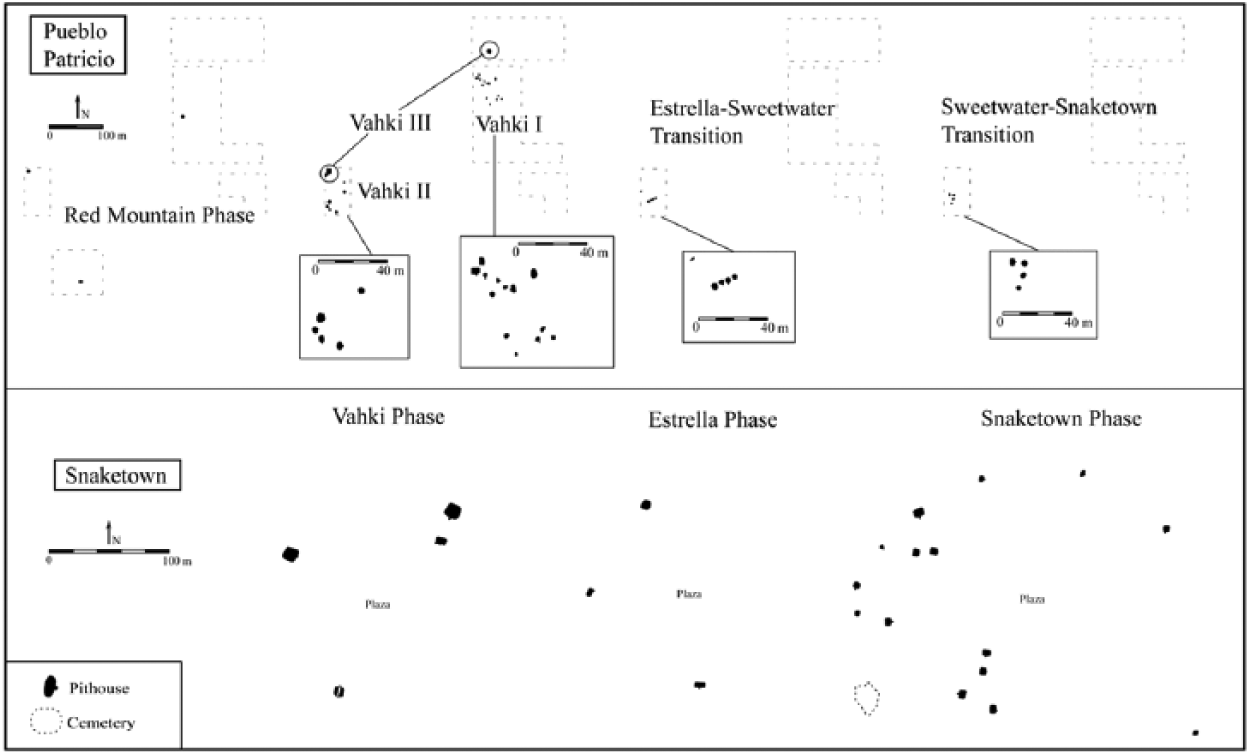
Red Mountain to Snaketown phase community patterns.
Vahki Phase (ca. ce 350-525)
Subsequently at Pueblo Patricio, there were three successive Vahki phase (Figure 2) occupations (Ensor, 2013a). The first had two or more informal aggregates of conjugal family dwellings, indicating cognatic residential groups. They were widely spaced indicating bilateral descent. The second had a single informal aggregate of conjugal family dwellings, also indicating a cognatic residential group. The third included two informal clusters of conjugal family dwellings, also widely spaced, indicating continuity in cognatic residence and bilateral descent.
At the settlement of Snaketown, there were two large matrilocal dwellings (100 and 110 m2), a portion of a third large dwelling (likely greater than 80 m2 in floor area), suggesting another matrilocal residence, and a third dwelling between the ranges for conjugal family and matrilocal residences (49.7 m2). These were formally arranged around an open plaza indicating a matrilineage practicing matrilocality (Ensor, 2013a).
Estrella (ca. ce 525-600), Sweetwater (ca. ce 600-675), and Snaketown (ca. ce 675-750) Phases
At Pueblo Patricio, one informal aggregate of conjugal family dwellings dating to the transition from the Estrella to Sweetwater phase and another dating to the transition from the Sweetwater to Snaketown phase indicate continuity in cognatic residential groups and bilateral descent (Figure 2; Ensor, 2013a). Pueblo Patricio was abandoned thereafter.
At Snaketown, the matrilocal dwellings were replaced in the Estrella phase by conjugal family dwellings surrounding the plaza, suggesting a shift in the matrilineage to avunculocality. The successive Sweetwater phase and Snaketown phase occupations had widely spaced conjugal family dwellings and small informal clusters of conjugal family dwellings surrounding the plaza, suggesting both avunculocality and bilocal residence at the matrilineage’s settlement. Whereas cognatic kinship was continuously used to form and maintain corporate land-using groups at Pueblo Patricio, a matrilineage occupied Snaketown but with shifts from matrilocality to avunculocality, later combined with bilocal residence (Ensor, 2013a).
Gila Butte Phase (ca. ce 750-875)
During the Snaketown–Gila Butte phase transition, the settlement at La Ciudad was first occupied with widely dispersed conjugal family dwellings and one informal aggregate of conjugal family dwellings, indicating the use of neolocality and cognatic residence with bilateral descent to colonize new farmland—the same strategy used 700 years prior at Pueblo Patricio (Ensor, 2013a). During the Gila Butte phase, those neolocal groups developed into extended cognatic residential groups. The settlement maintained an informal layout, indicating continuity in bilateral descent (Figure 3; Ensor, 2013a).

Gila Butte to Sacaton phase community patterns.
Meanwhile at Snaketown, the growing descent group had formally arranged conjugal family dwellings surrounding small plazas (termed “courtyards” in the Hohokam literature), indicating patrilocal residential groups, accompanied by informal clusters of conjugal family dwellings, indicating coexisting cognatic residential groups (Ensor, 2013a). These, along with a ballcourt and ceremonial features, surrounded the ancestral plaza. This combination of residential practices with a descent group suggests a shift from matrilineal descent, which would not be associated with patrilocality, toward ambilineal descent as a strategy for membership (a ramage; Ensor, 2013a).
Santa Cruz Phase (ca. ce 875-975)
At Snaketown, the dwelling and community pattern associated with patrilocal and cognatic residence with a ramage persisted through the Santa Cruz phase while the population continued to grow, and another ballcourt and more ceremonial features surrounded the plaza (Figure 3; Ensor, 2013a).
At La Ciudad, one segment illustrated continuity in cognatic residence while another developed into a formal courtyard group, indicating patrilocality, and two had courtyards and nonaggregated conjugal family dwellings surrounding plazas with cemeteries, indicating the development of patrilineages practicing both patrilocality and virilocality (Ensor, 2013a). One of the patrilineages was associated with a ballcourt. The numbers of dwellings in the two patrilineage locations increased in the middle of the phase, while the isolated patrilocal group dwindled to one dwelling and disappeared by the end of the phase. The cognatic residential group was reduced to only two dwellings at the end of the phase.
The settlement of Pueblo Grande was established in the Gila Butte phase. However, the earliest clear community patterns observable there date to the Santa Cruz phase at which time formal courtyard groups surrounded a plaza, indicating a patrilineage using patrilocality (Ensor, 2013a). While the Snaketown matrilineage became a ramage, Pueblo Grande was home to a patrilineage, and La Ciudad’s cognatic residential groups were transformed into two patrilineages, one patrilocal residential group, and one cognatic residential group.
Sacaton Phase (ca. ce 975-1150)
At La Ciudad, the two patrilineages and the depopulated cognatic residential group persisted until the settlement was abandoned shortly after
Pueblo Grande’s patrilineage became a ramage. The Pueblo Grande plaza orientation was maintained but the courtyards were replaced by informal clusters of conjugal family dwellings, indicating cognatic residential groups, suggesting a shift to an ambilineal ramage (Ensor, 2013a). The altered membership principles coincided with an influx of four new residential groups (where none existed before) scattered to the east of the ancestral descent group’s location. Those new informally scattered groups had informally arranged conjugal family dwellings, indicating cognatic residential groups and bilateral descent (Ensor, 2013a). Whereas the ramage at Snaketown transformed into a patriclan with subclan lineages, the patrilineage at Pueblo Grande became a ramage accompanied by newly established groups emphasizing cognatic residence and bilateral descent.
Soho (ca. ce 1150-1300) to Civano (ca. ce 1300-1400) Phases
Despite changes in pottery styles, architecture, and burial customs in the Classic period, Pueblo Grande’s community patterns exhibit continuity through the Sacaton, Soho, and Civano phases (Figure 4; Ensor, 2013a). Informal aggregates of Soho phase conjugal family dwellings around the ancestral plaza (then occupied by two square platform mounds) indicate continuity in the ambilineal descent group. The scattered four groups that settled the area to the east, along with new scattered aggregates to the north (where none existed before), had informal clusters of conjugal family dwellings, indicating cognatic residential groups and bilateral descent. The Civano phase adoption of above-ground adobe-walled architecture was not accompanied by a change in social organization. The same cognatic residential pattern—albeit with aggregated walled structures on the west side of, and on, a then large platform mound (all enclosed within a tall compound wall)—indicates continuity in the ramage. The increased number of scattered informal aggregates of dwellings to the east and north shows continuity in cognatic residential groups with bilateral descent. Pueblo Grande’s coexisting ambilineal and bilateral social organization contrasts with some Classic period settlements that had residential groups surrounding circular plazas (Doyel, 1991) suggesting unilineal descent groups.
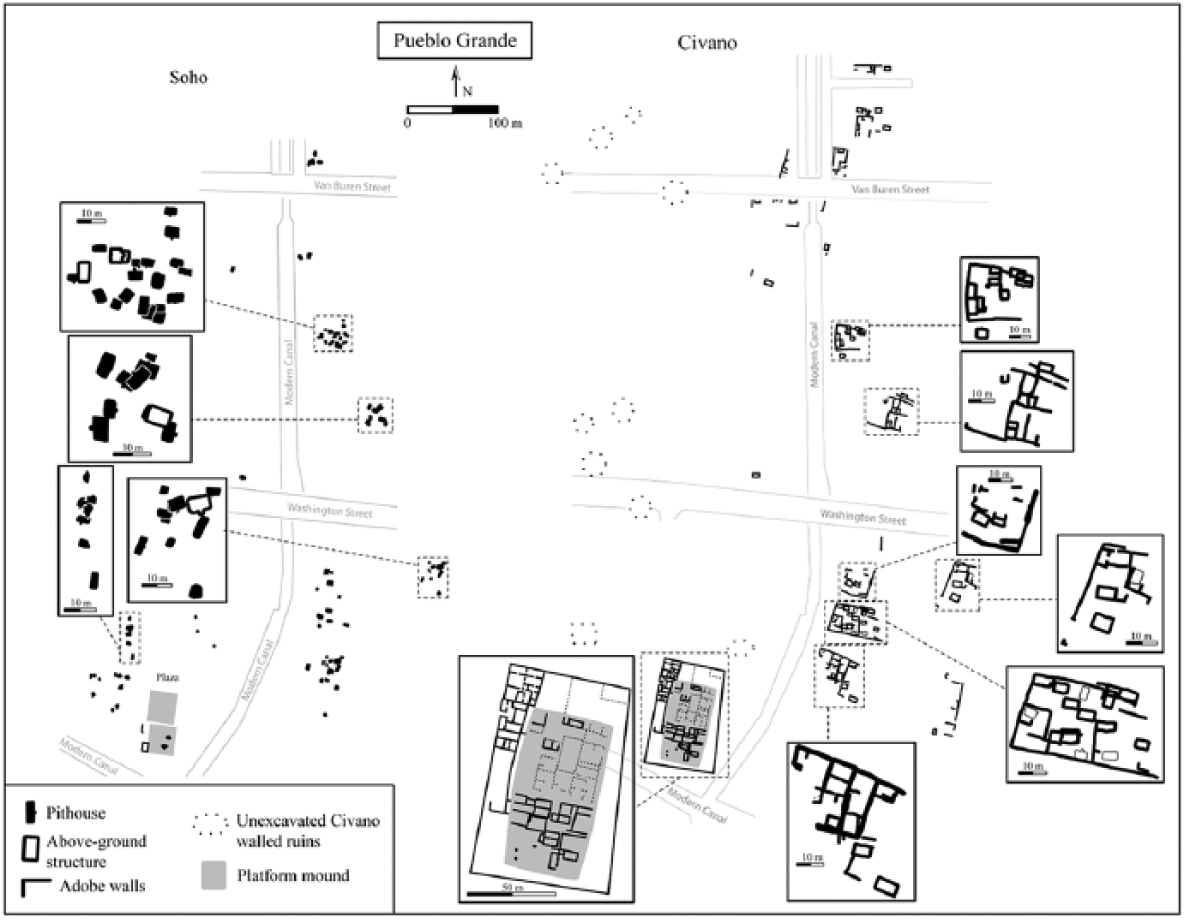
Classic period community patterns at Pueblo Grande.
Polvorón Phase (ca. ce 1400-1450)
Pueblo Grande was depopulated (or abandoned and reoccupied by fewer new groups). Widely scattered (indicating bilateral descent) amid the ruins of Civano phase structures were courtyards (indicating patrilocal groups), informal aggregates of conjugal family dwellings (indicating cognatic residential groups), and isolated conjugal family dwellings (indicating neolocality; Figure 5). Thus, the Polvorón phase at Pueblo Grande illustrates a diversity of residential practices combined with bilateral descent (Ensor, 2013a).
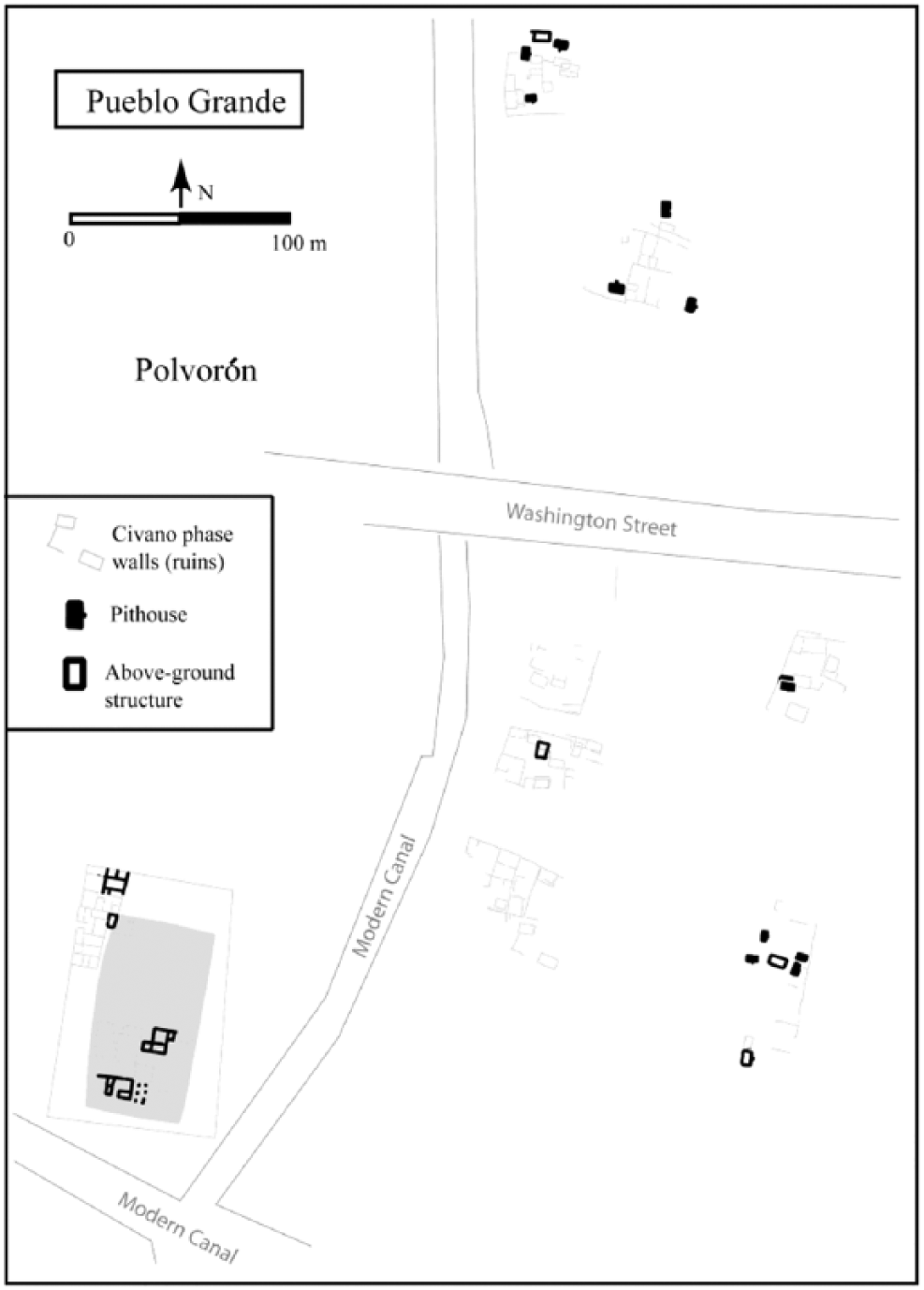
Polvorón phase community patterns at Pueblo Grande.
In summary, the Hohokam case study appears to defy many ethnological assumptions on kinship. At all times over the course of 1,450 years, there was remarkable variation in kinship practices, including variation within local communities, contradicting assumptions of homogeneous practices for cultures and posing a problem for methods guided by phylogenetic, neoevolutionary, and historical particularist high-level theories. There was no homogeneity. There was no Hohokam “proto-kinship.” There was no evolution: neither branching from a common ancestral set of practices nor sequential from one set of homogeneous practices to another and to another. Although use of 20th-century data might predict patrilineal descent groups in the past (based on the recognized clans with no functions), only some communities had patrilineal descent groups at variable unsynchronized times while some groups were never organized as such. Neither ethnographic kin terminology nor direct historical analogy would predict the ways that kinship varied over time, across contemporaneous local communities, and among contemporaneous groups within local communities. Moreover, historical particularist horizontal transmission cannot explain the kinship practices within the Phoenix Basin. Periods of change and continuity to practices in long-lasting groups were independent of the diffusion of traits (e.g., pottery styles, architecture, burial customs, etc.). Even several well-accepted functionalist hypotheses could not explain Hohokam kinship (Ensor, 2013a, 2016). Hohokam kinship was situational strategy, frequently manipulated, and variably negotiated, which is best explained by contemporary anthropological theory emphasizing practice and agency within historically contingent social contexts (see Ensor, 2013a for context-based explanations).
Conclusion
As the discipline devoted to sociocultural variation and change among living and past humans, anthropology should maintain as a central concern how it goes about researching kinship. As subjects and protagonists of our discipline’s directions, we must occasionally consider the theoretical relevance of what we are doing. Having experienced nearly two decades of resurgence in ethnological kin-term research to interpret prehistory, it seems timely to pause and take stock of where these efforts have brought us, where they are headed, and what changes are needed to promote sustainable productive avenues of inquiry on what is unequivocally an important subject to the discipline.
Phylogenetic theory and the use of the comparative method have been heavily critiqued across anthropological subfields. The neoevolutionary speculations on sequences in types, themselves considered inaccurate reflections of cultural variation, have also long been rejected. Historical particularism replaces the speculation inherent in the phylogenetic and neoevolutionary models with other assumptions, yet also methodologically assumes normative practices per culture for analyses. Nevertheless, evaluations of these high-level theoretical models, their assumptions, and interpretations on prehistory should involve testing with data actually dating to prehistory. Strong cross-cultural factual correspondence between material culture and kinship practices produces generalizable mid-level theory unbiased by high-level models while also avoiding the pitfalls of analogy.
Using cross-culturally tested mid-level theory for empirical analyses, the two archeological case studies discussed above defy the high-level theoretical models and assumptions emphasized in ethnological prehistoric kinship research. Instead, the archeological results using data that actually date to prehistory best conform with contemporary anthropological theory, emphasizing historically contingent political economic contexts, practice, and agency. Elsewhere, Souvatzi (2008, 2012, 2017) described variability in household organization within and across settlements in Neolithic Greece and without uniform directionality in change, also defying ethnological evolutionary models’ assumptions, while better conforming with contemporary political economic, practice, and agency theories.
Ethnologists should not abandon efforts to interpret prehistoric kinship using modern kin terminology simply because their current high-level models and methodological assumptions are not supported by both ethnographic and actual prehistoric empirical data. However, a change in theoretical perspectives would be more productive and sustainable. Sociolinguistic ethnographies make leading efforts to understand kin-term manipulation in historically contingent social contexts (e.g., Coehlo de Souza, 2012; Dousset, 2012; Mahalem de Lima, 2014; Turner, 2012). The same contemporary theoretical perspective is called for in historical linguistics (e.g., Blench, 2006; Campbell & Poser, 2008; Clendon, 2006; Dziebel, 2007). In conjunction, these movements could pave new perspectives and methods to research prehistoric kinship. The sociolinguistic emphasis on context-based semantic term manipulation could replace “culture” comparisons with context-based, or “event-based” (Chrisomalis, 2006), cross-cultural research to better inform ethnological interpretation on prehistory. Some efforts are already underway to develop ethnological databases to explore kinship and agency (e.g., Carmichael & Rijpma, 2017), specifically the relation between kin terminology and practice (e.g., Heady, 2017). Inevitably, however, any assumptions and interpretations using nonprehistoric data need to be tested archeologically with data from prehistory.
Toward that end, cross-cultural research has confirmed mid-level theories for several kinship practices. However, more is needed on virilocality with descent group locations, avunculocality with matrilineal descent group locations, and ambilineal descent groups (Ensor, 2013a, 2013c), along with distinguishing ambilocality and bilocality and de facto versus de jure practices (Ensor, 2013a). Because dwelling floor areas apply best with neolithic societies (Porčić, 2010), more research is needed on mobile foraging societies to expand archeological analyses deeper into prehistory and for regions such as Australia. An ultimate goal might be to develop an “archaeoethnology”—the cross-cultural analysis of diachronic archeological cultures (Peregrine, 2006)—of prehistoric kinship.
Footnotes
Acknowledgements
The author thanks Patrick Heady and Mikołaj Szołtysek, organizers of the Murdock and Goody Revisited: (Pre)history and Evolution of Eurasian and African Family Systems workshop, funded and hosted by the Max Planck Institute for Social Anthropology (Halle, Germany, April 16-17, 2015). This article synthesizes the author’s three papers presented at the workshop. Although the author alone is responsible for any omissions or errors, he also thanks Stella Souvatzi and Mikołaj Szołtysek for their comments on earlier drafts.
Declaration of Conflicting Interests
The author(s) declared no potential conflicts of interest with respect to the research, authorship, and/or publication of this article.
Funding
The author(s) disclosed receipt of the following financial support for the research, authorship, and/or publication of this article: The archeological investigations at Islas de Los Cerros were funded by the Foundation for the Advancement of Mesoamerican Studies, Inc. (FAMSI #05024, #07019), Eastern Michigan University, the Tinker Foundation, and the University of Florida.