



Abstract
Advanced consensus analyses are made available with the cultural consensus theory (CCT) framework, which is a model-based methodology used to closely derive the consensus knowledge of a group or population (e.g., a culture). The relevant data are their questionnaire responses about a subject domain. CCT has been established as a main methodology for ethnographic studies in social and cultural anthropology, and it has also been incorporated into other areas of the social and behavioral sciences as an effective information-pooling methodology. Recently, there are major advances in CCT, including (a) the multicultural extension, which can detect latent subgroups of a population, each with their own consensus answers to the questionnaire items; (b) the development of new models for several questionnaire designs, true/false, ordered category (Likert) scales, and continuous scales; (c) the estimation of important parameters that affect the response process; and (d) the development of Bayesian hierarchical inference for these CCT models. The joint analysis of these features positions such CCT approaches as some of the most advanced consensus analysis methods currently available. That is, they jointly (and hierarchically) estimate the consensus answers to the questionnaire items, the degree of knowledge (cultural competence) of each individual, the response biases of each individual, the difficulty (cultural salience) of each questionnaire item, and the subcultural group of the individual. In this article, we provide an overview of these major advancements in CCT, and we introduce CCTpack, which is currently the only software package available that handles all these extensions, especially (a) and (b).
Keywords
Introduction
Consensus beliefs, opinions, and expertise are rich sources of information with many uses, ranging from applications to anthropology, social research, and politics; commercial, Internet, and service uses; evaluations of persons (e.g., expertise or belief detection) and items (quality); and more. Cultural consensus theory (CCT; Batchelder & Romney, 1986, 1988; Romney, Weller, & Batchelder, 1986; Weller, 2007), which involves information aggregation techniques and models, provides advanced methods to retrieve and calculate such consensus information. For example, Batchelder and Anders (2012) showed that CCT models can detect consensus answers better than the majority rule, even during cases of only six respondents; and Anders and Batchelder (2012) showed that CCT models are capable of detecting cultural subgroups with diverse beliefs, which would otherwise provide misleading conclusions about the dominant group consensus. Third, CCT models benefit from improved accuracy in consensus detection, as they filter out response biases and item difficulty in the aggregation—descriptive calculations, such as majority rule or response means, cannot obtain the same handling of variance (e.g., see Anders & Batchelder, 2012; Anders, Oravecz, & Batchelder, 2014; Batchelder & Anders, 2012; France & Batchelder, 2014; Oravecz, Anders, & Batchelder, 2013; Oravecz, Faust, & Batchelder, 2014; Oravecz, Vandekerckhove, & Batchelder, 2012). These kinds of developments can markedly improve the precision of our data analyses, consequently improving the kinds of inferences researchers can make about consensus, culture, and other valuable, latent information from collected data. Furthermore, Anders (2014) has recently developed an R package, CCTpack, that provides pipelined implementations and diagnostics for such CCT methods, and CCT model-based clustering (one or more groups) for binary, categorical, and continuous data. This article reviews these recent major developments, and demonstrates how CCTpack can be utilized by anthropologists to perform these advanced consensus analyses.
The following is an illustration: To learn about consensus beliefs about a particular topic (postpartum hemorrhage) and in a particular context (in Bangladesh culture), Hruschka, Kalim, Edmonds, and Sibley (2008) interviewed three groups with graded experience. These groups consisted of skilled birth attendants (S) who received formal training in birth attendance, traditional birth attendants (T) who are without formal training but employ traditional Bangladeshi techniques in birth attendance, and Lay-Women (L) who are without any occupational experience in birth attending. Example questions involved are as follows:
Is the mouth of the womb not closing after birth (atonic uterus) a cause of too little bleeding?
Is vitamin or blood deficiency treated with amulets or blessings?
Is a slow flow of bleeding a sign of normal bleeding?
A priori, one would expect that these different occupational groups would constitute several consensuses, and indeed Hruschka et al. (2008) found that the data did not satisfy the classic CCT guideline for a single consensus (e.g., the 3:1 eigenvalue ratio; Weller, 2007). 1 As a consequence of this violation, a CCT modeling before the developments of Anders and Batchelder (2012) would be invalid to apply. These authors hence introduced CCT models that can handle consensus data with subgroups, providing consensus analysis with model-based clustering. The culture number diagnostic was also updated, as to instead examine the number sizable eigenvalues before a linear trend is observed, which then relates to the number of consensus groups in the data. Then, the validity of the CCT model fit is tested as to how well it reproduces the eigenvalue trend in the data. Note here that these eigenvalues indicate the amount that the respondents agree with one another, and they are obtained from a factor analysis of the respondents correlated with one another. For this example data set, as displayed by the black line in the left plot of Figure 1, the eigenvalue trend provides for at least two sizable magnitudes before a linear trend is observed, suggesting multiple clusters of consensus.

Principal component analyses of the respondent-by-respondent correlation matrix of the postpartum hemorrhage data, used to assess the number of underlying consensuses (groups) in the data.
In the study, three Bangladeshi groups were interviewed, but do they really form three subcultures of distinct beliefs? This question can be answered by applying multicultural CCT models specified at two and three cultures, and examining which performs better on the quality of fit diagnostics (discussed in more detail later). In this case, a two-culture model performed best on such diagnostics, and as displayed in Figure 1, each of the many model simulations (gray lines) clearly reproduces the eigenvalue trend of the observed data. With these developments, we thus obtain a model that can fit multicultural data and retrieve the consensus answers of each group—even when there are fewer consensus groups than the number of initial identities interviewed (e.g., S,T,L). Note that as an alternative approach to such multicultural modeling (model-based clustering), one may also consider running the three identities separately with single-culture CCT models. However, this assumes a priori that occupational experience will define each individual’s consensus group. Such an assumption could likely be false. For example, could there be some (T) traditional birth attendants who are also skilled in (or more practicing of) standard medical knowledge as the (S) skilled birth attendants? Could this also be the case for several (L) laywomen who have related occupations/interests? Could some (S) skilled birth attendants be more prescribing to cultural and spiritual beliefs? In these cases, the derived consensuses will be less accurate, and some individuals will not be correctly clustered or evaluated. In fact, we will see such results in the following output: Rather, occupational experience is correlated with but does not define consensus membership.
The CCT model fit results are illustrated in Figure 2, based on 14 respondents of each identity: S, T, L, and 50 questions. 2 The left plot provides the consensus expertise of each respondent (scale 0-1, ascending order) and their model-based clustering (“Cluster 1,” “Cluster 2”); the bottom row (S,T,L) is their original classification from the data. From here, it is clear to see that identity membership to cultural subgroups (S,T,L) does not guarantee that this individual’s belief/knowledge corresponds most closely to their identity membership. For example, the two clusters derived constitute the following: “Cluster 1,” a group largely in formal medicine (mostly S, some T, and two L), in which the T and L tend to have lower competency; and “Cluster 2,” a group largely in traditional practice (T, L, and two S) in which T and L tend to have similar competencies. Hence, some L and T in Cluster 1, for example, may have received education elsewhere about formal medicine regarding postpartum hemorrhage (and prescribe to this more than cultural practices), and the two S in Cluster 2 may persist with their cultural and/or spiritual beliefs (despite their professional practice). Note also that as previously mentioned, another advantage of such consensus modeling is the capacity to make person and item evaluations. Here, the professional expertise of some S individuals may be evaluated by their competency ordering in Cluster 1.
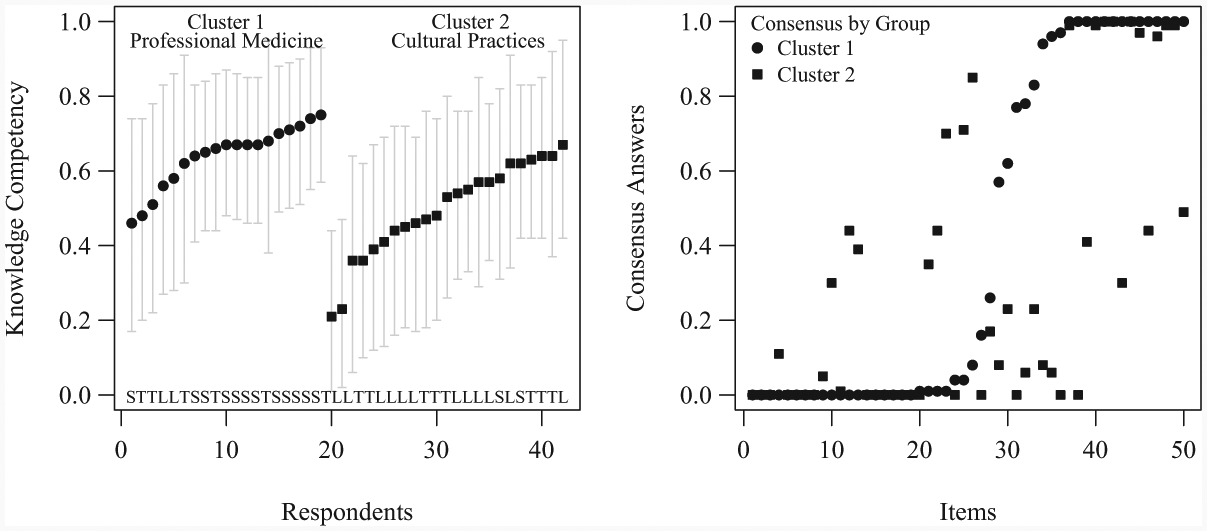
CCT model fit results on the postpartum hemorrhage data (42 respondents, 50 items).
Next, the right plot of Figure 2 provides the consensus answers (ascending order by Cluster 1) for each cultural subgroup for the 50 items (ordered likewise in Supplementary Appendix A, which also provides these answers). As discussed previously, prior work has shown that these model-derived answers can be more accurate than descriptive aggregations, such as the majority rule. Note that the values here, ranging between 0 and 1, represent the degree of consensus for these answers (or are probabilities of the answer being 1 or “true”). 3 Indeed by observing the plot, a comparison of the two groups shows that similar consensus answers were obtained for about 30 of the items, and that the groups are actually distinguished by different beliefs for the other 20 items (where the squares do not overlap, or are distant from, the circles). Cluster 2 has more middling consensus values than Cluster 1. This result is rational, as formal medicine is less flexible in treatment protocol than in cultural traditions, which may be more susceptible to mixed or debatable protocols in treatment. Finally, we note that there are other useful parameters (e.g., item difficulty, response biases) that are estimated by the model, which improve the recovery of these consensus answers and groups, than CCT models (or other statistical methods) that do not include these parameters. These additional parameters shall be discussed in subsequent sections.
Through this introductory illustration, we have demonstrated the value and basic mechanics of model-based consensus analysis for multi- and single-cultural data. The readers who are interested to directly apply such methodology to their data may advance to the CCTpack walkthrough in Section “CCTpack Walkthrough” (note that the prior two sections “CCT Data Diagnostics” and “Interpreting CCT Parameters” are also helpful). The upcoming sections provide important information about CCT, its background, its variety of models, and generalities for how they are implemented. For example, the section “Development Over Time of Methods to Apply CCT and Relationships to CCTpack” discusses the developments over time in applying such CCT methods and other packages in relation to CCTpack. The section “The Hierarchical Bayesian Approach and Its Advantages for Consensus Analysis” discusses the hierarchical Bayesian estimation framework, which is used to implement such advanced applications. The section “The CCT Data Diagnostics for Binary, Ordered Categorical, and Continuous Consensus Data” more thoroughly explains quality of fit diagnostics, as provided in Figure 1, for assessing the validity of a model on a data set. The section “Interpreting CCT Model Parameters” provides an example demonstration of how to interpret the CCT model parameters after a model fit. Then, the section “CCTpack Walkthrough” provides a full walkthrough in CCTpack between data loading, model application, diagnostics, and results. The general discussion follows: Finally, Supplementary Appendix B provides a useful quick-reference guide for each of the CCT models that handle binary, ordered categorical, and continuous data (the models available in CCTpack).
CCT
In general, multiperson, questionnaire-based studies ultimately seek to discover an appropriate description of the underlying opinions, beliefs, or preferences of a given cultural population. Typical questionnaire data analyses usually involve aggregating the responses within each item using a central tendency measure, which can result in a crude summary of shared knowledge or preference. For example, these analyses can be improved upon considering that in many cases of real data, (a) populations may consist of a mixture of substantial subcultures, which are failed to be captured by central tendencies (and/or can perturb them); (b) human respondents vary in their knowledge expertise, and could be weighted accordingly in the aggregation; (c) questions may vary in perplexity or difficulty, and this could be accounted for as well; and (d), a more accurate aggregation also results when each individual’s response biases are filtered out of the total aggregation. These considerations have been developed into a formal, cognitive model-based data analysis methodology that advances above basic aggregation techniques, by taking into account these population (or subcultural) component clusters and influential cognitive factors. This described methodology comprises the essence of CCT, especially its recent developments.
CCT, also known as an advanced consensus analysis framework, is applicable to what we term as consensus data. Consensus data can hence be summarized by four characteristics: a set of individuals providing responses to a set of items that pertain to a shared knowledge domain, where each respondent may be appropriately clustered into a group that shares a consensus (e.g., a culture, or a group with individuals ranging in knowledge about a common set of “culturally” correct answers). In such questionnaire studies, both the number of latent consensus groups and the consensus answers of each group are usually unknown. Providing answers to, as well as the details about these unknown factors, describes the principal roles of CCT methodology, and especially why such multicultural diagnostics and detection methods can be valuable for such research projects. Particularly, the recent developments of CCT that we focus on involve model-based clustering methods to appropriately estimate these features, as well as cognitive metrics pertaining to the individuals/items themselves (e.g., respondent knowledge, response biases, and item difficulty). These cognitive factors may substantially affect the response process, and are hence used to improve the model fit accuracy of the cultures (clusters) retrieved and their latent consensuses. This is done by effectively weighting respondents according to knowledge, accounting for accuracy issues across items of varying difficulty, and filtering out individuals’ response biases from final aggregates.
Noteworthy Advancements in CCT
The beginnings of CCT methodology were developed in the 1980s (Batchelder & Romney, 1986, 1988, 1989; Romney, Batchelder, & Weller, 1987; Romney, Batchelder, & Weller, 1986). The methodology principally involved a canonical model (the General Condorcet Model [GCM]) for data consisting of a single culture (or a single-culture assumption), in which the individuals have made binary (true/false, yes/no) responses to a questionnaire about a shared knowledge domain. Inferences from this fundamental approach have been used extensively in anthropological research (see Weller, 2007). Recently, CCT modeling capabilities have been largely advanced in at least four ways: (a) to more data types than just binary data, such as to ordered categorical data (Anders & Batchelder, 2013) and continuous data types (Anders et al., 2014), which, respectively, introduced two new CCT models; (b) to the detection of latent subgroups (multiple cultures) and their respective consensus answers for each of these data types, providing a model-based clustering methodology for cultural analysis (Anders & Batchelder, 2012); (c) to improvements in aggregation (e.g., more reliably deriving the consensus values) by parsing along influential factors such as respondent biases, level of knowledge, and the item difficulty parameters that are estimated (e.g., Batchelder & Anders, 2012; Oravecz et al., 2013); and (d) to implementing the models with the hierarchical Bayesian framework (see aforementioned references), which, among various advantages, can improve parameter recovery in cases of smaller data sizes (Rouder, Lu, Speckman, Sun, & Jiang, 2005; Rouder, Lu, Sun, Speckman, Morey, & Naveh-Benjamin, 2007).
Development Over Time of Methods to Apply CCT and Relationships to CCTpack
We have emphasized some recent advancements in CCT methodology that notably consist of its extension to multicultural clustering models (and culture number diagnostics), as well as its extension to handle ordered categorical data and continuous data, in addition to the more classical binary data case. Importantly, hierarchical Bayesian implementations were also developed for all these model extensions, which facilitated the application of these more complex models. Hierarchical Bayesian implementations (see Kruschke, 2011; Lee, 2011; Rouder & Lu, 2005) can refine the quality of data aggregation (e.g., consensus and group derivation) by accounting for more factors that may substantially affect the response process.
Background
Prior to these advancements, the most popular CCT model was developed only for binary data, and it necessitated a single-culture assumption: The consequence is that the interpretations of the model’s parameters are only valid to the extent that one can prove the data consist of only a single culture. This model is usually termed the single-culture GCM (Batchelder & Romney, 1986, 1988; Romney et al., 1987; Romney et al., 1986). Since its beginnings, the single-culture GCM has served as a notably important and fundamental model for consensus analysis methodology, and has been extensively used in anthropological research (see Weller, 2007). 4 To assess the single-culture assumption, CCT methodology has developed data diagnostics to help infer how many cultures may be existent in the data, such as by the eigenvalues obtained from a factor analysis (Comrey, 1962; Jolliffe, 2002) of the respondent-by-respondent correlation matrix (see Anders & Batchelder, 2012, for a detailed discussion).
Consequently, the first CCT packages were developed for the single-culture GCM, and are called ANTHROPAC (Borgatti, 1996) and UCINET (Borgatti, Everett, & Freeman, 2002). These packages allow application of the model with only heterogeneous knowledge competency, and otherwise fix response biases as neutral across respondents: For example, for all respondents, a 50/50 response guessing bias is used for items in which the respondent does not know the consensus answer. Hence, other factors that could improve data aggregation, such as heterogeneous response biases or item difficulties, cannot be estimated with these first packages. Both these packages utilized a clever but inferentially inefficient “method-of-moments” procedure to estimate the parameters of the GCM (see Batchelder & Romney, 1988). 5 Then following these packages, Karabatsos and Batchelder (2003) developed the first software package to advance model estimation techniques for the single-culture GCM into the Bayesian framework (see Gelman, Carlin, Stern, & Rubin, 2014), as well as for the model to estimate heterogeneous response biases and item difficulties. By this development, they markedly advanced aggregation potential of the GCM; and they offer S-PLUS (Everitt, 2001) code with their article for this application.
Recent Bayesian Methods
Then, some notable advancements were recently made for applying the single-culture GCM to the Bayesian framework at further levels and customizations: First, Bayesian Cultural Consensus Toolbox (BCCT; Oravecz et al., 2012) offers nonhierarchical Bayesian applications of the single-culture GCM and estimation of all the response factors of the model (as well as the option to fix any of them as neutral). Second, the Hierarchical Condorcet Modeling Toolbox (HCMT) 6 offers similar functionality (and some important extensions) but with the advance of hierarchical Bayesian model estimation. The usefulness of hierarchical Bayesian techniques in the context of CCT or cultural analyses is discussed next in Section “The Hierarchical Bayesian Approach and Its Advantages for Consensus Analysis.” The two notable and unique extensions provided in HCMT involve (a) a version of the GCM which allows individuals to respond with “Don’t Know” in addition to true/false, yes/no, A/B, and (b) the option to regress covariate (e.g., participant age, item length) effects on the estimated single-culture GCM parameters. For single-culture applications of the GCM, the HCMT is currently the most advanced package available, and offers the most customizability for this model. CCTpack is also a software package that provides hierarchical Bayesian implementations, and it will be discussed at the end of this section.
Recent Non-Bayesian Methods
Alternatively, there are several non-Bayesian packages for CCT applications that have been recently developed as well: First, there are CAML (Aßfalg & Erdfelder, 2012) and AnthroTools (Purzycki & Jamieson-Lane, 2017), which also fit simplified model versions of the GCM (restrictions to single culture) using maximum-likelihood methods as discussed in the first CCT packages; and furthermore, AnthroTools offers modeling methods for free-listing response data. Second, FlexCCT (France, Vaghefi, & Batchelder, 2013) is available, and can fit continuous responses to the single-culture case using maximum-likelihood methods, with two basic response bias options. One advantage of the maximum-likelihood approach is that it can generally achieve model fit in much less time than Bayesian inference, though at a cost of fitting more rudimentary model versions. Occasionally, these rudimentary models may be a poorer representation of the data when the influential factors comprising the data are more complex (e.g., multiple cultures, item difficulty, response biases).
CCTpack
Given these accounts, if one is interested in multicultural analysis with the GCM and/or single/multicultural analyses for ordered categorical or continuous data (notably with hierarchical Bayesian inference implementations), CCTpack is currently the only software package available that provides facilitated application of all of these models as well as their multicultural extensions. The package allows fitting all of the aforementioned cognitive parameters that can substantially affect the response process, such as heterogeneous knowledge competency, response biases, and item difficulty. The package can also handle participants who did not answer all the questions (missing data); and in the case of such missing data, the package provides estimates (makes predictions) of what a respondent would have answered to the items that he or she did not provide responses to. Furthermore, data diagnostics for the single/multiple cultural truth assumptions, based on mathematical properties of each model, are provided, which can help determine the number of cultures in the data. Furthermore, data diagnostics are provided to determine if heterogeneous item difficulty should be specified as well. In the following sections, we develop the approach by discussing the advantages of the hierarchical Bayesian framework, the CCT diagnostics for analyzing consensus data, and an overview of the three CCT models that, respectively, pertain to binary, ordered categorical, and continuous data that CCTpack provides. In Section “CCTpack Walkthrough,” a package tutorial (or walkthrough) is provided.
The Hierarchical Bayesian Approach and Its Advantages for Consensus Analysis
A noteworthy advantage of utilizing the hierarchical Bayesian framework as a model estimation approach for consensus research work is that it can minimize error in model estimation, and allow one to obtain more reliable parameter estimates in cases of smaller sample sizes (Rouder & Lu, 2005; Rouder et al., 2005; Rouder et al., 2007). This is typically achieved by modeling these samples of participants and items involved in the questionnaire study as sharing (statistical) properties from respective populations (e.g., items share properties more in common than the participants, and vice versa). Specifically, distinct stochastic population distributions, such as normal distributions, are specified as a source for the participants and items (and furthermore, subcultures can be modeled as from separate population distributions). In this way, the approach has been found to improve estimation for smaller sample sizes by constraining error and maximizing information that can be gained from the data (see Gelman, 2006; Kruschke, 2011; Lee, 2011; Rouder, Morey, & Pratte, 2015). For example, within-participant (or item) information is used to better estimate the between-participant (or item) information and vice versa (i.e., individual-level estimates are propagated to the group-level estimates and vice versa).
Furthermore, other reasons the Bayesian framework can improve reliability in estimation are that the parameters are estimated simultaneously; the parameters are integrated over the uncertainty of all other parameters, and as so, the error can be distributed more evenly across the estimated parameters. This is contrasted with maximum-likelihood or deviance minimization techniques, where estimations of one or multiple parameters can be serially done to derive the other parameters (e.g., from method of moment equations), in which error is more difficult to constrain or less evenly distributed. In addition, the Bayesian framework allows prior distributions to be specified for each of the parameters to further constrain error in estimation (see Gelman et al., 2014, for an explanation of Bayesian terms).
A second important note for why the hierarchical Bayesian framework is advantageous for consensus analysis, or these CCT model implementations, is that it is a framework which enables one to even apply such complex statistical models when it was not possible before to estimate such models. That is, the more complex expression of model likelihood that comes with these more advanced CCT models, for example, the multicultural extension and/or all of their cognitive metrics jointly estimated, renders them highly difficult to estimate with the more classical approaches, such as maximum-likelihood estimation. In fact, we currently do not know of any implementations of multicultural CCT models that are estimated with maximum-likelihood approaches. Thus, the Bayesian, especially hierarchical Bayesian, frameworks are quite valuable CCT model estimation approaches, and are capable of improving precision and performance in model estimation.
The CCT Data Diagnostics for Binary, Ordered Categorical, and Continuous Consensus Data
Validity of Group Measures
As noted previously, data aggregation measures (whether simple central tendencies or consensus model parameters) that describe a single population can be considered distorted or inappropriate measurements when the data involve subcultures / subgroups with notably different consensuses. Clustering these subgroups into their separate consensuses can improve the validity of the results. Alternatively, one might be interested to apply such a single-culture model to the data but provide a diagnostic based on mathematical properties, which supports the validity of a single-culture assumption. CCT methodology provides such kinds of diagnostics to discern appropriate assumptions of how many cultures are evident in the data and if the model satisfies them. We will discuss such diagnostics later in this section.
Quality of Data Aggregation
Second, we have noted that data aggregation can be improved by filtering the aggregation procedure according to factors that substantially affect the response process: For example, when individuals are weighted by their knowledge, and their response biases are filtered out, item difficulties can help us better estimate individual knowledge. For example, better estimates of individual knowledge may be obtained when we account that beginners may often get the easy questions correct, but often only the experts get the harder questions correct. When we estimate heterogeneous item difficulty, we can potentially improve model estimation. Furthermore, such improved data aggregation can improve the precision to which the consensus answers are recovered. However, sometimes this can make the model more difficult to estimate (e.g., longer model estimation time, clusters more intensive to recover), and CCT also has a diagnostic for if heterogeneous item difficulty is recommended for fitting the data.
These two aforementioned diagnostics have been developed for single/multicultural and hetero/homogeneous item difficulty, CCT models for binary data, ordered categorical data, and continuous data (which are overviewed in the next section); and CCTpack involves automatic generation of these diagnostics. Guidelines for how they are used and function are as follows (see also Anders & Batchelder, 2012, 2013; Anders et al., 2014, for more mathematical details):
Model Fit Diagnostic for Culture Numbers (Groups)
Based on mathematical properties of each of these models for binary/categorical/continuous data, the factor coefficients (e.g., eigenvalues) that pertain to how well the respondents agree with one another (e.g., of the respondent-by-respondent correlation matrix) may be obtained by a components analysis, and then plotted. This is commonly referred to as a scree plot; see the black line in the left plots of Figures 3 and 4. The number of sizable factors existent before an approximate linear trend is produced has shown to provide a reasonable indication for how many consensus groups may be existent in the data. Hence, before specifying how many cultures to fit a CCT model, it is recommended to inspect these scree plots, which we can produce from analyzing the respondent-by-respondent agreement trends in the data. Then, following a successful CCT model fit of the data, it is important to determine if the model has appropriately captured the scree plot trend that the original data produced. This is done by what is called a posterior predictive model check. In such a check, using the model parameters obtained from the model fit to the data, data sets are simulated (here 500 random sets), and hence checked if they correspond to the actual data observed. A scree plot is produced for each of these simulated data sets, and one observes if the simulated data sets appropriately correspond to the actual data set (Figure 3, left plot) or alternatively, fail to satisfy this diagnostic (Figure 4, left plot). Note that as the size of the first eigenvalue is often proportional to the total number of participants, in cases of large data sets (e.g., many participants) one may need to zoom in on the first several factors to better asses this diagnostic. This proportionality characteristic may also explain why the previous rule-of-thumb 3:1 eigenvalue ratio (e.g., see Weller, 2007) to assess the single-culture assumption may often fail to detect subcultures in large data sets (e.g., Hruschka et al., 2008).

CCT culture number (left) and item difficulty (right) diagnostics.
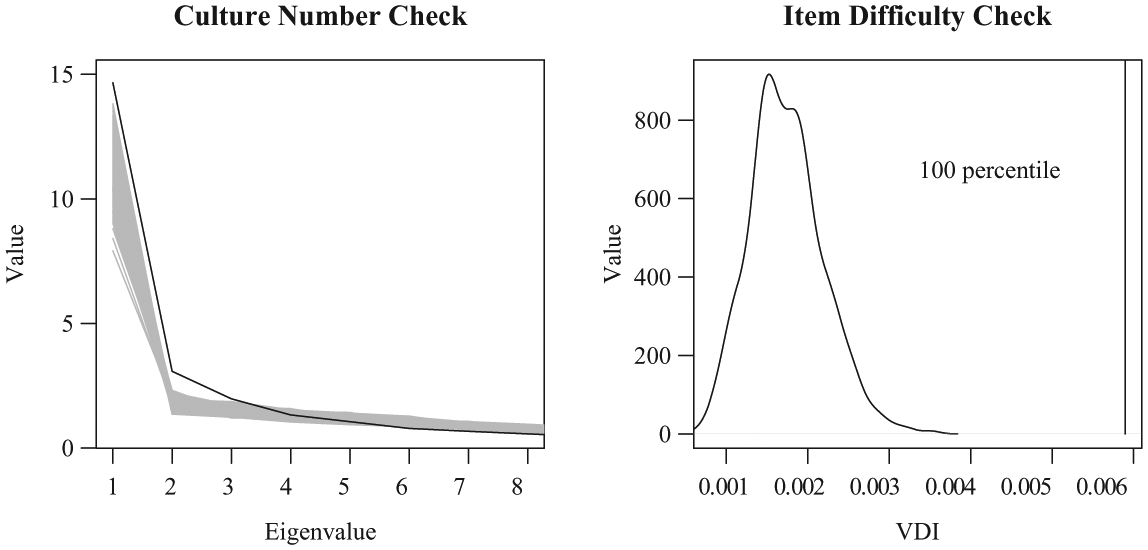
CCT culture number (left) and item difficulty (right) diagnostics.
Model Fit Diagnostic for Item Difficulty
A similar kind of posterior predictive model check can be used to determine if heterogeneous item difficulty is recommended in the model fit. Though assessing this property comes second in importance to the cultural number diagnostic check, as the interpretations from the parameters obtained from a CCT model can still be considered appropriate when data are fit with homogeneous item difficulty (though to involve a coarser aggregation) than with heterogeneous item difficulty that may sharpen results. This diagnostic hence serves as a tool to determine to what degree it may be important to specify heterogeneous item difficulty. Particularly, it involves a statistic called the variance dispersion index (VDI), which involves a comparison of the variance of responses within each of the items across the items (see Equation 15 of Anders & Batchelder, 2012). Hence, if the VDI is large, how items are responded to is highly varied across items, indicating support for heterogeneous item difficulty and vice versa. As before, one can simulate data sets from the model parameter estimates and see if model-predicted VDI statistics fall in the range of the observed statistic in the real data, as in Figure 3 (right plot), or alternatively, fail to satisfy this diagnostic as in Figure 4 (right plot). Consequently, if this check is not satisfied with homogeneous item difficulty, then heterogeneous item difficulty is recommended to be specified in the model.
Interpreting CCT Model Parameters
After a successful application of the model and verification of its fit diagnostics, an interpretation of the model parameters may be pursued. As previously mentioned, current CCT model applications can maximally provide (parameters for the following) a derivation of the item consensus values, respondent knowledge, response biases, and item difficulties; and if a multicultural application is performed, then also the group membership allocation for each respondent (and each subculture’s answer key and item difficulties). A Bayesian model application will result in a distribution of values for each parameter, and generally the mean is used as a reliable point estimate for each parameter’s true value called a posterior mean value. Then around this posterior mean value, interval bars (similar to confidence intervals) are determined by the distribution of values (e.g., 95% of the values; see Kruschke, 2011, for more details).
Figure 5 provides a demonstration (as they would be plotted by CCTpack) of the point estimates for each of the model parameters from a Bayesian application of a multiculture (here, two-culture) GCM to binary data (e.g., yes/no, true/false, A/B questions). In fact, we include the results from the postpartum hemorrhage data discussed in the Introduction: 42 respondents, 50 questions. In the top-left plot of the figure, the binary item truths, Z, for Culture 1 are represented by black circle symbols, whereas the binary item truths for Culture 2 are represented by white square symbols. Note here, however, that they are not in ascending order by Culture 1’s values as in the Introduction/Supplementary Appendix A. Then, the second plot, containing the item difficulty for each item λ, has the same kind of circle/square notation; 0 corresponds to the easiest items, 1 corresponds to most difficult. Here, the interval bars are not depicted to avoid excessive or obstructive markup within the plot. Note that for each parameter, the index v pertains to the culture number, and is hence in the set culture {1, 2}; and the index k is for the items and is in the set of items {1, 2, . . ., 50}. Then as for index i, these are the respondents in the set {1, 2, . . ., 42}.

A demonstration of CCT model parameters obtained from a multicultural (two-culture) fit to binary data, using a Bayesian implementation.
Consensus Values
The consensus values Z, for each culture (v) and item (k), are provided as Zvk in the first plot of Figure 5. As mentioned previously, here for the GCM, these answer values represent the degree of consensus. Hence, values close to 1 represent strong consensus of “yes/true/A” answers while values close to 0 represent strong consensus of “no/false/B answers.” Some previous CCT users may be accustomed to only dichotomous answers provided, without this more detailed information about the degree of consensus. These dichotomous answers are simply obtained by rounding these Z values (e.g., closest to 1 or 0). Then as for the other CCT models that handle item-scale questions, for example, ordered categorical and continuous data (Latent Truth Rater Model [LTRM]/Continuous Response Model [CRM]; see Figure 10), note that the consensus answers are instead called Tvk; they represent the item’s true position on the scale, and in this case, the degree of consensus is better discerned by the credible intervals (error bars).
Item Difficulty Values
The item difficulties, λ vk , are provided in the top-right plot of Figure 5. They are also culture specific, 7 and are ordered in the same correspondence as the consensus answers in the plot to the left. These λ vk values reflect the difficulty to respond correctly to each question. For the GCM (the binary data model in the current plot), λ vk = .5 is baseline level, so any values below .5 reflect the degree of item easiness, while values above .5 reflect the degree of item difficulty. Note that for the LTRM/CRM, λ vk = .0 is the baseline level (see Figure 10), so likewise below 0 is easier while above 0 is harder. It is important to remark that these item difficulty parameter values provide for a better estimation of the consensus answers, as well as each individual’s knowledge or response dynamics. These parameters are described next.
Respondent Competency
The respondent competencies, θ i , are provided in the bottom-left plot of Figure 5 for the 42 individual respondents. In this plot, the symbols represent the group memberships (model-based cluster assignments) of the individuals; respondents with a black circle belong to Culture 1, respondents with a white square belong to Culture 2. This symbology of the respondents corresponds to the same group symbology for the items in the top two plots of the figure. In the case of the GCM here, θ i is the probability between 0 and 1 that the individual responds correctly to any given question, and λ vk , the item difficulty, scales this in the case of a particular item. For the item-scale models (LTRM/CRM, example in Figure 10), this competency parameter θ i is instead called Ei. It measures their deviation from detecting the item’s true position on the scale, and this parameter is also scaled by item difficulty, λ vk .
Response Biases
The participant response biases, gi, are provided in the bottom-right plot of Figure 5 for the 42 individual respondents. The symbology is the same as in the respondent competency plot (lower left) previously discussed. For the GCM, gi is the probability between 0 and 1 that an individual guesses “true” (or the response coded “1”) on a question in which he or she does not know the answer. Then as for the item-scale models (LTRM/CRM, example in Figure 10), there are two response biases: ai, that is, the extent to which respondents prefer extreme values (ai > 0) versus middling values (ai < 0); and bi that is the extent to which respondents prefer values on the left of the scale (bi < 0) or right of the scale (bi > 0). Hence, baseline or neutral respondent biases for each of these parameters are given by ai = 0 and bi = 0.
Respondent Group Membership
The respondent group membership, Ω i , does not have its own plot in Figure 5, but is instead depicted by common group symbols in the bottom two plots. Two clusters (cultures) were fit with this CCT model, so any person’s group membership is either 1 or 2. It is also worth noting that a respondent’s competency (bottom-left plot) is a reasonable indicator (though not decisive) for the matching strength of this person to his or her cultural cluster. 8 Note that as we use a cognitive response model that parses for answer key, competency, item difficulty, and response biases, these latent clusters recovered by the model are advanced analyses compared to classic clustering approaches. In the following CCTpack walkthrough, we will show how to easily access these group membership values.
CCTpack Walkthrough
Being in the form of an R package, CCTpack is both widely accessible and freely available. The following subsections provide a demonstration of how to utilize the package, with a provided multicultural data example. The example data consist of a group of urban Guatemalan residents surveyed as to whether each disease (item) is better treated with a “hot” or “cold” remedy (Romney et al., 1986). The purpose of the investigation was to assess if ancient Mayan beliefs pertaining to whether certain diseases require a “hot” or “cold” remedy have persevered in urban Guatemalan culture. In this example data set, 14 random missing responses were added (of 23 respondents × 27 items = 621 total possible responses) to demonstrate the model’s capacity to handle missing data. Here, the data provide for a good practical example, especially due its smaller size (23 × 27), which allows for model fitting times on the scale of just a few minutes.
Installation
To get started, one must first download and install the general R software program from the official website:
Then, JAGS (Plummer, 2003), which performs the MCMC sampling and tuning, needs to be downloaded and installed from the official website:
http://sourceforge.net/projects/mcmc-jags/files/
Once R and JAGS are installed, then the CCT package called CCTpack can be installed—it is currently hosted on the Comprehensive R Archive Network (CRAN). CCTpack can be downloaded and installed by typing the following in the R console:
install.packages(“CCTpack”, dependencies=TRUE)
The function setting
Loading Data
After loading the CCTpack library, the next step is to load the data that will be fit by the model. The example data of this walkthrough can be loaded using the command:
Then, these data can be accessed any time by typing hotcold.
Notes
Data for the package should be prepared in a matrix format in which the respondents occupy the rows and the items occupy the columns. Any missing responses to items should be specified as NA. When the data are appropriately specified, CCTpack will detect the number of respondents and items; the number of missing responses; the data type: binary, ordinal, or continuous; and selects the appropriate CCT model to analyze the data. Binary data will be analyzed with the GCM, ordered categorical data with the LTRM (Anders & Batchelder, 2013), and continuous data with the CRM (Anders et al., 2014)—see also the Appendix for a quick-reference guide of the models.
When loading data into CCTpack, keep in mind that at the time of this writing, CCTpack is currently developed to analyze the following three types of data formats: (a) binary data, coded 0 or 1; (b) ordered categorical data, coded 1, 2, . . ., C; and (c) continuous data, coded in (0,1). Therefore, the applicability of our data to CCTpack depends on whether it can correspond to one of these three data formats. Some data can be appropriately transformed to these formats. For example, continuous data with positive magnitudes can be appropriately transformed to (0,1) by using the following linear transformml: y = (x − min(X)) / (max(X) − min(X)), where X is the data matrix and x is the data cell value; and in the case of continuous data in the reals (e.g., −∞,∝), these values can be transformed to (0,1) with the inverse logit transformml: y = 1/(1 + exp(−x)). As a default, if continuous data are not transformed to (0,1) before they are loaded into the software, the inverse logit transform is automatically used by the program, in which the program will account for values of 0 as 0.001 and values of 1 as 0.999.
Specifying Cultures and Item Difficulty
Before fitting the model to the data, one should specify how many cultures (e.g., separate clusters that have distinct consensus beliefs) to estimate from the data. As discussed previously, the number of potential cultures in the data may be inferred from a factor or scree plot analysis (e.g., the number of sizable factors before a linear trend is observed). To produce the appropriate scree plot, the following command is used:
The factor component values plotted in the scree plot can be accessed by
For the Hot-Cold data, as illustrated in the scree plot in Figure 6, two substantially large apparent factors are exhibited. Thus, two cultures can be entered for the fit as clusters = 2. With regard to item difficulty, the questionnaire that gave rise to the data may have substantial differences across items (e.g., some diseases are more prevalent), so varied item difficulty is reasonable to estimate, and is selected as itemdiff = T. Note that different model fits may be assessed by the validation diagnostics (posterior predictive checks, for example, Section “The CCT Data Diagnostics for Binary, Ordered Categorical, and Continuous Consensus Data”), and subsequently by model quality of fit statistics, such as the Deviance Information Criterion (DIC; Spiegelhalter, Best, Carlin, & van der Linde, 2002), provided in this package.
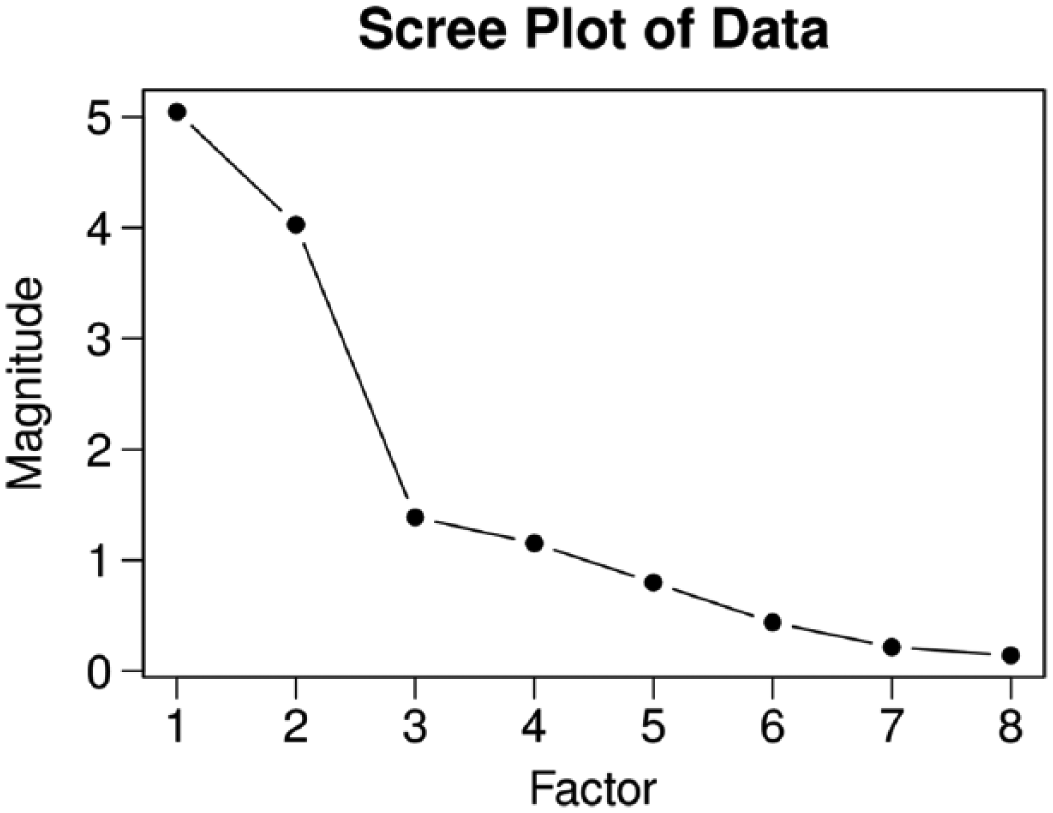
The scree plot generated from the dat <- cctscree (hotcold) command.
Applying the CCT Model
To apply the model with these settings to the data, the following command is used:
The settings
Notes
When a multiculture CCT model is applied to data, label-switching (Stephens, 2000) phenomena may occur. Label switching is defined by the situation in which the labels of the parameters between two or more MCMC chains are different, although they contain intended, corresponding data. For example, Culture 1 in Chain 1 may be labeled as Culture 2 in Chain 2; and the parameter values within these cultures will have highly similar, if not approximately the same cultural consensuses. When label switching occurs, the
Checking the Integrity of the Results
If the chains appear to have obtained proper convergence, then one may use the diagnostics discussed in Section “The CCT Data Diagnostics for Binary, Ordered Categorical, and Continuous Consensus Data” to assess the appropriateness of the model for the data. These two diagnostics, the culture number and item difficulty checks, can be calculated using the following command:
The command will produce the plots as in Figure 7, and give accompanying statistics (e.g., the VDI) for the item difficulty check. These checks can also be queued for calculation prior to the model run, by using the option,

The PPC plot containing the PPCs (diagnostics) that are important to verifying the validity of the number of cultures assumed and item difficulty options, and is generated from cctfit <- cctppc(cctfit).
The results in Figure 7 indicate that both checks are satisfied in this application. As discussed previously (Section “Interpreting CCT Model Parameters”), the culture number check is satisfied when the black line (scree plot of the data) is overlaying or highly similar to the gray lines (many scree plots produced from multiple data sets predicted by the model fit). Then, the item difficulty check is satisfied for the GCM when the VDI statistic for each culture lies within the 10th to 90th percentile of the distribution of VDI statistics, which is calculated from these many predicted data sets of the model fit.
Next, as in Section “The CCT Data Diagnostics for Binary, Ordered Categorical, and Continuous Consensus Data,” we demonstrate how these diagnostics can indicate if a model with poor specifications is applied to the data. For example, if one runs the single-culture model on the data set
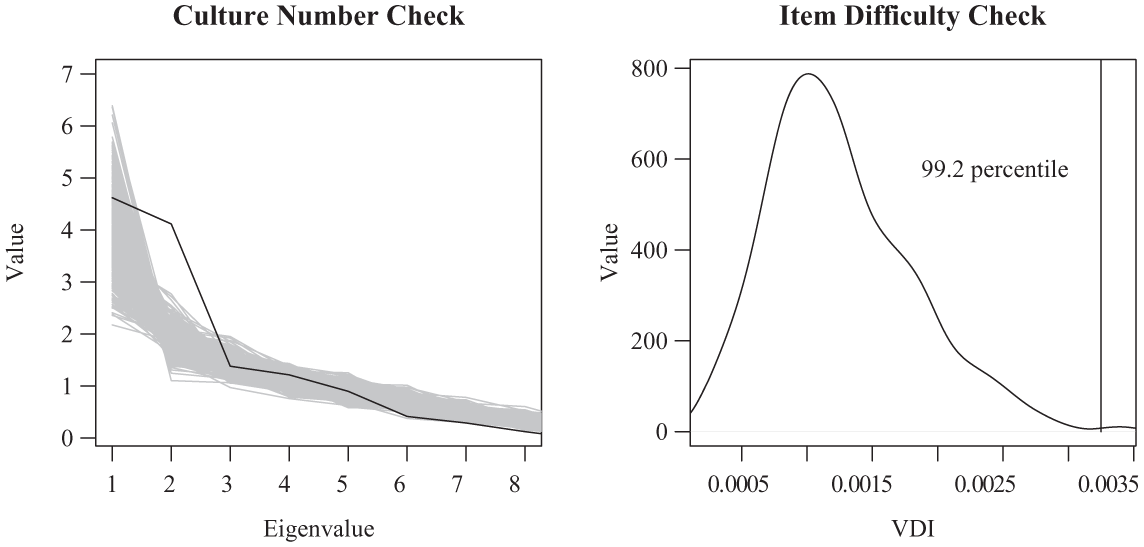
Depiction of inadequate performance on the culture number check and item difficulty check; from running the model inappropriately specified at one culture and no item difficulty, on the example data set.
Viewing and Examining the Results
The posterior results of the model may be visualized by
In addition, a tabular readout of the item answers, difficulties, and Bayesian-credible intervals is provided by the following commands:
For example, using

The results plot containing posterior mean parameter estimates generated from the cctresults(cctfit) command.
Then using
Then similar tabular readouts, but of the participant group memberships, competencies, biases, and Bayesian-credible intervals, are provided by the respective commands:
The plot that is generated from the
In Figure 9, circles denote the first culture, whereas squares denote the second culture. The interval bars depict the 95% highest density intervals (HDIs; Kruschke, 2011); sometimes, interval bars are not depicted on the items (as in the top two plots) to avoid excessive or obstructive markup within the plot, but these intervals and further information may be gathered from accessing the
In any readouts of the respondents and/or items (e.g.,
Quick Summary
A general summary of the fit object and data analyzed is provided by
As seen above, these statistics describe the data, the settings used for the fit, the quality of the fit, and the posterior predictive checks. As previously mentioned, we added 14 missing values to demonstrate the approach’s capacity to fit incomplete data. If cctfit
Helpful Commands
Example Results of the LTRM and CRM
CCTpack can also fit categorical and continuous data using the LTRM and CRM, and more details about these models are included in the Appendix. Note that as both the data type (more degrees of freedom) and the CCT models are more complex and advanced for these applications, the model run times are notably longer for these approaches.
Figure 10 contains example output of the LTRM model for ordered categorical data that has the simplified case of being single cultured (V = 1, hence all Ω i = 1). This output may be produced using the following command:
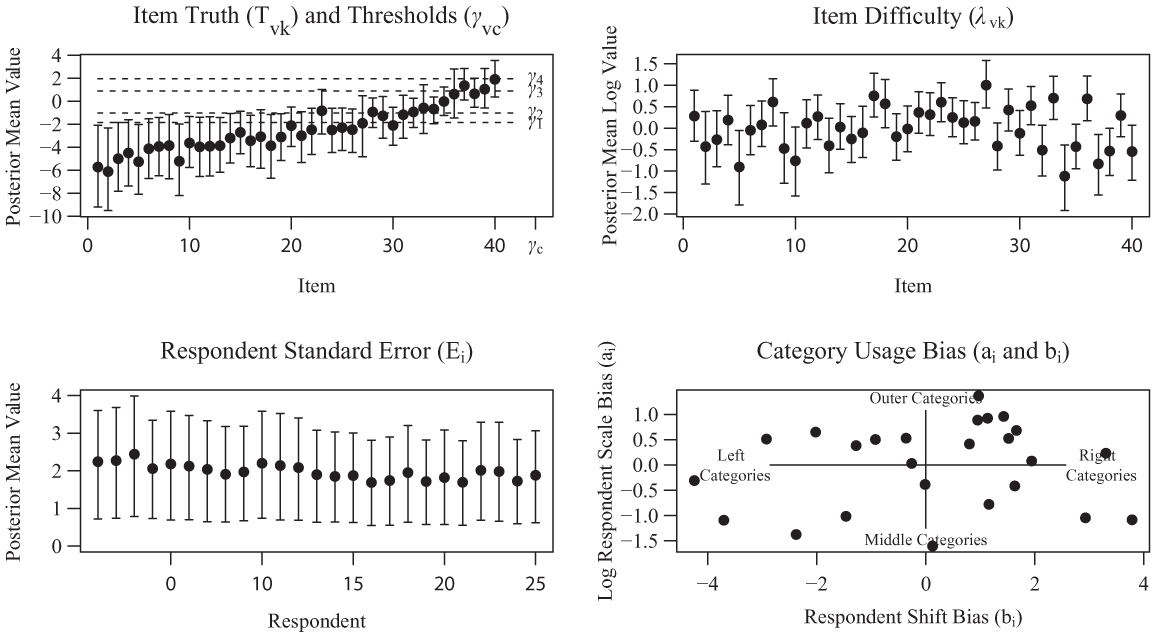
The results plot output from the model for ordinal (ordered categorical) data, containing posterior mean parameter estimates generated from cctresults(cctfit2).
As before, table readouts of the parameter results can be obtained by
The CRM, the model for continuous data, estimates these same parameters as in the LTRM, except for the shared set of thresholds, as the continuous data are assumed not to be filtered through a set of thresholds to arrive at discrete increasing values (e.g., as opposed to the ordered categorical data). An example fit of the CRM may be achieved using
Discussion
A number of recent developments in CCT methodology and modeling have notably advanced its applicability and depth of data analysis, particularly (a) the capacity to detect latent subgroups in populations, each with their respective answer keys through model-based clustering and multicultural diagnostics, and (b) the ability to fit ordered categorical and continuous data in addition to the fundamental binary data case. Furthermore, improvements in accounting for factors that can substantially affect the response process (e.g., response biases, respondent expertise, item difficulty, cluster membership), as well as hierarchical Bayesian implementations for these models, have been made. These kinds of developments discussed herein can notably improve the precision of our data analyses, consequently improving the kinds of inferences researchers can make about consensus, culture, and other valuable, latent information from collected data. However, access to such methodology is difficult for nonexperts and those less acquainted with the approach. This literature has provided a concise, didactic overview of the methodology and its recent developments, and how CCTpack may be used to analyze data with these more advanced techniques. CCTpack discussed herein is currently the only software program developed to handle binary, ordered categorical, and continuous data for both single and multiple cultures (model-based clustering); and models the maximum number of factors currently developed in CCT to affect the response process (e.g., response biases, expertise, difficulty, cluster membership). This should improve the precision to which we infer the consensus answers, as opposed to simpler models. We have also discussed alternative programs readers may be interested in for other aims.
Future developments to CCTpack may consider greater customizability of the modeling specifications beyond those mentioned in this article and greater customizability of the Bayesian settings (though standard diffuse prior settings are specified already). Future developments may also integrate additional models that may be formulated in proceeding publications. Third, developments may also seek to reduce the model estimation time, particularly for the categorical and continuous data models, which tend to be notably longer to fit to the data. Nonetheless, currently CCTpack greatly facilitates access to CCT methodology to a wide readership, for which these techniques might otherwise be inaccessible, or at least much more laboriously accessible, such as by only a manual coding of the CCT models, their estimation techniques, the data and model fit diagnostics, and the model parameter plotting/interpretation.
Footnotes
Declaration of Conflicting Interests
The author(s) declared no potential conflicts of interest with respect to the research, authorship, and/or publication of this article.
Funding
The author(s) disclosed receipt of the following financial support for the research, authorship, and/or publication of this article: We acknowledge funding from the Centre National de la Recherche Scientifique (CNRS, French NSF); the following grants from the Agence Nationale de la Recherche :BLAN-1912-01, ANR-16-CONV-0002 (ILCB), ANR-11-LABX-0036 (BLRI), and ANR-11-IDEX-0001-02 (A*MIDEX); and a grant from the National Science Foundation (Grant #1534471) to the third author.
Supplemental Material
Supplementary material is available for this article online.
Notes
Author Biographies
References
Supplementary Material
Please find the following supplemental material available below.
For Open Access articles published under a Creative Commons License, all supplemental material carries the same license as the article it is associated with.
For non-Open Access articles published, all supplemental material carries a non-exclusive license, and permission requests for re-use of supplemental material or any part of supplemental material shall be sent directly to the copyright owner as specified in the copyright notice associated with the article.
