



Abstract
This study examined whether children’s expression of gratitude and processes potentially related to this expression, such as wishes and spending preferences, would vary across childhood in an urban center of a majority world country. We collected data from 422 boys and girls aged 7 to 14 years residing in Izmir, Turkey. Results indicated that the expression of connective gratitude was common across all ages, and there was a decrease in the expression of concrete gratitude with an increase in age. There was no relationship between types of wishes and gratitude or wishes and spending preferences; however, girls expressed less concrete gratitude and fewer hedonistic wishes compared with boys. Saving and donating were the most common spending preferences, and with an increase in age, the tendency for spending money to buy things for oneself increased. These findings are discussed in relation to how cultural experiences may influence the development of gratitude in this population.
The sociocultural contexts within which children grow play an important role in the development of gratitude. As discussed by Merçon-Vargas, Poelker, and Tudge (2018), the vast majority of studies conducted in psychology and related fields involve samples from Western, Educated, Industrialized, Rich, and Democratic (WEIRD) societies, especially the United States (Henrich, Heine, & Norenzayan, 2010), with authors implicitly assuming that those samples also represent the rest of the world populations (Arnett, 2008). Moreover, scholars in majority world countries frequently cite findings drawn from these studies before assessing their cultural validity (Tudge & Freitas, 2012), which may not only harm the development of psychological research, but also the well-being of the majority world populations by leading to decontextualized conclusions and applications of findings. In this article, we will findings from a sample of Turkish children and adolescents to emphasize that the role cultural values and practices play on the development of gratitude cannot be overstated.
Our approach to the study of gratitude development is based on several frameworks. Drawing on cultural-ecological theory (Tudge, 2008; Tudge et al., 2006) and the bioecological model of human development (Bronfenbrenner, 2001; Bronfenbrenner & Morris, 2006), we suggest that four factors work synergistically to influence the development of the virtue of gratitude as defined by Merçon-Vargas et al. (2018):
The typical activities and interactions that developing individuals encounter in their everyday lives, what Bronfenbrenner (2001) termed proximal processes and Tudge (2008) referred to as everyday activities and interactions, allow children to continuously observe and engage in culturally appropriate ways of giving and receiving gifts and help.
The characteristics of developing children refer to early prosocial tendencies that are required for the development of the virtue of gratitude, such as expressing concern toward someone—who has been harmed—even without the existence of any emotional cue from that person (Vaish, Carpenter, & Tomasello, 2009) or aiding others because of an intrinsic motivation rather than a social obligation (Hepach, Vaish, & Tomasello, 2012). Improvements in children’s executive functions—volitional cognitive skills supported by the prefrontal cortex (Diamond, 2013)—may support the development of these tendencies by contributing to children’s ability to think flexibly about others’ needs and expectations, and set and execute goals aimed toward expressing gratitude to others. The characteristics of those whom developing children interact with, however, may either foster or inhibit these tendencies.
The contexts in which proximal processes take place, termed as microsystems by Bronfenbrenner (1979, 2001), are the local environments where children spend most of their time observing and interacting with peers and adults. Hence, these are the places where children’s initial values and beliefs are socialized—such as home—or where they may have these early ideas challenged, such as school. The broader sociocultural context, which Bronfenbrenner called macrosystem (1979; Bronfenbrenner & Morris, 2006) refers to an entire society, or a racial, ethnic, socioeconomic group within a society that surrounds the microsystems and set the standards for appropriate ways of expressing gratitude.
Finally, ontogenetic time refers to the changes in the expression of gratitude as children move from childhood to adolescence and then from adolescence to adulthood, whereas sociohistorical time refers to the historical events that occur in a society where the individual develops—such as wars, migration, or groundbreaking technological developments—which may influence the cultural standards that determine the expression of gratitude.
Considering how the interplay between these factors can vary from society to society depending on specific values and beliefs that societies foster and transmit, one cannot assume that children from different parts of the world would express their gratitude in the same way. Therefore, how can we conceptualize these values and beliefs that lead to differences in the expression of gratitude across different countries?
Although individualism and collectivism (Hofstede, 2001; Triandis, 1995) or independence and interdependence (Markus & Kitayama, 1991) frameworks are useful for comparing societies that predominantly value individualism or independence with those that predominantly value collectivism or interdependence, it falls short to embrace between- and within-cultural variations in their entirety. Given the limitations of these frameworks for understanding cultural values in societies like Turkey, where both individualistic and collectivistic values are endorsed highly (Göregenli, 1995, 1997; Hofstede, Hofstede, & Minkov, 2010; Sen, Yavuz-Muren, & Yagmurlu, 2014), perhaps it is not surprising that one of the most compatible theoretical perspectives that addresses this problem was proposed by a Turkish scholar, Çiğdem Kağıtçıbaşı. (2007, 2012). She introduced two new dimensions to the discussion of cultural differences: agency, which ranges from autonomy to heteronomy, and connectedness, which ranges from relatedness to separateness. These orthogonal dimensions that constitute four quadrants within which different cultural groups may be placed (Tudge, Freitas, & O’Brien, 2015), hence, enable studying the differences within societies in addition to the differences between them.
In regard to understanding how contexts may influence the development of children’s gratitude in Turkey, where we collected our data, it is important to consider the role of the broader sociocultural context of Turkey and the geographical location our participants reside, the city of Izmir. As a transcontinental country located between Western Asia and Europe, Turkey has long served as a crossroad between the East and the West with a diverse culture reflecting values and characteristics from both sides of the world. Its population is about 79 million (Turkey Census, 2016) with three fourth of it identifying themselves as Turks. The other largest ethnic groups include Kurds, Armenians, Jews, the Laz, Circiassians, Romanis, Greeks, and Syrians. Although the majority of the citizens of Turkey are registered as Muslims, Turkey is a secular country by constitution with residents following a variety of religions including Christianity and Judaism (Sunar & Fisek, 2005).
The largest geographic unit of Turkey is called Anatolia, a peninsula surrounded by the Black Sea (the North), Mediterranean Sea (the South), and the Aegean Sea (the West). Central Anatolia, where the country’s capital Ankara is also located, is a high plateau in the middle enveloped with mountains, which led to the formation of seven regions with distinct climates, cuisine, folk traditions, customs, dialects, and regional products (Howard, 2016).
In the last 70 years, Turkey has experienced a very dramatic transformation. Although it was a largely agrarian economy in the 1950s with around only 25% of its population living in urban areas, this percentage has risen to 75% today (The World Bank, 2015). Hence, although small cities and rural areas in Turkey’s different regions still preserve their local culture, the rapid urbanization following the World War II has led to a migration from rural areas in the east to urban centers in the west, which boosted the population and economy in these centers and led to the formation of culturally more diverse, metropolitan, cities.
Izmir, a port city located in Western Anatolia, is one such city. Located in Western Anatolia, it is the third most populous metropolitan municipality of Turkey with more than 4 million residents (Turkey Census, 2016). Although the city’s economy is largely based on industrial production and commerce of specific goods (metal, textile, food, tobacco, oil, construction materials, and chemical products), agriculture (cotton, olive, tobacco, and fig), and livestock (fish and animal by-products; Izmir Commodity Exchange, 2013), the classical sites and pristine beaches of Izmir give it a significance in tourism as well (Howard, 2016). Its advantageous geographical location had made Izmir one of the most important centers for early Western civilization. In particular, Ephesus—now an ancient touristic site in Izmir—was one of the biggest cities in the Roman Empire. Until the Greco-Turc population exchange that took place from 1922 to 1934 (Yildirim, 2007) and made more than one million Greeks forcibly leave their homelands, Izmir had a significant Greek population. Hence, the city has always been associated with Western traditions and its residents pride themselves on living in the most secular city in the country.
Although Turkey has traditionally been considered as a collectivist society, there is considerable within-country variability given the role that the rapid urbanization has played in the country’s recent history. For example, given that parents in rural Turkey expect their children to defer to parental wishes and want them to respect and obey the older adults in the community, this population can be placed into the heteronomous-related quadrant of Kağıtçıbaşı’s framework (Kağıtçıbaşı, 2005). However, parents from urban centers, like Izmir, expect their children to be autonomous, yet be related or close to the family and members of their community, which places them into the autonomous-related quadrant (Kağıtçıbaşı, 2005; Sen et al., 2014). Support for this argument comes from a study by Kağıtçıbaşı and Ataca (2005), which revealed a shift from heteronomous-related to autonomous-related child-rearing values and practices of Turkish parents over three decades of urbanization.
Based on the idea that children in this more urbanized and Western part of Turkey are socialized to develop a self that synthesizes both autonomy and relatedness, we propose that their expressions of gratitude, wishes, and spending preferences would likely reflect their cultural socialization. In this study, we first examined children’s expression of three types of gratitude: connective, concrete, and verbal.
Children who express connective gratitude would not only wish to return the favor of the benefactor, but would also particularly want to do something for or give something to the benefactor that she or he would want or need (Baumgarten-Tramer, 1938). Expressing this more sophisticated form of gratitude likely requires both a sense of autonomy and relatedness (Tudge et al., 2015). In particular, autonomy would allow children to make and carry out decisions independently (e.g., making a gift for another person without being told to do so), whereas relatedness would help them think about what the other person would like to receive (e.g., a gift that the person would like). Based on this rationale, we expected connective gratitude to be the most common form of gratitude across different ages in this sample given that both autonomy and relatedness are emphasized strongly in this sociocultural context. Although we did not have specific hypotheses regarding whether the expression of connective gratitude would depend on age, it is possible that connective gratitude may increase with age as a function of age-related improvements in children’s volitional cognitive skills, including executive functions and/or more sophisticated reasoning skills during middle childhood and adolescence (Best & Miller, 2010; Diamond, 2013). Given that such volitional forms of cognition may allow children to consider others’ needs, wishes, and expectations, and contribute to the ability to set and execute their goals for expressing their gratitude, volitional thinking and connective gratitude may follow similar trajectories of development.
Similar to the expression of connective gratitude, children who express concrete gratitude would also want to reciprocate a good deed; however, they would do so by providing that person with something that they themselves would want to receive, such as a toy. Hence, although this more simplistic form of gratitude also involves doing or giving something in return, it likely does not require reasoning about what others may want or need. Thus, based on the assumption that children in this urban and Western context of Turkey are socialized to be more related to others, which may promote children’s ability to consider others’ needs and expectations, we expected this type of gratitude to be less common than the other forms of gratitude, particularly connective gratitude. Consistent with previous findings suggesting that concrete gratitude is found less frequently among older than younger children (Payir et al., 2008), we expected the expression of concrete gratitude to be less prevalent in older children. In addition, we expected verbal gratitude (e.g., saying “thank you”) to be common across all ages; however, we did not expect age-related differences given that children may be taught to express verbal gratitude starting from early ages.
Second, we examined children’s expression of three types of wishes: hedonistic (e.g., having a new cell phone), self-oriented (e.g., attending a good college), and other-oriented (e.g., helping families in need). Consistent with the idea that both autonomy and relatedness are promoted strongly in this urban context of Turkey (Kağıtçıbaşı, 2005), we expected self-oriented wishes focused on one’s education and achievement, and other-oriented wishes focused on the well-being of others, to be expressed more commonly than hedonistic wishes oriented toward increasing pleasure via mostly monetary or concrete means (e.g., toys, boat).
Third, we examined children’s spending preferences by asking them to allocate money to these four categories: buying stuff for oneself, buying gifts for friends or family, saving for future, and donating to the poor or charity. Given the importance of relatedness in this cultural group, we expected lower prevalence for wanting to buy for one-self compared with other types of spending such as saving and donating money to others. Saving and donating are spending preferences that likely depend on sophisticated, future-oriented thinking skills including goal-setting and planning (Buckner & Carroll, 2007; Szpunar, Spreng, & Schacter, 2014). In the case of saving, one may need to consider the benefits of saving money now to delay gratification in the moment. In the case of donating, one may need to consider how receiving a donation may lead to a positive change in the well-being of another person. As such, we expected saving and donating to be more common among older children thanks to the improvements in volitional thinking skills (Diamond, 2013).
Finally, we examined the associations between (a) the expression of gratitude and types of wishes and (b) the types of wishes and spending preferences. Given that other-oriented wishes involve considering others’ well-being, we expect that children who expressed such wishes will be more likely to express connective gratitude and will be more likely to allocate their money to buying stuff for others and donating to the poor. Similarly, we expected that hedonistic wishes would be positively related with concrete gratitude and buying stuff for oneself.
Method
Participants and Procedure
A sample of 422 children, aged 7 to 14 (M age = 10.04 years,
Results
Descriptive Statistics
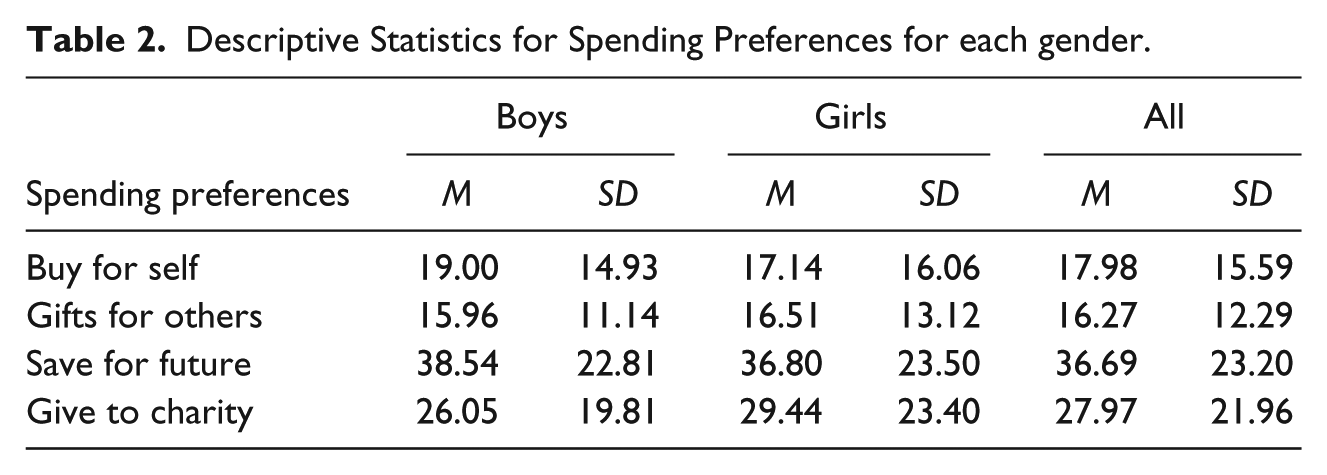
Descriptive statistics for categorical (i.e., types of wish and types of gratitude) and continuous (i.e., spending preferences) variables are provided in Tables 1 and 2, respectively. As mentioned in the “Method” section of this article (Tudge et al., 2018), some percentages for different types of wishes and gratitude add up to more than 100% because some participants provided more than one type of wish and/or gratitude expression.
Descriptive Statistics for Binary Variables Wishes and Gratitude.
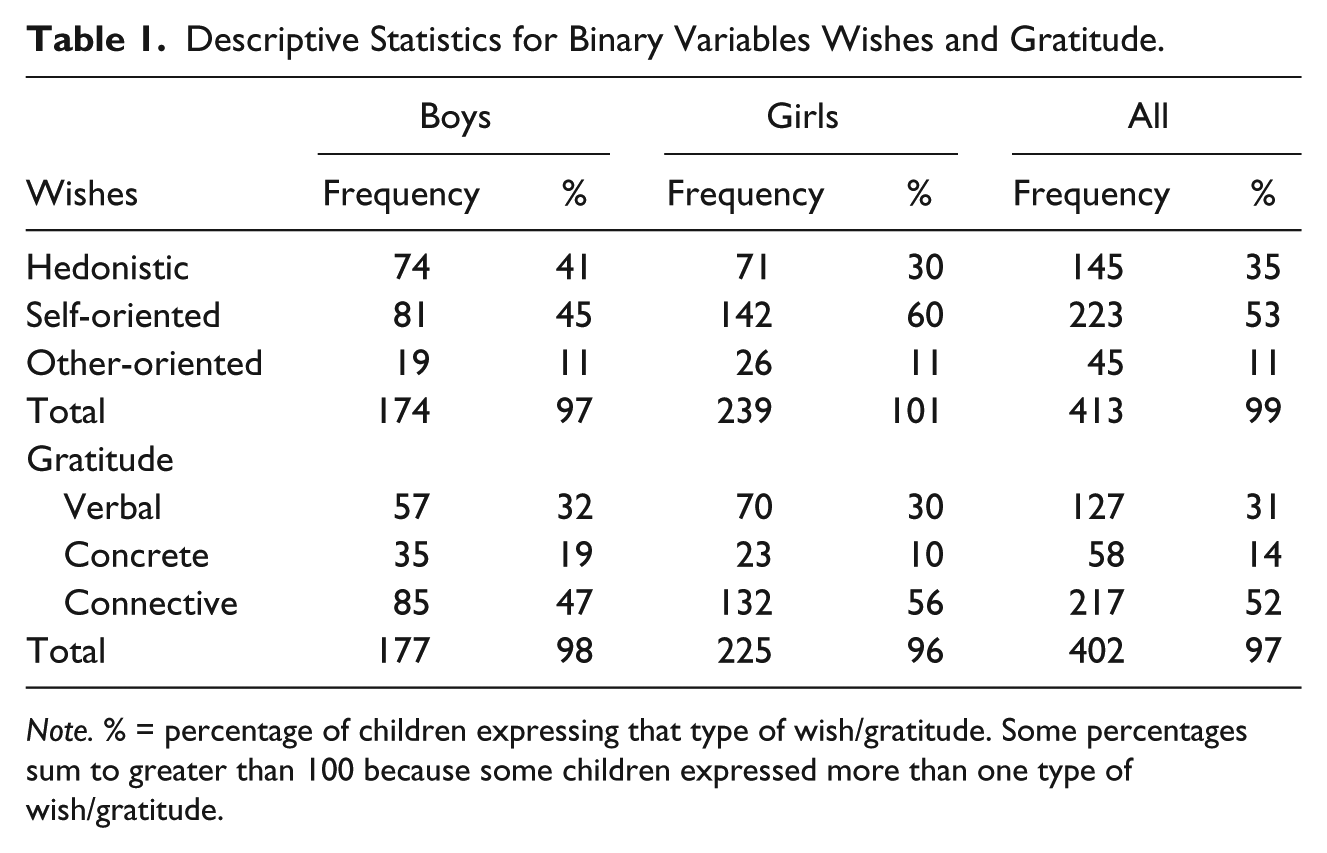
Note. % = percentage of children expressing that type of wish/gratitude. Some percentages sum to greater than 100 because some children expressed more than one type of wish/gratitude.
Descriptive Statistics for Spending Preferences for each gender.
Types of Gratitude
As reported in Table 1, a Cochran’s Q test determined that, overall, there was a statistically significant difference in the proportion of children who provided verbal, concrete, and connective gratitude, χ2(2, N = 417) = 111.85, p < .001. Follow-up McNemar’s tests revealed that the proportion of children who expressed verbal gratitude was larger than the proportion of children who expressed concrete gratitude, χ2(2, N = 417) = 29.83, p < .001, and the proportion of children who expressed connective gratitude was larger than the children who expressed concrete gratitude, χ2(2, N = 417) = 94.20, p < .001.
Types of Wishes
As Table 1 reveals, Cochran’s Q test, which compared the proportions of the three types of wishes yielded a significant result, χ2(2, N = 417) = 127.04, p < .001. Follow-up McNemar’s tests revealed that the proportion of other-oriented wishes was smaller than the proportion of hedonistic wishes, χ2(2, N = 417) = 17.77, p < .001, whose proportion was smaller than the proportion of self-oriented wishes, χ2(2, N = 417) = 55.06, p < .001.
Spending Preferences
Overall, children tended to save (M = 37.71, SD = 1.15) more than they tended to buy things for themselves (M = 18.1, SD = .77), buy gifts for friends or family (M = 16.3, SD = .61), and give to the poor or charity (M = 27.63, SD = 7.09), t(415) = 12.42, p < .001; t(415) = 14.66, p < .001; and t(415) = 4.86, p < .001, respectively. They also tended to donate more than they tended to buy gifts for friends and family, t(415) = 8.68, p < .001, and buy things for themselves, t(415) = 6.58, p < .001. Although they also tended to spend more on buying things for themselves than buying gifts for family and friends, this difference was not statistically significant, t(415) = 1.79, p < .08.
The Relations Between Age, Gender, Wish Type, and the Expression of Gratitude
In our subsequent analyses, we examined whether (a) age, after controlling for gender, would relate to the type of gratitude expressed, and (b) the type of wish children expressed, after controlling for gender and age, would relate to the type of gratitude expressed. To examine these questions, we conducted three sets of binomial logistic regression analyses with verbal, concrete, and connective gratitude as the outcome variables. In each set of analyses, the first model tested the main effects of age and gender on the outcome variable. In the second model, we included wishes (i.e., hedonistic, self-oriented, and other-oriented) as predictors (see Table 3).
Logistic Regression Analyses of Age, Gender, and Wish Type on Types of Gratitude.
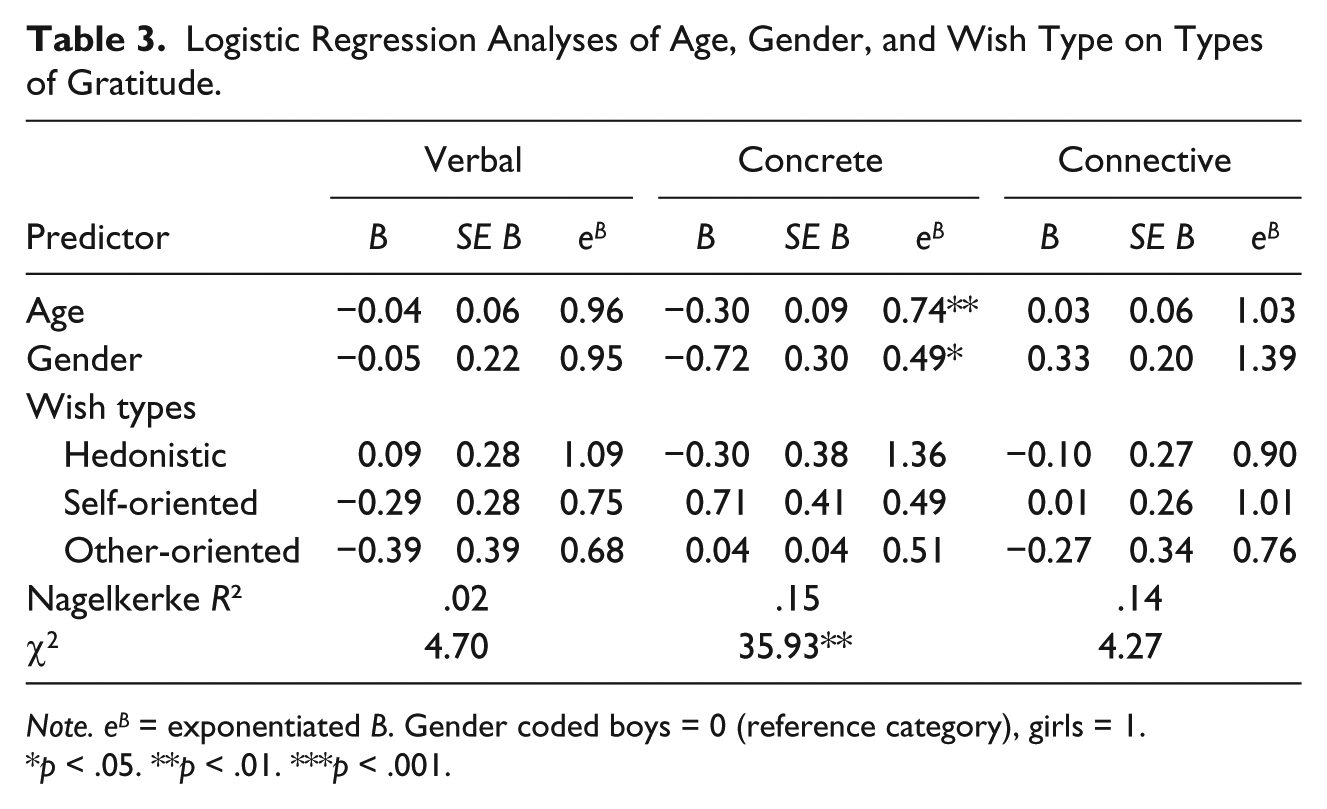
Note. eB = exponentiated B. Gender coded boys = 0 (reference category), girls = 1.
p < .05. **p < .01. ***p < .001.
Main effect of age
The results revealed that age, after controlling for gender, had no effect on the amount of verbal gratitude expressed, as expected. This effect was still insignificant when the three types of wishes were added to the model. As we predicted, with every additional year of age, children were 1.5 times less likely to express concrete gratitude (B = –.37, eB = .69, p < .001). However, this effect was no longer significant when the three wish types were added to the model, which reveals that the effect of age on concrete gratitude might have resulted from the variations in wishes due to age differences. Indeed, controlling for gender, there was a significant decrease in hedonistic wishes (B = –.31, eB = .73, p < .001) and a significant increase in self-oriented wishes with every additional year of age (B = .65, eB = 1.92, p < .01), but no linear relationship was found between age and other-oriented wishes. Contrary to our predictions, there was no relationship between connective gratitude and age.
Main effect of gender
Although not predicted, we found a significant main effect of gender on concrete gratitude after controlling for age, such that girls were 2.33 times less likely to express concrete gratitude compared with boys (B = –.85, eB = .43, p < .01). This effect was still significant after three types of wishes were added to the model (B = –.72, eB = .49, p < .05). There was a significant main effect of gender on hedonistic wishes after controlling for age, such that girls were 1.67 times less likely to express hedonistic wishes compared with boys (B = –.52, eB = .60, p < .05). Girls were also 1.92 times more likely than boys to express self-oriented wishes (B = .65, eB = 1.92, p < .01). There was no effect of gender on the expression of other-oriented wishes.
Relations between types of wishes and gratitude
Contrary to our predictions, there were no relations between the specific types of wishes and gratitude expression. However, the children who expressed self-oriented wishes tended to express less concrete gratitude (B = –.71, eB = .49, p = .079).
The Relations Between Age, Gender, Wish Type, and Spending Preferences
To test the prediction that, after controlling for gender and age, there would be a relation between types of wishes expressed and spending preferences, we conducted several linear regression analyses with each type of spending preference as the dependent variable. In Step 1, age and gender were included as control variables; in Step 2, all wish types were added as additional predictor variables. Results of Step 2 of these analyses are presented in Table 4.
Regression Analyses of Age, Gender, and Wish Type on Spending Preferences.
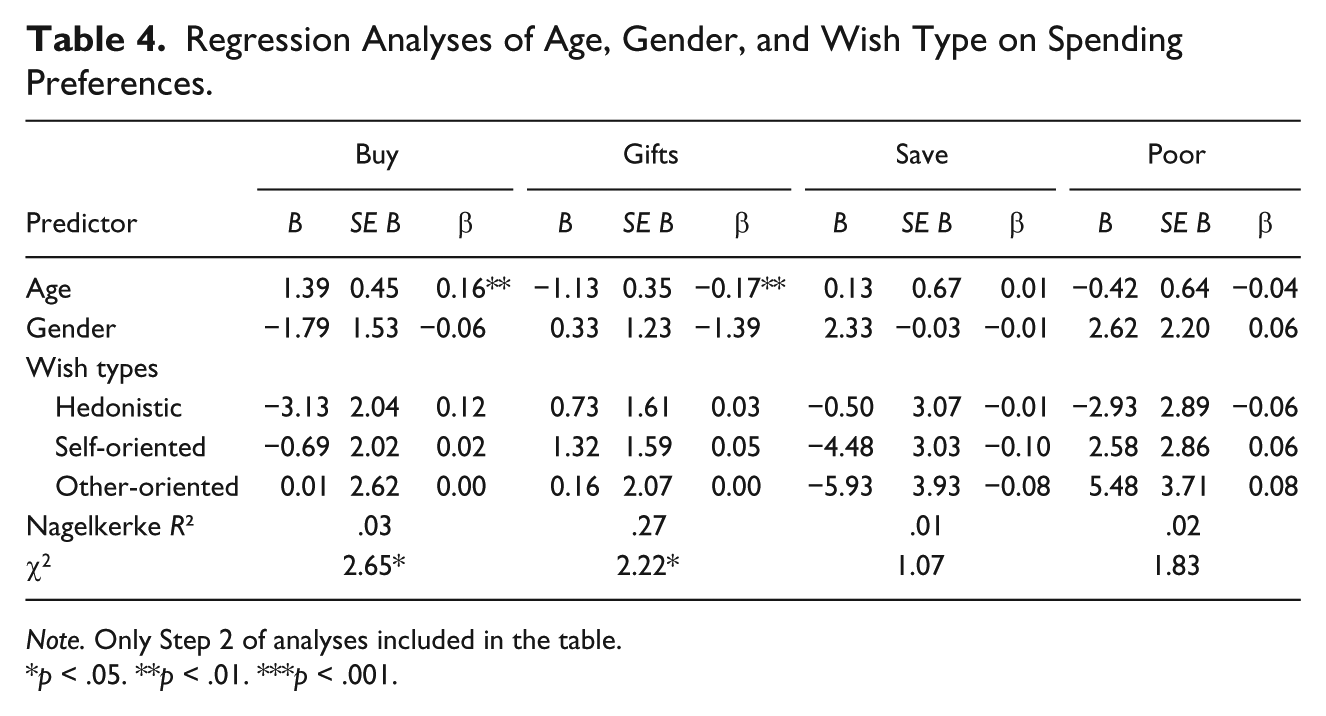
Note. Only Step 2 of analyses included in the table.
p < .05. **p < .01. ***p < .001.
Contrary to our hypothesis, there was no relation between the types of wishes and spending preferences (see Figure 1). Although not predicted, we found a significant effect of age on buying things for oneself and buying gifts for family and friends after controlling for gender. With increased age, children were more likely to report buying things for oneself (β = .14, p < .01). This effect remained significant after the three wish types were added to the model (β = .16, p < .01). However, older children were less likely to buy gifts for friends and family than were younger children (β = –.16, p < .01). This effect remained significant after the addition of the wishes to the model (β = –.17, p < .01). Age did not predict the money saved or the money given to the poor or charity. There was no effect of gender on any spending preferences.
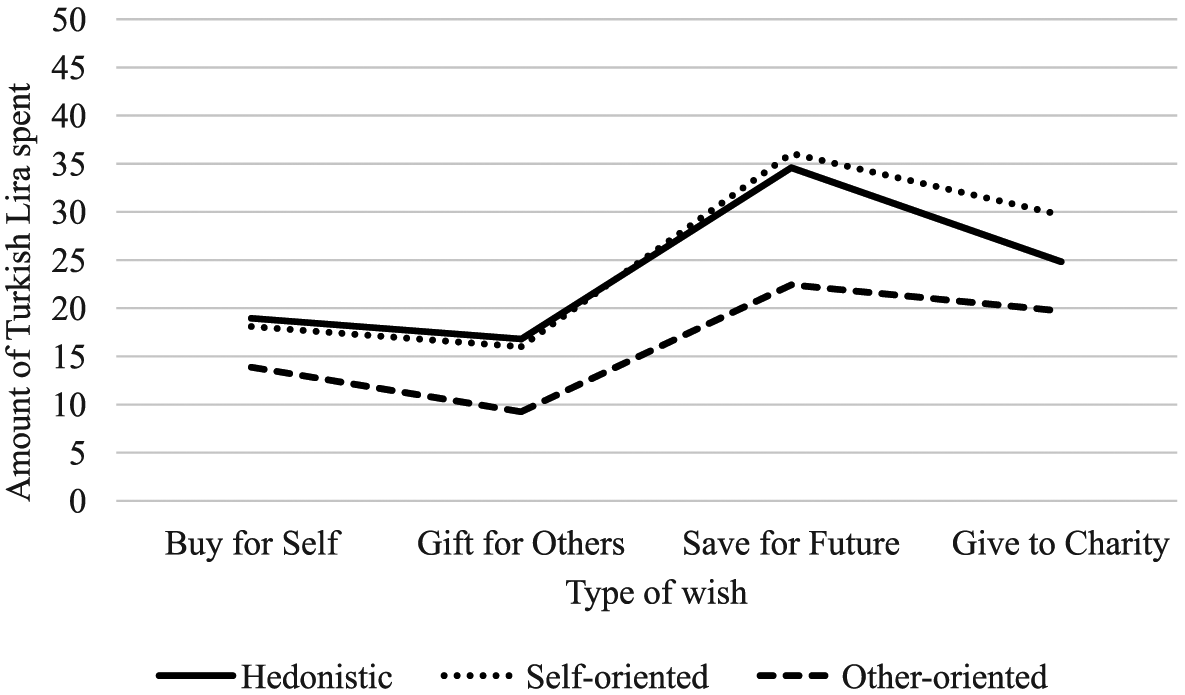
Spending preferences as a function of wish type.
Discussion
Drawing on the conceptualization of cultural values by Kağıtçıbaşı (2007, 2012), we argued that the populations residing in the urban centers of the majority world, such as Izmir in Turkey, are expected to value autonomy and relatedness, which then would be reflected in youth’s expression of gratitude as well as in their wishes and spending preferences. Consistent with our expectations, connective gratitude was the most popular type of gratitude expression, whereas concrete gratitude was the least popular, and the expression of concrete gratitude was less prevalent among older children. However, contrary to our predictions, age was not related to the prevalence of the expression of connective gratitude. On a close examination of the trends within our data, it appears that this null finding was largely driven by Turkish children’s tendency to show high levels of connective gratitude at all ages. This finding underscores the importance of understanding the specific proximal processes, particularly family socialization practices that may contribute to Turkish children’s tendency to express connective gratitude as early as 7 years of age.
Importantly, verbal gratitude was the second most popular expression of gratitude. Consistent with previous research, there was no relation between verbal gratitude and age, suggesting that there were no age-related increases or decreases in the expression of verbal gratitude (Payir et al., 2018). One explanation for this finding is that children may be socialized to express verbal gratitude earlier in development, perhaps before the age of 7, which was the youngest age group in our study. It is possible that verbal gratitude may emerge and increase across early childhood when children are first learning to say “thank you,” but does not change much after around 7 years given that children may already have become proficient in expressing this type of gratitude.
In regard to children’s expression of wishes, self-oriented wishes, wishes related to one’s own academic achievement and future success, were the most common. The high prevalence of such wishes in children and adolescents residing in Izmir is congruent with research suggesting that, in more urbanized and industrialized contexts of Turkey, families prioritize autonomy-linked goals for their children including their individual success and achievement (Kağıtçıbaşı & Ataca, 2005; Sunar & Fisek, 2005). As such, the high prevalence of self-oriented wishes in this urban context of Turkey may be a function of family socialization practices oriented toward children’s achievement and success.
Although hedonistic wishes were expected to be the least popular type of wish, an important proportion of children (35%) expressed these wishes. Thus, it would be important to understand why children who grow up in a sociocultural context that emphasizes relatedness commonly express hedonistic wishes. One possibility is that children who are socialized to be autonomous and to value self-achievement and success may also be socialized to want more material and monetary gains for themselves, such as a nice house or a computer. However, an important limitation of our study was that we did not examine the motivations that underlie children’s expressions of such wishes. For example, some children who reported hedonistic wishes could have the motivation to promote the well-being of others or to pursue more long-term achievement goals. For example, a child may want to buy a larger house to allow his or her younger siblings or grandparents to have their own rooms in his or her house. Alternatively, a child may wish for a computer to learn a new language, a new skill set, or become more successful at school. As such, it would be important to examine the motivation behind the different types of wishes children express in future work.
Regarding the allocation of money across the four spending options for the imaginary windfall, saving and donating to the charity or poor were the most common spending preferences. Age was not related to either of those preferences, suggesting that even younger children preferred to save their money rather than spending it on themselves and that they appreciated donating money to those who may be in need. Surprisingly, older children tended to spend more money on themselves and less money on friends and family than did younger children. This finding may reflect the need for self-related spending with increased autonomy during adolescence, and thus future studies can examine whether this trend reverses as youth move from adolescence to adulthood. An alternative explanation for this finding may be that young children in Turkey may not have real-life experience for having or spending money for their personal needs, whereas this may be common practice for adolescents. As such, given that adolescents may be more used to spending money for themselves, the increases in spending money on self may correspond to the increases in adolescents’ use of money in real life.
Although not hypothesized, gender was related to certain types of gratitude and wishes. Girls were less likely to express concrete gratitude and hedonistic wishes compared with boys. It is possible that girls may be socialized to think less of goods and that their hedonistic wishes may be discouraged more strongly compared with boys. Our findings also indicated that, compared with boys, girls were more likely to express self-oriented wishes related to academic achievement and success. Although nationwide statistics of Turkey suggest that males have higher levels of educational attainment than females, previous work suggested that families in urban contexts of Turkey do not tend to prefer one sex over another and emphasize the importance of education for both girls and boys (see Sunar & Fisek, 2005). As such, girls’ high levels of self-oriented wishes may suggest that girls in urban contexts of Turkey may be socialized to perform well academically and have successful careers. Future research should investigate how family socialization practices may influence children’s expressions related to materialism, gratitude, and wishes, and whether their socialization practices differ for boys and girls (see Halberstadt et al., 2016 and Hussong, Langley, Coffman, Halberstadt, & Costanzo, 2018, for the importance of parents’ socialization of gratitude; Kasser, Ryan, Zax, & Sameroff, 1995, and Kiang, Merçon-Vargas, Mendonça, Payir, & O’Brien, 2018, for parents’ socialization of materialism).
Contrary to our expectations, we did not find relations between specific types of wishes and gratitude. In particular, other-oriented wishes were not related to the expression of connective gratitude, and hedonistic wishes were not related to the expression of concrete gratitude. One explanation for these null findings may be that children who express a particular wish (e.g., hedonistic wishes) may do so for different reasons and therefore such wishes may not necessarily be related to a specific type of gratitude. For example, some children who reported self-oriented wishes, such as getting good grades or becoming a doctor, may wish for these accomplishments to make their parents or grandparents proud and happy, whereas others may want to turn their success into monetary gains for themselves. As such, for some children, self-oriented wishes could relate to or could be expressed with the aim to show connective gratitude, whereas for others, they could relate to concrete gratitude. Likewise, children who express hedonistic wishes such as for money may want to use their money to express connective gratitude toward their grandmother by getting her a gift she likes, whereas others may want to use the money to express concrete gratitude by getting their grandmother something that they themselves would like to get. Therefore, asking children why they would want to pursue a particular wish can help determine whether their explanations would reflect how they would express gratitude.
Likewise, we did not find an association between wishes and spending preferences. Children who expressed hedonistic, self-oriented, and other-oriented wishes did not differ with respect to how they allocate the imaginary windfall money across different spending options. Given that saving was the most popular spending preference regardless of the wish expressed, it is possible that children may have preferred to save money for different reasons. For example, children who expressed hedonistic wishes would have saved to buy stuff for themselves (e.g., cellular phone), those who expressed self-oriented wishes would have saved to invest on their education (e.g., spending on college expenses), whereas those who expressed other-oriented wishes could have saved to spend on others. This may explain why children who express different wishes may share similar spending preferences.
An alternative explanation for these null findings may be related to the measures used. Specifically, we inquired about children’s gratitude and wishes via open-ended questions that yielded categorical/binary variables. Because a major goal of this study was to examine the prevalence of different types of gratitude and wishes across childhood, the use of such open-ended questions was advantageous as they did not necessarily lead children to think about a particular type of gratitude or wish. It is important to note that although these instruments were designed to assess whether or not children expressed a certain type of gratitude or wish, they did not assess the extent to which children expressed these wishes or gratitude. As such, these instruments allowed us to examine group differences in spending preferences across children who reported expressing different types of wishes (e.g., self-oriented vs. hedonistic) or gratitude (e.g., connective vs. concrete), but they did not allow us to examine whether variations in how much children expressed certain types of gratitude or wishes predicted how they preferred to spend their money. To examine whether variations in the expressions of certain types of gratitude or wishes relate to certain spending preferences, it would be necessary to measure these constructs via instruments (e.g., rating scales) that could yield such information. On a similar note, our instruments were designed to acquire children’s responses on what they themselves would do and thus may introduce bias if children respond based on what is socially desirable. To address such potential biases, future research can also utilize measurement tools including caregiver or teacher reports, or child-report instruments with vignettes that prompt children to report on what another child (e.g., a friend) should do in hypothetical situations.
In conclusion, this is the first study to examine how children from an urban center in Turkey express their gratitude, whether their expressions of gratitude differ by age and gender, and whether and how their pattern of wishes, spending preferences, and expressions of gratitude are associated. Some limitations include using a cross-sectional design rather than a longitudinal one and recruiting participants from a single city. Future studies are needed to understand whether children from rural regions or other urban centers of Turkey show the same pattern of preferences as children from Izmir, and whether the findings of this study can be replicated using longitudinal designs.
Footnotes
Acknowledgements
We would like to express our deepest gratitude to Dr. Sezen Zeytinoglu for recruiting and supervising our research assistants, and mediating our communication with the school principals and teachers. We are also grateful for the contributions of our research assistants Cansu Şen, Ceren Gülbiçen, Dilan Üzgün, Dilara Özsoy, Duygu Şen, Emine Çoraklıoğlu, Emrehan Küçük, Fatma Sönmez, Naide Saracık, Selen Doğan, and Yağmur Gökşen.
Declaration of Conflicting Interests
The author(s) declared no potential conflicts of interest with respect to the research, authorship, and/or publication of this article.
Funding
The author(s) disclosed receipt of the following financial support for the research, authorship, and/or publication of this article: Support for the writing of this paper and for the data collected was generously provided by the John Templeton Foundation (Grant # 43510 to Jonathan Tudge, PI).