



Abstract
This study aimed to examine children’s expression of gratitude in Brazil, China, Guatemala, Russia, South Korea, Turkey, and the United States. Participants (N = 2,265) consisted of 7- to 14-year-olds (M = 10.56, SD = 2.09; 54.4% girls). Using hierarchical cluster analysis, we found four clusters of gratitude expression: (a) Russia and Turkey (moderate–high expression of connective, low concrete, and moderate verbal gratitude), (b) Brazil and the United States (low connective, higher rates of concrete, and moderate–high rates of verbal gratitude), (c) China and South Korea (higher rates of connective, lower concrete, and lower–moderate verbal gratitude), and (d) Guatemala (lower rates of concrete and connective gratitude, and higher rates of verbal gratitude). In addition, we found common trends in age-related differences for verbal and concrete gratitude among most societies. These findings support the argument for diligence in avoiding implicit generalizations based on research conducted mostly in Western Educated Industrialized Rich Democratic (WEIRD) societies.
Gratitude’s positive association with overall well-being and a plethora of its beneficial effects have inspired research over the last two decades, and some scholars have become interested in its development (McCullough, Emmons, & Tsang, 2002; Tudge, Freitas, & O’Brien, 2015). Considering gratitude as a virtue, operationalized as how beneficiaries express their gratitude and may reciprocate to benefactors, could provide insight into its evolution. However, as pointed out in Merçon-Vargas, Poelker, and Tudge (2018), an important shortcoming of gratitude research (as is true for over 90% of published research in psychology) is its implicit assumption that findings, based primarily on North American participants (mostly European Americans), are generalizable to populations outside of North America (Arnett, 2008; Henrich, Heine, & Norenzayan, 2010; Tudge & Freitas, 2012). Culturally sensitive studies are conducted, but, unfortunately, they are still far from the norm, suggesting a critical need to address this issue (Nielsen, Haun, Kärtner, & Legare, 2017).
The most common framework used to address cultural variations, the binary division between individualism and collectivism, contributes to the simplification of cultural differences, hampering a more culturally sensitive approach. Scholars with an interest in cultural diversity have moved beyond this oversimplified concept, yet in many influential development journals, this is still the exception to the rule (Nielsen et al., 2017). For example, if considered at all, countries such as Brazil, China, Guatemala, Russia, South Korea, and Turkey are grouped together as collectivistic cultures (Guatemala is the most collectivistic country) and are then contrasted with the United States. This is especially problematic because this approach likely maximizes between-country differences (Bornstein, Tal, & Tamis-LeMonda, 1991). In the studies presented in this special issue, as was discussed in Merçon-Vargas et al. (2018), we chose to use Kağıtçıbaşı’s (2007) framework. It is particularly useful when considering the seven societies examined here as explained below.
By suggesting two additional dimensions, Kağıtçıbaşı’s (2007) perspective moves beyond a binary division, allowing for greater cultural variability. Briefly, Kağıtçıbaşı’s two dimensions are agency (ranging from autonomy to heteronomy) and interpersonal distance (ranging from relatedness to separation). However, although Kağıtçıbaşı herself emphasized the importance of considering cultural differences on a continuous dimension, she proposed “prototypes” of cultural values. For example, the United States is considered to be in the autonomy-separate quadrant based on the stereotypical assumption that Americans promote values of individual achievement and success over others in the group. Typically, more collectivistic societies may be thought to fit into the heteronomous-related quadrant, but research demonstrates a shift in traditional societies as people move to urban centers for more opportunities and education (Kağıtçıbaşı & Ataca, 2005). With a move to a more competitive urban market, there is a tendency to value both autonomy and relatedness. For example, individual academic success may become more important, but a feeling of being related to the group is still highly valued. As such, there is indeed evidence that autonomous-related values are predominant in urban-educated groups in Brazil, China, Turkey, and Russia (e.g., Kağıtçıbaşı, 2007; Keller, 2007; Koh, Shao, & Wang, 2009; Seidl-de-Moura et al., 2008; Seidl-de-Moura et al., 2013; Tudge, Hogan, Snezhkova, Kulakova, & Etz, 2000). However, does this mean that these cultures raise children in the same way? We believe that this is unlikely.
As suggested by Keller and colleagues (2006), the idea of a cultural model representing autonomous-related values does not mean that there are no differences among cultural groups that are ascribed to the same “cultural model.” Even though societies may share a common broad cultural orientation (linked to “related” values, for example), the manifestation of these values may vary according to different demands across contexts (Keller, 2007; Tamis-LeMonda et al., 2008). Thus, we believe that cultural specificities cannot be overlooked. To examine variations among countries that could potentially share similar cultural models, we chose urban areas in Brazil, China, Russia, South Korea, and Turkey as representative of autonomous-related cultures, and the United States as representative of an autonomous-separate culture. Although the Guatemalan sample was recruited from a school situated in a rural area, they lived within 40 miles of the capital city, and their parents were highly educated. Thus, according to Kağitçibaşi’s framework, the Guatemalan participants are more similar to their peers living in urban environments than those in rural areas.
We aimed to examine similarities and differences in how children across these seven societies express gratitude. In this case, the expression of gratitude acts as a proxy for how children may act when responding to a benefactor for a gift or favor received. Of course, there is no way to know whether this is how children would act, but this allows us to begin to understand the development of gratitude as a virtue.
To accomplish our goal, we used hierarchical cluster analysis (HCA) using frequencies of each gratitude type to establish groupings of countries. We then followed up with logistic regression analyses comparing each society to all others to further explore significant differences. Given that our focus in this article is on the expression of gratitude, and our desire to conduct a more in-depth analysis of cross-society variation in this expression, we have left discussion of the imaginary windfall data to the other articles in this special issue. Overall, we believe that our study demonstrates the importance of approaching the development of gratitude from a cross-cultural perspective in a sensitive manner, acknowledging cultural variations beyond a comparison of cultures deemed to be opposites.
Conceptualization of Gratitude and Theoretical Framework
As posited by Merçon-Vargas et al. (2018), we conceptualize gratitude as a virtue that must be learned. The everyday interactions in which children engage with others, particularly parents, but also teachers and friends, are central to their development (Annas, 2011; Tudge, 2008). However, those interactions are influenced by the sociocultural contexts in which those interactions occur, and the prevailing values expressed in those contexts.
The values predominant in a given society are especially important when considering the importance of reciprocation to the definition of gratitude as a virtue because the type of reciprocation implied by those who express connective gratitude involves both autonomy and feeling connected to others (Tudge, Freitas, Mokrova, Wang, & O’Brien, 2015). As discussed by Tudge and colleagues (Merçon-Vargas et al., 2018; Tudge & Freitas, 2018; Tudge et al., 2015), verbal gratitude involves no reciprocation and may simply be a polite response to gaining something. Concrete gratitude involves reciprocation but of something of interest to the beneficiary rather than to the benefactor. Gratitude as a virtue is only found when the beneficiary (a) freely takes on an obligation to reciprocate (autonomously) to a benefactor, rather than doing so because of following a rule or being required to by others (heteronomy) and (b) reciprocates with something intended to benefit the benefactor. Connective gratitude is the closest to being a virtue, although it is best thought of as being a necessary (but by no means a sufficient) condition; to be virtuously grateful would require that one acts on this expression on a regular basis.
Connective gratitude, then, creates a cycle of reciprocation, which involves a feeling of relatedness. Given that societies are likely to value autonomy–heteronomy and relatedness–separateness to different degrees, they are also likely to express different amounts of verbal (e.g., saying thank you), concrete (reciprocity without taking benefactors’ needs and desires into account), and connective gratitude (reciprocity that does take benefactors’ needs and desires into account).
Besides cultural influences, gratitude as a virtue also requires some specific sociocognitive abilities, such as perspective taking and future thinking (Nelson et al., 2013). Previous research conducted in Switzerland (Baumgarten-Tramer, 1938), and replicated in Brazil (Freitas, Pieta, & Tudge, 2011) and the United States (Tudge et al., 2015) revealed some similarities across the samples supporting evidence for the necessity of these abilities. There were no age-related differences in the expression of verbal gratitude; however, younger children were more likely than older ones to express “concrete gratitude,” whereas older children were more likely to employ “connective gratitude.”
Based on these findings, and as discussed by Tudge, Freitas, O’Brien, and Mokrova (2018), our hypothesis was that age-related differences in the expression of gratitude may be comparable across countries. That is, we expected that older children across societies would be less likely to express concrete gratitude than would younger children (given the more egocentric nature of this type of gratitude). In contrast, we expected that older children in all societies would be more likely to express connective gratitude (which involves perspective taking) than would younger children. Based on Baumgarten-Tramer’s (1938) lack of findings of age differences for verbal gratitude, we did not hypothesize age-related differences for this type of gratitude, although some studies indicate that verbal gratitude may be expressed at different rates in different societies (e.g., Freitas et al., 2011; Tudge et al., 2015). We also expected that the extent to which different types of gratitude are expressed would vary across some societies but may be also similar between societies with similar core values (e.g., Confucianist values found in some Asian cultures).
The Present Study
Participants
The participants (N = 2,265) in our study were 7- to 14-year-olds recruited from elementary and middle schools in Brazil, China, Guatemala, Russia, South Korea, Turkey, and the United States (M = 10.56, SD = 2.09; 54.4% girls). Full descriptions of the participants and the cities from which we recruited them can be found in the previous articles of this special issue.
Measures
The measures used in this study were discussed in more detail by Tudge et al. (2018). Briefly, participants completed The Wishes and Gratitude Survey (WAGS: Freitas, Tudge, & McConnell, 2008; adapted from Baumgarten-Tramer, 1938). Two questions were of primary interest on the WAGS: “What is your greatest wish?” (answers coded as hedonistic, self-oriented, or social-oriented) and “What would you do for the person who granted you that wish?” (answers coded as verbal, concrete, or connective).
Analytical Procedures
We conducted an HCA in SPSS (Version 24) using Ward’s method to minimize the variance within groups relative to the variance between groups. Squared Euclidean distance was used to explore which countries are closest together based on the frequencies of each country’s gratitude expression (verbal, concrete, and connective). We used frequencies of each gratitude type across societies as independent variables. HCA grouped the countries that were closest to each other based on those frequencies. That is, clusters were created based on each country’s combination of three types of gratitude (verbal, concrete, and connective). As a follow-up, we conducted logistic regression analyses with each society compared with each of the other societies to assess significant differences for the three types of gratitude, controlling for age, gender, and wish types. Results were considered significant if p < .007 (based on Bonferroni p value adjustment for multiple testing). Finally, we used the results presented in the other articles of this special issue to discuss similarities and differences in the associations between wishes and age with types of gratitude.
Results
Gratitude Expression
Figure 1 shows the dendrogram for the HCA of gratitude expression. HCA allows us to demonstrate general groupings. From the dendrogram, we see that based on the distances separating countries, the HCA identified a total of four clusters: (a) The first cluster included children from Russia and Turkey, with a moderate–high expression of connective gratitude (around 52% in both countries), low concrete gratitude (around 14% in both countries), and moderate–high verbal gratitude (between 31% and 39%). (b) The second cluster included children from Brazil and the United States with a relatively lower rate of connective gratitude (between 36% and 38.6%), higher rate of concrete gratitude (between 25.5% and 33.9%), and moderate–high rates of verbal gratitude (between 33.4% and 46%). (c) The third cluster included children from China and South Korea, representing societies in which children expressed relatively higher rates of connective gratitude (57.5%-69.8%), lower rates of concrete gratitude (15.6%-17.6%), and lower–moderate rates of verbal gratitude (11.8% for South Korea and 26.5% for China). (d) The final cluster was composed of Guatemalan children, showing relatively lower rates of concrete (10.6%) and connective gratitude (40.8%), and higher rates of verbal gratitude (70.2%). Figure 2 displays a three-dimensional scatter plot with the frequencies of gratitude types. The use of three dimensions allows for a visual representation of where each country fits on the X- and Y-axis with concrete and collective gratitude, but with the added benefit of demonstrating verbal gratitude using the size of the circle as representative of the frequency of verbal gratitude.
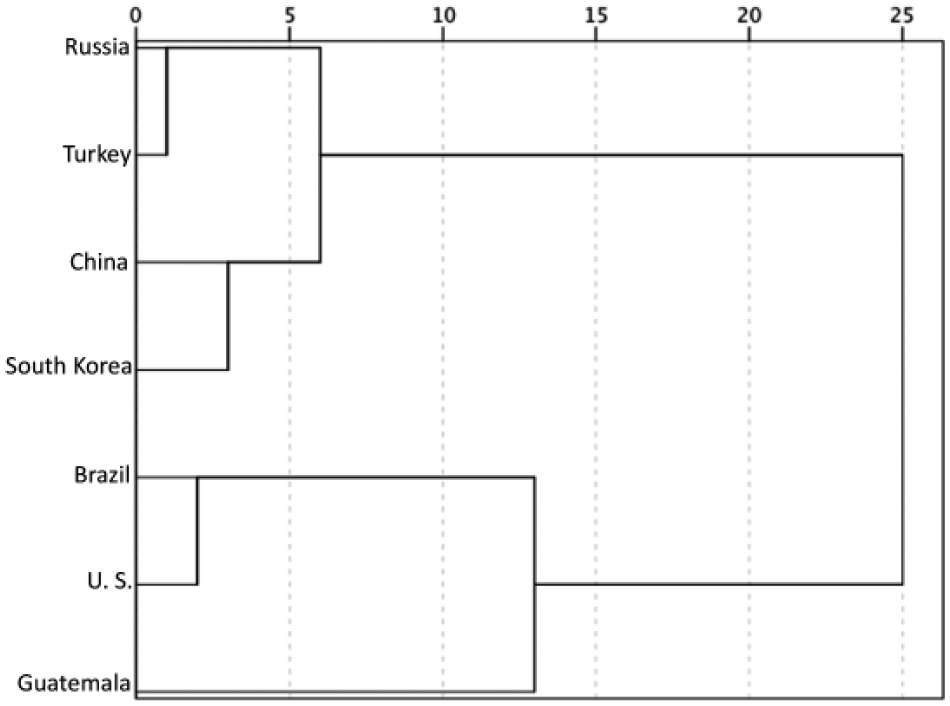
Dendrogram of the hierarchical cluster analysis for gratitude types across societies. Country clusters are based on the respective frequencies of each country’s gratitude expression (verbal, concrete, and connective). Each type of gratitude expression was entered as a separate variable.
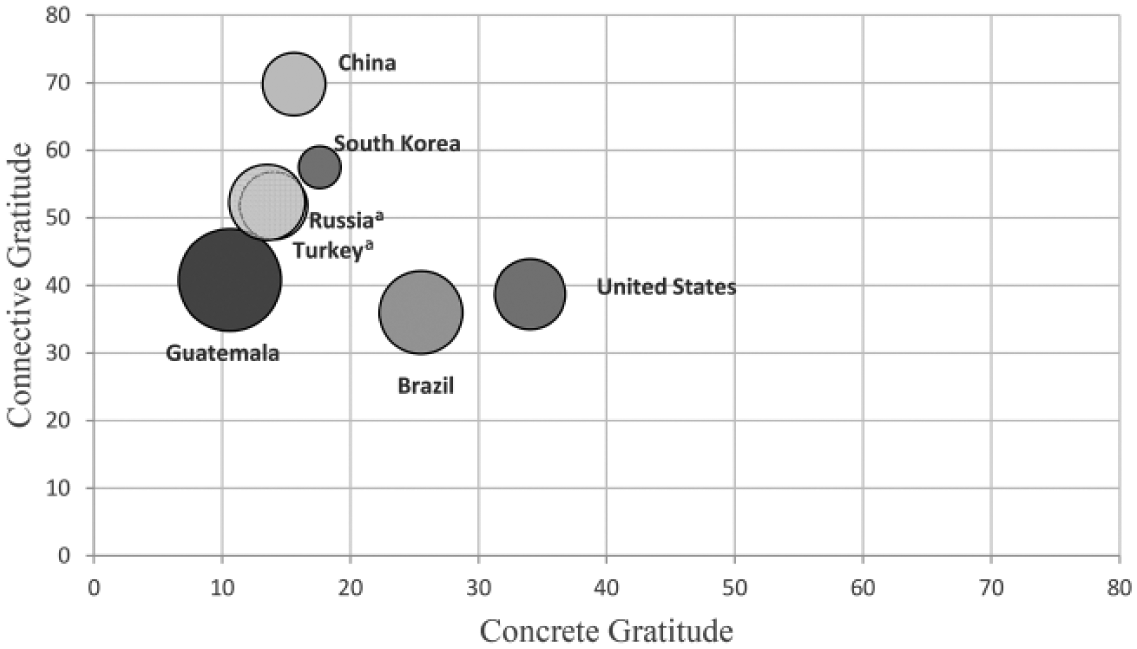
Percentage of concrete, connective, and verbal gratitude by country.
Because many comparisons of the three types of gratitude across societies were significant, the results will not be extensively discussed here but are summarized in Table 1. Considering the HCA results, Table 1 is not surprising. However, it is worth noting that even societies that clustered together significantly differed from one another in certain types of gratitude, and societies not clustered together may not have differed with respect to all types of gratitude. For example, Guatemalan children were more likely to express verbal gratitude than were children in all other societies, but the likelihood of expressing concrete gratitude was only significantly different from the United States. For connective gratitude, children from Guatemala differed significantly from children from China, South Korea, and Turkey, but not from Brazil, Russia, and the United States.
Exponentiated b for Logistic Regression Comparing Gratitude Types Across Societies.

Note. All eB displayed have significance level p < .007 (Bonferroni adjusted). Societies in the vertical column are the reference group (e.g., compared with Brazilians, Guatemalan children expressed 2.8 times more verbal gratitude). NS = nonsignificant.
Even though there seem to be some unique patterns of gratitude expression, we also see similar trends among some countries—the most striking similarity, perhaps, is that Turkish and Russian children expressed very similar rates of concrete and connective gratitude. Also, for the cluster including Brazilian and North American children, participants only differed significantly in the extent to which they expressed verbal gratitude. Finally, for the Asian cluster (China and South Korea), children differed significantly in the extent to which they expressed verbal and connective gratitude; it seems, however, that these significant differences are not strong enough to separate these countries into different clusters.
Age-Related Differences in Gratitude and Associations Between Wishes and Gratitude
Age-related differences
Table 2 summarizes the results from the seven articles of this special issue regarding the associations between age and wish types with gratitude types. Other than Brazil, age had no relation to verbal gratitude across societies. That is, children of all ages expressed verbal gratitude at similar rates in most societies. In addition, older children in five societies were less likely to express concrete gratitude than were younger children; this was not true for children in Guatemala and China. However, it is important to note that the rates for concrete gratitude in these two societies were very low (10.6% and 15.5%, respectively). Therefore, perhaps there was not sufficient statistical power to capture age-related differences. Last, older children in four societies (the United States, China, and Russia) were more likely to express connective gratitude than were younger children. This trend was not significant in Brazil, South Korea, or Turkey.
Associations Between Types of Gratitude and Age and Wishes Across Societies.
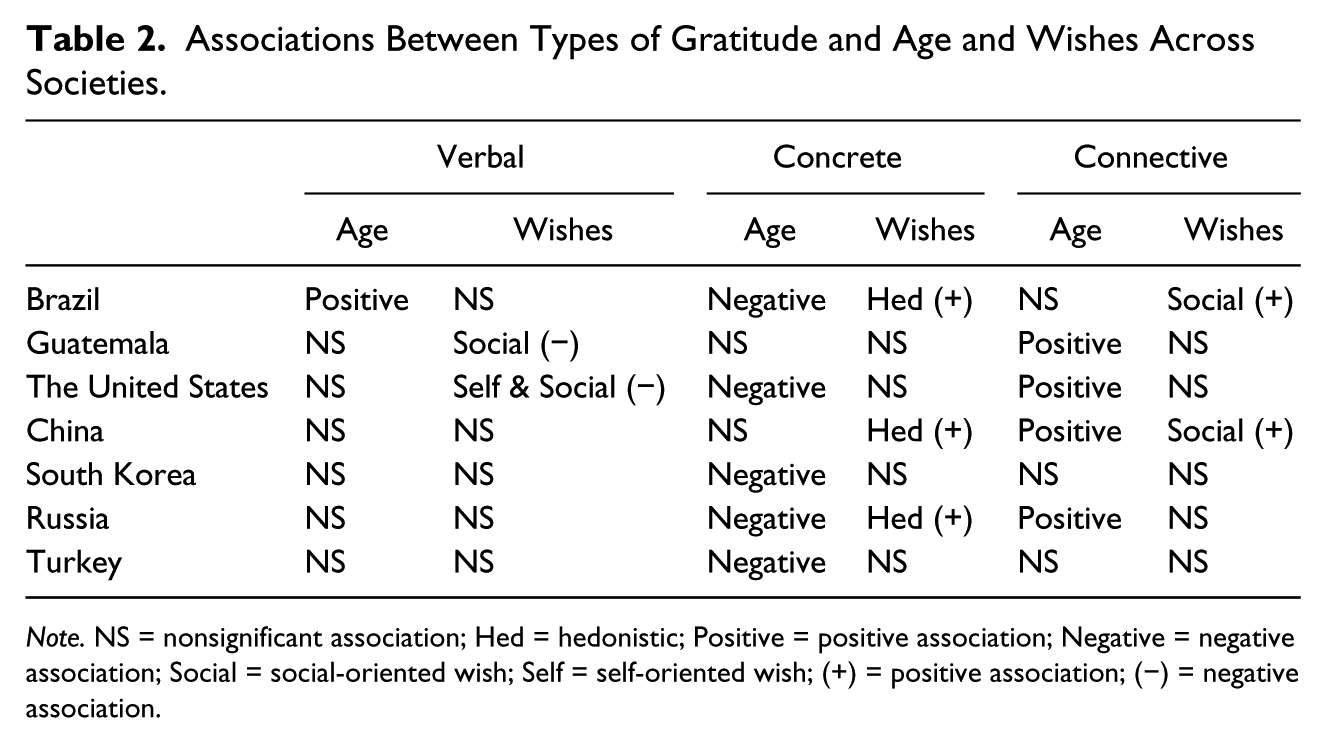
Note. NS = nonsignificant association; Hed = hedonistic; Positive = positive association; Negative = negative association; Social = social-oriented wish; Self = self-oriented wish; (+) = positive association; (−) = negative association.
Wishes
Regarding associations between gratitude and wishes across societies, there were some commonalities. For instance, for both Guatemala and the United States, social-oriented wishes were negatively related to verbal gratitude. For the United States only, verbal gratitude was also negatively related to self-oriented wishes. Moreover, for three societies—Brazil, China, and Russia—there was a positive association between hedonistic wishes and concrete gratitude. Last, for Brazil and China, social-oriented wishes were positively associated with connective gratitude.
Discussion
The present study tested the extent to which different types of gratitude expression varied across seven societies and whether age-related patterns of gratitude expression were similar across societies. In this case, the different types of gratitude are thought to represent how children may possibly reciprocate to a benefactor after receiving a gift or act of kindness; concrete gratitude does not take the benefactor’s wishes into account, but connective gratitude does. As expected, we found that the extent to which different types of gratitude were expressed varied across societies; children in the two Asian cultures were more likely to express connective gratitude (with Chinese children showing the highest rate), followed by children in the two Eastern European countries (Russia and Turkey). In contrast, children in the Americas (the United States, Guatemala, and Brazil) were less likely to express connective gratitude. Regarding concrete gratitude, children in the United States expressed the highest rate of this type of gratitude, which was significantly different from children in all other countries (except Brazil). Moreover, Guatemalan children were the most likely to express gratitude verbally, followed by Brazilian children.
The predominance of the use of verbal gratitude in Guatemala may be partially explained by the prevalence of the practice of saying “Gracias a dios” or “Thanks be to God” in everyday speech. Even when casually inquiring about one’s well-being when greeting a friend, the answer given by the friend is often “fine, thanks be to God.” This same expression “Graças a Deus” is used in Portuguese in Brazil, although perhaps not with the same regularity, and thus it is not surprising that Brazilian children demonstrated the second highest rate of verbal gratitude. It is probable that Guatemalan and Brazilian children have had this behavior modeled for them since they were young and likely have adopted the behavior themselves.
We also found some similarities for age-related differences in gratitude. As demonstrated in Table 2, our results indicated that for each additional year, there were lower rates of concrete gratitude in most societies (in-depth analysis can be found in individual country articles in this special issue). Older children tended to express more connective gratitude in three societies (the United States, China, and Russia), and verbal gratitude was not related to age in most countries. This shows at least a strong tendency to move beyond the most egocentric form of gratitude (concrete gratitude) among older children. Further research should examine what may lie behind the differences and similarities we found with expression of gratitude across societies to understand better its development.
Children’s expression of gratitude is a likely indicator of how they will reciprocate to a benefactor after they receive an act of kindness. As previously mentioned, we consider an expression of connective gratitude the closest to a virtue because it takes the wishes and desires of the benefactor into account when contemplating how to reciprocate. Therefore, it is important to look at the cultural reasons for why connective gratitude may be more prevalent in certain societies, but not in others. When examining possible cultural influences for the variations we found, it is important to remember that children learn normative values from interactions with adults and peers (Merçon-Vargas et al., 2018; Tudge et al., 2015). Examining the typical activities and interactions in which the children engage in their daily lives may provide a different picture. For example, considering common school activities in different countries may be informative.
Many children in all these cultures spend much of their day in school classrooms, and the activities that are part of their curriculum will likely affect their behavior, including their expression of gratitude. For instance, one common activity in elementary school classrooms in countries like the United States and Brazil is for children to make craft gifts for their parents at holidays (Cox, 2016). This may explain their tendency to use gifts—an example of concrete gratitude—as a way to demonstrate love and gratitude, as suggested by Visser (2008). Although initially children are likely only making the gifts following teacher instructions, with time and experience, they may choose to make gifts on their own or look forward to the opportunity to make gifts for their parents and close others.
In Chinese and South Korean cultures, elementary schools are more focused on academic work, and children may not have the same craft-making experience. Thus, it may be that a different way of showing gratitude, honoring the benefactor, is more prevalent in these countries (Visser, 2008). This is in line with the Confucian teaching of honoring others, particularly one’s parents and other elders. Research has suggested that children of Chinese immigrants who feel more grateful to their mothers demonstrate more filial piety (Shen, Kim, Wang, & Chao, 2014). Honoring the benefactor may lead to more connective gratitude than concrete gratitude. Clearly, without further research, this is mere speculation. However, we need to understand how different cultural values affect the development of gratitude while avoiding the assumption that gratitude-related practices common in one society are anything other than society-specific practices.
One crucial area of research going forward will be examining parents’ values and how they affect children’s gratitude development. More specifically, examining Schwartz’s Portrait Value Questionnaire filled out by parents who are asked to consider what values they want their children to have as adults may provide insight into which parental values may be more likely to lead to the development of gratitude as a virtue (Schwartz et al., 2012). For example, whether parents choose values that situate them in the bipolar dimension of self-enhancement versus self-transcendence along with conservation would be of particular use. Among other values, self-enhancement includes power dominance and power resources, which is in contrast to self-transcendence, which includes benevolence and care and conservation with tradition and conformity to rules. Considering the importance of first reciprocating to a benefactor, and, second, taking the benefactor’s needs and wishes into account, some of the values included in self-transcendence and conservation will likely play an important role in gratitude development.
Despite the contributions of this article to the study of gratitude, there are several limitations that should be addressed in future research. Even though we collected data from seven different countries, we only collected data in one or two cities in each society. It would be misguided to assume that similar results would be found in other areas of these countries; regional differences are likely, given the vast sociocultural and economic within-country diversity. Moreover, by using open-ended responses in the WAGS, there is always the chance that understanding may be different across the different languages used in the study. Our multinational research team worked assiduously to manage measurement equivalence issues, but the possibility for misunderstanding still remains.
Overall, our findings support the argument for diligence in avoiding implicit generalizations based on research conducted on a specific part of the world (mostly in WEIRD societies). Although scholars may not make these sorts of inferences explicitly, as Arnett (2008) noted, they routinely describe “adults” or “youths” or “children” as though these adults, youths, or children were not from a specific cultural context. In our study, children and adolescents were found to express verbal, concrete, and connective gratitude in all societies examined, albeit with frequencies varying by country and sometimes age. Therefore, a cultural frame is necessary to avoid overgeneralization and to acknowledge that context is important in understanding development.
Footnotes
Acknowledgements
We would also like to thank the children, families, and schools who participated in this research, and the students who helped with the collection, entry, cleaning, and coding of the data.
Declaration of Conflicting Interests
The author(s) declared no potential conflicts of interest with respect to the research, authorship, and/or publication of this article.
Funding
The author(s) disclosed receipt of the following financial support for the research, authorship, and/or publication of this article: This research was supported by a generous grant from the John Templeton Foundation awarded to PI Jonathan Tudge, and co-PIs Lia Freitas and Lisa Kiang.