




Abstract
National innovativeness is one key driver of economic development. The relation of national innovativeness and national culture has been firmly established by research. Cultural factors, however, influence national innovativeness via different mechanisms on the macro-, meso-, and micro-level of a country. In our article, we build on existing research on the link between cultural dimensions and national innovativeness to develop a new model that classifies different cultural dimensions in groups according to their mechanism: political, social, or individual (PSI-model). Using a newly established data set composed of world data, we test and find support for this model using a variety of regression models. The PSI-model provides a more structured theoretical background of the impact of different cultural dimensions on national innovativeness, especially with regard to social practices and social values. It can be used to generate policy recommendations on national innovativeness and offers further applications in fields related to the various impacts of national culture.
Introduction
The discussion about a link between innovation and economic performance characterizes management literature as well as economic theory for several decades (J. Freeman, 1996; C. Freeman, 2002; Porter, 1990; Verspagen, 2006). The new growth theory of economics attributes a substantial amount of economic growth to technological change caused either directly by investments in research and development (R&D) or indirectly by spillover effects (Helpman, 2004), notwithstanding intermittent slowdowns in growth caused by creative destruction as proposed by Schumpeter (2006, 2008). Hence, the introduction of a new production function or a new combination of production factors seems to have a bigger impact on economic growth than the accumulation of capital. Innovation therewith can be understood as one important driving force of economic development, as it fosters competitiveness, productivity, and the creation of new jobs (Organisation for Economic Co-operation and Development [OECD], 2013). Moreover, the prosperity as well as quality and standard of life of consumers is improved by innovation activities (Ahlstrom, 2010). This is an important issue as gross domestic spending on R&D varies widely between countries (OECD, 2018), and R&D activities are highly concentrated on industrial nations (Helpman, 2004).
If innovation propensity has such a big impact on economic growth and the wealth of nations, we need to better understand which factors affect the innovativeness of nations. Our main hypothesis is that national culture is one of these factors. This is in line with the historical analysis of Landes (2002) who states that, with regard to economic development, “culture makes all the difference” (p. 516) as it influences the creation and dissemination of knowledge in a country. Nonetheless, there are different dimensions of culture that seem to have a very distinct influence on innovativeness via different “channels” within the society and the political system of a country. Previous studies fail to group these different cultural dimensions according to their influence on the macro-, meso-, or micro-level.
Hence, our article explores the impacts of culture, as expressed through different cultural dimensions that influence political institutions, societal norms, and individual behavior, on national innovativeness theoretically and empirically.
The following contributions will derive from our work. First, our newly developed model exceeds existing research approaches as it allows for different paths in which cultural dimensions can impact national innovativeness, and explicitly takes differences between values and practices into consideration where necessary. This is particularly relevant with regard to the cultural dimensions of the Global Leadership and Organizational Behavior Effectiveness (GLOBE) Study, in which values and practices are distinguished for each cultural dimension. Second, based on a new data set, we provide empirical evidence about the effective direction of different cultural dimensions on national innovativeness. Finally, we argue that our findings about the effects of cultural dimensions on national innovativeness lead to not only new insights for national innovation policies, but also for intercultural cooperation in R&D.
The article proceeds as follows: First, we define and distinguish innovation and innovativeness. As our article focuses on national innovativeness, we use a national innovation index as a criterion for measurement. After a description of cultural dimensions and a literature review, we present our newly developed PSI-model that classifies different cultural dimensions in groups (political, social, and individual) and provides a theoretical background of the impact of different cultural dimensions on national innovativeness. After presenting our results, we discuss possible further applications of the model in research and practice.
Innovation and Innovativeness
Innovation is defined by the third edition of the Oslo Manual of the OECD (2005, p. 49) as “the implementation of a new or significantly improved product (good or service), or process, a new marketing method, or a new organisational method in business practices, workplace organisation or external relations.” A narrower definition of technological innovation only comprising products and processes can be found in the first edition of the Oslo Manual (Gault, 2014). Processes of invention, product development, and introduction (commercialization or implementation) are parts of the innovation process as “a process that begins with a novel idea and concludes with market introduction” (J. Freeman & Engel, 2007, p. 94).
The term innovativeness has a distinct meaning from the term innovation. There are two ways of defining the term innovativeness. The first type of definition is related to the adoption of new ideas in a social system and distinguishes between actualized and innate innovativeness (Midgley, & Dowling, 1978). Actualized innovativeness—also called consumer innovativeness (Dobre, Dragomir, & Preda, 2009; Goldsmith & Foxall, 2003)—refers to the definition of innovativeness by Rogers (2003, p. 267) as “the degree to which an individual (or other unit of adoption) is relatively earlier in adopting new ideas than the other members of a system.” Innate innovativeness can be defined as “the degree to which an individual makes innovation decisions independently of the communicated experience of others” (Midgley, 1977, p. 49).
The second type of definition of innovativeness understands the term as “the quality of being innovative” (Kumar, 2014, p. 3) and is in line with the definition of major dictionaries (e.g., “Innovativeness,” 2018a, 2018b, 2018c). In this context, innovativeness can be defined as the conditions that “need to be created for a system to continuously—not just intermittently—induce innovations” (Trantow, Hees, & Jeschke, 2011, p. 3) and can be applied to entities, from individuals to entire societies. For national innovativeness, different terms are in use, such as innovative capacity (Furman, Porter, & Stern, 2002; Porter & Stern, 2001), propensity to innovate (Williams & McGuire, 2010), or innovation performance (Adam, 2013; Gault, 2014). National innovativeness can be defined as “a country’s potential . . . to produce a stream of commercially relevant innovations” (Porter & Stern, 2001, p. 29), respectively, “the ability of a country to produce and commercialize a flow of innovative technology over the long term” (Furman et al., 2002, p. 899). National innovativeness largely depends on knowledge and technology creation, diffusion, and use in a society supported by national research policies as well as a network of related actors and institutions such as entrepreneurs, private enterprises with professional R&D facilities, public research institutes, and universities. These systems are typically referred to as National Systems of Innovation (NSI; C. Freeman, 1995; C. Freeman & Groete, 1997; Lundvall, Johnson, Andersen, & Dalum, 2002; OECD, 1997). Because innovativeness of a country, in the sense of NSI, can be considered a multifaceted construct with many diverse variables, it is often measured via innovation indices.1
This article is based on the second type of definition of innovativeness and exclusively refers to the national or societal level of innovativeness. In this context, the drivers of innovativeness become of particular interest. Generally, the ability to innovate is influenced by various factors, internal enterprise-specific factors determined by the enterprise characteristics or the decisions of the firm, as well as external factors that shape the overall business environment as institutional factors, inter alia business regulations, taxes, or customs. Cultural factors, so our assumption, influence both the internal and external factors, and therewith via different chains provide a basis for the innovativeness of an economy.
Culture and Cultural Dimensions
Cultural Dimensions
Culture can be understood as a meaning-system shared by all members of the same group to a certain extent and used for interpretation and evaluation of events and practices (Erez & Earley, 1993). For example, Hofstede, Hofstede, and Minkov (2010, p. 6) define culture as “the collective programming of the mind that distinguishes the members of one group or category of people from others.” This implies that meaning-systems between different cultures show differences in various factors that can be used to distinguish between these cultures. These factors are usually called cultural dimensions. A cultural dimension can be defined as “an aspect of a culture that can be measured relative to other cultures” (Hofstede et al., 2010, p. 31).
Several models of dimensions of national culture have been proposed by various authors, among them Kluckhohn and Strodtbeck (1961), Hofstede and colleagues (Hofstede, 2003; Hofstede et al., 2010), Trompenaars and Hampden-Turner (2012), the authors of the GLOBE study (Chhokar, Brodbek, & House, 2008; House, Dorfman, Javidan, Hanges, & Sully de Luque, 2013; House, Hanges, Javidan, Dorfmann, & Gupta, 2004) as well as McGuire, Fok, and Kwong (2006). From these, only Hofstede and the GLOBE study offer a set of country data large enough for statistical analysis.
Based on the findings of Hofstede and colleagues (Hofstede, 2003; Hofstede et al., 2010) as well as other researchers, the GLOBE study encompasses the biggest research framework on cultural dimensions, yet, with more than 170 collaborators from diverse cultural backgrounds. As a result, a set of nine cultural dimensions was developed, which was used to determine differences in leadership styles in management (Chhokar et al., 2008; House et al., 2013; House et al., 2004). The cultural dimensions of the GLOBE study are shown and defined in Table 1.
Cultural Dimensions of the Global Leadership and Organizational Behavior Effectiveness Study.

Source. House, Javidan, Hanges, and Dorfman (2002, p. 6).
A new feature introduced by the GLOBE study is the clear distinction between “social practices” and “social values,” as measured by two scales: the practice scale and the value scale. Social practices describe how things are being handled within the culture, while social values focus on the normative prescription and measure how things should be handled within the culture. The importance of the distinction is indicated by the fact that the two are not often correlated. For example, according to House et al. (2004), seven of the nine dimensions of the GLOBE study show a significantly negative correlation between the practice scale and the value scale. This result may be counterintuitive, demonstrating that people’s values can be quite contrary to their practices. A possible explanation is that the explicit distinction between values and practices in the survey triggers a reflection in the respondent and leads to frustration with the status quo and the desire for improvement especially if the value is held in high esteem. Hence, the relation between values and practices is more complex than a simple cause-effect relationship because the two scales are interdependent (House et al., 2004). Other explanations for the negative correlation are that the GLOBE study measures desirable social norms rather than their own values (De Mooij, 2013) or the marginal preferences of people rather than the relative weights of the underlying values (Maseland & van Hoorn, 2009).
Second, this new feature makes a comparison between the dimensions of Hofstede and GLOBE less straightforward. A correlation analysis conducted by House et al. (2004) shows various correlations between the concepts of the two studies, for example, the Hofstede dimension of Power Distance has a positive correlation to Power Distance (practice) of the GLOBE study. Uncertainty Avoidance of Hofstede shows a negative relation to the practice scale and a positive relation to the value scale of Uncertainty Avoidance of GLOBE. Hofstede’s Individualism has negative correlations to Institutional Collectivism (value) and In-Group Collectivism (practice). Finally, Masculinity shows a positive relation to Assertiveness (practice), but no relation to Gender Egalitarianism—practice or value scale—could be found.
In general, when applying cultural dimensions, one must seek to avoid the “ecological fallacy.” The ecological fallacy is an error occurring from ecological inference because of the information loss in data aggregation. So, statistical relationships on the national level do not necessarily appear on the individual level in the respective nation (King, Rosen, & Tanner, 2004). More specifically, cultural dimensions do not necessarily apply to an individual of that culture (“averaging ecological fallacy”). Also, the national measurement constructs of cultural dimensions are different from individual measurement constructs even if they have the same name (“measurement ecological fallacy”). So, there is no isomorphism of national and individual measurement parameters (Brewer & Venaik, 2014). However, the cultural dimensions of a nation do refer to the frequency of people with characteristics related to the dimension. So, trying to figure out the relationships between underlying individual characteristics and cultural dimensions can still be considered a valid research approach (De Mooij, 2013).
Literature Review
A conceptual framework to categorize the different research approaches concerning cultural differences of national innovation activities is presented by Kumar (2014). He identifies six “viewpoints” of related literature, which are innovation characteristics, adoption of/propensity to adopt innovations, geographical innovations (region-specific variations and cross-national differences of the diffusion process), market characteristics, learning effect, and organizational functions. We see our research in the category of innovation characteristics, which include “innovativeness of a country” and “level of inventiveness and innovativeness of societies” (Kumar, 2014, p. 3).
The main research in this area has been conducted based on the cultural dimensions of Hofstede (Hofstede, 2003; Hofstede et al., 2010). The conducted research applies a set of different methodologies especially with regard to the measurement of national innovativeness. Sun (2009), Halkos and Tzeremes (2013), and Busse (2014) use diverse innovation indices, while other researchers apply different sets of individual indicators. Nonetheless, the findings are remarkably consistent, as most studies find a negative impact of Power Distance (Busse 2014; Deckert & Nyssen Guillén, 2017; Halkos and Tzeremes 2013; Kaasa & Vadi, 2008; Shane, 1992, 1993; Sun, 2009; Williams & McGuire, 2010) and Uncertainty Avoidance (Deckert & Nyssen Guillén, 2017; Efrat, 2014; Halkos & Tzeremes, 2013; Kaasa & Vadi, 2008; Shane, 1993; Sun, 2009; Williams & McGuire, 2010) on innovativeness and a positive impact of Individualism on innovativeness (Busse, 2014; Deckert & Nyssen Guillén, 2017; Kaasa & Vadi, 2008; Shane, 1992, 1993; Sun 2009; Williams & McGuire, 2010). This indicates that cultures with characteristics of high Power Distance, such as paternalistic management and low autonomy of employees, and characteristics of high Uncertainty Avoidance, such as resistance to change and focus on formalization and standardization, have a negative impact on innovativeness. Cultures with characteristics of high Individualism, such as a high value of self-interest, self-fulfillment, and freedom, seem to have a positive impact. Generally, the impacts of Power Distance, Uncertainty Avoidance, and Individualism are widely acknowledged (Lubart, 2010).
At present, only a minority of researchers use the cultural dimensions of the GLOBE study to investigate cultural impacts on national innovativeness, among them, Taylor and Wilson (2012) and Rossberger and Krause (2012, 2013). In their research, Taylor and Wilson (2012) focus on the relationship of individualism and collectivism to innovation. They use the measure of Individualism of Hofstede (2003) and the definition of the GLOBE study (House et al., 2004) of collectivism that divides collectivism into Institutional Collectivism and In-Group Collectivism. They are able to show that Individualism correlates with national innovation rates as measured in citations-weighted technology patents per capita and citations-weighted scientific publications per capita, even when adjusted for wealth, military spending, trade openness, fuel exports, and education and R&D spending. They also find that Institutional Collectivism has a positive relationship to innovation, but that In-Group Collectivism has a negative relation, especially on the progress of science. Hence, collectivism on a national level can foster innovation while collectivism as clanism or localism harms innovation on a national level.
Rossberger and Krause (2012, 2013) examine the correlation between the cultural dimensions of the GLOBE study (House et al., 2004) and different innovation indices, among them, the Global Innovation Index (GII) for the years 2009, 2010, and 2011. They find significantly positive relations to Uncertainty Avoidance (practice), Institutional Collectivism (practice), Gender Egalitarianism (value), Future Orientation (practice), Humane Orientation (value), and Performance Orientation (practice). Furthermore, they find negative correlations to Uncertainty Avoidance (value), Institutional Collectivism (value), In-Group Collectivism (practice), and Future Orientation (value). In a further regression analysis, they identify three cultural dimensions as consistent significant predictors of innovativeness: Uncertainty Avoidance (values) and In-Group Collectivism (practices) show a negative relationship to the indexes and Humane Orientation (values) a positive relationship.
Calculations of rank correlations based on the averages of the GII for the years 2011 to 2014 (Deckert, Scherer, & Nyssen Guillén, 2015) largely confirm these findings, also providing evidence of a negative correlation of the GII to Power Distance (practice; see also Table 2). These results are in line with the correlations between the GLOBE dimensions and the Hofstede dimensions as outlined above, with the exceptions of correlations concerning Institutional Collectivism (practice) and Gender Egalitarianism (value).
Categories of Cultural Dimensions and Their Predicted Relation to Innovativeness.

Source. Own illustration based on Deckert, Scherer, and Nyssen Guillén (2015).
Note. 0 = no significant result; + = positive relation; – = negative relation.
However, the existing research approaches are very eclectic, focusing on only very few subindicators. In addition, they do not offer an interpretation of the results with regard to the differences of practice and value scale, but treat them as equivalent. Even House et al. (2004) cannot offer a clear explanation why some Hofstede dimensions show a correlation to the practice scale while others show a correlation to the value scale, and Uncertainty Avoidance even shows opposed correlations to both scales of the related concept of GLOBE. Hence, the article at hand focuses on the impacts of the different cultural dimensions, taking differences between practice and value scale into consideration where necessary. Concretely, it contributes to the literature developing a concise model based on clusters of factors for different spheres that explicitly takes the differences of the cultural dimensions with regard to practice and value scale into account, and offers testable hypotheses for statistical validation.
PSI-Model of Cultural Impact
Our newly developed PSI-model goes beyond previous research in different ways by grouping different cultural dimensions and therewith adds substantially to the understanding of cultural factors and their relation to innovativeness. In detail, it divides the cultural dimensions of the GLOBE study into three categories that comprise political, social, and individual aspects (macro-, meso- and micro-level), respectively (see Table 2). These categories, so our basic hypothesis, impact innovativeness via different channels.
Political Dimensions: Power Distance, In-Group Collectivism, and Performance Orientation
The practical values of political dimensions, that is, Power Distance, In-Group Collectivism, and Performance Orientation, determine how the political institutions of a country are shaped—whether they are pluralistic rather than exclusive, whether the political system follows a more centralized or decentralized way, and if positions are based mainly on performance or other factors such as kinship. Hence, the political factors shape the innovativeness of a nation through the powers that be, that is, the existing political institutions, which influence the economic institutions and innovation activities of a country (see, for example, Acemoglu & Robinson, 2013). Innovativeness is, thus, determined by the practice scale.
A high Power Distance means, among others, stronger tendencies to unequal power distribution, stable and scarce power bases, high levels of corruption, unequal opportunities for the members of society, and limited upward social mobility (House et al., 2004). Power Distance is negatively correlated to innovativeness (Deckert et al., 2015) so that pluralistic institutions seem to be conducive to innovations while exclusive institutions are detrimental to innovations.
In-Group Collectivism is measured by the relationship between children and parents and the relationship between employee and organization (House et al., 2004). The negative correlation of In-Group Collectivism to innovativeness (Deckert et al., 2015) is in line with the findings of Taylor and Wilson (2012). The impacts of in-group collectivism may be explained through the degree of clanism in a society. According to Collins (2004, p. 231), “a clan is an informal organization comprising a network of individuals linked by kin-based bonds.” Such kin-based bonds can have positive and stabilizing effects in unreliable and uncertain societies and “serve as an alternative to the formal institutions of markets and state bureaucracies” (Collins, 2013, p. 174). But clans also lead to a solidification of the status quo through “norms of loyalty, inclusion of members, and exclusion of outsiders” (Collins 2004, p. 232), and, especially, clan elites rely on these factors to maintain and consolidate their position (Collins, 2013). In-group collectivism is usually linked to higher cultural tightness (Triandis, 1989, 1997). Cultural tightness means that social norms are strongly imposed upon group members and that deviations from those norms are sanctioned. Usually, cultural tightness is reflected in the practices of social institutions (Chua, Roth, & Lemoine, 2015; Gelfand, Nishii, & Raver, 2006). So, strong in-group collectivism or clanism tends toward decentralized power structures and a persevering status quo with regard to power distribution.
In societies with high Performance Orientation, there are tendencies that individual performance is valued and rewarded, that individuals are believed to be in control, and that education and results are valued (House et al., 2004). Performance Orientation has been previously found to be positively correlated to innovativeness (Deckert et al., 2015). If people are not promoted for performance reasons, they are probably promoted due to kinship and/or corruption, which would lead to clientele politics and nepotism and would be detrimental to innovativeness. This could explain the positive relation of performance and innovation.
Social Dimensions: Assertiveness, Gender Egalitarianism, and Humane Orientation
The social dimensions of Assertiveness, Gender Egalitarianism, and Humane Orientation affect the relationships and interactions of persons with other persons. These factors determine whether there is direct-aggressive or indirect-defensive contact, gender equality or gender imbalance, and a general orientation of empathy or of coldness. Assertive cultures value tough and competitive behavior and direct and unambiguous communication. There seems to be some connection with the dimension of Performance Orientation as these cultures also value performance, initiative, control, capabilities, and competition (House et al., 2004). Previous research on Assertiveness (Deckert et al., 2015) shows little or no correlation to innovativeness, neither the practice scale nor the value scale. But we chose to include it with the factors of social self as it clearly focuses on the “relationship with others” in the definition and in the way it is measured.
Gender Egalitarianism is mainly expressed in equal educational, occupational, and positional opportunities for women. The value scale of Gender Egalitarianism has been found to be positively correlated to innovativeness (Deckert et al., 2015). Humane cultures value, among other things, altruism and friendship, and people are urged to give social, financial, and material support to others (House et al., 2004). The value scale of Humane Orientation has been found to positively correlate with innovativeness (Deckert et al., 2015).
The strong positive correlations to Humane Orientation and Gender Egalitarianism show that a human-centered and gender-conscious approach to innovation seems to be preferable to an aggressive approach. This can be explained by the importance of collaboration and networking in contemporary innovation efforts (Efrat, 2014). Another reason could be today’s need to include the customer perspective into innovation processes to better understand customer needs and wishes, which leads to concepts such as Empathic Design (Kouprie & Sleeswijk Visser, 2009; Mattelmäki, Vaajakallio, & Koskinen, 2013) and Design Thinking (Brown, 2008; Kelley, 2001). Together with the insight that many innovations come from outside the company (von Hippel, 1988), this trend is also reflected in the approaches of Open Innovation, Co-Creation, and Lead User Integration (Chesbrough, 2006; von Hippel, 2006; von Hippel, Sonnack, & Churchill, 2009).
Studies show that gender differences of self-reported personality traits are higher in countries with more progressive sex roles and usually conform to sex stereotypes (Costa, Terracciano, & McCrae, 2001; Williams & Best, 1982). This might be due to a stronger focus on what should be in countries with high-gender consciousness and might lead to a higher perceived discrepancy between what is and what should be.
Individual Dimensions: Uncertainty Avoidance, Future Orientation, Institutional Collectivism
The individual dimensions of Uncertainty Avoidance, Future Orientation, and Institutional Collectivism influence the self-regulation of members of a culture and, thus, their individual experiences and behavior. These factors determine whether the behavior is driven by fear of novelty (neophobes) or by curiosity (neophiles), by short-term or long-term considerations, and by individual or collective motives. For these cultural dimensions, a negative correlation with innovativeness is predicted when it comes to the respective value scales, a positive correlation when it comes to the practice scale (Deckert et al., 2015). Why do we expect this difference?
This phenomenon of a very different influence between the value scales and the practice scales can partially be explained in the following way. Societies with high Uncertainty Avoidance tend to have formalized interactions and procedures, clear order and rules, a preference for documentation, and a resistance to change. With regard to innovativeness, those societies are viewed as having a tendency to “inhibit new product development but facilitate the implementation stage through risk aversion and tight control” (House et al., 2004, p. 618).
Also for Future Orientation, this gap can be explained by the Janus-faced nature of the time frame: Innovative activities can be viewed as tasks requiring strong willpower and the ability to delay gratification, especially radical innovations, which are characterized as long term, highly uncertain, sporadic, nonlinear, stochastic, and context dependent (Leifer et al., 2000). Creativity usually requires enough time for contemplation and incubation and a certain perseverance on the part of the individual to stay at the task. However, creativity also involves the reaction to certain stimuli and a certain proactiveness to implement and try out new ideas in practice (Deckert, 2016).
Institutional or Societal Collectivism is measured by questions about the importance of group loyalty, collective goals, acceptance from others, and group cohesion in comparison with individual goals and ambitions (House et al., 2004). Related to the concept of individualism and collectivism is the concept of independent and interdependent self by Markus and Kitayama (1991). Individualistic societies are often linked to independent self-concepts, while collectivistic societies are often connected to interdependent self-concepts (Lehman, Chiu, & Schaller, 2004). Persons with an independent self primarily refer to their own thoughts, feelings, and actions and see themselves as distinct from others. This means that “individual behavior will vary because people vary in their configurations of internal attributes and processes and this distinctiveness is good” (Markus & Kitayama, 1998, p. 69). Such an attitude can be seen as a prerequisite for the generation and expression of new ideas and the motivation to develop and test new products. Contrary to that, persons with interdependent selves try to connect or relate to others. This includes “taking the perspective of others, reading the expectations of others, adjusting to others, and using others as referents for action” (Markus & Kitayama, 2010, pp. 423-424). This can be viewed as a necessary prerequisite to understanding the needs and wishes of potential customers and to adapting ideas to existing market situations.
Nonetheless, the differences in values and practices lead to what is known as cognitive dissonance. Cognitive dissonance is a concept of individual psychology; it can be defined as a “state of psychological tension, produced by simultaneously having two opposing cognitions” (Hogg & Vaughan, 2010, p. 105) and is often perceived as an “uncomfortable inconsistency among one’s actions, beliefs, attitudes, or feelings” (Gleitman, Gross, & Reisberg, 2010, p. 516). People usually try to reduce the discrepancy between the two cognitions to achieve cognitive consistency through, for example, appropriate actions or attitudes. “The greater the dissonance, the stronger the attempts to reduce it” (Hogg & Vaughan, 2010, p. 106). Based on this, our argument goes as follows: As the practice and value scales of the three individual dimensions show contrary tendencies toward innovativeness (positive relation for practice scale, negative relation for value scale; see Table 2), we assume that the gap between the practice and value scales is relevant rather than the separate progressions. Focusing on that gap between values and practices—the cognitive dissonance—our hypothesis is that whenever the gap is reduced, the overall impact on innovativeness is positive.
Data and Methodology
Independent Variables
As previous studies found close relations between single cultural dimensions and the innovativeness of a country, we decided to test the aggregated cultural dimensions as outlined above empirically with a focus on causal links. For the construction of the indicators that constitute our independent variables, the values of the GLOBE study for the practice scales and the value scales of the cultural dimensions are used as provided by House et al. (2004, pp. 742-744).
As delineated above in the theoretical background of our hypotheses, we assume that the practice scale and the value scale have a different impact depending on the context. Hence, as for the construction of the indicators, we took the practice scale for the indicator Political Dimensions (in accordance with hypothesis H1), the value scale for Social Dimensions (in accordance with hypothesis H2), and the gap between the practice scale and the value scale for Individual Dimensions (in accordance with hypothesis H3), respectively.
For the construction of the indicator “Political Dimensions,” we picked an approach that takes stock of the specifics of the single subindicators used. This is necessary as high levels of Performance Orientation are expected to have a positive effect on innovation, while high values for Power Distance and In-Group Collectivism should lower the innovativeness of a country. To overcome that methodological problem, we inverted the scale for the last two subindicators, as low Power Distance and low In-Group Collectivism influence innovativeness positively. We took the value for Performance Orientation and subtracted the variables Power Distance and In-Group Collectivism, before we divided the outcome by three to build the indicator. Hence, a positive sign of this indicator would mean that either an increase in Performance Orientation or a reduction of Power Distance and/or In-Group Collectivism ceteris paribus will increase innovativeness. Hence, also this indicator can be interpreted in the same way as the other ones.
For the construction of the indicator for “Social Dimensions,” we took the arithmetic mean of the three practice scale values of the subcategories, Assertiveness, Gender Egalitarianism, and Humane Orientation, respectively. A positive sign of this indicator on innovativeness would mean that it affects innovativeness positively.
As for the construction of the indicator for “Individual Dimensions,” for the subindicators of Uncertainty Avoidance, Future Orientation, and Collectivism, respectively, we took the arithmetic mean of the gap values (practice scale minus value scale). The outcome is used as the indicator. A positive sign of this indicator on innovativeness would mean that it affects innovativeness positively.
Dependent Variables
As the dependent variable, we selected the Global Innovation Index (GII) from the set of existing innovation indexes because it covers the largest number of countries over several years, it was conducted by or on behalf of supranational organizations, and it contains a high amount of calculated key figures instead of indicators based on opinion polls. Thus, the GII can be seen as a comprehensive measure of national innovativeness.
The GII is calculated as the simple average of two subindices, the Innovation Input Sub-Index and the Innovation Output Sub-Index. The Innovation Input Sub-Index contains the enablers of innovation activities such as human capital and infrastructure, while the Innovation Output Sub-index describes the results of innovation activities such as creative output. Each subindex is composed of several pillars. Each pillar is again composed of three subpillars, which are calculated using a score of individual indicators. In total, the index contains 81 indicators (Cornell University, INSEAD, & WIPO, 2014, p. 7ff.).
The values of the GII were provided by Cornell University (personal communication with Ms. Alexandra Bernard, project manager of The Global Innovation Index, Cornell University, September 26, 2014). The data of the GII contain values from the years 2011 to 2014, which were also published in the respective reports (see Cornell University, INSEAD, & WIPO, 2013, 2014; INSEAD, 2011, INSEAD, & WIPO 2012). In the report of 2011, there was a major change in the index so that comparability of the results between the years before 2011 and the years after 2011 is limited (see INSEAD, 2010, 2011).
The GII offers data from more nations than the GLOBE study. Consequently, the authors used the data of the 56 nations both studies have in common. For nations with more than one set of data for the cultural dimensions (e.g., East and West Germany), the authors calculated a weighted average of the cultural dimensions according to the percentage of population.
Subsequently, to construct the dependent variable, we took the arithmetic average for the years 2011 to 2014 of the GII.
Control Variables and Robustness Indicators
To test our findings for robustness, we used “Creative Output,”2 a single subcategory of the GII, as an alternative specification for the dependent variable, as well as the indicator GII for the year 2014 only.
Using a different specification allows us to control for biasing effects that may arise from the nature of the GII—it is set up from different subcategories and therewith displays an average (as countries may perform well in one subcategory, bad in some others). Using the GII-value for 2014 only also allows us to control for a potential bias that may arise from using an average value composed from different years (as we do with our main dependent variable).
In addition, we also included control variables in our model, as the GDP, the share of young people in the country (population under the age of 15), and the net enrollment in a country (see Table 3).
Descriptive Statistics.

Source. Authors’ compilation.
Note. GII = Global Innovation Index.
Analysis Strategies
While, strictly speaking, the values for cultural dimensions as well as for innovativeness stand for ranks, the number of ranks allows for the application of regression analysis. Nonetheless, some of the assumptions to use an Ordinary Least Squares model are violated. Hence, we decided to run regressions that use the Generalized Linear Model with a log link. This model fits a link between a vector of explanatory variables (Political, Social, and Individual Dimensions) and a vector of control variables as independent variables, and a dependent variable (Innovativeness, measured in GII 2011-2014). The regression coefficients displayed, Exp(B),3 indicate for the probability that innovativeness measured in GII increases once the respective independent variable increases.
Even if the independent variables show some correlation (see Table 4), in addition to univariate regressions, we test them combined in a multiple regression model. We do this as the expected explanatory value outweighs the methodological concerns: As in all countries all groups of factors are given, restricting our analysis on one factor only at a time may distort the practical value of our explanation.
Correlation Matrix.
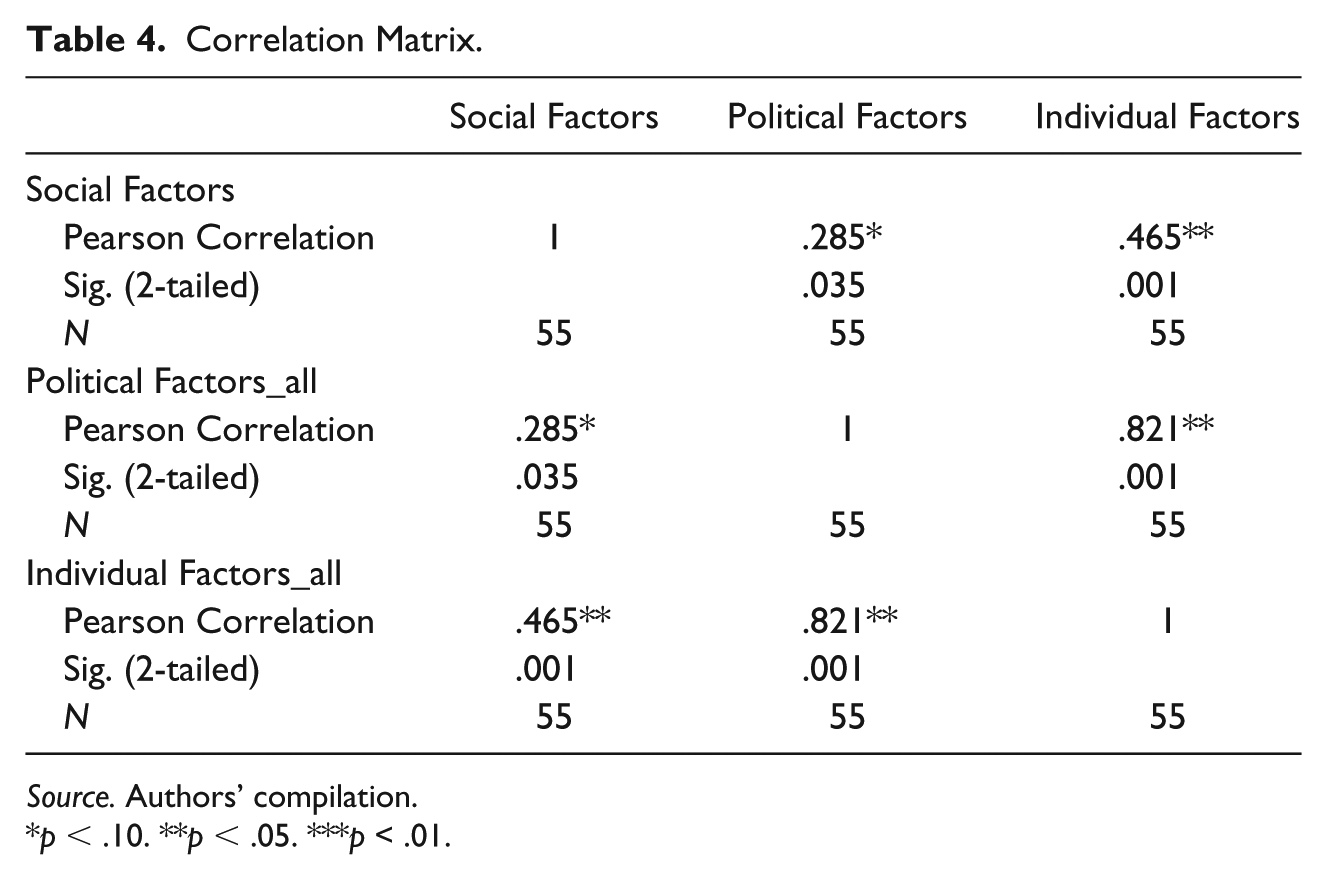
Source. Authors’ compilation.
p < .10. **p < .05. ***p < .01.
Findings
As expected, we found a positive link between innovativeness and social, political, and individual factors, respectively (see Table 5).
Regression Results for the PSI-Model (1), PSI-Model With Control Variables (2), and for the Single Indicators.

Source. Authors’ calculations.
Note. Standard errors in parentheses. PSI = political, social, individual; GII = Global Innovation Index.
p < .10. **p < .05. ***p < .01.
In all the models shown in Table 5, all the independent variables (IV) show a significant and positive relationship to innovativeness. According to our regression analysis, the PSI-model holds as the 3 null hypotheses cannot be rejected, neither tested in the complete PSI-model (Model 1), nor if tested separately (Models 3-5): Indeed, as stated in H1, high values of the indicator for “Political Dimensions” have a positive relationship with innovativeness, meaning that the practice scale of Performance Orientation has a positive and the practice scale of Power Distance and In-Group Collectivism has a negative relationship. H2 holds, as high values in the value scale for “Social Dimensions” have a positive relationship with innovativeness. Also for our third hypothesis, H3, we found empirical support. A low level of cognitive dissonance in “Individual Dimensions”—which means a decreasing gap between practice scales and value scales as measured in our indicator—has a positive relationship with innovativeness.
If the values of the respective indicator we used increase, the odds that innovativeness rises are significantly increased. This finding holds for all three indicators if tested separately (Table 5, Models 3-5), but also for the combination of all three indicators within one regression model (Models 1 and 2). This indicates—even if there is some correlation between two of the three indicators in use—the high overall explanatory value of our model: Even if the regression coefficient changes slightly using all three dimensions in one model, the significant overall impact is still given.
We tested our outcomes for robustness with regard to the specification of the dependent variable as well as regarding the direction of influence. The outcomes of the models with alternative dependent variables (Table 6) back up our finding, as we find again a significant and positive relationship. As expected, due to the nature of these data (“stable values from the past” for the IVs and a current indicator for the dependent variable), and the nonlinear model used, tests for Granger causality could provide evidence for the direction of influence as expected from the theory—culture influences innovativeness and not vice versa.
Regression Results for the PSI-Model With Different Outcome Variables for Robustness Check.

Source. Authors’ calculations.
Note. Standard errors in parentheses. PSI = political, social, individual.
p < .10. **p < .05. ***p < .01.
As for the control variables, only a high percentage of youth within the population shows a consistent link that is—as expected—negative with national innovativeness, while the schooling rates and the GDP do not show a significant relationship with innovativeness. Overall, our findings are fully in line with the related theories.
Discussion
While existing models (e.g., Shane, 1993; Williams & McGuire, 2010) discuss mechanisms between culture and innovation outcomes by distinguishing different stages of the innovation process (invention and implementation), our research distinguishes categories of cultural dimensions with different impacts on innovativeness as a whole.
The political dimensions presumably affect national innovativeness via the existing national institutions. Institutions of a society are “the rules of the game in a society” (North, 1999, p. 3), respectively, “the humanly devised constraints that structure political, economic and social interaction” (North, 1991, p. 97). These constraints can be informal constraints such as values, norms, sanctions, taboos, customs, traditions, and codes of conduct, or formal constraints such as constitutions, laws, contracts, and property rights (North, 1991).
Williamson (2000) proposes a model that distinguishes four levels of social analysis. Level 1 is the “social embeddedness level” where the cultural foundations of a society such as values, norms, and traditions are located. The second level is the level of “institutional environment.” This comprises the different functions of government, the distribution of power as well as property rights, and contract laws. Level 3 of the model is the level of governance where the institutions of governance are located. This level comprises structures that order and support trade, contracts, and economic transactions. The fourth and last level is the level of “resource allocation and employment” associated with neoclassical market economics (Joskow, 2008, pp. 7-11; Williamson, 2000, pp. 596-600).
Our research addresses the links between level 1 and levels 2 and 3. According to this model, the cultural dimensions of the GLOBE study operate on the first level and directly shape the institutional environment and governance structures on the second and third level. On a longer time frame, the existing institutions on levels 2 and 3 also influence the culture of a society so that a loop or circuit arises. This can lead to virtuous or vicious cycles in the development of societies, as proposed by Acemoglu and Robinson (2013).
As our indicator for Political Dimensions increases if either Performance Orientation increases or Power Distance and/or In-Group Collectivism decrease, the positive influence of that indicator is in line with theoretical explanations. The research concerning National Systems of Innovation (NSI) acknowledges that innovation performance of a nation is not only caused by formal R&D expenditures, but also by a variety of other factors linked to the flow and diffusion of knowledge and the regulatory framework of a country (Carlsson, 1996; Edquist, 2006; C. Freeman & Groete, 1997; Lundvall, 1999). These factors can be understood as an interplay of different political and economic institutions. Acemoglu and Robinson (2013, pp. 70 and 75) call sufficiently centralized and pluralistic political institutions “inclusive political institutions” and political institutions that are primarily decentralized and exclusive “extractive political institutions.” Inclusive political institutions make the usurpation of power by a dictator difficult, support and are supported by inclusive economic institutions, and allow for a free media. Inclusive economic institutions set the incentives for innovation through ensuring property rights and equal opportunities, upholding contracts, and allowing “creative destruction” through market entry of new businesses with new products or business models. In contrast, extractive political institutions do not set strong incentives for innovation as they primarily extract income and wealth from society to enrich small powerful elites and try to maintain the status quo (Acemoglu & Robinson, 2013). High Power Distance, high In-Group Collectivism, and low Performance Orientation tend to lead to extractive political institutions, which, in turn, lead to extractive economic institutions. “Nations fail today because their extractive economic institutions do not create the incentives needed for people to save, invest, and innovate [emphasis added]” (Acemoglu & Robinson, 2013, p. 366).
The social and individual dimensions impact and are impacted by diverse phenomena of cultural psychology. Cultural psychology deals with “the ways in which sociocultural processes are implicated in the workings of the human mind” (Kitayama & Markus, 1997, p. 3) or “the ways in which culture and psyche make each other up” (Markus & Kitayama, 1998, p. 66). This includes elements of social psychology as well as individual psychology. Social psychology deals with “human interactions” (Hogg & Vaughan, 2010, p. 2) and is reflected in the social dimensions while individual psychology deals with biological and cognitive influences on the attitudes and behavior of individuals (Myers, 2010), which is reflected in the individual dimensions.
Erez and Gati (2004) propose a multilevel model of culture that links the individual level of cultural self-representation with the level of national culture via the levels of group culture and organizational culture. Within this hierarchy of cultural levels, cultural self-representation is adapted and changed through top-down processes triggered by the national culture, while cultural dimensions on the national level emerge through behavioral changes at the individual level through bottom-up processes. In a similar fashion, Markus and Kitayama (2010, p. 422) propose a model that shows the “mutual constitution of cultures and selves.” This model includes the levels of societal factors and pervasive ideas, institutions and products, daily situations and practices, as well as self. There are several theories about the emergence of culture from individual behavior. The mechanisms for the emergence of culture include evolutionary adaptations, psychological needs such as a buffer against fear of death or the need for certainty, and interpersonal communication and can be, in many cases, viewed as complementary explanations (Lehman et al., 2004).
According to these models and theories, cultural dimensions can be viewed as an interaction of the cultural paradigms and the characteristics of the individual selves that the members of this culture possess. Understood in that way, culture influences the construction of self-concepts and self-regulation in the short term while, in an aggregated way, self-development influences cultural paradigms in the long term. As Lehman et al. (2004, p. 703) put it, Individual thoughts and acts influence cultural norms and practices as they evolve over time, and these cultural paradigms influence the future thoughts and actions of individuals, which then influence the persistence and change of culture over time. And so on.
The social dimensions of Gender Egalitarianism and Humane Orientation shape national innovativeness through the values of a society with regard to social dealings. Hence, the effect of the social factors on innovativeness seems to be driven by expectations and hopes rather than by actual practices.
The individual dimensions of Uncertainty Avoidance, Future Orientation, and Institutional Collectivism shape national innovativeness through a tension between what is and what should be with regard to self-regulation of the individual members of a culture. We call the gap of perceived as-is situations (practice scale) and desired to-be situations (value scale) a cultural cognitive dissonance. A diminishing cultural cognitive dissonance is related to higher innovativeness.
Conclusion
In this article, we propose a model with three different categories of cultural dimensions to explain the impact of culture on national innovativeness. We termed the three categories political, social, and individual (hence, the name “PSI-model”) according to their main proposed causal relations on the macro-, meso-, and micro-level. The political dimensions (Power Distance, In-Group Collectivism, and Performance Orientation) are argued to influence innovativeness through the existing political institutions of a country and, thus, are related to the practice scale. The social dimensions (Gender Egalitarianism and Humane Orientation) are argued to affect innovativeness through the relationships and interactions of people as being shaped by the social values of a society and therewith are related to the value scale. Finally, the individual dimensions (Uncertainty Avoidance, Future Orientation, and Institutional/Societal Collectivism) are argued to shape innovativeness through different forms of self-regulation, but, in particular, through the (diminishing) gap between the practice and value scale—a phenomenon we termed cultural cognitive dissonance.
As expected from the existing theory on the link between cultural dimensions and innovation, our newly developed model, tested empirically with a specifically constructed data set, provides evidence that the different dimensions as delineated above can act as drivers of innovativeness. In the discussion of the results, possible mechanisms from institutional economics, social psychology, and individual psychology underlying these relations could be identified. These proposed mechanisms might guide the potential practical use of our findings as well as future research activities.
As for practical implications, in particular, the political dimensions should be put center stage, as, for example, the creation of inclusive institutions or the reduction of power distance in national institutions, such as education systems, or science promotion systems, may increase the innovativeness of countries.
As for further research, especially the development of measurements to test the proposed mechanisms (e.g., in experiments or in further statistical analyses with a larger database to ascertain the impact of the mechanisms), could be fruitful fields applying our model.
Currently, our PSI-model has only been tested with regard to national innovativeness. We hope that the model can also be applied to other research topics with regard to cultural impacts and help to untangle the complex relations culture usually has with a diverse range of topics.
Footnotes
Declaration of Conflicting Interests
The author(s) declared no potential conflicts of interest with respect to the research, authorship, and/or publication of this article.
Funding
The author(s) received no financial support for the research, authorship, and/or publication of this article.