



Abstract
Helicopter parenting, defined as a form of overinvolved parenting of young adult children, is shown to be associated with young adult children’s well-being. Furthermore, the phenomenon of helicopter parenting is increasingly evident across various cultures. In this study, the association between helicopter parenting and young adult children’s well-being problems was examined, and the associations were compared between samples of American and Finnish young adults. With a sample of 441 American and 306 Finnish university students, results from path models suggested that maternal and paternal helicopter parenting was associated with university students’ symptoms of anxiety and depression, life dissatisfaction, and emotional dysregulation. Furthermore, even though the mean levels of helicopter parenting were lower among Finnish parents as compared with American parents, the associations between helicopter parenting and young adults’ well-being problems were, in general, equally significant. The implications for university students, parents of students, educators, and university administrators from different cultural backgrounds were also discussed.
Many of the changes that occur in young adulthood are associated with risks to well-being, which have become a growing public health concern (Schulenberg, Sameroff, & Cicchetti, 2004; U.S. Department of Health and Human Services, 2013). According to the U.S. National Health Interview Survey (NHIS), 3.6% to 5.2% of young adults between 1998 and 2011 reported two or more depressive symptoms during the past 30 days (Child Trends, 2015). Furthermore, these difficulties with well-being are particularly salient among university students who are facing many challenges, such as adjusting to independent living, establishing new relationships, dealing with academic demands, and handling additional financial needs (e.g., Wechsler & Nelson, 2008). Therefore, it is important to identify risk factors in the family of origin that could exacerbate such problems.
Helicopter parenting—defined as a form of overinvolved parenting of young adult children—has gained increasing media and research attention in the recent decade (Padilla-Walker & Nelson, 2012). Because parents continue to influence their children in young adulthood, it is essential to examine the association between helicopter parenting and young adult children’s well-being. Therefore, the first aim of this study is to examine the phenomenon of helicopter parenting and its association with young adults’ well-being. Based on socialization theory (Bandura, 1977; Sears, Maccoby, & Levin, 1957), parenting framework (Baumrind, 1967; Maccoby & Martin, 1983), and self-determination theory (Deci & Ryan, 2000), overinvolved parenting may discourage self-motivated behavior and hinder the development of psychological needs satisfaction (autonomy, competence, relatedness). Young adults with unmet psychological needs may be particularly vulnerable to situations that demand self-control and regulation, which could promote problems in young adult children’s well-being, such as anxiety, depression, emotional dysregulation, and life dissatisfaction.
Furthermore, as most of the research of helicopter parenting is done with U.S. samples, relatively little is known about this phenomenon outside of the United States. Limited empirical evidence suggested association between helicopter parenting and problems in young adult children’s well-being with samples from other countries, such as Australia (Locke, Campbell, & Kavanagh, 2012), Korea (Kwon, Yoo, & Bingham, 2016), Israel (Rousseau & Scharf, 2015), and China (Leung & Shek, 2017). However, the debate whether helicopter parenting is a global phenomenon is far from settled. One country—Finland—is unique in that traditional parenting in Finland is to encourage independence (e.g., Hüttenmoser, 1995; Kyttä, Hirvonen, Rudner, Pirjola, & Laatikainen, 2015). Given such tradition, it would be informative to investigate the current state of helicopter parenting and its association with young adult children’s well-being in Finland as compared with the United States. Therefore, the second aim of this study is to compare helicopter parenting and young adult children’s well-being problems between the United States and Finland. From a cultural ecological perspective (Garcia Coll et al., 1996), parenting behaviors are best understood within specific cultural contexts. With increasing globalization and changes in parenting perspectives (e.g., intensive parenting in contemporary society; Cui, 2014), though may be at a lower level as compared with the United States, helicopter parenting could be observed in Finland, and potentially with similar association with problems in young adult children’s well-being.
Helicopter Parenting and Young Adult Well-Being in the United States
When children become young adults, leave their parents’ home, and start independent living, some parents still remain heavily involved in their young adult children’s lives. Such parenting behavior is sometimes labeled as helicopter parenting (Padilla-Walker & Nelson, 2012). There has been increasing media coverage of this phenomenon in the United States, such as parents of university students who decide majors and courses for their children, argue with their children’s professors over poor grades, interfere with their children’s roommate disputes, and accompany their children to job interviews (e.g., ABC News, 2007, 2009; Levine, 2012; Gannett, 2012; Gibbs, 2009). The widespread nature of such parental behavior is also observed by university administrators (Somers & Settle, 2010).
With overwhelming media attention, empirical research is paying attention to this phenomenon. Over the past decade, many studies have investigated how helicopter parenting was related to young adult children’s well-being (e.g., Cui, Allen, Fincham, May, & Love, 2018; Darlow, Norvilitis, & Schuetze, 2017; Segrin, Givertz, Swaitkowski, & Montgomery, 2015). Studies suggested that helicopter parenting was associated with anxiety and depression (LeMoyne & Buchanan, 2011; Schiffrin et al., 2014), lower emotional regulatory abilities (Bradley-Geist & Olson-Buchanan, 2014; Segrin, Woszidlo, Givertz, & Montgomery, 2013; van Ingen et al., 2015), and dissatisfaction with life (Schiffrin et al., 2014) among university students. Taken together, these findings suggested that helicopter parenting in young adulthood could be related to young adults’ problems with psychological well-being.
Comparing Helicopter Parenting and Young Adult Well-Being Between United States and Finland
Several studies have examined helicopter parenting and young adult well-being outside of the United States. Using a sample of psychology and counseling professionals in Australia, Locke and colleagues (2012) reported that helicopter parenting was associated with a sense of entitlement and lack of resilience and life skills. With a sample of university students from Korea, Kwon and colleagues (2016) suggested that helicopter parenting was associated with lower levels of locus of control. However, they did not find an association with emotional well-being. Similar findings were reported in other countries (e.g., China—Leung & Shek, 2017; Israel—Rousseau & Scharf, 2015; Scharf, Rousseau, & Bsoul, 2017).
Finland is in a unique position when it comes to studying helicopter parenting, as the traditional parenting in Finland encourages independence. One reason for this tradition is that 70% of families in Finland are two-career families in which both parents work full-time (Official Statistics of Finland, 2011). Furthermore, Finland also portrays a high degree of shared responsibility or trust (Hüttenmoser, 1995; Medrano, 2013) among people (e.g., neighbors, strangers), in other words the stranger danger is low. Because of interpersonal trust, children can move freely. Indeed, a high degree of children’s independent mobility is a basic feature of Finnish childhood and child development. As a result, children grow up with a lot of autonomy and independence from their parents (Kyttä et al., 2015).
In recent years, however, some general changes in the Finnish society have connected parenting in Finland to helicopter parenting (Räsänen & Sarpila, 2014). With increasing resources and global influence accompanied by the reduced sense of safety and security, Finnish parents have become increasingly involved in children’s lives, such as looking after their young adult children and checking into their lives and lifestyles. In particular, the influx of online technology and social media means that parents can be in constant contact with their children even when they are away at a university. Few studies have examined the phenomenon of helicopter parenting and its association with young adults’ well-being in Finland. Räsänen and Sarpila (2014) conducted a survey among first-year university students in Finland and found that a significant proportion of university students reported the experience of helicopter parenting (41% of respondents). However, the association between helicopter parenting and university students’ well-being was not examined.
The Present Study
The goals of this study are to examine (a) the association between helicopter parenting and young adult children’s well-being and (b) the similarities and differences of such associations between the United States and Finland. Based on the theoretical perspectives and research, we proposed that (a) helicopter parenting would be positively associated with symptoms of anxiety and depression, emotional dysregulation, and life dissatisfaction among university students in both countries; and (b) the level of helicopter parenting would be lower in Finland than in the United States, but the association between helicopter parenting and problems in young adult children’s well-being would be similar in both countries. Two samples were taken, one from the United States and one from Finland. Data collection procedures and measures of interests were the same for both samples. Covariates, such as age, gender, year in school, family structure, and socioeconomic status, were included in both studies. These factors have been demonstrated to be related to helicopter parenting and young adult outcomes (e.g., Kouros, Pruitt, Ekas, Kiriaki, & Sunderland, 2017). Both age and year in school were included as covariates because even though they are related, age and year in school are rather distinct in the different cultural contexts as, compared with American university students, Finnish university students are on average older with bigger variations in age (e.g., many do not go to university right after graduating from high school as the Americans do). Analyses were conducted within each sample and then compared.
Method
Samples and Procedures
The United States
Participants were recruited at two large universities from introductory courses that met requirements of university liberal studies and served as college core courses. Most of the students attending these classes were from human and social sciences in which the majority of the students in these departments and colleges was female. Students in the targeted classes were invited to participate in an online survey for extra course credit, which included perceptions of their parents’ helicopter parenting behaviors, their own well-being, and demographics. Of the 712 students enrolled in these courses, 449 (63%) participated in the survey. For the purpose of studying helicopter parenting of young adults, students above age 35 were excluded from the current analyses. The final sample size was 441. The average age of the participants was 20.45 (SD = 2.85). Among the 441 student participants, 89.3% were female, 62.1% were freshmen and sophomores, 66.9% were from two-parent families, and 13.0% were from families with incomes under 30K (in dollars).
Finland
Finnish participants were also recruited from introductory courses at two large universities. Most of the students attending these classes were from social and educational sciences in which the majority was female. Students in the targeted classes were invited to participate in an online survey, which was the same survey used in the United States and translated into Finnish. The survey was translated, back-translated, discussed within a focus group, and pilot tested among a group of Finnish students before being finalized. Upon completing the survey, each participant received a movie ticket. Of about 700 students enrolled in these courses, 342 (49%) participated in the online survey. For the purpose of studying helicopter parenting of young adults, students above age 35 were excluded from the current analyses. The final sample size was 306. The average age of the participants was 22.86 (SD = 4.02). Among the 306 student participants, 87.1% were female, 87.7% were first- and second-year students, 68.0% were from two-parent families, and 15% being from families with incomes under 30K (in Euros).
Measures
The key measures—helicopter parenting and young adults’ well-being—were the same in the U.S. and Finnish samples. Some demographic variables were also the same (i.e., age, gender, year in school, family structure), whereas others were slightly different due to cultural and background variations (e.g., income categorization). For comparison purposes, only the same demographic variables were included as covariates in this study, which were age, gender, year in school, and family structure.
Perceived helicopter parenting
Perceived helicopter parenting was assessed with the helicopter parenting scale (Bradley-Geist & Olson-Buchanan, 2014). The scale included five items, asking student participants about their views of their mothers’ and fathers’ helicopter parenting since they started college (e.g., “I think my mother/father is too overly involved in my life” and “I feel like my mother/father has interfered in my life when I wish she or her wouldn’t have”). Responses ranged from 1 = strongly disagree to 5 = strongly agree. Reports of mothers and fathers were assessed separately, and the variables demonstrated sufficient reliability (for report of mothers, α’s = .86 for United States and .87 for Finland; for report of fathers, α’s = .89 for United States and .84 for Finland).
Young adults’ well-being problems
Anxiety symptoms were assessed by the 10-item Beck Anxiety Inventory (Beck, Epstein, Brown, & Steer, 1988), asking participants how much they were bothered by the symptoms during the past month. Sample items included “unable to relax” and “fear of losing control.” Response categories ranged from 0 = not at all to 3 = severely—it bothered me a lot. The items were summed together (α’s = .88 for United States and .84 for Finland). Depressive symptoms were assessed by the 10-item Center for Epidemiologic Studies–Depression (CES-D) scale (Radloff, 1977). Participants were asked to indicate how often they had certain feelings during the past week. Sample items included “I felt that everything I did was an effort” and “I felt fearful.” Response categories for these items ranged from 1 = rarely or none of the time (less than 1 day) to 4 = most or all the time (5-7 days). Two items were reverse coded and the 10 items were summed together (α’s = .80 for United States and .87 for Finland). Life dissatisfaction was measured by the 5-item life satisfaction scale (Diener, Emmons, Larsen, & Griffin, 1985). Sample items included “I am satisfied with my life” and “the conditions of my life are excellent.” The responses ranged from 1 = strongly disagree to 7 = strongly agree. Items were reverse coded then summed together to create a composite score of life dissatisfaction (α’s = .91 for United States and .88 for Finland). Emotional dysregulation was measured by the 18-item short version of the Difficulties in Emotion Regulation Scale (DERS-18; Victor & Klonsky, 2016). Sample items included “when I’m upset, I become out of control” and “when I’m upset, I have difficulty concentrating.” Responses ranged from 0 = almost never (0%-10%) to 5 = almost always (91%-100%). Several items were reverse coded and the items were summed together (α’s = .89 for United States and .89 for Finland).
Covariates
Age was assessed in years. Gender of participants was coded as 1 = male and 2 = female. Year in school was assessed as first-year, second-year, third-year, and fourth-year students. Family structure was dichotomized as 1 = two-parent family and 0 = other.
Results
Table 1 provides the means and standard deviations of the variables of interests for both samples along with demographic information. Comparisons were made between the U.S. and Finnish samples regarding the key variables using independent-sample t tests. The results revealed that, on average, American young adults perceived higher levels of helicopter parenting as compared with their Finnish counterparts (t = 4.96, p < .01 for mothers; t = 7.33, p < .01 for fathers). However, it is worth noting that, even though the average levels of perceived helicopter parenting for Finnish parents were lower (e.g., M = 8.80 for Finnish mothers as compared with M = 10.36 for American mothers), the scores demonstrated comparable variations (e.g., F = 1.41, p = .24 for maternal helicopter parenting when comparing variances between U.S. and Finnish samples) with almost the full range (5-25 for mothers and 5-23 for fathers), suggesting sufficient variability among Finnish parents. Regarding young adults’ well-being outcomes, Finnish students reported a significantly higher level of anxiety as compared with American students.
Descriptive Information and Comparison of Variables for U.S. and Finland Samples.
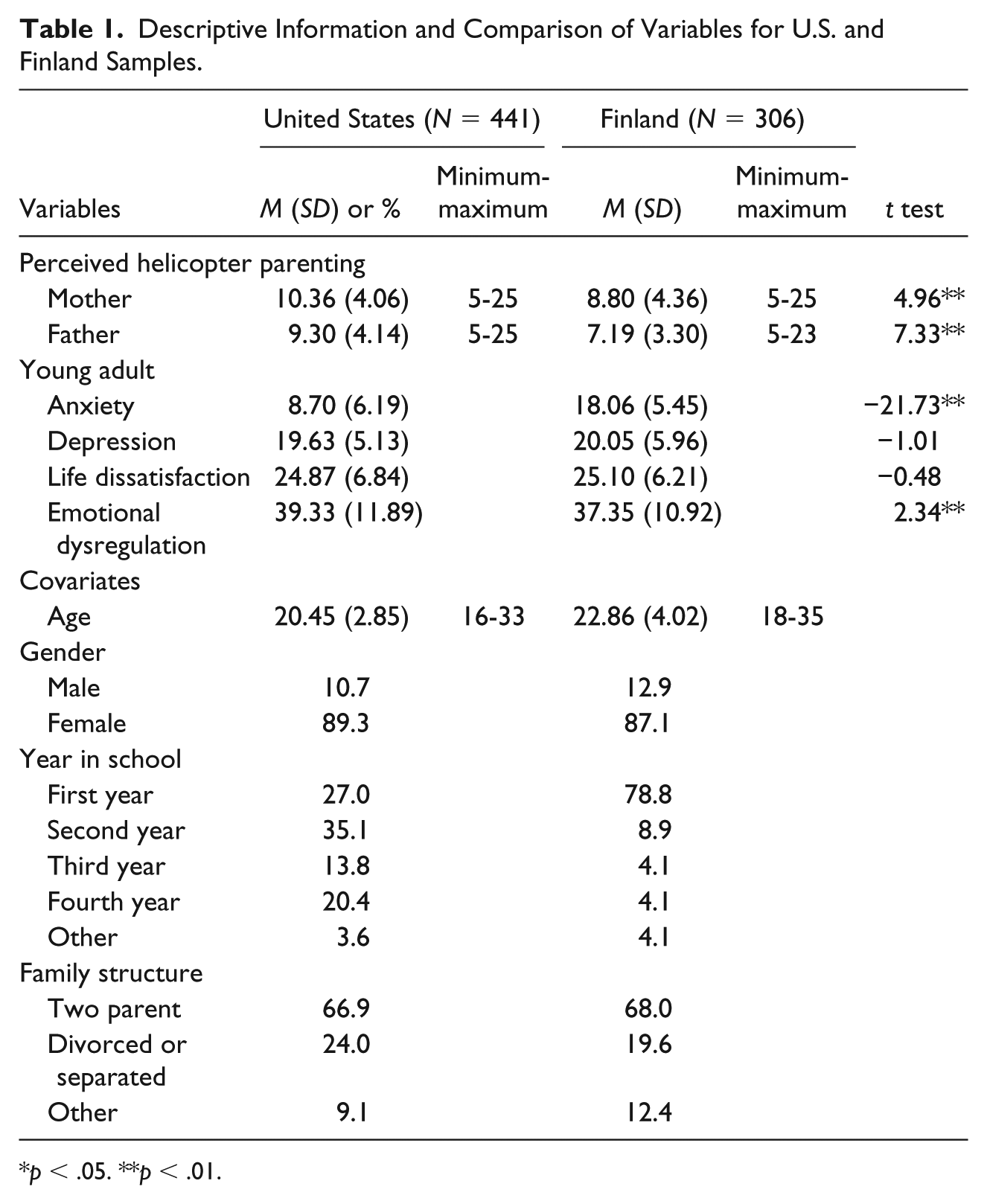
p < .05. **p < .01.
Following the descriptives, path models in structural equation modeling (SEM; Kline, 2015) with full information maximum likelihood (FIML) were used to assess the association between perceived helicopter parenting and young adults’ well-being. FIML computes maximum likelihood estimates and standard errors from data with missing values and provides less biased information than listwise deletion (Schafer, 1997). Covariates were included in the model (i.e., age, gender, year in school, and family structure) and their paths to outcomes were tested (not shown). For reason of parsimony, only the significant paths from covariates to outcomes were included in the models. Young adults’ well-being outcomes—anxiety, depression, emotional dysregulation, and life dissatisfaction—were included in the same model and their associations were tested. The model was tested separately for the U.S. and Finnish samples and then compared.
Figure 1 shows the results for perceived maternal helicopter parenting and young adults’ well-being. The path coefficients in Figure 1 are for the U.S. and Finnish samples. The model fit indices suggested good model fit (Kline, 2015). For the U.S. sample, the chi-square was 17.61 with 12 degrees of freedom. The comparative fit index (CFI) was .99, root mean square error of approximation (RMSEA) was .03, and p close (pc) was .80. For the Finnish sample, the chi-square was 24.42 with 12 degrees of freedom, CFI was .97, RMSEA was .06, and pc was .30.
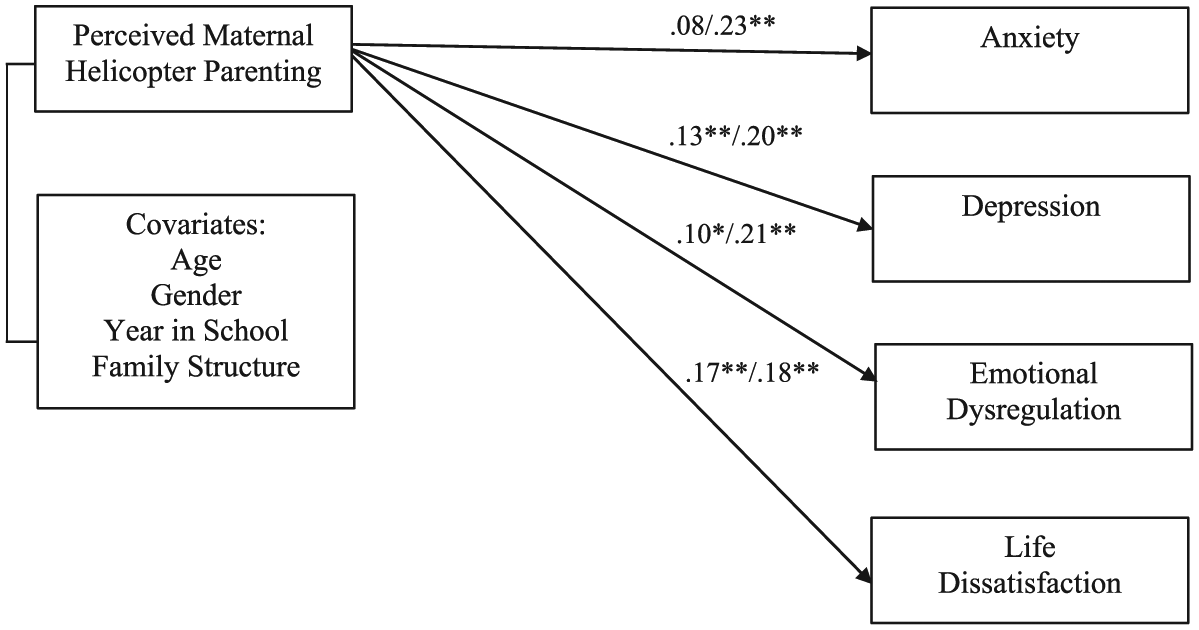
Perceived maternal helicopter parenting and young adults’ well-being problems.
The path coefficients before “/” in Figure 1 are for the U.S. sample. For the U.S. sample, perceived maternal helicopter parenting was significantly and positively related to young adults’ depression (b = .13, p < .01), life dissatisfaction (b = .17, p < .01), and, to a lesser degree, emotional dysregulation (b = .10, p < .05). The path from perceived maternal helicopter parenting to anxiety was not significant (b = .08, ns). The path coefficients after “/”in Figure 1 show results for the Finnish sample. Perceived maternal helicopter parenting was positively and significantly related to all young adults’ outcomes (e.g., b = .23, p < .01 for anxiety; b = .20, p < .01 for depression).
Path model comparisons between the U.S. and Finland models were conducted with multiple group comparisons. First, the two models for U.S. and Finnish samples were tested simultaneously to produce a baseline model fit, χ2(24) = 42.04. Then, corresponding paths were constrained to be equal across the U.S. sample and Finnish sample to compare changes in model fit. All the comparisons suggested that the path coefficients for U.S. sample and Finnish sample were of similar magnitude. For example, the paths from perceived maternal helicopter parenting to anxiety were constrained to be equal across models of United States and Finland, χ2(25) = 44.76. The change in chi-square, χ2(1) = 2.72, ns, suggested that the path from perceived maternal helicopter parenting to anxiety was not significantly different between the U.S. and Finnish samples.
Results from path models for fathers are shown in Figure 2. The model fit indices suggested good model fit. For the U.S. sample, the chi-square was 18.82 with 12 degrees of freedom, CFI was .99, RMSEA was .04, and p close (pc) was .75. For the Finnish sample, the chi-square was 22.85 with 12 degrees of freedom, CFI was .98, RMSEA was .05, and pc was .37.
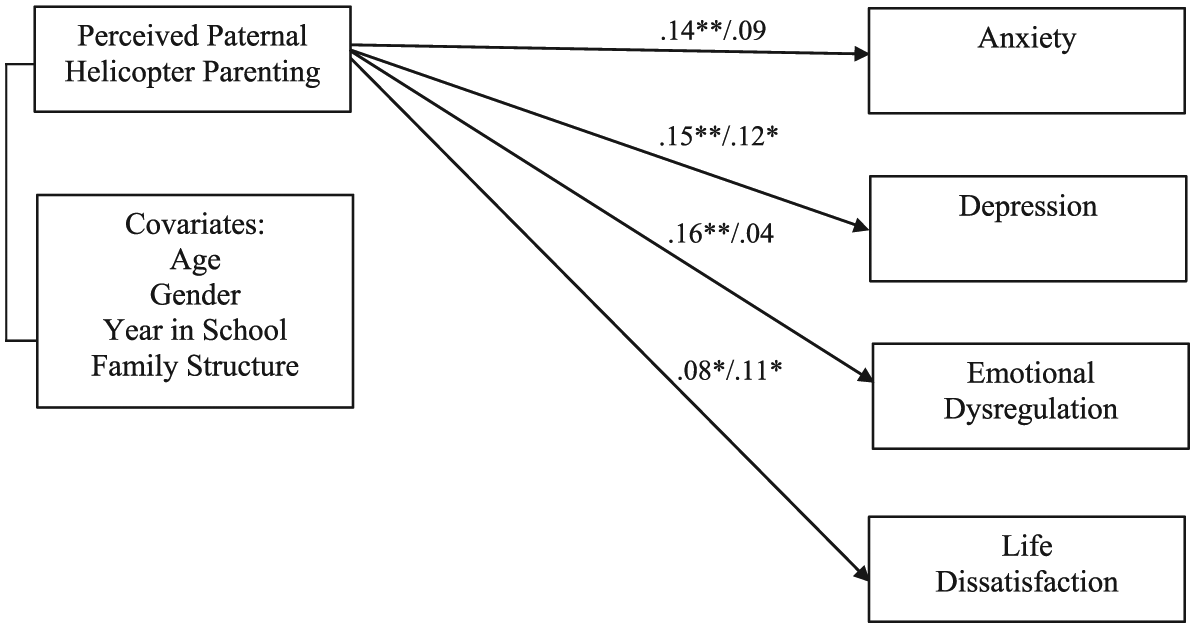
Perceived paternal helicopter parenting and young adults’ well-being problems.
The path coefficients before “/” reveal results for the U.S. sample. For the U.S. sample, perceived paternal helicopter parenting was significantly and positively related to all young adults’ outcomes (i.e., anxiety: b = .14, p < .01; depression: b = .15, p < .01; emotional dysregulation: b = .16, p < .01; and life dissatisfaction: b = .08, p < .05). The path coefficients after “/” show results for the Finnish sample. Perceived paternal helicopter parenting was positively and significantly related to depression (b = .12, p < .05) and life dissatisfaction (b = .11, p < .05). Similar to the comparisons for mothers, path model comparisons between U.S. and Finland models suggested that the path from perceived paternal helicopter parenting to young adult outcomes were of similar magnitude for the U.S. and Finnish samples.
Regarding covariates, in general, the patterns of significance for all the models (mother and father in United States and Finland) were the same. Because of the same patterns, as well as for comparison purpose, the same paths were included in all four models: family structure to anxiety, depression, and life dissatisfaction; and gender to life dissatisfaction. The results related to covariates (not shown) suggested that, as compared with those from other family structures, young adults from two-parent families reported lower levels of anxiety, depression, and life dissatisfaction. Female young adults reported lower levels of life dissatisfaction than their male counterparts.
Discussion
The purpose of this study was to investigate the association between helicopter parenting and young adult children’s well-being, and to compare between the United States and Finland. Results from path models suggested that perceived helicopter parenting was positively associated with young adults’ well-being problems including symptoms of anxiety and depression, emotional dysregulation, and life dissatisfaction. Furthermore, comparisons between the U.S. and Finland samples suggested that, even though the levels of perceived helicopter parenting among Finnish parents were lower, the association between perceived helicopter parenting and young adults’ well-being problems were equally significant.
The finding regarding the association between perceived helicopter parenting and university students’ well-being was consistent with findings from some previous studies (e.g., Kouros et al., 2017; LeMoyne & Buchanan, 2011; Schiffrin et al., 2014) that helicopter parenting was associated with negative young adult outcomes (e.g., higher anxiety, depressive symptoms, emotional regulatory problems). Such findings add to the current literature, suggesting that helicopter parenting, though may result from good intentions of parents, could lead to well-being problems among young adult children. Indeed, such parenting behavior could prevent young adults from acquiring self-regulatory abilities, which in turn are associated with well-being problems.
Furthermore, from a cultural perspective, it is important to investigate whether the phenomenon of helicopter parenting is unique to a certain culture or evident across cultures, and whether helicopter parenting has similar or different associations with child well-being. The findings in this study on comparisons between the United States and Finland suggested that helicopter parenting seemed to be perceived with full range of variations in both countries and that the associations with child well-being problems were similar. Regarding the levels of perceived helicopter parenting behavior, they were significantly lower for Finnish parents as compared with American parents. This is somewhat expected as the traditional parenting perspective in Finland is to encourage children to be independent (Kyttä et al., 2015). Therefore, it is not surprising that, in general, Finnish parents would practice less helicopter parenting.
More important than the levels of helicopter parenting, however, is its association with young adult children’s well-being problems. It is striking to find that even though the levels of perceived helicopter parenting among Finnish parents were lower, there were sufficient variations in perceived helicopter parenting among Finnish parents. More importantly, the association between helicopter parenting and young adult children’s well-being problems was equally strong in both samples. Combined with the fact that the levels of helicopter parenting among Finnish parents were lower but the associations were similar, the cultural implication may suggest that helicopter parenting may be more deviant from traditional Finnish parenting, therefore the negative impacts were salient. Such findings suggested that helicopter parenting could have a negative effect on young adults across cultures in both the United States and Finland, but with slight cultural variations.
Beyond important theoretical contributions, this study has several methodological strengths. First, this study took advantage of two large samples of university students from two different countries with equivalent measures that allowed comparisons between the two samples. Second, university students provided their perceptions of both mothers and fathers, yielding a more comprehensive picture of the parenting practice and its associations with young adult children’s well-being (Cui, Graber, Metz, & Darling, 2016). Finally, multiple covariates were added in the path model analyses, ensuring that the key associations were not spurious.
Despite the strengths, however, this study should also be viewed in light of several general limitations. First, each sample was comprised of undergraduate students from two universities, with the majority being female students. Future studies are needed to examine the potential role of gender of young adult children (Kouros et al., 2017). Second, all measures were from university students’ self-reports, which may be subjective and inflate the associations being tested (Cui, Lorenz, Conger, Melby, & Bryant, 2005). In particular, helicopter parenting was measured by young adults’ perceptions of their parents’ parenting behavior. As a result, the cultural differences in helicopter parenting could be due to differences in actual parenting or perceptions, which could affect the implications of the findings. Getting perspectives from parents and using trained observers to rate parenting behaviors are desired in future studies. Third, this study was cross-sectional and the analyses were correlational by design. As a result, the direction of associations needs to be interpreted with caution. It is also possible that young adult children who are more anxious and depressed demand parents to be more involved and practice more helicopter parenting. Future studies with longitudinal design are needed to provide support for the direction of the associations.
In conclusion, the findings of this research contribute to the current literature by demonstrating the cross-cultural association between perceived helicopter parenting and young adult children’s well-being. The message that helicopter parenting could be harmful for university students should be conveyed through family life education, parenting, and university student support programs to promote university students’ well-being. Future research should extend this line of research to other cultures to investigate whether helicopter parenting has become a global trend. Finally, future research should further explore the mechanisms through which helicopter parenting affects young adult children (e.g., autonomy, competence, and relatedness; Schiffrin et al., 2014). With the increasing prevalence of helicopter parenting within multiple cultures, more research efforts are needed to better understand and communicate its effects to parents, students, and university administrators.
Footnotes
Authors’ Note
Fiorella L. Carlos Chavez is now affiliated with University of Missouri, Columbia, USA.
Declaration of Conflicting Interests
The author(s) declared no potential conflicts of interest with respect to the research, authorship, and/or publication of this article.
Funding
The author(s) disclosed receipt of the following financial support for the research, authorship, and/or publication of this article: This project was made possible by the Fulbright Scholar Program’s award to Ming Cui. It was also supported, in part, by the National Council on Family Relations’s Innovation Grant Program. Opinions, findings, conclusions, or recommendations expressed within this work do not necessarily reflect the views of the Fulbright Program or the National Council on Family Relations.