



Abstract
Subsistence food sharing in Ust’-Avam (Taimyr Region, Russian Federation) is analyzed in light of Arctic research on sharing and current debate. Cultural traditions such as food sharing practices are widespread across indigenous communities in the Arctic and are arguably fundamental to the sustainability of indigenous Arctic cultures and their ability to buffer against environmental disequilibrium. Sharing diaries from 10 respondents over 12 weeks in August and October 2001, describe 162 distributions among 69 household dyads. Independent variables, including household relatedness, reciprocal sharing, and interaction effects, influence the documented food sharing pattern. Economic need and social association also influence sharing. Indicators of risk buffering are weaker than in two previous analyses of food sharing in Ust’-Avam that focus on primary distributions after the hunt and interhousehold meal sharing. Consideration of sharing by nonhunters provides an opportunity to examine explanatory hypotheses of food sharing, illustrating the nuances and robusticity of social ecology in indigenous subsistence economies.
Keywords
In the camp there would be three to five families. If someone killed a caribou they would split it with all the families. This distribution occurred especially for the first kill. After that, everyone started to hunt. If someone was unlucky we helped out. People still give meat, if I ask. Some people give meat, some do not—it depends on their soul. I do not pretend to give such a deed; I only lend it to you. . .when you meet with another honest Man in similar Distress, you must pay me by lending this Sum to him; enjoining him to discharge the Debt by a like operation, when he shall be able, and shall meet with another opportunity. I hope it may thus go thro’ many hands, before it meets with a Knave that will stop its Progress. This is a trick of mine for doing a deal of good with a little money.
The traditions of sharing the first kill are still observed by many households in Ust’-Avam. As an elder in the community, Yuri, who was no longer actively hunting, had a greater need for support than he had in the past. He did not lament this change but his last phrase referring to the “soul” of those who have food is gloss for a complex cosmology that connects each person’s actions to another’s and to the spirit owners of species that watch over their treatment. The role of traditional knowledge and cosmology in supporting prosocial norms of food sharing and cooperation is described in Ziker (2002a, 2014) and in Ziker, Nolin, and Rasmussen (2015). The focus of the present article is on sharing networks and the variables that best explain the network. These variables represent forces that shape social relations and traditions in the harsh but rich environment of the Siberian Arctic. Our goal is to examine alternatives explanations of such practices. Does food sharing serve to buffer individuals in uncertain times, building up community resilience while simultaneously serving to secure social ties?
The excerpt from Benjamin Franklin represents an alternative hypothesis that small cooperative acts can promote the public good ad infinitum. Does women’s food sharing work as generalized reciprocity? As a form of indirect reciprocity, generalized reciprocity is meant to improve social outcomes among cooperators and there is no expectation of a direct in kind return (Bshary & Bergmüller, 2008). While Franklin does not discuss the inherent problem of defectors or opportunists taking advantage without continuing payment forward, the low cost of the investment appears worth the risk. The idea of paying it forward may go back centuries and is wonderfully represented in the film Pay It Forward (Abrams, Feuther, Levy, & Leder, 2000).
Similarly, anthropologists have documented traditions encouraging generous transfers of essential foodstuffs among a wide variety of indigenous groups as diverse as Hadza (Woodburn, 1982), Ache (Kaplan & Hill, 1985), Inuit (Kishigami, 2004), and Apache (Basso, 1996). Evolutionary biologists and evolutionary anthropologists have vigorously debated the evolution of helping behavior and its importance in human evolution with a focus on evolutionary mechanisms including kin selection, reciprocal altruism, costly signaling, and others (e.g., Hamilton, 1964; Hawkes, 1993; Winterhalder, 1997). Generalized reciprocity (paying it forward) is not commonly viewed as a substantial contributor to the evolution of helping behavior in large groups because of the problem of defection.
In this article, we will begin by reviewing some food sharing studies conducted among subsistence-reliant societies and consider the main hypotheses about the evolution of cooperative behavior. We will contextualize these references to some recent relevant studies on the sharing economies of indigenous people in the Arctic. We present the analysis of a food sharing diary instrument conducted among 10 women in the community of Ust’-Avam in 2001. We compare the results of that instrument with the results of previous studies of food sharing in Ust’-Avam: the first on primary distributions of food immediately following procurement, and the second on interhousehold meal sharing. Finally, we consider all three studies in Ust’-Avam with reference to the cross-cultural work on food sharing and evolutionary hypotheses for cooperation. The research questions can be summarized thus:
In doing so, this article seeks to address to what extent socio-cultural practices help secure individual and community well-being across genders and generations. In addition, we test to what extent this organic “social welfare package” is mediated by kinship ties.
Individual decisions and structural constraints may vary across the distribution cycles of large-game kills. Ichikawa (2004) describes three common phases of food sharing for hunter-gatherers: (a) obligatory sharing after the kill; (b) voluntary sharing of raw meat (large, first-butchering portions) to those not participating in the kill; and (c) sharing portions prepared for consumption. Making these distinctions is important because each phase of distribution is likely shaped by varying socioecological pressures depending on the resources being procured and residence patterns. Most quantitative research on hunter-gatherer food sharing has focused on sharing after the kill or voluntary sharing to nonparticipates (e.g., Hawkes & Bliege Bird, 2002; Nolin, 2012; Smith, Bliege Bird, & Bird, 2003). In the Ust’-Avam context, obligatory sharing immediately following the kill is done among individuals taking part in the hunt. The second phase is done after hunters return to their homes with their shares. Normally, the parents or wife of the hunter will manage the distributions at this phase. The third phase, sharing at consumption events, is also a common occurrence in Ust’-Avam as visiting friends, neighbors, and relatives “for tea” is one of the popular social activities (Ziker & Schnegg, 2005). Food sharing at interhousehold consumption events is reported across the Arctic (e.g., Bodenhorn, 2000; Wenzel, 2000), as well as in tropical environments (Hames & McCabe, 2007). At least two studies on interhousehold sharing at meals have tested evolutionary hypotheses (Hames & McCabe, 2007; Ziker & Schnegg, 2005).
The focus of our analysis is on distributions that fall under the second phase in Ichikawa’s typology, but not alluded to in the “voluntary sharing of meat.” In Ust’-Avam, hunters and their families often distribute raw meat and fish to households without hunters, particularly elderly widowers and single mothers—providing clear examples of Ichikawa’s second phase. From ethnographic interviews about sharing, Ziker (2002a) reports that many of these female-headed households subsequently share portions of the meat and fish given to them with additional households. An instrument specifically targeted for women’s sharing networks is the source of information for this article. After looking at the variables that explain variation in women’s sharing networks, we compare those factors with those influencing sharing in primary distributions (Ziker et al., 2015) and consumption events (Ziker & Schnegg, 2005) in Ust’-Avam. In that sense, just as the eider’s provide long distance networks that link cultural and subsistence practices (Vestbo, Hindberg, Olesen, & Funch, 2018), so too do the women’s food sharing networks described here. Both provide a buffering capacity for communities and are relatively flexible in response to environmental stochasticity.
Explanatory Hypotheses and Comparative Food Sharing Studies
Studies of food sharing among other hunter-gatherer groups have demonstrated a variety of correlations relevant to the following explanatory hypotheses for helping behavior: kin selection, reciprocal altruism, signaling, and demand sharing (Gurven, 2004). Recent studies (Kasper & Mulder, 2015; Nolin, 2012; Ready & Power, 2018) also investigate the interaction of factors representing such mechanisms. Positive correlations between indicators of kinship and food sharing patterns have been found in a number of studies. For example, among the Indonesian Lamalera whale hunters, Nolin (2011) found that biological kinship is a better predictor of food-sharing relationships than social kinship (i.e., patrilineage membership). Food sharing is at least in part predicted by kin relatedness on Ifaluk atoll (Betzig & Turke, 1986), among Ache farmer-foragers in Paraguay (Gurven, Allen-Arave, Hill, & Hurtado, 2001), Hadza hunter-gatherers in Tanzania (Wood & Marlowe, 2013), and Mayangna and Miskito horticulturalists in Nicaragua (Koster & Leckie, 2014). Favoring relatives in food sharing follows the logic of nepotism and would follow the predictions of inclusive fitness theory for the evolution of altruistic behaviors via improving outcomes for descendants and collateral relatives (Hamilton, 1964).
In contrast, predictions about favoring kin are not required with reciprocal altruism, as rewards accrue directly to cooperative individuals and benefits can be delayed (Trivers, 1971); but contingency is expected (Gurven, 2004; Jaeggi & Gurven, 2013). In work with the reservation Ache of Paraquay, Gurven, Allen-Arave, Hill, and Hurtado (2000) found significant positive correlations between amounts transferred among pairs of families—demonstrating the contingency required of reciprocal altruism models. Reciprocal food sharing has been postulated as a mechanism that reduces variance in daily food intake among regularly cooperating members of a community through delayed returns (Cashdan, 1985; Kaplan & Hill, 1985). Nolin (2010) also found that reciprocity and household distance explained Lamalera food sharing patterns and that reciprocity explained most of the variation in sharing networks.
In indirect reciprocity based on image scoring, individuals invest only in partners that have sufficiently helped others in the past and are, therefore, interested in how others view them (Alexander, 1987). Among Ache forager-horticulturalists in Paraguay, Gurven et al. (2000) found that consistently high food producers give more than they receive, but gain the least on a daily basis because they are more likely to have their own supplies on any given day. The explanation Gurven et al. provide for this apparent generosity is that high producers receive additional food during hard times. Generosity signaling is hypothesized to provide long-term risk-buffering benefits to the signaler by maintaining social norms of sharing and may represent indirect reciprocity via image scoring. A recent study of men and women Martu hunters in the western desert of Australia (Bliege Bird & Power, 2015) also finds support for prosocial signaling. Those who “consistently pay higher costs to share,” not necessarily better hunters, are preferred for cooperative hunting activities. Another form of hypothesized indirect reciprocity is generalized reciprocity (Bshary & Bergmüller, 2008). Rather than investing to receive benefits in the future, individuals who receive help are willing to invest into third parties. This is the sort of pay it forward that Benjamin Franklin was encouraging in his letter and that we are investigating in this article via the sample of distributive sharing events in Ust’-Avam.
The costly signaling model proposes that big-game hunting evolved as part of competitive display rather than as part of provisioning relatives, risk buffering, or avoidance of defense costs (Zahavi, 1975). Marcel Mauss (1925/1954) discusses the obligatory, public, and sometimes antagonistic nature of gifts, particularly among hunter gatherers on the northwest coast of North America. This sort of gifting is likely a form of costly signaling. Hawkes and Bliege Bird (2002), using data from Torres Strait Meriam and Tanzanian Hadza, argue that the distribution of meat can best be seen in light of the evolution of men’s subsistence work, where “honesty is at a premium” and political alliances contribute to status acquisition. Similarly, Smith et al. (2003), found that Meriam turtle hunters gain social and reproductive benefits via meat distribution, consistent with the idea that hunting is a form of costly signaling. Nolin’s (2012) most recent analysis of sharing by Lamalera men with leadership positions found excessive giving by leaders is consistent with the sharing-as-signaling hypothesis. Among Lamalerans, however, status does not explain much of the variation in the sharing as a whole, and sharing observed by high-status households is best explained by the same factors that explain sharing by other households. This pattern suggests that multiple mechanisms may operate simultaneously to promote sharing in Lamalera.
When the consumption of food stores exhibits declining marginal value to the producer, then marginal portions are worth more to other individuals who have no food. As a result, there may be a cost associated with defending these food reserves and a producer should relinquish marginal portions to other individuals if the price of defense is greater than the additional value gained by others (Blurton Jones, 1984). Blurton Jones refers to this as tolerated scrounging. Continuing this logic, the disparity in amounts given should be low since portions are given out until the marginal consumption value or utility is equal for all potential recipients (Winterhalder, 1996). For example, Bliege Bird, Bird, Smith, and Kushnick (2002) found that Meriam sharing is conditioned by the marginal valuation of food to the acquirer, but only weakly affected by harvest variance, leading authors to conclude that sharing on the island of Mer does not function reduce foraging risk. Peterson’s (1993) concept of demand sharing follows a similar logic and emphasizes the social and symbolic significance of requests for food and other resources. While acknowledging its correspondence to the tolerated-scrounging model, Peterson views demand sharing as part of a wider “testing behavior” that is used to establish relationships by incurring “debt.” Another example of such testing behavior with the Mpimbwe of Tanzania may be the recent erosion of traditional kin-oriented and reciprocal sharing due to witchcraft accusations (Kasper & Mulder, 2015). Both tolerated scrounging and costly signaling models are more egocentric in their hypothesized benefits than are the kinship, reciprocal altruism, indirect reciprocity, and generosity signaling models. Economic need can intersect with kinship to drive sharing without tolerated theft or demand sharing, as Koster’s (2011) demonstrates for the Mayangna and Miskito horticulturalists in Nicaragua. Similarly, economic need rather than cooperative assortitivity appears to drive food sharing among the Agta hunter-gatherers in the Phillipines (Smith et al., 2018).
As Nolin’s (2012) study indicates, most empirical research on indigenous food sharing networks indicates a multiplicity of mechanisms at play. These mechanisms are likely to make the most sense when considering the local socioecology of food production and embeddedness in surrounding economies and societies. In a recent study that looks at the multiplicity of mechanisms involved in food sharing in the Arctic, Elspeth Ready (2016) examines customary food sharing and socioeconomic status of households in Kangiqsujuaq. Ready (2016) and Ready and Power (2018) find that food sharing emerges as a complex social, political, and economic phenomenon that accomplishes different objectives for actors based on their social position in the local network. Following this recent research, a basic premise of the analysis in this article is that a multiplicity of factors are likely informing decisions to share food beyond the household. Another premise of this article is that socio-ecological factors are likely to influence the predominant mechanisms favoring food sharing behavior. For example, among the Fillipino Agta hunter-gatherers reciprocal sharing is favored in more stable camps while demand sharing is more common with less camp stability (Smith et al., 2016). In order to more closely examine how socio-ecological conditions (Ember, Skoggard, Ringen, & Farrer, 2018) change food sharing strategies across the phases of food distribution we isolate and compare three types of food sharing networks in Ust’-Avam.
Method
Ust’-Avam is situated near the confluence of the Avam and Dudypta Rivers on the Taimyr Peninsula in north central Siberia. Two indigenous small-numbering peoples are represented in the community—the Dolgan and the Nganasan—along with a small minority of ethnic Russians, Ukrainians, and other former Soviet nationalities. The community is approximately 250 km by air from the regional center, Dudinka, and 400 km by water from the large industrial city of Noril’sk (Ziker, 2002a). Transportation to and from the cities is expensive, time-constrained, and risk-prone (e.g., helicopter, barge, and snowmachine), particuarly since the end of the Soviet Union (Ziker, 2002b). As a result, the community depends primarily on the production from hunting, fishing, and trapping activities for subsistence and supplemental exchange with the larger market. Approximately 60% of caloric intake (and almost all the protein) is derived from local subsistence activities—based on a survey conducted in April, 2003 (Ziker, 2014). Community censuses, genealogical data, and specialized surveys and observations provide the data for the following analyses. Individuals from Ust’-Avam took part in implementing the research protocols. Generally, community members wanted J.P.Z. to document their information, including everything from genealogies to photographs and discussions around the hearth fire, for posterity. J.P.Z.’s research in the community comprises a sum of 36 months from 1994 through 2007, including months-long hunting trips with indigenous hunters.
To investigate distributive sharing in Ust’-Avam, J.P.Z. developed a sharing diary for use during field trips in 2001 and 2003, specifically for households who did not have a residing hunter. Primary distributions of hunters and their households were also being investigated during those time periods using a different instrument (analyzed in Ziker et al., 2015). For the women’s sharing research, 10 qualifying household heads were asked to complete the diary daily for 7 days every 3 weeks. In actuality, only one household head completed the survey autonomously, and she included approximately 6 months of sharing data. The other nine household heads consented to be interviewed about their sharing, so J.P.Z. completed sharing diaries during interviews over 12 weeks in August through October 2001. One report from August 2002 and the remainder of the 2003 data are not included in this analysis. The data include 162 distributions among 69 household dyads.
The sharing diary questions focus on sharing events both to the household head and from the household head to other households. The event information includes the date of the transfer to the ego, what it was and how much, who gave it (i.e., sharer to ego), the social relationship of the giver to the ego, the answer to the question “Have you done anything for the sharer?” (i.e., returned goods or services), how often the sharer comes to visit (i.e., social association), who procured the food, with whom did the household head share derivative portions (i.e., ego to final recipient), and why did the household head share. Individuals are assigned ID numbers based on J.P.Z.’s 2003 and 2007 community censuses. Answers to the returned gift and visitation frequency questions are transformed to simple codes by K.S.F.. Gifts returned to the sharer are coded as 0 = none, 1 = attitudinal (gratitude expressed), 2 = immediate returns (food served), and 3 = previous exchange of goods and services. The frequency of visits between sharer and ego is coded 0 = never, 1 = rarely, 2 = sometimes, and 3 = frequently. The genealogical method employed for all individuals in the community is housed in a separate database and linked by the same individual ID numbers. Genealogies are analyzed in Descent (Hagen, 2007). Maximum household relatedness (rmax) is calculated by K.S.F. as the maximum individual relatedness within each household dyad. Individual sharing events by household are grouped by K.S.F. so that only interhousehold sharing events are represented. Sharing events are transcribed to a 51 × 51 matrix representing all the households in this sharing network. This matrix serves as the dependent variable in our analyses. Independent variable matrices representing the answers to the remaining questions, interaction effects, and matrices representing sums or differences in other household attribute variables are also transcribed to the same 51 × 51 household matrix.
To investigate the independent variables influencing distributive sharing, the dependent variable matrix is analyzed against the independent variable matrices using matrix regression, specifically the Multiple Regression Quadratic Assignment Procedure (MRQAP) (double-Dekker semi-partialling) process in UCINET (Borgatti, Everett, & Freeman, 2002). The independent variables used in the matrix regressions include maximum genealogical relatedness between households (kinship or rmax), the transpose of the dependent variable matrix representing reciprocal food transfers (reciprocity), ego-to-sharer returned gifts in nonfood goods and services (returned gifts), sharer-to-ego visitation frequency (social association), the differences in the number of active individual sharers in sharing households (active sharers differences), and the differences in the number of total household occupants (occupant differences).
The variables are meant to represent the predictions derived from explanatory hypotheses (Gurven, 2004; Ziker & Schnegg, 2005). Interhousehold relatedness and reciprocal food sharing are relevant to kin selection and reciprocal altruism. The returned gifts variable is relevant to the costly signaling hypothesis. The active sharers differences are relevant to relative economic need, and thus, the demand sharing hypothesis. The numbers of actively sharing household member and total number of household members are used to provide an index of relative need. The sharer-to-household head visitation frequency is meant to provide an independent measure of social association (following Koster & Leckie, 2014). Additional attribute matrices include the sum of active individual sharers in sharing households and the differences in producer/consumer ratios between households. These two variables are relevant to the hypothesized risk-buffering function of reciprocal altruism and economic need relative to the demand sharing hypothesis, respectively.
Results
Food sharing diaries for 10 focal women in Ust’-Avam and their 10 unique households are termed egos. The diaries document derivative distributions from sharers to egos (secondary distributions), as well as from egos to final recipients (tertiary distributions). The diaries also document distributions from producers to sharers (primary distributions) which are not included in this analysis. Secondary distribution in these data include 32 individual sharers, grouped into 22 unique households. Tertiary distributions include 54 individual recipients, grouped into 45 unique households. There is significant overlap in the households named such that the combined dataset has 51 unique households. A matrix regression (MRQAP) of the secondary distribution matrix on the tertiary distribution matrix indicates that they are not correlated (Pearson = −.0089, p = .4009). With significant overlap in the households involved, this suggests that there are significantly different sets of relationships in these two subphases of food sharing, and these two subphases are combined into a combined dataset for the remaining analyses.
In the combined women’s sharing matrix, the following independent variable matrices are found to individually predict the overall food sharing pattern (see Table 1): maximum genealogical relatedness between households (rmax), reciprocal food transfers (reciprocity), ego-to-sharer returned gifts in nonfood goods and services (returned gifts), sharer-to-ego visitation frequency (social association), and the differences in the number of active individual sharers in sharing households (active sharers differences). The variables in Table 1 are arranged according to the strength of each individual model R2, providing an indication of the relative magnitude of the variance in the sharing network by that variable.
Variance Explained by Individual Independent Variables on the Frequency of Distributive Sharing using Multiple Regression Quadratic Assignment Procedure.
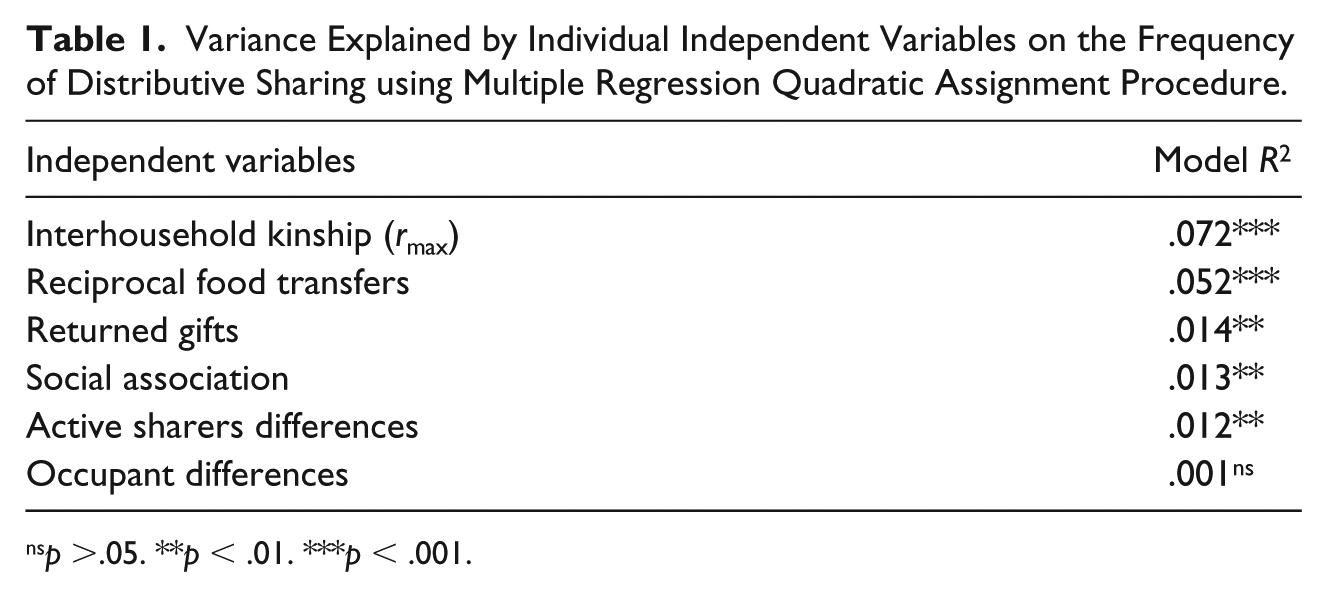
p >.05. **p < .01. ***p < .001.
Taken alone, each of the main effects of independent variables tells a limited story. The maximum model R2 for each of these variables independently is rmax = .07. While the variance explained is less than 10%, the statistical significance is high. As found previously in Ust’-Avam sharing networks (Ziker & Schnegg, 2005; Ziker et al., 2015), kinship is the statistically most significant variable for explaining food sharing: As household relatedness increases so does the frequency of interhousehold sharing. A similar relationship is found with reciprocal sharing of food as in the previous studies in Ust’-Avam: The more frequently food is returned, the more frequently it is given. In addition, we find in the women’s sharing network that as ego returns gifts to sharers in the form of other goods and services, the frequency of giving to egos’ households by sharers’ households increases. And finally, the frequency that sharers visit egos house also predicts food sharing to egos. In addition, the differences in the numbers of active (i.e., sharing) members of households—a measure of relative need—predict food sharing patterns. Differences in total household occupants and differences in household producer/consumer ratios are not predictive of these food sharing patterns. In sum, a series of variables representing the complexities of social relationships in the community and one indicator of relative economic inequality predict food sharing.
To explore the underlying patterns in more detail, interaction terms are generated with the possible permutations of these independent variables by taking the product of each pair of independent variable matrices. A new set of matrix regressions includes the paired main effects along with their interaction to reveal more about the structural features underlying the pattern. Finally, a series of combined models were generated to arrive at a model explaining the most variation in the derivative sharing network with the least number of variables. Our best combined model (see Table 2) includes the following main effects and one interaction: interhousehold genealogical relatedness (rmax), reciprocal food transfers (reciprocity), the dissimilarity in number of active household members (active sharers differences), an interaction term (rmax × Reciprocity), and sharer-to-ego visitation frequency (social association). The model R2 = .117 (p < .001) indicates that this set of independent variables explains approximately 12% of the variance in the food sharing pattern.
Best Combined Model for Frequency of Derivative Sharing on Multiple Independent Variables using Multiple Regression Quadratic Assignment Procedure.
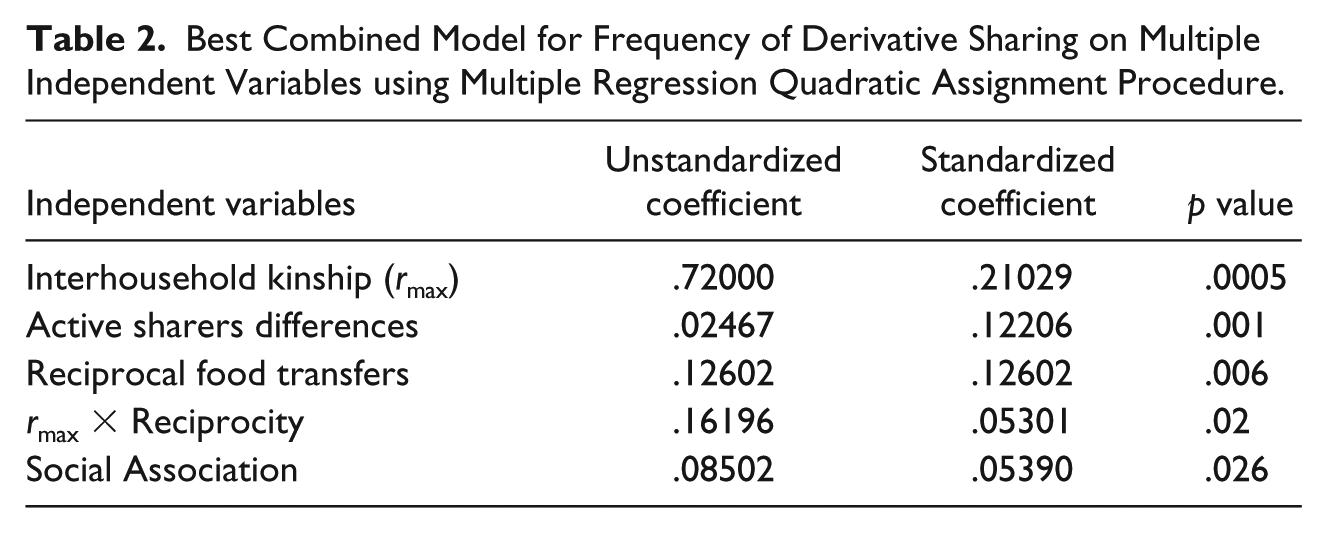
There are two things to note about the combined model in comparison to the main effects results presented above. First, the variable representing the frequency of returned gifts, which appeared to be strong in the individual results listed above, drops out of significance. When we include the frequency of returned gifts into the model, the overall model coefficient is unchanged and the standardized variable coefficient (p = .135) is not statistically significant. The fact that this variable drops out of significance in the multiple regression model indicates that the variation in food sharing explained by returned gifts is better explained by other variables. This has obvious implications for the explanatory hypotheses. Second, an interaction between kinship and reciprocity is statistically significant and remains in the combined model along with the main effects of kinship and reciprocity. What this indicates is that food sharing increases along with kinship and reciprocal sharing. This effect is on top of the nonreciprocal sharing with kin and the reciprocal sharing with relatedness controlled.
The combined model indicates that interhousehold relatedness, as measured by the strongest genealogical link between households, and economic need, as measured by the differences in number of active sharers in each household pair, are statistically the most significant variables explaining the food sharing pattern. In addition, reciprocal food sharing, the interaction of kinship and reciprocity, and the social association indicator are relevant variables in this sharing network. Uncooked portions of meat and fish provided to egos by other households are shared to additional households by the pathways of kinship and social association (friendship) and are also influenced by need.
Discussion
A few words from the sharing diaries of the women in Ust’-Avam helps to contextualize these findings. Regarding the question, “Why did you share? What do you get out of sharing?” answers include, “Pleasure, joy”; “Nina also shared”; “I simply gave it when I was outside”; “You need meat, just take it”; and “She’s a neighbor, I simply gifted it.” Regarding the question, “What did you or do you do for the person who shared?” answers include, “I thanked them”; “I give to her too—if she has it she gives it to me and if I have it I give it to her”; and “Together we drank tea, ate breakfast, and went to gather berries.” As can be seen here, there are a variety of reasons for sharing but the desire to attain status or leverage over other households does not stand out in these explanations. This finding is consistent with traditional knowledge about sharing in the community (Ziker et al., 2015).
Comparing the results of three food sharing studies in Ust’-Avam, we find that the women’s food sharing network is influenced by some of the same variables that condition the network of primary distributions as reported by hunters (Ziker et al., 2015) and the interhousehold meals observed by J.P.Z. in 1994 through 1997 (Ziker & Schnegg, 2005). There are some important differences in the variables investigated that illustrate the importance of the phase of sharing. Table 3 summarizes the comparative results with regard to the major explanatory hypotheses. A “yes” indicates a relationship between the sharing network and the independent variable, a “no” indicates lack of a statistical relationship, and an “n/a” indicates the relationship is not tested in the study.
Summary Results of Network Analysis of Main Explanatory Variables in Combined Multiple Regression Quadratic Assignment Procedure Models of the Three Interhousehold Sharing Networks in Ust’-Avam.

One difference relates to adding the rmax × Reciprocity interaction. Ziker et al. (2015) report that when the rmax × Reciprocity interaction is added into a combined model for primary distributions with the main effects, the coefficient on the main effect of reciprocity changes signs from positive to negative. In other words, the frequency of food sharing by hunters increases as reciprocal sharing by recipient households decreases. The sign on the main effect of interhousehold relatedness remains positive. This result provides evidence for three hypothesized kinds of sharing: (a) nepotistic food sharing; (b) food sharing occurring as part of reciprocal relationships between related households; and (c) food sharing as indirect reciprocity, as either generosity signaling or generalized reciprocity (i.e., paying it forward).
We find the analogous effects for the first two types of sharing in this women’s sharing network, but the opposite for the third type. We find the positive correlation between interhousehold relatedness and food sharing. We also find a positive correlation between food sharing and the interaction of interhousehold relatedness and reciprocal sharing. However, when controlling for kinship and the interaction effect in our final model, the sign on reciprocal sharing remains positive. This indicates that reciprocal sharing (i.e., giving back) with relatedness held constant is the predominant pathway for sharing, rather than indirect reciprocity. Also, because we are controlling for economic need, social association, and gifts returned, it is likely that such reciprocal sharing is related to a risk-buffering function, rather than the incurring “debt” as modeled in the demand sharing literature.
Household economic need influences sharing in the women’s network, as represented by the differences in active sharers, and in the meals network, as represented by average age differences in households. As the differences in these indicators increases, so does the frequency of food transfers. This finding is opposite to that from the study of the primary distribution network: The effect of the sum of hunter skill ratings follows predictions for risk buffering reciprocity. Household economic need appears to be a driver for the later phases of food sharing (i.e., the women’s sharing and meal sharing), rather than initial phases.
Providing goods or services back to givers is individually predictive in the primary distribution and women’s sharing networks, but drops out of significance in the combined models. This effect is likely part of the reciprocal relationships households have as kin or friends, rather than as payback for food transfers as status-seeking activities as predicted by the costly signaling hypothesis. All in all, sharing appears more prosocial in Ust’-Avam and less influenced via egocentric pathways.
Conclusion
Following Ichikawa’s (2004) typology, we have found that the phase of food distribution under examination is a significant factor that affects the landscape of sharing. Cross-culturally among immediate-return societies (Woodburn, 1982), parallels are found in the results of primary distribution studies among Ache (Gurven et al., 2000), Martu (Bliege & Power, 2015), and Inuit (Ready, 2016), as well of that in Ust’-Avam (Ziker et al., 2015) with generosity signaling being a significant contributor to sharing. In contrast, sharing at meals likely reflects reciprocity or economies of scale (Hames & McCabe, 2007; Ziker & Schnegg, 2005). With the second-phase sharing in the Ust’-Avam women’s network, social association, kinship, and friendship are the pathways by which food is shared beyond the household. Women’s sharing appears as part of the reciprocal relationship of kin and friends, and somewhat counter-intuitively, not as a form of paying it forward as with the primary distributions. We find that gifts returned by egos (i.e., returning benefits with other goods or services), in combination with other factors, is not a statistically significant explanatory variable in women’s food sharing, indicating women’s food sharing is also not about status striving. Women’s food sharing in Ust’-Avam appears to be a part of exisiting cooperative social relationships that are sensitive to need.
This research illustrates the nuances of social ecology in an indigenous subsistence economy in the Siberian Arctic. Multiple waves of food sharing serve a variety of economic and social functions including as a buffer in an environment characterized by disequilibrium. Cooperation among community members is essential for survival in the Siberian Arctic and this point is commemorated in tales and aphorisms. Food sharing helps to establish and maintain these important social ties.
Footnotes
Acknowledgements
J.P.Z. is grateful to friends and adoptive family in Taimyr who participated in the research and hosted repeated visits.
Authors’ Note
J.P.Z. wrote the article. K.S.F. conducted data manipulation and comments on earlier drafts.
Declaration of Conflicting Interests
The author(s) declared no potential conflicts of interest with respect to the research, authorship, and/or publication of this article.
Funding
The author(s) disclosed receipt of the following financial support for the research, authorship, and/or publication of this article: The research was supported with a grant from the National Science Foundation (2006-2009) no. 0631970 part of the BOREAS Eurocores project Home, Hearth and Household in the Circumpolar North. Fieldwork in 2001 was supported by a grant from the L.B.S. Leakey Foundation. Fieldwork in 2003 was supported by the Max Planck Institute for Social Anthropology.