



Abstract
Ethnological studies point to candidates for culturally universal and variable characteristics of romantic love models. However, only recently have these hypotheses begun to be tested through primary data collection intended for cross-cultural comparison. This study builds on two such efforts covering the United States, Russia, Lithuania, and China by adapting their methods to South Korea. We found support for the core features of romantic love identified in these studies (sexual attraction, altruism, intrusive thinking, emotional fulfillment, and idealization). We also explain peripheral meanings of love, including its association with sex, irrationality, and material considerations. In our discussion of East Asian models of romantic love, we argue that the apparently less altruistic attitudes of East Asian women toward their lovers are attributable to the deterioration of structural support for institutions that enforced the ideal of female sacrifice previously valorized in their family relations, and women’s backlash against these continued expectations.
The focus of the debate among anthropologists over the universality of romantic love has shifted from whether romantic love is an experience found in all cultures or merely a Western construct to refining the definition of romantic love and explaining how and why its meanings differ between historical and cultural contexts. Evidence of the existence of romantic love in societies ranging from forager bands to industrialized states suggests that the experience is not purely a result of globalization and cultural construction (Cole & Thomas, 2009; Jankowiak & Fischer, 1992; Lindholm, 1998). Neurological studies of love suggest a biological substrate behind the feelings and thought patterns commonly affiliated with romantic love (Fisher, Aron, Mashek, Li, & Brown, 2002), although the “cultural valence” of these patterns may depend on specific social conditions such as the strength of sexual double standards for pre-marital sexual relations (de Munck & Korotayev, 1999; de Munck, Korotayev, & McGreevey, 2016, p. 3). However, Charles Lindholm’s (1998) ethnological essay on variations in the social role and meaning of love illustrates that cultural constructions of romantic love are highly variable. This variability leads us to question whether we have yet identified the minimal cross-cultural features of romantic love that justify defining all such experiences as variations of the same phenomenon. Lindholm’s study provides an important testable hypothesis that inspired elements of this study.
We build on the pioneering work of Victor de Munck and his collaborators (de Munck, Korotayev, de Munck, & Khaltourina, 2011), who identified core aspects or cognitive traits Americans, Russians, and Lithuanians associated with romantic love. We sought to identify cognitive traits that South Koreans associate with romantic love, rather than focusing on other Euro-American cultures. Here, we highlight the role of cultural history and social structures in shaping the cultural elaboration or suppression of romantic love (de Munck et al., 2011; de Munck, Korotayev, & Khaltourina, 2009). We selected South Korea (hereafter Korea) 1 for this study because of its deep history of ideological exchange with China and similarly rapid industrialization, making it an apt society for comparison with the findings for China by Jankowiak, Shen, Wang, Yao, and Volsche (2015). Furthermore, its political and cultural entwinement with the United States and Christianity over the past century makes South Korea an especially relevant comparative sample for the American findings of de Munck et al. (2009) and de Munck et al. (2011).
The methodological and theoretical approach developed by de Munck and his co-authors (2009; de Munck et al., 2011) begins to address major shortcomings of both anthropological and psychological attempts to compare cultural constructions of romantic love across cultures. Ethnographic studies of love outside the United States tend to focus on the socio-economic factors (such as urbanization and the rise of wage labor) responsible for the idealization of love, ignoring the way love is tacitly conceptualized, much less performed, in various contexts (Cole & Thomas, 2009; Hirsch & Wardlow, 2006; Padilla, Hirsch, Munoz-Laboy, Sember, & Parker, 2007). This reluctance to explore love as a cognitive ideal has provided a partial picture of love as a meaningful behavior, and may reflect the continued belief among many anthropologists that romantic love is a mere fantasy (Lindholm, 1998).
Psychologists have developed several instruments (e.g., the Love Attitude Scale, Hendrick & Hendrick, 1986, 1998; Romantic Beliefs Scale, Sprecher & Metts, 1989) that capture the variation in American and Western European experiences of romantic love (for an overview, see Hatfield, Bensman, & Rapson, 2012). However, studies relying exclusively on Likert-type-scale instruments lack the ability to identify various cultural meanings and associations ascribed to love absent from American conceptualizations. Sociologist Ann Swidler (2001) illustrated the polysemic nature of romantic love and individuals’ inability to recall all of their cultural knowledge of love at any given time. This makes questionnaires helpful for prompting participants to consider associations they might not address in a broad open-answer question, but which might be no less salient to them and their society. Furthermore, extensive cultural knowledge and qualitative data collection is necessary to adapt and translate such measures and interpret responses to them in new cultural contexts. The mixed method approach used by de Munck et al. (2009) combines open- and closed-response questions with focus groups, interview data, and ethnographic knowledge, mitigating the shortcoming of previous methodological approaches and providing a map of each culture’s conceptualization of romantic love from analytical (or etic) and folk (or emic) perspectives. The present study adapted the mixed method approach of de Munck et al. (2009) and de Munck et al. (2011) to explore Koreans’ conceptualization of romantic love and test their earlier conclusions regarding the culturally universal characteristics of romantic love.
The original 15-question survey by de Munck et al. (2009) first asked respondents to free list all the things they associated with romantic love, and then presented them with 14 statements about love selected from a book of famous love quotations. Each statement captured the spirit of an aspect of romantic love documented in the social science literature such as transcendence, compulsive thought, commitment, sexual attraction, altruism, temporality, practicality, and idealization. De Munck and colleagues (2011) contextualized these responses by conducting focus groups and interviews to better interpret participants’ responses. They compared the responses of American and Russian participants (de Munck et al., 2009), and then expanded their study to Lithuanian participants (de Munck et al., 2011). William Jankowiak and colleagues (2015) adapted and expanded their study to include undergraduates living in Shanghai, China. Together, these studies identified potential characteristics of romantic love that may ultimately be human universals.
In this article, we probe the ways Koreans conceptualize meanings and experiences associated with romantic love. To provide a cross-cultural perspective, we adapted de Munck and Jankowiak’s earlier questionnaires, which enable us to compare our findings with those from the four previously investigated cultural contexts (the United States, Russia, Lithuania, and China). Considering the four previously examined cultures, one would expect the Korean construction of romantic love to reflect a synthesis of Chinese, Eastern European, and American notions. South Korea is an intriguing site to explore romantic love from a cross-cultural perspective because of its rapid urbanization and industrialization, which are sociological processes regularly linked to the adoption of companionate marriage models (Hirsch & Wardlow, 2006). South Korea shares a long history with China, existing as a vassal state throughout its most recent dynasty from 1392 to 1897, which increasingly modeled its government and family structure on neo-Confucian ideology (Deuchler, 1992). However, during the past 70 years, South Korea has been closely allied with the United States, serving as home to dozens of American military bases. These have served as vectors of cultural influence, as have Korean migrants who returned from the United States (Jo, 2018; Schober, 2016). North American Protestant missions to Korea, which began at the end of the 19th century, also greatly influenced the peninsula. Today, a quarter of the population is protestant and South Korea is now the second largest sender, after the United States, of Christian missionaries abroad (Baker, 2008; Choi, 2009; Chong, 2008; Harkness, 2014; Kang, 1997; T. Lee, 2010; Min, 2005). South Korea’s urbanization and industrialization occurred later than in Russia, with whom the Korean peninsula also shares a border, but earlier than in China, where it occurred later and over a more condensed period. Therefore, relative to the other four cultures (i.e., the United States, Russia, Lithuania, and China) studied, South Korea is an excellent site for comparing Western and non-Western models of romantic love. Examining Korea also addresses a gap in the literature, as less research has been conducted on South Korea compared with the more popular research sites of China and Japan generally and on the subject of love in particular (S. Chen & Wang, 2007).
This study draws on the first author’s in-depth ethnographic study (2016-2018), which explored South Koreans’ conceptions of romantic love and its role in contemporary marriage. In this article, we present findings from our adaptation of the surveys by Jankowiak et al. (2015), de Munck et al. (2009), and de Munck et al. (2011), which we distributed in and around Seoul, South Korea. These were designed to compare cognitive models of romantic love across cultures (described in the “Method” section). We also utilized the original China dataset of Jankowiak et al. (2015) to test for statistically significant differences between the two countries and compare our Korean findings with those of Jankowiak et al. (2015), de Munck et al. (2009), and de Munck et al. (2011). 2 Our findings support those of de Munck et al. regarding the cross-cultural core meanings of romantic love and the relationship between gender differences in love models cross-culturally (see the “Results” section). We also examined sex differences within and between the cross-cultural samples to test the claim by de Munck et al. (2009) that conceptions of romantic love vary more between cultures than between genders of the same culture. In the “Discussion” section, we first contextualize our findings in South Korea’s cultural history and then explain the cross-cultural commonalities between Korean and Chinese love models revealed by these surveys, as well as their most striking differences. We conclude by discussing the most urgent needs for future research on cross-cultural variation in the meaning of romantic love.
Method
The present study adopted all 39 questions in the China study by Jankowiak et al. (2015), and added two questions included in the three-society study by de Munck et al. (2011). The questionnaire began with an informed consent form followed by a free list question instructing participants to list all the things they associate with romantic love. Participants in the online survey were then presented with a list of 46 statements about love. The first 15 questions were those from de Munck et al. (2009) and de Munck et al. (2011) and the following 25 were from Jankowiak et al. (2015). The last seven questions probed participants’ thoughts about the meaning and application of jeong 3 and romantic love in relation to marriage. Participants indicated their responses on a 4-point Likert-type scale where 4 = “completely agree,” 3 = “mostly agree,” 2 = “mostly disagree,” and 1 = “completely disagree.” This is the same scale used in the previous two studies (de Munck et al., 2011; Jankowiak et al., 2015). At the end of the survey, a new question was added: “How long does it take to fall in love?” This question was posed to Americans and Lithuanians in the second study by de Munck et al. (2011). Participants were given eight options: less than an hour, less than a day, days, weeks, 1 month, 6 months, 1 year, or years. Participants were also asked about their marital status, how many boyfriends or girlfriends they had had, and how many times they had been in love to discern whether their responses reflected their personal experiences of romantic love.
Participants were recruited via advertisements through university class mailing lists at three universities, two in Seoul and a technology college outside Seoul, and through snowball sampling over the course of the first author’s 14 months of fieldwork (2016-2017). The Korean sample comprised 250 participants (137 female and 113 male) with an average age of 26.5 years. Of the sample, 9% of respondents were married, 6% had never had a boyfriend or girlfriend, and 5% had reportedly never been in love. The first and second author also conducted focus groups and semi-structured interviews with volunteers from among the survey participants.
Results
Our findings confirm and expand those of de Munck et al. (2011) and Jankowiak et al. (2015) regarding the commonalities in how different cultures conceptualize romantic love. Specifically, the responses of our Korean participants were in agreement with the five universal core traits identified by de Munck et al. (2011) and Jankowiak et al. (2015) (see Table 1).
(Item: Sexual attraction is necessary for love.) Romantic love is understood to contain a sexual component, which is also emphasized in the eros love style described by psychologists (J. A. Lee, 1977; Singer, 2009a, 2009b, 2009c).
(I will do anything for the person I love.) Romantic love is altruistic, encouraging sacrifice and selflessness, which psychologists describe as the agape love style. It also evokes a sense of commitment (J. A. Lee, 1977; Singer, 2009a, 2009b, 2009c; Sternberg, 1988).
(I constantly think about the person I love.) Romantic love is experienced as involving intrusive thoughts, also described as a feature of limerence and documented by the neurological studies of Hellen Fisher (Fisher et al., 2002).
(Love is the supreme happiness of life.) Romantic love is a source of joy and happiness in itself, not because it is a utilitarian means to an end, a notion Charles Lindholm (1995, 1998) describes as “transcendence.”
(My love will make my partner a stronger and better person.) This item contains elements consistent with Lindholm’s notion of transcendence. De Munck et al. (2011) argue, “the fifth factor also is indicative of transcendence and altruism by suggesting that the lover increases the beloved’s psychological well-being through his or her love, since, if this works mutually, then, indeed, the whole is greater than the sum of its parts” (p. 136). Idealization of the other is also a noted characteristic of love described by Fisher et al. (2002). Idealization of and identification with one’s love object was also described as a part of the experience of love by Sigmund Freud (1961). Furthermore, this statement can be understood as evoking the idea of altruism when conceptualized as meaning that love leads to actions that make a partner better and stronger: for example, through offering them emotional support.
Survey Results of a Five-Country Comparison of the Concept of Love.
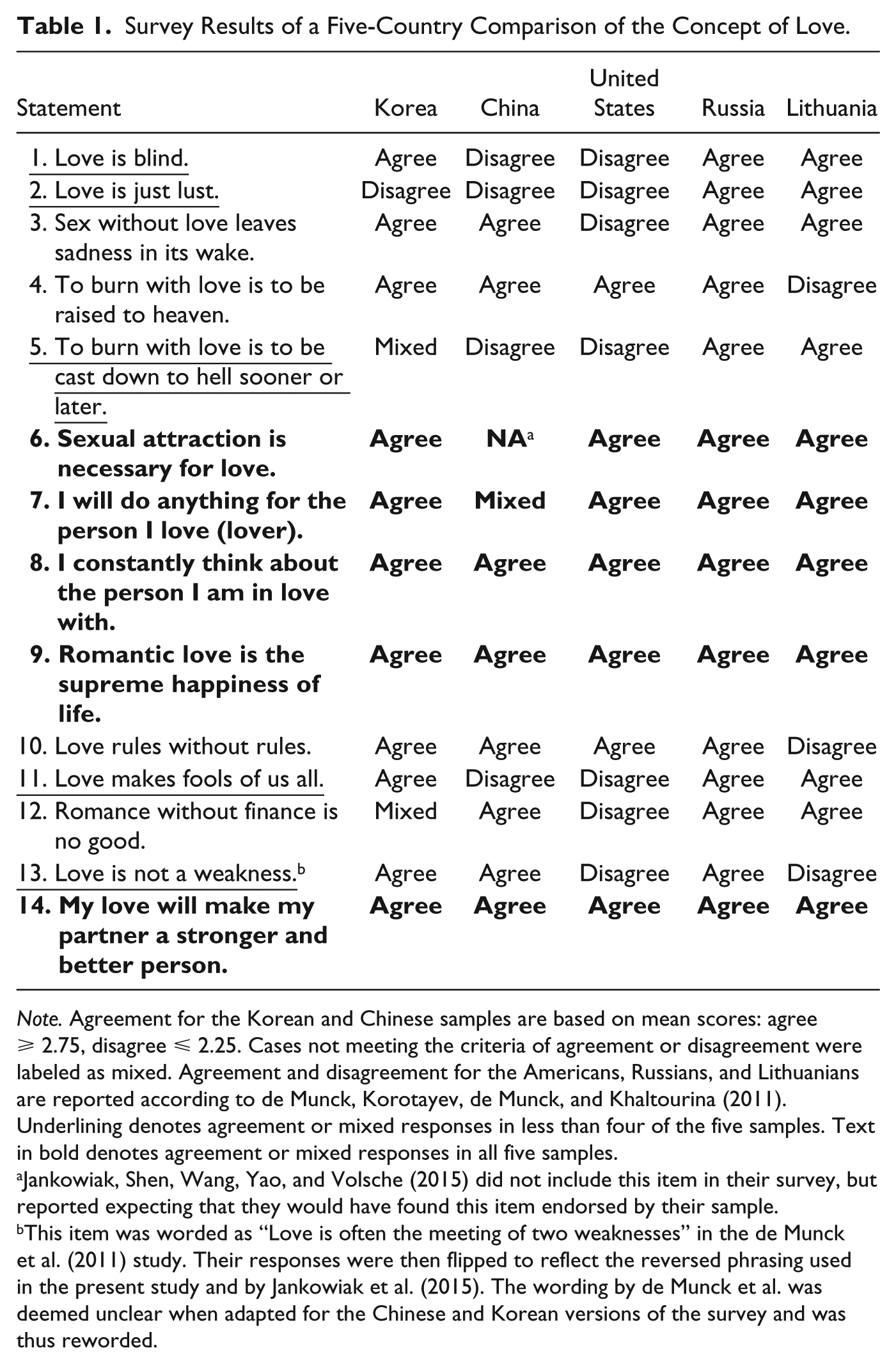
Note. Agreement for the Korean and Chinese samples are based on mean scores: agree ⩾ 2.75, disagree ⩽ 2.25. Cases not meeting the criteria of agreement or disagreement were labeled as mixed. Agreement and disagreement for the Americans, Russians, and Lithuanians are reported according to de Munck, Korotayev, de Munck, and Khaltourina (2011). Underlining denotes agreement or mixed responses in less than four of the five samples. Text in bold denotes agreement or mixed responses in all five samples.
Jankowiak, Shen, Wang, Yao, and Volsche (2015) did not include this item in their survey, but reported expecting that they would have found this item endorsed by their sample.
This item was worded as “Love is often the meeting of two weaknesses” in the de Munck et al. (2011) study. Their responses were then flipped to reflect the reversed phrasing used in the present study and by Jankowiak et al. (2015). The wording by de Munck et al. was deemed unclear when adapted for the Chinese and Korean versions of the survey and was thus reworded.
The results of the Korean survey further support the core attributes of love found by de Munck et al. (2011) in their Euro-American study. They also bolster the assertion by de Munck et al. (2009) that love models vary more between cultures than between genders, as our data mostly supported this contention. Comparing responses between the original dataset of Chinese respondents in the study by Jankowiak et al. with our Korean results using Mann–Whitney U tests, statistically significant differences emerged at a probability below .05 for 27 of the 39 items (see Table 2). In contrast, the Mann–Whitney U tests comparing male and female responses in the study by Jankowiak et al. (2015) revealed four significant differences, while our longer Korean questionnaire indicated 14 (see Table 3). Therefore, 69% of responses varied cross-culturally between the Korean and Chinese samples, while the Chinese sample varied across genders for 10% (4 / 39) of items and the Korean sample demonstrated significant gender differences for 30% (14 / 46).
Comparison of Korean and Chinese Survey Responses.
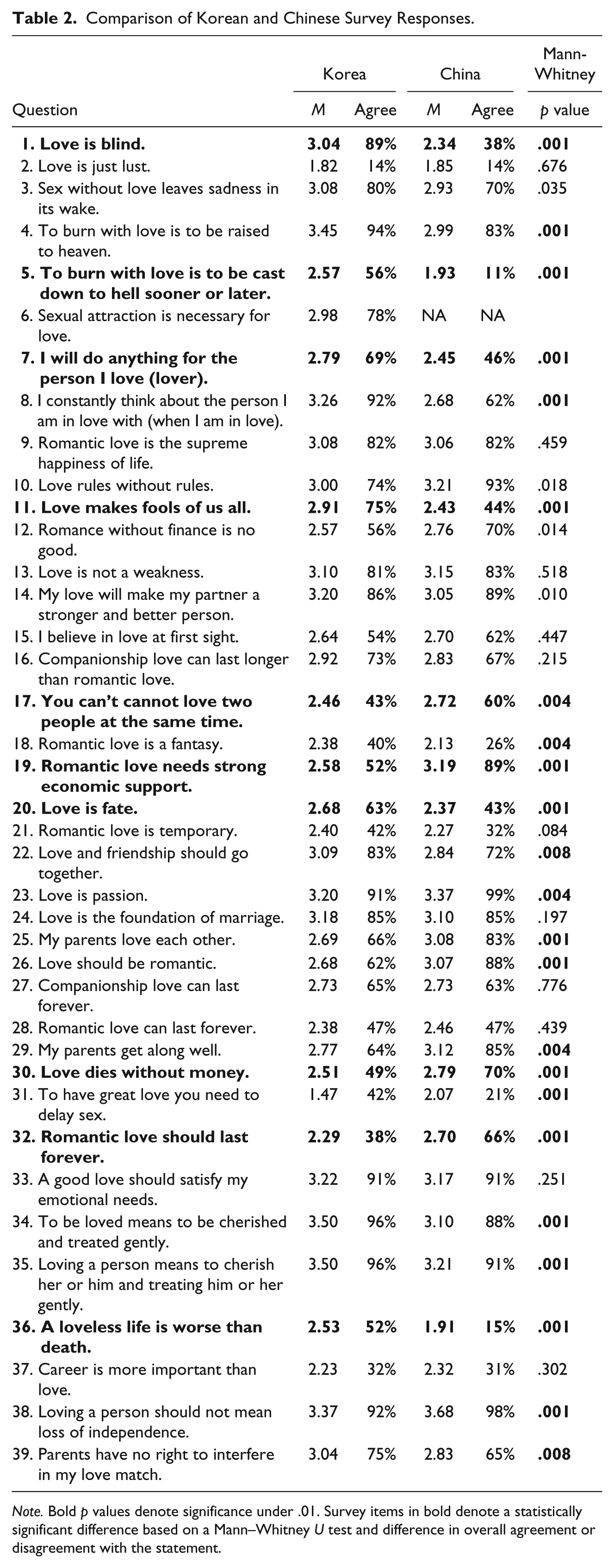
Note. Bold p values denote significance under .01. Survey items in bold denote a statistically significant difference based on a Mann–Whitney U test and difference in overall agreement or disagreement with the statement.
Significant Gender Differences Between Korean and Chinese Samples.
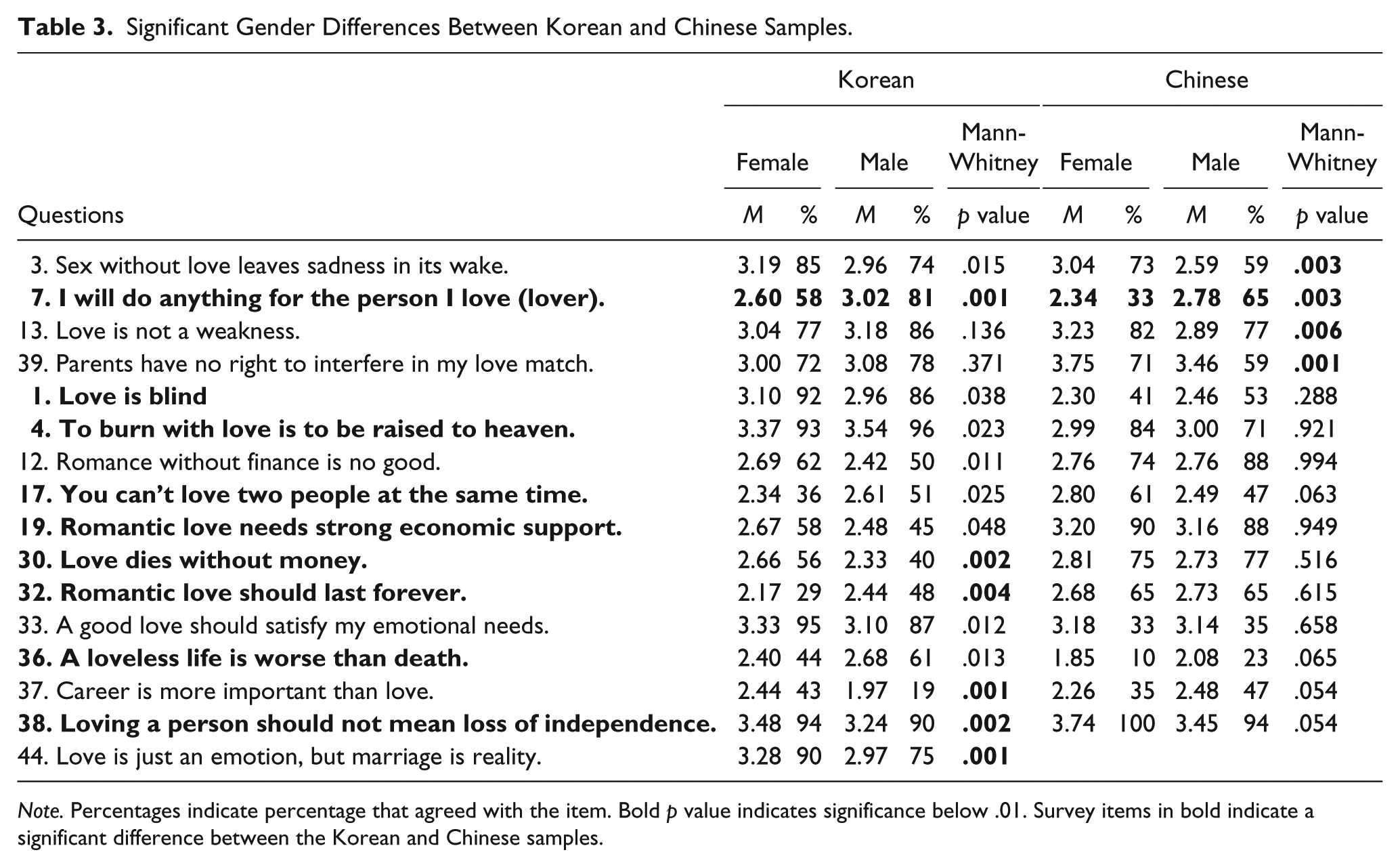
Note. Percentages indicate percentage that agreed with the item. Bold p value indicates significance below .01. Survey items in bold indicate a significant difference between the Korean and Chinese samples.
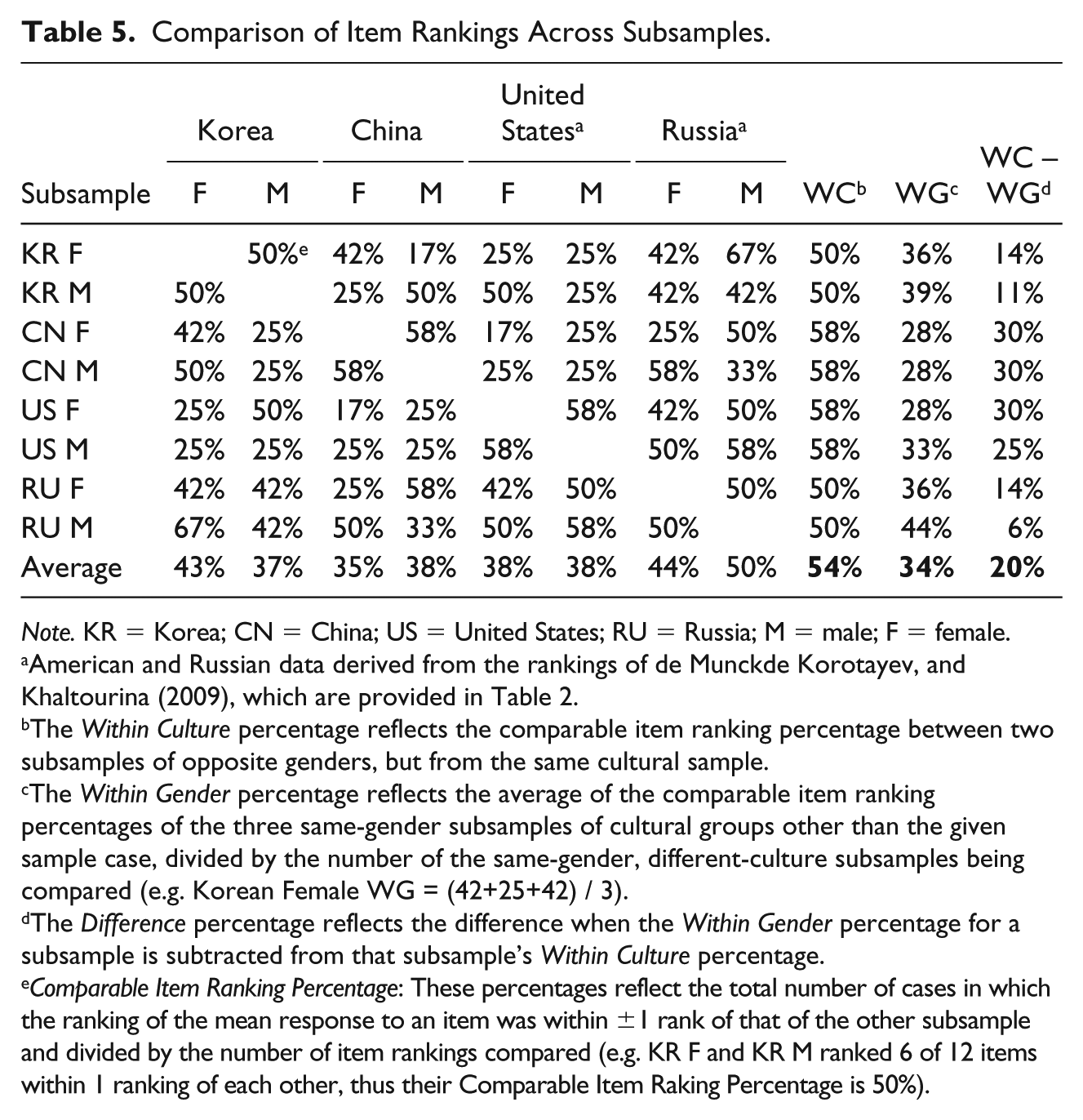
De Munck et al. (2009) contended that conceptualizations of love vary more across cultures than between the genders of a single culture. However, this is less clearly supported by rankings of agreement between the American, Russian, Chinese, and Korean samples when delineated by gender. 4 In their 2009 paper, de Munck et al. compared the rankings of their American and Russian surveys based on mean scores for each culture/gender subgroup. To simplify these rankings, de Munck et al. assigned the four highest rankings to “Category A,” the next four to “Category B,” and the remainder to “Category C.” “A” suggests high agreement and importance, “B” intermediate levels of agreement and importance, and “C” the least agreement and importance. We replicated this procedure using the methods of de Munck et al. (2009) in the Chinese dataset of Jankowiak et al. and our Korean dataset (see Table 4). However, we found this categorization system suboptimal, as it created distinctions that emphasize some ranking differences over others. To address this shortcoming, we compared the rankings of responses from each gender/culture subgroup to create percentages denoting how many items were ranked similarly based on the mean responses of participants in each sample. The criteria used for this comparison were to count rankings as comparable if they were within ±1 ranking of one another. The results of this process are presented in Table 5. 5
Twelve-Item Culture/Gender Subsample Rankings and Rank Groupings.
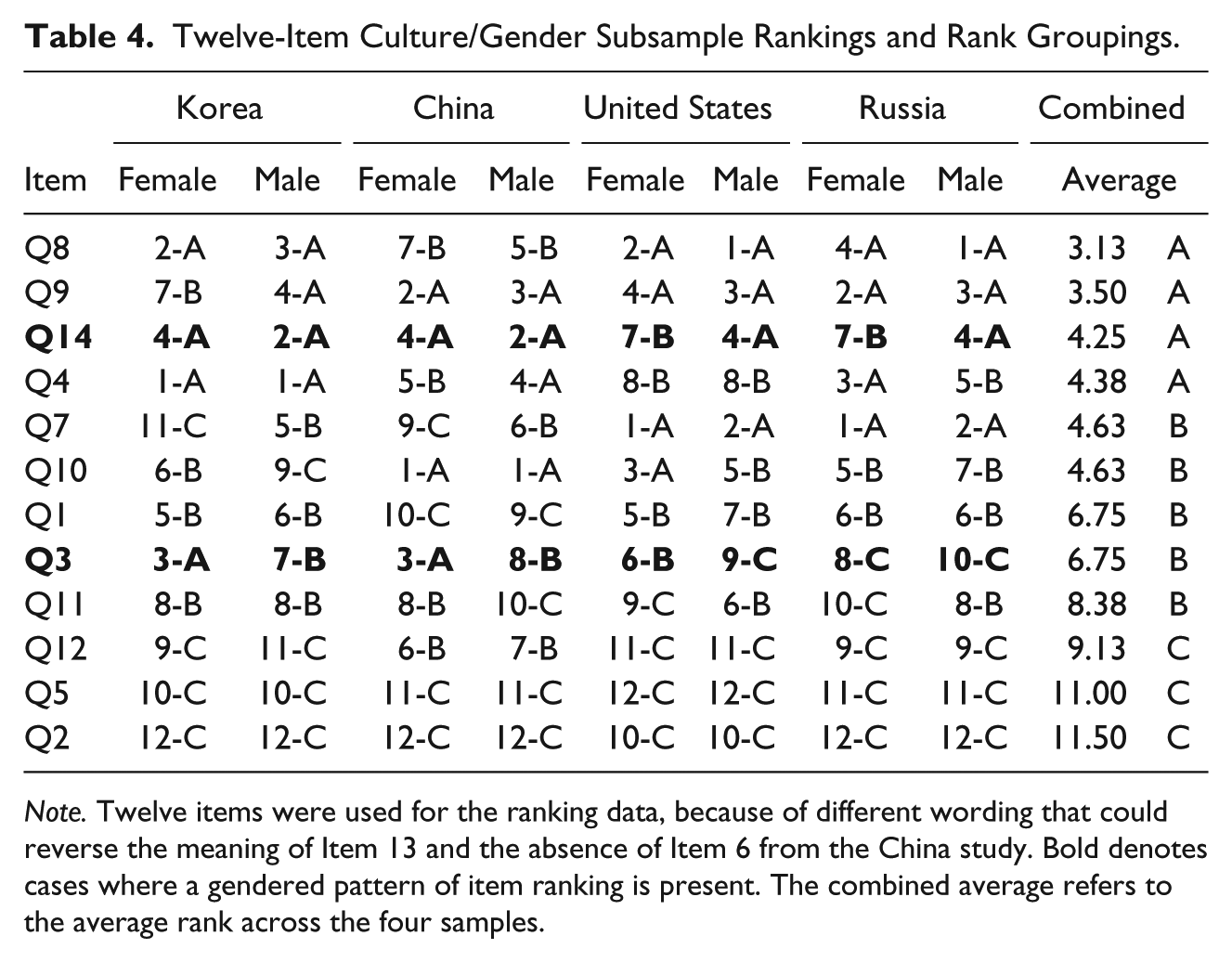
Note. Twelve items were used for the ranking data, because of different wording that could reverse the meaning of Item 13 and the absence of Item 6 from the China study. Bold denotes cases where a gendered pattern of item ranking is present. The combined average refers to the average rank across the four samples.
Comparison of Item Rankings Across Subsamples.
Note. KR = Korea; CN = China; US = United States; RU = Russia; M = male; F = female.
American and Russian data derived from the rankings of de Munckde Korotayev, and Khaltourina (2009), which are provided in Table 2.
The Within Culture percentage reflects the comparable item ranking percentage between two subsamples of opposite genders, but from the same cultural sample.
The Within Gender percentage reflects the average of the comparable item ranking percentages of the three same-gender subsamples of cultural groups other than the given sample case, divided by the number of the same-gender, different-culture subsamples being compared (e.g. Korean Female WG = (42+25+42) / 3).
The Difference percentage reflects the difference when the Within Gender percentage for a subsample is subtracted from that subsample’s Within Culture percentage.
Comparable Item Ranking Percentage: These percentages reflect the total number of cases in which the ranking of the mean response to an item was within ±1 rank of that of the other subsample and divided by the number of item rankings compared (e.g. KR F and KR M ranked 6 of 12 items within 1 ranking of each other, thus their Comparable Item Raking Percentage is 50%).
If there is more variation in the conceptualization of romantic love between cultures than genders, we expect that the percentage of agreement between the ranked responses of males and females of the same society will be more comparable to each other than to subsamples from other cultures. Table 5 shows a number of cases where the rankings of the subsamples were more similar to those of a subsample from another culture, and even other gender, than to the same culture and opposite gender counterpart. For example, while the rankings of Korean females were comparable with Korean males for 50% of the 12 items we compared, 67% were comparable with the rankings of Russian males. On average, the rankings of each subsample were more comparable with their opposite sex–same culture subsample than to the other six subsamples, as seen in the “difference” column in Table 5. The column lists the differences between each sample’s comparable ranking percentage with the opposite gender subsample from their culture against the average of their comparable ranking percentages with the other three subsamples of the same gender. When these comparative ranking percentages are averaged, the samples ranked 54% of the items similarly to their counterpart of the opposite gender from the same culture, with only 34% agreement with their counterparts of the same gender in other cultures (see Table 5). This supports the claim of de Munck et al. (2009) and de Munck et al. (2011) that culture is more significant than gender in predicting the cognitive construction of romantic love across cultures and genders. However, inconsistencies exist, and ranking data revealed gendered patterns in responses cross-culturally.
Examining the ranking of participants’ responses based on mean agreement scores revealed a gendered pattern across the eight culture-gender subsamples for Item 3 (Sex without love leaves sadness in its wake), which was also supported by Mann–Whitney U test results. De Munck et al. (2009) noted this sex difference in Russia and the United States, interpreting it as evidence of the stronger association between love and sex among women than men, which they suggest may represent a gendered model of love cross-culturally. Mann–Whitney U tests found this gender difference to be statistically significant in our Korean responses (p = .015) and the Chinese sample (p = .003) collected by Jankowiak et al. (2015). De Munck et al. (2011) did not report the statistical significance of sex differences in their data.
The only other item where both the Korean and Chinese samples exhibited significant gender differences was for Statement 7: I will do anything for the person I love (lover). This item was also one of the 27 items that significantly differed between South Korea and China when the Korean and Chinese responses were compared through a Mann–Whitney U test (p < .001) (see Tables 2 and 3). Notably this item did not differ between male and female respondents in the American and Russian study of de Munck et al. (2009). Surprisingly, the Korean responses differed more from the United States, China, and Lithuania responses (four of the 14 original items) than de Munck’s Russian responses (one difference of 14: “Love is just lust”) (see Table 1). To interpret the sample’s overall agreement or disagreement with each item for comparison with de Munck’s reported findings, we examined both the mean response and percentage of responses indicating agreement, and identified cases with mean responses over 2.75 and agreement over 60% as agreeing and those under 2.25 and 40% as disagreeing. In the Korea study, two cases (of the original 14) fell between this threshold and were labeled as “mixed” (Item 5: To burn with love is to be cast down to hell sooner or later; and Item 12: Romance without finance is no good), although both their means and percentages suggest more agreement than disagreement. The difference between Korean male and female respondents for Item 12 (Romance without finance) was significant (p = .011), and interview data confirmed this gender difference.
The Korean free list responses contained words comparable with those reported in the Chinese, American, Russian, and Lithuanian samples, but differed by including nouns frequently referring to the object of their love such as girlfriend, boyfriend, and lover, as well as terms for dating, which were not reported in previous studies (see Table 6). Interestingly, the Korean respondents were the only one of the five samples to include “family” in their free list. The only items that occurred frequently in all five samples were “being together” and “sex.” Many frequent responses in the previous four samples also appeared in the Korean free list results, but less frequently, for example, “joy,” “sacrifice,” “travel,” “gifts,” and “movies.” In contrast with the forced-choice questionnaire, the results of the Korean free list more closely resembled the American, Chinese, and Lithuanian responses than the Russian ones (see total at the bottom of Table 6).
Korean Free List Responses and Five-Country Comparison.

Note. A free list item in bold indicates that the item was not reported in the free lists of the previous four samples. Bold comparison X’s indicate presence in all five samples.
A principle components analysis yielded three interpretable factors among the 46 forced-choice question responses (see Table 7). The first factor contains items describing idealistic beliefs about love, the second captures practical and skeptical love attitudes, and the third illustrates a connection between respondents’ beliefs about the quality of their parents’ relationship and attitudes about the timing of sexual intercourse with one’s willingness to defy or reject parental authority over romantic decisions. These factors did not account for as much variance in the sample as did the factor analyses of Jankowiak et al. (2015) and de Munck et al. (2011). Furthermore, the number of questions does not completely account for the difference (25.3% of the variance was accounted for by these three factors).
Principle Components Analysis of the Korean Survey.
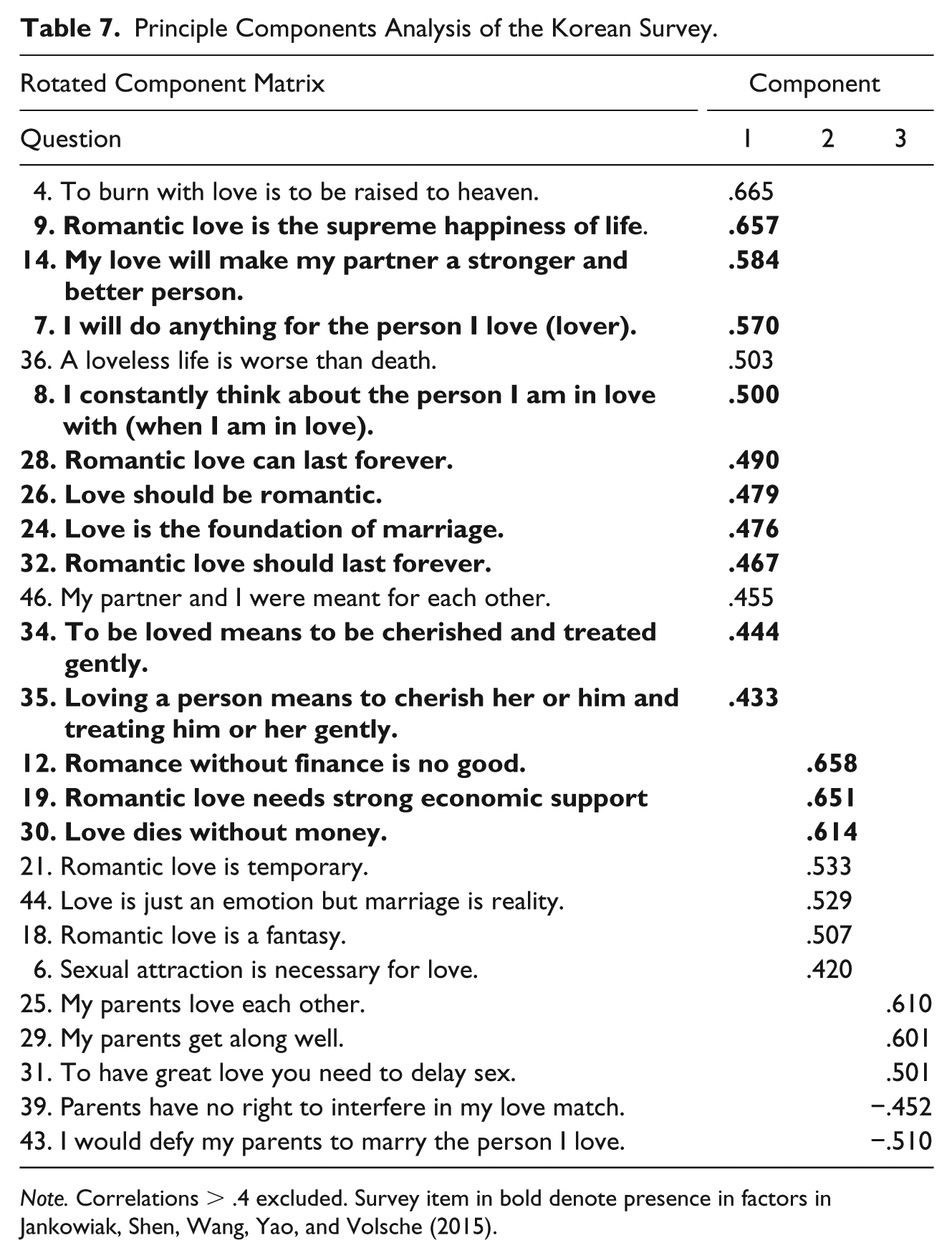
Note. Correlations > .4 excluded. Survey item in bold denote presence in factors in Jankowiak, Shen, Wang, Yao, and Volsche (2015).
Discussion
South Korean Romantic Love in Historical Perspective
To best understand the results of the findings of our South Korean study and the comparisons below, they must be interpreted within the context of South Korea’s cultural history regarding the emergence of romantic love as a criterion for marriage. Based on an analysis of published materials written and disseminated among the intelligentsia of Korea during the Japanese colonial period, Chiyoung Kim (2013) notes that the seeds of a courtship culture were planted by Koreans’ newly acquired knowledge of Western marriage practices. In the process, the new Sino-Korean term yeonae was created to refer to love for a member of the opposite sex. Because of significant missionary activities, the term was also associated with the Christian idea of love as a spiritual state of being (C. Y. Kim, 2013). Concurrent with these social changes, related themes of love, courtship, and marriage by choice were popularized in early 20th-century novels (Baldacchino, 2008, 2005; A. S. Lee, 2005).
By the 1960s, Victor Brandt (1971) paints a mixed picture of the state of Korean courtship. On one hand, he notes that a young man who eloped with a woman from outside the village was ostracized, and young women were jealously guarded from contact with young men from outside the family. On the other, he claims the youth of the village would occasionally have clandestine meetings on the beach under the cover of darkness. In her ethnography of Korean weddings in the 1980s and early 1990s, Laurel Kendall (1996) describes how arranged marriage meetings transformed into courtship. Prior to Korea’s forced opening and colonization by Japan in early 20th century only the couple’s kin actually met their child’s prospective spouse in advance of the wedding. However, gradually men began to insist on seeing (but not speaking to) their prospective bride before giving their consent to the union (Kendall, 1996). This began with white-collar men in the 1940s, and later became increasingly common throughout the country until the period of Kendall’s fieldwork. In the 1980 Kendall (1996) estimated that around half of couples met through arranged marriage meetings in which the couple could both see one another and were expected to engage in conversation. Potentially, they continued meeting for weeks or months before marrying. The other half often also met through some form of introduction by friends, or acquaintances, but these were not pre-screened by parents. Particularly among migrant factory workers, this sometimes led to cohabitation and pregnancy before marriage (Kendall, 1996; E. S. Kim, 1993; S. K. Kim, 1997). By the late 1990s and 2000s, as more women entered the workforce and attended college, opportunities for courtship increased and diversified to include group meetings arranged between students in different university departments and casual one-on-one introductions that did not need to lead to marriage (Baldacchino, 2007, 2008; Lett, 1998).
Today, although parentally arranged meetings oriented toward marriage akin to those described by Kendall exist alongside online marriage matchmaking companies like Duo, middle-class Koreans view such meetings as a last resort primarily used by adults in their mid and late-30s. Middle-aged interviewees all reported a period of courtship, and the majority (94%) of our Korean survey sample reported having experienced being in love (mean of 3 times) and dating (mean of 3.61 boyfriends/girlfriends). This speaks to the current primacy of courtship as the preferred method for evaluating marriage partners, which opened the door to the emergence of romantic love as a criterion, if not a prerequisite, for marriage.
Although courtship and the sanctioned pairing of love with marriage reached its current cultural hegemonic status only in Korea’s modern era, the experience was not unknown in the premodern Korean era, where conceptions of romantic love are apparent in the nation’s literature and folklore. These premodern love stories illustrate elements of romantic love explored by de Munck et al. (2009) and de Munck et al. (2011). Written by a Buddhist monk in the 1200s but attributed to Korea’s Three Kingdoms period (57
The Tale of Chunhyeon (Shin, 2016), which pre-date’s Korea’s forced opening to the world by the Japanese and remains the best-known love story in Korea, highlights several features of romantic love used in the studies by de Munck et al. (2009) and de Munck et al. (2011). In the tale, which began as an epic narrative song and later inspired short stories, novels, films, and TV series, a governor’s son falls instantly in love with the daughter of a former kisaeng (the Korean equivalent of a geisha), an example of love at first sight and of love being blind. He is so overwhelmed by intrusive thoughts of her that he is unable to continue his studies and sneaks off in the night to elope with her. (This is a vivid example of how love can be blind, often resulting in spontaneous behavior and intrusive thoughts and love “ruling without rules” as the elopement violates social conventions of parental authority over marriage.) On winning the approval of Chunhyeon’s mother, the two share a sexually passionate honeymoon until the young man is forced to move to Seoul to complete his civil service exam (an example of sexual attraction being necessary for love). In his absence, the lecherous new governor hears of Chunhyeon’s beauty and demands she become his concubine. When she refuses, she is tortured and jailed to await execution for disobeying (an example of love making one’s partner a stronger and better person, love not being a weakness, and being willing to do anything for the person one loves). The day she is to be executed, Chunhyeon’s husband returns disguised as a royal inspector, punishing the villainous governor and rescuing his faithful wife, who through her devotion earns the acceptance of her parents-in-law. 6 Both these premodern love stories elucidate how Koreans conceptualized romantic love before the companionate ideal of marriage became hegemonic. This suggests that current Korean conceptualizations of romantic love are not merely the by-products of globalization.
Korea’s folkloric accounts of love suggest that the analytical love measures of de Munck et al. describe components of romantic love appropriate to the Korean cultural context. They also indicate that these features of love are long-standing in Korea and not unique to industrialized societies with companionate ideals of marriage. However, cultural models of love are perpetually changing (C. Y. Kim, 2013; Swidler, 2001). Applying the questionnaire by de Munck et al. (2011) to South Korean participants clarifies how widely held the models of love apparent in the media are among actual individuals, how the past century and particularly recent decades have transformed Korea’s models of love, and suggest the sources of such changes through cross-cultural comparison, revealing the core meanings ascribed to love cross-culturally.
Cross-Cultural Core and Peripheral Features of Romantic Love
Our Korean data strengthens the assertion by de Munck et al. (2011) that romantic love shares five core elements cross-culturally, but by expanding the cross-cultural sample, it clarifies which aspects of romantic love are more widely held, if not universal (see Figure 1). Specifically, the ideas that sex can be separated from love without negative consequences (only the American sample disagreed that “sex without love leaves sadness in its wake”), that the throws of passionate love are euphoric (Lithuanians disagreed with the statement “to burn with love is to be raised to heaven”), that love is not governed by pre-scripted rules (Lithuanians disagreed with “love rules without rules”), and that romantic love requires a degree of financial stability (Americans disagreed with “romance without finance is no good”) were cross-culturally supported in all but one of the societies examined. The divorce of romantic and financial considerations perhaps speaks to American’s greater wealth and opportunities compared to the other countries sampled, and while none of these cultures strictly tie sexual relations to marriage or love, the American sample in de Munck et al. (2009) and de Munck et al. (2011) is currently the only one to reject the idea that, ideally, sex should be reserved for loving relationships. This is particularly baffling, as their original study (de Munck et al., 2009), which used a nearly identical questionnaire, indicated a similar response for Russian and American participants, in which American females and males endorsed the ideal tie of sex to love more strongly than did their Russian counterparts. Perhaps the discrepancy arises from unreported differences in the sample population of each study.
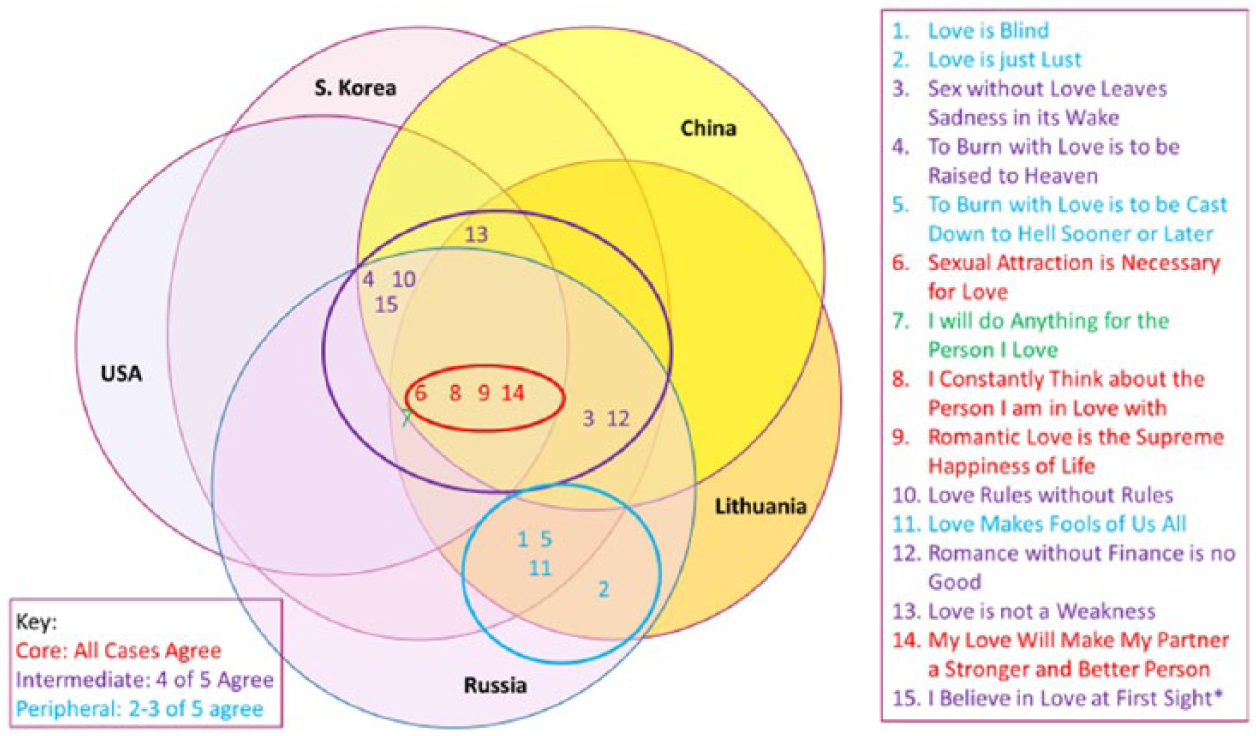
Core, intermediate, and peripheral components of romantic love.
The uniquely un-idealistic attitude toward love of the Lithuanian sample compared with the others was not addressed in the study by de Munck et al. (2011), which described both Russian and Lithuanian samples as viewing love as unreal and temporary. Furthermore, the Lithuanian free list items reported by de Munck et al. (2011) call into question the Lithuanian forced-choice responses, as “joy” was the second most frequent term used and items like happy, passion, and dream seem to conform to the idea of passionate love being “like rising to heaven.” For this reason and others discussed below, it is essential that both forced-choice and free list questions be interpreted together to identify whether the themes underlying the prescribed statements are part of the cultural consensus. Overall, these four themes are widely accepted by each sample, excepting a single outlying culture; thus, they reflect potential intermediately central components of a cross-cultural conception of love. Perhaps their rejection was due to a misinterpretation of the data, differences in the interpretations of the questions across cultures, or another unidentified factor. Perhaps the American anomalies arise from America and Western Europe’s separation of sex and love from courtship based on their hyper-dating cultures, which decreasingly associate adulthood with marriage, enabling lovers to be less concerned with financial considerations or sexual histories as in the “confluent love” described as an emergent ideal of romantic relationships by the sociologist Anthony Giddens (1992). Giddens (1992) based his analysis of the current direction of romantic love in the United States and Western Europe on psychological literature. Perhaps the weaker penetration of psychiatric models of love into Eastern Europe and East Asia are reflected in this cross-cultural difference (Lerner, 2015; Lim, Lim, Michael, Cai, & Schock, 2010).
The most variable conceptions of romantic love make up peripheral characteristics of romantic love, attributes present in certain circumstances but not in others. These attributes appear to be predominantly negative or irrational aspects of romantic love, such as the idea that love causes one to overly idealize the partner or relationship (love is blind) or to act irrationally or shortsightedly (love makes fools of us all). In interviews, South Koreans frequently interpreted these statements as reflecting the propensity of romantic love to lead people to make choices not in their own best pragmatic interests, and to act shortsightedly out of emotion rather than calculation. Eastern Europeans, according to de Munck et al. (2011), may have agreed for different reasons relating to their perception of romantic love as unreal and distinct from companionate love. This separation of romantic love and “real” or companionate love may account for the Eastern European acceptance of romantic love as merely concealed lust. The propensity of Americans and Eastern Europeans to distinguish between “real” and not real love, as described by Ann Swidler (2001) for the United States and de Munck et al. (2011) for Eastern Europe, as well as Giddens’s (1992) distinction between romantic love and confluent love in the United States and Western Europe, could be a product of Europe’s longer history of idealizing companionate marriage (Coontz, 2005). As love is institutionalized in marriage, it may become fragmented into the institutionally safe (companionate love, real love) and dangerous, liminal, anti-structural, passionate-romantic love (passionate/romantic, unreal love). Variability regarding the statements “love is not a weakness” or “love is often the meeting of two weaknesses” used by de Munck et al. (2009) and de Munck et al. (2011), may be attributed to confusion over the intended meaning of the question. Korean informants usually rejected this statement by pointing out (often in an incredulous tone) that love was a source of strength.
Toward an East Asian Model of Love: Commonalities Between South Korean and Chinese Romantic Love Models
Comparing Korean and Chinese responses with those of the studies by de Munck et al. reveals that the only striking difference between them and the Eastern European and American samples is the gender difference in evaluating the statement “I will do anything for the person I love” (see Table 3). This deviation from de Munck’s findings is important, as the item points to a core characteristic of the cross-cultural romantic love model, namely the idea that love ought to involve an altruistic orientation toward one’s beloved. Sprecher et al. (1994) employed a battery of scales, including a short form of the Love Attitude Scale, which includes measures of agapic love (altruistic love). On comparing Japanese, American, and Russian love styles, they found that the Japanese respondents were the least agapic of the three and that Japanese women were less agapic than Japanese men, consistent with our Korean findings and the Chinese findings of Jankowiak et al. (2015). This suggests that de Munck’s questionnaire might yield a similar pattern in Japan. Unlike the studies by de Munck et al., Sprecher et al. found a statistically significant gender difference in agapic love across all three samples and that Japanese females had the lowest mean responses for the agapic love items of all the country/gender groups examined (Sprecher et al., 1994). Thus, why do young East Asian women less strongly embrace the idea of romantic love requiring altruism? Rather than concluding that East Asian women have less altruistic conceptions of romantic love or are less willing to make sacrifices for their partners than their male or Western counterparts, we suggest that this pattern is the result of gender differences in how the question is conceptualized and the unique socio-cultural realities of East Asian gender inequality (see Table 8).
Quantitative Cross-Cultural Gender Differences.
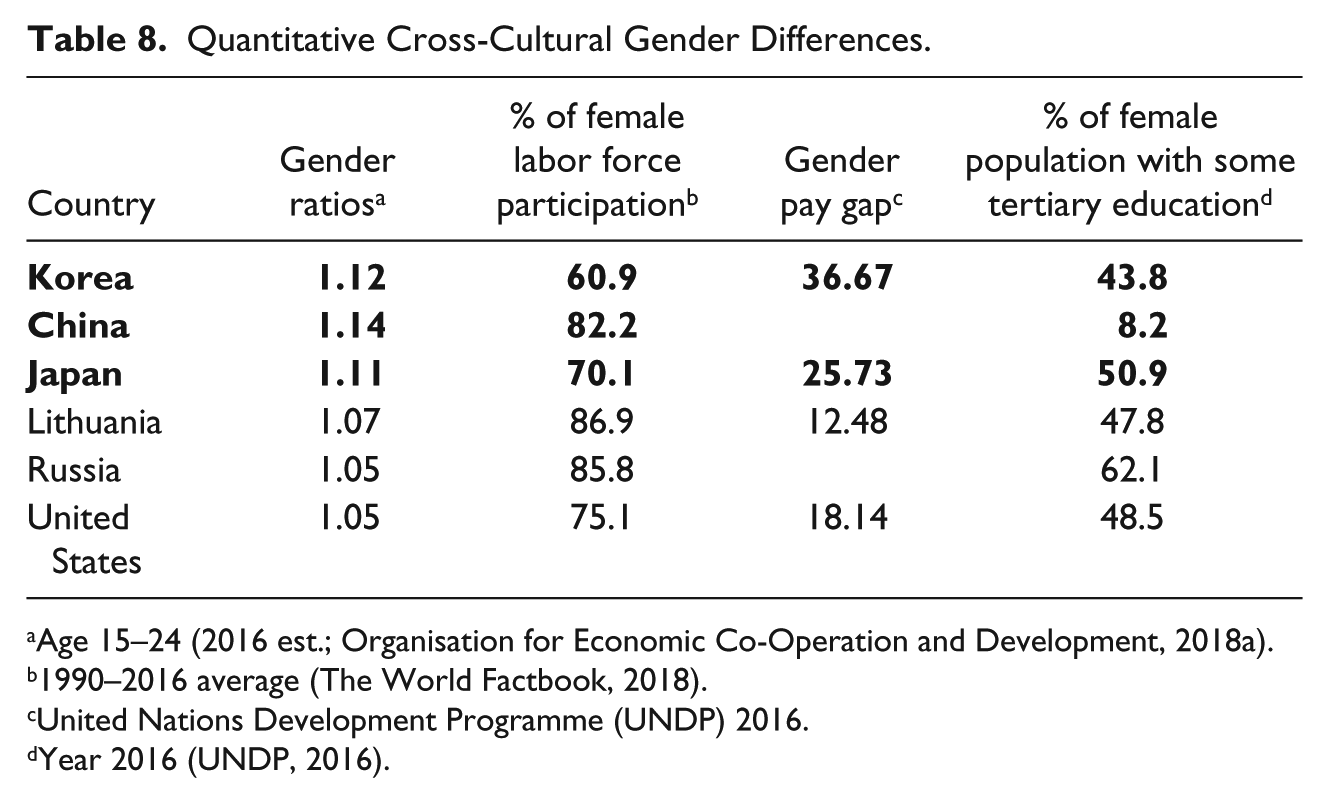
Age 15–24 (2016 est.; Organisation for Economic Co-Operation and Development, 2018a).
1990–2016 average (The World Factbook, 2018).
Year 2016 (UNDP, 2016).
The differences between Korean men’s and women’s responses to the statement “I will do anything for the person I love” reflect differences in what came to mind when considering the word “anything” as well as those in the likelihood that the “anything” actions might actually be asked of them. When men answered this question, they typically thought of insignificant sacrifices they could easily make such as not staying out with friends or co-workers too late or getting up early after a late night to take a girlfriend out for the day. Alternatively, they thought of extreme situations they would be unlikely to experience, such as committing a crime or risking their lives. In contrast, female informants reported imagining having to sacrifice their grades in school, give up a career, or move away from natal kin. These sacrifices are regularly asked of Korean wives and expected to be made for their husbands, whose careers are prioritized over those of their wives. The explanation of differences in reading the item and situations in which respondents consider them seems to proximately explain why Korean and Chinese females answered differently from Korean and Chinese males. However, this might not explain why this difference was absent in the other three samples, why Sprecher et al. (1994) found Japanese women to be less agapic in their love style, and why Chinese females on average disagreed with the statement “I will do anything for the person I love,” while Korean females were simply split on the question. Potential sources of the ultimate causation of this cross-cultural difference must be identified.
Ultimately, cross-cultural differences between the three Euro-American samples and Korean and Chinese samples must account for the differences between Korean and Chinese females’ responses to the item “I will do anything for the person I love.” One explanation is the qualitative and quantitative differences in gender inequality between East Asia, the United States, and Eastern Europe. Quantitatively, there are some indicators of greater gender inequality in East Asia than Euro-America, for example, greater differences in gender ratios due to the historical preference for sons, which contributes to marking women with a lower social status in the family and society. Korea, China, and Japan have more skewed gender ratios than the United States, Russia, and Lithuania when examining the 2016 estimates of 15- to 24-year-olds (see Table 8). Females are likely to be more selective and more able to demand commitment when the supply of eligible partners is greater (Guttentag & Secord, 1983). Thus, a larger gender ratio may be a contributing factor in the self-reported lack of romantic altruism of young East Asian females. Second, with the exception of the difference between China and the United States, East Asian countries have lower female labor force participation than Eastern Europe and the United States (World Factbook 1990-2016 average, see Table 8). Lower female labor participation translates into greater female financial dependence on male kin and husbands. The gender pay gap between East Asia and Euro-America is also greater, although statistics for China and Russia are unavailable (see Table 8). Furthermore, Korea and China have lower percentages of females with some tertiary education than the United States, Russia, and Lithuania. In the Chinese sample, which is composed entirely of college students at an elite Shanghai university, this suggests that college-educated respondents may be highly unrepresentative and their lesser willingness to unconditionally support a prospective lover may be attributed to their unique status. This limitation and others are discussed in the conclusion. Apart from the quantitatively apparent gender inequities that make sacrifices for love more unpalatable for young Korean and Chinese women than their Euro-American counterparts, additional patriarchal cultural legacies may account for this gap.
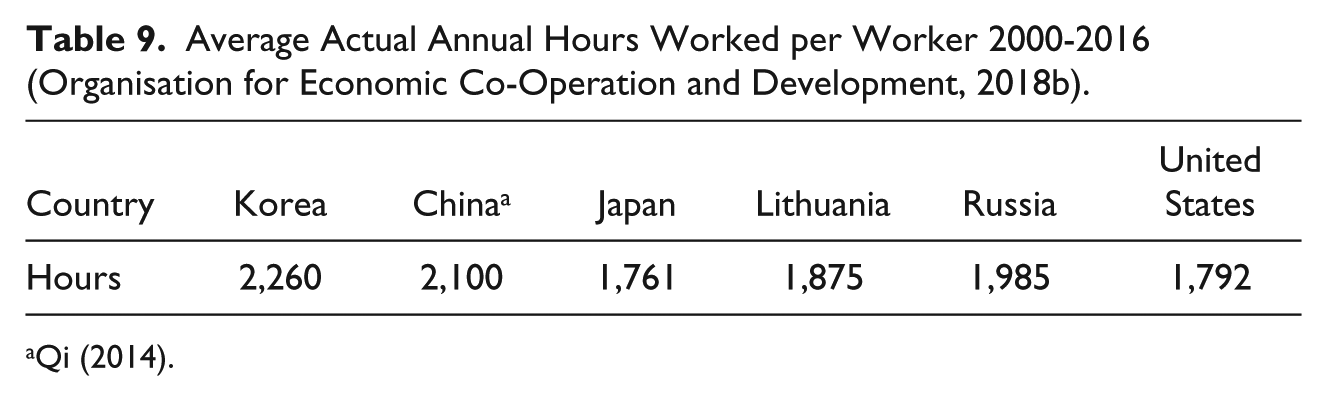
The relatively weaker agreement of East Asian women with agapic characterizations of love may also arise from unmarried women’s resistance to the cultural expectation that it is a female’s duty to sacrifice and subjugate herself in the family to enhance her children’s success and maintain the reputation of her natal kin. The burden on mothers to ensure children’s educational achievement is exacerbated by intense competition and extreme status sensitivity, particularly in South Korea, where the relative rankings of universities are common knowledge (Abelmann, 2003; Lett, 1998). Thus, for the college educated, where one receives a tertiary education is nearly as important as attending college at all. In addition, the costs of childhood education increase the demand on mothers to earn money to pay for the expensive advantages of private after-school programs, which are considered necessary for their children to succeed in the competitive college entrance exam and keep up with their school peers (Seth, 2002; Tudor, 2012). While many South Korean women are willing to sacrifice their careers for their children’s achievement, this sacrifice is likely made more willingly for children than for spouses. For example, our Korean interviews indicated that while husbands often report that the person they are closest to is their wife, wives tended to report being closer to their children. In the 1980s, Jankowiak (1993) revealed a similar finding for urban Chinese women. 7 The long hours worked in Korea and China compound the demands on wives to either completely manage their children’s education, rely on grandparents, or seek professional child care (see Table 9).
Average Actual Annual Hours Worked per Worker 2000-2016 (Organisation for Economic Co-Operation and Development, 2018b).
Although grandparents can be a great asset for couples with children as sources of free or inexpensive child care, in Korea, conflict with parents-in-law are regularly noted as a primary source of marital conflict alongside financial issues, especially in the early stages of the relationship. This is especially so if one or more parents-in-law moves in with the couple. Reliance on grandparents introduces several points of contention, not all of which are familiar in non-East Asian cultural contexts. For example, while Americans are no stranger to disputes over how to raise their children when handing them over to doting grandparents, in South Korea, entanglement with the extended family can raise the specter of the patriarchal Confucian household, in which the daughter-in-law becomes the lowest ranking adult member of the family and the mother–son bond ideally trumps the love between husband and wife. The greater tendency for conflict between the wife and her in-laws, rather than between the husband and his in-laws, reflects Korea’s tradition of patrilocal marriage, in which married daughters are considered to have left their natal family to join their husband’s. This residential pattern dates to the beginning of the Neo-Confucian Choson Dynasty from 1392 to 1897
However, we should not conclude that the female East Asian notion of love is devoid of any altruistic impulse or ideal. These explanations are offered merely to account for the relative difference in Korean and Chinese responses from the cultures examined by de Munck et al. (2011). In both the Chinese and Korean free lists, sacrifice was readily evoked, as was the value of commitment (Table 6). Sacrifice was also regularly emphasized in the first author’s interviews with middle-aged Korean wives. Moreover, sacrifice is emphasized in Korean and Chinese love folktales, such as the tales of the Tigress and Chunhyeon described earlier. Thus, it appears that the hesitancy of East Asian women to proclaim their willingness to make sacrifices for their partners stems from a realistic assessment of the gravity of this proclamation for their gender, not from psychological indifference to altruistic action. The interviews combined with an analysis of popular folktales further support our position that the sex difference emerging in our questionnaire concerning the willingness to “do anything for a lover” may not be an accurate representation of women’s actual behavior once they are in love.
Korean and Chinese respondents shared many beliefs about love that distinguished them from the American or Eastern European samples. Korean and Chinese respondents, like their American counterparts, rejected the idea that love was merely concealed lust. However, they agree with the Eastern Europeans in asserting that sex should be linked exclusively to love and that financial stability is necessary for romantic love to have a positive outcome. The significant stigma associated with childbirth out of wedlock may account for the East Asian and Eastern European acceptance of Item 3 (sex without love leaves sadness in its wake). For non-college-educated Americans, single parenthood has become increasingly normal and marriage difficult to obtain (Carbone & Cahn, 2014). Koreans and Chinese respondents also reported believing that “love is the foundation of marriage,” and although they agreed that companionate love was longer lasting than romantic love, they did not always consider these as separate types, as did the Russian respondents. Like Americans, the Koreans and Chinese regarded romantic love as real and capable of phasing into companionate love, or for some, persisting forever. In addition, like Americans, the Koreans and Chinese thought love and friendship could go together. De Munck et al. (2011) considered this separation of love and friendship as evidence that Russians and Lithuanians view romantic love as unreal. In the study by Sprecher et al. (1994), which compared the love styles of the Americans, Russians, and Japanese, the Russian responses were more ludic than that of the Japanese or Americans. Ludic love is characterized by being playful, unserious, and uncommitted (Hendrick & Hendrick, 1986). This supports the claim by de Munck et al. (2011) that Russians see romantic love as distinctly temporary and unreal, and thus incompatible with companionate love and friendship.
Comparing the principle components analysis of our Korean sample with that by Jankowiak et al. (2015), we found that in both societies, factors form around idealistic beliefs (Component 1) and practical ones (Component 2) (see Table 7). For the idealistic component, the Korean and Chinese samples held nine of the 13 traits in common (see items in bold in Table 7). The samples differed more in the second (pragmatic) components (three of seven in common). For Koreans, this component included several statements that question the reality of love, which correlated with endorsing pragmatic statements such as “love is just an emotion, but marriage is reality,” a common Korean expression. In total, 75% of male and 90% of female respondents agreed with this item, expressing the primacy of the institution over the emotion (see Table 3). This item was not included in the Chinese study.
Cross-Cultural Differences in East Asian Romantic Love: South Korea and China
Of the 39 forced-choice items included in the Chinese survey (Jankowiak et al., 2015), the Korean sample differed significantly on 27 of the 39 (69%) questions based on Mann–Whitney U tests (Table 2). Of the 27 items, only 10 (26%) were substantially different (in terms of statistical significance and overall tendency to agree, disagree, or be of mixed agreement). Of these 10 items, four can be summarized into two domains: the necessity of financial considerations as a foundation for love (e.g., “love dies without money,” “romantic love needs strong economic support”) and the belief that love is irrational and shortsighted (e.g., “love is blind,” “love makes fools of us all”). The Chinese participants strongly agreed with the idea that romantic love needs solid economic support and slightly less with the statement that “love dies without money.” Furthermore, the Chinese disagreed with the statement “love is blind” or that it “makes fools of us all.” Their responses suggest that the Chinese tend to view love as a more practical endeavor, which may curtail an irrational albeit loving impulse such as falling for someone financially unsuitable. Unlike Americans, the Koreans were torn about the idea that financial considerations should be a part of the calculus of love. This split is in part due to the significant South Korean gender difference over the idea that financial resources are a necessary requirement for love (Table 3). In interviews, Korean men often rejected this notion, pointing to examples such as adolescent love in which couples enjoy each other’s company without having significant money to spend. Korean women tended to downplay the importance of money, while remaining aware that many marital arguments arise over financial issues. Even when dating, Korean women reported that money could be an issue, such as when their male partner earns less than them and, as a result, becomes overly self-conscious and sensitive to this difference.
Downplaying the value of money is not apparent in China, where both young men and women recognize the pragmatic side of marriage. For example, the exorbitant real estate prices in and around Shanghai (and other large cities) make it difficult to purchase property within commuting distance of the city without the benefit of parental real estate investments (Arkaraprasertkul, 2016; To, 2016). The results of the “one child policy” (that was pursued in China between 1979 and 2016) may also play a role in Chinese love calculations. Considering that each marriage of singletons potentially needs to support four elderly parents, the repercussions of choosing a financially inept partner can be substantial (Fincher, 2014).
South Koreans also differed significantly from the Chinese participants in the study by Jankowiak et al. (2015) on two seemingly contradictory items describing the temporality of romantic love. On average, Koreans disagreed with the idea that romantic love should last forever; however, they were split regarding whether being in love meant one would eventually face hardship. Chinese respondents strongly disagreed that romantic love would develop into hardship and that romantic love could not last forever. Korean informants were divided on whether romantic love should last forever. Men were equally divided, while the women mostly disagreed (see Table 3). This division did not emerge for the Chinese sample. Perhaps the greater age range of the Korean sample, and thus greater experience, accounts for their skeptical belief that love does not need to be permanent. This experience might also account for their perception that love is often followed by hardship. Korean informants interpreted Item 5 (i.e., To burn with love is to be cast down to hell sooner or later) in two ways, which explains their split response. Those who agreed tended to explain that in the course of a love relationship, some moments of hardship occur, although these do not necessarily lead to the relationship ending. Those who disagreed believed that severe hardship was avoidable, at least for some couples. Taken together, these two questions suggest that the Chinese participants had a more idealistic conception of romantic love in terms of its longevity and propensity to bring or not bring hardship. The Chinese participants’ strong disagreement with the statement “A loveless life is worse than death” implies that Chinese youth are not entirely idealistic, but retain a milder or more optimistic view of love, considering it as having fewer ups and downs than their South Korean counterparts. Given their young age, this may be a reflection of the Chinese sample’s naive optimism rather than a wide spread cultural attitude shared among older and more experienced individuals. An alternative explanation is that these Chinese participants compensate for a lack of love with other interests.
Overall, the differences and similarities suggested by this study between Korean and Chinese models of love support the findings of de Munck et al. (2009) and de Munck et al. (2011). Despite the gendered differences between survey responses in Korea and China regarding the altruistic component of love, when all data are considered, each of the core components of love de Munck et al. (2011) outlined in this article were supported in both South Korea and China. Comparing the Korean and Chinese data also supports de Munck et al. (2009), who claimed that models of romantic love vary more between cultures than between genders. While the Korean and Chinese responses differed significantly for more than two thirds of the survey items, both samples demonstrated significant gender differences for less than 33% of the questions asked. A comparison of the agreement rankings between subsamples delineated according to culture and gender revealed that, when ranked, the responses of the Korean and Chinese participants more closely resembled their countrymen’s responses than their cross-cultural counterparts of the same gender.
The pattern of responses distinguishing American and Eastern European models of love was also not challenged by comparing the Korean and Chinese samples. De Munck et al. (2011) argued that where romantic love is perceived as unreal, it will be disassociated with friendship and marriage. In this regard, the Korean and Chinese samples mirrored the American pattern of perceiving romantic love as real and the basis of marriage and friendship. Our Korean sample differed most with Jankowiak et al. (2015) in terms of negative conceptions of love such as its temporality, irrationality, and practicality, aspects that also varied most among the five cultural samples. Considering these five samples together clarifies this emergent overall pattern and suggests a cross-cultural model of love consisting of core, intermediate, and peripheral components ranging from the universal to the culturally variable.
Conclusion
Our findings build on the work of de Munck et al. (2009), de Munck et al. (2011), and Jankowiak et al. (2015), and further support their findings that the cross-cultural core meanings of romantic love include intrusive thinking, sexual attraction, transcendence (or self-actualization), and altruism. We also found that negative meanings associated with romantic love, such as its temporality, unreality, irrationality, and propensity to cause harm, are cross-culturally variable. To determine if the core traits documented in these five cultures are representative, further research in other cultural contexts, especially in non-industrialized and non-agricultural societies, is required. These studies also support and expand the predictions of Lindholm (1998) by highlighting the centrality of transcendence and non-instrumental conceptualizations of romantic love in highly competitive, individualized societies with companionate ideals of marriage. However, these studies have not challenged Lindholm’s (1995, 1998) more controversial claim that cultural ideals of romantic love can be chaste, such as among the Troubadours, Bedouins, and the Marri Baluch of Pakistan. In these societies, love and marriage were separated and conceptions of sex as demeaning prohibited its affiliation with an idealizing romantic love ideology.
This study and those preceding it have several limitations that future studies should seek to address. The questionnaire would benefit from collecting more extensive demographic information that could help interpret variation within cultural samples and clarify which age groups are represented in the data. This questionnaire would also improve in terms of precision and accuracy by adopting subscales of items for each characteristic of love examined.
Also, future studies examining the cross-cultural model of romantic love should consider precautions to mitigate extreme and neutral response biases. Neutral response biases have been associated with respondents from collectivist cultures in cross-cultural psychology (C. Chen, Lee, & Stevenson, 1995; Hui & Triandis, 1989). Although these biases were statistically significant, they “generally did not alter cross-cultural comparisons of item means” (C. Chen et al., 1995, p. 170). C. Chen et al. (1995) found in their comparison of East Asian and North American respondents that doubling Likert-type scale items from 5 to 10 greatly reduced response style. However, Arce-Ferrer’s (2006) study of response styles found increasing Likert-type options did not reduce extreme response styles when comparing American and Mexican responses.
Each of the studies thus far have compensated for these limitations through interviews and extensive ethnographic knowledge. Future adaptation of this survey to new contexts will also require extensive cultural knowledge, as direct translation is not always possible or appropriate. Items that are more direct and less poetic might also ease the translation process, as Jankowiak et al. (2015) partially attempted with their adjustments. These adjustments might also make the scale more amenable to back translation.
The ethnographic record needs to engage the psychological and sociological literature, which has developed numerous scales to describe and measure the polysemic meanings of love. An interdisciplinary approach using a battery of complementary survey measures combined with open-ended questions, interviews, ethnographic observations, and historical knowledge would strengthen our ability to account for the cross-cultural commonalities and variations associated with romantic love. As globalization opens the door to more transcultural relationships, an understanding of how our assumptions and expectations about love influence our experiences will be increasingly relevant and critical in understanding the conflicts that may emerge from cultures’ discordant conceptions of love: the phenomenon that it is in private fantasy and cultural reality.
Footnotes
Acknowledgements
The authors thank William Jankowiak and his coauthors Yifei Shen, Cancan Wang, and Shelly Volsche, for their generosity in sharing their original China survey data for this article. They also thank William for his helpful guidance and encouragement during the writing of this manuscript. This article was significantly improved by the thoughtful suggestions and comments of the reviewers, by Carol Ember, and by Charles Lindholm who also provided many insights for this research program’s future development. Finally, they thank the following people who helped make the dissemination of this survey and the first author’s South Korean fieldwork possible: Song Gwanmin, Kim Sahoon, Kim Sangji, Yoo Eunhye, Kim Mira, Hong Minseok, David Kute, Kim Minjung, and Olga Fedorenko.
Declaration of Conflicting Interests
The author(s) declared no potential conflicts of interest with respect to the research, authorship, and/or publication of this article.
Funding
The author(s) disclosed receipt of the following financial support for the research, authorship, and/or publication of this article: The fieldwork, equipment, and participant incentives for this study were supported by the UNLV Anthropology Department’s Edwards and Olswang Grant and a Graduate Research Travel Grant from UNLV’s Graduate and Professional Student Association.