



Abstract
This article presents an international study of pro/antisocial behavior in young adults (SOCIALDEVIANCE1820). This is an ongoing cross-continental longitudinal research project that includes data and researchers from multiple countries across five continents. It aims to explore the intercultural universality of the risk and protective factors associated with pro/antisocial behavior and psychosocial adjustment during early adulthood. Researchers from all countries involved have already translated their questionnaires, selected an appropriate team, and started the data collection process. It is expected that this intercontinental longitudinal research project will have a tremendous social and scientific impact; this study will allow researchers to overcome many limitations of previous meta-analyses, such as limiting the applicability of data to developed countries and the bias caused by combining different assessment methods. Challenges in implementing cross-national studies, and the importance of this type of study to global policies, are discussed.
Keywords
Introduction
SOCIALDEVIANCE1820 is an ongoing cross-continental longitudinal study that aims to explore factors related to psychosocial adjustment and prosocial and antisocial behavior during early adulthood. Young adulthood, according to established scientific evidence (Farrington, Loeber, & Howell, 2012; Moffitt, 2006; Stolzenberg & D’Alessio, 2008), is a stage of life where social roles change, and it is known to be a key period for changes in levels of criminal activity, usually for the beginning of desistance from crime but in some cases for the aggravation of criminal activity. This period of time, therefore, is particularly important for behavioral changes and, in the case of deviant behavior, has a tremendous impact on and cost to society.
The understanding of intercultural risk and the protective factors for anti/prosocial behavior and psychosocial adjustment are major research and policy goals. Meta-analytic studies (Braga, Gonçalves, Basto-Pereira, & Maia, 2017) have provided exceptional insights into these goals; nonetheless, almost all studies included in meta-analyses have come from a very limited number of countries on just two continents (North America and Central and Nordic Europe). At the same time, an accurate replicability and test of the risk and the protective factors for anti/prosocial behavior and psychosocial adjustment implies that each study should use the same measures and that these should be applied under the same principles using relatively universal theoretical constructs (Basto-Pereira, Começanha, Ribeiro, & Maia, 2015).
However, most cross-national studies rely on official crime statistics, such as arrests or convictions and are biased by different legal frameworks. One of the few, and most remarkable, exceptions is the International Self-Report Delinquency Study (ISRD; 2019), a cross-national study of delinquency, substance abuse, and victimization among seventh-, eighth-, and ninth-grade students, with the main goal of comparing prevalence rates of self-reported delinquency, substance abuse, and victimization between countries and, further, producing scientific outcomes with implications for criminological theories and public policies. The second data collection sweep included participants from 31 countries; nonetheless, almost all participants came from Western regions. This project is now on the third data collection sweep, which covers 35 countries (Enzmann, Marshall, Steketee, Hough, & Killias, 2018).
In addition, there are two important cross-national works in related fields: the European School Survey Project on Alcohol and Other Drugs (The ESPAD Group, 2016) and the Parenting Across Cultures (PAC) Project (Lansford & Bornstein, 2011). The first project is a cross-national study conducted in 48 countries, whose main goal is to compare the prevalence of self-reported use of tobacco, illegal drugs, and alcohol among adolescents across European countries over time. Since the initial data collection in 1995, this survey has been conducted six times (The ESPAD Group, 2016). The second project, PAC (Lansford & Bornstein, 2011), is a remarkable longitudinal study conducted across nine countries and focused on how parenting, cultural, and biological characteristics affect child development until adolescence and young adulthood, including the development of risk-taking and self-regulation. Some years later, Steinberg et al. (2017) conducted a large cross-national longitudinal research project with the goal of exploring the development of risk-taking behaviors from childhood to young adulthood. Most of the study participants were integrated into this second cross-national research; it also included participants from two additional countries: Cyprus and India.
Despite the importance of carrying out cross-continental investigations, there are very few studies that include countries from truly diverse social and cultural backgrounds that focus on delinquency and/or child maltreatment. Furthermore, most such studies are limited to cross-national data from high-income Western countries and mainly focus on prevalence. The lack of truly cross-cultural research in this field creates a major bias, particularly given that culture plays a strong role in behavior. This issue imposes the following questions: is the current research only valid for high-income Western countries? Can we successfully base global policies on these results? In focusing on these concerns, the SOCIALDEVIANCE1820 project, a large international collaborative research project, was created (Figure 1).
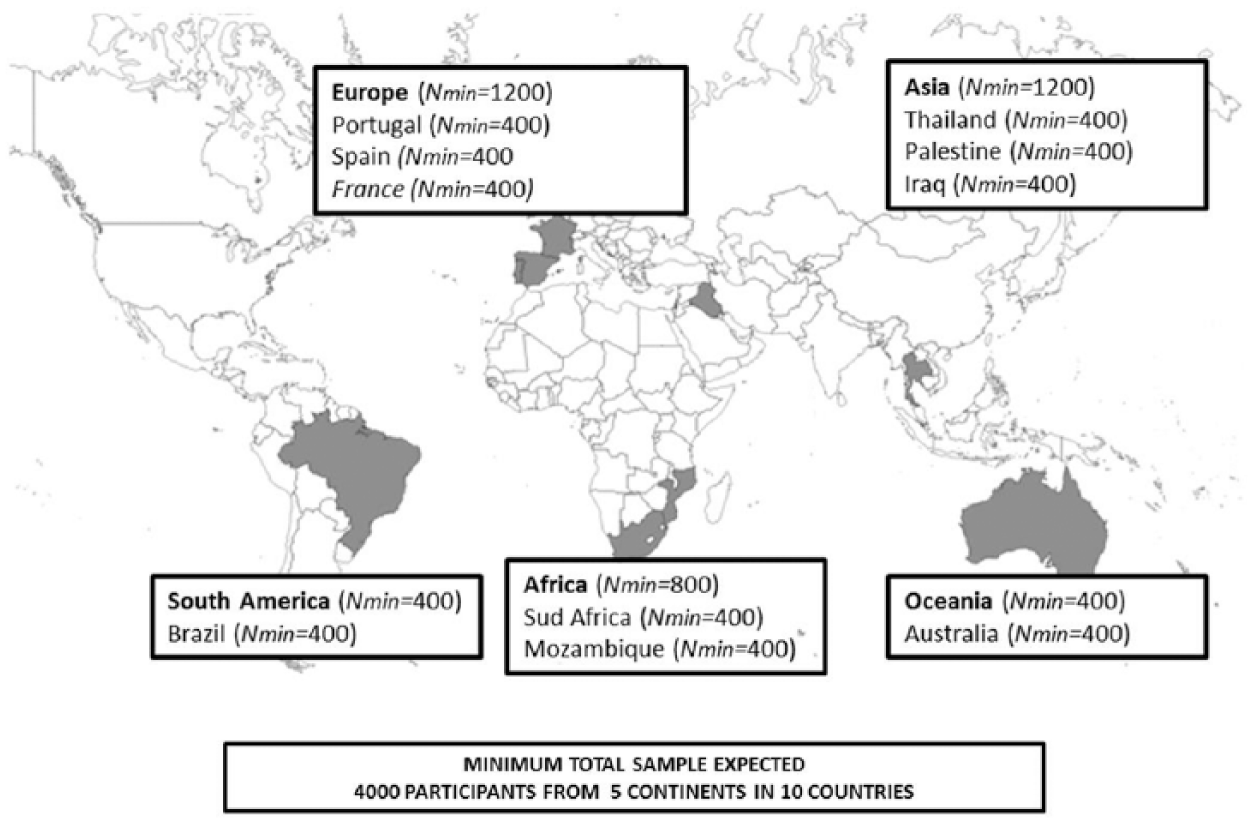
Visual representation of the countries that agreed to participate in this study and the expected sample in each country.
This article has two main goals: (a) to present, for the first time, a detailed description of the SOCIALDEVIANCE1820 cross-cultural research project and (b), drawing on the lessons learned until now, to discuss the challenges in implementing large cross-cultural studies and strategies to overcome them.
Main Goals of the SOCIALDEVIANCE1820 Study
The main goals of the study are (a) to test the universality of childhood adverse experiences as risk factors for antisocial attitudes, psychosocial adjustment problems, and inhibitors of prosocial attitudes, and also their mediators; (b) to investigate the intercultural validity of a number of key features of the Integrated Cognitive Antisocial Potential Theory (Farrington & McGee, 2017), the Age-Graded Theory of Informal Social Control (Sampson & Laub, 2005), the Deviant Peer Contagion Theory (Dishion & Tipsord, 2011), Psychopathy as a Unified Theory of Crime (DeLisi, 2009), and the Developmental Psychopathology Perspective (Cicchetti, 2016); (c) to explore whether coping strategies and significant life events (e.g., marriage) are related to pro/antisocial attitudes and psychosocial adjustment across cultures; and (d) to evaluate the psychometric properties and cross-cultural invariance of assessment scales for deviance, antisocial, and psychosocial functioning outcomes.
SOCIALDEVIANCE1820 is divided into three phases, and is expected to evaluate 4,000 young adults in the first phase. All the participants who participated in the first phase and agreed to be contacted again will be invited to participate in the second and third phases of this study. The first phase began in 2018, the second phase is expected to begin in 2019 (1 year after the first phase), and the third phase is expected to begin in 2020 (2 years after the first phase).
The longitudinal aims of the SOCIALDEVIANCE1820 project are the achievement of each main goal using a longitudinal, and thus more robust, design. Some examples of the study’s longitudinal aims are (a) to explore the universal impact of changes on social environment and on coping styles during young adulthood as protective factors mitigating the impact of serious childhood adversity; (b) to test if the traditional predictors of desistance from crime work on adult victims of child maltreatment; (c) to test the effect of life changes that are known risk/protective factors in desistance from crime (e.g., marriage and employment/unemployment changes); (d) the study of natural changes in coping styles and their mediational effect on the reduction of self-reported deviant behavior, mental health, and pro/antisocial characteristics; and (e) to analyze the cross-cultural temporal stability of antisocial traits.
Methodology
To be considered eligible for inclusion in the study, participants must be young adults in the local community between the ages of 18 and 20. The exclusion criteria include having less than 4 years of schooling, not understanding the language, or having severe psychopathology, all of which might jeopardize participants’ ability to understand and answer the questionnaire. The established preferential criteria specify a maximum gender discrepancy ratio of 35% to 65%, at least 10% nonstudent participants, and 10% to 50% with more than 12 years of education.
In most countries, the questionnaires are self-administered in groups (pen and paper). In those countries, each researcher visits the organizations/places where the sample will be collected and formally invite young adults to participate in the study. Participants are contacted in different places, including professional schools, high schools, universities, workplaces, charities, sports, and recreational organizations. All questionnaires included in the evaluation protocol are applied in Phase 1. This study participation invitation includes a summary of the SOCIALDEVIANCE1820 project, and will mention that individual participation is entirely voluntary and confidential. All participants who answer the questionnaire and agree to be contacted in Phase 2 will subsequently receive an email, and to participate in Phase 2, they only have to enter their participant code before answering the questionnaire. The same procedure will be performed in Phase 3.
To evaluate the psychosocial features of the cohort study, the protocol includes a general questionnaire about social and family characteristics (e.g., schooling, marital status, and family structure), and six psychological assessment instruments. The authors aim to evaluate psychological, familiar, and social dimensions such as: (a) the occurrence of a set of experiences during childhood and adolescence, including abuse, neglect, and household dysfunction (the Adverse Childhood Experiences (ACE) Questionnaire; Dube, Felitti, Dong, Chapman, Giles, & Anda, 2003); (b) psychopathic traits in adolescents and young adults up to the age of 20 (the Youth Psychopathic Traits Inventory—Short Version; Colins & Andershed, 2016); (c) the versatility of deviant behavior in the last year and throughout their lifetime (the Deviant Behavior Variety Scale; Sanches, Gouveia-Pereira, Marôco, Gomes, & Roncon, 2016); (d) their coping strategies when dealing with life difficulties (Brief COPE; Carver, Scheier, & Weintraub, 1989); (e) their psychopathological symptoms (the Depression Anxiety and Stress Scale-21; Lovibond & Lovibond, 1995); and (f) their altruistic attitudes (the Altruistic Attitudes Scale; Loureiro & Lima, 2009). Five of the six questionnaires have between 12 and 28 items. The mean time to complete the entire questionnaire is approximately 20 minutes, and according to the Portuguese sample collected, the refusal rate (individuals declining to participate or quitting during the data collection process) is approximately 5%.
Leadership Structure and the Current State of the Data Collection Process
Cross-national data are coordinated by the leading coordinator of the SOCIALDEVIANCE1820 project. The leading coordinator is responsible for managing this project internationally; each country has a local/national coordinator who possesses a doctorate in psychology/criminology or a field related to this research project and is associated with the research center/university, where the data are being collected. Each local coordinator has selected a team, usually a team of researchers or master’s students, who will collect data and write papers. Each local team will independently conduct the data collection process according to the SOCIALDEVIANCE1820 data collection principles, methodology, and assessment tools provided.
The researchers and their local team are also responsible for following all ethical and legal requirements. Cross-national data is coordinated by the SOCIALDEVIANCE1820 project’s leading team (the international team). SOCIALDEVIANCE1820’s leading coordinator is responsible for managing this project and authorizing requests and teams to conduct studies using SOCIALDEVIANCE1820’s cross-national database. Local coordinators can work alongside the leading team to achieve the main goals of this project or to propose their own aims and hypotheses. Non–cross-national/local studies are coordinated by the local/national coordinator in each country.
All the countries involved (Portugal, Spain, France, Australia, Brazil, Iraq, Palestine, Thailand, South Africa, and Mozambique), located on five different continents (Europe, Oceania, Asia, South America, and Africa), have already translated their questionnaires, selected an appropriate team, submitted documents for ethical and/or legal approval, and started the data collection process, but only Portugal, Spain, and Mozambique have already finished this process (Table 1). We expect that all of these tasks will be accomplished for all countries before the middle of 2019.
Collecting Data Tasks (February, 2019).
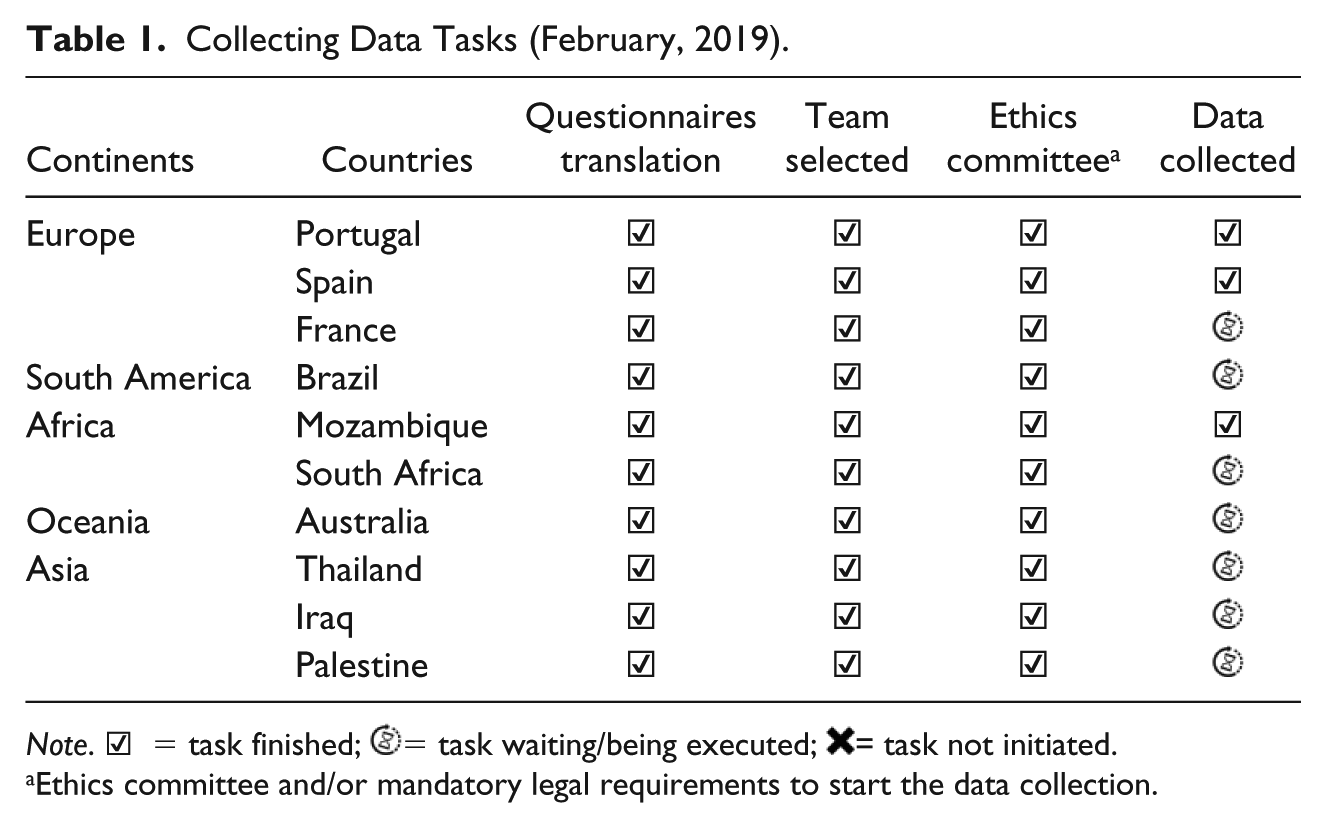
Note. ☑ = task finished;  = task waiting/being executed;
  = task not initiated.
Ethics committee and/or mandatory legal requirements to start the data collection.
Challenges to Implementing a Cross-Cultural Study and Strategies for Overcoming Them: Lessons From the SOCIALDEVIANCE1820 Research Project
The challenges to implementing large cross-cultural studies and strategies that can be implemented to overcome those problems are discussed, drawing on the lessons learned with the implementation of the SOCIALDEVIANCE1820 study. These challenges are addressed through five topics: (a) cross-national research teams; (b) language-related issues; (c) standardization of methods and procedures across countries; (d) different legal and ethical perspectives about research; and (e) different legal frameworks and findings about offending.
Cross-National Research Teams
The first step to conducting this cross-national research project was to identify researchers willing to create research teams and carry out the investigation in their countries. Many of these researchers were identified through the academic and personal networks of the leading coordinator; this was the case for researchers located in Portuguese-speaking countries (e.g., Brazil and Mozambique). In the case of researchers working in distant and/or culturally different locations (e.g., Asia, Australia, or Africa), the ResearchGate website (http://www.researchgate.com) was a key factor in searching for, identifying, and inviting English-speaking researchers in this field to participate.
A second step was to create an interesting proposal for all the researchers invited. In this regard, we projected that all national coordinators could implement the project, and thus be the author of scientific reports, using the cross-national database. This has translated into an opportunity for national coordinators both to collect data in their own countries and have access to participating in research projects using data collected in multiple countries. Moreover, this step enabled master’s degree students to be members of the local research team. They were able to help collect data and use the national/local data collection to write their own theses.
Other important factors in creating and maintaining this international research network were acquiring ethical and copyright authorizations; deriving, translating, and implementing standardized procedures; and creating email and Skype accounts available 7 days a week to support national coordinators and their teams.
Language-Related Issues
An easy way to ensure effective communication across sites and research teams in various countries was to invite local coordinators who spoke English. Nonetheless, there have been other important language-based issues, both linguistic and cultural. The same language can have subtle differences across countries and cultures (e.g., specific characteristics of Portuguese from Portugal versus Portuguese from Brazil) and thus affect the meaning of assessment tools used—and, consequentially, jeopardize the validity of the entire research project. To manage this issue, we used two different strategies. First, among all assessment tools, we have available to evaluate a set of planned theoretical constructs, we prioritized those instruments that have been translated and tested in a large number of countries. When those tools were not available in a particular language, we provided a version of the measure, translated by a bilingual speaker into English and Portuguese, to the national coordinator. Using the English (e.g., Thailand and Australia) or the Portuguese version (e.g., Brazil and Mozambique), an adaptation process to language specificities was conducted—or, in the case of different languages (e.g., English to Thai), the translation and back-translation process was conducted by a native speaker from the specific country where the data would be collected.
Standardization of Methods and Procedures Across Countries
Another challenge to the success of this cross-cultural research project was to assure the standardization of methods and procedures between multiple countries in multiple sites. This was extremely important to ensure the comparability of the findings between countries. A key strategy to overcome this challenge was the creation of the SOCIALDEVIANCE1820 program. This software package is a .zip file containing a set of documents in English and Portuguese describing the procedures to be adopted during the data collection process. After consenting to the terms of this research project, all the local/national coordinators received this package. Also included were a detailed description of ethical issues pertaining to the project, elaboration of the methodology and procedures to be applied, a set of instructions to read to all potential participants, an authorization form to be submitted to the institutions where data collection would take place, an informed consent form, all the questionnaires translated into English and Portuguese, and, finally, either a copy of the authorizations to translate and/or use the translated questionnaires, or a document certifying the public domain for each instrument. For the successful creation of the SOCIALDEVIANCE1820 package, it was important to use the experience gained by the international coordinator (and national coordinator for Portugal) and their research team during the implementation of this project in Portugal, where the project started.
Different Legal and Ethical Perspectives on Research
Dealing with multiple legal and ethical perspectives on research, even more so when it involves human participants, might be considered the biggest challenge posed by a cross-cultural study. The first step in this process was submission to, and gaining approval from, the Ethics Committee in Portugal. This approval facilitated and accelerated the response of other ethics committees around the world. It was also a key document to guarantee compliance with human rights and international ethical standards in countries where universities and other institutions do not have ethics committees to apply to (e.g., Mozambique). In addition, some of the local ethics committees where this project was submitted, particularly in countries and/or universities with a scant research tradition in this field, raised concerns about the questions dealing with abuse in the Adverse Childhood Experiences Questionnaire. It was therefore important to send to local coordinators a long list of published studies using this questionnaire, for which, approval was obtained by the respective ethics committees in a range of countries and cultures. In many cases, it was possible to support national coordinators by sending similar studies approved and conducted in their own countries, or in countries with the same religious or cultural background. In some cases, this helped to accelerate institutional and ethical approvals. In addition, each researcher coordinating the project locally signed an agreement guaranteeing that they would enforce all legal and ethical local and international requirements.
Different Legal Frameworks and Findings About Offending
It is important to note that, despite the legal framework being different from one country to another—and being dependent on different religious, political, and cultural backgrounds—most of the severe and moderate antisocial behaviors (e.g., robbery, theft, and homicide) are criminalized worldwide (Basto-Pereira & Maia, 2017), creating a common background for this research project. Nonetheless, there was a preference for measures of offending with a cross-cultural nature, such as the assessment of psychopathic/antisocial traits or the evaluation of relatively cross-cultural deviant acts, to further reduce this potential bias.
Social and Scientific Impacts and Main Limitations
This study will have important political and scientific implications due to both the involvement of countries on five continents and the study’s longitudinal design. First, it provides unique information and is advantageous to understanding the development of risk factors, antisocial behavior during early adulthood, and how coping strategies and significant life events are related to pro/antisocial attitudes and psychosocial adjustment, regardless of cultural factors. Second, the inclusion of local coordinators from different research fields of psychology and other related disciplines (e.g., forensic psychology; criminology; community violence; and clinical psychology) as local coordinators and researchers is another major advantage. Third, the cross-cultural validation of the scales within the protocol is another major contribution of this research project, one that will allow researchers to translate and provide psychometrically valid tools for local psychologists in nondeveloped low-income countries. New possibilities for research and clinical practice will be within reach after the global dissemination of these scales. Finally, there are very few studies with female samples addressing antisocial behavior; this study will include both male and female participants, with a minimum gender ratio of 35% to 65%, so it is expected to have a sample of 1400–2600 females collected over time and across continents. By providing unique information about female participants, this study will likely provide new insights about the antisocial behavior development process in women.
Some limitations of the study have already been identified. First, the use of a nonprobability sample is a major limitation. Despite the fact that it is almost impossible to provide a randomized sample of young adults (some young adults are university students, others are already working, while others are neither students nor workers), we believe that the major characteristics of the population (gender, level of schooling, and so on) should be proportionally present, so we established certain criteria to be followed by each national coordinator, as explained above. Another natural limitation is the fact that a longitudinal study is dependent on the individuals who participate in the first phase being able to participate in the remaining phases. Refusal, changes in contact information, and death are some of the risks involved in a longitudinal design. To diminish the risk of refusal, we encouraged national coordinators to promote prize draws, such as vouchers, in which, participants involved in Phases 2 and 3 might be eligible. Finally, this project relies on a large number of researchers working across diverse continents. Thus, problems or bureaucratic delays in local ethics (e.g., ethics committee authorization in each country) might delay overall data collection—and, in extreme situations, might compromise the data collection process and the participation of some countries in this cross-cultural study. Nonetheless, all have already initiated data collection, and almost all of them have collected more than half of the sample. This is a good indicator of the success that the SOCIALDEVIANCE1820 research project is expected to achieve as a cross-continental study, with the participation of multiple Western and non-Western countries at different levels of economic and social development.
Footnotes
Acknowledgements
The authors would like to thank the reviewers for their insightful comments and suggestions.
Declaration of Conflicting Interests
The author(s) declared no potential conflicts of interest with respect to the research, authorship, and/or publication of this article.
Funding
The author(s) disclosed receipt of the following financial support for the research, authorship, and/or publication of this article: The second author is supported by the Portuguese National Science Foundation (FCT) who funded William James Center for Research (UID.PSI.04810/2013) research grants.