



Abstract
Veiling is an ancient cultural practice endorsed by religion, social institutions, and laws. Recently, there have been adaptive arguments to explain its function and existence. Specifically, it is argued that veiling women is a form of male mate guarding strategy, which aims to increase sexual fidelity by decreasing overt displays of his mate’s physical attractiveness, thereby helping to secure his reproductive success. Furthermore, it is suggested that such mate retention strategies (veiling) should be more important when child survival is more precarious, as cues to sexual fidelity support higher paternal investment. Using publicly available data from the PEW Research Center encompassing 26,282 individuals from 25 countries, we tested the hypotheses that men should be more supportive of women’s veiling and this support should be more important in harsher environments, particularly those with poor health and high mortality rates, where paternal care is presumably more important. Our results show that men were more supportive of veiling than women, and this support increased as the environments became harsher. Overall, these findings support the male mate retention argument as well as the idea that the practice of veiling is sensitive to environmental differences.
“. . .In the daytime when on the highway . . . she goes about, she is to veil herself. The captive woman, who without the mistress [of the house] goes about on the highway, is to be veiled. The hierodule who is married to a man is to be veiled on the highway. The one who is not married is to have her head uncovered on the highway.” – The Assyrian Law Code, 12th century BC (Jastrow, 1921)
Veiling is an old cultural phenomenon and is endorsed by religion, social institutions, and laws. It has been practiced in ancient civilizations such as the Assyrians, Greeks and Persians (Cairns, 2002; Jastrow, 1921; Scarce, 1975), and has been adopted by religions mainly rooted in the Middle East, that is, Judaism, Christianity, and Islam (Bronner, 1993; Chico, 2000, Tariq, 2013). The veil or hijab is an article of clothing or cloth worn by women to cover and conceal different parts of their bodies, such as their head, face, and at its most extreme, the entire body. Veiling allows women to go out while maintaining their seclusion. Although veiling was once practiced across various civilizations and cultures as a symbol of piety, purity, and class—that is, forbidden for prostitutes and slaves—(Graeber, 2012; Jastrow, 1921; Lerner, 1986), during the last century it is mostly associated with Islamic faith and identity (Ruby, 2006). Consistent with this, the practice of veiling, once a common practice in medieval Europe (Burghartz, 2015; Koslin, 2008) has diminished, while in the Islamic world it has continued to be practiced frequently up to present day.
While there are different arguments regarding social, political, cultural, and personal aspects of veiling in contemporary Islamic discourses (e.g., Carvalho, 2013; Droogsma, 2007; El Guindi, 2003), there are few proposals regarding the function of veiling. Dickemann’s hypothesis (1981) suggests that families tend to compete for high-status, valuable, and wealthy grooms through claustration of their daughters (e.g., veiling) and dowry competition. However, more recently it has been proposed that this old cultural practice is a form of male mate guarding strategy (Pazhoohi and Hosseinchari, 2014), that is, a strategy designed to preserve sexual access to a mate, preventing her from defecting from the “mateship” and the encroachment of intrasexual rivals (Buss, 2002; Buss & Shackelford, 1997). As such veiling seeks to increase sexual fidelity by decreasing the outward evidence of a women’s physical attractiveness, thereby helping to secure her mate’s reproductive success (Pazhoohi & Hosseinchari, 2014). Consistent with this idea are data demonstrating that veiling decreases a female’s facial attractiveness (Mahmoud & Swami, 2010; Sheen et al., 2018; but also see Pasha-Zaidi, 2015); and for more extensive forms of veiling it decreases visual access to a female’s curvaceous body regions that are considered to be potential cues to a female’s reproductive potential and attractiveness (Pazhoohi, Macedo, et al., 2017).
It is further suggested that such a mate guarding veiling strategy increases paternal certainty which may be particularly important in harsher environments where a child’s survival is more at risk, thereby ultimately contributing to higher paternal investment in one’s child or children (Pazhoohi, Lang, et al., 2017). It is shown that as men’s perception of fidelity increases (or men’s concern over paternity decreases), they invest more in their putative children (Apicella & Marlowe, 2004). Similarly, irrespective of the culture, biological fathers and those men with high paternity confidence invest more in their children than stepfathers and/or men low on paternity confidence (Anderson et al., 1999, 2007; Apicella & Marlowe, 2004; Burch & Gallup, 2000; Marlowe, 1999). Accordingly, veiling is considered as a cultural practice serving to raise paternal certainty as well as to help secure stable pair bonding especially where there is a higher demand and cost for paternal investment (Pazhoohi & Hosseinchari, 2014; Pazhoohi, Lang, et al., 2017). In harsh and demanding environments, especially where the mortality rate is high, providing resources for rearing and raising offspring is costlier, and the need for biparental care increases (Gangestad & Simpson, 2000; Pazhoohi, 2017; Schmitt, 2005).
Note that if female veiling is a male mate guarding strategy, then men should be more supportive of veiling practices than women. Consistent with this position Blake et al. (2018) sampled Tunisian participants and found that men are significantly more supportive of Islamic veiling than women. The current study sought to expand the scope of the previous findings in three ways.
First, to extend the results of Blake et al. (2018) regarding a sex difference in support of veiling, the current study conducted a cross-cultural study by examining data from 25 countries and encompassing more than 26,000 individuals. Our hypothesis is that men are more supportive of veiling than women, as veiling is a practice that favors male sexuality by both minimizing female attractiveness and maximizing the chances of male reproductive success by imposing their control on female sexuality (Pazhoohi, 2016; Pazhoohi, Lang, et al., 2017; Pazhoohi & Burriss, 2016).
Second, we investigated if environmental health/harshness indices predict veiling attitudes at an individual level. In doing so we explicitly address and control for the possibility that variables aggregated at a national level may not be representative of the individuals present within them (Pollet et al., 2014). Moreover, we take into account the importance of religion and income at an individual level in our analysis. As veiling is understood to be an indicator of religiosity, we predict religion and veiling will be positively correlated, and this will be moderated by income as religious belief declines in economically developed countries as income security improves (Barber, 2011).
Finally, it is suggested that where there is an abundance of men compared to women (male-biased sex ratio), men compete more intensely for resources and mates, contributing to higher men’s aggression and violence (Barber, 2003; Hudson & Boer, 2002). We expect men’s preference for the veil, as a means for mate guarding, will be strongest in regions where women are scarce and rivals are abundant. Thus, we considered sex ratio. On a related note, we hypothesize that partnered men should be more supportive of veiling compared to single men to prevent unwanted attention to their partners from rival men.
Material and Methods
Data were acquired from Pew Research Center’s world’s Muslims dataset (Pew Center, 2012) which in face-to-face interviews surveyed respondents from October 2011 to November 2012. A total of 32,604 individuals from 26 countries (Afghanistan, Albania, Algeria, Azerbaijan, Bangladesh, Bosnia and Herzegovina, Egypt, Indonesia, Iran, Iraq, Jordan, Kazakhstan, Kosovo, Kyrgyzstan, Lebanon, Malaysia, Morocco, Niger, Pakistan, Palestine, Russia, Tajikistan, Thailand, Tunisia, Turkey, Uzbekistan) participated in the survey. All participants were over 18 years of age at the time of participation and reported Islam as their faith. Participants from Iran were excluded from the analysis as the question for the veiling attitude was not asked from the participants of this country. After the exclusion of those participants and other individuals who provided inappropriate answers or those who refused to answer the questions of our interests (see below), the final number of participants was 26,282.
Measures
Sex
Sex of the participants was extracted from question Q95 of the survey indicating gender of the participants (1-men and 2-women).
Veiling attitude
For the veiling attitude we used Q58 of the survey which reads “Please tell me whether the FIRST statement or the SECOND statement comes closer to your own views—even if neither is exactly right.” The choices were “1-women should have the right to decide if they wear a veil” and “2-women should not have the right to decide whether to wear a veil”, and the codes were recoded to 0 and 1, respectively. Those participants with responses coded as “3-neither/both equally”, “4-husband/family should decide”, “8-don’t know”, and “9-refused” were removed from analysis.
Income level
For the income level the participants were asked how they would describe their personal economic situation (Q7 of the survey): “1-very good”, “2-somewhat good”, “3-somewhat bad” or “4-very bad”. The numbers were recoded in a reverse order, meaning the highest number (4) indicated very good personal economic situation. Those participants with codes “8-don’t know” and “9-refused” were removed from analysis.
Importance of religion
Question 36 of the survey (Q36) asked participants “How important is religion in your life?” and the responses of “1-very important”, “2-somewhat important”, “3-not too important”, or “4-not at all important”, were recoded in reverse order, meaning the higher number means higher importance of religion in daily life. Those participants with the codes “8-don’t know” and “9-refused”, were excluded from analysis.
Marital status
Marital status was limited to those who were 1-married and live with a partner, and 2-who have never been married. We excluded those identified as widowed, separated, or divorced, as their sexual relationship was not clear.
Environmental harshness—the National Health Index
The focus of this study is on a particular aspect of environmental harshness, namely poor health and high mortality. The National Health Index (NHI) from the World Health Organization Statistical Information System (WHOSIS, www.who.int/whosis) estimates the general health for each of the 25 countries with a number of indices. We take them to be biological proxies for harsh environments, and following previous research (see DeBruine et al., 2010; Marcinkowska et al., 2014; Pazhoohi, Lang, et al., 2017), the measures of interest concerned eight items: neonatal mortality rate, infant mortality rate, under-five mortality rate, adult mortality rate, life expectancy at birth, maternal mortality rate, healthy life expectancy, and years of life lost to communicable diseases. NHI was calculated using a principal components analysis to obtain a single composite variable for each of the countries (DeBruine et al., 2010; Marcinkowska et al., 2014). The obtained values were multiplied by −1, so that higher values of NHI reflect better health of a nation. NHI for Kosovo and Palestine was calculated as the average of all other countries’ NHI values, as the health items were not available for these two countries. Data for sex ratio of total population was obtained from World Factbook (CIA, 2016) and sex ratio value for Palestine was calculated as the average of all other countries’ sex ratios.
Data analysis
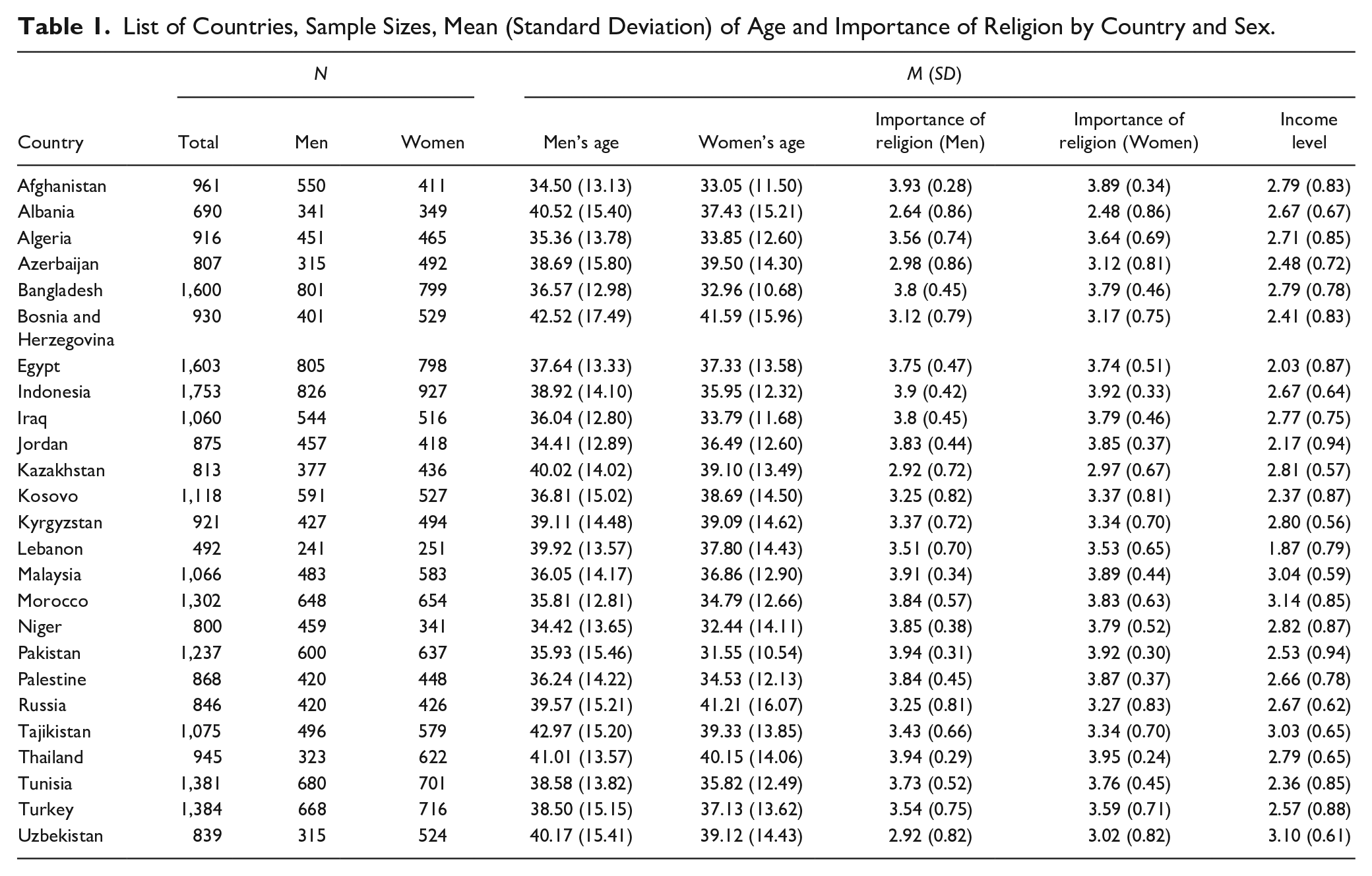
Table 1 presents a descriptive breakdown for sample size, age, and importance of religion for each country. A mixed effects logistic regression (i.e., a multilevel regression model) was conducted to test the effect of sex as a predictor of veiling, with country nested within geographical region as a random effect. The importance of religion, income level, sex ratio, and NHI were added as control variables to the model. Religion and income level were also added as random effects for participants nested within each country within geographical regions. The national indices (values for sex ratio and NHI) were z-scored. Geographical region classifications were assigned as per the World Bank’s “Country and Leading Groups” classification. A second mixed model was performed to include the effect of men’s marital status on the support of the veiling. All the variables remained the same as the first model, except the addition of marital status into the model as well as exclusion of female participants. An alpha level of .05 was used for all statistical tests. All data were analyzed in R (version 3.4.1), using the lme4 (Bates et al., 2015) and lmerTest (Kuznetsova et al., 2015) packages. Data are available in an ESM data file.
List of Countries, Sample Sizes, Mean (Standard Deviation) of Age and Importance of Religion by Country and Sex.
Results
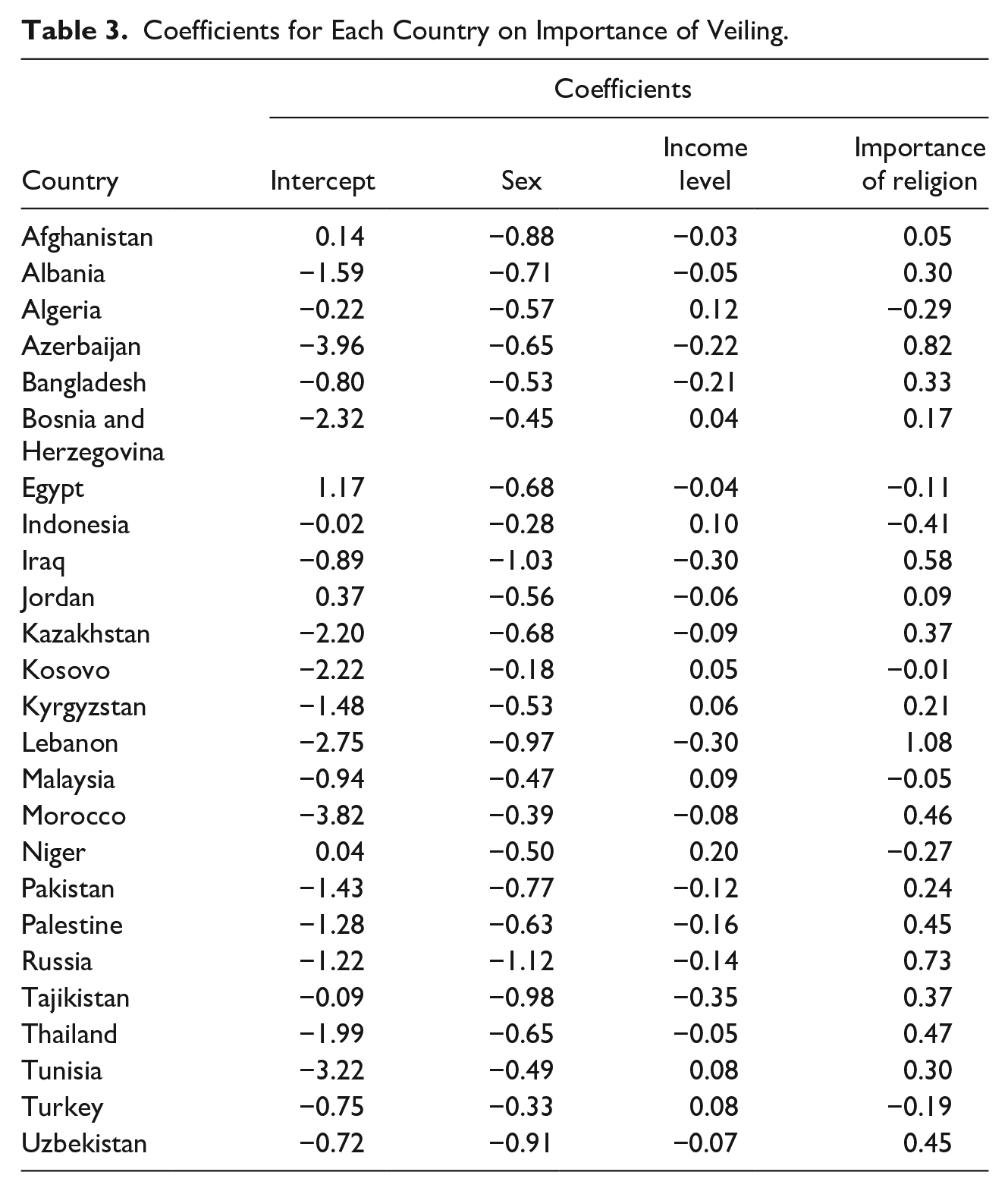
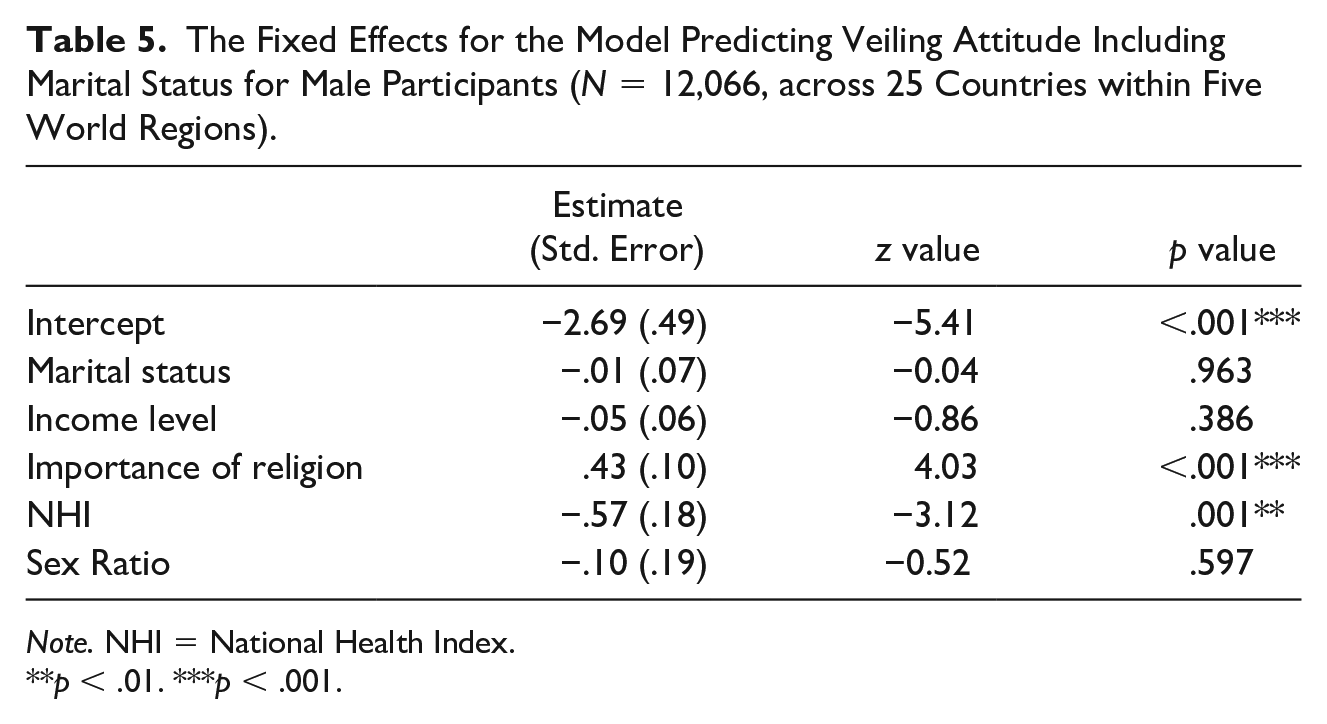
Table 2 shows the fixed effects from the model predicting veiling attitude. Results show sex negatively predicting veiling attitude, suggesting that men more than women support veiling. Also, there was a significant, positive relationship between importance of religion and support for veiling. However, a significant association between NHI and veiling attitude was observed, suggesting that as the health index decreases in a country, individuals support veiling more. There was no significant association between income level and veiling attitude, nor sex ratio and veiling attitude. See Tables 3 and 4 for coefficients for each country and each geographical region, respectively. Results for the second model (testing the effect of marital status of men on veiling attitude) did not show significant effect for the marital status (see Table 5).
The Fixed Effects for the Model Predicting Veiling Attitude (N = 26,282, across 25 Countries within Five World Regions).

Note. NHI = National Health Index.
p < .05. **p < .01. ***p < .001.
Coefficients for Each Country on Importance of Veiling.
Coefficients for Each Region on Importance of Veiling.

The Fixed Effects for the Model Predicting Veiling Attitude Including Marital Status for Male Participants (N = 12,066, across 25 Countries within Five World Regions).
Note. NHI = National Health Index.
p < .01. ***p < .001.
Discussion
Results of the current study show that men are more supportive of veiling than women, supporting the male mate guarding proposal whereby veiling serves the function of securing sexual fidelity (Pazhoohi & Hosseinchari, 2014). This result is also consistent with the sex difference results from the participants from Tunisia (Blake et al., 2018), where men were more supportive of veiling than women. Interestingly, the regression coeffects for each country and each geographical region returned a negative relationship, indicating that men from all 25 countries and every geographical region support veiling more than women (see Tables 3 and 4).
However, other factors can also contribute to the sex difference in endorsement of the veiling, in addition to what is suggested in the current paper (i.e., a mate guarding argument). For example, women’s familiarity with the practical inconvenience of the garment might contribute to women being less supportive of veiling than men. Previous research has also shown that veiled women are considered less attractive when compared with unveiled ones (Mahmoud & Swami, 2010; Sheen et al., 2018; see Pasha-Zaidi, 2015 for contrary results). Thus, the influence of veiling on women’s perceived attractiveness might contribute to their lower endorsement of the practice, as they may oppose something that reduces their attractiveness and conflicts with their mate choice strategy (Barber, 1999; Grammer et al., 2004). Future research is encouraged to investigate these ideas, for example, the hypothesis that women’s position on veiling is an indicator of their reproductive strategy.
Another aim of this study was to test the relationship between NHI and the importance of veiling. Results showed that support for veiling increases as the NHI decreases, supporting the argument that the importance of paternal certainty is greater in harsh environments where child survival is more precarious (Pazhoohi, Lang, et al., 2017). By increasing paternal certainty by mate guarding through veiling, paternal care is enhanced in such environments. It should be noted that the current study does not rule out other possible explanations for greater veiling in harsher environments. For example, the prevalence of pathogenic diseases, which is an indicator of environmental harshness, is positively associated with religiosity (Fincher & Thornhill, 2008) and support of conservative values (Tybur et al., 2010). And evidence supports the relationship between women’s sexual restrictiveness (as well as overall restricted sexual strategies), women’s subordination to men’s status, and social conservatism, with pathogen prevalence and environmental harshness (Thornhill et al., 2009; Tybur et al., 2015). Moreover, the role of harsher environments might be explained by the cultural tightness-looseness theory (Gelfand et al., 2011). This theory suggests that harsher environments, including those with disease, environmental threats, or low natural resources, may have stronger social norms and a low tolerance for deviant behavior (Gelfand et al., 2011; Roos et al., 2015). In sum, while the association between a support for veiling and harsh environments, measured by health and mortality indicators, is clear from the results of the current study, multiple variables may be at play, such as paternity confidence (proposed here), social conservatism, cultural tightness, and the like; any or all of which may moderate the association.
Our results also showed that support for veiling (an indicator of sexual conservative morality) is associated with importance of religion. Similarly, recent evidence has shown that in line with Reproductive Religiosity Model (Weeden et al., 2008; Weeden & Kurzban, 2013) religious belief and norms serve to moralize sexual promiscuity (Jacquet et al., 2020; Moon et al., 2019; Van Slyke & Szocik, 2020). Accordingly, all religious traditions condemn extramarital sexual relations (Burdette et al., 2007) and religiosity regulates female sexuality in favor of males’ paternity (Pazhoohi, Lang, et al., 2017; Strassmann et al., 2012) eliciting higher paternal care and family ties (Anderson et al., 2007; Pashos & McBurney, 2008). Previous research has also shown that support for veiling among both Muslim men and women is associated with their religiosity (Mahmoud & Swami, 2010; Pasha-Zaidi, 2015). While the association between religiosity and veiling is supported here and in previous studies, it would be beneficial if future research investigated whether this association is moderated by reproductive strategies and concerns over women’s sexual promiscuity.
While the support for veiling was, as predicted, associated with the importance of religion, no relationship was found between veiling attitude and income level. This dovetails with Pazhoohi, Lang, et al. (2017) who also failed to find any reliable relationship between country-level data for GDP and the importance of veiling. Income level is suggested to be negatively associated with religiosity (Herzer & Strulik, 2017; McCleary & Barro, 2006; Norris & Inglehart, 2011); and religiosity itself is a correlate of veiling as is shown here as well as in the previous research. However, the null results of the relationship between both the national-level (Pazhoohi, Lang, et al., 2017) and the individual-level income levels (current study) with veiling attitude, may indicate environmental unpredictability and harshness, but not wealth and income level, contribute to the importance of veiling.
Previous research has shown that male-biased sex ratios (an abundance of men) is associated with men’s higher intrasexual competition, contributing to higher aggression and violence amongst men (Barber, 2003; Hudson & Boer, 2002). Accordingly, we predicted that the relationship between men’s support for veiling would be strongest in regions that have male-biased sex ratios. As a male-biased sex ratio may lead into allocating more resources toward mating efforts in men, mate guarding practices (such as veiling) that secure men’s sexual access to their partners, and decreases the costs and chances of potential conflict and competition in such environments (of high intrasexual competition) may therefore be beneficial. However, in our model, the sex ratio did not return a significant relationship. The discrepancy between the results here and previous research for sex ratio and correlates of men’s intersexual competition (Barber, 2003; Griskevicius et al., 2012) could be due to the fact that the analyses are based on aggregate data (see Pollet et al., 2017 for a discussion on the potential pitfall of using aggregate data for sex ratio).
Finally, the results of this study did not find an effect for men’s marital status on their support for partner’s veiling. It appears that men’s religiosity is important in their opinion about their partner’s veiling, regardless of their marital status, again supporting the moderating effect of religiosity on veiling support.
Limitations and Concluding Remarks
It should be noted that using a dataset that was not collected to study the current hypotheses could be considered a limitation of this paper. On the other hand, this allowed us to test our hypotheses cross-culturally using a very large sample size, increasing the reliability and robustness of our results. Nevertheless, there are certainly advantages to collecting data to test specific hypothesis, and our present study indicates that one can expect real value from future studies that collect data to test hypotheses related to veiling attitude and support. We specifically suggest that such studies examine if support for veiling is driven mainly by concerns over female sexual promiscuity or if it is primarily a function of religious belief.
Using a large cross-cultural sample, the current study extended the literature on sex differences in support of veiling, as well as the importance of mate retention strategies (importance of women’s fidelity) in harsher and more demanding health and mortality environments. In conclusion, these new findings support the link between the ancient cultural practice of veiling and biological variation. Specifically, they converge with adaptive arguments such as human mate guarding (Buss, 2002; Pazhoohi & Hosseinchari, 2014), paternal investment, and ecological variation (Pazhoohi, Lang, et al., 2017); suggesting that veiling serves to increase paternal certainty, eliciting paternal investment in more demanding environments.
Supplemental Material
Table_S1_2 – Supplemental material for Sex Difference on the Importance of Veiling: A Cross-Cultural Investigation
Supplemental material, Table_S1_2 for Sex Difference on the Importance of Veiling: A Cross-Cultural Investigation by Farid Pazhoohi and Alan Kingstone in Cross-Cultural Research
Supplemental Material
Table_S2_1 – Supplemental material for Sex Difference on the Importance of Veiling: A Cross-Cultural Investigation
Supplemental material, Table_S2_1 for Sex Difference on the Importance of Veiling: A Cross-Cultural Investigation by Farid Pazhoohi and Alan Kingstone in Cross-Cultural Research
Footnotes
Declaration of Conflicting Interests
The author(s) declared no potential conflicts of interest with respect to the research, authorship, and/or publication of this article.
Funding
The author(s) received no financial support for the research, authorship, and/or publication of this article.
Supplemental Material
Supplemental material for this article is available online.
Author Biographies
References
Supplementary Material
Please find the following supplemental material available below.
For Open Access articles published under a Creative Commons License, all supplemental material carries the same license as the article it is associated with.
For non-Open Access articles published, all supplemental material carries a non-exclusive license, and permission requests for re-use of supplemental material or any part of supplemental material shall be sent directly to the copyright owner as specified in the copyright notice associated with the article.
