



Abstract
What variables are associated with cross-cultural differences in values at the individual level? In this study, the statistical effect of variables associated with ecological demands and available economic and cognitive resources on self-reported values are investigated in two independent samples to test the replicability of effects. Values are operationalized using a 10-item version inspired by Schwartz’ value theory. The effects of national wealth, climatic demands, availability of cool water, and parasite stress at the national level are used to predict value scores of individuals within nations using nationally representative data from all inhabited continents (k = 49 and k = 58; Ns = 64,491 and 81,991). Using mixed-effect models, new insights into individual- and nation-level dynamics in value scores are provided. First, the paper extends previous cultural theories to the individual level by investigating the effects of education and personal income as individual-level resources. Both personal income and education have strong direct effects on value scores. Second, higher education acts as a cognitive resource which turns climatic demands into challenges, effectively unpackaging nation-level theorizing with individual level dynamics. Third, contrary to previous nation-level research, parasite stress was not a significant predictor of individual-level values. Forth, supporting recent theorizing, individuals located in cool water regions reported significantly higher self-transcendence values. Fifth, the effects of wealth on openness values were convergent and reinforcing across levels (higher wealth is associated with more openness values), but operated in opposing directions for self-transcendence values (national wealth is associated with self-transcendent values, individual wealth is associated with self-enhancing values). The current patterns suggest that cultural research needs to pay more attention to individual versus nation-level dynamics and increase replication efforts with independent samples.
Keywords
Cultural differences in self-rated value orientations have been at the forefront of cultural research since Hofstede’s (1980) seminal study. Researchers have focused on values as one promising option for unpackaging culture (e.g., Berry et al., 2011; Smith et al., 2013), that is examining how values may help us to understand cultural differences. Not surprisingly, value differences between individuals and between nations as well as various psychological and social correlates of values at both levels are now well-documented (Smith et al., 2013). More broadly, studying cultural differences through a value lens has emerged as the dominant paradigm in psychology and related disciplines (e.g., Inglehart & Baker, 2000; Schwartz, 2011a; Taras et al., 2009, 2010). Yet, less is known about the correlates and possible origins of these value differences across cultures. In this paper, a biologically oriented perspective is presented, focusing on the needs and resources that humans as a biological species may need in order to survive and thrive. Values are cognitive representations of what people deem important in their life, that is their central life goals (Fischer, 2017; Schwartz, 1992). We should expect values to be calibrated in line with demands and resources available to individuals. In this paper, I focus on theories that have attempted to understand value differences across nations from a demand/threat versus resource perspective. There are certainly other perspectives and variables that may be relevant (Akaliyski, 2017; Boer & Boehnke, 2015; Van Herk & Poortinga, 2011), but here I will focus on more tangible threats and resources that are available to individuals and test which of these may be important for values. Among these, Welzel (2014) pointed to the importance of both wealth and availability of cool water (from now on labeled CW) as important for value development; Van de Vliert (2009, 2013) theorized that climatic demands in interaction with national wealth have an influence on value endorsements whereas Thornhill and Fincher’s (2014, Fincher et al., 2008) parasite stress theory suggested that stress induced by infectious diseases and parasites has a significant impact on values across cultures.
These theories are relevant when focusing on the relative importance of biological threats and demands and resources that may be available to individuals and as a result may shift the life goals and values of individuals and communities. However, most of this work has focused on aggregated data at the nation level. The individual level processes so far have received less attention and empirical scrutiny. This is not a trivial question as ongoing debates of the problem of ecological fallacies attest (Kievit et al., 2013; Robinson, 1950). It is inappropriate to draw inferences about individual level effects based on group or population level data, yet, the population level theories are often used to inform social policies that are thought to bring about change in individuals. 1 Here, the focus will be on the values reported by representative samples of individuals and the relative statistical impact of resources and demands at both individual and nation-level will be examined. Therefore, the paper moves the theorizing and analysis from the population level to the individual level where many of the proposed mechanisms are supposed to be operating.
A further limitation of research to date is that much of the interdisciplinary field of value research has been focused on individualism-collectivism (Oyserman et al., 2002), at the relative neglect of other dimensions of values. Do possible cultural evolution dynamics generalize to other value domains beyond individualism-collectivism? The most comprehensive theory of individual values to date has been proposed by Schwartz (1992) and in nearly 30 years of research, it has been shown to be applicable in samples around the world (for broad reviews, see: Fischer, 2013, 2017; Fontaine et al., 2008; Schwartz, 2011b) and the major distinctions can be linked to neurobiological systems (Brosch & Sander, 2013; Leszkowicz et al., 2016). Hence, by focusing on a well-established theory of human values that maps out values that are important to individuals, it is possible to comprehensively test the impact of threats and resources on a broader set of value orientations of individuals.
Finally, predictions from these various theories are typically tested in isolation. The relative predictive power of variables within each framework vis-à-vis plausible alternative explanations is currently under-explored (see Van de Vliert, 2013). Furthermore, given the limited number of data bases that span more than a few countries, replication effects have been limited. Therefore, in order to progress, science needs comparative tests of plausible theoretical accounts and independent data sets to replicate any patterns or trends (Open Science Collaboration, 2015).
The current study aims to address these points. First, the relative effects of the variables from the different frameworks are tested against each other using multilevel modeling. Second, by identifying resource variables at the individual level it becomes possible to unpackage previous nation-level associations that have been developed within the context of ecological theories of cultures, such as the climatoeconomic theory (Van de Vliert, 2009, 2013). Third, using two independent data sets based on representative samples around the world, it is possible to examine the replicability of effects.
Schwartz’ Nearly Universal Theory of Values
Schwartz (1992) developed a nearly universal theory of human values which specifies that values can be organized in terms of their motivational conflicts and congruence leading to the emergence of two major dimensions of values at the individual level. The first dimension (openness to change vs. conservatism) contrasts an emphasis on a hedonistic life and pursuing independent thoughts and actions, with an emphasis on preserving the social and cultural traditions and order, restraining actions to not upset social conventions, and being concerned with the security of one’s family and country. The second dimension (self-transcendence vs. self-enhancement) distinguishes a concern with the well-being of close and distant others, fairness within one’s society and a preoccupation with the protection of the environment versus an emphasis on more selfish concerns emphasizing advancing power, wealth and status for oneself and one’s immediate social group and demonstrating excellence, and dominance in socially and culturally sanctioned ways.
This value structure can be measured across societies using a variety of instruments (Schwartz, 1992; Schwartz et al., 2012) which have shown sufficient validity and replicability across most samples studied to date (see Fischer, 2017; Schwartz, 2011b for a review). In addition, the two major dimensions do not only emerge in self-reports, but can also be identified at the neural level and through reaction time studies (Brosch & Sander, 2013; Brosch et al., 2011; Leszkowicz et al., 2016; Pakizeh et al., 2007). The descriptive theory of the structure of values has significantly contributed to a better understanding of human motivation across a number of domains, including work on gender (Schwartz & Rubel, 2005), generational and developmental changes (Gouveia et al., 2015), environmental concerns (Gatersleben et al., 2014), and social attitudes (Boer & Fischer, 2013). It provides the most sophisticated and widely tested theoretical framework that captures major dimensions of values that have been discussed in the literature and have broad biological grounding.
Demand Versus Resource Models of Values
There have been longstanding speculations about the origins or sources of value differences between societies (for broader discussions see Boer & Boehnke, 2015). For example, Hofstede (1980) argued that value differences are driven by long historical trajectories, such as differences in hierarchical values within Europe being driven by long standing socialization patterns arising from populations that were under Roman rule. Schwartz and Bardi (1997) suggested that value differences were driven by exposure to communism. These theoretical accounts fall within a classic cultural transmission model, whereby cultural traits are developed at a certain period in time and are then passed on with high fidelity between generations and the transmission of values is then becoming relatively independent of the context (Brown et al., 2011). When testing these claims with data from representative samples in Europe, Van Herk and Poortinga (2012) found little evidence for the influence of longer-term historical trends and more recent historical trends seemed to exert influence mainly via cohort patterns. Examining temporal changes over the first decade of the 21st century, Tormos et al. (2017) also identified strong wealth effects on individual values. Similarly, comparing value similarity between pairs of European countries, socioeconomic indicators show the strongest effect on value similarity versus divergence in Europe (Akaliyski, 2017). In these studies focusing on European samples, the strongest influence on values overall and after controlling for confounds was average wealth (for a longer-term historical pattern with similar results, see Grossmann & Varnum, 2015). In more affluent regions, individuals were more open to change and self-transcendent in their value orientation.
Welzel (2013) provides the most comprehensive theoretical account of value and wealth associations, building on extended work within the postmaterialism framework (Inglehart, 1997) in political science. The main argument is that individuals have an inborn desire for personal growth and self-expression. These desires however can only be expressed if individuals have the necessary resources to address basic survival needs and can spend time and energy to first develop and then express their cognitive capacities. Existential pressures on life reduce self-expression because other needs and concerns are more pressing. With decreasing existential pressures and more access to resources, individuals will be able to do more things at their own will. Wealth is a form of an action resource that allows individuals to express their innate desires for freedom and emancipation. Accordingly, wealth enables value differences to emerge: wealth differentials across individuals and societies enable or constrain the expression of universal human values geared toward autonomy and agency.
Welzel’s discussion of emancipation values in this societal development perspective included indicators of autonomy, emphasis of personal choice in acceptance of homosexuality, abortion and divorce, an emphasis on gender equality, and an emphasis on expressing one’s voice in all spheres of social and political life. This index therefore cuts across both the self-transcendence value dimension (especially values related to universalism) as well as the self-direction and stimulation value types that form a major component of the openness to change value dimension by Schwartz (1992). The theorizing and testing of these predictions have mainly occurred at the aggregate societal level and one issue that needs attention is how these processes operate across levels and whether individual and societal level processes overlap (see below). In summary, economic resources in the form of wealth are predicted to increase both self-transcendence (vs. self-enhancement) and openness (vs. conservatism).
A second resource that is important for individual and community survival and functioning is access to water. In the final chapters, Welzel (2013) proposed a cool water (CW) hypothesis as a source of value development. Locations with (1) relatively low average temperatures, (2) regular rainfall over all seasons, and (3) access to permanently navigable waterways foster conditions of social organization around individual agency and empowerment. Water is fundamental for biological life on our planet. Therefore, autonomy of water access is crucial for human survival and thriving. Regular rainfall in colder regions limits the opportunities for powerful individuals or groups to monopolize access of this crucial resource. With relatively lower temperatures, water is also less likely to be infested by parasites or diseases. The ability to travel via riverine systems allows greater individual mobility and better trading connections which foster individual and communal survival. In combination, these geological features make it more likely that individuals form small groups with pluralistic power structures and develop rudimentary power sharing structures among more egalitarian groups. These structures can then be easily scaled up to become more effective institutions. These ecological conditions and associated egalitarian community structures increased reproductive rights of women due lower child mortality and increased opportunities for women (Brée & de la Croix, 2019). In other words, ecological conditions associated with unrestricted access to water and ease of navigation facilitate the emergence of autonomous and agentic values (Welzel, 2014), suggesting higher openness to change and self-transcendence values in regions characterized by cool water (CW) conditions.
Focusing on the demand side of ecology, an alternative account of value differences has been proposed in the context of parasite stress theory (Fincher et al., 2008, Thornhill & Fincher, 2014). Similar to Welzel’s broad emancipation theory, parasite stress theory emphasizes environmental pressure as a major causal factor in the emergence of value difference, this time in the form of the prevalence of communicable diseases and parasites in the environment. The main argument is that that the greater presence of parasites and diseases increases the risk of illness and death. One of the best options in such environments for both individuals and communities is to eschew new and untested practices or behaviors and to avoid contact with strangers that could harbor potentially lethal or debilitating diseases and parasites. Values as motivational states therefore reflect these precautionary measures. The theory predicts that in high parasite stress environments, individuals express a greater endorsement of values that emphasize security, restricting contact with strangers and maintaining the social order, and traditions that have been time tested. Conversely, it downplays values that emphasize contact with strangers, exploring new ideas or actions and engaging in activities that could potentially increase the risk of contracting diseases or injury. To date, the theory has been tested in relation to individualism-collectivism (Fincher et al., 2008), generalized sociality (Fincher & Thornhill, 2012), and in student samples responding to the Schwartz value survey (Bastian et al., 2019). Based on this theory, it is expected that greater parasite stress is associated with more conservative and more self-enhancing values.
These theoretical accounts predict a relatively simplistic direct effect of resources and stress on value endorsement, respectively. A fundamental principle in psychology is that demands and resources interact with each other (Lazarus & Folkman, 1984). High levels of stress pose either a threat or a challenge for well-being and psychological functioning, depending on whether the stress can be met by resources that offset the demands imposed by the stressors. If stressors can be met with adequate resources, they turn into manageable challenges. If resources are insufficient to address the stressors, they pose an existential threat. This is the central assumption underlying the climatoeconomic theory of culture (Van de Vliert, 2009, 2013) that predicts that climatic demands (acting as a stressor) and wealth (resource) interact. There are various lines of evidence that suggest a thermo-optimal zone of comfort. As a warm-blooded species, our internal temperature of around 37°C (98.6°F) needs to be kept constant. In colder temperatures, our body needs to generate heat (through shivering or movement, which are metabolically costly) in order to keep vital physiological functions operating. At the same time, metabolic reactions at cellular level constantly generate heat which needs to be transferred outside the body. When the ambient temperature increases and approaches the body core temperature, energy needs to be invested in active cooling (e.g., sweating, panting) (Parsons, 2003). Within the intermediary thermoneutral zone, metabolic costs for maintaining a constant core body temperature are minimal. Series of studies on both motor and cognitive performance suggest that this thermoneutral zone inferred by maximal performance levels lies somewhere between 20°C and 24°C (Seppanen & Fisk, 2006; Wu et al., 2020; Zhang et al., 2019). Performance systematically decreases moving further away from this optimal zone, suggesting an inverted u-curve relationship. In contrast, comfort level as indicated by thermal preferences and wellbeing levels suggest slightly larger zones of thermal preferences varying between 16°C and 28°C, but again with inverted u-curve properties around the stated preference (Bigano et al., 2006; Rehdanz & Maddison, 2005; Wu et al., 2020).
A second component for thermoregulation is access to highly quality food sources, which ensures survival. Crops such as wheat, millet, sorghum, rice, potato, and maize were cultivated early in human evolutionary history and provide a significant portion of calories for humans. Across the range, optimal production levels for these crops can be achieved between 15°C and about 30°C (Cline, 2007; Fischer & International Institute for Applied Systems Analysis, 2002; Watson et al., 1996). Testing various estimates within this range, Van de Vliert (2009) identified 22°C as the psychological optimum for the average temperature for the hottest and coldest months within a year. If the average temperature deviates from this optimum in winter or summer, humans need more resources to cope with the demands of the cold or heat. Based on these biological foundations, human populations need to adapt their behavior in response to external climate demands. In conditions where climatic demands are not met by adequate resources, communities will attempt to eke out a living and survive as best as possible, leading to a shift toward security and other values focused on survival. Hence, values shift toward protecting the immediate in-group and preserving the social order (conservatism values) as well as controlling people and resources (self-enhancing values). In contrast, when climatic demands are met by sufficient resources they turn into challenges and communities have an opportunity to overcome these threats. Therefore, addressing these challenges provides a sense of self-efficacy and personal growth, with life goals shifting toward emphasizing autonomous and self-directed values (openness to change values) and an unselfish orientation toward the well-being of others (self-transcendence values).
While climate demands need to be met by subsistence goods, in current societal structures these goods are not directly produced by the consumer, but rather purchased with money. Hence, Van de Vliert (2009) argued that the most important resource available to humans is money. Money is a cultural invention that enables the purchase of any necessary resources that individuals and communities may need to address climatic demands. In previous research, monetary resources are typically operationalized as average income at the nation level and the predicted interaction between wealth and climatic demands has been successfully tested in relation to both self-expression values (Van de Vliert, 2009), postmaterialism values (Fischer, 2013), and broad individualism-collectivism values (Fischer & Van de Vliert, 2011; Van de Vliert, 2009). These values are conceptually similar to the openness to change versus conservatism value distinction, but also tap into some values related to self-transcendence (especially universalism values which are related to both postmaterialism and self-expression values, e.g., the protection of the environment and lifestyle issues). To date the theory has not been tested with the complete Schwartz’ theory of values. The prediction is that values shift toward openness to change (independence of thought and action, stimulation, and enjoying life) as well as self-transcendence values (universalism and benevolence) in conditions where greater climatic demands are being met by higher wealth and therefore turn into challenges instead of threats.
Contribution of the Current Study
The various theories have been generally tested and supported at the nation-level, using aggregated individual-level data of values. Wealth, parasite stress, cool water (CW), and the interaction between climatic demands and wealth covary in theoretical meaningful with the average endorsement of specific aggregated values at the nation level. However, these effects cannot be generalized to individuals as doing so amounts to committing the ecological fallacy (Kievit et al., 2013; Robinson, 1950). Relationships that are investigated at the population level may not replicate at individual level or may even reverse directionality at the lower level.
Income is a classic example. There is plenty of research showing that greater income is associated with more beneficial societal level outcomes, including more cooperation and other-oriented values (Van de Vliert, 2009, 2013; Welzel, 2010, 2013). As discussed above, greater wealth is supposed to free aggregates of individuals from selfish concerns of survival and allows collectives to focus more on the concerns and well-being of others, while also pursuing their own drive for self-fulfillment. Wealth at the societal level appears to increase trust and altruistic relations between individuals within society. In contrast, research at the individual level has demonstrated that those with higher income are typically less empathetic, less prosocial, are less community focused when facing uncertainty, more likely to break social rules and cheat to their own advantage (Kraus et al., 2012; Piff et al., 2010; Piff, Stancato, Cote, et al., 2012; Piff, Stancato, Martinez, et al., 2012; Stellar et al., 2012; Stephens et al., 2014). Hence, there is a clear disjunction between the individual and societal level. At the societal level, greater wealth is associated with more individualistic, openness, and self-transcendence values; whereas at the individual level higher income and social status is associated equally with greater individualism and openness, but also with more behaviors that are related to higher self-enhancing values (power and achievement values) and lower self-transcending values (universalism and benevolence, i.e., caring about other people close and distant). Therefore, contextual effects may not generalize to individual-level effects and may even reverse. The overall effect observed at the nation level might be driven by mean differences at the population level but within each population the effect could well be in the opposite direction (see Figure 1). To date, these differential effects have not been tested simultaneously—to what extent are contextual (country-level) and individual-level effects operating simultaneously? Furthermore, as noted by Stephens et al. (2014), social class effects have not been explored more widely and the generalizability of these patterns requires further research. The current study addresses these gaps.
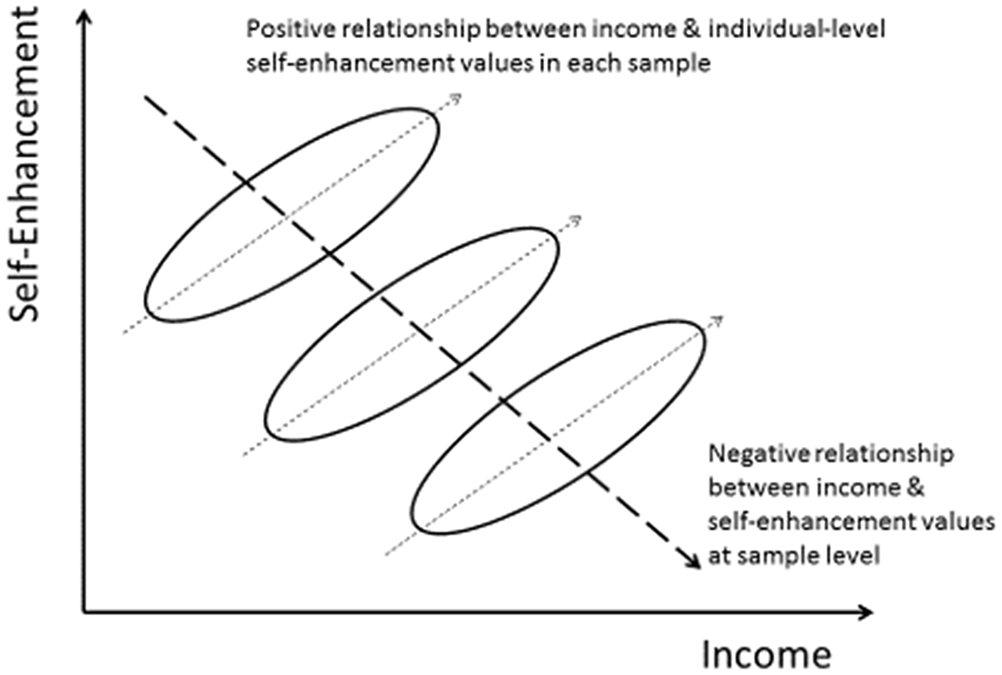
A demonstration of potentially opposing relationships at individual and sample level.
A second challenge is that previous research is mute about the individual level variables that are important for understanding these aggregate effects. Welzel’s and Van de Vliert’s theoretical arguments argue that economic resources are important. Resources at the individual level can take various different forms and it is not clear what type of resource is important for value expressions (Fischer, 2013). Given the previous emphasis on average wealth, the most direct individual level equivalent would be the income levels of individuals. Are resources at the national level (average wealth) and resources at the individual level (income of the individual) showing independent (additive) effects on the expression of values? For example, are wealth effects at the country level due to broad changes at an institutional and population level that are independent of the effects of individual level resources (a Durkheimian perspective that gives priority to social structural effects)? Or do resources at the individual contribute to value expression independently of the overall wealth of the society? In a cross-level study examining this question with postmaterialism values developed by Inglehart (1997) using representative data from 55 nations, Fischer (2013) reported that the climate × national wealth interaction predicted postmaterialism values of individuals (a cross-level effect), but the reported income within nations did not interact with climatic demands. This suggests that previous effects at the nation level are driven by broad contextual changes in the institutional and social environment that bring about these psychological effects, without having an equivalent process at the individual level. Obviously, this has broad implications and ramifications for any intervention effort based on these theoretical processes.
Another option is that money may not be the most relevant indicator. Money may not be a good resource if individuals do not know how to address the demands posed by the environment (e.g., climatic demands or parasite stress). In particular, educational levels of an individual might be important when considered in the context of climatic demands. Individuals who have higher education and are faced with climatic demands may have the cognitive resources to convert the demands into challenges that are then reflected in their value priorities. Borrowing from Welzel’s theoretical arguments, this experience of having adequate resources in the face of demands will allow individuals to express their innate desire for freedom and overcome these demands, leading to an associated shift toward greater self-transcendence and openness values. Current evidence suggests that US citizens with lower levels of education are more negatively affected in their emotional wellbeing by temperatures outside the optimal thermoneutral zone (Noelke et al., 2016). Educational level appears to be an important individual level resource over and above income that is worth exploring when discussing both human empowerment and climate-economic theory effects.
A final contribution of the current study is an explicit test and integration of theorized predictors. Previous studies often tested predictors (a) in isolation from each other (alternative explanations are not ruled out) and (b) the focus is typically on a more limited set of values (e.g., not the broader spectrum of values described by Schwartz, 1992). Few exceptions are the work by Van de Vliert (2013, Fischer & Van de Vliert, 2011) where wealth, parasite stress, and wealth by climatic demands interactions were tested simultaneously at the nation-level. What is missing is a comparative test of the relative importance of these variables against each other at the individual level, (b) using a more comprehensive model of values, and (c) tests of replication using identical sets of variables in new data sets. Based on these previous studies, the hypotheses are that (1) nation-level wealth is associated with greater endorsement of openness to change (vs. conservatism) and self-transcendence (vs. self-enhancement) values; (2) cool water conditions are associated with greater endorsement of openness to change (vs. conservatism) and self-transcendence (vs. self-enhancement) values; (3) greater historic parasite stress is associated with lower endorsement of openness to change (vs. conservatism) and self-transcendence (vs. self-enhancement) values; and (4) greater climatic demands combined with higher wealth is associated with greater endorsement of openness to change (vs. conservatism) and self-transcendence (vs. self-enhancement) values. The first research question is which of these predictors is statistically more reliable when simultaneously testing all four predictions. The second research question concerns the importance and direction of individual-level income effects on self-transcendence values in particular, given the previously noted divergence of individual versus nation-level wealth effects. The final and fifth hypothesis concerns the moderating effects of individual-level income and education as potential moderators of the climatic demand effects. To the extent that individual-level variables operate as moderators similar to nation-level wealth, we could expect that income and education as resources turn climatic demands into challenges, leading to an increase in openness to change (vs. conservatism) and self-transcendence (vs. self-enhancement) values. In summary, the current study reports two studies of nationally representative data that examine the effects of resources, climatic demands and ecological stress at the nation level as well as income and educational level as resources at the individual on the two major dimensions identified by Schwartz (1992). The hypotheses and research questions are tested in study 1 and the effects replicated in an independent sample using different nations in study 2.
Study 1
Methods
I used nationally representative data from wave 5 of the World Values survey collected between 2005 and 2009. Data used in this study are based on representative samples from 56 countries (total N = 83,975). More information on this data set is available in Welzel (2013). Full information on the sampling scheme, all instruments, translations, and raw data are available from worldvaluessurvey.org (last accessed May 25, 2021). Sample sizes for the individual country samples are included in the Supplemental Material.
Values
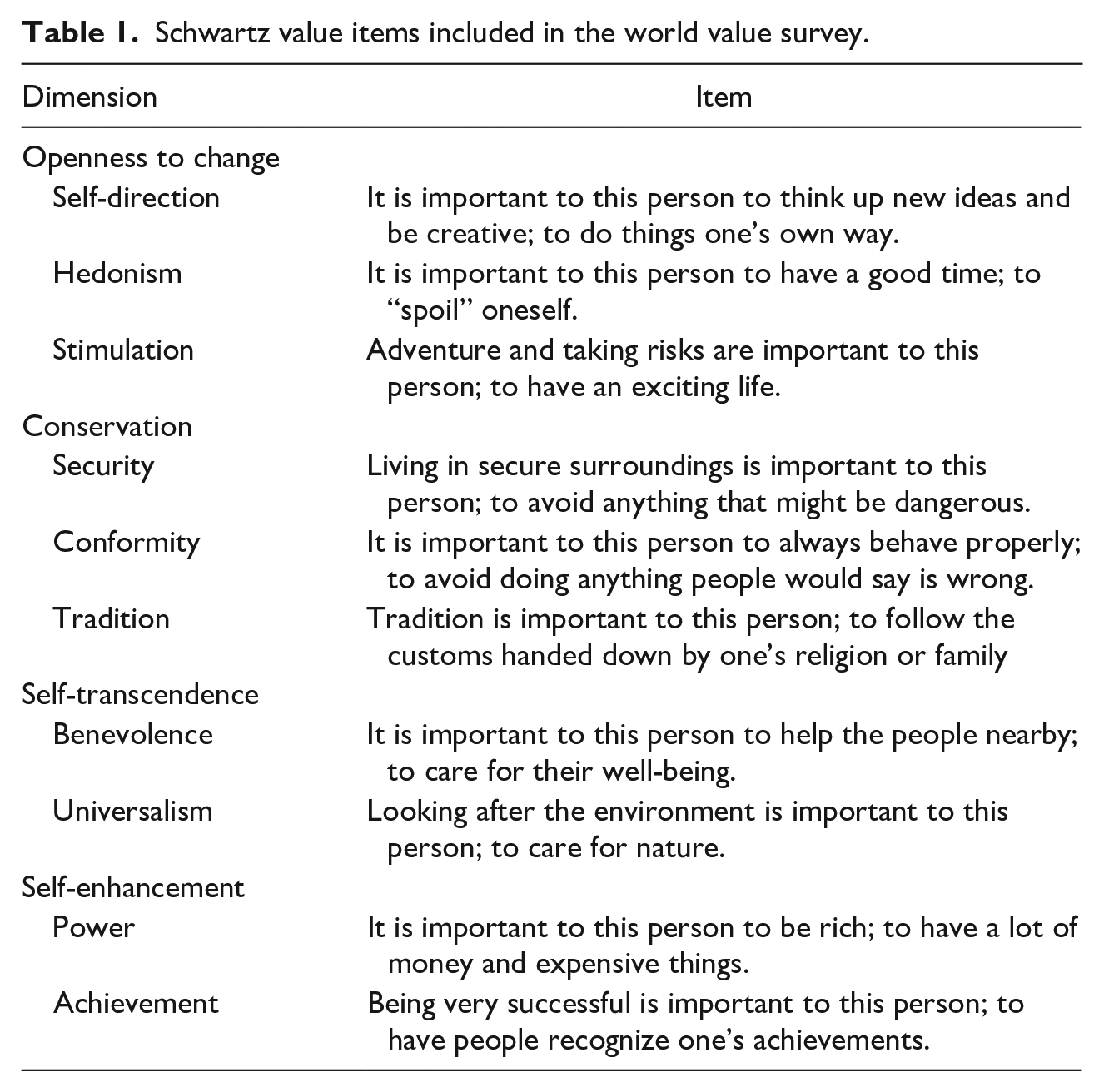
I used the 10-item value inventory which was inspired by the Portrait Value Survey (Schwartz et al., 2001). Welzel (2010) describes the development and the structural features of this measure, showing general validity of the measure. Respondents are presented with short statements depicting a hypothetical person and are asked to indicate whether this description is very much like them, like them, somewhat like them, not like them, or not at all like them. The responses are coded from one to five (very much like me, not at all like me). For the current study, responses were reversed so that a higher score indicates greater endorsement of the value. Table 1 shows all the items of this short measure. As can be seen there, some of the dimensions are better represented than others. For example, the Universalism component captures the nature protection component well, but does not include the importance of caring for others in society and the tolerance component (e.g., Schwartz et al., 2012). The scale has been tested and validated before (Welzel, 2010). For the current study, I created openness to change versus conservatism scores by averaging the self-direction, stimulation, and hedonism items and subtracting them from the averaged items for security, tradition, and conformity. The self-transcendence versus self-enhancement scores were calculated by the differences between the averages for universalism and benevolence items on one hand and achievement and power value items on the other hand. These scores capture the central motivational conflicts inherent in each dimension (Boer & Fischer, 2013; Schwartz, 1992). The raw scores were used for these calculations. These computations already take into consideration any response effects, because the resultant score is expressed as the relative importance of one value score relative to the other. If there are individual or cultural response tendencies that apply equally to all items (as is assumed for ipsatization, see Fischer, 2004), the relative difference between the two conceptually opposing value scores already accounts for this response tendency.
Schwartz value items included in the world value survey.
Country level variables
Wealth was measured by the gross national income expressed in product purchase parity per head from 2005 (see Boer & Fischer, 2013). Missing data (e.g., for Taiwan) was imputed using data from the CIA World Fact Book (www.cia.gov, last accessed October 25, 2010).
CW indicators were obtained from Chris Welzel (personal communication, April 26, 2021, see also Welzel, 2014). These scores are based on the weighted fraction of a country’s land territory being located in cold or temperate climate zones with no dry season, with the weighing to adjust for variation of rainfall and the presence of permanently navigable water-ways. Welzel (2013, 2014) presents more information on the derivation and validity of this index.
Climatic demands were taken from Van de Vliert (2013). Climatic demands were calculated as the sum of the deviations from 22°C (ca. 72°F) for the lowest and highest temperatures in the coldest month and the lowest and highest temperatures in the hottest month (for more details and detailed country indices, see Van de Vliert, 2009, 2013). One potential problem with a country-level approach is variation in temperature in nations spanning multiple latitudes. Addressing these criticisms, Van de Vliert (2009, 2013) has demonstrated that excluding or adjusting for temperature variations within countries strengthens climate effects, because they add error to the climatic predictions. In line with previous studies, I did not adjust for multiple latitudes and the results can therefore be interpreted as conservative estimates of climate effects.
Parasite prevalence was calculated by Murray and Schaller (2010) as each country’s prevalence of leishmanias, schistosomes, trypanosomes, malaria, typhus, filariae, and dengue. Murray and Schaller (2010) report evidence on validity and reliability of this nonzoonotic parasite indicator, which has been shown to be more important for social and cultural processes than zoonotic parasite stress (Fincher & Thornhill, 2012; Van de Vliert & Postmes, 2012).
Individual level resources
Economic resources were measured with a self-reported placement on a 10-point income scale. Respondents were asked the following question: “On this card is a scale of incomes on which 1 indicates the ‘lowest income decile’ and 10 the ‘highest income decile’ in your country. We would like to know in what group your household is. Please, specify the appropriate number, counting all wages, salaries, pensions and other incomes that come in.” The scale options with the relevant income brackets were country specific. Previous research has indicated that individuals are able to identify their relevant income category and reliable respond to income questions (Alwin, 2007). In the total sample, the most frequent responses were income steps 5 (17.8%) and 4 (13.9%).
Cognitive resources were operationalized through the highest completed level of education (drawing upon arguments by Welzel, 2013). There were five categories ordered in increasing level of education: no primary education (15.5% of the sample), minimum completed primary education (29.5%), minimum completed secondary technical education (18.0%), minimum completed secondary education in preparation for university (22.7%), and completed university education (14.3%). For 0.7% (559 individuals) of the sample, there was no information on the level of completed education.
Individual level demographic variables
A number of variables were included that have been shown to correlate with individual level values in previous studies and it would be informative to examine whether the variables of interest for the current study explain variance over and above these other variables. Specifically, values covary with age (Gouveia et al., 2015; Tormos et al., 2017) and gender (Schwartz & Rubel, 2005). Therefore, I included both age and gender (coded as female) in the current analysis. 52.1% of the overall sample were females. Mean age was 41.46 years (SD = 16.49). Employment status also correlates significantly with values (e.g., Ros et al., 1999; Souza & Porto, 2016; Tormos et al., 2017). For the present analyses, the following dummy variables for employment status were included: full-time employment (31.8%), self-employed (12.5%), unemployed (9.6%), or currently a student (7.5%). These responses were compared to other types of employment (including part-time, retired, housework, and other non-specified employment, the modal responses were retired [12.0%] or doing housework [14.1%]).
Analytical strategy
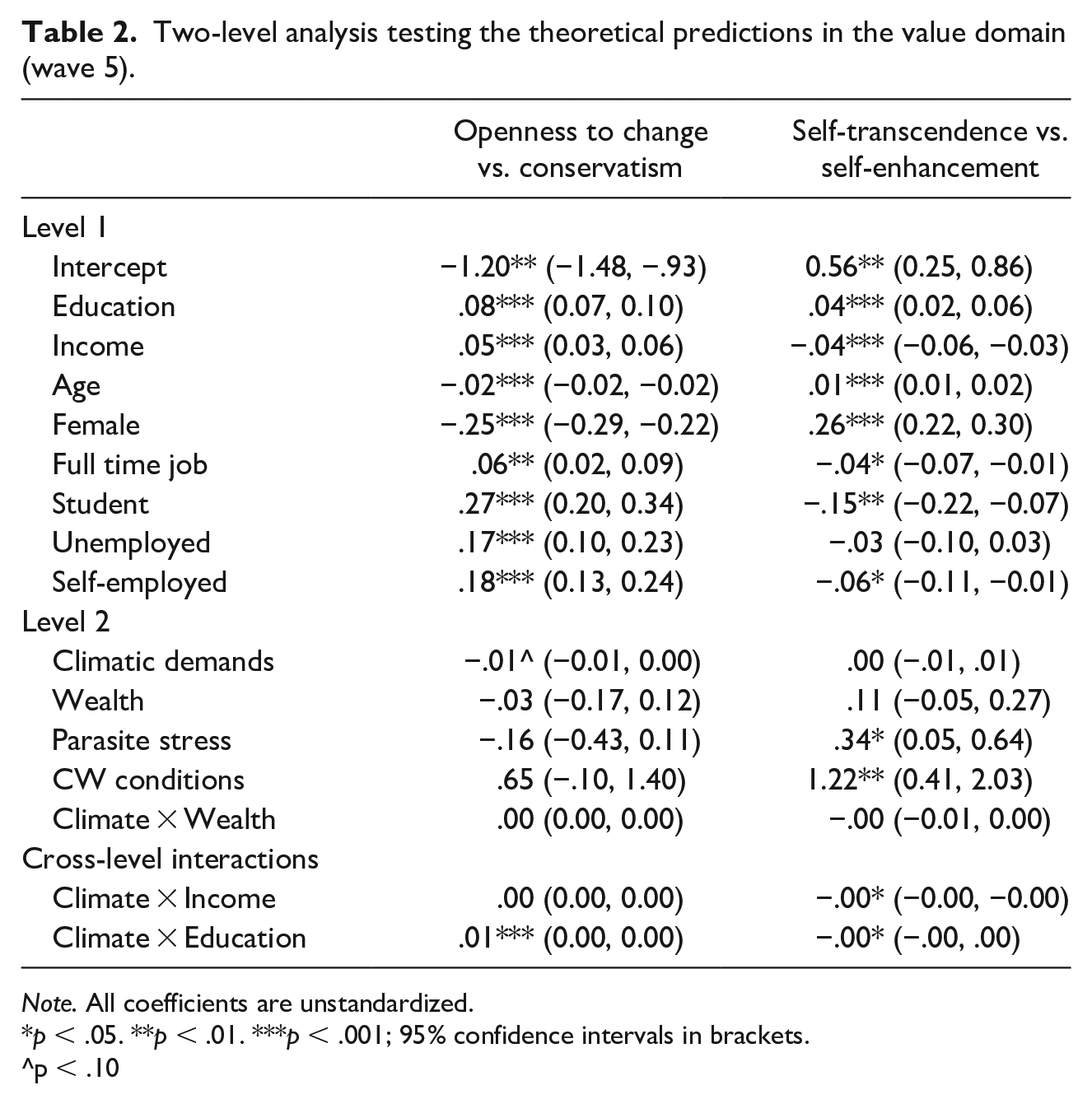
The analyses were run with the lme4 package (Bates et al., 2015) in R (R Core Team, 2021) to test the hypotheses. Values were used as dependent variables at the individual level. Dummy coded variables for gender (1 “Female”) and employment status (full-time job, student, unemployed, self-employed; all compared with other responses) were entered uncentered at level 1. Age (a control variable) and income scale (economic resources) were group mean centered. Education (cognitive resources) was an ordinal variable and was entered uncentered because it had a meaningful scale. Results are identical if education was group mean centered. At the nation level, wealth, parasite stress, and climatic demands were entered at level 2. Log transformed wealth (Van de Vliert, 2009) and climatic demands were grand mean centered and the interaction was computed using these centered variables. All individual level effects were entered as random effects, allowing for variability between nations. A number of models were tested and are described in the Supplemental Material. Model 1 included only the intercept, providing a baseline model. Model 2 included the individual level predictors age, gender, and employment. Model 3 added income (centered) and education (uncentered) as individual level predictors. Model 4 to 7 add each of the nation-level main effects (model 4: climatic demands; model 5: wealth; model 6: parasite stress; model 7: CW conditions). Model 8 enters all the main effects together. Model 9 adds interaction between climatic demands and wealth (controlling for the other nation-level main effects). Model 10 and model 11 enter the cross-level interactions between climatic demands and income/education. Model 12 includes all theoretically relevant terms. The results from model 12 are reported in Tables 2 and 3 in this manuscript, the full results are available in the Supplemental Material. All coefficients are unstandardized.
Two-level analysis testing the theoretical predictions in the value domain (wave 5).
Note. All coefficients are unstandardized.
p < .05. **p < .01. ***p < .001; 95% confidence intervals in brackets.
^p < .10
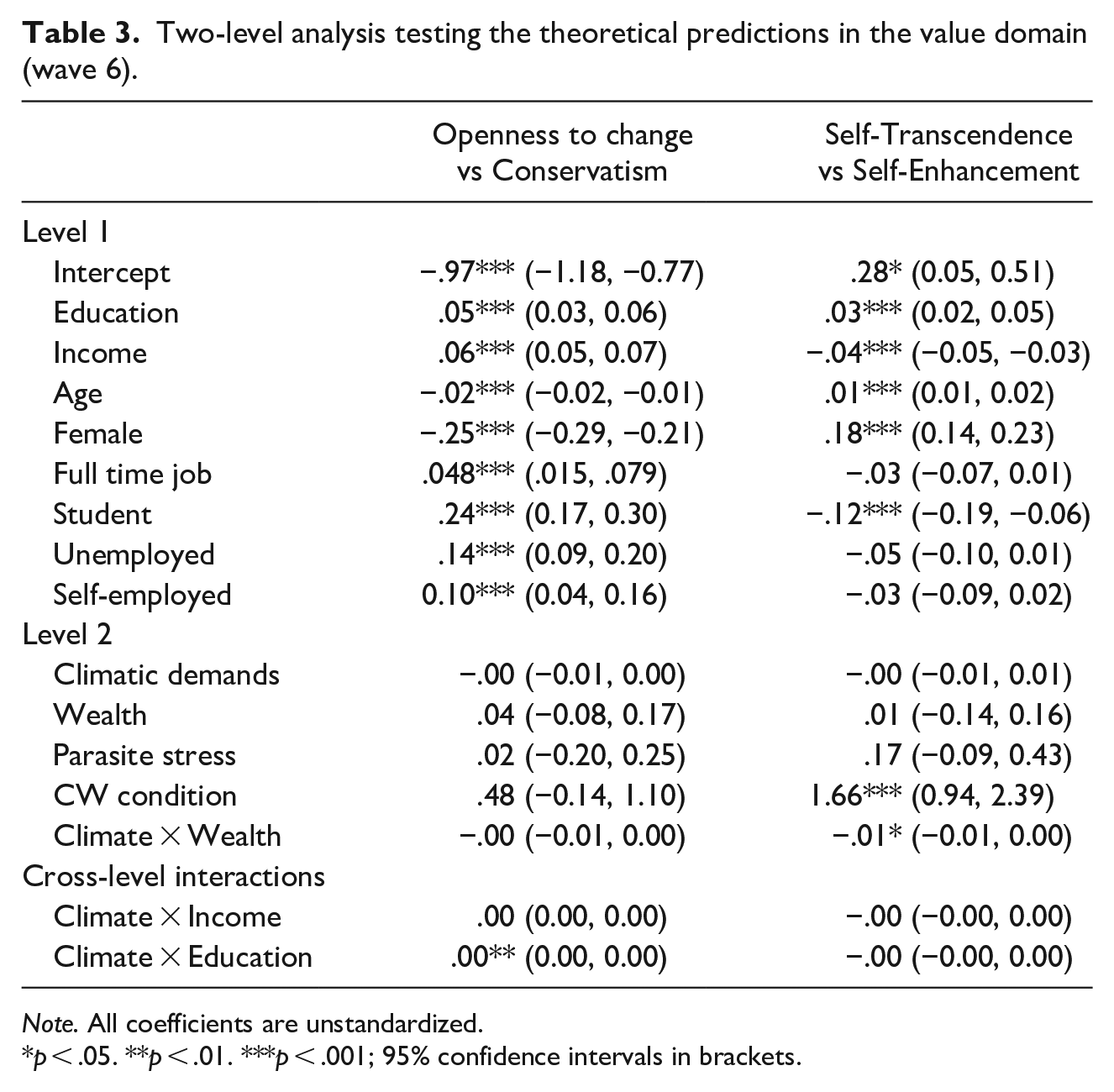
Two-level analysis testing the theoretical predictions in the value domain (wave 6).
Note. All coefficients are unstandardized.
p < .05. **p < .01. ***p < .001; 95% confidence intervals in brackets.
Results
Openness to Change Versus Conservation Values
Overall, 9.5% of the variability in openness to change versus conservation value scores at the individual level was attributable to nation clustering. Controlling for age, gender, and occupation accounted for 11.6% of the conditional variance at the individual level. Focusing on the hypotheses in isolation, both the effect of wealth and CW conditions were highly significant and positive, in line with predictions. The effect of parasite stress levels was also significant and negative (in line with predictions). The main effect of climatic demands was not significant. The predicted interaction between climatic demands and wealth was also not significant when entered separately. When entering all the variables together in the same model, none of the variables remained statistically significant, controlling for all the other variables. A test of model assumptions suggested that none of the variables had VIF values >5, suggesting no multicollinearity issues.
The first research question focused on the effects of the individual level resource variables. Both greater income and education within nations was significantly associated with endorsement of openness values. These two variables contributed an additional 11.6% of the conditional variance within nations, after controlling for age, gender, and occupation.
Focusing on the cross-level effects, the climatic demand by education interaction was significant and account for 11.2% of the intercept variance across samples (see Figure 2). In contexts with pleasant climate, the relationship between education and openness was significant but weak (b = 0.057, SE = 0.01, p < .01), whereas in more demanding climates the effect of education was stronger (b = 0.105, SE = 0.01, p < .01). Examined in a different way, among highly educated individuals, the effect of climate was negligible (b = −0.002, SE = 0.00, p = .60) compared to individuals with lower levels of education (b = −0.005, SE = 0.00, p = .15).
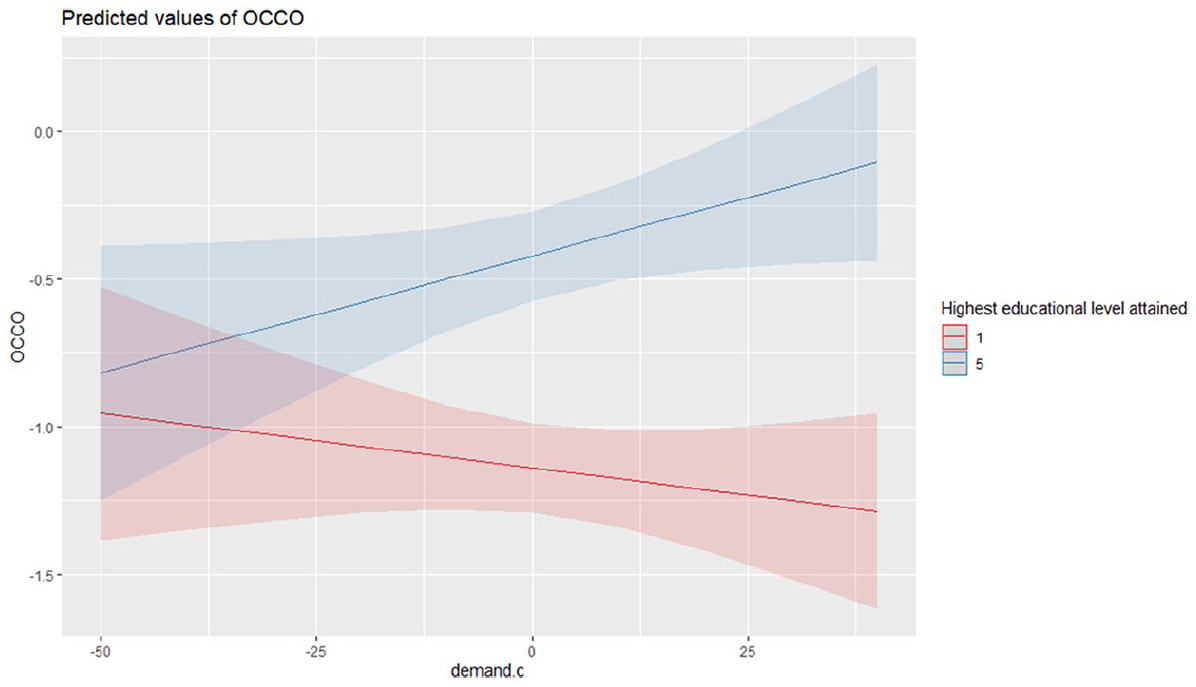
The interaction effect between individual level resources (education) and climatic demands on openness to change (vs. conservative) values.
In contrast, the interaction effect with income was only marginally significant (p = .09, explained variance 3.7%). When entering all effects simultaneously in the model, the climatic demands by education effect remained significant, but not the climatic demand by income effect.
Self-Transcendence Versus Self-Enhancement Values
Nation clustering explained 15.2% of the variability in self-transcendence versus self-enhancement values in a null model. The demographic variables explained 6.2% of the variability. Focusing on the hypotheses (see Table 1 and the Supplemental Material), after entering all individual level variables in the regression, greater national wealth was associated with greater endorsement of self-transcendence values. Wealth by itself accounted for 22.0% of the conditional variance in the intercept differences for self-transcendence versus self-enhancement (after controlling for all individual level predictors). CW conditions were also associated with greater self-transcendence, explaining 33.9% of variability in the intercept across cultures. Parasite stress was not significantly associated with self-transcendence values. Similarly, climatic demands by themselves or the interaction between wealth and climatic demands were not significantly associated with self-transcendence values. Therefore, entered separately, only hypothesis 1 (wealth) and hypothesis 2 (CW conditions) were supported. When entering all variables together, these two variables remained significant. All variables together explained 26.7% of the relative variance in intercepts.
Focusing on the first research question, income and education explained another 2.0% after accounting for the other individual level variables. Both variables were highly significant. At the individual level, greater education was also associated with more self-transcendent values, as predicted. However, income at the individual level was negatively associated with self-transcendence values: individuals with higher income reported relatively higher levels of self-enhancement.
Focusing on the final hypothesis, climatic demands interacted with individual level resources, entered individually and also entered together in the same equation and after statistically controlling for all other country-level effects. The cross-level interaction with education explained 8.5% of the variance in the intercept differences, whereas the cross-level interaction with individual income explained 6.3%. Education had a significant positive effect on self-transcendence values in temperate climates (1 SD below the mean): b = 0.06, SE = 0.01, p < .001, but not in demanding climates: b = 0.02, SE = 0.01, p = .17. This was not in line with the predicted effects of education buffering climatic demands. Increasing income was negatively and significantly associated with self-transcendence values in more demanding climates: b = −0.06, SE = 0.01, p < .0001, whereas in more temperate climates, the effect was negative but weaker: b = −0.03, SE = 0.01, p = .002. When entering all variables together, the cross-level interactions between climatic demands and both education and income remained significant. The final model with all predictors entered is shown in Table 2, the results for all models are included in the supplement.
Exploratory Analyses
One reviewer commented that the divergent effects of income of individuals versus wealth at the nation-level might be driven by social status competition effects. In poorer nations, individuals who are better-off may fear that they are going to lose their higher social status if they become altruistic and benevolent, an argument that is compatible with social dominance contests in more hierarchical societies (Kunst et al., 2017). A first test with only these two variables included suggested support for this hypothesis: b = −0.01, SE = 0.00, p < .001. The effect of income at 1 SD below the wealth mean was b = −0.04, SE = 0.00, p < .01, but was significantly stronger in samples at 1 SD above the wealth mean: b = −0.07, SE = 0.00, p < .00001. When including all random effects at individual level and nation-level, the test of this cross-level interaction on self-transcendence values was not significant anymore (p = .79). The status contest explanation of the divergence of economic effects was therefore not supported. The two other cross-level interactions remained significant.
Extending this argument to include climatic effects, it could be argued that these status contests may be more salient in more climatically demanding environments. The three-way interaction tested in isolation from all the individual and nation-level effects (e.g., including the main effects of wealth, income and climatic demands as well as two-way interactions and the three-way interaction) suggested some support for this hypothesis: b = 0.00, SE = 0.00, p < .05. In poorer and more demanding climates, there was a marked negative effect of income on self-transcendence values. In contrast, in high income countries, lower income individuals in demanding climates were more generous and high-income individuals in richer countries were not shifting their value priorities depending on climatic demands. When including all individual and nation-level effects, the effect was not reliable using standard significance levels (b = 0.00, SE = 0.00, p = .15).
For sake of completeness, the same regression focusing on openness to change (vs. conservatism) values was also run. The interaction between personal income and GDP per capita was significant, after controlling for all individual and nation-level variables: b = −0.01, SE = 0.007, p = .02. The interaction suggested accelerated effects with high income individuals in richer nations shifting further toward openness to change (vs. conservatism) values (see Figure 3).
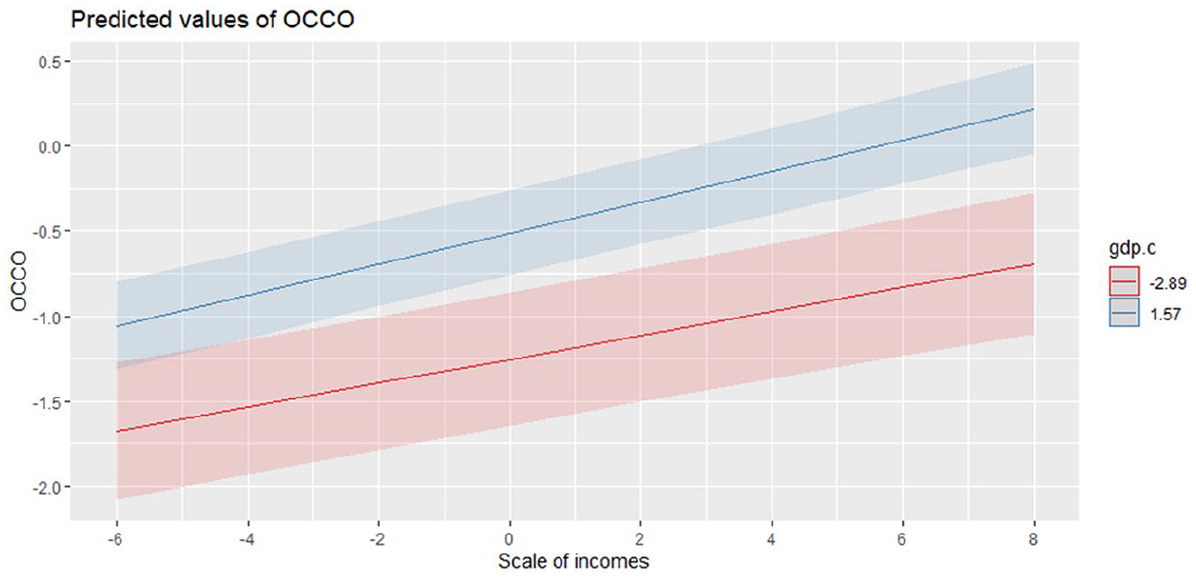
The interaction effect between individual level resources (income) and nation-level wealth on openness to change (vs. conservative) values
Discussion
The first study demonstrated that nation-level results may not hold when tested in cross-level models using nationally representative samples. Of the previously reported effects, only wealth and CW conditions at the nation level remained statistically significant when predicting self-transcendence value endorsements at the individual level. Historic parasite stress did not statistically explain any variance in value ratings. Climato-economic theory also did not predict any variance in individuals’ values when using wealth at the nation level. However, when using resources at the individual level, some interactions in line with predictions were observed for openness to change (vs. conservatism) values. Education levels interacted with climatic demands in the regression model predicting openness to change (vs. conservation) values and buffered the negative effects of climate on values. This is an exciting new pattern because it moves previous theorizing at the nation level down to the level of individuals where effects are supposed to be operating.
The cross-level interaction between climatic demands and individual resources were more complex, suggesting that lower income and less educated individuals in demanding climates were more caring for others compared to higher income and more educated individuals. An attempt to explore these effects further suggested that status competition effects could potentially drive this pattern. However, as with much previous research, these patterns are based on a single sample. It is important to cross-validate the findings and test them in a new and independent sample, using the same instruments. Study 2 uses the next wave of the World Values Survey to examine the robustness and replicability of these findings.
Study 2
The main purpose of this study is to replicate the findings reported in Study 1 in an independent sample, using the same set of variables, but a different constellation of nations and samples. To the extent that the theoretical processes are robust and universal, the respective sampling of national samples should be irrelevant to the predictiveness of the theories.
Methods
Data from wave 6 of the World Values Survey collected between 2010 and 2014 was included in this study. Data used in this study is based on representative samples from 60 countries (total N = 89,565). More information on this data set, instruments, sampling scheme, and translations are available from worldvaluessurvey.org (last accessed on May 25, 2021).
Values
The same short version of the portrait value survey (Schwartz et al., 2001) was included in the world values survey (see Welzel, 2010 for a description of the measure). The major difference is that a new item measuring universalism was added (V74. It is important to this person to do something for the good of society). This item was administered in 27 nations (N = 39,887). The results reported in this study did not change if this item was removed. As in the previous study, I created openness to change versus conservatism scores by averaging the self-direction, stimulation, and hedonism items and subtracting them from the averaged items for security, tradition, and conformity. The self-transcendence versus self-enhancement scores were calculated as the differences between the averages for universalism and benevolence items on one hand and achievement and power value on the other hand.
Country Level Variables
The same country level variables as in Study 1 were used.
Individual Level Resources
Economic resources were measured with the same self-reported placement on a 10-point income scale. The response scale options were country specific and reflect the appropriate numeric values of the income deciles in each country. In the total sample, the most frequent responses were step 5 (21.5%) and 6 (15.4%). Cognitive resources were operationalized through the highest completed level of education (no education: 11.9%; minimum completed primary: 26.6%; minimum completed secondary: 18.8%; technical education: 25.2%; tertiary education completed: 17.6%). One percent of the population did not provide information on their level of education.
Control Variables
As in Study 1, dummy codes for different occupational roles were included. The most frequent responses were full-time employment (32.3%), self-employed (11.8%), unemployed (9.6%), or currently a student (6.8%). 52.3% of the overall sample were females. Mean age was 41.94 years (SD = 16.55).
Analytical Strategy
The same analytical strategy as in Study 1 was used.
Results
A baseline model indicated that 9.2% and 15.2% of the variance at the individual level was between nations for Openness to change versus Conservatism and Self-Transcendence versus Self-Enhancement, respectively. These estimates are in line with previous estimates as well as study 1 showing relatively little variation in basic human values between nations (Fischer & Schwartz, 2011).
Openness to Change Versus Conservatism
Focusing on individual level variables (age, gender, occupation), the inclusion of these variables explained 5.4% of the variability. Adding education and income to the model, explained 11.5% of the variability at the individual level.
In relation to the predictions of nation-level variables, greater wealth and CW conditions were associated with higher openness to change values (supporting hypotheses 1 and 2), in contrast, neither parasite stress nor demanding climates or the interaction between climatic demands and wealth were significant. When entering all nation-level variables simultaneously, none of the variables remained significant. Again, a test of model assumptions did not suggest problem with multicollinearity.
Focusing on the final hypotheses, the interaction between climatic demands and education of individuals was significant, but not the interaction with income. The interaction between education and climatic demands explained 8.5% of the variance in intercepts. In line with predictions, the effect of education was positive in temperate climates: b = 0.02, SE = 0.01, p = .05; but was significantly stronger in demanding climates: b = 0.07, SE = 0.01, p < .0001. From the other perspective, the effect of climate was practically zero for individuals with lower levels of education: b = 0.00, SE = 0.00, p = .97; whereas it was positive and significantly stronger among higher educated individuals: b = 0.003, SE = 0.00, p = .29.
Self-Transcendence Versus Self-Enhancement
When entering the individual level variables 8.78% of the variance was explained. When entering education and income at the individual level, it explained 6% of the variability in intercepts (variability across samples). Education was associated with increases in self-transcendence values, whereas higher levels of income were associated with decreased self-transcendence values (vs. self-enhancement).
Focusing on the nation-level variables individually, greater wealth and CW conditions were significantly associated with self-transcendence (vs. self-enhancement) values which supported hypothesis 1 and 2, but neither parasite stress or the climatic demand by wealth effects were significant. When entering all variables simultaneously, CW conditions remained significant. The effect of wealth was not significant anymore, but the interaction effect for climatic demands by wealth became significant (b = −0.01, SE = 0.00, p = .049). In temperate climates, the effect of GDP per capita was positive and significant: b = 0.12, SE = 0.07, p = .06; whereas in demanding climates the effect was negative: b = −0.11, SE = 0.12, p = .33. Given that the effect only emerged after controlling for all other variables, the effect is probably not reliable.
Focusing on the individual-level resource variables in interaction with climatic demands, neither the interaction effects of education nor the effect of income with climatic demands were significant. Therefore, the interaction effects from study 1 were not replicated. The final model with all predictors entered is shown in Table 3, the results for all models are included in the supplement.
Exploratory Analyses
Exploring the social competition explanation for the self-transcendence versus self-enhancement values proposed by an anonymous reviewer again, the effect of the two-way interaction was not significant. Testing the extended social competition hypothesis including climatic demands, the effect was also not significant (p > .15). Examining the interaction between income and wealth on openness to change (vs. conservatism) values, the interaction was again significant, showing acceleration of income effects in wealthier countries on openness to change values.
Overall Discussion
The current study addressed what resource and ecological variables are predictive of values endorsed by individuals in two studies with representative samples from around the world. To briefly summarize the following effects replicated across both studies: (a) the positive effect of CW conditions on self-transcendence (vs. self-enhancement) values and (b) the interaction between climatic demands and education on openness to change (vs. conservatism) values. Most importantly from a theoretical perspective, climatic demands interacted with individual level resources in predicting openness to change values (vs. conservatism) and this effect was replicated across two different data sets. Therefore, the current study significantly extends previous climate-economic theorizing by pin-pointing individual level processes that may contribute to the previously noted ecological nation-level effects. Exploratory analyses also suggested that individual income and nation-level wealth interact and lead to accelerating effects on openness to change values. What was noteworthy was that individual level and nation level variables associated with wealth correlated in the same direction with openness values across levels, but income of individuals and wealth of nations had opposing correlations with self-transcendence (vs. self-enhancement) values. In the following, I discuss some general implications for theory and future research.
Climatic Versus Parasite Stress Explanations
There have been debates (Van de Vliert, 2013) about the relative importance of climatic effects versus parasite stress on human values and sociality, with the cool water model entering more recently into the theoretical discussion. In the current study neither climatic nor parasite stress variables at the national (ecological level) influenced responses by individuals. This lack of a cross-level effect is not due to problems with either the choice of variables or the specific data sets. When examining the correlations at the aggregate level, parasite stress had a significant relationship with values in both studies (see the Supplemental Material). Therefore, the parasite stress correlation is replicated at the aggregate level, but parasite stress appears to be a much weaker variable in the larger picture because effects disappear once other variables are controlled and more appropriate multi-level approaches are used. There are several possible explanations for this pattern. First, it may be that parasite stress plays a more distal role in the evolution of human sociality and exerts effects primarily at the aggregate level. In this case, the aggregate level effects of parasite stress are not directly correlated with the responses of individuals, but might exercise effects through more proximate variables. It is noteworthy that parasite stress effects have been found across a range of other institutional and psychological variables, but they may impact self-ratings of values more indirectly through institutional variables.
Second, it may be that more locally and temporally relevant variation is meaningful for individual values. Recent evidence suggests that local levels of parasite stress or temperature range at specific development periods of an individual or population are psychologically meaningful instead of estimates averaging across a larger range of locations (for an overview of the relevance of local effects, see Rentfrow & Jokela, 2016) or when examined without considering temporal developmental effects (Frankenhuis et al., 2019). To provide one specific example, parasite stress levels during pregnancy and infancy have been shown to influence cognitive development, which suggests that local stress levels at critical periods of an individual’s development may have longer lasting effects (e.g., Eppig et al., 2010). Such fine-grained studies differentiating local and temporal dynamics would be highly informative for value researchers.
Third and in contrast to parasite stress, CW effects had a significant positive effect on the endorsement of self-transcendence (vs. self-enhancement) values of individuals. Welzel argued that cool water conditions provide the background against which rapid cultural evolution may progress under specific conditions. Given more equal access to water, no individual or group was able to suppress and control others, which tended to result in more egalitarian power structures, which were more easily scaled up when technological conditions changed. As argued by Welzel (2013, 2014), women had greater autonomy over their reproductive rights, which in turn increased labor costs and triggered exploration of technological solutions to increase productivity. Emerging technological changes in turn required a more highly skilled group of individuals that could refine and improve technologies, setting into motion a rapidly accelerating cycle of cultural evolution. Cool water regions in Europe in particular became centers of large civilizations with changing technologies that required greater cooperation of educated individuals that explored solutions to increasingly complex technologies that became necessary to maintain productivity independent of labor costs. In the current data, the lasting effect of these ecological resources seem to be at the altruistic and universalistic value end of (self-transcendence) values rather than the independence and creativity-focused end of the (openness to change) value domain. Therefore, the legacy of these climatic resources of access to clean water is the socialization of trusting and tolerant individuals.
Fourth, climatoeconomic effects were not significant when analyzed at the country level, but there were significant cross-level interactions between education level of individuals and climatic demands within societies on openness to change values. This suggests that individual level resources are important for understanding how distal climatic effects play a role in affecting psychological realities of individuals. In other words, the nation-level aggregate processes may operate via more proximal variables that need to be identified in further research. The role of nation-level theories is therefore important for identifying possible variables to examine and the relevant individual level processes need to be further isolated in subsequent research.
In this study, education showed the most consistent and replicable interaction effect across the two studies. Education can be seen as a cognitive resource that enables individuals to pursue different avenues in life which may or may not be dependent on money as an economic resource. Money may not be the most important predictor at the individual level when unpackaging climatic effects because income can be spent in a number of different ways and may not lead to value change in face of climatic challenges. It is the cognitive capacities that are developed through education that seem to be important for shaping values in interaction with climate.
Extending this reasoning, similar processes might be possible for parasite stress. For example, future research could identify parasite stress levels in the local environment of individuals and then test whether these locally relevant parasite stress levels have an effect on value endorsement. Extending the specificity of these effects, it may be important to pinpoint specific developmental periods, when parasite stress is most likely to exert an influence on value development (Fischer, 2017). For example, cognitive development during pregnancy and infancy seems to be strongly affected by parasite stress levels (e.g., Eppig et al., 2010). Values change in line with developmental roles and responsibilities during a person’s ontogenetic development (Gouveia et al., 2015, Sortheix et al., 2019). Parasite stress may exert differential effects at different life stages in a person’s development, depending on the task that needs to be accomplished. This requires time sensitive sampling of parasite stress. Global historical parasite stress may not be the best variable to understand why individuals endorse specific values.
Economic Resources and Ecological Fallacies
Economic variables had significant effects on value endorsement at both levels, yet the directions were not always compatible across levels. Income of individuals and national wealth were found to be operating in the same direction for openness to change versus conservation values: greater economic resources at both levels lead to strengthening of openness to change values. Economic resources increase the autonomous and agentic motivation of individuals. There was even evidence of accelerating effects across levels. Having more disposable wealth at one’s disposal increases choices for individuals, especially if living in environments that are already relatively wealthier. Hence, having disposal income in a wealthy environment potentiates and unleashes an even faster drive toward greater emancipation of individual desires and actions (Welzel, 2013).
In contrast, for self-transcendence versus self-enhancement values, the effects were opposing at individual and societal level. Greater wealth at a societal level was associated with greater concern for others, whereas greater income at the individual level was associated with less concern for others and more concern with one’s achievement and power. This disconnection between individual and nation-level dynamics is in line with a number of recent findings at the individual level (e.g., Piff et al., 2010; Piff, Stancato, Cote, et al., 2012; Stellar et al., 2012). It appears that aggregate wealth effects bring about contextual changes at the aggregate level that allow individuals to become less self-centered and to consider more the well-being of others close and distant as well as the environment. On the other hand, at the individual level those individuals with greater income are more motivated to seek out situations and opportunities to further demonstrate success and achieve power over others and may have no time and energy left to be individually concerned with the welfare of others. Interestingly, a social status contest explanation as suggested by an anonymous reviewer was not able to reliably explain this difference.
One issue that may be worth exploring further is the relative effect of income inequality. The individual level income effects may be masked effects of a more unequal income distribution. Unfortunately, the individual level income deciles were not available to include in the current model. However, the available evidence suggests that economic effects on self-transcendence values are a classic example that aggregate and individual level effects do not need to be aligned.
Limitations and Future Research Directions
We have already outlined a number of avenues for further research. The macro-level variables might be too broad and general to exert sufficient influence on the values of individuals. Whereas previous research showed consistent effects using aggregate level data, the use of multi-level analyses may require more sensitivity at levels of geographical aggregation (e.g., region, neighborhood) as well as timing of measurement points (e.g., crucial developmental windows when parasite stress is most important) to predict variability in values of individuals. A second issue that needs greater attention in future studies is greater precision at estimating variances at each level. The baseline models suggested that within-nation variability was significantly larger than between-nation variability, hence values vary more within rather than between national boundaries. Nation-level analyses may often give the impression of more substantive variability across the globe. The current analyses found that even though this variability was small, there were systematic and statistically reliable nation-level effects. At the same time, one of the main motivations of the current study was to open the door for greater theorizing of systematic within-nation effects, because individually-relevant demands and resources most likely matter more at smaller geographic and administrative scales. The current study makes first steps in this direction and this remains one of the great theoretical and practical challenges for future studies.
Another limitation is the set of value measures used in this study. The data was administered as part of a larger survey to nationally representative samples around the world. This requires short and concise measures that capture key aspects of the value dimensions, but may miss some valid variance in the constructs. Relative compromises in validity are difficult to ascertain, but a number of studies have used these short measures successfully in previous research, suggesting that they tap into core value processes. Future studies nevertheless would benefit from more comprehensive value measures to examine plausible origins of cultural differences.
Conclusions
Previous research has primarily examined ecological level correlations, showing that resource and demand models focusing on wealth, parasite stress, and climate explain variability in mainly prosociality related values. The current study demonstrated that ecological analyses may not apply at the psychology of the individual and may miss important individual level processes. The task is to better understand how ecological theories operate at the individual levels. The current study provides one avenue in this quest for a more universal psychological science.
Research Data
sj-docx-1-ccr-10.1177_10693971211031476 – Research Data for Origins of Values Differences: A Two-Level Analysis of Economic, Climatic and Parasite Stress Explanations in the Value Domain
Research Data, sj-docx-1-ccr-10.1177_10693971211031476 for Origins of Values Differences: A Two-Level Analysis of Economic, Climatic and Parasite Stress Explanations in the Value Domain by Ronald Fischer in Cross-Cultural Research
Footnotes
Acknowledgements
I would like to acknowledge constructive comments from the editor and three anonymous reviewers as well as helpful discussions, suggestions and comments from Johannes Karl and Evert van de Vliert that have helped to improve the analyses and the manuscript.
Declaration of Conflicting Interests
The author(s) declared no potential conflicts of interest with respect to the research, authorship, and/or publication of this article.
Funding
The author(s) received no financial support for the research, authorship, and/or publication of this article.
Supplemental Material
Supplemental material for this article is available online.
Notes
Author Biography
References
Supplementary Material
Please find the following supplemental material available below.
For Open Access articles published under a Creative Commons License, all supplemental material carries the same license as the article it is associated with.
For non-Open Access articles published, all supplemental material carries a non-exclusive license, and permission requests for re-use of supplemental material or any part of supplemental material shall be sent directly to the copyright owner as specified in the copyright notice associated with the article.
