



Abstract
Fat talk is a conversational interaction recognized through comments like “Does this make me look fat?” In the US, based on psychological lab-based investigations, fat talk is defined as highly damaging for women and actively targeted for various interventions. Using a discourse completion task (DCT), we present normative responses (N = 313) to fat talk prompts testing women’s fat talk patterns across diverse languages and socio-cultural contexts. Based on replies from the DCT deployed in seven countries, we find that the normative response in all sites is always denial (“No, you aren’t!”) and often followed by additional reassurance (“you look good”). The consistency of findings suggests fat talk is an emergent global conversational form with shared, recognized rules among casual acquaintances. The normative denial response suggests positive functions where interactional fat talk reaffirms and reassures peer affiliation and membership. Ultimately, we suggest that fat talk may serve as a mundane rejection of everyday fatphobia; interventions posing fat talk as always harmful may simply reaffirm experiences of fat stigma by attempting to restrict the interpretation to only negative.
Anthropologists Mimi Nichter and Nancy Vukovic coined “fat talk” in the late 1980s, based on a detailed ethnography of weight-obsessed Arizona schoolgirls and their mothers (Nichter & Vukovic, 1994). Fat talk is a particular conversational form characterized by self-disparaging opening statements on some version of “Do I look fat?”. At that time the speech form was attributed to mainly adolescents who self-identified as middle-class White females; but, in the decades since it has been identified as a normative and common conversational interaction between US women of all ages (Englen & Salk, 2014; Salk & Engeln-Maddox, 2011; Taylor, 2016), 1 and perhaps for women in Australia and Anglophone Western Europe (e.g., Payne et al., 2011). It has also been observed among men, with a focus on muscle (or lack thereof), e.g., “Do my legs look skinny?” (Agostini et al., 2019; Engeln et al., 2013; Sladek et al., 2014, 2018; SturtzSreetharan et al., 2019b). Like women, the normative reply for men is denial (“nah man”) (SturtzSreetharan et al., 2019).
Studies in psychology have proposed that fat talk almost always results in negative psychosocial outcomes for the people (especially young women) who engage in it, such as loss of self-esteem and risks for disordered eating or anxiety (e.g., Compeau & Ambwani, 2013; Salk & Engeln-Maddox, 2012; Stice et al., 2003). The Body Project is one such leader in challenging the thin ideal and encouraging body acceptance in adolescent and college aged women; reducing fat talk is one primary target of their efforts (Stice et al., 2009; Vanderkruik et al., 2020). It is a cognitive dissonance-based general body acceptance programming for young women that attempts to “resist sociocultural pressures” and improve body satisfaction as a means to prevent the onset of eating disorders in particular. Participants are typically recruited in high schools, and facilitated by a trained peer to argue against the notion of the thin ideal through verbal, written, and behavioral exercises (http://www.bodyprojectsupport.org/background). For example, one take-home technique to cease fat talk is a “fat talk jar,” whereby everyone in the household is fined each time they engage in any form of it (Conte, 2019).
Nichter and Vukovic’s groundbreaking work clearly recognized that naturally occurring fat talk had important applied elements, given its association with powerful social meanings, relationship to social (dis)connections, and health decision-making (like around dieting). But their original work did not suggest fat talk was universally harmful, nor suggest that individual-level interventions was the best course of action. Rather, they identified several potentially positive, affiliative aspects of fat talk. That is, their work suggested that not all fat talk was necessarily either meant nor understood as hurtful and therefore harmful. Critically, their work that led to naming and defining fat talk came from observed interactions of people doing or reporting doing fat talk (interactional fat talk).
Here we present the findings from a study of patterns of fat talk, designed to increase our understanding of how fat talk functions as an interaction (i.e., a languaging event between interlocutors based in norms, rules, and meanings). Our approach, drawn from linguistic anthropology and using a discourse completion task, considers how a primed fat talk event is responded to and negotiated. Because there is increasing evidence that fat talk is observed in an array of contexts beyond that generally described by Nichter and Vukovic (relatively affluent US women who self-identify as White), and confirming this has implications for fat talk intervention designs, we sampled across an array of different sites as part of our design. Our hypothesis was that fat talk occurs as an interaction among interlocutors. This means that we do not understand it as an internal conversation limited to self-talk; rather, it is a conversation between at least 2 people who may be familiar or not (e.g., peers, friends, or even people with whom we establish rapid camaraderie). As such, fat talk then can have interactional benefits of engaging in conversation with others that need to be balanced against the belief that all fat talk is bad. This may be particularly the case in those regions where people characterize their relationships to others as more interdependent than independent (e.g., non-western communities).
Background to the Study Rationale and Design
In the last two decades, a large body of lab-centered, US-based psychological research has concluded that exposure to fat talk is extremely damaging; it is associated with body shame and low self-esteem, purportedly leading to increased risk of eating disorders and related mental health conditions like depression (e.g., Compeau & Ambwani, 2013; Salk & Engeln-Maddox, 2012; Stice et al., 2003). Fat talk in the contexts of friendship is sometimes described as “co-rumination” -- suggesting it has negative emotional valence, as well as undermining self-esteem (e.g., Rose et al., 2007). Accordingly, there is an enthusiastic effort – most especially in high schools and on university campuses - to eradicate women’s fat talk through interventions, support groups, fat talk free weeks, and fat talk free zones (e.g., Buelow et al., 2014).
The lab settings used in much of the relevant psychological research typically engage strangers to produce fat talk which is over heard by a study participant who is then asked to reflect on or complete a survey regarding how the overheard instance of fat talk made them feel (Salk & Engeln-Maddox, 2011, 2012). These studies do not capture naturalistic interactions with one’s peers of the types engaged in real world settings. We suggest these studies might be solely measuring (and so only capturing) the effects of negative self-talk, not interactional fat talk.
Previous literature has documented the spontaneous occurrences of fat talk among customers and retail clerks in a plus-sized clothing store (Elmen-Gruys, 2008, 2012). Her findings question the function of fat talk as simply affiliative and positive suggesting instead that it is a form of emotional labor that is rooted in fatphobia which emerges from White settler colonialism (see Farrell, 2011; Harrison, 2018; Laymon, 2018; Strings, 2019). Here, fatphobia means a position of antifat that understands body size as a direct result of individual choices and moral failings (Lupton, 2013; Puhl & Heuer, 2009; Strings, 2019). This idea is directly connected to the concept of the biocitizen, the idea that a person is solely responsible for their body and weight (Costa, 2021; Rose & Novas, 2007). Popular writer Shaw (2023) lays out all the ways we experience fatphobia or anti-fatness on a daily basis. It includes: everyday exposure to conversations about losing weight; experiencing conversations about the fear of being fat and engaging in calorie restriction; obsessing over any number of celebrities’ bodies being considered fat; and, the prescribing of the diabetes drug Ozempic to people without diabetes.
Elmen-Gruys understands the clothing store clerks to be the ones doing the emotional labor; however, it is not clear if the customers who initiate the fat talk find the interaction laborious. Elmen-Gruys suggests that while fat talk among women who share body size and ethnic background appears to reinforce shared experiences, when fat talk happens among women of different sized bodies and/or ethnic backgrounds, it results in sanctioning and “boundary making behaviors” (Elmen-Gruys, 2008, p. 5). Somewhat similar, in examining fat talk DCT responses among men of differing body sizes, we find that when men of similar body sizes engage in fat talk, it appears affiliative and affirming; however, when a smaller body sized man initiates the fat talk to a larger body sized man the conversation becomes awkward with inconsistent replies (SturtzSreetharan et al., 2019). Finally, Lucibello et al. (2021) find that body talk from coaches, teachers, and other people in authority directed at adolescent women athletes is understood negatively whereas body talk among peers is not noted.
Critically, there is some limited ethnographic evidence that not all participants in fat talk contexts report negative feelings in its wake (e.g., Katrevich et al., 2014; Salk & Engeln-Maddox, 2011; Taniguchi & Lee, 2012). As Nichter’s (2000) analysis has already suggested, fat talk may engage specific roles in negotiation of the self and body within peer group interactions. The proposition therein is that fat talk could serve to knit communities together, provide substantiation of group membership, and allow peer networks to coalesce. Indeed, Taylor (2011, 2016) has found that junior high school aged students engage in fat talk in order to assert group norms, preempt criticism by others, and express guilt for consuming ‘junk’ food. Thus, the functions of fat talk may include the advancement of social affiliation and provide a vehicle for psychological self-affirmation. More recently, Sommers (2021) found that interpersonal sensitivity, a desire to belong, and conformity to feminine norms are positively associated with fat talk. Specifically, women may engage in fat talk in order to signal a desire to fit into group norms or build connections (Sommers, 2021). If so, any such positive purposes of fat talk would most likely stem from the interactional achievements that take place during the conversation, findings which are difficult to see in laboratory contexts. By examining fat talk responses, we can gain insight into the ways that the fat talk interactions are taken up and responded to by interlocutors. For example, the culturally acceptable response rules in the US to conversations that begin with variants on the question “Am I fat?” (speaker A) appear on the surface to be emphatically affiliative, as in “No, you’re not” (speaker B) (Agostini et al., 2019; Becker et al., 2013; SturtzSreetharan et al., 2019, 2020). 2
Shannon and Mills (2015) call for increased research into fat talk cross-culturally, with the goal of better designed interventions to curb fat talk in more countries. We propose the need for cross-cultural research on fat talk with the view to improving interventions globally is more fundamental: better basic theory-building regarding the assumption that fat talk is always damaging, particularly clarifying any affiliative (or other positive) functions of this specific form of interactionally achieved conversation. To our knowledge there have not yet been any systematic comparative studies of fat talk across diverse sites.
But there are clues in the cross-cultural literature that suggest compelling differences could be detectable, and interpretively important in their contrast. For example, preliminary research suggests different reactions to fat talk scenarios on Facebook for Japanese and Korean viewers compared to US viewers, in that subsequent weight loss discouraging messaging produced more positive emotional reactions, including less body dissatisfaction (Lee et al., 2013; Taniguchi & Lee, 2012). In a study of fat talk among Japanese college-aged women, Takamura found that women understood fat talk in multiple ways including as friendly interactions, solidarity building, and as worries-talk about their own bodies; she also found that women reported feeling relief when their fat talk inquiries were responded to with statements such as “you are not fat” (Takamura, 2016). However, among Indonesian unmarried women, higher instances of fat talk were found to be associated with greater body dissatisfaction (Triyuliana, 2020). These diverse studies of fat talk demonstrate how ubiquitous this genre of conversational interaction is becoming. More generally, recent ethnographic analyses demonstrate that women’s concerns and anxieties around being ‘fat’ are globalizing rapidly (Brewis et al., 2018; SturtzSreetharan et al., 2021). Thus, there is some basis to consider that fat talk might be common in an array of settings, even if it takes different forms. But a central question is whether the affiliative functions may be apparent in some – or all – settings, with considerable implications for the goal of current psychological efforts to globalize anti-fat talk interventions.
Operationally, fat talk typically takes the grammatical form of a (self-focused) indirect complaint (Boxer, 1993b) or a request for self-evaluation (Pomerantz, 1984). For example, “These pants make me look fat!” or “Do these pants make me look fat?”. Although not a sustained genre of verbal interaction (Kim, 2015), fat talk appears to be a frequent phenomenon. It is a brief, formulaic script that occurs spontaneously; and, based on research on general complaints, US women may engage in this conversational genre more frequently than men (Boxer, 1993a). Because fat talk is understood as a formulaic script, it is particularly well-suited to being investigated through a discourse completion task (hereafter DCT) procedure.
Interactional norms can be meaningfully elicited using a DCT sampling strategy both within languages (e.g., Beebe & Cummings, 2009; Herbert, 1988; Kasper & Dahl, 1991) and across languages (e.g., Chen, 1993; Saifi & Sultani, 2017; Tang & Zhang, 2009). DCTs are useful in that they capture claims about language use (Labov, 1984) revealing what people believe is the appropriate response, rather than eliciting actual language practices. Our study aimed to apply the approach of DCT to document the ‘rules’ for responding to fat talk and to compare these responses across seven different sites. It is an important empirical step to explaining fat talk as a common genre of interaction, pinning down the expected or culturally normed responses to such interactions, and thus beginning to unravel if fat talk is appropriately designated as universally “harmful” -- and hence demanding purposeful intervention.
Using a DCT that features an initial fat talk prompt in the local languages examined in this study, we are able to compare an array of normative cultural (expected) sequential conversational responses by women to a single fat talk phrase. Anecdotally, we have repeatedly recorded US cisgender heterosexual men saying that the phrase “does this make me look fat?” is a ‘dangerous (or loaded) question’ that only has ‘one right answer’ (denial) when posed by a woman. However, other scholarship has noted that self-identifying White women in the US report that they prefer to be told ‘honestly’ whether or not they look fat (Tannen, 2017). Indeed, self-identifying White women in the US claim that they rely on their true friends to provide straightforward and important assessment and evaluation. Although, somewhat contradictorily, French women believe that self-identifying White women in the US expect their friends to discount their negative self-judgements (such as fat talk), while they (French women) report valuing friends who directly confirm or deny the negative self-evaluation (Carroll, 1988). Likewise, Deaf culture members in the US are said to discuss weight gain and physical appearances bluntly; indeed, not commenting on things like weight gain or change in appearance can be understood to signal an uncaring or aloof attitude (Karp, 2020; but see Roush 2007 for a critique of this stereotype). However, in these cases of being blunt or telling the bold truth the interlocutors are friends, and often good friends at that. In short, how fat talk is taken up in actual interactions is vague and unclear at present, suggesting a use for some basic clarity around fat talk norms to inform fat-talk interventions.
Methods
The Fat Talk Discourse Completion Tool
We developed a novel discourse completion tool to elicit responses to a fat talk prompt. After considerable cognitive interviewing and piloting of a range of possible tools to elicit normative fat talk conversational sequences, we selected a visual elicitation based on a line drawing (Figure 1). Piloting efforts included sitting down with participants to elicit specific feedback on the visual vignettes including how participants perceived various versions of the depicted women’s ages and appearances as well as if the context (a dressing room) seemed a reasonable location for a fat talk interaction to occur. For example, our first drawings were reminiscent of cartoon/manga and thus people did not identify with the two women. Likewise, we found that if both depictions of women had the same hairstyle, they were perceived as the same woman. Thus, we chose to have one woman depicted with a ponytail. Based on information learned in this process, we then piloted the survey with 24 participants and made final adjustments to the DCT. We chose “Does this make me look fat?” as the conversational prompt for Speaker A (see Table 1) for three reasons: 1) it is identified most often by participants on a widely-applied fat talk validation scale (Clarke et al., 2010); 2) it is a question that demands a response; and, 3) our pilot fieldwork in the test sites confirmed that the equivalent phrase occurred naturally in the local languages. Discourse completion task image. Prompts in Original Languages.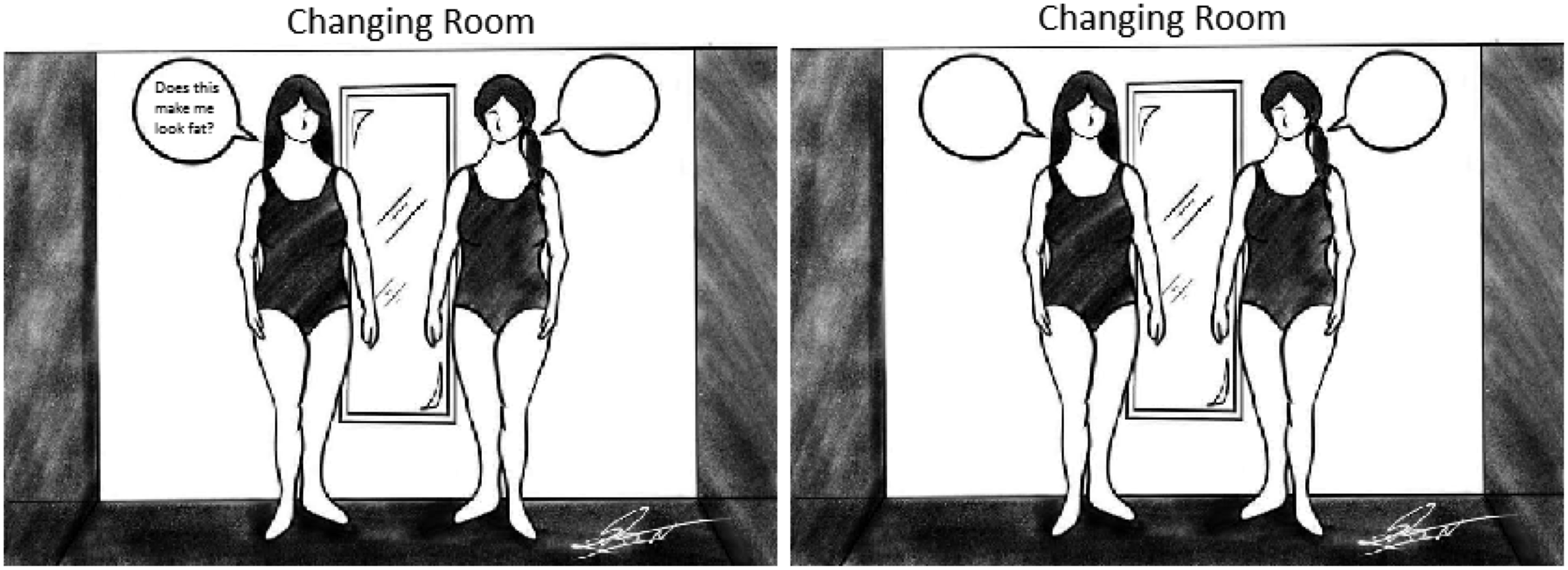

To simulate a naturally occurring fat talk situation recognizable to participants across sites, a clothing store fitting room location was ultimately selected as a potential mimicry of an everyday fat talk event (see Gruys, 2012; Pospisil, 2020). The figures themselves were drawn using the body outlines from the Stunkard body image scale that have successfully been applied cross-culturally in a range of settings (e.g., Brewis et al., 2011). The selected body sizes (#5 image) matches a BMI of 25 (Stunkard et al., 1983), exactly on the border between the medical classification of “normal” and “overweight.” We also went through several iterations of cognitive testing of different skin and hair colors, hair styles, clothing, body shape, etc., of the drawn figures to discern what was least confusing or distracting to participants. For example, having both speakers the same size reduced respondent confusion over whether they should identify with the speaker (A, the one with the prompt) or the interlocutor (speaker B, the one with the blank bubble to be filled in).
Study Sample and Sites
Study Sites and Samples Characteristics.
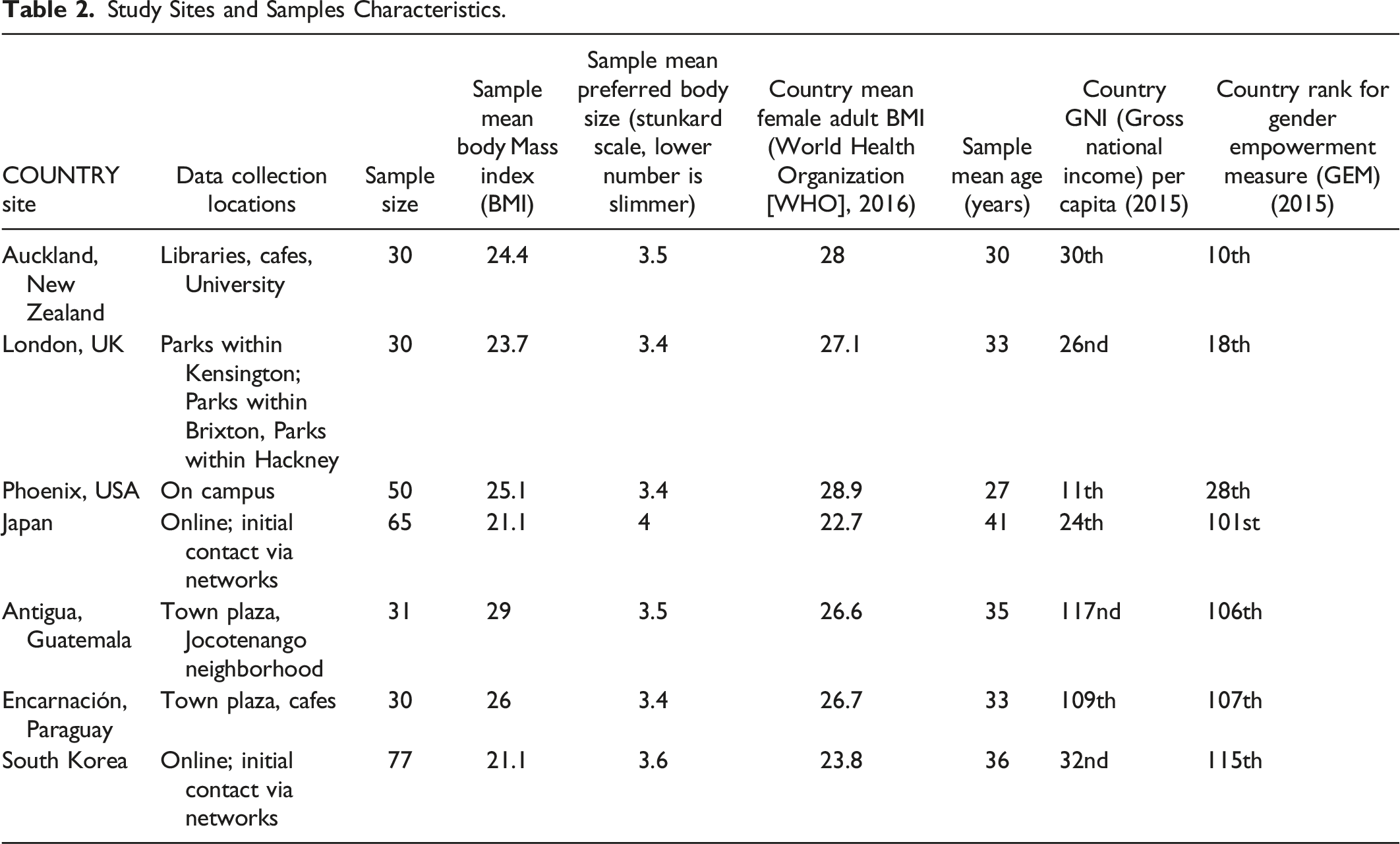
The DCT was followed by a set of questions which collected demographics and asked questions about body size (weight, height), body perception, and preferences, as well as socioeconomic status and work, and decision-making autonomy (the latter based on the Demographic and Health Survey (DHS) empowerment module questions (DHS Program 2015)).
In the second round of data collection, to help expand interpretability of findings, we added two more countries administered via an online DCT (utilizing SurveyMonkey) which was disseminated via author networks (email, social media platforms). The online survey mimicked that of the paper survey with few exceptions (e.g., consent form was altered for online format). A single-use non-ISP-tracking link to the survey was disseminated via email and social media platforms (e.g., WhatsApp) to people in the test sites. Upon clicking the link, the first question a participant would answer was to indicate their birthdate. If the submitted date indicated that the participant was not at least 18 years of age, the survey ended. If the participant was at least 18 years old, the next page they would see was the informed consent page. The informed consent for this round of data collection noted that proceeding further into the survey was equivalent to consenting into the research study. After the consent form, the online survey led with the DCT image and a text box for participants to write their response; this was then followed by the demographic and health survey.
We set a sample target for each in-country site of 30, above the recommended minimum size for saturation in ethnographic sampling at a single local site (Bernard et al., 2016, p. 41). Total sample is 313. Elicitation of responses was done in local languages. All DCT responses were coded in the original language before translating for reporting purposes. 3
Data Coding and Analysis
All responses to the first panel of the DCT were read iteratively identifying themes based on how the response addressed the propositional content of the fat talk prompt. This is an important point. By prioritizing the propositional content of the prompt, our focus was on how the truth value of the prompt was addressed. This allowed us to be more confident that we were not over-interpreting the responses provided by participants. Interpreting written responses requires caution as it is too easy to imbue the response with extralinguistic meanings (e.g., tone, emphasis, etc) which changes the overall meaning. For example, a response such as “No, you aren’t fat!” directly addresses the propositional content of the prompt by denying the truth value of the prompt. While a response such as “Yes it does!” addresses the truth value by validating it. Other responses such as “You look a bit chubby” validates the truth value but also mitigates the potential blunt effect of the validation by using the word ‘chubby’ and qualifying that with the word ‘bit’. Limiting our interpretation of each response to the way that the truth value of the prompt was addressed allowed us to develop codes that could be organized along a continuum of “no, that’s not true” to “yes, that’s true”. Adhering to the way that the propositional content was addressed helped ensure that codes (once developed) were applied in a consistent manner.
Coding Scheme and By-Site Exemplars for Responses to DCT Prompt: “Does this Make me Look fat?”.

As we present the results below, it bears repeating that the responses represent participants’ answers to DCT prompt “Does this make me look fat”? The responses do not provide information as to how the participant would actually respond to such a statement with an actual interlocutor. A DCT can’t replicate the contextual cues that are present in live interactions. The responses simply suggest what the prescribed normative response may be in each site. This is important to keep in mind given that meaning in language is not fixed and thus whether or not the responses reported by the participants would actually be taken up as affiliative or distancing in naturally occurring interactions is not knowable from the DCT. This is a first step in understanding normative replies to fat talk.
Results
Frequency of Speaker B Response to “Does this Make me Look fat?” by Site.

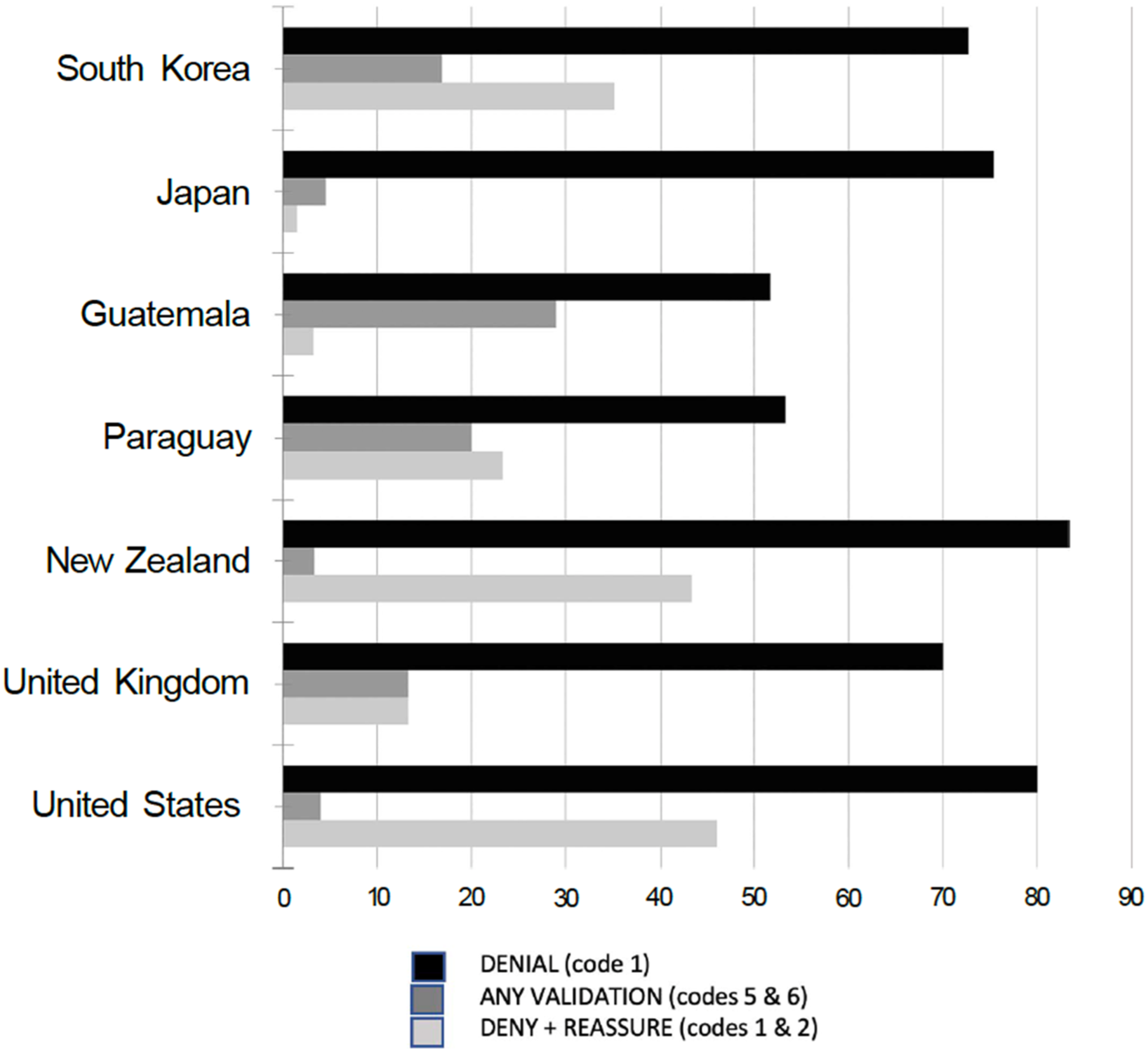
Percentage of speaker B response codes to “Does this make me look fat?” by Site.
To test the possible relationships between fat talk conventions and women’s status, we used binary logistic regression applied to the total dataset. Women with higher perceived SES (selected >5 on 1–10 ladder image, where 10 was the highest rung) and those with post-secondary education did not have higher predicted greater odds of presenting either denial or validation responses compared to other women (all p > .05, odds ratios did not include 1.0). Based on self-reported height and weight, those respondents who were classifiable as overweight by clinical definitions (above body mass index (BMI) of 27.5) were no more likely to either validate or deny in their responses (p > .05, odds ratio included 1.0). Similarly, women who self-reported being negatively judged because of their body size were just as likely to validate/deny at the same rate as women who did not (all p > .05, with odds ratio including 1.0).
In considering age, women over 30 had higher odds of validation responses than those under 30 years of age (p = .009, CI = 1.34–7.85), and lower odds of denial responses (p = .000, CI = .141–.507). Women with higher levels of self-reported decision-making autonomy had lower odds of validation responses (p = .007, CI = .133–.730); there was however no difference in the odds of denial responses based on women’s level of autonomy.
Discussion
It is perhaps unsurprising that it is normatively preferred -- across an array of field sites -- to respond to a question about whether or not a woman looks fat by denying that she does. This follows Watts’ explanation of politic behavior as “that behavior, linguistic and nonlingusitic, which the participants construct as being appropriate to the ongoing social interaction” (Watts, 2003: 276) which is, in short, doing what is expected. The ethnographic observations around fat talk described above are based on what people claim they say, rather than actual empirical examples of interactions. The DCT task we applied here did not describe the relationship between the two people in the line drawn image. While this is a noted limitation of the study, we can understand through side-bar commentaries written on some of the surveys that in the cases of responses in English and Spanish people understood the two women to be strangers or mere acquaintances. In one such commentary, a participant noted that her answer of “No, you don’t look fat” is not what she would actually say but what she understands to be the “correct answer”. However, for responses in Japanese and Korean, the prompts are written in a casual register suggesting that the two people cannot be strangers. 5 In this way, we can gain some implicit knowledge into the ways that participants across sites may have approached the two women drawn in the DCT.
We suggest there are three key important observations from this cross-cultural test of anticipated responses to a fat talk DCT. First, denial forms of women’s fat talk, as described by Nichter (2000) and echoed by Becker et al., (2013), were consistently elicited across a wide range of local contexts. The outright rejection of the proposition as the expected and normal response suggests two things: (1) the underlying fatphobia of the initial fat talk utterance must be rejected; and, (2) the expectation that women’s bodies be discursively created as ‘not fat’ in friendly peer interactions. Fat talk is, as such, a particular globalizing conversational form with understood interactional rules that transcend substantial differences in language, place, social, economic, and some key elements of women’s relative status.
The findings suggest that following fat talk with some form of denials, reassurances, or even deflections has become formulaic across diverse settings. It is perhaps best understood as analogous to the ritual greeting interactions described by Duranti (2007) which serve a variety of functions including reaffirmation of community belonging, sanctioning of social behaviors, and asking for information. In such cases, perhaps the interaction itself is the critical connection point, indicating a willingness to engage with the interlocutor and affirm their body.
Second, our analysis suggests that these widely shared forms of fat talk are not necessarily related to commentary on one’s own or someone else’s actual body size. The image used in the DCT depicts a woman with a of BMI of 25, placing her on the bottom-edge of the medically defined category of overweight, and making her roughly average sized for most of the countries in which we collected data (slightly thinner in some, slightly larger in others, see Table 1). Both the high frequencies of denial (“No you aren’t”) statements across diverse contexts and lack of association with women’s actual body size found in the statistical analysis suggest that fat talk utterances are overwhelmingly understood by interlocutors as something which demands rejection of the stated proposition. Indeed, absolute validation only occurred 3% of the time across all sites. The highest frequency was in Guatemala, at 16%, where malnutrition is still common and prior research has demonstrated strong anti-fat sentiments across the country (Hackman et al., 2016; Maupin & Brewis, 2014). The Guatemala findings suggest the possible need for more targeted work in sites where undernutrition and over-nutrition are simultaneously common. Even so, despite slightly elevated rates of absolute validation in Guatemala, our findings clearly show that across all sites it is normative to not validate the fat talk prompt.
We note that this finding is relevant to how people are responding to imagined conversations between people with body sizes that are close to both national averages and sample BMI averages across sites (if slightly higher in some and lower in others). It is possible that the results would be very different if the prompt or response was attributed to a much larger body. For example, overt denials might be less likely, perhaps replaced with higher frequencies of deflection. 6
Third, this evidence supports the ethnographic assertion that fat talk can fill positive (affiliative) functions. Following from Nichter and Vuckovic, fat talk should always be viewed as multivocal (1994, p. 112). This means that the interaction is doing more than affirming or denying the interlocutors’ body sizes or even addressing the question of fat. Here we suggest from the cross-cultural evidence, that women’s fat talk is effective at signaling affiliation between interlocutors by showing one speaker’s willingness to open herself up to direct evaluation of her body. The question prompt used in this research (“Does this make me look fat?”) appears on its face as a simple yes/no question. Yet, based on our reading of the responses in total, the answer to the question has potentially grave consequences – given the grammaticality of the interrogative linguistic form, a judgement of ‘yes, you are/look fat’ is possible. Thus, affiliation is created by the interlocutor not treating this question as simply a ‘yes’ or ‘no’ query; instead, these data suggest that the question is understood as a request for affirmation that one’s body is not fat. Thus, the central issue of the interaction is not the size of a body; instead, the issue may better be understood as a request for reaffirmation of self, in particular that the self is part of the group. And, in so doing, serve to function as a mundane but important rejection of fatphobia. The first step in this now normative interactional dance is to deny the proposition on its face: a full rejection of the question itself. By rejecting (denying) the proposition the interlocutor serves to reaffirm to the speaker that her question is totally absurd; by doing so, the speaker is given the chance to be fully enscribed as “one of the group” – whoever might comprise that group. And, given the high occurrence of reassuring statements co-occurring with a denial of the proposition in some sites (e.g., South Korea, but not Japan – see Figure 2), the question in those cases is perhaps particularly understood as a request for reassurance of affiliation between the speaker and interlocutor. 7
The cross-cultural design of our study allows us to think more concretely about our cross-site similarities. The findings highlight how fat talk interactions taken at face value simultaneously reflect and reproduce the devaluation and stigmatization of fatness. The widespread valorization of a thin ideal has produced a globalizing social norm which prescribes a negative response, a denial, to the question of “does this make me look fat?”. Each time interlocutors engage in the formulaic ritualized sequence of ‘does this make me look fat/no, you look great’ the understanding that being fat is bad is reinforced. Thus, despite the affiliative and solidarity building effects that such fat talk interactions may have, the fat talk itself is reinforcing and reinscribing an anti-fat attitude onto the interlocutors (or other members of the group who may perceive themselves to be fat).
Conclusion
Much of the existing literature on fat talk -- predominantly lab-based studies – concludes it only achieves negative health and psychological ends. Accordingly, interventions have been developed to curb its occurrence. But our study shows that practices around fat talk as a conversational interaction, across an array of sites, adhere to the initial suggestion by Nichter and Vukovic: fat talk has interpersonally positive dimensions that are embedded in a reasonably clear and consistent set of conversational norms. Viewed ethnographically and linguistically, and studied as an interactive phenomena, it cannot be assumed to be a harmful practice that undermines self-esteem. The idea that naturally-occurring fat talk events should or must be rejected, redirected, or ceased in settings like schools or households is difficult to justify when viewed through this lens. So, as anti-fat talk activities are being deployed as a public health promotion strategy in an increasing array of global sites, these data suggest the need for real caution. While the initial fat talk may be rooted in fatphobia, the response of a denial regardless of body size suggests a rejection of both the proposition and its underlying fatphobia.
This fits with a wider concern that many of the ways bodies and weight are discussed and presented within health interventions may – inadvertently – be creating inverse messaging (e.g., Brewis and Wutich, 2019; Barwick et al., 2012; Britton et al., 2006; SturtzSreetharan et al., 2021). If fat talk is a normal conversational feature with clear rules that supports affiliative functions, teaching people that fat talk is harmful can potentially have a rebound effect. Interventions then may recast what people otherwise take as a neutral-positive interaction as insulting or denigrating (i.e., converting to harmful to self-esteem). We cannot know this from this study, but the empirical findings here suggest this is an important proposal that warrants further study. Ethnographic studies around such efforts as the Body Project could be illuminating in this regard, tracking for example not just conversational language use but how language reactions change in their wake.
We also note that fat talk interventions have historically targeted young women. We suggest this is based in a set of untested assumptions relating fat talk to gender, based on the observation that young women, at least in the US, are susceptible to thin idealism and eating disorders, more likely to engage in fat talk, and also expected to self-degrade (Martz et al., 2009) or complain (Boxer, 1993a). The research on men’s actual use of and reactions to fat talk interactions remains nascent (but see Mikell & Martz, 2016; SturtzSreetharan et al., 2019; Tucker et al., 2007; Warren et al., 2012) and data for men were not included in this study, so we cannot know if this really is a highly gendered phenomenon. Including non-women in future research designs is one additional recommendation.
Finally, our findings suggest that telling someone they do not, in fact, “look fat” is a mundane rejection of fatphobia at individual interactional levels. Interlocutors may ask if they look fat as a reflection of internalized fatphobia but replies may be rejecting the notion of ideal bodies altogether by answering “no you don’t look fat” regardless of body size. The DCT show that it is the normative response across sites but we do not yet know the intention behind this cross culturally common response. We need further inquiry to determine if this common response is actually about adiposity at all. In the US, where one’s bodysize is understood to be a reflection of moral character, this response may actually be meant as a way to say “you are not a bad person,” affirming their personhood rather than commenting on the body per se. And, while other studies have documented cross culturally the ways that body size is understood as individual responsibility (see SturtzSreetharan et al., 2021), more work is needed to figure out the ways that negative statements concerning fat are meaningful and experientially different across sites.
Footnotes
Declaration of Conflicting Interests
The author(s) declared no potential conflicts of interest with respect to the research, authorship, and/or publication of this article.
Funding
The author(s) disclosed receipt of the following financial support for the research, authorship, and/or publication of this article: This project was made possible through funding we received from the Virginia G Piper Charitable Trust to Mayo Clinic-Arizona State University Obesity Solutions initiative.
