



Abstract
The paradox motivating this article is why California has acted globally by enacting a comprehensive mitigation policy to reduce the emissions of Greenhouse gases, a true public good since the benefits will be shared across the planet, but has not mustered the will to act locally through the adoption of an equally comprehensive adaptation policy for the state to protect its own public and private assets and interests. We attempt to explain the paradox by identifying what it is that differentiates climate change adaptation from mitigation, both substantively and politically. The paradox notwithstanding, we identify several imaginable adaptation policies and strategies that would be commensurate with individual and collective self-interested behavior.
One of the most notable stories in adopting strong, sweeping, and ambitious climate change mitigation policy in the United States is California’s AB32, the Global Warming Solutions Act of 2006 (Farrell & Hanemann, 2009; Guido, Cayan, Luers, Mahemann, & Croes, 2008). Enacted by a Democratic legislature and signed by a Republican governor, AB32 is exceptional in its comprehensiveness, goal setting, and bipartisan support. While some argue that the policy will ultimately result in significant economic gains for the state as a green technology leader, others believe the state is being placed at some considerable risk of undermining its economic position in the world economy (for the contrasting claims, see California EPA, 2010, and Charles Rivers Associates, 2010).
Viewed in terms of rational decision making, in enacting AB32 California risked placing itself in the position of imposing major changes and costs on its businesses and population to achieve significant greenhouse gas (GHG) reductions of importance not simply to itself but to the world at large. In effect, it took a strong stance on behalf of cleaning the global commons, gambling that this would provide the state with first-mover advantages as others ultimately follow. Mazmanian, Jurewitz, and Nelson (2008) suggested that AB32 needs to be understood in terms of electoral and constituency politics—for example, political positioning—especially by the governor, but by the Democratic legislative leaders as well, responding to the important environmental community within the state.
In spite of the uncertainties about AB32’s potentially significant near-term costs, and subsequent recession-induced state funding, AB32 has maintained considerable popular support as demonstrated when a ballot measure to gut AB32 was soundly defeated by voters in the 2010 general election (California Secretary of State, 2011). Support among the public was substantiated in the subsequent poll of environmental issues undertaken by the Public Policy Institute of California in the summer of 2012 (PPIC, 2012).
But there is another side to the California story that remains untold and that reveals a surprising contrast to the experience of AB32. In the environmental arena, where the driving imperative is to act locally, California has not acted with the same assuredness or sense of direction and determination. Despite the likely disruptive effects of climate change in the state, there has been little progress in fashioning a clear and comprehensive adaptation policy analogous or parallel to the state’s mitigation policy. In fact, there has been a distinct disinclination to recognize and act on adaptation measures in anticipation of accelerating climate change projected for the state in spite of the fact that achieving adaptation objectives would be vastly more attainable than trying to lead the world in GHG emissions reductions. Indeed, six years after the adoption of AB32 there is little to indicate that Californians or their elected leaders are prepared to address the highly likely local effects of climate change in as comprehensive a manner as with climate change mitigation policy, that is, to act locally in establishing a climate change adaptation policy.
Our analysis begins with some stylized “facts” about adaptation policy for sea level rise by contrasting policy characteristics of adaptation versus GHG mitigation. We posit that adaptation is characterized by very high complexity and low salience as a policy area. Next we attempt to link the issues of complexity with individual and institutional incentive structures that hinder formulation of adaptation policies. Lastly, we identify legal barriers to adaptation policy formation and conclude with recommendations for advancing policy development in the field.
Our goal for this article is to extend the literature on adaptive capacity by providing analyses of when and how social systems are likely to respond to climate change. Adger, Brooks, Bentham, Agnew, and Eriksen (2004) define adaptive capacity as the “ability or capacity of a system to modify or change its characteristics or behavior so as to cope better with existing or anticipated external stresses.” The article provides contingent analyses about individual and collective incentives that are likely to explain and predict system resilience to climate change (Folke, 2006), an understudied yet important dimension of climate change policy (Tompkins & Eakin, 2012)
Stylized Facts About Climate Change Policies
We limit the scope of our analysis to adaptation policies responding to sea-level rise. We do so because of the conjunction of the extraordinary vulnerability of California, and other coastal jurisdictions, to any substantial rise in sea level. The scientific assessment is that California may be in for a rude awakening—a catch up after several decades of relatively modest sea-level rise (Bromirski, Miller, Flick, & Auad, 2011) with potentially costly consequences (Linwood et al., 2011). Unfortunately, it is likely also the area of greatest vulnerability in the state due to the lack of existing institutional capacity for addressing the challenges posed by climate change in a cost-effective and comprehensive manner.
As a general rule, the longer the time frame, the more problematic are accurate forecasts of sea-level rise. That said, the current range of potential sea-level rise projections along California’s coast are cause for alarm. The median projections are for 3 ft by 2100, which may go up to 4.5 ft, depending on factors such as the extent and rate and of melting of the Antarctic ice cap and expansion of the water in the Pacific Ocean due to the global rise in temperature, and subsidence of coastal lands south of Cape Mendocino (Committee on Sea-Level Rise, 2012), with episodes of substantial damage along the coast resulting from extreme storm events, a la Sandy (Mastrandrea & Luers, 2012). By 2100, the ramifications from even the low projections are likely to be substantial if not profound for business, commerce, recreation, and residential areas.
When responses to sea-level rise do come, we believe that measures will consist of a combination of the three most widely discussed strategies: to resist (such as building a seawall), to develop resilience (such as designing exposed buildings and residences in anticipation of periodic flooding), or to retreat to higher land (Adaptation Advisory Panel to the State of California, 2010).
What California Is (and Is Not) Doing About Climate Adaptation
We recognize that there exists a wide range of climatic changes in addition to sea-level rise, such as an increasing incidence of severe forest fires, extreme weather events, decreased water availability for agricultural and urban uses, and numerous threats to public health. Although climate change is expected to exacerbate all of these threats, each has long exhibited a wide range of natural variation (such as the drought cycle) and associated coping policies. By contrast, the forecasted sea-level rise surpasses previous recorded human experience and there is no comparable established state institutional capacity for addressing its effects. In essence, there is no state-level counterpart—no planning entity, resources, organizational capacity, and public policy—to effectively address the effects of sea-level rise along the state’s 1,100 mile coastline and numerous bays and inlets. In this respect sea-level rise is a new policy issue in need of attention.
Moreover, rather than focusing on increased variability and extreme stochastic events, adaptation policies responding to increased sea levels must address the forecast increase in a sustained level. The California State Coastal Commission (CCC) has the mission of protecting, restoring, and enhancing the state’s natural and scenic coastline. The CCC was established, however, when the shoreline was presumed to be relatively stationary, and its mandate does not include managing intrusion (if not broad inundation) by the sea of the very shoreline that the commission has strived for decades to protect. Indeed, its mandate to protect the “natural” shoreline becomes ambiguous in a dynamic and nonstationary world. Specifically, is the CCC supposed to protect the status-quo shoreline or “let nature take its course?” If the CCC pursues the latter course, it will find itself opposed to many potential adaptation policies. On the other hand, if the CCC attempts to protect the status-quo shoreline, it must reverse course and support types of projects that it has previously strongly opposed.
Given this broad menu of possible actions, which have California selected? In 2008 the very governor who fostered, signed, and internationally promoted AB32, signed an executive order directing state agencies to each develop their own adaptation strategy. This has produced a growing awareness among state agencies and they have been incorporating climate change effects in guidelines and in their long-term agency plans. However, the executive order is a far cry from a statewide plan and supporting policies, especially given the strength of the state’s GHG mitigation policy.
As a response to the executive order, the California Natural Resources Agency (2009) prepared, with the help of other agencies, the California Climate Adaptation Strategy. The Strategy is primarily advisory in nature. For example, its recommendations to state agencies on permitting development in risky areas uses words like consider, should, generally, and as appropriate (pp. 7-8). The California Natural Resources Agency (2010) Progress Report on implementing the strategy indicates modest successes such as a revision to California Environmental Quality Act (CEQA), requiring consideration for locating development in areas prone to environmental hazards such as sea-level rise or catastrophic wildfire. The balance of the report summarizes the formation of advisory task forces and research projects to assess risks to various sectors of the state, such as the Coastal and Ocean Resources working Group, which has brought together 16 state agencies with ocean and coastal management responsibilities to develop sea-level rise management guidelines (CO-CAT, 2010).
Despite these steps, California has not established state AB32-like comprehensive legislation and designated a state agency or established a governing body to implement comprehensive adaption measures, as might be expected in view of the projections of sea-level rise. It has not required communities most likely to be affected to develop land-use and zoning guidelines based on the available scientific projections of climate change. Even in the extremely sweeping state-mandated regional smart growth planning, SB375, that took effect in January of 2009 (Barbour & Deakin, 2012), which requires all major urban areas in the state to develop comprehensive land-use plans in alignment with the state’s 2006 mitigation goals, no mention is made of the need for adaptation measures to be incorporated in the new regional plans. If nowhere else, one would expect adaptation to be given prominence and be subjected to statewide guidelines and policies in so comprehensive a planning process. It has been rumored for several years that there is legislation waiting in the wings in the halls of the state legislature, and it may surface given the Democratic Party’s new supermajority in the state legislature following the 2012 general election, but as of this writing it has failed to materialize. Likewise, the recommendations of the Adaptation Advisory Panel to the State of California (2010), that would synthesize for the state’s use the most recent climate science and provide adaptation guidelines for all major development in the state, have not been enacted.
Explanations for the Absence of Adaptation Policy
Before proceeding, we want to acknowledge that our thesis about California’s strong mitigation and weak adaptation policy is difficult to prove because it asserts something that should exist but does not, and this requires making a counterfactual argument. California’s actions run contrary to both the environmental mantra to “think globally but act locally,” as well as the rational actor assumption that actors (individuals, governments, businesses) will be quite reticent to voluntarily provide a collective good (climate change mitigation) but can be expected to act collectively to provide an excludable, group benefit (something of benefit to members of the group but unavailable to those outside of it), such as adaptation.
What explains this situation? First, as a policy type, climate change adaptation appears to fit Gormley’s (1986) criteria as a low salience and high complexity policy. That is, it is multifaceted and complex, it is not well appreciated by most citizens and policy makers, and it is not given high priority for action (Brody, Grover, Lindquist, & Vedlitz, 2010). As such, we would not expect strong proactive legislative action as there are very few electoral incentives associated with these types of policy issues. If there is to be any action at all, one would expect it among responsible agencies as an extension of their normal operations and agency authority in looking ahead. The same can be said of mitigation policy, of course. Which brings us back to the puzzle of why California has acted on mitigation but not adaptation? To put this in perspective, California might be successful in implementing its GHG mitigation policy and it will result in only minimal curtailment of global GHG emissions and, at best, just barely lessen the level of sea rise expected through the remainder of the century.
At the policy planning stage, adaptation has experienced much lower salience than mitigation. The salience of GHG reduction has been the central focus of the International Panel on Climate Change (IPCC) and has been embraced by the United Nations, especially the European Union and environmentalists across the United States. It has been the motivating factor behind the extensive scientific research undertaken within California in the years leading up to passage of AB32 (Guido et al., 2008). The 2014 IPCC report will, however, contain expanded coverage of the need for adaptation. There is no international scientific body comparable to the IPCC championing the need for adaptation policy targets like the IPCC 2050 mitigation goals. Moreover, until quite recently there was a reticence on the part of environmental and climate change groups to give attention to adaptation, for fear that it would distract from focusing on mitigation and it would signal some degree of capitulation regarding the likely success of these mitigation efforts.
In spite of the low salience of adaptation, policy makers could adopt incremental adaptation policies. For instance, the state could choose—but has not done so—to require a disclaimer in building permits that holds the state and authorizing local jurisdictions harmless from damages or liability if someone builds in an area of anticipated sea rise. This low-profile approach would serve to defer the cost to some future date as well as shift responsibility for those costs from the public to the individual, which is very different than requiring substantial adaption action in the present.
There is reason to believe that salience will increase if and when retreat is compelled by the reality of a rising sea, such as requiring that houses and businesses if not entire communities move back from the state’s shoreline. Research is beginning to show that salience will also increase as the potential effects of climate change on local communities becomes better known (Moser & Ekstrom, 2011). The San Francisco Bay Conservation and Development Commission (BCDC, 2009) is bringing attention to adaptation to its regional constituents by shifting its historic mission of preventing further intrusion into the San Francisco Bay to persuading people to either retreat from the shoreline or develop resilience strategies. In San Diego a coalition of civic and nonprofit groups have begun to raise the visibility of sea rise and are promoting a blueprint for adaptation for their community (ICLEI, 2012). The message is not always well received and has had problems persuading policy makers and the affected communities to address the issue. This should not come as a surprise since people often respond to the prediction of unwanted consequences with denial, at least until these predictions actually begin to be realized.
Second, it is possible that although mitigating GHG emissions is complex (Nelson, Rose, Wei, Peterson, & Wennberg, 2012), adaptation is even more so, conceptually, technically, and politically. Decision makers and the public need to understand the multiple ecological processes in much finer grain detail than in the case of mitigation. And while there is a strong consensus among the scientific community about rising temperatures—thus the need for mitigation via GHG reduction—there is less consensus about the potential impacts, from forest fires, spread of disease, droughts, and sea-level rise. In the simplest terms, mitigation is about reducing GHG emissions. While far easier said than done, the concept of reduction of environmental pollutants is well understood and appreciated after decades Clean Air and Clean Water programs.
There is no comparable frame of reference when it comes to sea-level rise although there are similarities. Earthquake preparedness has similar characteristics, and they are something Californians are familiar with. Importantly, California building codes do intrude significantly on private property rights by requiring older buildings to undergo seismic retrofits.
However, there are significant differences as well. 1 Experience has shown that an earthquake is typically followed fairly quickly by a return to normalcy. A sea-level rise coupled with stronger storm surges, on the other hand, will result in permanently altered natural and human landscapes. To the extent that there is much similarity between preparing for an earthquake and preparing for a rise in sea level, it involves a focus on appropriate new land-use regulations, precautionary building codes, and substantial redesign of the communities along the coastline. We do not have consistent ways of engaging in public discussion about these issues statewide and there appears to be little impetus to act collectively on them. The conversations that are taking place and authorities who are concerned are mainly local, as in the examples of coastal communities concerned with particular local environmental conditions and development needs and patterns. This local focus is ultimately a desirable necessity, but there is no statewide process providing an impetus to, and coordination among, these local actions. For example, while there is growing concern among researchers and professionals responsible for coastal management that strong action and clear policy direction on adaptation to climate change is needed (Hart et al., 2012), their call to action has to date gone unheeded.
Third, another possible explanation of the asymmetry between mitigation and adaptation policies involves physical and temporal proximity to the problem (Moser & Ekstrom, 2010). That is, the closer one gets to a significant problem and the point of decision, policy makers come to realize how truly complex it is and find it difficult to come to agreement on what to do. Hence, there is a natural tendency in politics to avoid taking action on a potential problem of uncertain magnitude and timing, especially when many are skeptical that it even will happen (or happen on their watch) and most believe that there will be time to respond after seeing more certain signs. This is akin to a real options analysis, where in situations of high uncertainty and longtime horizons, there is significant embedded value in deferring investment until new information comes in (Mun, 2006). However, the ability to defer investment assumes that there is adequate flexibility in meeting the policy (or project) goals and that there will be adequate opportunity to make the investment later if it proves to be advisable. However, some adaptation measures are like preparing for an earthquake that will certainly happen sometime, and when it does happen it will be sudden with no time remaining to prepare for it (low flexibility). With respect to sea-level rise, lost opportunities dominate: that is, where there are long-lived investments, such as conventionally constructed structures in future flood plains that need to be “climateproofed” today to avoid them becoming stranded assets.
A fourth possible explanation is that land-use regulation inherently involves imposing restrictions on private property and individuals and business enterprises are far more emotionally tied to, and possessive of, their property than other assets and aspects of life. Consequently, property rights are treated as sacred and efforts to enhance collective or public goods goals at the price of property rights are inevitably suspect and usually resisted. The fact that decisions about property are decentralized and left to local jurisdictions across the state reflects this reality. Experience suggests, moreover, that those living along California’s coast—the very areas to be most affected by sea rise—have the wealth and political wherewithal to defend themselves against any state-level adaptation policy they regard as privately onerous. Elected politicians must surely realize this and as a result are disinclined to being seen as advocates of comprehensive state-level land-use regulatory policy or mandating statewide adaptation regulation that results in subordinating individual property rights of landed elites.
Fifth, the broader the scope of coverage of an adaptation policy, the more and varied the stakeholders involved in the policy-making process, many of whom can block significant action they oppose. Veto players are individual or collective actors whose agreement (by majority rule for collective actions) is required for a change of the status quo (Tseblis, 1995). The same may be said with respect to AB32, which requires substantial contribution from all economic and business sectors and individuals in the state to achieve the GHG reduction objectives. However, as an added factor in the case of adaptation, environmentalists themselves are conflicted. Some support aggressive adaptation policies while others, for ethical or tactical reasons, believe attention must be focused on mitigation. Many conservatives, meanwhile, do not believe in the physics of anthropogenic warming and therefore oppose any adaptation policy, or simply are unwilling to support any new state-imposed regulations as a matter of broad political philosophy.
Sixth, adaptation suffers from the absence of clear, authoritative and quantitative goals (Mazmanian, Jurewitz, & Nelson, 2012). When it comes to mitigation, a specific atmospheric concentration goal (450 ppm) for GHGs was identified by the IPCC and implicitly adopted by California policy makers for 2020 and through executive order of the governor to 2050. In effect, the policy goal is a quantifiable target on the basis of which GHG emission reductions can be calculated and allocated to the various sectors in the state. No comparable target has been identified in the scientific or climate change policymaking communities with respect to adaptation: as for example, a goal of holding sea-level rise to no more than 3 feet by 2050 or forest fires to the number of episodes or acres charred in the preceding fifty or one hundred years. Indeed, any such sea-level goal would either be dominated by the atmospheric concentration goal (450 ppm), or it would dominate the atmospheric concentration goal and would itself become the binding constraint driving allowable emissions. In essence, the IPCC goal simply focuses on atmospheric warming and essentially simply lets the sea-level rise be whatever it may be in a world of 450 ppm. Absent an established sea-level target, the discussion of adaptation has centered on being prudent and planning ahead, but lacks any clear definition of what that means or how large the task is likely to be.
Implementing AB32 can be understood (at least technically and administratively) as an exercise in optimization: where can GHG emissions be reduced in the most cost-effective manner? The determination has been assigned to California’s Air Resources Board, under the auspices of the Secretary of California’s Environmental Protection Agency. Adaptation, by contrast, involves planning for contingencies if and when mitigation fails because others choose not to follow California’s (and similar first movers, e.g., EU’s) lead. It is about protecting ourselves from what can be thought of as “public bads”—rising temperatures and rising sea levels. Once a public bad is created, we all “enjoy it” (suffer it) equally. However, some can take private actions to mitigate, if not avoid, the bad completely—e.g., erecting private seawalls, enhancing air-conditioning, taking long summer vacations in Alaska.
Thus, while private actions to reduce GHG emissions may not make rational sense (i.e., any one individual’s contribution to the planetary goal is minuscule) and only collective action seems to make rational sense in this context, adaptation lends itself to a wide range of rational private strategies. Rational adaptation may also, and probably does, involve collective action strategies that are even more efficient than purely private strategies if they can be agreed upon by members of the collective. Thus, while private actions to reduce emissions make little if any rational sense (or only make sense if we assume that everyone else will follow), private action to adapt can make sense—but by themselves alone may not be a socially optimal response.
Seventh, considering the above possibilities, the nature of the decision to enact a state adaptation policy can be viewed as different in both degree and kind from mitigation. Dealing with the causes and the effects are simply not the same. With mitigation there is the single GHG reduction target and reaching it is an optimization problem across all potential players.
When it comes to adaptation policy, rather than optimization the objective decision-making function is different—perhaps satisficing rather than optimizing. In our illustrative case, adaptation is about land-use regulations, about private property rights, and individual’s ability to self-protect and as such involves a suite of risk management problems. There is no avoidance of a public bad whose mitigation cost is to be spread across all sources in a least-cost manner. The issue instead is what specific projects are to be incurred, at what level, and who is going to pay for them. At best, these projects are club goods; the incidence of their benefits will be unevenly spread across the population. Moreover, the appropriate solution would seem to be comprised of some pattern of both collective and private investments. It would seem to provide for some collective investment that benefits many in conjunction with allowing individuals to undertake certain supplementary private investments (so long as these investments are not antisocial). The choices to be made about the collective public investments are: what exactly are they technologically, at what scale should they be built (a classic risk analysis of a safety investment—shall I plan the bridge for the 25-year flood or the 100-year flood?), and who should pay for them?
Eighth, and finally, these seven issues take us to the question of who pays how much. In the case of adaptation, the analogue of getting the price right (the price for emitting GHGs) in mitigation is getting the locus of liability assigned unambiguously including penalties for noncompliance. Private adaptation responses and markets cannot possibly work smoothly without first assigning and making reasonably clear who bears liability for action and inaction. The price of adaptation (or really failing to adapt) is the cost consequence of failing to adapt in advance of anticipated effects. This is a price that will vary widely depending on the peculiar circumstances involved. There is no single price like the per-ton price of carbon, for example. That is why a specific price will not apply across the board. Nonetheless, liability should apply across the board unambiguously.
Both mitigation and adaptation will bury the costs of the policies in the goods purchased, whether it is in the form of a carbon tax, increased sea-rise flood insurance rates, raising the height of bridges, etc. Adaptation costs will be borne by those who are affected by sea-level rise and have to change investment patterns as well. New public investments such as higher elevation roads and other infrastructure will also be required. How much of the private costs to individuals will be socialized is an important political economy question. In theory, increased insurance rates are readily identifiable and specific to those who desire such insurance—i.e., they are specific private costs. Yet there can be a political backlash to such true-cost insurance strategies as experienced in Florida when the state’s political leaders chose to subsidize home owners, insurance when home owners balked at the true cost of hurricane insurance and, in turn, private insurers began to exit the market (Scism, 2011).
For one or more of these reasons—we are not sure precisely which or in what proportion—adaptation has been treated gingerly and with great circumspection in California, as elsewhere.
Individual and Community Incentives
Given these explanations for the absence of a strong statewide adaptation policy, there are still many local adaptation expenditures that could be justified in terms of local benefits, yet there are structural barriers or failures in incentives for even this small degree of investment. We suggest that there is a middle ground that involves contingent planning and a certain amount of decision making today (i.e., commitments to specific strategies contingent on experience and new scientific data) where the investment costs are incurred only when the exact scope of the problem is better understood.
We identify two broad categories of adaption responses: (a) those that can be undertaken by individuals or groups of individuals voluntarily acting at their own initiative, and (b) those that require or are best carried out as collective (public) activities. The latter require collective decision making, of course, and can encounter significant public opposition. We distinguish the degree of externalities associated with each category yielding four prototypical response patterns:
Private individual responses with low levels of spillovers or free riding effects: This category of adaptive responses would include steps taken by individuals and organizations to protect themselves and their property values. They would include such things as building your own seawall or buying private insurance (and surely paying higher premiums to the extent the threats are widely recognized). When individuals make these choices, there will certainly be collective ramifications as there always are (e.g., greater supplies of adaptation measures will need to be supplied). In addition, there will be problems if these collective ramifications are not anticipated and planned for appropriately, but the decisions themselves are usually choices that we want to respect and seek to satisfy as appropriate individual decisions. In other words, there are no overwhelming market failures (no large spillovers or free riding) and certainly nothing not already addressed by existing institutions (even though these institutions, like zoning institutions, may need to strain a bit harder). These adaptation measures will be totally decentralized: caveat emptor. As one example, the Oakland Airport, which is located along the shoreline of the San Francisco Bay, has begun designing a seawall around much of its property and anticipates retreating from some existing older, less valuable land. Presumably, the airport has adaptive capacity, including significantly independent revenue-raising authority.
Private collective (community) responses with low levels of spillover or free riding effects: This response pattern is not markedly different from the first except that the private voluntary decisions are being made by groups of individuals (“club goods” 2 ). The dividing line between a club and a government gets a bit murky but certainly has something to do with the degree of coerciveness involved in membership and individual decision making. For instance, wealthy communities typically have small numbers of actors with significant financial resources and may respond on their own (as has Balboa Island in Newport Bay, California), but this option is not available to most communities. Our default assumption, therefore, is that individuals will attempt to protect themselves but there will be an unwillingness to pay for others’ adaptation. Communities living in more elevated regions will have little incentive to pay for low lying and coastal protection and vice versa. In the case of low-spillover effects, to the extent that this lack of broader public finance support results in low private investment in adaptation measures, this lack of private investment would appear to be efficient; the benefits likely don’t outweigh the costs, otherwise the beneficiaries would undertake the investment.
The public policy implication in these first two contexts would seem to be to develop and disseminate to individual decision makers better information about likely/possible dimensions of climate change (especially since developing and disseminating such information is a public good). Also, “upstream” institutions such as transportation and zoning laws should integrate this information in their scenario planning. Land-use regulatory institutions continue to matter for these first two categories. Also, we presume, a high political price will be paid as requirements and rules are imposed on individuals designed to try to keep people from making a decision about their property that some elite thinks is “stupid.” If a person wants to do something that some elite thinks is stupid, it may simply come down to simply warning them against doing it unless there are meaningful adverse spillovers on others.
Private or collective decisions plagued by significant spillovers or free riding: This category is intended to include all decision-making contexts that suffer from a significant “prisoners’ dilemma” effect in which individual privately “rational” decision making leads to clearly suboptimal collective results. Thus, in concept, there may be adaptive steps that individuals could take that would be better decided collectively because of their collective interactions. Thus individuals might take adaptive steps that, while affording themselves an extra degree of protection, actually increase the threat to others or increase the costs of others taking adaptive steps. An example of this is if one homeowner installs a sea barrier in front of his or her property, storm surges will flow around the walls and push additional water onto neighboring properties and have erosion and deposition effects in adjacent areas.
The likely implication here is that there are two different kinds of regulatory “rules” that need to be considered for this category. First, rules that constrain individuals from doing things that serve their own interest but have negative spillovers on others. Second, rules that require individuals to undertake some action, or undertake it to a greater degree, because of its positive spillover effects on others.
Adaptive steps involving such large-scale economies that they are typically addressed through centralized collective action (Kates, Travis, & Wilbanks, 2012): With respect to sea-level rise, this would most likely be extensive construction of geographically extensive seawalls or barriers. Seawalls have been proposed for San Francisco Bay to protect the 1,000 miles of interior shoreline in the largest Pacific estuary in the Americas. Seawalls could be possible for Newport Bay and San Diego Bay as well. Major additions to the state water canals, pumping facilities, and storage capacities, including the Sacramento Delta and the State Water Project, which provides 50% of the water being transferred today from the northern to southern half of the state, are also examples of projects that would fall into this category.
The main policy implication in this category is that existing institutions responsible for our large-scale infrastructure need to be confronting the potential climate change problem and at least developing planning scenarios for handling such things as higher storm surges. Note that there are missing institutions. For instance, to the extent that sea-level rises are likely, the appropriate response might well be the undertaking of one or more collective large-scale projects. While the California Ocean Protection Council exists to coordinate projects across agencies, there currently does not appear to be any regional or statewide institution with adequate authorization to undertake such large infrastructure projects.
Adaptive steps with significant distributional implications: In some cases, undertaking necessary adaptation measures may involve serious issues of income distribution or social justice. In these cases, public sector funding may be warranted even for those categories of actions that would otherwise be adequately addressed through purely private decision making. Although many of these cases will involve purely intranational politics and decision making, other obvious and well-publicized problems will necessitate international cooperation and action. For instance, highly vulnerable, low-lying countries and islands (e.g., The Alliance of Small Islands) may be severely impacted or even wiped off the face of the map. At a minimum, the international community should act cooperatively to adopt international public policies to share the burden of providing aid and relocation to these populations.
This summary of contexts and implications highlights the fact that libertarian arguments advocating purely market solutions to climate change are entirely unsatisfactory. At best they only apply to the first two categories of action. Successful adaptation encompasses many public and club goods that are unlikely to be provided efficiently by individuals or communities. The scale and level of the problem does not match the level of authority and decision making.
Institutional Considerations
A different challenge to an effective adaptation policy exists in the nature and character of existing state institutions. We consider two attributes of institutions that potentially inhibit adaptation policy formation: limited coordination across agencies as well as turf wars.
Coordination Between Agencies
Because climate change effects will cross many traditional agency and substantive boundaries, adaptation will need to be managed either through central direction or close coordination among affected agencies and parties. For instance, the decision to build a seawall by one individual property owner in a coastal community could and probably would involve city, county, state coastal commission, and federal (marine protection) agencies, all of which have their particular responsibility for protecting and managing the coastline, though none with responsibility for anticipating what sea-level rise will do should the property not be protected or the ramifications of a seawall on one parcel of land for its neighbors. While coordination across agencies is growing via The Coastal and Ocean Resources Working Group, it is unclear which public agency or entity, at local, state, or federal level should be, or is, authorized to resolve conflicts with respect to specific adaptation measures.
Also, if history is a guide, when agencies are writing their own adaptation plans, each will remain hesitant to share authority with other agencies. Turf war is a universal metaphor for interorganizational conflict (Bardach 1996). They are fought over not only internal sources of autonomy such as budgets but also external sources of autonomy such as mission. Studies have consistently shown that public organizations compete against each other for resources and prestige. Organizations that are ideologically similar have greater conflict than diverse organizations (Savoie & Peters, 1998; The Government Accountability Office, 2000). If one accepts the premise that public organizations will have trouble coordinating their efforts, then organizational restructuring may well be required for successful adaption planning. A “transformation imperative” can help facilitate organizational change and learning (Vollman, 1996). Leadership will be required to elicit cooperation (Fernandez & Rainey, 2006), as the California Air Resources Board (CARB) has shown on mitigation. We discuss considerations for organizational restructuring in the conclusion.
Barriers to Adaptation Policy Formation
In addition to the institutional and individual level disincentives to adoption and implementation of a statewide adaptation policy, there are other barriers to policy formulation. First, adaptation is not simply the second half or natural complement of climate change policy. The types of approaches that are being adopted with respect to mitigation are not well suited to work with adaptation. Hence, although we know that decision makers have a tendency to apply previous solutions to new problems, they do not seem suited in this context. Known as the Einstellung effect, this represents the negative influence of previous experience when solving new problems (Luchins, 1942).
In addition to the Einstellung effect, there are no affirmative adaptation institutions in the state or federally. Major sea-level rise resistance projects, such as seawalls, will require massively invasive new infrastructure and can be expected to disrupt existing marine and coastal ecosystems, and require permits through existing institutional processes. The California Coastal Commission is a powerful veto agency designed for the protection and preservation of existing coastal resources, not for adapting to climate change. Even now, coastal communities want to dredge coastal areas to recover sand that has been washed away by strong storms but are being denied. The CCC is not likely to permit seawalls of the sort to resist sea-level rise even though they are already receiving applications. Permits could begin to be issued, of course, with a significant change in the CCC’s legal mandate and some heavy political pressure. The task faced by the CCC of preserving the “natural” coastal landscape and preventing further deterioration and development (saying “no”) is far different than dealing with the prospect of sea-level rise by restricting property development rights, building new seawalls, requiring a retreat from the coast or simply declaring caveat emptor—you take your chances; don’t look to us or the state to bail you out. In short, the CCC’s mandate is implicitly based on an incorrect assumption: the relative stationarity of the sea level. Thus it seems appropriate that the precise charter of the CCC should be reexamined and clarified in response to this likely rise in sea levels.
Furthermore, the existing Environmental Impact Review process under the California Environmental Quality Act can and surely will be used by some to attempt to prevent construction of any significant seawalls along the coast unless significantly modified. Although the county-level governments along the coast have the primary land-use planning authority and can condemn property and take other actions, they can be effectively checked by the CCC and federal agencies protecting resource habitat. Other federal development agencies can also be blocked. In sum, there is no institution for affirmative approval for adaptation and therefore no means for creating resilience in communities and statewide. In essence the state is starting from scratch about what needs to be considered and how decisions are to be made.
Conclusions and Recommendations
Consideration of these issues is likely to raise the issue of what should California and other jurisdictions be doing with respect to the anticipated effects of climate change? For one thing, we believe that the immediate focus should not be on trying to solve the many specific problems of adaptation so much as making sure that the state has a planning and decision-making institutional structure in place that is up to the task. Planning for adaptation should itself be adaptive. No one knows with certainty what will be the effects of accelerating climate change on the state or how fast changes will emerge. Nevertheless, the projections are quite ominous with respect to sea-level rise. The challenge must be to design flexible adaptive institutions based on a range of probable scenarios. In light of this, no costly steps should be taken prematurely based simply on projections and modeling alone unless there is a very good reason for doing so to avoid some likely larger problem. (This point alone differentiates the imperatives of adaptation from that of mitigation, where the effort is aimed specifically at reducing GHG emissions to a specific level and hopefully tolerable level ASAP).
The correct planning methodology should be based more on scenario planning and seeking to discover robust responses that are likely to be useful over a broad range of possible outcomes (Lempert, Jurgen, & Sprinz, 2009). Planning on a single point forecast is a recipe for either disaster or wasting scarce resources. The state needs to steer a difficult course between hazardous procrastination and costly premature commitments that may later prove inappropriate or wasteful. The state needs to develop a strategy/blueprint that drives tactical and policy responses rather than a single adaptation policy.
The other area of focus is to develop an institutional needs assessment for adaptation governance that maps existing governmental authority as well as the aforementioned adaptive planning requirements onto the necessary institutional arrangements (Farber, 2009). The needs assessment should be developed by a wide range of stakeholders external to state and local agency interests. One timeless element of the institutional design is the authority vested in hierarchical versus decentralized decision making. Should the Natural Resources Agency, CCC, or another agency be authorized as the statewide lead agency for climate adaption, as CARB was for the implementation of AB32? CARB is a powerful agency with long-tenured leadership and has been able to implement AB32 nearly on the schedule laid out in the authorizing legislation, except for litigation that found the agency guilty of rushing to utilize a cap and trade instead of considering other policies and measures. Conversely, given the local nature of adaptation responses, should there be a body in charge of defining scenarios that other agencies must (as opposed to should) consider in their own individual planning? Next, should policies and measures be based in compliance versus behavioral change (nudges vs. permitting/regulation)? Are new institutions needed or can existing ones reorient themselves to the task? What aspects of adaptation strategies involve public goods or projects with large economies of scale, or additions to existing large public projects? In short, we believe it is necessary to envision possible entirely new modes of governance to address climate change adaptation.
In the intermediate term, once the above needs assessment and map of decisions and authority has been established, then all relevant public agencies can be required to incorporate climate change adaptation into their long-range plans. A climate change adaptation review can be provided for all major development projects (a) along the lines of an environmental impact statement (EIS) that includes a real options analysis of the risks to the project from predicted climate change as well as the flexibility in responding to climate change, and/or (b) an endpoint check authority can be established to review and affirm all major development plans include adaptation planning (a la, the CCC for coastal zone projects today).
To provide a theoretical and practical framework for this analysis, we return to the institutional as well as individual and community incentive structures presented in the above sections on “Individual and Community Incentives,” “Institutional Considerations,” and “Conclusions and Recommendations.” Table 1 gives examples of actions (in bold), both private and public, which are likely to be taken in each quadrant and categorizes our policy recommendations. The recommendations in the low-spillover category provide a foundation for the planning and policies required in the high-spillover category.
Adaptation Options Vis-a-Vis Collective and Individual Incentives.
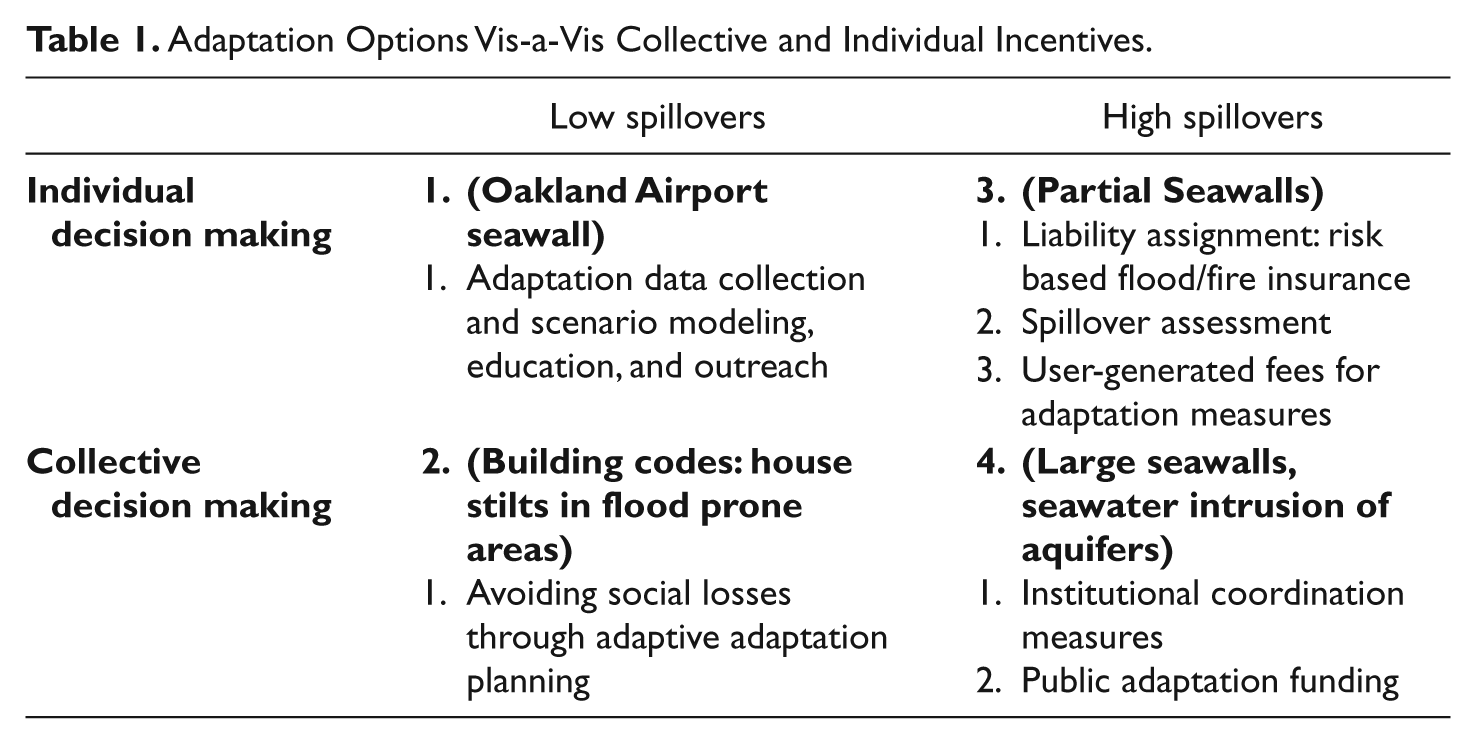
At the individual level, low-spillover Cell 1 shows the need to establish decision-making arena where different scenarios are considered, science-based claims are aired, and with the authority to resolve competing claims about the science and reconcile competing claims among existing interests and policies. As an example, the Climate Risk Council proposal by the Adaptation Advisory Panel to the State of California (2009) would reduce information asymmetries by providing scientific forecasts on sea-level rise, coastal intrusion, and seawall analysis that could be used by individuals for private adaptation investments. It would also create authority and legitimacy around the science of climate change. And, it would presumably make prospective planning processes more coherent, comparable, and consistent across agency jurisdictions. Forecasts can narrow the bands of uncertainty about climatic change through enhanced research—modeling, data integration, systems framework, experimental designs—as the backdrop for policy choices and decision making in a forward looking manner.
The high-spillover Cell 3 indicates the need for the clear assignment of liability for adaptation decisions (and nondecisions). If one community installs a seawall that simply pushes storm surges onto their neighbors, their liability for doing so needs to be modeled in the planning for their seawall. Comparing the individual, high-spillover cell with the collective Cells 2 and 4 highlights the need for differential sources of funding for each. Coastal communities are not likely to want to fund forest fire planning and zoning, and other citizens are not likely to want to fund seawall protection for rich coastal communities. Urban homeowners have long subsidized below-cost home owner’s insurance for houses in the suburban/forest fringe in California and elsewhere. User fees for coastal highways, municipal water districts, and community protection can help provide funding sources and design policies with subsidiarity or decision making at the lowest possible level. This can be thought of as a “pay-as-you-go” or pay-as-you-suffer funding strategies. In sum, the two categories of individual-level responses predict governance needs in three areas: (a) scientific research, modeling, and outreach, (b) politically contested liability and land-use reform, as well as (c) new user-generated revenue mechanisms to pay for adaptation measures.
Cell 2 shows collective responses without notable spillovers or free riding. In this cell we highlight zoning and building codes that reduce damages to existing and future infrastructure from climate change. The reconstruction experience in Japan following the Tsunami shows that individual decisions to build in low-lying areas (granted with perceptions of safety from seawalls) lead to nonoptimal social outcomes when extreme events occur. Prudential planning can minimize the social welfare losses from forecasted climate change.
Finally, Cell 4 highlights the need for institutional coordination from large-scale adaption efforts. Without institutional redesign, adaptation efforts with significant impacts to California coastal areas will not occur. Cell 4 also indicates the need for adaptation funding from general sources such as AB32 auction revenue that can be used to fund statewide adaptation planning and measures. The two categories of collective-level responses will likely require reconceptualizing how existing authority is delegated among agencies. The categories also entail implementing precautionary adaptive management based on best available science, which is likely to come into direct conflict with elements of the state’s political economy.
These hypotheses about required institutional change and the likely political conflict over the enactment of rational climate change adaptation strategies take us back to where we started: why California has only thought locally, but acted globally. To act locally on climate change adaptation will require the type of political consensus that policy makers displayed in passing AB32. A clear quantitative climate change adaptation goal, like the one developed in Mazmanian et al. (2012), could help spur action, but significant leadership will be required to overcome the barriers to adaptation policy enactment described in this article.
Footnotes
Declaration of Conflicting Interests
The authors declared no potential conflicts of interest with respect to the research, authorship, and/or publication of this article.
Funding
The authors received no financial support for the research, authorship, and/or publication of this article.