



Abstract
Climate compatible development (CCD) is gaining traction as a conceptual framework for mainstreaming climate change mitigation and adaptation within development efforts. Understanding whether and how CCD design processes reconcile different stakeholder preferences can reveal how the concept contends with patterns of sociocultural and political oppression that condition patterns of development. We, therefore, explore procedural justice and power within CCD design through a case study analysis of two donor-funded projects in Malawi. Findings show that donor agencies are driving design processes and involving other stakeholders selectively. While considerable overlap existed between stakeholders’ “revealed” priorities for CCD, invisible power dynamics encourage the suppression of “true” preferences, reducing the likelihood that CCD will be contextually appropriate and have widespread stakeholder buy in. Visible, hidden, and invisible forms of power create barriers to procedural justice in CCD design. We present five recommendations to help policy makers and practitioners to overcome these barriers.
Keywords
Climate change is already making development objectives more difficult to realize (Intergovernmental Panel on Climate Change [IPCC], 2014b). It represents a double source of inequity because those most adversely affected by it have benefitted least from carbon-intensive development pathways (IPCC, 2014b). In this context, climate compatible development (CCD) is proving attractive as a conceptual framework for mainstreaming climate change mitigation and adaptation within development efforts in order to reduce vulnerabilities (Mitchell & Maxwell, 2010). Vulnerability is seen as a function of exposure to sociocultural, economic, political, and environmental (including climatic) shocks and stressors; sensitivity to these shocks and stressors; and capacities to adapt and respond to them (IPCC, 2014a).
According to the IPCC (2014a), climate change mitigation constitutes human action to reduce greenhouse gas sources or enhance sinks. Climate change adaptation commonly denotes anticipatory or reactive actions that enable adjustment to actual or expected climate impacts (IPCC, 2014a). In line with human development discourses, development is defined as a function of individuals’ and groups’ sociocultural, political, and economic freedoms (Sen, 2001).
So far, the operationalization of CCD has outpaced academic inquiry into the concept. While the CCD literature is growing and research is beginning to critique CCD theory and practice (e.g., through evaluations of CCD outcomes—Tompkins et al., 2013; discourses—Käkönen, Lebel, Karhunma, Dany, & Thuon, 2014; and political economy—Tanner et al., 2014), overall, critical research remains limited. CCD’s procedural justice implications have been underexplored, and this represents a pressing research gap. Linked to this, there is a scarcity of social justice research that explores how CCD interventions allocate opportunities, privileges, burdens, and disadvantages (Schlosberg, 2007).
Procedural justice requires that stakeholders can participate in, and have their preferences recognized through, CCD design processes (Schlosberg, 2007). Participation and recognition constitute the political and sociocultural pillars of procedural justice, respectively. Participation denotes opportunities to take part in decision making (Hurlbert & Gupta, 2015), while recognition is achieved when stakeholders’ identities, cultures, and values are acknowledged and respected throughout CCD design processes (Tschakert, 2009). Participation and recognition share a reciprocal relationship, whereby those who go unrecognized are unlikely to be afforded participatory opportunities, while the depth and breadth of stakeholders’ participatory opportunities condition whether they command recognition (Schlosberg, 2007). CCD outcomes are more likely to be favorable to those whose views are considered within decision-making processes, suggesting that procedural justice can create pathways to distributive justice (Schlosberg, 2007).
Some studies touch upon procedure in CCD design (e.g., Mustalahti, Bolin, Boyd, & Paavola, 2012; Sova et al., 2015), but systematic evaluations are scarce. Empirical insights from project-level initiatives that explicitly pursue triple wins for adaptation, mitigation, and development are particularly lacking. Power constitutes the networks of societal institutions (formal and informal) and resources that delimit the boundaries and scope of procedural justice opportunities (Gaventa, 2006). Linked to a shortage of tools and frameworks that facilitate their holistic analysis, there is restricted understanding of the relationships between procedural justice and power within CCD design.
CCD professes to be a “development first” approach (Picot & Moss, 2014). However, limited consideration of procedural justice and power means it is uncertain how projects contend with patterns of sociocultural and political oppression that condition underdevelopment (Sen, 2001). Considering CCD’s procedural justice implications is important because development, mitigation, and adaptation outcomes are experienced differently across diverse temporal and spatial scales (Klein, Schipper, & Dessai, 2005). Understanding whether and how different components are prioritized and balanced within design processes can help signpost which individuals and groups will “win” and “lose” from them, allowing remedial actions to be taken to target injustices.
This article explores procedural justice opportunities and power within the design of two donor-funded projects that pursue CCD triple wins in Malawi. Together, the projects form the Enhancing Community Resilience Programme (ECRP), which seeks to improve the lives of over 600,000 vulnerable Malawians. In this article, we (a) develop a framework for exploring CCD’s procedural justice implications in the context of power, (b) identify different stakeholders’ priorities for ECRP project design, and (c) evaluate stakeholder recognition and participation in ECRP design processes.
Designing CCD: Multistakeholder Preferences, Procedural Justice, and Power
CCD stakeholders refer to actors or organizations that are interested in, or impacted by, CCD (Freeman, 1984). Multistakeholder partnerships incorporating actors and organizations that operate across global, national, and local scales can facilitate CCD design. They allow linkages between development, mitigation, and adaptation to be harnessed and trade-offs to be minimized (Dyer et al., 2013). They can also help reduce implementation costs (Larrazábal, McCall, Mwampamba, & Skutsch, 2012) and encourage long-lasting benefits (Peskett, Huberman, Bowen-Jones, Edwards, & Brown, 2008). Hence, stakeholder recognition and participation within design processes could make CCD effective and efficient, as well as socially just. Accordingly, policy standards that encourage CCD outcomes (e.g., REDD+, the Clean Development Mechanism) mandate that interventions consider stakeholder preferences (United Nations Framework Convention on Climate Change, 2006, 2011).
Professional CCD stakeholders comprise individuals, or organizations with employees, who earn a living through work related to mitigation, adaptation, and development. They commit resources that enable CCD initiatives (e.g., finance from donor agencies, implementation expertise from nongovernmental organizations [NGOs], and host governments; Dyer et al., 2013).
CCD initiatives operate across diverse governance levels but commonly aim to reduce the vulnerabilities of (often heterogeneous) groups of “local people” bound together by the proximities of their homesteads (Climate and Development Knowledge Network, 2016). Local people often desire access to CCD decision-making processes (Cromberg, Duchelle, & Rocha, 2014). Involving local people in design can help them expand their intellectual capabilities (Alkire, 2005), enable understanding of conditions that facilitate their engagement in implementation, and help ensure that project outcomes improve their lives (Gustavsson, Lindström, Jiddawi, & de la Torre-Castro, 2014). Achieving these benefits is unlikely when local people are involved only tokenistically and populations are considered socially homogenous or knowledge poor. In such cases, vulnerable populations may be detrimentally affected (Cook & Kothari, 2001).
Restricted understanding of the climate system (Curry & Webster, 2011) and development data shortages (Devarajan, 2013) means CCD design must navigate substantial uncertainty. In the absence of certainties, balancing development, mitigation, and adaptation priorities is contentious. There can be disagreement over how development should be defined and progressed (Pieterse, 2010), and stakeholder priorities for CCD (conditioned by distinct cultures and value positions) often conflict with one another (Hulme, 2011).Local people that climate and development interventions target have diverse identities and needs, giving way to dissimilar preferences for CCD (e.g., according to age, gender, resource wealth; Dodman & Mitlin, 2013). Developing countries’ populations and governments often prioritize development and adaptation over mitigation in order to reduce global inequalities (Tanner et al., 2014). Others suggest that these countries should prioritize low-carbon approaches because mitigation finance can help drive development (Bowen & Fankhauser, 2011).
By simultaneously recognizing the importance of development, mitigation, and adaptation, CCD could reconcile diverse stakeholder preferences through design processes (IPCC, 2014b). Professional stakeholders have sometimes collaborated successfully to design CCD (Corbera, Kosoy, & Tuna, 2007). However, other initiatives have been designed in isolation from local and national government representatives (Mathur, Afionis, Paavola, Dougill, & Stringer, 2014). Questions have been raised about the accountability of projects that operate without host government involvement (Spiro, 2002) and their implications for state sovereignty (Whitfield, 2008). Without a key actor (such as the government) having an oversight of activities, CCD lesson sharing may be limited, initiatives may be poorly harmonized and contributions toward national CCD trajectories may go unrecognized. NGO representation in CCD design can help interventions for overcoming vulnerabilities to be more locally appropriate. However, private sector–led CCD has sometimes excluded NGOs (Leventon, Dyer, & Van Alstine, 2015).
Evidence of design that has successfully reconciled professional stakeholders’ and local people’s preferences is scarce, although exceptions exist. For example, Awono, Somorin, Atyi, and Levang (2014) showed how village residents targeted by Cameroonian carbon forestry projects were encouraged to suggest livelihood improvement strategies. Likewise, local people were able to identify activities for implementation under a voluntary carbon market project in the Democratic Republic of Congo (Mathur et al., 2014).
CCD design is often “top-down” and “‘expert-led,” with minimal local-level involvement and decisions imposed on target populations (Mustalahti et al., 2012; Sova et al., 2015). Yet, CCD initiatives instigated across levels are commonly cloaked in the rhetoric of “participation” and “inclusion” (Dodman & Mitlin, 2013). While local people may manipulate top-down project implementation processes in order to meet their own goals (Cook & Kothari, 2001), restricted participatory opportunities with design processes can result in local people’s misrecognition—the absence of recognition—because their priorities are ill considered (Atela, Quinn, Minang, & Duguma, 2015).
Power conditions whether stakeholders can achieve procedural justice (Gaventa, 2006). Visible, hidden, and invisible forms of power exist (Gaventa, 2006), but holistic analyses that consider how all three types of power shape CCD design are rare. Visible power refers to formal rules, structures, and institutions that govern decision making. Whether different stakeholders can engage with visible decision-making processes hinges on their capabilities to do so (VeneKlasen & Miller, 2002). Hidden power concerns “who” can make decisions about “what.” Invisible power is exerted when stakeholders influence the belief systems of others, which include considerations of who is worthy of recognition and participatory opportunities (VeneKlasen & Miller, 2002).
The CCD literature predominantly considers stakeholders’ inability to achieve procedural justice in CCD design to result from visible and hidden powerlessness (Sova et al., 2015). For instance, resource shortages are often used to explain governments’ noninvolvement (Stringer et al., 2012), while limited local participation is frequently attributed to low-education levels and the opportunity costs of foregoing livelihood activities (Gustavsson et al., 2014). In contrast, professional stakeholders commit resources that enable CCD and commonly have their preferences considered (Mathur et al., 2014).
Well-articulated hidden power dynamics can constrain stakeholders’ procedural justice opportunities. For instance, governments have been excluded from CCD design because carbon market standards do not oblige project developers to involve host governments (Mathur et al., 2014). Likewise, key design decisions (e.g., identifying project aims and objectives, implementation timescales) are often taken prior to any community engagement (Kalame, Kudejira, & Nkem, 2011). Professional stakeholders have justified limited local involvement in CCD design by stressing that it can encourage unrealistic expectations for projects (Cromberg et al., 2014).
Even when local people are involved, methodological limitations can obscure and conceal their preferences. “Participatory” tools for assessing vulnerability often predetermine vulnerability parameters and withhold opportunities to suggest solutions for overcoming vulnerability and evaluating intervention designs (Alkire, 2005). The cost of conducting participatory assessments can mean only small “samples” of local people are engaged (Kalame et al., 2011). Misrecognition can occur when assessments are focused at, or aggregated to, the community level and overlook diverse or dissenting preferences (Bours, McGinn, & Pringle, 2014).
Explicit consideration of how invisible power conditions procedural justice opportunities within CCD design is scarce (Sova et al., 2015). However, it has been suggested that internationally driven, “expert” knowledge and Western science are being privileged within CCD design. Sometimes, “expert” knowledge is imported from abroad and unsuitable within local contexts. Leventon et al. (2015) reflected on how Zimbabwean conservation agriculture techniques were incorporated within Zambian CCD project designs but were incongruous with local conditions. Consequently, local people achieved reduced crop yields compared with those before the projects.
Local people’s recognition is also linked to CCD having their informed consent (Resodudarmo, Duchelle, Ekaputri, & Sunderlin, 2012). Strictly, informed consent requires that people choose activities to participate in based on their full understanding of all available information pertaining to these activities (Alkire, 2005). However, worldviews of local people are often grounded in indigenous values, which can be at odds with Western science (Hulme, 2011). In situations where CCD design is framed using scientific realities, gaining informed consent for CCD on such stringent terms, especially mitigation activities (that require an understanding of the causes of climate change), may be difficult.
Studies suggest that CCD design has created patterns of both procedural justice and injustice. CCD projects risk being designed in a way that furthers the values and preferences of the already powerful (e.g., donor agencies) but marginalizes those with less power (e.g., local people; Kalame et al., 2011; Mustalahti et al., 2012). While the literature touches on participation and recognition in CCD design, it does not systematically analyze procedural justice, meaning further research is required. Stakeholders’ inability to achieve procedural justice is often presented as a product of visible and hidden powerlessness (Sova et al., 2015). Barriers to procedural justice that are created by invisible power dynamics have been ill considered. In the following section, a theoretical framework is presented that facilitates holistic exploration of power and procedural justice within CCD project design.
Theoretical Framework
A framework was developed to guide evaluation of the procedural justice implications of CCD in the context of power (Figure 1). Gaventa’s (2006) “power cube” approach was used as the starting point, facilitating understanding of participatory “spaces” through which stakeholders can meaningfully engage with governance systems, and the visible, hidden, and invisible power dynamics that delimit these spaces. The power cube was adapted to consider “procedural justice spaces” rather than “participatory spaces,” thereby enabling explicit consideration of both stakeholder recognition and participation in CCD.
A framework to guide exploration of CCD procedural justice spaces.
Procedural justice spaces can classified as closed spaces, where stakeholders are not recognized as legitimate actors and decision making takes place in their absence; invited spaces, where stakeholder preferences are in some way recognized by CCD interventions, and they are offered participatory opportunities; or claimed spaces, where stakeholders establish to pursue their interests based on their own recognition patterns. The spaces, governance levels at which they occur, and forms of power that shape their existence comprise the three interconnected cube dimensions (Gaventa, 2006).
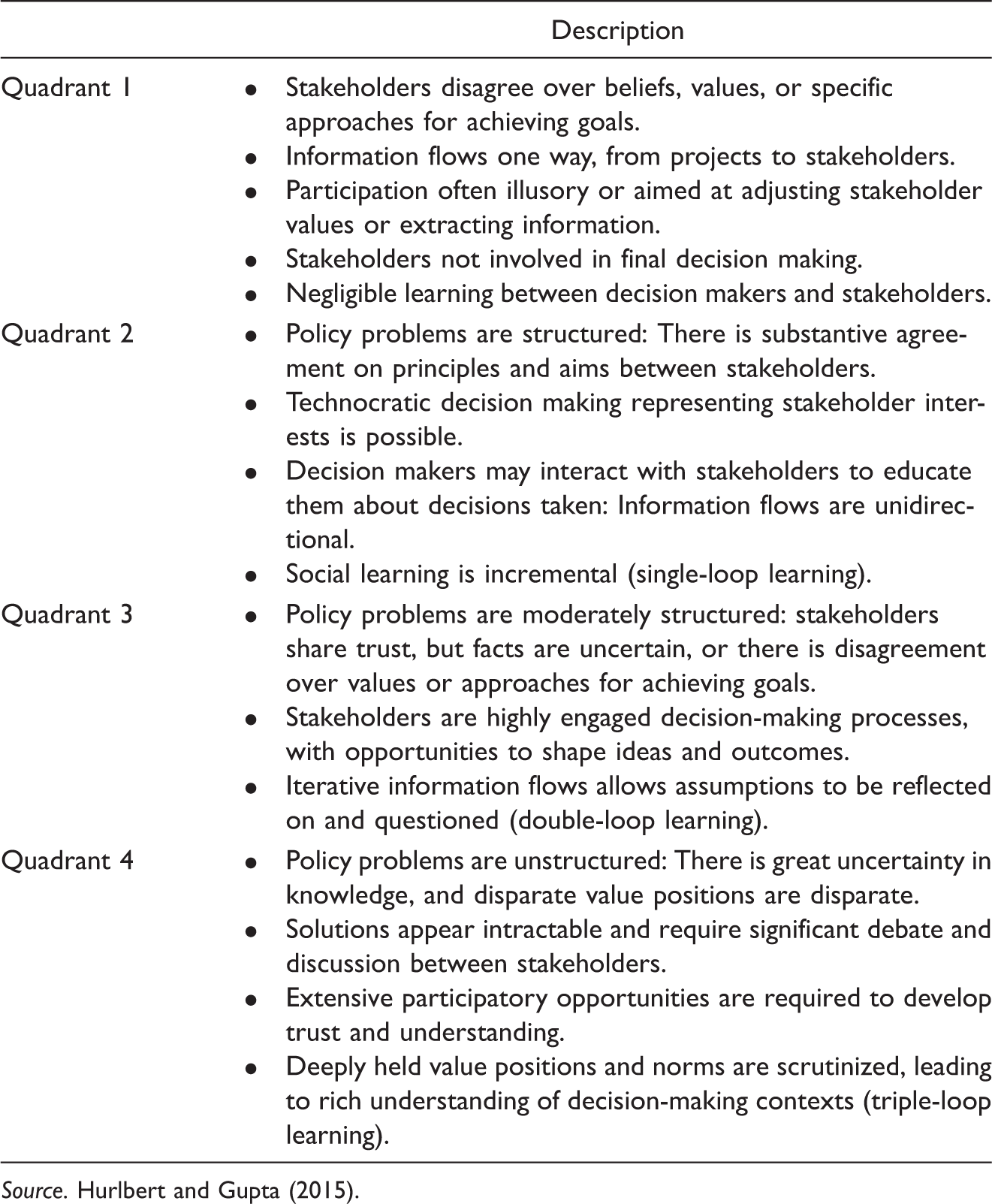
Hurlbert and Gupta’s (2015) “split ladder of participation” guided analysis of stakeholders’ participatory opportunities in invited and claimed spaces (see dashed arrows in Figure 1). The typology is an advance on hierarchical alternatives (e.g., Arnstein, 1969) that consider participation as symptomatic of binary power struggles between governing bodies and citizens. The split ladder considers participation as social learning processes, whereby multiple independent stakeholders collaborate for diverse reasons and are involved in unique ways. The specific problem being addressed determines the appropriate form(s) of stakeholder participation (Hurlbert & Gupta, 2015).
Quadrants for Examining the Depth of Stakeholder Participation Within the Design of ECRP Projects.
Source. Hurlbert and Gupta (2015).
Development, mitigation, and adaptation decision making occur across different governance levels (Klein et al., 2005). The framework facilitates multilevel analyses, enabling investigation of whether and how the procedural justice spaces open to stakeholders’ differ across these dimensions (Gaventa, 2006). In this research, the power cube has been adapted to reflect the levels at which ECRP decision-making processes have occurred: international, national, district, group village area, and village.
Research Approach and Methods
Research Context and Case Study Approach
Malawi was chosen as a research location because (a) it is among the world’s most vulnerable countries (Barrett, 2013), (b) projects pursuing CCD goals are already being implemented in the country, and (c) Malawi’s policy infrastructure encourages subnational projects that advance development, mitigation, and adaptation (Government of Malawi [GoM], 2012). A total of 12 projects pursuing CCD goals were identified nationally via 24 semistructured interviews with climate and development professionals (completed April 2014).
The Developing Innovative Solutions with Communities to Overcome Vulnerability through Enhanced Resilience (DISCOVER) project and Enhancing Community Resilience Project (ECRProject) were chosen for further study because they have more wide-reaching procedural justice implications than other identified projects. The selected projects are larger (DISCOVER targets 305,000 beneficiaries; ECRProject targets 298,500) and receive more funding (£21.5million) than other projects within the initial sample. Together, they form the ECRP, which is financed by United Kingdom, Norwegian, and Irish government grants.
Both projects began in the autumn of 2011 and run until March 2017. They implement activities that transcend the agriculture, forestry, and energy sectors: conservation agriculture, small-scale irrigation, livestock production, solar lighting adoption, improved cookstove adoption, postharvest management, seed multiplication schemes, forestry activities, and village savings-and-loans associations. By implementing these activities, they aim to achieve a range of development goals and help households adapt to the consequences of dry spells and drought, heavy rains and flooding, and strong winds. Projects intend to contribute to mitigation by reducing the sources and enhancing the sinks of greenhouse gases. Female-headed, elderly headed, and extremely resource-poor households, as well as those containing disabled or chronically ill adults, are considered to be particularly vulnerable and are primarily targeted by project activities (Concern Universal [CU], n.d.; Christian Aid [CA], n.d.).
ECRProject and DISCOVER operate across seven and five districts in Malawi, respectively (Figure 2). Diverse district study sites were chosen to facilitate understandings of the priorities and procedural justice experiences of local people living in areas with different socioeconomic and climatic profiles. Dedza (DISCOVER district), Kasungu (ECRProject district), and Nsanje (both projects) districts were selected based on analysis of documentary material (Malawi Vulnerability Assessment Committee [MVAC], 2005) and discussions with project staff. Dedza and Kasungu have comparable socioeconomic profiles. Across the two districts, food security levels, population sizes, average household wealth levels, dominant livelihood activities, agricultural conditions, market access, and ethnic diversity are very similar. They also share analogous climate conditions, in terms of seasonal trends and major climate chocks and stresses. Both are considered to have a superior socioeconomic status to Nsanje, where agricultural productivity is lower, HIV prevalence is higher, households are more isolated from markets, and their incomes are markedly lower (MVAC, 2005). Nsanje is considered one of the most climate vulnerable districts in Malawi, with populations acutely affected by floods and droughts (Nsanje District Government [NDG], 2015; Appendix A).
Districts targeted by the ECRProject (circles) and DISCOVER (triangles).
Two study villages were chosen from Dedza, Kasungu, and Nsanje. The advice of project field staff was sought to ensure that villages were made up of similar numbers of households, close to each other geographically and targeted with similar project activities. However, in Dedza and Kasungu, two villages with different average household resource wealth levels were purposively chosen based on field staff advice. This enabled consideration of whether and how household priorities for project design differed accordingly. Average household resource wealth levels were similar across both Nsanje villages.
Working with field staff was crucial for securing introductions to, and building trust with, households in study villages. To help reduce possible bias, information obtained from field staff was verified through researcher observations of household resources, wealth ranking exercises, and discussions with local people during data collection.
Material Collection
Data collection took place between September 2014 and May 2015. Information was sought from all stakeholders involved in project design. Descriptive data from households across selected village sites were collected using surveys (n = 457) and semistructured interviews (n = 140). Households were the appropriate data collection unit because projects seek to provide benefits to households rather than to individuals (CA, n.d.; CU, n.d.). Survey responses were sought from a random sample of 50% of all households in each village. Survey data were analyzed using coding techniques. Key themes related to household recognition and participation were identified (Babbie, 2008). Household interviewees for semistructured interviews were selected using a purposive sampling approach to follow-up on these themes (Teddlie & Yu, 2007).
A participatory methodology was used to rank households according to their resource wealth (Jefferies, Warburton, Oppong-Nkruma, & Freduh Antoh, 2005). In each study village, Village Heads identified six informants (one male and one female considered to reside in “lower-than-average wealth,” “average-wealth,” and “higher-than-average wealth” households) with which interviews were conducted to identify locally appropriate wealth indicators. Using information obtained through household surveys, every household that took part in research was wealth ranked using these indicators. Wealth ranking allowed households to be categorized related to their ownership of material resources and helped uncover how local procedural justice experiences differed in relation to household wealth.
A total of 32 semistructured interviews gathered qualitative data from professional stakeholders: 2 donor agency employees, 21 NGO employees, 1 national, and 8 local government employees. All stakeholders were asked about their preferences (development, mitigation, adaptation, other) for project design and whether they were afforded participatory opportunities.
Some interviewees guided the researcher toward documents that supported, or provided more detail on, their responses. These documents were subsequently analyzed. They comprised six program or project design documents (CA, n.d.; CU, n.d.; Department for International Development [DfID], n.d.; DISCOVER, 2012; ECRProject, 2011, 2012), two donor government policy documents (DfID, 2011; International Climate Fund [ICF], n.d.), four policy documents produced by the Malawian national government (GoM, 2006, 2011, 2012; MVAC, 2005), four policy documents produced by Malawian district governments (Dedza District Government, 2013; Kasungu District Government, 2013; NDG, 2014, 2015), and two consultancy reports (LTS International [LTSI], 2014; Phiri, 2010).
Data Analysis and Framework Application
Content analysis (Babbie, 2008) and critical discourse analysis techniques were used for data analysis (Fairclough, 1992). Univariate analysis techniques were used to analyze statistics derived through amalgamating survey data (Babbie, 2008). The framework developed in Theoretical Framework section was used to guide the analysis and evaluate (a) whether and how different stakeholders were afforded recognition and participatory opportunities within the ECRP Design Space and (b) whether and how power conditioned procedural justice opportunities.
The Design Space comprised those opportunities and channels through which project design was determined. It represented an unstructured problem because knowledge of future climate impacts was (and remains) uncertain (DfID, n.d.), and stakeholders held diverse CCD preferences. Therefore, achieving procedural justice required that decision making was based on significant deliberation between stakeholders (Quadrant 4, Table 1).
Stakeholder participatory opportunities were classified using the split ladder (Hurlbert & Gupta, 2015). An inductive approach identified instances within the data where stakeholders’ identities, cultures, and values were (mis)recognized. Constant comparison techniques identified linkages between individual instances, allowing patterns of (mis)recognition to emerge (Glaser & Strauss, 1967). Whether and how stakeholder recognition and participation differed across governance levels was considered. Combined use of content analysis and critical discourse analysis techniques enabled identification of how visible (content analysis), hidden (content and critical discourse analysis), and invisible power (critical discourse analysis) conditioned procedural justice opportunities.
Results
Opportunities for professional stakeholders and local people to participate and have their preferences recognized through ECRP design are presented in turn. For confidentiality purposes, interviewees and survey respondents are anonymized.
Professional Stakeholders
The Design Space was an invited space (Gaventa, 2006), led and controlled by donor agencies—predominantly the U.K. DfID, the largest funding provider. Donors selectively recognized and requested other stakeholders’ participation. The primary aim of the ECRP was donor-determined to “increase the resilience of vulnerable communities to climate variability and change” (DfID, n.d., p. 1).
In April 2011, donors invited NGOs to propose ECRP project designs. Through communications with prospective consortia, donors set out a prescriptive overarching project design framework, which sought to balance upward and downward accountability. Donors aimed to ensure that projects were locally appropriate and that local people could participate in, and benefit from, activities. However, projects must also provide value-for-money (DfID, 2011) and meet developed country policy goals.
Donors commissioned a consultant to review disaster risk-reduction and adaptation programs and projects in Malawi and produce “information which would assist in the development of the design” (Phiri, 2010, p. 7). This occurred through discussions with NGO personnel responsible for interventions, but local people’s views were not considered. Results stressed that project adaptation and development goals should be pursued through multiple mutually reinforcing “community-based activities” (Phiri, 2010). Donors considered that these activities should draw on the institutions, resources (including natural resources), and knowledge of “communities” of local people (DfID, n.d.).
Activities with mitigation cobenefits (e.g., solar energy, improved cookstoves, and afforestation) were prioritized: “a win–win approach” (donor agency employee). According to two NGO employees, low-carbon approaches are “high on their [DfID’s] agenda” because they “fit into the bigger UK policy agenda [of mitigation].” Implementing low-carbon technologies through the ECRP helps the United Kingdom deliver on its international climate commitments. Another U.K. government objective was to build the evidence base to encourage developing countries to move toward low-carbon pathways and help “lay the foundations for a global climate deal” (ICF, n.d.). Data concerning the numbers of “poor men and women” provided with energy access under the ECRP is being collated to help show that moving toward low-carbon pathways can enhance global development (ICF, n.d.).
ECRProject and DISCOVER responded to the donors’ call for proposals. Consortia member organizations collaborated to design projects, engaging in dialogue and learning visits with one another. Two NGO employees commented that “we were having workshops with the whole team for almost three weeks” and “it was an inclusive process.” Consortia members’ design preferences were borne out of organizational pragmatism. One donor and four NGO interviewees agreed with an NGO employee who considered that organizations prioritized implementation of “activities in which we had expertise . . . in areas where we already had presence.”
This prescriptive project design framework allowed donors to exert hidden power, which curtailed NGO opportunities to participate in substantive decision making. NGO employees were nevertheless afforded significant autonomy to shape project implementation strategies. This led ECRProject and DISCOVER to pursue quite different approaches. For example, carbon emissions reductions enabled by household improved cookstove adoption have been used to leverage carbon market finance under DISCOVER but not ECRProject (CU, n.d.). Some ECRProject NGO organizations have used village savings-and-loans associations and disaster risk-reduction training sessions as entry points for introducing other project activities within target villages, unlike DISCOVER NGOs.
Consortia opportunities to determine projects’ strategic aims and objectives were restricted. According to one NGO interviewee, “over 90% of what was in the call for proposals ended up in the project.” Another considered that “everything was heavily influenced by DfID thinking.” Donors were able to exert hidden power because “NGOs are completely dependent on donor funding opportunities . . . to continue our operations” (NGO interviewee). That donor funding opportunities involve a high level of prescription is an established norm: the “common approach” (NGO interviewee). However, limits to NGO participation within design processes may reduce the chances that projects are locally appropriate.
Over time, dependency on funding has led to donor project design preferences being institutionalized within NGO practices. Donors’ hidden power has produced, and been reinforced by, invisible power. Five NGO interviewees considered that community-based approaches, which were first introduced by donors over a decade ago, have become the accepted blueprint for climate and development projects: “It’s the new way of thinking” (NGO employee). Likewise, NGOs “can’t miss emissions reductions out in projects which deal with climate change now” (NGO employee). Hence, development and adaptation activities favored by donors and included within project design are also those that NGOs have expertise in and wish to continue implementing (six NGO employees). Invisible donor power over NGO value positions may have crowded out space for these value positions to incorporate local priorities.
NGOs were afforded Quadrant 3 participation (Figure 1, Table 1). Information flows with donors were iterative, but consortia members were recognized as technical, rather than strategic, decision makers. Consortia members were responsible for proposing specific implementation strategies within the context of the overarching framework set out by donors.
National and local government policy documents were consulted during project design. Project development and adaptation goals and specific activities implemented by the project largely reflect national and local government preferences for development and adaptation (Dedza District Government, 2013; GoM, 2006, 2011; Kasungu District Government, 2013; NDG, 2014). Traditional leaders, who are integrated within district government systems in Malawi, have contributed to defining these preferences. Information produced by national government bodies was used to locate projects within Malawi’s most climate vulnerable districts (two NGO employees; DfID, n.d.). Climate mitigation, which will reportedly create “positive local and global socioeconomic as well as environmental benefits,” was considered a priority at national (GoM, 2012, p. 10) and local levels (two district government employees).
National government actors perceived that they were sidelined from decision making (hidden powerlessness). One government employee stated that “we were not involved in deciding the project goals; we were just informed” and added that “[the ECRP] has disrespected the government.” The interviewee rejected consortia suggestions that they held face-to-face project design discussions with government representatives (CA, n.d.; CU, n.d.). However, the same interviewee considered that limited government involvement could also be explained by an absence of policy frameworks mandating government input into climate and development projects (visible powerlessness): “Government . . . [is] also to blame. We did not have policy in place.” A donor employee set out reasons why national government was overlooked, citing low capacity (visible powerlessness) and concerns about misplaced government priorities: We did not want [national government] to make decisions on behalf of the people on the ground. The chain is so long for the government, it would take so long . . . Their eyes would be on the money . . . They just want you to buy them things like four-by-four vehicles.
Local People
Projects pay considerable rhetorical attention to local people’s participation and recognition. Local “participation,” “empowerment,” and “ownership” are mentioned 23, 22, and 24 times, respectively, within ECRProject (CA, n.d.) and DISCOVER (CU, n.d.) design documentation. However, local people were only afforded Quadrant 1 participation in project design.
Consortia invited households to take part through Participatory Vulnerability and Capacity Assessments (PVCAs; November 2011). Assessments were conceived to capture household perspectives, identifying key risks and hazards experienced by households, livelihood activities practiced by households, important local institutions and approaches for sharing climate information, household asset ownership, and existing household approaches for dealing with difficult weather conditions. Documentary review suggests that PVCA design adopted a flexible approach that allowed households to define vulnerability in a locally appropriate way. Households were also given scope to suggest solutions to climate and development problems (ECRProject, 2011). However, they were unable to take any decisions relating to project design, which is an example of hidden powerlessness. They were recognized only as information providers, with PVCA processes encouraging a one-way flow of information from local people to NGOs and donors (DISCOVER, 2012; ECRProject, 2012).
PVCA information validity is limited by small sample sizes. ECRProject PVCAs took place in 55 villages under 40 Group Village Areas across Malawi (ECRProject, 2012). By 2014, ECRProject was operational in 948 villages under 122 Group Villages Areas (LTSI, 2014). DISCOVER PVCAs took place in 35 Group Village Areas (DISCOVER, 2012). By 2014, DISCOVER was operational in 1,149 villages in 110 Group Villages Areas (LTSI, 2014). Two NGO employees blamed sampling limitations on limited capacity “to do PVCAs in all the villages could take a lot of . . . time and resources” (NGO employee). The visible powerlessness of NGOs restricted opportunities for local preferences to be considered within project design.
Information generated through PVCAs was used only to validate consortium design decisions already taken: Two NGO employees commented that “the PVCA validated the programme design . . . [which] was written from desk work” and that “we didn’t submit a concept note, conduct the PVCAs and then, from there, work out what direction we should go in . . . that didn’t happen.”
Consortium members disagreed on the extent to which project designs incorporated PVCA findings. One NGO employee considered that “PVCAs confirmed what everyone was talking about . . . the results and the project proposal . . . speak to each other.” However, according to a different NGO employee, Western NGO staff preferences were prioritized over household preferences: “Each expat wanted his ideas included . . . to the extent that the views of the communities might have been left out.” Professional stakeholders and documentary material provided no evidence that PVCA information changed any decisions made during desk-based design. Local people’s misrecognition may have translated into invisible power that reinforced their aforementioned visible powerlessness.
Mean Importance Ratings of ECRP Development Goals by Households.

Source. 256 household surveys.
Household Perceptions of Climate Shocks Targeted Under ECRP.
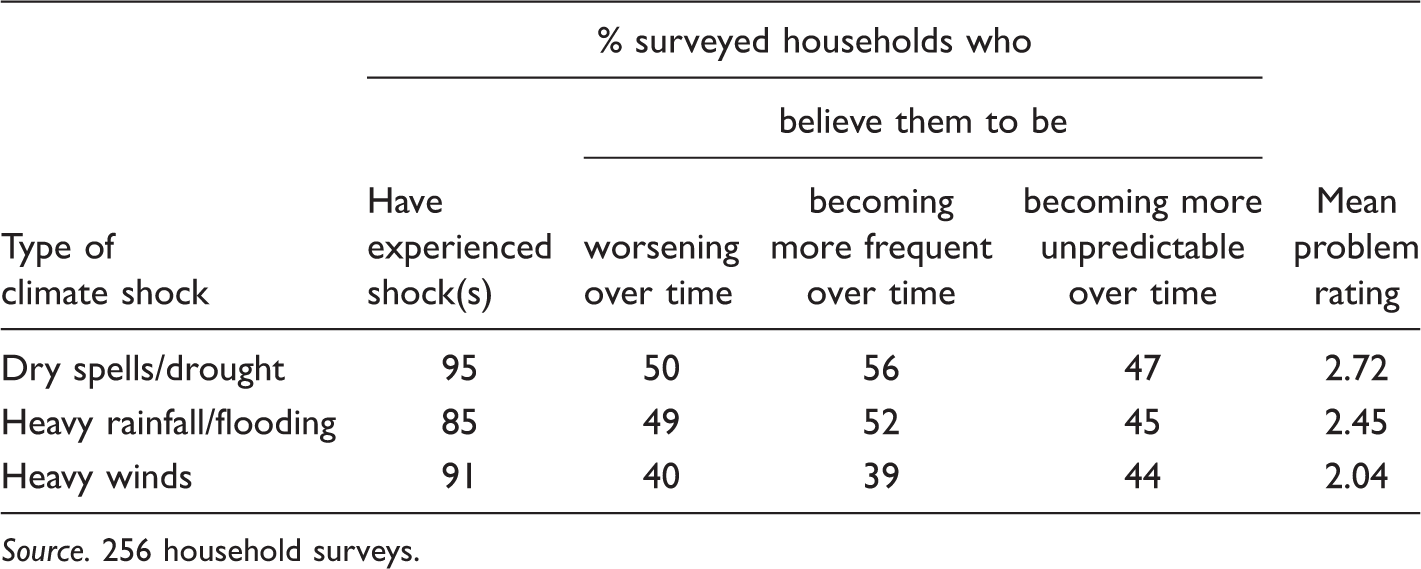
Source. 256 household surveys.
Interviews conducted with household heads validated these findings. One household head in Kasungu stated, “Our lives will be improved [by ECRP development goals], so we feel honored and respected.” A Nsanje household head said, “People had no idea how to deal with the issues [climate shocks] in the past but now we are being educated—we are happy about that.” Another Nsanje household head considered that “without the project the [2015] flooding would have been more severe.”
Donor rationales for including low-carbon technologies within projects are not understood by households. Knowledge of what greenhouse gases are or how they affect the climate is minimal. Thirty-seven percent of household survey respondents were unsure why weather patterns change over long periods; 52% believed trees were the most important regulators of climate: “Trees help to bring in rainfall.” Commonly, this reflected a belief that God rewards villages who look after natural resources with good weather. Only two household respondents reported that greenhouse gas emissions cause climate change. Therefore, households chose to participate in low-carbon activities based on perceived benefits associated with an indigenous worldview rather than scientific knowledge of climate change.
Development goals (electricity access, new cooking technologies) pursued through household solar lighting and improved cookstove adoption, which produce mitigation cobenefits, were least highly prized by households (Table 2). Less-than-average wealth, elderly headed, and female-headed households gave these goals the lowest importance. They routinely rated these goals as “not very important” or “not important at all.” Two-tailed t tests showed that differences between mean electricity access ratings provided by all households and both less-than-average wealth (t = 2.50, p = .01) and elderly headed households (t = 2.82, p = .005) were statistically significant. One less-than-average wealth Dedza household head described electricity access as a “luxury.” A less-than-average wealth female Nsanje household head said that “electricity, through solar or another way, is not important for us at all. What matters to our household is good shelter and food.”
Improved water access is a development goal that can also contribute to adaptation because flooding and drought condition water security in Malawi (GoM, 2006). It emerged as a local priority but was not incorporated within project design. In one Dedza study village and one Kasungu study village, 24% and 38% of survey respondents, respectively, considered poor water access a significant problem. The Village Head of the Dedza study village explained how households had relocated to a new village site 20 years ago. The current village location has no water access infrastructure, but the previous village location had become inhabitable due to perpetual flooding. Five interviewees in the Kasungu village reported that households rely on shallow wells dug close to a nearby stream. However, wells take a long time to refill once emptied, especially in the afternoons and the dry season. Other households commute to a trading center where the nearest borehole is located. Two interviewees reported that they make a 3- to 4-hour round trip at least twice a day, reducing time available to engage in productive livelihood activities.
DISCOVER PVCA findings also reveal that “water, sanitation and hygiene were identified as priorities in a number of the communities where we conducted PVCA” (CU, n.d., p. 11). However, the consortia decided not to alter project design to incorporate water security activities. This was because “we do not want to overstretch the set of activities” (CU, n.d.). An alternative reason for noninclusion was provided by a donor agency employee. He said that “DfID was also implementing a water and sanitation programme in some [non-ECRP] districts” but considered that DfID preferred not to duplicate activities through different programs and projects. This is further evidence that local preferences were secondary to professional stakeholder preferences within the Design Space.
Discussion
The analytical framework has enabled comprehensive evaluation of the procedural justice implications of ECRP project design. By incorporating a holistic power analysis, the framework furthers understanding of the contextual factors that delimit stakeholders’ procedural justice opportunities. It can be used by academics and practitioners to unpack and systematically critique CCD design, both at and beyond the project level. Procedural justice spaces that succeed CCD design can also be evaluated using the framework.
Our findings show that interlinked and mutually reinforcing forms of visible, hidden, and invisible power condition stakeholders’ procedural justice opportunities during CCD design, which further reinforces the value of holistic power analyses. In the following, we situate our results within the CCD literature. Stakeholder priorities for CCD are discussed before recommendations that are presented to facilitate pathways to procedural justice through design processes.
Stakeholder Priorities for CCD
Considerable overlap existed between different stakeholder priorities for ECRP project design. Donors, NGOs, and government representatives prioritized CCD triple wins to be delivered through packages of mutually reinforcing community-based project activities. Local people’s preferences for project design translated into the pursuit of double wins across development and adaptation. Common ground could help facilitate multistakeholder partnerships and constitute a previously unidentified driver for advancing CCD (Ellis, Cambray, & Lemma, 2013, present other drivers).
Local people’s and professional stakeholders’ contrasting worldviews could impede collaborations around mitigation actions that are based on strict definitions of informed consent. Local people prioritize ECRP low-carbon activities for different reasons than DfID and other implementing partners. Studies of other CCD projects show that values placed on low-carbon activities by local people and project implementing partners are often dissimilar (Boyd, May, Chang, & Veiga, 2007; Jindal, Swallow, & Kerr, 2008). In such cases, incorporating mitigation activities within CCD presents an ethical dilemma that is overlooked in climate justice debates. If incorporated, populations will unwittingly take action to help solve a problem for which they have negligible responsibility but are exacerbating their vulnerabilities (Adger, Paavola, Huq, & Mace, 2006). However, mitigation activities may be associated with locally valued benefits. Mitigation finance can also help augment traditional aid funding and provide extra resources for reducing vulnerabilities (Ellis et al., 2013).
Donor and NGO employees suggested that mitigation is achieved as a cobenefit of ECRP development and adaptation activities. However, activities with mitigation benefits (solar lighting, improved cookstoves) were the least prioritized by local people, especially the most vulnerable households living in particularly climate sensitive locations. In areas where water access was poor, activities focused on improving the situation would have been more highly prized. Donor prioritization of mitigation benefits may have crowded out opportunities for pressing local priorities to be pursued through ECRP projects. Mustalahti et al. (2012) raised the same concerns about REDD+ projects in Tanzania.
Further points of contention between stakeholders may be obscured by power dynamics. Apparent and considerable overlap between different stakeholders’ priorities is surprising because CCD operates in a context of uncertainty and value plurality (Curry & Webster, 2011; Sen, 2009). However, NGO dependence on external funding creates an invisible power dynamic that allows donor expectations to shape their activities, both in the ECRP and elsewhere (Chahim & Prakash, 2014). Government dependence on external budget support also enables donor preferences to permeate national policy positions (Swedlund, 2013).
Invisible power presents a challenge for advancing CCD. Because CCD design is an unstructured policy problem, design decisions should be predicated on deliberative participatory processes in which diverse stakeholder preferences are considered and critiqued (Hurlbert & Gupta, 2015). This would encourage decision making that is contextually appropriate and has widespread stakeholder buy in (Hurlbert & Gupta, 2015). The suppression of government, NGO, and local preferences undermines this process, reducing the chances that CCD will be well suited to local conditions and constituencies, encourage local involvement during implementation, and generate life-changing outcomes (Larrazábal et al., 2012).
Stakeholder Recognition and Participatory Opportunities
ECRP project design was “top-down” and donor-led, with only selective involvement of other stakeholders, which further compromises the collaboration and deliberation required to solve unstructured policy problems (Hurlbert & Gupta, 2015). Studies of other CCD interventions report similar design procedures (Atela et al., 2015; Sova et al., 2015). Visible, hidden, and invisible forms of power create barriers to procedural justice in CCD design. These barriers sustain and exacerbate political and sociocultural oppression that condition patterns of underdevelopment.
NGO budgetary and resource constraints created a hidden power dynamic that prevented most target households from taking part in PVCAs. Limited visible power resulting from an absence of guiding policy frameworks also restricted government involvement in ECRP design (see also Stringer et al., 2012). NGO dependence on external funding (visible powerlessness) enabled donors to exert hidden power over NGOs, limiting their strategic contributions to the design process. Invisible power has not been accounted for within the study of CCD projects. Yet, donor control of resources, upon which NGOs, governments, and local people in Malawi are dependent, enabled them to determine recognition patterns that were assimilated into ECRP design processes and conditioned stakeholder participatory opportunities.
It is increasingly suggested that CCD design problems are routinely being framed and solved using belief systems that privilege “expert” knowledge and draw on Western science (Käkönen et al., 2014; Sova et al., 2015). Stakeholders, such as donors whose visible and hidden power enables them to control design processes, consider expert knowledge necessary for dealing with uncertainty and complexity within the CCD operating context. However, subsequent design processes misrecognize stakeholder (including local people’s) preferences that do not align with Western, scientific worldviews (Sova et al., 2015).
Lessons for Current and Future CCD Project Design
Based on research findings and the literature, five recommendations are now presented to encourage procedural justice and avoid injustice through CCD project design.
Avoid epistemological certainties
Solutions to well-defined policy problems can be designed using linear approaches that draw upon particular epistemological positions, but such approaches are unsuitable for designing CCD (Hulme, 2011). The institutionalization of expert knowledge as the appropriate means to “solve” CCD design is not consistent with uncertainty and complexity in the CCD operating context. It creates an invisible power dynamic that serves to reinforce visible and hidden forms of power that create procedural injustices. To overcome this invisible power dynamic and create pathways toward procedural justice, policymakers must avoid making design decisions on the basis of epistemological certainties and accept that CCD has no definitive reality. Uncertainty and value plurality in the CCD operating context means that, depending on how they are designed, CCD initiatives might create further problems that also require solutions (Hulme, 2011). Adopting circumstantial, discursive design procedures that draw on diverse stakeholder perspectives could reduce the likelihood of this.
Put local priorities first
The crowding out of local priorities by professional stakeholder design preferences compromises procedural justice but may also demotivate people from taking part in project implementation. This reduces the chances that CCD will meaningfully improve peoples’ lives or offer value-for-money. Climate change is often only one among many vulnerability drivers for developing world populations and may not be the most destructive in the short term. Designing activities that address local development priorities is crucial for encouraging local people to undertake mitigation and adaptation activities that generate long-term benefits (Reid, Cannon, Berger, Alam, & Milligan, 2009). Therefore, advancing CCD requires that local priorities become central to project design. In this context, targeted, robust, and reflexive participatory needs assessments remain an important tool for integrating a range of local priorities within CCD design processes.
Make participatory assessments robust and reflexive
Methodological limitations mean project developers’ reluctance to make participatory assessment results central to CCD project design is unsurprising. Small sample sizes mean findings from the ECRP and other project assessments are not generalizable and may have overlooked diverse preferences (Awono et al., 2014; Kalame et al., 2011). Greater provision of resources is required to facilitate robust participatory assessments that avoid tokenism.
CCD should follow the lead of ECRP projects, which used flexible categories to help local people classify their priorities and vulnerability. This is preferable to the use of closed categories or open-ended questions for revealing “true” preferences (Alkire, 2005). One-on-one interviews that purposively target vulnerable individuals and households can help ensure that assessments capture diverse local priorities. Harnessing indigenous knowledge can facilitate innovation when local people are able to suggest solutions for overcoming their vulnerabilities (Nyong, Adesina, & Elasha, 2007). Incorporating nonlinguistic processes is important when tacit understandings are an important source of local knowledge (Mohan, 2001). Opportunities should be provided to allow local people to feedback on prospective project designs (Alkire, 2005).
Take steps to reconcile worldviews
To avoid misrecognition through the incorporation of mitigation in CCD design, efforts should be made to reconcile the worldviews of local people and other stakeholders. Reid et al. (2009) outlined a range of methods (e.g., community mapping and modeling, climate “schools,” theater for development) that can expand local peoples’ climate knowledge while broadening project employees’ understanding of indigenous worldviews and vulnerabilities. Research suggests that people are more likely to invest the necessary effort to encourage successful mitigation and adaptation actions when they are aware that climate change is human induced (Mutabazi, Sieber, Maeda, & Tscherning, 2015). There is no single optimum colearning method. What is important is that reconciliation processes enable stakeholders to identify, classify, and understand worldviews held by themselves and others. This will rely on project staff acknowledging the subjectivity inherent in CCD design decisions (Raymond et al., 2010).
Local people may in some cases be unable to give their full, informed consent for mitigation activities if this requires that they understand and assimilate a scientific worldview. Explaining the value positions behind, and complexities inherent in, carbon trading may present particular problems when market funding mechanisms are utilized (Granda, 2005). In such cases, project developers must make decisions that result in trade-offs between procedural and distributive justice. Psychological theories suggest that people in extreme resource poverty prioritize the achievement of material benefits over procedural freedoms (Inglehart, 1971). Hence, proceeding with activities that create mitigation benefits would seem sensible providing they are adequately designed to also facilitate substantial and locally valued development and adaptation gains.
Harness knowledge coproduction between professional stakeholders
Knowledge coproduction between professional stakeholders can strengthen CCD design (Dyer et al., 2013). Donors offer financial resources contingent on democratic mandates from developed country populations. Their global reach makes them well placed to help integrate CCD projects in particular places with innovative learnings from elsewhere. However, opportunities for NGO and national and local government representatives to offer unfettered strategic insights are required to ensure projects offer locally appropriate solutions (Leventon et al., 2015).
Donors must accept that empowering stakeholders through coproduction may result in their own disempowerment (Chambers, 1995). Barriers to this may be created when invisible belief systems mean donors hold unfavorable cognitive framings of other stakeholders (VeneKlasen & Miller, 2002). Positive perceptions of government representatives require that they avoid malpractice. A recent spate of arrests followed allegations that public officials in Malawi have been systematically misusing public funds (Anders, 2015). Such incidents make donors wary of trusting governments with project resources and taking steps to enhance their capacity to do so.
Conclusion
Study of projects that pursue CCD triple wins in Malawi has revealed that donor agencies are driving design processes and that other stakeholders are only selectively recognized. Opportunities for local people to participate and achieve recognition are particularly constrained. This results in procedural injustices but may also restrict project abilities to achieve effectiveness, efficiency, and distributive justice benefits. Considerable overlap between stakeholders’ “revealed” priorities could help advance CCD. However, divergent worldviews and suppression of “true” preferences could lead to misrecognition and prevent projects from improving local peoples’ lives. Visible, hidden, and invisible forms of power create barriers to stakeholder participation and recognition in CCD design.
Policy makers and practitioners can overcome these barriers and facilitate patterns of procedural justice if they put local priorities first, make participatory assessments robust and reflexive, take steps to reconcile worldviews, and harness coproduction between professional stakeholders. However, the institutionalization of expert knowledge as the appropriate means to “solve” CCD design is at odds with these recommendations as well as the value plurality and complexity in the CCD context. To create pathways toward procedural justice, policymakers must avoid making design decisions on the basis of epistemological certainties, accept that CCD has no definitive reality, and embrace discursive solutions. The development and improvement of tools to assist CCD decision making in the context of uncertainty will be crucial. Research findings and lessons presented here are crucial to facilitate CCD project design that challenges, rather than exacerbates, sociocultural and political drivers of underdevelopment.
Footnotes
Appendix A
Declaration of Conflicting Interests
The authors declared no potential conflicts of interest with respect to the research, authorship, and/or publication of this article.
Funding
The authors disclosed receipt of the following financial support for the research, authorship, and/or publication of this article: This work was funded through a Centre for Climate Change Economics and Policy PhD studentship awarded to Benjamin T. Wood.