



Abstract
Observers have expressed concern that Chinese mining companies operating in Latin America are more egregious violators of labor and environmental standards than other mining companies. Critics point to the case of one operation in particular—Shougang Hierro Peru—as evidence of China’s threat to Latin American labor and environment. We combine archival research in Peru, personal interviews, and data analysis to examine the extent to which Shougang Peru is an outlier in labor and environmental performance relative to other foreign and Peruvian mining firms. We find that Shougang Hierro Peru has indeed established a poor labor and environmental record in Peru. However, a counterpart firm from the United States performed worse on many levels, and some Peruvian firms are not far behind. Such findings show that Chinese firm behavior should not be analyzed in isolation, especially in sectors such as mining where labor and environmental problems are endemic to the sector.
Introduction
Chinese companies have traded, loaned, and invested more in Latin America and the Caribbean (LAC) in the last five years than ever before. Previous studies have assessed the impact of the China–LAC trade boom that took off after 2000 and the wave of China–LAC loans since 2008 (Gallagher, Irwin, & Koleski, 2012; Gallagher & Porzecanski 2010; Hearn & León 2011; Jenkins & Peters 2009; Wise & Quiliconi, 2007). In this article, we take up the even more recent wave of Chinese foreign direct investment (FDI) in LAC, which has just begun to receive invaluable scholarly attention (Gonzalez Vincente, 2013; Sanborn & Torres 2009).
As of 2010, Chinese investment in LAC has grown to quite significant levels. A number of studies have dismissed this investment as insignificant, citing figures from the Chinese Ministry of Commerce (MOFCOM) showing that less than half of a percent of China’s outward direct investment (ODI) has gone to LAC 1 (de la Torre, Aedo et al. 2011, p. 35; Kotschwar, Moran, & Muir, 2011; Calderón, 2010, p. 25; MOFCOM, 2011). However, scholars have shown that MOFCOM’s geographically disaggregated ODI data is extremely misleading because it reports tax havens and “first stops” for investment flows, rather than their ultimate destinations (Rosen & Hanemann, 2009, p. 4; Salidjanova, 2011, p. 16). In fact, researchers and mining officials estimate that Chinese ODI in LAC from 2005 to 2011 totals somewhere in the neighborhood of US$25 to US$50 billion, contradicting MOFCOM’s figures (Gallagher & Porzecanski, 2010; Scissors, 2013; Tang “Analysis”, in press, p. 4;). The Economic Commission for Latin America and the Caribbean (ECLAC) reports that Chinese companies invested US$15 billion in Latin America in 2010 alone, comprising more than 13% of total FDI in the region (ECLAC, 2010, p. 99). The mounting share of Chinese investment directed to Latin America has also captured the eye of China scholars (Cala, 2010).
Previous scholarship on China–LAC relations has focused mainly on its global political, security, resource scarcity, and macroeconomic implications. Western sources have sounded alarm bells over the security implications of Chinese expansion in the region (Ellis, 2011, p. 4). Other scholars debate whether China has been locking up versus expanding and diversifying Latin American hydrocarbon and mineral reserves (Cala 2010; He, 2010, p. 16; Jiang, 2009a; Moran, 2010; Pierson, 2009). Substantial macroeconomic work has taken advantage of the UN Comtrade database to study China–LAC trade. (International Bank for Reconstruction and Development [IBRD], 2005, p. 9; Gallagher & Porzecanski, 2010; Mesquita Moreira & Estevadeordal, 2010) Scholars have only recently highlighted that Latin America is now the second-largest destination for Chinese outward FDI, which comes mostly from state-owned companies and focuses on primary resources. (Peters, 2012) Sanborn and Torres (2009) show that Chinese FDI in LAC comes from a great diversity of companies, both state- and privately owned, small and large, globally experienced, and inexperienced. Gonzalez Vicente (2013) shows that the development impact of the Chinese projects in LAC varies based on the backgrounds of both the companies themselves and the regions in which they invest.
In this article, we investigate the evidence that Chinese mining companies have an abnormally adverse social or environmental impact in the LAC region. Many harbor fears that Chinese mining companies will transplant poor domestic practices to their overseas investments (Friedman, 2006; Moody, 2007). Cheng Siwei, Vice Chairman of the Standing Committee of the National People’s Congress, denounced Chinese companies operating abroad for “irresponsible practices [that have] prevented Chinese companies [from] expanding their business overseas” (Xinhua 2007). In Africa, Chinese companies seem to be fulfilling these expectations of labor and environmental violations (Brautigam, 2009, p. 300). Still, scholars agree that Chinese companies adapt to higher standards in countries with better regulatory systems (Gonzalez Vicente, 2009, p. 2; Moody, 2007; Myers, 2011; Sanborn & Torres, 2009).
We focus on only one Chinese company, Shougang Hierro Peru. Though the mining and energy sector has attracted more Chinese investment than any other in LAC, the investment is so recent that only one Chinese mining company has been operating long enough for us to assess its impact. Recent investments worth over US$10 billion have come from state-owned and private Chinese companies alike. However, the only Chinese mining project in production is Shougang Hierro Peru, a Peruvian state-owned iron mine acquired by the Chinese conglomerate Shougang in 1992. Shougang Hierro Peru was China’s first major investment project in LAC and one of the first outside China.
Scholars and journalists alike have seized on Shougang Hierro Peru’s environmental and labor record as evidence of the threat China poses to Latin America. When discussing China’s impact in Latin America, articles from The New York Times, Forbes and Reuters all raise Shougang as the prime example of the China threat (Emmott, 2005; Friedman, 2006; Parish Flannery, 2012; Romero, 2010). Kotschwar et al. (2011) write in Americas Quarterly that “Shougang has seemingly fulfilled the worst expectations of Chinese companies.” Their article “Chinese Investment in Latin American Resources: the Good, the Bad, and the Ugly” depicts Shougang as the ugly side and Western company Antamina as the good side. They ask, “What can the Peruvian government do to encourage firms to behave more like Antamina and less like Shougang?” (Kotschwar et al., 2011)
The literature generally attributes this threat to China’s cultural differences, suggesting an inevitable clash of civilizations. Peruvian and Western scholars, government officials and company officials alike attribute Shougang’s struggles to “cultural differences,” a “cultural problem,” “China[’s] . . . Latin American culture shock,” or “a cultural quantum leap for China” (ECLAC, 2010, p. 122; Kotschwar et al., 2011; Moody, 2007; Sanborn & Torres, 2009, p. 198). By “culture,” they mean corporate culture among Chinese SOEs, which they judge to be ignoring environmental damage and denying labor rights in favor of unconstrained economic growth.
While many have discussed Shougang’s violations and union conflicts, none have compared its performance on Peru’s environmental or labor standards with that of other foreign companies. Some sources have conjectured that Shougang is far worse (Parish Flannery, 2012; Sanborn & Torres 2009, p. 198). Others have noted the lack of comparisons and recommended a comparative study (Gonzalez Vicente, 2013, p. 47; Willer, 2000). A recent study by Kotschwar et al. (2011) does compare Shougang’s environmental and social impact with that of foreign mining companies. (Kotschwar et al., 2011) The authors break new ground but do not access Peruvian data on firm performance. Instead, they base the comparison largely on Western corporate social responsibility codes to which Chinese companies do not subscribe.
The goal of this article is to place Shougang’s environmental and social impact in perspective by comparing it to that of other foreign mining companies in Peru. We conducted 9 weeks of research in Peru, tracking down data from the Ministry of Energy and Mining (MINEM), the Ministry of Labor and Promotion of Employment (MTPE), the new Supervisory Agency for Energy and Mining Investment (OSINERGMIN), the Ministry of the Environment’s even newer Environmental Evaluating and Auditing Agency (OEFA), the regulatory body of the Lima stock market (SMV), Shougang Hierro Peru’s unions, and Shougang Hierro Peru itself. Only a small portion of this data is publicly available. To investigate the reliability of these data sources and corroborate our findings, we interviewed government officials, Chinese and other foreign mining company executives, NGO representatives, academics, union leaders, Shougang’s workers, and community residents. We also researched the accounts of Shougang’s history in both Peruvian and Chinese newspapers.
Method
We compare Shougang’s environmental standard performance to that of the other foreign mining companies on four quantitative indicators. First, we evaluate overall performance by comparing the average annual fines each company has received from MINEM for serious environmental violations. Second, we assess overall compliance effort by comparing the extent to which each company met the spending requirements of its Environmental Remediation and Management Plan (PAMA). Third, we measure everyday inspection performance using OSINERGMIN’s standardized environmental inspection ratings. Finally, we examine everyday effort to meet standards by comparing compliance with the inspectors’ company-specific recommendations.
To assess labor standard performance, we present four indicators based on government data. First, we evaluate overall performance by comparing the average annual fines each company has received from MINEM for serious labor standard violations. Second, we assess safety performance by examining each company’s average annual fatailities and serious accidents, as reported by MTPE. Third, we measure micro-scale compliance levels using OSINERGMIN’s labor standard inspection ratings. Fourth, we make rough estimates of wages and benefits, a complex issue due to the prevalence of subcontracting. We use information provided by Shougang’s union, Shougang itself, and SMV financial statements to evaluate common claims about Shougang’s wages.
Finally, we use interview data to compare Shougang’s backward linkages to the local community to those of other companies. We assess the extent to which they employ locals directly and indirectly, buy local products, and generally support the local economy. Since the government does not collect data on such linkages, we were unable to construct a quantitative comparison, but a wide range of interviewees painted a consistent picture of how Shougang’s behavior in this area differs from that of other foreign mining companies.
One source of possible bias in the data is that each indicator covers a different span of time. Unfortunately, most of the compliance data has only been collected for the last decade. If Shougang had performed much worse before 2000, our inspection data would not record that. Fortunately, most of the key indicators—for labor and environmental fines, fatalities, and serious injures—span the entire tenure of each mine.
Another concern is that Peru’s environmental and social standards do not measure up to internationally recognized norms. The World Bank maintains that multinational companies perform worse in Peru than in developed countries, since Peru’s low standards and lax enforcement allow them to get away with it (IBRD, 2005, p. 91). Western and Peruvian NGOs have criticized Peru’s regulatory system for putting MINEM in charge of both promoting mining investment and enforcing environmental regulations (IBRD, 2005, p. 75; NGO Official 2011).
While we recognize that Peru’s standards are lower, they are sufficient for this study because we are comparing across companies within the same system. Since all companies show noncompliance by Peruvian standards, we can compare their relative compliance levels without making claims about their absolute levels of compliance.
The data we use in this study is unlikely to be biased due to government corruption or other political factors because the data was not collected or analyzed by the government. MINEM contracts its inspections and impact evaluations out to mostly Organisation for Economic Co-operation and Development (OECD)-based independent consulting firms including Knight Piesold, BSI Inspectorate, Shesa Consulting, and SGS Labs. Auditing is contracted out to Deloitte, PriceWaterhouseCoopers, and Ernst & Young.
The only existing comparative study on Shougang draws its conclusions largely on Western corporate social responsibility (CSR) standards, suggesting that these standards may allow a more rigorous comparison than domestic regulations (Kotschwar et al., 2011) Indeed, CSR platforms have made great contributions in recent years by mainstreaming the expectation that corporations will voluntarily demonstrate their responsibility toward the environment, labor, and community. Kotschwar et al. (2011) dedicate the bulk of their study to the foreign companies’ CSR credentials, including EITI, ICMM, and UN Global Compact. They do not compare performance with respect to domestic regulations.
Unfortunately, CSR performance data are difficult to compare. The United Nations Global Compact repeatedly emphasizes that it “provid[es] a complement rather than substitute for regulatory regimes. It is not designed to monitor or measure the performance of companies (emphasis in the original)” (OECD, 2011). Critics complain that the Global Compact and other voluntary CSR programs allow corporations to boost their social image by reporting all of their strengths and none of their weaknesses (“Communication”, 2011; Knudsen, 2011). In addition, Shougang has fewer incentives to subscribe to CSR certification and ratings programs. Publicly traded OECD-based companies participate in CSR programs to obtain and maintain funding from OECD-based investors and creditors (Knudsen, 2011; Yanacocha Official, 2011). Chinese companies are unwilling and unable to join many CSR programs. First, they have little incentive to join, since they do not depend on OECD-based funding. Second, it is difficult for them to fulfill some financial requirements, such as allowing the World Bank to purchase their shares or lend them a high-interest loan (Chinese Mining Official, 2011; Yanacocha Official, 2011). This is not meant to denigrate the value or integrity of international CSR organizations, but merely to point out that participation in Western CSR credential programs should not be taken as proof of higher standards.
Company Background
We sought the greatest possible variety in large foreign companies in Peru for our comparison group. Peruvian government officials agreed to supply us with the files on labor and environmental inspections and fines for four companies. For our three comparison cases, we selected Antamina, Doe Run, and Yanacocha because these companies offered the most similarities to Shougang in terms of foreign ownership, size, type, and length of operations. We also take into account whether the operations are greenfield or brownfield, meaning whether they built their operations from scratch or acquired them from previous owners.
Shougang Hierro Peru is quite unique in that it is a large, foreign-owned complex with a long history that both mines and processes iron. Shougang operates an open-pit iron mine, as well as concentrating and processing plants that produce iron ore filter cake, iron pellets, and iron sinter. In 2010, it employed 1,907 direct employees and 2,331 contracted and other indirect workers. It is the only iron mine in Peru and one of the oldest mining facilities. Eager to produce steel, in 1952 the Peruvian government signed a concession contract with an American joint venture called Marcona Mining Company (Serna Guzmán, Perry Cruz, Guevara Trelles, 2007, p. 8). In 1975, after leftist military generals took power in a coup, they nationalized Marcona Mining and renamed it the Peruvian Iron Mining Company (henceforth Hierro Peru). President Fujimori privatized the bankrupt Hierro Peru in 1992. The Shougang Group won the bidding, acquired 98.52% of the shares in 1993 and has been managing the mine ever since. The Shougang Group is one of China’s largest steel companies, owned by the provincial government of Beijing. It purchased the mine in order to gain access to raw iron ore for its steel plants in China.
Compañía Minera Antamina is a large, foreign-owned greenfield polymetallic mine. Today, Antamina is owned by four major mining companies from the developed world: BHP Billiton (England/Australia, 33.75%), Xstrata (Switzerland, 33.75%), Teck (Canada, 22.5%), and Mitsubishi (Japan, 10%). (“About” 2012) It is slightly larger than Shougang, with 2,227 direct employees in 2010 as well as 4,370 subcontracted and indirect workers. Antamina operates an open-pit mine and a polymetallic concentrating plant, producing concentrates of copper, zinc, molybdenum, lead, and silver. Unlike Shougang, the complex does not include plants that process these metals into pellets or other intermediate products. Also unlike Shougang, its owners acquired the concession as a greenfield or undeveloped project, rather than a brownfield mine already in production. While U.S. mining giant Cerro de Pasco bought the land in 1952, it was still exploring the concession when the leftist regime nationalized it in 1970. The state-owned mine made little progress in evaluating Antamina’s copper deposits over the next 25 years. In 1996, Fujimori sold this undeveloped, partially explored concession to two Canadian firms, which began production under the name Antamina in 2001 (“Quien” 2010).
Minera Yanacocha is an extremely large, foreign-owned greenfield gold and copper mine. Yanacocha comprises five open-pit mines, four copper leaching pads, and three gold recovery plants. (“Yanacocha,” 2010) Today, it is owned by a strange partnership of foreign, domestic, and nonmining companies: Newmont Mining Corporation (51.35%, United States), Compañía de Minas Buenaventura (43.65%, Peru), and the World Bank’s International Finance Corporation (5%). In 2010, Yanacocha employed 2,953 direct and 8,175 indirect or contracted workers, about four times as many as Shougang or Antamina. Like Antamina, Yanacocha’s foreign owners acquired it as a greenfield concession. Denver’s Newmont Mining Corporation and a French partner bought the concession in 1982 and uncovered the Yanacocha gold deposit 4 years later. Newmont recognized the enormous potential for profit and wasted no time in gaining the state’s approval and building the facilities. Though the original discovery occurred a century later than Shougang and Antamina, Yanacocha began production the same year as Shougang and quickly became the world’s largest gold mine.
Doe Run Peru is a foreign-owned, brownfield complex that both mines and processes a range of ores. The owner is Doe Run Company, a U.S. subsidiary of RENCO. It comprises the La Oroya processing complex for copper, zinc, lead and other metals and the Cobriza mine to guarantee a minimum copper supply for the complex. The complex and mine employed over 3,000 direct workers until the company’s operations were shut down when the Peruvian state revoked its concession. Multiple Peruvian mining officials and scholars recommended Doe Run as the most appropriate comparison case for Shougang due to its similar size, foreign ownership, and history (Former MINEM Minister, 2011; Peruvian Professor, 2011). Like Shougang, its foreign owner acquired it through state privatization as a brownfield concession in 1997. In 1922, foreign mining giant Cerro de Pasco built the Metallurgical Complex of La Oroya to process polymetallic output from the region’s mines. In 1974, the Peruvian government nationalized it. In 1997, by which point the complex had become technologically obsolete and environmentally hazardous, the government privatized it. (DGAA 2006a, 6; “La Oroya” 2008) The American firm Doe Run Company won the auction with a similar bid to that of Shougang for Hierro Peru—US$120.5 million for the complex and a US$107.9 million investment commitment (Canales Rivera & CEPEMA, 2008, p. 6). The Peruvian government has revoked Doe Run’s concession for failing to comply with its PAMA, and Doe Run is currently appealing the state’s decision.
Environmental Impact: Evidence
Like most mining operations in Peru, Shougang is far from a model of corporate social responsibility. However, our analysis suggests that Shougang is not significantly worse than its counterparts. Shougang did not stand out for environmental standard violations, though it fell below average on some indicators. It performed about average on overall fines, better on PAMA spending, slightly below average on 2008 standard compliance, and significantly below average on implementing environmental auditors’ recommendations.
Shougang paid less in average annual environmental fines than Doe Run or Yanacocha, though more than Antamina. We received data on fines from MINEM’s General Bureau for Environmental Issues (DGAA). Since DGAA passed this responsibility on to OSINERGMIN in 2007 (who passed it to OEFA in 2009), DGAA could only provide us with information on fines from the beginning of each operation up to 2007. We simply divided the amount of the fines by the years each mine had been in operation to calculate each company’s average annual environmental fines (Figure 1).
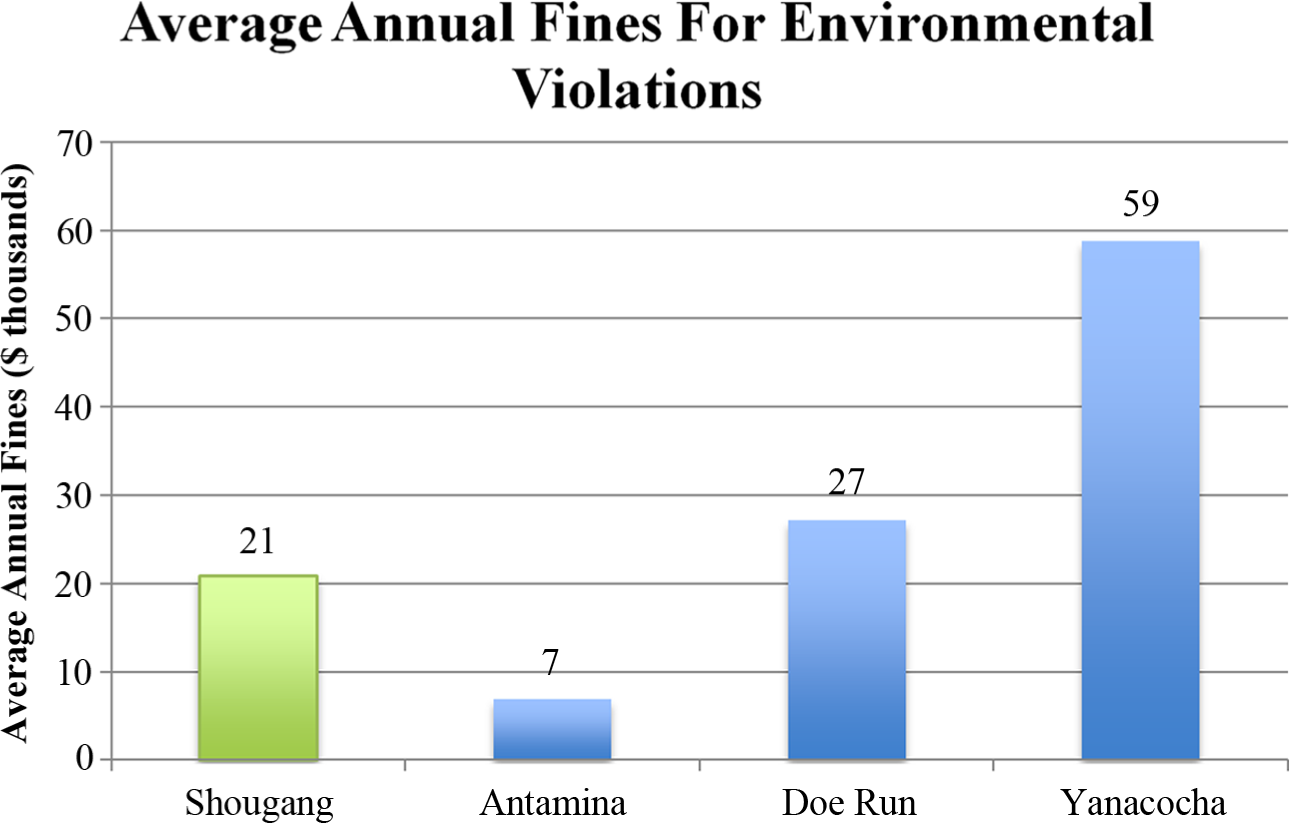
Average annual environmental fines since company establishment.
Yanacocha paid the most because of a massive mercury spill in 2000 that the company delayed in reporting; aside from this fine they were charged for two environmental standard violations. Shougang and Doe Run both paid eight fines for violating environmental standards, and Doe Run paid another three for PAMA violations. Antamina paid three fines for environmental standard violations. Thus, in terms of major violations of environmental standards, Shougang is roughly average.
Shougang outperformed Doe Run on PAMA investment spending, though Doe Run had committed to make a far larger investment. When the Peruvian government privatized state-owned brownfield mining concessions with existing environmental hazards, it required the new investors to commit to mitigate these hazards through a formal PAMA contract. Antamina and Yanacocha, as greenfield projects, do not share these responsibilities. In Shougang’s PAMA, the company committed to spend US$16.6 million from 1997 to 2006 to rehabilitate its crumbling infrastructure, which meant constructing a new tailings deposit, reducing dust and gases, protecting against oil spills, and treating household waste water (BO Consulting, 2007, p. 68). As of 2006, Shougang had spent US$12.7 million, or 77% of its original commitment, and physically completed 90% of the projects (Figure 2). Doe Run committed to spend approximately US$168 million from 1998 to 2006. Its PAMA sought to mitigate the complex’s hazardous emissions by constructing a new sulphuric acid plant, an effluent treatment plant, domestic and industrial wastewater treatment plants, an arsenic trioxide plant, and a monitoring station. (Canales Rivera & CEPEMA 2008, p. 6). With 6 months left in its initial 10-year PAMA, Doe Run had executed US$83.3 million or 50% of its originally scheduled investment, and it had made only 43% physical progress (Cletech, 2006, p. 38). It cannot be denied that Doe Run faced a much greater PAMA investment burden than Shougang. Still, Shougang fulfilled a greater percentage of its scheduled investment than Doe Run.

PAMA investment spending, 1997-2006.
In terms of everyday compliance with environmental standards, we find that Shougang received slightly lower ratings than the other companies. We base this comparison on compliance percentages assigned by their third-party, government-contracted environmental auditors’ reports to OSINERGMIN. Each company’s overall compliance is a simple average of its scores in nine to twelve individual areas, including toxic, industrial, and domestic waste management, emission regulation, and community relations. Since the government has been shifting the agency responsible for these reports as well as the reports’ formats, it was not possible to acquire quantitative data for every year of operation. 2 Therefore, we compare the companies’ compliance percentages in OSINERGMIN’s 2008 yearbook (APOYO Consultoria, 2009). We separate the results from these two sources because while OEFA only gave us the files for four companies, OSINERGMIN’s yearbook contains data for a few new comparison cases. OSINERGMIN’s 2008 data shows Shougang to be the second lowest of five companies (Figure 3).
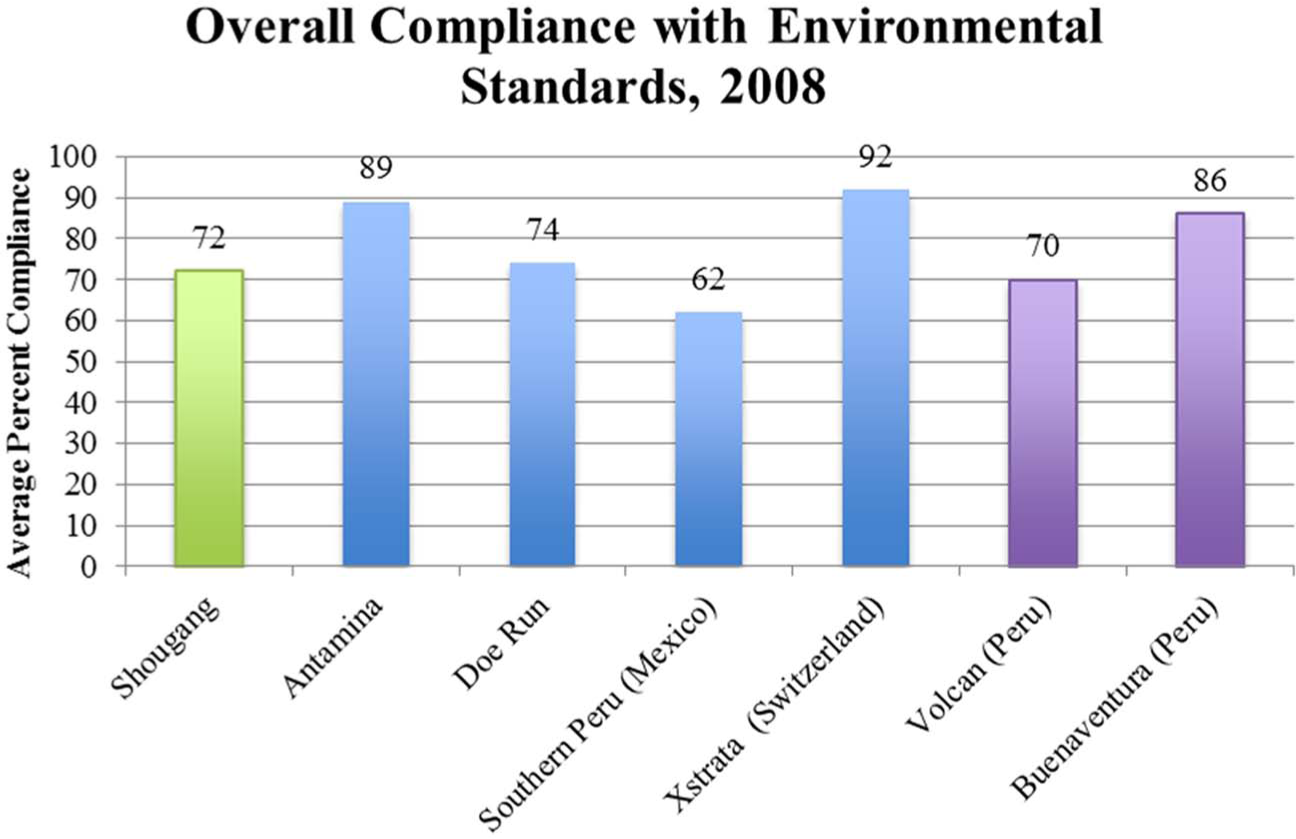
Overall compliance, 2008 environmental audit.
The companies at the far right are the two largest Peruvian mining companies, Volcan and Buenaventura. Interestingly, they appear to be in the same league as the foreign giants, roughly speaking. The best and worst performers are two large OECD-based companies, the Swiss company Xstrata and the Mexican company Southern Peru Copper Corporation. In short, Shougang does not stand out in the 2008 data.
Finally, we find that Shougang does stand out in its lack of compliance with environmental auditors’ recommendations. We culled these percentages from tens of thousands of pages of DGAA (2004-2007) and OEFA (2009-2010) archival files, so we are averaging hundreds of compliance scores for the period 2004-2010. 3 These recommendation compliance percentages differ from standard compliance percentages in that recommendations are company-specific orders based on the previous inspection. They vary across companies and across time in seriousness, urgency, complexity and difficulty. While it is unclear how Shougang’s recommendations compared to those of other companies, it is clear that Shougang has complied less readily with these recommendations than the other companies (Figure 4).
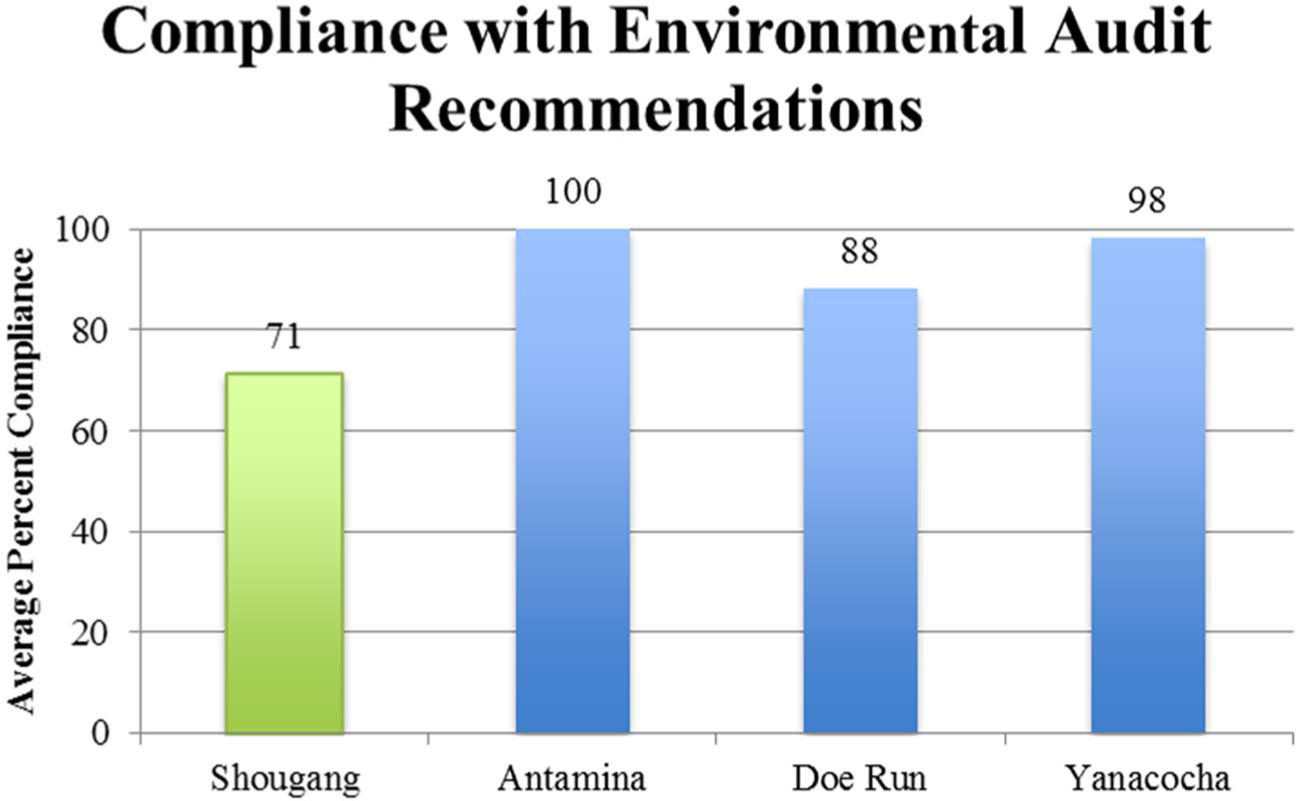
Average percent compliance with environmental audit recommendations.
It is important to note that these recommendations are minor compared to the previous indicators. They range from implementing pollution control systems to labeling garbage cans. Although auditors report them consistently, government reports ignore them (APOYO Consultoria, 2009).
Labor Impact: Evidence
When compared to the other firms in our sample, Shougang does not stand out for labor standard violations. At the same time, its rate of serious accidents is abnormally high. It comes in roughly average on overall labor code violations from 1993 to 2006, somewhat below average on its fatality rate since 2006, and leads the foreign companies in serious accidents since 2006.
DGAA gave more fines for labor standard violations to Doe Run and Antamina than to Shougang (Figure 5). Shougang received eight fines for worker fatalities and five fines for health and safety standard violations. Antamina received six fines for fatalities and two fines for health and safety violations. Doe Run received 13 fines for fatalities and six fines for health and safety violations. Yanacocha received 11 fines, all for fatalities. Shougang does not appear to be the outlier that its reputation would suggest.

DGAA labor-related fines, 1993-2006.
MINEM’s mining fatality database, which covers 2006 to 2011, reveals that recently Antamina and Yanacocha have improved while Doe Run and Shougang have not (Figure 6).

Average annual fatalities, 2006-2011.
This database is publicly accessible through MINEM’s website. It includes one other large, OECD-based mining company and the major Peruvian companies from Figure 3. We observe that Shougang performs below average for foreign firms, but by no means does it stand out. Its fatality rate is less than half that of Doe Run and well below that of the domestic mines, Volcan, and Buenaventura. Antamina and Yanacocha have reduced their fatality rates essentially to zero since 2006. An ex-Minister of Energy and Mining maintained that Antamina and Yanacocha improved largely because the government played “hardball” with them, threatening to revoke their concessions if they did not improve (Former MINEM Mnister, 2011).
Shougang does stand out in DGAA’s data on serious accidents (Figure 7). DGAA classifies accidents as minor, disabling, and fatal. We compare disabling accidents across the wider set of companies from Figure 3 and Figure 6.
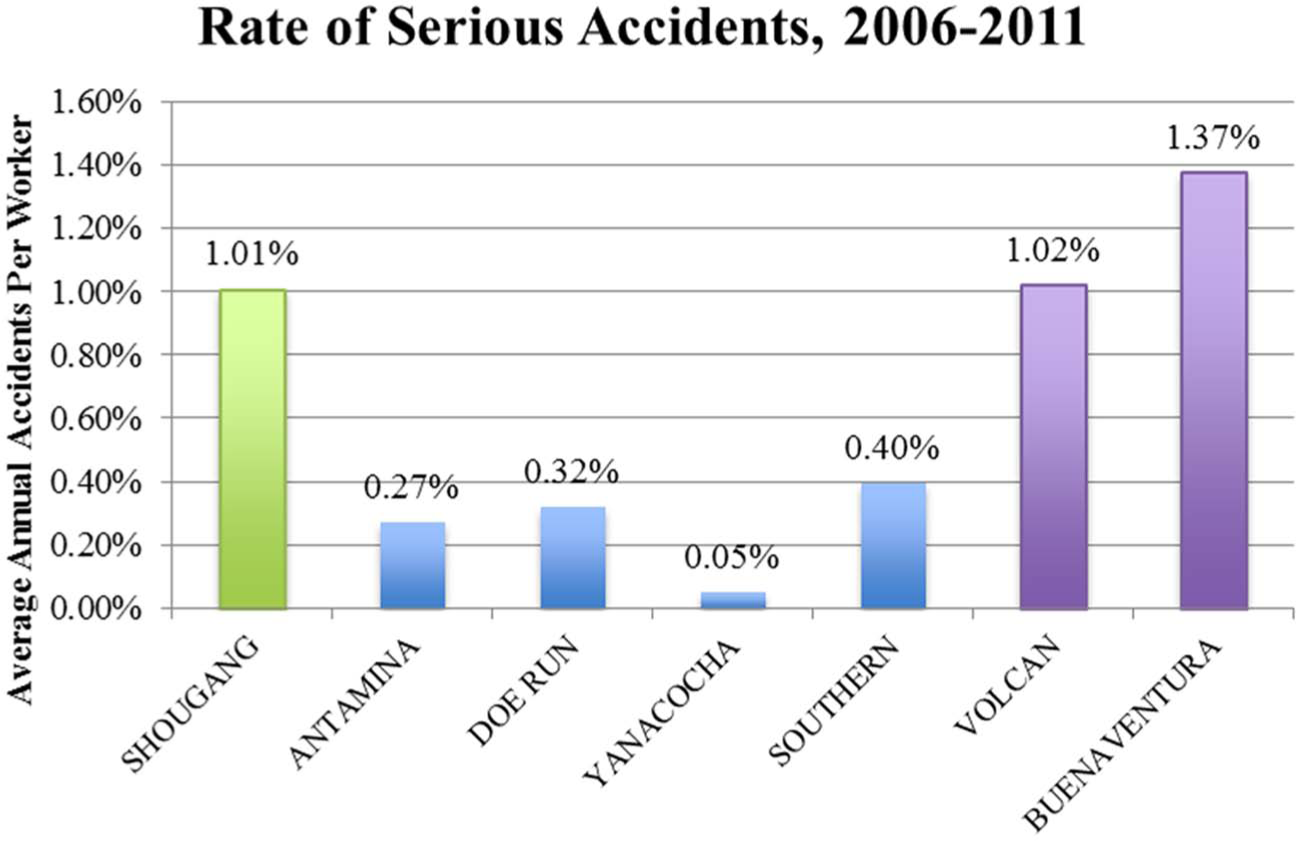
Rate of serious accidents, 2006-2011.
Clearly, Shougang does stand out among foreign companies in this area. While it improves slightly upon the major Peruvian companies Volcan and Buenaventura, it has more than twice as high a disabling accident rate as the other companies. Though Shougang did not stand out for fatalities or disabling accidents, here it is something of an outlier. Interviews suggest that while Shougang complies with labor standards in general, its ancient machinery endangers workers. As a union official put it, “Shougang doesn’t invest much money in safety measures like buying new machinery—much of it is 20 years old. They do just enough to get by” (Shougang Union Leader, 2011).
Wages and Contractors
Our findings agree with claims that Shougang’s wages are lower than its counterparts, but this differential is both smaller and less meaningful than others have suggested. Outside sources have lambasted Shougang for its low average salaries. Emmott (2005) and Kotschwar et al. (2011) both report the same figure to demonstrate Shougang’s low wages: US$14 per day (Emmott, 2005; Kotschwar et al., 2011). They agree that the industry average hovers around US$30 per day, and Kotschwar et al. (2011) add that Antamina and Yanacocha pay some of the highest salaries in the industry.
While Shougang may not pay quite as much as other foreign companies, they pay far more than these sources suggest. 4 The workers’ union provided us with the official 2010 to 2011 wage scales it negotiated with the company (Figure 12). Experienced workers earn US$22 to US$27 per day in wages alone while recent hires earn US$15 to US$17 per day. The average daily wage comes to approximately US$20, not including bonuses or benefits (Sanborn & Torres, 2009, p. 196). Shougang and striking workers have cited average salaries of US$29 to US$35 per day in newspaper articles (Gou 2005; “Remuneraciones” 2002; “Shougang” 2004). The unions confirmed that bonuses and benefits are substantial, but it is unclear whether they would add US$10 to the average daily wage to place Shougang at the national average. According to these data, wages are low but closer to average than other sources have suggested.
While Shougang’s mining wages may seem like an important social justice issue to outside observers, Peruvians see them as middle-class privileges. A former Antamina manager pointed out that these are not manual-labor shaft miners, but rather highly skilled operators of million-dollar open-pit mining machines. Officials from Antamina, Chinalco, and MINEM argued that demand is so high for these workers that “no company can afford to pay little,” concluding that Shougang’s wages “must be very close to the level of other companies” (Chinalco Manager, 2011; Former Antamina Official, 2011; Former MINEM Mnister, 2011). Our calculation of Shougang’s US$20 average base wage, excluding benefits and bonuses, is 2.5 times greater than Peru’s minimum wage (“Ejecutivo” 2010). Shougang’s union officials acknowledge that their main concern is not the level of the average wage, but rather the inequity in the dual wage scale for old and new hires and the subcontracting 5 (Shougang Union Delegation, 2011).
A hidden, more disturbing issue is the mining companies’ use of low-paid subcontractors. While Emmott (2005) and Kotschwar et al. (2011) focus only on formally employed workers, NGOs and unions in Peru are most concerned about subcontracting. Peruvian law allows mining companies to hire subcontractors to manage nonmining aspects of the mine. Companies can also hire “intermediaries” from poorly regulated outside firms; intermediaries work alongside formal workers but are hired and paid by the outside firms. Mining companies have been shifting up to 80% of their labor force to intermediaries and outside contractors in order to avoid minimum wages, legal liability, and firing restrictions. Ex-Vice Minister of Environmental Management Jose de Echave writes that subcontracting “has played a pivotal role in the poor quality of mining employment” due to contractors’ “poor training of the workers and inadequate safety measures.” (de Echave, 2007) Contractors earn about half of the wages of the lowest paid formal workers, with none of the benefits, bonuses, unionization rights, or job security. (Sanborn & Torres 2009, p. 196; “Trabajadores” 2007).
While Shougang may pay its formal workers less than other foreign mining companies, it also uses fewer subcontracted workers. We compared the percentage of contracted workers across four foreign and one Peruvian company using data from SMV and Antamina’s 2010 Sustainability Report (Figure 8).
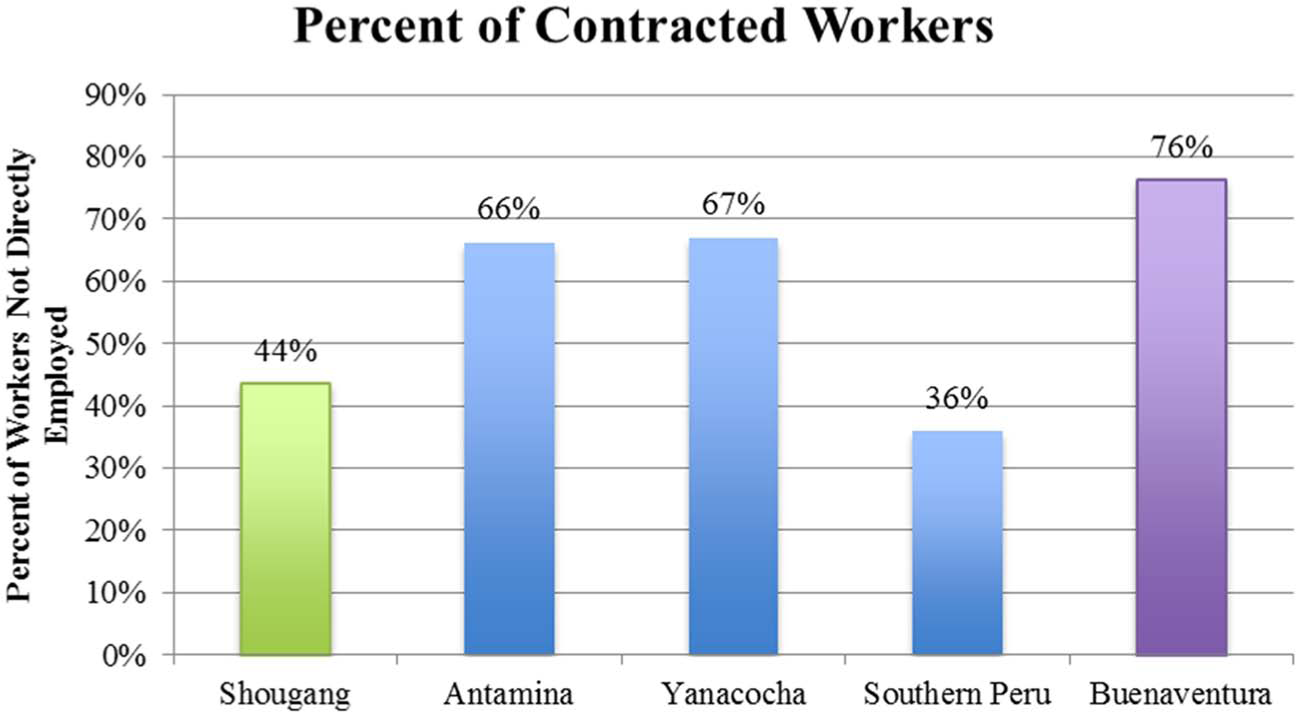
Percent of workers not directly employed by the company.
Shougang uses fewer contracted workers than Antamina and Yanacocha. This is not necessarily a good thing. A former Antamina manager claimed that Antamina ensures that its contractors pay their workers well and argued that the company uses more contractors because it provides more services to its employees (Former Antamina Official, 2011). Given Shougang’s lower use of contractors, its average wage for indirect and direct workers combined may exceed those of Antamina and Yanacocha. Still, the quantity of jobs may be more important than the quality of the wages. Though companies pay far lower wages to their contractors than to their formal workers, these low contractor wages still exceed those available in other sectors. An ex-Minister of MINEM stressed the fact that many mining conflicts begin when communities realize how few jobs are available for locals at the new mines (Former MINEM Minister, 2011).
Interviews suggested that Shougang did not stand out in using contractors illegitimately when compared to other foreign firms. Mining companies in Peru routinely attempt to save money by illegally hiring contractors for “principal labor” that is central to the production process. In 2007, the MTPE’s National Director of Labor Inspections, Jorge Villasante, cited Shougang as one of the “best examples” of a mining company misusing contractors, “as illustrated by the high number of union complaints” 6 (Torres Azucena, 2007). However, Shougang’s union leaders acknowledged that while Shougang does “use contractors in order to avoid paying high salaries and benefits . . . It’s the same with all companies and not any worse than other mining companies” (Shougang Union Official, 2011). Since MINEM refuses to investigate this issue, we have no data on which to concretely compare the companies.
Backward Linkages
Shougang has fewer backward linkages in Peru as a whole but may have deeper local linkages than do its counterparts. Every mining company imports all its heavy machinery, since Peru does not manufacture mining equipment. When it came to secondary products and services like food preparation, dust masks, equipment repair, waste removal, cleaning and construction services, we found a consistent pattern. Shougang bought more local goods and hired more local service providers, such as cheap, local caterers. Antamina and Yanacocha bought better quality goods and services, hiring multinationals like Sodexo Peru to provide food services. Antamina and Yanacocha bring more revenue to Peru as a whole because they pay more for these products and services. However, most of their service providers come from Lima, deepening regional inequality. Shougang sources its cheaper, lower quality goods and services from small, local firms to minimize costs. In Antamina and Yanacocha’s defense, they have been encouraging their Lima service providers to purchase local inputs like uniforms, shoes, milk, and vegetables. While Shougang’s service providers may be local, they often bring little local benefit because they simply import food and other products from Lima when they are not locally available. Thus, it is unclear what impact Shougang’s local sourcing has on local development.
It is also important to note that local mining money can bring negative impacts for mining communities. The miners spend more money in town, which is positive for the local vendors. However, the influx of cash inflates prices for other local buyers. A Shougang union official pointed out that as workers enjoyed rising bonuses, locals began complaining that “The workers are buying new cars and other things, causing the prices to go up” (Shougang Union Official, 2011). An ex-Vice Minister of the Economy remarked that “It can be bad having this new money because it brings prostitution, drugs, and other crime . . . inequality and rising prices can make the community hate the mining” (Former Vice Minister of the Economy, 2011).
Like Western companies, Shougang employs local workers rather than importing them from China. Although Chinese mines in Africa have received criticism for importing Chinese workers, Gonzalez Vicente (2009) notes that, “Contrary to the case of their operations in Africa, Chinese SOEs [in Latin America] do not introduce Chinese contract workers in their projects” (Gonzalez Vicente, 2009, p. 107; Pomfret, 2010). As in other foreign companies, today only a handful of Shougang’s managers are foreigners.
Union Relations
If Shougang has performed better than its reputation suggests, it is worth asking if Shougang’s union relations are really as poor as they are portrayed. Previous reports on Shougang depict the mine’s labor problems in terms ranging from “more intense . . . than with other mining companies” to “a nearly two-decade long revolt from mine workers” (ECLAC, 2010, p. 122; Moxley, 2010).
Shougang does stand out significantly in annual strikes. We collected annual reports by the MTPE’s General Statistics and Computer Systems Office on strikes in the mining sector. The reports recorded both numbers of strikes (Figure 9) and total man-hours lost (Figure 10) for the period 2001 to 2011.
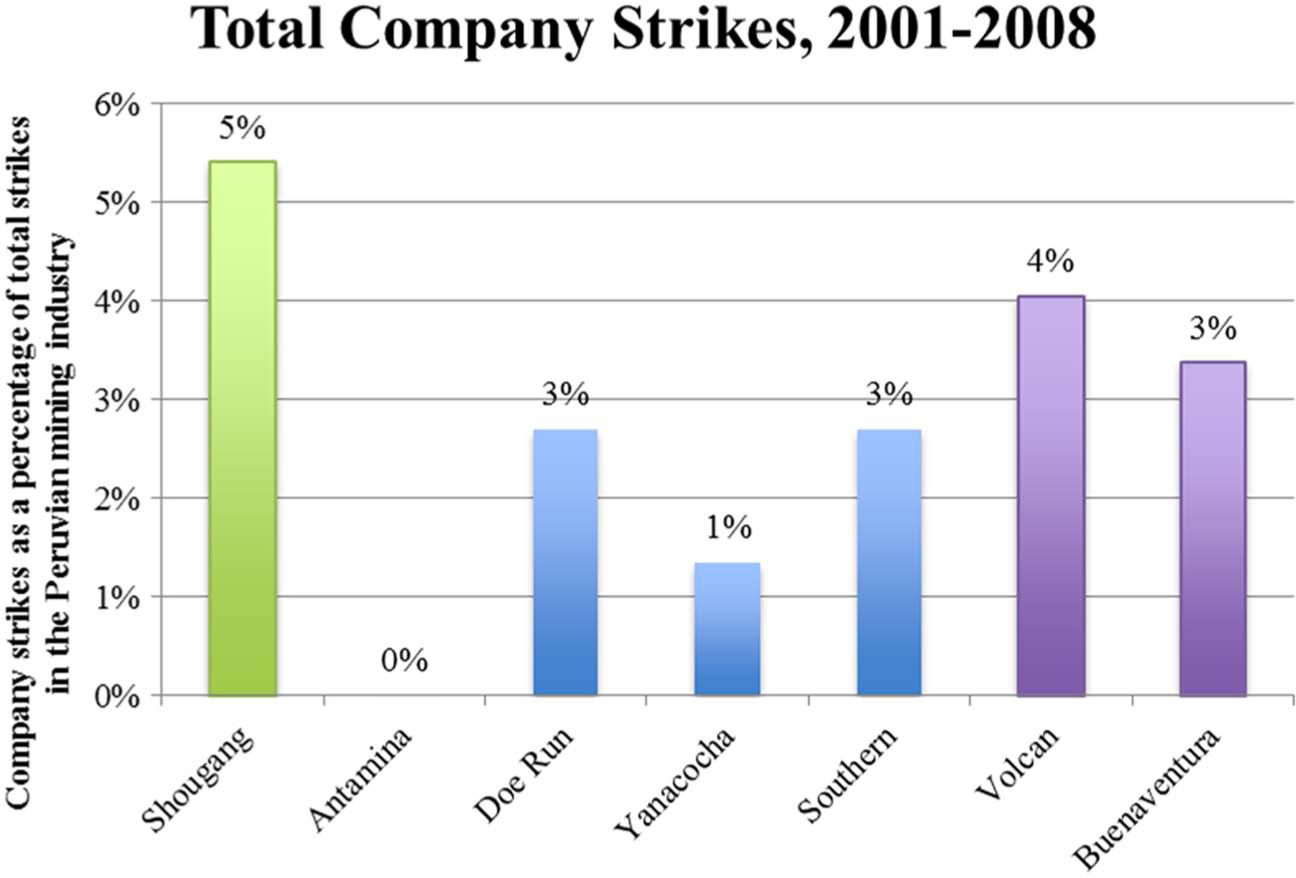
Total company strikes as a percentage of total mining industry strikes, 2001-2011.
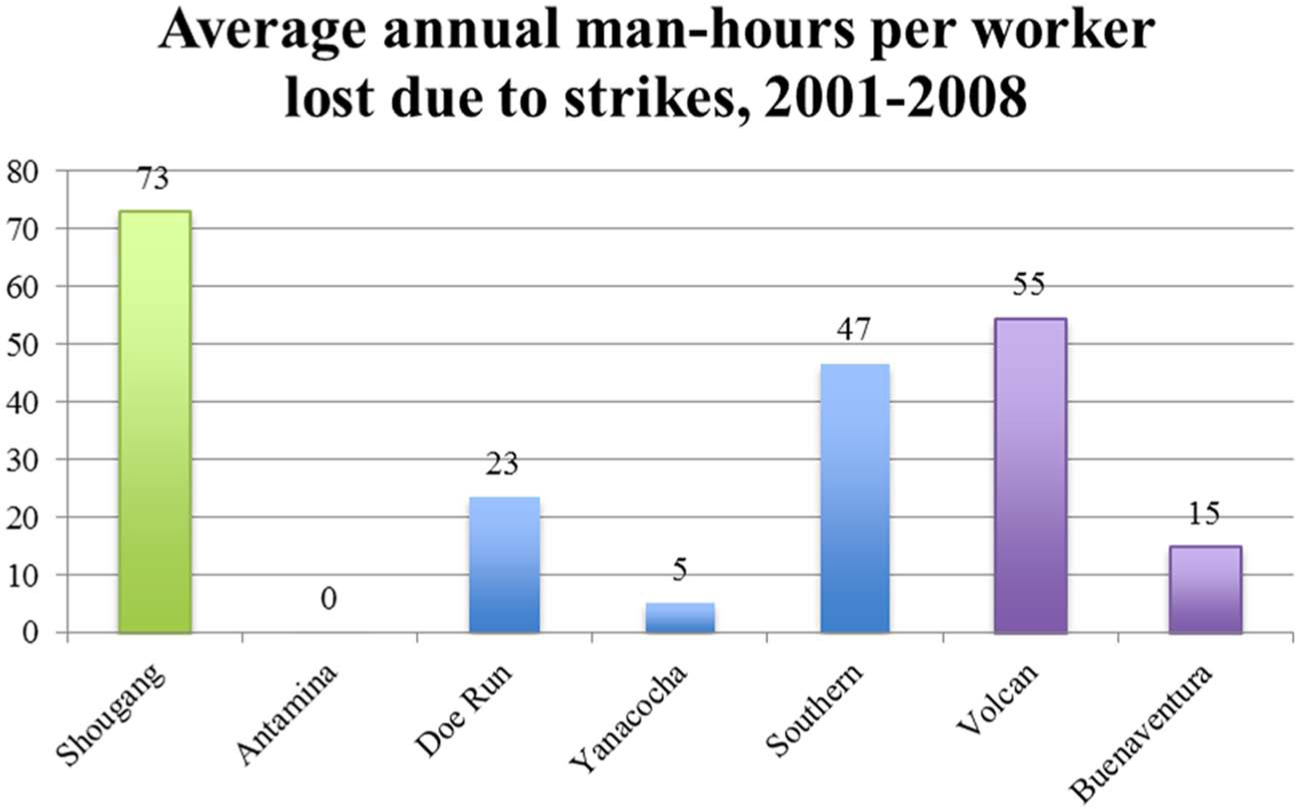
Average annual man-hours lost per worker, 2001-2008.
The above figures illustrate that although Shougang did not stand out for labor or environmental violations, it has experienced an abnormally large amount of strikes. Doe Run, which performed worse than Shougang on almost every indicator of labor standards, lost 70% fewer man-hours to strikes. Roughly one in 20 strikes by Peruvian miners from 2001 to 2008 occurred at Shougang.
Roots of Labor Conflict
To understand why Shougang Hierro Peru has such poor relations with its unions today, it is important to understand the historical conflict between Shougang and the unions. This conflict stems from a series of events that have never been properly documented.
Reports on Shougang have popularized the false idea that Shougang ruined its labor relations right from the beginning by firing half the company’s workers (Combe, 1996; Kotschwar et al., 2011; Parish Flannery, 2012; SNMPE Official, 2011). In fact, the Peruvian government fired those workers before offering the mine up for privatization (“Hoy” 1992; “Se realizó” 1992; Serna Guzmán et al., 2007, p. 56) Even the unions acknowledged the need for firings and new investment to renovate the mine and make it profitable (“Huelga” 1992; “Personal” 1992).
Far from an instant culture clash, both Chinese and Peruvian sources recognize the first 3 years as a great success. To this day, union officials praise Shougang for accepting their annual list of demands from 1993 to 1995 and tripling daily wages (Deng, 2010, p. 2; Jun, 1996, p. 2; “Shougang Hierro” 1993; Shougang Union Delegation, 2011). Everyone agreed proudly that Shougang “turned the mine around” from a US$32 million loss in 1992 to a US$5 million profit in 1993 (Gou, 2005; “Shougang Hierro” 1993; Wang, 1996).
Shougang’s union conflict began in 1996, when it broke its investment commitment. When Shougang bought Hierro Peru, it paid US$118 million and committed to invest an additional US$150 million in the mine by 1995 (Serna Guzmán et al., 2007, p. 127). By the deadline, Shougang had invested only US$38 million, choosing instead to pay a US$12 million fine. The government set a new investment target for 1999, and again Shougang fell short and paid the fine (Serna Guzmán et al., 2007, p. 35).
The union soured toward Shougang not because this commitment was to the community, as previous studies suggest, but because the commitment was to modernize the mine. Most journalists and scholars have assumed that Shougang angered the union because the US$150 million investment was supposed to go to help the community (Kotschwar et al., 2011; Parish Flannery, 2012; Romero, 2010). This is false. Even Shougang’s fiercest Peruvian critics did not expect Shougang to spend a dime of the US$150 million on the community; it was all destined for the mine (Anaya Valer, 1996; Combe Mindreau, 1996; “Shougang” 1995). The union was counting on Shougang to buy newer, larger machines and buildings to ensure safety, increase productivity, and expand employment (“Inversión” 1992). When Shougang failed to make these investments, it was betraying the main purpose of the privatization.
Shougang Hierro Peru defaulted on the investment commitment and stopped negotiating with the unions because it was falling apart back in China. In 1995, the Chinese parent company (Shougang) lost its access to credit in China, suffered a massive corruption scandal, and closed 10 investment projects in China. (Gonzalez Vicente, 2013, p. 51; Steinfeld 1998, p. 219; Gou, 2005) Matt Ferchen observes that “Given the dramatic cutbacks in Shougang’s domestic operations, it’s surprising that any investment at all continued in Peru.” (Ferchen, 1999, p. 29)
Instead of admitting that the parent company crisis made it impossible for Shougang to increase investment as planned, the company sought to hide the crisis (“Shougang cumplirá” 1995). When the union went on strike, Shougang’s management hired a private police force to stop the demonstrations. One worker died in the clash, the strikes worsened, and Shougang fired the union leaders (Gou, 2005; Wu, 1999, p. 2). Since then, Shougang has systematically refused to grant any of the unions’ demands and workers have set fire to the company offices. Company–union relations have not recovered to this day.
Public Relations Comparison: Doe Run
A brief comparison of Shougang’s history with that of the American company Doe Run highlights the importance of both historical baggage and public relations strategy. Doe Run has maintained popularity among workers and community members while recording a worse social and environmental impact than Shougang.
Like Shougang, the American company Doe Run won a privatization bid to take over a troubled state mining operation. Peru privatized the Doe Run metallurgical complex because it had become one of the most polluted places on Earth, and the state could not afford to invest in the necessary cleanup and pollution mitigation technologies. Doe Run Peru also failed to honor its investment commitments. While it complied with a number of provisions including slag deposits and ferrite conditioning tanks, it defaulted on the most significant commitment—the US$90 million sulfuric acid plant (Canales Rivera & CEPEMA, 2008, p. 128; DGAA, 2006b).
Doe Run did not experience a parent company crisis like Shougang, but it claimed that falling metal prices robbed it of the earnings it needed to meet its commitments. However, instead of silently defaulting, Doe Run Peru petitioned MINEM for a 4-year extension on the sulfuric acid plant due 2007, citing a lack of funds. MINEM granted the extension. Doe Run Peru asked for a second and third extension and the third time MINEM refused. It is unclear to what extent Doe Run Peru was actually struggling financially. Many argue that Doe Run Peru’s parent company in the United States, Doe Run, could easily have injected new capital to keep it afloat. Others blame commodity prices.
In another parallel to Shougang, the state struggled to punish Doe Run Peru because the poorly written contract did not include an enforcement mechanism. When Doe Run failed to meet its extended deadline, MINEM revoked Doe Run’s concession. But according to bankruptcy procedure, Doe Run Peru’s assets would have been transferred to its largest creditor, Doe Run in the United States. In order to prevent Doe Run from escaping scot-free, MINEM levied a hefty fine on Doe Run Peru for failing to meet the commitments, more than the company owed to Doe Run in the United States. The state was then able to seize Doe Run Peru’s assets as its largest creditor. Doe Run’s umbrella corporation, RENCO, filed an arbitration suit in international court in protest (“Renco” 2011). This case has not yet been resolved, but Peru may lose on the basis of its poorly written initial contract.
The greatest contrast between the cases of Shougang and Doe Run lies in the companies’ deliberate labor strategies. Shougang’s workers went on strike more, though Shougang did not violate more labor or environmental standards. While both companies defaulted on crucial investment commitments and committed some violations, Doe Run has always framed itself as the unions’ great supporter. When it bought the complex, it wooed the union with the argument that the privatization had prevented the complex from closing. It did not fire union leaders or hire private police forces to break strikes, and has strategically acceded to some union demands. Shougang, by contrast, stonewalled communication with the unions and continues to reject their annual proposals. Doe Run’s socially minded framing, and Shougang’s complete lack of it, have largely determined their relationship with workers and the community.
Comparison Summary
Though the literature has widely assumed Shougang to be far worse than comparable foreign mines, Shougang does not stand out as having a particularly negative performance on quantitative environmental or social indicators. Its two largest failures were lack of compliance with environmental auditors’ recommendations and an abnormally high rate of serious accidents. The company also performed somewhat below average on 2008 environmental standard compliance and 2006-2011 fatalities. It came out average or better on some of the most important measures, including PAMA spending and fines for both environmental and labor violations. On other issues, including wages, subcontracting, and community backward linkages, little hard data is available, but Shougang appears to be less of an outlier than previous reports have suggested. The only clear way in which Shougang stands out from other foreign mining companies is its high rate of strikes.
The quantitative comparison also shows that the brownfield projects for the most part underperformed the greenfield projects. Doe Run and Shougang were the lowest performers on environmental standard compliance (Figure 3), environmental recommendation compliance (Figure 4), recent fatalities (Figure 6) and serious accidents (Figure 7).
The comparison between Shougang Hierro Peru and Doe Run Peru shows the importance of public relations. Shougang essentially terminated communication with the unions and avoided publicity after its fallout with the unions in 1996. Doe Run framed its actions as having saved the workers from unemployment and worked to maintain union support. Fifteen years later, while Shougang’s workers carried out strikes, protests, and arson against the company, Doe Run’s workers demonstrated on its behalf.
Conclusions
Chinese investment in Latin America has exploded in recent years, leading observers to worry that Chinese companies may transplant poor labor and environmental practices to the region. Chinese investment is so recent that only one mining company has been operating long enough for us to assess its impact. The existing literature on this company, Shougang Hierro Peru, declares this company’s environmental and social record to be far worse than that of other comparable foreign-owned companies.
We analyzed new government data and the historical record on Shougang and similar companies to assess these allegations. Even after years of contention and controversy, we found that Shougang performs below other foreign companies on some indicators, especially with its unions and workers when compared to other foreign firms. Shougang also performs poorly with respect to environmental indicators, but is not significantly different than its U.S. and domestic counterparts on many scores. Indeed, a U.S.-based company Doe Run performs just as poorly or worse than Shougang on many fronts despite the fact that Doe Run enjoys the experience of much higher standards in its headquarter country relative to China.
Theoretically, scholars have framed the relationship between foreign investment and the environment as having the possibility of following two paths. The “pollution halo” path can occur if a firm brings the higher standards of its headquarter country to a country with lower environmental standards. The “pollution haven” path can happen if a firm ignores its headquarter country standards and pollutes more in the lower standard country (see Gallagher, 2008). For Chinese firms the first assumption does not hold because China starts from a lower standard than the standards in Latin American countries. Therefore Chinese firms have a steeper learning and compliance curve relative to a U.S. counterpart that has experienced higher levels of regulation at home. Nevertheless, Shougang is still not starkly different than its US counterpart on environmental indicators. And, as new Chinese firms have moved into the region they have certainly learned from the Shougang example.
New Chinese projects in Peru may be learning the right lessons from the Shougang experience. They have invested heavily in framing their socially responsible contribution to the workers and community. The leading project, Chinalco’s Toromocho copper mine, has led Chinalo to spend between US$150 million and US$200 million to build a completely new city with homes, running water, and sanitation facilities for the inhabitants. 7 Chinalco and Minmetals have gone so far as to hire Western CEOs to navigate the mining approval process (Chinalco Manager, 2011). Both Peruvian and Chinese mining officials have confirmed that these companies have adopted North American CEOs as an explicit strategy to get their operations approved (Chinalco Manager, 2011; Deng, 2010). Many actors are still concerned about the efficacy of this process but there is no doubt that such actions are profoundly different than Shougang’s entry into Peru of labor and community relations than Shougang ever was.
There may not be any clear lessons from Shougang that apply only to Chinese companies, but there are certainly lessons that apply to Peru’s mining FDI policy in general. Labor, human rights, and environmental concerns are endemic to economic activity in the mining sector. While Chinese, U.S., and other foreign firms have a responsibility and stake in changing their behavior, it is no substitute for strengthening national policy to maximize the benefits and mitigate the risks of mining activity. There are three signs that Peru is moving in that direction.
First, the improving regulatory framework has forced companies to improve their social and environmental impact (Kotschwar et al., 2011). Many commented on the regulatory system’s positive impact on Shougang. An NGO leader maintained that today, “new legislation and better regulation have forced the company to make adjustments to survive” (NGO Official, 2011).
Second, while the Peruvian regulatory framework has improved greatly since the 1990s, two salient labor issues are subcontractors and government resolution of union negotiations. Since MINEM and MTPE have not agreed on the appropriate use of subcontractors, their conflict leaves unions, mining communities, and NGOs outraged at the widespread outsourcing of what used to be decently paid company jobs. MTPE, which is supposed to be the ultimate mediator in union–company disputes, is not an effective mediator because locals see it as being captured by the companies. In Shougang’s case, the unions point out that regional office of MTPE ignores the union’s list of demands and simply forces the company to give a slightly higher raise and one time bonus (Shougang Union Delegation, 2011).
Finally, the underlying problem facing all mining companies in Peru is the population’s lack of confidence in the government ministries that regulate these companies. Unlike workers, nearby communities often have no stake in the mining operations. When they feel that a company is damaging the environment, they attempt to shut down its operations. These communities do not trust the environmental impact evaluations, third-party audits, or other inspections that private consulting firms prepare for MINEM. At the same time, local government and community officials have no means of challenging problematic mining operations. The government must give these communities a potent legal channel through which they can air their grievances. While community accountability will result in the end of some mining concessions, it is necessary to provide this avenue inside the system rather than forcing citizens to take matters into their own hands.
Footnotes
Declaration of Conflicting Interests
The authors declared no potential conflicts of interest with respect to the research, authorship, and/or publication of this article.
Funding
The authors disclosed receipt of the following financial support for the research, authorship, and/or publication of this article: The authors gratefully acknowledge support from the Rockefeller Brother’s Fund and the C.S. Mott Foundation.
Notes
Author Biographies
He has edited or coedited a number of books, including Rethinking Foreign Investment for Sustainable Development: Lessons from Latin America (with Daniel Chudnovsky) and Putting Development First: the Importance of Policy Space in the WTO and IFIs. He is also a research associate at GDAE.