




Abstract
Although several studies suggest foreign manufacturers in the United States may provide access to good quality employment opportunities with fair compensation and stable benefits, the question of who benefits more from the location of manufacturing foreign direct investment (FDI) remains open. Using the National Establishment Time Series data set and individual earnings data from the American Community Survey Public Use Microdata Sample files, this research conducts a quantile regression to estimate the earnings distribution effects that a concentration of manufacturing FDI may have on different earnings groups in Georgia between 2004 and 2010. The research does not measure inequality directly, but the findings both from place-of-work and place-of-residence earnings analyses suggest strong implications relating to the issue of inequality among people. The concentration of manufacturing FDI in a certain area shows the largest distribution effects on area workers in the lower earnings group and residents in the middle earnings group.
Foreign direct investment (FDI) in the United States, which predominately occurs in the manufacturing sector, remains critically important for a strong regional and local economy because of the resulting increase in employment levels with higher wages (U.S. Economics and Statistics Administration, 2011). Job generation is one potential benefit to a local economy receiving FDI. U.S. subsidiaries of global companies directly and indirectly employed more than 12 million American workers in 2013, which accounted for a significant share of the regional and local economy (Richards & Schaefer, 2016). While mergers and acquisitions can save existing jobs through the purchase of an existing enterprise, greenfield investments (i.e., the creation of new enterprises and the development or expansion of production facilities or plants) can provide additional jobs in the communities where they are located (Shannon, Zeile, & Johnson, 1999). External investment in plants or facilities not only generates employment but can also spur development of complementary businesses that provide further employment opportunities. Thus, attracting greenfield investment to localities and regions with high unemployment levels can be a desirable solution to their economic problems (Dunning & Lundan, 2008; Jones & Wren, 2006; OECD, 2008). Furthermore, FDI-supported manufacturing jobs ensure more job security. Recent analysis shows that manufacturing FDI jobs tend to be more stable than domestic manufacturing jobs. Total manufacturing employment fell 24%, while manufacturing FDI jobs declined by only 11% between 1998 and 2008 (U.S. Economics and Statistics Administration, 2011).
However, concern has arisen that the rapid rise in inward FDI may have an adverse effect on American workers. Some researchers feared that U.S. affiliates of foreign companies might change the composition of employment, moving “good” jobs to “bad” jobs with lower-than-average wages. Graham and Krugman (1995) compared compensation per employee and value added per employee across industries for U.S. affiliates of foreign companies against U.S. companies with data for 1988 and 1990. Although aggregate data showed that both compensation and value added per worker were higher for foreign companies than for the average domestic company in the United States, the difference between foreign and domestic companies was essentially because of differences in industrial composition. While employees in high-wage capital-intensive industries such as petroleum refining and chemicals raise the average, no systematic difference existed between foreign- and U.S.-owned companies in compensation and value added per employee (Graham & Krugman, 1995).
Nevertheless, several empirical findings suggest that foreign manufacturing plants pay higher wages than domestic plants (Figlio & Blonigen, 2000; Jackson, 2010; U.S. Economics and Statistics Administration, 2011). From 1998 to 2008, workers at foreign companies received 30% higher pay than workers at other U.S. firms (U.S. Economics and Statistics Administration, 2011). Focusing specifically on foreign manufacturing plants in South Carolina, Figlio and Blonigen (2000) found that foreign investment raises local real wages much more than does domestic investment. They estimated that adding a single foreign plant to a county is associated with a more than 2.3% increase in real wages for all workers in foreign and domestic plants in that industry in the same county, while the estimated wage increase associated with an equal-sized new domestic plant is just 0.3% (Figlio & Blonigen, 2000).
Overall, manufacturing FDI may provide access to good quality employment opportunities with fair compensation and stable benefits. The question of who benefits more from the location of manufacturing FDI, however, remains open. There have been very few studies linking location of manufacturing FDI to the issue of inequality among people. One of the most distressing situations over the past decades has been the growing inequality in income and earnings. Some researchers argued that inequalities may only be a problem in the early stages of economic growth and higher average per capita income tends to reduce the overall income inequalities as the national economy grows (Kuznets, 1960). Since the 1970s, however, most of the increased wealth generated by the gain in productivity growth has gone to the highest income class, while wages for the middle and lower classes have risen at a far lesser rate than the rate of productivity growth (Bartik & Houseman, 2008; White House Task Force on the Middle Class, 2010). In 2007, incomes for the top 1% accounted for 23.5% of total U.S. income, which is the highest level of income concentration since 1928. The share of these higher income households jumped to 160% in 2002, while everyone else’s share actually declined (White House Task Force on the Middle Class, 2010). This is strong evidence of income inequality: the fact that, at any given level of growth, a smaller share of the benefits of that growth is flowing to the middle class on down.
This research selects Georgia as a case study area, which is historically one of the largest recipients of FDI in the U.S. manufacturing sector. Between 1990 and 2010, an annual average of 800 foreign manufacturing plants located in the state provided an annual average of 70,000 jobs. In addition, the state has a substantial proportion of foreign manufacturing jobs relative to the total manufacturing employment in the state. In 1990, the share of employment associated with foreign manufacturing plants in Georgia was 9.8% of total manufacturing employment, and this share increased to 12.3% in 2010.
This research does not measure earnings inequality directly, but tries to answer the research question of who benefits more from manufacturing FDI job growth. To measure the earnings inequality effects directly, an inequality measurement—including Gini or Theil index—can be applied. However, that inequality measurement does not provide answers on which earnings groups are affected more by manufacturing FDI. Applying a quantile regression approach, this research instead estimates earnings 1 distribution effects that a concentration of manufacturing FDI may have on different earnings groups during the study period of 2004 and 2010. In other words, the findings of the earnings impact analysis will suggest several implications relating the issue of whether and how the location of manufacturing FDI has reduced or increased inequality among people.
Data and Geographic Unit of Analysis
This research relies on two data sources. First, the National Establishment Time Series (NETS) data set 2 provides longitudinal establishment-level employment for each foreign and domestic manufacturer. It allows the unique ability to measure the employment trends down to the finest geographic scale possible, using street addresses and longitude/latitude for each establishment over time. 3 Thus, the employment levels can be aggregated into each geographic unit in each year for each specific manufacturing sector.
Second, the data for individual earnings come from the American Community Survey (ACS) Public Use Microdata Sample (PUMS) files. 4 ACS is an ongoing survey that serves as a replacement for the former Census long form and covers about 1% of the U.S. population each year (U.S. Census Bureau, 2009). It releases an annual PUMS, which is a set of untabulated records about individual people or housing units. The earnings data are available at the individual level from the annual PUMS, which lists each worker’s total pretax wage and salary income as an employee. 5 This provides a unique opportunity to compare different impacts of manufacturing FDI location on different earnings classes, while other aggregated earnings data sets at the county or city level do not. This research also derives other data representing individual characteristics, such as age, education attainment, race/ethics, gender, industry, and occupation, from ACS PUMS files.
The research uses the Public Use Microdata Area (PUMA) as a geographic unit of analysis for measuring the impact of manufacturing FDI on individual earnings across different local communities. The individual earnings data are available at the individual level from annual ACS PUMS files from 2001 to 2011. However, traditional metropolitan statistical area and county geographic identifiers are not available in the ACS PUMS (U.S. Census Bureau, 2009). Instead, PUMAs are the lowest level of geographic area available between 2005 and 2011. This data availability restricts the study period to 2004-2010. 6
PUMAs have a minimum population of 100,000 and maximum of a little less than 400,000, and the Census Bureau attempted to group similar areas together. Because the analysis separately examines direct and indirect effects of locations of manufacturing FDI on individual earnings, this research uses place of work of PUMAs (POWPUMAs) and residential PUMAs (RESPUMAs), respectively, as a geographic unit of analysis. Figure 1 shows the 43 POWPUMAs (or RESPUMAs) identified in Georgia.

Study area: POWPUMAs (RESPUMAs) in Georgia.
Models
To estimate the earnings distribution effects of manufacturing FDI on different levels of earnings groups, this research applies two specific analyses: place-of-work and place-of-residence earnings models. First, the place-of-work earnings analysis measures the direct distribution impact that locating manufacturing FDI in a community may have on the earnings of those who work in the area. Second, the place-of-residence earnings analysis measures the indirect distribution impact of manufacturing FDI in a certain community on the earnings of those who live in the area.
Place-of-Work Earnings Model
To measure the correlation between the manufacturing FDI concentration and individual earnings for manufacturing workers, the logarithm of individual

The research calculates total foreign and domestic manufacturing employment levels in each place of work of PUMA (POWPUMA) in each year for each specific manufacturing sector (3-digit NAICS). To control spatial fixed effects and year period effects, spatial dummies and time dummies are included.
Age
Education attainment dummy
Race/ethnicity dummy
Gender dummy
English language proficiency dummy
Occupation (major occupation) dummy 8
This research uses quantile regression. While ordinary least squares (OLS) regression relies on mean regression analysis, which estimates the average earnings equation conditional on the covariates, quantile regression estimates the earnings equation in various conditional quantiles of earnings. This method is an attractive alternative estimation because it does not impose arbitrary exogenous sample selection criteria to divide the sample, allowing a researcher to estimate as many quantile regressions as possible. No sample selection bias occurs because the method uses the entire sample to estimate each quantile. Furthermore, the quantile regression is robust as to outliers and is especially suitable for heteroscedastic data since it is estimated by minimizing the sum of absolute values of residuals instead of the sum of squared residuals (Cameron & Trivedi, 2009; Koenker & Hallock, 2001). Using quantile regression analysis, this research can develop more detailed and accurate information from the earnings equation at all different levels of earnings (Buchinsky, 1994). This means that the results of quantile regression analysis can answer the research question of who is benefiting more from manufacturing FDI job growth.
There are 286,580 individual observations of Georgia workers in the 2005-2011 ACS PUMS. Among those, the research selects individuals who were 16 years or older, worked in the manufacturing sector, and lived in Georgia. In addition, the research restricts the sample to individuals who reported working at least 50 weeks during the previous year (year-round worker) and usually 35 or more hours per week (full-time worker). This restriction relies on the notion that year-round and/or full-time workers are less likely to have changed jobs than seasonal and/or part-time workers. The sample also excludes self-employed workers. These restrictions reduce the sample size to 25,363 individual observations.
Table 1 summarizes the statistics for the place-of-work earnings model. The annual average earnings (in 2010 dollars) in the manufacturing sector in Georgia was $55,086 and the annual earnings ranged from $446 to $422,772, representing the broad range of earnings groups. The research identified an average of 255 manufacturing FDI employees in the specific manufacturing sectors (3-digit NAICS), while the average employee level for domestic manufacturing is 2,884. The average age of manufacturing workers is about 44. Although a recent report shows that over half of current workers in the manufacturing sector have some education beyond high school (U.S. Executive Office of the President, 2009), the descriptive statistics in Table 1 reflect that the percentage of manufacturing workers with a college degree or higher is only 42.5 in the selected sample. White workers represent the largest racial and ethnic group with 65.6%, followed by Black, Hispanic, and Asians, comprising 22.3%, 8.1%, and 3.2% of the sample, respectively. The number of male workers is more than double the number of female workers (69.1% vs. 30.9%). The percentage of manufacturing workers who speak English well is 95.5.
Descriptive Statistics for Place-of-Work Earnings Model.

Note. N = 25,363.
Place-of-Residence Earnings Model
Because of its multiplier effects, locating a new foreign manufacturing firm may add a number of new jobs both directly from the firm and indirectly from local suppliers, as well as support and service providers (Dunning & Lundan, 2008; Jones & Wren, 2006). Accordingly, the new firm not only pays its own employees, but the firm’s expenses go toward the purchase of goods and services, including, but not limited to, utilities, wholesale and retail trade, business, professional, management, employment services, and manufactured materials. These expenses also may have positively affected earnings of those who live in the surrounding communities. This research examines whether and how the concentration of manufacturing FDI in a certain community has an indirect impact on the earnings of those who live in the area. Like the place-of-work earnings analysis, it also focuses on the earnings distribution effects on the different earnings groups. This research assumes that location of manufacturing FDI (relative to U.S. domestic manufacturing location) in a certain community has positively influenced individual earnings for the middle-class workers who lived in that community from 2005 to 2010, compared with other classes.
The following equation measures the correlation between the manufacturing FDI concentration and individual earnings of those who live in a certain community:

Like the place-of-work model, the research deflates the individual
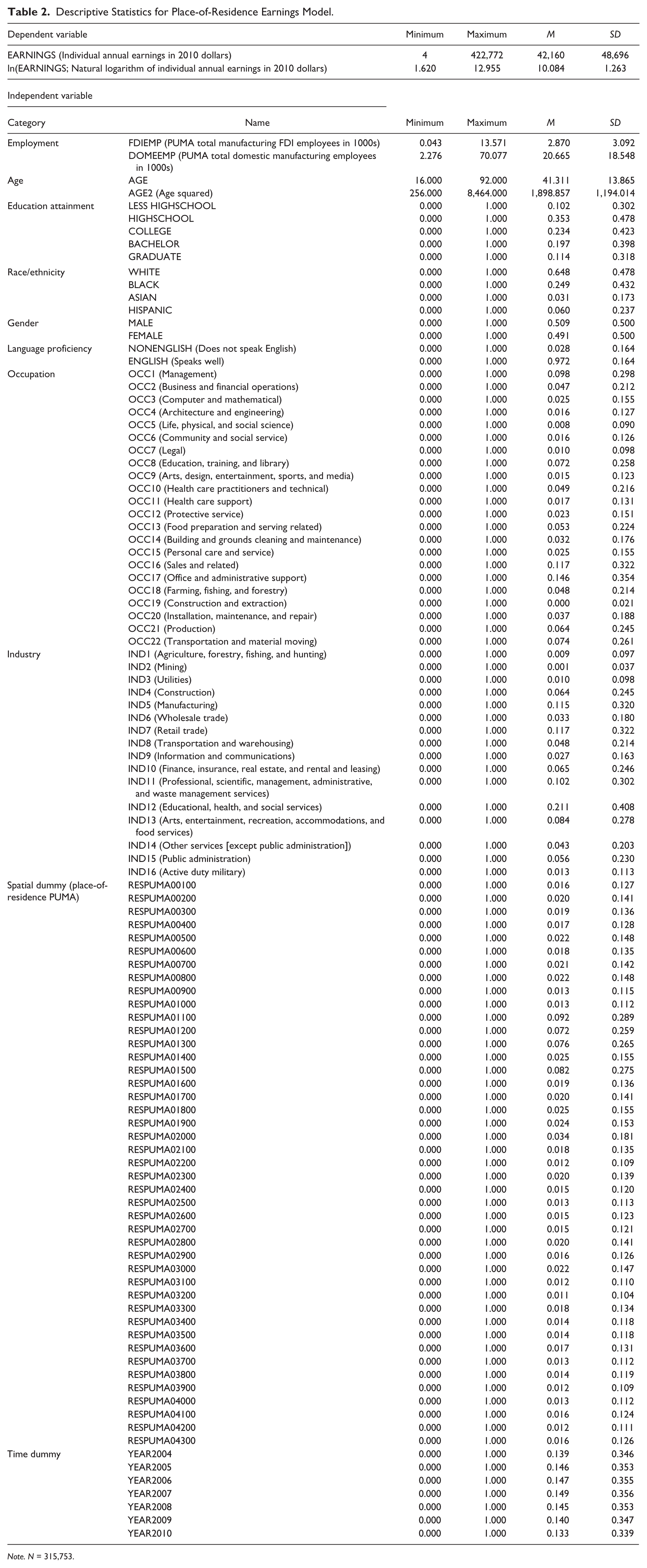
Among 652,533 individual observations involving Georgia residents in the 2005-2011 ACS PUMS, the research selects those individuals who were 16 years or older and worked in Georgia. The research further restricts the sample to individuals who had earnings in the prior year, but does not exclude part-time and non–year-round workers, resulting in 315,753 individual observations in this sample.
Table 2 presents descriptive statistics for the place-of-residence earnings model. The annual average earnings level for Georgia residents (in 2010 dollars) is $42,160, with an average of 2,870 manufacturing FDI employees in RESPUMA. The average employee earnings level in domestic manufacturing is $20,665. Notably, more than 54.5% of workers in this sample graduated from some college and/or pursued higher education. Thus, the workers in this sample are more highly educated when compared with the percentage of similarly educated manufacturing workers (42.5%) in Table 1. While male workers predominate in the manufacturing sector (69.1%) as shown in Table 1, no great difference exists between the numbers of male and female workers in this sample. Other statistics are similar to those found in the place-of-work earnings model. The average age is about 41. White workers comprised the largest racial and ethnic group with 64.8%, followed by Black, Hispanic, and Asian workers, who comprise 24.9%, 6.0%, and 3.1% of the sample, respectively. The percentage of manufacturing workers who speak English well is 97.2.
Descriptive Statistics for Place-of-Residence Earnings Model.
Note. N = 315,753.
Results and Discussion
Place-of-Work Earnings Model
Before reporting quantile regression results, the research first turns to the estimate results of OLS regression of the place-of-work earnings equation. The estimate results in Table 3 show that both foreign and domestic manufacturing employment are positively associated with individual earnings. This means that each additional job in either a foreign or a domestic manufacturing plant is associated with an increase in the earnings of those who work in the manufacturing sector. However, the coefficient of manufacturing FDI employment is larger than that of domestic employment, suggesting that manufacturing workers’ earnings are more highly sensitive to manufacturing FDI concentration than domestic. The addition of 1,000 jobs in manufacturing FDI is associated with a 1.99% increase in earnings, while the same increase in domestic manufacturing employment is associated with only a 0.26% increase in earnings. 9
Ordinary Least Squares (OLS) Regression Result for Place-of-Work Earnings Model.

Note. Occupation dummies, industry dummies, spatial dummies, and time dummies included.
p < .1. **p < .05. ***p < .01.
What explains this difference? By calculating share of employment levels in the high-tech sector both in domestic and foreign manufacturing firms, this research finds that manufacturing FDI is the more technologically advanced sector compared with domestic manufacturing in Georgia. The average share of foreign high-tech manufacturing employment exceeded 30% of all foreign manufacturing employment between 2004 and 2010, while the average share of domestic high-tech manufacturing employment was 18.2%. Because a number of studies have concluded that high-tech jobs are high-paid jobs, compared with other jobs (Heckler, 2005; James & Leary, 2011; National Science Board, 2002), a significant portion of manufacturing FDI jobs occurred in the high-tech sector, which required higher productivity and thus provided higher wages.
In addition, foreign manufacturing firms may have hiring practices or strategies that differ from those of domestic manufacturing firms. Foreign manufacturers may pay higher wages to attract better workers in a labor market with which they are unfamiliar (Figlio & Blonigen, 2000). However, the standardized coefficients (beta coefficients) suggested that both foreign and domestic manufacturing employments do not have a strong effect on the workers’ earnings, compared with the individual characteristics variables.
For the individual characteristics variables, the estimate results matched those found by most other studies (Buchinsky, 1994). Age has a positively significant impact on individual earnings. Manufacturing workers whose highest education level is high school, some college, a bachelor’s degree, or a graduate degree make 14.95%, 24.96%, 52.04%, and 73.80% more, respectively, than those without a high school diploma. Compared with the reference group (White), non-White workers earn less. Female workers receive lower wages than male workers with similar job qualifications. Workers who are proficient in speaking English make 14.68% more than those who do not speak English.
The OLS regression model relies on mean regression analysis, which estimates the average earnings equation conditional on the covariates. Meanwhile, quantile regression estimates the earnings equation in various conditional quantiles of earnings; thus, this research can develop a more detailed earnings model that estimates the earnings distribution effects of concentrated manufacturing FDI on all different levels of earnings groups. The research estimates quantile earnings models using nine different quantile levels—10%, 20%, 30%, 40%, 50%, 60%, 70%, 80%, and 90%.
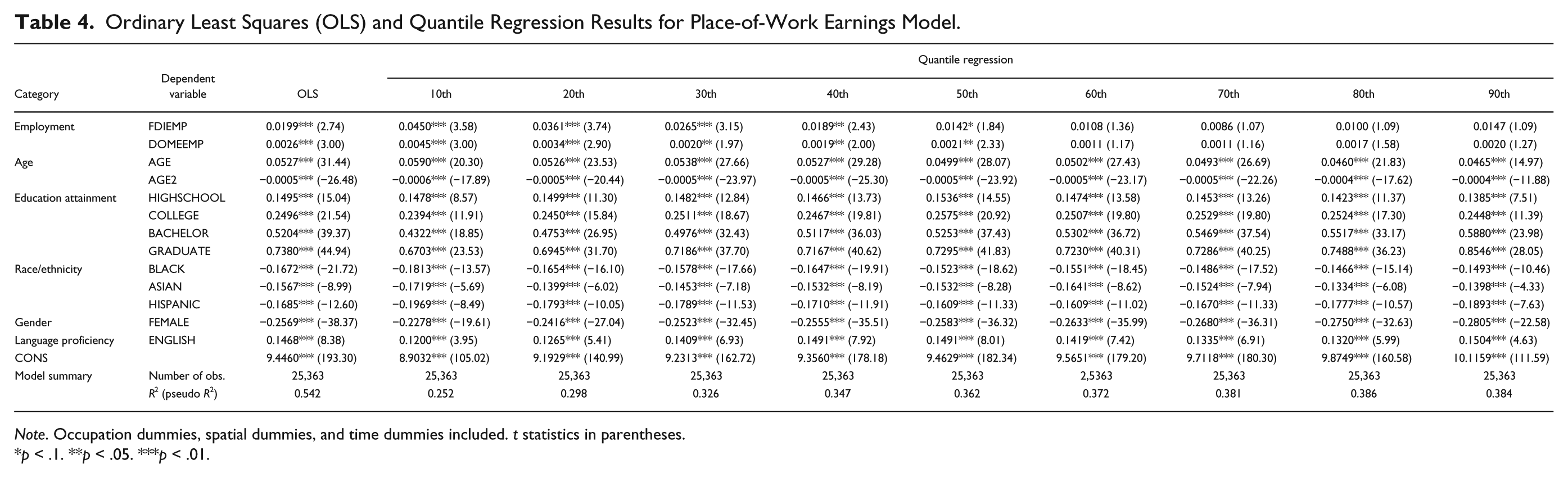
Table 4 represents the coefficients and associated t statistics for both OLS and quantile regressions. The most striking result is that the distribution effects of manufacturing FDI at the nine quantiles differ significantly. The coefficients of manufacturing FDI employees are positive and significant in all cases except for the 60% to 90% quantile. In general, a downward trend of coefficients of manufacturing FDI employees appears from the lower to the middle quantile, and then the coefficients slightly increase from the middle to the higher quantile. The research reveals similar patterns in the coefficients of domestic manufacturing employees. However, the estimate results indicate that the coefficients of manufacturing FDI employees are greater than those of domestic employees over the range of all quantiles.
Ordinary Least Squares (OLS) and Quantile Regression Results for Place-of-Work Earnings Model.
Note. Occupation dummies, spatial dummies, and time dummies included. t statistics in parentheses.
p < .1. **p < .05. ***p < .01.
While many previous studies identified manufacturing’s historical role as a prime source for middle class jobs (Leigh, 1994; Leigh & Hoelzel, 2012; White House Task Force on the Middle Class, 2010), the estimations from the quantile regressions suggest that lower quantile (lower earnings group) are more highly sensitive to both foreign and domestic manufacturing employment levels. In other words, manufacturing FDI job growth has progressive distribution effects. Although the concentration of manufacturing FDI does not have a huge impact on the middle earnings group, compared with other earnings groups, the result suggests that it may reduce earnings inequality among people.
Place-of-Residence Earnings Model
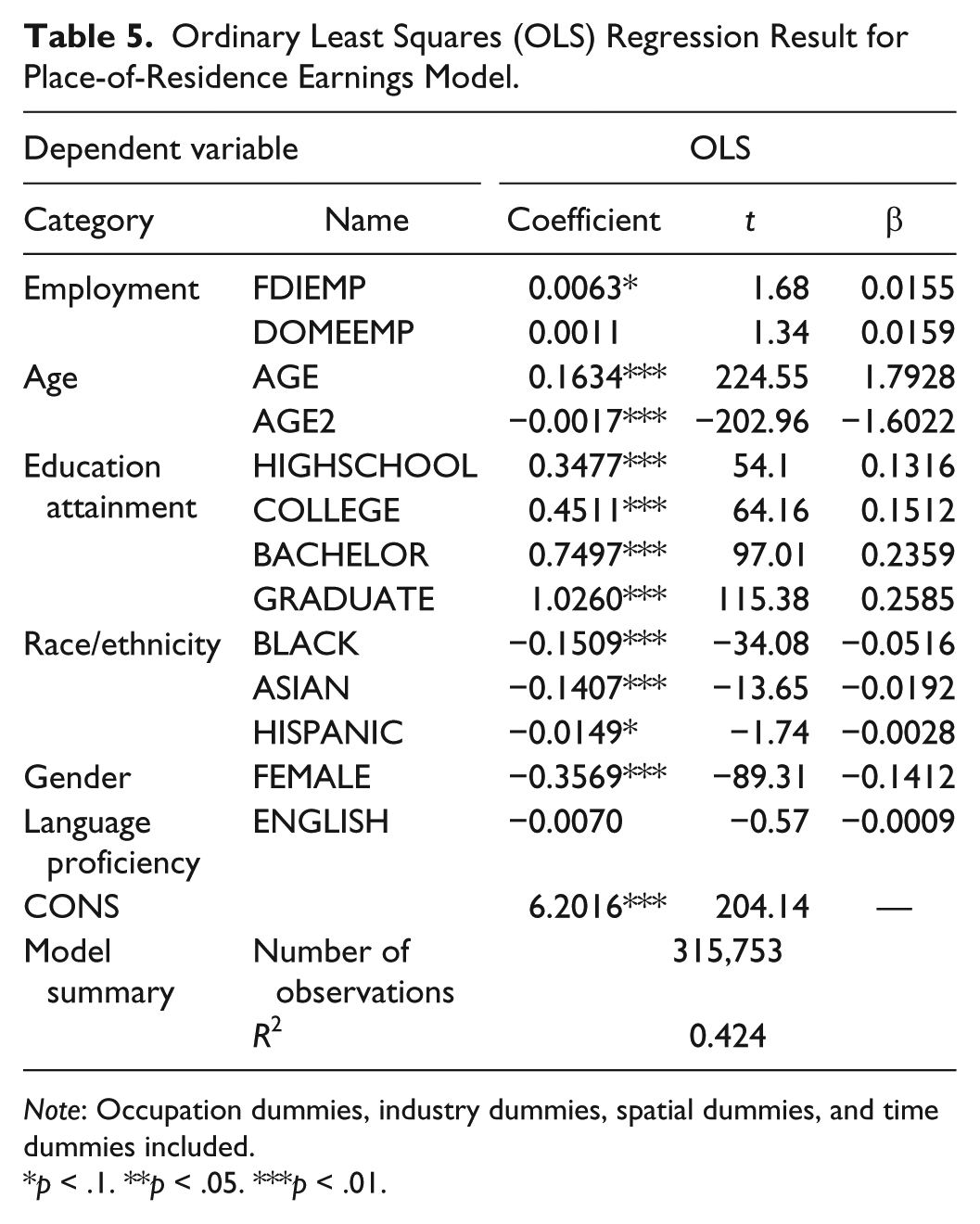
The research further examines whether and how the concentration of manufacturing FDI in a certain community has an indirect impact on the earnings of those who live in the area. Table 5 presents the estimates result of OLS regression for the place-of-residence earnings model. Although only manufacturing FDI jobs are statistically significant at the 10% level, both foreign and domestic manufacturing employments are positively associated with individual earnings, suggesting that each additional job in both foreign and domestic manufacturing plants in a particular community is associated with an increase in earnings for those who live in the area.
Ordinary Least Squares (OLS) Regression Result for Place-of-Residence Earnings Model.
Note: Occupation dummies, industry dummies, spatial dummies, and time dummies included.
p < .1. **p < .05. ***p < .01.
The coefficient of manufacturing FDI employees is larger than that of domestic employees, meaning that resident earnings are more highly sensitive to manufacturing FDI concentration than domestic. In addition, the magnitudes are smaller than those found in the place-of-work earnings model. The addition of 1,000 jobs in manufacturing FDI is associated with a 0.63% increase in earnings, and the same increase in domestic manufacturing employment is associated with a 0.11% increase in earnings. However, small standardized coefficients (beta coefficients) for both foreign and domestic manufacturing employments, compared with those for the individual characteristics variables, indicate that the place-of-residence effects of both foreign and domestic manufacturing employment are not strong.
Age has a positively significant impact on individual earnings. Manufacturing workers whose highest education level is high school, some college, a bachelor’s degree, or a graduate degree make 34.8%, 45.1%, 75.0%, and 102.6% more, respectively, than those without a high school diploma. The magnitude of the effect based on level of education attainment is substantial. Compared with the reference group (White), Blacks, Asians, and Hispanics earn 15.1%, 14.1%, and 1.5% less, respectively. Male workers earn more than female workers with similar job qualifications. The coefficient of English language proficiency is negative but is not statistically significant.
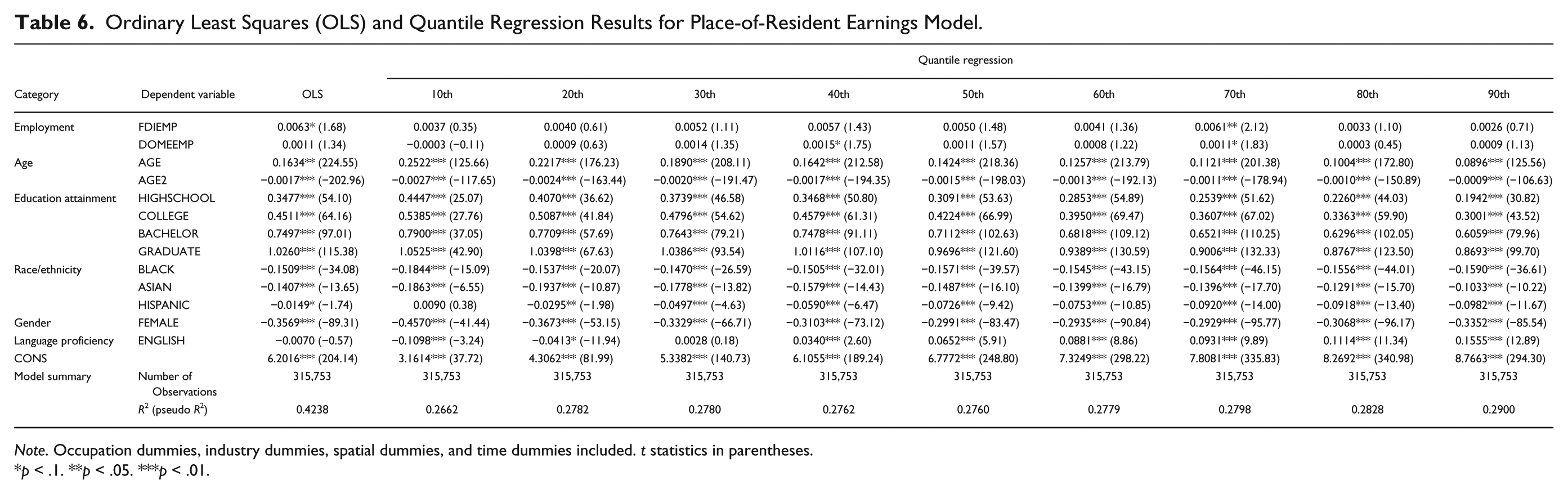
To estimate earnings distribution effects for the different earnings groups, the research performs quantile regressions at nine different quantile levels from 10% to 90%. Table 6 represents the coefficients and associated t statistics for both OLS and quantile regressions. The estimate results indicate that the coefficients of manufacturing FDI employees are greater than those of domestic employees over all ranges of quantiles. Coefficients on both manufacturing FDI and domestic manufacturing employee variables are positive but not statistically significant except for the 70% quantile.
Ordinary Least Squares (OLS) and Quantile Regression Results for Place-of-Resident Earnings Model.
Note. Occupation dummies, industry dummies, spatial dummies, and time dummies included. t statistics in parentheses.
p < .1. **p < .05. ***p < .01.
Despite these statistically insignificant results, the magnitudes of manufacturing FDI employees increase at the middle quantile. This result supports the assumption in this research that location of manufacturing FDI, relative to U.S. domestic manufacturing location, in a community had a positive influence on individual earnings for the middle-class workers who lived in that community from 2004 to 2010, compared with other classes. However, the fact that only the 70% quantile is statistically significant may indicate that manufacturing FDI may actually have a regressive distribution effect.
Conclusion
Using Georgia as a case study, this research attempted to examine whether and how manufacturing FDI has generally reduced inequality among people. Using individual earnings data from the ACS PUMS files, a quantile regression was conducted to estimate the earnings distribution effects that a concentration of manufacturing FDI may have different levels of earnings groups. The research applied two specific analyses: place-of-work and place-of-residence earnings models. First, the place-of-work earnings analysis measured the direct distribution impact that locating manufacturing FDI in a particular community may have on the earnings of those who work in the area. The result of the analysis demonstrates that manufacturing FDI job growth has progressive distribution effects in Georgia. Compared with other earnings groups, the lower earnings group is more highly sensitive to foreign manufacturing employment levels. Although the concentration of manufacturing FDI did not have a huge impact on the middle earnings group compared with other earnings groups, the result suggests that it may reduce earnings inequality among people. Similar patterns appeared in the coefficients of domestic manufacturing employees, although the estimate results indicated that the coefficients of manufacturing FDI employees are greater than those of domestic employees over the range of all quantiles.
Second, the place-of-residence earnings analysis measured the indirect distribution impact of manufacturing FDI in a certain community on the earnings of those who live in the area. Despite the statistical insignificance, the result of the analysis revealed that the magnitudes of manufacturing FDI employee earnings increase at the middle quantile. This result supported the assumption in this research that location of manufacturing FDI, relative to U.S. domestic manufacturing location, in a community positively influenced the individual earnings of the middle-class workers residing in that community from 2005 to 2010, compared with other classes.
This research did not measure inequality directly, but the findings both from place-of-work and place-of-residence earnings analyses suggested strong implications relating to the issue of inequality among people. The concentration of manufacturing FDI in a certain area shows the largest distribution effects on area workers in the lower earnings group and residents in the middle earnings group. Therefore, support for manufacturing FDI jobs is associated with the proliferation of middle- and lower-class jobs, and should be encouraged both for individuals seeking an affordable standard of living and for the positive macroeconomic benefits.
Footnotes
Acknowledgements
This study is based on a portion of the author’s unpublished doctoral dissertation, “Foreign Direct Investment and Sustainable Local Economic Development: Spatial Patterns of Manufacturing Foreign Direct Investment and Its Impacts on Middle-Class Earnings,” completed in the School of City and Regional Planning, Georgia Institute of Technology, May 2014.
Declaration of Conflicting Interests
The author(s) declared no potential conflicts of interest with respect to the research, authorship, and/or publication of this article.
Funding
The author(s) received no financial support for the research, authorship, and/or publication of this article.