



Abstract
Transboundary water resources management in the Equatorial Nile Basin (EQNB) is a politically contested issue. There is a growing body of literature examining water-related discourses which identifies the ability of powerful actors and institutions to influence policy. Concern about the effects of future climate change has featured strongly in research on the Nile River for several decades. It is therefore timely to consider whether and how these concerns are reflected in regional policy documents and policy discourse. This study analyzes discourse framings of water resources management and climate change in policy documents (27, published between 2001 and 2013) and as elicited in interviews (38) with water managers in the EQNB. Three main discursive framings are identified which are present in the discourses on both subjects: a problem-oriented environmental risk frame and two solution-oriented frames, on governance and infrastructure development. Climate change discourse only emerges as a common topic around 2007. The framings found in the water resources management discourse and the climate change discourse are almost identical, suggesting that discursive framings were adopted from the former for use in the latter. We infer that the climate change discourse may have offered a less politically sensitive route to circumvent political sensitivities around water allocation and distribution between riparian countries in the EQNB. However, the climate change discourse does not offer a lasting solution to the more fundamental political dispute over water allocation. Moreover, in cases where the climate change discourse is subsumed within a water resources management discourse, there are dangers that it will not fully address the needs of effective adaptation.
Transboundary water resources management (WRM) in the Equatorial Nile Basin (EQNB) is a politically contested issue. Disputes over water allocation between the Nile Basin's downstream riparian countries (Egypt and Sudan) and upstream riparian countries (Ethiopia, South Sudan, Uganda, Kenya, Tanzania, Rwanda, Burundi, and Democratic Republic of Congo) are an important feature of water resources development in the EQNB. The 1959 Nile Waters Agreement, from the colonial period, which allocates Nile water between Egypt and Sudan, has in recent years been challenged by the upstream riparian countries (Cascao, 2008). Since 2010, a new agreement to manage water in the Nile Basin, the Cooperative Framework Agreement, has been opened up for signature. The signing of this treaty by six of the Nile riparian countries and its rejection by Egypt and Sudan shows that political divides over transboundary water remain at the core of WRM in the basin.
The availability of and access to water are important prerequisites for social and economic development in the Nile Basin. A growing industrial sector, increase in irrigated agriculture, and rise in population and living standards across the Nile Basin are increasing demand for water (Nile Basin Initiative [NBI], 2012). Despite economic growth, about 80% of the Nile Basin's population is still employed in the agricultural sector (Central Intelligence Agency, 2015) and their livelihoods are closely linked to water access and availability. Drought events such as in 2011 in East Africa and 2015 in Ethiopia show that rainfall variability continues to exert a dramatic effect on livelihoods and food security in parts of the Nile Basin (“Horn of Africa,” 2011; “As Mozambique's Rivers,” 2016). The seven riparian countries (Uganda, South Sudan, Kenya, Tanzania, Rwanda, Burundi, and Democratic Republic of Congo) have a combined population of 338 million and are home to about 30% of Africa's population (United Nations, 2015).
Climate change is expected to affect water availability in the basin. Africa as a continent is generally held to be one of the regions most vulnerable to anthropogenic climate change, due to its high exposure and low adaptive capacity (Boko et al., 2007; Niang et al., 2014). Climate models project increased heavy rainfall events in East Africa and amplification of existing water stress as a likely consequence of climate change (Niang et al., 2014). These factors are likely to lead to changes in river flow characteristics (Milly, Dunne, & Vecchia, 2005) and a possible increase in the frequency or intensity of droughts (Seneviratne et al., 2012).
Discourses encompass discursive frames around specific issues, for example, WRM. Discursive frames are “ever-changing ‘scripts’ for organising and understanding the social and political world” (Dayton, 2000, pp. 72–73). Discursive frames “are transmitted via language and are constructed through social interaction, reaction, and adjustment” (Dayton, 2000, pp. 72–73). The study of environmental discourses is an established field. Prominent studies have examined the alteration in attitudes and opinions within international discourse on ozone depletion (Litfin, 1994), traced the development of policy discourses on acid rain in the United Kingdom and the Netherlands over the 1980s and 1990s (Hajer, 1995), and reflected on the plurality of competing and complementing international environmental discourses and their connection to the industrialization paradigm over time (Dryzek, 2013).
There is a growing body of literature examining water-related discourses often with a focus on IWRM and its influence on policy making (Biswas, 2004; Molle, 2008; Saravanan, McDonald, & Mollinga, 2009). Furthermore, discourse analysts are interested in the study of securitization of water resources (Buzan, Wæver, & Wilde, 1998; Gerlak & Mukhtarov, 2016; Lankford, Bakker, Zeitoun, & Conway, 2013; Stetter, Herschinger, Teichler, & Albert, 2011; Warner, 2011; Zeitoun & Warner, 2006). Political discourse around climate change is a strongly contested issue predominantly framed as an environmental crisis (Boykoff, 2008; Doulton & Brown, 2009; Hulme, 2009) and also raising questions around human security and vulnerability (O'Brien, Eriksen, Nygaard, & Schjolden, 2007).
The convergence of values attached to the environment can be observed in global environmental discourses. Most global environmental discourses share similar discursive framings, namely, that the environment is framed as in a state of crisis, which presents a threat to society and the economy. Solutions to address and prevent such crises are offered by institutional reform and financial investments (Adger, Benjaminsen, Brown, & Svarstad, 2001). Such global discourses often result in a “best-practice” approach, which suggests common solutions to a diverse range of local problems in very different local contexts. In this way, global environmental discourses influence local decision-making by creating, as well as limiting, choices for policy outcomes.
Powerful actors and institutions, like the NBI and the Lake Victoria Basin Commission (LVBC), are able to influence policy discourses and, at the same time, are a product of other discourses themselves (Hajer & Versteeg, 2005). These policy actors produce discourses, which are then reproduced by other actors, leading to the formation of discursive policy coalitions. While some powerful actors are enabled through the institutional structure and thus manage to shape and influence the discourse, the discursive structure presents a constraint for others, limiting the discourse to certain perspectives and views (Hajer, 1995, p. 49). Powerful actors may try to influence a discourse and shape it to match their interests; thus, analyzing policy discourses can help to reveal interests and political power struggles.
Climate variability and discussion about the effects of future climate change have featured strongly in research and scholarship on the Nile Basin for several decades (Gleick, 1991; Hulme, 1990); it is therefore timely to consider whether and how these concerns are reflected in regional policy documents and policy discourse. In this context, we examine how political discourses over WRM have reacted to the threat of climate change and its potential impacts. Despite the importance of discourses for political decision making (Hajer & Versteeg, 2005), and the challenge of climate change for transboundary WRM, we know little about how water managers are beginning to frame the issue of climate change, how this framing is mediated by existing frames, and if there are any emerging implications for decisions over contested water resources in the EQNB. We seek to address this gap by asking, “How do water managers frame climate change compared with existing framings of WRM in the EQNB, and what are the implications for adaptation?”
This study analyzes speech acts as published in policy documents and elicited through interviews with water managers in the EQNB as evidence of discourse. The analysis compares discursive framings of WRM and climate change used by key actors who shape water management in the EQNB. These include the NBI and the LVBC (intergovernmental institutions), national governments of riparian countries, and other relevant stakeholders. We begin with a brief introduction to the context of WRM and the nature of the climate change challenge for water availability in the EQNB. The research methods, data sources, and research findings are then presented. We conclude with a discussion of the discourse framings in the wider political context of the EQNB and their implications for adaptation to climate change in the basin.
Climate Change and Water Resources in the Equatorial Nile Basin
The EQNB comprises a major part of the Nile Basin, encompassing 650,000 km2 and stretching from central Burundi and northern Tanzania in the south to central South Sudan in the north, including Lake Victoria with its tributaries (Figure 1). The EQNB contributes less than 30% annually to the main Nile flow measured at Lake Nasser, via the White Nile (El Bastawesy, Gabr, & White, 2013). The White Nile's main water source is Lake Victoria, which gains more than 80% of its water from direct rainfall (Di Baldassare et al., 2011). The lake's level has exhibited high variability in response to rainfall variation and extreme rainfall events (Conway, Allison, Felstead, & Goulden, 2005) and also more recently due to management factors, such as regulation of lake outflows for electricity generation (Conway, 2005; Sutcliffe & Petersen, 2007). The other 20% of the water inputs to the lake derive from tributary inflows, including the Kagera and Mara Rivers.
Map of the Nile Basin (boundary shown in red) showing the location of the Equatorial Nile Basin (shown in orange).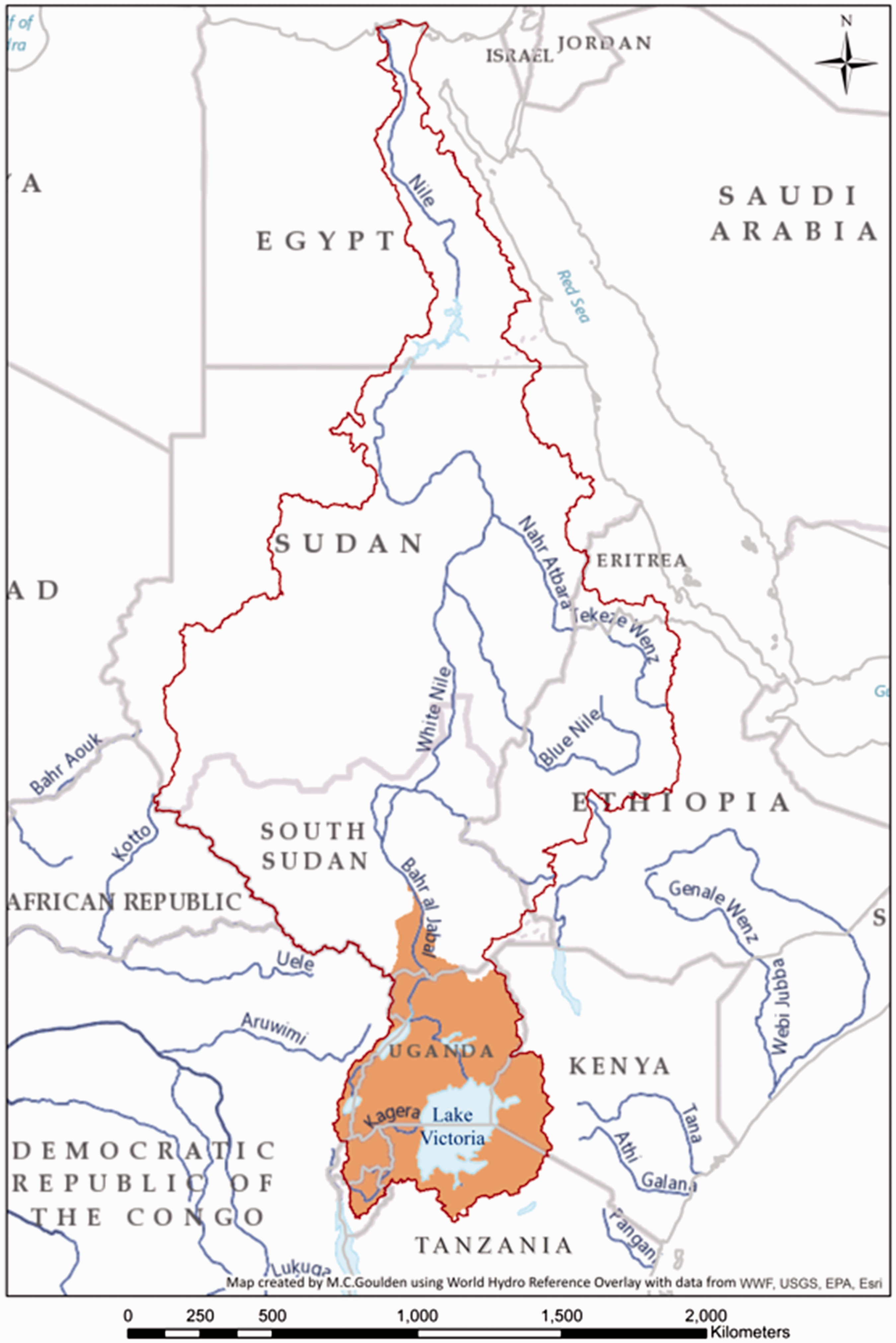
The climate in the riparian countries of the EQNB encompasses semiarid, tropical, and subtropical zones. Rainfall patterns are characterized by marked seasonality and interannual variability (Conway et al., 2009) and are strongly influenced by the El Niño-Southern Oscillation (Beyene, Lettenmaier, & Kabat, 2010). There is evidence that rainfall patterns in the Lake Victoria region/EQNB have changed since 1960. An increase in overall rainfall in the basin has been observed, with higher rainfall during the short rains from October to December (Kizza, Rodhe, Xu, Ntale, & Halldin, 2009).
The details of future climate change and its implications for lake levels and river discharge in the EQNB remain highly uncertain (Conway et al., 2009; Di Baldassare et al., 2011; Taye, Willems, & Block, 2015). Although the frequency of heavy rainfall events is likely to increase in many locations globally, projections of changes for specific locations in the Nile Basin remain highly uncertain (Kundzewicz et al., 2014). For example, Christensen et al. (2007) have reviewed different global climate models (GCMs) and found a model average of a 7% increase in annual rainfall in East Africa, although the individual model results ranged from a decrease of 3% to an increase of 25%. A recent study of the Mara River basin using five GCMs showed an increase in flow projections by the mid- to late 21st century, with wetter wet seasons and drier dry seasons (Dessu & Melesse, 2013). Such differences, between individual GCM projections and between their ensemble mean changes over time, underscore the high level of uncertainty about the detail of the climate change threat. This propagates into severe challenges for policy makers and water managers to interpret what the implications for action might be.
Climatic conditions and their effects on discharge of Nile tributaries are an important factor in the context of hydropolitics and water allocation in the EQNB (Elhance, 1999). There are many examples of transboundary African rivers and lakes where climate variability has compromised water management and exacerbated competing national water needs (Zeitoun, Goulden, & Tickner, 2013). These include the prolonged sequence of low rainfall and Blue and Main Nile discharge during the 1980s (Conway, 2005) and declining level of Lake Victoria between 2000 and 2006 (Goulden & Conway, 2008). Riparians may factor in observed rainfall data for calculating water available in a basin and use this when negotiating water allocation in a transboundary river basin (Goulden, Conway, & Persechino, 2009).
Material and Methods
In this study, speech acts between 2001 and 2013 were examined. These included documents as well as semistructured interviews with policymakers in the EQNB. Speech-acts were analyzed inductively, and patterns that emerged during the analysis were recorded and subsequently interpreted in the wider political context of the Nile Basin. Documents are understood to present the official standpoint of key actors and organizations in the sector such as government departments and international and transboundary organizations. The discursive frames resulting from the document analysis illustrate the formal or official framing of the discourse. Documents were selected based on their technical and geographical relevance for WRM in the EQNB and included policy documents and technical reports (full list in Table A1). Only documents with a clear focus on WRM in EQNB countries were considered, and out of a total sample of 162 documents, 46 were initially selected. Documents were qualitatively assessed by importance for policy making and only documents which were assessed as medium to high importance were included in the analysis. This reduced the sample size to 27 documents, which were analyzed in regards to their discursive framings of WRM and climate change. Based on Potter and Wetherell (1994), the discourse analysis included the three following features:
The content and form of the document The action, construction, and variability of the document, that is, actions that people perform through their writing which in turn construct a discourse but which vary depending on the actor (different actors may give a subject different meaning) The rhetorical and argumentative organization of a text or speech-acts in order to uncover how the discourse is framed to compete with alternative framings
The frames identified from the document analysis were then analyzed in relation to the perceptions of decision makers identified for interview. A total of 38 semistructured interviews were conducted (full list in Table A2). In the interviews, participants were asked about their personal views of WRM and to note important challenges in WRM in the EQNB. Participants were also asked about their personal perceptions of climate change and its impacts and consequences for sustainable WRM and adaptation.
The participants included policy makers, experts, and practitioners based in the region, identified through initial contacts and augmented through a snowball sampling process. Personal opinions and insights offer a different interpretation of the policy documents, adding important contextual information, which enables a more nuanced appraisal of the formal texts. While formal policy documents are understood to represent a more abstract and higher level discourse, the data from interviews can reveal insights into day-to-day policy issues and thus a more practical and applied perspective on water management.
Results
This section presents the results of the analyses of the WRM and climate change discourses. An inductive approach was used for the analysis of each discourse by carefully reviewing the documents, identifying framings, and coding them using the software NVivo. Similar framings were then grouped, and the process was repeated twice. This process ensured that the essence of each framing was captured and avoided significant duplication within the framings finally selected. This resulted in three aggregated discursive framings identified in the documents, which were present in the discourses on both WRM and climate change. The three framings were (a) an environmental risk frame, (b) a governance frame, and (c) an infrastructure development frame. The interview data were then analyzed using the coding developed from the document analysis.
Despite many academic papers on climate change in the Nile Basin since the early 1990s, climate change discourse only emerges as an important topic for WRM in the EQNB around 2007, gaining more traction since 2010 (Figure 2). The rather unusually high appearance of the term climate change in 2010 is due to two important documents, which were both published that year: Kenya's National Climate Change Response Strategy and the Strategic Plan by Kenya's National Environment Management Agency. Both documents frequently mention climate change, with the National Strategy specifically honing in on the issue.
Normalized word frequencies for the terms “water resources management” (WRM) and “climate change” (CC) compared in analyzed documents published between 2001 and 2013 (Table A1, N = 27).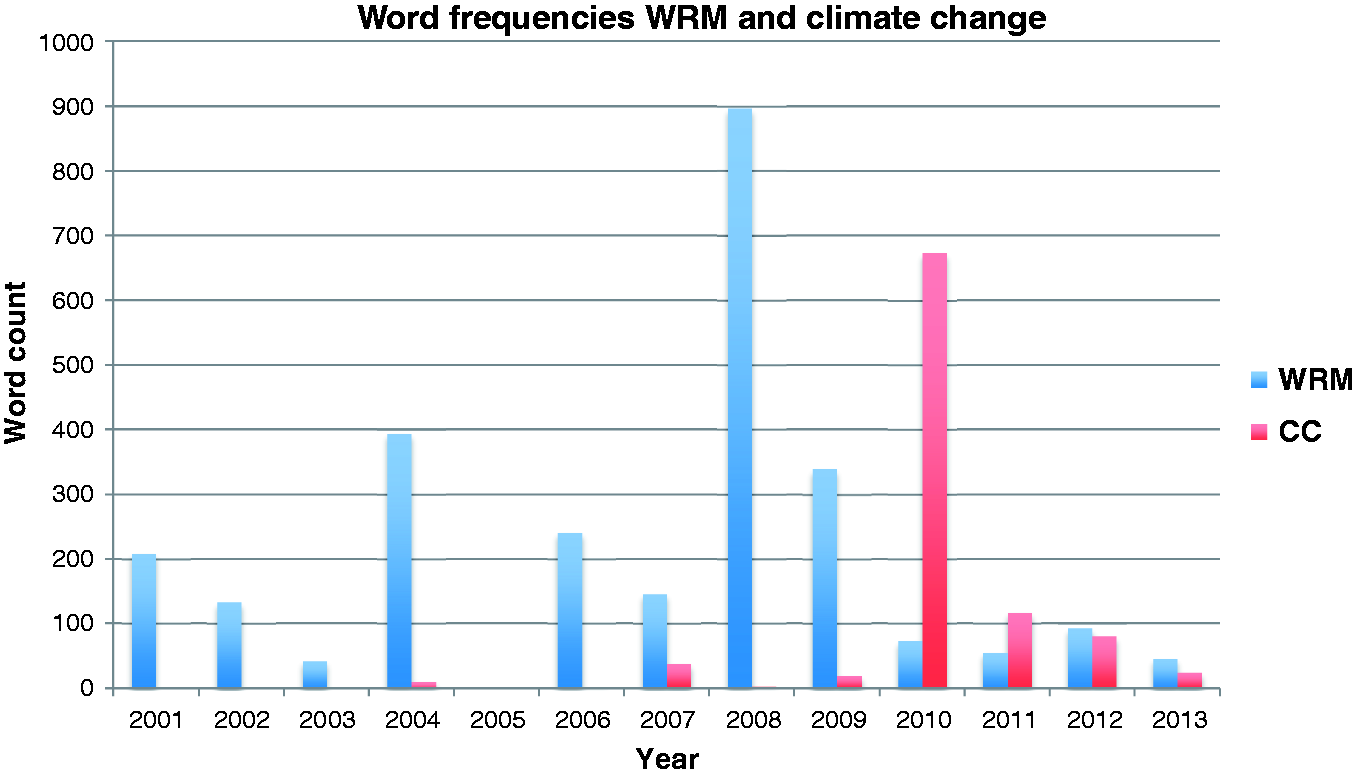
The framings found in the WRM discourse and the climate change discourse in the EQNB are almost identical, suggesting that discursive framings were adopted from the WRM discourse for use in an emerging climate change discourse. Both discourses show similar discursive patterns, which identify problems and suggest solutions. For example, environmental risks (e.g., floods and droughts) are framed as key challenges to human livelihoods. Solutions and mitigation mechanisms for these risks are framed most often around improving governance and sometimes infrastructure. Although both solution frames are used in the WRM and the climate change discourse, the infrastructure framing is rarely used in the climate change discourse. The following sections present the framings in more detail.
Discursive Framing of WRM
The WRM discourse frames natural events, such as floods and droughts, as environmental risks and threats to human livelihoods. To mediate these risks, WRM is framed as a solution to protect catchment areas to prevent and reduce environmental degradation and its negative effects on livelihoods. As specific measures to achieve these aims, the WRM discourse proposes improving governance and development of infrastructure as the main solutions to the problem.
Examples of Discursive Frames.

As Table 1 shows, the discourse analysis found a strong overlap in framing between the two discourses. Most frames, which were found in the WRM discourse, were also found in the climate change discourse. Due to the development of discourses over time, and the later emergence of the climate change discourse, it appears that the discursive framings were first developed in relation to WRM and then adopted for use in the climate change discourse.
The infrastructure development frame was common in WRM policy documents. The discursive arguments point to the inadequacy of the infrastructure to address shocks such as flooding and drought, which are argued to be disrupting water services and electric power and are further aggravated by climate change. The framing highlights investments in energy production and transmission infrastructure as successfully facilitating transboundary cooperation. The framing suggests a linear trajectory to solve WRM problems exacerbated by climate change—investing in more and better infrastructure will solve issues around WRM. The logic of the framing goes as follows: the higher the financial investment, the greater the amount of infrastructure projects built, the better and more effectively WRM issues will be addressed, the more benefits will be derived, which can be shared among riparians, thus reducing political tension and enhancing cooperation. This framing was present in documents by the Kenyan and Tanzanian governments, as well as the NBI and the World Bank (Government of Tanzania, 2008; Nile Equatorial Lakes Subsidiary Action Program [NELSAP], 2012; World Bank, 2004; Water Resources Management Authority [WRMA], 2009b).
There is evidence, however, that there is competition between the two frames of infrastructure development and improved governance. Although the NBI forms a discourse coalition with parts of the Kenyan and Tanzanian governments and the World Bank, by utilizing the infrastructure development framing in their policy documents, the LVBC promotes a different view, one that emphasizes the importance of governance. For example, the LVBC's Strategic Plan points out under “Lessons learned: Positive change at the community/society level is not dependent on the level of investment but on local governance and community participation” (LVBC, 2011, p. 8).
These differences of either promoting the governance framing or advocating mainly infrastructure development as solutions to environmental risks were also reflected in interviews. Where participants emphasized the importance of improved governance for achieving better water management, the framing of infrastructure development tended to be less prominent. Overall, participants from policy networks forming around the LVBC preferred the governance framing over the infrastructure framing (Hissen, 2014). While this points toward two discourse coalitions within the EQNB, the differences are relatively subtle, and both subscribe to the dominant discourse on WRM.
Mosse and Lewis (2006) observe how policy organizations, such as the NBI or LVBC, act as governance brokers and translate governance processes into policy implementation—namely, via establishing and maintaining interpretations of reality, or in other words creating and sustaining discourses. As argued earlier, policy makers define and sustain interpretations of reality via framing policy discourses. When a discursive frame becomes dominant and is consequently institutionalized, these interpretations of reality are translated into policies and development projects and thus directly impact policy practice, as seen in the EQNB (as discussed in the Section Discussion—Hydropolitics and Adaptation Practice).
Discursive Framing of Climate Change
Most of the discursive frames observed in the WRM discourse were also used in relation to climate change. In policy documents, climate change is framed as exacerbating environmental risks and consequently threatening sustainable development (East African Community [EAC], 2011; Government of Kenya, 2010; NBI, 2012; Nile Basin Development Forum, 2011; United Republic of Tanzania, 2007). This framing is found at all policy levels in WRM documents by regional actors such as the NBI and the LVBC to those of national governments, donor agencies, nongovernmental organizations (NGOs), and local water management groups (EAC, 2011; Government of Kenya, 2010; Government of Tanzania, 2008; LVBC, 2011; Mara River Water Users Associations, 2011; NBI, 2012; Nile Basin Development Forum, 2011; Swedish International Development Cooperation Agency, 2010; United States Agency International Development, 2013).
Climate change is commonly framed in the same context as other environmental risks such as environmental degradation, soil erosion, deforestation, pollution, and so forth (National Environment Management Authority, 2010). In documents and interviews, there is a direct association between climate change impacts and water resources and changes in the quantity and timing of water availability (Government of Tanzania, 2002; Nile Basin Development Forum, 2011), for example, higher evaporation and evapotranspiration, increased frequency and intensity of floods and drought, higher air and water temperatures (with various negative consequences such as an increase in water-borne diseases), sea level rise, and melting glaciers (NBI, 2012). This extensive list represents highly generalized physical climate change impacts, and most water policy documents simply refer to the “adverse impacts of climate change,” stating that climate change is a concern that should be addressed (EAC, 2011; Government of Kenya, 2013; Government of Tanzania, 2008; LVBC, 2011). There is a marked absence of specific examples of the kinds of hazards, impacts, and consequences that climate change could bring to inform and justify policy responses.
In policy reports and interviews alike, climate change is framed as harmful for the people living in the EQNB. For example, one interviewee from the Kenyan government remarked, “[Climate change] will really spoil this economy, and if we don't check it we are dead, all of us. All of the East African community will die—socially and even economically” (KE Gov (a)).
To address threats posed by climate change, the discourse suggests improved governance and investment in infrastructure. Improved governance measures such as well-designed policies, functioning institutions, and technical capacity building are advocated in policy documents and by interviewees. Phrases such as “no-regret” measures, “climate-mainstreaming,” and “climate-proofing” development projects are used to describe approaches to address climate change in the water sector. The NBI defines “no-regret” measures as actions “that build resilience to current climate variability while enhancing adaptive capacity” (NBI, 2012, p. 218).
“No-regret” measures placed within the frame of improved governance include greater cooperation between the Nile riparian countries, enhancing the integration of markets in the region and fostering intrabasin trade to create shared benefits, and strengthening human and institutional capacity at national and local levels. This framing mirrors measures supported under the WRM discourse to improve transboundary water management.
It is interesting to observe that the climate change framing mirrored the WRM to a large extent (Table 1). The climate change discourse framed environmental risks (or the exacerbation of these through climate change) as a key challenge to human livelihoods and framed improved governance and infrastructure as solutions to the challenge. However, the details of the framing around governance varied from the WRM discourse. Although there was a strong emphasis on improving transboundary cooperation to enhance adaptation to climate change in the basin, decentralization and participation at a local level were not seen as important solutions to the challenge. These two aspects were hardly present in the climate change discourse in the EQNB. This is surprising, as climate change adaptation will need to be implemented across different policy levels and scales, and its success will in part depend on the capacity of local government and communities to adapt to environmental change (Adger, Arnell, & Tompkins, 2005).
In terms of developing infrastructure, the climate change framing centers on increasing water-storage capacity and hydropower production and investing in power transmission lines (NBI, 2011, 2012; NELSAP, 2012). Once more the same measures are mentioned as those in the discursive framing on infrastructure development on WRM. This suggests that water managers in the EQNB view climate change from the same perspective as other water-related challenges. The dominant discursive logic is that climate change exacerbates preexisting WRM challenges, and hence, the measures proposed under the WRM are generally considered adequate to address climate change. This logic is widely accepted in the EQNB and spans the two discourse coalitions centered on the NBI and the LVBC.
Discussion—Hydropolitics and Adaptation Practice
This study has examined the political discourse around WRM and climate change in the EQNB. Climate change is highly likely to influence water availability and thus livelihoods in the years to come, yet while policy makers are aware of the issue, conviction in its importance seems limited. Several respondents identified the “real issue” in the Nile Basin as the allocation or reallocation of water among the riparian countries. This has been particularly manifested in negotiations on the Cooperative Framework Agreement, which have resulted in a widening of the political divide between upstream and downstream (namely, Egypt and Sudan) riparians and has become even more topical with the ongoing construction of the Grand Ethiopian Renaissance Dam on the Blue Nile in Ethiopia (Cascão & Nicol, 2016; El Bastawesy, Gabr, & Mohamed, 2015; Keith, Epp, Houghton, Lee, & Mayville, 2014).
Discourse analysis showed some differences between the framings in policy documents and concerns voiced by policy makers in interview. Although views in interviews were consistent with the perception in documents of climate change as an environmental risk, which needed to be addressed through governance reforms (including improved cooperation) and infrastructure (e.g., KE NGO1, INGO2 (a), INGO2 (b)), the interviews raised additional interests. Interview results revealed three dominant subject areas: (a) climate change, (b) diplomatic relations in the Nile and EQNB, and (c) available finance. The climate change theme was split into three components: First, how much money was available (and from whom) to finance projects on WRM adaptation and to reduce anticipated impacts of climate change. Second, reflections on the diplomatic relations of riparian countries in the EQNB and jointly managed projects on WRM (participants often had a positive focus, omitting any difficulties of working together). In particular, policy makers emphasized that to improve climate change adaptation, riparian countries needed to work together as the impacts were cross-boundary. This resonates with the cooperation framing identified in documents (Section Discursive Framing of Water Resources Management). Third, interviewees focussed on how to finance WRM, in particular, for the construction of water infrastructure. Water managers were very concerned about future water availability in the EQNB. Interviewees already experienced a rise in demand for water and expected that demand would continue to rise, while climate change was likely to reduce the amount of water available in the future. Therefore, their main concern was how to guarantee adequate water supply and finance necessary water infrastructure, such as for water storage.
In the interviews overall, there was a strong focus on finance, which was not found to the same extent in policy documents. While some policy documents mentioned financial concerns, this issue was only mentioned as part of the infrastructure development framing and did not emerge as a stand-alone frame. The theme around financing, however, seems to provide a “missing link” between the two discourses on WRM and climate change. As previously shown, there is an overlap between the solution frames in both of the discourses on WRM and climate change. For example, for climate change adaptation, similar measures are proposed to those for WRM, for example, enhancing water-storage capacity. Although financing concerns are widespread in the Nile Basin and often seen as a constraint to development in the African context (Decalo, 1992), in recent years, donor countries have made pledges to invest heavily in financing climate change adaptation in least developed countries (Adger, Huq, Brown, Conway, & Hulme, 2003; Caravani, Barnard, Nakhooda, & Schalatek, 2014). Policy makers in the EQNB are aware of this and have already started to reframe existing water management projects. For example, a large program funded by the World Bank in 2012, which had previously been discussed as a program extension for enhancing cooperation over WRM in the Nile Basin, was reframed in its extension phase as one for improving climate resilient growth (World Bank, 2012). The interventions proposed under the new framing were identical to the interventions proposed under the previous program, including enhancing cooperation between riparians by investing in institutional capacity, jointly managed water resources planning and activities, and promoting investments in the region.
To explain this observation of rising awareness of climate change and a shift in the discourse, the development of hydropolitics in the Nile Basin needs to be taken into account. The history of hydropolitics in the Nile Basin is rooted in questions about the distribution, allocation, and use of water and is thus closely intertwined with water security concerns (Waterbury, 2002). Interventions, which are mentioned as part of the solution frames in the WRM and climate change discourses (namely increasing water storage and addressing water related hazards), would also benefit water security in the EQNB. However, hardly any reference to “water security” was found in policy documents. Instead, these interventions were predominantly framed in the context of adapting to climate change. In a few cases, participants did relate better water infrastructure to “being water-secure” (Hissen, 2014). The few speech acts that explicitly refer to water security only used the infrastructure development frame, omitting the governance frames.
Given the politically sensitive context and the political deadlock over the Cooperative Framework Agreement negotiations, it is unsurprising that the term water security is rarely mentioned in the WRM discourse unlike climate change. Some of the differences may also result from the more restricted use of the term water security until the mid- to late 2000s. Policy makers in the EQNB may use framings around climate change instead of water security, as they are much less politically sensitive (Nicol & Cascao, 2011). This strategy seems to be constructive to circumvent the political deadlock over the Cooperative Framework Agreement. It appears that the climate change discourse offers a less politically sensitive avenue for organizations such as the NBI or the LVBC (and its member states) to discuss transboundary WRM issues and prepare and implement technical responses, which involve governance reform and infrastructure development. This framing also to some extent externalizes the problem and also makes it accessible to new funding opportunities as the international donor community has increasingly financed climate change adaptation and mitigation, thus motivating a move toward climate change as a new source for funding WRM-related projects.
The discursive strategy used by water managers in the EQNB has potentially contributed to the continuation of cooperation over transboundary WRM during relatively tense hydropolitical times. However, the strategy does not address directly the roots of the tension over water security; it has not resolved the “real issue,” namely, the reallocation of water rights. Furthermore, using the climate change discourse as a substitute to address WRM challenges limits policy makers from fully addressing climate change impacts, which are not entirely covered by WRM concerns. For example, while policy makers often referred to climate finance, impacts, and adaptation in the interviews, they rarely mentioned specific adaptation measures. In another example, the previously mentioned World Bank–funded program (World Bank, 2012), reframed as “climate resilient,” retained the original objective of transboundary cooperation. However, among other things, adaptation of WRM to climate change also requires changing practices at local scales through strong engagement with local governments and communities. As found in this study, the governance framing in the climate change discourse centered on transboundary cooperation but was silent on decentralization and stakeholder participation. To adapt to climate change by making WRM more resilient, it can be argued that the framing of the discourse needs to include a stronger focus on decentralization and participation, with local government and communities involved in design and implementation.
Even though policy makers highlighted their efforts to “climate-proof” development projects and infrastructure, it is unclear whether such approaches (and their implementation) are sufficient to adapt effectively to climate change or whether some proposals represent cases of maladaptation (Barnett & O'Neill, 2010). For example, building infrastructure such as dams for hydropower and irrigation expansion may increase exposure to droughts (leading to electricity load shedding) and longer term water scarcity. This can also contribute to land-use change, which in turn may deplete carbon sinks (Cooley, Christian-Smist, Gleick, Allen, & Cohen, 2009; Gleick et al., 1997). Effective “climate proofing” requires stress-testing infrastructure and management systems and incorporating flexible and forward-looking decision-making processes to address uncertainty in climate change impacts alongside nonclimatic changes.
Appendix
Policy Documents Included in the Discourse Analysis on WRM, Climate Change, and Water Security Showing the Authors (Actors), Type of Actor (Policy Level) and Title, Type, and Year of Publication of the Document.

List of Interview Participants.

Conclusion
The emergent discourse on climate change in the EQNB forms an extension of the discourse on WRM. Three discursive frames were identified in both discourses: (a) an environmental risk frame, (b) a governance frame(s), and (c) an infrastructure development frame. The environmental risk frame was widely used to describe the nature of the problem; improving governance and developing infrastructure were frames used to present solutions. Discourse analysis showed some differences between the framings in policy documents and concerns voiced by policymakers in interviews. These revealed climate change, diplomatic relations in the EQNB and more widely in the Nile Basin, and availability of finance as dominant subject areas.
A climate change discourse in the EQNB only really emerged after 2007 and is similar to the WRM discourse. This suggests that the language and main elements of the climate change narrative have been largely adopted from the WRM discourse. We infer that the climate change discourse may offer a less politically sensitive route to circumvent the political sensitivities around water allocation and distribution between riparian countries in the Nile Basin, to allow continued transboundary cooperation over water. However, the climate change discourse does not offer a lasting solution to the more fundamental political dispute of water allocation. Moreover, the climate change discourse is highly generalized, and if it remains subsumed within a WRM discourse, there are dangers that it will not fully address the needs of effective adaptation. A more nuanced and less derivative discourse on adaptation would recognize among other things the need to decentralize adaptation efforts and encourage participation of local governments and communities in the design and implementation of adaptation programs.
Footnotes
Acknowledgments
The authors thank the research participants in Kenya, Uganda and Tanzania who contributed to the study. The views expressed in this article are those of the authors and do not reflect the official position of the Department for International Development.
Declaration of Conflicting Interests
The authors declared no potential conflicts of interest with respect to the research, authorship, and/or publication of this article.
Funding
The authors disclosed receipt of the following financial support for the research, authorship, and/or publication of this article: This research was funded by the Tyndall Centre for Climate Change Research at the University of East Anglia, Norwich, UK. Declan Conway is partly supported by UK NERC Grant Ref: NE/M020398/1 and the UK Government’s Department for International Development (DFID).