




Abstract
The blue economy is a globally emerging concept for ocean governance that seeks to tap the economic potential of the oceans in environmentally sustainable ways. Yet, understanding and implementation of particular visions of the blue economy in specific regions diverge according to national and other contexts. Drawing on a discourse analysis of Chinese language documents, this article assesses how the blue economy has been conceptualised in Chinese state policy and discourse. Part of a state ideology and practice of modernisation that is defined in terms of rejuvenation under a strong state, the blue economy in China is seen as an opportunity to promote modernisation from overlapping economic, geopolitical and ecological perspectives and actions. China’s distinctive model for the blue economy presents emerging challenges for global ocean governance.
Introduction
Globally, academic and policy discussions surrounding the emergent ‘blue economy’ have rapidly proliferated in recent years (Bennett et al., 2019; Satizábal et al., 2020; Silver et al., 2015; Voyer et al., 2018). Diverse actors are seeking to tap economic possibilities and reconfigure the institutions that govern access and use of marine resources and coastal spaces (Brent et al., 2020). At the broadest level, the blue economy is envisaged as a governance regime that links economic growth and environmental sustainability. This vision has been promoted by major global institutions including the World Bank (2017) and the Food and Agricultural Organisation of the United Nations (2018). At the same time, the concept is increasingly critiqued for its emphasis on an economic approach that potentially marginalises weaker stakeholders, such as small-scale fishers (Bennett et al., 2019; Brent et al., 2020). However, there remains much variation over how the blue economy is interpreted, represented and implemented in different regions and geographical contexts (Voyer et al., 2018). Based on a critical discourse analysis, this article describes and analyses how the idea of the blue economy is being conceptualised and implemented in China.
We argue that understanding the emergence of the blue economy in China matters for two main reasons. Firstly, the sheer scale and significance of China in economic, demographic and geopolitical terms means decisions taken in China about ocean governance have global impacts. As China continues to take an increasingly active presence in the world’s oceans through resource extraction, aid, trade and intergovernmental fora, Chinese ideas about the blue economy will have increasing political weight in the future (Crona et al., 2020). Secondly, the emergence of the blue economy in China is significant because the ways in which the Chinese state conceives of economic use and governance of the oceans are quite different from the blue economy ideas of global institutions. In contrast to prevalent conceptions of the blue economy that link environmental sustainability with economic development (see Cisneros-Montemayor, 2019 for a recent review), China’s conceptions of the blue economy revolve around how it can contribute to a state-centric vision of modernisation, which includes—but subordinates—environmental sustainability among several other concerns. We argue that in order to reduce misunderstandings and minimise conflict, ocean policymakers need to better understand the bases on which China’s blue economy is emerging and its likely trajectories.
Because of the high degree of state control in China (Zhao, 2016), understanding the role of the state and its relationship to the blue economy in China is necessary. Scholars now describe China’s economy as a version of state capitalism, where the state takes a ‘leading role in fostering and guiding capital accumulation’ (McNally, 2012: 744; see also Naughton and Tsai, 2015; Zheng & Huang, 2018). In China, state capitalism is characterised by the strong role of the state in guiding economic policy and by the strong role of state-owned enterprises and is closely linked to economic nationalism, where economic power is closely tied to national power (Belesky & Lawrence, 2019; McNally, 2012). Although there is much literature written in China—in the Chinese language for a largely Chinese audience—English language studies on Chinese ocean governance remain relatively small in number (e.g. Choi, 2017; Lu et al., 2015; Feng et al., 2016; Mallory, 2013; 2016; Zhang & Wu, 2017). In this article, we describe blue economy discourses and practices as they emerge in China and how they relate to the broader context of Chinese state capitalism.
The current Chinese state vision of the blue economy was encapsulated by Premier Li Keqiang in his policy brief in early 2019, ‘Vigorously develop the blue economy, protect the ocean environment, and construct a maritime power’ (⼤⼒发展蓝⾊经济, 保护海洋环境, 建设海洋强国) (Li, 2019). These three goals are closely linked with wider goals of the Chinese state to attain ‘socialist modernisation’ (Xi, 2014a). In this article, we examine how in Chinese literature the blue economy simultaneously acts as a modernising opportunity from economic, geopolitical and environmental perspectives. These perspectives overlap and reinforce each other to support the conception of a blue economy that is ultimately strongly associated with the goals of the Chinese state, with the Communist Party of China (CPC) firmly in control at the helm.
Understanding the Blue Economy in China
Coined in the 1990s in a Western context, the term ‘blue economy’ gained global widespread popularity by the 2010s, though no consensus about the term exists (Silver et al., 2015; Voyer et al., 2018). The term ‘blue economy’ is less of a clear programme for policy action than a contemporary ‘buzzword’ incorporating a range of contested meanings and definitions (Bueger, 2015). Most dominant definitions coming from the English language and from multilateral institutions tend to emphasise the broad linkages between economic development and ecological sustainability, using tools such as economic accounting and marine spatial planning (Cisneros-Montemayor, 2019). Building on Silver et al. (2015), Voyer et al. (2018) categorised four central interpretations of the blue economy concept: oceans as natural capital, oceans as livelihoods, oceans as a driver of innovation and oceans as good business.
Yet there has been limited discussion of how the blue economy is unfolding in varied geographic contexts (see Choi, 2017). How the blue economy is represented and implemented in different nation-states relates closely to national development priorities, and how the largely global discourse of the blue economy articulates with regional, national and local interests remains an area for much further research (Childs and Hicks, 2019). The focus in this article is on Chinese-state envisioning of the blue economy as a process of modernisation.
Modernisation is an inherently ambiguous term with multiple perspectives that has been heavily theorised in the social sciences, including in the Chinese context (e.g. Beck et al., 1994; Kipnis, 2012). Our focus here is on how the idea of modernisation has been conceived by the Chinese state, where it has played a significant role over many years. For example, the idea of the ‘four modernisations’—of agriculture, industry, national defense, and science and technology—provided one of the key policy platforms for Deng Xiaoping in the post-1978 reform period. Deng’s stated goal for these modernisations was to achieve a ‘moderately prosperous society’ (小康社会) through economic growth. While particular strategies and policies have changed, the idea of modernisation continues to inform much of state governance in China.
One recent definition of modernisation in China is by the influential nationalist Chinese academic Hu Angang, who defines it as ‘the process of a series of modern elements and combination modes in society, displaying ground-breaking change or reform from a low to a high level’ (Hu, 2013; cited in Hu et al., 2017: 271). Importantly, this theory is ‘not based on Western ideas’ (Hu et al., 2017: 271), corresponding with much other discourse in China that stresses Chinese exceptionalism, which has arisen more prominently in President Xi Jinping’s era (Callahan, 2012). Xi regularly refers to modernisation in the context of the improvement of Chinese society, which includes but is not limited to material improvement (see also Bai & Liu, 2020); for example, attaining ‘modernisation of the state governance system and capacity’ through ‘follow[ing] the socialist system with Chinese characteristics’ (Xi, 2014a). ‘Socialist modernisation’ is the goal of the Chinese state, which is to be attained ‘by the middle of the 21st century’ (Xi, 2014b).
In this article, we interpret Chinese state efforts at modernisation within the context of overarching state models of economic and political development (Zhao, 2010). Following Zheng and Huang, we understand Chinese state efforts at modernisation as part of a model of economic and political development where ‘the fundamental logic of the market is made structurally subordinate to the political imperatives of the state…. [T]he state and the economy are regarded as inseparable, and the state is an important—even the most important—economic actor in the national economy’ (2018: 425, 113).
Under Xi Jinping, this model has shifted to a more assertive stance globally, where China now seeks to actively challenge and shape global governance (Zhao, 2017; Morton, 2020). A unifying theme is that of the ‘Chinese Dream’ (中国梦), a signature slogan promoted by Xi and associated with the idea of national rejuvenation, or re-capturing the nation’s past glories—in contrast to historical periods where China has been ‘humiliated’ by foreign powers (Callahan, 2017). Thus, Chinese modernisation is a state ideology and practice that is defined in terms of national rejuvenation under a strong state and led by a strong CPC. This large-scale backdrop of rejuvenation and Chinese exceptionalism is the broader context in which all Chinese policy discussions take place, including those with reference to the blue economy.
Methods
We draw on a critical discourse analysis of documents (n = 284) conducted by the first and second authors, including peer-reviewed papers and books, academic theses, policy papers or government reports and pronouncements and news media and published research articles, almost all in Chinese. Other authors provided input based on their own relevant expertise on the blue economy (e.g. Satizábal et al., 2020) and, specifically, China’s conceptualisations of the blue economy, including insights gained via field research conducted in China and with knowledge of Chinese language (e.g. Mallory, 2013).
We define discourses as ‘(dominant) ideas, concepts and categorisations in a society that give meaning to reality and that shape the identities, interests, and preferences of individuals and groups’ (Arts et al., 2010, 57). Discourses are the parts of social interaction in which meaning is negotiated, and particular ideas and social practices become normalised, as part of the intangible, cultural exercise of power (Arts & Buizer, 2009; Foucault, 2002; Gee, 2014). Studying discourse can be particularly effective in illuminating the indirect and non-coercive aspects of state power that subtly influence how subjects behave and how interventions unfold (Agrawal, 2005). We acknowledge there can be significant disconnects between discourse and practice. However, assessments of the extent to which such policies are actually implemented effectively are largely outside the scope of this article.
China is a particularly good subject for studying state discourse because of the prominence of political ideology—understood in the Chinese context as a body of ideas linked to ‘power, language and social practices and institutions … driven by the need for all political forces to legitimise their strategies and programmes, by creating an appropriate intellectual narrative’ (Brown, 2012: 53-54 see also Eagleton, 2007). In the period under Xi, the CPC ideology has been reinvigorated and largely defined by the Party’s struggle against Western liberalism (Callahan, 2015; Garnaut, 2019; Gries, 2020). As Brown and Bērziņa-Čerenkova (2018) argue, in the Xi era, ideology ‘enforces unity, creates a common purpose, and operates as a means of guiding the country, under the direction of unified CPC rule, towards its great objective—modernisation with Chinese characteristics’ (339).
This article was generated together with a companion article examining the emergence of the blue economy in the Philippines (Satizábal et al., 2020). Both articles generated a library of categories for both countries regarding what is being discussed; where it is being discussed and where it will be applied; who participates and benefits; what/who is missing from the discussion; and what the implications are. Specifically, we categorised the documents in terms of theme (coastal-marine governance, sovereignty, industrial development, sustainable development and demographics–population), and in terms of scale (multilateral, bilateral, international and national) and used NVivo software to code sub-themes. For example, under the national node, some sub-themes included policies and institutional frameworks, mechanisms, funding source, key stakeholders, motives, projects and programmes, and resource management. Based on the relative dominance of particular codes for the China analysis, we developed the three key themes of economic, geopolitical and ecological modernisation (Babbie, 2011; Bernard, 2017). Most of the documents were coded under the national scale. While Chinese language documents focused on linked economic and geopolitical themes with some ecological concerns, English language documents from Chinese sources were almost exclusively focused on international policy and geopolitical studies.
A note on language is necessary here. In addition to the diverse ways in which the English term ‘blue economy’ is interpreted and used internationally (Silver et al., 2015; Voyer et al., 2018), there are several related terms in use in China. In the vast majority of the Chinese literature reviewed, and in almost all official policy documents and yearbooks, the term ‘ocean economy’ (海洋经济) is used, and with gradually increasing consideration in five-year plans until the 13th Five-Year Plan for Social and Economic Development, when the term ‘blue economy’ (蓝色经济) was used in a five-year plan for the first time (Erickson & Martinson, 2019). In several academic journal articles and academic theses, the term ‘maritime economy’ (海上经济) is used, always with reference to China’s relationship with foreign entities (Li et al., 2018; Liu, 2015, 2017). The term ‘blue economy’ (蓝色经济) is usually used in the context of environmental sustainability and the related ‘green economy’, and has only recently been used in official discourse (e.g. Li, 2019). The term ‘blue territory’ (蓝色国土) is also sometimes used, referring to unexploited maritime areas with much potential for economic value generation and also to areas of the ocean that China claims jurisdiction over (Martinson, 2018).
When referring to specific Chinese sources we use direct translations (ocean, maritime and blue) while continuing to emphasise the clear linkages between Chinese discussions of the ‘ocean economy’ and wider global discussions of the ‘blue economy’—discussions surrounding both concepts are attempts to articulate conceptions of how to use, manage and control the ocean.
Results
The following sections show how discourse about the blue economy works with reference to state visions of economic, geopolitical and ecological modernisation.
Economic Modernisation
This section introduces how the ocean economy is represented in official Chinese plans, policies and statistics and then presents two of the central strategies for China’s economic modernisation: industrial upgrading and functional zoning based on geographic location theory.
While economists in China have been discussing developing the ocean economy since at least 1978 as part of the wider ‘reform and opening up’ strategy led by Deng Xiaoping, the central authority started boosting ocean economic development as a core policy priority in the early 2000s (National Party Congress, 2002; State Council, 2003). By 2019, China’s ocean economy was RMB 8.94 trillion, accounting for 9% of China’s overall Gross Domestic Product (GDP) (Ministry of Natural Resources, 2020). The Chinese government promotes the development of 12 different sectors of the ocean economy: seawater utilisation, electricity, mining, salt, chemical engineering, pharmaceuticals, shipbuilding, hydrocarbon, engineering, marine fisheries, travel and tourism (Figure 1). In the 13th Five-Year Plan for Ocean Development, China’s technocratic leadership set explicit ocean economic development targets for the ocean economy overall and with regard to these individual ocean sectors, including specific goals for economic strength (e.g. ocean GDP as a percentage of national GDP), science and technology (e.g. rate of investment of research and development), industrial structure (e.g. the proportion of ocean industries in the service sector), society and livelihood (e.g. science and education bases) and natural environment (e.g. water quality). Contribution of China’s marine industries to the ocean economy, 2019 (Ministry of Natural Resources, 2020).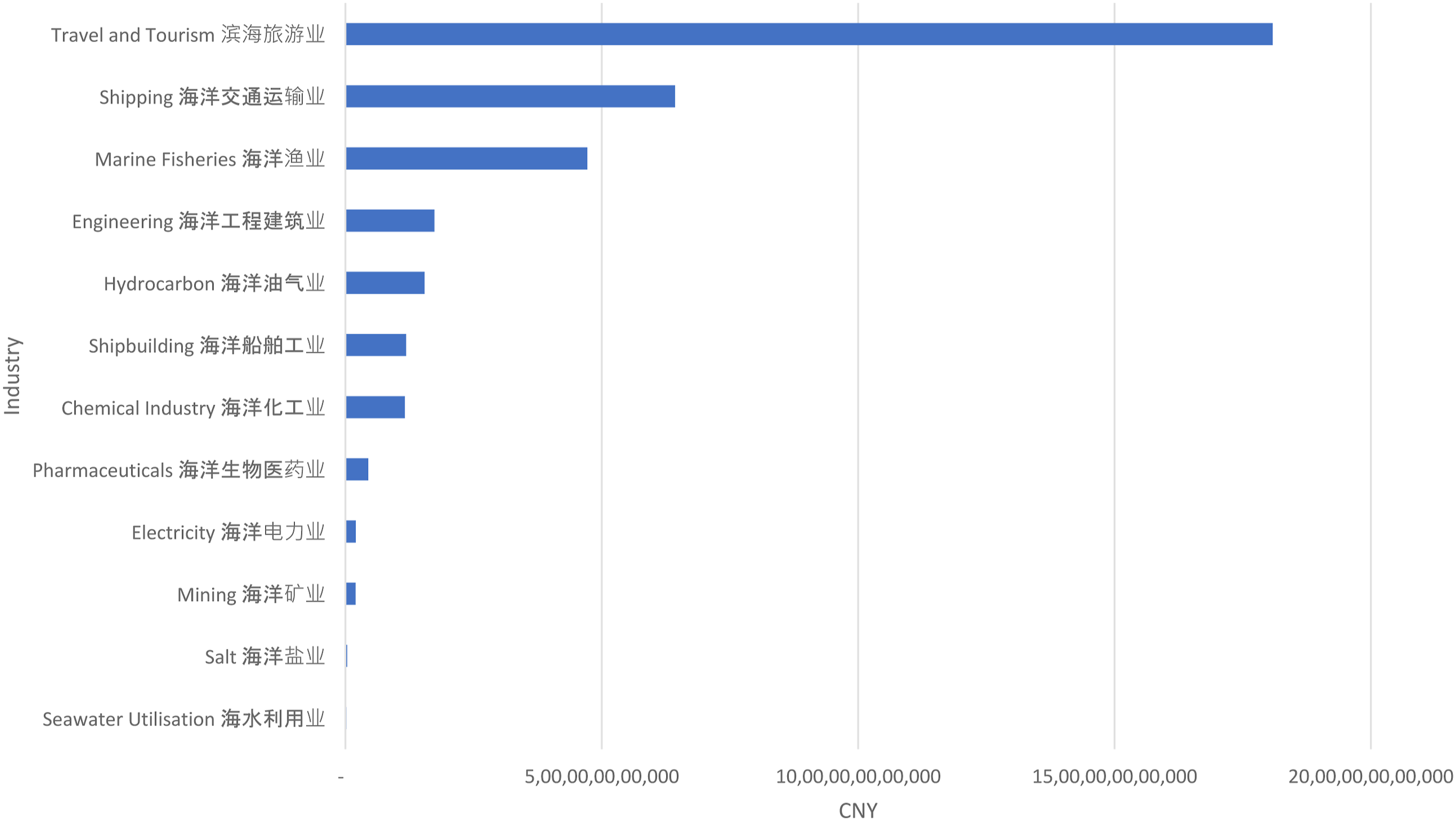
The goal of industrial upgrading in China’s blue economy is to modernise the inefficient operation and management of the more ‘traditional’ of the 12 ocean economy sectors, such as low-tech fisheries, and to emphasise newer, innovative ways of attaining economic growth that capture added value from moving away from the primary sector (production of raw commodities) to the secondary (manufacturing) and tertiary (services) sectors (Bao (鲍谦) & Huang (黄硕琳), 2012; Mao (毛昕), 2013; Song, 2007). The National Science and Technology Xinghai Plan 2016–2020 (全国科技兴海规划) emphasises how the blue economy can play a leading role in improving efficiency and innovation. Since the early 2000s, the growth of China’s ocean economy has been dominated by expansion of the tertiary sector. In particular, coastal and ocean tourism (e.g. cruises, recreational fishing, homestay tourism and beach tourism) is a major growth area: between 2002 and 2017, it grew tenfold, from 148 billion RMB to 1464 billion RMB (To & Lee, 2018). In contrast, marine fisheries and aquaculture grew from 121 billion RMB to 468 billion RMB in the same period (To & Lee, 2018). However, upgrading aquaculture is a major component of economic modernisation in the ocean economy. Attention to improving the performance of aquaculture has included emphasis on improved equipment, technology transfer, genetics/breeding and promoting better farming practices on culture density, feeding and disease prevention, and drug use (Han et al., 2016; Wang, 2010).
Economic modernisation is also promoted by leveraging geographic advantages (Figure 2). In China, the concept of ‘geographic locational theory’ (地理区位) has been employed as the foundation underlying the geographic characteristics of economic development (Li, 2011; Li et al., 2018; Lou et al., 2005). This concept refers to the ways in which specific geographical localities are divided, combined or linked according to the needs of industrial development and strategic policy planning. As with the goals of industrial upgrading, the role of the state in planning and directing this process is again a crucial feature. The idea is to use the interconnectivity among various administrative regions—and between China and other countries—in order to optimise economic modernisation via several forms including transportation, logistics, technology, telecommunications and tourism, and to reduce the gaps between more developed areas (e.g. frequently urban) with lesser developed areas (frequently a fishing or aquaculture region with relatively fewer commercial activities) (Gu, 2012, p. 19; Li et al., 2018, p. 149). Examples of policies using this framework include the special economic zones (SEZs)—designated zones with lower taxes and tariffs in order to create a foreign investment–friendly environment for an export-oriented economy (Tao & Yuan, 2016). Maritime China.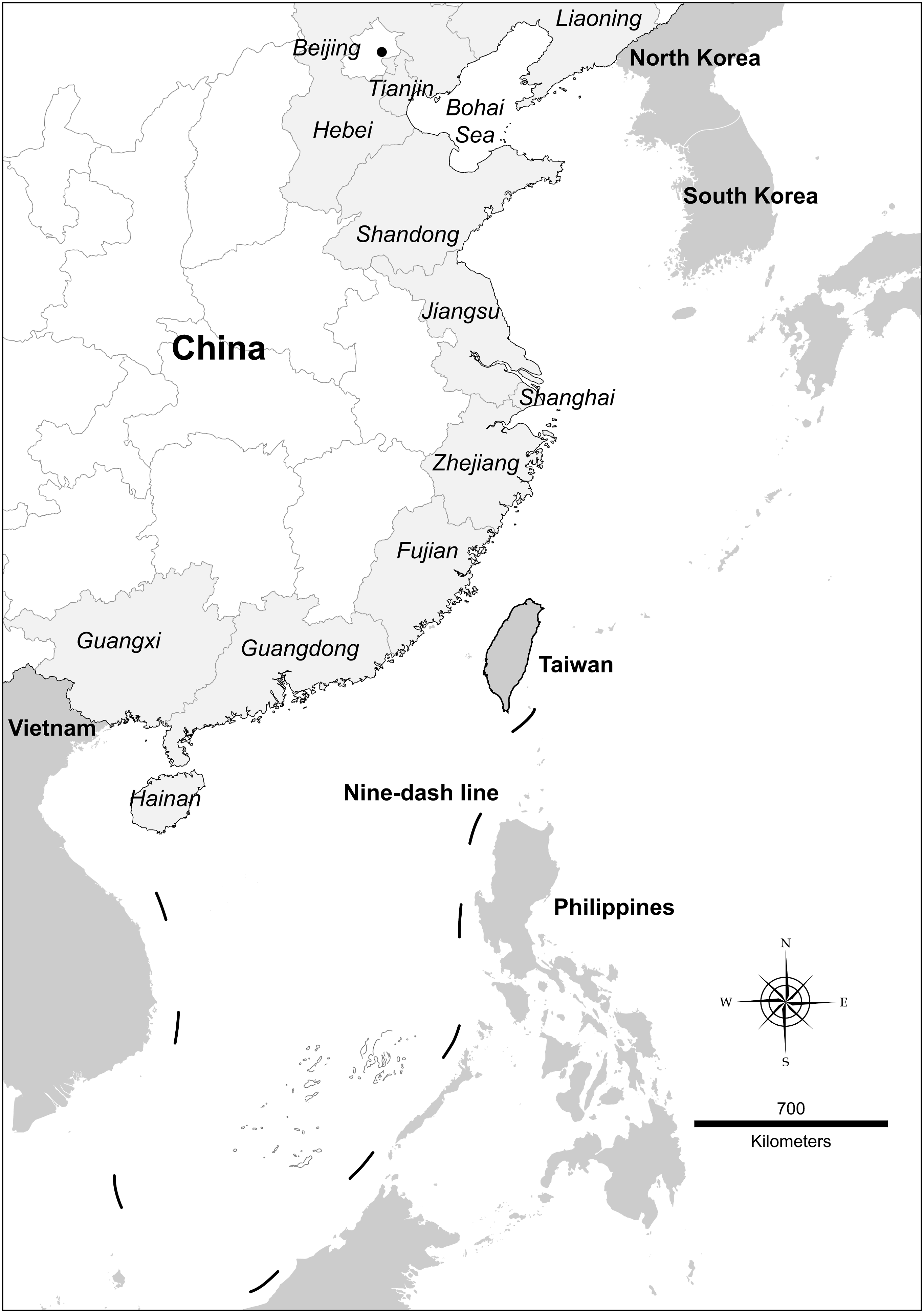
China has three regional ocean economic areas with the north around the Bohai, along the east coast around the Yangtze River delta and in the south around the Pearl River delta. According to Jiang (2015), particular areas are associated with specific sectors and different strengths and weaknesses. The northern provinces of Shandong and Liaoning are associated with trade, ports, tourism and mariculture. The central provinces of Fujian and Zhejiang are associated with transitions from domestic capture fisheries to distant water fishing or value-added aquaculture, while the southern province of Guangdong is associated with a high level of transport and logistics connectivity based around its established manufacturing industries. The provinces of Shandong, Zhejiang, Fujian and Guangdong have established blue economic pilot zones (蓝色经济试验区), with Fujian’s experimenting with ocean economic development across the Taiwan Strait (Chinese Central Government, 2012). At the municipal level, 14 ocean economic development demonstration zones (海洋经济发展示范区) focus on particular ocean economic sectors (Chinese Central Government, 2018).
There are many overlapping ways in which China’s oceans are zoned—including with reference to ocean, SEZ, province or sector. However, marine functional zoning (海洋功能区划, a version of marine spatial planning) is employed as the main tool by which this geographic locational planning is implemented in the Chinese exclusive economic zone (EEZ) (Choi, 2017; Feng et al., 2016). Coastal regions are seen to have advantages of accessibility and convenience of transport (Wang, 2013a, 2013b), and oceans are associated with open spaces with great potential and prospects (Chen, 2010). Overall, from a geographical perspective, the blue economy is seen as an opportunity to promote poverty reduction and modernise regional ocean economies through functional zoning (Li, 2019).
Geopolitical Modernisation
This section introduces the key idea of maritime power and then presents two central strategies by which China aims to attain this goal: the 21st Century Maritime Silk Road and increased assertiveness in maritime disputes.
China explicitly aims to attain the status of a ‘maritime power’ (海洋强国) (Li, 2019). While there is ambiguity to the precise definition of this term, Martinson tracks an increasing emphasis in official documents to the language of control, for example, in then-State Oceanic Administration Director Liu Cigui’s definition of maritime power as a state that ‘has formidable comprehensive power with respect to developing the ocean, exploiting the ocean, protecting the ocean, and controlling the ocean’ (Ren, 2012, cited in Martinson, 2018). The phrase ‘strong maritime power’ has also been taken up by provincial and local governments, who have made plans to create ‘strong maritime provinces or cities’ (e.g. in Shandong, ‘山东海洋强省建设行动方案,‘). These plans tend to describe aspirations to develop maritime industries in order to contribute to the construction of national maritime power. According to academic Liu Shuguang (2018), China’s ocean economy is seen as a driver of innovation that can advance the goal of becoming a maritime power and contribute to the Chinese Dream by strengthening China’s status as a strong nation-state that is internationally respected, increasing collaboration between China and other nations, defending maritime boundaries to protect access to fishing resources and ensuring the sustainability and security of the ocean environment. While defence technology development and Chinese naval aspirations are also clearly a feature of Chinese conceptions of ‘maritime power’ (Martinson, 2018; Erickson and Martinson, 2019), in the Chinese literature reviewed these are rarely explicitly discussed in reference to the ocean economy.
The expansion of the Maritime Silk Road (海上丝绸之路) half of the Belt and Road Initiative (一带一路) is a form of soft geopolitical power. The Maritime Silk Road policy aims to rejuvenate China as a maritime economic power by reclaiming the glory of 15th century maritime activities associated with Zheng He (郑和) and strengthening the trading relationship with other states (Xu, 2017; Chan, 2018); a modernisation of the old Silk Road. While the strategic focus and geographic scope of the Maritime Silk Road have changed since its original introduction in 2013, overall, the Maritime Silk Road is presented in Chinese official sources as an opportunity for states to cooperate with China for joint prosperity and security. Among its aims are to enhance maritime trade between China and other countries, increase food and energy security, enable Chinese investments in port and ocean economy–related infrastructure and to facilitate new sources of economic growth (Chen et al., 2016). Increasingly the Maritime Silk Road is taking a global dimension and is linked in Chinese discourse to a range of other outward-facing policies, such as the formulation of an Arctic Policy (Xinhua News, 2018) and participation in multilateral fora, such as the negotiations over the Conservation and Sustainable Use of Marine Biological Diversity of Areas Beyond National Jurisdiction (Ma, 2019).
However, in addition to the soft power of investments, aid and cooperation through the Maritime Silk Road, Chinese goals for the ocean economy have also hardened maritime disputes. Maritime conflicts between China, the Philippines, Vietnam and other countries are typically portrayed as threats not only to sovereign rights of China (Chen, 2012; Dong, 2015), but also to national goals of economic development. According to Li and Yang (2008), for example, the dispute in the South China Sea is a significant problem because it has meant that China has been unable to effectively develop the area. Discourses about disputes also tend to refer to broader geopolitical tensions. In the Chinese literature, it is common to portray Japan and the United States as potential enemies, and Philippines and Vietnam as ‘barbarian’ or ‘uncivilised’ (野蛮) neighbours who are allied with the United States and ‘unfriendly’ to China and Chinese tourists (Han, 2012; Li et al., 2018; W. Liu, 2017). Han (2012), for example, asserts that Chinese economic weakness in the oceans is due to ‘strategic containment’ by the United States and Japan (reinforcing the notion of the ‘century of humiliation’), supported by Vietnam and the Philippines, while Liu (2015) asserts that the heated dispute with the Philippines has led to Chinese fishers being ‘tied up and shot’. Chinese discourse sees Japan as a potential competitor and sometimes a ‘threat’ in terms of the ocean economy (Liu, 2015; Zhang et al., 2004). Li et al. (2018), for example, portray Japan as working together with the United States to ‘manipulate’ smaller countries in the region and to ‘intentionally block China’s maritime channels’. Such strategies to challenge the rise of China are perceived in dominant discourses as part of the barriers to China’s national modernisation.
Ecological Modernisation
This section introduces how ecological modernisation in China has been represented in China through the discourse on ecological civilisation and tracks how this concept has changed from the Hu to the Xi periods.
In China, the concept of ecological modernisation was formalised through the publication of a report by the Chinese Academy of Sciences in 2007 (China Centre for Modernisation Research, 2007; Zhang et al., 2007), and more recently, the related idea of ‘ecological civilisation’ has emerged as the official state goal, referred to by some as ‘environmental modernisation with Chinese characteristics’ (Muldavin, 2015: 1000). An analysis of discourses about ecological civilisation through the Hu and Xi eras shows how the concept evolved from an argument for stricter environmental laws to become a narrative for economic expansion and geopolitical superiority.
Ecological civilisation (生态文明) is, according to the official news website of the CPC, a civilisation that ‘respects nature, adapts to nature, protects nature, and develops the concept of unity. It embraces ... the concept of ecological value and natural capital, the concept of spatial balance, and the idea that mountains, forests, lakes, and farm fields together create a community of life’ (Renmin Ribao, 2015). Ecological civilisation not only currently functions as a framework of China’s environmental laws, but also constructs a new Chinese concept of sustainability portraying China as a nation whose development is guided by a harmonious relationship with nature (Hansen et al., 2018). Because of its ‘harmonious’ image, ecological civilisation promotes a vision of society whose modes of production and trade, as well as resource extraction, is guided by sustainable principles and environmentally responsible citizens (Hansen et al., 2018).
Ecological civilisation was first brought up as a concept by Pan Yue, the then Vice-Minister of Environmental Protection, in 2003. The CPC incorporated ecological civilisation into their ideology in 2007, when President Hu Jintao announced the ‘commencement of ecological civilisation infrastructure’ in his work report to the 17th Communist Party Congress (Hu, 2007). Ecological civilisation during Hu’s term as president meant stricter, top-down, ‘iron fisted’ pollution regulations, as well as the endorsement of a low-carbon economy (Goron, 2018). It was not until 2012 that ecological civilisation became one of the most important objectives and ideologies of the CPC, when Hu dedicated an entire section to it in his work report to the 18th Communist Party Congress (Hu, 2012). In the same year, the construction of an ecological civilisation became one of the five core missions (五位一体) in the CPC constitution, along with political, cultural, economic and social construction (Hu, 2012).
Under Xi Jinping, ecological civilisation became less of a framework for environmental regulations and more of a vehicle for the Chinese Dream (see Geopolitical Modernisation section). Because part of the Chinese Dream mandate is to create a ‘moderately prosperous society’ that is modern and innovative (Lin, 2016; Xinhua News, 2016; see also Economic Modernisation section), a corresponding ‘beautiful China’ can be achieved through the construction of an ecological civilisation that promotes green growth, puts in effort to solve environmental problems, protects ecosystems and transforms the current environmental monitoring system (Xinhua News, 2017a).
Xi also makes a more explicit connection between ecological civilisation and economic development. The catchphrase, ‘green water and green mountains mean gold and silver mountains (绿水青山就是金山银山)’, was written into Xi’s work report to the 19th Communist Party Congress (Xi, as quoted in Zhang, 2017), and suggests that environmental governance under Xi, while still focussing on solutions to environmental problems through innovation (CPC News, 2018), will not be discussed in terms of intrinsic values but in terms of how it can improve economic development and modernisation so that China can reap mountains of gold and silver.
China under Xi has continued the country’s focus on the ocean as a resource. China’s 13th Five-Year Plan contains a chapter that cites numerous policies to develop its maritime economy (National People’s Congress et al., 2017), strengthening its protection of marine resources and the environment and safeguarding its maritime interests and rights. With this in mind, the 13th Five-Year Plan has stated that coastal development is to be carried out in a way that addresses environmental problems that have plagued China’s ‘blue territory’ and ‘strengthens integrated maritime management’ (Chinese State Council, 2015). While China has made some progress in increasing marine protected areas through its marine ecological civilisation policy (China Ocean News, 2018), by viewing the ocean as a resource and ‘blue territory,’ China is suggesting that even within its ecological civilisation framework, economic and geopolitical aspirations dominate.
Discussion
A vibrant economy and the continual improvement of living standards is a key source of legitimacy for the CPC, and the oceans are seen as an increasingly important potential source of future economic growth. China’s strategy of industrial upgrading within the ocean economy has been one broadly adopted by many developing states in the post-war period to facilitate economic growth, hinging initially on the transition from an economy based on agriculture to one based on heavy industry and manufacturing and then finally to an emerging economy based on services and advanced, modernised technology (Lin & Wang, 2008; Studwell, 2013). Chinese economic restructuring is currently centred around restructuring the economy away from a reliance on manufacturing and exports and adjusting to a ‘new normal’ of lower, but higher-quality, growth rates with greater levels of domestic consumption (Song et al., 2016). Similarly, China’s emphasis on functional zoning can be understood as a local version of what in economic geography has been written about clustering, SEZs and production networks (e.g. Delgado et al., 2016; Coe & Yeung, 2019) and in the maritime sector specifically, marine spatial planning (Fang et al., 2011)—what Choi terms as the production of ‘new spatial rationalities’ (Choi, 2017).
An important theme in its blue economy efforts is China’s vision to become a strong nation and how China aims to improve its status and power in the international sphere as a project of geopolitical modernisation. Crucially, geopolitical modernisation is intimately linked to—and underwritten by—the project of economic modernisation and (to a lesser extent) ecological modernisation. In Chinese discourse, therefore, Chinese soft power through the Maritime Silk Road and wider participation in multilateral oceans issues and fora, as well as Chinese hard power manifested in maritime disputes, are both fundamentally intertwined with the exploitation of and control over access to ocean economic resources. In this way, they form part of national development strategies to attain socialist modernisation and the Chinese Dream.
The concept of ecological civilisation also serves as a means for China to contrast itself against ‘Western’ ways of modernisation, illustrating an alternative development path, and positions China’s modernisation process as morally superior due to traditional connections with nature (Pan, 2003). However, China’s blue economy faces significant environmental challenges (e.g. Cao et al., 2017; Hughes, Huang and Young, 2013). Initiatives where economic growth and ecological conservation take place remain separate and uneven. Hyper-urbanisation continues unabated in coastal super-regions and environmental regulations are implemented but not well enforced (Sze, 2015; Xinhua News, 2017b). The discourse around ecological civilisation never moves too far from economic growth and securing China’s position as a strong maritime power (e.g. Li et al., 2013). With the interweaving of ecological sustainability and economic growth, the economy still takes priority and is always entwined with the vision of a strong state and party. Furthermore, China’s top-down approach to environmental protection consolidates the power of the party-state, which ‘profits from the environmental crisis by projecting itself as the sole legitimate steward of the environment’ (Li & Shapiro, 2020).
Scholars are already debating whether China’s ecological civilisation framework is a better sustainable development model than those in messy Western democracies (e.g. Frazier et al., 2019; Li & Shapiro, 2020). Ecological civilisation potentially serves as a more efficient, authoritarian sustainable development model or ideal being implemented in China and promoted abroad. This could present challenges for other countries, such as small island developing states, harbouring more conservation-minded views of the blue economy or more participatory forms of governance and accountability.
In relation to the four central interpretations of the blue economy identified by Voyer et al. (2018), what is notable about China’s ideas of the blue economy is the extent to which it is seen as an instrument for state goals and priorities. While value-added production, business opportunities, improved livelihoods and ecological sustainability do figure in discussions of China’s blue economy, ultimately these features are couched in terms of national benefits, such as the contribution towards modernisation and improving China’s position in global geopolitics. Social equity is assumed to follow on from economic benefits, but is rarely, if ever, mentioned explicitly. Economic, geopolitical and, to a far lesser extent, ecological modernisations mutually reinforce each other to advance the goals of the Chinese state for socialist modernisation. This is a broader vision than the cross-cutting theme of ‘maritime security’ also identified by Voyer et al. (2018), and we suggest that assessing the extent to which states see the blue economy as an arena for performing state power would usefully complement the existing interpretations of the blue economy.
Conclusion
Understanding the ways in which the concept of the blue economy moves from a burgeoning policy ‘buzzword’ to interact with existing programmes and priorities in diverse national contexts is an emergent research frontier (Childs and Hicks, 2019). This article has shown how China’s visions of the blue economy are focussed largely around how the blue economy can contribute to wider state-making goals. Economic, geopolitical and ecological aspects of the blue economy overlap and form part of the overall state agenda to modernise the nation and consolidate state power. In the ideology of the CPC, this process of modernisation is part of the Chinese Dream—rejuvenating the Chinese nation to its historical role as a great power under the leadership of the CPC. In this respect, Chinese blue economy aspirations can be seen through the much wider prism of other historical attempts by states to use the oceans as a means to increase geopolitical power (Wirth, 2016). Social equity is rarely explicitly articulated, and ecological sustainability is a lower priority than economic and geopolitical aspects. The role of the state in this vision is in contrast with conceptions of the blue economy articulated outside China and in multilateral fora such as the FAO and World Bank, which emphasise to varying degrees aspects of natural capital, private investment, innovation, good business and livelihoods (Silver et al., 2015; Voyer et al., 2018). While the state has been acknowledged as a key stakeholder in other discussions of the emerging blue economy (e.g. Carver, 2019; Choi, 2017), it is rarely the central object of analysis.
Chinese ideas about the blue economy are significant in part because of the scale and importance of China and of China’s EEZ (e.g. Sumaila, 2019). However, the significance of these ideas goes well beyond domestic Chinese priorities. China’s global influence in the oceans, already significant, is continuing to increase and reach into other territorial jurisdictions. Chinese involvement in maritime disputes is linked with the idea of an expanded ocean economy and territory. More broadly, Chinese aid, trade and investment is reshaping relationships in contested ways from Africa to the Asia-Pacific (Economy & Levi, 2014; Rabena, 2018; Rajah et al., 2019), including in ocean economies (Duchâtel & Duplaix, 2018; Fabinyi, 2020).
As Callahan notes, the grand strategy of Chinese foreign policy ‘is ambitious: to use economic leverage to build a Sino-centric “community of shared destiny” in Asia, which in turn will make China a normative power that sets the rules of the game for global governance’ (Callahan, 2016a: 3; see also Callahan, 2016b; Naughton, 2020). Founded on the narratives of humiliation and rejuvenation, China’s blue economy is cast in opposition to the dominant order (Wirth, 2020). While there are significant caveats about the extent to which China can actually implement and achieve its geopolitical objectives (Zhao, 2020), it is certain that China’s ideas about the blue economy will have increasing influence. This may be seen, for example, in direct exploitation of ocean spaces to which China has new access (Fabinyi, 2020) or through investments in port, fisheries, energy and other ocean economy infrastructure not just domestically but around the world (Duchâtel & Duplaix, 2018). The desire for geopolitical expansion through economic leverage explains the emphasis in Chinese discourse on national benefits through economic and geopolitical modernisation. It is therefore unlikely that critical concerns related to ecological sustainability and social equity will be prioritised in, or significantly constrain, such activities.
A Chinese blue economy is one that—through an inter-related set of economic, geopolitical and (to a far lesser degree) ecological practices—contributes to the broader, long-term vision of modernisation as a nationalist project. This vision is ultimately defined in opposition to Western liberalism (Callahan, 2015) and under the Xi administration, the focus on Chinese exceptionalism has intensified (Zhao, 2016; Gries, 2020). Future research and policy will increasingly need to examine and adapt to the various interactions this distinctive vision of the blue economy has with alternative conceptions, from local to global scales.
Footnotes
Declaration of Conflicting Interests
The author(s) declared no potential conflicts of interest with respect to the research, authorship and/or publication of this article.
Funding
The author(s) disclosed receipt of the following financial support for the research, authorship and/or publication of this article: This research was supported by an Australian Research Council Discovery Project [DP180100965] (MF, AW, KB, WD). MF and KB also acknowledge the support of the Nippon Foundation Ocean Nexus Center. Thank you to Gil Hizi and Paula Satizábal for assisting with data analysis.
