



Abstract
The aim of this study was to validate a Spanish version of the Cognitive Emotion Regulation Questionnaire (CERQ-S), originally developed by Garnefski, Kraaij, and Spinhoven. To date, it is the only available instrument that permits a conceptually pure quantification of cognitive strategies of emotional regulation. A sample of 615 students (25% men; 75% women) completed the CERQ-S. Confirmatory factor analyses showed that, as in the original version, a nine-factor model also explained the data collected with the Spanish version. However, an alternative model that integrates the nine dimensions in two second-order factors shows appropriate global fit indices and has interesting implications. Likewise, the results of the present study are comparable with those obtained in previous work with measures of depression, anxiety, and anger, and increase support for the validity of this instrument for assessing normalized affective states.
Keywords
The concept of emotional regulation refers to the set of competencies that permit people to supervise, appraise, and modify the processes involved in the genesis of emotion and modulate its manifestations (Gross, 1999; Thompson, 1994, p. 27). However, emotional regulation is not a simple concept; rather, it is made up of a wide variety of processes of a biological, social, behavioral, and cognitive nature, whose empirical study requires individualized analysis. In this regard, one of the most productive research lines has been that developed by Garnefski and Kraaij’s group, which focuses on the study and measurement of controlled processes of cognitive emotional regulation (Garnefski & Kraaij, 2007; Garnefski, Kraaij, & Spinhoven, 2001; Garnefski, Kraaij, & Spinhoven, 2002). The studies carried out by this group have relevant implications at both the theoretical and applied levels.
From a theoretical point of view, these researchers highlight the affinity between the model of conscious cognitive emotional regulation and that of cognitive coping (Garnefski, Kraaij, et al., 2002). But they also point to conceptual differences between the two, which mean that the first is more operative when studying the cognitive factors that regulate the emotions (Garnefski et al., 2001). The traditional coping model (Lazarus & Folkman, 1984) considers indistinctly both cognitive coping strategies (e.g., planning an action) and behavioral ones (e.g., seeking support from others), so that the measurement instruments designed in accordance with this model provide data reflecting the combined effects of the two types of strategy, but not of each one separately. This limitation is overcome in the cognitive emotional regulation model, in which cognitive factors are conceptualized and measured independently of behavioral ones (Garnefski et al., 2001; Garnefski, Kraaij, et al., 2002).
From an applied angle, the results obtained by Garnefski and Kraaij’s group reflect the relevance of cognitive emotional regulation processes in the modulation of symptoms associated with certain psychological disorders (e.g., Garnefski & Kraaij, 2006; Garnefski, Van den Kommer, et al., 2002), and as indicative of risk in people faced with difficult or traumatic life situations (e.g., Garnefski, Koopman, Kraaij, & ten Cate, 2009; Garnefski, Kraaij, Schroevers, & Somsen, 2008; Schroevers, Kraaij, & Garnefski, 2008).
A key element in all such research has been the availability of a normalized measurement instrument for emotional regulation processes, the Cognitive Emotion Regulation Questionnaire (CERQ; Garnefski et al., 2001; Garnefski, Kraaij, et al., 2002). Up to now, this questionnaire has been the only available instrument that permits a conceptually pure quantification of the cognitive strategies of emotional regulation. It was originally developed with an adolescent sample but has also recently been validated in adults (Garnefski & Kraaij, 2007). The questionnaire evaluates nine strategies of cognitive emotional regulation: Self-blame (i.e., thinking that one is responsible for what happened), Acceptance (i.e., accepting what happened and resigning oneself to it), Rumination (i.e., reflecting on the feelings and thoughts associated with what happened), Positive refocusing (i.e., thinking about happy experiences instead of the stressful event), Refocus on planning (i.e., concentrating on the measures to adopt in response to the event), Positive reappraisal (i.e., considering the positive aspects of what happened), Putting into perspective (i.e., minimizing the relevance of the event), Catastrophizing (i.e., having thoughts that intensify the negativity of what happened), and Other-blame (i.e., having thoughts that blame others for what has happened to oneself). In turn, these nine dimensions can be grouped into two more general categories, which in previous studies have been referred to as adaptive strategies and less adaptive strategies (Garnefski et al., 2001; Jermann, Van der Linden, d’Acremont, & Zermatten, 2006). The first of these categories would include the strategies of Acceptance, Positive refocusing, Refocus on planning, Positive reappraisal, and Putting into perspective, whereas the second would include those of Self-blame, Rumination, Catastrophizing, and Other-blame.
The CERQ has been translated into different languages and applied to multiple populations, in which adequate evidence has been obtained of its reliability and validity for assessing the cognitive components of emotional regulation, showing in all its adaptations the same factor structure (Jermann et al., 2006; Martin & Dahlen, 2005; Zhu et al., 2008). These characteristics make the questionnaire invaluable for the study of emotional regulation processes influenced by cognitive coping strategies, as well as for research on their adaptive or pathological functionality in the face of negative life experiences. The main objectives of this instrumental study are to translate the CERQ for Spanish adult and adolescent population (CERQ-S) and to analyze its dimensionality, internal consistency, and reliability. Likewise, we set out to evaluate its criterion validity by examining the relationship of its dimensions to reports of depressive symptoms, to anxiety and anger traits, and to the presence of a positive or negative affective state.
Method
Sample
Total number of participants was 615, with an age range of 16 to 58 years (mean age = 32.94 years and SD = 9.39). Pairwise deletion was used for missing data. Men accounted for 25% of the sample (mean age = 32.26 years; SD = 11.09), whereas 75% were women (mean age = 33.12 years; SD = 8.69). Educational level ranged from high school (10%) to university (90%). As regards employment situation, 50.8% had a permanent job, 14.1% were in temporary jobs, and 35.1% were students and unemployed. Participation in the study was voluntary, with no financial or academic reward.
Procedure
The sample was obtained by means of a personal e-mail addressed to students enrolled in different courses at a university and a secondary school, both in Spain. Addresses were informed that participation, which was voluntary and anonymous, consisted in filling out a battery of questionnaires on an Internet webpage, to which they could accede by means of a user code and a username. With the aim of examining the test–retest reliability of the CERQ-S, after a 2-month interval those who responded to the first call for participation were asked to fill out the questionnaire once again; on this occasion 245 persons responded.
Instruments
Cognitive Emotion Regulation Questionnaire
The CERQ (Garnefski et al., 2001; Garnefski, Kraaij, et al., 2002) is a 36-item questionnaire that measures the cognitive emotional regulation strategies a person uses in response to a stressful life event. It consists of nine scales, each with four items and conceptually different: Self-blame, Acceptance, Rumination, Positive refocusing, Refocus on planning, Positive reappraisal, Putting into perspective, Catastrophizing, and Other-blame. On the items, measured using a Likert-type scale (from 1 = almost never to 5 = almost always), the higher the score, the greater the use of the coping strategy in question. The Spanish version of this questionnaire (CERQ-S) was developed in accordance with the guidelines of the International Test Commission (Hambleton, 2005) and using the back-translation method based on the original English version: (1) the original version was translated into Spanish by a bilingual group expert in psychology; (2) The Spanish version of the CERQ, the CERQ-S, was translated back into English by a different translator, also bilingual and a psychologist; and (3) the discrepancies arising were discussed and the appropriate corrections made to the CERQ-S.
Beck Depression Inventory
The Beck Depression Inventory (BDI; Beck, Rush, Shaw, & Emery, 1979; Spanish version by Vázquez & Sanz, 1997) is a 21-item self-report instrument (range: 0 to 63 points) that measures the intensity of depressive symptoms. The reliability coefficient yielded by the two-halves method is .93. As regards convergent validity, the correlation with the clinical assessment of depression ranges from .62 to .66.
State-Trait Anxiety Inventory
The State-Trait Anxiety Inventory (STAI; Spielberger, Gorsuch, & Lushene, 1970; Spanish version by TEA, 1982) is a self-report instrument comprising 20 items related to Trait-anxiety and another 20 related to State-anxiety, with a range of 0 to 60 for each scale. In the present study, we used the trait anxiety scale (STAI-T), which presents a test–retest reliability of .81 and an internal consistency ranging from .83 to .92.
State-Trait Anger Expression Inventory
The State-Trait Anger Expression Inventory (STAXI-2) was developed by Spielberger (1988); the Spanish version was developed by Miguel-Tobal, Casado, Cano-Vindel, and Spielberger (2001). For the present research, we used the Trait-anger scale (STAXI-2-T), which consists of 10 items (range: 0 to 40 points); this scale has a test–retest reliability of .71 and an internal consistency of .89.
Positive and Negative Affect Scale
The Positive and Negative Affect Scale (PANAS; Watson, Clark, & Tellegen, 1988; Spanish version by Sandín et al., 1999) consists of 20 items that evaluate two independent dimensions: positive affect (PA) and negative affect (NA). The range for each scale (10 items on each) is 10 to 50. Internal consistency ranges from .87 to .91, and the rest of the instrument’s psychometric properties are quite satisfactory.
Statistical Analyses
To obtain evidence of the instrument’s construct validity in a Spanish sample, we tested the original model proposed by Garnefski et al. (2001) using the confirmatory factor analysis (CFA) procedure. After analyzing the goodness-of-fit indices (GFI) and the patterns of correlations between the latent variables, we also tested alternative models.
Because of the ordinal nature of the items, we used polychoric correlations, and as an estimation method that of unweighted least squares (ULS), given the large number of variables (Flora, Finkel, & Foshee, 2003; Holgado, Chacón, Barbero, & Vila, 2010; Jöreskog, 2001). Once we had estimated the polychoric correlations matrix, we checked the assumption of bivariate normality. To do so, we calculated the percentage of tests that reject the null hypothesis of bivariate normality for each pair of correlations. Moreover, following Jöreskog (2001), we considered the percentage of items whose root mean square error of approximation (RMSEA) was less than .1.
The statistical analyses were carried out using the following applications: PRELIS 2.30, LISREL 8.71 (Jöreskog & Sörbom, 1996a, 1996b), and SPSS 15 for Windows.
Results
Confirmatory Factor Analysis of the CERQ-S
In accordance with the original structure proposed by Garnefski et al. (2001), the dimensions of the instrument are grouped in the following: Self-blame (Items 1, 10, 19, and 28); Acceptance (Items 2, 11, 20, and 29); Rumination (Items 3, 12, 21, and 30); Positive refocusing (Items 4, 13, 22, and 31); Refocus on planning (Items 5, 14, 23, and 32); Positive reappraisal (Items 6, 15, 24, and 33); Putting into perspective (Items 7, 16, 25, and 34); Catastrophizing (Items 8, 17, 26, and 35); and Other-blame (Items 9, 18, 27, and 36). Table 1 shows, respecting the authors’ original structure, the descriptive data and reliability of the scales (Cronbach’s alpha) obtained with Dutch-, French-, Chinese-, and Spanish-speaking samples.
Descriptive Statistics and Reliability of the Original, French, Chinese, and Spanish CERQ Scales
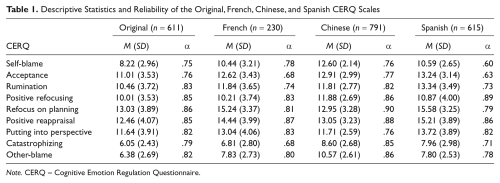
Note. CERQ = Cognitive Emotion Regulation Questionnaire.
The use of polychoric correlations was justified by the fact that, at a nominal level of 5%, the assumption of bivariate normality was not rejected for any pair of correlations obtained (360).
As a result of carrying out a CFA on the model, the following global fit indices were obtained: χ2(degrees of freedom or df = 558; p = .00001) = 2513.95; RMSEA = .082 with an interval at 90% (.080 to .087; values <.08 are adequate); GFI (goodness-of-fit index) = .90; AGFI (adjusted goodness-of-fit index) = .88; CFI (comparative fit index) = .98; NFI (normed fit index) = .99 (values >.90 are adequate); and SRMR (standardized root mean square residual) = .10 (values <.10 are adequate).
These results, at the limit of what is considered a good fit, suggest the need for an analysis of the modification indices with the aim of trying to increase global goodness of fit. After carrying out the analysis, it was considered appropriate to have Item 19 (I think about the mistakes I have made in this matter) saturate in the dimensions of Self-blame and Positive reappraisal, and Item 21 (I want to understand why I feel the way I do about what I have experienced) in those of Rumination and Refocus on planning. The fit indices of this new model (Model 2) were as follows: χ2(df = 556; p = .00001) = 2250.52; RMSEA = .078 with an interval at 90% (.075 to .082); GFI = .96; AGFI = .95; CFI = .98; NFI = .99; and SRMR = .06.
The significant increase of χ2 of 263.43 for 2 degrees of freedom indicates that Model 2 is a significant improvement on Model 1. Table 2 shows the structure of Models 1 and 2 with the completely standardized solution, together with the correlations between the nine factors.
CERQ-S: Completely Standardized Solution of Model 1 and (Model 2)
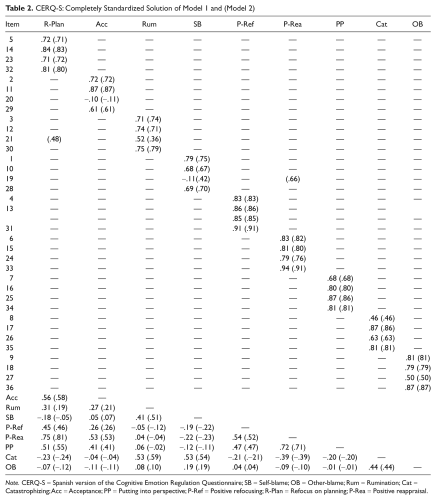
Note. CERQ-S = Spanish version of the Cognitive Emotion Regulation Questionnaire; SB = Self-blame; OB = Other-blame; Rum = Rumination; Cat = Catastrophizing; Acc = Acceptance; PP = Putting into perspective; P-Ref = Positive refocusing; R-Plan = Refocus on planning; P-Rea = Positive reappraisal.
After analysis of the correlations between the Model 2 factors, and in accordance with what has been described in previous studies on the CERQ (Garnefski et al., 2001; Jermann et al., 2006), it was decided to propose a second-order factorial model made up of two higher order factors (Model 3). These two factors, as already mentioned, encompass cognitive coping styles that have been categorized as adaptive strategies and less adaptive strategies. The fit indices of Model 3 were as follows: χ2(df = 582; p = .00001) = 1738.05; RMSEA = .075 with an interval at 90% (.071 to .080); GFI = .93; AGFI = .93; CFI = .98; NFI = .99; and SRMR = .08.
These results provide empirical support for the structure proposed. The completely standardized solution of the structural model is shown in Figure 1.
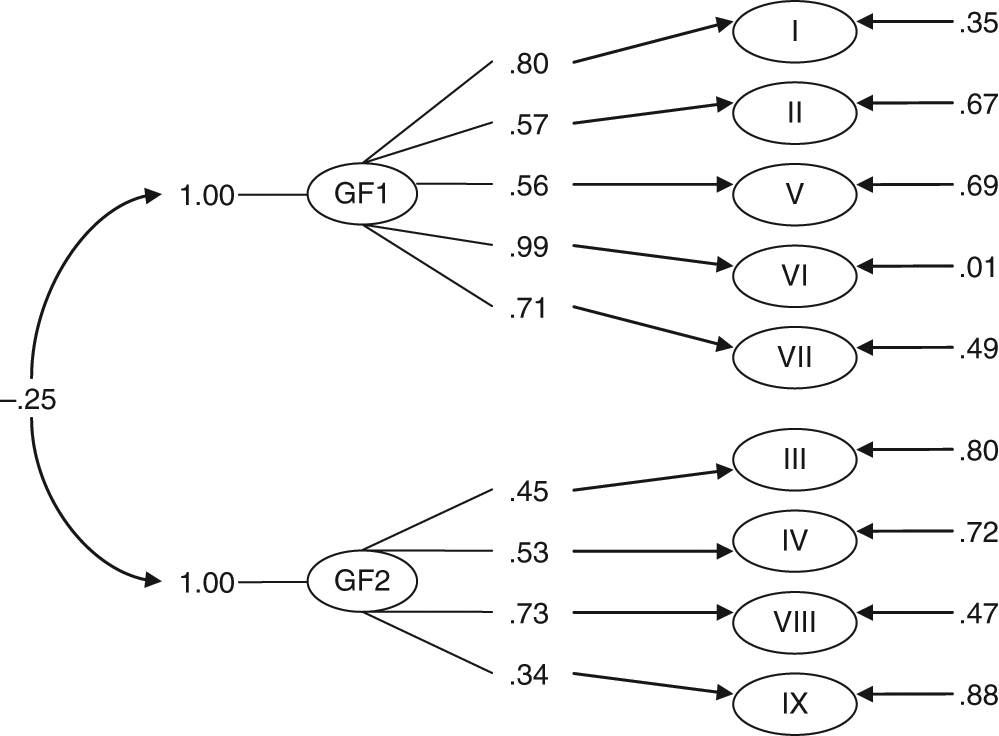
Spanish version of the Cognitive Emotion Regulation Questionnaire (CERQ-S): Completely standardized solution of the structural part of Model 3
The basic psychometric characteristics of the dimensions obtained in the CFA of Model 3 show that both the reliability of the scales and their average discrimination are adequate (Table 3). Those which obtain lower Cronbach’s alpha values are Self-blame (.61) and Acceptance (.64); however, the average discrimination of both is more than .30 (Nunnally & Bernstein, 1994). The second-order factors also present adequate internal consistency indices and average discrimination, especially that which predicts the less adaptive strategies. For their part, the test–retest reliability indices, calculated with 2 months’ difference, range from acceptable to moderately strong; r = .49 to r = .71.
CERQ-S: Cronbach’s α, Test–Retest Reliability and Mean Discrimination
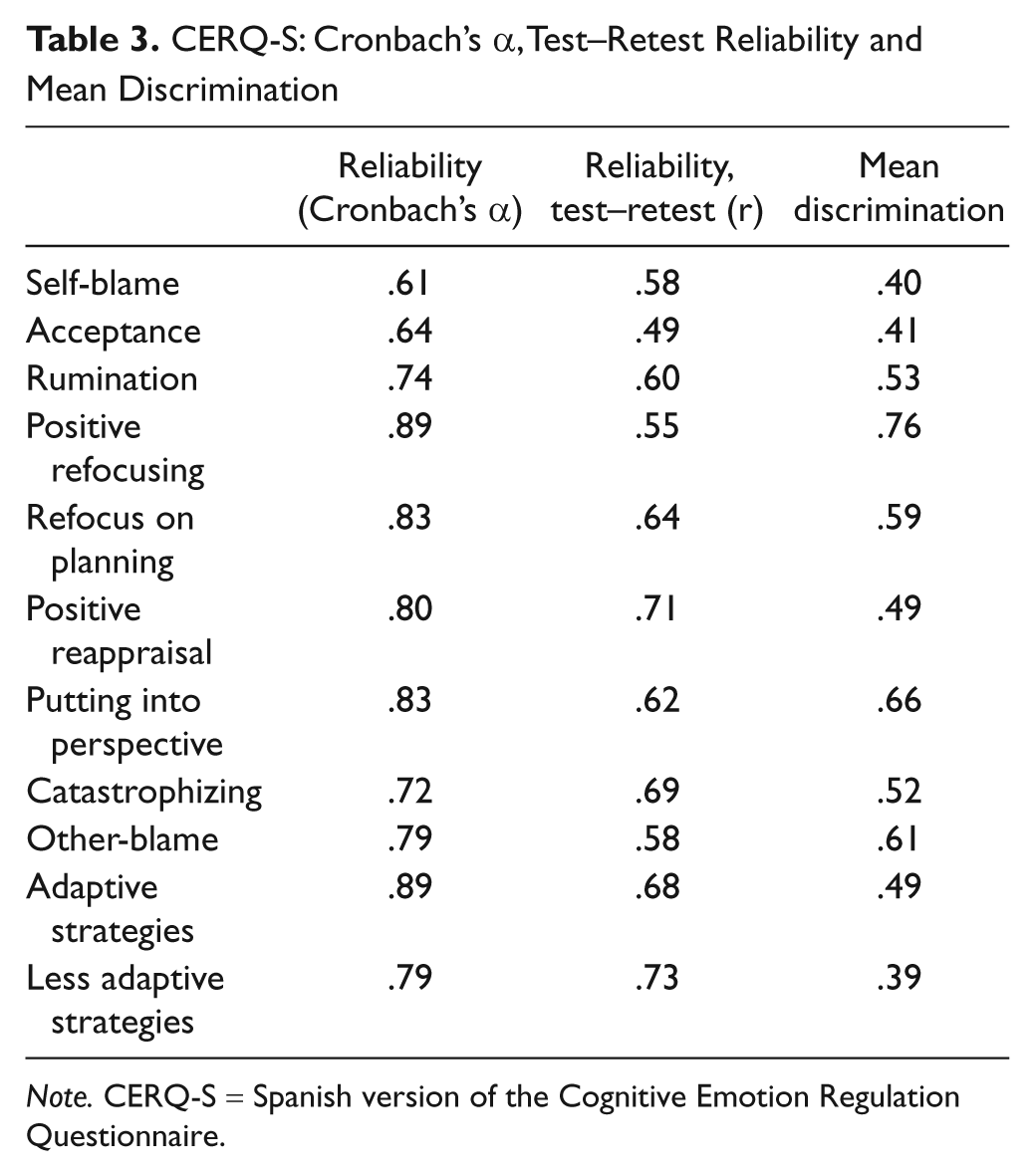
Note. CERQ-S = Spanish version of the Cognitive Emotion Regulation Questionnaire.
Applying a multivariate analysis of covariance (MANCOVA), with age as covariable, we found differences between men and women in cognitive strategies of emotional regulation: Wilks’s λ = .93; F(9, 560) = 4.75; p = .000; η2 = .071. Females scored higher on Rumination, F(1, 570) = 8.84, p = .003, η2 = .015; Putting into perspective, F(1, 570) = 6.64, p = .010, η2 = .012; Catastrophizing, F(1, 570) = 5.02, p = .025, η2 = .009; and Self-blame, F(1, 570) = 3.59, p = .059, η2 = .006. Males scored higher on Other-blame: F(1, 570) = 4.27, p = .039, η2 = .007. We also found significant differences related to age: Wilks’s λ = .94, F(9, 560) = 4.19, p = .000; η2 = .063. The older the participant, the less the Catastrophizing (r = −.21, p < .01) and Other-blame (r = −.10, p < .05), and the greater the Positive reappraisal (r = .09, p < .05).
Criterion Validity
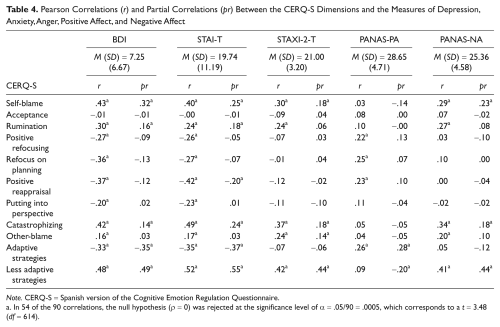
To analyze the criterion validity, we calculated the Pearson bivariate correlation index between each of the CERQ-S subscales and the scores on (a) depression (BDI), (b) trait anxiety (STAI-T), (c) trait anger (STAXI-2-T), (d) positive affect (PANAS-PA), and (e) negative affect (PANAS-NA). Given the interrelation between the CERQ-S scales, we also obtained the partial correlation between each subscale and each one of the measures referred to above, controlling in each case the effect of the remaining subscales (Table 4). Given the amount of correlation estimated, the threshold level of significance was adjusted using the Bonferroni correction.
Pearson Correlations (r) and Partial Correlations (pr) Between the CERQ-S Dimensions and the Measures of Depression, Anxiety, Anger, Positive Affect, and Negative Affect
Note. CERQ-S = Spanish version of the Cognitive Emotion Regulation Questionnaire.
In 54 of the 90 correlations, the null hypothesis (ρ = 0) was rejected at the significance level of α = .05/90 = .0005, which corresponds to a t = 3.48 (df = 614).
In the measures of depression (BDI) and anxiety (STAI-T), the correlations obtained with the CERQ-S dimensions, except that of Acceptance, obtained a significance level of p < .01. However, once the influence of the remaining subscales on each one of the dimensions had been controlled by means of partial correlations, the relationship disappeared between depression and the strategies of Positive refocusing, Refocus on planning, Positive reappraisal, Putting into perspective, and Other-blame. In anxiety, relations were only maintained in a positive manner with Self-blame, Rumination, and Catastrophizing and, inversely, with Positive reappraisal. On the other hand, both the adaptive strategies and the less adaptive ones correlated significantly with depression and anxiety, the former inversely and the latter positively. As regards trait anger (STAXI 2-T), the relation was maintained—once the influence for the other dimensions had been controlled—with Self-blame, Catastrophizing, and Other-blame, and there was a slight increase in the direct relationship between anger and the less adaptive cognitive strategies of emotional regulation. Finally, of all the Pearson correlations obtained between the CERQ-S subscales and positive and negative affects (PANAS), in the partial correlations the only relationships maintained were those between negative affect and the strategies of Self-blame and Catastrophizing.
Discussion
The CERQ-S fits the nine-factor model identified in the original version of this questionnaire (Garnefski et al., 2001). With a view to optimizing this fit, after an initial CFA, Items 19 and 21 were reassigned to other dimensions in a second model. Despite the fact that the translation of the items into Spanish was carried out following strict back-translation criteria, it may be that some cultural bias has influenced the meaning these items have for the participants in our study (see, in relation to this, Niedenthal, Barsalou, Winkielman, Krauth-Gruber, & Ric, 2005; Russell, 1991; Scherer & Brosch, 2009). Thus, bearing in mind the content validity, the interpretation of Item 19 (I think about the mistakes I have made in this matter) in our cultural context appears to be more closely related to reflection on the errors made than to an internal attribution of responsibility (Self-blame); consequently, this item would also measure Positive reappraisal. On the other hand, and in the particular context considered here, Item 21 (I want to understand why I feel the way I do about what I have experienced) appears more likely to connote a tendency for coping focused on analysis of the experience (Refocus on planning) than for reiterative thinking (Rumination) about it.
The CERQ-S emerges as a reliable instrument for measuring strategies of cognitive emotional regulation. The internal consistency of the subscales is generally good, and similar to that of other CERQ adaptations, though the Cronbach alphas of the Acceptance and Self-blame subscales are no more than acceptable; even so, both show values greater than .30 in average discrimination (Nunnally & Bernstein, 1994). These lower values may be because of the fact that Items 19 and 20 have created difficulties in both this and other adaptations; indeed, it has even been suggested that they do not exactly measure the factor to which they refer (Jermann et al., 2006). On the other hand, a certain stability is observed in the measurement of the cognitive strategies assessed through the CERQ-S: over an interval of 2 months, test–retest correlations ranging from acceptable to moderately strong were obtained.
The pattern of intercorrelation between the CERQ-S scales suggests the combined effect of different sets of cognitive strategies on emotional regulation; this is an aspect that would require detailed study through the use of canonical correlations between sets of coping strategies. The phenomenon in question, already described by Garnefski in her seminal work (Garnefski et al., 2001), has also been seen in other adaptations of the questionnaire (e.g., Martin & Dahlen, 2005; Zhu et al., 2008). In the present study, the strategies making up these sets varied according to the depressive symptoms, to the extent to which the person showed the emotional traits of anxiety and anger, and to the valence of the person’s affective state (positive or negative). In this sense, and considering the psychopathological aspects, the results indicate a close relationship between, on one hand, the cognitive emotional regulation strategies of Rumination, Catastrophizing, Self-blame, and Positive reappraisal (in the latter case an inverse relationship), and on the other, reports of anxiety and depressive symptoms. Moreover, reported depressive symptoms show a high inverse relationship to the strategies of Refocus on planning and Positive refocusing.
The relationship between the strategies and the presence of anxiety and depression symptoms shows a surprising level of cross-cultural stability. They are present in the adaptations with samples from Holland (Garnefski et al., 2001; Garnefski, Legerstee, Kraij, Van den Kommer, & Teerds, 2002), Switzerland (Jermann et al., 2006), and North America (Martin & Dahlen, 2005). But there are also idiosyncrasies (see Zhu et al., 2008), which suggest the existence of a cultural stamp of identity that determines the pattern of cognitive emotional regulation strategies and their impact on the emotional process (see Mesquita & Albert, 2007). Such cultural influence would explain, for example, the fact that in collectivist models (e.g., Chinese), the use of cognitive strategies that attribute the causes of a stressful event to others (Other-blame) are associated with high levels of anxiety (Zhu et al., 2008), whereas in individualist models (e.g., Spanish and Dutch), there is no such type of association. Likewise, cognitive strategies (e.g., Positive reappraisal) that contribute to a reappraisal of the stressful event in terms that favor personal growth are only associated with low levels of anxiety and depression in individualist cultural models. However, in collectivist models there is a preference for the use of more impersonal emotional regulation strategies (Positive refocusing). Even so, beyond this initial analysis, future research needs to identify the factors underlying these cross-cultural differences and their repercussions for the functionality of these types of strategy.
It is also the case in the present study that the strategies of Self-blame, Other-blame, Catastrophizing, and, in an inverse fashion, Putting into perspective, are related to greater propensity to experience feelings of anger. The first two strategies involve causal attribution processes linked to the dimensions of internalized and externalized anger (Spielberger, 1988), which have shown themselves to be predictive of anxious and depressive symptomatology (Bridewell & Chang, 1997). The association between Catastrophizing and the anger trait has also been observed in other studies (e.g., Martin & Dahlen, 2004, 2005). This relationship emerges as modulated by biases in information processing (e.g., erroneous estimation of probabilities, dramatic and extremely negative appraisals) that exacerbate the feeling of anger (Deffenbacher, 1993). Conversely, we can assume that the Putting into perspective strategy facilitates the recovery of emotional equilibrium on relativizing the relevance and extent of the event that sparked the anger.
As regards the relationship between cognitive coping styles and the experience of positive and negative affect as assessed by the PANAS, it is observed that the strategies of Positive refocusing and Positive reappraisal are related to the activation of affects with positive valence, whereas the Self-blame strategy has a negative effect on this type of affective activation. In turn, Self-blame, Catastrophizing, Other-blame, and Rumination are associated with the activation of affects with negative valence, whose emergence, indeed, is inhibited by the use of the Positive refocusing strategy. Thus, the CERQ-S could prove a useful instrument in prevention programs insofar as positive and negative affects are predictive of anxiety and depressive conditions (Dyck, Jolly, & Kramer, 1994; Jolly, Dick, Kramer, & Wherry, 1994).
As in previous studies, the dimensions of the instrument are found to be summarized in two second-order factors, referred to as adaptive and less adaptive strategies (Garnefski et al., 2001; Jermann et al., 2006). However, this dichotomic classification is of little help in defining the functionality of cognitive strategies (Garnefski & Kraaij, 2007). In our view, this kind of grouping may be indicative not so much of the adequacy or adaptivity of the emotional regulation, but rather its direction. Thus, faced with a negative or unpleasant event, some people will react by trying to mitigate its emotional effect (e.g., by applying Cognitive reappraisal or Putting into perspective to attenuate a feeling of anger), whereas others will indulge this effect (e.g., applying Catastrophizing or Other-blame, which facilitate feelings of anger). In sum, we can speak of “synergic” and “antagonistic” strategies. The choice of one type of strategy or the other might be determined by different factors—attributional styles, expectations, goals, personality characteristics, and so on—, whose involvement in processes of emotional regulation should be analyzed in future research.
As a corollary, we can state that the present study shows how the CERQ-S, similar to its original version, fits well with a model made up of nine emotional regulation strategies, and that these are grouped in accordance with two second-order factors (synergic vs. antagonistic strategies). Likewise, the data obtained indicate that the CERQ-S is a valid instrument for measuring cognitive strategies of emotional regulation. In this sense, the study replicates the results obtained in previous works in relation to depression, anxiety, and the emotional trait of anger and increases support for the validity of the CERQ as an instrument applicable to normalized states of affectivity. Nevertheless, despite this first successful step in the process of obtaining evidence of validity in Spanish population in support of the use of this questionnaire, we feel there is a need—to rule out sources of systematic variation—for in-depth study of the structural invariance and the invariance of the measurement model according to different groups, such as those of gender.
Finally, this study has some limitations that should be borne in mind. On one hand, although one of the strengths of the study is the sample size employed, its composition (90% of university students) is too homogeneous, and this affects the generalization of the results obtained. On the other hand, both gender and age are unequally represented in the sample, so that it is not viable to analyze the use of emotional regulation strategies according to these variables. Finally, it should be pointed out that the relationships between certain emotional regulation strategies and the presence of depression and anxiety symptoms were observed in a sample of healthy persons, so that these results cannot be extrapolated to clinical samples.
Footnotes
Declaration of Conflicting Interests
The authors declared no potential conflicts of interests with respect to the authorship and/or publication of this article.
Funding
Financial support for this work was provided by the Research Promotion Plan of the National Distance University of Spain (UNED; 2010).