




Abstract
The purpose of this study was to determine whether the Psychological Inventory of Criminal Thinking Styles (PICTS) was capable of predicting recidivism in 322 male sex offenders released from prison-based sex offender programs in a Midwestern state. The Static-99R and PICTS General Criminal Thinking (GCT), Reactive (R), and Entitlement (En) scores all correlated significantly with general recidivism, the Static-99R correlated significantly with violent recidivism, and the Static-99R score and PICTS GCT, Proactive (P), and En scores correlated significantly with failure to register as a sex offender (FTR) recidivism. Area under the curve effect size estimates varied from small to large, and Cox regression analyses revealed that the PICTS En score achieved incremental validity relative to the Static-99R in predicting general recidivism and the PICTS GCT, P, and En scores achieved incremental validity relative to the Static-99R in predicting FTR recidivism. It is speculated that the PICTS in general and the En scale in particular may have utility in risk management and treatment planning for sex offenders by virtue of their focus on antisocial thinking.
Sex offenders present a number of conceptual and practical challenges to researchers, clinicians, and policymakers. The conceptual challenge presented by sexual offending is whether and to what extent research conducted on nonsex offenders applies to individuals who have been convicted of a sexual crime. There is evidence, for instance, that sexual offending is underpinned by general antisocial and sexual deviance tendencies (Hanson & Bussiere, 1998; Knight, 1999). Research further indicates that sexual offending is both similar to and distinct from nonsexual offending: It is similar to nonsexual offending to the extent that both fall along the full length of the general antisocial dimension, but it is distinct from nonsexual offending in the sense that only sexual offending appears to fall along the sexual deviance dimension (Knight & Thornton, 2007). The practical challenge presented by sexual offending is that observed levels of recidivism are often lower in sex offenders than they are in nonsex offenders (Langan, Schmitt, & Durose, 2003). This could mean one of two things: that sex offenders are less active than nonsex offenders or that sexual offenses, particularly sexual offenses against children, are more likely to go unreported than nonsex offenses (Gilbert et al., 2009).
Criminal thinking is referenced sporadically in the sex offender literature, with the primary emphasis being on offense-specific cognitive distortions (Ward, Hudson, Johnson, & Marshall, 1997). Accordingly, there is not a great deal of research addressing whether general antisocial attitudes contribute to sexual offending. Of the handful of studies that have been conducted on this issue, both general antisocial cognition and an attitude of entitlement have been documented in the thinking of sex offenders (Ward et al., 1997). There is very little consensus, however, on the role, if any, that antisocial cognition plays in sexual offending (Hatch-Maillette, Scalora, Huss, & Baumgartner, 2001). An attitude of entitlement may be particularly salient in sex offenders, but in most studies on sex offenders, entitlement is measured specific to a man’s attitude toward sex or masculinity (Hanson & Harris, 2000; Hill & Fischer, 2001; Pemberton & Wakeling, 2009). In one of the few studies to explore the relationship between a general sense of entitlement and sexual offending, Mills, Anderson, and Kroner (2004) determined that sex offenders were no more likely to express antisocial entitlement than nonsex offenders but that antisocial entitlement beliefs correlated significantly higher with prior incarcerations in sex offenders than they did in nonsex offenders.
Adopting a confirmatory factor analytic and item response theory framework, Walters, Hagman, and Cohen (2011) introduced a hierarchical model of criminal thinking consisting of three levels. Positioned at the bottom of this hierarchy are seven specific criminal thinking styles (mollification, entitlement, power orientation, superoptimism, cutoff, cognitive indolence, discontinuity). The next level of the hierarchy consists of two overlapping higher order factors: a proactive or cold-blooded/scheming factor and a reactive or hot-blooded/impulsive factor. The first four thinking styles (mollification, entitlement, power orientation, superoptimism) load onto the proactive factor, and the last three thinking styles (cutoff, cognitive indolence, discontinuity) load onto the reactive factor. These two higher order factors then load onto a general superordinate factor labeled General Criminal Thinking (GCT) which is situated at the top of the hierarchy. All three levels of the hierarchy contribute to criminal and antisocial behavior, but their contributions may vary based on the type of evaluation being conducted. Whereas the superordinate factor provides the best estimate of a person’s overall criminal thinking, the proactive and reactive dimensions and the individual thinking styles provide valuable information on how criminal thinking is expressed (e.g., scheming vs. impulsive; mollification [excuse-making] vs. entitlement [permission-giving]).
Walters et al.’s (2011) conceptualization of criminal thinking has been operationalized in scales, scores, and indicators from the Psychological Inventory of Criminal Thinking Styles (PICTS; Walters, 1995). In an attempt to understand the relationship between criminal thinking and sexual offending, Walters, Deming, and Elliott (2009) administered the PICTS to a large group of male offenders undergoing sex offender treatment in the Indiana Department of Corrections (IDOC). Using factor and correlational analysis, they discovered that the PICTS seemed to operate in much the same manner with sex offenders as it did with nonsex offenders. First, the factor structure of the PICTS was similar to what has been reported in nonsex offenders: a hierarchical organization marked by two higher order factors, proactive and reactive criminality. Second, the PICTS was found to correlate differentially with the two Static-99/99R (Hanson & Thornton, 2000) factors. The Static-99/99R is the most commonly used actuarial risk measure for sex offender evaluations in North America (Fabian, 2006), and its ability to predict sexual (Cohen’s d = .70) and nonsexual (Cohen’s d = .58) recidivism in sex offenders is well documented (Hanson & Morton-Bourgon, 2009). In the Walters et al. (2009) investigation, the PICTS GCT score correlated significantly with the Static-99 total score and the general antisocial subscale but not with the sexual deviance subscale, and the proactive criminal thinking (P) score correlated twice as high with the general antisocial subscale of the Static-99 as it did with the sexual deviance subscale.
Harris and Hanson (2004) determined that 14% of sex offenders recidivate within 5 years of release, 20% recidivate within 10 years of release, and 24% recidivate within 15 years of release, using official police records as the criterion, although these numbers vary as a function of demographics and criminal history and represent the lower limit of offending. In an effort to overcome the practical challenge presented by sexual offense underreporting, researchers have begun measuring sex offender recidivism in a number of different ways. One way is to examine general as well as sexual recidivism. Another way is to include all violations leading to incarceration based on the understanding that probation/parole officers and prosecutors will sometimes take the more rapid and certain route in dealing with problematic probationers and parolees (violating the offender’s parole or probation and sending him or her to prison) rather than taking a chance on a long, expensive, and less than certain trial. A third way researchers attempt to measure recidivism is by gauging the extent to which individuals fail to register (FTR) with the police as sex offenders. Although FTR as a sex offender may not predict future sexual offending (Duwe & Donnay, 2010; Levenson, Letourneau, Armstrong, & Zgoba, 2010; Zgoba & Levenson, 2012), it has been found to predict general recidivism (Washington State Institute for Public Policy, 2006) and may tap into the antisocial or rule-breaking component of sexual offending (Levenson et al., 2010). It is therefore important that failure to report as a sex offender also be considered an outcome potentially predicted by the PICTS.
The purpose of this study was to determine whether the PICTS, as a measure of criminal thought process, is capable of predicting postrelease outcomes in sex offenders released from prison after participating in sex offender treatment once the Static-99R has been controlled. Based on the fact that released sex offenders are six to seven times more likely to be arrested for a new nonsexual offense than they are to be arrested for a new sexual offense (Langan et al., 2003), three outcome measures were considered for inclusion in this study: general recidivism, violent recidivism (sexual recidivism plus arrests for nonsexual violent crimes like robbery and assault), and FTR as a sex offender recidivism. Three principal hypotheses were tested in this study using the three-level criminal thinking hierarchy proposed by Walters et al. (2011). The first hypothesis stated that the PICTS GCT score would predict general, violent, and FTR recidivism and in so doing demonstrate incremental validity relative to the Static-99R. The second hypothesis proposed that the PICTS P and R scores would predict all three forms of recidivism and achieve incremental validity relative to the Static-99R. The third hypothesis held that one or more of the PICTS thinking style scales would predict all three forms of recidivism and predict above and beyond the contributions of the Static-99R. Although thinking style predictors of recidivism were not identified a priori, the Cutoff (Co), Discontinuity (Ds), and Entitlement (En) scales are generally the strongest thinking style predictors of recidivism available on the PICTS (Walters, 2002, 2012a), and so special attention was directed at the En scale given its role in prior cognitively based sex offender research.
Method
Participants
All sex offenders entering the IDOC are routinely offered sexual offender treatment once they enter the system. The original sample of 591 male sex offenders from the Walters et al. (2009) investigation represented 97% of all sex offenders entering the Indiana state system between January 1, 2007, and October 31, 2008. As part of the routine clinical treatment protocol, all participants were scored on the Static-99R and administered the PICTS. Licensed mental health professionals scored the Static-99R and administered the PICTS to inmates outside their cells in small groups of four to five inmates. Of the 591 sex offenders who entered treatment between 2007 and 2008, 357 were released from custody before January 1, 2012. A comparison of the 357 releases and 234 nonreleasees revealed no significant group differences in age, race, marital status, offense, Static-99R score, or sentence, although releasees had more years of education (M = 11.70, SD = 2.06) than nonreleasees (M = 11.24, SD = 2.15), t(589) = 2.59, p < .05.
Twelve of the 357 released program participants were removed from the study because their PICTS protocol was clearly invalid (Confusion-revised ≥ T score of 95 [raw score of 27] or Defensiveness-revised ≥ T score of 65 [raw score of 28]), and another 23 were removed because they possessed fewer than 9 years of education (the grade level that falls just above the mean reading level, 8.2 [Walters, 2013], of the PICTS items). Comparisons between the 322 individuals who served as participants in this study and the 35 individuals who were removed because of an invalid PICTS or an educational level below the ninth-grade level failed to identify any group differences in race, marital status, confining offense, or prior sentence (p > .10) but did indicate that removed individuals were slightly older (M = 40.77, SD = 13.78) than those who ended up as participants in this study (M = 36.35, SD = 11.95), t(355) = 2.05, p < .05.
More than three quarters of the individuals who participated in this study were White (n = 249, 77.3%), with the remainder of the sample being Black (n = 69, 21.4%), Hispanic (n = 3, 0.9%), or Native American (n = 1, 0.3%). The marital breakdown was 59.6% single, 16.1% married, 23.9% divorced or separated, and 0.3% widowed. Approximately half the participants in the current sample (n = 160, 49.7%) had been serving a sentence for extrafamilial child molestation (all victims < 16 years old), 69 (21.4%) had been serving a sentence for intrafamilial child molestation (all victims <16 years old), 58 (18.0%) had been serving a sentence for rape or sexual assault on a victim 16 years of age or older, 13 (4.0%) had been serving a sentence for a noncontact sexual offense involving children (e.g., possession of child pornography, solicitation of a minor), 7 (2.2%) had been serving a sentence for a noncontact sexual offense involving adults (e.g., exhibitionism, voyeurism), and 15 (4.7%) had been serving a sentence for a miscellaneous sexual offense or a nonsexual crime.
Measures
The PICTS (Walters, 1995) is an 80-item self-report measure designed to assess criminal thought process. Each PICTS item is rated on a 4-point Likert-type scale (1 = disagree, 2 = uncertain, 3 = agree, 4 = strongly agree), and scores are derived by summing item responses for all items contributing to a particular scale. The 80 PICTS items are organized into two 8-item validity scales, Confusion-revised (Cf-r) and Defensiveness-revised (Df-r), and eight 8-item thinking style scales, Mollification (Mo), Cutoff (Co), Entitlement (En), Power Orientation (Po), Sentimentality (Sn), Superoptimism (So), Cognitive Indolence (Ci), and Discontinuity (Ds). One of the eight original thinking styles (Sn) failed to load onto a GCT factor in a confirmatory factor analytic/item response theory analysis of the PICTS (Walters et al., 2011), and so only the 7 thinking style scales that did load onto the GCT factor (Mo, Co, En, Po, So, Ci, Ds) were included in the present study. These 7 thinking style scales are summed to form three higher order scores: a proactive criminal thinking (P) scale (Mo + En + Po + So), a reactive criminal thinking (R) scale (Co + Ci + Ds), and a GCT score (Mo + Co + En + Po + So + Ci + Ds). The reliability, validity, and dimensionality of the PICTS items and scales have been found to be adequate, with scores on the GCT achieving the strongest reliability and validity of any of the scales on the PICTS (Walters, 2002, 2013; Walters et al., 2011; Walters & Geyer, 2005). Internal consistency (α) coefficients of .94, .89, .92, and .61 were obtained in the current study for the GCT, P, R, and En, respectively.
The Static-99/99R (Hanson & Thornton, 2000) is a brief actuarial rating scale composed of 10 static-historical items derived by combining nonredundant items from the Rapid Risk Assessment for Sex Offence Recidivism (Hanson, 1997) and Thornton’s Structured Actuarial Clinical Judgment–Minimum (Grubin, 1998). The Static-99 and Static-99R are identical except for the age item, which is scored dichotomously on the Static-99 (18-24.9 = 1; 25 and older = 0) but divided into four categories on the Static-99R (18-34.9 = 1; 35-39.9 = 0; 40-59.9 = −1; 60 and older = −3). Because the two versions of the Static-99/99R correlated highly in the current sample (r = .86, p < .001) and vary only on the scoring of one item, the most recent version (Static-99R), and the one most likely to be used in present-day sex offender evaluations, was employed in this study. Scores on the Static-99R can be organized into four levels of risk: low risk (−3 to 1), low-moderate risk (2 or 3), moderate-high risk (4 or 5), and high risk (6 or higher). As an actuarial risk measure for sexual offending, the Static-99R possesses adequate test–retest reliability and moderately strong predictive validity (Hanson & Morton-Bourgon, 2009). In addition, it contains the two primary predictors of criminal recidivism: age and criminal history (Gendreau, Little, & Goggin, 1996).
Procedure
Three factors have been found to negatively impact on the predictive validity of the PICTS: invalid responding, poor reading ability, and a long delay between the completion of the PICTS and the start of the follow-up period. Invalid responding was defined as protocols with 20 or more missing items, a Cf-r raw score of 27 (T score = 95) or higher, or a Df-r raw score of 28 (T score = 66) or higher. Education was used as a proxy for reading skills and given that the mean reading level for items on the PICTS is 8.2 years (Walters, 2013), individuals with less than 9 years of formal education were removed from the sample. Finally, the longest delay between administration of the PICTS and release from prison was 51 months. Based on previous research (Walters, 2009b) this is considered a moderate delay between testing and release and was therefore not viewed to be of sufficient length to necessitate removal of any more participants from the study.
The IDOC data base was reviewed to determine which participants were arrested and reincarcerated during the follow-up period that began on January 1, 2007, and ended on December 31, 2012. The presence of an arrest, the date of arrest, and the type of offense for which the individual was arrested were all recorded. General recidivism was defined as any arrest leading to reincarceration in the IDOC during the follow-up period. Because there were only two participants who committed new sexual offenses and seven additional participants who committed new nonsexual violent offenses (robbery, assault), these two groups of offenses were merged into a single category labeled violent recidivism. Any arrests leading to reincarceration in the IDOC for failing to register as a sex offender during the follow-up period were classified as FTR recidivism. Based on the belief that child sex offenders and adult sex offenders differ in important ways (Knight & Thornton, 2007), supplemental analyses were conducted on each group separately. Permission to conduct this study was provided by the IDOC and Kutztown University Institutional Review Board.
Three different statistical procedures were employed in this study. First, point–biserial correlations were computed between the Static-99R and the PICTS GCT, P, R, and En scores, on the one hand, and general, violent, and FTR recidivism, on the other hand. Second, standard and time-dependent receiver operating characteristic (ROC) analyses were performed on the Static-99R and GCT, P, R, and En scores to determine each measure’s strength in accurately predicting general, violent, and FTR recidivism. The time-dependent ROC analyses were conducted with a time frame (t) of 36 months, the time frame that provided the best balance between maximizing recidivism cases and minimizing censored cases. These analyses were implemented with a Kaplan–Meier estimator, and confidence intervals were calculated from the influence function of the estimator. Third, a series of Cox proportional-hazards regression analyses for survival data were conducted using the Static-99R, the GCT, P, and R, and the seven PICTS thinking style scales as predictors and general, violent, and FTR recidivism as outcomes. Cox regression calculates a hazard ratio from time (until event) and event (censored or uncensored) data. The Cox hazard ratio can be interpreted as an individual’s probability of surviving (not experiencing general, violent, or FTR recidivism) through the end of the follow-up period. The time-dependent ROC analyses were calculated with an R program (R Core Team, 2013) developed by Paul Blanche (Blanche, Dartigues, & Jacqmin-Gadda, 2013), and the point-biserial correlations, standard ROC analyses, and the Cox regression analyses were calculated with SPSS, Version 17.0 (SPSS, 2008).
Results
The base rates of general, violent, and FTR recidivism in this sample were 18.3%, 2.8%, and 10.2%, respectively, and the average length of follow-up was 42.02 months (SD = 13.86). Descriptive statistics for the five main predictor variables (Static-99R, GCT, P, R, and En) and three outcome measures (general recidivism, violent recidivism, and FTR recidivism) and zero-order correlations between these eight variables can be found in Table 1. In partial support of the three hypotheses tested in this study, the point-biserial correlations between the predictor and outcome variables revealed that the PICTS GCT and R scores predicted general and FTR recidivism (rpb = .12-.17), the PICTS P score predicted FTR recidivism (rpb = .19), and the PICTS En scale predicted general and FTR recidivism (rpb = .19-.24). As indicated by the results listed in Table 2, area under the curve (AUC) effect size estimates ranged from null to high for the Static-99R (.509-.770) and from modest to moderately high for the GCT, P, R, and En (.568-.702), based on effect size equivalencies provided by Rice and Harris (2005).
Descriptive Statistics and Correlations for Predictor and Outcome Variables.
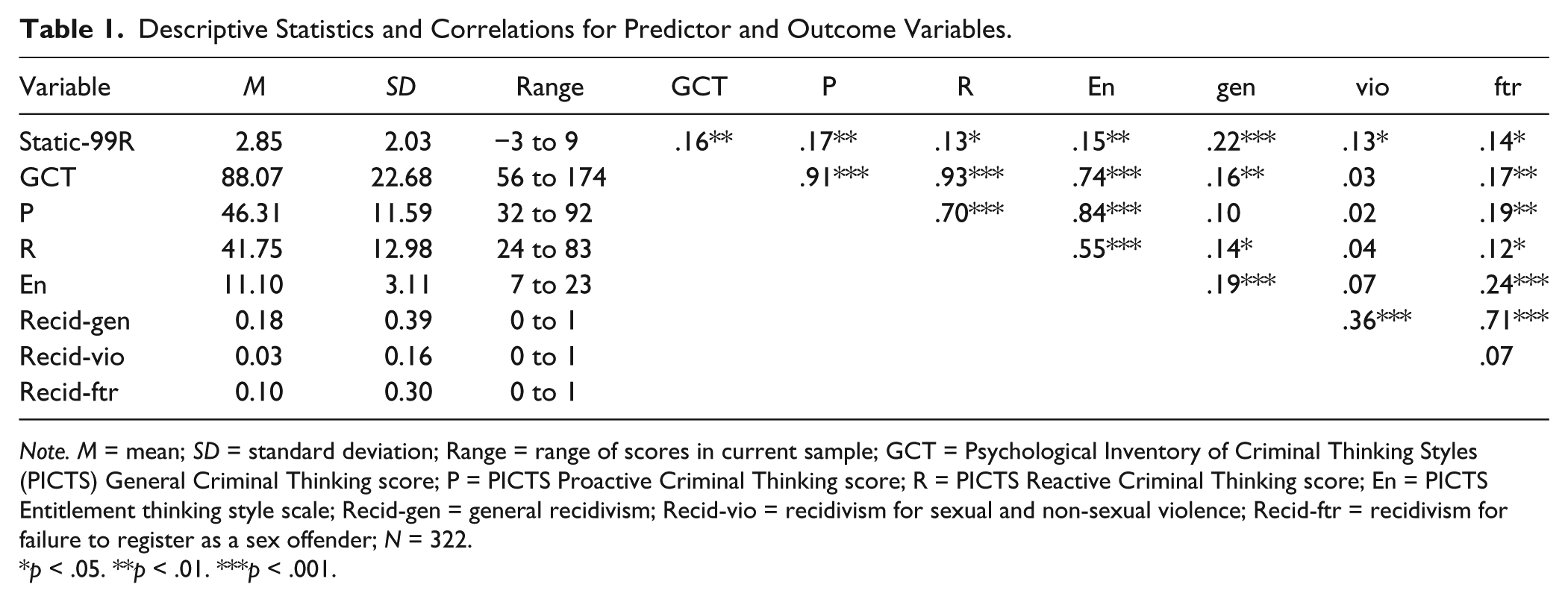
Note. M = mean; SD = standard deviation; Range = range of scores in current sample; GCT = Psychological Inventory of Criminal Thinking Styles (PICTS) General Criminal Thinking score; P = PICTS Proactive Criminal Thinking score; R = PICTS Reactive Criminal Thinking score; En = PICTS Entitlement thinking style scale; Recid-gen = general recidivism; Recid-vio = recidivism for sexual and non-sexual violence; Recid-ftr = recidivism for failure to register as a sex offender; N = 322.
p < .05. **p < .01. ***p < .001.
Standard and Time-Dependent Receiver Operating Characteristic Analyses of Recidivism Prediction.
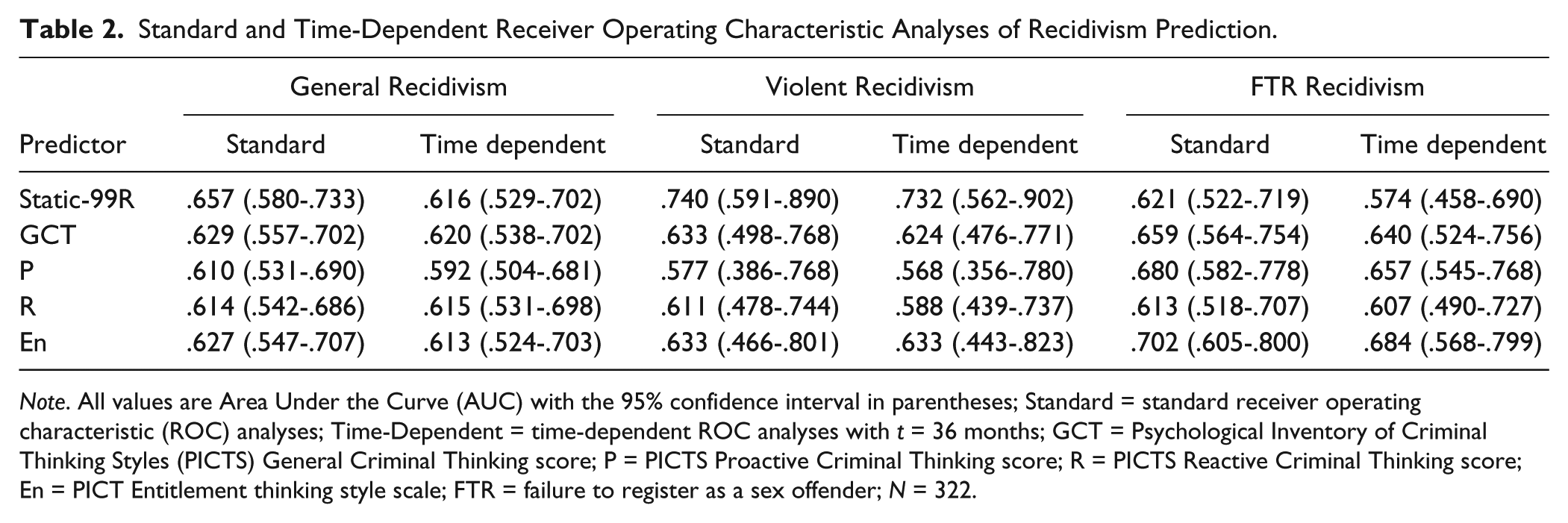
Note. All values are Area Under the Curve (AUC) with the 95% confidence interval in parentheses; Standard = standard receiver operating characteristic (ROC) analyses; Time-Dependent = time-dependent ROC analyses with t = 36 months; GCT = Psychological Inventory of Criminal Thinking Styles (PICTS) General Criminal Thinking score; P = PICTS Proactive Criminal Thinking score; R = PICTS Reactive Criminal Thinking score; En = PICT Entitlement thinking style scale; FTR = failure to register as a sex offender; N = 322.
Cox regression analyses revealed that in testing the first hypothesis, the GCT only achieved incremental validity relative to the Static-99R in predicting FTR recidivism (see Table 3). Results pertaining to the second hypothesis showed that when the P and R scores were included in a Cox regression analysis, only P recorded a significant effect and then only for FTR recidivism (see Table 4). Including all seven PICTS thinking styles in a Cox regression equation analysis with the Static-99R revealed that En successfully predicted general recidivism (p < .05) and FTR recidivism (p < .01) above and beyond the contributions of the Static-99R and the other six thinking style scales, findings consistent with the third hypothesis (see Table 5). A hazard ratio of 1.146 for En in the general recidivism analyses denotes that a one standard deviation increase in En predicted a 15% rise in the risk of general recidivism, holding the Static-99R score and the other six PICTS thinking style scales constant. A hazard ratio of 1.204 for En in the FTR analysis denotes that a one standard deviation increase in En predicted a 20% increase in the risk of FTR recidivism, holding the Static-99R and the other six thinking styles constant.
Cox Regression Analyses of General, Violent, and FTR Recidivism for the Static-99R and PICTS GCT Score.
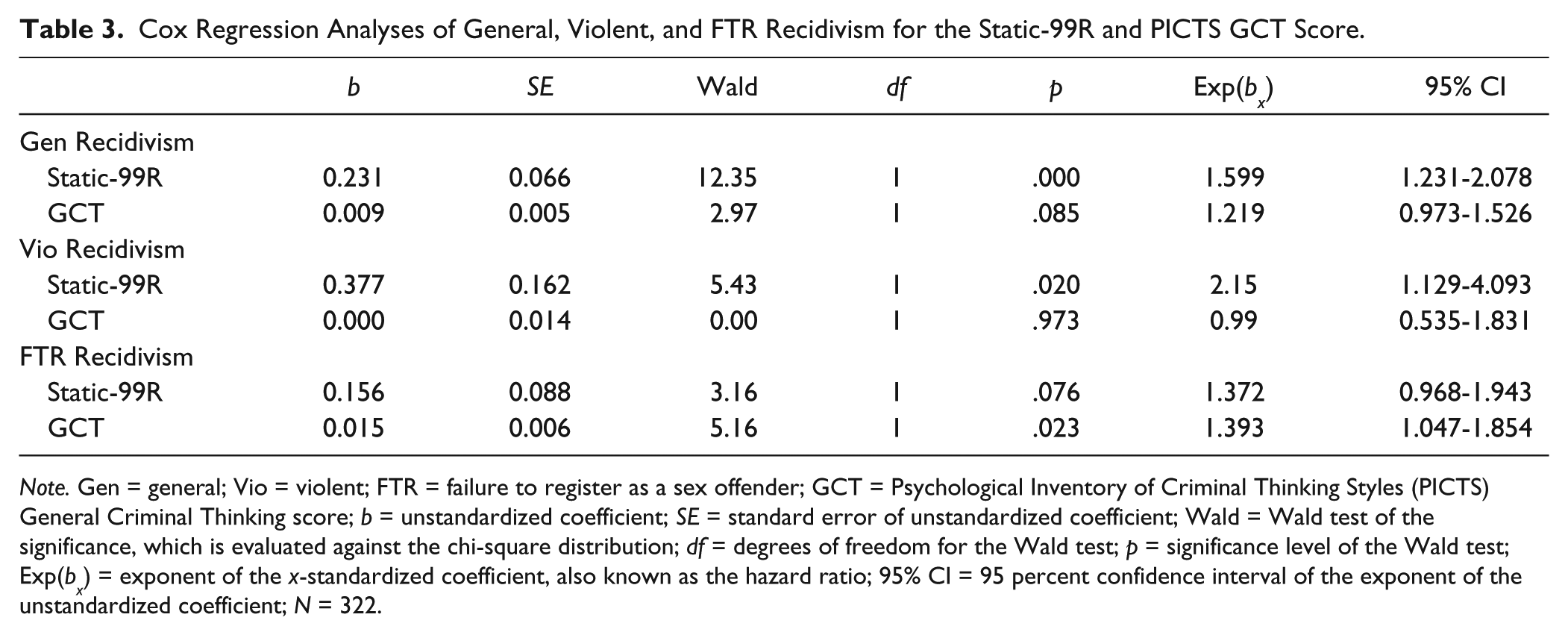
Note. Gen = general; Vio = violent; FTR = failure to register as a sex offender; GCT = Psychological Inventory of Criminal Thinking Styles (PICTS) General Criminal Thinking score; b = unstandardized coefficient; SE = standard error of unstandardized coefficient; Wald = Wald test of the significance, which is evaluated against the chi-square distribution; df = degrees of freedom for the Wald test; p = significance level of the Wald test; Exp(bx) = exponent of the x-standardized coefficient, also known as the hazard ratio; 95% CI = 95 percent confidence interval of the exponent of the unstandardized coefficient; N = 322.
Cox Regression Analyses of General, Violent, and FTR Recidivism for the Static-99R and PICTS P and R Scores.
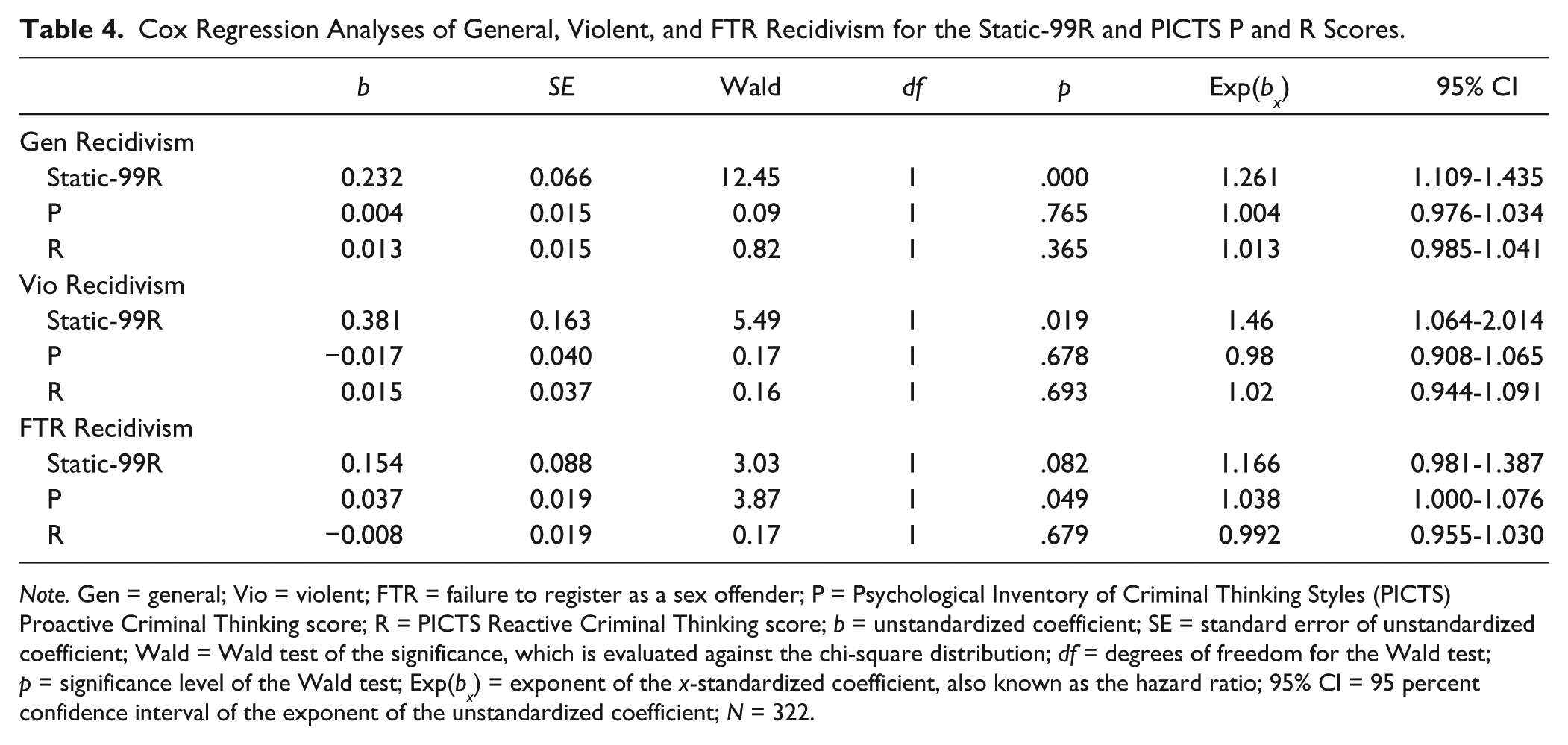
Note. Gen = general; Vio = violent; FTR = failure to register as a sex offender; P = Psychological Inventory of Criminal Thinking Styles (PICTS) Proactive Criminal Thinking score; R = PICTS Reactive Criminal Thinking score; b = unstandardized coefficient; SE = standard error of unstandardized coefficient; Wald = Wald test of the significance, which is evaluated against the chi-square distribution; df = degrees of freedom for the Wald test; p = significance level of the Wald test; Exp(bx) = exponent of the x-standardized coefficient, also known as the hazard ratio; 95% CI = 95 percent confidence interval of the exponent of the unstandardized coefficient; N = 322.
Cox Regression Analyses of General, Violent, and FTR Recidivism for the Static-99R and PICTS Thinking Style Scales.
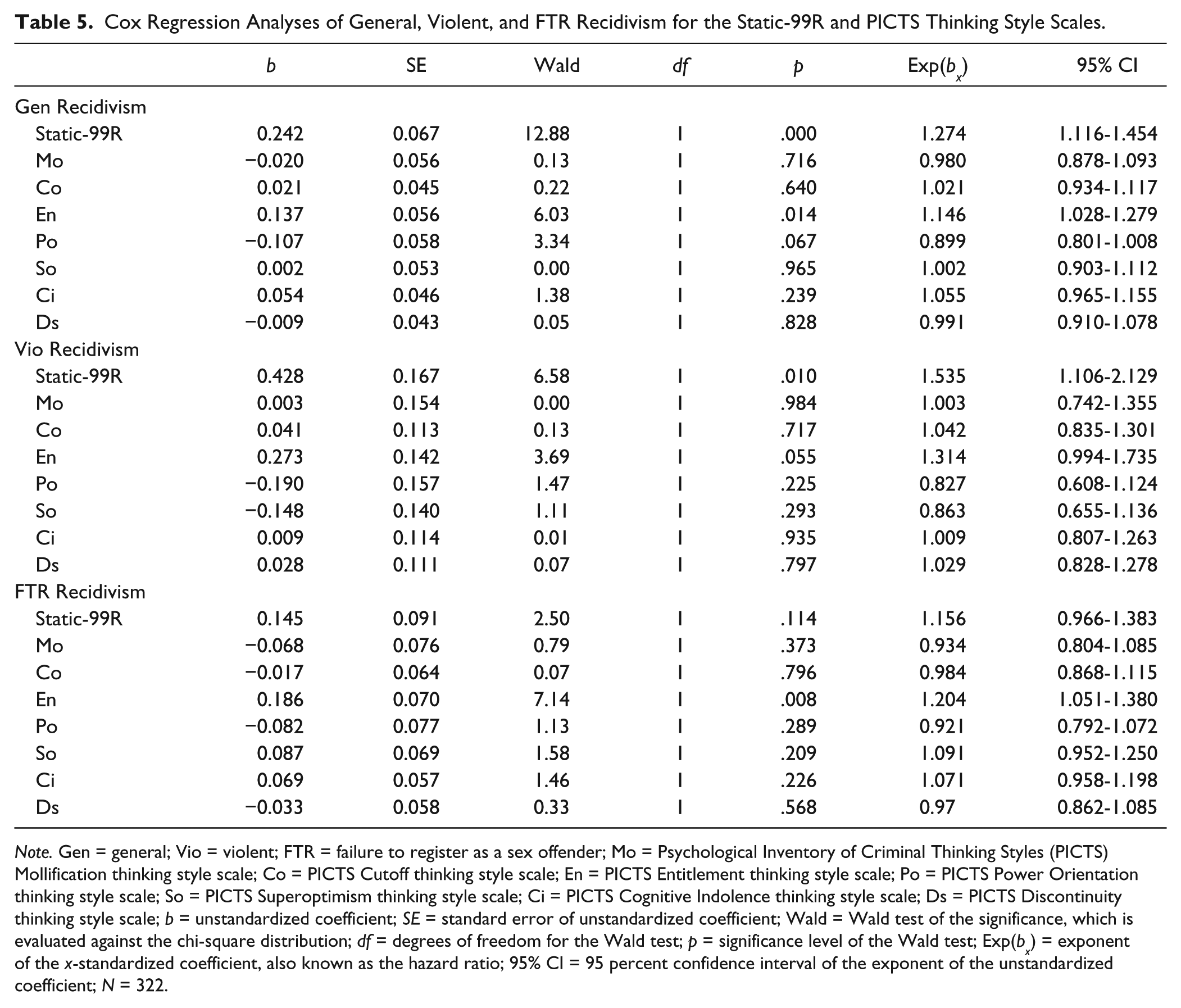
Note. Gen = general; Vio = violent; FTR = failure to register as a sex offender; Mo = Psychological Inventory of Criminal Thinking Styles (PICTS) Mollification thinking style scale; Co = PICTS Cutoff thinking style scale; En = PICTS Entitlement thinking style scale; Po = PICTS Power Orientation thinking style scale; So = PICTS Superoptimism thinking style scale; Ci = PICTS Cognitive Indolence thinking style scale; Ds = PICTS Discontinuity thinking style scale; b = unstandardized coefficient; SE = standard error of unstandardized coefficient; Wald = Wald test of the significance, which is evaluated against the chi-square distribution; df = degrees of freedom for the Wald test; p = significance level of the Wald test; Exp(bx) = exponent of the x-standardized coefficient, also known as the hazard ratio; 95% CI = 95 percent confidence interval of the exponent of the unstandardized coefficient; N = 322.
Additional analyses were conducted to test the ability of the antisocial and sexual deviance components of the Static-99R and the P and R dimensions of the PICTS to predict FTR recidivism. When the Stattic-99R was broken down into its general antisocial and sexual deviance components, along the lines suggested by Roberts, Doren, and Thornton (2002), the general antisocial subscale was found to correlate .11 (p = .05) with FTR recidivism, whereas the sexual deviance subscale failed to correlate with FTR recidivism (r = −.01, p = .90). When the GCT score was broken down into its P and R dimensions, the P scale—the dimension most likely to be associated with deliberate antisociality—correlated two thirds higher with FTR recidivism (r = .19, p < .001) than did the R scale (r = .12, p < .05).
Separate analyses were also conducted on participants whose confining offense involved sexual contact with a child (n = 229) or sexual contact with an adult (n = 58). The results, as presented in Table 6, showed that in participants whose confining offense involved sexual contact with a child, the Static-99R and PICTS GCT, P, R, and En scores achieved significant zero-order correlations with general and FTR recidivism. Cox regression analyses conducted on the child sex offending subsample revealed that the GCT was incrementally valid relative to the Static-99R in predicting general (Wald = 4.07, p < .05, Exp(bx) = 1.01 [1.00-1.02]) and FTR (Wald = 5.68, p < .05, Exp(bx) = 1.02 [1.00-1.03]) recidivism. 1 The En scale achieved a significant correlation with general recidivism in participants whose confining offense was a contact sexual offense against an adult, but none of the other variables, including the Static-99R, earned significant correlational or incremental validity results with participants in this subgroup.
Zero-Order Correlation and Area Under the Curve Effect Size Estimates for the Static-99R and PICTS GCT, P, R, and En Scores by Confining Offense.
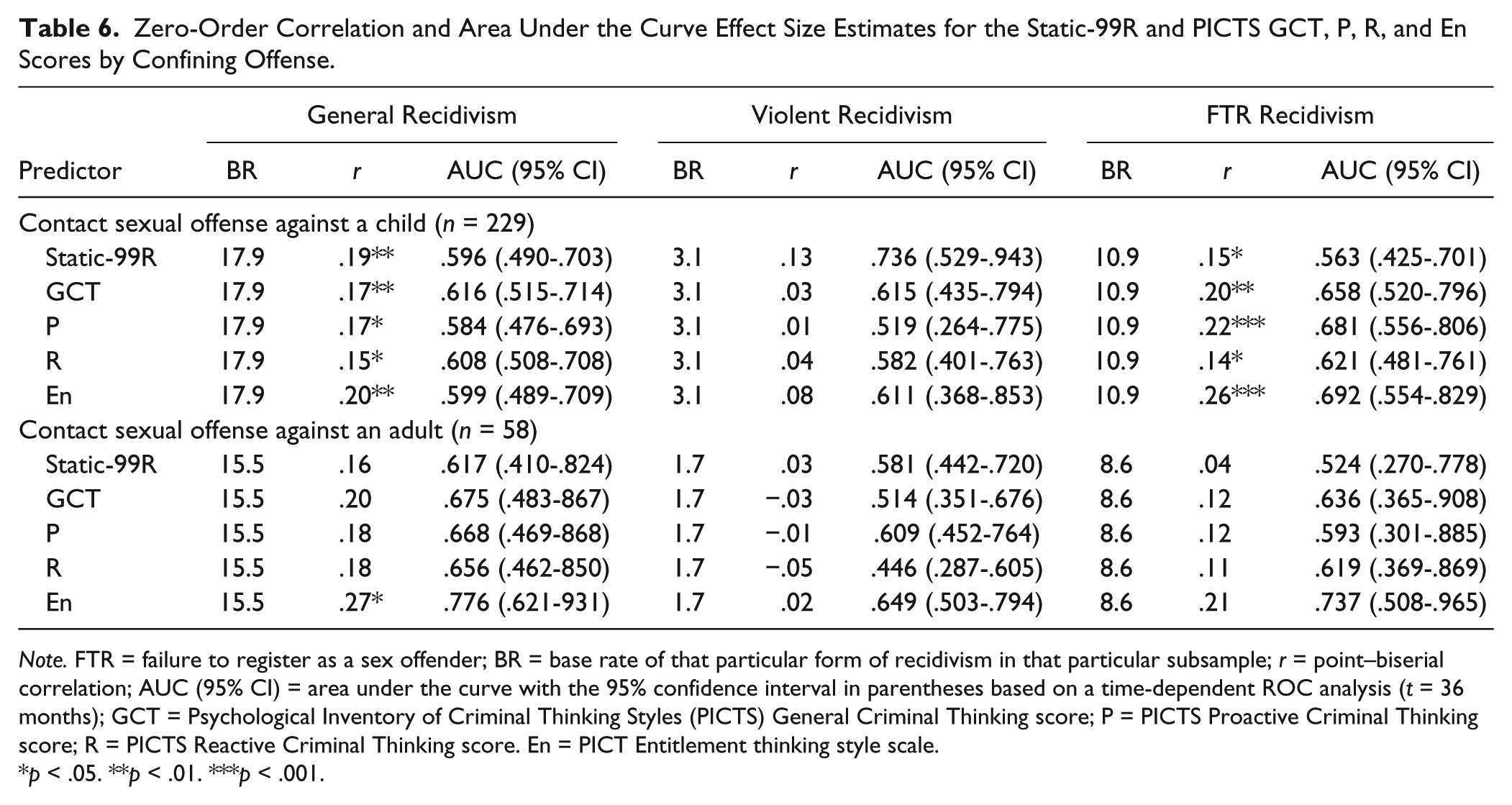
Note. FTR = failure to register as a sex offender; BR = base rate of that particular form of recidivism in that particular subsample; r = point–biserial correlation; AUC (95% CI) = area under the curve with the 95% confidence interval in parentheses based on a time-dependent ROC analysis (t = 36 months); GCT = Psychological Inventory of Criminal Thinking Styles (PICTS) General Criminal Thinking score; P = PICTS Proactive Criminal Thinking score; R = PICTS Reactive Criminal Thinking score. En = PICT Entitlement thinking style scale.
p < .05. **p < .01. ***p < .001.
Discussion
There were three hypotheses tested in this study, one for each level of the hierarchical model of criminal thinking proposed by Walters et al. (2011). The highest or superordinate level was represented by the PICTS GCT score, the middle level by the PICTS P and R scores, and the lowest level by the PICTS thinking style scales. PICTS scores representing the first two levels of the criminal thinking hierarchy predicted general and FTR recidivism, but only GCT and P attained incremental validity relative to the Static-99R and then only when predicting FTR recidivism. The En scale, on the other hand, not only correlated moderately with both general and FTR recidivism but also achieved incremental validity relative to the Static-99R and the other six PICTS thinking style scales. The zero-order correlations between the Static-99R and general recidivism outcome were significant but slightly below the mean effect size reported in a recent meta-analysis (r = .16-.22 vs. r = .26 [Hanson & Morton-Bourgon, 2009]) and the PICTS GCT, P, and R scores successfully predicted general recidivism at a level slightly below what has been reported for general offender populations (r = .10-.16 vs. r = .17-.20 [Walters, 2012b]).
Whereas the PICTS GCT, P, and R scores could be of assistance in sex offender evaluations, this role may not extend to risk prediction given that none of the higher level scores added incrementally to predictions of general or violent recidivism beyond the historical risk factor contributions of the Static-99R. By the same token, PICTS scales at all three levels of the criminal thinking hierarchy successfully predicted FTR recidivism even after accounting for participants’ scores on the Static-99R. To the extent that FTR recidivism reflects rule breaking and antisocial tendencies (Levenson et al., 2010), this makes sense. In fact, the general antisocial component of the Static-99R and PICTS P score correlated higher with FTR recidivism than did the sexual deviance component of the Static-99R and PICTS R score, respectively. Thus, if the PICTS GCT, P, and R scores are to play a role in risk prediction, this role may be restricted to the antisocial component of sexual offending.
In contrast to the largely negative incremental validity results attained by the GCT, P, and R scores for general recidivism, the En thinking style scale displayed incremental validity relative to the Static-99R and other PICTS thinking styles scales in predicting both general and FTR recidivism. This confirms previous research showing that sexual and masculine entitlement are salient features of the sex offending profile (Hanson & Harris, 2000; Hill & Fischer, 2001; Pemberton & Wakeling, 2009) and an attitude of general antisocial entitlement may be capable of identifying a more serious subgroup of sex offenders (Mills et al., 2004). Also, as was observed in the previous Mills et al. (2004) study, the En scale was not elevated relative to nonsex offending inmates from the PICTS normative sample (average T score of 42.5 for sex offenders compared with 50.0 for the normative sample), but did predict general recidivism in both child sex offenders and rapists. The current results consequently provide support for Mills et al.’s conclusion that entitlement in sex offenders is not restricted to themes of sexuality and masculinity but may actually reflect a more general attitude of entitlement. Further research is required to more fully evaluate this possibility, but it may be that the sexual and masculine entitlement frequently cited in the sex offender literature is simply an extension of a more general sense of entitlement.
One theoretical implication that can be drawn from this study is that criminal thinking contributes to recidivism in sex offenders just as it contributes to recidivism in nonsex offenders. Research reveals that there is an important antisocial component to sex offending (Hanson & Bussiere, 1998; Knight, 1999; Knight & Thornton, 2007), and previous research conducted on the PICTS indicates that the GCT score is more sensitive to this particular element of sex offending than it is to the sexual deviance component (Walters et al., 2009). When the results of the current investigation are considered in light of the previous Walters et al. (2009) study, we can see that criminal thinking is relevant to sexual offending primarily because of its relationship to the general antisocial component of sexual offending. The PICTS GCT, P, R, and En scores come under the classification of what Mann, Hanson, and Thorton (2010) refer to as psychologically meaningful risk factors. These individual propensities offer insight into what is going on within the individual and how the individual interacts with others. These consistencies in thought and behavior help shape a person’s environment, all of which are highly relevant to risk management.
A practical implication of these results is that the PICTS En scale, if not the full P score, may be useful in assessing both sexual-offending and nonsexual-offending inmates. Sex offenders who leave prison with an inflated sense of entitlement or who display other features of proactive criminal thinking (e.g., a cold, calculating, and manipulative approach to interpersonal situations) were significantly more likely to recidivate than sex offenders leaving prison without a strong sense of entitlement or other proactive criminal thinking tendencies. Hence, beliefs about personal privilege, uniqueness, and ownership could be considered risk factors for future recidivism in sex offenders about to be released from prison, and such attitudes could serve as targets for intervention before, during, and after release. The skill-based interventions found in most correctional programs are effective in reducing reactive criminal thinking but appear to have minimal impact on proactive criminal thinking patterns, of which entitlement is a prime example (Walters, 2009a). Intervention programs that challenge positive-outcome expectancies for sexual and nonsexual crime and strong efficacy expectancies for sexual and nonsexual offending will consequently be required to effectively manage entitlement beliefs.
A principal weakness of this study is the low base rate of sexual reoffending found in the sample. Less than 1% of the participants (2 out of 322) was rearrested and reincarcerated for a new sexual offense in a follow-up that averaged 42 months, making it impossible to evaluate sexual recidivism in this study. The use of untreated sex offenders, a longer follow-up period, and self-report outcome data, given the large dark figure of unreported crime (Coleman & Moynihan, 1996), might increase the base rate of sexual offending to the point where sexual recidivism can be properly evaluated. Treatment has been found to be effective with sex offenders (Lösel & Schmucker, 2005) and may be one reason why rearrests for sexual offenses were so low in the current sample of treated sex offenders. Studying untreated sex offenders might therefore provide a higher base rate of sexual reoffense than was possible with the current sample. Extending the period of follow-up might also serve to increase the base rate of sexual and violent offending and permit more meaningful analysis of these outcomes. Using offender self-reports as the outcome measure might also increase the base rate of sexual reoffending given that victimization surveys show that the rate of sexual victimization is about four times higher than the rate of official arrests for rape and sexual assault (Greenfeld, 1997), although underreporting would still occur.
A second limitation of this study is that it was conducted in a single jurisdiction with individuals who had completed a treatment program, produced a valid PICTS, and had at least 9 years of education. In addition, the study itself employed a conservative definition of recidivism (arrest plus reincarceration in the IDOC). The generalizability of the current results to sex offenders in the IDOC would appear to be good in that more than 97% of all sex offenders who entered that system between January 1, 2007, and October 31. 2008, were included in the original Walters et al. (2009) study. Moreover, a comparison of inmates who served as participants in the current study and those who did not participate because they had not yet been released from prison revealed few meaningful differences between the groups. Although the generalizability of the current findings to other sex offender groups is uncertain, it should be noted that participants from the current study were comparable with sex offenders in three other states with respect to their mean Static-99R scores (Zgoba et al., 2012).
The results of this study indicate that the PICTS may have a role to play in sex offender assessment and treatment. In making sense of this role, it is important to understand that the PICTS has both strengths and weaknesses when it comes to working with offenders in general and with sexual offenders in particular. One of the PICTS’ primary strengths is its ability to assess criminal and antisocial thought processes, something that is unattainable using an actuarial risk measure like the Static-99R. Sex offenders in this study, as well as in previous research (Langan et al., 2003), have been found to commit many more nonsexual crimes than sexual ones. The PICTS can be useful in assessing the general antisocial component of sex offending in that criminal versatility is still the rule rather than the exception when it comes to persons classified as sex offenders (Harris, Smallbone, Dennison, & Knight, 2009). Another strength of the PICTS is that it seemed to do well in areas where the Static-99R did less well (i.e., FTR recidivism), whereas it did poorly in areas where the Static-99R seemed to do well (i.e., violent recidivism), making it a good complement to the Static-99R. The primary weakness of the PICTS, besides the fact that it failed to predict violent recidivism or achieve consistent incremental validity relative to the Static-99R except in predicting FTR recidivism, is that the results are only useful if the respondent produces a valid profile and is in possession of at least an eighth-grade reading level. Consequently, while the PICTS may add a dimension to sex offender assessment, it is no substitute for an actuarial instrument like the Static-99R.
Footnotes
Authors’ Note
The assertions and opinions contained herein are the private views of the authors and should not be construed as official or as reflecting the views of the Indiana Department of Corrections.
Declaration of Conflicting Interests
Glenn D. Walters is the author of the Psychological Inventory of Criminal Thinking Styles (PICTS) and receives remuneration from the sale of the PICTS manual.
Funding
The authors received no financial support for the research, authorship, and/or publication of this article.