




Abstract
To evaluate the factor structure, reliability, and validity of the Personality Inventory for DSM-5 (PID-5) in Chinese nonclinical adolescents, a total of 1,442 Chinese middle school youths (Mage = 14.85, girls = 52.4%) were recruited in the present study. All the participants completed the full-length 220-item PID-5. Some participants (n = 1,003) were administered adolescents’ social adjustment as a criterion measure at the same time and 236 participants took part in longitudinal assessment of the PID-5 and adolescents’ social adjustment 6 months later. First, exploratory structural equation modeling analyses supported a six-factor structure of the PID-5 in our present sample. Second, Negative Affectivity, Detachment, Antagonistic, and Disinhibition domains had positive correlations with negative social adjustment, and negative correlations with positive social adjustment concurrently and longitudinally, with the exception of Constraint and Psychoticism. Third, Cronbach’s alpha for the PID-5 traits ranged from .57 to .91 in the full sample. The 6-month test–retest reliability by indexes of interclass correlation coefficient showed poor to good stability. As a whole, our findings provided preliminary evidence of the PID-5 as a reliable and valid measure of adolescents’ maladaptive personality traits in mainland China.
Adolescence was characterized as a time of “storm and stress”. Adolescents may show some extent of personality pathology, which was seen as a developmentally appropriate performance in this tumultuous period (Shiner & Tackett, 2014). Therefore, some researchers misbelieved that it was too early to give adolescents a personality diagnosis, because their personalities were under construction and had a high level of instability and plasticity (Elliott et al., 2011; Shiner & Allen, 2013). However, the meta-analysis of personality across the lifespan indicated that both normal and disordered personality traits have remained moderately stable since childhood (Ferguson, 2010). A burgeoning body of empirical evidence made it clear that personality disorders occurred in childhood and adolescence could heighten risks for their internalizing and externalizing problems both concurrently and consecutively (Cohen et al., 2005; De Fruyt & De Clercq, 2014; Shiner, 2009; Shiner & Tackett, 2014). For some young people, their maladaptive personality patterns may become severe enough to be diagnosed as personality disorders. For others, even if their maladaptive personality traits may not reach clinical significance, these problems probably still lead to difficulties in social adjustment and mental health (Shiner & Tackett, 2014). Thus, it is necessary and appropriate to assess personality pathology in adolescence to implement early intervention and reduce the risk of personality disorders in adulthood.
Although the Diagnostic and Statistical Manual of Mental Disorders–Fifth edition [DSM-5] trait model of personality disorders has been assigned to Section III and is urgently in need of further evidence to guarantee its diagnostic validity and reliability, it is considered to be a better approach to define personality pathology in childhood and adolescence (Shiner & Allen, 2013). Because it can reduce the stigma by giving them a diagnosis of personality disorder under the guidance of the categorical model (De Clercq et al., 2014). It also helps understand the antecedents of adult personality disorder in childhood through general personality structure (i.e., five-factor model) owing to the similar etiological processes underlying normal and abnormal personality development (Widiger et al., 2009). Krueger et al. (2012) developed the Personality Inventory for DSM-5 (PID-5) with five high-order domains (Negative Affectivity, Detachment, Antagonism, Disinhibition, and Psychoticism) to operationalize the dimensional approach of personality disorders in DSM-5. The conjoint factor analyses and item response theory analysis of the PID-5 with general personality measures based on the five-factor model of personality structure supported that the PID-5 could represent a maladaptive variant of the normative five-factor personality structure (De Fruyt et al., 2013; Griffin & Samuel, 2014; Suzuki et al., 2015).
Initially, the PID-5 was developed for adults. A substantial body of literature have confirmed that the 25 facets of the PID-5 have five-factor structure and adequate internal consistencies in adult samples from different cultural backgrounds, including American (e.g., Anderson et al., 2015; Crego, Gore, et al., 2015), Arabic (Al-Attiyah et al., 2017), Belgian (Bastiaens et al., 2016), Canadian (Quilty et al., 2013), Danish (Bach et al., 2016; Bo et al., 2016), Dutch (Van den Broeck et al., 2014), French (Roskam et al., 2015), German (Zimmermann et al., 2014), Italian (Fossati et al., 2013; Fossati et al., 2017), Norwegian (Thimm et al., 2017), Spanish (Gutiérrez et al., 2017), and Chinese (Sui et al., 2017) samples.
The PID-5 was also suggested to be a valid measure to assess maladaptive personality traits during childhood and adolescence ranged from 11 to 17 years old. Only a few studies have examined the reliability and validity of the PID-5 in the younger population. The first study was conducted by De Clercq et al. (2014) in a sample of 434 community-dwelling adolescents. They found that the majority of the PID-5 facets demonstrated moderate to excellent internal consistencies, except for the Suspiciousness (α = .58). Other researchers validated PID-5 in Italian community-dwelling and clinically referred adolescents as well as Dutch psychiatric-referred late adolescents and emerging adults (De Caluwé et al., 2019; Somma et al., 2016; Somma et al., 2017). All these studies supported that the five-factor structure of the PID-5 could be replicated in the adolescent populations, although the factor-level of the PID-5 structure showed slight differences from the proposed structure in the adult samples. Under such circumstances, further psychometric research of the PID-5 in younger age groups is essential to explain the factor complexity of the PID-5 and the relatively lower reliability of any PID-5 facets in samples of adolescents.
To our knowledge, there is still no study to examine the psychometric properties of the PID-5 in adolescents from eastern cultural background, which is represented by Confucius tradition and collectivism. Although Sui et al. (2017) found that all the facets of the PID-5, except the rigid perfectionism, were loading on the expected domains in Chinese college students as Krueger et al.’s initial construction of the PID-5. Wang and Wang (2019) proposed that cultural differences between the East and the West may influence personality-related descriptive terms and diagnosis of personality disorders deeply. For example, the item, “I try to do what others want me to do,” describes social approval behavior that conforms to Chinese social norms, rather than a maladaptive personality trait in the adolescent period (Chen & French, 2008). Additionally, in contemporary China, adolescents are mainly evaluated by their academic achievement, which may motivate them to maximize their value on the cognitive aspect of personality traits instead of the emotional aspect (Shao et al., 2019). Intelligence was considered as the most important personality descriptor through one lexical approach about personality traits from the Chinese perspective (Shao et al., 2019). Given that there are some overlaps between psychoticism and intelligence (De Fruyt et al., 2013; Gore & Widiger, 2013), we hypothesized that the maladaptive function of psychoticism in adolescence may not be significant.
The aforementioned studies also examined the criterion validity of the PID-5 with their self and interpersonal dysfunction during adolescence, because researchers have gradually recognized that disturbances in self and interpersonal functioning comprise the core of personality disorders, which are reflected in the diagnosis procedures of personality disorders of the DSM-5 Section III (APA, 2013). More specifically, Somma et al. (2017) found that adolescents’ personality pathological traits assessed by the PID-5 increased the risk of adolescents’ deviant relationship style and substance misuse. Fossati et al. (2017) provided external validity of the PID-5-BF through exploring the relationship of maladaptive personality traits with adolescents’ noncoping and noncooperativeness in the measure of disordered personality functioning. Their findings indicated that maladaptive personality traits assessed by the PID-5-BF explained significant variance in adolescents’ noncooperativeness and noncoping behavior problems. In clinically referred adolescents, the scores of the PID-5 traits subscale, such as Anxiousness, Submissiveness, Anhedonia, Depressivity, Withdrawal, and Unusual Beliefs, were significantly related to adolescents’ history of life-threatening suicide attempts, even excluding the effect of mood disorder diagnosis and maladaptive traits that defined borderline personality disorders. The correlations among the PID-5 domains and youth’s quality of life indicated that Negative affectivity and Detachment were significantly associated with youth’s quality of life in physical, psychological, social, and school domains; Antagonism and Disinhibition were significantly related to the school-related quality of life, whereas Psychoticism was negatively associated with the total score of youth’s quality of life (De Caluwé et al., 2019). Although these existing studies provided sound evidence for the criterion validity of the PID-5, a more comprehensive criterion to evaluate adolescents’ developmental function is needed to examine additional forms of the criterion validity of the PID-5 (Al-Dajani et al., 2016).
Additionally, test–retest stability was considered to be the most meaningful and important reliability in personality research (Watson, 2004). Up to now, only three published studies have provided evidence of the temporal consistency for different forms of the PID-5. Wright et al. (2015) examined test–retest reliability of the PID–5 across an average of 1.44 years in a clinical sample of 93 adult participants. Fossati et al. (2017) examined the 2-month test–retest reliability of the PID-5-Brief-Form in a subsample of 42 adolescents. And Díaz-Batanero et al. (2019) explored the 2-week test–retest reliability of the PID-5-Short-Form in a subsample of 65 clinical adult patients. All these studies supported excellent test–retest reliability for most of the PID-5 traits with negligible to small change. However, the interpretation of test–retest reliability should take the sample size and retest interval into account. The sample sizes in the above three studies were too small to determine the true level of stability (Watson, 2004). Within a short retest interval, test–retest reliability could reflect the stability of the measure and observed changes could be attributed to measurement error. However, there is no clear distinction between short-term and long-term stability of the personality pathological traits (Watson, 2004). To address this gap, more test–retest reliability evidence of the PID-5 in a relatively large sample within an adequate interval is needed.
The Present Study
Starting from the considerations mentioned above, the current study aimed to validate the PID-5 in Chinese adolescents, including factor structure, measurement invariance across groups, internal and test–retest reliabilities, the concurrent and predictive validity of the PID-5. First, we examined the factor structure of the PID-5 through exploratory structural equational modeling (ESEM). One- to six-factor solutions through ESEM were compared based on model fitting indices and interpretability of the factor structure. In light of theoretical hypothesis and empirical studies about the factor structure of the PID-5 (e.g., Krueger et al., 2012), we expected that five-factor solutions would fit our data best. Then we evaluated the measurement invariance of the factor structure across gender. We expected that the PID-5 may demonstrate strong measurement invariance between male and female adolescents.
The second goal of the current study was to adopt a comprehensive and validated measure, that is, adolescents’ social adjustment across self, interpersonal, behavior and coping domains, to evaluate the concurrent and predictive validity of the PID-5. It was expected that maladaptive personality traits assessed by the PID-5 were negatively associated with positive social adjustment and positively associated with negative social adjustment, especially in self and interpersonal domains. More specifically, we assumed that Negative Affectivity may contribute to adolescents’ social adjustment across the four domains, Detachment may mainly contribute to adolescents’ social adjustment in the interpersonal domain, Antagonism and Disinhibition may mainly affect adolescents’ social adjustment in behavior and coping domains, and Psychoticism may primarily relate to adolescents’ self-development domain.
Last, we further examined the internal consistency of the 25 low-order traits as well as the high-order domains in the full sample, and the 6-month test–retest reliability with a relatively large subsample.
Method
Participants and Procedure
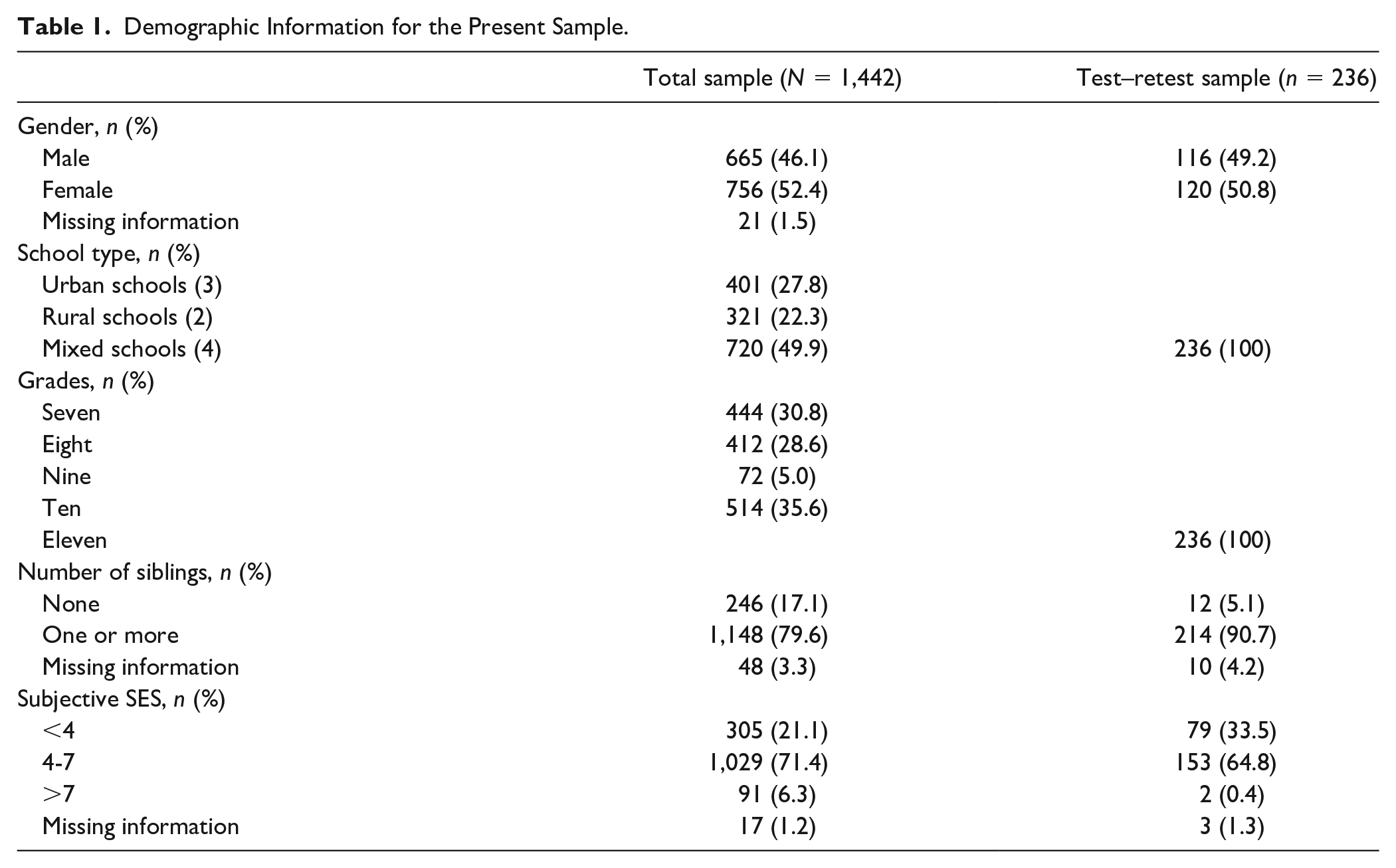
A total of 1,512 adolescents were recruited from three middle schools in Tianjin, four middle schools in Hebei Province, and two middle schools in Jiangxi Province. Due to a large number of missing data (more than 30%) or suspected random responses, 116 (7.7%) participants were excluded from the analysis. The final sample was comprised of 1,442 adolescents (46.1%) with a mean age of 14.85 years (ranging from 11 to 19 years). Six months later, we retested a subsample of 263 adolescents on the PID-5 at one of the urban–rural mixed schools. Twenty-seven participants have transferred into other classes due to excellent academic performance. The final longitudinal sample comprised 236 participants with 116 male participants (49.2%; see Table 1 for more details).
Demographic Information for the Present Sample.
We used a standardized testing procedure across different schools. The school principals and head teachers coordinated the assessment procedure. All the participants were informed that participation in this study was voluntary and their answers were confidential. Data were collected during regular daily classes in each classroom with 40 to 60 students using a paper and pencil form. Researchers went to each classroom to make the instructions consistent and clear. It took about 25 to 50 minutes to finish the whole questionnaire. We provided free lectures about personality development in adolescence as a reward. All study procedures were approved by the Institutional Review Board of Wuhan University.
Measures
The Personality Inventory for DSM-5
The original PID-5 is a 220-item self-report questionnaire with 25 low-order facets and five high-order domains of personality pathology (Krueger et al., 2013). Participants were required to rate each PID-5 item on a 4-point scale, from very false to very true. Scholars in Beijing Normal University and Peking University got authorization from APA to translate the PID-5 into Chinese. They built two independent translation team, which included lots of graduate students majored in abnormal and clinical psychology from Beijing Normal University and Peking University. First, they translated the PID-5 into Chinese independently and asked lots of graduate students to rate the accuracy and appropriateness of each item in Chinese from 1(accurate) to 3 (discrepancy). For the items rated as 2 and 3, they consulted bilingual psychologists to decide the final translation. Second, they invited two Chinese-English-speaking clinical psychologists to back-translate the Chinese version into English and compared the back-translated items with the original English items. As for the controversial items, they still consulted bilingual psychologists to choose the best solution. At last, the final Chinese version of the PID-5 was approved according to the similarity with the English original items and the consensus among experts in personality disorders at Beijing Normal University and Peking University.
Adolescents’ Social Adjustment Assessment Scale
This scale was developed in mainland China with four adjustment domains (self, interpersonal, behavior, and coping) and two-pole functions (positive versus negative), including eight low-order factors: self-affirmation and self-confusion, prosocial inclination and social alienation, behavior effectiveness, and behavior disruption, constructive coping and destructive coping (Zou et al., 2012). It comprised of 50 items, rated by 5-point Likert-type scale. It has been adopted by a large number of related studies in China and has good reliability and validity (e.g., W. Zhang et al., 2012; Y. Zhang et al., 2015). In the current sample, the internal consistency of all the subscales ranged from 0.70 to 0.91.
Data Analyses
Consistent with most of the previous studies (Bach et al., 2018; Bastiaens, et al., 2016; Bo et al., 2016; De Caluwé et al., 2019; De Clercq et al., 2014; Fossati et al., 2017; Somma et al., 2017), we used ESEM methods, which integrate the advantages of structural equation modeling (SEM) and exploratory factor analyses (Asparouhov & Muthén, 2009; Marsh et al., 2009), to examine the factor structure and model fit of the PID-5 in the current sample. Given most of the personality traits and facets, including the PID-5, showed meaningful factor cross-loadings (Hopwood & Donnellan, 2010), the ESEM approach is considered to be more advantageous than CFA (Cooke & Sellbom, 2019). First, ESEM estimates loadings for each item on all factors, which may attenuate the inflation of factor correlations, especially when the item-to-factor cross-loadings were greater than zero. Second, the result of the ESEM approach may clarify the nomological network of the PID-5 by reflecting items being accounted for by multiple factors. Third, the ESEM models generally showed superior model fit compared with their CFA counterparts because of the less restrictive nature of the ESEM models (Cooke et al., 2019).
Missing values for the 220 items in PID-5 ranged between 0.00% and 1.4%. Any strategy for missing values less than 5% is claimed to be fairly accurate to generate almost similar results (Schafer, 1999; Tabachnick & Fidell, 2006). In the present study, the ESEM analysis conducted for the mean imputed, expectation-maximization algorithm and listwise deleted data yielded a similar factor structure. Therefore, the expectation-maximization algorithm method was adopted to random missing data in the ESEM analyses to keep the sample size.
We performed ESEM with the statistical program Mplus 7.0. Because subjects were clustered into schools, TYPE = COMPLEX and CLUSTER = SCHOOL were set. One- to six-factor solutions were compared in terms of fit indices and interpretability of the factor structure. The lowest Bayesian information criterion (BIC) value indicated the best factor solution. If the factor structure of the best fitting model is difficult to explain, we chose the factor solution with the second-lowest BIC. Several indexes were also used to assess the model fit, including the goodness-of-fit statistic (χ2), Browne and Cudeck’s root mean square error of approximation (RMSEA), the Tucker–Lewis index (TLI), and Bentler’s comparative fit index (CFI), and standardized root mean square residual (SRMR; Tanaka, 1993). As Hu and Bentler (1999) suggested, TLI and CFI value ≥.95 and RMSEA value ≤ .06 indicate a good model fit, whereas TLI and CFI value ≥.90 and RMSEA value ≤.08 indicate an adequate fit.
Measurement invariance analyses were conducted across participants’ gender. First, we tested the factor structure solution separately for male and female adolescents (Brown, 2015). Then, we examined three levels of measurement invariance, that is, configural (with no invariance constraints), weak (with only factor loadings constraints), and strong invariance (with factor loadings and item intercepts constraints), to determine whether the factor structures, factor loadings, and item intercepts were equal between female and male participants (Marsh et al., 2009). In addition to the cutoff criteria for each fit index suggested by Hu and Bentler (1999), differences between the nested models (weak vs. configural; strong vs. weak) are used to determine measurement invariance across groups: ΔCFI/ΔTLI < .01 and ΔRMSEA < .015 indicated the proposed model are invariant between groups, ΔCFI/ΔTLI between .01 and .02 suggests a moderate measurement variance between groups, and ΔCFI/ ΔTLI > .02 or ΔRMSEA higher than .015 indicates an absolute measurement variance between groups (F. F. Chen, 2007; Cheung & Rensvold, 2002; Meade et al., 2006; M. Wang et al., 2019).
Next, we adopted Pearson correlation and zero-order and partial correlation analysis to examine the concurrent and predictive validity of the PID-5 on adolescents’ social adjustment across self, interpersonal, behavior, and coping domains concurrently and 6 months later. Because correlations as low as 0.12 would be statistically significant at p < .05 due to the large sample size, results are provided concerning the magnitude of effect size (Oltmanns & Widiger, 2018). According to J. Cohen’s (1992) guidelines of Pearson correlation, r = .10, .30, and .50 could interpret observed effect sizes as small, medium, or large, respectively.
Finally, interclass correlation coefficients (ICCs) for test–retest reliability were used to evaluate the test–retest reliability of the PID-5. Following the guideline by Koo and Li (2016), ICC estimates and their 95% confident intervals were calculated using SPSS 25.0 based on the single-rating, absolute-agreement, 2-way mixed-effects model. The ICC estimates were interpreted as follows: ICC values less than 0.50 are indicative of poor test–retest reliability, values ranged from 0.50 to 0.75 indicated moderate test–retest reliability, values between 0.75 and 0.90 indicated good test–retest reliability, and values larger than 0.90 indicated excellent reliability. Otherwise, the result interpretation should consider the 95% confidence interval. For example, the obtained ICC value is 0.73 and its 95% confidence interval ranges from 0.60 to 0.80, which demonstrates that the true ICC value has a 95% probability of being located at any point between 0.60 and 0.80. Therefore, it is more appropriate to conclude that the level of test–retest reliability is moderate to good.
Results
ESEM was conducted, targeting one- to six-factor structure. As Table 2 presented, the six-factor ESEM model was associated with acceptable to good fit. However, the RMSEA and TLI values of the five-factor ESEM model were not suggestive of adequate fit by any reasonable standard, although the CFI value suggested acceptable model fit. Even though the fit of the exploratory SEM with five factors was acceptable when an error covariance was allowed between unusual beliefs and cognitive dysregulation, emotional lability and hostility (χ2 = 1438.90, degrees of freedom = 183, RMSEA = 0.069, CFI = 0.95, TLI = 0.91, SRMR = 0.025), it is difficult to interpret the results that the Constraint scales such as preservation, restricted affectivity were loaded on the Psychoticism domain (see Table 3). Therefore, the six-factor solution was retained in the current study (see Table 4). All factor correlations ranged from nonsignificant (r = .04, p > .05) to moderate (r = .70, p < .001).
Exploratory Structural Equation Modeling Factor Analyses of the Chinese Version of the PID-5 (N = 1,442).
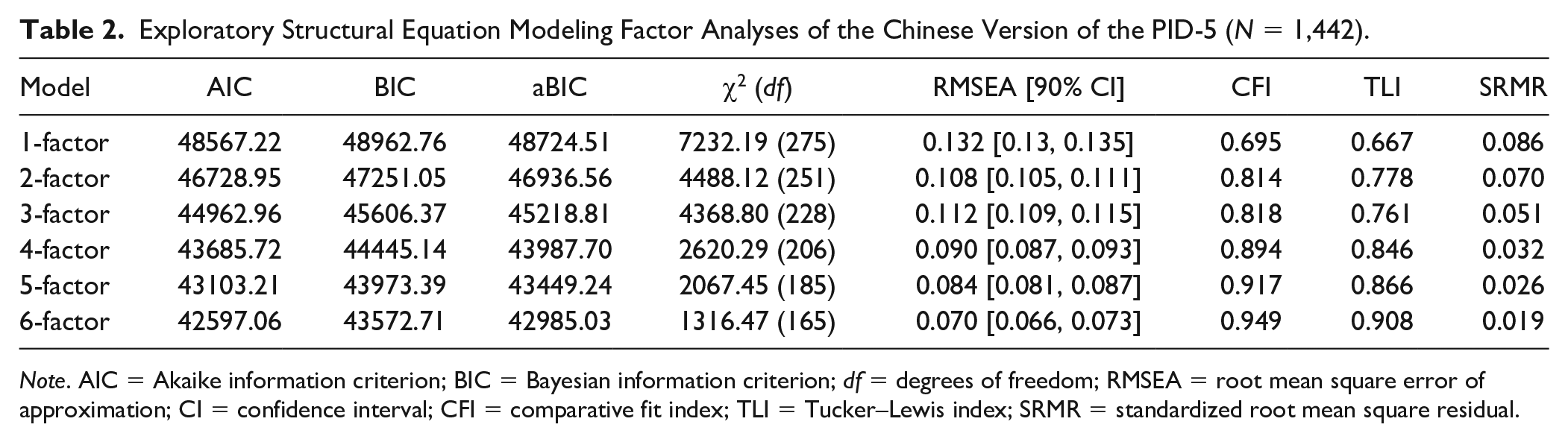
Note. AIC = Akaike information criterion; BIC = Bayesian information criterion; df = degrees of freedom; RMSEA = root mean square error of approximation; CI = confidence interval; CFI = comparative fit index; TLI = Tucker–Lewis index; SRMR = standardized root mean square residual.
Standardized Factor Loading and Factor Correlations Based on Exploratory Structural Equation Modeling Factor Analysis (N = 1,442).

Note. Factor loadings <.30 are omitted. F1 = Negative Affectivity; F2 = Detachment; F3 = Antagonism; F4 = Disinhibition; F5 = Psychoticism.
p < .05. **p < .01. ***p < .001.
Standardized Factor Loading and Factor Correlations Based on Exploratory Structural Equation Modeling Factor Analysis (N = 1,442).

Note. F1 = Negative Affectivity; F2 = Detachment; F3 = Antagonism; F4 = Disinhibition; F5 = Constraint; F6 = Psychoticism.
Measurement invariance based on participants’ gender was also assessed for the six-factor solution of the PID-5 (see Table 5). All model fit indices were adequate in both boys and girls. With regard to measurement invariance across gender, the models of the three types of invariance testing fit the data well across male and female adolescents (CFI and TLI higher than 0.90; RMSEA less than 0.08; ΔCFI and ΔRMSEA less than 0.01, with the exception of ΔTLI = 0.015).
Measurement Invariance Model Fit Statistics for the PID-5 across Different Groups.
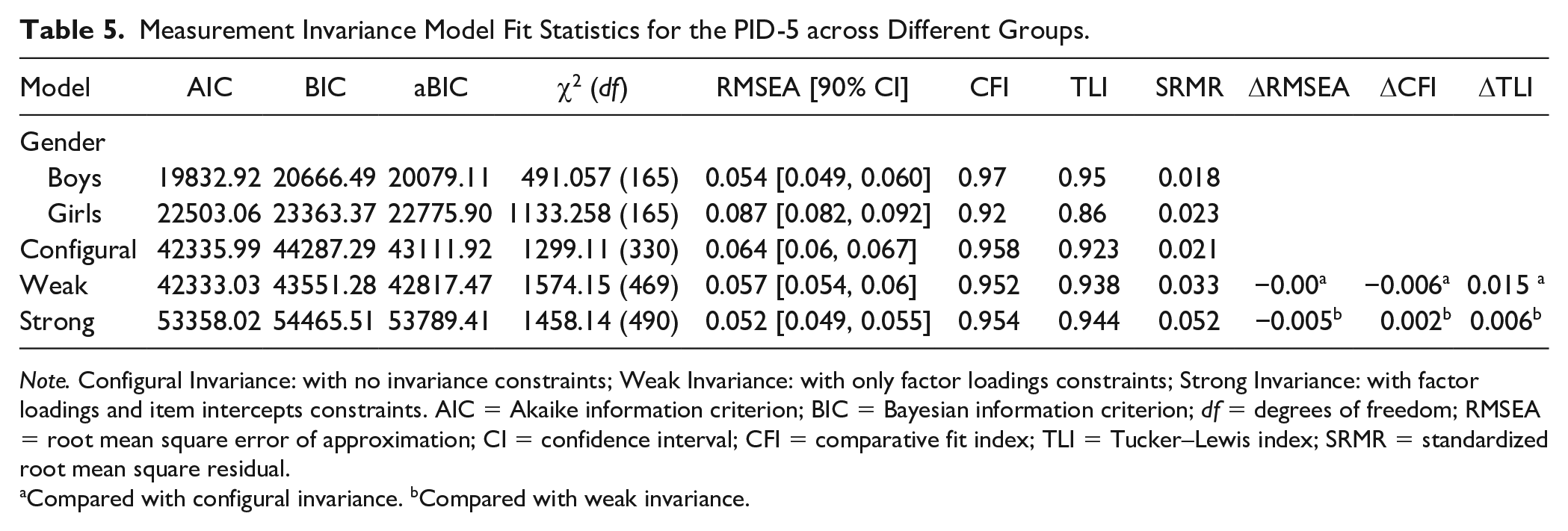
Note. Configural Invariance: with no invariance constraints; Weak Invariance: with only factor loadings constraints; Strong Invariance: with factor loadings and item intercepts constraints. AIC = Akaike information criterion; BIC = Bayesian information criterion; df = degrees of freedom; RMSEA = root mean square error of approximation; CI = confidence interval; CFI = comparative fit index; TLI = Tucker–Lewis index; SRMR = standardized root mean square residual.
Compared with configural invariance. bCompared with weak invariance.
The majority of the 25 traits of the PID-5 showed good internal consistencies (α > .80 for 14 out of 25 facets) in Chinese adolescents (see Table 5). The suspiciousness facet showed a poor reliability coefficient of .57. If we deleted the two items with relatively low item-total correlations (Item 133, r = .42, p < .001; Item 177, r =.31, p < .001), the internal consistency of the suspiciousness traits increased to .70. For the other 10 PID-5 facets, alpha coefficients ranged from .60 to .79, indicating moderate internal consistency. The internal consistencies of the five high-order traits demonstrated moderate to good internal consistency with alpha coefficients ranged from .76 to .87.
The correlations (i.e., Pearson r coefficients) between the PID facet scales and the adolescents’ social adjustment domain scales were summarized in Table 6. In general, most of the PID-5 facets were positively correlated with adolescents’ negative social adjustment, and negatively correlated with adolescents’ positive social adjustment, with the exception of rigid perfectionism and submissiveness. Although adolescents with higher levels of rigid perfectionism showed higher levels of self-confusion and interpersonal alienation, they also demonstrated higher levels of self-affirmation and behavioral effectiveness. The correlations between submissiveness and prosocial inclination as well as behavioral effectivity were also significant. Furthermore, there were some large effect size relationships and a lot of medium effect size relationships among the 25 facets of the PID-5 and social adjustment in self and interpersonal domains (e.g., depressivity with self-confusion; anhedonia, callousness, depressivity with alienation). Concerning the relationships among the 25 facets of the PID-5 and social adjustment in behavioral and coping domains, there were no large effect size relationships for any correlations, although there were some medium effect size relationships (e.g., distractibility with behavioral effectiveness, callousness with behavioral disruption; anhedonia with constructive coping as well as destructive coping, impulsivity with constructive coping as well as destructive coping).
Pearson Correlations Between the 25 PID-5 Facets And Adolescents’ Social Adjustment and Zero-Order and Partial Correlations Between the Five High-Order Domains of the PID-5 and Adolescents’ Social Adjustment (T1: n = 1,003; T2: n = 236).
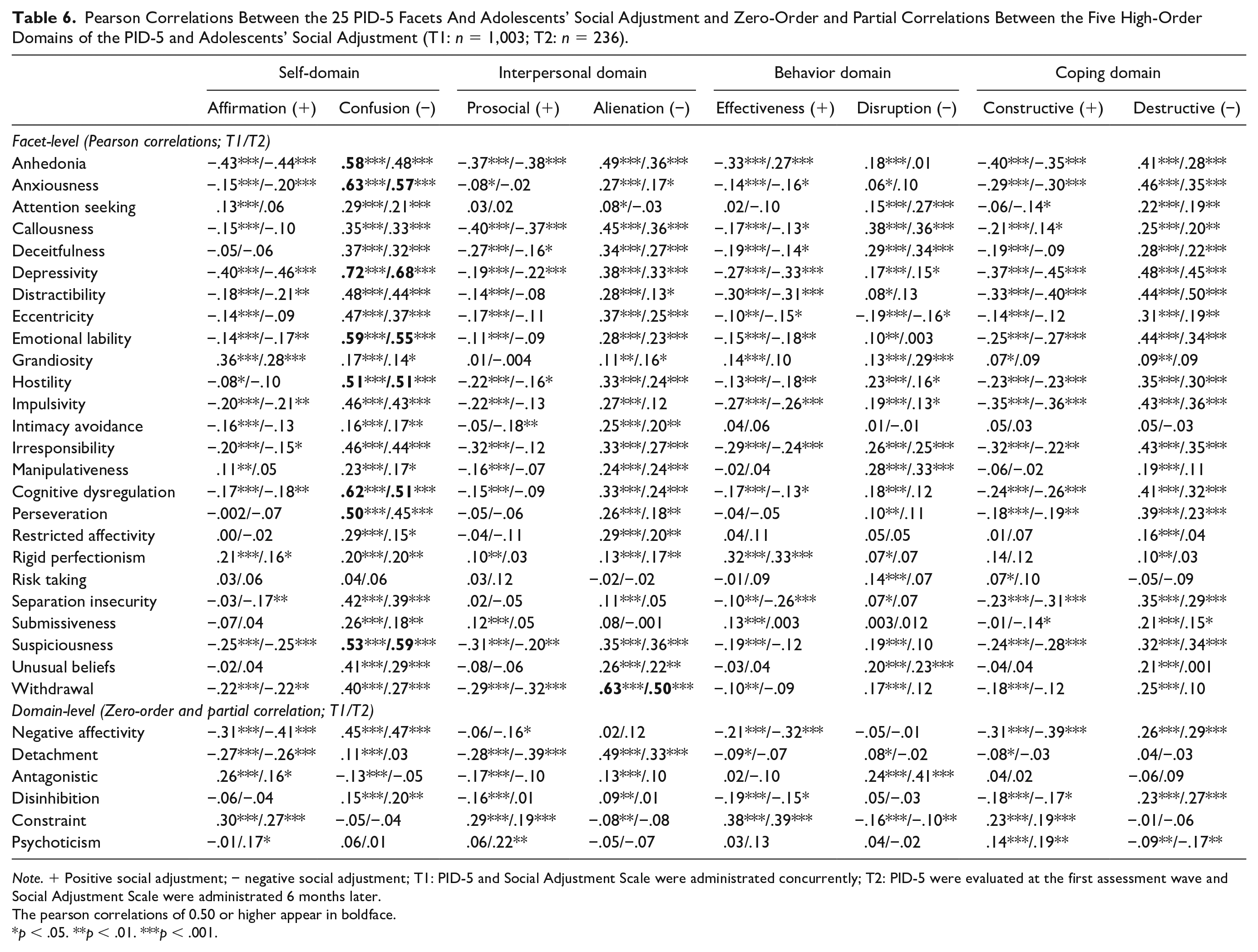
Note. + Positive social adjustment; − negative social adjustment; T1: PID-5 and Social Adjustment Scale were administrated concurrently; T2: PID-5 were evaluated at the first assessment wave and Social Adjustment Scale were administrated 6 months later.
The pearson correlations of 0.50 or higher appear in boldface.
p < .05. **p < .01. ***p < .001.
Internal Consistency Reliability Coefficients and Test–Retest Reliability.
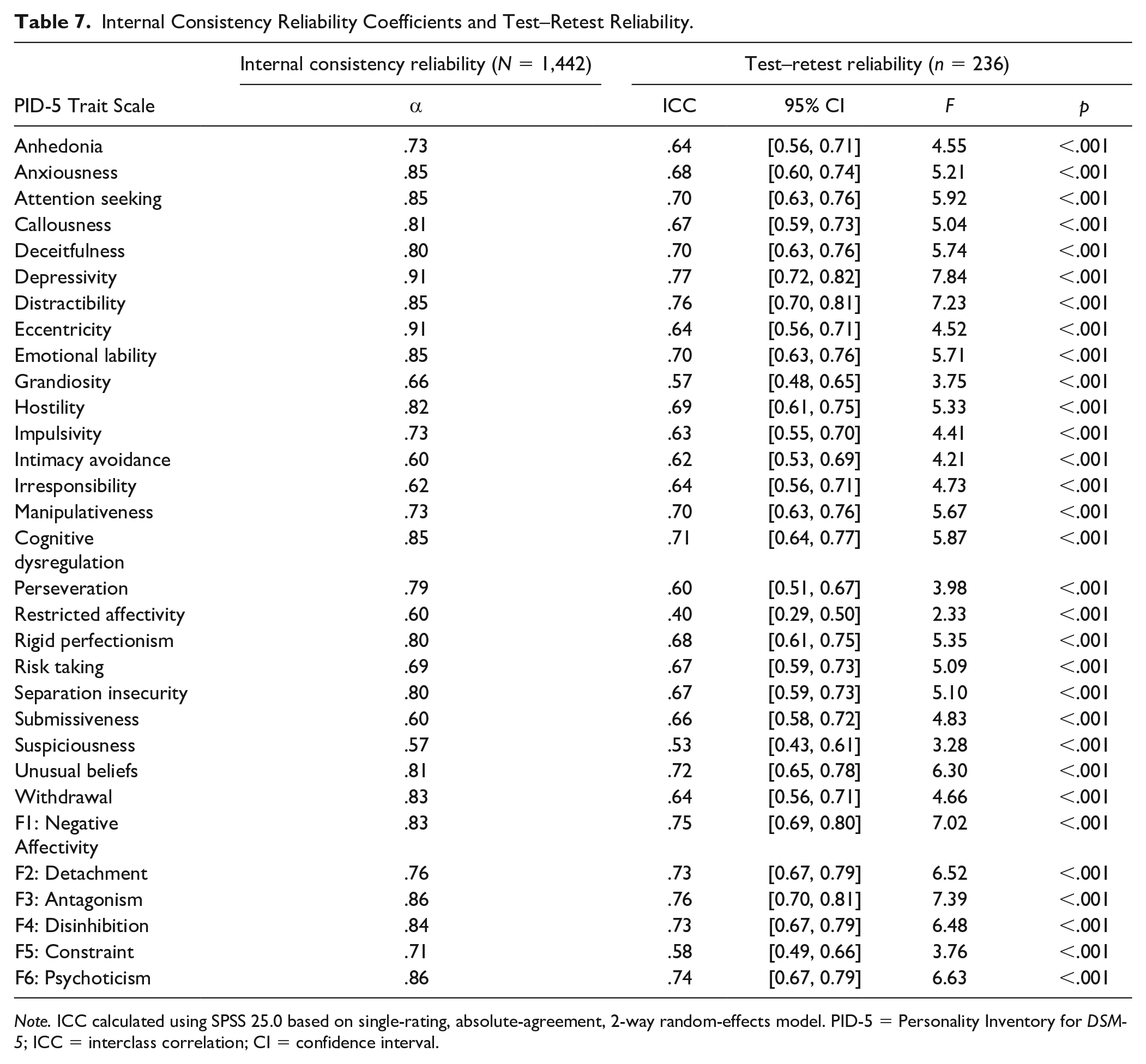
Note. ICC calculated using SPSS 25.0 based on single-rating, absolute-agreement, 2-way random-effects model. PID-5 = Personality Inventory for DSM-5; ICC = interclass correlation; CI = confidence interval.
To control the biased effect of highly related facets, we reanalyzed the concurrent and predictive validity of the PID-5 scale by zero-order and partial correlation analyses between the six high-order factors of the PID-5 scale and adolescents’ social adjustment. Negative Affectivity, Detachment, Antagonistic, and Disinhibition domains had positive correlations with negative social adjustment, and negative correlations with positive social adjustment across all four domains, with the exception of constraint and psychoticism domains, whether measured at the same time or intervals. Particular high-order traits of the PID-5 may have uniquely stronger associations with specific aspects of social adjustment.
When the PID-5 and social adjustment were measured simultaneously, the Negative Affectivity domain significantly related to most of the social adjustment indexes, with the exception of social adjustment in the behavior domain. The Detachment domain mainly contributed to social adjustment in self and interpersonal domain. The Antagonistic domain negatively contributed to behavior disruption, while positively related to self-affirmation and negatively related to self-disruption. The Disinhibition domain mainly contributed to social adjustment in the behavior and coping domain. The most unexpected results were the associations between Constraint domain and social adjustment. The Constraint domain including rigid perfectionism, submissiveness, preservation, and restricted affectivity demonstrated a significantly positive association with positive social adjustment and a negative association with negative social adjustment. The Psychoticism domain comprising of the three typical subscales (i.e., eccentricity, unusual beliefs, and cognitive dysregulation) was positively associated with active coping and negatively associated with negative coping.
The zero-order and partial correlation between the PID-5 at the first test point and adolescents’ social adjustment at the 6-month follow-up showed similar results as those found at the same time. But the partial correlations between Negative Affectivity and prosocial inclination became significant, and the relationships between Disinhibition, Antagonism, and social adjustment in interpersonal domains became nonsignificant. Furthermore, the associations of Psychoticism with positive adjustment in self and interpersonal domains became significant.
The results of the test–retest reliability for the 25 PID-5 traits were presented in Table 7. ICCs were significant for all the 25 PID-5 traits. Except for restricted affectivity (poor test–retest reliability, ICC was below .50), suspiciousness, and grandiosity (poor to moderate, ICC ranged from .43 to .65), other 22 PID-5 traits showed moderate to good test–retest reliability (ICC ranged from .50 to .82). As for all the six high-order traits of the PID-5, the level of test–retest reliability indicated poor to good (ICC ranged from .49 to .81).
Discussion
The present study evaluated the factor structure, test–retest reliability, and criterion validity of the PID-5 in Chinese nonclinical adolescents. The six-factor solution was fitting well with the current sample. Our measurement invariance testing has supported the strong measurement invariance of the PID-5 between boys and girls. Internal consistencies and test–retest reliability of this measure were poor to good. Four out of the six high-order traits of the PID-5 were positively related to adolescents’ negative social adjustment and negatively associated with positive social adjustment across self, interpersonal, behavior, and coping domains, which provided external validity evidence for the PID-5. In sum, our findings confirmed the reliable and valid utility of the PID-5 to assess maladaptive personality traits during adolescence in the Chinese cultural context.
Factor Structure of the PID-5
In terms of factor structure, our findings were partially consistent with previous studies across the clinical and nonclinical populations in different cultural contexts. The model fit indices by ESEM analysis supported the interpretable six-factor structure of the PID-5 in Chinese adolescents. There are controversial opinions about the relationships between Anankastic and Disinhibition. A considerable body of empirical studies supported that the Anankastic traits should be negatively loaded in the same domains with traits in disinhibition domains (Oltmanns & Widiger, 2018). For example, irresponsibility, nonplanfulness, and nonperseverance loaded positively and perfectionism, rigidity, and workaholism loaded negatively on the domain of Disconstraint domain in the CAT-PD (Wright & Simms, 2014). From this perspective, most of the previous studies of the PID-5 supported the five high-order domains among the 25 facets. However, the initial version of the DSM-5 dimensional trait model and ICD-11 suggested that Compulsivity/Anakastic and Disinhibition should not be considered opposite poles of the same domain (Skodol, 2012). With four domains being unipolar concerning maladaptive functioning and one being bipolar, this structure is inconsistent and perhaps unnecessarily confusing. Unfortunately, most of the traits with the exception of rigid perfectionism in compulsivity domains were excluded in the DSM-5 factor structure analysis. Thus, rigid perfectionism has negatively loaded within the Disinhibition domain in the final DSM-5 dimensional trait model. The factor analysis of ICD-11 also found that a four-factor solution was the expected structure for the PiCD. The Disinhibition and Anankastic were loaded in one domain, even though the ICD-11 proposal suggested they were separate and independent domains (Oltmanns & Widiger, 2018). However, the domain of Anankastic appears to be necessary to account for the symptoms of the obsessive–compulsive personality disorder (Crego, Samuel, et al., 2015). From this perspective, there were compelling reasons to retain the six-factor structure in the DSM-5 dimensional model. In the current Chinese adolescent sample, Disinhibition and Constraint were not loaded in one domain in the five-factor structure, whereas the Constraint and Psychoticism were loaded in one domain. Therefore, we decided to retain the six-factor structure with the Disinhibition and Constraint separating into independent domains, rather than the five-factor structure with a confusing structure.
However, the correlations between Psychoticism and Negative Affectivity as well as Detachment were nonsignificant, which was quite different from the previous studies. Those odd results may be explained by the controversial nature of the Psychoticism domain in youth. Some researchers have stated that Psychoticism lacks attention in the developmental literature in youth and much more work should be needed to understand this domain in early life (Shiner & Tackett, 2014). Besides, the factor correlations would be reduced through ESEM because of the presence of several nonzero cross-loadings (Cooke & Sellbom, 2019). However, the correlation between Negative Affectivity and Disinhibition is much larger than would be expected. This result may reflect the slight cultural differences in the link between externalizing problems and social status in adolescence. In western samples, they found that some children with externalizing problems may be well-liked by a subgroup of their peers, while at the same time disliked by their victims (Crick et al., 2009; Orue & Calvete, 2011). However, dark triad traits including disinhibition were significantly related to low likeability and high loneliness in the Chinese samples (W. Zhang et al., 2015). As a result, adolescents with a high level of Disinhibition in China may suffer from deterioration of their social status to some degree and thus increase their scores on Negative Affectivity compared with adolescents in North American or Western European cultures.
Consistent with the meta-analysis findings of the five-factor PID-5 structure in adult samples (Watters & Bagby, 2018), 11 facets loaded higher than .30 onto two domains, one facet that loaded higher than .30 on three domains, and 13 facets showed pure markers on one domain. Factor loadings for their respective domains indicated some inconsistencies with the theoretical proposal and previous studies.
One of the unexpected findings was the traits of rigid perfectionism, preservation, restricted affectivity, and submissiveness loaded highest in an independent domain in the six-factor solution, which is similar to the Constraint dimension (i.e., control, harm avoidance, traditionalism, and absorption) in the Multidimensional Personality Questionnaire (Javdani et al., 2014) or the Anankastic scale in the Personality Inventory for ICD-11 (Carnovale et al., 2020). According to Krueger et al.’s (2012) proposed factor structure, rigid perfectionism should negatively load on the Disinhibition domain, perseveration and submissiveness should load on the Negative Affectivity domain, and restricted affectivity should negatively load on the Negative Affectivity domain. The meta-analysis of 14 independent psychometric studies of the PID-5 in adults showed that rigid perfectionism and restricted affect had cross-loadings on their expected domain and Negative Affectivity domain with weighted mean loading coefficients higher than .30, whereas submissiveness and preservation were primarily loading on their expected domains (Watters & Bagby, 2018). However, all the selected studies retained five domains. To our knowledge, no previous studies compared the model fit of the five-factor with the six-factor structure. Our findings supported the theoretical proposal of the ICD-11, which suggested the Anankastic be an independent domain, comprising emotional and behavioral constraint (restricted affectivity), being concerned with following rules and meeting obligations, perfectionism, and preservation (Mulder et al., 2016).
Submissiveness did not show significantly loading higher than .30 on Negative Affectivity. This might be due to cultural differences in the meaning of submissiveness. In contrast to western culture, where people are encouraged to develop independence and autonomy, submissiveness is regarded as socially approved behavior that conforming to cultural expectations in eastern culture (X. Chen & French, 2008; J. Wang & Wang, 2019). Adolescents are still under the control and protection of their parents. The characteristics and behavior described in submissiveness scale, that is, Item 9 (I change what I do depending on what others want); Item 15 (I usually do what others think I should do); Item 63 (I do what other people tell me to do); Item 202 (I try to do what others want me to do), would be praised as “good youths” by parents and teachers (J. Wang & Wang, 2019). Submissive adolescents may demonstrate a lower level of Negative Affectivity temporally because submission represents positive characteristics such as a good sense of responsibility, social maturity, and competence in collective culture (X. Chen & French, 2008).
Withdrawal and intimacy avoidance showed cross-loadings on Detachment and Constraint domains. Based on the symptoms of the DSM-5 personality disorders, withdrawal and intimacy were the critical symptoms in avoidant personality disorders, whereas personality traits in the Constraint domain represented the symptoms of obsessive–compulsivity personality disorders. These two personality disorders were related significantly. They have similar patterns of correlations with neuroticism and extraversion in the five-factor model (Dyce & O’Connor, 1998; Reynolds & Clark, 2001). Additionally, the results of an exploratory principal components analysis of the SIDP-IV (Structured Interview for DSM-IV Personality) avoidant, borderline, depressive, and obsessive–compulsive symptoms raw indicated that all the symptoms of avoidant and obsessive–compulsive personality disorders loaded on two factors. One factor showed the common factor in dysphoric symptoms, the other factor may reflect a problem of how to engage with others. Individuals with avoidant personalities may be rather reluctant and fearful to engage others for fear of being rejected or ridiculed. For individuals with obsessive-compulsivity personality disorders, they may be hardworking, perfectionists, and insistent on others conforming to their way of doing things (Huprich et al., 2006). Therefore, we considered it was reasonable for the cross-loading among these facets.
The three traits loading on the Psychoticism domains were also loading significantly on the Negative affectivity domains. In the hierarchy of the PID-5, two factors emerged from the general factor, labeled internalizing and externalizing based on the pattern of loadings. Eccentricity, unusual beliefs, and cognitive dysregulation with other traits representing Negative Affectivity and Detachment loaded strongly on the factor labeled internalizing. Psychoticism factor emerged as an independent domain at the fifth level of the hierarchy, which still showed a significant correlation with Negative affectivity and Detachment factor in the fourth level (Wright et al., 2012). In addition, anhedonia had significant loadings on the expected Detachment factor, but it also demonstrated the highest loadings on Negative affectivity. The meta-analysis results also showed this interstitial pattern of the anhedonia traits on both Negative Affectivity and Detachment domains, although it loaded highest on Detachment (Watters& Bagby, 2018). Moreover, we found emotional lability and hostility were not significantly associated with the Negative Affectivity and Antagonism factor respectively, rather both of them showed the highest loadings on the Disinhibition factor. De Clercq et al. (2014) regarded these differences as developmental issues. The hostility expressed by children or adolescents may indicate impulsive reactivity due to lack of mature cognitive and emotional regulation, whereas adults’ hostility may indicate clear Antagonistic traits. As both Antagonism and Disinhibition were included in high-order factors of externalizing traits (Morey et al., 2013), it is reasonable to accept the cross-loadings of hostility on both Disinhibition and Antagonism. Emotional liability represents emotional dysregulation which is simultaneously related to Disinhibition and Negative affectivity (Bastiaens et al., 2016). That could explain why it loaded significantly on the Disinhibition facet in our study.
The Concurrent and Predictive Validity of the PID-5
Although there were many epidemiological studies supported the unique and enduring effect of personality pathology on long-term social adjustment, including depression and anxiety disorders, substance use problem, long-term unemployment, and relationship failure (Grant et al., 2004; Gunderson et al., 2011; Huang et al., 2009; Moran et al., 2016), the present study provided the first evidence for the concurrent and predictive validity of the PID-5 on adolescents’ social adjustment in mainland China. Consistent with our hypotheses, zero-order and partial analysis showed that Negative Affectivity, Detachment, Antagonism, and Disinhibition were positively associated with negative adjustment and negatively associated with positive adjustment in the four domains simultaneously and longitudinally. And the relationship of maladaptive personality traits with social adjustment showed differentiation across the PID-5 domains. More specifically, after controlling the other five facets, Negative Affectivity mainly explained adolescents’ social adjustment in self-domain; Detachment was largely related to adolescents’ interpersonal adjustment; Antagonism was largely related to adolescents’ disruptive behavior problems, and Disinhibition mainly explained the adolescents’ coping style.
Surprisingly, after controlling the other five maladaptive personality domains, the relationships between Constraint and social adjustment were opposite to theoretical expectations. At the facet level, the correlations between behavioral constraint traits such as rigid perfectionism and submissiveness, and adolescents’ positive social adjustment in the behavior domain were significantly positive. This may explain the positive relationship between Constraint and positive social adjustment. Participants in the current study were middle school students and their main developmental tasks were academic performance in China. Thus, these behavioral constraint traits may positively contribute to adolescents’ academic achievement at school through persistent efforts, which in turn promote their social adjustment. In addition, these traits, such as submissiveness and restricted affectivity, were particularly protective against adolescents’ externalizing problems (Javdani et al., 2014). It was consistent with the findings of the Anankastia in personality inventory for ICD-11, which was negatively related to Disinhibition and included rigid perfectionism and preservation (Mulder et al., 2016; WHO, 2018). Those who ranked higher in Anankastia tended to be less likely to demonstrate behavioral/externalizing dysfunction (Carnovale et al., 2020).
At the facet level, cognitive dysregulation, unusual beliefs, and eccentricity were positively associated with negative social adjustment without controlling the other maladaptive traits. However, the partial correlations between Psychoticism and constructive coping style became positive when controlling the effect of the other maladaptive personality domains. This difference may reflect that the moderate level of Psychoticism traits might contribute to certain adaptive characteristics such as cognitive exploration, which may improve their performance on the coping domain at school, when Psychoticism traits were severe or coupled with other risk traits, such as Negative affectivity, Antagonism, Detachment, they may result in severely maladaptive problems (Blain et al., 2020). Indeed, there was some evidence that supported traits loaded in the Psychoticism domain are related to openness in five-factor personality traits. Although some studies found psychoticism had no significant relationship with openness in five-factor personality traits (Ashton et al., 2012; Quilty et al., 2013; Zimmermann et al., 2014), other studies found they were at least moderately overlapped (De Fruyt et al., 2013; Gore & Widiger, 2013). The inconsistencies among the existing studies may attribute the combination of disordered openness and intellect in openness trait, both of which describe individual differences in cognitive exploration and have advantages over sensory and abstract information (DeYoung, 2015; DeYoung et al., 2012). Disordered openness is positively associated with psychoticism, whereas intellect is positively related to good academic performance and social adjustment (Chmielewski et al., 2014; DeYoung et al., 2012). However, adolescents may have difficulty in distinguishing disordered openness (i.e., psychoticism) from intellect in reporting their personality traits. Thus, our findings may mix adolescents’ intellect and psychoticism. Future studies should endeavor to unravel the relationship between Psychoticism and Intellect using multiple measures.
Internal Consistency and Test–Retest Reliability
We further evaluate the internal consistency reliability in the whole sample and the 6-month test–retest reliability of the PID-5 in a subsample of adolescents in one urban–rural mixed middle school. In general, our findings suggested that the 25 PID-5 trait scales demonstrated moderate internal consistency and poor to good 6-month test–retest reliability as a measure of adolescents’ personality pathology. Although our intraclass correlation coefficients of all the domains and traits were lower than Fossati et al. (2017), our sample size was larger and the retest interval was longer. As the interval length increases, instability is more likely to reflect varying degrees of true change. Our findings could be understandable in consideration of the meta-analysis of personality test–retest reliability coefficients indicating that mean retest correlations increased from .31 in childhood to .54 during college within a constant time interval of 6.7 years (Roberts & DelVecchio, 2000).
Limitations and Future Directions
In conclusion, our findings provided strong evidence to support the reliability and validity of the PID-5 among Chinese adolescents. However, the present study still had several limitations that should be acknowledged. First, our findings were based on adolescents’ self-report. However, adolescents with maladaptive personality traits may show some degree of self-perception bias. It would be better to adopt multiple sources of information to assess adolescents’ personality traits and functioning. Second, although we explained the unexpected findings in the current study, more alternative methods of criterion validation are needed to help us further advance our conceptual understanding of the PID-5 in eastern cultural contexts. Third, our retest interval maybe not short enough to distinguish the true change of maladaptive personality traits from measurement error of the PID-5. Future studies should consider a shorter retest interval within 2 months as well as a longer retest interval to compare the test–retest reliability with varying retest intervals.
Footnotes
Declaration of Conflicting Interests
The author(s) declared no potential conflicts of interest with respect to the research, authorship, and/or publication of this article.
Funding
The author(s) disclosed receipt of the following financial support for the research, authorship, and/or publication of this article: This study was supported by Humanity and Social Science Youth foundation of Ministry of Education of China, 16YJC190031.
