




Abstract
A challenge in the field of social and emotional learning is the lack of consensus regarding a framework to delineate key social and emotional skills (SE skills). Taking a conceptual approach, some have argued that the Big Five model from personality psychology offers a comprehensive framework to organize SE skills; however, little research has been done to empirically support this. In two studies—one using a factor analytic, data-driven approach, and one using an expert consensus approach—we provide multimethod evidence suggesting that there is a significant degree of overlap between SE skills and the Big Five, and we conclude that the Big Five can be used to organize SE skills.
History has shown us that emerging scientific fields often grapple with identity crises as they develop. Researchers in these new fields generate a plethora of disparate constructs, concepts, and theories and, oftentimes, these are created without the benefit of taxonomies that can be used to organize the pieces into a coherent whole. As a result, the researchers—and practitioners—are left without a framework that can describe how the constructs and theories might fit together, which are redundant, and which are unique. In the field of Chemistry, for example, chemists proposed several taxonomies for organizing the elements before Mendeleev introduced the modern Periodic Table in 1869 (Scerri, 2011). The subsequent acceptance of the Periodic Table and its properties provided a common schema for reference and integration, paving the way for numerous scientific discoveries.
Social and emotional learning (SEL) is one burgeoning scientific field in which history is seemingly repeating itself. A frequently cited challenge in SEL is the lack of consensus regarding a framework to delineate key social and emotional skills (SE skills). As many as 136 SE skill frameworks have been identified in the literature (Berg et al., 2017), although close inspection of the 136 frameworks reveals a great deal of similarity across them. The field of SEL suffers from jingle–jangle fallacies, which refers to the erroneous assumptions that two different things are the same because they have the same name (jingle), or that two identical things are different because they have a different name (jangle).
These issues parallel the history of a closely related field, namely, personality psychology. Decades ago, there was an explosion of interest in personality traits, which was accompanied by a rapid increase in the number of personality terms and assessments. Jingle–jangle fallacies were rampant as researchers developed new models, labels, and definitions to describe personality traits. As John and Srivastava (1999, p. 102) wrote, “What personality psychology needed was a descriptive model, or taxonomy, of traits.” The solution was the empirically derived Big Five Model, which states that all personality characteristics can be parsimoniously organized into five high-order factors—conscientiousness, agreeableness, emotional stability, openness to experience, and extraversion (John et al., 2008).
Embracing the Big Five model as an overarching framework with which to study personality enabled the field of personality psychology to progress. SEL currently finds itself in the same position personality psychology was in decades ago. It would be advantageous for the SEL field to look to similar disciplines for solutions for growth and progress. It is neither efficient nor necessary to reinvent the wheel in the search for a way to organize SE skills. In a recent report on future directions of SE skill assessment, the Collaborative for Academic, Social, and Emotional Learning (CASEL), a leading voice in SEL, argued that the field should leverage existing resources and expertise “to realize the full potential of SE [learning] assessment and the effective use of data” (Cipriano et al., 2020, p. 10). Personality psychology may be a source for these resources.
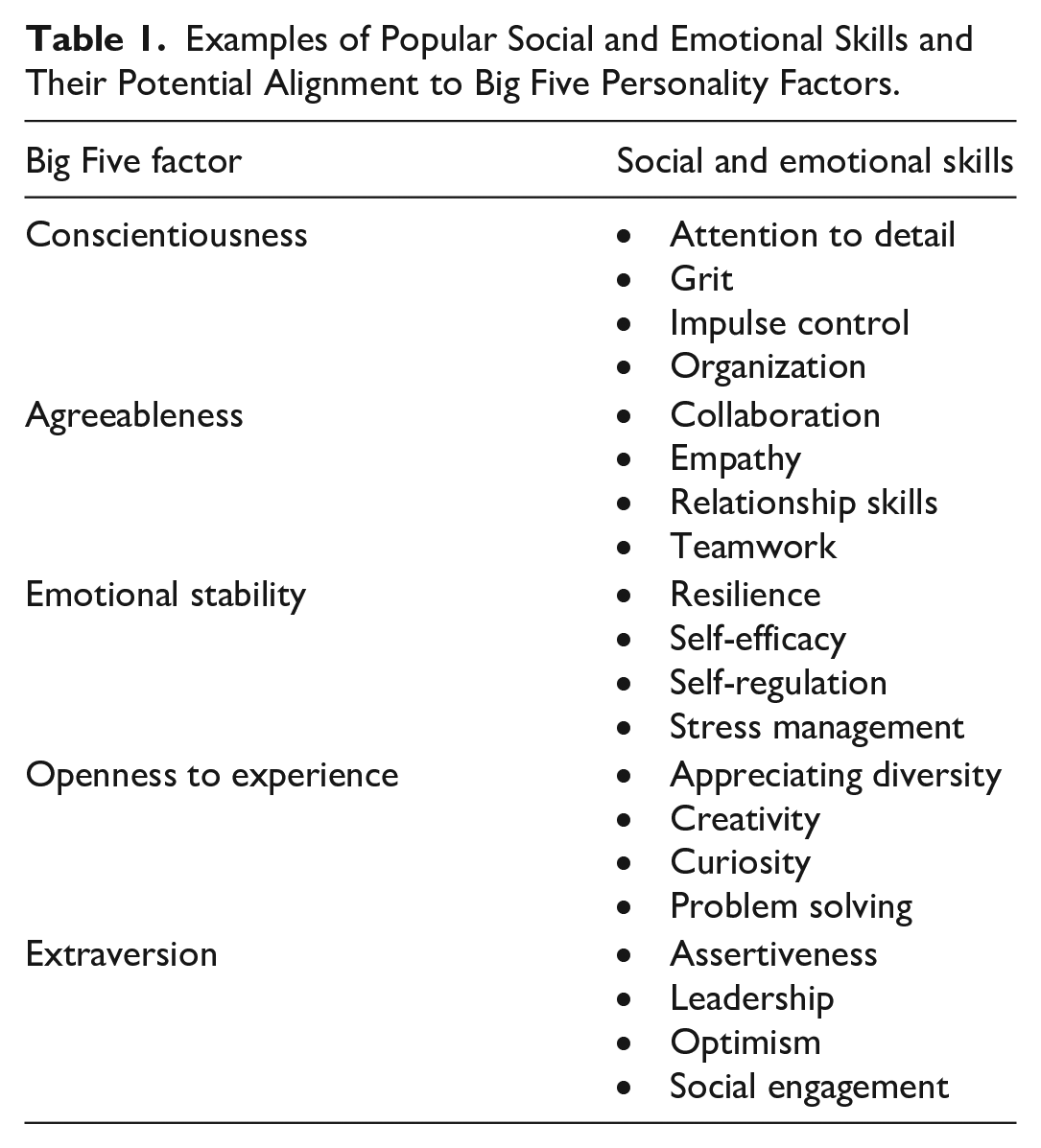
Indeed, some have proposed that the multitude of SE skill terms can actually be distilled into one five-factor model that resembles the Big Five personality trait model. The Big Five have been referred to as a Rosetta Stone (Martin et al., 2019) for translating the plethora of SE skill terms into a common language. For example, the popular concept of grit may very well overlap to a significant degree with the Big Five trait of conscientiousness (Credé et al., 2017). Table 1 provides just a few examples of popular SE skill constructs that may be organized according to the Big Five.
Examples of Popular Social and Emotional Skills and Their Potential Alignment to Big Five Personality Factors.
Like Martin et al. (2019), others have argued that the Big Five is appropriate for conceptualizing SE skills given that the skills in the more prominent SE skill taxonomies can be organized into five domains resembling the Big Five (Abrahams et al., 2019; Burrus & Brenneman, 2016; Kyllonen et al., 2014; Lipnevich et al., 2016; Soto et al., 2021). The conceptual support for the Big Five as a viable framework for SE skills is convincing, and it has driven some movement in this direction. For example, the Organisation for Economic Co-operation and Development (OECD) is using the Big Five model in the OECD Study on Social and Emotional Skills, a large-scale, international study of SE skills of 10- and 15-year-old students (Kankaraš & Suarez-Alvarez, 2019). ACT’s Holistic Framework (Casillas et al., 2015) and the SE skill assessment component of MosaicTM by ACT® (previously called ACT® Tessera®; ACT, 2021) are based on this framework as well. While many authors have taken a conceptual approach to mapping existing SE skill taxonomies to the Big Five, others have taken an empirical approach to support the effort. Primi et al. (2016) carried out a factor analysis of eight SE skill measures translated into Portuguese. Some of the measures assessed single constructs, such as self-esteem, while others were more comprehensive, assessing broad domains, such as the Big Five. There were six well-defined factors, five of which corresponded to the Big five. They labeled the sixth factor external locus of control/negative valence. Ultimately, it seems that a combination of conceptual (or rational) and empirical approaches will provide the best evidence for determining the value of the Big Five to the field of SEL, much like a combination of conceptual and empirical approaches often provide the best avenues for designing psychological measures and building out the evidence for construct validity of such measures (Clark & Watson, 2019; Simms & Watson, 2007).
To move in this direction and gain consensus for a framework, additional empirical support is needed. Here, we describe two empirical studies using distinct methodologies to further investigate the viability of the Big Five in field of SEL. In Study 1, we use a factor analytic approach, jointly factor analyzing items from a Big Five measure and a measure of SE skills. If the five personality constructs and the five SE skills comprise entirely different factors, it would suggest that they do not covary and therefore represent distinct, meaningful factors. However, if the personality and SE skill items in fact load on common factors, it would suggest the contrary; that is, personality traits and SE skills covary and therefore are not unique. In Study 2, we use an expert consensus approach to determine the degree of overlap between the Big Five personality traits and SE skills. If collective expert ratings of similarity between personality and SE constructs match what others (e.g., Martin et al., 2019) have postulated in terms of relatedness, this would further suggest that personality and SE constructs overlap to a large degree—and may even be equivalent in raters’ minds.
Study 1: A Factor Analytic Approach
The purpose of Study 1 was to extend the findings of Primi et al. (2016). We, too, used a factor analytic approach and included a measure of the Big Five. Although Primi et al. included eight SE skill measures and systematically used four criteria to select these measures, they used translated measures and did not include any measures based on the CASEL framework. Given that CASEL’s framework is arguably the most influential in the United States, this is a critical omission. CASEL’s framework outlines five core competencies (CASEL, 2020), including self-awareness, self-management, social awareness, relationship skills, and responsible decision making. It is important to determine empirically whether the Big Five can capture the competencies detailed by CASEL.
Method
Participants
Participants were from a random sample of U.S. students in Grades 9 to 12 who took the ACT on the February 2020 national test date and afterward responded to an email invitation to complete a survey about themselves to help us better understand ACT test takers. They were not told the specific purpose of the study. They were assured that their responses would be kept confidential and would not influence their ACT scores. Students were not paid for their participation. In April 2020, 2,013 of these students were invited to participate in an incentivized follow-up study. The message included a Qualtrics survey link unique to each participant that directed them to the measures described below. The first 300 students to participate in the follow-up study received a $10 gift card. Seven hundred fifty-three students initiated the survey, but some did not respond to any items or stopped before completing. The final data set used in the analyses reported below includes 642 students with complete data. Survey responses were matched to the ACT database, which includes students’ self-reported demographic information. The gender breakdown was as follows: female (72.9%), male (24.8%), and 2.3% did not respond. The breakdown of the race/ethnicity categories was as follows: White (63.6%), Hispanic/Latino (10.6%), Black/African American (7.8%), Asian (7.6%), two or more races (4.5%), prefer not to respond (3.6%), Native Hawaiian/other Pacific Islander (0.3%), and American Indian/Alaska native (0.2%).
Measures
Big Five Inventory
The Big Five Inventory (BFI; John et al., 2008) is a widely used 44-item inventory measuring the Big Five personality traits. Respondents indicate their level of agreement to Likert items with the stem “I see myself as someone who . . . ” As an example, respondents are asked to indicate the extent to which they agree that they see themselves as someone who is talkative. There are five response options ranging from disagree strongly to agree strongly. In adolescent, college-aged, and adult samples (Benet-Martínez & John, 1998; John et al., 2008; Soto et al., 2008), a clear five-factor structure has been repeatedly found with the items having their largest loadings on their intended factors.
Washoe County School District Social and Emotional Competency Long-Form Assessment
The Washoe County School District Social and Emotional Competency Long-Form Assessment (WCSD-SECA; Crowder et al., 2019) is a 40-item measure of CASEL’s five competencies. Respondents indicate how easy or difficult various tasks are on a 4-point scale ranging from very difficult to very easy. An example item asks respondents how easy or difficult it is to set goals. In addition to the five broad competencies, specific areas or facets of self-awareness and self-management are assessed, specifically, self-awareness of strengths/weaknesses and emotion and self-management of emotion, goals, and schoolwork. To our knowledge, there has been no reporting of the WCSD-SECA’s factor structure in the literature or public domain.
Results
We examined factor models fit to the BFI and WCSD-SECA items separately and combined. We used several criteria to select the best fitting model, including fit indices, size of factors (i.e., number of items per factor and variance explained), and interpretation of factors. Hu and Bentler (1999) argued that an RMSEA of .06 or lower and CFI and TLI values of .95 or higher indicate good model fit; however, these are specific to maximum likelihood estimation (given that the indicators are not continuous, we used WLS estimation) and others have since noted that these rules of thumb vary across estimation procedure and a variety of conditions (Nye & Drasgow, 2011). Therefore, we consider these suggested cutoffs but do not adhere strictly to them. Fit indices for all models are provided in Table 2.
Fit Indices for All Factor Models Fit.
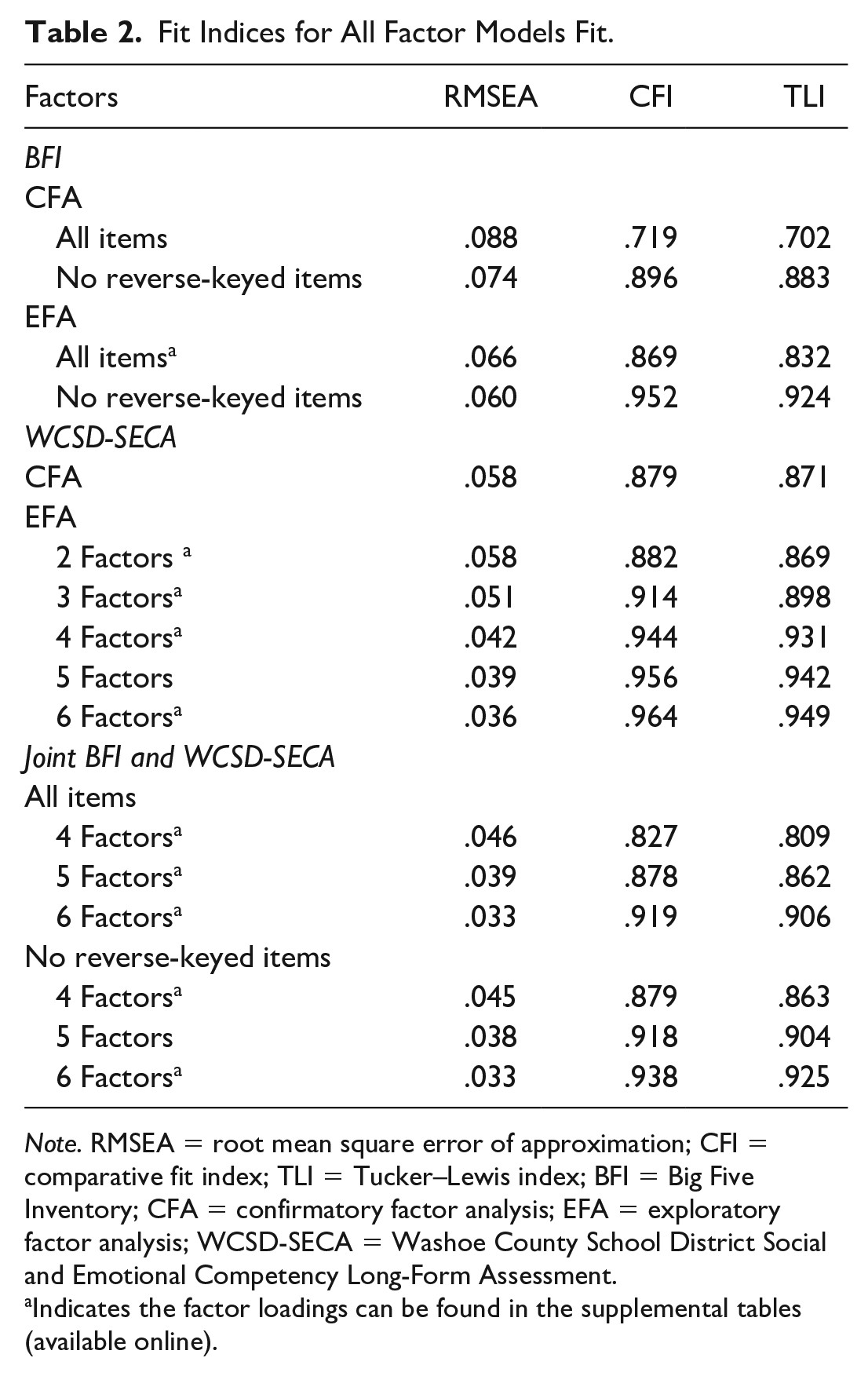
Note. RMSEA = root mean square error of approximation; CFI = comparative fit index; TLI = Tucker–Lewis index; BFI = Big Five Inventory; CFA = confirmatory factor analysis; EFA = exploratory factor analysis; WCSD-SECA = Washoe County School District Social and Emotional Competency Long-Form Assessment.
Indicates the factor loadings can be found in the supplemental tables (available online).
BFI Factor Solution
Although the BFI’s factor solution has been well documented, we fit a confirmatory factor model to assess the fit of the model in the current sample. The fit indices were poorer than expected. The reverse-keyed items appeared to be the source of the problem, and once they were removed, the fit indices greatly improved. 1 To facilitate interpretation of the joint factor model reported on below, we fit exploratory factor models and provide the loadings from a five-factor model in Table 3. Considering the findings from the confirmatory model, we fit the models with and without the reverse-keyed items, and as we saw above, the models without reverse-keyed items were much cleaner. Therefore, this is the model presented in Table 3. The loadings for the exploratory model including the reverse-keyed items can be found in Table S1 (available in the online supplement).
BFI Item Factor Loadings.
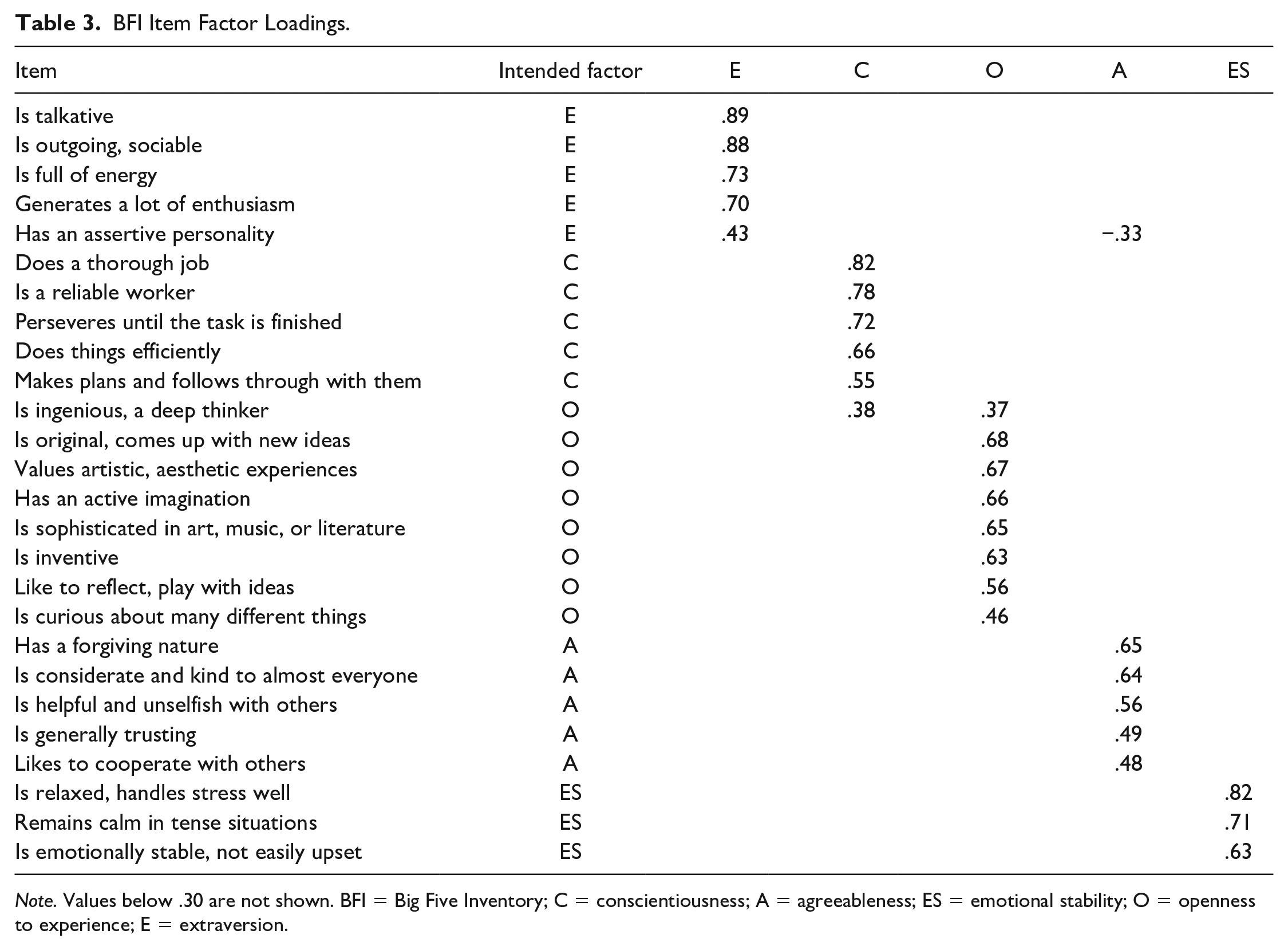
Note. Values below .30 are not shown. BFI = Big Five Inventory; C = conscientiousness; A = agreeableness; ES = emotional stability; O = openness to experience; E = extraversion.
WCSD-SECA Factor Solution
To our knowledge, this is the first documentation of the WCSD-SECA’s factor structure. We first fit a high-order model to the data to account for the self-awareness and self-management facets, but the model was misspecified. Specifically, the correlation between the self-awareness and self-concept latent variables was greater than 1, indicating that the factors are indistinguishable. Next, we fit a confirmatory model with five factors (i.e., the five aligning to CASEL’s five competencies), which yielded decent fit indices (see Table 2), but the factors were highly correlated with one another, ranging from .565 to .932 (M = .769). 2
To provide additional information about the factor structure of the WCSD-SECA in general, we fit a series of exploratory factor models to the data. We report the loadings for the five-factor solution to facilitate interpretation of the joint factor model reported on below and to provide a closer look at how the items covary to determine whether five distinct factors are indeed measured with the assessment. These can be found in Table 4. The five-factor model did not resemble the CASEL-specified model.
WCSD-SECA Item Factor Loadings.
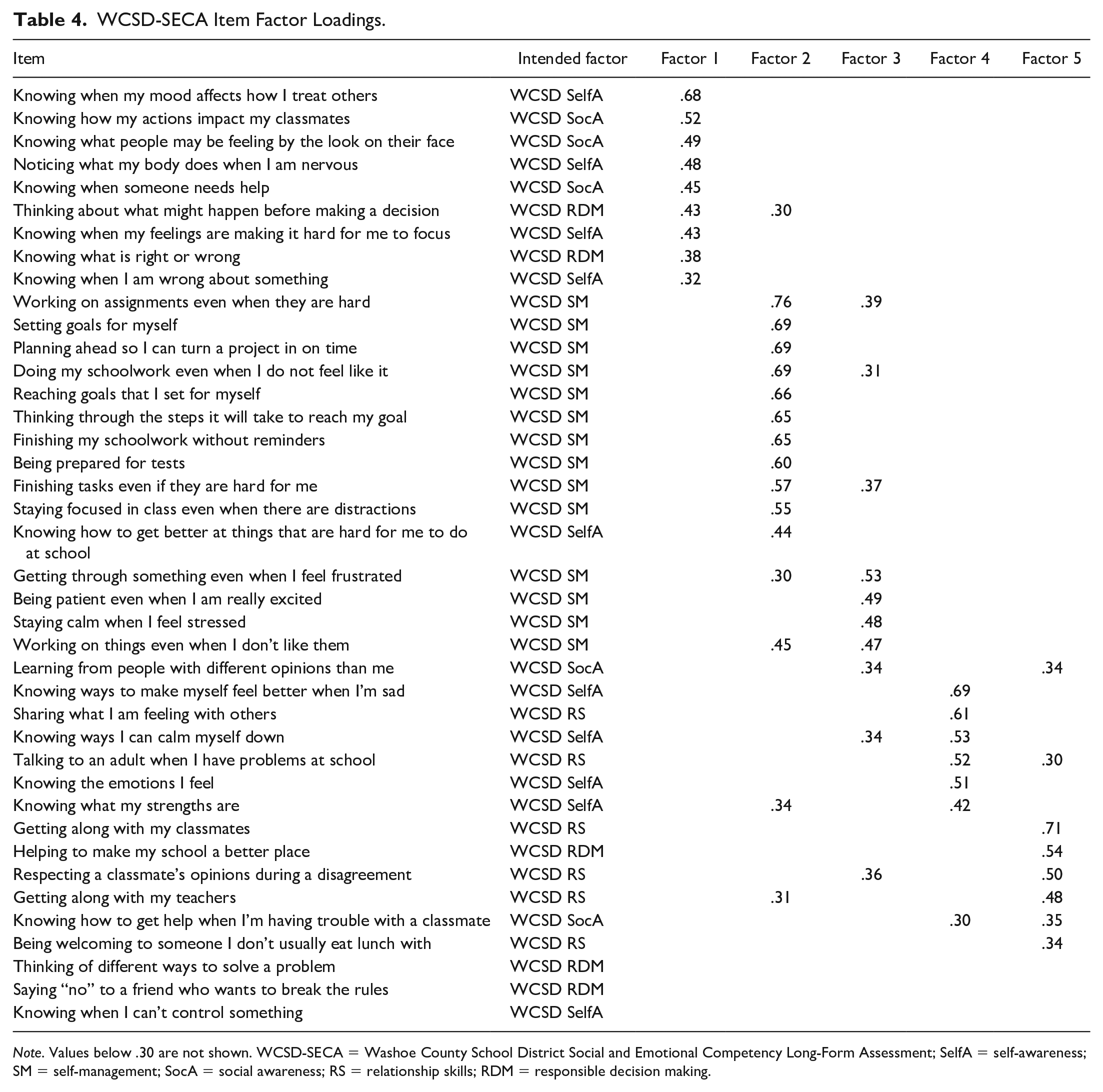
Note. Values below .30 are not shown. WCSD-SECA = Washoe County School District Social and Emotional Competency Long-Form Assessment; SelfA = self-awareness; SM = self-management; SocA = social awareness; RS = relationship skills; RDM = responsible decision making.
For general edification, fit indices for solutions with two six factors can be found in Table 2, and loadings for models with two, three, four, and six factors can be found in Tables S2 to S5 (available in the online supplement). The fit indices for all models were adequate. Across all models, the self-management items were the only that consistently covaried. Also note that the three-factor model did not resemble intrapersonal- (self-awareness and self-management), interpersonal- (social awareness and relationship skills), and cognitive-related (responsible decision making) competencies (Weissberg et al., 2015).
Joint BFI and WCSD-SECA Factor Solution
We examined four-, five-, and six-factor models fit to the BFI and WCSD-SECA simultaneously. The fit indices across the three models were similar, and the same general conclusions can be made across the three as well. First, the BFI and WCSD-SECA items covaried. In each model, each factor contained items from both measures. Second, the BFI and WCSD-SECA items covaried in predictable ways given the item content. As one example, the BFI item “Remains calm in tense situations” from the emotional stability scale and the WCSD-SECA item “Staying calm when I feel stressed” from the self-management scale loaded on the same factor in each model. Third, the factors can be interpreted as the Big Five, not as the CASEL competencies.
The five-factor model resembled the Big Five personality model (see Table 5). Each BFI item loaded on its intended factor, and the WCSD-SECA items loaded on one or more of these five factors. The first factor aligned with extraversion with all BFI extraversion items loading on that factor, along with two of the six relationship skills items, specifically the two related to expressing oneself. The second factor consisted of all BFI openness items and one WCSD-SECA responsible decision making item related to problem solving. The third factor consisted primarily of conscientiousness and self-management items, specifically the self-management items related to goal setting and preparedness. The self-management items related to emotion regulation loaded on the fourth factor, along with two self-awareness items and three BFI emotional stability items; therefore, this factor was labeled emotional stability. Finally, the best interpretation of the fifth factor was agreeableness. In addition to the BFI agreeableness items, WCSD-SECA items from various scales loaded on this factor, including relationship skill items related to getting along with others, and self-awareness and social awareness items related to empathy. Most of the WCSD-SECA items were pure indicators of a Big Five factor (e.g., “Thinking of different ways to solve a problem” from responsible decision making, which loaded on openness), but seven had secondary loadings on a second factor. For example, four items pertaining to working on tasks that are difficult or disliked loaded on both conscientiousness and emotional stability.
BFI and WCSD-SECA Item Factor Loadings.
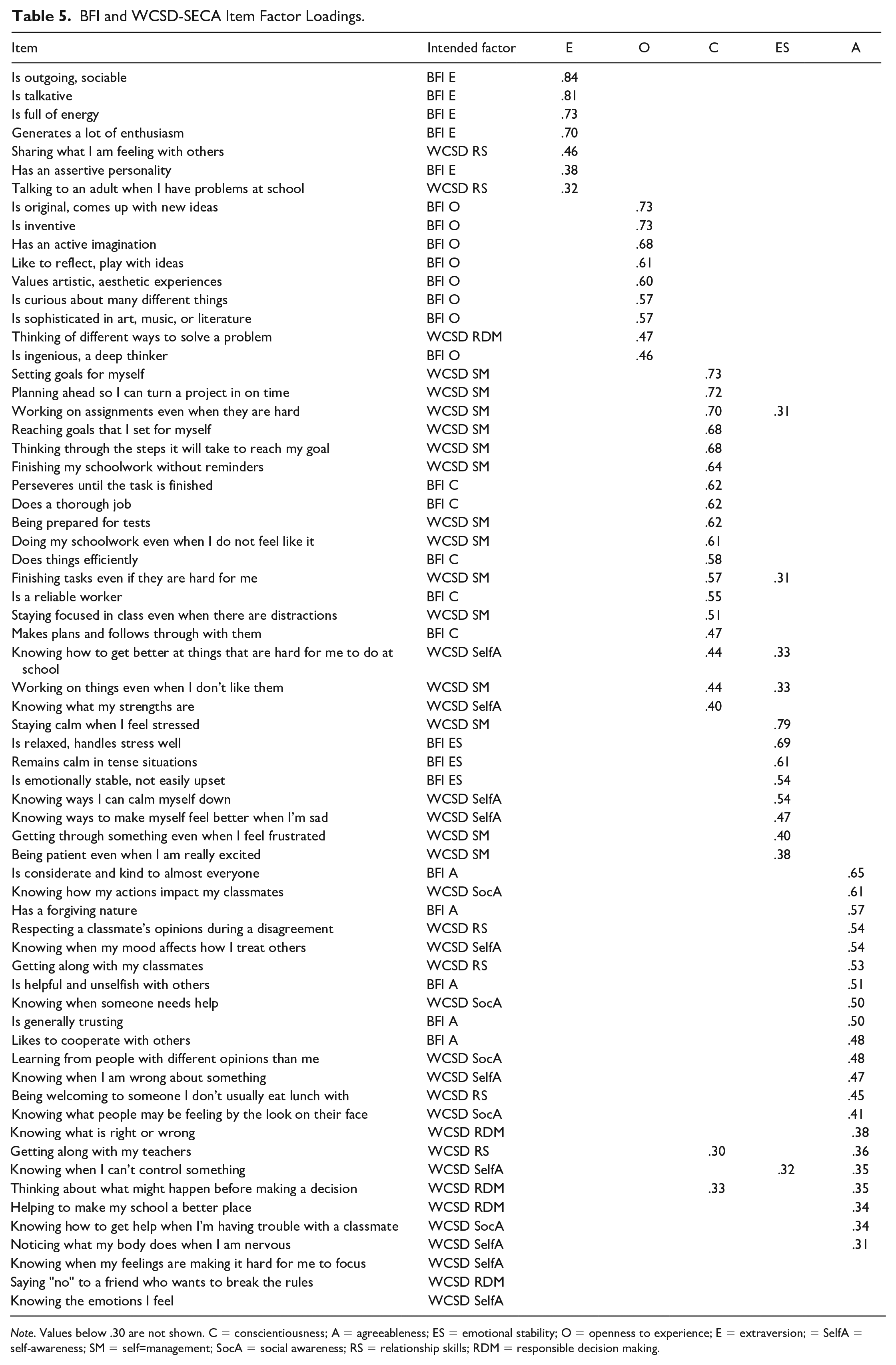
Note. Values below .30 are not shown. C = conscientiousness; A = agreeableness; ES = emotional stability; O = openness to experience; E = extraversion; = SelfA = self-awareness; SM = self=management; SocA = social awareness; RS = relationship skills; RDM = responsible decision making.
The four- and six-factor models were similar to the five-factor model. In the four-factor model, the extraversion and agreeableness factors merged to form an interpersonal factor, and in the six-factor model, the sixth factor was largely composed of the self-awareness items. These solutions can be found in Tables S6 and S7 (available in the online supplement). Note that we carried out the factor analyses with the reverse-keyed items included as well, and the general conclusion was the same; that is, a five-factor model resembling the Big Five personality model fit the data well, and the WCSD-SECA items loaded on those factors. Four-, five-, and six-factor models with reverse-keyed items can be found in Tables S8 to S10 (available in the online supplement).
Discussion
Study 1 extended the work of Primi et al. (2016) to include English language measures of the Big Five personality traits and CASEL core SE competencies. We largely replicated their findings with robust support for five factors aligning to the Big Five, though we did not find a sixth factor related to external locus of control/negative valence, which, given the BFI and WCSD-SECA item content, is unsurprising. The CASEL-based items loaded on one or more of these five factors, suggesting that the variance in these items can be explained by these five domains. Moreover, it should be noted that neither the five- nor the three-factor CASEL competency model fit the WCSD-SECA items, suggesting that empirical, data-driven support for those models is lacking.
Study 2: An Expert Consensus Approach
The findings from Study 1 support the conceptually driven approach taken by others (e.g., Burrus & Brenneman, 2016) to use the Big Five as an organizing framework for SE skills. To further investigate overlap between the Big Five and SE skills, we carried out a second study, taking an expert consensus approach, which, to our knowledge, has not been previously documented in the literature. Details of the procedure can be found below, but in short, we asked subject matter experts (SMEs) to rate the degree of overlap between Big Five personality traits and popular SE skills. Relying on experts for their informed judgment is a long-standing practice (Helmer, 1967) that can be used to supplement experimental methods, such as randomized controlled trials, to develop guidelines or policy (see Jorm, 2015, for a lengthy list of use cases for a particular expert consensus method in mental health research). This approach is used in various fields from medicine (e.g., Januzzi et al., 2019) to economics (e.g., Howard & Sylvan, 2015) and has several advantages. Although based on a conceptual alignment, aggregation across multiple experts is more compelling than alignment specified by single teams of researchers, which could be subject to bias and idiosyncratic judgments (Lynam & Widiger, 2001). Moreover, in this study, we sought input from experts from multiple backgrounds and theoretical orientations with varying degrees of familiarity with the Big Five and SE skills and to again minimize any potential bias (Samuel et al., 2012).
Method
Participants
Qualtrics survey invitations went out to three listserves, one affiliated with a personality psychology organization and two affiliated with SEL organizations. Ninety-three individuals completed part or all of the survey. Three were excluded from further analysis because they were deemed to not be SMEs; two said they had no familiarity with personality traits and frameworks and had no familiarity with SE skills and frameworks, and one reported being only mildly familiar with one of the two. Data from 90 participants were used in subsequent analyses. Eighteen 3 did not complete the survey in its entirely and did not provide demographic information. The 72 with complete data reported the following roles or titles: college professor (n = 39), graduate student (n = 17), researcher (n = 12), K-12 teacher (n = 2), and “other” (n = 2).
Measure
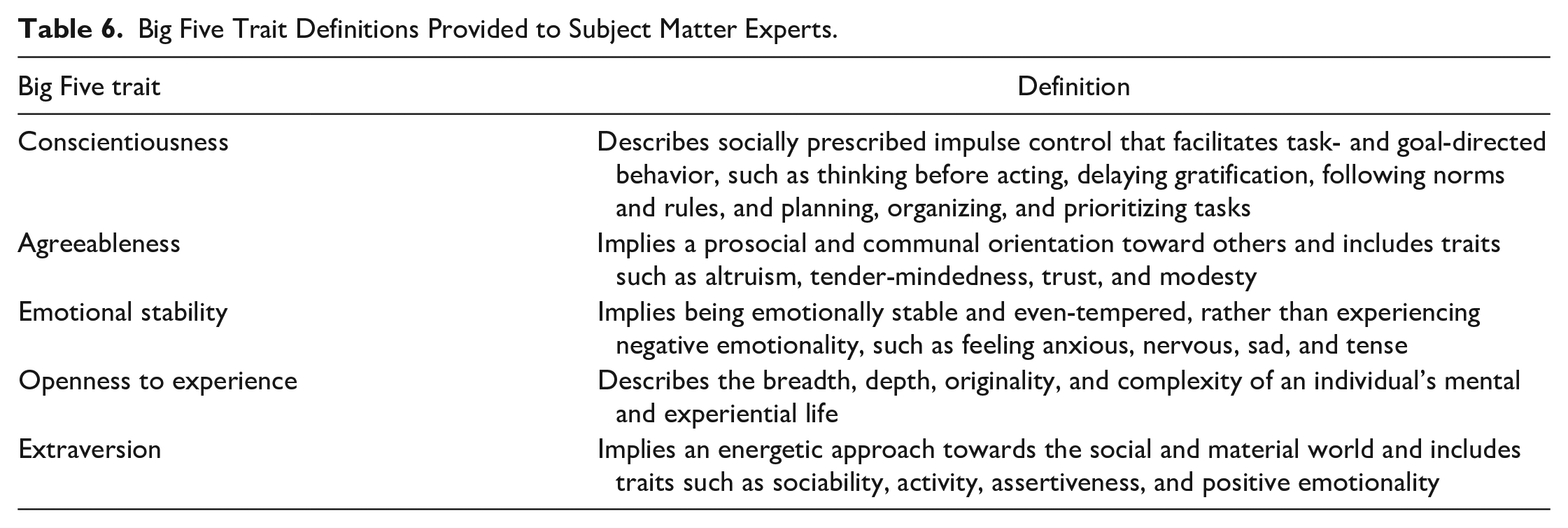
Participants were provided with a definition of a Big Five personality trait (which was not labeled) based on definitions provided by John et al. (2008; see Table 6), followed by 20 SE skill terms. These terms were pulled from some of the more influential and widely used SE skill frameworks, specifically CASEL, Character Lab, MESH, and OECD. CASEL and OECD were selected given that they are the leading frameworks nationally and internationally, respectively. Character Lab is a hugely popular SEL organization, and MESH is widely used in California’s CORE districts, reaching hundreds of thousands of students. We limited the pool to these four to reduce burden on the SMEs. Each framework has the following number of SE skills: CASEL (n = 5), Character Lab (n = 9), MESH (n = 4), and OECD (n = 6). The six OECD skills are high-order skills with underlying facets. We did not include the low-order facets so as to not tax the SMEs. The sixth is labelled “compound skills,” and as such is not interpretable; therefore, it was not included. Of the remaining 23 terms, three were repeated verbatim across frameworks (i.e., growth mindset can be found in Character Lab and MESH, and both self-management and social awareness can be found in CASEL and MESH).
Big Five Trait Definitions Provided to Subject Matter Experts.
Participants were asked to indicate the extent to which each term is related to the definition provided—not at all related, a little bit related, moderately related, or very much related. This exercise repeated a total of five times, one for each of the Big Five personality trait definitions. The Big Five were presented in a random order, and within each of the five repetitions, presentation of the 20 SE skills was randomized as well. At the conclusion of the five repetitions, participants were asked to indicate their level of familiarity with personality traits and frameworks and SE skills and frameworks.
Results
Table 7 presents the mean ratings for each SE skills term per Big Five trait, as well as the percentage of SMEs who said the terms were at least a little bit related and moderately related. There was a high degree of agreement among the experts (ICC = .99). Each SE term was judged to be related to at least one Big Five trait. Seven terms were judged to be related to all of the Big Five at least to some degree, specifically, emotional regulation, purpose, relationship skills, self-control, social/emotional intelligence, self-awareness, and social awareness. Task performance was the only term judged to be related to just one of the Big Five (i.e., conscientiousness), but all other SE skills were thought of as “blends” of two or more Big Five traits.
Descriptive Statistics of SMEs’ Ratings of Degree of Relatedness Between Big Five Definitions and Social and Emotional Skill Terms.
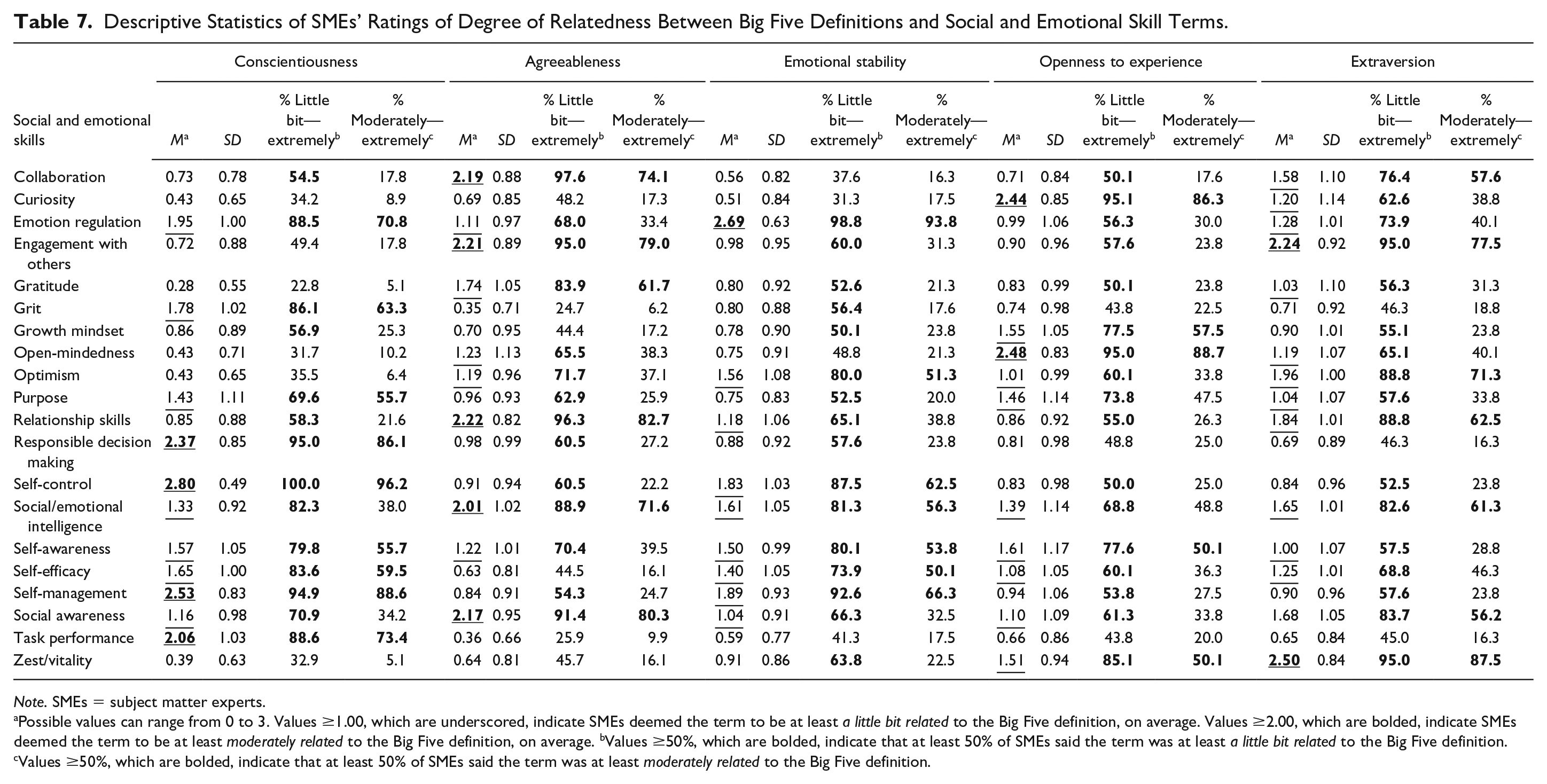
Note. SMEs = subject matter experts.
Possible values can range from 0 to 3. Values ≥1.00, which are underscored, indicate SMEs deemed the term to be at least a little bit related to the Big Five definition, on average. Values ≥2.00, which are bolded, indicate SMEs deemed the term to be at least moderately related to the Big Five definition, on average. bValues ≥50%, which are bolded, indicate that at least 50% of SMEs said the term was at least a little bit related to the Big Five definition. cValues ≥50%, which are bolded, indicate that at least 50% of SMEs said the term was at least moderately related to the Big Five definition.
Despite this apparent blending, the ratings evidenced convergent and discriminant patterns with each of the Big Five traits based on the content of the terms. For example, by sorting terms based on the percentage of SMEs who rated the terms as moderately to extremely related to conscientiousness, the highest rated terms were self-control (96.2% of SMEs rated this term as moderately–extremely related to conscientiousness), self-management (88.6%), responsible decision making (86.1%), and task performance (73.4%). Across these four terms, on average, 86.1% of SMEs rated them as having moderate–extreme overlap. In contrast, the terms rated as having the least overlap with conscientiousness were curiosity, optimism, gratitude, and zest, with an average of 6.4% of SMEs rating them as having moderate–extreme overlap. Similar patterns emerged for the other four traits of the Big Five. The highest and lowest rated terms for the remaining Big Five were as follows: Agreeableness: relationship skills, social awareness, engagement with others, and collaboration (M = 79.0%) versus self-efficacy, zest, task performance, and grit (M = 12.1%); Emotional stability: emotion regulation, self-management, self-control, and social/emotional intelligence (M = 69.7%) versus grit, task performance, curiosity, and collaboration (M = 17.2%); Openness to experience: open mindedness, curiosity, growth mindset, and self-awareness (M = 70.7%) versus gratitude, grit, task performance, and collaboration (M = 21.0%); Extraversion: zest, engagement with others, optimism, and relationship skills (M = 74.7%) vs. growth mindset, grit, responsible decision making, and task performance (M = 18.8%).
Nine SE skills were rated as at least moderately related to conscientiousness, followed by seven for emotional stability and extraversion, six for agreeableness, and five for openness. Self-awareness and social/emotional intelligence were rated as at least moderately related to three of the Big Five. The remaining 18 skills were determined to be related to one or two of the Big Five.
Discussion
The expert consensus approach taken in Study 2 led to similar conclusions as prior research using conceptual alignments or factor analytic approaches linking the Big Five and SE skills. With a very high degree of agreement, there is clear consensus among experts from different theoretical orientations and fields—personality psychology and SEL—that the Big Five personality traits and popular SE skills overlap to a significant degree. In fact, the SME ratings not only showed that the terms from SE skills are related to the Big Five, but they evidenced substantial convergent and discriminant patterns based on item content.
Moreover, close examination of the specific SME ratings led to some insights about the SE skill-Big Five associations. First, conscientiousness was related to nearly twice the number of SE skills as openness. This is to be expected given that conscientiousness is the trait most highly associated with academic performance (Poropat, 2009), while skills related to openness may be thought of as more related to cognitive ability (DeYoung et al., 2005) and thus out of the realm of SEL. Second, five SE skills overlap between agreeableness and extraversion (namely, collaboration, engagement with others, relationship skills, social/emotional intelligence, and social awareness), leaving just one unique skill for agreeableness and two for extraversion. This may suggest that the agreeableness–extraversion distinction is not necessary for SE skills but instead a broad interpersonal factor could be sufficient. SE skill overlap is also relevant to our third observation; four skills pertaining to controlling oneself or having belief in control over oneself—emotion regulation, self-control, self-efficacy, and self-management—are associated with both conscientiousness and emotional stability. Unlike agreeableness and extraversion, however, there are many unique and key features of these traits that warrant their distinction in a taxonomy. For example, goal pursuit, which is a critical skill for students to acquire, is a hallmark of conscientiousness but has little to no relevance to emotional stability.
General Discussion
Stakeholders are becoming increasingly aware of the importance of SE skills for academic, work, and life success, and the field of SEL is growing at a rapid pace. While on one hand, the surging popularity is encouraging, we must be sure that science and best practices do not lag behind. One critical issue concerns the plethora of SE skill frameworks in use, which creates confusion among users and hampers progress towards reliable and valid measurement of SE skills and SE skill curriculum development. The field of SEL could benefit from gaining consensus for an organizing framework. While at least 136 frameworks currently exist (Berg et al., 2017), few are empirically backed and most overlap with one another to some degree. Like others (e.g., Primi et al., 2016), we argue that the personality psychology’s Big Five framework provides a solid taxonomy for organizing SE skills, and we provide support from two distinct methodologies—a factor analytic, data-driven approach, and an expert consensus approach—to support this stance.
In the first study, we jointly factor analyzed items from a Big Five measure and items from WCSD-SECA, a measure intended to cover CASEL’s five competencies. We found support for a five-factor model resembling the Big Five, with the WCSD-SECA items largely loaded on one or more of these five factors. In the second study, we compiled SME ratings of the degree of overlap between the Big Five and 20 SE skills from the more popular SE skill taxonomies. The SMEs indicated a significant degree of overlap, with substantially higher mean ratings for terms that are meaningfully related to the Big Five (e.g., self-control with conscientiousness, emotional regulation with emotional stability, open-mindedness with openness to experience, etc.). The findings from these two empirical methods, in consideration with prior work conceptually describing overlap between personality traits and SE skills, lend strong support for the notion that personality traits and SE skills are not all that dissimilar, at least in terms of an appropriate organizing framework.
Are There Advantages of Using the Big Five for Organizing SE Skills?
Elsewhere (ACT, 2021), we have articulated the advantages of the Big Five (as have others; e.g., Chernyshenko et al., 2018). In short, the framework has enjoyed many years of empirical support in the field of personality psychology. Based on the lexical hypothesis that language should contain terms for all meaningful individual differences (Goldberg, 1993), the five factors were discovered through factor analysis of trait descriptors found in the English language dictionary (see de Raad & Mlačić, 2015, for a complete history). The five-factor solution has been replicated with different assessments, different languages, different reporters, and different samples. For example, McCrae et al. (2005) replicated the structure in nearly 50 cultures in six continents. The five factors are routinely and predictably related to important life outcomes, ranging from academic success (Poropat, 2009) to mortality (Bogg & Roberts, 2004). In addition to decades of empirical support, the framework is advantageous because it optimizes bandwidth and fidelity (Cronbach & Gleser, 1965), allowing one to summarize a large amount of information while simultaneously allowing for some nuanced individual difference description (Soto & John, 2014).
The Big Five has undeniable support in the field of personality psychology. Does this automatically mean it should enjoy the same success in the field of SEL? Not necessarily. However, there is accumulating support for the Big Five in SEL as well. Multiple single-team researchers have argued that the Big Five can be used to make conceptual sense of the hundreds of SE skill labels and frameworks (e.g., Soto et al., 2021). In the current study, we extended this to get expert consensus on conceptual links between the Big Five and SE skills. Finally, the current study and prior literature (Primi et al., 2016) offers empirical, data-driven support. That is, all signs point to the Big Five having great utility in SEL. In evaluating these factors, we conclude that yes, there are advantages of using the Big Five for organizing SE skills.
Are there Disadvantages of Using the Big Five for Organizing SE Skills?
We can think of three potential arguments against using the Big Five for organizing SE skills, but we have counterarguments for each of these. First, one may argue that there is a conceptual difference between a personality trait and a SE skill, thus rendering a personality trait framework inappropriate for SE skills. Soto et al. (2021) made a clear conceptual distinction between traits and skills. Personality traits refer to what a person tends to do, whereas skills refer to what a person is capable of doing. A person might not be high on trait-level extraversion, tending to let others take the lead and being relatively quiet. However, that person may possess skills related to being energetic, persuasive, and assertive, which would make him or her a good leader when the occasion necessitates it. The goal with SEL is to equip individuals with skills for success—not to make every person have the same tendencies. Given that traits and skill are distinct from one another does this mean a Big Five-based framework won’t work for SE skills? No. As Soto et al. argue, SE skills should be organized into five domains but rather than defining extraversion solely as a tendency to engage with people, it should be defined as a capacity to engage with people, with characteristics reciprocally influencing each other from tendency to capacity (and vice versa) in terms of their behavioral manifestations.
Second, there is a possibility that the Big Five fail to capture all important SE skills. While grit clearly is closely linked with conscientiousness, according to the SMEs in the current study, self-awareness and social/emotional intelligence are blends of multiple SE skills and do not map as clearly to the Big Five model (although, according to SMEs, even these two skills have a high degree of overlap with the Big Five). In their Study on Social and Emotional Skills, the OECD makes use of the Big Five but also includes skills of self-efficacy and achievement motivation (Kankaraš & Suarez-Alvarez, 2019). As discussed above, Primi et al. (2016) concluded that a six-factor model best fit SE skill indicators. They resolutely concluded that a sixth factor does not invalidate the Big Five framework. They concluded that their sixth factor simply supplements the model. Similarly, the ACT Holistic Framework (Casillas et al., 2015) notes similarities between the Big Five and a six-factor model known as HEXACO, which includes a factor related to honesty or integrity. While educators and parents may not feel comfortable assessing honesty in students, this factor is of great interest in the workforce to predict things like counterproductive work behaviors (Giordano et al., 2018), and this has not rendered the Big Five obsolete in industrial/organizational psychology.
A third point of contention with relying on a personality trait framework for SE skills concerns the malleability of skill and traits. There is ample evidence that SE skills can be developed through SEL programs (Mahoney et al., 2019). Some may be reluctant to use a personality trait framework to conceptualize SE skills due to an erroneous assumption that personality traits are fixed and do not show significant change over time. However, just like there is ample evidence that SE skills can be developed, there is ample evidence that personality traits change normatively over the life course, even into old age (Roberts et al., 2006), and in response to intervention (Hudson et al., 2019; Roberts et al., 2017). When considering these various lines of argument, we conclude that no, there are no disadvantages of using the Big Five for organizing SE skills.
The Intersection Between Social Emotional Learning, Personality, and Mental Health
In addition to supporting the idea that the field of SEL ought to look to personality psychology for resources, we also would argue that clinical psychology and psychopathology research offer resources that can be leveraged to enable the field of SEL to progress and to promote wellness and prevention. For example, clinical interventions that have proven successful may be effective for school-based SEL programs as well. An example is mindfulness training, which was used in clinical research and practice long before being introduced in schools (Zenner et al., 2014).
The field of SEL may be reluctant to “officially” embrace anything associated with clinical psychology or even “mental health”—and for good reason. SE skill assessments are not designed to be diagnostic tools, and they do not measure clinically recognized disorders. Likewise, SEL programs and curricula are not designed to treat clinical disorders. The goal of SEL is to provide students with skills for success, and stakeholders fear an unintended consequence, such as a student being pinned with a stigma-laden label. Albeit justified, despite any reluctance, the associations between SE skills and mental health cannot be disputed.
While perhaps not immediately clear, the present studies provide evidence of the connection. Just as SE skills can be linked with the Big Five, so too can clinical conditions. The American Psychiatric Association (APA; 2013) identifies five pathological personality traits that are associated with personality disorders, four of which map directly onto the Big Five. This was based on a body of research delineating associations between the Big Five and personality disorders (Samuel & Widiger, 2008; Saulsman & Page, 2004). Links between the Big Five and mental disorders such as mood and substance use disorders have been clearly delineated as well (e.g., Kotov et al., 2010), and researchers have argued that “greater attention to these constructs [e.g., the Big Five] can significantly benefit psychopathology research and clinical practice” (Kotov et al., 2010, p. 768) and that “these traits may be helpful in directing prevention efforts” (p. 810). Notably, this is the same argument we have made here for the benefit of SEL.
Big Five associations with mental disorders and SE skills only loosely connect clinical disorders and SE skills; the transitive property of equality certainly does not apply here. However, close examination of SE skill descriptions and criteria of clinically recognized disorders can further elucidate the connection and provide some face validity to the argument. For example, several symptoms of Antisocial Personality Disorder (ASPD) resemble CASEL competencies (or lack thereof). ASPD involves lack of empathy (APA, 2013), which CASEL explicitly mentions as an example of social awareness. “Incapacity for mutually intimate relationships” (APA, 2013, p. 764) is an ASPD criterion that involves relationship skills. Another diagnostic criterion of ASPD is “absence of prosocial internal standards, associated with failure to conform to lawful or culturally normative ethical behavior” (APA, 2013, p. 764). This aligns with responsible decision making, which “includes the capacities to consider ethical standards and safety concerns” (CASEL, 2020, p. 2). Self-management entails setting personal and collective goals, whereas individuals with ASPD set goals solely for their personal gratification. Self-management is tied to other personality disorders as well; it includes “managing one’s emotions” (CASEL, 2020, p. 2), the inability of which is a hallmark feature of Borderline Personality Disorder. Connections between SE skills and mental disorders does not stop at personality disorders. For example, the inability to manage one’s emotions can be seen in mood disorders, such as Disruptive Mood Dysregulation Disorder (APA, 2013). Clearly, weak SE skills and clinical disorders are not equivalent, but the parallels between the two are indisputable. Given that most psychopathological conditions lie on a continuum with “normality” (Kotov et al., 2017), it seems reasonable to presuppose that effective and adaptive SE skills lie on a common continuum with ineffective and maladaptive skills.
Again, we do not intend to promote the idea that SEL should be aimed at identifying clinical conditions. Instead, our objective is to highlight another long-standing area of research and practice that may prove fruitful for SEL programs (e.g., the mindfulness practices aforementioned). Perhaps of even greater importance, the more these types of practices become commonplace in schools and elsewhere, the more they are normalized. This could help promote skill development aimed at wellness and prevention, as well as reduce any shame students feel if they are in need of SE skill development, and ultimately contribute to the de-stigmatization of mental illness writ large. Conceivably now more than ever, this is of paramount importance. Since the onset of the COVID-19 pandemic, we have seen an uptick in mental illness, particularly among young people (Pierce et al., 2020), and students are reporting high levels of stress resulting from the pandemic (Styck et al., 2021). Normalizing these feelings and struggles, and teaching students necessary coping skills to manage them, can only help them develop into more adaptive and flexible individuals poised to grow and thrive.
Limitations and Future Directions
Our intent was not to have the final word on aligning all SE skills to the Big Five. Our goal was to further explore whether this would be a reasonable approach to take for organizing the field of SEL. Coupled with prior research, the current studies do indeed support this approach. The common take-home message from both studies here is that the Big Five can be used to understand the network of SE skills, their interrelationships, and thus—with some additional work—their overall structure.
The current studies are not without their limitations, however. Although large, the Study 1 sample may be somewhat restricted in SE skill or personality trait variation, given that the students self-selected into the study. You might imagine that more conscientious students, for example, would be more likely to volunteer to participate in such studies. In addition, the factor structure of the BFI is well established in prior literature, but the reverse-scored items did not function well in the current sample. Finally, an advantage of Study 1 was that it included CASEL’s core competencies; however, the study was limited in that this was the only framework included, and CASEL’s framework does not cover some popular SE skills such as growth mindset. Study 2 clearly was limited to the four SE skill frameworks we selected (leaving at least 132 frameworks unstudied!). We cite the value 132 facetiously, but do sincerely acknowledge that inclusion of 20 SE-related terms does not sufficiently cover all relevant aspects of SEL. While we made an effort to balance due diligence and SME burden, we recognize that additional frameworks and terms need to be considered for replication.
In addition, next steps would be to more extensively assess empirical relationships among personality traits and SE skills to determine whether a particular SE skill term is synonymous with one of the Big Five at the broad level, or if it represents a facet of a broader dimension, or if it in fact is not captured by the Big Five (sometimes referred to as “orphan,” and “interstitial” constructs). An example of this approach comes from the clinical and personality literatures, where the notion of evaluating convergent and discriminant relations is key for building out the construct validity of a measure and the body of evidence needed to establish the utility of new theories and constructs (Clark & Watson, 2019). Evidence of this sort is part of the research reported above (though to an abbreviated extent given the limited number of items used in these studies). For example, in Study 2, the ratings showed evidence of convergent and discriminant relationships, with terms like self-control showing a 96.2% rate of SME overlap with Big Five conscientiousness (thus providing evidence of convergence), but much lower levels of agreement with other constructs of the Big Five, ranging from 22.2% to 62.5% (thus providing evidence of discrimination). Importantly, the self-control construct has been repeatedly evidenced in both trait- and behavior-level analyses of conscientiousness content (e.g., Jackson et al., 2010). Thus, future research on SE skills could set up comparisons of this sort among popular frameworks and SE skill measures to more clearly elucidate convergent/discriminant patterns among constructs.
Conclusion
There was a time when personality psychology lacked clarity and cohesion, and SEL currently finds itself in a similar situation. The Big Five was the solution to personality psychology’s problem, and we provide empirical evidence here that it may offer a solution to SEL as well. This would help solidify a common framework for the field to use, which, in turn, would progress all aspects of the field, including SE skill description, assessment, and learning/training applications, as well as the understanding of important associated outcomes and developmental trends, and more. As aforementioned, CASEL recently argued that the field should leverage existing resources and expertise “to realize the full potential of SE [learning] assessment and the effective use of data” (Cipriano et al., 2020, p. 10). We agree wholeheartedly. However, we encourage researchers and practitioners to look beyond “SEL” and leverage resources and expertise from other fields as well, including—but not limited to—clinical, community, educational, industrial/organizational, and personality psychology.
Supplemental Material
sj-pdf-1-asm-110.1177_10731911211045744 – Supplemental material for Multimethod Support for Using the Big Five Framework to Organize Social and Emotional Skills
Supplemental material, sj-pdf-1-asm-110.1177_10731911211045744 for Multimethod Support for Using the Big Five Framework to Organize Social and Emotional Skills by Kate E. Walton, Dana Murano, Jeremy Burrus and Alex Casillas in Assessment
Footnotes
Declaration of Conflicting Interests
The author(s) declared no potential conflicts of interest with respect to the research, authorship, and/or publication of this article.
Funding
The author(s) received no financial support for the research, authorship, and/or publication of this article.
Supplemental Material
Supplemental material for this article is available online.

Notes
References
Supplementary Material
Please find the following supplemental material available below.
For Open Access articles published under a Creative Commons License, all supplemental material carries the same license as the article it is associated with.
For non-Open Access articles published, all supplemental material carries a non-exclusive license, and permission requests for re-use of supplemental material or any part of supplemental material shall be sent directly to the copyright owner as specified in the copyright notice associated with the article.
