



Abstract
Emotion differentiation refers to the tendency to label emotions in a granular way. While differentiation is an important individual difference in the context of psychological well-being, it is unknown how it fluctuates within individuals. Such a within-person measure is important, since it would allow the study of how changes in differentiation predict subsequent levels of other variables of interest. Here, we present a framework to study emotion differentiation at the within-person level by introducing a momentary emotion differentiation index. This index is directly derived from the classical emotion differentiation index, the intraclass correlation. We first give a theoretical derivation of this index. Next, using data from two experience sampling studies, we show how this new momentary index is related to other momentary indicators of well-being, and take the first steps in building its nomological network. A better understanding of within-person fluctuations in emotion differentiation will allow us to identify the causes and consequences of these fluctuations, and search for ways to teach individuals to increase their level of emotion differentiation.
Emotion differentiation, or emotional granularity, refers to the degree to which people use discrete emotion labels such as anger or sadness to describe their feelings (Barrett et al., 2001; Kashdan et al., 2015). High differentiators use these discrete emotion labels in a specific, context-dependent way. Low differentiators, however, have a high valence focus and mainly seem to differentiate between positive and negative emotions (Barrett, 1998, Erbas et al., 2015). To represent their emotional experiences, they tend to use same-valenced emotional labels interchangeably across different situations.
More granular, differentiated emotions are considered to be more functional than undifferentiated affective experiences. According to the feelings as information perspective (Schwarz, 2012), individuals use their emotions to retrieve information about their environment. This perspective suggests that experiencing differentiated discrete emotions can provide specific information about the emotional situation, enabling individuals to regulate their emotions and react to the situation in a more adaptive way. For instance, the emotion of anger has very different appraisals and behavioral tendencies than the emotion of sadness (Frijda, 2007; Moors et al., 2013). Therefore, when these emotions are experienced independently of one another, the information they provide will also be more differentiated, and thus more specific to the context. However, when the emotions are not differentiated from one another and instead are used interchangeably to represent a more general negative experience, the information they provide will be nonspecific and insensitive to contextual factors. Moreover, experiencing a specific emotion also provides a clear-cut target for emotion regulation. When you precisely know what you feel, it is easier to select the most appropriate or effective emotion regulation strategy for that specific emotion in that specific context, and emotion regulation efforts will be more effective (Kalokerinos, et al., 2019). In sum, high levels of emotion differentiation are theorized to provide individuals with more unique contextual knowledge, a clear target to regulate, and information on how to regulate it effectively.
In line with this theory, two decades of research on emotion differentiation show that granular emotions protect against challenges to well-being. For instance, high differentiation of negative emotions is associated with an increased use of emotion regulation strategies (Barrett et al., 2001), while low differentiation of negative emotions is associated with more ineffective down-regulation of negative emotions (Kalokerinos et al., 2019). Moreover, individuals with high levels of negative emotion differentiation experience less aggression in response to anger (Pond et al., 2012), lower impulsivity (Tomko et al., 2015), and less social avoidance in response to rumination (Seah et al., 2020). In contrast, individuals with low levels of negative emotion differentiation show increased alcohol use in response to stress (Kashdan et al., 2010), and experience more depressive symptoms in response to brooding (Starr et al., 2017). Finally, there is evidence that low emotion differentiation is a feature in certain clinical populations, including major depressive disorder (Demiralp et al., 2012), social anxiety disorder (Kashdan & Farmer, 2014), autism spectrum disorder (Erbas et al., 2013), and borderline personality disorder (Suvak et al., 2011).
Emotion differentiation is assessed separately for negative and positive emotions, because research demonstrates that they are generally unrelated to each other (i.e., there is often a weak relation between an individual’s level of positive and negative emotion differentiation, see, e.g., Erbas et al., 2016; Willroth et al., 2020). Research has found that it is primarily differentiation of negative emotions that is important to well-being (e.g., Demiralp et al., 2012; Kashdan et al., 2010; Pond et al., 2012), for which there are two possible explanations. First, negative emotions encompass a wider variety of emotional states (Ortony et al., 1987), and therefore there is more room for differentiation. Second, negative emotions are more closely linked with well-being than positive emotions (Houben et al., 2015), likely because they are signals of threats and challenges.
However, although it is less strongly linked with well-being, positive emotion differentiation does seem to be related to some aspects of emotionality such as emotional variability and emotional intensity (Boden et al., 2013; Demiralp et al., 2012). Furthermore, higher levels of positive emotion differentiation are positively associated with coping (Tugade et al., 2004), and a recent study found that the link between rumination and depression was weaker for individuals who had higher levels of differentiation for both negative and positive emotions (Liu et al., 2019).
In sum, research shows that emotion differentiation is an important factor for psychological well-being. However, although the importance of emotion differentiation as an individual difference variable is well-established, far less is known about how the construct of emotion differentiation changes within individuals across time. There is some cross-sectional research on the development of emotion differentiation throughout the life span. A study by Nook and colleagues for instance shows a decrease in the level of differentiation from childhood to adolescence (likely due to an increased tendency to report one emotion at a time in childhood), and an increase in the level of differentiation from adolescence to adulthood (Nook et al., 2018). However, in a study among adolescents aged 14 to 17 years, emotion differentiation appeared to relate negatively to age (Starr et al., 2020). Finally, a study examining the level of differentiation in younger and older adults, found no difference between the two populations (Mikkelse et al., 2020). Together, these findings indicate that emotion differentiation is a skill that is acquired throughout the life span, but more research is needed to determine exactly how and when it develops.
Apart from these slower changes in the level of emotion differentiation throughout the life span, it is also likely that the level of emotion differentiation fluctuates at a momentary level across contexts. For instance, it has been theorized that emotion differentiation is influenced by factors related to cognitive capacity that can affect the extent to which we can attend to and utilize conceptual emotion knowledge in the emotion formation process (Barrett et al., 2004; Lindquist & Barrett, 2008). This raises the question whether emotions are always differentiated at the same level, or whether there are times that we differentiate more or less between our emotions.
To begin to address this question, in some recent studies, emotion differentiation has been conceptualized as a variable characteristic. Tomko et al. (2015) used a novel measure of momentary emotion differentiation to look at its relation with impulsivity, and Grossmann and colleagues (Grossmann, Gerlach, et al., 2016; Grossmann, Huynh, et al., 2016) used an entropy index to assess the diversity with which emotions are experienced at the momentary level. Both of these measures showed substantial within-person variability. While both of these measures do not strongly correlate with the intraclass correlation (ICC), and therefore seem to capture different phenomena than what is traditionally referred to as emotion differentiation, there is some conceptual overlap: These indices all aim to capture how different discrete emotions relate to one another. Therefore, the fact that these indices demonstrate within-person variability suggests that such variability may also be present in the classical conceptualization of emotion differentiation.
Supporting this idea, in a recent study, we offered initial insight into the importance of studying changes in emotion differentiation within persons. Based on experience sampling data, we calculated separate emotion differentiation indices for each day. We found that within individuals, emotion differentiation fluctuates highly from day to day, and these fluctuations were predicted by stress on both the same day and the previous day (Erbas et al., 2018). This variability suggests that emotion differentiation can be targeted for intervention. In line with this idea, a recent study by Van der Gucht et al. (2019) showed that a mindfulness based intervention increased individuals’ level of emotion differentiation, both at the end of the intervention as well as after a few months, again hinting at the malleability of emotion differentiation over time.
The idea of studying emotion differentiation at a within-person level is in line with general trait theories such as Fleeson’s Whole Trait Theory. These theories argue that individual differences in behavior, thoughts, and feelings (e.g., personality traits) consist of a stable part and a variable part. Such theories argue that traits should be viewed as reflecting density distributions: the same individual behaves differently on different occasions, and it is through the distribution of these behaviors that we can understand the traits of the individual (e.g., Fleeson, 2001; Fleeson & Jayawickreme, 2015). These approaches have been productively applied to other emotion variables (e.g., Blanke et al., 2020).
In sum, previous studies on emotion differentiation and related constructs hint that emotion differentiation is malleable and fluctuates over time, which highlights the need for a framework to study the moment-to-moment dynamics of emotion differentiation. Such a framework is important, because if emotion differentiation is variable within individuals, this would open the door to research questions regarding the causes and the consequences of these fluctuations, their covariates, and ways to enhance differentiation. However, thus far, such research has been practically impossible due to the way the construct is operationalized. Typically, in studies of emotion differentiation, individuals repeatedly rate an array of emotion labels to indicate their current feelings, often in daily life using Experience Sampling Methodology (ESM) or in the laboratory in response to consecutive (emotional) stimuli. The level of differentiation is determined by the amount of covariation between different emotions across measurements. To do this, the ICC (measuring average consistency, which is identical to Cronbach’s alpha; Shrout & Fleiss, 1979) is commonly used as a measure of emotion differentiation. A high ICC (closer to 1) indicates a high degree of covariation between the emotions. This means that different emotion labels are endorsed together frequently across different emotional contexts, and thus indicates a low level of emotion differentiation (Kashdan et al., 2015). In contrast, a low ICC (approaching 0) indicates low covariation between like-valenced emotions across situations. This points to greater emotional specificity, as people are reporting more divergent emotions depending on the circumstances. In essence, to estimate the level of emotion differentiation, data across multiple measurement occasions are summarized in one value. In other words, while emotion differentiation is not a dynamical construct, repeated assessments are needed to estimate it. Therefore, it is impossible to study emotion differentiation at the momentary level with the current measures.
To address this problem, we present a framework to study emotion differentiation at the momentary level. We introduce a momentary index that is directly derived from the classical trait emotion differentiation index, the ICC. When aggregated across time-points, our momentary index perfectly relates to the ICC. This momentary measure estimates emotion differentiation at a specific time-point relative to the person’s overall level of emotion differentiation. In other words, it captures within-person fluctuations in emotion differentiation. In what follows, we give the mathematical derivation of the momentary index from the ICC and examine how it fluctuates within individuals.
After this, we take the first steps toward building a nomological network for momentary emotion differentiation. To do this, we use data from two ESM studies to examine the relationship between momentary differentiation and momentary measures of well-being: positive and negative emotion, stress, rumination, self-esteem, and emotion-focused coping. In line with research at the between-person level, we expect higher levels of momentary differentiation to be positively related to positive momentary indicators of well-being, and negatively related to negative indicators.
Momentary Emotion Differentiation
Here, we provide the derivation of the momentary emotion differentiation index from the classical index, the ICC. As we mentioned earlier, the ICC actually measures nondifferentiation, because higher values indicate more covariation between emotions. In the past, this has sometimes been dealt with by multiplying it by −1, which transforms the index of nondifferentiation into an index of differentiation. (e.g., Kalokerinos et al., 2019). As a final step, we also apply this transformation to our index.
We start from the observation that the average consistency-variant of the ICC is equivalent to Cronbach’s alpha (Shrout & Fleiss, 1979). This implies that, for a given individual and assuming the scores on each emotion term to be centered, the classical ICC index can be computed as

where J equals the number of emotion terms, Yj indicates the scores on the jth emotion term and X the sum scores per measurement across the emotion terms. We can rewrite this formula as follows:

revealing a perfect, but nonlinear relationship between the ICC and the ratio of the variance of the sum scores and the sum of the variances of the separate emotion terms. As shown in Figure 1 (based on data from Study 1), this relationship is monotonically increasing, implying that the Spearman Rank correlation between both measures equals one.
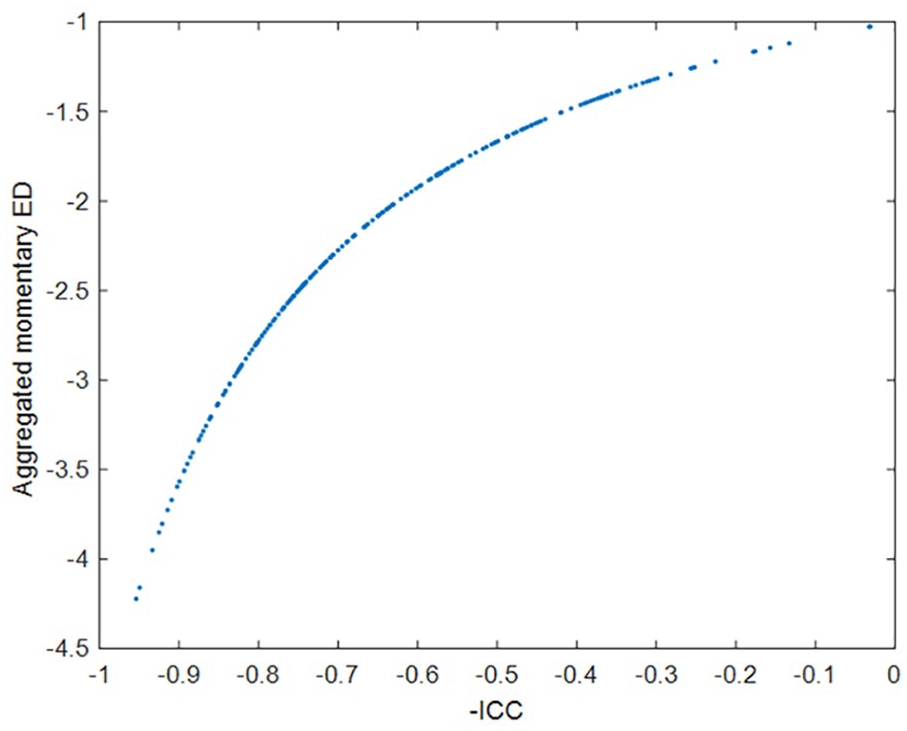
The relationship between the aggregated momentary index for negative emotion differentiation, the EDi, and the classical between-person index for emotion differentiation, the reverse-coded intraclass correlation, in Study 1.
Now, to obtain a momentary measure, we make use of the general knowledge that the variance of a variable almost equals the average squared deviation of the scores to the mean of the variable (i.e., almost, because we divide by I − 1 rather than I, where I indicates the number of measurement occasions for the individual under study):
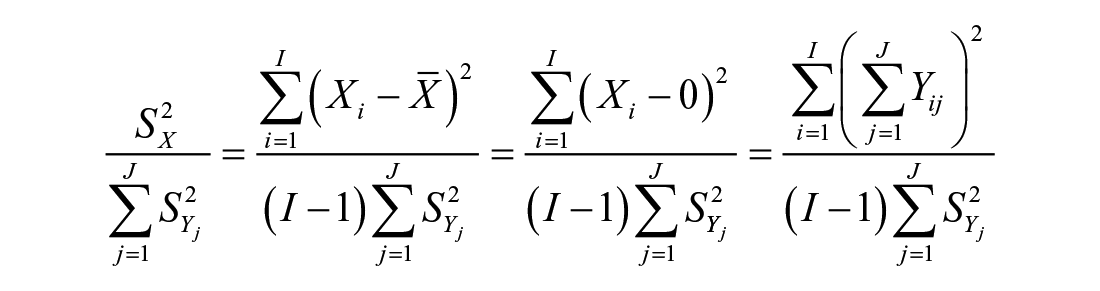
where

To then transform nonEDi into a momentary measure of emotion differentiation, EDi, we multiply nonEDi by −1. As shown by the derivation above, the calculation of the momentary index, separately for positive and for negative emotions, involves the following steps: (1) person-mean center each emotion, (2) compute the means of the (centered) emotions for each time-point, (3) multiply this by the number of emotions, then take the square. This is the numerator of the equation. Next, (4) compute the variance for each of the centered emotions, and (5) take the sum of the variances of all of the emotions. This is the denominator of the equation. Finally, (6) multiply the outcome with −1. Syntax to calculate the momentary emotion differentiation index in R is available at https://osf.io/p25jv/.
EDi will be more negative when an individual strongly deviates in the same direction from their mean level for most of the emotions. In other words, a more strongly negative value means that, at that specific time-point, the level of differentiation is low relative to the individual’s overall level of differentiation. EDi will be approaching zero when an individual deviates in opposite directions from their baseline level across the emotions, or when emotions are experienced at mean level. In other words, if, for instance, an individual encounters an emotional situation that results in higher than average levels of anger, sadness, and anxiety, EDi will be strongly negative, indicating lower levels of momentary differentiation. However, if the encounter results in higher than average levels of anger, but lower than average levels of sadness, and average levels of anxiety, then EDi will be closer to zero, indicating higher levels of differentiation.
Based on the above formula, we can infer four important statistical characteristics of this new measure. First, nonEDi, which has a different value for each measurement occasion, is directly derived from the ICC, which has a single value across all measurement occasions. To understand how the nonEDi relates to the ICC, it is helpful to know how to transform the momentary index back into a single index. This can be done by taking the sum of all nonEDi s per individual, and dividing this sum by the total number of measurement occasions −1 of that individual. It thus follows that the exact contribution of each momentary nonEDi value is a function of its value, with higher values (or, in the case of the transformed index EDi, more strongly negative values), having a larger contribution to the person-level ICC. Moreover, the more measurement occasions there are, the smaller the contribution of each measurement occasion will be.
Second, given that in daily life, emotional reports fluctuate across measurement occasions, EDi will also fluctuate, as it is defined in terms of deviations from emotion means. Thirds, as these deviations are summed and squared, large deviations will lead to skewed distributions of EDi. Fourth, the relation between EDi and the momentary sum score Xi (or the mean emotion score at the measurement occasion) has a U-shape, because the former is a squared and scaled version of the latter. However, how this U-shape presents itself depends on the distribution of Xi: if this is symmetrical, as will usually be the case for positive emotions, we will see a full U-shape, implying a low correlation between the two measures. If Xi scores are skewed themselves, which often happens for negative emotions, the right leg of the U-shape will be overrepresented, and therefore, EDi and Xi will be positively correlated. Figure 2 illustrates these characteristics for five individuals from Data set 1 for negative and positive emotions.
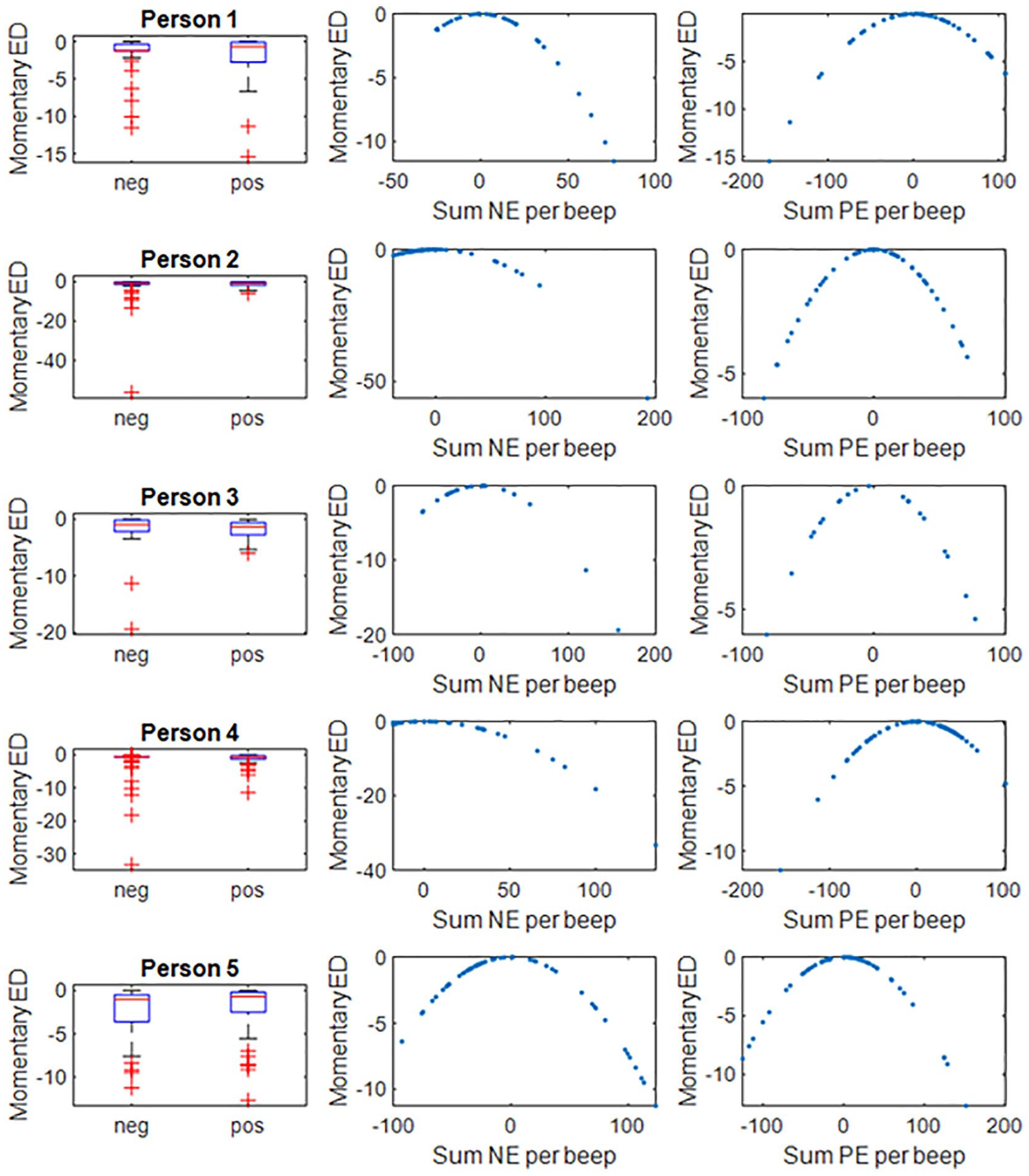
The distribution of the momentary emotion differentiation index EDi for negative (neg) and positive (pos) emotions (first column), the relationship between negative momentary emotion differentiation and the sum of negative emotions per time-point (sum NE per beep; second column), and the relationship between positive momentary differentiation and the sum of positive emotions per time-point (sum PE per beep; third column) for five different participants from Study 1.
While the momentary emotion differentiation measure EDi is mathematically derived from the ICC, it is important to verify how they relate in empirical data, how the EDi fluctuates across time, and how it relates to momentary psychological well-being. Investigating how the EDi relates to momentary indicators of well-being provides initial external validation for the new measure, as well as taking first steps in building a nomological network for momentary emotion differentiation.
To this end, we examine how the EDi is related to other momentary variables that are related to emotion differentiation on the between-person level. More specifically, we look at how the EDi correlates with self-esteem, stress, rumination, and emotion-focused coping, and to momentary levels of positive and negative emotion, which appear to relate to emotion differentiation at the person-level (Erbas et al., 2014; Erbas et al., 2018). Next, in line with Dejonckheere et al. (2019), we examine whether momentary emotion differentiation relates to momentary well-being after accounting for its shared variance with the mean and standard deviation of momentary emotions. Dejonckheere et al. (2019) argue that mean levels of positive and negative emotion are the most prominent indicators of psychological well-being, while the standard deviation is the most primitive dynamical measure. Therefore, they argue that it could be considered a requirement for new affective measures to have a unique effect on well-being over and above the mean and standard deviation (Dejonckheere et al., 2019). Finally, we investigate how momentary well-being outcome measures relate to the overall ICC, the classic person-level measure of emotion differentiation. This will give us an idea of whether in these two data sets, momentary emotion differentiation and overall emotion differentiation have a similar or different nomological network.
Method
To validate our new index of momentary emotion differentiation EDi, we used data from two ESM studies. Study 1 is part of a longitudinal measurement-burst study 1 which involved 1 week of ESM. Study 2 is an ESM study focused on psychology students who were receiving their exam results, and was thus designed around this specific emotional event. For both studies, the data, the included ESM variables, and a list of other projects that have used these data are available at https://osf.io/p25jv/.
Participants
Study 1
We aimed to recruit 200 participants, accounting for 25% attrition over the course of the full study, which allowed more than 80% power to detect small effects at the between-person level (r = .15, α = .05). At the start of data collection, participants were Belgian secondary-school students who were about to start their first year at university. Potential participants (N = 686) completed the Center for Epidemiologic Studies Depression Scale (Radloff, 1977), which was used as a prescreening tool to select a stratified sample with diverse depression scores (Ingram & Siegle, 2009; see also Bastian et al., 2015, for more detail regarding the stratification of the sample).
Initially, 202 participants were included, but two participants had low compliance with the ESM protocol (less than 50%), and were excluded from analyses. This led to a sample of 200 participants (90 male, Mage = 18.32, SDage = 0.97). Participants received €60 for completing all measures. The study received approval from the KU Leuven ethics committee (Commissie Medische Ethiek van de Universitaire Ziekenhuizen KU Leuven).
Study 2
Participants were 101 Belgian first-year psychology students receiving results from their first semester (14 male; Mage = 18.64; SDage = 1.45). We aimed to recruit at least 100 students (which is about 25% of enrolled first year psychology students), allowing more than 80% power to detect medium-sized effects at the between-person level (r = .30, α = .05). We recruited at a first-year research participation session and using social media. Participants were not prescreened (see Study 1), and no participants were excluded due to low compliance. Participants received €50 for completing at least 80% of the ESM questionnaires, and €5 less for every 10% drop in compliance. The study received approval from the KU Leuven Social and Societal ethics committee.
Materials and Procedure
Study 1
The study started with a lab session in which participants completed self-report questionnaires and cognitive tasks. This was followed by 7 days of ESM, after which participants returned to the lab and completed additional self-report questionnaires, lab tasks, and interviews.
Study 2
Similar to Study 1, the second study started with a lab session in which participants completed self-report questionnaires, followed by ESM. The ESM protocol started 2 days before participants received their exam results, and continued for 7 consecutive days after the results were released. Here, we only include the time-points starting from the moment the participants received their exam results.
ESM protocol
The data in both studies were collected using the Android software mobileQ (Meers et al., 2020). In the first study, participants received a research-dedicated smartphone. In the second study, participants with a compatible Android phone installed mobileQ (n = 28) and the other participants were given research-dedicated smartphones.
Study 1
For 7 days, participants carried the smartphones that were programmed to prompt 10 times a day during waking hours (from 10 a.m. to 10 p.m.) according to a stratified random-interval scheme. At each prompt, participants completed 24 items, including items assessing their current positive and negative emotions (relaxed, happy, cheerful, angry, sad, anxious, depressed, and lonely), stress, rumination (one item about the past, one item about the present, which were averaged into one rumination index), and self-esteem, which were all rated on a slider scale ranging from 0 (not at all) to 100 (very much). On average, participants complied with 87.27% (SD = 9.05%) of the prompts.
Study 2
Similar to Data set 1, we used a stratified random-interval scheme with 10 intervals between 10 a.m. and 10 p.m. At each prompt, participants completed 26 items, including items assessing their exam-related positive and negative emotions (satisfied, relieved, happy, proud, anxious, ashamed, disappointed, angry, and sad), stress, rumination, and emotion-focused coping, which were all rated on a slider scale ranging from 0 (not at all) to 100 (very much), except for rumination, which was assessed on a 0 (not at all) to 6 (very much) scale. Because we only use the postrelease data and there was some variability between participants in when results were released (between surveys 21 and 28 of 90), participants received between 63 and 70 postrelease surveys (M = 68.69). On average, participants responded to 90.5% (SD = 7.8%) of the prompts.
Momentary emotion differentiation
The momentary ratings of positive and negative emotions in the ESM were used to calculate the indices for momentary emotion differentiation. Table 1 contains the Ms and SDs of the positive and negative momentary emotion differentiation indices for both data sets.
Means and Standard Deviations of the Momentary and Classical Emotion Differentiation Indices and the Momentary Indicators of Well-Being for Study 1.
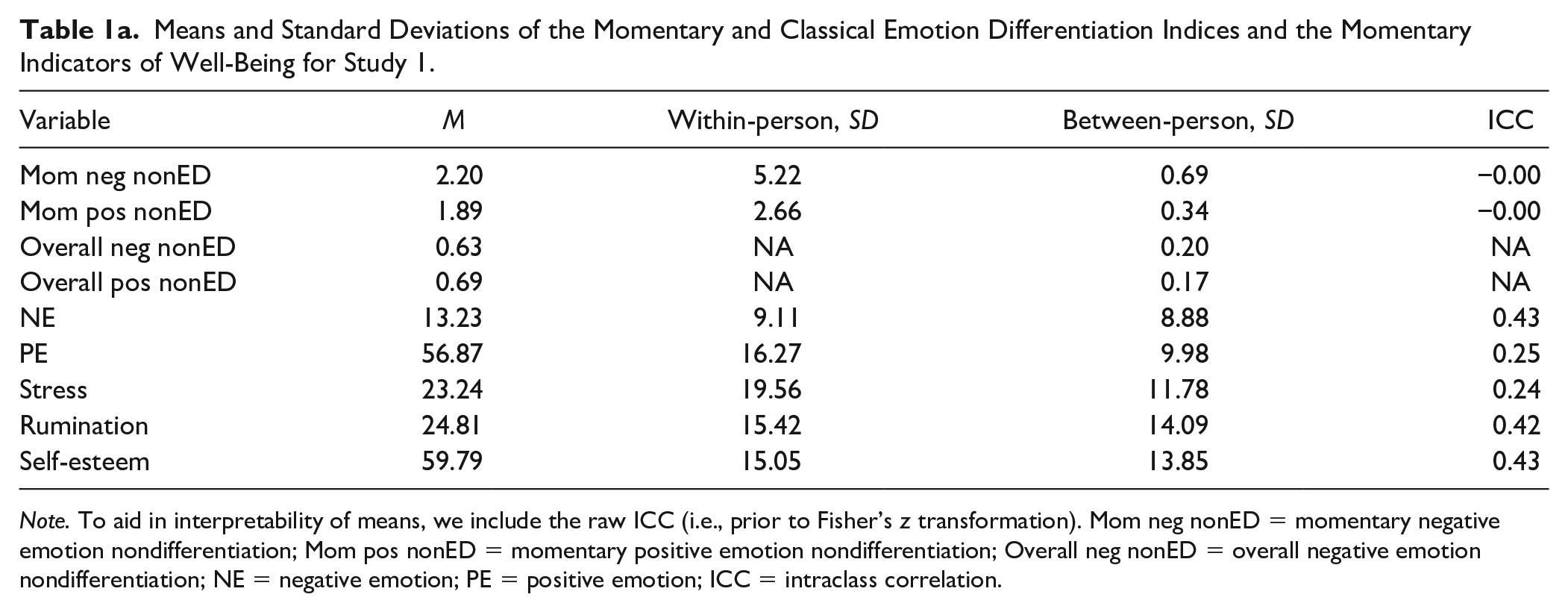
Note. To aid in interpretability of means, we include the raw ICC (i.e., prior to Fisher’s z transformation). Mom neg nonED = momentary negative emotion nondifferentiation; Mom pos nonED = momentary positive emotion nondifferentiation; Overall neg nonED = overall negative emotion nondifferentiation; NE = negative emotion; PE = positive emotion; ICC = intraclass correlation.
Means and Standard Deviations of the Momentary and Classical Emotion Differentiation Indices and the Momentary Indicators of Well-Being for Study 2.
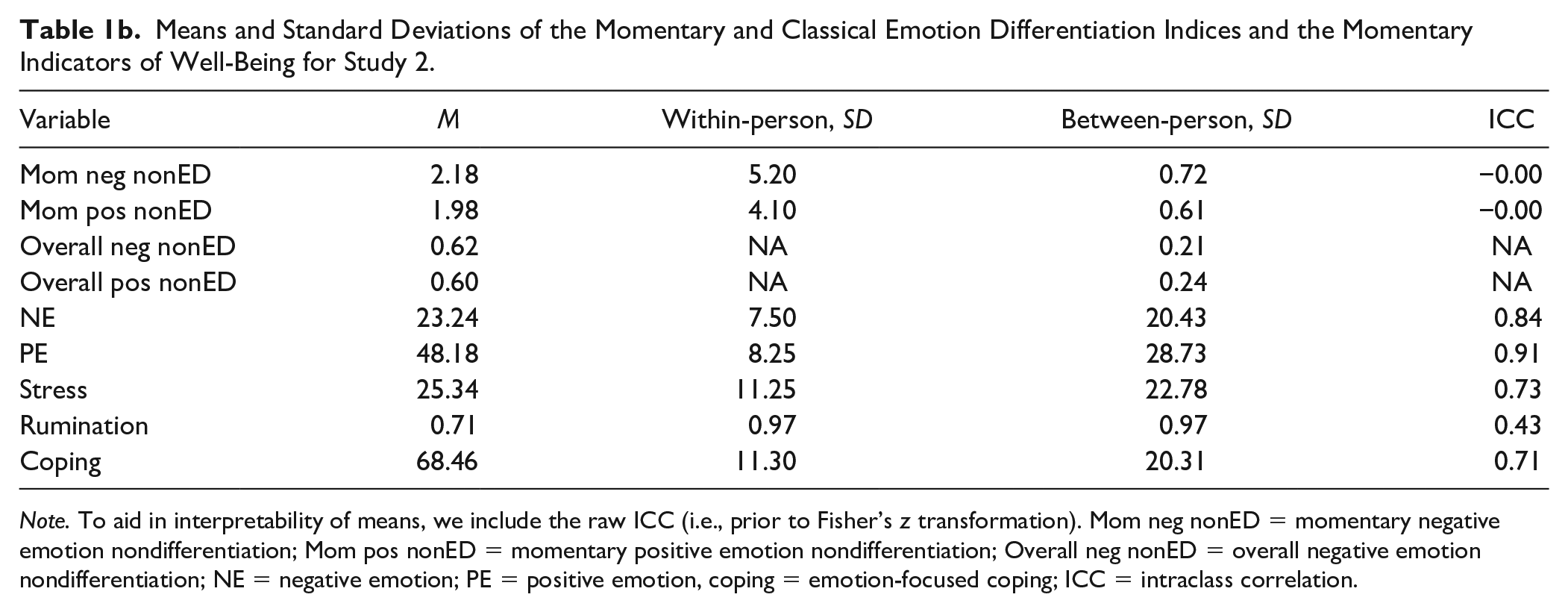
Note. To aid in interpretability of means, we include the raw ICC (i.e., prior to Fisher’s z transformation). Mom neg nonED = momentary negative emotion nondifferentiation; Mom pos nonED = momentary positive emotion nondifferentiation; Overall neg nonED = overall negative emotion nondifferentiation; NE = negative emotion; PE = positive emotion, coping = emotion-focused coping; ICC = intraclass correlation.
Person-level emotion differentiation
In line with previous research, to capture the covariation between multiple emotions across occasions in a single index, an ICC was calculated (e.g., Demiralp et al., 2012) measuring average consistency between the emotion ratings (Shrout & Fleiss, 1979). A high ICC reflects high levels of covariation, and thus low levels of emotion differentiation. For each individual, a separate index was calculated for positive emotions and negative emotions. Interpretable ICCs are between 0 and 1, therefore five participants with negative ICCs for negative emotions in Data set 1 (0 from Data set 2), and nine participants with negative ICCs for positive emotions for Data set 1 (and 0 for Data set 2) were excluded from further analyses (Erbas et al., 2018; Giraudeau, 1996). The syntax to calculate the ICC can be found here: https://osf.io/p25jv/. Table 1 contains the means and standard deviations of the positive and negative emotion differentiation indices. The indices were then multiplied with −1, so that high values reflect high levels of emotion differentiation
Momentary well-being
We included several positive (self-esteem and mean positive emotion in Study 1, emotion-focused coping and mean positive emotion in Study 2) and negative (rumination, stress, and mean negative emotion in Studies 1 and 2) momentary indicators of well-being. From previous research, we know that negative emotion differentiation at the between-person level correlates with mean levels of positive and negative emotion (e.g., Boden et al., 2013; Erbas et al., 2019), self-esteem (Erbas et al., 2014; Erbas et al., 2019), stress (Erbas et al., 2018) and rumination (e.g., Liu et al., 2019), and that positive emotion differentiation at the between-person level relates to mean levels of emotion (Boden et al., 2013) and coping (Tugade et al., 2004). While directly translating between-person findings to the intraindividual level is often not possible and not the best practice (e.g., see Molenaar & Campbell, 2009) emotion differentiation at the within-person level has not been studied before. Therefore, we started building its nomological network based on these previous findings at the between-person level.
Self-esteem, emotional coping, and stress were assessed with single items. Rumination was assessed by taking the mean of two items that assessed the level of rumination about the past and the level of rumination about the present in Study 1 and a single item in Study 2. Mean positive and mean negative emotion were the means of the positive and negative emotions at each time-point. Tables 1a and 1b contain the means and standard deviations of the momentary well-being items. The text of the items used in both studies to assess these variables can be found here: https://osf.io/p25jv/.
Data Analysis
We conducted our analyses in R (v4.0.2). All data and code is available on OSF (https://osf.io/p25jv/) and an R function to calculate the momentary and person-level emotion differentiation index is also available on GitHub (https://github.com/seanchrismurphy/emodiff). We analyzed our data using multilevel models (measurement occasions nested within participants). We fit these models using lme4 (Bates et al., 2015) and calculated p values using lmerTest (Kuznetsova et al., 2017).
Results
The Relationship Between the Aggregated Momentary and the Person-level Emotion Differentiation Index
The momentary emotion nondifferentiation index, the nonEDi, is directly derived from the person-level index, the ICC. Therefore, the per-person aggregated nonEDi (i.e., the sum of all nonEDi’s divided by the total number of measurement occasions −1) should be perfectly, but nonlinearly related to the ICC. This was indeed the case. This finding is illustrated in Figure 1 for the relationship between person-aggregated EDi index for negative emotions, and the reverse-coded overall ICC for negative emotions in Data set 1. As the figure shows, the relationship between the aggregated index of momentary differentiation, and the reverse-coded ICC (the overall index of differentiation), is perfect and nonlinear (Spearman’s ρ is 1).
Correlates of Momentary Emotion Differentiation
We assessed how momentary emotion differentiation (EDi) related to other momentary indicators of well-being. We applied two-level models (moments nested within persons), in which we predicted mean negative emotion, mean positive emotion, stress, self-esteem, emotion-focused coping, and rumination (all with separate models) with the momentary emotion differentiation index, which was entered as a predictor at Level 1. Level 2 consisted of a random intercept and random slope. Separate models were computed for positive and negative momentary emotion differentiation, and separately for the two data sets. All momentary predictors were person-mean centered.
The results are presented in Table 2 2 . Across the two studies, higher levels of positive momentary emotion differentiation were associated with lower levels of mean negative emotion, rumination, and stress, and higher levels of self-esteem (Study 1), and emotion-focused coping (Study 2). The only inconsistent finding was for mean positive emotion: in Study 1, positive momentary emotion differentiation was significantly related to higher levels of mean positive emotion, whereas this relationship was not significant in Study 2.
Concurrent Association Between Positive and Negative Momentary Emotion Differentiation and Momentary Indicators of Well-Being in Study 1 and Study 2.
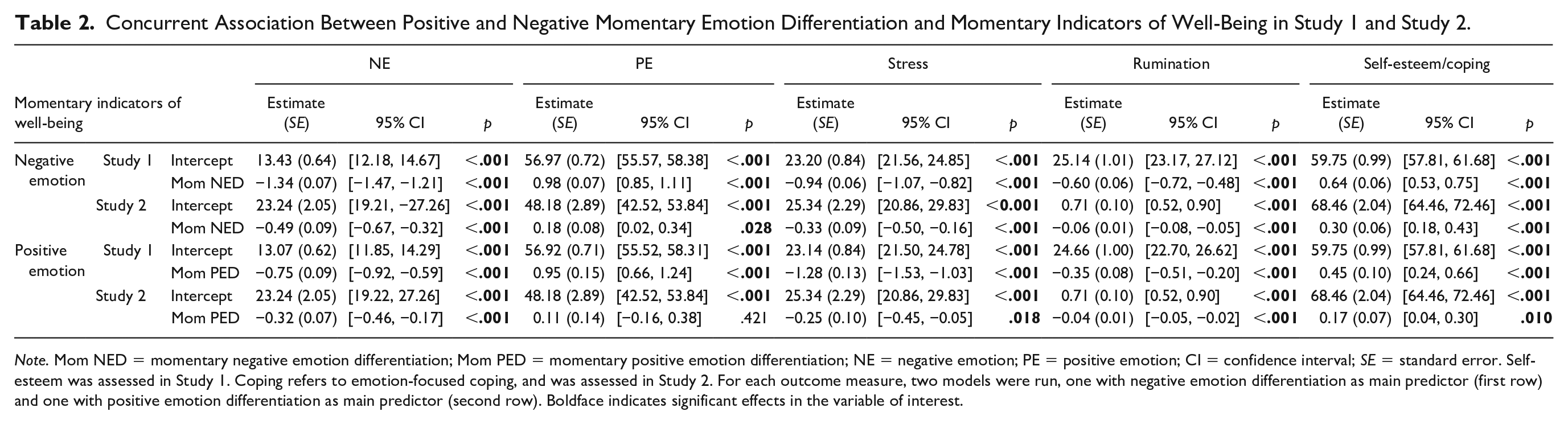
Note. Mom NED = momentary negative emotion differentiation; Mom PED = momentary positive emotion differentiation; NE = negative emotion; PE = positive emotion; CI = confidence interval; SE = standard error. Self-esteem was assessed in Study 1. Coping refers to emotion-focused coping, and was assessed in Study 2. For each outcome measure, two models were run, one with negative emotion differentiation as main predictor (first row) and one with positive emotion differentiation as main predictor (second row). Boldface indicates significant effects in the variable of interest.
Higher levels of negative momentary emotion differentiation were associated with lower levels of mean negative emotion, rumination, and stress, and higher levels of mean positive emotion, self-esteem (Study 1), and emotion-focused coping (Study 2), and these findings were consistent across the two data sets. In sum, these findings suggest that higher levels of momentary differentiation of both positive and negative emotions relate positively to positive momentary indicators of well-being, and negatively to negative momentary indicators of well-being.
In a next step, we followed recommendations by Dejonckheere et al. (2019) to assess the predictive power of momentary emotion differentiation above and beyond the mean and the standard deviation. We examined the relationship between positive and negative momentary emotion differentiation and stress, rumination, self-esteem, and emotion-focused coping after controlling for mean levels of momentary positive or negative emotion, and for the momentary standard deviation of the emotions. To this end, we repeated the previous analyses, but now included both the mean of the positive or negative emotions and the standard deviation of the positive or negative emotions as predictors at Level 1. The results are presented in Table 3.
Concurrent Association Between Positive and Negative Momentary Emotion Differentiation and Momentary Indicators of Well-Being in Study 1 and Study 2, While Controlling for the Momentary Person-Centered Mean and Standard Deviation of Negative or Positive Emotions.
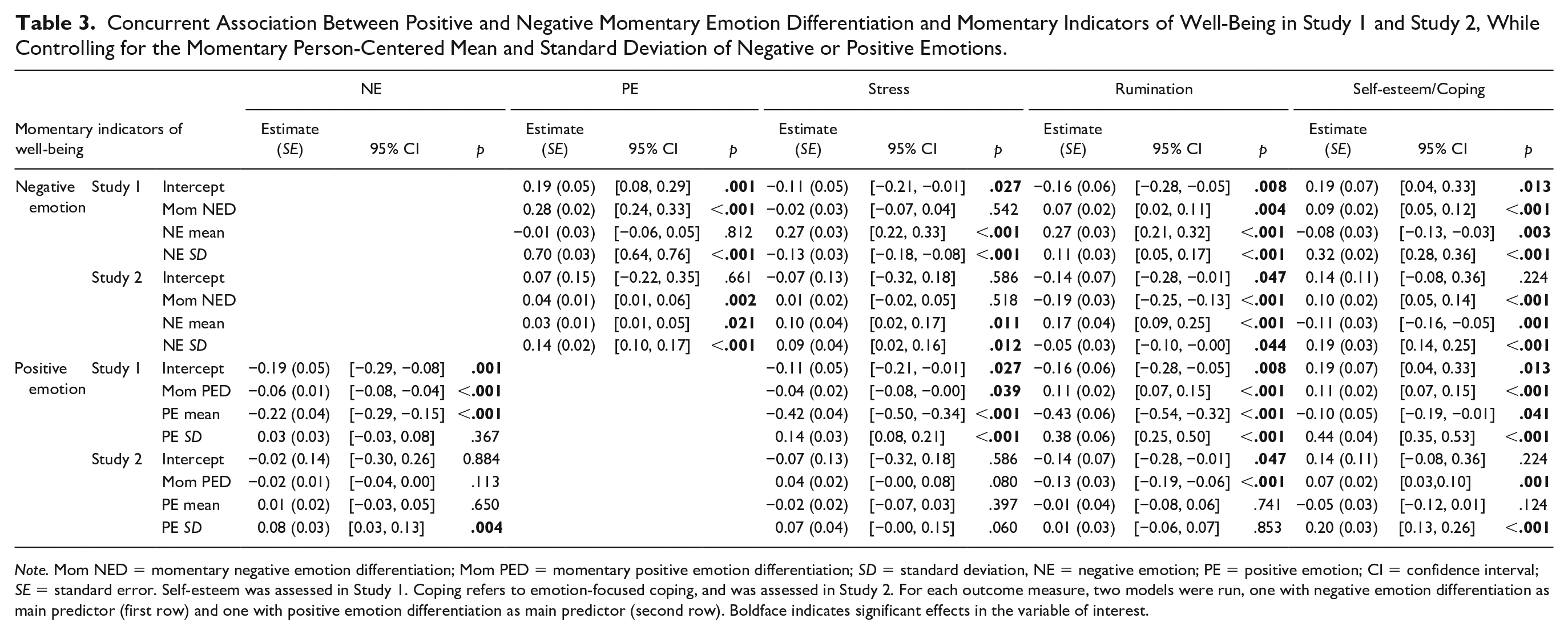
Note. Mom NED = momentary negative emotion differentiation; Mom PED = momentary positive emotion differentiation; SD = standard deviation, NE = negative emotion; PE = positive emotion; CI = confidence interval; SE = standard error. Self-esteem was assessed in Study 1. Coping refers to emotion-focused coping, and was assessed in Study 2. For each outcome measure, two models were run, one with negative emotion differentiation as main predictor (first row) and one with positive emotion differentiation as main predictor (second row). Boldface indicates significant effects in the variable of interest.
For positive emotions, after controlling for the mean and the standard deviation, higher momentary emotion differentiation was significantly related to lower levels of negative emotion, lower levels of stress (but only in Study 1), higher levels of self-esteem (Study 1) and higher levels of emotion-focused coping (Study 2). In Study 2, higher levels of positive emotion differentiation were also related to lower levels of rumination. However, in Study 1, the direction of this relationship was changed and more differentiation of positive emotions was related to higher rumination. This is the opposite of what the previous analyses showed, and what would be theoretically expected, and it was also not replicated in Data set 2.
After controlling for the mean and standard deviation of negative emotions, negative momentary emotion differentiation was positively related to mean positive emotion, self-esteem (Study 1) and emotion-focused coping (Study 2). The relationship with stress was no longer statistically significant. Interestingly, similar to positive momentary emotion differentiation, higher levels of negative momentary emotion differentiation were related to higher rumination in Study 1, which again is the opposite of what the previous analyses showed, and what would be theoretically expected. However, this finding was again not replicated in Data set 2, where higher levels of negative emotion differentiation were significantly related to lower levels of rumination.
Summary
For both positive and negative momentary emotion differentiation, the findings were largely consistent across data sets and showed that higher levels of momentary emotion differentiation related positively to positive outcomes, and negatively to negative outcomes. However, some relations became weaker and were no longer significant after controlling for the mean and standard deviation. Interestingly, there appeared to be suppression effects for rumination in Study 1, for both positive and negative emotion differentiation. However, this was not replicated in Study 2,
Person-Level Emotion Differentiation and Well-Being
Finally, we assessed how the overall ICC, the person-level index of emotion differentiation, related to the well-being measures. Results can be found in Tables 4 and 5.
Concurrent association between positive and negative person-level emotion differentiation and momentary indicators of well-being in Study 1 and Study 2.
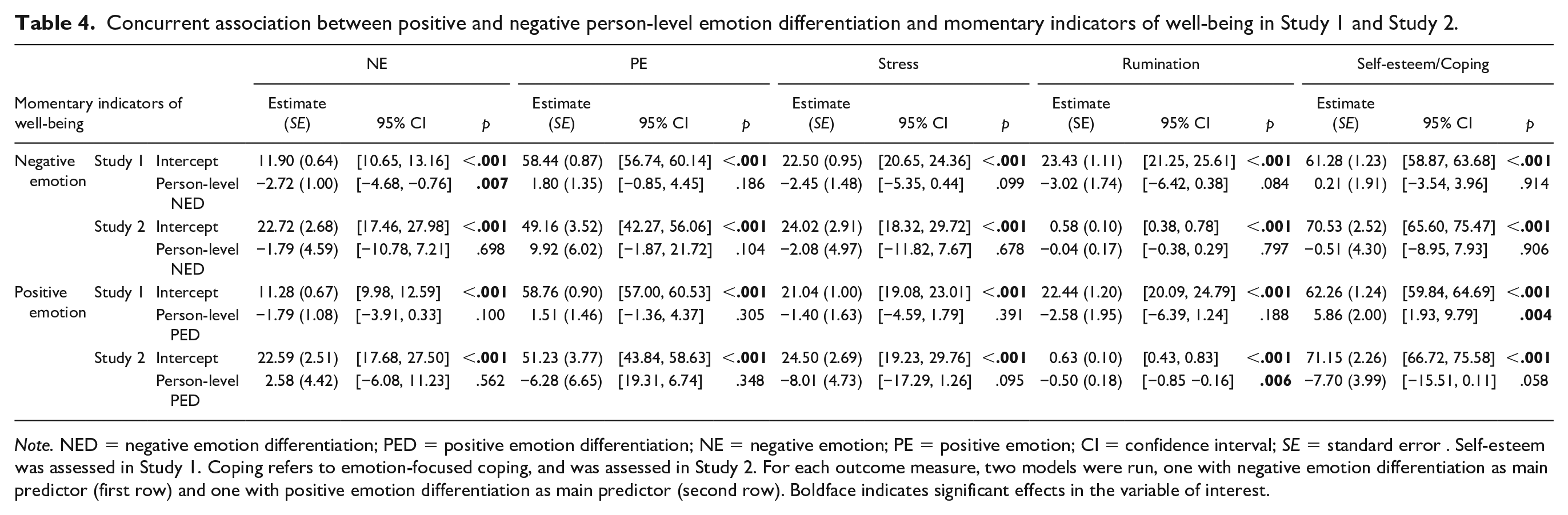
Note. NED = negative emotion differentiation; PED = positive emotion differentiation; NE = negative emotion; PE = positive emotion; CI = confidence interval; SE = standard error . Self-esteem was assessed in Study 1. Coping refers to emotion-focused coping, and was assessed in Study 2. For each outcome measure, two models were run, one with negative emotion differentiation as main predictor (first row) and one with positive emotion differentiation as main predictor (second row). Boldface indicates significant effects in the variable of interest.
Concurrent Association Between Positive and Negative Person-Level Emotion Differentiation and Momentary Indicators of Well-Being in Study 1 and Study 2, While Controlling for the Momentary Person-Centered Mean and Standard Deviation of Negative or Positive Emotions.
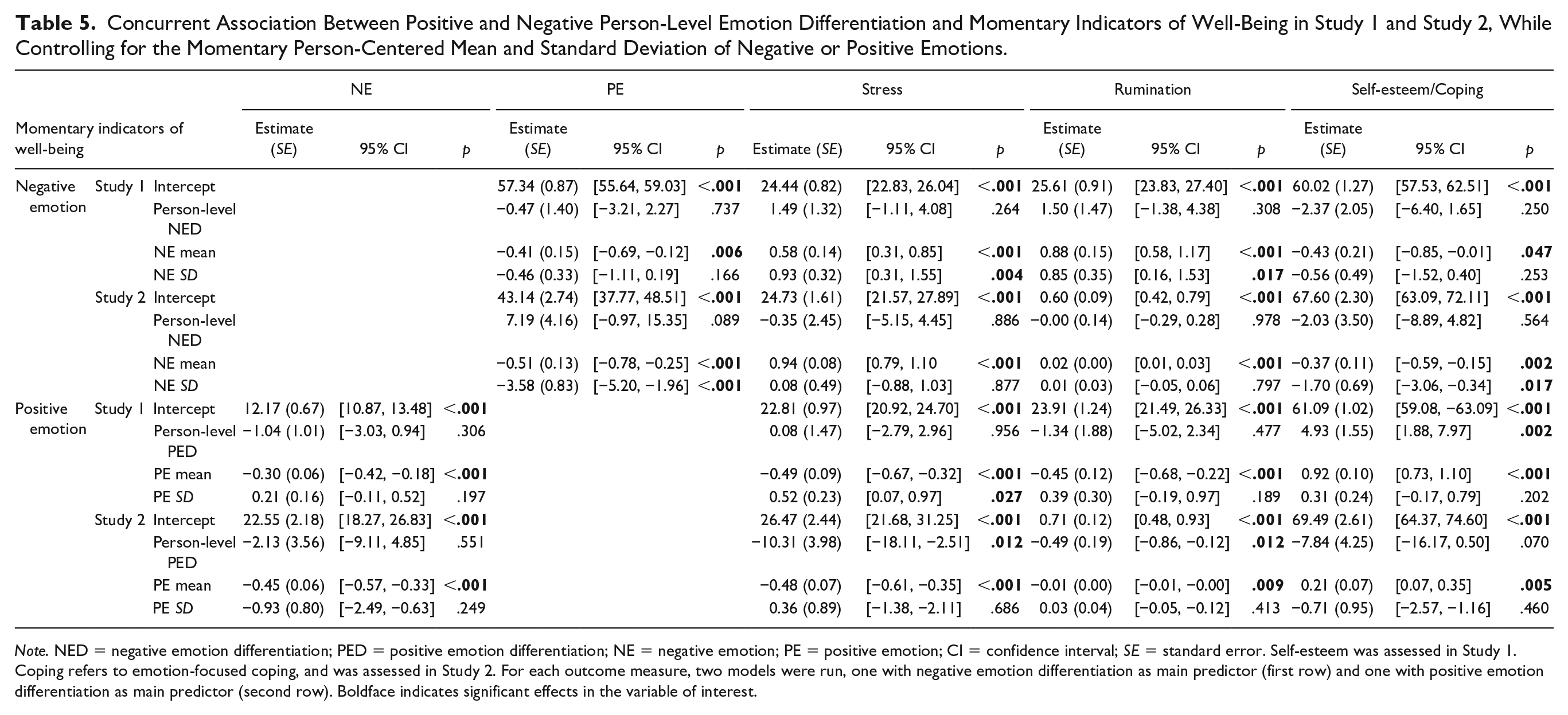
Note. NED = negative emotion differentiation; PED = positive emotion differentiation; NE = negative emotion; PE = positive emotion; CI = confidence interval; SE = standard error. Self-esteem was assessed in Study 1. Coping refers to emotion-focused coping, and was assessed in Study 2. For each outcome measure, two models were run, one with negative emotion differentiation as main predictor (first row) and one with positive emotion differentiation as main predictor (second row). Boldface indicates significant effects in the variable of interest.
Positive person-level emotion differentiation was positively related to self-esteem in Study 1 and negatively to rumination in Study 2. The relations with the other indicators of momentary well-being were not significant in both studies. Negative person-level emotion differentiation was significantly related to lower negative emotion in Study 1, but not in Study 2. All other associations were not significant.
Next, we repeated these analyses while controlling for the momentary mean and standard deviation of emotions. After controlling for the mean and standard deviation of positive emotions, positive between-person emotion differentiation was positively related to self-esteem in Study 1, and negatively to stress and rumination in Study 2. After controlling for the mean and standard deviation of momentary negative emotions, negative person-level emotion differentiation was not significantly related to any of the momentary indicators of well-being in either of the studies.
Summary
These findings indicate that person-level emotion differentiation is not strongly associated with momentary positive and negative emotion, stress, rumination, self-esteem, and emotion-focused coping. This suggests that although momentary emotion differentiation and person-level emotion differentiation are very strongly related to each other, their nomological network may be different, at least at the momentary level.
Discussion
Emotion differentiation or emotional granularity is typically treated as a trait and assessed at the person-level. This conceptualization of emotion differentiation allows us to draw conclusions about which individuals have higher or lower levels of emotion differentiation, which traits are associated with better differentiation abilities, and how, for instance, possessing higher levels of emotion differentiation can protect individuals from negative outcomes. However, increasingly, evidence is emerging that levels of emotion differentiation are variable within individuals, and that these fluctuations are both substantial and meaningful. Understanding these levels was stymied by the fact that there was no available method to study emotion differentiation at a momentary level. To address this need, we presented a framework that allows us to study within-person dynamics in emotion differentiation. We introduced a momentary emotion differentiation index that was directly derived from, and perfectly related to, the classical emotion differentiation index, and verified its relationships with indicators of momentary well-being.
Across two data sets, we found that higher momentary levels of positive and negative emotion differentiation were related to lower levels of negative emotion, stress and rumination, and higher levels of positive emotion, self-esteem, and emotion-focused coping. After controlling for the means and standard deviations of positive and negative momentary emotions, the associations with stress largely disappeared. However, the other effects generally remained similar. One unexpected finding emerged in the models including these control variables. In Study 1, we found that the relationship between momentary emotion differentiation and rumination reversed: in analyses without the control variables, higher positive and negative momentary emotion differentiation were associated with lower rumination, but this relationship became positive after controlling for the mean and standard deviation of momentary emotions.
One notable difference between the two studies is that the outcome measures (i.e., the indicators of momentary well-being) in Study 2 seem to have much higher ICCs than the outcome measures in Study 1 (see Tables 1a and 1b). A possible explanation for this finding is that Study 1 was a typical ESM study where outcomes were assessed in response to different events that typically occur in normal daily life. Study 2 centered around a specific and important event (exam grades) and all measures were assessed in relation to participants’ experiences related to this single event. Indeed, the descriptives show that in Study 1, the difference between the within-person and between-person standard deviations is rather small, whereas in Study 2 the between-person standard deviations are much higher compared with the within-person standard deviations, indicating that individuals differed more strongly in how they responded to their exam grades, while the responses within individuals were much more consistent. However, in general, the results of Study 1 and Study 2 were very similar. Moreover, for rumination, the within-person and between-person standard deviations and ICCs were actually quite similar across the two studies. Therefore, we do not think this can explain the unexpected finding with regard to rumination in Study 1. We are therefore hesitant to provide a strong interpretation of this finding given that it did not replicate in Study 2, or in the models without control variables for Study 1. If this is a true finding, one potential explanation could be that both differentiation and rumination partially index awareness of, and attention to, emotions. When we control for mean emotion, we may remove some of the variance associated with reflective and compassionate awareness of emotions, which may be behind the initial negative correlation between differentiation and rumination. Left behind could be only a more judgmental and reactive awareness that is still indexed by both variables, resulting in a positive correlation between differentiation and rumination.
In general, our findings thus show that when individuals have low levels of momentary emotion differentiation, they experience higher levels of negative indicators of well-being, and lower levels of positive indicators of well-being. Moreover, most of these relationships between momentary emotion differentiation and momentary well-being were found in the two data sets, even after accounting for the shared variance between the momentary index and the momentary mean and standard deviation of emotions. This indicates that our index has added value above and beyond these two most basic statistical constructs. In line with person-level research on emotion differentiation, the current findings thus hint at the possibility that low momentary differentiation may reduce the ability to successfully regulate emotions in that moment in time, thereby negatively affecting their well-being. Of course, this hypothesis needs further testing in future studies. At the between-person level, we see for instance that when individuals who are low in emotion differentiation use an emotion regulation strategy, this does not help them much to successfully reduce their negative emotions (Kalokerinos et al., 2019). Specifically, low differentiators appear to show more maladaptive behavior, such as more impulsivity (Tomko et al., 2015), more aggression in response to anger (Pond et al., 2012), or more alcohol consumption in response to stress (Kashdan et al., 2010). The new momentary index now makes it possible to study whether this relationship between low levels of emotion differentiation on the one hand and unsuccessful emotion regulation and maladaptive behavior on the other hand also holds at the momentary level.
Finally, in comparison with the overall index for emotion differentiation, the momentary index appeared to have more relationships with momentary well-being, underlining the power of the momentary index, and confirming the need to study emotion differentiation from both a within and between-person framework.
This new momentary index of emotion differentiation enables researchers to study moment-to-moment changes in emotion differentiation, allowing comprehensive within-person investigation. For the first time, we can now really look at how emotion differentiation changes over time, how it lingers over time, whether it predicts other variables over time, and so on. However, studying dynamical characteristics of a variable generally requires more sophisticated modeling techniques than a between-persons approach. Luckily, having a momentary index of emotion differentiation allows us to use a whole array of advanced modeling techniques such as linear growth models or autoregressive cross-lagged models to investigate these dynamical processes within individuals.
This opens up a host of new research questions: we can now examine how emotion differentiation fluctuates or lingers over time, and which factors influence or are affected by these fluctuations. Importantly, by applying structural equation frameworks, we can study the directionality of such relationships, which would help with building stronger theory around the construct of emotion differentiation. For instance, we can assess how the way that we differentiate between emotions is affected by contextual factors such as major life events or the presence of others, or individual characteristics that are prone to fluctuations such as working-memory capacity, impulsivity, or stress. We can also examine emotion differentiation as a predictor of subsequent adjustment, for instance more directly testing the idea that differentiation is a component of effective emotion regulation (Kalokerinos et al., 2019).
Furthermore, such analyses may also hint at relationships hidden in person-level indices of differentiation: for example, we find consistent relationships between momentary positive emotion differentiation and momentary well-being outcomes, but such relationships are more inconsistent with the traditional person-level index of positive differentiation (Kashdan et al., 2015). This is also generally in line with our findings, which demonstrated that at the person-level, emotion differentiation was not strongly related to our well-being indicators, while these relationships were more present at the momentary level.
Finally, the momentary index of emotion differentiation can also give us insight regarding the ICC, the classical between-person emotion differentiation index. The momentary index is directly derived from the overall ICC. Moreover, we have seen that by taking the sum of all momentary indices and dividing them by the number of time-points minus one for each individual, we get an index that has a perfect (but nonlinear) relation with the overall ICC, implying that the overall ICC is built up from these momentary indices. In essence, the momentary index thus shows us which time-points contribute to the overall ICC and in which way: it shows us which time-points increase, and which time-points decrease the overall ICC. By identifying the specific time-points that contribute positively and negatively to the overall index of emotion differentiation, the momentary index thus allows us to have a qualitative look at these time-points: what does a time-point that contributes positively to the overall emotion differentiation index look like in terms of intensity, or in terms of deviation from the mean for the different emotions? For example, how do time-points where no emotions are experienced (i.e., where all emotions are rated as zeros) influence the overall emotion differentiation index? The momentary index can thus function as a magnifying glass for the overall index of emotion differentiation, and help identify potentially problematic time-points or unexpected features of the overall index. By doing so, it can give indication on how to improve the overall index.
Moving forward, we see potential benefits of this framework for gaining insight into the mechanisms underlying emotion differentiation. As emotion differentiation appears to play a role in psychopathology, understanding when and why emotion differentiation increases or decreases is crucial for developing better interventions to train this skill. A framework that allows to investigate such fluctuations from a within-person perspective is therefore necessary. The current framework will help identify risk factors and protective factors, and by doing so, illuminate the processes and mechanisms that need to be targeted in interventions.
Footnotes
Acknowledgements
Thank you to Sean C. Murphy for his assistance with the R package to calculate momentary emotion differentiation.
Declaration of Conflicting Interests
The author(s) declared no potential conflicts of interest with respect to the research, authorship, and/or publication of this article.
Funding
The author(s) disclosed receipt of the following financial support for the research, authorship, and/or publication of this article: This research was supported by the KU Leuven Research Council (grant GOA/15/003) and a grant from the Research Foundation Flanders (FWO) awarded to Eva Ceulemans (grant G074319N).Yasemin Erbas is supported by a postdoctoral fellowship of the Research Foundation Flanders (FWO). Elise K. Kalokerinos is supported by an Australian Research Council Discovery Early Career Researcher Award (DE180100352).
