




Abstract
Quality professional development (PD) can be a great benefit to teachers who need help with classroom management implementation. PD programs have better outcomes when there is follow-up after skill instruction. Providing PD within a multitiered support (MTS) framework can make PD delivery more efficient for schools. We describe an MTS-PD program and its empirical support. We also provide specific recommendations for developing an MTS-PD implementation team, data collection systems, and classroom management skills for training.
Mrs. Olive was struggling with classroom management in her second-grade math class. She was relatively new to teaching, starting her second year in a Title I elementary school and having received limited instruction in classroom management during her preservice education program. During the last school year, Mrs. Olive had sought support from her fellow second-grade teachers and her principal. They recommended that she be consistent with discipline and keep a predictable class schedule. While she worked diligently to do as her colleagues and principal suggested, Mrs. Olive still felt like she struggled to keep all of her students engaged during academic instruction and the classroom disruptions, including student out-of-seat behavior and inappropriate conversation with peers, to a minimum. Mrs. Olive believed that she could become a better classroom manager with a little more support.
Teachers can benefit from professional development (PD) that is designed to teach and support implementation of effective classroom management procedures that promote appropriate student behavior (Simonsen et al., 2014; Yoon, Duncan, Lee, Scarloss, & Shapley, 2007). Unfortunately, as was the case with Mrs. Olive in the opening vignette, teachers receive limited classroom management instruction during preservice training (Oliver & Reschly, 2010) and, therefore, need effective classroom management PD. Researchers suggest that the most effective PD models include ongoing support and follow-up for trainees (Fixsen, Naoom, Blase, Friedman, & Wallace, 2005), which typically involves 30 or more hours of direct support posttraining (Yoon et al., 2007). This amount of follow-up may be difficult for schools to implement. Given the potential range of teacher skills in a single school, it is also likely that teachers will need varying levels of support.
One method to enhance the feasibility and efficiency of PD is to apply it within a multitier system of support (MTSS) framework. Frequently used to support student academic and behavioral improvement, MTSS requires schools to organize practices and interventions according to needs and frequently monitor students’ response to their current levels of support. MTSS is typically based on three tiers of support: Universal (Tier I), Secondary (Tier II), and Tertiary (Tier III). Universal supports are provided to all students and can include universal reading curricula and establishing and teaching behavioral expectations. Those who do not respond academically or behaviorally to Tier I programming receive additional Secondary supports, often implemented in small group formats (e.g., small group reading or social skills instruction). For students with the most intensive needs, individualized Tier III supports are implemented, such as one-on-one reading instruction or behavior intervention plans that are informed by functional behavioral assessment (see McIntosh & Goodman, 2016, for a comprehensive, teacher friendly overview of MTSS).
Recently, the MTSS framework has been applied to PD to increase teachers’ classroom management skills. The multitiered support for PD (MTS-PD) framework uses the same tiered logic as for student academic and behavioral supports, and is also based on frequent observations, progress monitoring, and data-based decision making. Tier I consists of universal skill training for all teachers. To enhance acquisition, this training and subsequent support should be brief and focus on one skill at a time (Gage, MacSuga-Gage, & Crews, 2017; Simonsen et al., 2014). The single-skill training is delivered to a group of teachers or an entire faculty during a large- or small-group PD. The instruction is structured as follows: (a) definition of the skill, (b) rationale for using the skill, (c) example of skill in use, (d) critical features of the skill, (e) the goal for the skill (i.e., how often it should be used), (f) an activity identifying examples of the skill in the audience’s context, (g) a plan for developing and reinforcing skill use (e.g., self-monitoring or performance feedback), and (h) review and wrap-up (see Figure 1 for an example Tier I lesson plan based on recommendations from Simonsen et al., 2014). Following the initial training, progress monitoring should occur through teacher self-monitoring of skill use or, ideally, direct observations by another teacher, school staff member, or outside expert.

Example multitiered support for professional development Tier 1 lesson plan targeting behavior-specific praise skill development.
After 1 to 2 weeks of skill implementation, measured skill use is then compared with a predetermined goal (e.g., six behavior-specific praise statements per 15-min observation), and the need for increased support is determined based on meeting or not meeting the identified goal. These goals may be research-based recommendations or teacher- or team-determined. Teachers who do not meet the goal are provided targeted Tier II supports, including one-on-one reteaching of the skill and regular (e.g., 3 times a week) visual performance feedback. This feedback may be provided in-person or via email and should include the following: (a) specific identification of skill steps that have been completed successfully, (b) recommendations for improving missed steps, and (c) a graph of current progress (see Figure 2 for an example of emailed visual performance feedback). If continued data collection does not show improvement following this increased support after at least seven school days and/or at least three progress monitoring data points, Tier III supports will be implemented. These supports include intensified one-on-one skill coaching and consultation based on observation data with the addition of specific goal setting, action planning, and modeling of the skill in the teacher’s classroom during large-group instruction. Schools must also consider criteria for determining when to fade supports. For example, teachers receiving Secondary supports may begin having feedback faded when they have met the skill goal for at least three consecutive observations.
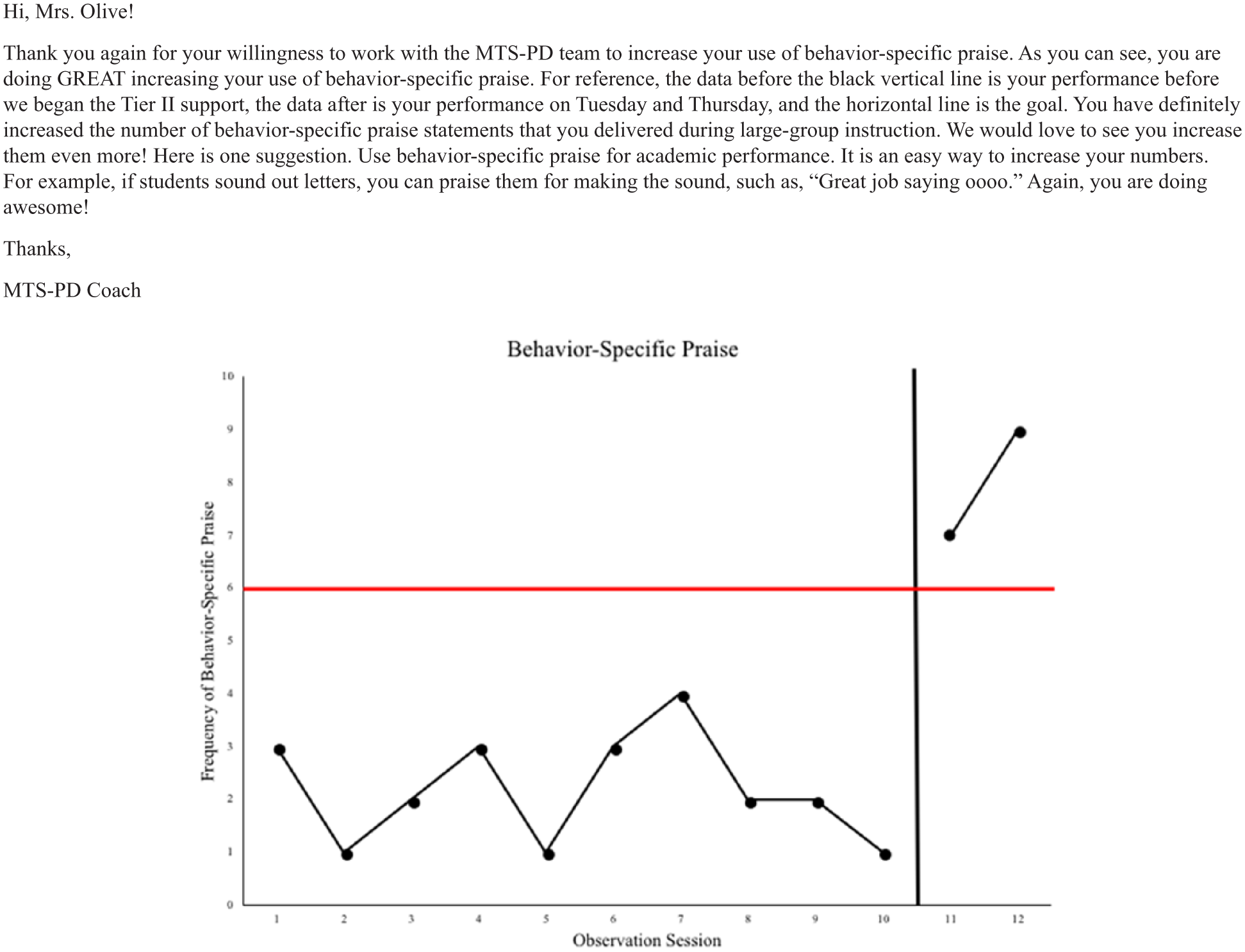
Example of a MTS-PD performance feedback email.
Current Empirical Support for MTS-PD
MTS-PD is a framework for efficiently implementing research-based PD, including visual performance feedback and one-on-one coaching (see Darling-Hammond, Hyler, & Gardner, 2017, for a complete review). A number of studies with positive findings have recently been conducted and support MTS-PD implementation. These studies have focused on Tier I and II support (Gage et al., 2017; MacSuga-Gage, 2013), Tier II support (Gage, Grasley-Boy, & MacSuga-Gage, 2018; Simonsen et al., 2016), and all three tiers of support (Myers, Simonsen, & Sugai, 2011; Thompson, Marchant, Anderson, Prater, & Gibb, 2012). Across these studies, the researchers targeted increasing behavior-specific praise or opportunities to respond and reported positive outcomes across a variety of supports. All but one of the studies were conducted in elementary schools with general education classroom teachers; the study by Myers et al. was conducted in a middle school and included one self-contained special education classroom.
Although MTS-PD research has mostly taken place in general education classrooms, other research supports implementing the same effective classroom management skills with students with emotional and behavioral disorders (EBD; Sutherland, Lewis-Palmer, Stichter, & Morgan, 2008). To increase the likelihood that students with EBD will be able to successfully access the general curriculum, teachers must be able to effectively manage their classrooms. Therefore, by increasing teachers’ classroom management skills using MTS-PD, students with EBD have a better chance of success in general education classrooms.
Developing an MTS-PD System
It is critical that schools spend time planning for the following four elements when developing an MTS-PD system: (a) implementation team composition, (b) data collection systems, (c) classroom management skills to train, and (d) structuring tiered support (Simonsen et al., 2014).
Implementation Team Composition
Similar to academic and behavioral MTSS, an implementation team is needed to implement and monitor MTS-PD. Depending on a school’s structure, there may be one overarching team that plans PD and support or those functions may be placed on grade-level teams. The MTS-PD team’s primary responsibility will be to provide the initial skill training and conduct ongoing progress monitoring on the skill through direct observation and/or collecting teacher self-monitoring data. Team members will also evaluate support system effectiveness either directly (i.e., PD coaches are part of the team) or indirectly (i.e., a team liaison assigns PD coaches to teachers). Although most studies have evaluated MTS-PD using outside researchers as coaches or trainers, a number of school-based personnel have the behavioral expertise to provide brief teacher training and performance feedback. These staff may include behavioral consultants/specialists, school psychologists, student/teacher assistance teams, prereferral assistance teams, special education teachers, or lead teachers with strong classroom management skills.
Data Collection Systems
There are myriad ways to collect high-quality progress monitoring data. Below, we focus on the two main types: electronic and paper and pencil approaches.
Electronic
As technology rapidly developed over the past several decades, numerous electronic data collection systems became available (see MacSuga-Gage, Schmidt, McNiff, Gage, & Schmidt, 2015, for advice on identifying an electronic data collection system). Several systems are often used for behavioral and/or classroom management observations, including the School-Wide Classroom Observation and Analysis application (SCOA; Anderson, 2012).
SCOA
SCOA is a data collection system that runs on iOS devices and allows frequency and duration recording of several preprogrammed teacher and student behaviors. It also allows users to set the length of the observation and program additional observable behaviors that were not included. Unlike more complex electronic data collection systems, SCOA does not time stamp events within the observation and does not provide statistical analysis software. Observation data can be emailed as a table for later entry into Excel or another graphing tool. SCOA was specifically designed for schools and teachers, is affordable (US$2.99 on the Apple app store), and accessible (see https://louisville.edu/education/abri/assessment/scoa-application.pdf).
Paper and pencil
Given the technology required, electronic data systems may be cost or expertise prohibitive for many schools. Fortunately, behavioral observations can easily be conducted using paper and pencil systems. These are typically self-developed observation systems or existing skill-based checklists and rating scales.
Self-developed systems
Self-developed observation systems fall into two main categories: event recording and interval recording. School staff with behavioral training may be familiar with collecting behavioral data using event or interval recording systems. Event recording is similar to the way data are collected with SCOA, wherein the observer records frequencies and/or durations of specific behaviors during an observation period. Event recording systems are relatively simple, particularly when measuring the frequency of a behavior. A teacher can self-monitor his or her own classroom management skills by recording each use of the skill during a predetermined large-group instruction period. For example, a teacher could use the “rubber band on the wrist” approach: Place 10 or more rubber bands on the right wrist and each time the skill is used (e.g., behavior-specific praise) move a rubber band to the left wrist. At the end of the period, the teacher counts the number of rubber bands on the left wrist and records this total for at least 3 days to evaluate skill use. Alternatively, a teacher or coach could observe a teacher and simply put a check mark on a post-it note each time the skill is used.
Interval recording involves recording whether or not a skill was used during a specific time interval. For example, an observer would mark a yes or check mark for an interval if the behavior occurred at least once during a 10-s time period (see Cooper, Heron, & Heward, 2007, for complete descriptions of both event and interval recording or Lee, Vostal, Lylo, & Hua, 2011, for teacher friendly examples). Interval recording, however, may be less practical for self-monitoring skill use.
Checklists and rating scales
There are a number of checklists and rating scales that are freely available and provide a snapshot of the skills currently in place in a classroom and documenting changes following PD. One example is the Classroom Management: Self-Assessment Revised (Simonsen, Fairbanks, Briesch, & Sugai, 2006), which has teachers rate their own classroom management performance on 13 relevant items. These ratings are then summed to arrive at an overall self-assessment of performance.
Another useful self-assessment checklist tool is the Missouri School-Wide Positive Behavior Support Teacher Self-Assessment of Effective Classroom Practices (see http://pbismissouri.org/tier-1-effective-classroom-practices/). This checklist is arranged by eight effective classroom management skills and asks teachers to determine their preparation and use of those skills. Alternatively, implementation team members could create their own checklists or rating scales based on the skills of focus. For instance, a teacher could rate their use of behavior-specific praise on a 10-point Likert-type scale each day and track his or her own perceptions of skill use.
Graphing data
Data-based decision making is one of the major focuses of MTSS. Thus, many systems currently exist for graphing academic and behavioral data. For MTS-PD, however, the responsibility for graphing data falls on the implementers. The data collection systems discussed require manual graphing in a separate program, such as Microsoft Excel. It is important to have a team member who is comfortable creating graphs, and it is equally important that the team be comfortable reviewing the graphs to make decisions for changing supports.
Classroom Management Skills to Train
As suggested earlier, school team members or administrators should focus on a single classroom management skill at a time to facilitate teacher mastery of the skill. According to Knoster (2015) and the U.S. Department of Education, Office of Special Education Programs (2016), there are five major areas of effective classroom management practices that can be considered in developing the skill or list of skills to train: (a) maximizing structure; (b) establishing, teaching, and reinforcing behavioral expectations; (c) actively engaging students; (d) creating a continuum of responses for appropriate behaviors; and (e) consistently applying a continuum of responses for inappropriate behaviors. There are a number of discrete skills within each practice, which should be the focus within MTS-PD trainings. These effective practices and examples of specific skills are summarized in Table 1. School team members should think about which specific skills would be easiest to train and support when deciding where to start with MTS-PD. Team members could also determine MTS-PD focus by surveying teachers or conducting brief classroom observations to decide which skills are most needed to support their effective implementation of a classroom management system.
Description of Recommended Effective Classroom Management Practices and Specific Skills.

Structuring Tiered Support
Finally, school team members need to carefully consider the types of support they are able to offer at each tier. This decision will be based in part on how many teachers the team will be supporting at once and the feasibility of having to provide different levels of support across teachers. Typically, Tier I support is provided to many teachers through large-group PD on a specific skill or skills. Tier II support usually involves performance feedback for a smaller number of teachers in need of assistance, based on direct observations or teacher self-monitoring data, delivered several times per week either in-person or via email. Tier III support needs to be individualized and is warranted if a teacher does not respond to Tier II support. It may take the form of in-class modeling or real-time feedback provided by a coach or MTS-PD team member. As with other tiered models of support, Tier III is the most time- and resource-intensive for the support team, but in an ideal model it will be implemented with the smallest number of teachers. MTS-PD teams should remember, however, that the lack of teacher training in classroom management may lead to many more teachers needing Tier II or III support than expected from a typical MTSS model. Assessing teacher needs via surveys or observations can help teams understand teachers’ needs across the school as part of planning MTS-PD and their ability to support successful implementation.
Conclusion
Classroom management is a necessary component of effective instruction. However, research continues to demonstrate that teachers do not receive adequate classroom management instruction during their preservice training and limited effective in-service PD (Oliver & Reschly, 2010). A growing evidence base has found that an MTSS approach to increasing teachers’ classroom management skill use is an effective and efficient model for in-service PD. The MTS-PD model is designed to be resource efficient, cost-effective, and, importantly, effective for increasing classroom management skill use. We believe that this model can be used with any grade level or group of students, with any teacher willing and interested in classroom management PD.
Mrs. Olive worked with her school’s MTS-PD implementation team to improve her classroom management skills. First, she created a simple paper and pencil data collection sheet to track her use of behavior-specific praise using rubber bands on her wrist. She collected five consecutive days of data during math instruction and found that she rarely used the skill. Next, she attended a brief (20-min) grade-level training on behavior-specific praise that was provided by one of the team members and followed the format outlined in Figure 1. She again collected her own data, but found that she had trouble consistently using the skill during instruction. She asked the MTS-PD team for more help and a coach was assigned to support her skill development. The coach worked one-on-one with her, reteaching the skill and helping Mrs. Olive focus on giving behavior-specific praise when students were on-task during instruction. The coach also collected direct observation data using SCOA and provided performance feedback through an email every other day with advice for how to improve skill use and a graph of her data. After two emails, Mrs. Olive saw a dramatic increase in her use of behavior-specific praise, meeting the school goal of six behavior-specific praise statements during 15-min large-group instruction. Mrs. Olive noticed that more of her students were engaged with her instruction and she felt confident that she could work with the MTS-PD team to continue to grow her classroom management skills.
Footnotes
Declaration of Conflicting Interests
The author(s) declared no potential conflicts of interest with respect to the research, authorship, and/or publication of this article.
Funding
The author(s) received no financial support for the research, authorship, and/or publication of this article.