



Abstract
Educators frequently use social media platforms such as Pinterest and Teachers Pay Teachers for guidance on teaching. In this article, we explore reasons why these websites are popular with educators, consider their potential risks and benefits, and provide examples of resources provided on these sites. We recommend that educators first identify and learn the critical elements of effective practices from trustworthy sources and then use sites such as Pinterest and Teachers Pay Teachers to facilitate implementation.
A new student, Aiden Rayburn, who is eligible for special education services with an emotional disorder, has joined Ms. Nelson’s third-grade classroom. Ms. Nelson received information from his previous school that Aiden has a hard time sitting in his seat and frequently engages in behaviors like slamming his fists on the table when he is frustrated. Ms. Nelson wants to make sure that she is adequately prepared to meet his needs, so she begins to search for ideas on ways to help him stay on task and manage his outbursts. She sits down at her computer and accesses the Teachers Pay Teachers website, which many of her colleagues told her they use when they need ideas for teaching. Ms. Nelson types “behavior management strategies” in the search bar. She instantly receives hundreds of pins with ideas for classroom management, many of which look potentially relevant for Aiden. As she begins to click on different links, Ms. Nelson becomes overwhelmed. There are so many choices. “How do I tell which are the most effective?” she asks herself. Eventually, Ms. Nelson chooses a resource called “Smile/Frown Behavior Strips” because it comes with materials and clear guidelines for implementation. She introduces the strategy with Aiden, but is disappointed to discover that it does not seem to be working. Moreover, she believes that implementation is contributing to a straining of the relationship between Ms. Nelson, Aiden, and Aiden’s parents. The more she employs the downloaded technique, the more challenging Aiden’s behaviors become.
General and special education teachers need to understand the unique needs of students with emotional and behavioral disorders (EBD) and use effective instructional practices and strategies to meet those needs. The story of Ms. Nelson provides a cautionary tale of teachers using websites such as Pinterest and Teachers Pay Teachers (TpT) to get ideas and strategies for addressing challenging behaviors in their classrooms, including those of students with and at risk for EBD. Educators commonly use social media to virtually access instructional resources and recommendations. In 2015, for example, Cummings reported that approximately 1.3 million educational resources were pinned on Pinterest every day. Yet resources and recommendations on these websites are not vetted and may contain misleading information, facilitating teachers’ selection and implementation of ineffective strategies that fail to improve student behavior and other outcomes. Therefore, the purpose of this article is to examine the pros and cons of Pinterest and TpT and consider why they are popular with teachers, explore specific resources on Pinterest and TpT, and provide recommendations for educators on how to appropriately use Internet resources, including Pinterest and TpT, to inform instruction.
Pinterest and Teachers Pay Teachers
Pinterest and TpT are social media platforms that provide users access to a variety of information and resources on many educational topics, including behavior management and teaching students with EBD. Pinterest is not specifically designed for education, but it contains thousands of “pins” regarding topics such as education, children and youth with disabilities, and behavior management (Cleaver & Wood, 2018). Teachers can go to Pinterest, type terms of interest like behavior management strategies into the search bar, and instantly be provided with hundreds, sometimes thousands, of resources, typically links from other websites, that users have “pinned” or recommended. Unlike Pinterest, TpT is specifically designed for educators. Teachers upload lessons, worksheets, PowerPoints, and other resources that can then be searched by users (e.g., other teachers) and purchased for a nominal fee, though some are free. Both platforms allow educators to virtually connect with one another and provide opportunities for teachers to share ideas, resources, and strategies. However, again, there is no vetting process to ensure the accuracy or effectiveness of content accessed on these websites. Thus, ineffective practices may be accessed and implemented in classrooms by teachers who use these websites.
There are many characteristics of both websites that teachers may find appealing. Carnine (1997) suggested that teachers select and use instructional practices they perceive to be trustworthy, accessible, and usable. Pinterest and TpT are definitely easy and inexpensive to access for anyone who is on the Internet. To access information, educators simply access the Internet, log on to the website (https://www.pinterest.com or https://www.teacherspayteachers.com), click in the search box, and type what they want to find. A list of relevant results with brief descriptions is generated instantly. All one has to do, then, is find suitable results and click on them to find out more about the selected strategies. Pinterest and TpT also commonly provide teachers with easy-to-use activities that can quickly and efficiently be implemented in the classroom. Especially on TpT, the resources typically include downloadable and printable materials for teachers to use, such as student worksheets, anchor charts, data forms, and bulletin board materials. With all the demands placed on teachers, most practitioners value resources that are ready to use and do not require significant preparation time.
Finally, educators may find information from other teachers on websites such as Pinterest and TpT trustworthy because of the practice-based evidence that typically accompanies resources on the sites. Practice-based evidence refers to evidence about the effectiveness of an instructional practice drawn from the real world of practice. Examples include first-person stories and testimonials about a practice and its positive effects from teachers who have successfully used it in their own classrooms (Cook & Cook, 2016). For example, a teacher may provide practice-based evidence supporting the positive effects of a practice by saying in her blog, “I used this practice in my classroom and it was a huge success!” or “When I used this, my students responded really well.” Practice-based evidence differs from effectiveness data drawn from experimental research. Practitioners tend to value practice-based evidence because it provides proof that the strategy worked in the real world, in classrooms similar to their own. Evidence drawn from highly controlled experimental studies may not be viewed by practitioners as reflecting the complex realities of typical classroom instruction (Simons, Kushner, Jones, & James, 2003).
Research on Website Usage and Quality
Although the reasons for educator usage of websites such as Pinterest and TpT may not be completely clear, what is known is that teachers are accessing these sites. In their survey of more than 1,000 English language arts and mathematics teachers, Opfer, Kaufman, and Thompson (2017) found that 86% of elementary teachers and 63% of secondary teachers reported consulting Pinterest for ideas and materials to integrate into their instruction, whereas 87% and 53% of elementary and secondary teachers, respectively, used TpT. Hott and colleagues (2019) found that 72% of the math teachers they interviewed, including special education teachers who taught math, used Pinterest to find resources and 58% used education blogs.
Despite the apparent popularity of Pinterest, TpT, and similar websites among teachers, questions remain regarding the quality of the instructional recommendations and resources that are accessed. Reichow and colleagues (2012) analyzed the quality of content found on websites related to autism spectrum disorder. They found that 17% of the websites promoted strategies that were not evidence based and that finding high-quality websites was challenging. Using a team of experts to evaluate the content of 30 autism-related websites, Reichow and colleagues found that sites with the domain of .edu and .gov tended to be of higher quality. However, according to the researchers, the content and technical terminology utilized at many of the high-quality websites may be difficult for some consumers to understand and apply. With so much information available on different websites, parents and educators may choose to avoid less user-friendly websites and instead opt for websites such as Pinterest and TpT that give them accessible, usable, and practice-based information.
Test, Kemp-Inman, Diegelmann, Hitt, and Bethune (2015) examined 47 educational websites that specifically claimed to provide evidence-based practices (EBPs) for students with and without disabilities. They categorized the websites into three groups: trust, trust with caution, and do not trust. The authors considered only 34% of the websites as falling into the trustworthy category, with another 23% deemed trust with caution. The remaining 43% of websites were considered not trustworthy (Test et al., 2015). Alarmingly, nearly half of the websites claiming to provide educators with EBPs did not provide evidence to back up their assertions. Thus, it is imperative that teachers approach information found on the Internet with caution because so many websites provide information that may not be trustworthy.
The research-to-practice gap refers to the disparity between research findings and common classroom practice (e.g., Burns & Ysseldyke, 2009; Carter, Stephenson, & Strnadová, 2011). Specifically related to students with EBD, Gable, Tonelson, Sheth, Wilson, and Park (2012) found that general and special education teachers infrequently used some of the identified research-based practices for students with EBD. For example, only 26.1% of special education teachers reported usually or always using peer-mediated interventions to promote behavioral skills, 27.3% used group-oriented contingency management, and 26.3% used peer-assisted learning (see also Cooper et al., 2018). Similarly, observational research shows that teachers do not use highly effective instructional strategies, such as behavior-specific praise, with sufficient frequency (Floress, Jenkins, Reinke, & McKown, 2018). If teachers select and use practices recommended on websites such as Pinterest and TpT that are actually ineffective, the research-to-practice gap will be widened, further harming the outcomes and opportunities of students with and at risk for EBD. In contrast, if teachers can access usable resources that are effective from websites, the research-to-practice gap can be narrowed and student outcomes improved.
Types of Resources on Pinterest and Teachers Pay Teachers
Are resources on Pinterest and TpT likely to improve or worsen the research-to-practice gap? We searched both Pinterest and TpT for “behavior management strategies” and selected examples of the types of resources teachers like Ms. Nelson might find on these websites. Identified strategies ranged from effective practices based on research and theory to ineffective practices unsupported by research, and from practices with effective guidance for appropriate implementation to general, cursory descriptions that are insufficient to guide effective practice.
Generally Effective Practice, But Without Effective Guidance for Implementation
We first describe two examples of resources that promote effective, research-based practices, but do not (a) make clear that a particular strategy is supported by research or (b) provide adequate description of the strategy’s critical elements that would facilitate effective practice implementation, which we found to be the most common type of resource on Pinterest and TpT.
One pin on Pinterest was a short blog called “ending chaos in the classroom” (https://www.cfclassroom.com/2012/05/ding-you-are-now-free-to-start-focusing.html). On the blog, the teacher describes a “magical” solution to problem behavior in her classroom, in which she rings a bell, rewards a student who is exemplifying desired behavior by giving the student a tally mark, and then watches the remaining students in the class begin to follow expectations as well. The explanation is very brief, but the author does include a link for purchasing her classroom management bundle, which she indicates includes guides and detailed instructions for different practices, including this one. Although not specifically identified as such, the recommended strategy appears to combine contingent teacher praise and a token economy. Contingent teacher praise, when a teacher praises a student contingent upon exhibiting a desired behavior, is a research-based practice that can also positively affect the behaviors of others in the environment who do not directly receive praise but desire it (Partin, Robertson, Maggin, Oliver, & Wehby, 2009). A token economy is a research-based practice involving students earning tokens (or tally, sticker, etc.) for engaging in a targeted behavior that are exchanged for reinforcers when enough tokens are earned (e.g., a new pencil for five tokens; Soares, Harrison, Vannest, & McClelland, 2016).
Despite the recommended strategy being based on sound behavioral principles and research-based practices, the blog post does not include detailed explanations of how to implement different aspects of the practice effectively. For example, the author does not specify how to praise the student who is behaving appropriately. If readers of this pin are familiar with behavior-specific praise (Partin et al., 2009), then they know that specifying the behavior for which the student is being praised is a more effective reinforcement than general praise. If a teacher merely says, “Good job, Aiden!,” neither Aiden nor his classmates know what Aiden has done to earn praise and therefore may not know what to do in the future to earn more praise. In contrast, if the teacher says, “Good job raising your hand and waiting to be called on, Aiden,” before giving Aiden a tally, Aiden and his classmates know the appropriate behavior that earned reinforcement. Similarly, the author does not sufficiently explain token economies. Readers familiar with token economies likely know that tokens, tally marks in this case, need to be redeemed for preferred reinforcements such as a new pencil or the chance to be line leader. Tally marks are unlikely to be an effective reinforcer alone, with no tangible reward to accompany them. In summary, the strategy shared on this pin is based on sound, research-based practices, and the novel use of the bell might add to its effectiveness. However, as is typical of many of the resources available on Pinterest and TpT, the cursory information provided by authors does not provide readers detailed guidance on how to appropriately implement the technique. In this case, then, teachers without backgrounds in behavior-specific, contingent teacher praise and token economies may use the recommended approach ineffectively.
Another example of a resource that is founded on a research-based practice that includes insufficient guidelines to aid implementation comes from a teacher, Ms. Prek, who uploaded a token board that teachers can download to use with students when they are implementing a token economy (https://www.teacherspayteachers.com/Product/Token-Board-Behavior-Management-Strategy-265128). Although we generally agree with Ms. Prek’s claim that this is a great resource to increase desired behavior and decrease unwanted behaviors, without concrete guidelines it is possible that teachers who download the board will implement token economies inappropriately and ineffectively. For example, if Ms. Nelson does not already know how to effectively deliver reinforcers such as tokens, she might use the token economy board but fail to specify to Aiden what he did to earn a token. If Aiden does not understand why he earned the token, it is unlikely that he will understand what to do to earn more tokens. Similarly, Ms. Nelson may reward Aiden with a new pencil after earning five tokens, but without a systematic approach for determining which rewards Aiden prefers, Ms. Nelson may be giving him something that is not actually reinforcing to him. Thus, although this easy-to-use, easily accessible (on TpT) research-based practice is available to Ms. Nelson and others, there is a high probability that the resource will be used ineffectively and fail to improve student outcomes because of limited information on how to implement the practice.
Potentially Ineffective Practice
In addition to research-based but incompletely explained or justified strategies at Pinterest and TpT, we also found posts that contained information that is not supported by sound research or theory and therefore likely to be ineffective or even detrimental. For example, a teacher, “Elementary Arts,” uploaded a resource called “Smile/Frown Behavior Strips” to TpT (https://www.teacherspayteachers.com/Product/Behavior-Management-Strategies-Smile-Frown-Behavior-Strips-1576399). For this practice, the author recommended giving each student a behavior strip with a green smiley face, a yellow neutral face, and a red frown face. After the class period, the teacher circles one of the faces and writes down the child’s behavior to indicate whether the student was on task, off task, or disruptive, respectively. When students receive a red frown face, the teacher calls home to inform the parents of the disruptive behavior, ostensibly as a punishment to deter future disruptive behavior.
The author does not provide research support for this practice, and we are not aware of any research supporting such a practice. Indeed, punishing by calling home after disruptive behavior could result in more disruption from some students who may find the attention from the teacher and parents reinforcing. In addition, frequent negative phone calls from a teacher may negatively affect the home-school relationship and result in the student developing negative attitudes toward the teacher and school. Indeed, we recommend that teachers focus on communicating with parents about positive student behaviors whenever possible, not just calling home when disruptive behavior occurs (Park & Turnbull, 2002).
Posts recommending unsupported and potentially ineffective practices are easy to access on Pinterest and TpT and often accompanied by resources and guidelines to facilitate their use and vignettes and anecdotal examples that may result in teachers trusting them as effective. For example, the behavior strips web link resource includes a guide, along with the behavior strips for teachers to download and use. Teachers who search websites such as Pinterest and TpT will, then, be able to easily access resources that are be presented as effective and can readily be used in their classrooms. Teachers and other stakeholders should therefore be cautious and critical consumers of web-based recommendations.
Generally Effective Practice With Effective Guidance for Implementation
Some resources on Pinterest and TpT did contain sound guidelines for implementing practices and an available and understandable research or theoretical base for the recommended strategy. For example, Chris authored a blog post pinned on Pinterest about providing students with instructional choices (https://www.autismclassroomresources.com/choices-improve-behavior/). The author describes the theoretical basis for instructional choices well: Think about a teacher who can’t present a lesson because the student is possibly hurting someone else (possible escape-related behavior), or the student whose behavior is the center of attention as a class clown (possible attention-seeking behavior). Both functions are reinforced by the student getting an expected outcome that reinforces the behavior. Choices increase the likelihood that a student will engage with the task itself.
The next two paragraphs of the pinned resource are devoted to describing the research support for using choices to improve student behavior. Chris then describes common types of choices teachers can give to students. Examples include choosing from a menu of reinforcers for completing a task, choosing between two tasks, choosing the order of tasks, and choosing where to sit to complete a task. She then describes six tips for implementing instructional choices successfully (i.e., choices need to be reasonable, pair with visuals, write a visual for staff, avoiding punishment isn’t a real choice, mix choices up, and state choices clearly). The blog post is easy to access (on Pinterest) and written in a way that is easy to understand. The author includes multiple references to research articles and a vignette about a child with whom she used choices to support the trustworthiness of the practice’s effectiveness.
Recommendations for Using Web-Based Resources
As described, some of the information regarding instructional practices on social media sites such as Pinterest and TpT is not trustworthy, yet some of the resources on these websites can be helpful for providing materials and ideas for implementation. Therefore, we have two primary recommendations for navigating web-based resources: (a) stick to trustworthy websites and other reliable resources to identify and understand the critical components of effective, research-based practices and (b) use sites such as Pinterest and TpT to get creative ideas and downloadable materials for applying those effective, research-based practices or EBPs. In this section, we discuss three web-based resources that (a) we consider trustworthy because they identify effective, research-based practices on the basis of support from multiple, high-quality, experimental studies and (b) provide meaningful guidance on critical steps for implementing the research-based practices: Autism Focused Intervention Resources & Modules (AFIRM); Comprehensive, Integrated, Three-Tiered (Ci3t) Model of Prevention; and Evidence-Based Intervention Network (EBIN).
AFIRM (https://afirm.fpg.unc.edu/afirm-modules) is a free and trustworthy resource, published by an extension of the National Professional Development Center on Autism Spectrum Disorders, that lists 27 practices identified as EBPs for children and youth with autism based on their positive effects in multiple, high-quality experimental studies. For each EBP, a module is provided to help teachers effectively implement the strategy. For example, if teachers are interested in using the EBP extinction to eliminate a maladaptive behavior, they can use the extinction module on AFIRM to learn how to appropriately implement the EBP. There are six sections in this module. The suggested viewing times for these modules range in length from 10 to 45 min. The first section explains the purpose of extinction followed by four sections on basics, planning, using, and monitoring extinction. The module ends with a video on applying extinction in practice. Although the modules are lengthy, they can be watched in short increments to make it easy to complete them. Teachers will likely find the AFIRM website useful because it is easy to access, describes in detail how to use each EBP, and identifies many trustworthy EBPs that have strong empirical bases in support of their use. Once teachers have a solid understanding of extinction, they may choose to go to Pinterest or TpT and search for resources to support their use of the intervention. For example, there are many data-recording sheets available on the Internet to assist teachers in determining how well extinction is working. Teachers implementing extinction (or any other intervention targeting discrete behaviors) might be interested in the frequency count/event recording sheet provided free of cost by Mary’s Many Makings on TpT (https://www.teacherspayteachers.com/Product/Frequency-CountEvent-Recording-Sheet-1337198).
Another trustworthy website is the Ci3t website, which provides a variety of free resources and information on interventions for use in Tiers 2 and 3 of a multitiered system of support model. Under the Professional Learning tab (http://www.ci3t.org/pl), teachers will find the Tiered Intervention Library, which provides information on 14 research-based practices. Information includes an instructional video, an implementation checklist, forms to assess social validity, a resource guide containing links to additional websites and modules, and references to research and practitioner articles. One of the research-based practices identified on Ci3t is behavior contracts. After downloading, watching, and reading the easily accessible, readily usable, and trustworthy resources on Ci3t, educators will have a good idea of what behavior contracts are, how they work, and the critical steps in implementing them. At this point, a teacher may wish to search Pinterest, TpT, or other web-based sources to find different behavior contracts that are appropriate for the student they are working with. For example, Sarah (a teacher) sells, for US$3.99 at the time of publication, a digital download of printable weekly behavioral contracts (https://www.teacherspayteachers.com/Product/Daily-Weekly-Behavior-Contract-Chart-359604). There are two versions: one with general behavioral goals already included and one with blank goals for the teacher to individualize. Many other examples of behavioral contracts are available for teachers to print out and use on the Internet.
The EBIN (http://ebi.missouri.edu) is our final example of a trustworthy website that identifies effective, research-based practices and provides resources to understand and implement the recommended practices. The EBIN, which is maintained by faculty and students from university school psychology and special education programs, features effective assessments and interventions in the areas of reading, math, and behavior. In the area of behavior, the EBIN classifies interventions in five different categories: acquisition, proficiency (attention seeking/reinforcement), proficiency (escape), generalization, and classwide interventions. Under proficiency (attention seeking/reinforcement), for example, nine interventions are listed, including behavior contracts, self-management processes, mystery motivators, and response cards. The EBIN provides intervention briefs (which include a description, procedures, critical components, and materials for the targeted intervention), modeling videos, and evidence briefs (providing details of the theoretical and research support for the practice). A teacher might, for example, select response cards as an intervention to use (http://ebi.missouri.edu/?p=89) and find out how it works using the two briefs and three videos on response cards available on the EBIN. After gaining this understanding, the teacher might then search other websites such as Pinterest and TpT for materials to use when implementing the practice. We quickly found many different downloadable and printable options for response cards to be used in classrooms, including a downloadable file of 27 printable pages of response cards posted on TpT by A Rocky Top Teacher (available for US$2.50 at the time of publication, https://www.teacherspayteachers.com/Product/Response-Cards-for-Test-Preparation-1166029).
Although we have mentioned several websites featuring research-based practices, ours is not an exhaustive list. Other websites such as What Works Clearinghouse (WWC) and the IRIS Center, for example, also identify and describe research-based instructional practices (see Table 1). Educators can also identify and learn about the implementation of effective practices from reliable practitioner journals such as Beyond Behavior and Teaching Exceptional Children and textbooks that focus on research-based practices (e.g., Burns, Riley-Tillman, & Rathvon, 2017; Cook & Tankersley, 2013). We also encourage educators with advanced training in research to search for research-based practices in systematic reviews and meta-analyses published in research journals such as Behavioral Disorders and Exceptional Children (see Cook, Cook, & Collins, 2016; Santangelo, Novosel, Cook, & Gapsis, 2015; and Torres, Farley, & Cook, 2014, for discussions of identifying research-based practices). Teachers might also generate ideas for implementation by communicating with trusted colleagues and mentors.
Selected Trustworthy Websites for Identifying and Understanding Effective, Research-Based Practices.
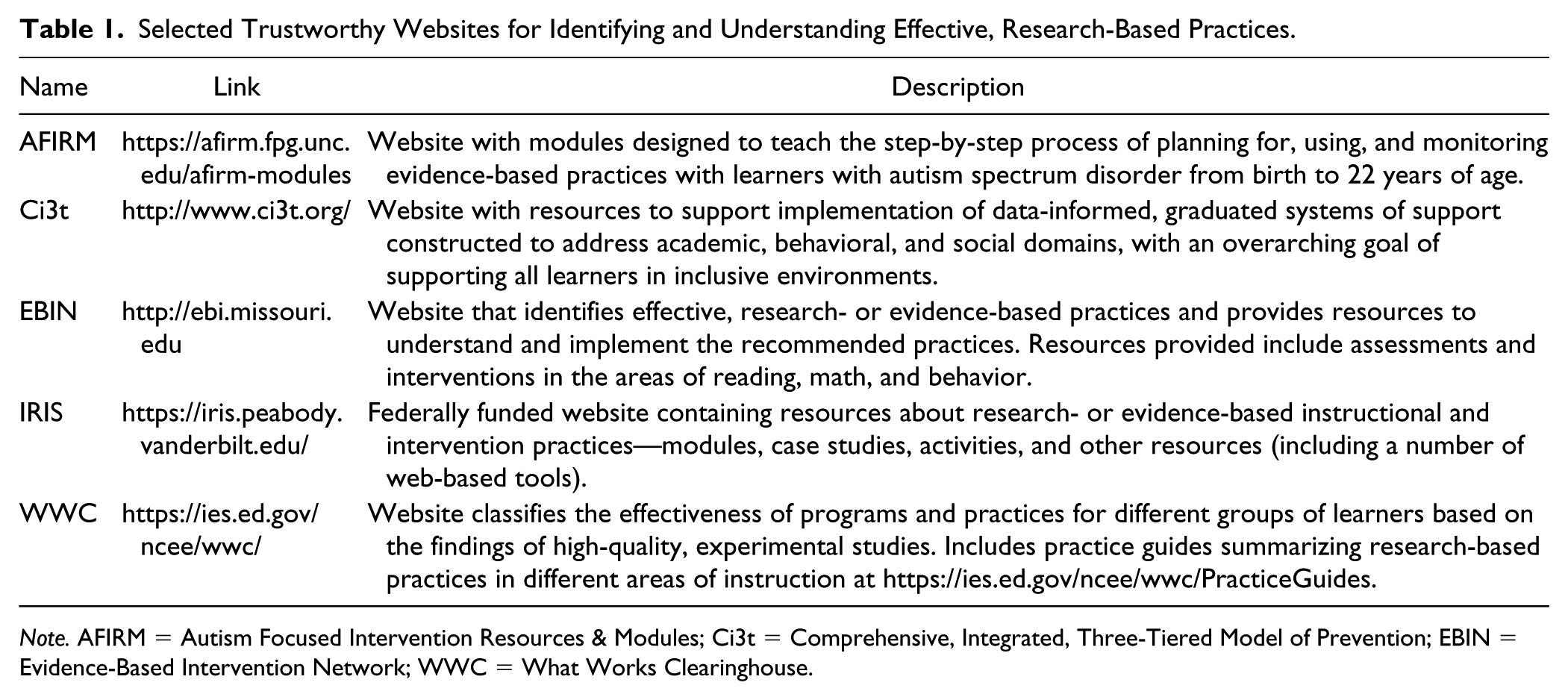
Note. AFIRM = Autism Focused Intervention Resources & Modules; Ci3t = Comprehensive, Integrated, Three-Tiered Model of Prevention; EBIN = Evidence-Based Intervention Network; WWC = What Works Clearinghouse.
Because the practices from the trustworthy sources in Table 1 are identified on the basis of their research support, teachers can have confidence that they are generally effective. Moreover, these resources provide meaningful guidance on how to implement the practices. Accordingly, rather than rely on information from sources such as Pinterest and TpT, which may promote ineffective practices and not identify the core elements of practices, teachers should use trustworthy sources to identify effective practices and understand how to implement them appropriately. After teachers have identified and learned the critical elements of a research-based practice that addresses their student’s needs, then they might search websites such as Pinterest and TpT for innovative ideas and materials to facilitate implementation.
The following scenario revisits the example of Ms. Nelson. However, this time, instead of using TpT to determine which practice to use, she starts by using a trustworthy resource to identify and understand what to teach, and then uses TpT to facilitate implementation.
A new student, Aiden Rayburn, who is eligible for special education services with an emotional disorder, has joined Ms. Nelson’s third-grade classroom. Ms. Nelson received information from his previous school that Aiden has a hard time sitting in his seat and frequently engages in behaviors like slamming his fists on the table when he is frustrated. Ms. Nelson wants to make sure that she is adequately prepared to meet his needs, so she begins to search for ideas on ways to help him stay on task and manage his outbursts. Ms. Nelson sits down at her computer and goes to the Ci3t website to look for effective, research-based practices she can use with Aiden. After reading about a few different practices, she decides that a behavior contract would be a good fit for her, her classroom, and Aiden. After reading and watching the resources on the Ci3t website, Ms. Nelson has a good understanding of how behavior contracts work. Aiden’s previous teacher notes that Aiden loves basketball. So Ms. Nelson finds a product on TpT called “Behavior Contract: Basketball Theme” by The Greenhouse Educators. She likes the cute templates that are fully editable. For $2.50, Ms. Nelson purchases the product and downloads the nine pages. She and Aiden discuss the behavior contract and set a goal for calmly expressing frustration. With guidance and reminders from Ms. Nelson, and reinforcement as specified in the behavior contract, Aiden begins to express his frustration using his words rather than slamming his fist on the desk.
By using Ci3t, Ms. Nelson ensures that she is choosing a practice that is supported by research as effective, and she saves time by finding premade materials on TpT. Although using two different websites to find materials may seem more time-consuming at first, it is critical that educators use trustworthy resources to identify and understand effective, research-based practices. Saving time is not worth the risk of (a) selecting and implementing an ineffective practice or (b) implementing an effective practice inappropriately.
Conclusion
All students need to be taught using effective practices, and this is especially critical for students with or at risk for EBD. Unfortunately, many teachers, both general and special educators, are not adequately prepared to handle the challenging behaviors often exhibited by students with or at risk for EBD (Bradley, Doolittle, & Bartolotta, 2008; Kern, Hilt-Panahon, & Sokol, 2009). To find ways to help their students, teachers are increasingly using websites such as Pinterest and TpT to find instructional resources. The sites are user-friendly, easy to access, and may seem trustworthy. However, despite their popularity, it is often unclear whether practices recommended on these websites are trustworthy and supported by sound theory and research. Accordingly, it is possible for well-intentioned teachers to select and implement an ineffective practice from websites such as Pinterest and TpT. Moreover, often there is insufficient guidance provided on these websites on how to implement the recommended strategies correctly.
We discussed four resources we found on Pinterest and TpT from a search for “behavior management strategies” to illustrate the strengths and weaknesses of using these resources to inform teaching of students with and at risk for EBD. Because of the risks involved in identifying what and how to teach on websites such as Pinterest and TpT, we recommend that educators start their search for effective strategies by using trustworthy sources such as the AFIRM, Ci3t, and EBIN sites. Once effective strategies are identified, we suggest that teachers cautiously use sources such as Pinterest and TpT to provide additional information to facilitate implementation of the practice as needed.
Footnotes
Declaration of Conflicting Interests
The author(s) declared no potential conflicts of interest with respect to the research, authorship, and/or publication of this article.
Funding
The author(s) received no financial support for the research, authorship, and/or publication of this article.
