



Abstract
In this article, we provide both a critical analysis of and logical response to a set of the most typical school-based objections to the effective use of positive reinforcement. For example, one objection is that positive reinforcement amounts to bribery. Practitioners are provided with clear and concise arguments refuting each objection and data-informed rationales supporting the school-based use of positive reinforcement.
Keywords
From a behavioral perspective, the term reinforcement simply refers to circumstances in which an action or event occurring just after a behavior has the effect of making that behavior more likely to occur in the future (Alberto & Troutman, 2009). For example, a student correctly solves a problem, the teacher provides positive feedback by telling her she is correct, and that feedback makes the student more likely to be correct again in the future. In this case, we can say both that the teacher provided a reinforcer in the form of verbal acknowledgment and that the student was reinforced by the teacher’s verbal acknowledgment because behavior continued on afterward.
Note that in this example verbal acknowledgment was simply positive feedback indicating that the student was correct and that the feedback could have been presented differently. A larger and more obvious positive feedback display might have included more verbal praise, such as, “wow, you’re really good at this!” or even public acknowledgment—“everyone, I’m so impressed with Sally’s hard work on this!” A smaller and less obvious version might have included a simple smile or thumbs-up gesture without any verbal interaction. At some point, confidence and a history of success (e.g., “I can read”) maintains learned behavior in the absence of external sources of reinforcement (e.g., teacher praise).
The terms reinforcement and positive feedback are often used interchangeably as both describe a process of making students aware of their success in some manner. However, while reinforcement involves all possible responses to positive behavior (e.g., verbal, tangible, public, privilege), we use the term positive feedback herein in reference only to verbal acknowledgment and not any other form of reinforcement. A graphic representation of this relationship appears in Figure 1. Regardless of the nature of reinforcement, the guiding rule is to use the least amount of reinforcement necessary to facilitate continued student success (Alberto & Troutman, 2009). If the teacher can get by with a smile and nod, that is preferable to larger verbal reinforcers, and certainly preferable to the use of any tangible reinforcers (e.g., tokens, points, privileges).
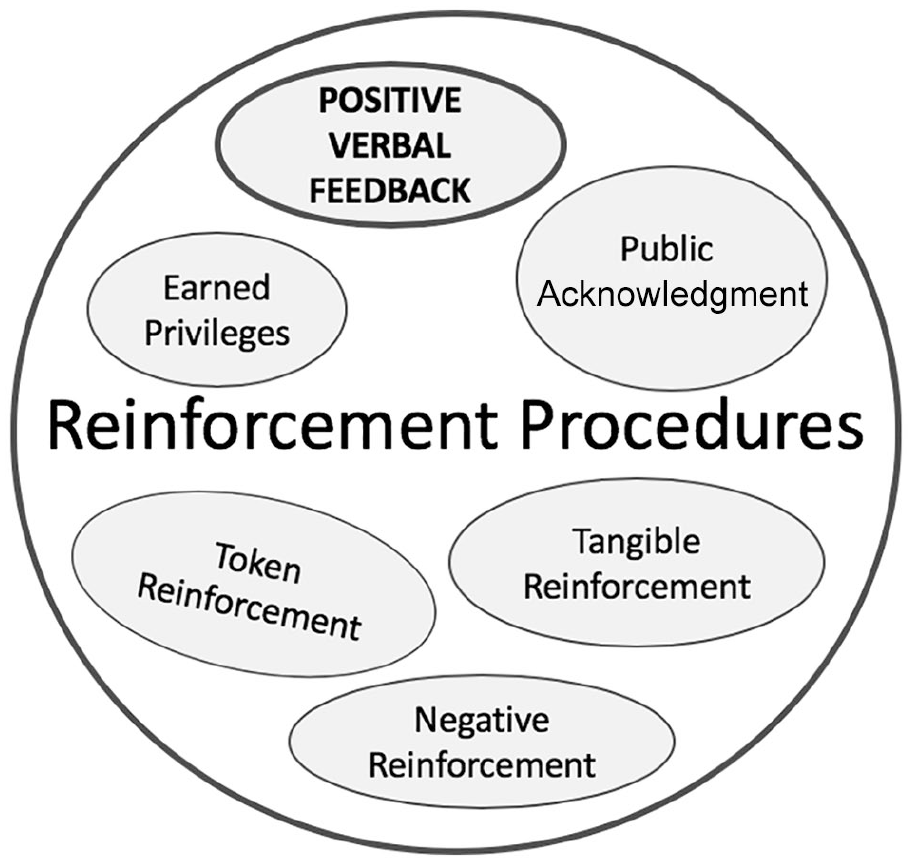
The relationship between verbal feedback and other reinforcement procedures.
In the instructional setting, reinforcement is most often delivered in the form of verbal acknowledgment, simply letting a student know that he or she is correct. Of course, this can be done with a simple “yes” or with a larger “you are really doing great—good job!” Despite the positive effects of even these simple forms of reinforcement, the goal is still to get rid of verbal feedback so that the student continues in a completely independent manner (Alberto & Troutman, 2009). Importantly, because reinforcement can be delivered in a number of ways, it is often easy for teachers to inadvertently reinforce undesired and negative behaviors.
It is common to hear people question the importance of reinforcement. They point out that successful adults read and do math on a daily basis without any need for reinforcement. From this they conclude that the provision of any type of reinforcement in some way inhibits a student’s ability to achieve any independent success. But even the most successful and independent adults at one point did not possess or were not fluent with some requisite skills and required instruction. Instruction requires feedback and part of the teacher’s job is to provide students with feedback to guide their success (Brophy, 2006; Hattie & Timperley, 2007).
Despite logic and evidence, the simple process of reinforcement continues to be eschewed in education as an archaic, ineffective, and even harmful practice (see Cameron et al., 2001; Kohn, 2018). From our review of all of the evidence, we tend to see criticism of positive reinforcement to be on par with a rejection of the science for global warming, evolution, or the absence of a link between vaccinations and autism. Despite the fact that the evidence in favor of positive feedback is overwhelming and unequivocal, there are those who cherry-pick the science in an attempt to make their case. Our purpose in this article, then, is to provide a logical and evidence-based response to this rejection of science. We do that by providing logical and evidence-based responses to the most common criticisms of positive feedback, with a special focus on the application of positive feedback in the school and classroom. We refer to these commonly heard criticisms as myths and hope that the direct and logical refutations of these myths that we present will allow educators to both understand the positive effects of reinforcement and have the language to forcefully refute these myths when they are spoken in the educational realm.
Responses to Seven Common Myths Regarding Positive Reinforcement
Myth 1: Research Does Not Support the Use of Positive Reinforcement
If one were to set out to interview physicians across the nation, asking about the prevailing theory for some specific disease, there would likely be wide consensus across the field as well as predictable dissenters with views far outside the mainstream. This is in part due to the fact that science can never prove that any relationship does or does not exist. It can only provide evidence about what is most likely. That is, science cannot prove that reading instruction “causes” reading, but the evidence is such that suggesting there is no connection between the two is extremely unlikely.
To selectively seek out only that research supporting a preconceived theory or prediction is to reject the scientific method itself, which requires attention to all available evidence. To ensure that we are getting a wide view of all the research rather than a myopic view of some individual studies, it is helpful to look at systematic reviews of the literature or meta-analyses wherein all available studies and their array of findings are analyzed to determine the likelihood of or degree to which an intervention is effective. Positive feedback in school and classroom settings has been evaluated using meta-analysis (e.g., Cameron & Pierce, 1994; Hattie, 2009). Hattie (2009) analyzed research on positive feedback involving almost 68,000 people and found that the average effect of feedback is .73, ranking 10th out of all factors. An effect size of .73 means that the average student receiving regular positive feedback sees a positive effect of almost three quarters of a standard deviation. Among contributions from all teaching approaches, the only strategy with a larger effect is formative assessment (.90), which also involves feedback.
Given this exceedingly positive finding, there are some studies in the feedback literature that have shown no effects or even counterproductive effects from the use of positive feedback (e.g., Deci et al., 1999). However, there are three key considerations to address whenever we look at contradictory research. First, context is important and sometimes different researchers perform their studies with subtle nuanced differences that make comparisons invalid. For example, as described earlier, the term feedback herein is meant to denote verbal acknowledgment that provides information about performance. On the contrary, reinforcement is a much broader term that encompasses a wide range of possible actions. Clearly, there are problems in comparing studies that have different definitions of the variable being studied. If one study is focused on tangible reinforcement with high interest tasks and the other focused on verbal acknowledgment and low interest tasks, we might expect that the two studies would have different outcomes. This context is important as our science suggests that not all reinforcement is equal. The effectiveness of reinforcement is dependent upon its nature, delivery, frequency, predictability, the learning history of the student, and the difficulty of the task (Skinner, 2014). Failure to consider context when looking at the research on reinforcement leads to contradictory findings.
Statistical significance plays a role in the second consideration. In the social sciences, we typically require a .05 level of confidence that the results we see are not simply random variations. That is what the p < .05 means when you see data presented in the reporting of empirical research. But that means that about 5% of “significant” research findings may be wrong. This is why we must strive to look at the whole of the available research. For example, Hattie’s (2009) research looked at more than 1,200 studies, including both those with positive and negative effects and concluded that positive feedback was associated with large positive effects on achievement.
Our third key consideration is that replication or demonstrating a repeating of research findings is necessary because even scientists can make mistakes. In 1989, Fleischmann and Pons published a study claiming to have achieved cold fusion in a laboratory. Verification of this claim would have meant that cheap energy production would be available to the entire world. However, other scientists in their field could not replicate the researcher’s claims and cold fusion was debunked in fairly short order (see Huizenga, 1993). Verification is an important part of the scientific process, and we emphasize it here because science has repeatedly shown the positive educational effects of feedback in spite of some contradictory findings. In sum, the research as a whole supports positive reinforcement as an effective strategy and as an integral part of teaching and learning (Cook et al., 2017).
Myth 2: Reinforcement Inhibits Intrinsic Motivation
For the sake of argument here, let us assume that reinforcement is effective, but that it produces other problems or side effects that are greater than positive change in behavior. For example, one might contend that while reinforcement during instruction may be effective in getting a student to read with accuracy, fluency, and comprehension, it also negatively affects the student’s feelings of self-worth, self-esteem, or motivation. This argument is most frequently put forth by the suggestion that reinforcement somehow robs an individual of internalizing his or her success or that receiving external reinforcement removes the individual’s ability to enjoy learning or increase successful performance (Kohn, 1999).
In responding to this frequently cited myth, we first must ask what it means to say that a student has intrinsic motivation or is “internalizing” his or her behavior. According to the Cambridge Dictionary (Internalize, 2019), internalizing is defined as the ability “to accept or absorb an idea, opinion, belief, etc. so that it becomes part of your character.” Similarly, the word “intrinsic” is defined as “basic to a thing, being an important part of making it what it is” (Intrinsic, 2019). Thus, it appears that some critics of reinforcement believe that one being told that he or she is doing something well or correctly in some way inhibits the belief that the behavior in question is a part of his or her character.
To be clear, there is some evidence that behaviors such as children’s conscious decisions to follow rules at an early age are predictors of their later demonstration of moral behavior (e.g., Kochanska et al., 2010). But where did these children first learn of the rules and what feedback did they use to make decisions about their own success with the rules? As has been noted, feedback is an essential component of instruction. In the absence of feedback from their parents or caregivers, how would these children have learned to discriminate right from wrong and develop a moral outlook related to those rules? It seems far more logical to assert that acknowledging student success is the route by which they were provided with the feedback necessary to formulate beliefs about their own success. But clearly, if a student is not successful, then there is little hope for him or her internalizing of any positive feelings. Thus, effective instruction (which inherently involves feedback) has been demonstrated to be an essential component of setting students up to have confidence and high self-esteem (Kirschner et al., 2006). In effective instruction, the contingency of success before praise is important in this interaction. Simply providing praise without attaching it to real student behavior has not been demonstrated to be effective in producing self-esteem (Lawrence, 2006). Effective instruction is the key to facilitating the student success upon which positive feedback is contingent.
Let us look even deeper at the concept of internalizing one’s own success. If this was truly the outcome that we determined to be most important, then how would we go about measuring it? That is, how would we know whether our students were really internalizing their success? We could ask students about their feelings. In fact, when this is done, the evidence has long shown that students with higher academic success rates have more confidence and higher self-esteem (e.g., Engelmann et al., 1988; Rosenshine, 1978). This should not be at all surprising as it is entirely logical that success breeds confidence. If self-esteem, confidence, and the ability to sustain skills under generalized conditions are indicators of internalizing success, then effective instruction involving positive feedback represents the best course of action to achieving it. So while one might use reinforcement in a manner that would be counterproductive, the evidence is clear that simply providing students with feedback on their success promotes success with both practice and self-esteem.
Myth 3: Reinforcement Is Bribery
Legally speaking, bribery is considered to be an illegal act (Bribe, 2019a). Over time, the term has been broadened to include payments to persons for engaging in behaviors they otherwise would not do. According to the Cambridge Dictionary (Bribe, 2019b), the word bribe as a verb is defined as “to give someone money or something else of value, often illegally, to persuade that person to do something you want.” In this sense, all transactions in which an agent holds out for more money could be considered bribery. For example, consider that you let your lawn grow too long and the neighbor boy who typically cuts your grass balks at cutting it. Offering him more money to do the job technically fits this broader definition of bribery.
Clearly, these are not the types of corrupt practices connoted when referring to reinforcement as bribery. But there is an important distinction that should help to clarify this difference. As part of instruction, reinforcement means only that the student was recognized for success. While this could be tangible in the provision of tokens or privileges, for example, the great majority of positive instructional feedback comes in the form of verbal acknowledgment. That is, the teacher is telling the student that he or she has been successful in a given task or circumstance. Because positive feedback is focused on promoting success, longer-term success will be the reinforcer that maintains behavior. That is, letting a student know that he or she is successful builds the confidence necessary to make learning positive and promote further learning. Of course, in effective implementation, there is a contingency; the student only receives positive feedback when he or she is correct. But calling this type of feedback bribery means that all vending machines bribe us with the promise of a preferred item, contingent upon inserting money. Assuming that this is the definition that we wish to use, then we would have to say that bribery is a part of most every interaction we have with others. On the contrary, if we stick with a more original and legal definition of bribery, the notion that reinforcement is a type of bribery becomes obviously ridiculous.
Myth 4: Reinforcement Is Counterproductive and Inhibits Positive Behavior
While the literature has indicated that positive feedback is perhaps the single most effective strategy that a teacher can regularly and immediately employ (see Hattie, 2009), research has repeatedly demonstrated that teachers use this strategy at very low rates overall (Scott et al., 2017), and even less so with students who have a history of failure, particularly male minorities and students with or at risk of emotional and behavioral disorders (Scott et al., 2019; Stichter et al., 2009; Yoshikawa et al., 2012). In other words, the students doing most poorly and at greatest risk of larger school and life failures receive the least positive feedback. On the contrary, students with the best outcomes both academically and socially receive the most positive feedback. While these facts alone do not necessarily support the use of reinforcement, they seem to indicate that its use is not associated with problematic outcomes. Still there are those who publicly denigrate any type of positive feedback as not just ineffective but counterproductive (e.g., Kohn, 1999, 2018).
These criticisms typically point to two types of studies. In one instance, research participants are assigned to either receive tangible reinforcement or not in the performance of some task. Participants are then observed during free time, and the amount of time spent engaging in the task is measured as an index of intrinsic motivation. Because those not reinforced have sometimes been found to be more likely to continue engagement into free time, authors have concluded that reinforcement inhibits intrinsic motivation (e.g., Deci, 1971). In a second instance, research participants are performing at a high level, some type of tangible reinforcement is introduced, and participant performance drops (e.g., Lepper et al., 1973). Again, authors conclude that reinforcement inhibits motivation and performance and overlook that, as a general rule, tangible reinforcers are effective mainly with tasks that are of low interest or those in which students do not wish to engage (Cameron et al., 2001).
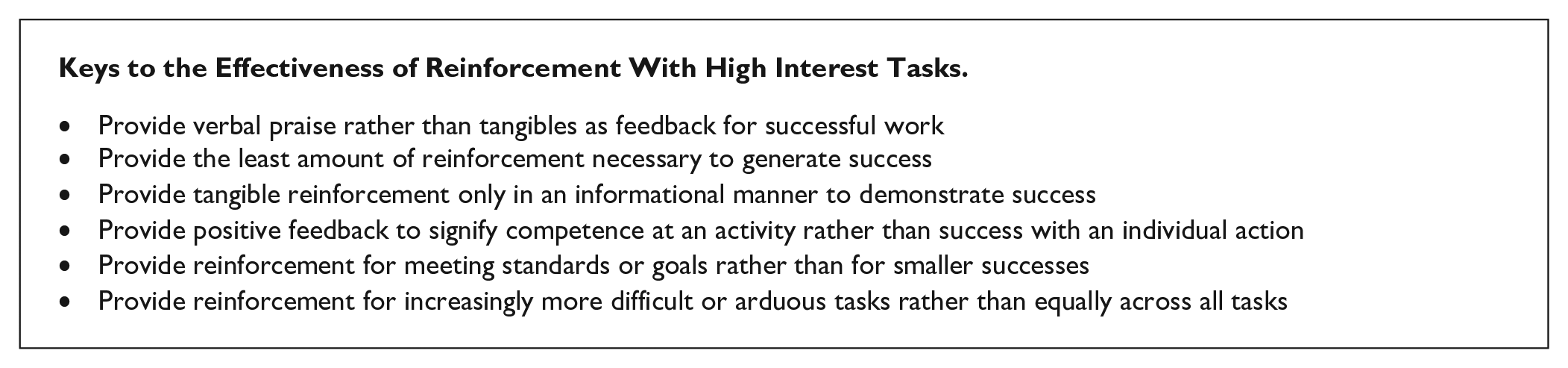
There are two larger points to be made with regard to this myth. First, remember that context is important (see Myth 1); these studies involve the use of tangible reinforcers and not simple verbal acknowledgment as positive feedback. If students are successful in the natural environment, then we can assume that reinforcement is occurring naturally, perhaps as a factor of confidence, self-esteem, or joy associated with increasing competence. Under these circumstances, there would be no need to introduce any external reinforcers. An occasional acknowledgment (e.g., “Wow, you are so good at that”) might be all that is warranted. As an example, if someone were to come to you and begin providing you a treat for every time you read words correctly in the newspaper, it would very likely interrupt your newspaper reading. You may even find this to be insulting and avoid reading the paper altogether. While external reinforcement may once have been an effective strategy when you were learning to read, you now read because it works for you—it is now naturally reinforcing. If one is already successful, then the introduction of external reinforcers can inhibit performance. That is why positive verbal feedback is typically warranted when students already possess an interest or history of success with a skill or task (Scott, 2016). However, more tangible forms of reinforcement can still be effectively used if provided in the correct manner. The boxed item on the next page provides an overview of the keys to effective tangible reinforcement with high interest behaviors (adapted from Cameron et al., 2001, 2005).
Keys to the Effectiveness of Reinforcement With High Interest Tasks.
The second point to be made in regard to this myth involves a logic for considering why peak performance might decrease after reinforcement. Consider that we were to be tracking a student’s performance with any academic skill and that performance was variable but steadily increasing. If we were to provide reinforcement only for meeting a criterion level, natural variability might make it appear that student performance was adversely affected by reinforcement. But looking at the larger graph presented in Figure 2 shows that overall performance was increasing. Furthermore, the nature of such post-reinforcement pauses is well-researched. We know that variable ratio (i.e., randomly intermittent based on performance) schedules of reinforcement are associated with little to no post-reinforcement pauses while fixed ratio and interval schedules are far more likely to produce pauses (Young et al., 2017). Again, context matters when considering relationships between complex learning environments and human behavior.
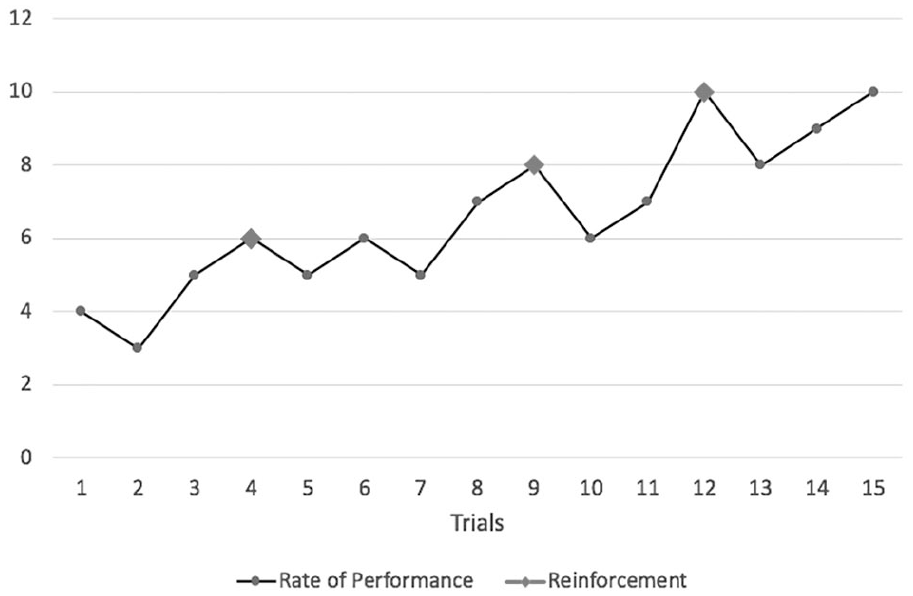
Post-reinforcement pauses within a successful intervention involving reinforcement.
We might also consider this second point in a different manner. When performance is variable, any time we reinforce only the highest performance, we should expect that the next trial is likely to produce a decrease. For example, it is not likely that a professional golfer wins two tournaments in a row. Because of this, one could look at the prize money received after a tournament win and determine that prize money inhibited the performance of professional golfers. In reality, this phenomenon is more akin to a regression to the mean. If we only reinforce outliers, then we would expect that the next trial will be back in line with the mean. If you were only reinforced for flipping a coin to heads 10 times in a row, then it would be extremely unlikely that you would flip the coin 10 times in row on the next trial. But was it the reinforcement that caused this or the fact that the next trial was simply more likely to be closer to the mean? While flipping a coin is a random event and not the same as student performance, the same logic applies. That is, if we use reinforcement only for the demonstration of outlier performance, then we would expect to see decreases in performance on the most immediately subsequent trials. Put simply, when mindful of the keys to effective reinforcement, there is no evidence that positive reinforcement is counterproductive or inhibits positive behavior.
Myth 5: Reinforcement Inhibits Creativity
An oft-heard criticism of reinforcement is that it inhibits creativity. While the mechanisms underlying this criticism are not well articulated in the literature, it is logical to assume that it is related to myths involving reinforcement inhibiting intrinsic motivation or being counterproductive (see Myths 2 and 4). Clearly, if students are reinforced for only one way of problem solving, then their abilities to conceive of or produce alternative solutions will be less likely to develop and be effectively utilized. For example, if we were teaching a student to build a tower from a variety of differently shaped blocks while modeling only one block arrangement and providing feedback that only that one arrangement was correct, then we would expect that the student would be unlikely to spontaneously generate alternative arrangements.
This circumstance is not a problem with reinforcement. Rather, it is a problem with the manner in which reinforcement is used within instruction. Creativity is something that can be taught and encouraged in the same manner as critical thinking (Eisenberger & Selbst, 1994; Rose & Lin, 1984). Hattie’s (2009) meta-analyses have shown an effect size of .65 for teaching creativity. Others (e.g., Higgins et al., 2005) have noted that systematically designed and explicitly delivered instruction provides the best outcomes for creativity. Teachers first provide instruction to facilitate student success with understanding key skills and relationships, and then teach and encourage alternatives. In this manner, teachers encourage students to explore creativity.
While creativity involves adapting performance to create novel solutions and outcomes, it is important to note that students cannot be creative with skills that they do not possess. The process of learning can generally be plotted along a very predictable curve. Referencing Figure 3, at the bottom of the curve, the student is learning a new behavior. Progress is relatively slow and teacher encouragement and frequent feedback is necessary to keep it going. As the student moves through the fluency and maintenance phases, the teacher can gradually fade the frequency of feedback as student success takes over to maintain behavior. Generalization involves students learning to use the skills in novel situations, and this can be taught through the use of a range of authentic examples. The final phase of learning involves the student demonstrating the ability to adapt the skill in new and creative ways. Clearly, if the student had not acquired the skill, never gained fluency or maintenance, and could not successfully use the skill in authentic situations, then there is little logic in thinking that he or she would have the ability to adapt the skill. For this reason, calls for creativity to be taught in the absence of skill instruction are at best misguided. Rather than inhibiting creativity, positive feedback is an essential component of shaping student responses that demonstrate critical thinking and creative solutions. Logically, there is no evidence to support the contention that reinforcement inhibits creativity. In fact, positive feedback can be used to encourage creative behavior.

Phases of learning plotted on a typical learning curve.
Myth 6: Focus on Specific and Measurable Behavior Ignores More Important Constructs
As a variation of the focus on creativity, criticisms of reinforcement are often tangled up in larger criticisms of measuring specific student behaviors or outcomes. As Kohn (2018) stated, “The more our attention is fixed on the surface, the more we slight students’ underlying motives, values, and needs.” To be clear, a focus on observable behaviors in no way precludes a focus on any other variable, process, feeling, or mental state. That is, teachers can focus on students’ motivations, values, and needs in the design of effective instruction while measuring what effect that has on performance. To suggest that performance is not important is to ignore a basic logic: Attention to any construct or manner of learning is only as valuable as the outcome it produces. There is no need to denigrate a focus on internalized variables of learning. It is not a zero-sum game. There can be a balanced focus on process and outcome.
Perhaps the bone of contention herein is in the definition of success. While internal states are important, feeling good about math while not being able to solve problems is no better than solving problems without understanding. Let us look closer at these process variables. A common example suggests that a focus on only the correct answer in math ignores the student’s understanding of the principles and processes involved in solving a problem correctly. As with previous examples, this is not a problem with reinforcement. It is a problem with the way in which reinforcement is used. A graphic representation of the relationship between instruction and measurable outcomes is presented in Figure 4. Process and understanding are themselves outcomes that we can measure and their impact is evidence for two critical components of effective instruction. First is the need for breaking complex skills into teachable components so that students may experience success with both understanding and outcomes, leading to a higher likelihood of future success (again, the definition of reinforcement). Second is the need for teacher-driven lessons in which examples, activities, and discussions provide opportunities for students to have a personal context for learning. In a related sense, teacher encouragement of students’ critical thinking during instruction (e.g., reciprocal teaching) approximates some of these internal factors and has been shown to have large positive effects on students’ abilities to successfully problem solve (Hattie, 2009; Rosenshine & Meister, 1994). In sum, all important constructs must be measurable because if they could not be measured, then we would not have any way of knowing of their importance.
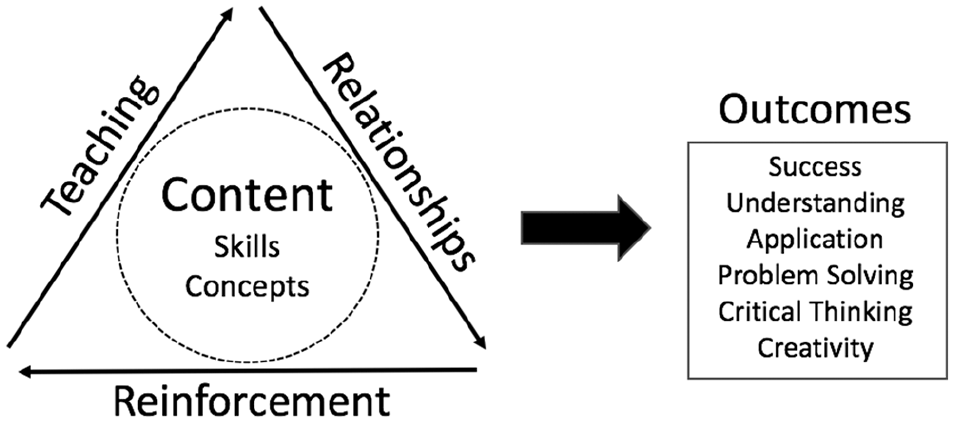
A graphic representation of the relationship between instruction and measurable outcomes.
One further implication of this myth is that a focus on what students do is irrelevant and any focus on outcomes somehow ignores or interferes with the more important internal process variables of motives, values, and needs. In this context, instruction is presented such that the only way one can internalize learning is if there is no measurement of outcomes. But at the heart of this premise is a flawed circular logic, that measuring behavior produces outcomes that are inferior to not measuring outcomes. Would not the information necessary to come to this conclusion require a measurement of outcomes? In other words, it is not logical to state that not measuring outcomes leads to better outcomes. If, in fact, no outcomes were measured to support this premise, then there is no basis for such a conclusion.
Myth 7: In the “Real World” Nobody Is Going to Give You Anything for Doing What Is Expected
A common refrain from those who are reluctant to use even the simplest forms of reinforcement is to claim that reinforcement is not part of the natural world. They suggest that offering reinforcement sets students up to unrealistically expect similar consequences for expected behaviors throughout life. The most logical response to this myth involves pointing to the fact that the employed all receive payment in some form for their work. But it also makes sense to again remember that reinforcement during instruction simply means letting students know when they are successful, with the purpose of providing reinforcement to make it more likely that students continue to be successful in the future. Thus, we hope that verbal acknowledgment serves both to guide the student to discriminate right from wrong or success from failure and to generate a confidence to support continued learning and success.
It is also worth making a distinction between academic learning and tasks for which there are strong natural contingencies competing against performance. For example, attempting to quit smoking, start or continue dieting, and increase exercise all have strong natural reinforcement contingencies in opposition, including a desire to smoke, eat, or avoid tiring exercise, respectively. In fact, the difficulty with these types of behavior change efforts is that people find the behavior they are trying to avoid to be more reinforcing than meeting their goal. Compare this with the student who is learning a new skill and notice that there is no such counter-incentive against success with learning. The only aversive associated with learning basic academic content is the fear of failure. To the extent that we can facilitate student success, there is no such competing contingency.
Other Points Regarding Reinforcement
Other criticisms of reinforcement, while less cogent in terms of pointing to specific problems, may be more commonly offered up by the average person as a reason to be suspect of reinforcement procedures. Because these criticisms are often semantic in nature, responses are generally simpler and require only an example or definition as correction. For example, people sometimes attempt to dismiss research supporting the effectiveness of reinforcement by stating that it is based on animal research and, thus, using such is akin to treating humans like animals. It is true that much of the basic early research on the science of human behavior was done in laboratories using pigeons and rats (see Ferster & Skinner, 1957, as an example). But the term “basic research” refers to the type of fundamental study used to improve and refine scientific theory. In the end, theory on human behavior is only valid to the extent that the principles can be replicated with humans or used to predict human outcomes. In fact, the majority of our medical science also was established using non-human subjects ranging from single-cell organisms to primates. While concerns related to animal cruelty in all such cases are ripe for debate, the fact that an effective treatment for cancer was developed via basic research using rats does not prompt anyone to claim that medicine treats people like rodents.
It is also common for people to say reinforcing student behavior is an attempt to force behaviors upon them—or like treating students like rats pressing levers. As has been mentioned previously, to the extent this might be true, it is not a problem with reinforcement but with the manner in which reinforcement is being used. Any intervention, practice, or procedure can be misused or used in a manner that does not serve the best interests of students. But critics of reinforcement are too quick to create a false dichotomy wherein reinforcement can be used either for bad or not at all. In reality, we have discussed at length the logic underpinning reinforcement as an inherent component of instruction, and for the sole purpose of illuminating and encouraging continued success. The fact something can be used ineffectively is no more a logical criticism for reinforcement than it is for the surgeon’s scalpel, which can certainly be used as easily for harm as for good. The key is in using research to create guidelines for maximizing benefit and minimizing harm.
Conclusion: Trust in Science
It seems that the degree to which people trust science is at least in part a factor of the stakes of being wrong. That is, there is far less argument about the role of science in the fields of medicine or engineering and the population is pretty good at ignoring the occasional outlier study that contradicts conventional wisdom within those fields of science. That noted, people continually fall prey to charlatans peddling all manner of unproven cures for cancer and other serious ailments. Perhaps the more dire the circumstances, the more likely we are to want to believe in a miracle cure.
While we believe science offers us the best hope for positive outcomes and the avoidance of wasteful and irresponsible practices in education, we also realize that teachers are often more susceptible to emotional arguments than to scientific data (Broekkamp & van Hout-Wolters, 2007; Cornell, 2006/2017). This is a problem as those who speak out falsely against positive feedback have most typically been published in the more widely circulated popular press (e.g., websites, commercial books) which likely receives more attention from teachers and the general public than does review of the actual scientific studies that appear in scholarly journals frequented predominantly by academics. However, this does not change the fact that, while it is not an absolute certainty, we do have a science for positive feedback and it is solid. While it is possible to cherry-pick the literature to make a point, only a systematic review and analyses of the literature can be trusted to provide our best hope for the truth. The body of literature overwhelmingly supports the effective provision of positive feedback in schools and classrooms.
As humans, we are much more likely to attend more to emotionally salient events than we are to recognize or trust statistical prevalence (Cornell, 2006/2017). This is why arguments about treating students like lab rats and talk of how reinforcement ignores what it is to be an independent and intrinsically motivated human have such sway over educators even though the evidence is absent or contrary. But even within the field of education, leaders and experts do not agree as to what constitutes not just compelling evidence but evidence at all (Hirsch, 2010). As advocates for students with or at risk of emotional and behavioral disorders, and in fact for all children and youth, we believe that it is our collective responsibility to speak up when we hear these myths used as excuses to withhold effective practices from our students. While many of our most privileged and advantaged students might have sufficient confidence to succeed in the absence of high probability strategies, too many simply will not, and that is a measurable outcome of which we should all be too aware.
Footnotes
Declaration of Conflicting Interests
The author(s) declared no potential conflicts of interest with respect to the research, authorship, and/or publication of this article.
Funding
The author(s) received no financial support for the research, authorship, and/or publication of this article.