



Abstract
Strategies for preventing the escalation of problematic student behavior in inclusive school settings are detailed. These strategies include utilizing proactive behavioral interventions, implementing function-based behavioral interventions that address root causes of escalated student behaviors, and teaching and reinforcing socially acceptable alternatives to escalated student behaviors. Each strategy is described in practical detail using case study vignettes about students who engage in escalated behaviors within inclusive school settings.
Mr. Walsh is excited to begin his first year as the school behavior specialist at Aspen Elementary School. Upon meeting the school principal for the first time, Mr. Walsh quickly learns that decreasing occurrences of escalated student behaviors—particularly physical aggression, property destruction, and leaving school property without permission—is a high priority for the upcoming school year. Mr. Walsh learns that during the previous school year escalated behaviors typically resulted in students either being sent to the principal’s office or home for the remainder of the school day. Restraint procedures were also reportedly used if educators perceived that escalated student behaviors posed an imminent safety risk. Mr. Walsh was surprised to learn that over 100 office referrals resulting in students being sent to the principal’s office or home for the remainder of the school day were issued in response to last year’s occurrences of physical aggression, property destruction, and leaving school property without permission. There were also 36 reported uses of restraint procedures during the previous school year at Aspen Elementary School.
Reactive Policies and Escalated Student Behaviors
Reactive policies, namely the use of exclusionary (e.g., school suspension) and restraint procedures, are often implemented in response to escalated behaviors displayed by students receiving special education services within school settings (Heilbrun et al., 2015; U.S. Commission on Civil Rights, 2019). However, since these reactive policies typically address the physical form of student behaviors (i.e., what behaviors look like) as opposed to root causes of student behaviors (i.e., what behaviors allow students to access or avoid within a particular context or situation), these policies often fail to both address the root causes of problem behaviors and facilitate meaningful behavior change among students (Heilbrun et al., 2015; U.S. Commission on Civil Rights, 2019).
Unfortunately, reactive policies can unintentionally reinforce escalated behaviors and, in the process, increase future occurrences of these problem behaviors. For example, educators may intend to punish a student by suspending them from school after the student engages in physical aggression (e.g., biting or hitting their classroom teacher). However, if the student perceives parts or all of the school experience (e.g., completing independent seatwork, interacting with non-preferred peers and adults) as aversive, the student is unlikely to perceive school suspension as an aversive consequence. In fact, the student may even engage in physically aggressive behaviors more frequently in the future in order to avoid or escape the school experience. Given the inadequacy of these reactive policies in response to escalated student behaviors, Congress and many disability advocacy organizations have since called for a national need to focus interventions on preventing occurrences of problem behaviors and replacing restrictive behavioral interventions with those designed to teach socially appropriate behaviors (U.S. Commission on Civil Rights, 2019; U.S. Department of Education, 2012).
A Proactive Approach: Implementing Function-Based Behavior Interventions
A function can best be described as the source of reinforcement that maintains a specific behavior. Through their behaviors, students can access preferred items and activities (i.e., tangibles), adult or peer attention, and sensory (i.e., automatic) reinforcement (e.g., tactile stimulation associated with cracking one’s knuckles, auditory stimulation associated with humming or whistling). Students can also temporarily avoid or altogether escape adult or peer attention, non-preferred tasks and activities, and sensory stimuli students perceive as aversive (e.g., tactile stimuli associated with handwashing, auditory stimuli associated with fire alarms) through their behavior (Cooper et al., 2020).
Behaviors can also be maintained by multiple functions. For example, a student may access peer and teacher attention upon engaging in property destruction (e.g., throwing student desks and chairs, ripping student work and bulletin boards off of classroom walls) during math class and, after being sent home in response to this problem behavior, escape academic task demands for the remainder of the school day. In short, any behavior that maintains or increases over time is being reinforced through one or both of the following principles: positive reinforcement when a student accesses something they perceive as desirable contingent on engaging in a specific behavior, or negative reinforcement when a student avoids or altogether escapes something they perceive as aversive contingent on engaging in a specific behavior. By understanding how the presence, or absence, of variables within students’ environments influences students’ behaviors, we can implement behavior interventions to provide students with frequent access to reinforcement throughout the school day. Such actions can render engaging in problem behaviors irrelevant. They can also teach students socially acceptable alternatives to problem behaviors that more efficiently and consistently result in access to reinforcement (O’Neill et al., 2014).
Unlike reactive policies such as exclusionary and restraint procedures that address the physical form of student behaviors (i.e., what behaviors look like), function-based behavior interventions address root causes of student behaviors (i.e., what behaviors allow students to access or avoid within a particular context or situation; Walker et al., 2018). Specifically, function-based behavior interventions involve responding to function over form by providing students with the reinforcement they previously accessed through carrying out problem behaviors.
Contrary to reactive policies, function-based interventions can be implemented before problem behaviors occur or before they escalate in intensity. In addition, function-based interventions can be implemented consistently and appropriately with minimal disruption within school settings by educators, without requiring extensive behavioral training or experience (Walker & Pinkelman, 2018). Whereas reactive policies such as school suspension may unintentionally reinforce students for engaging in problem behaviors (e.g., by providing attention or removing task demands), function-based interventions allow students to access reinforcement within classroom settings and, in the process, enhance the quantity and quality of educational experiences among students with behavioral support needs.
Preventing Escalated Behaviors in Classroom Settings
As Mr. Walsh prepared for the beginning of the school year, he attended a professional development training on the topic of supporting students that engage in escalated problem behaviors by utilizing function-based behavior interventions. During this professional development training, Mr. Walsh learned that escalated problem behaviors, such as physical aggression, property destruction, and leaving school property without permission, are typically preceded by more subtle changes in student behaviors and, by recognizing and responding to these changes in student behaviors, educators can successfully prevent problem behaviors from escalating (Colvin & Scott, 2015). Mr. Walsh also learned that escalated problem behaviors often occur in response to characteristics of school environments, such as task demands, activity transitions, and in some cases specific individuals who may be present. Thus, through understanding the relationships between escalated behaviors and the school environments in which they occur, educators can alter the environments to prevent problem behaviors from occurring in the first place (Colvin & Scott, 2015; Cooper et al., 2020). Not surprisingly, Mr. Walsh was curious to learn more about function-based behavior interventions and, specifically, how designing and implementing function-based behavior interventions could minimize the need for implementing exclusionary and restraint procedures with his students.
In the rest of this article, we describe strategies for hypothesizing functions of escalated student behaviors and generating function-based behavior interventions that address the root causes of escalated behaviors and prevent escalated problem behaviors from occurring within inclusive school settings. The intent of sharing these interventions is twofold. First, the following interventions provide students with frequent access to reinforcement throughout the school day to discourage problem behaviors from occurring or escalating in nature. They also teach and reinforce socially acceptable strategies for accessing wants and needs within inclusive school settings. Second, the interventions maintain safety for students and educators by (a) proactively addressing problem behaviors to prevent them from occurring in the first place or (b) identifying precursor behaviors (i.e., milder problem behaviors that typically precede escalated problem behaviors) so as to intervene before behaviors escalate in intensity. The rationale behind these interventions is that by considering the function(s) of escalated problem behaviors, educators can both decrease the frequency and intensity of student problem behaviors and minimize the use of reactive policies such as restraint and exclusionary procedures.
Functional Behavior Assessment and Hypothesizing Behavior Functions
When addressing escalated student behaviors that adversely affect student learning and safety, the functional behavior assessment (FBA) process should be conducted to hypothesize functions of student behaviors (i.e., what the student is accessing or avoiding through their behavior that is maintaining occurrences of escalated behaviors). Once the function(s) of maintaining occurrences of escalated problem behaviors are identified, home (e.g., parents and family members) and school (e.g., paraprofessionals, teachers, administrators, related service providers) stakeholders can collaboratively identify and implement function-based behavior interventions that address root causes of problem behaviors and, in the process, facilitate socially significant behavior change among students that engage in escalated behaviors within school settings. The prerequisite steps to hypothesizing functions of escalated student behaviors include defining escalated student behaviors and collecting behavior data through indirect assessments, direct assessments, and functional analysis procedures. Each of these steps is described in the following sections.
Defining Target Behaviors
Educators can use the “stranger test” prior to collecting data on escalated problem behaviors to ensure that the behavior(s) targeted for data collection are specific, objective, and measurable. If a behavior is clearly defined, a stranger (an individual unfamiliar with the student’s behavior) should be able to accurately describe what the target behavior looks like given only a written definition of the target behavior (Cooper et al., 2020). For example, when defining elopement, an educator may state that elopement is occurring any time a student leaves an assigned area without being accompanied by an educator or with educator permission. Defining escalated student behaviors in specific, objective, and measurable terms is a crucial prerequisite to accurate and consistent data collection, especially when multiple educators are collecting data in a variety of settings (O’Neill et al., 2014).
Collecting Data
Indirect assessments
Indirect assessments involve obtaining information from home stakeholders (e.g., parents and family members), school stakeholders (e.g., classroom teachers and paraprofessionals), and students themselves through interviews, checklists, and rating scales (Cooper et al., 2020). Indirect assessment tools include the following: Problem Behavior Questionnaire (PBQ; Lewis et al., 1994), Guess and Check: Teacher Guided FBA (Anderson & Bateman, 2010), Motivation Assessment Scale (MAS; Durand & Crimmins, 1992), and Functional Assessment Checklist: Teachers and Staff (FACTS; March et al., 2000). Indirect assessment procedures are useful strategies for obtaining data related to escalated student behaviors as they often require minimal time and behavioral expertise among educators conducting these assessments. However, due to the inherent subjectivity associated with asking students and their stakeholders to share their recollections and opinions related to escalated problem behaviors, indirect assessments are best used as preliminary, as opposed to primary, assessment methods during the FBA process. In other words, information obtained through indirect assessment procedures should be further investigated through direct assessment and functional analysis procedures.
Direct assessments
Direct assessments involve directly observing students in school settings and include the following: event recording, duration, latency, time sampling, interresponse time, ABC recording, and scatterplot recording (Cooper et al., 2020). Direct assessment procedures can be used to confirm or disconfirm data obtained from indirect assessment procedures regarding when and where escalated problem behaviors are most and least likely to occur. Through observing students in a variety of school settings and at a variety of different times, educators can better understand specific variables within the environment (e.g., task demands, activity transitions, presence of specific peers or adults) that are typically present or absent during occurrences of escalated problem behaviors. Relationships between environmental variables and escalated student behaviors observed through direct assessment procedures can guide the development of behavior interventions customized based on characteristics unique to students and the environments in which student problem behaviors typically occur (O’Neill et al., 2014). Observed relationships between environmental variables and escalated student behaviors can also be further investigated through functional analysis procedures.
Functional analysis procedures
Sometimes, clear functions maintaining occurrences of escalated student behaviors are not evident through indirect and direct assessment methods. Under these circumstances, a functional analysis can be conducted that involves systematically manipulating environmental variables (e.g., access to attention, avoidance/escape of non-preferred tasks and activities) to better understand how these variables influence student behavior. By systematically manipulating these environmental variables and monitoring student behavior under different conditions (e.g., providing attention or activity breaks contingent on occurrences of escalated problem behaviors, temporarily ignoring occurrences of escalated problem behaviors), educators can investigate relationships between environmental variables and escalated student behaviors not evident through indirect and direct assessment methods (Cooper et al., 2020). Achieving this level of precision is a complex process and, as functional analysis procedures can temporarily strengthen or unintentionally reinforce escalated problem behaviors, it is important to note that educators should have the prerequisite training and expertise needed to conduct functional analyses in a manner that maintains the safety of students and educators.
Implementing Function-Based Behavior Interventions
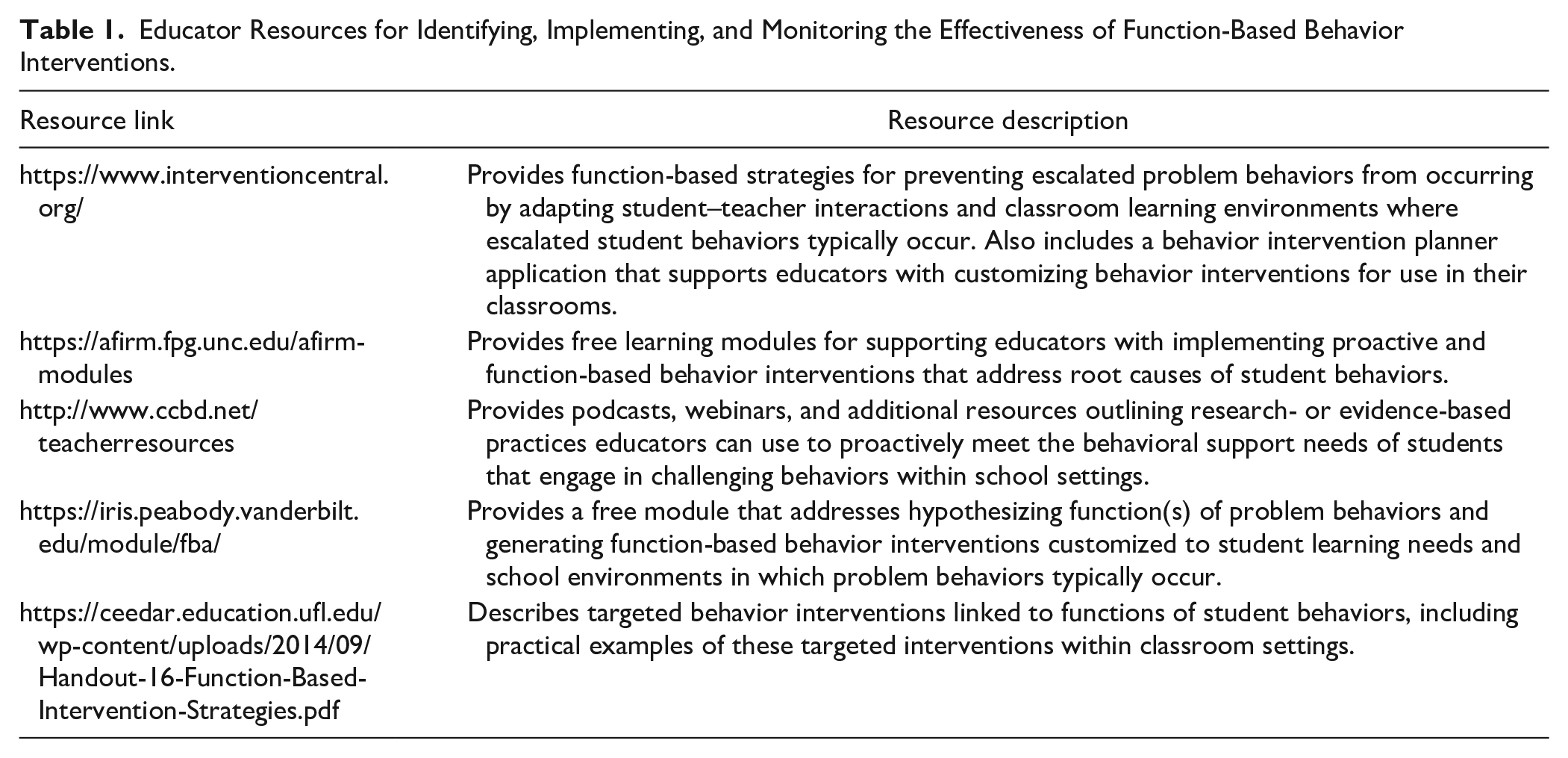
After conducting a FBA and hypothesizing the function(s) maintaining occurrences of escalated problem behaviors, educators can identify and implement function-based behavior interventions designed to prevent problem behavior(s) from escalating or from occurring altogether (Cooper et al., 2020; O’Neill et al., 2014). In an effort to provide our readers with a variety of strategies for preventing escalated student behaviors within their classrooms, Table 1 includes resources for identifying, implementing, and monitoring the effectiveness of function-based interventions. Noncontingent reinforcement (NCR), differential reinforcement of other behavior (DRO), and differential reinforcement of alternative behavior (DRA), three research-based behavior interventions for preventing escalated problem behaviors, are described in detail in the following sections with accompanying tables, tips for implementation, and practice-based examples using hypothetical vignettes involving students who engage in escalated problem behaviors as case studies.
Educator Resources for Identifying, Implementing, and Monitoring the Effectiveness of Function-Based Behavior Interventions.
It is important to note that function-based interventions are an extension of the Positive Behavioral Interventions and Supports framework, a proactive, preventive, and research-based approach to addressing student behaviors utilized in inclusive classrooms across the United States (Walker & Pinkelman, 2018). That means that the individualized, function-based behavior interventions described in the following sections can and should be combined with classwide strategies for promoting student success that involve enriching learning environments through frequent access to reinforcement, as well as promoting student engagement through frequent opportunities for active participation (Colvin & Scott, 2015; Cooper et al., 2020). We direct readers to Simpson et al. (2020) as one outlet for guidance on how to implement these strategies.
Noncontingent Reinforcement
Noncontingent reinforcement (NCR) is the use of positive reinforcement delivered to students independent of their behavior (Cooper et al., 2020). In other words, students do not need to earn reinforcement that is contingent upon engaging in desired behaviors, nor can they lose access to reinforcement contingent upon engaging in undesired behaviors. To maximize the effectiveness of NCR, educators should ensure that (a) the type of reinforcement delivered through NCR is the same as the type of reinforcement the student accesses through engaging in the problem behavior(s) and (b) NCR is delivered on a predetermined schedule to ensure reinforcement is delivered consistently (Cooper et al., 2020).
Fixed interval (FI) and variable interval (VI) schedules of reinforcement, two common schedules of reinforcement used when implementing NCR procedures, involve providing students with reinforcement at the conclusion of predetermined time intervals. While FI reinforcement schedules involve the delivery of reinforcement after a set amount of time, VI reinforcement schedules involve the delivery of reinforcement after different amounts of time revolving around a specific average (Cooper et al., 2020).
For example, a classroom teacher may deliver verbal descriptive praise every 20 min (FI 20-min schedule) for a student whose problem behavior consists of leaving the classroom or school setting without teacher permission to access the teacher’s attention usually around every 30 min (as determined through data collection). The teacher could also use a VI 20-min reinforcement schedule to provide reinforcement through teacher attention initially after 18 min of instruction, next after 22 min of instruction, and again after 20 min of instruction (i.e., reinforcement is delivered approximately every 20 min). Essentially, by providing students with frequent access to the same type of reinforcement they previously accessed by engaging in the problem behavior(s), there is often less of an incentive for the student to exhibit problem behavior(s). Thus, engaging in problem behaviors becomes unnecessary and irrelevant, as student needs are already being met (Cooper et al., 2020).
Educators can proactively address escalated student behaviors by implementing NCR procedures and, consequently, minimize the need for reactive policies such as restraint and exclusionary procedures (Phillips et al., 2017; Richman et al., 2015). Three important characteristics of NCR contribute to the effectiveness of this intervention as a viable preventive measure to exclusionary and restraint procedures within school settings. First, since NCR involves the delivery of reinforcement independent of student behaviors, there is no reinforcement delay associated with the wait for students to engage in desired behaviors (Phillips et al., 2017). This is especially advantageous when supporting students with acquiring new behaviors that can serve as socially acceptable alternatives to problem behaviors for accessing wants and needs within the school setting.
Second, as reinforcement is delivered independent of student behavior, teachers do not have to monitor occurrences of desired behaviors when delivering NCR. It is important to note that, as NCR involves delivering reinforcement that is independent of student behavior, it is possible that reinforcement could be delivered after instances of escalated behaviors and unintentionally increase escalated behaviors in the process. While it is important to monitor student behavior and ensure escalated behaviors do not increase after NCR is implemented, the ability to deliver NCR with minimal interruption to class instruction allows this intervention to be implemented with relative ease by educators with minimal formal backgrounds in applied behavior analysis. Finally, as student displays of escalated behavior decrease over time, delivery of reinforcement through NCR can be decreased (Ritter et al., 2018).
Cindy is a first-grade student who, based on a FBA, engages in problem behaviors in order to access adult attention. For example, when her preferred (favorite) adults in the school setting have not interacted with Cindy in approximately 30 min, Cindy engages in problem behaviors that include biting, spitting at, and pulling the hair of her peers and teachers. She will also run out of her classroom and leave the school property. During previous school years, when Cindy engaged in these behaviors, the classroom teacher would immediately notify both the school behavior specialist and principal. Upon locating Cindy, the school behavior specialist and principal would attempt to verbally redirect Cindy back to her classroom and, if Cindy refused, attempt to verbally redirect Cindy to the principal’s office. If Cindy did not comply, restraint procedures were frequently used to move Cindy to the principal’s office.
Based on data collection, Mr. Walsh observed that Cindy engaged in problem behaviors maintained by access to adult attention approximately every 30 min throughout the school day. In order to render these problem behaviors irrelevant through NCR, Mr. Walsh and the rest of Cindy’s team decided to implement NCR on a VI 20-min schedule. Approximately every 20 min, NCR through task-specific praise from Cindy’s teacher, notes of encouragement from adults who worked with Cindy, radio calls with preferred adults, check-ins from preferred adults, and passes to visit preferred adults were provided to Cindy. Through data collected following the implementation of NCR, Mr. Walsh noted that the frequency of her problem behaviors decreased by 40% within 2 weeks of implementation.
Implementation Tip: Build and Maintain Positive Student–Teacher Relationships
If students have had predominantly negative interactions with their teachers in the past and, as a result, perceive their teachers as aversive, attention from teachers is unlikely to function as reinforcement (Haydon et al., 2020). To build positive relationships with their students, educators must pair themselves with established reinforcers such as safe, predictable, and enriching learning environments, positive student–teacher interactions and successful experiences throughout the school day, and student interests and goals for the future (Colvin & Scott, 2015; Cooper et al., 2020). Put simply, educators can foster positive relationships with their students by building trust and rapport with their students as well as creating and maintaining learning environments that promote student engagement and success. For example, in order to build and maintain positive student–teacher relationships with Cindy, educators who worked with Cindy began each day with positive interactions (e.g., greeting Cindy on the bus ramp or upon entering her classroom), interacted with Cindy during non-instructional times throughout the school day (e.g., in the cafeteria during lunch and on the playground during recess), and ended each day with positive interactions (e.g., thanked Cindy for her attendance and effort throughout the school day, reminded her how much they were looking forward to working with her the following day).
In an effort to support educators with implementing NCR procedures, Table 2 includes a NCR implementation checklist, an application of the NCR implementation checklist used with Cindy, and helpful questions to consider when implementing NCR procedures. The intent of this table is to support educators with customizing, implementing, and evaluating the effectiveness of NCR interventions delivered within their classrooms, with the ultimate goal of enhancing inclusive experiences for students who engage in escalated behaviors within school settings.
Checklist for Implementing Noncontingent Reinforcement (NCR) Within School Settings.
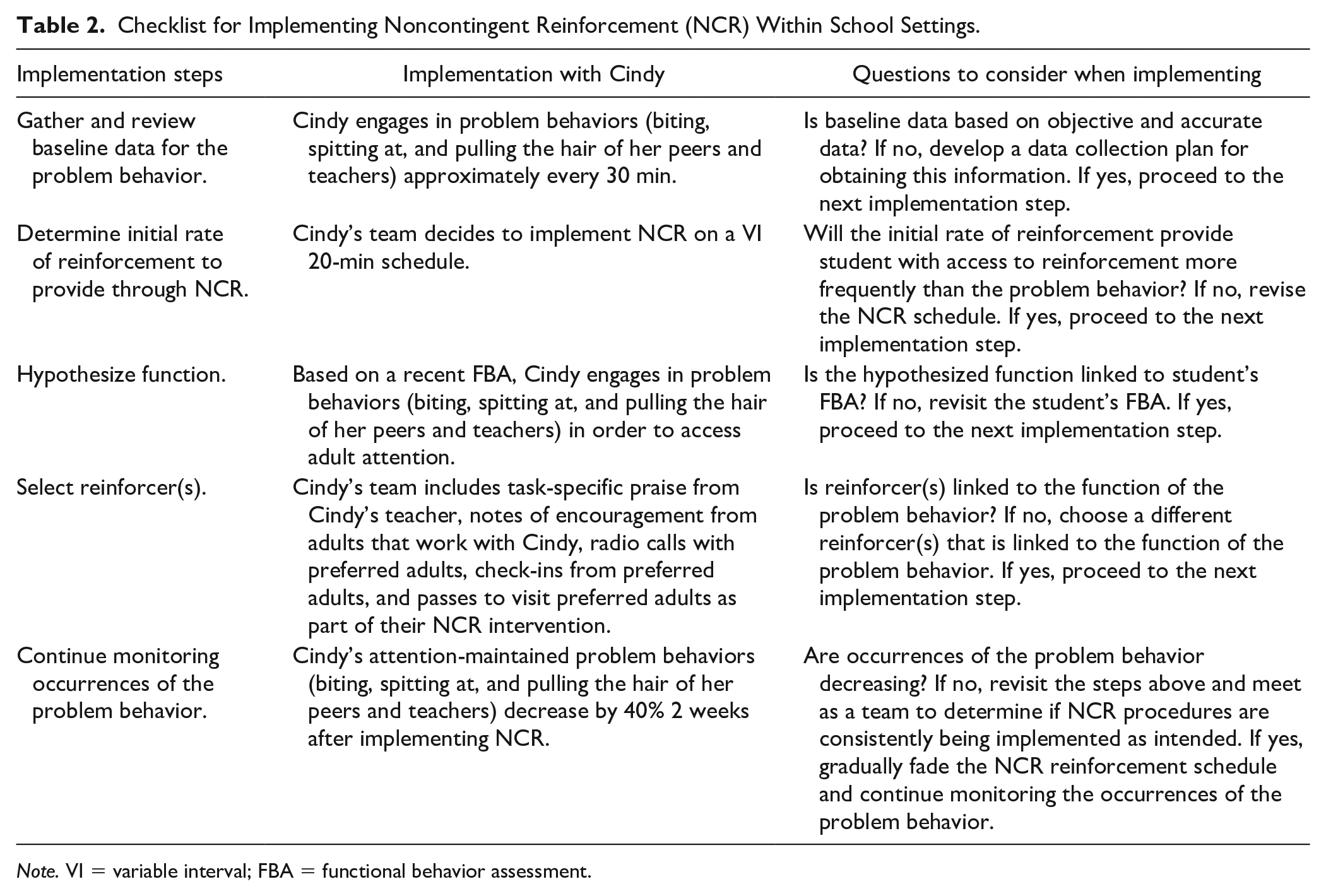
Note. VI = variable interval; FBA = functional behavior assessment.
Differential Reinforcement of Other Behavior
Differential reinforcement is defined as the reinforcement of some behaviors but not others (Cooper et al., 2020). In other words, reinforcement is provided contingent on occurrences of desired behaviors or the absence of problem behaviors and minimized or withheld contingent on occurrences of problem behaviors. Similar to NCR procedures, it is important to ensure the type of reinforcement delivered through differential reinforcement procedures is the same as the type of reinforcement the student accesses through engaging in the problem behavior(s), and that differential reinforcement procedures are implemented using a predetermined schedule of reinforcement based on baseline data related to escalated student behaviors. Providing students with frequent access to reinforcement through the use of differential reinforcement procedures can render engaging in problem behaviors irrelevant as students are already accessing reinforcement consistently. Frequent access to differential reinforcement can also make problem behavior inefficient for students because refraining from engaging in problem behaviors takes less effort than engaging in problem behaviors (Cooper et al., 2020; Jessel & Ingvarsson, 2016).
Fixed-interval differential reinforcement of other behavior (FI-DRO), a type of differential reinforcement, involves establishing time intervals for data collection purposes, providing reinforcement contingent on the absence of the problem behavior during a time interval, and withholding reinforcement contingent on the occurrence of the problem behavior during a time interval (Cooper et al., 2020). If problem behaviors do occur during a time interval, the time interval is discontinued, and a new time interval begins. It is important to note that, in order to increase the probability that students frequently access reinforcement through FI-DRO procedures, time intervals should initially be determined based on data collection related to the escalated behavior. For example, for a student who engages in physical aggression approximately every 30 min, time intervals included in a FI-DRO procedure may begin at approximately every 20 min. Then, as occurrences of physical aggression decrease, the length of intervals can be gradually increased.
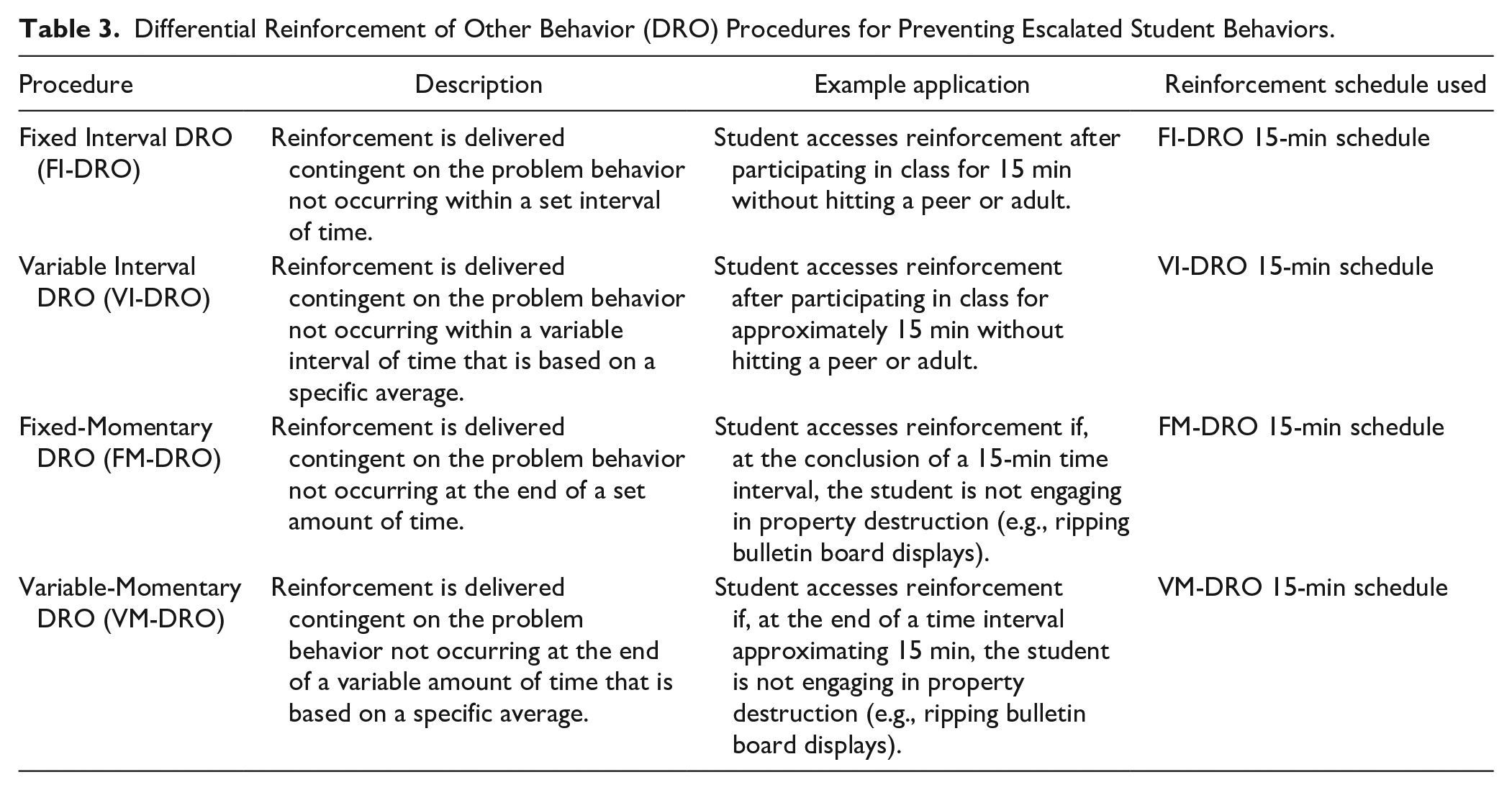
There are several DRO procedures for preventing escalated student behaviors available to educators. In an effort to support educators with identifying and implementing DRO procedures for use in their classrooms, Table 3 provides brief overviews and practical examples of these DRO procedures applied to preventing escalated student behaviors within school settings.
Differential Reinforcement of Other Behavior (DRO) Procedures for Preventing Escalated Student Behaviors.
Instead of following her second-grade classroom schedule, Wendy frequently wanders around the classroom engaging in preferred tasks and activities. Specifically, tangibles Wendy frequently accesses include books, dolls, center items in her classroom, and items off of her teacher’s desk such as figurines and stuffed animals. When tangibles listed above are taken away, Wendy engages in physically aggressive behaviors toward adults (primarily her classroom teacher) such as biting, scratching, hitting with a closed fist, kicking, and spitting. A recent FBA has determined that Wendy engages in the behaviors listed above to access tangibles.
During past school years, when Wendy engaged in physical aggression, the teacher working with Wendy would immediately notify both the school behavior specialist and principal. After arriving in Wendy’s classroom, the school behavior specialist and principal would interlock arms with Wendy and walk with her to the principal’s office (i.e., implement a restraint procedure). If Wendy continued to engage in physical aggression in the principal’s office, Wendy’s parents were typically notified, and Wendy was sent home for the remainder of the school day.
Based on data collection, Mr. Walsh observed that Wendy engaged in physical aggression toward adults approximately every 15 min throughout the school day. In order to provide Wendy with frequent access to reinforcement without engaging in problem behaviors, Mr. Walsh and the rest of Wendy’s team decided to implement a FI-DRO procedure beginning with 10-min time intervals. At the conclusion of a 10-min interval during which zero occurrences of physical aggression occur, Wendy is permitted to choose from a wide array of preferred items and activities (e.g., books, dolls, figurines, stuffed animals) and play with one of these tangibles for 3 min. If Wendy does engage in physical aggression toward adults during a time interval, the time interval is discontinued and, when Wendy is no longer engaging in physical aggression, a new time interval begins.
In order to minimize and eliminate access to reinforcement contingent on problem behaviors, Wendy’s teacher removes the figurines and stuffed animals from her desk and locks them in a cabinet in her classroom. She also stores preferred items and activities Wendy previously accessed through problem behaviors (e.g., books, dolls, center items in her classroom) in a locked file cabinet until these materials are available for student use during free time and center activities.
Implementation Tip: Identify and Respond to Precursor Behaviors
Precursor behaviors refer to mild problem behaviors that typically precede more escalated problem behaviors and can be identified through conversations with students’ family members and educators, as well as by directly observing students in settings where escalated behaviors typically occur (Heath & Smith, 2019; Najdowski et al., 2008). For example, a student who engages in physical aggression toward educators in order to avoid or escape independent seatwork may first refuse to complete their seatwork, request to leave class (e.g., request to use the restroom, visit the school nurse), or use profanity if not permitted to do so. Students often engage in different problem behaviors for the same reason and, by responding to mild problem behaviors, we can more safely, more efficiently, and less restrictively address student problem behaviors they escalate in intensity. Specifically, as precursor and escalated problem behaviors can be maintained by the same function, identifying precursor behaviors allows educators to better understand root causes of problem behaviors, respond to problem behaviors before problem behaviors escalate in nature, and minimize disruptions to student learning within inclusive school settings (Hoffmann et al., 2018).
Scaffolding instruction, incorporating choice-making opportunities into daily instruction (e.g., allowing students to choose what reinforcer they can earn contingent on completing classroom assignments), and reminding students of reinforcement contingencies available in the classroom (e.g., DRO procedures) are all potential strategies for responding to precursor behaviors displayed by students such as Wendy who engage in escalated problem behaviors maintained by avoidance/escape of non-preferred tasks and activities (Colvin & Scott, 2015; Cooper et al., 2020). For example, when Wendy’s teacher observes Wendy engaging in relatively minor problem behaviors that typically precede occurrences of physical aggression (e.g., requests to leave assigned area, complaints about schoolwork), Wendy’s teacher prompts Wendy to view the timer on her desk and reminds her that she will have her choice of preferred items and activities as soon as the timer beeps (contingent on physical aggression not occurring). She also checks in frequently with Wendy to ensure Wendy understands assignment expectations and provides instructional scaffolding and supports as needed to ensure Wendy is successful with class assignments.
Differential Reinforcement of Alternative Behavior
Differential reinforcement of alternative behavior involves teaching and reinforcing socially acceptable alternatives to problem behaviors. The rationale behind DRA is that by teaching and reinforcing alternative strategies students can use to access wants and needs within the school setting, educators can facilitate meaningful behavior change among their students by simultaneously reinforcing desired behaviors and withholding reinforcement contingent on occurrences of problem behaviors (Cooper et al., 2020).
There are three essential components of alternative behaviors taught and reinforced as parts of a DRA intervention. First, alternative behaviors need to be function-based. That is, in order to incentivize engaging in the alternative behavior as opposed to the problem behavior, engaging in the alternative behavior must allow the student to consistently and immediately access or avoid the same stimuli as engaging in the problem behavior. Second, the alternative behavior should be a step toward the long-term behavior goal within a particular context or situation, such as verbally requesting to leave the classroom instead of leaving the classroom without permission, or taking a brief activity break after completing independent seatwork instead of engaging in property destruction to avoid independent seatwork. This is crucial to encourage the acquisition and development of socially acceptable behaviors, in addition to discouraging occurrences of problem behaviors through DRA interventions (Cooper et al., 2020). Third, the alternative behavior must be perceived as socially acceptable among educators. If the alternative behavior is not perceived as socially acceptable, educators are less likely to consistently reinforce occurrences of the alternative behavior.
Differential reinforcement of alternative behavior interventions have been used to address escalated student behaviors, such as physical aggression, property destruction, and leaving assigned areas without permission (Athens & Vollmer, 2010; Boyle & Adamson, 2017), and are essentially “win-win scenarios” for students and educators. By engaging in socially acceptable behaviors, students are able to access the same type of reinforcement that previously maintained occurrences of problem behaviors. During this process, educators are able to maintain instructional control of their classrooms because reinforcement is contingent on the occurrence of behaviors they perceive to be desirable and minimized or withheld contingent on the occurrence of problem behaviors.
Marcus is a fifth-grade student who, based on a recent FBA, engages in escalated behaviors in order to avoid/escape non-preferred tasks and activities. For example, when Marcus is asked to engage in independent seat work during math class, Marcus engages in property destruction (e.g., throws computers and keyboards on the floor, flips over chairs and tables, rips down classroom bulletin boards). During past school years, when Marcus engaged in these escalated behaviors, the classroom teacher would immediately notify both the school behavior specialist and principal. Upon entering Marcus’ classroom, the school behavior specialist and principal would verbally prompt Marcus to stop engaging in property destruction. If Marcus did not comply (which was typically the case), the school behavior specialist and principal would implement a restraint procedure by interlocking arms with Marcus and escorting him to the principal’s office. If Marcus continued to engage in property destruction in the principal’s office, Marcus’ parents were typically notified, and Marcus was sent home for the remainder of the school day.
In an effort to support educators with teaching and reinforcing alternative behaviors, we have included a competing behavior pathway model for Marcus (see Figure 1). The competing behavior pathway model includes the current reinforcement contingency maintaining occurrences of escalated behaviors. Specifically, members of a student’s Individualized Education Program (IEP) team (e.g., family members, educators) collaborate and identify setting events (i.e., slow triggers that typically occur before, but not immediately before, problem behaviors such as an argument at home with a parent or missed medication), antecedents (i.e., fast triggers that immediately precede problem behaviors such as transitioning from a preferred to non-preferred activity or the presentation of an academic task demand), and the maintaining consequence (i.e., what the student typically accesses or avoids by engaging in an escalated problem behavior) associated with escalated student behaviors (O’Neill et al., 2014).
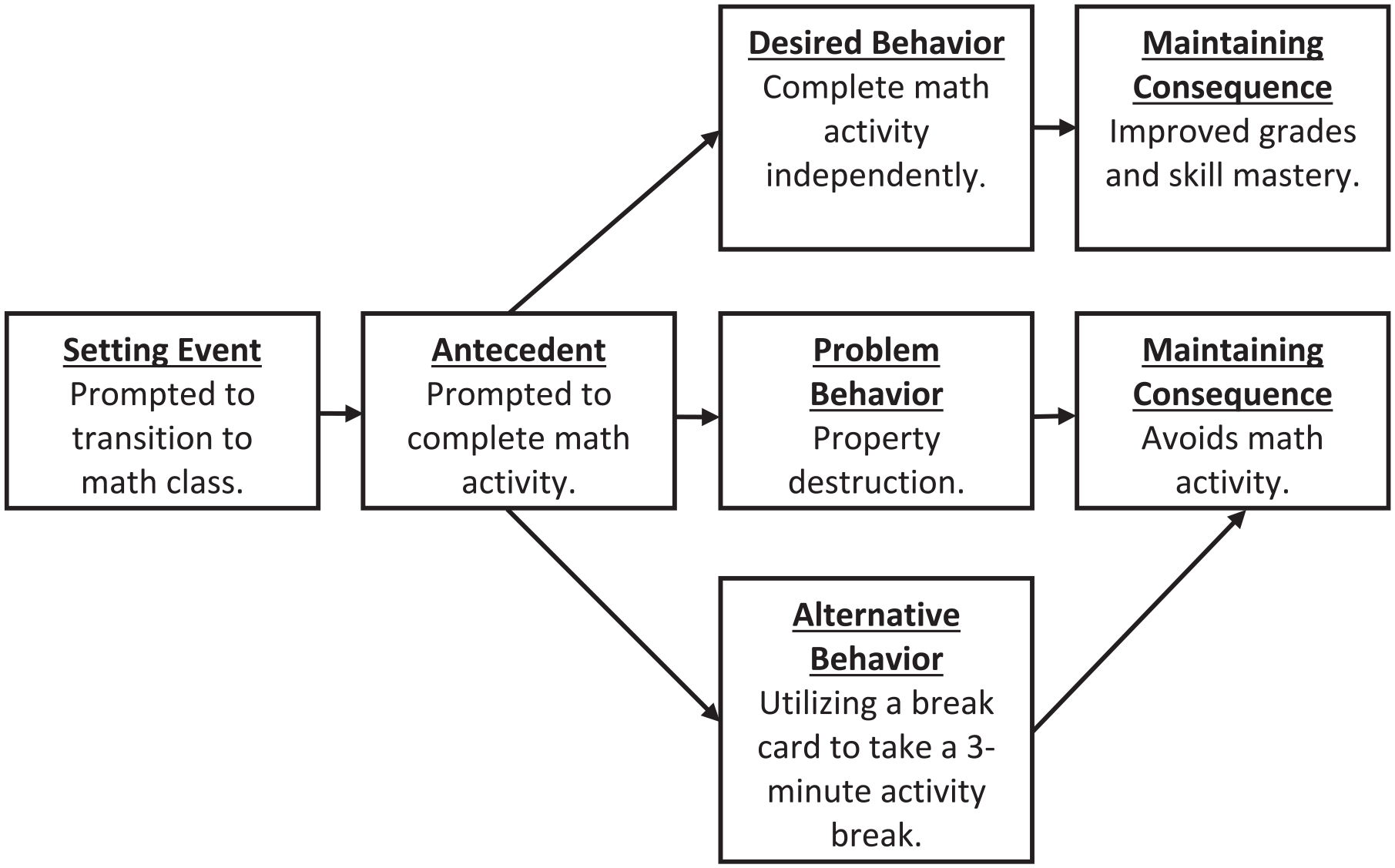
The competing behavior pathway model used to address Marcus’ property destruction behaviors.
After completing this targeted analysis, the team also identifies the desired behavior presented as a long-term behavior goal, accompanied by the predicted maintaining consequence of the desired behavior and, thereby, generating the rationale for working toward the desired behavior. For example, because Marcus typically avoids or altogether escapes independent seatwork by engaging in property destruction, the newly developed long-term behavior goal for Marcus includes completing seatwork independently. The consequences associated with this behavior are likely to include improved grades and progress toward IEP goals and other indicators of academic achievement. Finally, because the desired behavior is not being exhibited by the student, the team identifies an alternative behavior that addresses both the function of the problem behavior and is a step toward achieving this desired behavior. For example, Marcus can utilize a break card to receive a brief activity break.
Implementation Tip: Present Alternative Behaviors as Steps Toward Long-Term Behavior Goals
It is possible that educators and students’ family members may feel uncomfortable reinforcing alternative behaviors, believing that alternative behaviors involve lowering expectations for students that engage in escalated behaviors. Consequently, it is important to communicate to educators and students’ family members that, except in cases when the alternative and desired behaviors are identical (e.g., hand-raising to access adult attention), reinforcing occurrences of the alternative behavior is only temporary (O’Neill et al., 2014). In other words, as occurrences of problem behaviors decrease and occurrences of the alternative behavior increase, the team can gradually begin teaching and reinforcing behaviors that more closely resemble the desired behavior.
Figure 2 outlines the process used by Mr. Walsh and the rest of Marcus’ team to decrease his property destruction behaviors. This resource is intended to support educators with facilitating student progress from engaging in the alternative behavior to engaging in the desired behavior, as well as communicating this progress to students’ educators and family members. As occurrences of property destruction decrease, Marcus’ educators will gradually fade the provision of brief breaks from independent seatwork (from the opportunity to present three break cards per class to the opportunity to request teacher or peer support with one problem on an independent seatwork math activity). Unlike the lengthy periods of independent seatwork Marcus previously avoided by engaging in property destruction behaviors, these brief breaks from independent seatwork are increasing the amount of independent seat work Marcus completes during math class. As Marcus more consistently accesses the same types of naturally occurring reinforcement that maintain the task completion of his peers (e.g., improved grades, skill mastery), the need for contrived reinforcers (e.g., break cards) can be reduced gradually as natural forms of reinforcement maintain and increase rates of desired behaviors.
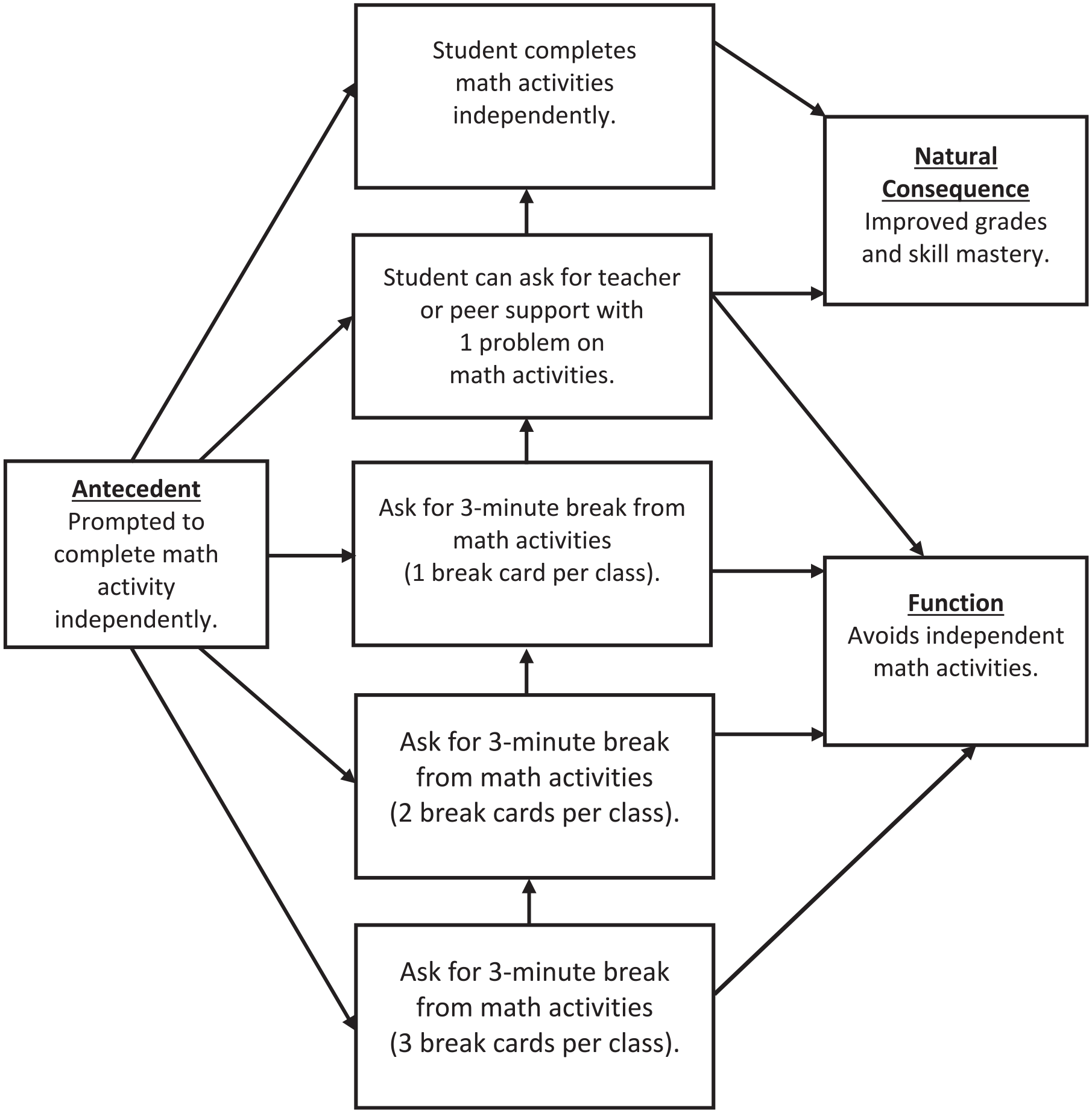
Marcus’ plan for progressing from the alternative behavior to the desired behavior.
Conclusion
Reactive policies, such as exclusionary and restraint procedures, are often implemented in response to escalated student behaviors within inclusive school settings. Exclusionary and restraint procedures insufficiently address root causes of problem behaviors and, as such, insufficiently support students who engage in escalated behaviors. As an alternative, we have discussed the importance of hypothesizing functions of escalated student behaviors and providing students with frequent access to reinforcement throughout the school day to discourage problem behaviors from occurring or escalating in nature. We have also emphasized the importance of teaching and reinforcing socially acceptable alternative behaviors as determined by family members, educators, and society in general that meet the same function(s) of problem behavior for students in an effort to facilitate long-term behavioral growth among students who engage in escalated behaviors. We hope readers find this helpful to their practice so that all students, regardless of the behavioral supports needed, can experience meaningful access to and educational opportunities within inclusive school settings.
Footnotes
Declaration of Conflicting Interests
The author(s) declared no potential conflicts of interest with respect to the research, authorship, and/or publication of this article.
Funding
The author(s) received no financial support for the research, authorship, and/or publication of this article.
