




Abstract
Most students with emotional and behavioral disorders (EBD) have challenging classroom behaviors and poor postschool outcomes. Self-determination promotes positive classroom behavior and successful postschool outcomes. By incorporating choice-making, an element of self-determination, teachers across grade levels can address behavioral issues and promote positive postschool outcomes for students with EBD. This article provides guidance on how to incorporate choice-making for students with EBD.
Ms. Hernandez, an English language arts teacher at Hamilton Middle School, experiences daily challenging behavior from Noah, a student in sixth grade with an emotional and behavioral disorder. Ms. Hernandez feels frustrated because Noah frequently gets up out of his seat without permission and walks around or leaves the classroom. In addition, Noah struggles with passing grades in the class. Ms. Hernandez wants to identify strategies that will help Noah stay in his seat more often and improve his grades.
It is common for students with emotional and behavioral disorders (EBD) to have challenging classroom behaviors (Lipscomb et al., 2017) and poor postschool outcomes (Wagner & Newman, 2012). Teachers often find students with EBD disengaged from classroom instruction and demonstrating inappropriate and challenging behavior. Furthermore, only 40% of students with EBD graduate from high school (Newman et al., 2011). Adult life for students with EBD often results in unstable employment. That is, 50% of students with EBD are terminated from a job at least once within 2 years of high school (Wagner et al., 2005). In addition, 75% are involved with the criminal justice system as an adult (Wagner & Newman, 2012).
Self-determination is the ability to self-regulate behavior, act autonomously, have psychological empowerment (e.g., motivation or self-efficacy), and have self-realization (Wehmeyer et al., 1997). For example, Madison, a third-grade student with high self-determination, eats one piece of candy in one sitting, styles her own hair before school each morning, asks questions to understand the math problem that she got wrong, and is proud of the good grade she received on the art project.
High self-determination is an established predictor of school and postschool success for students with disabilities (Carter et al., 2010). Choice-making, one of the teaching components of self-determination, has shown improvement in challenging classroom and academic behaviors for students with EBD (Jolivette et al., 2001). Kelly and Shogren (2014) found that teaching self-determination to students with EBD increased on-task classroom behaviors such as paying attention to the speaker, remaining in their seat, and following directions and decreased off-task classroom behaviors including sleeping, texting, and talking out of turn to other students. Students with high self-determination are more likely to have sustained employment, attend postsecondary education, and live independently in their postschool, adult life (e.g., Carter et al., 2011).
Choice-Making
Choice-making is a teaching component of self-determination and an evidence-based intervention that positively impacts postschool outcomes for students with EBD by improving classroom behavior (e.g., Royer et al., 2017). Providing choices is a feasible intervention to increase student engagement and reduce problem behavior (Lane et al., 2018). Choice-making occurs when the student is provided with multiple options for completing an assignment. Implementing choice-making requires no cost and can be accomplished in a few steps. For example, through choice-making, a student selects which method they prefer to demonstrate their knowledge such as writing an essay, producing a comic strip, or making an oral presentation. Students can also be given the opportunity to select the order in which a series of tasks is completed. With choice-making instruction, students learn skills and attitudes that enable responsibility for their choices and, ultimately, their lives.
Both teachers and students have positively rated choice-making opportunities. Teachers can implement choice-making with high levels of fidelity while teaching in a general education class (Ennis et al., 2020). Furthermore, teachers find choice-making to be useful and are willing to incorporate choice-making into future lessons (Jolivette et al., 2001) with other students (Ennis et al., 2020). Students report enjoying making a choice and prefer having a choice to not having one (Ennis et al., 2017).
As an element of self-determination, choice-making contributes to positive postschool outcomes such as employment, postsecondary education, and independent living (Carter et al., 2011). The ability to make choices (without influence from others) that align with one’s values, beliefs, and needs is a feature of adulthood.
As demonstrated by multiple studies conducted within public primary and secondary schools, improvements in challenging and academic behavior (e.g., increased on-task behavior and increased task completion) are seen quickly among students with and at risk of EBD when choice-making is incorporated into teacher lessons (e.g. Royer et al., 2017). Jolivette et al. (2001) provided three math worksheets to three first- and second-grade, 7-year-old students with EBD. Within a self-contained classroom, each student was provided the option to choose the order in which they completed the three math worksheets. Two of the students increased desired academic and social behaviors.
Dunlap et al. (1994) allowed two fifth-grade, 11-year-old students with EBD to choose their assignment from a menu of English language arts (ELA) activities. When provided the menu of choices in a self-contained classroom, the students both had an increase of task completion and engagement, with lower occurrences of disruptive behavior. Daly et al. (2006) allowed two seventh-grade, 13-year-old students with EBD to choose their reward during ELA. When provided these choices, the number of correct words read increased and the number of reading errors decreased. Choice-making might provide the predictability and sense of control that students need to increase academic and behavioral success (Jolivette et al., 2001).
To support positive postschool outcomes for students with EBD, choice-making can be implemented by teachers across grade levels (elementary school, middle/intermediate school, and high school) to increase success with academic related tasks and social behavior. When choice-making opportunities are used as an intervention across ages, grade levels, and subject areas, students demonstrate an increase in positive behaviors and decrease in inappropriate behaviors (Jolivette et al., 2020). An elementary teacher might allow a student with EBD to choose the order of stations to attend (e.g., music center, science center, and book center) while a high-school teacher might allow a student with EBD different forms of presentation options (e.g., written, electronic, poster).
Choices can be implemented across- and within-activities. Across-activity choices involve giving students a choice of what activities they would like to do (e.g., write a report or record a speech), what order they would like to do them, or what future activity they would like to do once they finish a required task. Within-activity choices involve giving students a choice of materials, location, or partner for a specified activity (Ennis et al., 2017). Research suggests that results may be more positive when across-activity choices activities are given versus within-activity choices (Ennis et al., 2017). Examples of across-activity choices are used in the following steps and scenarios.
How to Implement Choice-Making in the Classroom
While attending a professional development on how to promote self-determination, Ms. Hernandez learns that implementing the evidenced-based practice of choice-making has been shown to decrease challenging behaviors and increase desired academic outcomes for students with EBD. After the training, Ms. Hernandez develops a plan to incorporate choice-making into lesson planning for all students in her class while specifically looking at how often Noah is out of his seat.
The following steps, adapted from Jolivette et al. (2001) and Hirsch et al. (2018), outline how to incorporate choice-making into a lesson. Jolivette et al. (2001) implemented these choice-making steps within a research study with three students with EBD and found a positive impact on academic and social behaviors. Hirsch et al. (2018) outlined how to expand steps of choice-making to fit within a lesson cycle.
Before Instruction
Step 1: Determine the lesson content and objectives to be taught
This can be an academic content area (e.g., math or reading) or a behavior lesson (e.g., keeping hands to yourself or waiting your turn to speak). Ms. Hernandez chooses an existing lesson about comprehension of nonfiction literacy, in which the students provide evidence from text to support their understanding of the material.
Step 2: Create two or more assignment options
Each option should provide the same level of difficulty and time investment. One option can relate to demonstration of mastery/product such as choosing from oral presentations, visual representations, or written essays as their end products. Another option can relate to the order of completion (e.g., students choosing to do even number essay questions first, then the odd number questions). Assignments can be broken into smaller, separate assignments, with students allowed to choose which assignment they will complete first. For example, if the original assignment includes 15 math questions, those questions can be split into three smaller assignments of five questions each. Then the students can choose the order in which they want to complete the three assignments.
Ms. Hernandez adapts the current assignment of a 12-question, open-ended response activity. Each of the 12 questions was examined for level of complexity and divided evenly across the three assignments, keeping the level of complexity consistent. This resulted in three assignments with four questions of equivalent complexity in each.
Step 3: Incorporate accommodations and modifications
Incorporate individualized supports, as outlined in a student’s Section 504 Plan or Individualized Education Program. For students who may feel overwhelmed when provided choices, it may be best to provide limited choices initially and build to more complex choices (Lane et al., 2018). For example, “You will do this set of questions last. You may choose one of these two sets of questions to start with.”
Ms. Hernandez determines that the instructional accommodations and modifications remained the same as the original assignment and these were provided across the three assignments.
Step 4: Select and define the challenging or academic behavior
Determine a behavior that interferes with learning and describe the behavior using observable and measurable terms. It could be a challenging behavior (e.g., Braxton interrupts the teacher when his is talking to the whole class) or an academic behavior that needs improvement (e.g., Kenna completes half of weekly quiz questions).
Noah’s challenging behavior is leaving his assigned area without permission to walk around or leave the classroom. This occurs three times during the two-hour ELA class.
Step 5: Select a progress monitoring system
Select or develop a system to record the challenging or academic behavior before and after instruction. Figure 1 provides an example data collection sheet allowing for preintervention and postintervention data gathering.
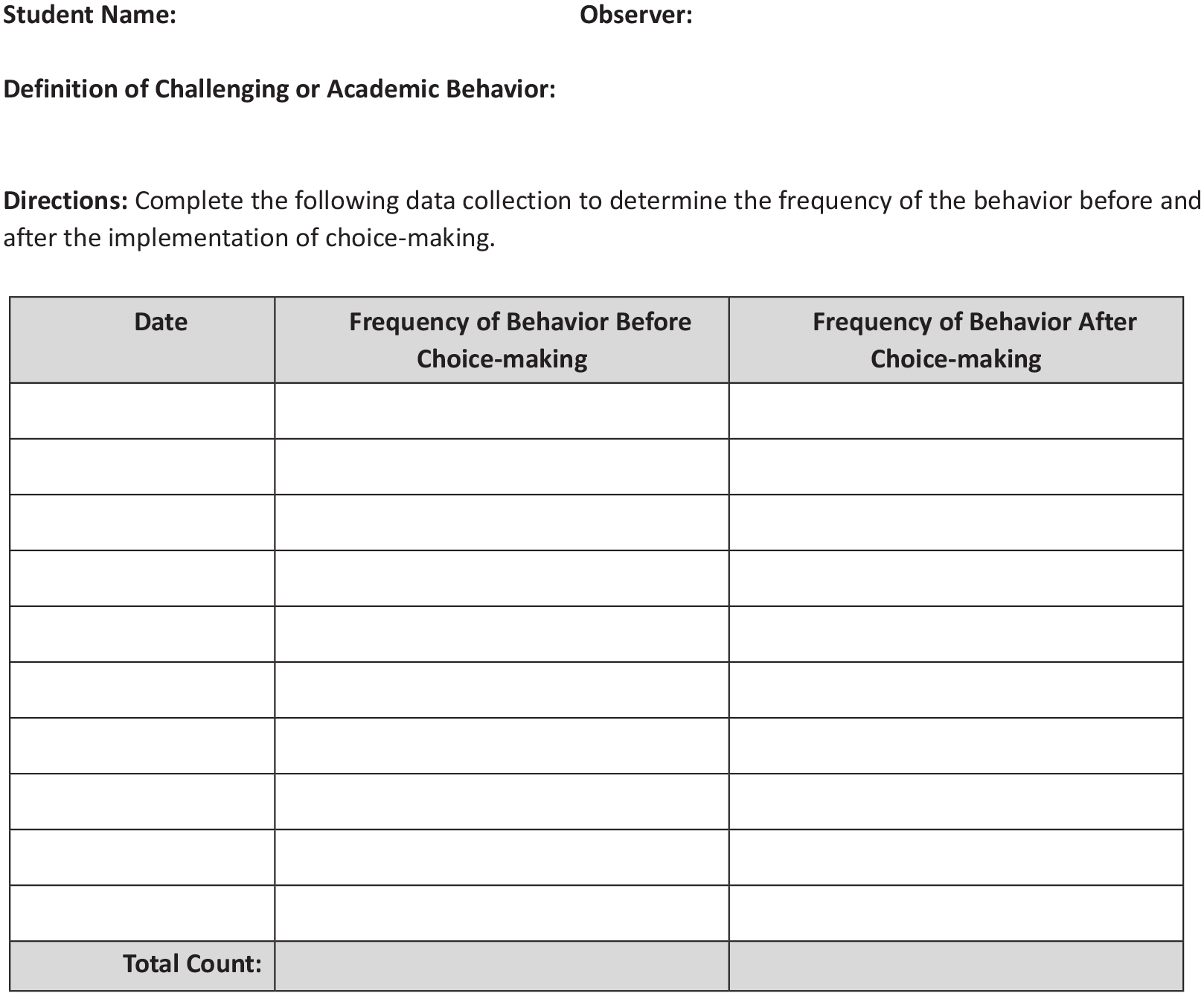
Data Collection: Frequency of Behavior Before and After Choice-Making.
Ms. Hernandez selects “Data Collection: Frequency of Behavior Before and After Choice-Making” (see Figure 1) to track the number of times Noah leaves his assigned area without permission.
Step 6: Observe and collect data
Use the selected progress-monitoring system to document observations of the challenging or academic behavior. This will lead to determining the frequency, duration, or intensity of the behavior (e.g., Braxton interrupts his teacher an average of nine times each day; Kenna completes an average of 37% of weekly quiz questions).
Ms. Hernandez begins observing Noah’s behavior more closely and each time Noah leaves his seat she marks a tally under the “Frequency of Behavior Before Choice-Making” column. After 3 days of collecting these data, Ms. Hernandez determines Noah was out of his seat a total of 11 times.
Step 7: Select a choice-making fidelity checklist
Implementing fidelity refers to accurately following the planned steps. There are several ways to ensure high fidelity during a lesson with choice-making. The first step is to develop a choice-making fidelity checklist that reflects each of the steps needed to implement choice-making (see Figure 2). The checklist can be completed by (a) the teacher as a self-report after the lesson, (b) the teacher while watching a recording of the lesson, or (c) another teacher or staff member while observing the lesson.
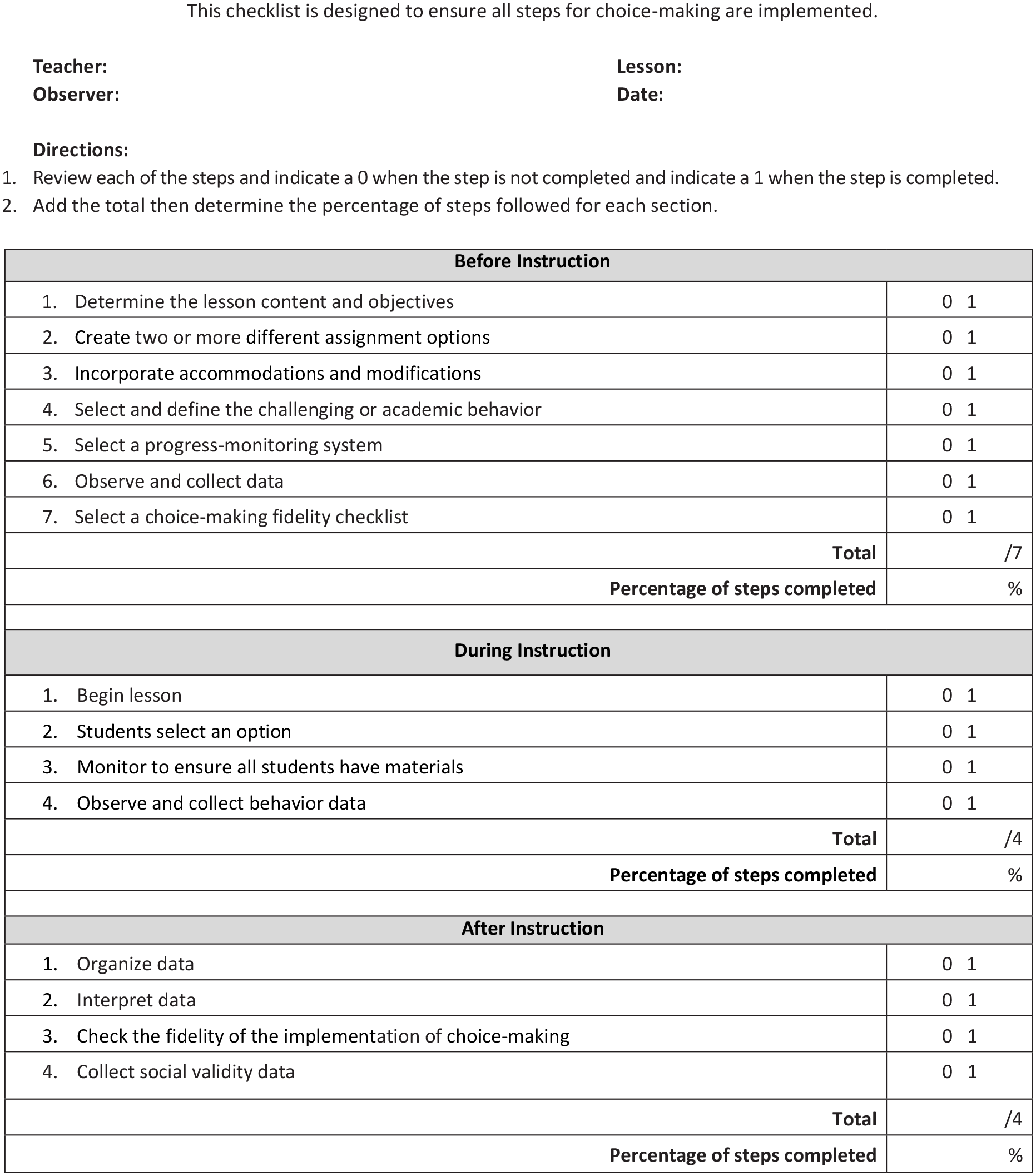
Choice-Making Fidelity of Implementation Checklist.
Ms. Hernandez uses the “Choice-Making Fidelity of Implementation Checklist” (see Figure 2) to indicate what steps were followed when the choice-making intervention was implemented. Another teacher observed the lesson and completed the checklist.
During Instruction
Step 1: Begin lesson
During the lesson, offer the assignment options or the order of completion option to the whole class. Offering to the whole class provides an inclusive, non-isolating climate, which contributes to building self-determination for all students in the class.
Ms. Hernandez reads the directions for three assignments and lets them know that they are responsible for completing all three. She allows each student to choose the order of completion.
Step 2: Students select an option
Students select the assignment option or order of completion of their choice. It may be beneficial to remind the students that making choices gives them control over events in their day and can positively shape their school experience (Lane et al., 2018). Provide wait time (approximately 10 s) for each student to select and begin the assignment. For example, Braxton looked at both assignments and pointed to assignment 1. Then the teacher handed him assignment 1. If a student does not select an option, prompt the student to choose. For example, approximately 10 s passed, and Braxton had not decided on an assignment. While pointing to assignment 1, the teacher provides a summary of the directions. Then the teacher points to assignment 2 and provides a summary of the directions. Next, the teacher asks Braxton to decide between the two assignments.
Each student in Ms. Hernandez’s class selects the assignment they were going to complete first and then begins. Noah did not make an initial choice and did not begin the assignment. Ms. Hernandez reviews the choices with Noah and provides approximately 10 s for Noah to select his initial assignment. Ms. Hernandez gives Noah a verbal reminder to choose. Then Noah selects an assignment.
Step 3: Monitor
Monitor students to ensure they have the necessary materials (e.g., pen, pencil, scissors, calculator, etc.) to complete their choice.
Ms. Hernandez makes sure Noah and the rest of the class have access to the necessary materials, which includes a copy of the nonfiction literacy piece, a writing utensil, and the assignment of their choice.
Step 4: Observe and collect data
Use the selected progress- monitoring system to document the frequency, duration, or intensity of the challenging or academic behavior.
Ms. Hernandez continues to use the “Data Collection: Frequency of Behavior Before and After Choice-Making” form to track the number of times Noah leaves his seat and assigned area. Each time Noah leaves his seat Ms. Hernandez marks a tally under the “Frequency of Behavior After Choice-Making” column.
After Instruction
Step 1: Organize data
Refer to the progress-monitoring system to measure the frequency, duration, or intensity of the challenging or academic behavior. You may find it easier to read and interpret student progress if the data are converted to graph format. This can be achieved by using software programs such as Microsoft Excel.
At the end of the lesson, Ms. Hernandez refers to the “Progress Monitoring: Frequency of Behavior with and Without Choice-Making” chart to calculate how often Noah left his seat and assigned area.
Step 2: Interpret data
Use the progress-monitoring system to evaluate the effectiveness of choice-making. Determine the frequency, duration, or intensity of the challenging behavior exhibited and if the behavior increased, decreased, or stayed the same. For example, during a lesson that included a choice-making assignment, Braxton’s interruptions decreased to an average of three times per day, and Kenna’s weekly quiz question completion increased to an average of 82%.
After examining the data, Ms. Hernandez discovers that before choice-making was introduced, Noah left his seat and assigned area a total of 11 times in 3 days. In addition, data show Noah’s behavior improved after choice-making was introduced, with Noah leaving their seat a total of five times in 3 days. Ms. Hernandez then looks at the data even closer. Before choice-making Noah was out of his seat an average of more than three times each class period, while after choice-making was introduced, Noah was out of his seat an average of less than twice each class period.
Step 3: Check the fidelity of the implementation
Review the fidelity of the implementation checklist to determine if all the steps were accurately followed. If a step was not accurately followed, identify the barrier and solution for this step.
Ms. Hernandez reviews the fidelity checklist and is pleased to learn the other teacher observed all steps as completed.
Step 4: Collect social validity data
Social validity refers to obtaining the student and teacher opinion about choice-making. For example, student social validity can be collected by asking the student with EBD if they would like choices for the next assignments. In addition, teacher social validity can be collected through reflection on the feasibility of implementing choice-making.
Ms. Hernandez asks all the students in Noah’s class their opinion on having choices for the assignment. The students indicated they liked having options and want more options for assignments in the future.
Locate Support to Implement Choice-Making
We encourage teachers to seek support from other school personnel such as fellow teachers, behavioral specialists, transition specialists, and school psychologists in implementing choice-making. These professionals can provide consultation and assistance to teachers who are interested in implementing choice-making. For example, teachers may share a predetermined menu of choices that can be easily and quickly provided across and within activities (Lane et al., 2018). Other examples of support include a behavioral specialist assisting a teacher in defining the challenging behavior, creating a progress-monitoring system, and interpreting the collected data and a transition specialist assisting a teacher and students in learning more about how choice-making can promote self-determination and positive postschool outcomes.
Conclusion
Choice-making provides opportunities for students with EBD to reduce challenging behavior and increase desired academic behaviors (Royer et al., 2017). This contributes to building self-determination for students with EBD. It might lead to improved school and postschool outcomes. In this article, we presented a choice-making strategy designed to reduce challenging classroom behavior and increase appropriate academic response. Teachers can build choice-making in the development of new lesson plans or embed it into existing lesson plans. Choice-making is well suited for use across settings and grade levels. Monitoring the fidelity of implementation and behavioral progress provides opportunities to support the impact of choice-making on challenging classroom and academic behavior. For more information regarding self-determination (including choice-making) for students with disabilities, visit The National Technical Assistance Center on Transition: The Collaborative https://transitionta.org/topics/secondary-education/self-determination/ and The IRIS Center https://iris.peabody.vanderbilt.edu/wp-content/uploads/misc_media/fss/pdfs/2018/fss_choice_making.pdf.
Ms. Hernandez identifies a challenging behavior and integrates choice-making into an existing ELA lesson. To determine the extent to which the choice-making strategy decreased challenging behavior, student progress was monitored as well as fidelity of implementation. Ms. Hernandez is pleased with the success of incorporating choice-making into the lesson about comprehension of nonfiction literacy and incorporates choice-making into other lessons. In addition, Ms. Hernandez monitors other challenging and academic behaviors, including Noah’s grades and the behaviors of other students. After six weeks of implementing choice-making into additional lessons, Ms. Hernandez’s data collection reveals Noah staying in their assigned seat more often, his class grade has improved, and his classmates are completing more assignments as well.
Footnotes
Declaration of Conflicting Interests
The author(s) declared no potential conflicts of interest with respect to the research, authorship, and/or publication of this article.
Funding
The author(s) received no financial support for the research, authorship, and/or publication of this article.
