



Abstract
A between-subjects experiment (N = 531) studied the juxtaposition of programming from the Discovery Channel’s Shark Week with shark conservation public service announcements (PSAs). Cultivation and priming theories provided a conceptual framework for testing how shark-on-human violence paired with different types of PSAs (celebrity endorser present or not) influence audiences’ emotional reactions, threat perceptions, willingness to support conservation, and intentions to seek information. Findings reveal that shark-on-human violence and presence of a PSA influence fear reactions and perceived threat of shark attacks. Findings related to conservation support, information seeking, and the role of previous Shark Week viewing and demographics are also discussed.
Keywords
The Discovery Channel’s Shark Week is one of summer’s perennial television favorites. Every August, millions of Americans tune in to watch hours of programming dedicated to the ocean’s greatest predator. Shark Week presents a compelling mix of educational content about sharks with thrilling stories of shark attack victims and survivors. This combination of documentary and entertainment is increasingly popular, especially on cable television (Metz, 2008. In 2013, Shark Week broke its own viewership records since it premiered in 1987: 2.12 million people watched primetime Shark Week programming and nearly 29 million viewers tuned in overall (De Moraes, 2013). Its 2013 kickoff program, a 2-hour primetime show dedicated to the extinct Megalodon shark, inspired more social media chatter than any other show on broadcast or cable that day, including a professional football game and a documentary on teen phenom Justin Bieber (De Moraes, 2013).
Shark Week is “a pop-culture leviathan” that thrills audiences by suggesting that sharks are among the last threats to human dominance on earth (Fetters, 2012). Despite their fearsome reputation, however, sharks very rarely kill humans; each year about four people are killed by sharks (University of Florida, 2013). This figure has been called “ridiculously low” by a shark biologist, especially “when you consider the billions and billions of human hours spent in the water every year” (Lovgren, 2005). Meanwhile, up to 70 million sharks are killed each year by the fishing industry as accidental bycatch and for shark fin soup, a ceremonial dish popular in China (Mahr, 2010). As a result, many shark species face extinction (Denyer, 2013). Still, a content analysis of Shark Week episodes from 2001 to 2012 found that the Discovery Channel relied heavily on presenting audiences with images of sharks as violent killers, even after the channel partnered with ocean conservation groups in 2010 (Evans, 2014).
Shark Week presents a conundrum for environmentalists who aim to protect shark species from extinction. Shark Week provides access to audiences who are interested in sharks, yet the image of sharks presented by the Discovery Channel emphasizes their potential violence over their declining numbers. In recent years, the Discovery Channel has run shark conservation public service announcements (PSAs) from organizations like the Pew Charitable Trusts and Oceana that emphasize the opposite message. For example, one PSA states: “We shouldn’t be scared of sharks. We should be scared for sharks” (Oceana, 2010). These PSAs do not ask for donations or specific behavioral change (although the websites they ask viewers to visit do), but rather appeal for better understanding and awareness of shark conservation. 1 Whether these short PSAs have an effect on the Shark Week audience’s perception of sharks or play a motivating role in engaging viewers with conservation is an empirical question that has remained unanswered.
This study aims to describe the effects of juxtaposing conservation PSAs with Shark Week programming. Specifically, we test if and how different levels of shark-on-human violence paired with different types of PSAs, or with no PSA at all, influence audience beliefs, emotions, and willingness to support shark conservation. We do so using an online between-subjects experiment with clips from Shark Week and PSAs developed by ocean conservation groups.
Literature Review
Violent Media and Fear Reactions
Fear is the emotion one often feels when facing a threat or danger (Lazarus, 1991), and it is accompanied by bodily reactions such as a pounding heart, raised brows, and wide eyes (Darwin, 2009; Ekman & Rosenberg, 1998; Roseman, Wiest, & Swartz, 1994). Feeling afraid motivates people to be vigilant and take so-called fight or flight actions (Lazarus, 1991; Öhman, 2009). Media have long been recognized as having the ability to scare audiences (Cantor, 2009; Janis & Feshbach, 1953; Witte, 1992). In particular, mediated representations of dangers or injuries, distortions of natural forms (e.g., injury-related bodily mutilation), and the others’ experiences of danger and/or fear are especially likely to produce fright reactions in audiences (for a review, see Cantor, 2009). These three types of fear-arousing stimuli are very common in Shark Week programming (Evans, 2014). In its three-decade history, research indicates that Shark Week has left a mark on the public’s perceptions of sharks. One survey found that most respondents had heard of Shark Week (58%), more than the number who had actually been snorkeling or diving with sharks (10%; O’Bryhim, 2006). Additionally, most participants greatly overstated their own risk of being attacked by a shark.
This suggests that a marine twist on cultivation theory may be at play: a “mean ocean” effect. Cultivation theory posits that viewers will import attitudes about risk of violence from watching television (Gerbner, 1969; Morgan & Shanahan, 2010). Numerous studies have shown a connection between watching crime-related television shows and increased perceptions of risk of being a crime victim (e.g., Goidel, Freeman, & Procopio, 2006; Holbrook & Hill, 2005). In one study, concern about violence in television advertisements was also correlated with overestimating risk about being the victim of assault (Hetsroni, 2011). Moreover, heavy television viewing is associated with less willingness to make sacrifices for environmental reasons (Shanahan, Morgan, & Stenbjerre, 1997). Thus, watching the violent images often featured on Shark Week may lead audiences to become overly fearful of being victimized by sharks and/or less willing to make sacrifices in order to protect sharks and their environment.
In addition to longitudinal televised viewing of shark attacks, just one instance of viewing shark-on-human violence might elicit fear. Media priming is “the short-term impact of exposure to the media on subsequent judgments or behaviors” (Roskos-Ewoldsen, Roskos-Ewoldsen, & Carpentier, 2009, p. 74). Media priming occurs when exposure to media makes a particular concept (e.g., violence as a solution, failings of particular politicians) more accessible in the mind and can influence how audiences act toward others (e.g., Bushman, 1998) or vote for political candidates, for example (e.g., Moy, Xenos, & Hess, 2006; Pan & Kosicki, 1997). Fear is rather easily primed by visual stimuli thanks to the associative connections in the brain’s neural networks (Esteves, Parra, Dimberg, & Öhman, 1994). Priming of fear has been linked to increased risk perceptions (Lerner & Keltner, 2001) and differences in information seeking about and supported remedies for societal threats (i.e., gun violence, drunk driving; Nabi, 2003). A cultivated and/or primed fear of sharks may influence audiences’ perceptions of sharks and support for shark conservation, leading us to these hypotheses:
Shark Conservation Public Service Announcements
PSAs are a form of advertising meant to promote the messages of nonprofit groups and government institutions instead of commercial products. Since 2010, the Discovery Channel has made a concerted effort to partner with ocean conservation groups during Shark Week and has aired PSAs, featured more scientists in its programming, and shared facts about shark conservation on its website (Eilperin, 2012). 2 A content analysis of Shark Week programming found that although conservation messaging and statements of low risk of shark attacks did increase since 2010, Shark Week still largely presented sharks as violent and dangerous predators (Evans, 2014). Additionally, pre-2010 Shark Week footage is still aired regularly and is available on platforms such as Netflix, iTunes, and YouTube. Sharks are a crucial part of a healthy marine ecosystem, and marine scientists are aware of the importance of highlighting conservation messages about sharks as a critical part of protecting them from extinction (Simpfendorfer, Heupel, White, & Dulvy, 2011). Because shark conservation PSAs have emphasized that sharks very rarely attack humans and, therefore, are not as scary as they are often portrayed in the media, we propose the following hypothesis:
Additionally, the evocation of fear can sometimes lead to boomerang effects where audiences are angry at the attempt to influence how they should think, feel, or act (Dillard & Shen, 2005). For instance, persuasive messages that attempt to scare audiences into taking action are often met with defensive reactions, such as judgments that the message is overblown or manipulative (Nabi, Roskos-Ewoldsen, & Carpentier, 2008; Shen, 2010). By highlighting the irrationality of being scared of sharks, PSAs about shark conservation may prompt audiences to question the nature of the Shark Week programming. As such, we propose another hypothesis:
Types of Public Service Announcements
PSAs use different strategies in their attempts to gain the public’s attention. Using celebrity spokespeople has long been a favored marketing technique for message creators (Erdogan, 1999). Celebrity endorsements can result in increased sales for products by adding value through “meaning transfer,” where the endorsed product or message gains the positive aura of the well-liked celebrity (Amos, Holmes, & Strutton, 2008). For example, Steve Irwin was considered an environmental celebrity whose message helped popularize conservation efforts despite his lack of knowledge of biodiversity (Northfield & McMahon, 2010). A review of studies on the use of celebrities in PSAs found that this technique can be helpful in changing attitudes or behaviors such as curbing drunk driving, learning about HIV/AIDS prevention, quitting smoking, and fostering antidrug attitudes among adolescents (Shead et al., 2011).
While a review of the literature does not reveal many studies about the effects of celebrity PSAs in the environmental realm specifically, the success of celebrity PSAs in other social change–oriented arenas suggests that a similar effect could occur in this context. However, the effectiveness of a celebrity endorser may be mitigated by pairing pro-environmental PSAs with compelling content that (indirectly, through its arousal of fear in audiences) contradicts the message that sharks are not dangerous and are, in fact, threatened with extinction.
Research in marketing and consumer psychology indicates that the context within which an advertisement is shown will influence its effectiveness. For instance, Griskevicius et al. (2009) found that advertisements relying on a social proof (e.g., “most popular”) persuasion heuristic were more effective when placed within the context of fear-inducing media (a crime drama), while advertisements using a scarcity (e.g., “limited edition”) approach were more persuasive when displayed within a romantic media context (a romantic comedy). These findings conformed to predictions from evolutionary psychology that when scared, people like to stick together, but when fighting for mates they tend to try to stand out from the crowd. Other research demonstrates that arousal can transfer from one mediated context to the next (Cantor, Bryant, & Zillmann, 1974; Zillmann, 1971) as can attention (Anderson, Alwitt, Lorch, & Levin, 1979) and emotional reactions (Cavanaugh, Bettman, Luce, & Payne, 2007; Holbert & Hansen, 2008; Lerner & Keltner, 2000). This body of research leads us to the following research question:
Moreover, viewer demographics may also predict differences in responses to Shark Week and shark conservation PSAs. Age, gender, and education level have each been linked to support for environmental conservation and related behaviors (e.g., Kim, Jeong, & Hwang, 2013; Stern, Dietz, & Kalof, 1993; Van Liere & Dunlap, 1980). The existing literature linking demographic factors and environmental conservation support lead to the following inquiry regarding support for shark conservation after viewing different portrayals of sharks and different PSAs:
A further step in assessing the processes behind the effects of shark-on-human violence in Shark Week and shark conservation PSAs is to test if emotional and cognitive reactions to shark-related content are also predictors of intentions to support shark conservation as well as to seek more information about sharks. Cognition and emotion interact to help shape audience reactions to media messages (Nabi, 1999; Witte, 1992). Both perceived risk (e.g., O’Connor, Bord, & Fisher, 1999) and emotional connections (e.g., Carrus, Passafaro, & Bonnes, 2008; Kollmuss & Agyeman, 2002) have been found to motivate individuals to take action related to the environment. Emotions can also motivate behavior above and beyond what cognitive beliefs alone would predict (Cappella, Romantan, & Lerman, 2002). This is likely because emotions serve a motivating function that helps individuals turn thoughts into actions (Zeelenberg & Pieters, 2006).
Furthermore, the risk information seeking and processing model (RISP; Griffin, Dunwoody, & Neuwirth, 1999) points to the joint importance of cognitive factors, like risk perception, and emotions, such as fear, in motivating information seeking. The risk information seeking and processing model (Griffin et al., 1999) has successfully predicted when people seek information about climate change (Kahlor, 2007; Yang & Kahlor, 2013) and other environmental risks (Griffin et al., 2008). While stronger risk perceptions are related to a greater likelihood of information seeking, the impact of emotions on motivating information seeking depends on the nature of the emotion felt. For instance, fear can increase information seeking or avoidance, depending on the individual and the situation (Brashers, 2001; Miller, 1987), while anger has been linked to increased seeking (Griffin et al., 2008). This leads to our last inquiry:
Method
Sample
Participants were recruited via Amazon’s Mechanical Turk platform (MTurk), an increasingly common and valid source of participants for social scientific research (Buhrmester, Kwang, & Gosling, 2011). The sample consisted of 531 U.S. participants ranging in age from 18 to 72 years (M = 36.04, SD = 13.09). The sample included slightly more males (n = 275; 51.8%) than females. More than three quarters were White (77.4%), and 9.8% of the participants were African American, 9.4% Asian or Pacific Islander, and another 6.8% Hispanic/Latino(a). Most of the participants had at least a high-school education/GED (98.3%), and almost half (44.8%) reported having obtained a 4-year college degree or higher.
Design and Procedure
A questionnaire hosted by Qualtrics housed a between-subjects online experiment. After giving consent to participate, participants provided demographic data and then viewed one of the videos assigned randomly by Qualtrics. After viewing the video containing both a Shark Week clip and a clip that the participants were told was a commercial that ran during Shark Week, participants responded to the remaining dependent measures. The monetary incentive to participate was $0.50 USD. All procedures were approved by an institutional review board.
Stimulus Materials
Video clips from Shark Week as well as two PSAs about shark conservation and a non–shark-related commercial (which served as an attention control) were used as the stimulus materials. Each video included two segments: an approximately 3-minute clip from Shark Week followed by one of three shorter videos: a PSA promoting shark conservation featuring a celebrity, a PSA promoting shark conservation without a celebrity, or an attention control video (see Table 1).
Description of Stimulus Materials.

Note. PSA = public service announcement.
The 15 video versions varied by the level of shark-on-human violence (none, medium level of violence, high level of violence) and presence/type of PSA (PSA present and celebrity spokesperson, PSA present and no celebrity, PSA absent). Additionally, for the medium- and high-violence videos, both live-to-tape and recreated portrayals of shark-on-human violence were included in the design; both types were actual clips from Shark Week. This design allowed for improved ecological validity in the study by using a broader range of actual Shark Week programming. Analysis of variance (ANOVA) procedures revealed no significant differences on dependent measures based on the live-to-tape or recreated nature of the violence conditions (Fs < 1). Therefore, this variable was not used or controlled for in further analyses.
Measures
Emotional Reactions
After viewing both video segments, participants were asked to rate their emotional reactions. They were given the following prompt: “After watching the video segments, how do you feel? This video segment made me feel . . .,” followed by a randomized listing of 13 emotional reaction adjectives presented on 7-point scales ranging from 1 (not at all) to 7 (very much): fear (fearful, afraid, scared, anxious; α = .93, M = 3.08, SD = 1.83), anger (irritated, annoyed, aggravated, angry; α = .90, M = 2.11, SD = 1.42), compassion (compassionate, sympathetic; r = .68, p < .001, M = 3.84, SD = 1.78), and curiosity (inquisitive, curious, interested; α = .79, M = 4.61, SD = 1.47).
Perceived Personal Threat of Shark Attack
Perceived threat measures were adapted from Witte, Cameron, McKeon, and Berkowitz (1996). The concept of perceived threat is a combination of perceived severity of the threat (three items, e.g., “I believe that shark attacks are severe”) and perceived susceptibility of the threat (three items, e.g., “I am at risk for a shark attack if I swim in the ocean”), all measured on a scale from 1 (strongly disagree) to 7 (strongly agree). All six items were summed and divided by six to form an index of perceived threat (α = .78, M = 4.95, SD = 1.09). In addition to demonstrating acceptable reliability as a measure of perceived threat, a confirmatory principal component analysis revealed that all six items loaded adequately onto one factor (all component loadings were .46 or higher).
Defensive Reactions Toward Shark Week
Participants were asked to rate their opinions of how well six adjectives (overdone, distorted, overblown, exaggerated, exploitative, and manipulative) described the Shark Week segment, specifically, on a scale from 1 (strongly disagree) to 7 (strongly agree). The six adjectives were adopted from Nabi et al. (2008), and displayed a high level of internal reliability (α = .92, M = 2.86, SD = 1.51).
Intentions to Seek More Information About Sharks
Three items adapted from Yang (2012) assessed intentions to seek more information from sharks. The items were “When the topic of sharks comes up, I’m likely to tune it out” (reversed); “I am likely to search for information about sharks”; and “I am likely to look for information about sharks to learn more about them” (α = .74, M = 4.12, SD = 1.51). Participants responded to all three items on a scale from 1 (strongly disagree) to 7 (strongly agree).
Intentions to Support Shark Conservation
Four items adapted from Oliver, Dillard, Bae, and Tamul (2012) were used to measure intentions to support shark conservation. Participants were asked their willingness, from 1 (not at all willing) to 7 (extremely willing), to “donate money to an organization lobbying for policies to help protect sharks,” “sign a petition asking your representative to vote for shark conservation legislation,” “discuss the issue of shark conservation with family and/or friends,” and “forward a link about shark conservation to others” (α = .90, M = 3.44, SD = 1.75).
Previous Viewing of Shark Week
Two measures were used to assess previous viewing. The first asked how many years (from 1987-2013) the participants recalled viewing the program (M = 3.15, SD = 4.71). The second asked participants to recall approximately how many hours they spent watching the most reason season of Shark Week. Responses ranged from zero to 100 hours (M = 1.50, SD = 5.47). However, the 100 hours response was an extreme outlier (next highest response was 40 hours), and therefore removed from analysis in order to improve the normality of the data for accurate analyses (Tabachnick & Fidell, 2007). Additionally, this variable had a substantial positive skew. To correct for this, we used a transformation suggested by Tabachnick and Fidell and took the base 10 log of the variable plus a constant (1). This transformation resulted in a variable that met the assumptions of normality (M = 0.21, SD = 0.32, skew = 1.68, kurtosis = 3.03). Recent and lifetime viewing were significantly correlated (Pearson’s r = .35, two-tailed, p < .001).
Results
Hypotheses 1, 2, 4, and 5 and Research Questions 1 and 2 were tested using ANOVA procedures typical for testing if experimental groupings are associated with significantly different levels of a continuous outcome variable. Hypothesis 3 and Research Questions 3 and 4 were analyzed via hierarchical regression. First, though, a two-item manipulation check asked participants to rate their agreement with two statements on a scale from 1 (strongly disagree) to 7 (strongly agree): “The events in the Shark Week clip seem violent” and “The events in the Shark Week clip seem passive” (reverse coded). These two items were combined and averaged to form an index of perceived violence. A one-way ANOVA with the index as the outcome and the violence condition as the factor was significant, F(2, 528) = 54.41, p < .001,
Hypothesis 1 predicted that watching more violent shark videos would induce greater levels of fear in participants. A significant one-way ANOVA with fear as the outcome and the violence condition as the fixed factor confirmed this hypothesis, F(2, 528) = 28.34, p < .001,
Hypothesis 3 posited that frequent viewing of Shark Week would result in greater fear and perceived threat of shark attacks. Two hierarchical regressions were run to test this hypothesis. The first, with fear as the dependent variable, placed the experimental manipulations and gender in the first step. The second step included hours spent watching the most recent season of Shark Week and years spent watching Shark Week. The second hierarchical regression utilized the same steps and independent variables to predict perceived threat of shark attack (see Table 2). The most noteworthy finding was that after controlling for the variables in Step 1, the recent viewing of Shark Week was a significant predictor of fear reactions (β = .12, p < .05), while years spent viewing the program was not (β = −.04, p = .41). When predicting perceived threat of a shark attack, recent viewing (β = .10, p = .06) approached significance, while longer-term consumption (β = −.07, p = .19) was not a significant predictor. Given the impact of recent viewing of Shark Week on feelings of fear and perceptions of threat, Hypothesis 3 was partially supported.
Hierarchical Regressions Predicting Fear and Perceived Threat.
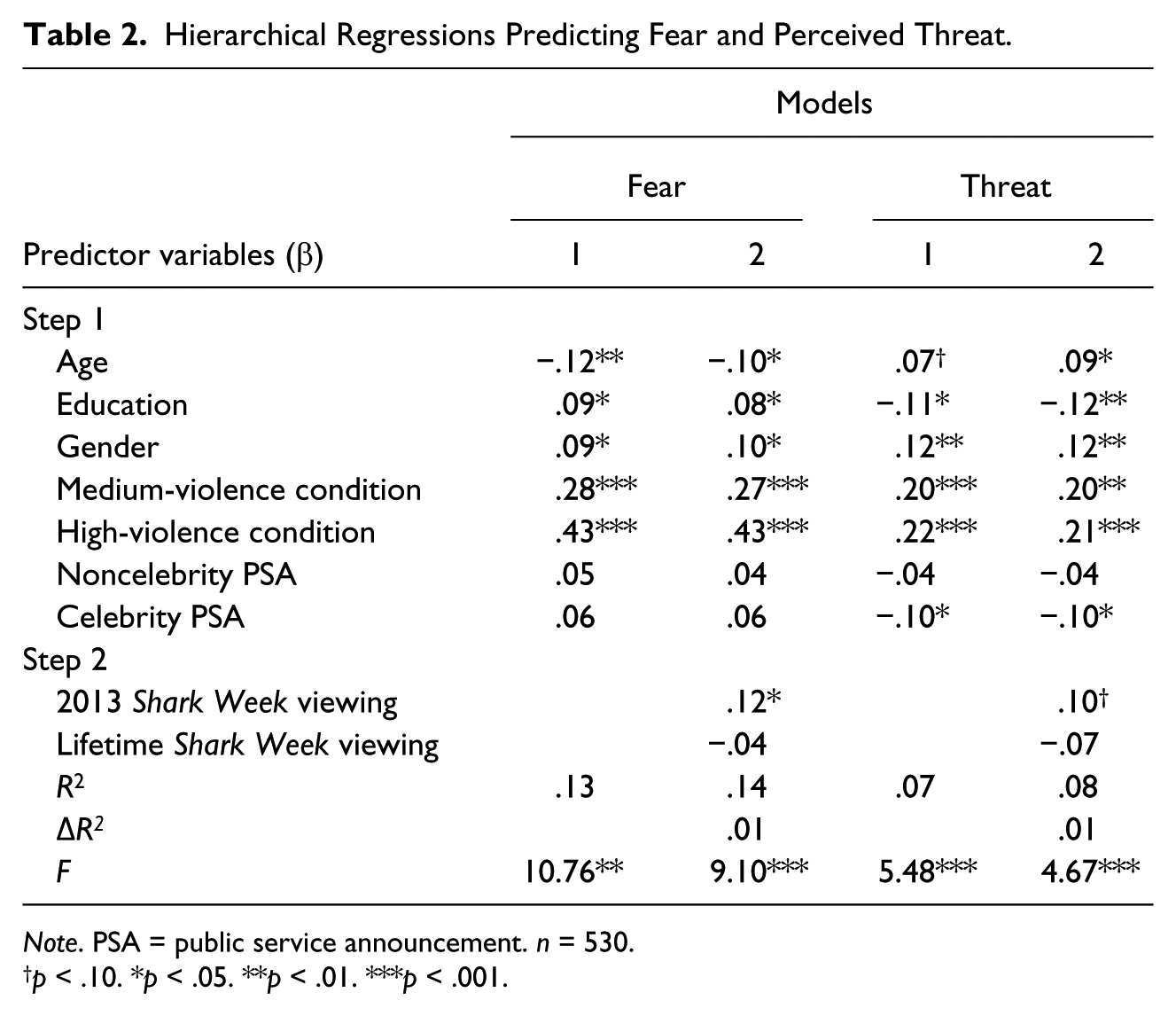
Note. PSA = public service announcement. n = 530.
p < .10. *p < .05. **p < .01. ***p < .001.
Hypothesis 4 predicted that watching a PSA about shark conservation would help assuage the fear that could result from watching a violent Shark Week clip. A two-way ANOVA with fear as the outcome and PSA condition and violence condition as the fixed factors was used to test this hypothesis. The violence condition was included as a factor in case the PSAs had different effects on fear reactions when shown after different types of Shark Week clips. The omnibus ANOVA was significant, F(4, 522) = 7.25, p < .001,
Hypothesis 5 predicted that seeing a PSA about shark conservation would prompt participants to perceive Shark Week content as overdone or exploitative. A two-way ANOVA with defensive reactions as the outcome and the PSA condition and violence condition as the fixed factors was not significant, F(8, 522) = 1.24, p = .27,
Research Questions 1 and 2 asked how level of violence and type of PSA would influence intentions to support shark conservation. A two-way ANOVA was significant, F(8, 522) = 3.02, p < .01,
To test Research Question 3, which asked if sample demographics influenced intentions to support shark conservation, a hierarchical regression analysis was performed (see Table 3). This regression included demographic variables (gender, age, and education level) in the first block, followed by the experimental conditions (level of violence and type of PSA) in the second block. The results revealed that gender was a significant predictor of intentions to support shark conservation in each block of the analysis, with women (M = 3.59, SD = 1.82) more likely than men (M = 3.30, SD = 1.68) to support shark conservation. Age was also a negative predictor of intentions to support shark conservation in the first two blocks. Education did not predict intentions to support shark conservation.
Hierarchical Regression Predicting Intentions to Support Shark Conservation.

Note. PSA = public service announcement. n = 531.
p < .10. *p < .05. **p < .01. ***p < .001.
To test Research Question 4, which asked how emotional and cognitive reactions to Shark Week would influence intentions to support shark conservation as well as intentions to seek more information about sharks, another hierarchical regression analysis was performed (see Table 4). The cognitive variables (perceived risk and defensive reactions) did not predict intentions to support shark conservation. However, adding the emotional reactions to the video content explained an additional portion of the variance (R2 change = .19). Feelings of fear predicted less support for conservation while anger, compassion, and interest all predicted greater support. For information seeking, defensive reactions to Shark Week were associated with lower intentions to seek information, while feelings of interest were a strong positive predictor of seeking intentions.
Hierarchical Regression Predicting Intentions to Support Shark Conservation and Intentions to Seek Shark-Related Information.

Note. PSA = public service announcement. n = 530.
p < .10. *p < .05. **p < .01. ***p < .001.
Discussion
The present data revealed numerous consequences of viewing Shark Week. This study demonstrated that participants were more likely to support shark conservation after viewing a PSA, but they were still likely to overstate their own risk of being the victim of a shark attack. We found that participants overstated their own risk and reported more fear whether they were watching Shark Week clips with high or medium levels of violence and that they did not distinguish between live-to-tape and reenacted violence. This suggests that televised shark-on-human violence, whether gory, cartoonish, or realistic, can possibly result in fear and/or overstated beliefs about personal risk. Research on fear appeals suggests that adding an efficacy component to messages about threats (e.g., “You can take precautions to avoid shark attacks”) could motivate audiences to take adaptive actions (Witte, 1992, 1998). Future work could test how nature-related programming and/or PSAs that include efficacy information alter the influence of fear on perceptions.
The number of years viewers had watched Shark Week was not a good predictor of fear or perceived threat of shark attacks. Rather, watching the most recent season of Shark Week was a better predictor of feelings of fear and perceptions of shark threat. This is despite the fact that post-2010 Shark Week programs were more likely to include statements of low risk of shark attack than earlier seasons (Evans, 2014). This finding indicates that while the Discovery Channel may be adding more scientific statements such as the actual low risk of shark attack to Shark Week programming, it still presents sharks as frightening and potentially violent animals in ways that resonate with audiences. Since recent viewing of Shark Week was a better predictor of fear and threat reactions than the number of years watching the programming, it is possible that a priming framework may be a better explanation than cultivation theory as to why viewers are fearful after watching Shark Week. More work is needed to explore the interplay between priming and cultivation with regard to pairing educational PSAs that attempt to “correct” the messaging of popular television content by presenting a contradictory message.
While viewing shark conservation PSAs did increase intentions to support shark conservation, it did not alleviate the fear participants felt after viewing the segments. Additionally, viewing the PSA did not incite defensive reactions toward Shark Week. Given the vividness of the images and sounds in its production, it is possible that the arousal from watching the Shark Week segment carried over even after the PSA due to excitation transfer (Zillmann, 1971), possibly overriding the PSA’s message that sharks are not to be feared. Our study does show, however, that even short pro-shark advocacy messages can have desirable effects when paired with a potentially conflicting programming that vilifies sharks, such as increased intent to support shark conservation by signing a petition, donating money, or merely talking with a friend about saving sharks. Nonprofit groups depend on grassroots support to help enact policy or social change; moreover, they depend on tangible public engagement in order to be known as leaders in their causes. From our results, it seems partnering with Shark Week, with its large viewership, may be a worthwhile investment for advocacy groups working to protect sharks from extinction.
One interesting finding was that there was no significant difference in the effects of the celebrity and noncelebrity PSAs on intentions to support shark conservation. Advocacy groups considering using a celebrity for a media campaign may find an equally effective public response without the time and funds required for a celebrity spokesperson. A limitation of this study, however, was that it used just one celebrity PSA. It is therefore impossible to generalize a conclusion about the effects of any celebrity on attitudes about sharks. Future research could use multiple celebrities and statistically control for liking of the celebrity to address this concern.
Another intriguing finding was that women and younger participants were more likely to support shark conservation than were men and older participants. These effects did not interact with experimental conditions, meaning that they occurred despite the different amounts of violence and types of commercials presented. Women tend to have higher levels of trait empathy (Lawrence, Shaw, Baker, Baron-Cohen, & David, 2004), and perhaps felt more for the sharks than did their male counterparts. Younger people and the more educated are also more likely to be politically liberal (Pew Center for the People & the Press, 2012) and, therefore, may be more likely to support liberal causes like environmental protection. These findings beg further investigation, but they may be helpful for advocacy groups who want to target their messages to friendly audiences.
With regard to audience intentions to support shark conservation and seek information about sharks, factoring in emotional reactions to the shark-related media allowed the models to predict a significantly larger portion of variance than did the models with only demographics, experimental manipulations, and cognitive reactions. These results point to the importance of measuring discrete emotional reactions to media consumption as predictors of support and information seeking. Grouping emotions into general negative and positive valence categories, as is often done in media effects work, may inadvertently mask the motivational nuances different emotions bring to these contexts (Nabi, 2010). For instance, while fear and anger are both negative emotions, fear was associated with less support while anger was associated with more support for conservation. Additional work could assess the specific referents for these emotional reactions—did viewers feel compassion toward sharks or toward victims of shark attacks, and did they feel anger toward shark attack victims who did not take precautions or toward those who are killing sharks?—to provide more insight as to the role of discrete emotions in motivating conservation support and information seeking.
Previous work on information seeking in environmental contexts has also found audience channel beliefs, informational subjective norms, capacity/efficacy, and attribution of responsibility to play important roles in predicting information seeking (e.g., Dietz, Fitzgerald, & Shwom, 2005; Stern et al., 1993). Moreover, the effects sizes on many of our analyses were small, therefore implying that additional factors can help explain the remaining variance in outcomes. Future work could measure these variables in conjunction with viewership of and cognitive and affective reactions to watching popular content with a contradictory PSA message.
Like any social scientific endeavor, the present study comes with limitations. First, it is important to acknowledge that there are many ways to analyze audience responses to media, and the present study utilized only a limited range of theoretical (i.e., cultivation and priming frameworks) and methodological (i.e., experimental) approaches. Future work could improve on the present study by using qualitative approaches to get a richer analysis of how audiences make sense of popular culture content accompanied by PSAs related to conservation. Additionally, our study captured reactions immediately following viewing. Further ethnographic study or a survey design could describe attitude change over time and also clarify the attention-getting role of celebrities in PSAs, which may not have been captured in our experimental design showing no difference between the celebrity and noncelebrity PSA. Moreover, our self-report measures of recent and past viewing were significantly correlated, and future research could rely on more precise measurements of media exposure made possible by digital video recorder and cookie technology.
The sample taken from MTurk, while more diverse than a sample comprising undergraduate university students, may not be representative of Shark Week viewers. Thus, these results may not directly translate into the actual effects of Shark Week on the general public. Also, the stimuli used here were short clips of a multihour, multiyear popular culture phenomenon. While the manipulation check was successful in differentiating the clips based on level of violence, use of more varied and longer Shark Week footage would provide a richer picture of the effects of viewing the program. The emotion measures after the video segments captured general discrete emotional states, but we do not know toward whom the compassion or anger is felt. Future research could use more time- and topic-sensitive emotion measures.
Lastly, intent is not behavior. In addition to providing a branding opportunity for nonprofit organizations, running PSAs should result in increased donations and membership, political support, or behavior change, depending on the specific call to action in the PSA. The PSAs used in this study were geared toward general awareness and attitude change about shark conservation with no specific “ask” for donations or behavioral change, making our study of their effectiveness in changing attitudes and intentions limited but appropriate. Studies of PSAs asking for behavioral change may especially benefit from behavioroid measures or a longitudinal design.
Conclusion
The Discovery Channel’s stated mission is “to satisfy curiosity and make a difference in people’s lives by providing the highest quality content, services and products that entertain, engage and enlighten” (Discovery Channel, 2014). This form of infotainment, exemplified by the popular annual television program Shark Week, does not always align with the goals of environmental advocates. The Discovery Channel has been criticized by many scientists and environmentalists for presenting an inaccurate and potentially harmful portrait of sharks as killers, when in fact sharks rarely attack humans and some species are at risk of extinction (Eilperin, 2012).
The channel’s partnership with ocean conservation groups starting in 2010 may be seen as an attempt to respond to those critiques. Partnering with a nonprofit organization is a tried and true method for corporations to address controversies and perceived shortcomings (BP, 2012; Ocean Conservancy, 2013). Our findings indicate that this strategy may result in a complex reception for the conservation organization’s message. While Shark Week’s portrayal of shark-on-human violence resonated with viewers and evoked a fear of sharks, participants were also more likely to support shark conservation after viewing a PSA. In other words, running a PSA may allow a conservation organization to reach its goal of changing some attitudes about conservation, but not all of them, even if the PSA explicitly asked viewers to reject the message of the popular television content (e.g., “Scared of sharks? We should be scared for sharks”; Oceana, 2010).
This study has implications for advocates who wish to change attitudes about environmental issues as well as for scholars of media effects. The portrayals of sharks under study here are small parts of a controversial and popular media product. Moreover, the complexity of our results reflects the challenges of measuring effects in a media landscape characterized not by single messages received in an orderly fashion. In reality, audiences consume and make sense of countless (often-conflicting) media messages in their day-to-day lives. Audiences’ negotiation of conflicting mediated messages has been the subject of many productive scholarly approaches, such as cognitive dissonance (Festinger, 1957) and uses and gratification theories (Ruggiero, 2000), and it has proved especially fruitful in the health communications realm (e.g., Rady, McGregor, & Verheijde, 2012). However, the experimental paradigm often struggles to recreate the alternately hybridized, balkanized, and intertexualized global media system in its studies. This study attempted to close some of the gap by examining a persuasive appeal—a PSA asking viewers to support shark conservation—not on its own but contextualized within the actual media content it was paired with when it aired on the Discovery Channel. While this is a simplified version of reality, it is a contribution toward our understanding of how audiences negotiate the complex messaging they receive from multiple environmental and entertainment media channels.
Footnotes
Acknowledgements
We would like to thank Scott Myrick for his assistance in editing the stimulus materials for this study.
Declaration of Conflicting Interests
The author(s) declared no potential conflicts of interest with respect to the research, authorship, and/or publication of this article.
Funding
The author(s) received no financial support for the research, authorship, and/or publication of this article.