



Abstract
Scholarly communication is shaped in a social context everywhere; therefore, it may be affected by many factors, and it does not form in the same pattern in all parts of the world. While the primary nature and function of scholarly communication has remained unchanged for centuries, it differs by culture, countries, religion, attitude, and social context. The purpose of the article is to review how scholarly communication is being shaped in Iran. The article highlights the differences between scholarly communication in Iran and in Western countries by considering the relevant historical, religious, cultural, social, and political factors and their impact on scholarly communication.
Introduction
“Scholarly communication” is a complex process that occurs among scholars, peers, scientists, and researchers in various fields and contexts. Borgman (2000) describes scholarly communication as the study of how scholars in any field (e.g. physical, biological, social, and behavioural sciences, humanities, technology) use and disseminate information through formal and informal channels. The study of scholarly communication includes the growth of scholarly information, the relationships among research areas and disciplines, the information needs and uses of individual user groups, and the relationships among formal and informal methods of communication. (p. 414)
Ober (2008) noted that scholarly communication is the system of people, procedures, and tools through which the results of research and scholarship are registered, evaluated, disseminated, and preserved. Traditionally, the end products of this system have been peer-reviewed journals and books.
In addition to the aforementioned definitions, we may note that scholarly communication takes place in a particular social context, and it differs by culture, country, religion, attitude, and other social factors. This article provides insight into the scholarly communication system in Iran. Iran is located on the northeastern shore of the Persian Gulf and the southern shore of the Caspian Sea in Asia. More than 90% of the people are Moslems, the formal religion is Islam, and the government is also called the Islamic Republic of Iran. All these factors are affecting scholarly communication in some ways.
Scholarly Communication and Its Stakeholders
Scholarly communication has taken place through formal and informal channels for many years. Although scholarly communication has changed from the oral to the written to the printed and now to the electronic form, the main function of scholarly communication has remained essentially unchanged in the past three centuries. For example, shifting to the virtual world did not change the main stakeholders in scholarly communication, although it changed the way they communicate. Who are the stakeholders? Ober (2008, p. 18) listed the primary stakeholders as follows:
Researchers and scholars, generally employed as university faculty or enrolled as students, but also from government agencies, and the private sector;
Libraries and librarians, who are agents for dissemination and preservation, and who purchase (or rent) and organize access to the results of scholarship;
Publishers, both commercial and non-profit, who organize evaluation/peer review, and initiate dissemination, usually by offering subscriptions to journals and sales of scholarly books;
Readers, including researchers and scholars, students, and members of the public. (p. 18)
The scholarly communication system has been under pressure due to the huge changes in information technology in the past 20 years. Information technology has had a great impact on publishers and has provided many new possibilities to produce and disseminate information. Researchers have many more opportunities to use and share scientific information. In spite of technological advancement, it is hard to say that scholarly communication has changed in the developing countries in the same way as it has in Western countries. One reason is the technological gap between the developed and developing countries. We thus raise the following questions: How was scholarly communication being shaped in the developing countries before this recent technological advancement? How does technological advancement change scholarly communication in the developing countries? In this article, the authors try to answer these questions with a focus on scholarly communication in Iran, a developing country.
History of Scholarly Communication in Iran
Iran, which was formerly known as Persia, has a long and great history and culture dating back to about 3,000 years, before and after Islam entered the country. (Islam entered Iran about 1,400 years ago.) We can see the names of large libraries and universities in the history of Iran such as Estakhr Library and Jondi-Shahpour Medical School in the pre-Islamic era. No other educational institution in the Moslem world has a tradition dating to the pre-Islamic era except for the Persian Jondi-Shahpour Medical School. Jondi-Shahpour must have been established before the fourth century A.D. It was particularly significant during the reign of Anushirvan, the Sassanid king. There is evidence that Shapur-ibn-e-Sahl, who died in 255 A.H. (in the ninth century A.D.), was the last physician and dean of Jondi-Shahpour Medical School. The traditions of this school and hospital were transferred to other medical schools during the Islamic era. With more than 500 years of history, Jondi-Shahpour has been the most stable educational institution in the Moslem world, except for the seminaries (Mansouri, 2007). Figure 1 shows the development of educational institutions in Iran from the pre-Islamic era until the establishment of Tehran University, as the first modern university of Iran, in 1934.
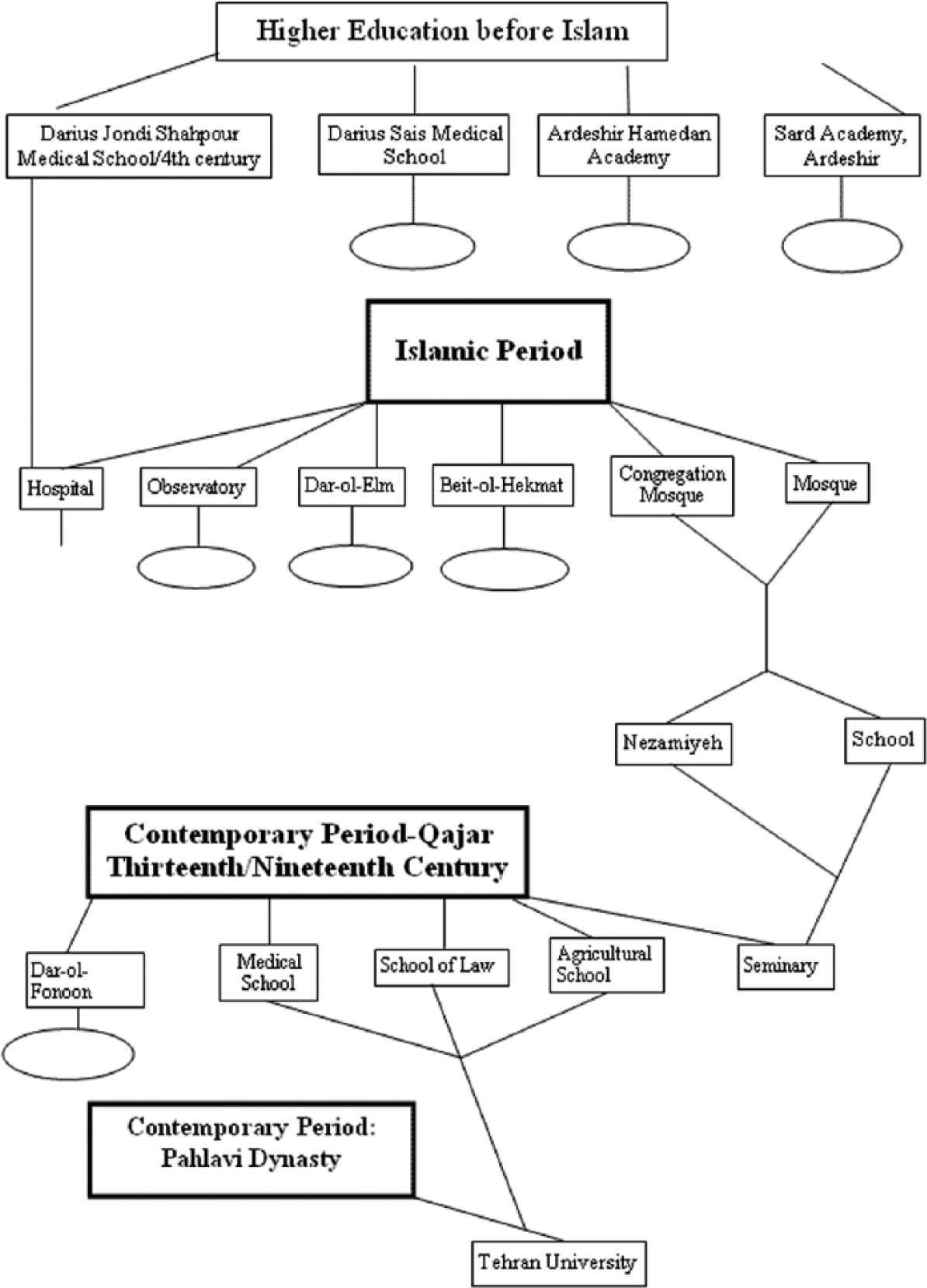
Development of educational institutions in Iran.
As mentioned earlier, the end products of the scholarly communication system are peer-reviewed journals and books. Historically, the first scientific periodical in Iran was first published in 1864. It was a monthly magazine in Persian, Arabic, and French called Ruznameh Elmieh Dolat-e Iran (Scientific Newspaper of Iran Governments). It contained scientific papers for the common public. The first academic scientific periodical in Iran was called Danesh (Knowledge; Hosseini-Pakdehi, 1995). However, a breakthrough in the publication of scientific periodicals occurred after 1965 when 250 scientific periodicals made their appearance within a 20-year span (Zaré, 1999).
A recent study of the number of scholarly journals in Iran shows that there are now 1,036 journals currently published by different universities and research institutes. The journals were identified using the approved peer-reviewed scholarly journals list provided by two Iranian ministries: the Ministry of Science, Research, and Technology and the Ministry of Health and Medical Education. Table 1 shows the number of Iranian scholarly journals by subject category in 2009 and 2012. As can be seen from Table 1, the number of scholarly journals doubled within a 3-year span.
Iranian Scholarly Journals by Subject.

In spite of increases in the number of scholarly journals, the publishing of scientific papers in Iran has been hampered by many problems, such as delays in publishing accepted papers, the long time needed for the referee process, and the lack of peer-reviewed journals in some fields. Alidousti, Khosrowjerdi, Abdolmadjid, and Mohamadi (2009) have stated that the relative lengthy processes of refereeing and publishing scientific periodicals is a major failing of such publications in Iran and is associated with certain negative consequences such as lack of functionality and mismatch with the rules and regulations.
Their survey of the current status of scientific journals in Iran reveals that the major orientation of this system is not toward development of scientific communication, facilitation of entry of new journals, or reinforcement of the natural process of growth of these scientific periodicals. Moreover, given the aforementioned shortcomings, the system of scientific periodicals in the country suffers from a lack of functionality that has barred it from attaining its major objectives and has led to decreased productivity and efficiency of the system (Alidousti et al., 2009).
While the well-known formal and informal means of scholarly communication (journals, conference, etc.) are being used in Iran, this does not take the same shape as in Western countries. One of the differences concerns understanding of the concepts of the scholarly journal, scholarly communication, knowledge, science, scientific collaboration, and so on, in Iran. One of the prominent scientists of Iran (Mansouri, 2008) believed that the understanding of people in the Middle East of words such as knowledge, science, or scientific collaboration is not the same as in Western countries. There are many factors affecting the meaning of these words in the mind of people in the East, particularly Moslems. Mansouri (2008) continues, With respect to science, we have to realize that history has conditioned the mind of a Moslem in a very specific way, whether or not he is actively practicing his religion. Science is identified unconsciously with theology and the same words are used for both. This situation is in no way to be compared with that in Europe in the seventeenth century [when lines were drawn between science and religion] Moslems today are ready to accept any “scientific knowledge” without seeing any religious contradiction. In fact, the identification of science with religion is a vivid experience in the Moslem world. (p. 10)
Scholarly Communication in Iran at Present
In addition to the influence of history, religion, and the understanding of basic concepts, there are many more factors that may be having an effect on scholarly communication in a country like Iran. Culture is one of the most important parameters for any scientific communication. Generally, people (even as scientists) communicate with each other based on social and cultural norms that are different in Iran from that in Western countries. The structure of social behavior and values in any society or country determine how to communicate. The relationship between colleagues inside and outside of a scientific institute differs even among Iran’s neighboring countries. The rules and regulations of scientific institutes have direct effects on scholarly communication. Scientists often try to adjust their scientific activities to be within the rules and regulations. One of the problems in Iran is the fast changes in the rules and regulations of scientific institutions, which affect the shaping of scholarly communication among peers inside or outside scientific institutions. It seems that Iranian scientists do not have enough time to establish their scientific activities with these fast and continuous changes in the rules of its universities. For example, promotion rules in Iranian universities have been considerably changed twice in the past 5 years, which are being criticized by many scientists in Iran.
The balance between being a scientist and being an administrator or science policy maker and the effects of these different roles on scholarly communication is another issue that is addressed by Mansouri (2008), who states, In the West [scientists] can be normal scientific workers and do not need to be administrators. In fact, too often we do witness a kind of schizophrenic behavior of scientists in our countries. When they practice their science and solve problems theoretically or experimentally, they behave have more or less like any other scientist in the modern world; but once they try to administer science, they behave like a traditional “Olama,” meaning that they act according to a very obsolete concept of science. (p. 11)
In addition of the aforementioned factors, there is a technical problem with having access to scientific information: the low speed of the Internet in Iran. This has a direct impact on scholarly communication and prevents effective communication at national and international levels. There is a digital gap involving high-speed Internet between big and small cities in Iran. The infrastructure for having high-speed Internet is mainly developed only in large cities, and only low-speed Internet is available in many parts of the country. We should make it clear that even high-speed Internet in Iran means speeds of up to 512 MB/s or 1 GB, and only recently up to 2 GB. Also, access to this speed is restricted for many people. Although we can attribute it to the technological gap to some extent, there are other reasons for this problem, which are not technical but political. We can come to the conclusion that recent technological advancements such as the Internet facilitate scientific communication between Iranians and their international peers, but now they are facing new challenges that are not necessarily technical.
Adding to the aforementioned issues is the problem of filtering policies in Iran, and there is no exception, even for universities and academic or research institutions. While the purpose of filtering is to control immoral websites, there is practically no access to many scientific websites due to this filtering.
The last issue affecting scholarly communication is the international sanctions on Iranian economy. The issue again is an economic and political matter, and it leads to many problems for Iranian scientists trying to do scholarly communication and scientific collaboration. While Iranian scientists were not formally the target of the international sanctions, in practice they suffer from the issue. For example, the international serials and book prices are increased for information providers in Iran due to the loss of national currency against the international currencies. These circumstances do negatively influence scholarly communication in Iran.
Joint Publications as a Sign of Scholarly Communication
If it is accepted that joint publication is a visible indicator of scholarly communication, co-authorship would show us empirical evidence for scholarly communication. A review of the literature shows that Iranian joint publications have been increasing in recent years; however, many joint publications are produced by Iranian researchers and the number of internationally produced papers is not high. The result of a co-authorship study at a particular university in Iran showed that the co-authorship in general is high (91.27%), but co-authorship with colleagues at national institutions (18.26%) and international colleagues (6.08%) is not high (Galyani-Moghaddam & Moballeghi, 2012). This may be attributed to geographical reasons and also to the value of teamwork as perceived by the university. This also shows that scholarly communication at an international level is not easily shaped by Iranian scientists.
A study of co-authorship among Iranian scientists in biology, chemistry, and physics by Harirchi, Melin, and Etemad (2010) shows that Iranian researchers devote a majority of their time to research tasks and they often work as either full professors or as assistant/associate professors. This study indicates that the ones who engage in international collaboration in Iran are experienced scientists rather than junior researchers. Many of them have met their foreign collaborators during visits abroad. Many of them have foreign university degrees. When we look at the foreign collaborators, we realize that many of them are actually natives of Iran. This group seems to be of high importance to the Iranian scientists who are in Iran as they may function as a link to the scientific community in other countries, besides being collaborating partners themselves. Cultural circumstances do influence scientific collaborations, and it is thus natural that Iranian expatriates play an important role for Iranian scientists in their efforts to reach out to the international scientific community, as well as in getting access to information and taking part in international networks. The reasons or motives for participating in international research collaboration include increased efficiency on the one hand and benefit from the collaborators’ knowledge or equipment on the other (Harirchi et al., 2007).
Another study of co-authorships in Iran by Hayati and Didegah (2010) shows that Iranian researchers have had scientific collaboration with 115 countries and that their numbers have increased between 1998 and 2007. The results also show that the number of domestic articles per year was 2 to 3.5 times more than international ones. Investigating international collaboration in different subject areas revealed that geosciences had the biggest number of publications co-authored internationally. Iran’s main partners were the United States, Canada, and the United Kingdom. European researchers were the main counterparts of Iranian researchers. The results revealed that the average number of citations received by internationally co-authored publications was more than those received by domestic co-authored publications (Hayati & Didegah 2010).
Discussion and Conclusion
The scholarly communication system has changed due to recent technologically driven innovation, while the main function of scholarly communication has remained essentially unchanged in the past three centuries. However, there are many factors that are having an impact on the scholarly communication. In this article, we discussed how differently scholarly communication takes place in developing countries, with a focus on Iran, than in the West.
History, religion, culture, society, promotion rules and regulations, technological advances, and finally political factors can shape scholarly communication in different patterns. A review of the literature shows that Iranian joint publications, as a visible part of scholarly communication, have been increasing in recent years; however, many of the joint publications are produced by Iranian researchers, and the number of internationally produced papers is not high. It also shows that scholarly communication at the international level for Iranian scientists is very difficult because of many reasons. While Iran is a country with great history of scientific societies, the present situation is not as bright as its brilliant history.
Footnotes
Declaration of Conflicting Interests
The author(s) declared no potential conflicts of interest with respect to the research, authorship, and/or publication of this article.
Funding
The author(s) received no financial support for the research, authorship, and/or publication of this article.