



Abstract
This study presents a media content analysis of representations of the Square Kilometre Array telescope on Twitter by South African users, drawing on a sample of 1,588 Tweets recorded over a period of 1 year from September 2011 to August 2012. The framing of the Square Kilometre Array was dominated by the site allocation process, which focused on the contestation between South Africa and Australia and formed a proxy discourse for politico-symbolic themes that framed the project as a symbol of African achievement. The overall composition of messages is dominated by large media firms, but there remains substantial scope for individual agency in shaping the discourse, particularly for high-profile users and leading science journalists. Micro-determinants also played a key role in shaping the virality of messages.
Keywords
Introduction
Reviews of the field of science communication research have revealed some critical gaps. Research into representations of science in Africa is severely limited, accounting for 0% of a meta-analysis of Social Sciences Citation Index (SSCI)–indexed research papers between 1956 and 2010 (Schäfer, 2012). This gap is particularly concerning in light of the emerging conception of science as a globalized activity, expressed in terms of a “global scientific and technological frontier” that is common parlance within innovation studies (Alder, 2010; Fagerberg & Verspagen, 2006; Martin, 2008). The literature is largely focused on the traditional media, particularly the print media, rather than the online media (Schäfer, 2012). This methodological gap is particularly salient in light of the increasing use of the online media to access information about science (Dudo et al., 2011; National Science Board, 2012). Overviews of research into the role of the social media in science communication raise empirical questions about (1) the “virality” of messages; (2) the linkages between various types of social media, and between the social media and traditional media channels; and (3) the role of controversy in science communication (Brossard, 2015).
To address these gaps, this study presents a content analysis of Twitter feed from the South African domain, with a case study focus on the Square Kilometre Array (SKA) radio telescope, which will become the world’s largest telescope and the largest science project in Africa. A key moment in the development of this project was the decision by the international SKA consortium, based at Jodrell Bank in the United Kingdom, to base the largest share of the telescope’s infrastructure in South Africa. This signaled the beginning of a long period of growth for South African astronomy and increased participation by Africa in the global science and technology community. This raises further questions specific to the (South) African context: How was this watershed moment reflected in public conversations? How have social actors constructed representations of the SKA in the social media? How have the dimensions of virality, media linkages, and controversy been manifested in this environment?
Science, the Social Media, and the South African Context
Science Communication and the Social Media
In both developed and developing countries, the use of the Internet to access scientific information is growing, while the use of traditional media, particularly print media, is declining (Dudo et al., 2011). In the United States, the Internet has recently become the primary source of information about science, eclipsing television in 2012 (National Science Board, 2012). In South Africa, the use of the Internet to access information about science has also grown rapidly, while the use of other sources is declining. However, the Internet still lags behind newspapers, radio, and television as a source of information about science (Gastrow, 2015a). In the United States, online science information consumers are not representative of the general population, being more educated and primarily male (Brossard, 2015). The South African Social Attitudes Survey indicates that in South Africa the use of the Internet to access information about science is associated with younger, more educated, and more affluent South Africans, indicating that it is a source of information for the country’s small middle class rather than of the low-income majority of the country (Gastrow, 2015a). Thus, in both countries there is concern that the Internet may be contributing to gaps in science knowledge and differences in science attitudes.
As pointed out by Brossard and Scheufele (2013), the rapid increase in the use of the Internet to access scientific information has created an imperative for understanding the communication of science in this “brave new online world” (p. 40). Brossard (2015) outlines some of the key changes framing this emerging research imperative. The rise in consumption of science content through online sources has increased the prevalence of hypertextuality, interactivity, and multimediality. The division between “news” and “opinion” is becoming increasingly blurred. Online news is accompanied by Web 2.0 mechanisms that strongly effect their distribution and interpretation. Twitter content influences the manner in news stories are perceived, as the microblogging site generates public comments on news stories (Anderson, Brossard, Scheufele, Xenos, & Ladwig, 2014). At the same time, there is evidence for broad and increasing integration between traditional media channels and emerging online media channels, both in terms of content and in terms of ownership and control (McQuail, 2005).
However, the literature has been, and remains, oriented toward the traditional and print media. Schäfer (2012) presents a meta-analysis of studies on the media’s coverage of science in the form of a systematic empirical overview of the literature, drawing on a sample from the SSCI of 215 publications, 201 journal articles, and 14 books, published from 1956 to 2010. He found that since 2000, 80.1% of the sample focused on the print media. Surprisingly, analysis of Internet coverage of science during this period was low, at only 3.8% of the sample, but had grown from 1.1% in the 1990s. The literature directly addressing the use of the Twitter platform to access science information remains limited. One of the few studies in this terrain is that of Liang et al. (2014), based on an empirical study of 1,405 nanotechnology scientists’ use of the social media. They found that being mentioned on Twitter increased the scientific impact of scientists’ work, including having an amplifying effect on communication through traditional media channels. Prominent science journalists can also play an important role—for example, Andrew Revkin has more than 65,000 followers on Twitter. In contrast, South Africa’s leading science journalist, Sarah Wild, has approximately 3,000 followers.
However, as noted by Brossard and Scheufele (2013, p. 14100), “The notion of virality for science stories has seldom been empirically investigated. The influential microblog site Twitter as yet to be explored empirically as a science communication platform.” Brossard and Scheufele conclude that science communication researchers should make investigating these aspects a priority.
A Blind Spot on Africa
Schäfer (2012) also examines the geographical coverage of the literature, revealing a clear and sustained bias toward Western countries. At no point since the 1950s have more than 1.6% of analyses focused on non-Western countries. There were no studies focusing on Africa in the sample, highlighting that media coverage of science in developing countries, and in Africa particularly, is a major gap in the literature. The only extant research on representations of science and technology in Africa falls outside the formal SSCI system. Lugalambi, Nyabuga, and Wamala (2011) and Clayton and Joubert (2012) examine science journalism processes in Africa and do not refer to the social media. Similarly, science communication research in South Africa is limited and focused on the process and outputs of science journalism through the mainstream print news media (Claassen, 2001a, 2001b, 2011; Gastrow, 2010; van Rooyen, 2004) rather than the online media.
Astronomy and the Square Kilometre Array in South Africa
Schäfer (2012) also found that astronomy receives very little coverage in the field of science communication research—not enough to feature in the analysis—indicating that research into the coverage of astronomy in the media is a gap in the science communication literature. The literature focused on astronomy in the media is indeed restricted. Most research in this area focuses on science communication from a practitioner’s point of view (e.g., Heck & Madsen, 2003), including case studies of public relations efforts of scientific projects (e.g., Christensen, 2002; Finley, 2002; Madsen & West, 2001). Lewenstein (1993) offers a history of public relations in NASA from its beginnings until 1986. Madsen (2001) employs a media content analysis of news media outputs using a set of variables specifically relevant to astronomy and space science—a useful input into the methodology for this study.
Astronomy has long been part of indigenous knowledge systems in Africa. Western astronomy played a role in the colonial project in South Africa as far back as 1685, when astronomical observations were made for navigational purposes (Wild, 2012), and South Africa’s first observatory was established in 1820. From the 1950s onward South African involvement extended to satellite tracking in collaboration with international agencies, including NASA. This built on South Africa’s comparative advantage in astronomy, which requires adequate infrastructure, and more important, low levels of light, dust, and radiofrequency (RF) pollution. This competitiveness led to ongoing investments in South African astronomy. The advent of democracy in 1994 led to a further massive increase in astronomy support and investment.
Astronomy and cosmology occupy distinct places in the African and South African cultural and political landscape. First, astronomy has a politico-symbolic value that has resulted in substantial support from the South African government and prominence in the public sphere. As postulated by Gottschalk (2005), In its first twelve years of rule the African National Congress (ANC) government spent more on astronomy than all governments combined between 1913 and 1993. Three factors drove this unexpected development: (a) national prestige; (b) the dignity of the continent of Africa; and (c) Black dignity. Both astronomy and astronautics project an image of modernity—the cutting edge of high technology. When the government supports initiatives such as SALT, SKA, the proposed national space agency, and microsats, it does so because it perceived these as having a political importance far beyond their intrinsic importance to astronomy. These project “soft power”—an image of modernity to foreign powers and foreign investors—which contribute to their intangible perceptions of South Africa. (p. 1)
This analysis suggests that the case study needs to assess the SKA as a symbol within the context of the Habermasian public sphere (Habermas, 1989), where social actors, including the government, media, education sector, private sector, and general public, all frame the topic according to their interests and perspectives, sometimes in a contested manner.
Today, South African astronomy capabilities continue to play an important role in the global astronomy system. South Africa is host to the largest single-lens optical telescope in the Southern hemisphere—the Southern African Large Telescope (SALT). However, the SKA telescope is poised to become the flagship astronomy facility in South Africa, composed of over 3,000 15-meter wide dishes, and thousands more receivers in its aperture arrays. The outer dish installations will be located 3,000 km from the core site in South Africa, with the perimeter installations being based in Botswana, Ghana, Kenya, Madagascar, Mauritius, Mozambique, Namibia, and Zambia. Thousands of aperture arrays will extend over Australia and New Zealand. Approximately 70% of the telescope is to be located in South Africa. The purpose of this giant technical feat is to search for answers to questions at the frontiers of physics and cosmology, where scientists are seeking to identify and understand the fundamental laws and structures of the universe. Some of these questions are the following: How do galaxies evolve and what is dark energy? Are we alone? How were the first black holes and stars formed? What generates the giant magnetic fields in space? Was Einstein right? Moreover, the SKA aims to conduct blue sky research into currently unknown questions.
The SKA organization is headquartered in the United Kingdom, at Jodrell Bank, and is composed of an international consortium of 11 member countries. There are project offices in South Africa and Australia, as well as smaller nodes within each of the member countries. In terms of communication, the centralized international science communication function is based at the headquarters in the United Kingdom, while the locally orientated communication functions for South Africa and Australia are based in the relevant project offices. A number of other actors also play a role in communication, including government departments and agencies, universities and research institutes, science facilities, firms, intermediary organizations, the public, and the mass media (Gastrow, 2015).
The large scale and technical complexity of the SKA necessitate a long time frame for the project. The concept for the SKA originated in 1991. By 2003, a shortlist of suitable sites had been developed. Since 2008, and through 2015, the design and costing of the system has been ongoing. Site selection took place in 2012, when the majority of the project was allocated to South Africa and its African partner countries, and the remainder to Australia and New Zealand. Construction is due to begin in 2016, with full science operations by 2024.
The South African SKA Project Office was established in 2003, with South Africa’s preliminary bid to host the project. During the bidding phase for the location of the SKA, precursor or “pathfinder” radio telescopes were commissioned and built in South Africa, both to test the technology and to illustrate to the international community that South Africa had the requisite capacity in the field. In September 2006, South Africa and Australia were shortlisted as final contenders to host the SKA infrastructure. At stake were perceptions of national pride and identity, as well as economic and employment benefits. This competition overlayed existing sporting rivalries in the national games of cricket and rugby and were framed as such in the news media (Gastrow, 2015). Moreover, the Australian press presented a discourse of Afro-pessimism, framing South Africa as a backward nation without the basic capabilities to conduct frontier science. The South African press retorted with messages dismissing Afro-pessimism. During this period, this interaction generated both public controversy and news value and proved to be a dominant theme in the news media coverage of the SKA (Gastrow, 2015).
Some of the key events during this time shaped the periodization of both news media and social media representations of the SKA. On March 10, 2012, the Sydney Morning Herald leaked information about a confidential report from the SKA’s site advisory committee that, on balance, favored South Africa over Australia. On April 4, 2012, an expected announcement of the site allocation was delayed. Rhetoric from the SKA hinted that a split site solution was being considered. On May 25, 2012, the SKA announced that the site location would be split between South Africa and Australia, with the largest share being located in South Africa.
Thus, although astronomy is usually uncontroversial, as it is directed at basic science with low levels of risk or profit for vested interests (Madsen, 2001), in the case of the SKA, the lens of analysis for conflict and controversy is relevant, particularly for the controversial process of the site allocation for the infrastructure of the project. Other, secondary controversies include contestation related to shale gas fracking and the local development context. The SKA site is located over shale gas deposits that the oil and gas industry is seeking to exploit. Despite legislated protection for the site, ongoing lobbying by the industry has led to contestation in the public sphere, including in the media. In terms of the development context, local communities have in some cases questioned whether the expenditure on the SKA would be of benefit to them. Other voices have asked whether a developing country such as South Africa should direct funding at astronomy, rather than at more basic development objectives (Gastrow, 2015).
Methodology
The media content database was provided by the South African Agency for Science and Technology Advancement, a unit of the National Research Foundation. In an effort to track media representations of astronomy in South Africa, these data were collected by Fuseware, a specialist media analysis consulting firm. Fuseware employed an algorithm-based methodology to search for coverage of the SKA on the Twitter platform. Data were collected by searching for specific keywords and phrase combinations across their data sources. Complex Boolean queries were used, such as all articles mentioning the word “kat,” as well as “telescope,” but excluding “ska music.” These Boolean queries allowed for effective filtering of the data, but in some cases may have filtered out legitimate data if it matched the Boolean filter. Automated filtering may at times have filtered out relevant data, but filter keywords were chosen to minimize any likelihood of this happening. The search terms used to draw data from these sources included: SKA, square kilometre array, square kilometer array, MeerKAT, KAT-7, and radio astronomy. All tweets mentioning any of the keywords in the search were collected. The tweets were limited to South Africa—the location of users posting tweets, and the geotag of tweets, were taken into account to verify locations in South Africa. According to Fuseware, this methodology has an accuracy of approximately 95%. This did however form a limitation, as some relevant actors were not using Twitter accounts registered in the South African domain.
The database of Twitter posts included the text of the post itself, the publication date, the name of the sender, the number of other users that subscribed to follow the source user, and the number of times an original post was reposted by other (South African) users. It is thus possible to calculate the total number of followers that each user and each message potentially reaches. This provides an indication of the interactive nature of the social media as well as the effects of the viral propagation of messages within the Twitter platform.
Feasibility considerations necessitated constrained time parameters for the data set. Time parameters also needed to include coverage of key events. The desktop research, media content analysis pilot study, and the key informant interviews all indicated that the allocation of the SKA infrastructure site to South Africa and Australia in May 2012 was the most significant event for the SKA in South Africa, particularly in the media. This was placed near the chronological center of the analysis, and the time parameter was established to cover 1 year in the history of the SKA, from September 2011 to August 2012, rendering a sample of 1,588 tweets during this period.
The development of the coding variables and framework drew on multiple sources of information and methodological guidelines. First, the analysis of key informant interviews provided salient information about the news value of the SKA, as well as information about the key issues, controversies, actors, relationships, and periodicity of the SKA (Gastrow, 2015). Another source of information was a study of representations of the SKA in the South African news media (Gastrow, 2015). The extant literature provided some useful points of reference. One example of the analysis of science content on Twitter is Runge et al. (2013), which used computational linguistic software to analyze Twitter content related to nanotechnology, assessing representations of (un)certaintly, as well as tones of optimism, neutrality, and pessimism. The broader literature on the study of representations of science in the media provides some guidelines for the construction of appropriate search terms and parameters and the associated analytical methods. These studies include Nelkin (1995), Nisbet and Lewenstein (2002), Bauer (2005), Bonfadelli (2005), Gastrow (2010), Lugalambi et al. (2011), and Weingart et al. (2000) . Within the limited literature on astronomy in the media, Madsen (2001) provides a useful point of departure for methodological design, although this is limited by the broader focus of the Madsen (2001) study, which includes space science as well as astronomy and conflates the data for these two domains and, thus, renders a methodology and findings that are not directly comparable to the case of the SKA.
The Atlas.ti data analysis software system makes it possible to continuously add, change, and merge codes throughout the coding process, and the final coding system emerged from a grounded process drawing on all the aforementioned sources. This coding schema was applied to the media database in two main rounds. The first round entailed automated searches for specific texts strings that could unambiguously identify specific codes. The second round entailed a manual coding exercise, where all the automatically assigned codes were verified, and the text of each Twitter post also read and manually coded for variables that required subjective interpretation. Atlas software provides functionality in terms of generating descriptive and analytical statistics from the coding data. This analysis was conducted with the aim of identifying salient features of media representations of the SKA and situate these in the context of the associated communication process, returning to the research questions related to the construction of messages by social actors, the politico-symbolic values of representations of the SKA, the “virality” of messages, interactions across media platforms and channels, and the role of controversy in science communication.
Representations of the SKA on Twitter
Periodization and Changes Over Time
Representations of the SKA in Twitter are clearly influenced by aspects of the project’s periodization, with a major focus on the site allocation, its associated contestation with Australia. The number of tweets referring to the SKA remained relatively low in the early months of the sample’s time frame, September to December 2011. Following a low point in December, outputs increased steadily in the early months of 2012, leading to a first peak in output in March 2012, when there were 188 tweets, and a second, larger peak in May 2012, when there were 817 (see Figure 1). If one excludes these 2 months, the average per month is 58.3. The peak in March exceeds 3 times this average, and the peak in May exceeds 14 times this average. These peaks mark clear aspects of periodization—the site allocation announcement was expected in March, but was then postponed. This triggered an increase in social media activity. When the site allocation decision was announced on the 25th of May, it triggered a spike in social media coverage that exceeded the sum of all the coverage of the other 12 months in the year under investigation. A closer look at the data reveals that of the 817 tweets in May 2012, 528 were sent on the 25th of May, the day of the site allocation announcement. This “spike within in a spike” represents the high point of the SKA’s presence on the Twitter platform, in line with what can be seen to be the most significant announcement and the highest level of news value to emanate from the project during this period. This pattern of periodization was also reflected in the mainstream news media (Gastrow, 2015b).
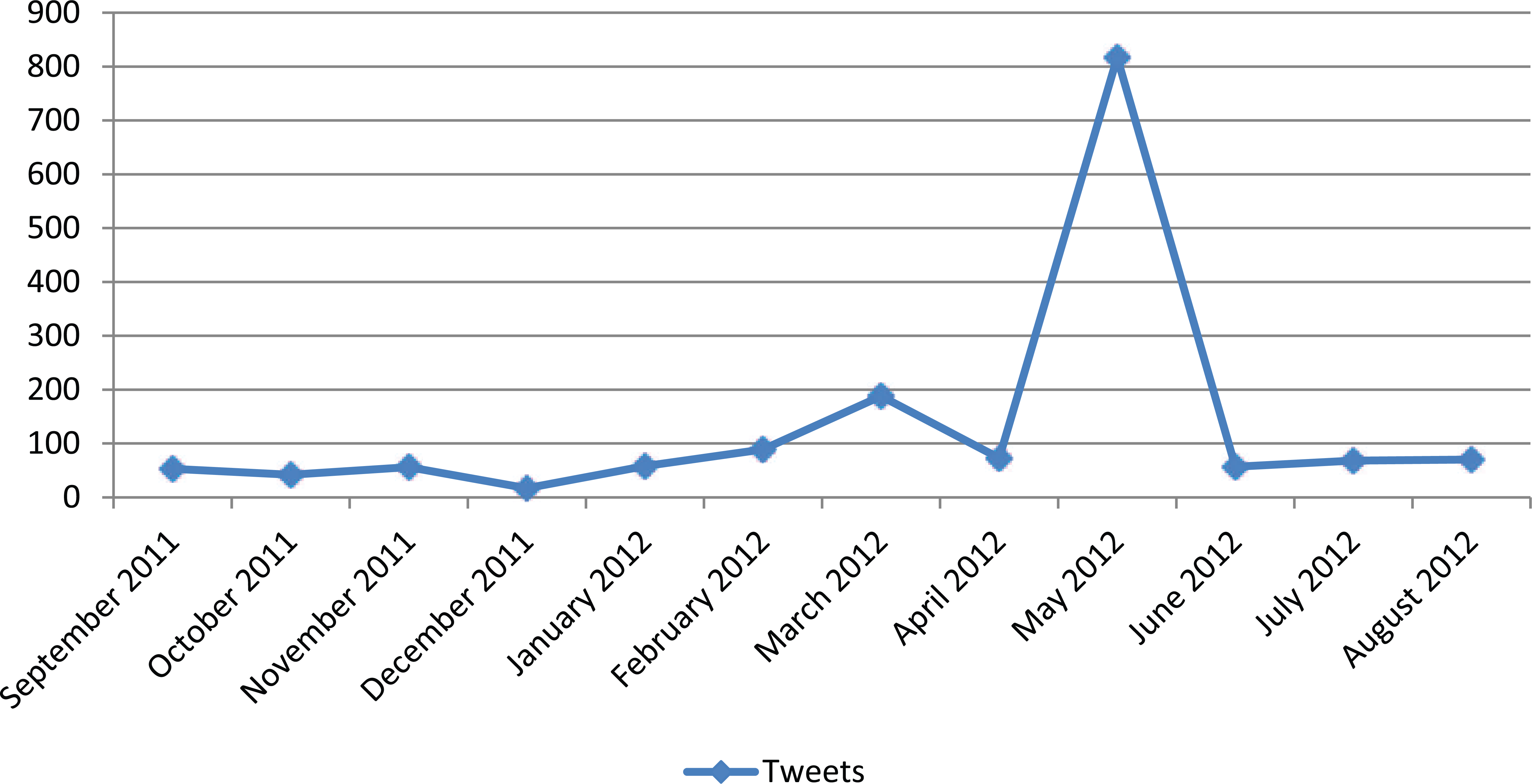
Tweets, September 2011 to August 2012.
Actors, Micro-Determinants, and Virality
The most commonly mentioned actors were those from the public sector, primarily from the national Department of Science and Technology. The second most commonly referred to set of actors were those from European governments—this group consists largely of references to the AERAP (the African-European Radio Astronomy Partnership) and references to the European Union in general. This is a result of a proactive social media strategies and campaigns by European actors, which led to regular social media posts being made, and re-tweeted, throughout the year under review.
Specific individuals from the SKA were mentioned 44 times. Senior management were among the most commonly referred to actors, including, Justin Jonas (Associate Director: Science and Engineering) in 17 tweets, Jasper Horrell (General Manager: Science Computing and Innovation) in 10 tweets, and Bernie Fanaroff (Project Director) in 8 tweets. Other individuals within the SKA, including South African and international management and scientists, as well as science communicators, were also mentioned, but less frequently. Science facilities were mentioned in 41 tweets—primarily referring to the Hartebeesthoek Radio Astronomy Observatory (HartRAO), one of SKA’s main science and engineering partners in South Africa, which was mentioned 36 times. This relatively high profile is a consequence of a social media campaign conducted by HartRAO. Universities and research institutes received relatively little attention, being mentioned in only 30 and 13 tweets, respectively. Firms were mentioned only 21 times. Elon Musk, the South African-born entrepreneur behind the multinational firms PayPal, Space-X, and Tesla, was mentioned twice.
An analysis of the messages mentioning the main SKA individual actors (Justin Jonas, Jasper Horrell, and Bernie Fanaroff) shows how micro-level determinants related to individual actors can have a major impact on the scale and scope of messages that are posted into the social media, and subsequently propagated virally. “Micro-determinants” here refers to the influence of third parties or external events, for example, appearances on other media platforms, conferences, symposia, or endorsement by popular personalities or organizations.
Of the 17 tweets referring to Justin Jonas, 14 are related to “TedxRhodesu,” an independently organized Ted Talks event (http://tedxrhodesu.com/) that took place in August 2012—after the site allocation was announced. This highlights the importance of understanding the role of interconnectivity between Twitter and other online social media platforms, for example, Sugimoto et al. (2013), which analyzed the complex linkages between TED talks and YouTube views, comments, and likes. The tone of the messages related to Jonas is largely positive, mounting a challenge to Afro-pessimism, and also focusing on the social context of the SKA, looking at “War, Poverty and Radio Astronomy”—and thus in line with the public framing of the project suggested by Gottschalk (2005).
Jasper Horrell was mentioned 10 times in the Twitter database. Again, there is a micro-determinant factor behind these representations—9 of the 10 messages originate in a posting from an ICT symposium, Gartnersym (http://www.gartner.com/technology/symposium/orlando/). Bernie Fanaroff is mentioned eight times, of which four are related to tweets and re-tweets from Simon Gear, a television weather presenter, environmental consultant, and public commentator on environmental issues (http://www.sdgconsulting.co.za). Since Gear, as a public personality, has a relatively large number of followers (2,145), these tweets achieved a relatively high level of public visibility. Interestingly, on the 25th of May, at the high point of media attention to the SKA, only one tweet mentioned Fanaroff, the most senior member of SKA staff in South Africa, but not a Twitter user.
Information Flows
Re-tweets are indicators of the viral propagation of a message—the extent to which it has spread within the Twitter platform. The database includes the identification of re-tweets of each message, although Twitter users located outside of South Africa, such as The Economist and ASTRON_LOFAR, were not included in the database as they had not registered their Twitter accounts through a South African domain. However, the re-tweets of these users’ posts are included, where these re-tweets have been posted by South African actors. In such cases, the data illustrate how the South African social media have propagated messages originating from international sources within the national media.
Figure 2 shows users that have been re-tweeted, in order of audience size, which is in turn divided into the potential direct audience (those who received tweets from the user) and the potential indirect audience (who received re-tweets). The largest audiences are reached by large mainstream privately owned media firms, namely, News24, TimesLIVE, and Business Day. Together, messages from just these three users reached the accounts of 902,708 other users. This shows that the social media, while introducing a greater degree of public participation and agency in the construction of messages, remains a channel of communication for organizations and institutions, and to this extent retains structural characteristics that resemble more traditional media. This also serves as an indication of the integration of media platforms, with the large media firms controlling the news media market also having developed effective systems to penetrate the social media (as suggested by McQuail, 2005).
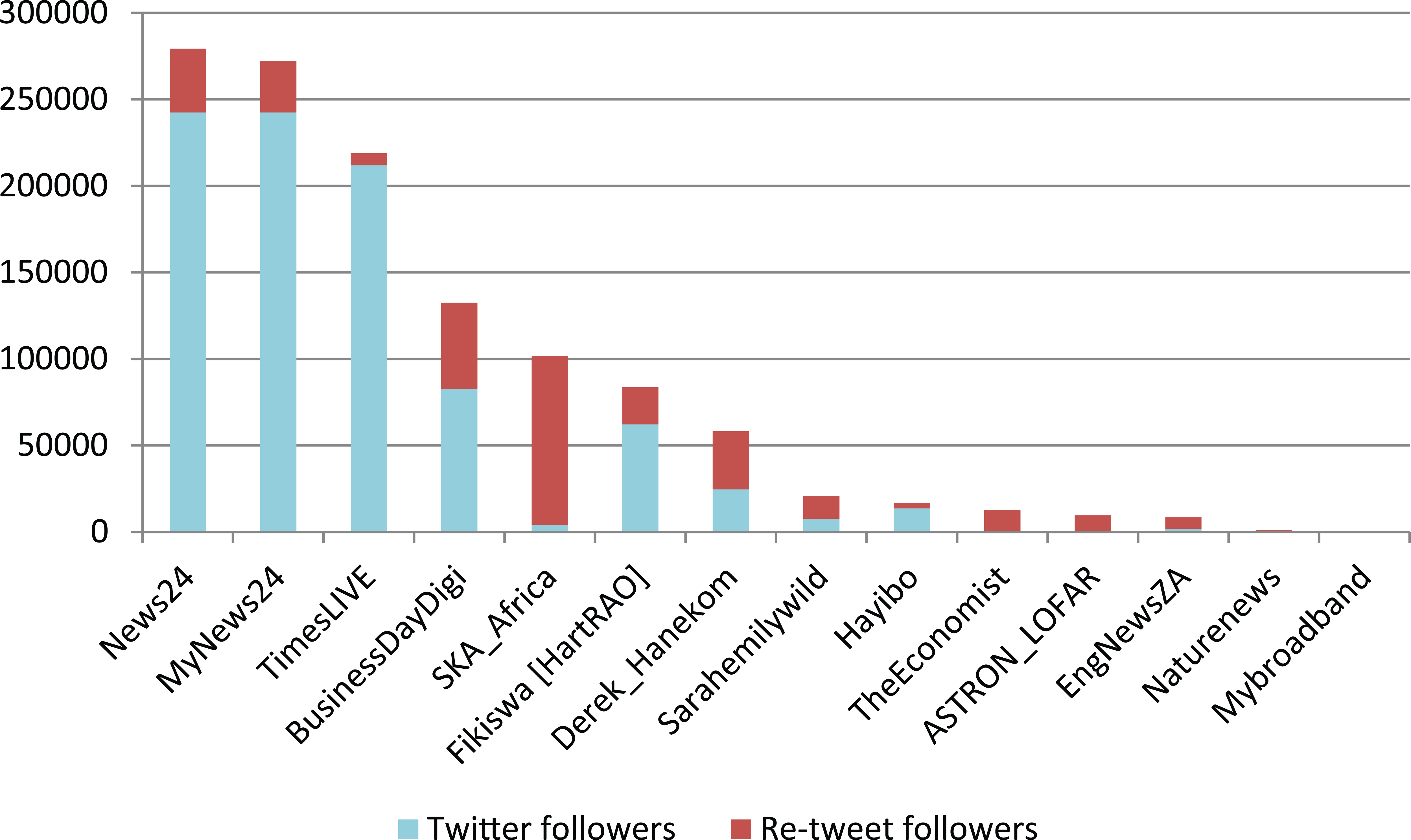
Twitter users and their audiences via tweets and re-tweets.
A stark contrast is evident when comparing the audience composition of the SKA and the main media firms. While media firms have a potential direct audience forming the majority of their total audience, the SKA’s audience consists almost entirely of a potential indirect audience. The SKA’s messages have a far greater propensity to be re-tweeted and propagated further across the social media landscape. The SKA is thus an outlier in the data set, with a ratio of direct to indirect audience of 24:1, in comparison to between 0 and 3.5 for all other users. For each user reached by a tweet from the SKA, on average 24.1 users were reached by re-tweets of that message. This again presents evidence that an organization with a well-directed social media strategy and implementation can reach a large online audience and compete with the corporate media to attract the attention of the public. Another example is that of HartRAO, which also has a relatively strong presence in Twitter, with 40 tweets and 18 re-tweets, reaching an audience of 58,191 users—a considerable reach for a relatively small radio astronomy facility.
Although the corporate media reach the largest audiences, and messages from the SKA have the greatest relative impact, there remains considerable space for individuals to have their voices heard. The only individual journalist to feature in this data set is Sarah Wild, tweeting in her personal capacity, but also in her capacity as one of the leading science journalists covering the SKA. While the size of her audience is small in comparison to the corporate media, she does illustrate that an individual science journalist can make an impact on Twitter. Another point of entry for individuals is open for those in influential positions. Derek Hanekom, who during the time period of the study was the Deputy Minister for Science and Technology, was active on Twitter, while, in contrast, the Minister of Science and Technology, Naledi Pandor, was not active on Twitter. The data clearly illustrate the effect that such direct engagement with the social media can have. Hanekom is the second most re-tweeted Twitter user, after the SKA organization itself. His four tweets during the year under review reached the accounts of 24,541 direct followers. In addition, re-tweets of these messages reached the accounts of a further 33,650 followers. As such, the four tweets reached a potential total of 58,191 followers. These examples illustrate the substantial reach that Twitter posts can achieve for high-profile individual users. Thus, despite the evidence of media integration and the dominant role of large organization in the composition of Twitter messages, there remains substantial agency for individuals to shape the public discourse on this platform.
Science and Technology
Science aspects of the SKA were infrequently referred to, and were largely addressed in general terms, rather than through references to specific science and technology aspects. Approximately 10% of the sample (167 tweets) made some reference to science. The large majority of these were references to science in general (e.g., “a great science project”). Only 32 tweets, or about 2% of the sample, made reference to specific science aspects of the SKA. Of the main science research questions of the SKA, only the SETI question and the question of the origin of the universe received any coverage, with 5 and 2 tweets, respectively, mentioning these questions.
A smaller proportion of the tweets in the sample (144) made reference to technology, although this included more frequent references to specific technology aspects (88), of which ICTs and the receiver dishes were the most commonly mentioned (48 and 47, respectively). The precursor instruments received a similar level of coverage to technology aspects of the SKA, being referenced in 143 tweets, or about 9% of the sample. In the 140 characters that may comprise a tweet, the focus thus appears to have been elsewhere—primarily in expressing a point of view about the site bid or the site allocation announcement. This again suggests that the politico-symbolic value of the project, and the associated public interest generated by controversy and contestation, have captured the public imagination to a greater degree that its science and technology characteristics.
Controversy and Contestation
The fracking controversy received only a small fraction of the coverage received by the site allocation process, thus positioning this as a marginal issue in the overall representations of the SKA. A total of 21 tweets mentioned fracking, 10 of which framed fracking as essentially in opposition to the SKA project, and the other 11 taking a neutral position. There were no pro-fracking statements in the sample. The development context of the SKA was also a peripheral issue in the social media. Fifteen tweets made explicit reference to the role of astronomy in a developing country context, and these largely consist of references to Jonas’s appearance on a TED Talks online lecture on this topic. The sample made very little reference to the site locality, with only three tweets mentioning the closest town (Carnarvon), and none mentioning any of the other nearby towns.
In contrast, the site allocation process for the SKA infrastructure is the dominant issue referred to in the sample. More than 52% of the sample (873 tweets) made reference to the bidding process, to the split-site decision, or to some other aspect of the site allocation process. In the months preceding May 2012, the bidding process was a dominant theme, accounting for 366 tweets.
From the date of the site location announcement (May 25, 2012), reactions to the split site allocation were dominant, occurring in 446 tweets. The split site allocation was a contentious issue, and the tone of these responses was recorded and coded. This coding was conducted through an interpretive manual coding exercise, without the use of key words, in which each tweet related to the site allocated was assessed for a tone that was positive (a favorable view of the decision and its consequences) or negative (an unfavorable view). Most of the responses were neutral in tone, composed mainly of the sharing of news or information. Of those that did register a tone in relation to the announcement, most were positive (87) and only a few were negative (14). Overall, the issue of site allocation gained more public interest than the other controversies, again highlighting this as the central discourse in the public construction of the SKA as a symbol (see Tables 1 and 2).
References to Organizational Aspects of the Square Kilometre Array.

References to the Square Kilometre Array Site Allocation.

The SKA as a Symbol of Globalized Science in an African Context
In the Twitter content database, the SKA is framed by the competition with, and later collaboration with, Australia and New Zealand. A total of 328 tweets (21%) made reference to Australia, while 90 (6%) made reference to New Zealand. Far smaller proportions mentioned other partner countries, including African partner countries. Only three tweets mentioned that the SKA is headquartered in the United Kingdom, indicating that this fact receives little public interest in South Africa. The representations of the SKA that emerge from the social media are thus of an African project, rather than a developed country project with an African infrastructure site. The developed country headquarters are almost omitted from the discourse, and the Australian infrastructure site is framed as being a smaller and less significant component of the project.
The main preoccupation with the site bid and site allocation of the SKA positioned the project as a symbol of African science and technology and as a refutation of Afro-pessimism and affirmation of African science and technology capabilities. However, this framing was in most cases latent, for example, as expressed by positive responses to the site allocation by South Africans. Comparatively few tweets made explicit symbolic references, totaling only 128 tweets, or about 8% of the sample. Thirty-three tweets explicitly framed the SKA as an African project, while smaller proportions explicitly referred to the SKA as a validation of African and South African science and technology capabilities. Some reactions to topical issues were more common, for example, references to Africa Day, which coincided with the day that the site allocation announcement was made.
Conclusion
This study contributes to the science communication literature by addressing certain critical gaps, namely, science communication in developing countries, particularly in Africa; science communication in astronomy; the role of the Internet, social media, and Twitter in particular, in science communication; the nature of virality in the social media; and linkages between different media platforms in this context. It contributes to a contextualized understanding of science communication in an African context by exploring the manner in which representations of the SKA have been constructed by public actors to frame the project as a symbol in the public sphere.
This framing was dominated by the site allocation process, which focused on the contestation between South Africa and Australia, and thus formed a proxy discourse for politico-symbolic themes that, as suggested by Gottschalk (2005), framed the project as essentially African: as a symbol of African achievement, as an affirmation and validation of African capabilities, and as a symbol of modernity and membership of the global scientific and technological community. In contrast, there was comparatively little focus on the science and technology aspects of the project. The analysis also shows that, in contrast to the suggestion by Madsen (2001) that astronomy is a noncontroversial science, representations of astronomy in the media can be strongly shaped by conflict and controversy, in this case in a manner inherently related to the African context.
The analysis of information flows reveals that proactive social media campaigns lead to significantly higher public profiles on Twitter. However, as suggested by McQuail (2005), the overall composition of messages is dominated by large media firms, indicating that integration between the traditional and online media plays a key role in shaping representations of the SKA on Twitter. On the other hand, there remains substantial scope for individual agency in shaping the discourse, particularly for high-profile users and leading science journalists. Micro-determinants also played a key role in shaping the virality of messages. The influence of other social media platforms, as well as conferences, symposia, celebrity personalities, and positions of political influence, all strongly shaped the extent to which messages from individual users were re-tweeted.
Footnotes
Declaration of Conflicting Interests
The author(s) declared no potential conflicts of interest with respect to the research, authorship, and/or publication of this article.
Funding
The author(s) received no financial support for the research, authorship, and/or publication of this article.